arXiv:hep-ph/9808297v1 11 Aug 1998
Testing for New Physics with Low-Energy Anti-Neutrino
Sources: LAMA as a Case Study
I. Barabanov a, R. Bernabei b,O. G. Miranda c∗ V. B. Semikoz d, and J.W.F. Valle c†
a Institute for Nuclear Research, Moscow, Russia b Dip. di Fisica Universita’ di Roma “Tor Vergata”,
and INFN, sez. Roma 2, I-00133 Rome, Italy
c Instituto de F´ısica Corpuscular - C.S.I.C.
Departament de F´ısica Te`orica, Universitat de Val`encia 46100 Burjassot, Val`encia, SPAIN
http://neutrinos.uv.es
d The Institute of the Terrestrial Magnetism,
the Ionosphere and Radio Wave Propagation of the Russian Academy of Science,
IZMIRAN, Troitsk, Moscow region, 142092, Russia Abstract
Some electroweak models with extended neutral currents, such as those based on theE6group, lead to an increase of theν−escattering
cross section at energies below 100 keV. We propose to search for the heavy Z′ boson contribution in an experiment with a high-activity artificial neutrino source and with a large-mass detector. We present the case for the LAMA experiment with a large NaI(Tl) detector lo-cated at the Gran Sasso underground laboratory. The neutrino flux is known to within a one percent accuracy, in contrast to the reactor case and one can reach lower neutrino energies. Both features make our proposed experiment more sensitive to extended gauge models, such as theχ model. For a low enough background the sensitivity to theZχ boson mass would reach 600 GeV for one year running of the
experiment.
pacs13.15.+g 12.20.Fv 12.60.Cn 95.55.Vj
∗E-mail: [email protected] On leave fromDepartamento de F´ısica
CINVESTAV-IPN, A. P. 14-740, M´exico 07000, D. F., M´exico.
1
Introduction
We have recently revived the idea of using low energy neutrino reactions as sensitive precision tests of the Standard Model (SM) [1] both as probes for non-standard neutrino electromagnetic properties [2, 3] as well as extended gauge structures [4]. The alternative use of reactors such as the MUNU experiment has recently been suggested [5]. Here we discuss in detail the possible advantages of performing measurements at low energy with a very intense anti-neutrino source, such as a147
P m source proposed in the LAMA experiment [1]. In contrast to ref. [4] where the potentiality of low energy source experiments was discussed from a more general perspective, here we concentrate on the specific case of the LAMA proposal, using the design parameters of the experiment as a case study. In LAMA the neutrino flux should be determined with an accuracy better than one percent. The dimen-sions of the source will allow to surround it by the detector.
We evaluate the potential that such an isotope source offers in testing the electroweak gauge structure of the SM. For definiteness we consider the sensitivity of this experiment to models that can arise from an underlying
E6 framework [6]. The later have been quite popular since the eighties,
es-pecially because they arise in a class of heterotic string compactifications. LEP measurements at the Z peak have achieved very high precision in deter-mining the neutral current coupling constants governing e+
e−→l+
l−. This constrains especially the mixing angle between the Z and the Z′ bosons. As a result we will focus here on the possible constraint for the mass of the additional gauge boson MZ′.
We consider extensions of the Standard Model involving an extra U(1) symmetry at low-energies, coupled to the following hyper-charge [6]
Yβ = cosβYχ+ sinβYψ, (1) while the charge operator is given as Q = T3
+Y. Any value of β is al-lowed, giving us a continuum spectrum of possible models of the weak inter-action. The most common choices considered in the literature are cosβ = 1 (χ model), cosβ = 0 (ψ model) and cosβ = √3
√ 8, sinβ = − √ 5 √ 8 (η model). If
we restrict ourselves to the case when only doublet and singlet Higgs bosons arising from the fundamental 27-dimensional representation of the primor-dial E6 group are present, then one obtains a direct relationship between the
Z′ mixing angle θ′ and its mass M
superstring models in ref. [7]. Their advantage for us is that they enable us to convert the bound we determine onMZ′ into one on the Z′ mixing angle,
much more stringent that would be obtained directly by the present method.
2
The Cross Section
In the SM, the differential cross section forνee→νee scattering is given by,
dσ dT = 2meG2F π {(gL+1) 2 +g2 R−[2(gL+1)2+ me Eν (gL+1)gR] T Eν +(gL+1)2 (T Eν )2 } (2) wheregLandgRare the Standard Model model expressions gL,R= 1/2(gV ∓
gA).
The neutral current contribution to νe→νe scattering in such extended models is given for example in Ref. [7]. The corresponding contribution to the differential cross section will be, for θ′ = 0,
δdσ dT = γ 2meG2F π {2(gL+ 1)δgL+ 2gRδgR− [ 4(gL+ 1)δgL+ me Eν ((gL+ 1)δgR+gRδgL)] T Eν + 2 (gL+ 1)δgL( T Eν )2 } (3) where γ = M 2 Z M2 Z′ (4) and δgL,R depend on the model under consideration. In the particular case of the LRSM this corrections are given by
δgL = s4 W r2 W gL+ s2 Wc 2 W r2 W gR (5) δgR = s4 W r2 W gR+ s2 Wc 2 W r2 W gL (6)
δgL = 4ρs 2 W( 3cosβ 2√24 + √ 5 √ 8 sinβ 6 )( 3cosβ √ 24 + √ 5 √ 8sinβ) (7) δgR = 4ρs2W( 3cosβ 2√24 + √ 5 √ 8 sinβ 6 )( cosβ √ 24 − √ 5 √ 8sinβ) (8) where, ρ denotes the radiative corrections to the ratio M2
W/M
2
Zcos
2
θW ≡ 1
and β defines the E6 model, in which we are interested in.
We can rewrite Eq. (3) as
δdσ dT =γ∆ =γ 2meG2F π {D+E T Eν ( T Eν − 2)−Fme Eν T Eν} (9) with ∆ in obvious notation and
D = 2(gL+ 1)δgL+ 2gRδgR (10)
E = 2(gL+ 1)δgL (11)
F = (gL+ 1)δgR+gRδgL. (12)
The correction to the νee scattering depends on the model as well as on the energy region. In order to illustrate how these corrections may affect the Standard Model prediction we can define the expression
R = ∆
(dσ dT)SM
(13) This ratio depends on the specific model through the angleβand depends also on the electron recoil energy as well as on the neutrino energy.
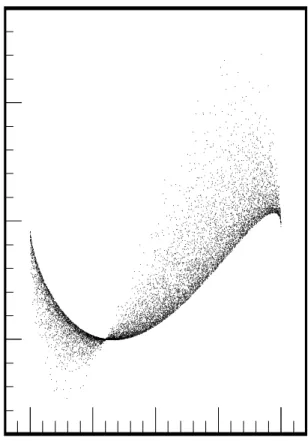
We have plotted in Fig. (1) the quantity R in Eq. (13) for a class of E6
models. Different values of Eν and T are considered, corresponding to the case of a 147
P m source. We can see from the plot that for cosβ ≃ 0.8 one can have a large deviation from the Standard Model predictions simply by varying Eν and T. For cosβ ≃ −0.4 one can see that, irrespective of the kinematical variables of Eν and T the deviation that can be achieved is very small. For models with cosβ <∼ −0.4 we have a negative contribution that would decrease the number of events for some electron energies. This effect is just the opposite of what would be expected in the case of a neutrino magnetic
moment and would be a direct signature of extended gauge theories. However the sensitivity is smaller here than for the models for which cosβ ≃0.8.
Altogether, one sees that the χ model is the most sensitive to this scat-tering. Other popular cases such as the η and ψ models, often cited in the literature, have a smaller sensitivity. For this reason, from now on we fix on
χ model, which is also theoretically appealing as it corresponds to the hy-percharge that lies in SO(10)/SU(5). For this case we wish to see for which choices of the kinematical variables of Eν and T there is greater sensitivity to the new physics.
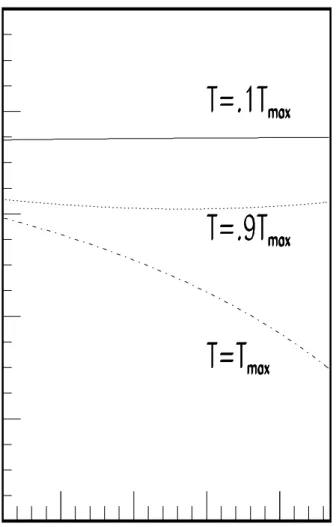
In Fig. (2) we have plotted Eq. (13) for the specific case of the χmodel for the range of neutrino energies accessible at a 147
P m source. In the plot we show the value of this ratio for different values of the electron recoil energy. For very low electron energies, close to the energy threshold, one has a bigger deviation from Standard Model predictions in theχ model. Indeed, the independent term D in eq. (9) is large and positive, while the other two terms give small negative contributions. The plot shows how the corrections get smaller as the recoil electron energy increases. As we can see from the figure, in order to reach a constraint for γ <∼0.1, i.e. a Z′ mass of about
>
∼300 GeV or so, we need a resolution of the order of 5 %. From the present
global fit of electroweak data the constraint on the Z′ mass for the χmodel is 330 GeV at 95 % C. L. [8], while from direct searches at the Tevatron the constraint is 595 GeV at 95 % C. L. [9].
3
Experimental Prospects
The LAMA experiment
The experiment LAMA [1] has been proposed for neutrino magnetic mo-ment search in the range of 10−10
−10−11
µB. The principle of our proposed experiment is similar to the reactor one. A large neutrino magnetic moment (LMM) would significantly contribute to the neutrino electron scattering pro-cess. As an alternative to the reactor idea, we propose the use of an artificial neutrino source (ANS). Our main aim in the experiment is the investigation of low-energy neutrino-electron scattering as a test for a possible deviation from the Standard Model prediction. For definiteness we focus on the pos-sibility of investigating the gauge structure of the electroweak interaction as mentioned above. The use of an ANS has a number of essential advantages
with respect to the reactor for the experiments with low-energy neutrinos:
• (a) the effective neutrino flux with the proposed ANS should be at least 10 times higher than in a typical reactor. This could potentially be increased in the future;
• (b) the accuracy of source activity determination should be as high as a few tenths of percent in comparison with 10 % for the reactor case;
• (c) the ANS energy should be low enough, giving the possibility to minimise effect of background from the high-energy part of the neutrino spectrum;
• (d) the experiment should be carried out in a deep underground labo-ratory, to ensure a low enough background.
All these advantages make the use of an ANS preferable to a reactor for the kind of experiment under consideration.
The isotope for the ANS The 147
Pm isotope has been chosen as an optimal candidate for the ANS both from the point of view of its physical parameters (low enough neutrino energy, absence of gamma-rays, long enough lifetime) as well as the possibility to produce a large enough activity. The scheme of the 147
Pm decay with its basic parameters is presented in Fig 3.
The 147
Pm isotope has been produced commercially since 1980 by a Russian Nuclear Plant called ”Majk” by extracting it from used reactor fuel. The other radioactive REE elements admixture in the produced 147
Pm is less then 10−9
and could be lower, if necessary. A 5 MCi 147
Pm source is planned to be used for the first step of the experiment. A source with such an activity can be produced by the plant in 3-4 moths after small improvement in technology. An upgrade in activity up to 15 Mci can be achieved by the plant in a reasonable period of time. The neutrino spectrum of147
Pm is well-known from the experimental measurement of the beta-electron spectrum. It corresponds to an allowed transition and is given in Fig 1 of ref. [10]. We will use in the following the 5 MCi 147
Pm source activity, unless mentioned otherwise. It is important to notice that the neutrino flux from the source is expected to be known with high accuracy ( 0,3% ) [10], thus substantially
reducing the systematic errors in contrast to the recently suggested [5] reactor neutrino experiment.
Scheme of the experiment
As a target we consider the use of a NaI(Tl) scintillator installed at the Gran Sasso Laboratory for dark matter particles search [11]. The NaI(Tl) detector is an ideal detector for this kind of experiment, as the mass of the detector could be large enough, a threshold of about 2 keV can be achieved [11] and methods of its purification from U, Th and K are well worked out and can be further improved [12]. The mass of detector is about 120 kg and should be scaled up to 1 ton. For our estimate here we will use a 400 kg NaI mass as mentioned in ref. [1]. The source is surrounded by passive shielding of W (20 cm) and Cu (5 cm) from the unavoidable admixture of 146
Pm (∼ 10−8
) with a 750 keV γ line and other possible REE gamma isotopes. After careful measurement of gamma admixtures in the commercial 147
Pm samples the possibility to decrease the shielding will also be considered.
The expected number of events
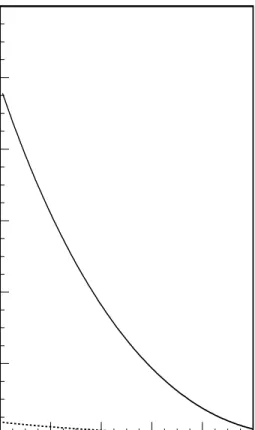
The basic cross section was given in Eq. (2). This cross section has to be integrated over the anti-neutrino energy spectrum from the ANS and averaged over the expected detector energy resolution. What we obtain for the case of interest (147
Pm) is shown in Fig. (4). The number of ν −e
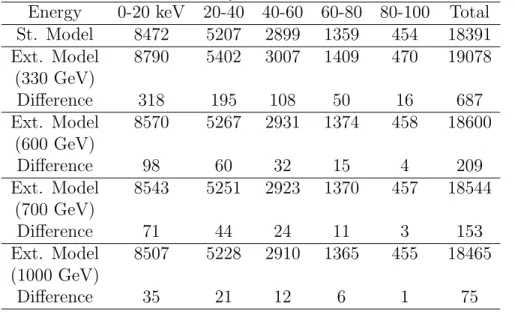
scattering events expected in the Standard Model and in the χ model are shown in Table I. The results in Table I assume a 400 kg detector and a 5 MCi 147
Pm source with the geometry presented in Fig. 1 of Ref. [1]. The total number of events is about 104
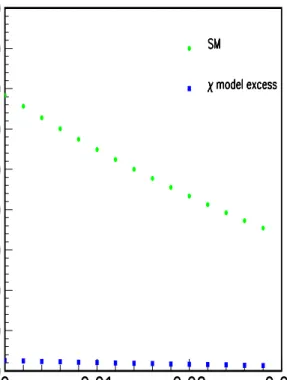
, ensuring a statistical accuracy of about 1%. The deviation from the Standard Model prediction induced by an extra neutral gauge boson with mass of about 300 GeV is 4 % or so, and could be detected. As can be seen the deviations are maximal for the lowest energies. It is therefore convenient to present the results for a region down to 30 KeV. In Fig 5 we display the results we obtain when restricting to this optimum region. The plot shows the histogram obtained when we bin the recoil energy variable in 2 KeV bins, the increment due to a 330 GeV neutral gauge boson in the χ model is also shown at the bottom of the figure.
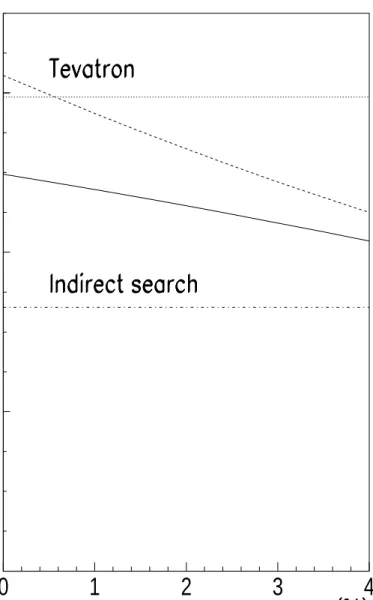
In order to estimate the sensitivity that our proposed experiment can reach we can perform a hypothetical fit assuming that the experiment will measure the Standard Model prediction. In order to simulate a realistic situation we also ascribe several values for the systematic error per bin (in per cent). The result is summarized in Fig. 6. One can see that, if we
consider only the statistical error one can probe at 95 % C. L. a 500 GeV
Z′ mass in the χ model. This value will decrease as the systematic error increases. In the same Fig. 6 we also show the expectations for the case of a one tone detector. In this case the attainable sensitivity will be 625 GeV if only the statistical error is considered. This value is comparable to the present constraint obtained by the CDF collaboration.
As we mentioned in the introduction, for the case of constrained models there is a relation between the mass of the extra gauge boson MZ′ and the
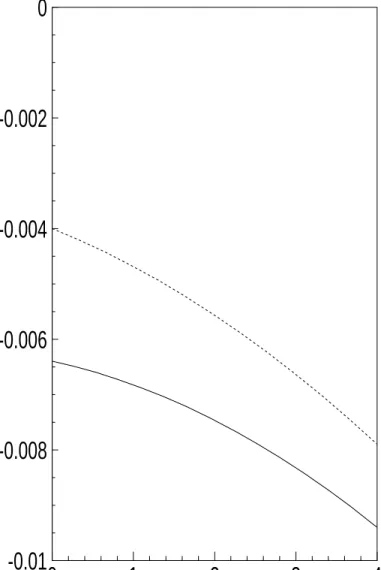
mixing angle θ′ between the Z and theZ′ boson. Therefore it is possible to infer from Fig. 6 the potential sensitivity on the mixing angle for this specific case. This is shown in Fig 7. One can see that the sensitivity will be close to the LEP bound for the general (unconstrained) model case, which applies also to the constrained case.
Background
The above estimates have been made without taking into account the background. The required background level is determined from the condi-tion that statistical fluctuacondi-tion of the background event number plus stan-dard electroweak model event number should be less than the effect expected. Taking into account our discussion in the previous section we conclude that the background should be less than effect expected in the Standard Model. So the rate of background due to residual radioactive contaminants should be < 10−3
/day/kg. This value is some orders of magnitude lower than the best background achieved so far, which is however mainly dominated by en-vironmental contributions and to some extent by non-standard contaminants [12]. Further efforts are in progress to improve the background parameters of the detector through new devoted R & D. As it can be seen from table 1 the most of the events lie in the low energy region. As a result the optimal region for data-taking is 2-30 Kev. The statistical accuracy in this case would be only 10 % lower but the permissible level of the background would be 3 times higher.
4
Discussion and Conclusion.
Some Extended Gauge Theories, such as those based on the E6 group,
pre-dict an increase of the anti-neutrino-electron scattering cross section at low energies. For definiteness we concentrate on one of such models, theχmodel.
We have proposed to look for extra contribution of the heavy Z′ boson in
ν −e scattering in an experiment (LAMA) with a high-activity artificial neutrino source and with a large-mass NaI(Tl) detector at the Gran Sasso underground laboratory. The neutrino flux is known to within a one percent accuracy, so that even a few percent increase would be detectable. For low enough background the sensitivity to the Z′ boson mass would reach 600 GeV for one year running of the experiment. This estimate is obtained for the idealised case of anti-neutrino electron scattering from a free electron. In practice in a realistic detector, such asNaI, the electrons are bound and, in some cases it is necessary to take the effect of binding into account, such as for the case of the iodine atom. Recently the corrections to the differential cross section due to the atomic binding energy have been discussed in ref. [13]. They are particularly important for the first level of theI atoms, where the binding energy isε1 = 32.92 KeV. These corrections could be taken into
account by computing the wave equation for the electron in the Hartree-Fock-Dirac approximation [14]. A useful approximation can be obtained in terms of q=εi+T where T is the recoil electron energy and εi denotes the electron binding energy in the I atom [14, 15]. In this case the energy dis-tribution Sinel(q) for the bound electron of a given atomic level can be taken as Sinel(q)≃ Sf ree(q)θ(q−εi) where Sf ree(q) stands for the energy distribu-tion in the free electron case. We estimate an overall uncertainty of about 10 % in our use of the free electron approximation, which would affect the overall statistics (expected number of events in either the Standard Model or its extensions). Note however that they should cancel in the ratio given in eq. 13 and in the corresponding sensitivity plots for the deviations from the Standard Model that we have presented.
Acknowledgements
This work was supported by DGICYT under grant number PB95-1077, by the TMR network grant ERBFMRXCT960090 and by INTAS grant 96-0659 of the European Union. O. G. M. was supported by CONACYT and SNI-M´exico and V. S. by the RFFR grants 97-02-16501, 95-02-03724.
References
[1] I. R. Barabanov et. al., Astrop. Phys. 8 67 (1997); I. R. Barabanov et. al., Astrop. Phys. 5 159 (1996).
[2] P. Vogel and J. Engel, Phys. Rev. D39 (1989) 3378.
[3] N. Ferrari, G. Fiorentini and B. Ricci Phys. Lett. B387 (1996) 427. [4] O. G. Miranda, V. Semikoz and Jos´e W. F. Valle hep-ph/9712215, Phys.
Rev. D 58 013007 (1998).
[5] M. Moretti, C. Broggini and G. Fiorentini, Phys. Rev.D 584160 (1998). [6] See, for example, J.W.F. Valle,Prog. Part. Nucl. Phys. 26(1991) 91, and
references therein.
[7] M. C. Gonz´alez-Garc´ıa and J. W. F. Valle, Nucl. Phys.B345(1990) 312. [8] Precision Tests of the Standard Electroweak Model. P. Langacker, (ed.), Singapore, Singapore: World Scientific (1995) (Advanced series on di-rections in high energy physics: 14); M. Cvetic, P. Langacker, hep-ph/9707451.
[9] CDF coll., F. Abe et. al., Phys. Rev. Lett. 79 2192, (1997).
[10] V.N.Kornoukhov, Preprint ITEP N90 (1994), ITEP N26 (1996), ITEP N2 (1997) and Phys. of Atomic Nuc. 60 (1997) 558.
[11] R. Bernabeiet. al.Phys. Lett. B389 757 (1996). R. Bernabeiet al.Phys. Lett. B424 195, (1998).
[12] R. Bernabei et al. ROM2F/98/27 to appear.
[13] S. A. Fayans, V. Yu. Dobretsov, A. B. Dobrotsvetov, Phys. Lett. B291 1 (1992).
[14] V. I. Kopeikin, L. A. Mikaelyan, V. V. Sinev and S. A. Fayans, Phys. of Atomic Nuc. 60 2032 (1997).
[15] S. A. Fayans, L. A. Mikaelyan, V. V. Sinev, Inelastic scattering of an-tineutrinos from reactor and beta sources on atomic electrons, Wein-98, Santa Fe, June 1998.
Table 1: The expected number of events for the LAMA proposal for the Standard Model and for the χ model for different values of the Z′ mass.
Energy 0-20 keV 20-40 40-60 60-80 80-100 Total St. Model 8472 5207 2899 1359 454 18391 Ext. Model 8790 5402 3007 1409 470 19078 (330 GeV) Difference 318 195 108 50 16 687 Ext. Model 8570 5267 2931 1374 458 18600 (600 GeV) Difference 98 60 32 15 4 209 Ext. Model 8543 5251 2923 1370 457 18544 (700 GeV) Difference 71 44 24 11 3 153 Ext. Model 8507 5228 2910 1365 455 18465 (1000 GeV) Difference 35 21 12 6 1 75
0
0.5
1
-1 -0.5 0 0.5 1
cos
β
Figure 1: Scatter plot of attainable values for the relative deviation R in eq.13 for different values for the incoming neutrino energyEν and the electron recoil energy T. The plot is for different E6 models. The χ model corresponds to
0.4
0.42
0.44
0.46
0.48
0.5
0.05 0.1 0.15 0.2
E
ν
Figure 2: Plot of the ratio given in eq.13 for the χ model as a function of
Figure 3: Level scheme of 147
0
0.2
0.4
0.6
0.8
1
1.2
0
0.02 0.04 0.06 0.08
0.1
T
e(MeV)
d σ /dt (10 -44 CM 2 /MEV)Figure 4: Differential cross section for the νee scattering in the Standard Model (solid line) and expected increment due to additional positive con-tribution of an extra 330 GeV gauge boson in the χ model (dashed line). The differential cross section was integrated over the antineutrino energy spectrum and averaged over the energy resolution.
0
100
200
300
400
500
600
700
800
900
0
0.01
0.02
0.03
T
e(MeV)
Number of eventsFigure 5: Expected number of events in the standard model and in the χ
0
200
400
600
0
1
2
3
4
σ
syst
(%)
Figure 6: Attainable sensitivity to the mass of an extra gauge boson in theχ
model for the LAMA proposal as a function of the systematic error per bin. The results consider the cases of a detector of 400 kg (solid line) as well as 1 tone (dashed line).
-0.01
-0.008
-0.006
-0.004
-0.002
0
0
1
2
3
4
σ
syst
(%)
Figure 7: Attainable sensitivity to the mixing angle of an extra gauge boson in the constrained χ model for the LAMA proposal as a function of the systematic error per bin. The results consider the cases of a detector of 400 kg (solid line) as well as 1 tone (dashed line).