Effects of Different Types of
Adaptations on the Behavior of
Young Children with Disabilities
Carol M. Trivette
Carl J. Dunst
Deborah W. Hamby
Chainey E. O’Herin
Orelena Hawks Puckett Institute
Ashville and Morganton, NC
Abstract: The effectiveness of adaptations to the en-vironment, materials, and activities with young chil-dren with disabilities was the focus of this research synthesis. The synthesis included 19 studies of 104 children with different types of disabilities (autism, multiple disabilities, developmental delays, Down syndrome, visual impairments, cerebral palsy, and behavioral disorders). Most of the studies used single participant designs; two studies used contrasting con-ditions designs, two investigations were case studies, and one was a cross-sectional study. Results showed that all three types of adaptations were related to variations or changes in child behavior; the adapta-tions were most effective when used for 10 or more sessions; and the outcomes most effected by the in-terventions were communication and cognition, and to a lesser degree, social behavior. Implications for practice are described.
This paper includes a research synthesis of findings from studies of young children with disabili-ties where different types of adaptations were used to promote child participation in typically occurring ac-tivities to affect the behavioral competence of the children. The adaptations included both environ-mental accommodations and modifications to activi-ties and materials (e.g., Bailey & Wolery, 1992; Camp-bell, Milbourne, & Wilcox, 2008; Doctoroff, 2001; Mayfield, 1996; McCormick & Feeney, 1995; Sandall, 2003). Environmental adaptations include such things as rearranging play areas in classroom settings and
rearranging furniture in a child’s home to make it eas-ier for a child to move around. Adaptations to activi-ties include such things as making modifications to curricular activities and simplifying an activity by breaking it down into a smaller number of steps so that a child can more easily complete a task. Adapta-tions to materials include such things as putting han-dles on puzzle pieces and having a child use specially designed eating utensils to make it easier for a child to use the materials. It is generally agreed that adapta-tions make possible child participation in classroom, home, and community settings, and that participation in turn provides the contexts for child learning (e.g., Hamm, Mistrett, & Ruffino, 2006; Mistrett, 2004; Os-tensjo, Carlberg, & Vollestad, 2003; Wolery, Schroe-der, Martin, Venn, Holcombe, Brookfield, Huffman, & Fleming, 1994). The extent to which the use of adaptations were associated with discernable differ-ences in child behavior and competence was the main focus of this research synthesis.
The research synthesis was guided by a char-acteristics--consequences framework that focused on how and in what manner different types of adapta-tions had similar or different effects and conse-quences (Dunst & Trivette, 2009; Dunst, Trivette, & Cutspec, 2007; Dunst, Trivette, & Watson, 2009). More specifically, we examined the conditions under which different types of adaptations affected young children with disabilities’ cognitive, communication, social, and motor behavior. The studies included in the synthesis were ones where the adaptations were the primary or sole intervention and child behavioral competence was an outcome of interest. The investi-gators of all the studies included in the research syn-thesis hypothesized or predicted that the adaptations would be associated with discernable behavior conse-quences.
Background
Young children with disabilities often require special kinds of interventions in order for them to learn and develop (Guralnick, 2005; Wolery, Strain, & Bailey, 1992). Both researchers and practitioners have described how adaptations to physical settings, activi-ties, materials, instruction, etc. can promote chil-dren’s participation and engagement in interactions with their social and nonsocial environments (e.g., Day, McDonnell, & Heathfield, 2005; Mayfield, 1996; Sandall, 2003). As noted by Campbell et al. (2008), Wolery (1994), and others (e.g., Doctoroff, 2001), adaptations function as a kind of mediator, facilitat-ing young children with disabilities involvement in different activities and routines that more easily per-mit child learning. Stated differently, adaptations function as a means to an end where the conse-quences of their use includes more frequent and bet-ter opportunities for child learning and improved be-havior functioning.
A number of classification schemes have been developed for categorizing different types of adaptations (e.g., Campbell, Milbourne, & Wilcox, 2008; Mayfield, 1996; McCormick & Feeney, 1995; Sandall, 2003). Most categorizations describe adapta-tions to the physical environment, activities, materi-als, curriculum, and instructional practices. One of these is Creating Adaptations for Routines and Activities described in CARA’s Kit (Milbourne & Campbell, 2007).
CARA’s Kit
Campbell, Milbourne and their colleagues (Campbell, 2005; Campbell, McGregor, & Nasik, 1994; Campbell, Milbourne, Dugan, & Wilcox, 2006; Campbell, Milbourne, & Wilcox, 2008; Wilcox, Gui-mond, Campbell, & Moore, 2006) have developed, based on both research and practice, a hierarchy for designing and implementing adaptations for young children with disabilities that varies along a contin-uum from the least to most intrusive kinds of inter-ventions. The hierarchy includes five types of adapta-tions:
Adaptations to the environment. This includes rear-ranging furniture, arrear-ranging play areas, the use of mo-bility devices, and the use of specially designed equip-ment.
Adaptations to activities and routines. This includes changes in how an activity is done (e.g., adding
mo-tor movements to telling a smo-tory) and changes in the length of time a child has to complete a task.
Adaptations to materials. This includes modifica-tions to toys and other materials (e.g., writing instru-ments) and assistive technology devices.
Adaptations to instructional practices. This includes reducing the number of steps a child is expected to perform or adding additional information (e.g., pic-tures) to show a child what he or she is being asked to do.
Provide assistance. Thisincludes another person helping a child do an activity or doing an activity while a child is watching.
This research synthesis examined the effects of adaptations to the environment, activities, and ma-terials on child behavior. Existing research reviews on adaptations to instructional practices can be found elsewhere (e.g., Okolo, Cavalier, Ferretti, & MacAr-thur, 2000; Wolery & Sainato, 1996). We did not ex-amine studies that involved assistance since our main interest was adaptations to physical settings and ma-terials or activities.
Search Strategy
Search Terms
A series of different searches were done to identify relevant studies using the search strategy de-scribed in Lucas and Cutspec (2007). The terms adapt* or modif* or accom* and infan* or toddler* or child* or preschool* or kindergarten* or daycare or childcare or “day care” or “child care” or “nursery school” and diab* or disorder* or delay* or impair* or retard* plus a list of more than 50 other specific types of disabilities (autism, Down syndrome, visual impairment, spina bifida, cerebral palsy, etc.) were used in all the
searches. The search for studies of adaptations to the environment also included classroom or environment or setting or “open space” or “learning center” or “classroom design” or “physical arrangement” plus more than 25 other terms about specific types of environmental adaptations as search terms (furniture, chair, table, etc.). The search for adaptations to activities and rou-tines also included activit* or routin* or cent* or area* plus more than 100 specific types of activities as search terms (dressing, eating, bathing, playing, etc.). The search for adaptations to materials also included toy* or material* and more than 50 specific types of materials as search terms (spoon, pen, book, crayon, etc.). In those instances where very large numbers of
papers were located (more than 1000 in any one search) the results were delimited by using the search terms research or evaluate or study.
Sources
ERIC (Educational Resources Informa-tion Center), Psychological Abstracts
(PsychInfo), REHABDATA, Medline, Aca-demic Search Elite, and InfoTRAC Expanded Academic ASAP were searched to identify stud-ies. These were supplemented by searches of Ingenta, Google Scholar, and an EndNote li-brary maintained by the Puckett Institute.
Hand searches of the reference sections all retrieved journal articles, book chapters, and books were examined to identify additional stud-ies. The reference sections of the papers cited in the Background section of this paper as well as other articles, chapters, and books (e.g., Bed-narczyk, Alexander-Whiting, & Solit, 1994; Campbell, Milbourne, & Wilcox, 2008; Fabregat, Costa, & Romero, 2004; Mistrett, Hale, Dia-mond, Ruedel, Gruner, Sunshine, Berman, Saun-ders, & McInerney, 2001; Sullivan & Lewis, 2000) were also examined to identify relevant studies.
Inclusion Criteria
Studies were included if they were inves-tigations of one of the three types of adaptations constituting the focus of the synthesis, the adap-tations were designed to promote child partici-pation in typically occurring activities, the studies included children with disabilities birth to six years of age, and the outcomes in the studies included some type of child behavioral conse-quence or effect. Studies were limited to those investigations where sufficient information was provided about the adaptations and they were not used in combination with other interven-tions to be able to eliminate treatment con-founds and multiple treatment interference.
Exclusion criteria. Studies of children with-out identified disabilities (Moody, 2008) and studies of children older than six years of age were excluded. In those studies which had chil-dren both under and over six years of age, we
included the findings for only the younger chil-dren. Studies that evaluated children’s abilities to learn to use some type of adaptation (e.g., assis-tive technology) but did not include a child be-havioral outcome measure were also excluded. Studies were excluded if the adaptations were implemented in a noncontextual manner (e.g., Olive, Lang, & Davis, 2008) or the child behav-ior was not appropriate in terms of the manner in which the adaptation was used (e.g., Frea, Ar-nold, & Vittimberga, 2001). We also excluded studies that implemented multiple kinds of adap-tations simultaneously.
Search Results
Participants
Nineteen studies were located that in-cluded 104 participants. The characteristics of the study participants are shown in Appendix A. The children ranged in age from 5 to 80 months with the majority between 36 and 60 months of age. Most of the participants (86%) were boys. The children had a variety of types of disabilities, including autism, cerebral palsy, Down syn-drome, visual impairments, and Retts syndrome as well as other disabilities.
Study Characteristics
Appendix B shows the research designs used in the studies and the characteristics of the adaptations that were the focus of investigation. Most of the studies (79%) used single-participant designs (AB, ABA, or multiple baseline). Two investigations were case studies, two studies used a contrasting conditions design, and one was a cross-sectional study.
Half of the studies were conducted in classroom settings. Five studies were conducted in the children’s homes, two were conducted in clinics or therapy rooms, and one was conducted on a playground and gym.
Three of the studies investigated adapta-tions to the environment, 12 studies investigated adaptations to activities, and three studies inves-tigated adaptations to materials. The settings in which the interventions were implemented in-cluded free play, meal times, book reading, circle time, and art. Two studies investigated
adapta-tions during transiadapta-tions between activities in classroom settings. The interventions were im-plemented from one to more than 30 sessions. Most were implemented between 5 and 20 ses-sions.
Method of Analysis
The sizes of effects for the relationship between the adaptations and child outcomes were discerned in two ways. First, in all the sin-gle participant design studies and the contrasting conditions studies, we calculated the means and standard deviations for the baseline and inter-vention conditions, and then computed a Cohen’s d for the mean differences using the formula in Dunst, Hamby and Trivette (2007) for single participant design studies. Second, for all the studies, including the case studies and one cross-sectional study, we assessed the degree to which the observed and reported outcomes were consistent or inconsistent with investigator ex-pectations. This was done using a 5-point scale (-2 = highly inconsistent, -1 = somewhat inconsis-tent, 0 = neither consistent nor inconsisinconsis-tent, 1 = somewhat consistent, 2 = highly consistent) for determining how well the results matched inves-tigator expectations (Yin, 2002b). Inspection of graphs in the single participant design studies, the magnitude of reported influences in the con-trasting conditions and cross-sectional studies, and the narrative descriptions in the case studies, were used to make the ratings. The pattern matching strategy allowed us to code and include studies for which traditional effect sizes could not be computed. Inter-rater agreement for the pattern matching ratings was 90% for the com-plete set of findings.
Mean Cohen’s d effect sizes and mean pattern matching scores were calculated for dif-ferent intervention, moderator, and outcome variables. The intervention variables included type of adaptation (environment, activity, materi-als), number of intervention sessions (Range = 5 to 37), and the setting in which the interventions were implemented (classroom, home, therapy rooms, etc.). Four moderator variables were evaluated: Child gender, age, and disability, and research design. The different outcomes in the
studies were coded according to four domains: Cognitive, communication, social, or gross mo-tor. The behavior coded as cognitive outcomes included sound-guided reaching, engagement with the physical environment, and object per-manence. The behaviors coded as communica-tion outcomes included child utterances, speech production, child-initiated nonverbal and verbal behavior, and communicative efficacy. The be-havior coded as social outcomes included child positive affect, engagement with adults or peers, behavioral compliance, and social greetings. The behavior coded as gross motor outcomes in-cluded child-initiated movement and locomo-tion.
The average Cohen’s d and average pat-tern matching scores for the intervention, mod-erator, and outcome variables were used as the best estimates of the size of effect between vari-ables. The 90% confidence intervals for the means of both effect sizes were used as a meas-ure of the “range of reaction” of the interven-tion variables on the study outcomes. The smaller the confidence interval for a mean effect size, the better the mean is an estimate of the real size of effect. Neither type of effect size could be weighted since the procedure for doing so cannot be applied to single participant data (Shadish & Haddock, 1994).
We also ascertained for the different in-tervention, moderator, and outcome variables, the number and percentage of effect sizes that reached an a priori predetermined level. A Cohen’s d of .50 was used as the criterion for determining if an adaptation had a discernable effect on a study outcome. A pattern matching score of one or two was used as the criterion for determining if an adaptation was associated with the expected pattern of results. Both of these metrics assisted in substantive interpretation of the synthesis findings.
Synthesis Results
The complete set of results are shown in Appendix C. The table shows the outcomes that were the focus of investigation, the child behav-ior that was measured, the domains to which the
outcomes were assigned, and the Cohen’s d and pattern matching scores for each outcome meas-ure. The information in this table as well as that in Tables 1 and 2 were used to discern the man-ner in which the adaptations were related to the study outcomes.
Cohen’s d Effect Size Findings
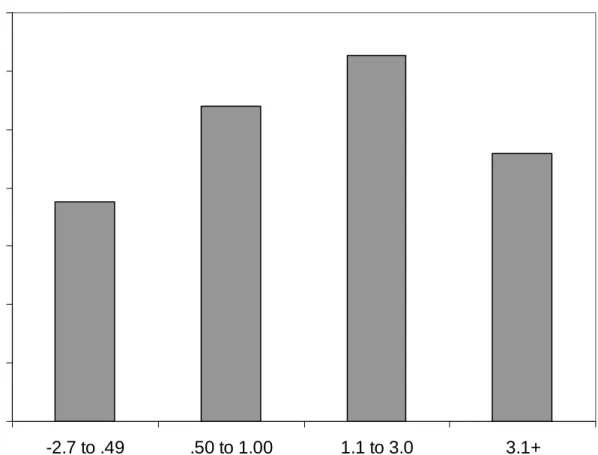
Omnibus findings. The omnibus findings are displayed in Figure 1. What are shown are the results for all types of adaptations combined and all outcome measures combined organized by the percentages of effects having different ranges. Just over half (54%) of the effect sizes were greater than 1.0, and 81% of the effect sizes were .50 or greater. Most studies yielded
results showing moderate to large effect sizes for the relationships between the different types of adaptations and the study outcomes.
Table 1 shows the results for the three intervention variables and the outcome meas-ures. The results for type of adaptation, number of sessions, and intervention setting provide a basis for ascertaining the differential effects of the interventions on the study outcomes. The results for the outcomes provide a basis for dis-cerning which types of behavior are influenced by the interventions.
Type of adaptation. All three types of adap-tations were related to the study outcomes as evidenced by the average Cohen’s d effect sizes, their confidence intervals, and the numbers and
0 5 10 15 20 25 30 35 -2.7 to .49 .50 to 1.00 1.1 to 3.0 3.1+
COHEN'S d EFFECT SIZES
PE RCENT O F EF F E CT SI Z E S
Figure 1. Percentages of Cohen’s d effect sizes organized according to different ranges of effects for the relationships between the adaptations and the study outcomes
percentages of effect sizes .50 or larger. Adapta-tions to the environment were associated with the largest average effect sizes whereas adapta-tions to materials were associated with some-what smaller (but nonetheless large) average ef-fect sizes. Adaptations to activities were highly effective as evidenced by a large average effect size and a confidence interval showing that the largest majority of adaptations were associated
with large effect sizes.
Number of sessions. The more sessions the adaptations were used, the more positive were the study outcomes. This was evidenced by the differences in the average size of effects for the number of sessions the adaptations were used (5 -9 vs 10+) and the numbers and percentages of effect sizes .50 or larger. There were also con-comitant increases in the confidence intervals Table 1
Mean Cohen’s d Effect Sizes and 90% Confidence Intervals (CI) for Different Intervention and Outcome Variables
Variable Number Mean d 90% CI d≥ .50 Childrena Effect
Sizes Number Percent
Type of Adaptation Environment 6 10 2.27 .86 – 3.68 9 80 Activity 23 30 1.86 1.38 – 2.34 24 80 Material 6 8 1.39 .41 – 2.36 5 63 Number of Sessions 5-9 16 25 1.52 .92 – 2.11 17 68 10-15 9 11 2.30 1.30 – 3.29 9 82 16-37 11 12 2.21 1.37 – 3.04 12 100 Setting Inclusive Classroom 18 20 2.47 1.85 – 3.10 19 95 Noninclusive Class-room 8 10 2.30 1.58 – 3.01 10 100 Playground/Gym 2 6 1.11 -.82 – 3.05 5 83 Therapy Room/ Clinic 1 3 .95 -2.20 – 4.11 1 33 Home 6 9 .85 -.10 – 1.79 3 33 Outcome Domain Cognitive 9 9 3.42 2.53 – 4.31 9 100 Communication 21 28 1.57 1.10 – 2.04 20 71 Gross Motor 2 2 3.52 -.28 – 7.31 2 100 Social 6 9 .88 -.29 – 2.04 7 78
a For purposes of the analyses, the results from the Koppenhaver et al. (2001) study were treated
which indicates that the influences of the adapta-tions become more pronounced the more they were used.
Intervention setting. The adaptations were differentially effective depending on the settings in which they were implemented. The adapta-tions were equally effective when implemented in either inclusive or noninclusive classroom set-tings. This was ascertained by the large average effect sizes and the confidence intervals indicat-ing that the largest majority of sizes of effects were also large. The adaptations were also effec-tive when implemented on a playground or gym as evidenced by the average effect size and the fact that 83% of the effect sizes were .50 or lar-ger. The studies that implemented the adapta-tions in the children’s homes or in a therapy room and clinic produced mixed results. Whereas the average effect sizes for both set-tings were large, only one third of the individual effect sizes were .50 or larger. In both cases, a few very large effect sizes inflated the average effect size.
Outcome domain. The adaptations were highly effective in influencing cognitive and communication outcomes, and also effective in affecting social and motor outcomes. The sizes of effects for both the cognitive and communi-cation outcomes were large, and the confidence intervals for both sets of measures were also large. The average sizes of effect for the gross motor outcome was also large, where the two effect sizes were 2.91 and 4.12. The largest ma-jority of the effect sizes for the social outcomes were .50 or larger.
Moderator effects. The extent to which the effectiveness of the adaptations were moderated by child and study variables are shown in Table 2. The adaptations were equally effective when used with boys or girls. The adaptations were more effective when used with younger com-pared to older children as evidenced by de-creases in both the average effect sizes and num-ber and percent of effect sizes .50 or larger across age groups. This was probably due to the fact that the older children appeared to be more profoundly impaired based on the information
included in the research reports (although few studies reported child functioning levels). The adaptations were most effective for children with autism, multiple disabilities, unspecified developmental delays, and to a lesser extent, cerebral palsy. They were also effective for chil-dren with behavioral disorders as determined by the number and percent of effect sizes .50 or larger.
Single participant design studies yielded larger average effect sizes compared to the con-trasting group design studies. The fact that the single participant design studies yielded very large effect sizes (relative to other designs) was not unexpected since this has generally been the case where effect sizes are calculated on single participant data (e.g., Raab & Dunst, 2007). Pattern Matching Findings
Omnibus findings. Figure 2 shows the om-nibus findings for the pattern matching analyses. Thirty percent of the study results were rated as highly consistent with investigator predictions, and 38% were rated as somewhat consistent with predictions. Just over two thirds of the out-comes (68%) were rated as matching investigator predictions. Very few results (8%) were rated as inconsistent with investigator predictions. One quarter of the results, however, were rated as neither consistent nor inconsistent with investi-gator predictions. Nonetheless, the findings, taken together, show that the cross-case synthe-sis of the results provide more evidence to sup-port rather than to refute the conclusion that the adaptations generally had positive effects (Yin, 2002a).
The pattern matching results for the in-tervention and outcome variables are shown in Table 3. The findings include the ratings for the outcomes in the single participant design and contrasting conditions studies included in the Cohen’s d effect size analyses as well as ratings of the results for the two case studies (Aitken & Bower, 1982; Lane & Mistrett, 1996) and the one cross-sectional study (Ostensjo, Carlberg, & Vollestad, 2005). Because of the constrained range of ratings (-2 to +2), effect sizes of .25
to .49 were considered small, .50 to .99 medium, and 1.0 or greater large. All of the average effect sizes for all variables and measure were .26 or larger.
Type of adaptation. All three types of adap-tations were associated with positive study out-comes. The average effect size for the material adaptations was large, and those for the activity and environment adaptations were medium. The
confidence intervals for the material and activity adaptations indicated that they had medium to large effects, whereas those for the environment adaptations were small to large.
Number of sessions. The findings for the session analyses showed that the more sessions the adaptations were used, the larger the average effect sizes and the larger the number and per-cent of effect sizes that matched expectations.
Table 2
Mean Cohen’s d Effect Sizes and 90% Confidence Interval (CI) for Different Moderator Variables
Variable Number Mean d 90% CI d≥ .50
Children Effect Sizes Number Percent
Child Gender
Male 24 32 1.97 1.42 – 2.52 25 78
Female 11 16 1.66 .97 – 2.34 13 81
Child Age (months)
12-36 5 5 2.50 2.29 – 2.71 5 100 37-48 10 12 2.15 1.26 – 3.03 11 92 49-60 12 19 2.07 1.29 – 2.84 16 84 61-78 7 10 1.01 -.02 – 2.05 4 40 Child Disability Autism 17 21 2.36 1.69 – 3.02 17 81 Multiple Disabilities 8 10 2.10 1.07 – 3.12 8 80 Developmental De-laya 5 6 1.42 .62 – 2.21 5 83 Cerebral Palsy 4 8 1.17 -.22 – 2.55 6 75 Behavioral Disorder 1 3 .46 -.21 – 1.14 2 66 Research Design ABA 12 19 2.02 1.19 – 2.85 17 89 Multiple Baseline 20 24 2.00 1.50 – 2.50 20 83 Contrasting Condi-tions 3 5 .65 -.67 – 1.98 1 20
There were also concomitant changes in the confidence intervals for the average effect sizes, indicating that the effect sizes for the adapta-tions became larger the more frequently the ad-aptations were used.
Intervention setting. The adaptations were similarly effective when used in either inclusive or noninclusive classroom settings or home set-tings. The average effect sizes for the two class-room settings and the homes were all large, and the confidence intervals for all three settings were medium to large. The average effect size for the playground and gym was medium, and that for the therapy room and clinic was small. For both settings, only half the effect sizes matched expectations.
Outcome domain. The outcomes that were
most affected by the adaptations were communi-cation and cognitive behaviors. The average ef-fect sizes for the communication and cognitive outcomes were both large and had medium to large confidence interval effect sizes. The aver-age effect size for the social outcomes was me-dium but the confidence interval effect sizes were only small to medium. The adaptations had mixed results for motor outcomes. Whereas the average effect size was medium, the confidence interval indicated that the effects of the adapta-tions had both positive and negative effects.
Moderator effects. Table 4 shows the extent to which the relationships between the adapta-tion intervenadapta-tions and the pattern matching scores were moderated by child and study vari-ables. The average sizes of effects and the
confi-Figure 2. Percentage of pattern matching scores for the relationships between the adaptations and the study outcomes. (NOTE: -2 = Highly inconsistent, -1 = Somewhat consistent, 0 = Neither consistent nor inconsistent, 1 = Somewhat consistent, and 2 = Highly consistent with investigator expectations.)
0 10 20 30 40 -2 -1 0 1 2
PATTERN MATCHING SCORES
P E RCENT O F EF F E C T S IZ E S
Table 3
Mean Pattern Matching Scores and 90% Confidence Intervals (CI) for Different Intervention and Outcome Variables
Variable Number Mean Pattern Matching Scores 90% CI Matched Expecta-tions
Children Effect Sizes Num-ber Percent
Type of Adaptation Material 8 10 1.10 .67 – 1.53 8 80 Activity 35 64 .86 .63 – 1.09 43 67 Environment 8 16 .75 .37 – 1.13 10 63 Number of Sessions 5-9 25 45 .60 .33 – .87 27 60 10-15 10 16 1.00 .64 – 1.36 13 78 16-37 11 12 1.42 1.01 – 1.83 10 83 Setting Inclusive Classroom 18 20 1.35 1.12 – 1.58 19 95 Noninclusive Class-room 8 10 1.30 .82 – 1.78 8 80 Home 11 26 1.04 .73 – 1.35 18 69 Playground/Gym 2 6 .50 -.36 – 1.36 3 50 Therapy Room/ Clinic 8 19 .26 -.26 – .79 10 53 Outcome Domain Communication 21 28 1.04 .78 – 1.29 26 81 Cognitive 20 30 1.03 .72 – 1.34 20 71 Social 10 20 .55 .18 - .92 9 45 Motor 9 10 .50 -.33 – 1.33 6 60
a The findings from the Koppenhaver et al. (2001) and Ostensjo et al. (2005) studies were
Table 4
Pattern Matching Scores and 90% Confidence Intervals (CI) for Different Moderator Variables
Variable Number Mean Pattern Matching Scores 90% CI Matched Expecta-tions
Children Effect Sizes Num-ber Percent
Child Gender
Male 36 65 .88 .65 – 1.10 46 71
Female 11 16 1.13 .77 – 1.48 12 75
Child Age (months)
5-36 17 38 .82 .48 – 1.15 27 71 37-48 10 12 1.33 1.00 – 1.67 11 92 49-60 13 28 .79 .52 – 1.05 17 61 61-78 7 10 .60 .11 – 1.09 4 40 Child Disability Autism 17 21 1.14 .84 – 1.44 16 76 Multiple Disabilities 8 10 1.00 .61 – 1.39 8 80 Developmental De-lay a 5 6 1.17 .55 – 1.79 5 83 Visual Impairment 11 31 .68 .28 – 1.07 20 65 Cerebral Palsy 6 19 .63 .30 – .96 10 53 Behavioral Disorder 1 3 1.33 -.61 – 3.28 2 66 Research Design ABA 12 19 1.16 .80 – 1.52 15 80 Multiple Baseline 20 24 1.13 .87 – 1.38 19 79 Case Study 12 33 .73 .35 – 1.11 22 67 Contrasting Condi-tions 3 5 .40 -.12 – .92 2 40 Cross-sectional 1 9 .33 .02 – .64 3 33
dence intervals for child gender showed that the effectiveness of the adaptations differed some but not appreciably by this moderator.
The results from the analyses of child age showed that the effects on the study out-comes were medium to large for children 5 to 60 months of age, but that the influences of the adaptations on the study outcomes were mixed for the 61 to 78 month old children as evidenced by the large confidence interval for the average effect size. The number and percent of effect sizes that matched expectations decreased among the older children indicating that the ad-aptations were generally more effective when used with younger children.
The adaptations were most effective for children with autism, developmental disabilities, developmental delays, and visual impairments. The effects of the adaptations for children with cerebral palsy and behavioral disorders were mixed as evidenced by the confidence intervals and number and percent of effect sizes that matched expectations.
The single participant design studies pro-duced larger average pattern matching scores compared to the studies using other designs. The one cross-sectional study and the two case stud-ies yielded average pattern matching scores and confidence intervals showing that the adapta-tions were generally effective. The contrasting conditions studies yielded mixed results.
Conclusions
The preponderance of evidence from both the Cohen’s d effect size analyses and the pattern matching analyses indicated that the ad-aptations constituting the focus of this research synthesis were effective in terms of influencing or changing child behavior. There are, however, certain caveats that need to be acknowledged to more fully understand the child and environ-mental conditions under which the adaptations were most effective:
The three types of adaptations
(environment, activities, materials) had more similar than different consequences in terms of
CONTINUUM OF ADAPTATIONS
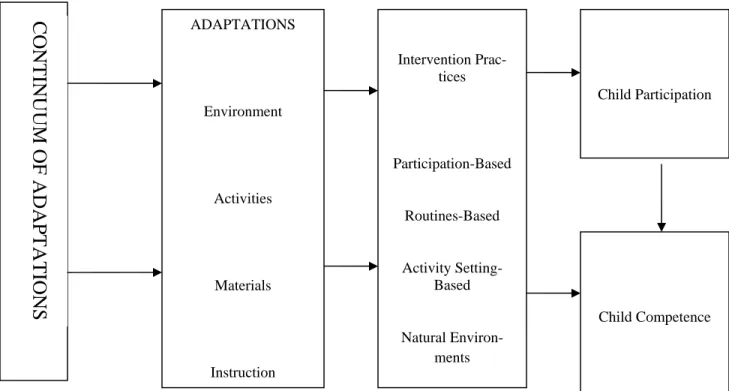
ADAPTATIONS Environment Activities Materials Instruction Intervention Prac-tices Participation-Based Routines-Based Activity Setting-Based Natural Environ-ments Child Participation Child CompetenceFigure 3. Framework for conceptualizing the functions of adaptations in terms of early in-terventions practices for promoting child participation in everyday activities and their effects on
affecting child behavior (Tables 1 and 3). The sizes of effects for the relationships between the adaptations and the study outcomes were all moderate to large with only a few exceptions.
The more frequently the adaptations were used with the children, the more effective the adaptations were in terms of influencing child behavior (Tables 1 and 3). Both the Cohen’s d and pattern matching analyses produced similar results highlighting the importance of frequent use of adaptations with young children with dis-abilities.
The settings in which the adaptations were used mattered to a certain degree in terms of the effectiveness of the adaptations (Tables 1 and 3). The adaptations were most effective when used in classroom settings and on a playground or in a gym, and to a lesser extent, in home settings. The reasons the interventions produced mixed results for the therapy room/clinic setting is not clear but may have to do with both the kinds of adaptations that were used (Appendix B) and the particular outcomes used to meas-ure intervention impact (Appendix C).
The adaptations were generally more effec-tive when used with younger compared to older preschool aged children (Tables 2 and 4). On the one hand this indicates that adaptations appear appropriate (even if rather simple) for very young children if designed and implemented carefully. On the other hand, this finding may be confounded by differences in the children vary-ing in age. It appeared (but could not be con-firmed) that the older children seemed to have more serious disabilities and impairments.
The adaptations were most effective for chil-dren with autism, multiple disabilities, develop-mental delays, visual impairments, and to a lesser degree, cerebral palsy. The differential effective-ness, at least in part, is probably due to the fact that different kinds of adaptations (Appendix B) tended to be used with children with different diagnoses (Appendix A).
Taken together, the results as a whole provide support for the contention that adapta-tions can be effective for making it easier for young children with disabilities to participate in
typical classroom, home, and community activi-ties, where participation in turn is more likely to promote learning and have positive behavioral consequences (Campbell, Milbourne, & Wilcox, 2008; Doctoroff, 2001; Mayfield, 1996; Mistrett, 2004; Sandall, 2003). The findings are also con-sistent with the World Health Organization’s (2001) model for conceptualizing the relation-ship between environmental factors
(adaptations), participation, and activity, and how all three contribute to improved function-ing. One of the lessons learned from conducting this research synthesis is that there is a need for a better conceptualization and operationalization of different kinds of adaptations, and how adap-tations fit into models like the World Health Or-ganization’s (2001) framework for explaining and overcoming the consequences of disability (see also National Institute on Disability and Re-habilitation Research, 2006).
Implications for Practice
The findings from this research synthesis as well as key features of a number of studies included in the meta-analysis have a number of implications for practice. One implication has to do with the manner in which adaptations are used with young children with disabilities as part of different kinds of practices that used everyday activities and routines as sources of child learn-ing opportunities (Campbell & Sawyer, 2007; Dunst, Bruder, Trivette, Hamby, Raab, & McLean, 2001; Jung, 2003; Kellegrew, 2000; McWilliam, 2000). Figure 3 shows a simple way of thinking about how adaptations are used to promote both child participation in everyday activities and child competence. Intervention practices used to promote child participation (engagement, involvement, etc.) in activities should provide context for child learning to the extent that the adaptations have anticipated ef-fects. Adaptations in turn should affect child competence to the extent that they support and make it easier for a child to produce behavior. The reader is referred to Campbell (2005) for descriptions of these kinds of practices.
A second implication has to do with the purpose of an adaptation and whether it can
rea-sonably be expected to influence either child participation or competence. In many cases, ad-aptations are used for purposes other than en-couraging child-initiated engagement with peo-ple or materials (e.g., installing a ramp to make it easier for a parent to get his or her child in their home). In situations like this, one would not ex-pect that the adaptations would have child-competency enhancing effects (see especially Ostensjo, Carlberg, & Vollestad, 2003, 2005, for examples of these kinds of adaptations). In con-trast, adaptations that are specifically designed to affect child-initiated behavior would be expected to have competency-enhancing effects (see e.g., Cosbey & Johnston, 2006, for an example of this kind of practice).
A third implication pertains to the ex-pected relationship between an adaptation and child participation in everyday activities where increased participation is hypothesized to be the consequence of the adaptation. A not so readily apparent finding from this research synthesis is that many of the adaptations were found to be associated with increased child engagement with the social and nonsocial environments which, in principle, would be a condition for better child learning and improved child functioning (e.g., Wimpory, Hobson, & Nash, 2007). The reader is referred to Schilling and Schwartz (2004) for an example of how adaptations had strong positive effects on child engagement.
A fourth implication has to do with the relationship between adaptations and child be-havior. Adaptations would be expected to be optimally effective when the adaptations are functionally related to desired or expected child behavior. We were surprised to find studies where the outcome measure constituting the fo-cus of analysis made little or no sense in terms of the adaptations that were being evaluated. Adaptations should be optimally effective in in-fluencing child behavior where the adaptations make possible child production of competence that has discernable environmental conse-quences (e.g., using an adapted cup in order to more easily drink).
There is at least one implication for re-search based on the findings from this rere-search synthesis. If the relationships shown in Figure 3 in fact “best explain” how adaptations function as a mediator of both child participation and competence, there are statistical methods that could be used to test whether the model fit the data (e.g., Hoyle, 1995). If the data necessary to conduct meta-analytic structural equation model-ing were available, even more sophisticated causal modeling could be performed (e.g., Cheung & Chan, in press). The yield would be a better understanding of how and in what man-ner adaptations have both direct and indirect effects on child participation and child compe-tence.
Aitken, S., & Bower, T. G. R. (1982). The use of the sonicguide in infancy. Journal of Visual Impairment and Blindness, 76, 91-100.
Bailey, D. B., Jr., & Wolery, M. (1992) Designing and arranging environments for infants and preschoolers with disabilities. In Teaching in-fants and toddlers with disabilities (2nd ed., pp. 197-227). Upper Saddle River, NJ: Merrill. Bednarczyk, A. M., Alexander-Whiting, H., &
Solit, G. A. (1994). Guidelines for the adap-tation of preschool environments to inte-grate deaf, hard of hearing, and hearing chil-dren. Children's Environments, 11, 6-15. Bellon-Harn, M. L., & Harn, W. E. (2008).
Scaf-folding strategies during repeated storybook reading: An extension using a voice output communication aid. Focus on Autism and Other Developmental Disabilities, 23, 112-124.
Blair, K.-S. C., Umbreit, J., & Eck, S. (2000). Analysis of multiple variables related to a young child's aggressive behavior. Journal of Positive Behavior Interventions, 2, 33-39.
Campbell, P. H. (2005). Participation-based ser-vices: Promoting children's participation in natural settings. Young Exceptional Children, 8 (1), 20-29.
Campbell, P. H., McGregor, G., & Nasik, E. (1994). Promoting the development of young children through use of adaptive and
assistive technology. In P. H. Safford (Ed.), Early childhood special education (Yearbook in Early Childhood Education Vol. 5) (pp. 192-217). New York: Teachers College Press. Campbell, P. H., Milbourne, S., Dugan, L. M., &
Wilcox, M. J. (2006). A review of evidence on practices for teaching young children to use assistive technology devices. Topics in Early Childhood Special Education, 26, 3-13. Campbell, P. H., Milbourne, S., & Wilcox, M.
(2008). Adaptation interventions to promote participation in natural settings. Infants and Young Children, 21(2), 94-106.
Campbell, P. H., & Sawyer, L. B. (2007). Sup-porting learning opportunities in natural set-tings through participation-based services. Journal of Early Intervention, 29, 287-305. Cheung, M. W. L., & Chan, W. (in press). A two
-stage approach to synthesizing covariance matrices in meta-analytic structural equation modeling. Structural Equation Modeling. Cosbey, J. E., & Johnston, S. (2006). Using a
single-switch voice output communication aid to increase social access for children with severe disabilities in inclusive classrooms. Research and Practice for Persons with Severe Dis-abilities, 31, 144-156.
Day, J. N., McDonnell, A. P., & Heathfield, L. T. (2005). Enhancing emergent literacy skills in inclusive preschools for young children with visual impairments. Young Exceptional Children, 9(1), 20-28.
Deitz, J., Swinth, Y., & White, O. (2002). Pow-ered mobility and preschoolers with complex developmental delays. American Journal of Oc-cupational Therapy, 56, 86-96.
Dettmer, S., Simpson, R. L., Myles, B. S., & Ganz, J. B. (2000). The use of visual sup-ports to facilitate transitions of students with autism. Focus on Autism and Other Developmen-tal Disabilities, 15, 163-169.
DiCarlo, C. F., & Banajee, M. (2000). Using voice output devices to increase initiations of young children with disabilities. Journal of Early Intervention, 23, 191-199.
Doctoroff, S. (2001). Adapting the physical envi-ronment of all young children for play. Early
Childhood Education Journal, 29, 105-109. Dooley, P., Wilczenski, F. L., & Torem, C.
(2001). Using an activity schedule to smooth school transitions. Journal of Positive Behavior Interventions, 3, 57-61.
References
Aitken, S., & Bower, T. G. R. (1982). The use of the sonicguide in infancy. Journal of Visual Impairment and Blindness, 76, 91-100.
Bailey, D. B., Jr., & Wolery, M. (1992) Designing and arranging environments for infants and preschoolers with disabilities. In Teaching in-fants and toddlers with disabilities (2nd ed., pp. 197-227). Upper Saddle River, NJ: Merrill. Bednarczyk, A. M., Alexander-Whiting, H., &
Solit, G. A. (1994). Guidelines for the adap-tation of preschool environments to inte-grate deaf, hard of hearing, and hearing chil-dren. Children's Environments, 11, 6-15. Bellon-Harn, M. L., & Harn, W. E. (2008).
Scaf-folding strategies during repeated storybook reading: An extension using a voice output communication aid. Focus on Autism and Other Developmental Disabilities, 23, 112-124.
Blair, K.-S. C., Umbreit, J., & Eck, S. (2000). Analysis of multiple variables related to a young child's aggressive behavior. Journal of Positive Behavior Interventions, 2, 33-39.
Campbell, P. H. (2005). Participation-based ser-vices: Promoting children's participation in natural settings. Young Exceptional Children, 8 (1), 20-29.
Campbell, P. H., McGregor, G., & Nasik, E. (1994). Promoting the development of young children through use of adaptive and assistive technology. In P. H. Safford (Ed.), Early childhood special education (Yearbook in Early Childhood Education Vol. 5) (pp. 192-217). New York: Teachers College Press. Campbell, P. H., Milbourne, S., Dugan, L. M., &
Wilcox, M. J. (2006). A review of evidence on practices for teaching young children to use assistive technology devices. Topics in Early Childhood Special Education, 26, 3-13. Campbell, P. H., Milbourne, S., & Wilcox, M.
participation in natural settings. Infants and Young Children, 21(2), 94-106.
Campbell, P. H., & Sawyer, L. B. (2007). Sup-porting learning opportunities in natural set-tings through participation-based services. Journal of Early Intervention, 29, 287-305. Cheung, M. W. L., & Chan, W. (in press). A two
-stage approach to synthesizing covariance matrices in meta-analytic structural equation modeling. Structural Equation Modeling. Cosbey, J. E., & Johnston, S. (2006). Using a
single-switch voice output communication aid to increase social access for children with severe disabilities in inclusive classrooms. Research and Practice for Persons with Severe Dis-abilities, 31, 144-156.
Day, J. N., McDonnell, A. P., & Heathfield, L. T. (2005). Enhancing emergent literacy skills in inclusive preschools for young children with visual impairments. Young Exceptional Children, 9(1), 20-28.
Deitz, J., Swinth, Y., & White, O. (2002). Pow-ered mobility and preschoolers with complex developmental delays. American Journal of Oc-cupational Therapy, 56, 86-96.
Dettmer, S., Simpson, R. L., Myles, B. S., & Ganz, J. B. (2000). The use of visual sup-ports to facilitate transitions of students with autism. Focus on Autism and Other Developmen-tal Disabilities, 15, 163-169.
DiCarlo, C. F., & Banajee, M. (2000). Using voice output devices to increase initiations of young children with disabilities. Journal of Early Intervention, 23, 191-199.
Doctoroff, S. (2001). Adapting the physical envi-ronment of all young children for play. Early Childhood Education Journal, 29, 105-109. Dooley, P., Wilczenski, F. L., & Torem, C.
(2001). Using an activity schedule to smooth school transitions. Journal of Positive Behavior Interventions, 3, 57-61.
Dunst, C. J., Bruder, M. B., Trivette, C. M., Hamby, D., Raab, M., & McLean, M. (2001). Characteristics and consequences of every-day natural learning opportunities. Topics in Early Childhood Special Education, 21, 68-92. Dunst, C. J., Hamby, D. W., & Trivette, C. M.
(2007). Guidelines for calculating effect sizes for practice-based research syntheses (Winterberry Re-search Perspectives Vol. 1, No. 3). Asheville, NC: Winterberry Press.
Dunst, C. J., & Trivette, C. M. (2009). Using re-search evidence to inform and evaluate early childhood intervention practices. Topics in Early Childhood Special Education, 29(1), 40-52. Dunst, C. J., Trivette, C. M., & Cutspec, P. A.
(2007). Toward an operational definition of evidence -based practices (Winterberry Research Per-spectives Vol. 1, No. 1). Asheville, NC: Winterberry Press.
Dunst, C. J., Trivette, C. M., & Watson, A. (2009). Procedural manual for conducting a practice -based research synthesis. Asheville, NC: Winter-berry Press. (in preparation).
Fabregat, M., Costa, M., & Romero, M. (2004). Adaptation of traditional toys and games to new technologies: New products generation. In J. Goldstein, D. Buckingham, & G. Brougere (Eds.), Toys, games, and media (pp. 225-240). Mahwah, NJ: Erlbaum.
Frea, W. D., Arnold, C. L., & Vittimberga, G. L. (2001). A demonstration of the effects of augmentative communication on the ex-treme aggressive behavior of a child with autism in an integrated preschool setting. Journal of Positive Behavior Interventions, 3, 194-198.
Guralnick, M. J. (Ed.). (2005). The developmental systems approach to early intervention. Baltimore: Brookes.
Hamm, E. M., Mistrett, S. G., & Ruffino, A. G. (2006). Play outcomes and satisfaction with toys and technology of young children with special needs. Journal of Special Education Tech-nology, 21(1), 29-35.
Hoyle, R. H. (Ed.). (1995). Structural equation mod-eling: Concepts, issues, and applications. Thousand Oaks, CA: Sage.
Hsieh, H.-C. (2008). Effects of ordinary and adaptive toys on pre-school children with developmental disabilities. Research in Develop-mental Disabilities, 29, 459-466.
Johnston, S., Nelson, C., Evans, J., & Palazolo, K. (2003). The use of visual supports in
teaching young children with autism spec-trum disorder to initiate interactions. Aug-mentative and Alternative Communication, 19, 86-103.
Johnston, S. S., McDonnell, A. P., Nelson, C., & Magnavito, A. (2003). Teaching functional communication skills using augmentative and alternative communication in inclusive settings. Journal of Early Intervention, 25, 263-280.
Jung, L. A. (2003). More better: Maximizing natural learning opportunities. Young Excep-tional Children, 6(3), 21-26.
Kellegrew, D. H. (2000). Constructing daily rou-tines: A qualitative examination of mothers with young children with disabilities. Ameri-can Journal of Occupational Therapy, 54, 252-259. Kern, P., Wolery, M., & Aldridge, D. (2007). Use of songs to promote independence in morn-ing greetmorn-ing routines for young children with autism. Journal of Autism and Developmental Dis-orders, 37, 1264-1271.
Koppenhaver, D. A., Erickson, K. A., Harris, B., McLellan, J., Skotko, B. G., & Newton, R. A. (2001). Storybook-based communication intervention for girls with Rett syndrome and their mothers. Disability and Rehabilitation, 23, 149-159.
Lane, S. J., & Mistrett, S. G. (1996). Play and as-sistive technology issues for infants and young children with disabilities: A prelimi-nary examination. Focus on Autism and Other Developmental Disabilities, 11, 96-104.
Lucas, S. M., & Cutspec, P. A. (2007). The role and process of literature searching in the preparation of a research synthesis (Winterberry Research Perspectives Vol. 1, No. 10). Asheville, NC: Winterberry Press.
Mayfield, P. K. (1996). Adaptations for young children with visual impairments in regular settings. Early Childhood Education Journal, 23, 231-233.
McCormick, L., & Feeney, S. (1995). Modifying and expanding activities for children with disabilities. Young Children, 50(4), 10-17. McWilliam, R. A. (2000). It's only natural ... to
have early intervention in the environments
where it's needed. In S. Sandall & M. Os-trosky (Eds.), Natural Environments and Inclu-sion (Young Exceptional Children Mono-graph Series No. 2 ) (pp. 17-26). Longmont, CO: Sopris West.
Milbourne, S. A., & Campbell, P. H. (2007). CARA's kit: Creating adaptations for routines and activities. Philadelphia: Thomas Jefferson Uni-versity, Child and Family Studies Research Programs.
Mistrett, S. (2004). Assistive technology helps young children with disabilities participate in daily activities. Technology in Action, 1(4), 1-8. Mistrett, S. G., Hale, M. M., Diamond, C. M.,
Ruedel, K. L. A., Gruner, A., Sunshine, C., Berman, K., Saunders, J., & McInerney, M. (2001, February). Synthesis on the use of assistive technology with infants and toddlers (birth through two). Washington, DC: U.S. Department of Education, Office of Special Education Pro-grams. Retrieved January 4, 2008, from
http://www.fctd.info/webboard/files/
AIR_EI-AT_Report_2001.pdf.
Moody, A. K. (2008). Engagement and commu-nication during shared storybook reading: A comparison of electronic and traditional books for preschoolers who are at risk. Dis-sertation Abstracts International, 68, 08. National Institute on Disability and
Rehabilita-tion Research. (2006, February). Notice of final long range plan for fiscal years 2005-2009. Wash-ington, DC: Author. Retrieved March 3, 2008 from the NIDRR Web site: http:// www.ed.gov/legislation/FedRegister/
other/2006-1/021506d.pdf.
Okolo, C. M., Cavalier, A. R., Ferretti, R. P., & MacArthur, C. A. (2000). Technology, liter-acy, and disabilities: A review of the re-search. In R. Gersten, E. P. Schiller, & S. Vaughn (Eds.), Contemporary special education research: Syntheses of the knowledge base on critical instructional issues (pp. 179-250). Mahwah, NJ: Erlbaum.
Olive, M., Lang, R. B., & Davis, T. N. (2008). An analysis of the effects of functional com-munication and a Voice Output
Communi-cation Aid for children with autism spectrum disorder. Research in Autism Spectrum Disorders, 2, 223-236.
Ostensjo, S., Carlberg, E. B., & Vollestad, N. K. (2003). Everyday functioning in young chil-dren with cerebral palsy: Functional skills, caregiver assistance, and modifications of the environment. Developmental Medicine and Child Neurology, 45, 603-612.
Ostensjo, S., Carlberg, E. B., & Vollestad, N. K. (2005). The use and impact of assistive de-vices and other environmental modifications on everyday activities and care in young chil-dren with cerebral palsy. Disability and Reha-bilitation, 27, 849-861.
Raab, M., & Dunst, C. J. (2007). Influence of child interests on variations in child behavior and function-ing (Winterberry Research Syntheses Vol. 1, No. 21). Asheville, NC: Winterberry Press. Sandall, S. R. (2003). Play modifications for
chil-dren with disabilities. Young Children, 58(3), 54-55.
Schepis, M. M., Reid, D. H., Behrmann, M. M., & Sutton, K. A. (1998). Increasing commu-nicative interactions of young children with autism using a voice output communication aid and naturalistic teaching. Journal of Applied Behavior Analysis, 31, 561-578.
Schilling, D. L., & Schwartz, I. S. (2004). Alter-native seating for young children with autism spectrum disorder: Effects on classroom be-havior. Journal of Autism and Developmental Dis-orders, 34, 423-432.
Shadish, W. R., & Haddock, C. K. (1994). Com-bining estimates of effect size. In H. Cooper & L. V. Hedges (Eds.), The handbook of re-search synthesis (pp. 261-281). New York: Rus-sell Sage Foundation.
Sullivan, M., & Lewis, M. (2000). Assistive tech-nology for the very young: Creating respon-sive environments. Infants and Young Children, 12(4), 34-52.
Thunberg, G., Ahlsen, E., & Sandberg, A. D. (2007). Children with autistic spectrum dis-orders and speech-generating devices: Com-munication in different activities at home. Clinical Linguistics and Phonetics, 21, 457-479.
Trudeau, N., Cleave, P. L., & Woelk, E. J. (2003). Using augmentative and alternative communication approaches to promote par-ticipation of preschoolers during book read-ing: A pilot study. Language Teaching and Ther-apy, 9, 181-210.
Wilcox, M. J., Guimond, A., Campbell, P. H., & Moore, H. W. (2006). Provider perspectives on the use of assistive technology for infants and toddlers with disabilities. Topics in Early Childhood Special Education, 26, 33-49. Wimpory, D. C., Hobson, R. P., & Nash, S.
(2007). What facilitates social engagement in preschool children with autism? Journal of Autism and Developmental Disorders, 37, 564-573.
Wolery, M. (1994). Designing inclusive environ-ments for young children with special needs. In M. Wolery & J. S. Wilbers (Eds.), Including children with special needs in early childhood pro-grams (pp. 97-118). Washington, DC: Na-tional Association for the Education of Young Children.
Wolery, M., & Sainato, D. M. (1996). General curriculum and intervention strategies. In S. L. Odom & M. E. McLean (Eds.), Early inter-vention/early childhood special education: Recom-mended practices (pp. 125-158). Austin, TX: PRO-ED.
Wolery, M., Schroeder, C., Martin, C. G., Venn, M. L., Holcombe, A., Brookfield, J., Huff-man, K., & Fleming, L. A. (1994). Classroom activities and areas: Regularity of use and perceptions of adaptibility by general early educators. Early Education and Development, 5, 181-194.
Wolery, M., Strain, P. S., & Bailey, D. B., Jr. (1992). Reaching potentials of children with special needs. In S. Bredekamp & T.
Rosegrant (Eds.), Reaching potentials: Appropri-ate curriculum and assessment for young children (pp. 92-111). Washington, DC: National As-sociation for the Education of Young Chil-dren.
World Health Organization. (2001). International classification of functioning, disability and health (ICF). Geneva, Switzerland: Author.
Yin, R. K. (2002a). Applications of case study re-search. Thousand Oaks, CA: Sage.
Yin, R. K. (2002b). Case study research: Design and methods. Thousand Oaks, CA: Sage.
Appendix A
CHARACTERISTICS OF THE STUDY PARTICIPANTS
Number
Study
Sample Size
Age
(Months) Male Female Caucasian Diagnosis/Disability Aitken & Bower (1982) 10 5 to 25 10 0 NRa Congenital blindness
Bellon-Harn & Harn (2008) 1 72 0 1 0 Mental retardation and blindness
Blair et al. (2000) 1 48 1 0 NR Behavior disorder and language delay
Cosbey & Johnston (2006) 3 43 to 78 0 3 NR Multiple disabilities
Deitz et al. (2002) 2 60 1 1 NR Spastic quadriplegia and developmental delay
Dettmer et al. (2000) 1 60 1 0 NR Autism
DiCarlo & Banajee (2000) 2 24 to 28 2 0 NR Chromosomal abnormality
Dooley et al. (2001) 1 36 1 0 NR Autism
Hsieh (2008) 3 42 to 57 2 1 0 Developmental disabilities
Johnston et al. (2003a) 3 39 to 54 1 2 NR Developmental disabilities
Johnston et al. (2003b) 3 51 to 63 3 0 NR Autism
Kern et al. (2007) 2 39 and 41
2 0 1 Autism
Koppenhaver et al. (2001) 6 43 to 80 0 6 6 Retts syndrome
Lane & Mistrett (1996) 1 12 1 0 NR Periventricular Leukomalasia
Ostensjo et al. (2005) 95 58b 55 40 NR Cerebral palsy
Schepis et al. (1998) 4 36 to 60 3 1 NR Autism
Schilling & Schwartz (2004)
4 47 to 50 4 0 3 Autism
Thunberg et al. (2007) 2 60 and 66
2 0 NR Autism
Trudeau et al. (2003) 2 65 and 70
1 1 NR Down syndrome and speech and physical disabilities
a NR = Not reported.
Appendix B
RESEARCH DESIGNS AND CHARACTERISTICS OF INTERVENTION
Intervention Characteristics
Study Study Design Location Setting Type of
Adaptation Description
Number of Sessions Aitken & Bower (1982)
Case study Clinic Home
Play Activity Sonicguide: (emition of ultrasonic sound)
1-15
Bellon-Harn & Harn (2008) Contrasting conditions
Therapy session
Book reading
Activity Use of VOCA 10
Blair et al. (2000) ABA Inclusive classroom
Play Material Play with many materials and many peers
6
Cosbey & Johnston (2006) Multiple baseline Inclusive classroom
Play Activity Use of VOCA 12-14
Deitz et al. (2002) ABA Playground Gym
Play Environment Use of powered mobility riding toy during recess
5
Dettmer et al. (2000) ABA Home Transition Activity Visual schedule, visual “finished task” boy and visual
timer were used to signal transitions between activities
10
DiCarlo & Banajee (2000) Multiple baseline Inclusive classroom
Snack Activity Assistive technology used to communicate
9-15
Dooley et al. (2001) AB Non-inclusive classroom
Transition Activity Use of communication device with pictorial labeling of next
activity
17
Hsieh (2008) Multiple baseline Classroom Play Material Adaptation of ordinary toys 9-11
Johnston et al. (2003a) Multiple baseline Inclusive classroom
Play Snack Group singing
Activity Use of ACC devices 15-37
Johnston et al. (2003b) Multiple baseline Non-inclusive classroom
Play Activity Graphic symbol used to represent “Can I play?”
17-22
Kern et al. (2007) ABA Inclusive classroom
Morning greeting
Activity Used songs and lyrics to modify transition into class
9-10
Koppenhaver et al. (2001) ABA Home Book reading
Activity Various ACC devices 32
Lane & Mistrett (1996) Case study Home Play Environment Adapted chair, positioning of furniture, use of pillows for
head support
NR
Material Adapted race track, use of switches to activate musical toys Ostensje et al. (2005) Cross-sectional NR Eating
Personal care Communication
Play
Material Use of adapted cups, spoons, etc.
NR
Environment Modification to seating, hand rails, etc. Activity Use of communication
systems/devices Schepis (1998) Multiple baseline Non-inclusive
classroom
Snack Free play
Activity Use of VOCA 4-14
Schilling & Schwartz (2004) ABA Inclusive classroom
Art Free play Circle
time
Environment Therapy balls replaced commonly used seating devices
19-28
Thunberg et al. (2007) ABA Home Eating meals Book reading “Talking about
school”
Activity Use of VOCA 3-5
Trudeau et al. (2001) Contrasting conditions
Home Reading book Material Use of adapted book 6
Appendix C
OUTCOME MEASURE AND DOMAINS AND THE EFFECT SIZES FOR THE ADAPTATIONS
Outcomes Effect Sizes
Study
Type of
Measurement Child Behavior Domain
Cohen’s d
Pattern Matching
Score Aitken & Bower (1982),
Child 1
Videoed observation Reaching for objects Cognitive - 1
Aitken & Bower (1982), Child 2
Videoed observation Response to approaching object Cognitive - 2 Tracking objects Cognitive - 2 Reaching for objects Cognitive - 2 Object permanence Cognitive - 2 Placing to a surface (anticipation
of touching) Cognitive - 2
Locomotion Motor - 2
Aitken & Bower (1982), Child 3
Videoed observation Response to approaching object Cognitive - 1 Tracking objects Cognitive - 1 Reaching for objects Cognitive - 1 Social games Social - -1
Locomotion Motor - 2
Aitken & Bower (1982), Child 4
Videoed observation Response to approaching object Cognitive - 1 Social interaction play Social - 2 Tracking objects Cognitive - 2 Reaching for objects Cognitive - 1 Aitken & Bower (1982),
Child 5
Videoed observation Reaching for objects Cognitive - 1
Locomotion Motor 0
Aitken & Bower (1982), Child 6
Videoed observation Response to approaching object Cognitive - 2 Reaching for objects Cognitive - 1 Aitken & Bower (1982),
Child 7
Videoed observation Reaching for objects Social - -2
Walking Motor -1
Aitken & Bower (1982), Child 8
Videoed observation Reaching for objects Cognitive - 0
Walking Motor -1
Aitken & Bower (1982), Child 9
Videoed observation Reaching for objects Social - -2
Locomotion Motor -2
Aitken & Bower (1982), Child 10
Videoed observations Response to approaching object Cognitive - 0 Tracking objects Cognitive - 1 Reaching for objects Cognitive - 1 Aitken & Bower (1982),
Child 11
Videoed observations Tracking objects Cognitive 0
Placing Cognitive 0
Bellon-Harn & Harn (2008)
Frequency of behaviors Number of child utterances Communication 3.12 1 Mean length of child utterances Communication -.09 0 Number of child initiations Communication -.16 0 Blair et al. (2000) Observation: frequency
of behaviors
Lack of aggressiveness toward peers or teachers Social .67 2 Appropriate engagement in activities Cognitive .72 2 Appropriate interactions with
Appendix C, continued
Outcomes Effect Sizes
Study
Type of
Measurement Child Behavior Domain
Cohen’s d
Pattern Matching
Score Cosbey & Johnston (2006),
Child 1
Observation: frequency of behaviors
Frequency of independent unprompted VOCA usage
Communication 5.32 2
Cosbey & Johnston (2006), Child 2
Observation: frequency of behaviors
Frequency of independent unprompted VOCA usage
Communication 1.98 2
Cosbey & Johnston (2006), Child 3
Observation: frequency of behaviors
Frequency of independent unprompted VOCA usage
Communication .84 1
Deitz et al. (2002), Child 1
Frequency of behaviors Child-initiated movement Motor 4.12 2 Child-initiated contact with others Social .71 0 Child positive affect Social .88 0 Deitz et al. (2002), Child 2 Frequency of behaviors Child-initiated movement Motor 2.91 1
Child-initiated contact with others Social -2.76 -1 Child positive affect Social .82 1 Dettmer et al. (2000) Latency between
activities
Child transition time decrease Cognitive 4.77 2
DiCarlo & Banagee (2000), Child 1
Frequency of behaviors Specific initiated communication Communication 2.70 1
DiCarlo & Banagee (2000), Child 2
Frequency of behaviors Specific initiated communication Communication 2.20 1
Dooley et al. (2001) Frequency of behaviors Child compliance with new task Social 2.35 2 Hsieh (2008),
Child 1
Frequency of behaviors Engaged toy play Cognitive 2.99 1
Hsieh (2008), Child 2
Frequency of behaviors Engaged toy play Cognitive 2.78 1
Hsieh (2008), Child 3
Frequency of behaviors Engaged toy play Cognitive 3.52 1
Johnston et al. (2003a), Child 1
Frequency of behaviors Correct use of symbolic communication
Communication 1.52 2
Johnston et al. (2003a), Child 2
Frequency of behaviors Correct use of symbolic communication
Communication 2.37 2
Johnston et al. (2003a), Child 3
Frequency of behaviors Correct use of symbolic communication
Communication .66 1
Johnston et al. (2003b), Child 1
Frequency of behaviors Correct use of symbolic communication
Communication .89 0
Johnston et al. (2003b), Child 2
Frequency of behaviors Correct use of symbolic communication
Communication .72 2
Johnston et al. (2003b), Child 3
Frequency of behaviors Correct use of symbolic communication
Communication .66 0
Kern et al. (2007), Child 1 Frequency of behaviors Independent responses during
morning greeting routine Social .89 1 Kern et al.(2007), Child 2 Frequency of behaviors Independent responses during morning greeting routine Social 4.32 1
Appendix C, continued
Outcomes Effect Sizes
Study
Type of
Measurement Child Behavior Domain
Cohen’s d
Pattern Matching
Score Koppenhaver et al. (2001) Frequency of behaviors Successful symbolic
communication acts with unfamiliar storybook
Communication 1.40 2
Successful symbolic communication acts with unfamiliar storybook
Communication .55 1
Lane & Mistrett (1996) Investigator descriptions Participation in social play Social - 1
Smiling Social - 2
Ostensje et al. (2005) Pediatric Evaluation of Disability Inventory (PEDI): Caregiver Assistance subscale
Indoor locomotion Motor - 1 Outdoor locomotion Motor - 1 Self-care - Eating Social - 1 Self-care - Grooming Social - 0 Self-care - Bathing Social - 0 Self-care - Dressing Social - 0 Social functioning – Functional
comprehension Social - 0 Social functioning – Functional
expression Social - 0 Social functioning - Playing Social - 0 Schepis et al. (1998),
Child 1
Frequency of behaviors Communicative interactions during snack time Communication 2.91 1 Communicative interactions
during play time Communication 4.40 2 Schepis et al. (1998),
Child 2
Frequency of behaviors Communicative interactions
during snack time Communication 2.28 2 Communicative interactions
during play time Communication 3.50 1 Schepis et al. (1998),
Child 3
Frequency of behaviors Communicative interactions during snack time
Communication 2.67 2
Schepis et al. (1998), Child 4
Frequency of behaviors Communicative interactions during snack time
Communication 2.60 1
Schilling & Schwartz (2004),
Child 1
Frequency of behaviors Engaged in art activities Cognitive 2.13 2
Schilling & Schwartz (2004),
Child 2
Frequency of behaviors
Engaged in reciprocal play activities
Cognitive 3.99 2
Schilling & Schwartz (2004),
Child 3
Frequency of behaviors
Engaged in small group table activities
Cognitive 4.67 1
Schilling & Schwartz (2004),
Child 4
Frequency of behaviors Engaged in circle time activities Cognitive 5.24 1
Thunberg et al. (2007), Child 1 Frequency of communication behaviors Effectiveness of child
communication during mealtime Communication .05 0 Effectiveness of child
communication in sharing experiences
Appendix C, continued
Outcomes Effect Sizes
Study
Type of
Measurement Child Behavior Domain
Cohen’s d Pattern Matching Score Thunberg et al. (2007), Child 2 Frequency of communication behaviors Effectiveness of child communication during story reading Communication .11 0 Effectiveness of child communication in sharing experiences Communication .19 1 Trudeau et al. (2003) Child 1 Frequency of communication behaviors
Production of specified intent Communication .28 1
Trudeau et al. (2003) Child 2
Frequency of communication behaviors