123
8
Plant Systematics
and Evolution
CHAPTER OUTLINE
Early History of Classification 124 Carolus Linnaeus 124
How Plants are Named 126 Common Names 126
A CLOSER LOOK 8.1 The Language of Flowers 128
Scientific Names 129 Taxonomic Hierarchy 130
Higher Taxa 130 What Is a Species? 131
A CLOSER LOOK 8.2 Saving Species Through Systematics 133 The Influence of Darwin’s Theory
of Evolution 134
The Voyage of the HMSBeagle 134 Natural Selection 136 Phylocode 137 Chapter Summary 137 Review Questions 137 Further Reading 138
KEY CONCEPTS
1. Scientific names are two-word names called binomials that are internationally recognized by the scientific community. 2. Carolus Linnaeus, an eighteenth-century Swedish botanist, started the binomial system and is therefore known as the Father of Taxonomy.
3. With the publication in 1859 of On the Origin of Species,Charles Darwin proposed that species are not static entities but are works in progress that evolve in response to environmental pressures.
4. Natural selection favors the survival and reproduction of those individuals in a species that possess traits that better adapt them to a particular environment.
C H A P T E R
Fossils, such as this 160 million year old arucarian pine cone from Argentina, were part of the evidence Charles Darwin used to formulate
124 U N I T I I Introduction to Plant Life: Botanical Principles
P
lant systematics is the branch of botany that is con-cerned with the naming, identification, evolution, and classification (arrangement into groups with common characteristics) of plants. In a strict sense, plant taxonomy is the science of naming and classifying plants; however, in this book the termstaxonomyandsystematicsare used inter-changeably. The simplest form of classification is a system based on need and use; early humans undoubtedly classified plants into edible, poisonous, medicinal, and hallucinogenic categories.EARLY HISTORY OF
CLASSIFICATION
The earliest known formal classification was proposed by the Greek naturalist Theophrastus (370–285 B.C.), who was a
student of Aristotle. In his botanical writings ( Enquiries into PlantsandThe Causes of Plants), he described and classified approximately 500 species of plants into herbs, undershrubs, shrubs, and trees. Because his influence extended through the Middle Ages, he is regarded as the Father of Botany.
Two Roman naturalists who also had long-lasting impacts on plant taxonomy were Pliny the Elder (A.D. 23–79) and Dioscorides (first century A.D. ). Both described medicinal
plants in their writings, and Dioscorides’sMateria Medica
remained the standard medical reference for 1,500 years. From this period through the Middle Ages, little new botani-cal knowledge was added. Blind adherence to the Greek and Roman classics prevailed, using manuscripts painstakingly copied by hand in monasteries throughout Europe.
The revival of botany after its stagnation in the Middle Ages began early in the Renaissance with the renewed inter-est in science and other fields of study. The invention of the printing press in the middle of the fifteenth century allowed botanical works to be more easily produced than ever before. These richly illustrated books, known as herbals,dealt largely with medicinal plants and their identification, collection, and preparation. The renewal of interest in taxonomy can be traced to the work of several herbalists; in fact, this period of botanical history from the fifteenth through the seventeenth centuries is known as the Age of Herbals. Another factor in the revival of taxonomy was the global exploration by the Europeans during this period, which led to the discoveries of thousands of new plant species. In less than 100 years more plants were intro-duced to Europe than in the previous 2,000 years.
Carolus Linnaeus
By the beginning of the eighteenth century, it was common to name plants using a polynomial (see fig. 8.4 ), which included a single word name for the plant (today called the genus name), followed by a lengthy list of descriptive terms, all in Latin. This system had flaws. It was not standardized; different polynomials existed for the same plant; and it was cumbersome to remember some of the longer polynomials, which could be a paragraph in length. This was the state of taxonomy during the time of Linnaeus.
Carolus Linnaeus ( fig. 8.1 ) was born in May 1707, in southern Sweden, the son of a clergyman. He became inter-ested in botany at a very young age through the influence of his father, who was an avid gardener and amateur botanist. It was expected that Linnaeus would also become a clergyman, but in school he did not do well in theological subjects. He did, however, excel in the natural sciences and entered the University of Lund in 1727 to pursue studies in natural sci-ence and medicine. (At this time medical schools were the centers of botanical study because physicians were expected to know the plant sources of medicines in use.) After one year he transferred to the University of Uppsala, the most presti-gious university in Sweden. It was here that he published his first botanical papers, which laid the foundations for his later works in classification and plant sexuality. In 1732, he under-took a solo expedition to Lapland to catalog the natural his-tory of this relatively unknown area. He later publishedFlora Lapponica,a detailed description of the plants of this area.
Linnaeus received his medical degree in 1735 from the University of Harderwijk in the Netherlands. Soon he came under the patronage of George Clifford, a director of the Dutch East India Company and one of the wealthiest men in Europe. He served as Clifford’s personal physician and as curator of his magnificent gardens, which housed specimens from around the world. The 3 years he spent in the Netherlands
Figure 8.1 Statue of Carolus Linnaeus (1707–1778) holding flowers of Indian blanket (Gaillardia pulchella) at the Linnaeus Teaching Garden, Tulsa, OK.
Figure 8.2 Frontispiece of Systema Naturae,one of the writings of Linnaeus, in which he expounded on his ideas of classification.
He returned to Sweden in 1738 and soon married Sara Elisabeth Moraea. After setting up a medical practice in Stockholm, he was appointed physician to the Swedish Admiralty, specializing in the treatment of venereal diseases. In 1741, he returned to the University of Uppsala as professor of medicine and botany, a position he retained until retire-ment in 1775. Linnaeus was a popular teacher who attracted students from all over Europe. Many of his students became famous professors in their own right; others traveled to distant lands collecting unknown specimens for Linnaeus to classify. After suffering several strokes, he died in January 1778.
One of Linnaeus’s achievements was his sexual system of plant classification, which did much to popularize the study of botany. This system was based on the number, arrangement, and length of stamens and thus divided flowering plants into 24 classes. Using this system, it was possible for anyone to identify and name unknown plants. At the time, his lan-guage was risqué because he compared floral parts to human sexuality, with stamens referred to as husbands and pistils∗ as wives; for example, “husband and wife have the same bed” meant stamens and pistils in the same flower ( fig. 8.3 ).
Figure 8.3 (a) Linnaeus’s sexual system related floral parts to human sexuality. (b) Hibiscusin the Mallow Family (Malvaceae) keys out to feminine malesbecause the stamens are attached to the style.
Vegetable Kingdom Key of the Sexual System Marriages of plants
Florescence Public marriages Flowers visible to every one
In one bed
Husband and wife have the same bed
All the flowers hermaphrodite: stamens and pistils in the same flower Without affinity
Husbands not related to each other
Stamens not joined together in any part With equality
All the males of equal rank
Stamens have no determinate proportion of length
1. One male 5. Five males 2. Two males 6. Six males 3. Three males 7. Seven males 4. Four males 8. Eight males With subordination
Some males above others
Two stamens are always lower than the others
14. Two powers 15. Four powers
With affinity
Husbands related to each other
Stamens cohere with each other, or with the pistil
16. One brotherhood 17. Two brotherhoods
In two beds
Husband and wife have separate beds
Male flowers and female flowers in the same species
21. One house 22. Two houses 23. Polygamies
(a)
(b)
Clandestine marriages
Flowers scarce visible to the naked eye
24. Clandestine marriages 18. Many brotherhoods 19. Confederate males 20. Feminine males 9. Nine males 11. Twelve males 12. Twenty males 13. Many males 10. Ten males
were the most productive period in his life. During that time, he completed several books and papers including Systema Naturae, Fundamenta Botanica, and Genera Plantarum,
126 U N I T I I Introduction to Plant Life: Botanical Principles
Dr. Johann Siegesbeck, a contemporary of Linnaeus and director of the botanical garden in St. Petersburg, was shocked at the analogies and said such
loathsome harlotry as several males to one female would not be permitted in the vegetable kingdom by the Creator . . . . Who would have thought that bluebells, lilies, and onions could be up to such immorality?
Despite the opposition of some, the Linnaean sexual method was easy to understand and simple for even the ama-teur botanist to use. This method, however, was an arti ficial system grouping together clearly unrelated plants (in his sys-tem, cherries and cacti were grouped together); by the early nineteenth century it was abandoned in favor of systems that reflected natural relationships among plants.
Linnaeus’s greatest accomplishment was his adoption and popularization of a binomial system of nomenclature.
When he described new plants, he conformed to the current practice of using a polynomial. For convenience, however, he began to add in the margin a single descriptive adjective that would identify unequivocally a particular species ( fig. 8.4 ). He called this adjective the trivial name. This combination later developed into the two-word scientific name, or bino-mial, described in the next section. Linnaeus used this system consistently inSpecies Plantarum,published in 1753. This work contains descriptions and names of 5,900 plants, all the plants known to Linnaeus. The binomial system simplified scientific names and was soon in wide use. In 1867, a group of botanists at the International Botanical Congress in Paris established rules governing plant nomenclature and classifi-cation. They establishedSpecies Plantarum as the starting point for scientific names. Although the rules (formalized in theInternational Code of Botanical Nomenclature) have been modified over the years, the 1753 date is still valid, and many names first proposed by Linnaeus are still in use today.
Linnaeus’s contributions were not limited to botany since the binomial system is used for all known organisms. He is credited with naming approximately 12,000 plants and ani-mals; for all his contributions to the field of taxonomy, he is known as the Father of Taxonomy.
HOW PLANTS ARE NAMED
Names are useful because they impart some information about a plant; it may be related to flower color, leaf shape, fla-vor, medicinal value, season of blooming, or location. Names are necessary for communication; “if you know not the name, knowledge of things is wasted.”
This discussion begins with a look at common names, or what plants are called locally, and follows with an examina-tion of internaexamina-tionally recognized scientific names.
Common Names
A close look at common names often reveals a keen sense of observation, a fanciful imagination, or even a sense of humor: trout lily, milkweed, Dutchman’s pipe, Texas bluebonnet, ragged sailor, and old maid’s nightcap ( table 8.1 ). Sometimes the names even convey feelings or emotions (see A Closer Look 8.1—The Language of Flowers).
Names have evolved over centuries but are sometimes only used in a limited geographical area. Even short dis-tances away, other common names may be used for the same plant. Consider, for example, the many names for the tree that many people call osage orange(Maclura pomifera)
( fig. 8.5a ): bodeck, bodoch, bois d’arc, bow-wood, osage apple tree, hedge, hedge apple, hedge osage, hedge-plant osage, horse apple, mock orange, orange-like maclura, osage apple, and wild orange.
Figure 8.4 A photograph from Species Plantarumillustrates the beginning of the binomial system. Note the trivial names in the margin next to the polynomial description for each species. The trivial name was later designated as the species epithet, which, together with the generic, forms the binomial.
Table 8.1
Some Common Names
and Their Meanings
Names in Commemoration
Douglas-fir David Douglas, plant collector (1798–1834)
Camellia Georg Josef Kamel, pharmacist (1661–1706)
Gerber daisy Traugott Gerber, German explorer (?–1743)
Freesia Friedrich H. T. Freese, German physician (?–1876)
Names That Describe Physical Qualities
Dusty miller White woolly leaves Dutchman’s breeches Shape of flower
Goldenrod Shape and color of inflorescence Indian pipe Shape of flower with stem Cattail Inflorescence of carpellate flowers Lady’s slipper Shape of this orchid’s flower Milkweed Milky juice when plant is cut Skunk cabbage Fetid odor of inflorescence
Cheeses Fruit resembles a round head of cheese Smoke tree Plumelike pedicels
Shagbark hickory Shedding bark
Redbud Color of flower buds
Quaking aspen Rustling leaves
Bluebell Color and shape of flower Crape myrtle Wavy edges of petals
Scientific Names That Have Become Common Names
Hydrangea Abelia
Vanilla Narcissus
Coreopsis Gladiolus
Names That Indicate Use
Daisy fleabane Gets rid of fleas
Boneset A tonic from this plant can heal bones Feverwort Medicinal property to reduce fever Kentucky coffee tree Seeds roasted for coffee substitute Belladonna Juice used to beautify by producing
pallid skin and dilated, mysterious eyes
Names That Indicate Origin, Location, or Season
Pacific yew Grows along northern Pacific coast Spring beauty One of the first flowers of spring Marshmallow Found in wet, marshy habitat Daylily Flowers last only a day Four-o’clock Flowers open in late afternoon Japanese honeysuckle Country of origin is Japan
(a)
Figure 8.5 Mock orange is a common name shared by (a) the treeMaclura pomiferaand (b) the shrub Philadelphus lewisii—two entirely different species of plants.
128
Dwarf sunflower: adoration Tall sunflower: haughtiness Yellow tulip: hopeless love Blue violet: faithfulness Wild grape: charity
Zinnia: thought of absent friends
Even today, several plants have well-known symbolic meanings. Red roses convey passionate love; a four-leaf clo-ver means luck; orange blossoms symbolize weddings; and an olive branch indicates peace. Floral colors can also com-municate feelings, with red indicating passion; blue, security; yellow, cheer; white, sympathy; and orange, friendship. With some thought, it is possible to find the right flower and color to express the exact message.
Box Figure 8.1 Flowers convey a message all their own.
A CLOSER LOOK 8.1
Through traditions, some flowers became symbolic of certain emotions and feelings. This was sometimes even reflected in their common names; two straightforward examples are forget-me-not flowers, which conveyed the sentiment “remember me,” and bachelor’s button, which indicated the single status of the wearer. This symbolism reached its peak during the Victorian era, when almost every flower and plant had a special meaning. In Victorian times, it was possible to construct a bouquet of flowers that imparted a whole message (box fig. 8.1). A Victorian suitor might send a bouquet of jonquils, white roses, and ferns to his intended, which indicated that he desired a return of affection, he was worthy of her love, and he was fascinated by her. This “lan-guage” became so popular that dictionaries were printed to interpret floral meanings. One of the most popular dictionar-ies was the Language of Flowers(1884) by Kate Greenaway, a well-known illustrator of children’s books. Following is a small sampling of some common flowers and plants and what they symbolized:
Amaryllis: pride
Apple blossom: preference Bachelor’s buttons: celibacy Bluebell: constancy Buttercup: ingratitude
Yellow chrysanthemum: slighted love Daffodil: regard Daisy: innocence Dogwood: durability Elm: dignity Goldenrod: caution Holly: foresight
Honeysuckle: generous and devoted affection Ivy: fidelity
Lavender: distrust Lichen: dejection
Lily of the valley: return of happiness Live oak: liberty
Magnolia: love of nature Marigold: grief
Mock orange: counterfeit Oak leaves: bravery Palm: victory Pansy: thoughts
Spring crocus: youthful gladness
Table 8.2
Genus Names and Their Meanings
Names in Commemoration
Begonia Michel Begon, patron of botany (1638–1710) Forsythia William Forsyth, gardener at Kensington
Palace (1737–1804)
Bougainvillea Louis Antoine de Bougainville, explorer and scientist (1729–1811)
Fuchsia Leonhard Fuchs, German physician and herbalist (1501–1566)
Zinnia Johann Gottfried Zinn (1727–1759) Wisteria Caspar Wistar, American professor of plant
anatomy (1761–1818)
Names That Describe Physical Qualities
Myriophyllum Finely divided leaves Chlorophytum Green plant
Lunaria Moon, refers to appearance of pods Helianthus Sunflower
Zebrina Zebra, refers to striped leaves Trillium Floral parts in threes Tetrastigma Four-lobed stigma Ribes Acid tasting; refers to fruit Polygonum Many knees; refers to jointed stems Zanthoxylum Yellow wood
Sagittaria Arrow; refers to arrowhead leaves
Names from Aboriginal or Classic Origins
Avena Oats (Latin)
Triticum Wheat (Latin)
Allium Garlic (Greek)
Catalpa Catalpa (North American Indian)
Vitis Grape vine (Latin)
Ulmus Elm (Latin)
Pinus Pine (Latin)
Names That Indicate Use
Solidago Make whole or strengthen Angelica Angelic medicinal properties Cimcifuga Repel bugs
Saponaria Soap; refers to soap that can be made from the plant
Pulmonaria Lung; used to treat infections of the lung Potentilla Powerful; refers to its potent medicinal
properties
Names That Indicate Location
Elodea Grows in marshes
Petrocoptis Break rock; refers to habit of growing in rock crevices
On the other hand, different plants may share the same common name. Although mock orange is one of the common names for osage orange, the name mock orange is usually associated with a completely unrelated group of flowering shrubs ( Philadelphusspp.) ( fig. 8.5b ). These examples point out the difficulties with common names; one plant may be known by several different names, and the same name may apply to several different plants. The need to have one univer-sally accepted name is fulfilled with scientific names.
Scientific Names
Each kind of organism is known as a species,and similar spe-cies form a group called a genus(pl., genera). Each species has a scientific name in Latin that consists of two elements; the first is the genus and the second is the specific epithet. Such a name is a binomial, literally two names, and is always italicized or underlined; for example,Maclura pomifera is the scientific name for osage orange. A rough analogy of the binomial concept can be seen in a list of names in a telephone directory, where the surname “Smith” (listed first) represents the genus and the first names (John, Frank, and Mary) define particular species within the genus.
In the binomial, the first name is a noun and is capital-ized; the second, written in lower case, is usually an adjective. After the first mention of a binomial, the genus name can be abbreviated to its first letter, as inM. pomifera,but the spe-cific epithet can never be used alone. The genus name, how-ever, can be used alone, especially when referring to several species within a genus; for example,Philadelphusrefers to over 50 species of mock orange. The specific epithet can be replaced by an abbreviation for species, “sp.” (or “spp.” plu-ral), when the name of the species is unknown or unnecessary for the discussion. In the previous example,Philadelphussp. refers to one species of mock orange whereasPhiladelphus
spp. refers to more than one species.
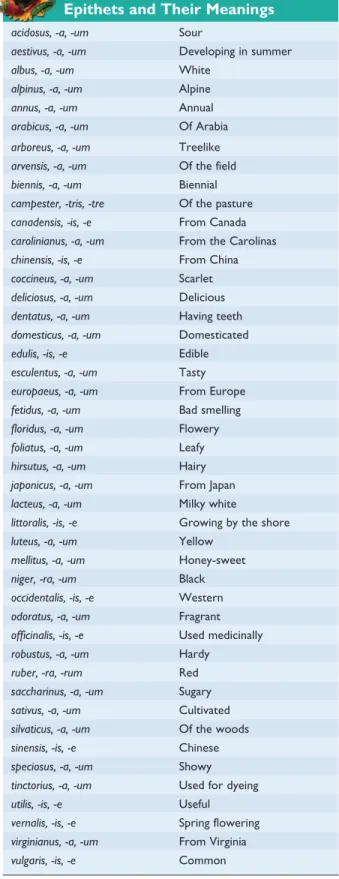
Scientific names may be just as descriptive as common names, and translation of the Latin (or latinized Greek) is informative ( table 8.2 ). Sometimes either the genus name or the specific epithet is commemorative, derived from the name of a botanist or other scientist. Some specific epithets are frequently used with more than one genus, and knowledge of their meanings will provide some insight into scientific names encountered later in this text ( table 8.3 ).
A complete scientific name also includes the name or names of the author or authors (often abbreviated) who first described the species or placed it in a particular genus. For example, the complete scientific name for corn isZea mays
L.; the “L” indicates that Linnaeus named this species. On the other hand, the complete name for osage orange isMaclura pomifera(Raf.) Schneid. This author citation indicates that Rafinesque-Schmaltz first described the species, giving it the specific epithetpomifera,but Schneider later put it in the genusMaclura.In this text, the author citations are omitted for simplicity.
130 U N I T I I Introduction to Plant Life: Botanical Principles
Table 8.3
Common Scientific
Epithets and Their Meanings
acidosus, -a, -um Sour
aestivus, -a, -um Developing in summer
albus, -a, -um White
alpinus, -a, -um Alpine
annus, -a, -um Annual
arabicus, -a, -um Of Arabia
arboreus, -a, -um Treelike
arvensis, -a, -um Of the field
biennis, -a, -um Biennial
campester, -tris, -tre Of the pasture
canadensis, -is, -e From Canada
carolinianus, -a, -um From the Carolinas
chinensis, -is, -e From China
coccineus, -a, -um Scarlet
deliciosus, -a, -um Delicious
dentatus, -a, -um Having teeth
domesticus, -a, -um Domesticated
edulis, -is, -e Edible
esculentus, -a, -um Tasty
europaeus, -a, -um From Europe
fetidus, -a, -um Bad smelling
floridus, -a, -um Flowery
foliatus, -a, -um Leafy
hirsutus, -a, -um Hairy
japonicus, -a, -um From Japan
lacteus, -a, -um Milky white
littoralis, -is, -e Growing by the shore
luteus, -a, -um Yellow
mellitus, -a, -um Honey-sweet
niger, -ra, -um Black
occidentalis, -is, -e Western
odoratus, -a, -um Fragrant
officinalis, -is, -e Used medicinally
robustus, -a, -um Hardy
ruber, -ra, -rum Red
saccharinus, -a, -um Sugary
sativus, -a, -um Cultivated
silvaticus, -a, -um Of the woods
sinensis, -is, -e Chinese
speciosus, -a, -um Showy
tinctorius, -a, -um Used for dyeing
utilis, -is, -e Useful
vernalis, -is, -e Spring flowering
virginianus, -a, -um From Virginia
vulgaris, -is, -e Common
A scientific name is unique, referring to only one spe-cies and universally accepted among scientists. It is the key to unlocking the door to the accumulated knowledge about a plant. Imagine the confusion if only common names were used and a reference was made to mock orange. Would this reference allude toMaclura pomiferaor to a species of
Philadelphus?
TAXONOMIC HIERARCHY
In addition to genus and species, other taxonomic categories exist to conveniently group related organisms. As pointed out, Linnaeus used an artificial system; however, today scientists use a phylogeneticsystem to group plants. In a phylogenetic system, information is gathered from morphology, anatomy, cell structure, biochemistry, genetics, and the fossil record to determine evolutionary relationships and, therefore, natural groupings among plants.
Higher Taxa
Species that have many characteristics in common are grouped into a genus, one of the oldest concepts in taxonomy ( fig. 8.6 ). In almost every society, the concept of genus has developed in colloquial language; in English the wordsoak, maple, pine, lily, androse represent distinct genera. These intuitive groupings reflect natural relationships based on shared vegetative and reproductive characteristics. Many of the scientific names of genera are directly taken from the ancient Greek and Roman common names for these genera (Quercus,old Latin word for oak).
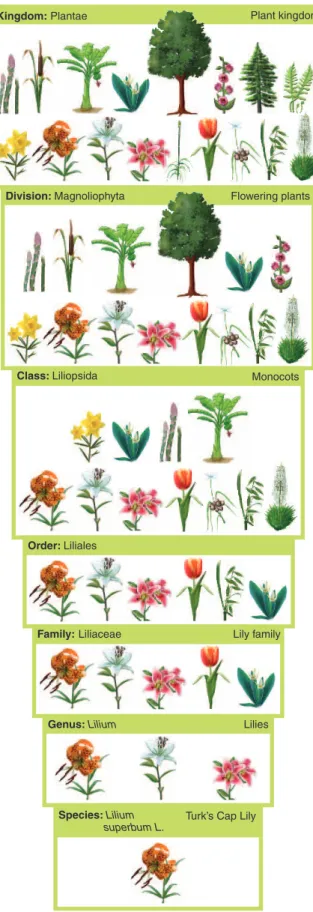
The next higher category, or taxon(pl., taxa ), above the rank of genus is the family.Families are composed of related genera that again (as in a genus) share combinations of morphological traits. In the angiosperms, floral and fruit features are often used to characterize a family. Ideally, the family represents a natural group with a common evolution-ary lineage; some families may be very small while others are very large, but still cohesive, groups. A few common angiosperm families that have special economic importance are listed in Table 8.4 . According to the International Code of Botanical Nomenclature, each family is assigned one name, which is always capitalized and ends in the suffix -aceae. The old established names of several well-known families present exceptions to this rule. Both the tradi-tional and standardized names are used for these families ( table 8.5 ). The taxa above the rank of family and their appropriate endings are presented in Table 8.6 . The higher the taxonomic category, the more inclusive the grouping ( fig. 8.7 ). Families are grouped into orders, orders into
classes,classes into divisions(phyla) * , and divisions into
kingdoms. A domain is above the kingdom level and is the *Eitherdivisionorphylum(sing.;phyla,plural) may be used to indicate the taxonomic rank that is composed of a group of related classes. Traditionally,divisionhas been the term preferred by botanists and will be used throughout this textbook.
most inclusive taxonomic category. The complete classifi-cation of a familiar species is also illustrated in Table 8.6 . In addition to the categories already described, biologists also recognize intermediate categories with the “sub” for any rank; for example, divisions may be divided into subdivisions, and species may be divided into subspecies (varieties and forms are also categories below the rank of species).
Although the International Code of Botanical Nomenclaturehas rules that govern the assignment of names and define the taxonomic hierarchy, it does not set forth any particular classification system. As a result, there are several organizational schemes that have supporters. These systems differ in the numbers of classes, divisions, kingdoms, and even domains and how they are related to one another. Presently most biologists use a three-domain, six-kingdom system, which will be described fully in Chapter 9. There is general agreement about the use of a three-domain, six-kingdom sys-tem, but biologists still debate the definition of a species.
What Is a Species?
As indicated previously, each kind of organism is known as a species. Although this intuitive definition, based on morphological similarities, works fairly well in many cir-cumstances, it is limited; scientists have given much thought to the biological basis of a species. Many accept the biologi-cal species conceptfirst proposed by Ernst Mayr in 1942,
which defines a species as “a group of interbreeding popula-tions reproductively isolated from any other such group of populations.”
This definition presents problems when defining plant species. Many closely related plant species that are distinct morphologically are, in fact, able to interbreed; this is true for many species of oaks and sycamores. By contrast, a single plant species may have diploid and polyploid(more than the diploid number of chromosomes) individuals that may be reproductively isolated from each other. It is esti-mated that as many as 40% of flowering plants may be polyploids, with the evening primrose group a thoroughly studied example; an even higher percentage of polyploid species occurs in ferns. Because of these limitations, alter-natives to the biological species concept have been sug-gested. The ecological species conceptrecognizes a species through its role in the biological community as defined by the set of unique adaptations within a particular species to its environment. The availablity of molecular sequence data for nucleic acids and proteins had led to the development of the genealogical species concept.Proponents utilize the distinct genetic history of organisms to differentiate species. Despite the lack of an all-inclusive botanical definition, the concept of “species” facilitates the naming, describing, and classifying of plants in a uniform manner. An inventory of the world’s species is the first step in preserving biodiver-sity, as discussed in A Closer Look 8.2—Saving Species through Systematics.
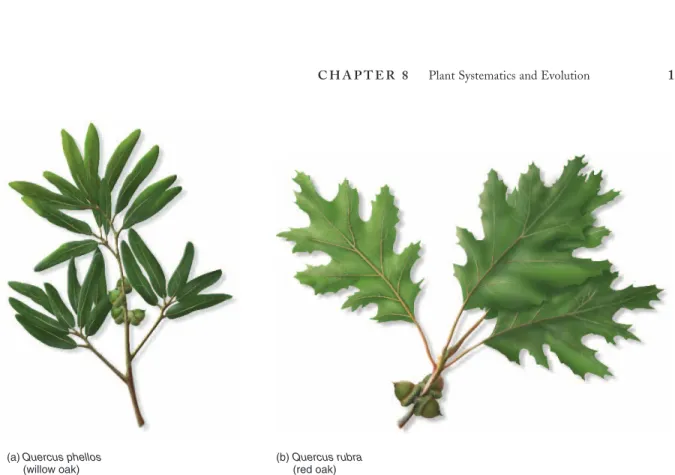
Figure 8.6 A genus is a group of species that share many characteristics in common. Although willow oak (Quercus phellos)and red oak (Quercus rubra)are clearly distinct species, they are both recognizable as belonging to the oak (Quercus)genus by the presence of acorns.
Quercus phellos
(willow oak)
(a) (b)Quercus rubra
132 U N I T I I Introduction to Plant Life: Botanical Principles
Table 8.4
Economically Important Angiosperm Families
Scientific Family Name Common Family Name Economic Importance
Aceraceae Maple Lumber (ash, maple), maple sugar
Apiaceae Carrot Edibles (carrot, celery), herbs (dill), poisonous (poison hemlock)
Arecaceae Palm Edibles (coconut), fiber oils and waxes, furniture (rattan)
Asteraceae Sunflower Edibles (lettuce), oils (sunflower oil), ornamentals (daisy)
Brassicaceae Mustard Edibles (cabbage, broccoli)
Cactaceae Cactus Ornamentals, psychoactive plants (peyote)
Cannabaceae Hemp Psychoactive (marijuana), fiber plants
Cucurbitaceae Gourd Edibles (melons, squashes)
Euphorbiaceae Spurge Rubber, medicinals (castor oil), edibles (cassava), ornamentals (poinsettia)
Fabaceae Bean Edibles (beans, peas), oil, dyes, forage, ornamentals
Fagaceae Beech Lumber (oak), dyes (tannins), ornamentals
Iridaceae Iris Ornamentals
Juglandaceae Walnut Lumber, edibles (walnut, pecan)
Lamiaceae Mint Aromatic herbs (sage, basil)
Lauraceae Laurel Aromatic oils (bay leaves), lumber
Liliaceae Lily Ornamentals, poisonous plants
Magnoliaceae Magnolia Ornamentals, lumber
Malvaceae Mallow Fiber (cotton), seed oil, edibles (okra), ornamentals
Musaceae Banana Edibles (bananas), fibers
Myrticaceae Myrtle Timber, medicinals (eucalyptus), spices (cloves)
Oleaceae Olive Lumber (ash), edible oil and fruits (olive)
Orchidaceae Orchid Ornamentals, spice (vanilla)
Papaveraceae Poppy Medicinal and psychoactive plants (opium poppy)
Piperaceae Pepper Black pepper, houseplants
Poaceae Grass Cereals, forage, ornamentals
Ranunculaceae Buttercup Ornamentals, medicinal and poisonous plants
Rosaceae Rose Fruits (apple, cherry), ornamentals (roses)
Rubiaceae Coffee Beverage (coffee), medicinals (quinine)
Rutaceae Citrus Edible fruits (orange, lemon)
Salicaceae Willow Ornamentals, furniture (wicker), medicines (aspirin)
Solanaceae Nightshade Edible (tomato, potato), psychoactive, poisonous (tobacco, mandrake)
Theaceae Tea Beverage (tea)
133
A CLOSER LOOK 8.2
Earth is blessed with a tremendous variety of living organ-isms. About 1.4 million living microbes, fungi, plants, and animals have been identified by systematics. The number of yet undescribed species is much greater, with estimates rang-ing between 10 million and 100 million. Biodiversityis an inventory of the number and variety of organisms that inhabit Earth. We are currently in the midst of a biodiversity crisis; the variety of living species is declining owing to an acceler-ated extinction rate. Human activities are responsible for this terrible loss. Over 6.6 billion people at present inhabit Earth, and this number is expected to increase to over 9 billion in the next 50 years. Population pressures cause natural areas to be cleared for agriculture or expanding urbanization. More people also results in more pollution that fouls the land, sea, and air. All of these human-induced changes translate into a death toll upon the world’s biodiversity.
Consider the tropical rain forests of the world. These forests are some of the most biologically diverse areas on the planet, home to approximately 70% of the world’s species. Unfortunately, these forests have been subjected to massive destruction. Scientists have calculated that species loss in the tropical rain forests is currently 1% to 5% per decade and will increase to 2% to 8% by the year 2015. This rate translates to an average loss of 9,000 species per year, or a heartbreak-ing 225,000 extinctions between 1990 and 2015.
Why should we care about biodiversity? Biodiversity is the basis for the necessary essentials to human existence: food, fiber, fuel, and shelter. Of the estimated more than 250,000 species of angiosperms, nearly 20,000 have been used at one time or another as food for humans. Advances in agriculture are dependent upon the interaction between sys-tematics and biodiversity. Since the 1960s, world crop yields have increased two- to four-fold. Part of this increase is due to the creation of improved crop varieties through breeding programs and more recently through genetic engineering. Locating and identifying relatives of crop species have been of critical importance to agricultural research in breeding for desirable characteristics. With the advent of genetic engi-neering, nearly any plant species is a potential source of genes for transfer to agricultural crops. Ironically, the conversion of native ecosystems to agricultural lands in an attempt to accommodate the food demands of an exponentially grow-ing human population may eliminate the very organisms on which agriculture depends for its future. Fertile soil, obvi-ously essential for the vitality of agricultural crops, is also a by-product of biodiversity because it is formed through the interactions of a number of soil organisms: fungi, earthworms, bacteria, plant roots, and burrowing mammals. Species loss could result in soils unable to support vegetation.
Not all of the world’s supply of food comes from cul-tivated sources. There is still a substantial harvest of wild
plants and animals. Commercial fishing is in essence the hunting of wild fish populations. Blueberries and maple syrup are just two examples of foods gleaned from nature in the United States. Wood and wood pulp are other products har-vested from biodiversity resources. Biodiversity in itself is a major economic force, as evidenced by the increasing popu-larity of ecotourism. Sport fishing, hunting, and bird-watching are other examples of economically profitable activities that depend on the preservation of biodiversity. Lastly, nearly half of the medicinals now in use originated from a wild plant, and it has been estimated that between 35,000 and 70,000 spe-cies of plants are used directly as medicines worldwide.
Knowledge of systematics has many practical applications. There has been a movement to reduce our dependence upon chemical pesticides and instead rely more heavily on biological controls to manage nuisance organisms. Biological control methods depend upon proper identification of a pest, knowledge of its life cycle, and correct identification of its predators and susceptibility to disease. Misidentification can be costly. Mealybugs are noxious pests that can cause mas-sive damage to crops. A species of mealybug was identified as the culprit in the devastation of coffee plantations in Kenya. Biological control methods were employed using the natural enemies of the identified species of mealybug but were inef-fective. Further investigation revealed that the mealybug had been misidentified. Once the correct species was assigned, natural pests of the mealybug were brought in from its native habitat in Uganda, and the mealybug infestation was soon brought under control. Knowledge of systematics can be used to predict economic uses of little known but related species. Researchers identified anticancer compounds from Kenyan populations of Maytenus buchananii. There was a problem, however; the species was rare in this locality. Knowledge of systematics suggested that closely related spe-cies would probably possess the same chemical compounds. This proved to be the case when a population of the same genus but different species was collected from India.
Clearly, the preservation of biodiversity should be of utmost importance to everyone. Systematic research is fun-damental to learning about the characteristics and dimensions of biodiversity. Systematics is necessary to identify localities of high species diversity or rare species. Baseline data must be collected to ascertain which species are declining in num-bers or those whose range is becoming limited. Knowledge of systematics will determine if exotic pests are moving into new areas and threatening native species. Without scientific identification and mapping, valuable habitats and the species found there will be lost. In fact, Systematics Agenda 2000 is an ongoing global initiative by the scientific community to dis-cover, describe, and classify the world’s species in an effort to understand and conserve biodiversity.
134 U N I T I I Introduction to Plant Life: Botanical Principles Family Name Traditional Name Standardized Name
Sunflower Compositae Asteraceae
Mustard Cruciferae Brassicaceae
Grass Gramineae Poaceae
Mint Labiatae Lamiaceae
Pea Leguminosae Fabaceae
Palm Palmae Arecaceae
Carrot Umbelliferae Apiaceae
Table 8.5
Traditional and
Standardized Names for Some
Common Families
Table 8.6
The Taxonomic
Hierarchy and Standard Endings
Rank
Standard
Ending Example
Division (Phylum) -phyta Magnoliophyta
Class -opsida Liliopsida
Order -ales Liliales
Family -aceae Liliaceae
Genus Lilium
Species Lilium superbum L.
Figure 8.7 Major ranks in the taxonomic hierarchy. Note that the higher the ranking, the broader the defining characteristics and the more inclusive the group.
Turk’s Cap Lily Species: Lilium superbum L. Division: Magnoliophyta Order: Liliales Family: Liliaceae Lilies
Kingdom: Plantae Plant kingdom
Flowering plants
Lily family
Genus: Lilium
Class: Liliopsida Monocots
THE INFLUENCE OF DARWIN’S
THEORY OF EVOLUTION
The theory of evolution by means of natural selection was to irrevocably change the way biologists view species. Instead of unchanging organisms and generations created all alike, it was realized that species are dynamic and variable, continu-ally evolving through the mechanism of natural selection in which adaptions are refined to a changing environment.
The Voyage of the HMS
Beagle
Charles Robert Darwin ( fig. 8.8 ) was born in England in 1809 to a family of distinguished naturalists and physi-cians. His grandfather was Erasmus Darwin, a well-known poet and physician, and his father, Robert Darwin, was a successful country doctor. At 15 years of age, Charles was sent to the University of Edinburgh Medical School to study medicine. Not finding it to his liking, he transferred after
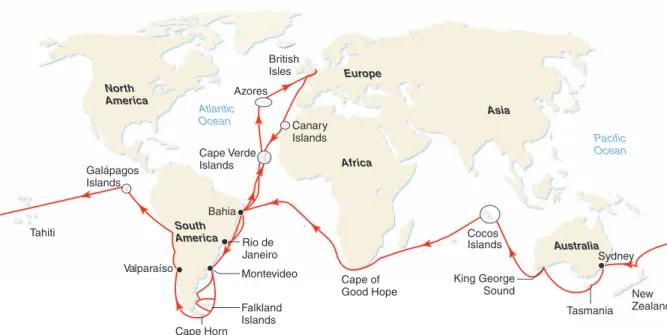
2 years to Cambridge University to study theology. While at Cambridge, he spent much of his free time with the students and professors of natural history. This association later proved invaluable. In 1831, at the age of 22, Darwin graduated from Cambridge with a degree in theology. Shortly thereafter he was recommended as ship naturalist by John Henslow, one of the natural history professors at Cambridge. The ship in ques-tion was the HMSBeagle, commissioned by King William IV to undertake a voyage around the world for the purpose of charting coastlines, particularly that of South America, for the British navy. The voyage of theBeaglebegan on December 27, 1831, and was to last 5 years ( fig. 8.9 ). During his time on theBeagle,Darwin collected thousands of plants and other specimens from South America, the Galápagos Islands (off the coast of Ecuador), Australia, and New Zealand. He stud-ied geological formations and noted fossil forms of extinct species. He found that some fossils of extinct species bore a striking resemblance to extant species, as though the former had given rise to the latter. Darwin spent some time studying the species found on the Galápagos Islands. He noted that animals and plants found in the Galápagos were obviously similar to species found in South America, but there were distinct differences. These observations led Darwin to ques-tion the fixity of species concept. According to this concept, widely held at the time of Darwin, species were acts of Divine Creation, unchanging over time.
When theBeaglereturned to England in 1836, Darwin married his cousin Emma Wedgwood (of the famous
Figure 8.9 The 5-year voyage of the HMS Beagle.Darwin’s observations on the geology and distributions of plants and animals in South America and the Galápagos Islands were the groundwork for the development of the theory of evolution by means of natural selection. North America Galápagos Islands Tahiti Valparaíso Cape Horn Falkland Islands Montevideo Rio de Janeiro South America Bahia Azores British Isles Cape Verde Islands Canary Islands Africa Cape of Good Hope Europe Asia Cocos Islands King George Sound Australia Tasmania Sydney New Zealand Atlantic Ocean Pacific Ocean
Figure 8.8 Charles Darwin (1809–1882) published The Origin of Speciesin 1859.
136 U N I T I I Introduction to Plant Life: Botanical Principles
Wedgwood china family) and settled, at age 27, in the English countryside. He continued his work in natural history, con-ducting experiments, writing papers, and corresponding with other naturalists. Among his works was a four-volume trea-tise on the classification and natural history of barnacles.
In 1842, he began putting his thoughts together on what was to become his theory of evolution by natural selection. Darwin continued to expand and fine-tune his thoughts over the next 16 years. In June of 1858, he received a manuscript from Alfred Russel Wallace (1823–1913), a young British naturalist working in Malaysia. Wallace’s work was entitled
On the Tendency of Varieties to Depart Indefinitely from the Original Type; Wallace had independently arrived at the concept of natural selection. Wallace and Darwin jointly presented their ideas on July 1, 1858, at a meeting of the Linnean Society in London. During the next few months, Darwin completed writing what was to become one of the most influential texts of all time. With the publication on November 24, 1859 ofOn the Origin of Species by Means of Natural Selection, or the Preservation of Favoured Races in the Struggle for Lifeby Charles Darwin, biological thought was changed forever.
Natural Selection
There are four underlying premises to Darwin’s theory of evolution by natural selection:
1. Variation:Members within a species exhibit individual differences, and these differences are heritable.
2. Overproduction:Natural populations increase geometri-cally, producing more offspring than will survive. 3. Competition:Individuals compete for limited resources,
what Darwin called “a struggle for existence.”
4. Survival to reproduce: Only those individuals that are better suited to the environment survive and reproduce (survival of the fittest), passing on to a proportion of their offspring the advantageous characteristics.
Offspring that inherit the advantageous traits are selected for survival and many will live to reproductive age passing on the desirable attributes. Those that do not inherit these traits are not likely to survive or reproduce. Gradually, the species evolves, or changes, as more and more individuals carry these traits. Darwin gave this example:
If the number of individuals of a species with plumed seeds could be increased by greater powers of dis-semination within its own area (that is, if the checks to increase fell chiefly on the seeds), those seeds which were provided with ever so little more down, would in the long run be most disseminated; hence a greater number of seeds thus formed would ger-minate, and would tend to produce plants inheriting the slightly better-adapted down.
Concept Quiz
Darwin identified four conditions that are necessary if evo-lution is to occur: genetic variation, overproduction of off-spring, competition for limited resources, and reproduction of the fittest.
Imagine a plant population that reproduces entirely by asexual methods, such as spreading by underground stems. Although there are many individual plants in the population, they are essentially a single plant genetically; that is, they are clones. Can natural selection act on a population of clones? Is this population capable of evolving? Explain.
In addition to natural selection, humans have long used
artificial selection,natural selection as practiced by humans (see Chapter 11), to shape the characteristics of crop plants to suit the needs of humanity. The most serious flaw in Darwin’s Theory of Evolution was the mechanism of heredity. Darwin had not worked out the source of variation in species, nor did he understand the means by which traits are passed down from generation to generation. It would take an Austrian monk, Gregor Mendel (see Chapter 7), working in relative obscurity with pea plants, to come up with the answers to Darwin’s questions about inheritance.
A well-known example of natural selection is the case of heavy-metal tolerance in bent grass, Agrostis tenuis.
Certain populations of bent grass were found growing near the tailings, or soil heaps, excavated from lead mines in Wales despite the fact that mine soils had high concentra-tions of lead and other heavy metals (copper, zinc, and nickel). When mine plants were transplanted into uncon-taminated pasture soil, all survived but were small and slow growing. A nearby population of bent grass from uncontaminated pasture soil exhibited no such tolerance when transplanted into mine soil; in fact, most (57 out of 60) of the pasture plants died in the lead-contaminated soil. The survival of the three pasture plants in mine soil is significant; undoubtedly these three possessed an advanta-geous trait, the ability to tolerate heavy-metal soil. A trait that promotes the survival and reproductive success of an organism in a particular environment is an adaptation.The mine plants had descended from bent grass plants that pos-sessed the adaptation that conferred tolerance to the mine soil; over time (less than 100 years in this case) populations ofAgrostistolerant to heavy metal evolved from those few tolerant individuals.
Although Darwin’s theory of natural selection is the foundation of modern evolutionary concepts, biologists today are still learning about the forces that shape evolution.
Concept Quiz
Natural selection favors the survivorship of those individu-als in a population that possess characteristics crucial for survival.
You observe that trees in a part of a forest in which deer are plentiful have higher branches than the trees in a fenced-off part of the forest. Explain the different selective forces at work in these two different environments.
PHYLOCODE
The Linnaean system of nomenclature and the hierarchy of classification that has been presented in this chapter were created more than 250 years ago, before Charles Darwin and Alfred R. Wallace had proposed their evolutionary theory by means of natural selection. Linnaean nomenclature is an artificial system based upon the appearance of organisms that often does not reflect their evolutionary relationships, or
phylogeny.Currently, there is a movement to reject this pre-evolutionary taxonomy and replace it with a new system of nomenclature, called PhyloCode, that is truly phylogenetic.
PhyloCode is based upon the work of the twentieth-century German entomologist Willi Hennig, who proposed that only shared derived characteristics should be used to define a group of related organisms. He further proposed that each group constructed should be monophyletic, or composed of only those organisms that can trace their descent from a common ancestor. These natural groupings are known as
clades.
First introduced in 1983, the PhyloCode abandons the Linnaean ranks of the taxonomic hierarchy. In this system, as new information that may change a group’s ranking accu-mulates, names are not changed, as they would be with the Linnaean system, which associates different suffixes with different ranks. Instead of ranks, clades are the only groups recognized. Opponents fear that a complete abandonment of all ranks will result in a loss of comparative information and encourage a proliferation of names that, without any context, will serve only to confuse the nomenclature.
Released in 1991, the APG (American Phylogeny Group) system compared the sequence data of select genes to clas-sify the flowering plants. The highest formal rank in this classification system is the order; higher categories are only identified as clades. As more data accumulated, APG II, an update of the classification, became available in 2003. In this system, angiosperms are recognized as a clade, sharing several distinct characteristics, such as ovules enclosed in a carpel and double fertilization. Within the angiosperms, all mono-cots appear to belong to a distinct clade, but molecular data
indicates that the traditional dicots represent several evolution-ary lineages. Most of the dicots do comprise a clade and are now called the eudicotsor true dicots.Approximately 75% of all angiosperm species are now classified as eudicots. Traditional dicots excluded from the clade eudicot are called the paleodi-cots(literallyold dicots) by some authorities and include sev-eral ancient lineages in the evolution of angiosperms.
CHAPTER SUMMARY
1. Plant systematics has its origins in the classical works of Theophrastus of ancient Greece, who is generally regarded as the Father of Botany. The study of plants, as did many other intellectual endeavors, went into a decline during the Dark Ages of Europe but was later revived owing to renewed interest in herbalism during the fifteenth to sev-enteenth centuries.
2. Linnaeus, a Swedish botanist of the eighteenth century, is credited with the creation of the binomial, or scientific name. Although common names are often informative and readily accessible, scientific names have the advantage of being recognized the world over and unique to a single species.
3. The taxonomic hierarchy includes the major ranks: do main, kingdom, division (phylum), class, order, family, genus, and species.
4. Biologists have wrestled with the concept of the species; the biological concept describes a species as a group of interbreeding populations, reproductively isolated from other populations.
5. Charles Darwin and his theory of evolution by natural selection irrevocably changed the way biologists viewed species. Natural selection favors those individuals that possess traits that better enable them to survive in the environment. These individuals survive to reproduce, and many of their offspring will tend to have these adaptations and pass them on to future generations. In this way, popu-lations change over time. The four underlying conditions of Darwin’s theory of evolution by natural selection are variation, overproduction of offspring, competition, and survival to reproduce.
REVIEW QUESTIONS
1. List the common names of some of the wildflowers in your area. Determine the type of information each name imparts.
2. Using a plant dictionary (see Further Reading) look up the scientific names and their meanings for common house-plants and landscape house-plants in your area.
3. Briefly describe the concept of evolution by natural selection.
138 U N I T I I Introduction to Plant Life: Botanical Principles
4. Why are only inherited traits important in the evolution-ary process?
5. How do mutations (Chapter 7) lead to the evolution of new species?
6. What was the lasting contribution of Linnaeus? How was the binomial system an improvement over polynomials? 7. In what ways can systematics preserve biodiversity?
FURTHER READING
Blunt, Wilfrid. 1971. The Compleat Naturalist: A Life of Linnaeus.The Viking Press, New York, NY.
Briggs, David, and S. Max Walters. 1984.Plant Variation and Evolution,2nd Edition. Cambridge University Press, Cambridge, MA.
Coombes, Allen J. 1994.Dictionary of Plant Names: Botanical Names and Their Common Equivalents. Timber Press, Beaverton, OR.
Conniff, Richard. 2006/2007. Happy Birthday Linnaeus.
Natural History115(10): 42–47.
Darwin, Charles (author) and Edward O Wilson (editor) 2006.
From So Simple A Beginning: The Four Great Books of Charles Darwin.W. W. Norton & Company, New York. Friedman, William E. 2006. Sex Among the Flowers.Natural
History115(9): 48–53.
Gilbert, Bil. 1984. The Obscure Fame of Carl Linnaeus.
Audubon86:102–115.
Greenaway, Kate. 1992.Language of Flowers.Dover Press, New York, NY.
Irvine, William. 1983. Apes, Angels, and Victorians: The Story of Darwin, Huxley, and Evolution.University Press of America, New York, NY.
Judd, Walter S., Christopher S. Campbell, Elizabeth A. Kellogg, Peter F. Stevens, and Michael J. Donoghue. 2002.Plant Systematics, A Phylogenetic Approach, 2nd Edition.Sinauer Associates, Sunderland, MA.
Kohn, David. 2005. The Miraculous Season: The Historical Darwin.Natural History114(9): 38–40.
Laufer, Geraldine Adamich. 1993.The Language of Flowers.
Workman Publishing, New York, NY.
Laufer, Geraldine Adamich. 1996. Tussie-Mussies.The Herb CompanionApril/May: 48–53.
Litt, Amy. 2006. Origins of Floral Diversity.Natural History
115(5): 34 –40.
Mayr, Ernst. 2000. Darwin’s Influence on Modern Thought.
Scientific American283(1): 78–83.
Miller, Douglass R., and Amy Y. Rossman. 1995. Systematics, Biodiversity, and Agriculture. BioScience 45(10): 680– 686.
Pennisi, Elizabeth. 2001. Linnaeus’s Last Stand? Science
291: 2304–2307.
Piementel, David, Christa Wilson, Christine McCullum, Rachel Huang, Paulette Dwen, Jessica Flack, Quynh Tran, Tamara Saltman, and Barabara Cluff. 1995. Economic and Environmental Benefits of Biodiversity. BioScience
47(11): 747–757.
Quammen, David. 2004. Darwin’s Big Idea. National Geographic206(5): 2–35.
Quammen, David. 2007. The Name Giver. National Geographic211(6): 72–87.
Raby, Peter. 2001.Alfred Russel Wallace: A Life.Princeton University Press, Princeton, NJ.
Savage, Jay M. 1995. Systematics and the Biodiversity Crisis.
BioScience45(10): 673–679.
Schiebinger, Londa. 1996. The Loves of Plants. Scientific American274(2): 110–115.
Sulloway, Frank J. 2005. The Evolution of Charles Darwin.
Smithsonian36(9): 58–69.
Withgott, Jay. 2000. Is It “So Long, Linnaeus?” BioScience
50(8): 646–651.
ONLINE LEARNING CENTER
Visitwww.mhhe.com/levetin5efor online quizzing, web links to chapter-related material, and more!