McCreadie, Richard (2012) News vertical search using user-generated
content. PhD thesis.
http://theses.gla.ac.uk/3813/
Copyright and moral rights for this thesis are retained by the author
A copy can be downloaded for personal non-commercial research or
study, without prior permission or charge
This thesis cannot be reproduced or quoted extensively from without first
obtaining permission in writing from the Author
The content must not be changed in any way or sold commercially in any
format or medium without the formal permission of the Author
When referring to this work, full bibliographic details including the
author, title, awarding institution and date of the thesis must be given
News Vertical Search using
User-Generated Content
Richard McCreadie
School of Computing Science
University of Glasgow
A thesis submitted for the degree of
Doctor of Philosophy
September 2012
c
Abstract
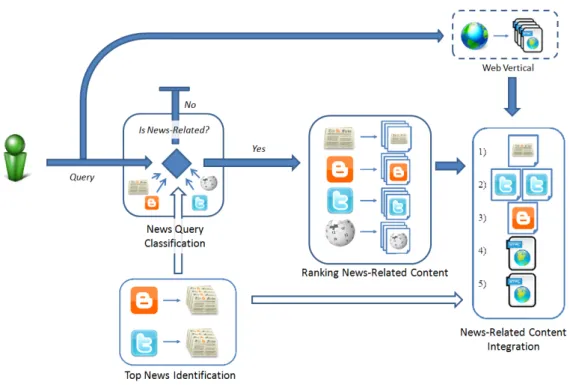
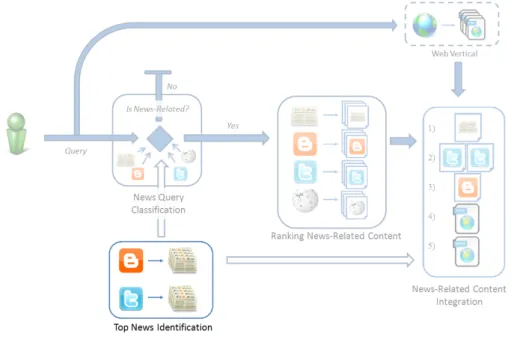
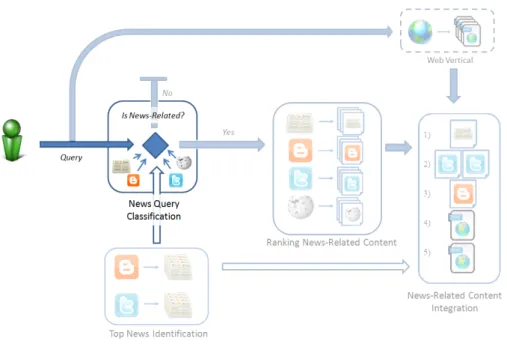
The thesis investigates how content produced by end-users on the World Wide Web — referred to as user-generated content — can enhance the news vertical aspect of a universal Web search engine, such that news-related queries can be satisfied more accurately, comprehensively and in a more timely manner. We propose a news search framework to describe the news vertical aspect of a universal web search engine. This framework is comprised of four components, each providing a different piece of functionality. The Top Events Identification component identifies the most important events that are happening at any given moment using discussion in user-generated content streams. The News Query Classification component classifies incoming queries as news-related or not in real-time. The Ranking News-Related Content component finds and ranks relevant content for news-related user queries from multiple streams of news and user-generated content. Finally, the News-Related Content Integration component merges the previously ranked content for the user query into the Web search ranking. In this thesis, we argue that user-generated content can be leveraged in one or more of these components to better satisfy news-related user queries. Potential enhancements include the faster identification of news queries relating to breaking news events, more accurate classification of news-related queries, increased coverage of the events searched for by the user or increased freshness in the results returned.
Approaches to tackle each of the four components of the news search framework are proposed, which aim to leverage user-generated content. Together, these approaches form the news vertical com-ponent of a universal Web search engine. Each approach proposed for a comcom-ponent is thoroughly evaluated using one or more datasets developed for that component. Conclusions are derived concern-ing whether the use of user-generated content enhances the component in question usconcern-ing an appropriate measure, namely: effectiveness when ranking events by their current importance/newsworthiness for the Top Events Identification component; classification accuracy over different types of query for the News Query Classification component; relevance of the documents returned for the Ranking News-Related Content component; and end-user preference for rankings integrating user-generated content in compar-ison to the unaltered Web search ranking for the News-Related Content Integration component. Analysis
of the proposed approaches themselves, the effective settings for the deployment of those approaches and insights into their behaviour are also discussed.
In particular, the evaluation of the Top Events Identification component examines how effectively events — represented by newswire articles — can be ranked by their importance using two different streams of user-generated content, namely blog posts and Twitter tweets. Evaluation of the proposed approaches for this component indicates that blog posts are an effective source of evidence to use when ranking events and that these approaches achieve state-of-the-art effectiveness. Using the same ap-proaches instead driven by a stream of tweets, provide a story ranking performance that is significantly more effective than random, but is not consistent across all of the datasets and approaches tested. In-sights are provided into the reasons for this with regard to the transient nature of discussion in Twitter.
Through the evaluation of the News Query Classification component, we show that the use of timely features extracted from different news and user-generated content sources can increase the accuracy of news query classification over relying upon newswire provider streams alone. Evidence also sug-gests that the usefulness of the user-generated content sources varies as news events mature, with some sources becoming more influential over time as new content is published, leading to an upward trend in classification accuracy.
The Ranking News-Related Content component evaluation investigates how to effectively rank con-tent from the blogosphere and Twitter for news-related user queries. Of the approaches tested, we show that learning to rank approaches using features specific to blog posts/tweets lead to state-of-the-art rank-ing effectiveness under real-time constraints.
Finally this thesis demonstrates that the majority of end-users prefer rankings integrated with user-generated content for news-related queries to rankings containing only Web search results or integrated with only newswire articles. Of the user-generated content sources tested, the most popular source is shown to be Twitter, particularly for queries relating to breaking events.
The central contributions of this thesis are the introduction of a news search framework, the ap-proaches to tackle each of the four components of the framework that integrate user-generated content and their subsequent evaluation in a simulated real-time setting. This thesis draws insights from a broad range of experiments spanning the entire search process for news-related queries. The experiments re-ported in this thesis demonstrate the potential and scope for enhancements that can be brought about by the leverage of user-generated content for real-time news search and related applications.
Acknowledgements
This thesis was make possible by the great support that I have received from a wide variety of people during the course of my PhD.
I first would like to thank my parents, who constantly encouraged me and helped keep the more practical aspects of my life intact, especially when deadlines were approaching.
I must thank both my supervisor, Iadh Ounis, and co-supervisor Craig Macdonald. Their supervision taught me how to integrate and build upon prior works from many areas to tackle new tasks and design sound experiments to explore them. Moreover, without their meticulous attention to detail, this thesis would not have been possible.
I would also like to thank the TerrierTeam research group with whom I shared an office for four years (and counting), most notably Rodrygo Santos who provided feedback relating to some of the experi-ments in this thesis.
Finally, I wish to thank Charlie Clarke for his mentoring during the SIGIR Doctoral Consortium in the early stage of this thesis, which helped to shape it.
Contents
Abstract i Acknowledgements iii 1 Introduction 1 1.1 Introduction . . . 1 1.2 Motivation . . . 2 1.3 Thesis Statement . . . 6 1.4 Contributions . . . 61.5 Origins of the Material . . . 8
1.6 Thesis Outline . . . 9 2 Information Retrieval 12 2.1 Introduction . . . 12 2.2 Indexing . . . 14 2.2.1 Tokenisation . . . 15 2.2.2 Stopword Removal . . . 15 2.2.3 Stemming . . . 16
2.2.4 Index Data Structures . . . 16
2.2.5 Large Scale Indexing and MapReduce . . . 19
2.2.6 Document Boilerplate . . . 23
2.3 Document Retrieval . . . 25
2.3.1 Term Frequency - Inverse Document Frequency (TF-IDF) . . . 26
2.3.2 The Best Match Weighting Model . . . 27
2.3.3 Divergence From Randomness . . . 28
CONTENTS
2.3.5 Query Expansion and Pseudo Relevance Feedback . . . 30
2.4 Evaluation . . . 32
2.4.1 Evaluation Measures . . . 32
2.4.2 Cranfield Paradigm . . . 34
2.4.3 TREC . . . 35
2.4.4 Relevance Assessment . . . 35
2.5 Machine Learning for IR . . . 36
2.5.1 Classification . . . 36
2.5.2 Learning to Rank . . . 38
2.5.3 Machine Learning Libraries/Toolkits . . . 39
2.6 Topic Detection and Tracking (TDT) . . . 39
2.6.1 Topic Tracking . . . 40
2.7 Ranking Aggregates . . . 41
2.7.1 Aggregate Ranking Approaches . . . 41
2.8 Resource Selection/Vertical Search . . . 43
2.8.1 Source Selection via Expected Relevancy . . . 45
2.8.2 Source Selection via Vertical Type . . . 46
2.8.3 Merging of Document Rankings . . . 47
2.9 Conclusions . . . 48
3 Search and User Generated Content 50 3.1 Introduction . . . 50
3.2 The Blogosphere . . . 51
3.2.1 Blog Search Queries . . . 52
3.2.2 Blog Post Search . . . 53
3.2.3 Top News Stories Identification . . . 54
3.2.4 News and Blogs . . . 56
3.2.5 Summary . . . 57 3.3 Digg . . . 57 3.3.1 Digg Users . . . 58 3.3.2 Story Promotion . . . 58 3.3.3 Summary . . . 59 3.4 Twitter . . . 59
CONTENTS
3.4.1 Twitter Characteristics . . . 60
3.4.2 Twitter Search . . . 61
3.4.3 TREC 2011 Microblog Track . . . 62
3.4.4 Event Detection in Twitter . . . 63
3.4.5 Summary . . . 64
3.5 Query-Logs . . . 64
3.5.1 Query Log Analysis . . . 65
3.5.2 Query Types and Vertical Selection . . . 66
3.5.3 Summary . . . 68
3.6 Wikipedia . . . 68
3.6.1 News Events and Wikipedia . . . 69
3.6.2 Summary . . . 69
3.7 Conclusions . . . 70
4 A Framework for Real-time News Search 72 4.1 Introduction . . . 72
4.2 Real-Time News Queries . . . 73
4.3 A Taxonomy of News Queries . . . 74
4.4 Framework Overview . . . 76
4.5 Top Events Identification . . . 79
4.6 News Query Classification . . . 83
4.7 Ranking News-Related Content . . . 86
4.7.1 Blog Posts . . . 87
4.7.2 Real-time Tweet Search . . . 88
4.8 News-Related Content Integration . . . 89
4.9 Conclusions . . . 91
5 Evaluation Datasets and Crowdsourcing 92 5.1 Introduction . . . 92
5.2 Datasets Overview . . . 94
5.2.1 Top Event Identification Datasets . . . 97
5.2.2 News Query Classification Datasets . . . 99
5.2.3 Ranking News-Related Content Datasets . . . 102
CONTENTS
5.2.5 Summary . . . 104
5.3 Crowdsourcing . . . 104
5.3.1 Work Validation Strategies . . . 106
5.3.2 Agreement Measures . . . 107
5.3.3 Structured Crowdsourced Evaluation . . . 108
5.4 Crowdsourced Task: Identifying Top Events . . . 108
5.4.1 Task Description . . . 109
5.4.2 Interface Design for News Article Assessment . . . 109
5.4.3 Validation of Worker Assessments . . . 110
5.4.4 Crowdsourcing Configuration . . . 112
5.4.5 Assessment Accuracy . . . 112
5.5 Crowdsourcing Task: Classifying User Queries . . . 113
5.5.1 Task Description . . . 113
5.5.2 Interface Design for News Query Classification . . . 114
5.5.3 Validation of Worker Labelling . . . 116
5.5.4 Crowdsourcing Configuration . . . 116
5.5.5 Label Quality . . . 117
5.6 Crowdsourcing Task: Ranking Blog Posts for a News Story . . . 118
5.6.1 Task Description . . . 118
5.6.2 Interface Design for Blog Post Ranking . . . 119
5.6.3 Validation of Worker Assessments . . . 120
5.6.4 Crowdsourcing Configuration . . . 122
5.6.5 Assessment Quality . . . 122
5.7 Crowdsourced Task: Document Relevance Assessment . . . 123
5.7.1 Task Description . . . 123
5.7.2 Interface Design for Document Relevance Assessment . . . 124
5.7.3 Validation of Worker Assessments . . . 126
5.7.4 Crowdsourcing Configuration . . . 126
5.7.5 Assessment Quality . . . 126
CONTENTS
6 Identifying Top News 129
6.1 Introduction . . . 129
6.2 Unlearned Story Ranking Approaches . . . 131
6.2.1 Voting for Important Stories (Votes) . . . 131
6.2.2 Relevance Weighted Aggregation (RWA) . . . 132
6.2.3 Story Length Normalisation (RWAN) . . . 133
6.2.4 Temporal Promotion (GaussBoost) . . . 134
6.2.5 Maximum Burst Magnitude (MaxBurst) . . . 136
6.3 Learning To Rank Stories (LTRS) . . . 137
6.4 Experimental Methodology . . . 140
6.4.1 Blog Stream Methodology . . . 140
6.4.2 Tweet Stream Methodology . . . 143
6.5 Research Questions . . . 144
6.6 Evaluation: News Story Ranking with Blogs . . . 146
6.6.1 Votes, RWA and RWAN . . . 147
6.6.2 GaussBoost . . . 148
6.6.3 Learning to Rank Stories Effectiveness . . . 149
6.6.4 Influential Story Ranking Features . . . 151
6.6.5 Event Promotion in Blogs . . . 152
6.6.6 Conclusions . . . 153
6.7 Evaluation: News Story Ranking with Tweets . . . 153
6.7.1 Votes, RWA and RWAN . . . 154
6.7.2 GaussBoost . . . 156
6.7.3 MaxBurst . . . 158
6.7.4 Learning to Rank Stories Effectiveness . . . 159
6.7.5 Influential Story Ranking Features . . . 162
6.7.6 Event Promotion in Tweets . . . 163
6.7.7 Conclusions . . . 164
CONTENTS
7 News Query Classification 168
7.1 Introduction . . . 168
7.2 Feature Aggregation from News Streams (FANS) . . . 169
7.3 Experimental Methodology . . . 172
7.4 News Query Classification Features . . . 174
7.5 Research Questions . . . 177
7.6 Evaluating News Query Classification on the May 2006 Dataset . . . 178
7.6.1 Integrating User-generated Content . . . 178
7.6.2 Feature Importance . . . 180
7.6.3 Timeliness . . . 183
7.7 Evaluating News Query Classification on the April 2012 Dataset . . . 184
7.7.1 Integrating User-generated Content . . . 185
7.7.2 Feature Importance . . . 187
7.7.3 Timeliness . . . 191
7.8 Conclusions . . . 192
8 Ranking News Content 195 8.1 Introduction . . . 195
8.2 Learning to Rank User-Generated Content . . . 196
8.2.1 Learning to Rank Blog Posts . . . 197
8.2.2 Learning to Rank Tweets . . . 201
8.3 Experimental Methodology . . . 205
8.3.1 Blog Post Ranking Methodology . . . 205
8.3.2 Tweet Ranking Methodology . . . 207
8.4 Research Questions . . . 207
8.5 Evaluation: Blog Post Ranking . . . 208
8.5.1 Learning to Rank Performance . . . 208
8.5.2 Ranking Effectiveness Over Time . . . 209
8.5.3 Blog Post Ranking Features . . . 210
8.5.4 Conclusions . . . 212
8.6 Evaluation: Tweet Ranking . . . 213
8.6.1 Learning to Rank Performance . . . 213
CONTENTS
8.6.3 Conclusions . . . 216
8.7 Conclusions . . . 217
9 News-Related Content Integration 219 9.1 Introduction . . . 219
9.2 Resource Selection for News-Related Content Integration . . . 220
9.3 Comparative Ranking Evaluation and Presentation . . . 222
9.4 Research Questions . . . 226
9.5 Experimental Methodology . . . 226
9.5.1 News-Related Queries and Content Sources . . . 226
9.5.2 Document Rankings . . . 227
9.5.3 Experiment structure . . . 229
9.5.4 Worker Instructions . . . 230
9.5.5 Crowdsourcing Configuration and Statistics . . . 230
9.6 Evaluation: Integrating News and User-generated Content . . . 231
9.6.1 Integrating Top Events . . . 231
9.6.2 Integrating News and User-Generated Content vs the Web Search Ranking . . . 233
9.6.3 Integrating User-Generated Content vs News Content . . . 235
9.6.4 Integrating User-Generated Content for Breaking and Recent Events . . . 237
9.7 Conclusions . . . 238
10 Conclusions and Future Work 241 10.1 Contributions and Conclusions . . . 241
10.1.1 Contributions . . . 241
10.1.2 Conclusions . . . 244
10.1.3 Thesis Conclusions . . . 248
10.2 Directions for Future Work . . . 249
10.3 Closing Remarks . . . 250
A Parameter Analysis for Top Events Identification 252 A.1 Parameter Analysis on Blogs . . . 252
A.1.1 News Story Representations . . . 252
CONTENTS
A.2 Parameter Analysis on Twitter . . . 254
A.2.1 Background Window . . . 256
A.2.2 Recent Window . . . 257
A.2.3 News Story Representations . . . 258
A.2.4 Ranking Depth . . . 261
B Worker Instructions for Crowdsourcing 264 B.1 Story Ranking Task Worker Instructions . . . 265
B.2 News Query Classification Worker Instructions . . . 266
B.3 Blog Post Ranking Task Worker Instructions . . . 267
B.4 Document Assessment Task Worker Instructions . . . 268
C Features for News Query Classification 269 C.1 Query-only Features . . . 269 C.2 Frequency Features . . . 270 C.3 Retrieval Features . . . 273 C.4 Burstiness Features . . . 274 C.5 Importance Features . . . 276 C.6 Stream-Specific Features . . . 277
D News Query Classification Learners 279
List of Figures
1.1 Example search results for the query ‘olympics’ to the Google Search engine on the
22/07/12. . . 3
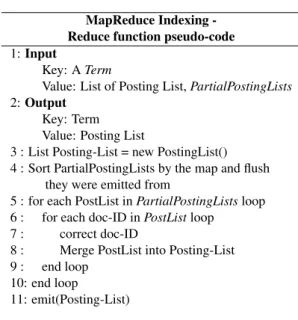
2.1 Pseudo-code for the word-counting operation, expressed as map and reduce functions. 21 2.2 Pseudo-code for the Terrier indexing strategy Map function. . . 23
2.3 Pseudo-code for the Terrier indexing strategy Reduce function. . . 24
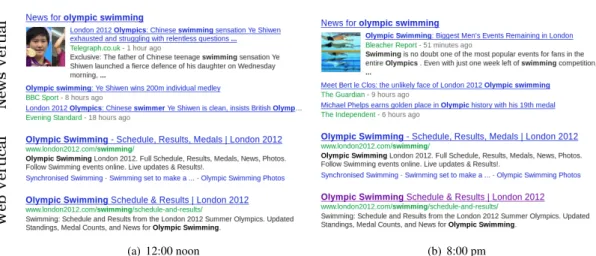
4.1 Top ranked results from the Google Web search engine for the query ‘olympic swim-ming’ on 01/08/12 at two points in time. . . 74
4.2 Overview of the proposed News Search Framework. . . 77
4.3 Top news identification component within our news search framework. . . 80
4.4 Top Bing search results for the query ‘cnn’ on 27/06/2012. . . 81
4.5 News query classification component within our news search framework. . . 83
4.6 Top news-related results returned for the query ‘find silver in london’ from the Google Web search engine on 01/08/12. . . 84
4.7 Google Trends result for the query ‘ash cloud’ (made on 30/01/2012). . . 85
4.8 Ranking News-Related Content component within our news search framework. . . 86
4.9 News-Related Content Integration component within our news search framework. . . . 89
5.1 Illustration of available document corpora from different years. . . 94
5.2 An example of news story importance scoring on the nytimes.com website - 10/01/2012. 100 5.3 A screenshot of the external judging interface shown to workers within the instructions. 110 5.4 Displayed summary of three workers judgements for a single task instance. . . 111
5.5 Task instance possibly completed by a bot. . . 111
5.6 News query classification instances used in this thesis. Not all of the news story sum-maries are shown in the Headline+Summary interface to save space. . . 115
LIST OF FIGURES
5.7 A screenshot of the external judging interface shown to workers within the instructions. 119 5.8 An example blog post rendering both when cleaned and as HTML. The HTML
render-ing contains the same content as the cleaned version, however, due to a missrender-ing CSS template one would need to scroll down to get to it. . . 121 5.9 The basic interface with which our workers label each query. . . 125 6.1 Example of Gaussian curves with varying values ofl(the Gaussian curve width). Note
that for illustration clarity, weights have been normalised so that∆t= 0will always be assigned a weight of 1. . . 134 6.2 An example of 12 story ranking features generated from two story representations, two
tweet rankers, two extracted tweet-features and two aggregation models. . . 139 6.3 Example tweet that would be promoted by the Mentions feature. . . 163 6.4 The average age of selected tweets as the retrieval depth is increased. . . 164 7.1 A hypothetical distribution of documents published over time that are about a
newswor-thy event in three streams. . . 170 7.2 Illustration of feature generation for news query classification. . . 172 7.3 News query classificationF1performance for three temporal settings using each news
and user-generated content stream. . . 182 7.4 News query classification effectiveness when using different combinations of stream
features query-only features (66/33 split). . . 188 7.5 News query classificationF1when using features derived from each stream over time. 193 9.1 Illustration of the top events and news and user-generated content integration into the
Web search ranking (IntegrationN ews(RW, I)andIntegrationRE(Q, R1..n, RW, S)). 222
9.2 Comparison of our framework presentation of search results to the Bing Web search engine. . . 224 9.3 Illustration of the ranking interface produced for the query ‘north korea’ on 13/4/12 with
our framework, where the enhanced ranking integrates Digg posts. The first two rank-ings are the ranking pair to be assessed. The third (red) bordered ranking a validation ranking designed to catch workers that are randomly clicking. . . 225 9.4 The number of topics where the majority of users preferred the Web search ranking or
LIST OF FIGURES
9.5 Topic comparison between rankings enhanced with news articles and those enhanced with other user-generated content sources. . . 236
List of Tables
2.1 A document-posting list . . . 17
2.2 An example inverted-index . . . 17
2.3 An example document index . . . 18
2.4 IR corpora in order of increasing size . . . 20
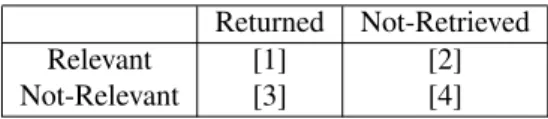
2.5 Document ranking/classification confusion table for calculating precision and recall. . 33
4.1 Classifications for the 2268 queries sampled from the MSN query log. . . 76
5.1 Statistics of all corpora representing document streams used in this thesis. . . 95
5.2 A listing of the datasets and corpora used to evaluate each component of our news search framework. For each dataset, whether they were produced for the Text REtrieval Conference (TREC) and whether they use crowdsourcing for relevance assessment gen-eration is also noted. Where the crowdsourced assessments column is marked with a 4*, that indicates that we collaborated with TREC to produce the assessments using crowdsourcing. . . 96
5.3 Top Events Identification datasets used in this thesis. Datasets that were produced by TREC or that contain crowdsourced relevance assessments are denoted with a4in the associated column. Where crowdsourced assessments are marked with a4* the dataset assessments were crowdsourced by ourselves on behalf of TREC. . . 98
5.4 News Query Classification datasets used in this thesis. Datasets that were produced by TREC or that contain crowdsourced relevance assessments are denoted with a4in the associated column. . . 100
5.5 Ranking News-Related Content datasets used in this thesis. Datasets that were produced by TREC or that contain crowdsourced relevance assessments are denoted with a 4 in the associated column. Where crowdsourced assessments is marked with a4* the dataset assessments were crowdsourced by ourselves on behalf of TREC. . . 102
LIST OF TABLES
5.6 Summary of theN RCIApr2012News-Related Content Integration dataset used in this thesis. Datasets that were produced by TREC or that contain crowdsourced relevance assessments are denoted with a4in the associated column. . . 104 5.7 Summary of the tasks crowdsourced for each dataset. . . 105 5.8 Judgement distribution and agreement on a per category basis. . . 112 5.9 Statistics for the MSN query log from 2006, as well as the sampledN QCtest
2006 and N QC2006f ull. . . 114 5.10 Statistics for the validation sets created for theN QCtest
2006andN QC
f ull
2006. . . 116 5.11 Quality measures for news query classification on the approximately 100 queryN QCtest
2006 with varying interfaces, in addition to the over 1000 queryN QC2006f ull using the Link-Supportedinterface. . . 118 5.12 Average amount paid per hour to workers and work composition for each batch of HITs. 122 5.13 Accuracy of blog post assessments in comparison to the track organiser judgements. . . 123 5.14 Statistics of the documents to be assessed from each of the five news and user-generated
content sources. . . 124 5.15 Statistics of the document relevance assessments produced by MTurk workers. . . 127 6.1 A sample assignment of votes for two articles (a1anda2) over 3 days (d1tod3). . . . 132 6.2 Blog stream LTRS feature instances used. . . 143 6.3 Tweet stream LTRS feature instances used. . . 145 6.4 News story ranking performance of Votes, RWA and RWAN in comparison to the best
participating system to the TREC top news stories identification task during 2009 and 2010. . . 146 6.5 News story ranking performance of VotesGaussBoost and RWAGaussBoost when the
Gaussian curve widthlis varied. . . 150 6.6 Comparison between our learning to rank approach when trained under both
Cross-Corpus and Per-Cross-Corpus training with the best TREC systems in terms of overall story ranking performance under the Blogs09and Blogs10story ranking topics. Ndenotes a statistically significant increase over the best individual feature (t-testp <0.05). . . 151 6.7 Strongest 5 positive and negative features on the Blogs09and Blogs10datasets.
Bold-ened feature weights indicate features with a high impact on the story ranking. The document feature component is not reported, as only document relevance is used in this experiment. . . 152
LIST OF TABLES
6.8 News story ranking performance of Votes, RWA and RWAN in comparison to the ran-dom baseline. NandHindicate statistically significant increases/decreases over Votes using the Tweet representation undert-testp <0.05.NNandHHindicate statistically significant increases/decreases over Votes using the Tweet representation under t-test
p <0.01. . . 155
6.9 News story ranking performance of VotesGaussBoost and RWAGaussBoost in
compar-ison to Votes and RWA. The most effective NDCG and Success@1 performance ob-served under each approach and dataset is highlighted. NandHindicate statistically significant increases/decreases over the baseline run withoutGaussBoostundert-test
p <0.05. NNandHHindicate statistically significant increases/decreases undert-test
p <0.01. . . 157
6.10 News story ranking performance of VotesM axBurst, RWAM axBurstand RWANM axBurst.
The most effective NDCG and Success@1 performance observed under each approach and dataset is highlighted.NandHindicate statistically significant increases/decreases over the base news story ranking approach withoutM axBurstundert-testp <0.05.
NNandHHindicate statistically significant increases/decreases undert-testp <0.01. 158 6.11 News story ranking performance of VotesM axBurst+GaussBoostand RWAM axBurst+GaussBoost
in comparison to Votes and RWA. The most effective NDCG and Success@1 perfor-mance observed under each approach and dataset is highlighted. N and Hindicate statistically significant increases/decreases over the base news story ranking approach withoutM axBurstand GaussBoostunder t-test p < 0.05. NNandHHindicate statistically significant increases/decreases undert-testp <0.01. . . 160 6.12 Learned story ranking performance when training across story ranking datasets when
using AFS. The most effective NDCG and Success@1 performance observed under each approach and dataset is highlighted. NandHindicate statistically significant in-creases/decreases over the random baseline undert-testp <0.05.NNandHHindicate statistically significant increases/decreases undert-testp <0.01. . . 161 6.13 Top 5 features (comprised of their four individual elements) selected by AFS on the
Twitter12−T Rdataset. . . 162
7.1 News Streams available within each of the two news query classification datasets. . . . 173 7.2 All query-only and stream features extracted from theN QCM ay2006andN QCApr2012
LIST OF TABLES
7.3 All 10 corpus specific stream features extractedN QC20120 sDigg and Twitter streams. . 177 7.4 News query classification performance using multiple combinations of news and
user-generated streams. Statistical significance (t-testp <0.05) over the BBC+Guardian+Telegraph news baseline is denotedN. . . 179 7.5 News query classification performance for each of the three query feature categories
described in Appendix C.1. . . 180 7.6 News query classification performance using different feature set/streams combinations.
Statistically significant (t-testp <0.05) decreases in performance over using all features are denotedH. . . 181 7.7 News query classification performance in terms of precision, recall andF1 for three
temporal settings using all streams. Statistically significant (t-testp < 0.05) decreases in performance over classification at the original query time are denotedH. . . 183 7.8 Percentage of the four query types that were classified correctly at the three points in time.184 7.9 News query classification performance using multiple combinations of news and
user-generated corpora. . . 187 7.10 Positive and Negative query features selected on the 66% training set and their weights
(66/33 split). . . 189 7.11 News query classification performance using different feature set/streams combinations.
The best performing feature combinations that use a single stream are highlighted in bold. Cases where combining streams results in increased performance over any single stream is also highlighted in bold. . . 191 7.12 News query classification performance in terms of precision, recall andF1 for three
temporal settings using each news and user-generated content stream. The best per-forming feature combinations that use a single stream are highlighted in bold. Cases where combining streams results in increased performance over any single stream is also highlighted in bold. Statistically significant increases (t-test p<0.05) over the same features extracted from the query time are denotedN. . . 192 8.1 Blog post ranking features. . . 199 8.2 Tweet learning to rank features. . . 204
LIST OF TABLES
8.3 Blog post ranking performance of the best TREC runs in comparison to our proposed learning to rank approach. Note thatLT RC8.2.1
BlogP ostswas the best TREC system, hence
we do not list it twice. Cases where our learning to rank approach achieves statistically significant increases (t-test p<0.05) over the DPH sample are denotedN. . . 209 8.4 The most influential features for blog post ranking for timet . . . 210 8.5 The most influential features for blog post ranking for timet+ 7days . . . 213 8.6 Tweet ranking effectiveness of LTR using a variety of learning algorithms.Ndenotes a
statistically significant (t-test p<0.05) increase over tweet ranking sample (Sample). . . 214 8.7 The most influential features for tweet ranking. . . 216 9.1 Statistics of the 219 news-related queries used during our evaluation. . . 227 9.2 News-related content integration evaluation experiment statistics. . . 230 9.3 Number of end users that prefer the Web search ranking with the integrated top events
ranking in comparison to the Web search ranking unaltered. . . 232 9.4 Number of preferences for both the Web and Enhanced rankings. . . 233 9.5 Proportion of query topics where integrating user-generated content was more effective
than integrating newswire articles. . . 238 A.1 News story ranking performance of Votes and RWA when using different story
repre-sentationsa. . . 253 A.2 News story ranking performance of Votes and RWA when retrieval depth is varied. . . 255 A.3 News story ranking performance of Votes when the background window size of
avail-able tweets is varied. The most effective NDCG and Success@1 performance observed under each approach and dataset is highlighted.NandHindicate statistically significant increases/decreases over the same approach with a default window size of 10 days under
t-testp <0.05. NNandHHindicate statistically significant increases/decreases under
t-testp <0.01. . . 257 A.4 News story ranking performance of Votes when the recent time window sizeris varied.
The background window sizewis set to 10. The most effective NDCG and Success@1 performance observed under each approach and dataset is highlighted.NandHindicate statistically significant increases/decreases over the same approach with a default win-dow size of 10 days undert-testp <0.05.NNandHHindicate statistically significant increases/decreases undert-testp <0.01. . . 259
LIST OF TABLES
A.5 News story ranking performance of Votes when the recent time window size is varied. The background window sizewis set to 2 days. The most effective NDCG and Suc-cess@1 performance observed under each approach and dataset is highlighted. Nand
Hindicate statistically significant increases/decreases over the same approach with a default window size of 10 days undert-testp <0.05.NNandHHindicate statistically significant increases/decreases undert-testp <0.01. . . 260 A.6 News story ranking performance of Votes, RWA and RWAN with and without query
expansion on Wikipedia. The most effective NDCG and Success@1 performance ob-served under each approach and dataset is highlighted. NandHindicate statistically significant increases/decreases over the same approach with a default window size of 10 days undert-testp <0.05.NNandHHindicate statistically significant increases/decreases undert-testp <0.01. . . 261 A.7 News story ranking performance of Votes, RWA and RWAN as ranking depth is varied.
The most effective NDCG and Success@1 performance observed under each approach and dataset is highlighted.NandHindicate statistically significant increases/decreases over the same approach with a default window size of 10 days undert-testp < 0.05.
NNandHHindicate statistically significant increases/decreases undert-testp <0.01. . 263 D.1 News Query classification effectiveness when using all features under a variety of
learn-ing algorithms. Statistical significance over Logistic Regression (Multinomial) (paired t-test p<0.05) denotedN. . . 280
Chapter 1
Introduction
1.1
Introduction
Major universal Web search engines serve around a billion of user queries each day (Norman, 2011). It has been reported that up to 11% of these Web search queries are related to current news (Bar-Ilanet al., 2009). For these queries, users may either be searching for information about a specific news story, or looking to see what the top news stories of the moment are. We refer to these types of queries as
news-related queries.
User-generated contentrefers to documents published on the World Wide Web (Web) by the general public, rather than by paid individuals, corporations or companies. Social media websites, such as Twit-ter1, are prime examples of user-generated content sources. On Twitter, users publicly post messages to
other users that subscribe to them. Other examples of widely used user-generated content are blogs and Wikipedia2pages.
The online news landscape has been greatly affected by the emergence of user-generated content. In particular, the role of the public in the online news space has undergone a dramatic shift from a static news consumer base into a dynamic news machine, where news stories are summarised, discussed and commented upon in real-time (Bandariet al., 2012; O’Reilly & Milstein, 2009). Indeed, news today is spread by a variety of diverse media (Kwaket al., 2010; Scott, 2007), driven by user interaction and user-generated content, e.g. news reporting in Twitter (O’Brien, 2009).
This shift has had consequences for universal search engines when tackling news-related queries. In particular, users can now be searching for information about events only seconds after those events have occurred (Hansell, 2007). These queries are challenging to satisfy, since the search engine may not yet be aware of the event in question, making the identification of such queries as news-related difficult.
1http://twitter.org 2http://wikipedia.org
1.2 Motivation
Moreover, if the query is identified as news-related, no relevant newswire articles or Web search results are likely to have yet been published. Instead, the only relevant content about a breaking event may exist within user-generated content sources.
In this thesis, we investigate how a universal Web search engine can be enhanced with user-generated content, such that news-related user queries can be satisfied more accurately, fully and in a more timely manner. The aim is to provide end-users with a final search result ranking that provides increased relevance and coverage of events for news-related queries. In particular, we focus on improving the final search result ranking for those news-related queries that cannot be easily satisfied by newswire articles, either because the event that the user is searching for has just broken and hence no news articles have yet been published, or because newswire article coverage is insufficiently detailed or out-of-date.
1.2
Motivation
A universal Web search engine enables users to search large collections of heterogeneous documents published on the Web. For example, news websites, forums, blogs and public wiki sites are all indexed by Web search engines. However, modern universal Web search engines do not treat all their documents in the same manner. In particular, they define groups of documents referred to asverticals, where each vertical can be searched independently (Arguello et al., 2009). The motivation for vertical search is to provide increased search effectiveness over specific types of documents. For example, an image vertical allows the searching of images, while a shopping vertical allows the searching of products. Universal Web search engines search one or more of their verticals when the user submits a query. They return an aggregate of the results retrieved from verticals that they predict are potentially relevant to the user’s query. In this thesis, we consider a universal Web search engine that supports two verticals in particular, namely a Web vertical and a news vertical. The Web vertical ranks Web documents to produce an initial ranking for the user query, referred to as theWeb search ranking. The news vertical integrates specifically news-related documents into the Web search ranking for queries that the search engine identifies are news-related.
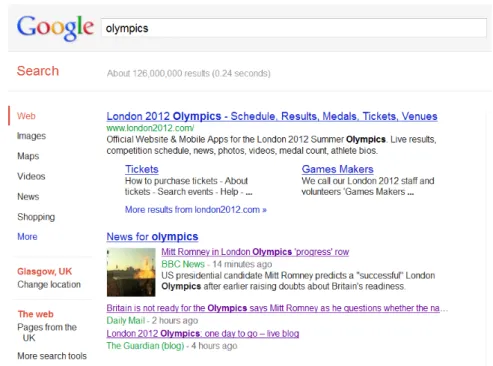
For illustration, Figure 1.1 shows the search results returned by the Google1search engine for the query ‘olympics’ submitted on the 22nd of July 2012. As can be seen, Google provides search from multiple verticals, each listed down the left hand side of the Web search results. Meanwhile, within the results themselves, we see that the London Olympics homepage has been retrieved at the top rank. This result comes from their Web vertical, which represents search over the Web as a whole. On the other
1.2 Motivation
Figure 1.1: Example search results for the query ‘olympics’ to the Google Search engine on the 22/07/12.
hand, the second ranked result contains current newswire articles about the London Olympics, retrieved from the news vertical.
Notably, a news vertical has some unique characteristics that distinguish it from other types of ver-tical. Firstly a typical news vertical searches over newswire articles and other documents from multiple providers. In our previous example illustrated by Figure 1.1, two newswire articles and one blog post were returned: one article from the BBC1; one article from the Daily Mail2; and one blog post from
the official Guardian blog3. We refer to the different types of documents retrieved by the news vertical
in general as news-related content. This news-related content is then integrated into the Web search results. Secondly, the news-related queries that the news vertical serves are oftenreal-timein nature, i.e. they are concerned with ongoing or recent events. As a result, news-related content retrieved by the news vertical is often timely. For example, from Figure 1.1, we observe that the news-related content returned was published between 14 minutes and 4 hours prior to the time the query was issued. Re-trieving timely news-related content is a one of the main challenges of for the news-vertical, since for fast-moving events, content may quickly become out-dated.
1http://bbc.co.uk 2http://dailymail.co.uk 3http://guardian.co.uk
1.2 Motivation
The search process of a universal Web search engine that supports both a Web and news vertical can be described as follows. A user initiates the search by entering a textual query into the universal search engine. The search engine then routes that query to each of the Web and news verticals. The Web vertical ranks Web documents for the query, producing the Web search ranking. The news vertical first classifies the user query as news-related or not. If the query is not news-related, then the Web search ranking is left unaltered. On the other hand, if the query is news-related, then news-related content is first ranked for the user query. Next, the most relevant and timely of this news-related content is selected. Finally, the selected news-related content is either interleaved into the Web search results or displayed nearby in a manner that the search engine considers will increase relevance and coverage for the user query.
However, recall how the shift in the online news landscape has changed the way that news is now being reported. In particular, social media websites are now known for reporting news (Munk, 2009). Moreover, the speed at which news is reported and spread has greatly increased (Shammaet al., 2009). For example, when a passenger plane crashed in the Hudson river in the U.S., the event was first re-ported from the scene via the microblogging website Twitter only minutes after the plane touched down (O’Brien, 2009). Indeed, the first Twitter tweet was posted a full 15 minutes before the first newswire article was published. Furthermore, one of the main consequences that this has had for uni-versal Web search engines is that users are searching for news about events soon after they occur. For instance, when New York city suffered a power cut, the Google search engine reported observing re-lated queries within two seconds of the event (Hansell, 2007), well before any newswire articles were published about it.
These changes have introduced new challenges for universal Web search engines that support a news vertical. In particular, we identify four key challenges and describe each below:
Top Events Identification: A news vertical only integrates additional news-related content into the Web search ranking for news-related queries. We consider a query to be news-related if it refers to a cur-rent event, such as a celebrity death. However, not all events are potentially newsworthy. For instance, newswire providers such as Reuters continually report on stock market fluctuations1, but in most cases
one would not consider these newsworthy. Hence, there is a need to identify what are theimportant
events happening at any point in time. For instance, if the user entered the query ‘ash’ during April 2010, then the news vertical would need to know that the Eyjafjallajkull volcano in Iceland had erupted2
1http://uk.reuters.com/business/markets 2http://news.bbc.co.uk/1/hi/8623534.stm
1.2 Motivation
and that this event is sufficiently important to make ‘ash’ a potentially news-related query. Moreover, the events considered important may change rapidly. For instance, a prominent unpredictable event such as an earthquake is likely to dominate the news headlines, reducing the importance of all the other events reported on that day. Since news is now being reported in user-generated content sources, it may be no longer sufficient to rely on newswire providers, e.g. CNN1, since their top stories may be out-of-date. For example, when Michael Jackson died, the news broke first on Twitter (Munk, 2009). Hence, the first challenge we identify is how a news vertical can automatically identify the top events right now?
News Query Classification: When a new query arrives, the news vertical must first classify it as news-related or not. However, news-related queries are particularly challenging to classify, since they change rapidly over time in line with the newsworthy events of the moment. Furthermore, due to the increased speed at which breaking news is reported via user-generated content, news-related queries can now appear in advance of newswire articles reporting on the event (Hansell, 2007). For instance, in our previous Hudson river plane crash example, there was a delay of 15 minutes between the story breaking on Twitter and the first published newswire article (O’Brien, 2009). This raises the second challenge that we identify, namely how can we accurately classify news-related queries in the current real-time news environment?
Ranking News-related Content: If a user query is identified as holding a news-related intent, then news-related content needs to be ranked for the query. However, for queries relating to events reported first in social media, newswire articles will not have yet been published, rather, only user-generated content sources will contain relevant documents at that time. Hence, a traditional news vertical that only tracks newswire sources would not retrieve any relevant content that could then be integrated. Moreover, user-generated content has the potential to provide relevant content in cases where newswire coverage is unavailable or suspect. For example, during a bombing in Damascus (Syria), on the ground investigators used social media to report what they could confirm had happened in the absence of a free-press (Fiona McCann, 2012). Hence, a universal Web search engine that supports a news vertical needs to rank con-tent from user-generated sources in addition to newswire sources to satisfy news-related queries where relevant newswire articles have not yet been published or are insufficient to provide full coverage of the event. As a result, the third challenge that we identify is how can user-generated content be effectively ranked for a news-related user query?
1.3 Thesis Statement
News-Related Content Integration: The introduction of user-generated content ranked from a variety of diverse sources, e.g. Twitter, Blogs or Diggs. complicates the task of integrating this content into the Web search ranking. In particular, given a large volume of newswire and user-generated content ranked for the user-query, some subset of this content needs to be selected for inclusion into the Web search results. Moreover, the types of content selected will vary from query-to-query, since the value added by user-generated content is both query and time-dependent. For example, user-generated content can have a high value when there are few or no newswire articles yet available, but is less useful if there are readily available high quality newswire articles that will satisfy the query. As a result, the fourth challenge that we identify is how to effectively integrate this news-related content into the Web search ranking, such that the relevance to, and coverage of, the event that the user is looking for is increased.
1.3
Thesis Statement
This thesis states that user-generated content can aid in satisfying news-related queries submitted to uni-versal Web search engines in real-time. In particular, we propose a news search framework that allows to fully integrate the functionalities that are needed to deploy a news vertical within a universal search engine: a classifier to identify news-related queries, a mechanism to identify the useful news-related content and a strategy to integrate this selected content into the Web search ranking. The essential argu-ment made in this thesis is that user-generated content can improve the performance of each component of the framework. In particular, we hypothesise that user-generated content can increase the accuracy of the deployed query classifier. We also hypothesise that user-generated content may include unique, valuable and relevant information to answer some types of news-related queries, such as those relating to breaking events. Furthermore, we postulate that the appropriate integration of user-generated content into the Web search ranking will increase the coverage of events that users are looking to know more about. Finally, we postulate that all the aforementioned functionalities can be enhanced by identifying the most important events at the time the query was issued using the volume of available user-generated content.
1.4
Contributions
The main contributions of this thesis are the following. Firstly, we introduce our news search framework that describes the functionalities required by a universal Web search engine to deploy a news vertical. This framework is defines four distinct components. Three of these components directly relate to the three news search functionalities described earlier (see Section 1.3), i.e. the classification of news
1.4 Contributions
queries, the selection of news-related content and the integration of that news-related content into the Web search results. The final component produces rankings of events by their current importance, which are used to enhance the performance of the other components. Notably, our framework is designed such that these four components each encapsulate one of the four news search challenges that we identified in Section 1.2. Our framework is therefore a suitable basis for investigating these news search challenges using user-generated content. For clarity, we refer to each framework component using the label for its associated news search challenge.
Next, for each of the four components, we propose, develop and evaluate novel approaches to enable or enhance them. We describe our contributions for each component below:
Top Events Identification: We propose a fully automatic real-time approach for the identification of currently important news-related events based upon voting theory. This approach leverages the volume and relatedness of discussions within different user-generated content streams to rank events. Using real-time discussions from both tweet and blog post streams, we experiment to determine how effectively it can rank events represented by newswire articles. In addition, we investigate to what extent the age of discussions used impact the event ranking.
News Query Classification: We propose a real-time classification approach that leverages recent discussions from a variety of parallel news and user-generated content sources. This approach has two aims. Firstly, it uses up-to-the-minute discussions in user-generated content to increase classification accuracy for queries relating to breaking news. Secondly, it combines evidence from multiple news and user-generated content sources simultaneously, e.g. newswire articles and blogs, to increase classifica-tion accuracy overall. We evaluate how accurately news and non-news queries can be classified using parallel newswire, blog, tweet, Wikipedia edit and digg streams.
Ranking News-related Content: We use the phrase ‘news-related content’ to describe a wide vari-ety of different document types from newswire and user-generated sources. Prior works have shown that IR document weighting models can be used to effectively rank much of this content, from newswire arti-cles to Wikipedia pages. However, some types of (user-generated) content can be difficult to rank, since their characteristics differ greatly from typical Web documents. For instance, tweets are constrained in length to 140 characters. We propose approaches that leverage machine learning for rank those types of user-generated content that have unique characteristics. In particular, we propose to overcome the challenges that these characteristics bring, by representing each user-generated document as a set of features, with the aim of better describing what makes these unique types of document relevant. For example, useful feature about a tweet might include whether it contains a link to a news article. We
1.5 Origins of the Material
identify tweets and blogs as having unique characteristics and develop machine learned ranking models for each. We then evaluate these models to determine whether they are effective.
News-Related Content Integration: Finally, through a large-scale user-study performed using the emerging field of crowdsourcing, we evaluate how user-generated content can be effectively integrated into the Web search ranking. The aim is to increase the relevance and coverage of the Web search ranking for news-related user queries. Here, we aim to determine the types of content should be selected for each query, e.g. tweets or news-articles. We also examine the manner in which this content should be displayed. For instance, should blogs be displayed after news articles, and how much screen real-estate should be used for each? In general, we study when and where end-users consider the addition of user-generated content to the search ranking to be advantageous.
A additional contribution of this work is the development of methodologies for the production of new evaluation datasets for each of the four framework components. In particular, develop methodolo-gies that leverage the emerging field of crowdsourcing to produce relevance assessments, label queries and evaluate our final search rankings with end-users. We experimentally evaluate our crowdsourcing methodologies to determine whether they are able to produce accurate assessments and labels as well as conclude on best practices.
1.5
Origins of the Material
Some of the work within this thesis can be traced back to conference and journal publications. The following are our publications that are both relevant to this thesis and form the basis for research detailed in one or more chapters:
• Chapter 4: The components of our proposed news search framework were first published in (Mc-Creadieet al., 2010b) and (McCreadie, 2010).
• Chapter 5: Our crowdsourcing methodologies for dataset development have been published in (McCreadie et al., 2010a), (McCreadie et al., 2011a) and (McCreadie, Macdonald & Ounis, 2012).
• Chapter 6: Our approaches for identifying the most important events of the moment have been published in (McCreadieet al., 2010c) and (McCreadieet al., 2011b).
• Chapter 8: The blog post ranking approach that we propose was first reported in (Santos, Mc-Creadie, Macdonald & Ounis, 2010). Notably, it produced the best performance of the all systems submitted to the TREC 2010 Blog track.
1.6 Thesis Outline
Furthermore, during the PhD research programme, we also developed a novel information retrieval infrastructure to efficiently tackle large volumes of user-generated content, which both supports our experiments throughout this thesis and that lead to conference and journal publications. In particular, we developed a large-scale distributed MapReduce indexing infrastructure using Hadoop1 to enable the fast indexing of large-scale user-generated and other collections within the open source Terrier IR platform2, subsequently published in (McCreadie, Macdonald & Ounis, 2009a) and (McCreadieet al., 2011c).
1.6
Thesis Outline
In this thesis, we investigate how user-generated content can aid in satisfying news-related queries sub-mitted to Web search engines. In particular, we propose a news search framework to describe the func-tionalities required to tackle news-related queries in the current fast-paced news search setting. Using this framework as a base, we examine whether user-generated content can be used to more accurately classify queries as news-related and provide better coverage for the user query. The outline of this thesis is as follows:
• Chapter 2 introduces important information retrieval (IR) concepts that are used all throughout the thesis. In particular, we begin by describing the underlying architecture of a basic IR system in terms of its indexing and retrieval components, in addition to more advanced aspects of such systems such as terabyte-scale indexing using the MapReduce paradigm. Furthermore, we discuss the evaluation of IR systems both in general and more specifically within the context of the Text REtrieval Conference (TREC). We then discuss more specialist areas of IR that are used in later chapters in this thesis to tackle particular news search tasks, namely: machine learning; news vertical search; aggregate ranking; and resource selection.
• In Chapter 3, we motivate the use of user-generated content for news-related tasks. We describe how each of five different user-generated content sources, namely: Blogs; Digg; Query-logs; Microblogs and Wikipedia, might be useful either as a source of news-related information and/or as a source of content to return to the user. Finally, we identify the knowledge gap within the literature that this thesis addresses, namely can user-generated content aid in satisfying news-related queries within a universal Web search setting?
1http://hadoop.apache.org/ 2http://terrier.org
1.6 Thesis Outline
• Chapter 4 presents our framework for news search. It defines the four framework components that are needed to deploy real-time news vertical search, describes the purpose of each component and discusses the challenges that need to be addressed within each. We experimentally investigate each of these four components in Chapters 6, 7, 8 and 9.
• Chapter 5 describes all of the datasets that we use for evaluation of each framework component within their subsequent experimental chapters (Chapters 6, 7, 8 and 9). In particular, it details prior datasets that we use, in addition to the creation and quality assurance of new datasets that we develop using crowdsourcing.
• In Chapter 6, we tackle the first of our framework components, i.e. the identification of the important events of the moment for display to the user. In particular, we propose both learned and unlearned story ranking approaches to rank newswire articles representing events and then test their effectiveness for real-time news story ranking when driven by blog and tweet streams. Finally, we analyse how newswire article ranking differs when using blogs and tweets to drive the ranking process, conclude on the effectiveness of our proposed approaches and whether user-generated content can be used to effectively identify important events in real-time.
• Chapter 7 tackles the second of our framework components, i.e. the automatic classification of news queries using user-generated content. We propose a novel news query classification approach that extracts classification evidence about each query from a set of parallel news and user-generated content streams. We evaluate the effectiveness of this approach on two different datasets, each comprised of multiple streams of news and user-generated content, concluding when and where the addition of user-generated content can increase classification accuracy for news-related user-queries.
• In Chapter 8, we investigate the third of our framework components, i.e. the ranking of user-generated content for a news-related query. In particular, we propose to use machine learning to tackle the unique characteristics two types of user-generated content, namely blog posts and mi-croblogs. We evaluate whether our proposed approaches are more effective than using traditional document weighting models for these unique types of document.
• The last of our experimental chapters, Chapter 9, examines the final component of our framework, i.e. the integration of news-related content into the Web search ranking. We propose both resource selection and heuristic-based techniques to merge newswire articles, blogs, tweets, Wikipedia pages and diggs into the Web search ranking. We perform a crowdsourced study with end-users
1.6 Thesis Outline
to evaluate whether these approaches can produce rankings that provided better coverage for the user query, i.e. to conclude when and where end-users want user-generated content added to their Web search results.
• Chapter 10 closes this thesis by summarising the conclusions and outcomes from each of the individual chapters, in addition to providing possible new research directions uncovered by this work.
Chapter 2
Information Retrieval
2.1
Introduction
The field of information retrieval (IR) deals with the representation, storage, organisation of and ac-cess to information items (Baeza-Yates & Ribeiro-Neto, 1999). It was created to solve the issues with information access to large heterogeneous collections of information, normally natural language cor-pora. Research in IR is concerned with efficient storage of information, the efficient retrieval of that information and effectiveness in satisfying the user’s information need. A user typically expresses their information need as a query (one or more terms), which an IR system then searches for and retrieves information items that it believes are relevant to the user’s information need. These retrieved items are normally presented to the user as a ranked list, where higher ranked items are deemed more likely to be relevant to the user’s information need.
The IR process can be loosely split into the following four parts. To begin with, the input corpora must be converted into a data structure that can be easily searched, conventionally called an index (van Rijsbergen, 1979). A user with an information need then formulates a query and provides it to the system in a form that it can understand (conventionally as a natural language text). The IR system matches the information items within the index to the query, selecting those that are conceptually close. We refer to the information items within an index as documents in this work. A weighting model is then applied, which provides the final similarity score between multiple information items (Baeza-Yates & Ribeiro-Neto, 1999). Lastly, the retrieved documents are presented to the user to satisfy their information need. Unfortunately, the user’s query may be a poor representation of their information need and as such, even an effective IR system may not return relevant results. As a result of this, in light of the retrieved documents, the user may choose to re-formulate their query to be either more specific or otherwise as needed.
2.1 Introduction
This IR process has subsequently been extended to leverage more advanced document ranking tech-niques, e.g. Learning to Rank (Liu, 2009), whereby many features of the documents are combined within a learned model to provide more accurate matching to the user query. Other approaches also build upon this basic process to tackle more complex search tasks, e.g. expert search (Macdonald, 2009), or combine many instances of this process over diverse indices to provide composite rankings, e.g. resource selection (Si & Callan, 2003a).
Research in IR has focused on the relationship between documents and the queries that should retrieve them. Moreover, advances have been empirically measured through a long history of experi-mentation to evaluate how a particular search system is performing. Standard evaluation of an IR system involves measuring the performance of the system on a query for which some relevant documents are known. Success can then be measured in terms of how many of these documents where retrieved, and at what ranks. This will be repeated over multiple queries and then an aggregate function used to determine the final effectiveness of the system.
All of the work in this thesis is strongly grounded in IR, and indeed much is built upon or further enhances the traditional IR process to tackle the novel challenges posed by real-time news search. In this chapter, we describe background IR literature that is relevant to both to the news search framework that we will propose in Chapter 4 and to our later experiments. In particular, the remainder of this chapter is structured as follows:
• Section 2.2 provides a background into the indexing process of an IR system. We describe in detail the preparation of documents, indexing strategies and the final index structures produced. We make use of index structures to drive retrieval of both news and user-generated content for the user query in Chapters 6, 7 and 9. Furthermore, we discuss some more advanced aspects of the indexing process in a Web environment, namely: how corpora spanning billions of documents can be efficiently indexed using the MapReduce paradigm; and how noise in web pages can be reduced through boilerplate removal techniques. We use MapReduce to index very large Twitter corpora spanning hundreds of millions of documents (see Table 5.1), while boilerplate removal is used to clean unprocessed documents downloaded from the Web, e.g. blogs.
• Section 2.3 further describes the document retrieval process once an index has been created. In particular, we discuss how users represent their information needs as queries, and how these queries are processed by an information retrieval system. Then we discuss both popular ap-proaches and frameworks for matching documents to each query and techniques for automati-cally expanding the user query with the aim of increasing search effectiveness. We use these
2.2 Indexing
approaches extensively throughout the experimental portions of this thesis (Chapters 6, 7 and 9) both to extract evidence about the documents related to a user-query for classification as well as for the ranking of different types of documents for display to the user.
• In Section 2.4, we detail evaluation methodologies in the field of IR and describe the Text RE-trieval Conference (TREC) that is central to the evaluation of multiple of the sub-tasks of the news search framework that we describe in Chapter 4. Furthermore, we describe the document ranking evaluation measures that we use later to evaluate the effectiveness of our news search sub-tasks.
• Section 2.5 introduces the field of machine learning. Machine learning approaches have become increasingly popular in the field of information retrieval, as they enable the automatic learning of effective models from large-scale datasets, e.g. learning to rank (Liu, 2009). Indeed, we use machine learning extensively in this thesis within Chapters 6, 7 and 9.
• In Section 2.6, we provide a background into the field of topic detection and tracking (TDT), that is involved with the monitoring of news events over time. TDT is relevant to the task of top news identification that we tackle in Chapter 6.
• Section 2.7 describes prior work in the field of aggregate search. Aggregate search tasks involve the ranking of groups of documents representing some concepts, instead of ranking individual documents. For example, expert search systems rank experts based upon the documents that they themselves have authored. We propose an aggregate voting approach to tackle the identification of current news stories for the user query in Chapter 6.
• In Section 2.8, we provide an overview of prior work in resource selection, that tackles search over multiple heterogeneous document corpora. We use resource selection techniques in our final experimental chapter to build a news search system combining heterogeneous news and user-generated content for display to the user (see Chapter 9).
• We provide a summary of this chapter in Section 2.9.
2.2
Indexing
To make access to information as efficient as possible, index data structures need to be created that accurately summarise the content of all information items to be searched. All information items consid-ered in this work are comprised of natural language text. The characteristics of information items from different sources can vary greatly, compare a Twitter tweet to a news article for example. For simplicity,
2.2 Indexing
we refer to information items generally asdocumentsfor the remainder of this thesis, but may use more specific terminology where appropriate. The creation of index structures summarising documents is known as indexing. Indexing is used to create index structures for all of the news and user-generated content sources used in this thesis (see Chapter 5). In the following, the indexing process is explained with reference to the example document below, specifically the first paragraph taken from a news article from the BBC news website on the 17/6/20091:
‘‘One of the biggest surprises in the Digital Britain report was the news that everyone with a fixed line telephone would pay a broadband tax."
2.2.1
Tokenisation
The first stage within the indexing process is known as tokenisation. In this stage, the text is split into chunks based on some boundary condition, normally white-space characters. This is approximately equivalent to splitting a document into its individual words - through non-standard encoding formats within some documents mean that this will not always be the case. At the tokenisation stage, the text is also lower-cased and all punctuation removed. Once tokenised, the above text might be represented as follows (where ‘—’ represents a term boundary):
‘‘one|of|the|biggest|surprises|in|the|digital|britain|report| was|the|news|that|everyone|with|a|fixed|line|telephone|would| pay|a|broadband|tax"
2.2.2
Stopword Removal
In his work on mechanised encoding and searching, Luhn (1957) described how the descriptive power of a word follows a normal distribution with respect to the number of times it is used (its term frequency). This means, the more often a word is used, the less informative it becomes. In particular, the most common words (e.g. the) cannot be used to distinguish between documents because they are contained in nearly all documents. Since these words are therefore not useful, they are known asstopwordsand are completely removed from the index (Baeza-Yates & Ribeiro-Neto, 1999). Rather than calculate this on a per-collection basis, often a pre-defined list of stopwords is used. Indeed, articles, prepositions and conjunctions are likely candidates to be included. It should also be noted that removing stopwords has
2.2 Indexing
the positive effect of reducing the size of the final index structures. After stopword removal the example document might look like the following:
‘‘biggest|surprises|digital|britain|report|news|everyone|fixed| line|telephone|pay|broadband|tax"
2.2.3
Stemming
In natural language, many words have multiple variants (e.g write, wrote, writing, written). These syntactical variations make direct matching between the user’s query and the text unlikely to suc-ceed (Baeza-Yates & Ribeiro-Neto, 1999). One solution to this problem is to transform these words down into their root forms - this is known as conflation. Conventionally, this is performed through the process of stemming, where the syntactical suffixes of words are removed based of a set of logical trans-formation rules. The first stemming algorithm was published by Lovins (1968). Meanwhile, possibly the most well known stemming algorithm is Porter’s stemmer (Porter, 1980). After stemming using Porter’s stemmer, our example text contains the following:
‘‘biggest|surpris|digit|britain|report|new|everyon|fix|line| telephon|pai|broadband|tax"
It is interesting to note that not all words are changed (e.g. “biggest”), and that some words once transformed do not correspond to real English words (e.g. “pai”). This is not an issue however, since the user’s query will be similarly transformed such that a mapping can be obtained.
In most IR systems abag-of-wordsapproach is taken to store the final text. In this case, the ordering of terms is ignored, instead, only the number of times a term appears within the text is recorded. The storage structure used for each piece of text (document) is known as a document-posting list. The posting list for our example is shown in Table 2.1.
2.2.4
Index Data Structures
To be useful, the index structures need to be as compact as possible, support fast random access and store meta information about documents. There are various techniques that can be applied to achieve this. As IR systems are typically interested in accessing on a term basis (as opposed to a per-document basis), aninverted indexis normally used (van Rijsbergen, 1979). In an inverted index, each entry is a term-posting list (the inverse of a document-posting list), that lists the documents in which the term occurs.