МЕНАЏМЕНТ У ХОТЕЛИЈЕРСТВУ
И ТУРИЗМУ
HOTEL AND TOURISM MANAGEMENT
ФАКУЛТЕТ ЗА ХОТЕЛИЈЕРСТВО И ТУРИЗАМ У ВРЊАЧКОЈ БАЊИ
FACULTY OF HOTEL MANAGEMENT AND TOURISM IN VRNJAĈKA BANJA
УНИВЕРЗИТЕТ У КРАГУЈЕВЦУ
UNIVERSITY OF KRAGUJEVAC
Менаџмент у хотелијерству и туризму
Hotel and Tourism Management
No. 1/2020
Publisher:
Faculty of Hotel Management and Tourism in Vrnjaĉka Banja
Editorial Advisory Board:
Prof. Dragana Gnjatović, Ph.D. – President, University of Kragujevac, Faculty of Hotel Management and Tourism in Vrnjaĉka Banja, Serbia
Prof. Andrei Jean Vasile, Ph.D. – Petroleum-Gas University of Ploiesti, Romania
Prof. Dejan Mihailović, Ph.D. – Tecnologico De Monterrey, Division of Social Sciences and Humanities, Monterrey, Mexico
Prof. Dora Smolĉić Jurdana, Ph.D. – University of Rijeka, Faculty of Tourism and Hospitality Management, Opatija, Croatia
Prof. emeritus Radoslav Senić, Ph.D. – Kragujevac, Serbia
Prof. Janko M. Cvijanović, Ph.D. – Economics Institute, Belgrade, Serbia Prof. Masahiko Gemma, Ph.D. – Waseda University, Tokyo, Japan
Prof. Sonja Jovanović, Ph.D. – University of Niš, Faculty of Economics, Niš, Serbia
Prof. Vladimir I. Trukhachev, Ph.D. – Stavropol State Agrarian University, Stavropol, Russian Federation Prof. Ţarko Lazarević, Ph.D. – Institute for Contemporary History, Ljubljana, Slovenia
Asst. Prof. Vladimir Dţenopoljac, Ph.D. – American University of the Middle East, College of Business Administration, Kuwait ISSN 2620-0279 (Printed) ISSN 2620-0481 (Online) UDC 005:338.48 The journal is published biannually
Circulation: 100 copies
Printed by:
SaTCIP d.o.o. Vrnjaĉka Banja
For publisher:
Prof. Drago Cvijanović, Ph.D., Dean
Editorial office:
Journal Менаџмент у хотелијерству и туризму – Hotel and Tourism Management
Faculty of Hotel Management and Tourism in Vrnjaĉka Banja, VojvoĊanska 5a, 36210 Vrnjaĉka Banja, Serbia Tel./Fax No:036 515 00 25
E-mail: [email protected]
The journal is index ed in scientific databases:
ERIHPLUS EBSCO Ulrich's Web CEEOL SCIndeks WorldCat DOAJ CNKI Google Scholar
CIP - Каталогизација у публикацији Народна библиотека Србије, Београд 005:338.48
MЕНАЏМЕНТ у хотелијерству и туризму = Hotel and
T ourism Management / Editor in Chief Drago Cvijanović. - Vol. 6, no. 1 (2018)- . - Vrnjaĉka Banja : Faculty of Hotel Management and T ourism in Vrnjaĉka Banja, 2018 - (Vrnjaĉka Banja : SaT CIP). - 25 cm
Polugodišnje. - Je nastavak: ХиТ менаџмент = ISSN 2334-8267. - Drugo izdanje na drugom medijumu: Mенаџмент у хотелијерству и туризму (Online) = ISSN 2620-0481
ISSN 2620-0279 = Mенаџмент у хотелијерству и туризму COBISS.SR-ID 264085772
Editor in Chief:
Prof. Drago Cvijanović, Ph.D. University of Kragujevac, Faculty of Hotel Management and Tourism in Vrnjaĉka Banja, Serbia
Associate Editors:
Prof. Sneţana Milićević, Ph.D. – University of Kragujevac, Faculty of Hotel Management and Tourism in Vrnjaĉka Banja, Serbia
Prof. Darko Dimitrovski, Ph.D. – University of Kragujevac, Faculty of Hotel Management and Tourism in Vrnjaĉka Banja, Serbia
Ex ecutive Editors:
Asst. Prof. Aleksandra Mitrović, Ph.D. – University of Kragujevac, Faculty of Hotel Management and Tourism in Vrnjaĉka Banja, Serbia
Asst. Prof. Miljan Leković, Ph.D. – University of Kragujevac, Faculty of Hotel Management and Tourism in Vrnjaĉka Banja, Serbia
International Editorial Board:
Prof. Adam Pawlicz, Ph.D. – University of Szczecin, Faculty of Economics and Management, Szczecin, Poland Prof. Adelaida Cristina Honțuș, Ph.D. – University of Agronomic Sciences and Veterinary Medicine of Bucharest, Faculty of Management and Rural Development, Bucharest, Romania
Prof. Adrian Nedelcu, Ph.D. – Petroleum-Gas University of Ploiesti, Faculty of Economic Sciences, Ploiesti, Romania
Prof. Adrian Nicolae Ungureanu, Ph.D. – Petroleum-Gas University of Ploiesti, Faculty of Economic Sciences, Ploiesti, Romania
Prof. Adrian Stancu, Ph.D. – Petroleum-Gas University of Ploiesti, Faculty of Economic Sciences, Ploiesti, Romania
Prof. Agatha Popescu, Ph.D. – University of Agronomic Sciences and Veterinary Medicine of Bucharest, Faculty of Management and Rural Development, Bucharest, Romania
Prof. Alberto Pastore, Ph.D. – Sapienza University of Rome, Faculty of Economics, Rome, Italy
Prof. Aleksandra Despotović, Ph.D. – University of Montenegro, Biotechnical Faculty, Podgorica, Montenegro Prof. Alexandru Stratan, Ph.D. – Institute of Economy, Finance and Statistics, Chisinau, Moldova
Prof. Alina Marcuta, Ph.D. – University of Agronomic Sciences and Veterinary Medicine of Bucharest, Faculty of Management and Rural Development, Bucharest, Romania
Prof. Ana Langović Milićević, Ph.D. – University of Kragujevac, Faculty of Hotel Management and Tourism in Vrnjaĉka Banja, Serbia
Prof. Andrzej Kowalski, Ph.D. – Institute of Agricultural and Food Economics, Warsaw, Poland
Prof. Anna Grigorievna Ivolga, Ph.D. – Stavropol State Agrarian University, Stavropol, Russian Federation Prof. Anna Michálková, Ph.D. – University of Economics in Bratislava, Faculty of Commerce, Department of Services and Tourism, Bratislava, Slovak Republic
Prof. Arja Lemmetyinen, Ph.D. – University of Turku, Turku School of Economics, Pori, Finland Prof. Bahrija Umihanić, Ph.D. – University of Tuzla, Faculty of Economics, Tuzla, Bosnia and Herzegovina Prof. Boban Melović, Ph.D. – University of Montenegro, Faculty of Economics, Podgorica, Montenegro Prof. Bojan Krstić, Ph.D. – University of Niš, Faculty of Economics, Niš, Serbia
Prof. Claudia Sima, Ph.D. – University of Bedfordshire, Luton, United Kingdom
Prof. Cristiana Tindeche, Ph.D. – University of Agronomic Sciences and Veterinary Medicine of Bucharest, Faculty of Management and Rural Development, Bucharest, Romania
Prof. Cvetko Andreeski, Ph.D. – “ St. Kliment Ohridski” University – Bitola, Faculty of Tourism and Hospitality, Ohrid, Macedonia
Prof. Daniela Graĉan, Ph.D. – University of Rijeka, Faculty of Tourism and Hospitality Management, Opatija, Croatia
Prof. Danijela Despotović, Ph.D. – University of Kragujevac, Faculty of Economics, Kragujevac, Serbia
Prof. Danko Milašinović, Ph.D. – University of Kragujevac, Faculty of Hotel Management and Tourism in Vrnjaĉka Banja, Serbia
Prof. Darko Lacmanović, Ph.D. – Mediterranean University, Faculty of Tourism (Montenegro Tourism School – MTS), Podgorica, Montenegro
Prof. Diana Dumitras, Ph.D. – University of Agricultural Sciences and Veterinary Medicine of Cluj-Napoca, Department of Economic Sciences, Cluj, Romania
Prof. Dina Lonĉarić, Ph.D. – University of Rijeka, Faculty of Tourism and Hospitality Management, Opatija, Croatia
Prof. Dragan Vojinović, Ph.D. – University of East Sarajevo, Faculty of Economics, Pale, Republic of Srpska, Bosnia and Herzegovina
Prof. ĐorĊe Ĉomić, Ph.D. – The College of Hotel Management, Belgrade, Serbia
Prof. Emira Kozarević, Ph.D. – University of Tuzla, Faculty of Economics, Tuzla, Bosnia and Herzegovina Prof. Ermina Smajlović, Ph.D. – University of Tuzla, Faculty of Economics, Tuzla, Bosnia and Herzegovina
Prof. Felix Arion, Ph.D. – University of Agricultural Sciences and Veterinary Medicine of Cluj -Napoca, Cluj, Romania
Prof. Ferhat Ćejvanović, Ph.D. – University of Tuzla, Faculty of Economics, Tuzla, Bosnia and Herzegovina Prof. Gabriela Ilieş, Ph.D. – Babeş-Bolyai University of Cluj-Napoca, Romania
Prof. Goran Maksimović, Ph.D. – University of Priština, Faculty of Agriculture, Lešak, Serbia
Prof. Goran Popović, Ph.D. – University of Banja Luka, Faculty of Economics, Banja Luka, Republic of Srpska, Bosnia and Herzegovina
Prof. Gorazd Sedmak, Ph.D. – University of Primorska, Faculty of Tourism Studies - Turistica, Portoroţ, Slovenia Prof. Gordana Ivankoviĉ, Ph.D. – University of Primorska, Faculty of Tourism Studies - Turistica, Portoroţ, Slovenia
Prof. Hasan Hanić, Ph.D. – Belgrade Business Academy, Belgrade, Serbia
Prof. Ivan Milojević, Ph.D. – University of Defence, Military Academy, Belgrade, Serbia
Prof. Ivana Blešić, Ph.D. – University of Novi Sad, Faculty of Sciences, Department of Geography, Tourism and Hotel Management, Novi Sad, Serbia
Prof. Ivanka Nestoroska, Ph.D. – “ St. Kliment Ohridski” University – Bitola, Faculty of Tourism and Hospitality, Ohrid, Macedonia
Prof. Ivo Ţupanović, Ph.D. – Faculty of Management, Herceg Novi, Montenegro
Prof. Janez Mekinc, Ph.D. – University of Primorska, Faculty of Tourism Studies - Turistica, Portoroţ, Slovenia Prof. Jelena Petrović, Ph.D. – University of Niš, Faculty of Sciences and Mathematics, Department of Geography, Niš, Serbia
Prof. Jelena Radović - Stojanović, Ph.D. – University of Criminal Investigation and Police Studies, Belgrade, Serbia Prof. Jovanka Popov-Raljić, Ph.D. – University of Novi Sad, Faculty of Sciences, Department of Geography, Tourism and Hotel Management, Novi Sad, Serbia
Prof. Krasimira Staneva, Ph.D. – Bulgarian Association of Geomedicine and Geotherapy, Sofia, Bulgaria Prof. Lela Ristić, Ph.D. – University of Kragujevac, Faculty of Economics, Kragujevac, Serbia
Prof. Liviu Marcuta, Ph.D. – University of Agronomic Sciences and Veterinary Medicine of Bucharest, Faculty of Management and Rural Development, Bucharest, Romania
Prof. Luca Ferrucci, Ph.D. – University of Perugia, Department of Economics, Perugia, Italy
Prof. Lukrecija Đeri, Ph.D. – University of Novi Sad, Faculty of Sciences, Department of Geography, Tourism and Hotel Management, Novi Sad, Serbia
Prof. Lynn Minnaert, Ph.D. – New York University, Jonathan M. Tisch Center for Hospitality and Tourism, New York, United States
Prof. Ljiljana Kosar, Ph.D. – University of Novi Sad, Faculty of Sciences, Department of Geography, Tourism and Hotel Management, Novi Sad, Serbia
Prof. Maria Vodenska, Ph.D. – Sofia University “ St. Kliment Ohridski”, Faculty of Geology and Geography, Sofia, Bulgaria
Prof. Mariana Assenova, Ph.D. – Sofia University “ St. Kliment Ohridski”, Faculty of Geology and Geography, Sofia, Bulgaria
Prof. Marija Kostić, Ph.D. – University of Kragujevac, Faculty of Hotel Management and Tourism in Vrnjaĉka Banja, Serbia
Prof. Marija Lakićević, Ph.D. – University of Kragujevac, Faculty of Hotel Management and Tourism in Vrnjaĉka Banja, Serbia
Prof. Marija Mandarić, Ph.D. – University of Kragujevac, Faculty of Hotel Management and Tourism in Vrnjaĉka Banja, Serbia
Prof. Marko Ivanković, Ph.D. – Federal Agro-Mediterranean Institute, Mostar, Bosnia and Herzegovina Prof. Miladin Stefanović, Ph.D. – University of Kragujevac, Faculty of Engineering, Kragujevac, Serbia Prof. Miomir Jovanović, Ph.D. – University of Montenegro, Biotechnical Faculty, Podgorica, Montenegro Prof. Mirjana Kneţević, Ph.D. – University of Kragujevac, Faculty of Economics, Kragujevac, Serbia
Prof. Montse Crespi Vallbona, Ph.D. – University of Barcelona, Faculty of Economics and Business, Barcelona, Spain
Prof. Natalia Nikolaevna Balashova, Ph.D. – Volgograd State Agricultural Academy, Faculty of Economy, Volgograd, Russian Federation
Prof. Naume Marinoski, Ph.D. – “ St. Kliment Ohridski” University – Bitola, Faculty of Tourism and Hospitality, Ohrid, Macedonia
Prof. Nebojša Pavlović, Ph.D. – University of Kragujevac, Faculty of Hotel Management and Tourism in Vrnjaĉka Banja, Serbia
Prof. Nicolae Istudor, Ph.D. – Bucharest University of Economic Studies, Faculty of Agrifood and Environmental Economics, Bucharest, Romania
Prof. Nikola Dimitrov, Ph.D. – “ Goce Delchev” University in Štip, Faculty of Tourism and Business Logistics, Gevgelija, Macedonia
Prof. Nikola Panov, Ph.D. – Ss. Cyril and Methodius University in Skopje, Faculty of Natural Sciences and Mathematics, Skopje, Macedonia
Prof. Nikolina Popova, Ph.D. – International Business School, Botevgrad, Bulgaria
Prof. Nimit Chowdhary, Ph.D. – Jamia Millia Islamia University, Department of Tourism and Hospitality Management, New Delhi, India
Prof. Rade Ratković, Ph.D. – Faculty of Business and Tourism, Budva, Montenegro
Prof. Raluca Ion, Ph.D. – The Bucharest University of Economic Studies, Faculty of Agro-food and Environmental Economy, Bucharest, Romania
Prof. Ramona Suharoschi, Ph.D. – University of Agricultural Sciences and Veterinary Medicine of Cluj-Napoca, Faculty of Food Science & Technology, Cluj, Romania
Prof. Renata Pindţo, Ph.D. – Faculty of Economics, Finance and Administration (FEFA), Belgrade, Serbia Prof. Rita Vilkė, Ph.D. – Lithuanian Institute of Agrarian Economics, Department of Rural Development, Vilnius, Lithuania
Prof. Rob Davidson, Ph.D. – MICE Knowledge, London, United Kingdom
Prof. Robert Dimitrovski, Ph.D. – Institute of knowledge management, Skopje, Macedonia
Prof. Sandra Janković, Ph.D. – University of Rijeka, Faculty of Tourism and Hospitality Management, Opatija, Croatia
Prof. Sandra Ţivanović, Ph.D. – University of Kragujevac, Faculty of Hotel Management and Tourism in Vrnjaĉka Banja, Serbia
Prof. Silvana Đurašević, Ph.D. – Mediterranean University, Faculty of Tourism (Montenegro Tourism School – MTS), Podgorica, Montenegro
Prof. Slavica Tomić, Ph.D. – University of Novi Sad, Faculty of Economics in Subotica, Serbia
Prof. Smiljka Isaković, Ph.D. – University of Kragujevac, Faculty of Hotel Management and Tourism in Vrnjaĉka Banja, Serbia
Prof. Sneţana Štetić, Ph.D. – The College of Tourism, Belgrade, Serbia
Prof. Sneţana Urošević, Ph.D. – University of Belgrade, Technical Faculty in Bor, Serbia
Prof. Sonia Mileva, Ph.D. – Sofia University “ St. Kliment Ohridski”, Faculty of Economics and Business Administration, Sofia, Bulgaria
Prof. Stela Baltova, Ph.D. – International Business School – IBSEDU, Botevgrad, Bulgaria
Prof. Svetlana Vukotić, Ph.D. – University Union–Nikola Tesla, Faculty of Entrepreneurial Business, Belgrade, Serbia
Prof. Tanja Angelkova Petkova, Ph.D. – “ Goce Delchev” University in Štip, Faculty of Tourism and Business Logistics, Gevgelija, Macedonia
Prof. Tanja Mihaliĉ, Ph.D. – University of Ljubljana, Faculty of Economics, Ljubljana, Slovenia
Prof. Tanja Stanišić, Ph.D. – University of Kragujevac, Faculty of Hotel Management and Tourism in Vrnjaĉka Banja, Serbia
Prof. Vasily Erokhin, Ph.D. – Moscow University of Finance and Law, Business School, Department of Management and Marketing, Moscow, Russian Federation
Prof. Velibor Spalević, Ph.D. – University of Montenegro, Faculty of Philosophy, Podgorica, Montenegro Prof. Veljko Marinković, Ph.D. – University of Kragujevac, Faculty of Economics, Kragujevac, Serbia Prof. Victor Manole, Ph.D. – Academy of Economic Studies, Bucharest, Romania
Prof. Vidoje Vujić, Ph.D. – University of Rijeka, Faculty of Tourism and Hospitality Management, Opatija, Croatia Prof. Viera Kubiĉková, Ph.D. – University of Economics in Bratislava, Faculty of Commerce, Department of Services and Tourism, Bratislava, Slovak Republic
Prof. Virgil Nicula, Ph.D. – Lucian Blaga University of Sibiu, Romania
Prof. Vladimir Senić, Ph.D. – University of Kragujevac, Faculty of Hotel Management and Tourism in Vrnjaĉka Banja, Serbia
Prof. Zivile Gedminaite-Raudone, Ph.D. – Lithuanian Institute of Agrarian Economics, Department of Rural Development, Vilnius, Lithuania
Prof. Zlatko Langović, Ph.D. – University of Kragujevac, Faculty of Hotel Management and Tourism in Vrnjaĉka Banja, Serbia
Prof. Ţeljko Vaško, Ph.D. – University of Banja Luka, Faculty of Agriculture, Banja Luka, Republic of Srpska, Bosnia and Herzegovina
Asst. Prof. Andrej Mićović, Ph.D. – University of Kragujevac, Faculty of Hotel Management and Tourism in Vrnjaĉka Banja, Serbia
Asst. Prof. Aristidis Papagrigoriou, Ph.D. – Piraeus University of Applied Sciences, Piraeus, Greece
Asst. Prof. Boris Michalik, Ph.D. – Constantine the Philosopher University in Nitra, Faculty of Arts, Nitra, Slovak Republic
Asst. Prof. Branislav Dudić, Ph.D. – Comenius University in Bratislava, Faculty of Management, Bratislava, Slovak Republic
Asst. Prof. Dejan Sekulić, Ph.D. – University of Kragujevac, Faculty of Hotel Management and Tourism in Vrnjaĉka Banja, Serbia
Asst. Prof. Goran Škatarić, Ph.D. – University of Donja Gorica, Podgorica, Montenegro
Asst. Prof. Gordana Radović, Ph.D. – University Business Academy, Faculty of Economics and Engineering Management, Novi Sad, Serbia
Asst. Prof. Iva Bulatović, Ph.D. – Mediterranean University, Faculty of Tourism (Montenegro Tourism School – MTS), Podgorica, Montenegro
Asst. Prof. Ksenija Leković, Ph.D. – University of Novi Sad, Faculty of Economics in Subotica, Serbia
Asst. Prof. Lazar Stošić, Ph.D. – The Association for the Development of Science, Engineering and Education, Serbia
Asst. Prof. Marija Magdinĉeva Šopova, Ph.D. – “ Goce Delchev” University in Štip, Faculty of Tourism and Business Logistics, Gevgelija, Macedonia
Asst. Prof. Marta Sidorkiewicz, Ph.D. – University of Szczecin, Faculty of Management and Economics of Services, Szczecin, Poland
Asst. Prof. Milena Podovac, Ph.D. – University of Kragujevac, Faculty of Hotel Management and Tourism in Vrnjaĉka Banja, Serbia
Asst. Prof. Milica Luković, Ph.D. – University of Kragujevac, Faculty of Hotel Management and Tourism in Vrnjaĉka Banja, Serbia
Asst. Prof. Sonja Milutinović, Ph.D. – University of Kragujevac, Faculty of Hotel Management and Tourism in Vrnjaĉka Banja, Serbia
Asst. Prof. Vesna Milovanović, Ph.D. – University of Kragujevac, Faculty of Hotel Management and Tourism in Vrnjaĉka Banja, Serbia
Asst. Prof. Zoran Srzentić, Ph.D. – University of Kragujevac, Faculty of Hotel Management and Tourism in Vrnjaĉka Banja, Serbia
Asst. Prof. Ţeljko Vojinović, Ph.D. – University of Novi Sad, Faculty of Economics in Subotica, Serbia
Layout Editors:
Aleksandar Mitrović – University of Kragujevac, Faculty of Hotel Management and Tourism in Vrnjaĉka Banja, Serbia
Saša Đurović University of Kragujevac, Faculty of Hotel Management and Tourism in Vrnjaĉka Banja, Serbia
Copy Editors:
Asst. Prof. Dragana Pešić, Ph.D. – University of Kragujevac, Faculty of Hotel Management and Tourism in Vrnjaĉka Banja, Serbia
Asst. Prof. Aleksandra Radovanović, Ph.D. – University of Kragujevac, Faculty of Hotel Management and Tourism in Vrnjaĉka Banja, Serbia
Jovanka Kalaba, Ph.D. – University of Kragujevac, Faculty of Hotel Management and Tourism in Vrnjaĉka Banja, Serbia
Editorial
Менаџмент у хотелијерству и туризму – Hotel and Tourism Management is an open access peer-reviewed journal which discusses major trends and developments in a variety of topics related to the hospitality and tourism industry. The Journal publishes both theoretical and applied research papers, giving full support to collaborative research efforts taken jointly by academia and industry. According to its editorial policy goal, Менаџмент у хотелијерству и туризму – Hotel and Tourism Management has constantly been striving to increase its quality by promoting the popularisation of science and providing significant scientific and professional contribution to the development of hospitality and tourism industry, both in Serbia and on the global scale. The Journal is publishe d by the Faculty of Hotel Management and Tourism in Vrnjaĉka Banja, University of Kragujevac. Since launching the Journal in 2013, fourteen issues have been published so far.
Менаџмент у хотелијерству и туризму – Hotel and Tourism Management includes the following sections: Original Scientific Paper, Review Article, Short or Preliminary Announcement and Scientific Critique. It is published biannually. The Journal offers an open access of its contents, which makes research results more visible to a wider international academic community. All articles are published in English and undergo a double-blind peer-review process.
The main aspects taken into consideration in paper evaluation are the originality of the study, contribution to the theory and practice and the use of grammar and style (eit her American or British English are accepted). The expected turn -around period is one to two months following the date of receipt. The crucial requirements for the submission of a manuscript are that the manuscript has not been published before, nor is it under consideration for publication elsewhere. The manuscript will be initially checked to ensure that it meets the scope of the Journal and its formal requirements. Submitted content will be checked for plagiarism. The provided names and email addresses will be used exclusively for the purposes stated by the Journal and will not be made available for any other purpose or to any other party.
The Journal has a reputable international editorial board comprising experts from the United States, the United Kingdom, the Russian Federation, Spain, Italy, Mexico, Japan, Kuwait, India, Poland, Slovakia, Romania, Finland, Lithuania, Moldova, Greece, Slovenia, Bulgaria, Serbia, Croatia, Montenegro, North Macedonia, Bosnia and Herzegovina.
I am glad to announce that Менаџмент у хотелијерству и туризму – Hotel and Tourism Management is indexed in ERIHPLUS (European Reference Index for the Humanities and the Social Sciences), CEEOL (Central and Eastern European Online Library), DOAJ (Directory of Open Access Journals), EBSCO (EBSCO Information Services), Ulrich's Web (Ulrich's Periodicals Directory), SCIndeks (Serbian Citation Index), CNKI (China National Knowledge Infrastructure), WorldCat and Google Scholar databases.
I would like to use this opportunity to express my deep gratitude to the authors, reviewers, and members of the Editorial and Publishing Boards for their devoted time and efforts that have contributed to the development of our Journal. At the end, I am pleased to invite you to look into the latest research in the fields of hospitality and tourism presented in the current issue.
Editor in Chief
CONTENT
Original Scientific Papers
Jane Akinyi Odeny, Shem Maingi, Joseph Kurauka
The role of procurement procedures in environmental management:
A case study of classified hotels in Mombasa County, Kenya...11-23 Jovana Filipović, SrĊan Šapić
The impact of consumers’ traveling and media activities on consumer
behaviour towards purchasing global brands...25-35
Cvetanka Ristova Maglovska
What do hotel guests really want? An analysis of online reviews using text
mining...37-48 Sneţana Topalović, Veljko Marinković
A multidimensional approach to the analysis of perceived value in
tourism...49-58
Jelena Stojković, Sneţana Milićević
SWOT analysis of wine tourism development opportunities in the Trstenik
vineyard district...59-67 Stefan Zdravković, Jelena Peković
The analysis of factors influencing tourists’ choice of green
hotels...69-78
Pavla Burešová, Katarína Mrkvová, Branislav Dudić
Changes in gastronomy...79-88
Review Article s
Milena Podovac, Danijel Drpić, Vedran Milojica
Analysis of tourism supply of the city of Zagreb and perspectives of its future
development...89-99 Nebojša Pavlović, Irena Ĉelić
The analysis of competitive strategies from the perspective of small and
medium enterprises...101-110
Vesna Krstić, Sandra Ţivanović
Ethical principles of complementary medicine application in health
tourism...111-122
Hotel and Tourism Management, 2020, Vol. 8, No. 1: 37-48.
37 Original Scientific Paper UDC: 366.622:077
338.488.2:640.4
doi: 10.5937/menhottur2001037R
What do hotel guests really want? An analysis of
online reviews using text mining
Cvetanka Ristova Maglovska1*
1 Goce Delĉev University of Štip, Faculty of Tourism and Business Logistics, North
Macedonia
Abstract: Hotels offer a range of attribute-based services perceived to be wanted and gladly used by guests while staying at the hotel. That is, hotels at least th ink they have recognized the attributes of importance to their guests. Whether there is a desire for high -quality Wi-Fi, touchscreen technology, RFID or even tablet-controlled hotel room to satisfy the digital-savvy guests or small fridge, microwave and tea for families, hotels today find themselves into a position where online reviews represent one of the most valuable tools for getting insights into the factors that determine guests' experiences. By scraping the online reviews of 21 five-star hotels in North Macedonia on Booking.com, this paper investigates the attributes that are affecting guests' experience by analyzing the sets of online reviews using text mining. Research findings offer a more consistent understanding of the guest experience expressed in online reviews in terms of determining which amenities enhance guest satisfaction. The paper also illustrates how the methodological approach of text mining enables the use and visual interpretation of the data, and thus contributes to the studies in th e field of hotel management.
Keywords: guest, hotel, online reviews, text mining
JEL classification: L83, Z32
Šta gosti hotela stvarno ţele Anali a onlajn recen ije
pomoću rudarenja teksta
Saţetak: Hoteli pruţaju niz usluga zasnovanih na hotelskim atributima za koje pretpostavljaju da će ih gosti rado koristiti tokom boravka u hotelu. Odnosno, hoteli bar misle da su prepoznali atribute od znaĉaja za njihove goste. Bez obzira na to da li postoji ţelja za visokokvalitetnom Wi-Fi tehnologijom, ekranom osetljivim na dodir, RFID ili hotelskom sobom koja je kontrolisana od strane tableta, ili pak za malim friţiderom, mikrotalasnom pećnicom i mogućnošću pripremanja ĉaja za porodicu, hoteli se danas nalaze u poloţaju gde onlajn recenzije predstavljaju jedan od najvrednijih alata za dobijanje uvida u faktore koji odreĊuju iskustvo gostiju. Izdvajanjem onlajn recenzija 21 hotela sa pet zvezdica u Severnoj Makedoniji na Booking.com, ovaj rad istraţuje atribute koji utiĉu na iskustvo gostiju analizirajući skupove onlajn pregleda primenom rudarenja teksta. Rezultati istraţivanja nude dosledno razumevanje iskustva gosta izraţenog u onlajn recenzijama u smislu utvrĊivanja sadrţaja koji povećavaju njegovo zadovoljstvo. Rad, takoĊe, prikazuje kako metodološki pristup rudarenje teksta omogućava korišćenje i vizuelno interpretiranje podataka, pa samim tim doprinosi studijama u oblasti hotelijerstva.
Hotel and Tourism Management, 2020, Vol. 8, No. 1: 37-48.
38
Klјučne reči: gost, hotel, onlajn recenzije, rudarenje teksta
JEL klasifikacija: L83, Z32
1. Introduction
Millions of guests are hosted by the hotel industry every day answering to all the expectations guests have when checking into the hotel. Hotels offer a range of attribute based services to their guests, but understanding what kind of services or attribute -based services align with the fulfillment of guests' expectations is the key to getting guests back, so it is not surprising that more and more hotels approach the use of advanced data analytics solution that will increase guest satisfaction (Shabani et al., 2017). The power of text mining has been proven in many industries, helping businesses save money, increase efficiency and make more informed decisions based on insightful activities. Because text mining helps raise the quality of service to a higher level, it is undoubtedly accepted by almost all sectors and businesses, and hospitality is no exception. Since the hotel industry is highly competitive (Jovanović, 2019), text mining finds its application following this fact. A key challenge for the hotel industry is that in an age of constant connectivity brought by digital technologies, guests have very high expectations and are increasingly looking for a personalized experience. It is actually the digital media that affects the modern lives of guests' (Vidaković
& Vidaković, 2019), bringing them to a different pattern of consumpt ion (Kuzmanović &
Makajić-Nikolić, 2020) that craves for personalization i.e. specific desires for hotel attributes. If guests feel that they are not satisfied with the services that are offered, they always have many other options nearby. To maintain competitiveness and strengthen loyalty, hotels are taking certain steps such as using text mining, a helpful and valuable tool to analyze guests' expectations in order to increase the level of satisfaction. Due to the huge amount of data that guests create, text mining is the perfect partner for the hotel industry. Online reviews are considered as a form of data, representing a form of content created by the guests and shared on the digital platforms. So, when g uests are happy, the Internet knows it. Similarly, when a guest is unhappy, hotels carry the burden of that resentment in their online reviews. But, by collecting and analyzing these data with text mining approach in real-time, hotels are offered an opportunity to enhance the guest experience through analyzing the attributes that cause it in the first place.
This research focuses on collecting the online reviews from the 21 five -star categorized hotels in North Macedonia at Booking.com and therefore present text mining as a tool that enables automatic scraping and extracting knowledge from unstructured text such as online reviews. The rationale for conducting this research is found in the effectiveness of text mining as a tool that has the ability to answer and deliver real-time decisions regarding the attributes that constitute the guests‟ experience from analyzing online reviews. The paper is structured as follows. First, the theoretical background discusses the existing literature on hotel attributes, guest-generated reviews on the Internet and text mining. Second, the research framework presents the usage of the text mining method with the details of stages of text analysis. Results and discussions are then elaborated through the document -term matrix, LDA and sentiment analysis from the online reviews. The paper concludes with a summary of the research findings, contribution, limitations and brief recommendations of text mining future usage in hotels operations .
2. Theoretical background
2.1. Guest experience and the importance of hotel attributes
While the basic desire of most guests at the hotel is the same - to have a place to sleep and keep their belongings - there are countless variations that exist above this basic need. Some
Hotel and Tourism Management, 2020, Vol. 8, No. 1: 37-48.
39 guests want to make use of many different hotel facilities and offerings, whether it is enjoying the pool, enjoying the spa or using a well-stocked gym. Yet, some guests will want to use more services, besides a bed in the room to sleep at night and store their clothes and other belongings in a safe place.
One of the most frequently researched topics in hospitality probably is identifying the attributes that actually contribute to hotel selection, booking, experience quality, guests‟ satisfaction and loyalty. Whereas, in academic literature, researches have shown that what hotel guests often want usually depends on their own individual specific needs, guests' needs vary from hotel to hotel, from destination to destination (Milićević et al., 2020). Such is the case with Israeli hotels for disabled guests, where Poria et al.'s (2011) research found that while staying at the hotel, guests faced difficulties with physical surroundings and customer service and interactions. A study by Rhee and Yang (2015) using combined analysis to compare guests' expectations with their actual experience in luxury hotels showed that the hotel classification influences upon the priority of hotel attributes desired by guests. Authors' findings ranked “rooms” as the most important guests' attribute, opposite to “location” which was ranked among the least important attributes of guests‟ experien ce and satisfaction. Guests' experience and satisfaction in the past used to be researched and explored with guest surveys, especially comment cards (Lockyer, 2005). Today, with the rapid growth of digitalization, applications, and technology, guests are empowered to provide two -way information communication in the hotel industry as Internet users, thereby creating a huge amount of guest-generated content (Sigala, 2008) which ultimately provides the hotels a new method of understanding guests' expectations and experience adequately. Of all guest-generated content, online reviews are the ones characterised as electronic variations of the traditional written form of WOM (Filieri & McLeay, 2014), therefore being one of the most prominent tools (Chatterjee, 2001) to assess guests' experiences in hospitality.
Hotel managers have already found that guest-generated reviews improve their ability for well-informed decision-making within their management activities resulting in upgrading performance, maximization of hotel profitability, and guest loyalty. Nowadays, guest -generated reviews are used by hotels to minimize flaws and mistakes in the hotels' products and services and use hotel means effectively. Of course, it is clear that all these advantages in hotel operation are initially provided by the expressed positive feelings, i.e. guest satisfaction in online reviews and the described attributes of hotel services, referring to the experience. Academic researchers, who confirm this, state that only positive guest -generated reviews create a quality eWOM that serves to increase hotel online bookings (Torres et al., 2015) through amplifying the reputation of the hotel (Ye et al., 2009) and the guests' reliability in the hotel (Kim et al., 2009). Per Kim et al.'s (2015) study, hotel revenue is significantly impacted by the number of online reviews, and according to Tuominen's (2011) research, a strong positive connection exists among the hotel room occupancy rate and revenue p er available room (RevPAR) and the number of online reviews generated by guests. Obviously, products and services must meet guests' expectations (Lakićević & Sagić, 2019), therefore online reviews can be a huge benefit for hotels, but everything depends on how well they are managed. The key takeaway here is evident, and that is to invest in the cultivation of online reviews, because only through that process, will hotels be able to achieve the peak of guests‟ experience and satisfaction and therefore contribute to the overall hotels‟ operations. In what follows, text mining is presented as that key point able to examine and extract valuable accurate information from online reviews, i.e. attributes that form the guests‟ experience, because it is needless to say that, better performance of hotel operation activities listed above comes from fulfilled guests' experience and satisfaction, which in this case is derived from the hotel attributes can be traced in the guest -generated review.
Hotel and Tourism Management, 2020, Vol. 8, No. 1: 37-48.
40
2.2. Capturing the real value of online reviews with text mining
The challenge of gaining insights into guest -generated reviews is to extract valuable information and patterns from relatively large, highly unstructured (often messy) (McAfee & Brynjolfsson, 2012) text data written in natural language (authorized by human / guests). Manual scanning and analysis of such data is considered impractical due to the high computational load. Like the content itself, guest-generated reviews on the Internet are of high volume, variety and velocity and because of that could be considered as big data. However, how many data can be called “big” remains unknown (Mohanty, 2015). Since the volume actually refers to the number of online reviews generated on the Internet for a hotel in a given period, Liu et al.'s (2017) study shows the usage of 412,784 reviews generated by guests at 10,149 hotels on TripAdvisor in five Chinese cities and gives us insight about how “big” data could be. The authors used the advantage of the guest-generated reviews, segregating them per language group in order to provide practical knowledge about the drive behind guest satisfaction. Their study found that international tourists, who wrote online reviews in other languages (the research covers reviews written in En glish, French, Italian, German, Spanish, Japanese and Russian), significantly differed in their focus on the roles of various hotel attributes (“rooms”, “location”, “cleanliness”, “service” and “value”) in creating their maximum satisfaction rating of the hotel stay. As compared to international tourists, Chinese tourists at home had different room preferences relative to the other hotel attributes. Significant influences in the study were found regarding the interaction of hotel attributes “rooms” and “service” and between “value” and “service”, meaning that if guests view a hotel deal as a good value for money, the demands they put on the service would be decreased, with the opposite impact at the other end of the value continuum.
Because of the unstructured form of natural language text and volume of guest -generated reviews on the Internet, text analysis, more precisely text mining and sentiment analysis play an essential part in capturing the real value from data. Text mining and sentiment analysis are considered the most suitable for various types of unstructured data in text form, where the content is legible and the meaning is obvious in the variety of various Internet sources, like review sites, social networks, forums, blogs, and so on. The objective of text mining is to exploit valuable information easily from a variety of text documents (He et al., 2013;Liu et al., 2011). Text mining‟s field deals with converting unstructured data into structured
datasets, while reducing time and effort, but most of all it reduces data dimensionality into more manageable, meaningful and relevant data. Text mining focuses on finding and extracting hidden patterns, directions and connections, models, trends from unstructured data documents (He et al., 2015a;2015b).
Recently, the approach of text mining on unstructured features of guest -generated reviews on the Internet, like text context, has been receiving growing academic attention (Goh et al., 2013). Actually, the research using text mining in hospitality is relatively recent. In hospitality, text mining frequently focuses on some common words listed in the online reviews, namely: location, room size, staff, breakfast, comfort, temperature, cleanliness and maintenance (Nickolas & Lee, 2017; O‟Connor, 2010). For example, by analyzing and comparing 2,510 online reviews generated, Berezina et al. (2016) used text mining approach to investigate the basics of guests‟ satisfaction and dissatisfaction at a hotel. Authors‟ research further has found that satisfied guests who respond more frequently to the intangible elements as “staff” are more likely to recommend hotels to others than dissatisfied guests. Contrarily, dissatisfied guests rely more on tangible elements as “furniture” and “finances” during the hotel stay. In Barreda and Bilgihan's (2013) study of 17,357 guest-generated reviews from TripAdvisor.com it was found that “bedroom” and “bathroom” services, “location”, “standards of service” and “cleanliness” were important issues for guests.
Hotel and Tourism Management, 2020, Vol. 8, No. 1: 37-48.
41 Since the Internet has brought information explosion of unstructured data, sentiment analysis (commonly known as opinion mining) has also become special application of text mining.
Pang and Lee (2008) describe sentiment analysis as a computational systematic exploration and study of beliefs, emotions, thoughts, attitudes and subjectivity in a text. Further than this, sentiment analysis is considered to be a method for retrieving information and classify ing data into subjective categories (positive, negative or neutral) or calculate the intensity of feelings (Pang & Lee, 2008;Thelwall et al., 2010). In academic research, Duan et al. (2013)
operated the technique of sentiment analysis to extract 70,103 guest-generated reviews on the Internet from 1999-2011 of 86 hotels in Washington, while Geetha et al. (2017) concentrated on the sentiment orientation of guest-generated reviews on the Internet and found it had affected guest ratings. He et al. (2017) performed text mining, natural language preprocessing to clean the text documents and sentiment analysis for guest-generated reviews on the Internet and found that sentiment results from the title and content of guest-generated reviews were highly correlated with overall guests‟ ratings for hotels. The study of Qu et al. (2008) also suggests that most sentiment feelings derived from text reviews were significantly associated with overall guest assessment.
The above-mentioned research studies show how successful results and good outcomes from guest-generated reviews may come by leveraging text mining and sentiment analysis. The established relation between text analysis and guest -generated reviews in these studies further verifies that only by engaging this approach, hotel attributes mentioned in real-time online reviews that maximize the guests‟ experience can be determined.
3. Materials and methods
To obtain adequate and proper data, online reviews were collected from one of the biggest travel metasearch engines for reservation, Booking.com. Booking‟s reviews have been listed as more trustworthy because only guests that have previously booked through Booking.com can write a review, which eliminates the appearance of fake reviews. For the data to be compiled, Python web crawling was chosen, where Scrapy was used as a we b crawler framework. As a research sample only five-star categorized hotels in North Macedonia were targeted at Booking.com, in order to understand what attributes cause guests‟ experience and satisfaction in luxury hotels. The crawler scraped 2,801 online reviews from 21 hotels on Booking.com from 8 cities in North Macedonia. As Kozinets (2010) states, there was now need for ethical clearance the “download of existing posts does not strictly qualify as human subjects research” (p. 151). Consent is only needed where there is contact or interference (Hookway, 2008).
For further analysis, the data was inputted into the R program. After the cleaning of non -English reviews, the data set was left with 2,222 online reviews written in the -English language. Later, R program tools were used to process the data, and remove all stop words, punctuation marks and set all reviews into lowercase. Once the coding process was do ne, reviews were divided into words, resulting in 3,200 different words. When the word frequency was listed, a lot of adjective words were listed in the data, such as “wonderful”, “amazing”, “perfect” and others. Because this paper is focused on mining the attributes in the online reviews, some of these adjective words were removed, but some were left as “helpful” because they give us a closer look on how the attributes evoke the experience. Some other forms of linguistic entity were encoded in R into a “rudimentary” form reflecting the same significance. For example, for the word “restaurant”, several forms as “restaurant”, “restorant”, “restoraunt” and “resturants” were noted and changed. Other unnecessary words include “look”, “observation”, “say”, “round” and many others. This resulted with the extraction of 365 different words, connected to the guest experience.
Hotel and Tourism Management, 2020, Vol. 8, No. 1: 37-48.
42
4. Results and discussion
When all reviews and words were processed by R, the frequency of the words was calculated. This coding process was performed iteratively from high-frequency words to low-frequency ones. Table 1 displays the data from high-frequency to low-frequency words that were selected for statistical analysis with frequency of more than >30 words. Table 1 lists 70 relevant words associated to the guests‟ experience, used to describe the satisfaction rate alongside their total frequency. These words represent a broad variety of hotel and hotel stay related attributes relevant to the experience of hotel guests.
Table 1: Document frequency term-matrix of 70 words in online reviews
Word Frequency Percentage Word Frequency Percentage
room 650 6.64% price 63 0.64% hotel 513 5.24% bar 62 0.63% staff 430 4.39% children 51 0.52% breakfast 398 4.07% day 51 0.52% location 331 3.38% coffee 49 0.50% pool 248 2.53% cold 49 0.50% clean 233 2.38% lake 47 0.48% spa 206 2.10% reception 47 0.48% bathroom 192 1.96% expectation 46 0.47% comfortable 187 1.91% recommendation 46 0.47% center 176 1.80% booking 45 0.46% restaurant 171 1.75% roofbar 45 0.46% friendly 159 1.62% check-in 44 0.45% service 150 1.53% floor 43 0.44% food 149 1.52% free 43 0.44% helpful 124 1.27% polite 43 0.44% view 116 1.18% dining 42 0.43% bed 109 1.11% sauna 42 0.43% wellness 91 0.93% bad 41 0.42% place 90 0.92% hot 38 0.39% facilities 88 0.90% money 38 0.39% guests 88 0.90% noise 38 0.39% parking 84 0.86% superior 38 0.39% shower 84 0.86% warm 36 0.37% old 82 0.84% door 36 0.37% onebedroom 81 0.83% delicious 35 0.36% time 81 0.83% disgusting 34 0.35% area 79 0.81% relax 33 0.34% swimsuit 78 0.80% quality 33 0.34% quiet 74 0.76% balcony 32 0.34% renovation 74 0.76% broken 32 0.33% fitness 71 0.74% lights 32 0.33% star 69 0.70% air-condition 31 0.33% spacious 68 0.69% holiday 31 0.32% night 63 0.64% smell 31 0.64%
Hotel and Tourism Management, 2020, Vol. 8, No. 1: 37-48.
43 The frequency of these 70 words indicates that the first 18 words represent approximately half (46.39%), while the rest of the words account for less than 30%, (28.23%) of the total frequency of all words. As Ko (2018) states, the distribution can be described as one of the words with a fairly high frequency named as the “head“ and words with low frequency (accurately in this research sample with an average percentage of less than 1 per word beginning from the 19th word) named “long tail”. “Head” words, concentrate on basic products and services, as well as essential attributes, such as “room”, “bed”, “bathroom”, “staff”, “breakfast”, “food”, “service”, “cleanliness”, “location”, “pool”, “spa”, “friendliness” and so on. The words from the “long tail” show the guests‟ other essential areas - the experience. Some of these words are practical and factual in nature, although others are guests‟ personalized evaluation of their stay in the hotel.
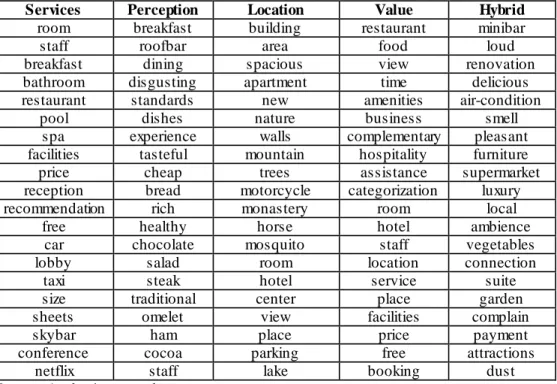
Afterwards, topic modelling was used trying to find similar topics across the guest-generated reviews on the Internet, and trying to group different words together, such that each topic will consist of words with similar meanings. The summary included in this paper was Latent Dirichlet Allocation (LDA) analysis with Gibbs sampling in R. LDA transforms each review into a vector of weights representing the intensity of each topic in the review, where a to pic is a distribution of probabilities over the set o f words used in the database reviews. This probabilistic model assigns the word a probability score of the most probable topic that it could be potentially belong to. Using these probabilities, twenty most likely words were ranged in each topic in order of how likely it was that each word belongs to that topic as shown is Table 2.
Table 2: Classifying words to a particular topic using LDA topic modelling
Services Perception Location Value Hybrid
room breakfast building restaurant minibar
staff roofbar area food loud
breakfast dining spacious view renovation
bathroom disgusting apartment time delicious
restaurant standards new amenities air-condition
pool dishes nature business smell
spa experience walls complementary pleasant
facilities tasteful mountain hospitality furniture
price cheap trees assistance supermarket
reception bread motorcycle categorization luxury
recommendation rich monastery room local
free healthy horse hotel ambience
car chocolate mosquito staff vegetables
lobby salad room location connection
taxi steak hotel service suite
size traditional center place garden
sheets omelet view facilities complain
skybar ham place price payment
conference cocoa parking free attractions
netflix staff lake booking dust
Source: Author's research
The words are in ascending order of phi-value. The higher the ranking, the more probable the word will belong to the topic. While performing LDA in R all 365 words were used in the analysis, in order to get a wider range of words. Topics were na med according to the representation of words. Typical words for the five topics are:
Hotel and Tourism Management, 2020, Vol. 8, No. 1: 37-48.
44
1. Topic 1 (Services) – Usually associated words with the hotel‟s facilities include: “room”, “breakfast”, “bathroom”, “pool” and “spa”.
2. Topic 2 (Perception) – Perception words connected to the guests‟ stay include: “disgusting”, “dishes”, “cheap”, “traditional” and “staff”.
3. Topic 3 (Location) – Words associated with the location of the hotels include: “building”, “area”, “new”, “nature”, “center”, “view” and “place”.
4. Topic 4 (Value) – Words associated with guests‟ perceived value or money in the hotel include: “food”, “time”, “free”, “complementary”, “price” and “expectation”. 5. Topic 5 (Hybrid) – Words that appear to consist two distinctive groups of words reflecting the very different experiences of hotel guests include: “vegetables”, “supermarket”, “delicious”, “smell”, “pleasant”, “local”, “luxury” and “dust”. Using NRC in R for sentiment analysis is immensely helpful when it comes to analyzing a text. In other terms, the polarity of the sentiment articulated within the spectrum that ranges from positive to negative is extracted and shown in Table 3.
Table 3: Sentiment analysis of hotel online reviews
Min. 1st Qu. Median Mean 3rd Qu. Max.
-4.5000 0.0000 0.5000 0.6868 1.2000 6.6000
Source: Author's research
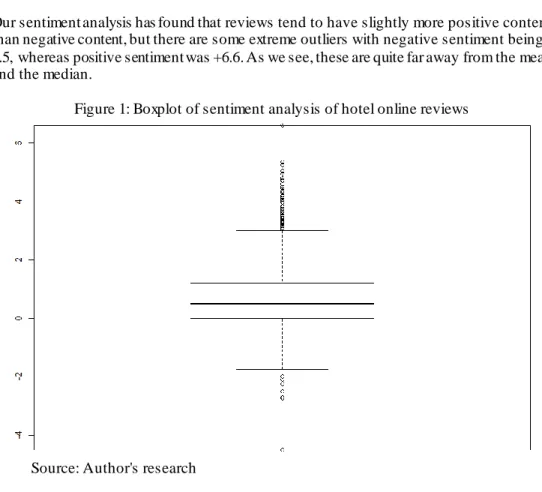
Our sentiment analysis has found that reviews tend to have slightly more positive content than negative content, but there are some extreme outliers with negative sentiment being -4.5, whereas positive sentiment was +6.6. As we see, these are quite far away from the mean and the median.
Figure 1: Boxplot of sentiment analysis of hotel online reviews
Source: Author's research
As a graphical representation of sentiment analysis, boxplot is used to visually show the distribution of numerical data and skewness through displaying the data. Seeing in Figure 1 that the median is +0.5, only a slight part of the online reviews tends to be positive. Since a
Hotel and Tourism Management, 2020, Vol. 8, No. 1: 37-48.
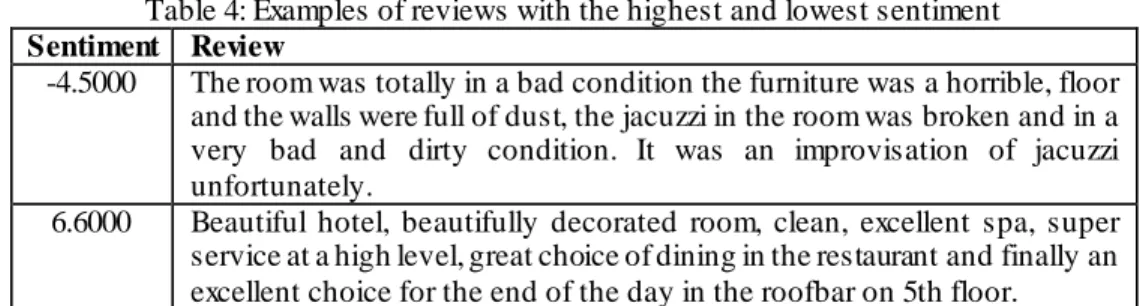
45 strong outlier is showed in both positive in negative sentiment, examples of the reviews with Syuzhet method in R will be shown in Table 4 to figure out which the most positive and negative review was and the whole paragraph.
Table 4: Examples of reviews with the highest and lowest sentiment
Sentiment Review
-4.5000 The room was totally in a bad condition the furniture was a horrible, floor and the walls were full of dust, the jacuzzi in the room was broken and in a very bad and dirty condition. It was an improvisation of jacuzzi unfortunately.
6.6000 Beautiful hotel, beautifully decorated room, clean, excellent spa, super service at a high level, great choice of dining in the restaurant and finally an excellent choice for the end of the day in the roofbar on 5th floor. Source: Author's research
Given the statistics, guests‟ experience as seen in this research is, undoubtedly, an extraordinarily complex construct. In general, guests use the same attributes associated with hotel stays to assess their experience, although only the order of priority of those attributes may vary. The document-term matrix and topic modeling, identify the guest experience by representing which attributes guests consider as significant, important and contribute to their experience and satisfaction in a particular hotel. Therefore, these lists of words represent a “discreet” and “direct” presentation of the guest experience.
According to the research, guests‟ rank their experience as satisfactory or dissatisfactory in an online review from various perspectives. Guests complain most about dirty and outdated rooms, where the words “renovation”, “old”, “dirty” appear. However, data also noted, that guests were pleased with their hotel experiences for a variety of reasons, delicious food, friendly staff and location of the hotel in nature, mountains or even more particular they could be satisfied from products with rich, traditional attributes or dissatisfactory from products with disgusting attributes.
5. Conclusion
In these times, it is common for hotel guests to review a product or service online. In the online reviews, guests leave text content to publicly express their own personal thoughts and feelings, and briefly reveal their opinion about the hotel attributes. Critically, hotels are presented with a viable approach of the widespread applicatio ns of text analysis as text mining and sentiment analysis, allowing hotels to extract vast volume of accumulated text, and thus enabling them to effectively study and analyze the hotel attributes that form guests' experience. The research outcome shows that guests are prone to share even the tiniest detail of the hotel attribute and how it affected their experience in an online review. As expected, attributes as “room”, “staff”, “breakfast”, “location”, “bathroom”, “restaurant” come among the top, but then again attributes as “shower”, “balcony”, “door” and “floor” appear, giving us more wide insight besides the already expected attributes mentioned above. Related attributes to the guests' stay at the hotel that also matter have been presented, where the findings reveal “friendly”, “quiet”, “polite”, “delicious” and “disgusting” are important to the guests' experience.
In sum, the theoretical and practical implications of using text mining for scraping guest -generated reviews on the Internet are tremendously significant. Without text mining in hospitality, valuable guest information can be lost or ignored, which is a major shortcoming for a predominantly guest-oriented industry. Also, text mining can be used as a tool to create
Hotel and Tourism Management, 2020, Vol. 8, No. 1: 37-48.
46
vast profiles of information about guests, emphasizing the most important practical implication; enabling the hotel to deliver and create personalization or personalized experience.
Several limitations can be found in this paper. First, in this research sample, the document -term matrix presents a variety of hotel and hotel stay related attributes, where in future researches it is recommended to narrow them for better determination of the hotel attributes that contribute to the guests' experience. Second, LDA topic modeling shows some overlapping words, where again in future researches a small set of words might be used that would result in overlapping between topics. Lastly, NRC in R offers a possibility to further explore the sentiment in online reviews, beside positive and negative, bu t in another 8 emotion type, which by analyzing, can provide even better insights for hotels, like what attributes made guests feel joy, trust or anger, disgust.
Acknowledgment
The research work by Ristova Maglovska, C. for this paper was done during an Erasmus+ Traineeship from February 1st, 2020 to May 1st, 2020 at the University of Kragujevac, Faculty of Hotel Management and Tourism in Vrnjaĉka Banja under the mentorship of assoc. prof. Darko Dimitrovski.
References
1. Barreda, A., & Bilgihan, A. (2013). An analysis of user generated content for hotel experiences. Journal of Hospitality and Tourism Technology, 4(3), 263–280.
https://doi.org/10.1108/JHTT-01-2013-0001
2. Berezina, K., Bilgihan, A., Cobanoglu, C., & Okumus, F. (2016). Understanding satisfied and dissatisfied hotel customers: Text mining of online hotel reviews. Journal
of Hospitality Mark eting & Management, 25(1), 1–24.
https://doi.org/10.1080/19368623.2015.983631
3. Chatterjee, P. (2001). Online reviews: Do consumers use them? Online reviews: Do Consumers use them? Advances in Consumer Research, 28, 129–133.
4. Duan, W., Cao, Q., Yu, Y., & Levy, S. (2013). Mining online user-generated content: Using sentiment analysis technique to study hotel service quality. 46th Hawaii
International Conference on In System Sciences (HICSS) (pp. 3119–3128). Maui,
Hawaii. https://doi.org/10.1109/HICSS.2013.400
5. Filieri, R., & McLeay, F. (2014). E-WOM and accommodation: An analysis of the factors that influence travelers‟ adoption of information from online reviews. Journal of
Travel Research, 53(1), 44–57. https://doi.org/10.1177/0047287513481274
6. Geetha, M., Singha, P., & Sinha, S. (2017). Relationship between customer sentiment and online customer ratings for hotels-An empirical analysis. Tourism Management, 61, 43–54. https://doi.org/10.1016/j.tourman.2016.12.022
7. Goh, K. Y., Heng, C. S., & Lin, Z. (2013). Social media brand community and consumer behavior: Quantifying the relative impact of user-and marketer-generated content.
Information Systems Research, 24(1), 88–107. https://doi.org/10.1287/isre.1120.0469
8. He, W., Tian, X., Tao, R., Zhang, W., Yan, G., & Akula, V. (2017). Application of social media analytics: A case of analyzing online hotel reviews. Online Information
Review, 41(7), 921–935. https://doi.org/10.1108/OIR-07-2016-0201
9. He, W., Tian, X., & Shen, J. (2015a). Examining Security Risks of Mobile Banking Applications through Blog Mining. MAICS (pp. 103-108). Greensboro, NC, USA: University of Dayton.
Hotel and Tourism Management, 2020, Vol. 8, No. 1: 37-48.
47 10. He, W., Wu, H., & Yan, G., & Akula, V., & Shen, J. (2015b). A novel social media competitive analytics framework with sentiment benchmarks. Information &
Management, 52(7), 801–812. https://doi.org/10.1016/j.im.2015.04.006
11. He, W., Zha, S., & Li, L. (2013). Social media competitive analysis and text mining: A case study in the pizza industry. International Journal of Information Management,
33(3), 464–472. https://doi.org/10.1016/j.ijinfomgt.2013.01.001
12. Hookway, N. (2008). Entering the blogosphere‟: Some strategies for using blogs in
social research. Qualitative Research, 8(1), 91–113.
https://doi.org/10.1177/1468794107085298
13. Jovanović, S. (2019). Green hotels as a new trend in the function of sustainable development and competitiveness improvement. Economics of Sustainable Development, 3(1), 1–7.
14. Kim, D. J., Ferrin, D. L., & Rao, H. R. (2009). Trust and satisfaction, two stepping stones for successful E-commerce relationships: A longitudinal exploration. Information Systems Research, 20(2), 237–257.
15. Kim, W. G., Lim, H., & Brymer, R. A. (2015). The effectiveness of managing social media on hotel performance. International Journal of Hospitality Management, 44, 165– 171. https://doi.org/10.1016/j.ijhm.2014.10.014
16. Ko, H. C. (2018). Exploring big data applied in the hotel guest experience. Open Access
Library Journal, 5(10), e4877. https://doi.org/10.4236/oalib.1104877
17. Kozinets, R. V. (2010). Netnography: Doing Ethnographic Research Online. London, United Kingdom: Sage.
18. Kuzmanović, M., & Makajić-Nikolić, D. (2020). Heterogeneity of Serbian consumers' preferences for local wines: Discrete choice analysis. Economics of Agriculture, 67(1), 37–54. https://doi.org/10.5937/ekoPolj2001037K
19. Lakićević, M., & Sagić, Z. (2019). Accommodation capacities and their utilization in the function of tourism development: Case of Ivanjica. Ek onomik a, 65(3), 77–88.
https://doi.org/10.5937/ekonomika1903077L
20. Liu, B., Cao, S., & He, W. (2011). Distributed data mining for e-business. Information
Technology and Management, 12, 67–79. https://doi.org/10.1007/s10799-011-0091-8
21. Liu, Y., Teichert, T., Rossi, M., Li, H., & Hu, F. (2017). Big data for big insights: Investigating language-specific drivers of hotel satisfaction with 412,784 user-generated
reviews. Tourism Management, 59, 554–563.
https://doi.org/10.1016/j.tourman.2016.08.012
22. Lockyer, T. (2005). The perceived importance of price as one hotel selection dimension.
Tourism Management, 26, 529–537. https://doi.org/10.1016/j.tourman.2004.03.009
23. McAfee, A., & Brynjolfsson, E. (2012). Big data: The Management revolution. Harvard
Business Review. Retrieved April 6, 2020 from
https://hbr.org/2012/10/big-data-the-management-revolution.
24. Milićević, S., ĐorĊević, N., & Krejić, Z. (2020). Research on tourists' attitudes on the potential of Goĉ mountain for the development of eco -tourism. Economics of
Agriculture, 67(1), 223–238. https://doi.org/10.5937/ekoPolj2001223M
25. Mohanty, H. (2015). Big data: An introduction. In Big Data: A Primer. New Delhi, India: Springer.
26. Nicholas, W. C. K., & Lee, H. S. A. (2017). Voice of customers: Text analysis of hotel customer reviews (cleanliness, overall environment & value for money). International Conference on Big Data Research (pp. 104-111). Osaka, Japan: Association for Computing Machinery.
27. O‟Connor, P. (2010). Managing a hotel‟s image on TripAdvisor. Journal of Hospitality
Mark eting & Management, 19(7), 754–772.
Hotel and Tourism Management, 2020, Vol. 8, No. 1: 37-48.
48
28. Pang, B., & Lee, L. (2008). Opinion mining and sentiment analysis. Foundations and
Trends in Information Retrieval, 2(1–2), 1–135. https://doi.org/10.1561/1500000011
29. Poria, Y., Reichel, A., & Brandt, Y. (2011). Dimensions of hotel experience of people with disabilities: an exploratory study. International Journal of Contemporary
Hospitality, 23(5), 571–591. https://doi.org/10.1108/09596111111143340
30. Qu, Z., Zhang, H., & Li, H. (2008). Determinants of online merchant rating: Conte nt analysis of consumer comments about Yahoo merchants. Decision Support Systems,
46(1), 440–449. https://doi.org/10.1016/j.dss.2008.08.004
31. Rhee, H. T., & Yang, S. B. (2015). Does hotel attribute importance differ by hotel? Focusing on hotel star-classifications and customers‟ overall ratings. Computers in
Human Behavior, 50, 576–587. https://doi.org/10.1016/j.chb.2015.02.069
32. Shabani, N., Munir, A., & Bose, A. (2017). Analysis of big data maturity stage in
hospitality industry. Retrieved April 6, 2020 from
https://arxiv.org/ftp/arxiv/papers/1709/1709.07387.pdf
33. Sigala, M. (2008). Web 2.0, social marketing strategies and distribution channels for city destinations: Enhancing the participatory role of travellers and exploiting their collective intelligence. In M. Gascó-Hernández, T. Torres -Coronas (Eds.), Information communication technologies and city marketing: digital opportunities for cities around the world (pp. 221-245). IDEA Publishing.
34. Thelwall, M., Buckley, K., & Paltoglou, G. (2010). Sentiment in Twitter events. Journal of the American Society for Information Science an d Technology, 62(2), 406–418.
https://doi.org/10.1002/asi.21462
35. Torres, E. N., Singh, D., & Robertson-Ring, A. (2015). Consumer reviews and the creation of booking transaction value: Lessons from the hotel industry. International
Journal of Hospitality Management, 50, 77–83.
https://doi.org/10.1016/j.ijhm.2015.07.012
36. Tuominen, P. (2011). The influence of TripAdvisor consumer-generated travel reviews on hotel performance. 19th Annual Frontiers in Service Conference (pp. 1–11). Columbus, Ohio, USA: University of Hertfordshire Business.
37. Vidaković, M., & Vidaković, D. (2019). Digital media, creativity, and marketing, within the scope of the contemporary instant culture. The Annals of the Faculty of Economics in
Subotica, 41, 131–144. https://doi.org/10.5937/AnEkSub1941131V
38. Ye, Q., Law, R., & Gu, B. (2009). The impact of online user reviews on hotel ro om sales. International Journal of Hospitality Management, 28, 180–182.
https://doi.org/10.1016/j.ijhm.2008.06.011