Kent Academic Repository
Full text document (pdf)
Copyright & reuse
Content in the Kent Academic Repository is made available for research purposes. Unless otherwise stated all
content is protected by copyright and in the absence of an open licence (eg Creative Commons), permissions
for further reuse of content should be sought from the publisher, author or other copyright holder.
Versions of research
The version in the Kent Academic Repository may differ from the final published version.
Users are advised to check http://kar.kent.ac.uk for the status of the paper. Users should always cite the
published version of record.
Enquiries
For any further enquiries regarding the licence status of this document, please contact:
[email protected]
If you believe this document infringes copyright then please contact the KAR admin team with the take-down
information provided at http://kar.kent.ac.uk/contact.html
Citation for published version
Phan, Huy and Chén, Oliver Y. and Koch, Philipp and Pham, Lam Dang and McLoughlin, Ian
Vince and Mertins, Afred and De Vos, Maarten (2019) Unifying Isolated and Overlapping Audio
Event Detection with Multi-Label Multi-Task Convolutional Recurrent Neural Networks. In:
44th IEEE International Conference on Acoustics, Speech, and Signal Processing (ICASSP 2019).
DOI
Link to record in KAR
https://kar.kent.ac.uk/72657/
Document Version
UNIFYING ISOLATED AND OVERLAPPING AUDIO EVENT DETECTION WITH
MULTI-LABEL MULTI-TASK CONVOLUTIONAL RECURRENT NEURAL NETWORKS
Huy Phan
∗‡, Oliver Y. Ch´en
∗, Philipp Koch
†, Lam Pham
‡Ian McLoughlin
‡, Alfred Mertins
†, and Maarten De Vos
∗‡
University of Kent, School of Computing, UK
∗
University of Oxford, Department of Engineering Science, UK
†University of L¨ubeck, Institute for Signal Processing, Germany
ABSTRACT
We propose a multi-label multi-task framework based on a convo-lutional recurrent neural network to unify detection of isolated and overlapping audio events. The framework leverages the power of convolutional recurrent neural network architectures; convolutional layers learn effective features over which higher recurrent layers per-form sequential modelling. Furthermore, the output layer is designed to handle arbitrary degrees of event overlap. At each time step in the recurrent output sequence, an output triple is dedicated toeachevent category of interest to jointly model event occurrence and temporal boundaries. That is, the network jointly determines whether an event of this category occurs, and when it occurs, by estimating onset and offset positions at each recurrent time step. We then introduce three sequential losses for network training: multi-label classification loss, distance estimation loss, and confidence loss. We demonstrate good generalization on two datasets: ITC-Irst for isolated audio event de-tection, and TUT-SED-Synthetic-2016 for overlapping audio event detection.
Index Terms— Audio event detection, isolated sound, overlap-ping sound, multi-label, multi-task, convolutional recurrent neural network
1. INTRODUCTION
Audio event detection (AED) [1, 2] is an important research area within the wider machine hearing field [3, 4], aiming at determin-ing when and which target events occur in continuous audio. This task has recently attracted significant attention in the research com-munity, manifested by rapidly increasing numbers of participants in related international challenges over the past few years [5]. Ideally, event instances of different categories of interest would occur in iso-lation so that there is at most one such occurrence at any time point in the signal [6, 7]. However, in practice, they may occur at the same time, leading to partial or full temporal overlap [8, 9], sometimes called polyphonic AED. Due to the mixture of multiple acoustic sources, detection of overlapping events is much more challenging than detection of isolated ones.
Isolated and overlapping AED literature often appear to derive from two separate methodological streams. For the former, there is a large body of work covering different perspectives: noise robust-ness [10, 7, 11], multichannel and multimodal fusion [12, 13, 14], weak labelling [15, 16], early event detection [17, 18, 19], event de-tection under scarcity scenarios [20, 21], as well as false positive
The research was performed when H. Phan was at the University of Ox-ford and supported by the NIHR OxOx-ford Biomedical Research Centre. Cor-responding author:[email protected]
reduction [22, 7]. Particularly, the multitasking approach that jointly performs event detection and event boundary estimation [23, 6, 24] has demonstrated state-of-the-art performance on different bench-mark datasets. In the latter stream, overlapping events are either sep-arated using source separation methods [25, 26] prior to detection, or recognized via a selection of local spectral features [11, 10, 7]. The most successful approach appears to be to directly classify the mixtures via multi-label classification [27, 28, 29, 8, 9]. But both streams have one aspect in common: they are efficient when cou-pled with underlying deep learning models [8, 30, 6, 20], particu-larly convolutional recurrent neural networks (CRNN) [8, 30]. This is partly due to their power in feature learning and partly due to their capability in performing complex modelling tasks, i.e. multi-label and multi-task. However, there exists a methodological gap between them. Audio events intrinsically possess temporal structures, and tai-loring a network’s output layer and loss functions for structure mod-elling has been shown to be efficient for the isolated AED [23, 6, 24]. However, this capacity has been uncharted for overlapping AED, and it remains questionable how to generalize a network’s output layer and tailor its loss functions [20, 6] to accommodate arbitrary event overlap, i.e. from one to the maximum number of simultaneous or partially-simultaneous target events. Bridging this gap would allow us to unify how isolated and overlapping AED is trained and oper-ated.
To this end, we present a multi-label multi-task CRNN frame-work to homogeneously deal with isolated and overlapping events. The network body makes use of a CRNN architecture as it has been shown to be efficient for both isolated [30, 8] and overlapping [8] AED. The idea is to use the convolutional layers to learn good time-frequency invariant features over which recurrent layers are lever-aged to incorporate a long temporal context, i.e. hundreds of audio frames. The network sequential output layer is designed to accom-modate all possible event overlaps. At each time step of the recurrent output, we tailor a set of output triplets each of which is dedicated to one event category of interest. The output consists of three elements: event activity, event onset distance, and event offset distance, to al-low the network to determine whether or not an event of this category is happening at the current time index, and estimate the distances to its boundary, i.e. event onset and offset position, at the same time. As one output triplet is tied to one specific category, inference for all target event categories can be carried out individually no matter how many events of different classes occur concurrently. For training, three types of loss are proposed: sequential multi-label classification loss, sequential distance estimation loss, and sequential confidence loss. Combining the three losses, the network is penalized for both mistakes it makes on event activity determination and event
bound-R FC i x xj k xl xm ... ... ... ... ... ... ... ... ... ... ... ... i G Gj Gk Gl Gm Event activity Input Residual recurrent Output kernel: 5x1, stride: 5x1 kernel: 5x5, stride: 1x1 kernel: 5x5, stride: 1x1 kernel: 4x1, stride: 4x1 kernel: 5x5, stride: 1x1 kernel: 2x1, stride: 2x1 R FC R FC R FC R FC x Conv. 1 Max pool 1 Conv. 2 Max pool 2 Conv. 3 Max pool 3 i z i a j z j a k z k a l z l a m z m a
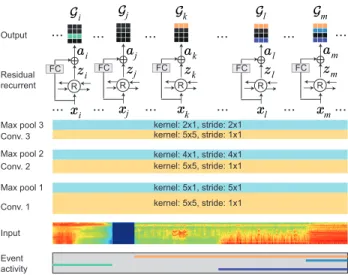
Fig. 1. Overview of the proposed multi-label multi-task CRNN.
ary estimation, integrated over all time steps of the recurrent output layer.
2. THE MULTI-LABEL MULTI-TASK CRNN
The proposed network architecture is illustrated in Fig. 1 and is described in detail in the following sections.
2.1. Input
An audio signal, sampled at 44100 Hz, is converted into a log Mel-scale spectrogram usingM = 40Mel-scale filters in the frequency range of [50, 22050] Hz. In addition, a window (i.e. frame) size of 40 ms with 50% overlap is used. C different event categories are considered in total. Since events from any of these categories may happen at a certain audio frame, in order to accommodate all possible occurrences it is necessary to annotate each audio frame with a set of
CtripletsG={(yc, pc, qc)},1≤c≤C, one of which is dedicated for each event category.yc
∈ {0,1}equals to one if an event of class
cis active at the current audio frame and equals to zero otherwise.
pc
, qc
∈R+denote the distances from the current frame to the event
onset and offset if it is active and are normalized to [0,1].pcandqc
are forced to be zero when the event is absent.
As a long context is crucial for audio event detection [8, 30], we use an audio segment ofT = 512frames as an input to the network. Hence, one sample, i.e. one audio segment, is represented by a time-frequency imageS ∈ RM×T and associated with a sequence of
T triplet setsG = (G1,G2, . . . ,GT)whereGt = {(yct, p c t, q
c t)},
1≤c≤C, as described above, denotes the annotation of the frame at the time indext,1≤t≤T. The network therefore plays the role of mapping:S7→G, which is multi-label (i.e. multiple classes may be active concurrently) and multi-task (i.e. joint modelling of event activity and event boundary).
2.2. Convolutional layers
The convolutional block of the network essentially consists of three convolutional layers, each followed by a max pooling layer. The convolutional layers are commonly designed to haveF two-dimensional convolutional filters of size5×5with the stride set to one in both temporal and spectral directions during the convolution operation. Zero-padding (also known asSAMEpadding) is used in order to maintain a temporal size equal toT. After convolution, batch normalization [31] is applied on the feature maps, followed by Rectified Linear Units (ReLU) activation [32].
The three max pooling layers aim to improve spectral invariance while keeping the temporal size unchanged. Their pooling kernel size are set to5×1,4×1, and2×1with stride of5×1,4×1,
2×1, respectively. With these settings, the spectral dimension is reduced from an input ofM = 40to8→2→1after the pooling layers, respectively. Concatenating allFpooled feature maps after the last pooling layer, we have transformed the original input into a convolutional image featureX∈RF×T.
2.3. Residual recurrent layer
The above convolutional outputXcan be interpreted as a sequence ofT convolutional feature vectors, i.e. X ≡ (x1,x2, . . . ,xT) wherext ∈ RF,1≤t≤T. A bidirectional recurrent layer is then used to read the sequence of convolutional feature vectors into the sequence of recurrent feature vectorsZ ≡ (z1,z2, . . . ,zT), where
zt= [hbt⊕htf]Wz+bz, (1) hft=H(xt,hft−1), (2) hbt=H(xt,hbt+1). (3) Here,hf t,hbt∈R H
represent the forward and backward hidden state vectors of sizeH at recurrent time stept, respectively while⊕ in-dicates vector concatenation. Wz ∈ R2H×2H denotes a weight matrix andbz ∈ R2
H
denotes bias terms. Hrepresents the hid-den layer function of the recurrent layer and we use Gated Recurrent Units (GRU) [33] here to realize the functionH.
As a recurrent output vectorzt is expected to have context in-formation from the entire sequence, to allow the network to explore possible combinations of local convolutional featuresxtand contex-tual recurrent featureszt, we aggregate them via a residual connec-tion. Asxt ∈RF andzt ∈R2H may have different sizes in prac-tice, we transferxt through a fully-connected layer with a weight matrixWx∈RF×2Hand bias termbx∈R2Hto make their sizes compatible. The final residual feature vector at time steptis
at= ReLU(xtWx+bx)⊕zt. (4)
Batch normalization [31] is also applied to the fully-connected layer of the residual connection.
2.4. Output layer
The output layer consists ofT ×C×3entries in total which are orderly arranged in the output sequenceGˆ = ( ˆG1,Gˆ2, . . . ,GˆT). At time indext,Gˆt={(ˆy c t,pˆ c t,qˆ c
t)},1≤c≤C, is the set ofCoutput triplets, one dedicated to each event category.yˆtcindicates how likely an event of classcis occurring at twhilepˆc
t and qˆ c
t estimate the distances to its onset and offset fromt. To obtain the outputGˆt at time indext, the residual outputatis transferred through a single fully-connected layer withsigmoidactivation:
oGˆt = sigmoid(atWa+ba), (5)
whereWa ∈ R2H×3C and ba ∈ R3C. oGˆt ∈ [0,1]
3C is the flattened vector including the entries ofGˆtin a pre-determined order.
2.5. Losses
Similar to [20, 6], for network training, we want to penalize the net-work on both tasks: event activity determination and event bound-ary estimation. Assume output sequenceGˆ = ( ˆG1,Gˆ2, . . . ,GˆT) is obtained from the network given an input S associated with groundtruthG= (G1,G2, . . . ,GT). Since the event activity deter-mination task is addressed as a multi-label classification problem,
i.e. multiple events of different classes may be present at the same time, the multi-class cross-entropy loss cannot be used here. There-fore, we interpret the multi-label classification problem as multiple binary classification problems and employbinarycross-entropy loss penalization. Furthermore, integration over the network’s output at different time steps is necessary to take into account all possible misclassifications. Thesequential multi-label classification lossis
Eclass(G,Gˆ) = 1 T T X t=1 C X c=1 −yctlog(ˆy c t)−(1−y c t) log(1−yˆ c t) . (6)
Similarly, thesequential distance lossinduced by errors in event onset and offset distance estimation is given by
Edist(G,Gˆ) = 1 T T X t=1 C X c=1 kpct−pˆ c tk 2 2+kq c t−qˆ c tk 2 2 . (7)
The event boundary estimation errors can also be quantified as the
{intersection : union}ratio of the truth boundary and the esti-mated boundary [20, 6] and further penalized using thesequential confidence loss: Econf(G,Gˆ) = 1 T T X t=1 C X c=1 y c t− intersection(G,Gˆ) union(G,Gˆ) 2 2 =1 T T X t=1 C X c=1 y c t− min(pct,pˆ c t)+min(q c t,qˆ c t) max(pc t,pˆ c t)+max(q c t,qˆ c t) 2 2 . (8)
Note that we do not use the event activity likelihood to weight the
{intersection : union}ratio as in [20, 6], in to order to more aggressively penalize the network. Finally, the network is trained to minimize the accumulated unweighted multi-task losses over all training examples:
E=X
iEclass(
Gi,Gˆi) +Edist(Gi,Gˆi) +Econf(Gi,Gˆi). (9)
3. INFERENCE
Inference for joint event detection and boundary estimation can be carried out individually for different event categories of interest sim-ilar to [18]. However, we need to extend this to handle the sequential output of the network.
Letm, n >0both denote the time indices of a continuous test
signal. Given a test audio segmentS(m)of lengthTframes starting at the time indexm and assuming its output sequenceGˆ(m), its contribution to the confidence score that a target event of classc
occurs at time indexnis given by
fc n|S(m) = T X t=1 ˆ ytc(m)1 ˆ yct(m)> αc 1 n∈Ω pct(m), q c t(m) ,
whereαcdenotes a class-specific threshold on event activity likeli-hood,Ω pc
t(m), q c t(m)
represents theregion of interest (ROI) de-termined bypct(m)andq
c
t(m), and1(·)is the indicator function. In essence, we iterate over the output sequenceGˆ(m)and collectively integrate the event activity likelihoods into a confidence score. In addition, the event activity likelihoodyˆct(m)at time steptof the se-quence is only counted if it is greater than the likelihood threshold
αcand wherenlies inside the ROIΩ pct(m), q c t(m) , meaning m+t−pˆct(m)≤n≤m+t+ ˆp c t(m). (10) Note that the estimated onset and offset distances need to be denor-malized to their original range before inference.
The confidence score obtained from all test audio segments sam-pled from the test signal is
fc(n) =
X mfc n|
S(m)
. (11)
A second class-specific detection thresholdβcis applied to the con-fidence score for joint event detection and segmentation. Although we do not study early detection of an ongoing event [17, 18] in this paper, the inference scheme described has such a capability.
4. EXPERIMENTS 4.1. Datasets
We conducted experiments on two datasets:
ITC-Irst [34]—created for studying isolated AED, this database consists of twelve recording sessions with 16 annotated event categories. Following the standard split used in previous works [34, 23, 18], nine out of twelve recordings were used for training and the remaining three were used for evaluation. In addition, eval-uation was based on twelve out of 16 categories with the others considered as background sounds. For relevant parameter search (cf. Section 4.2), leave-one-recording-out cross-validation was con-ducted on the nine training recordings. The channelTABLE 1[34] was chosen for the experiments.
TUT-SED-Synthetic-2016 [8]—created for studying overlap-ping audio event detection, this database consists of 100 mixtures of 994 isolated event instances from 16 event categories. Further detail on the dataset creation procedure can be found in [8]. Out of 100 created mixtures, 60 were used for training, 20 for evaluation, and 20 for validation [8].
4.2. Network training and parameters
To form the training data, we sampled all possible audio segments of lengthT frames from the training recordings. The network was trained with a minibatch size of four for 100 and 10 epochs for ITC-Irst and TUT-SED-Synthetic-2016, respectively.F = 256 convolu-tional filters were used for the convoluconvolu-tional layers and the size of hidden state vectors of the recurrent layer wasH = 256. The net-work was trained using theAdamoptimizer [35] with learning rate
10−4
. For regularization, a dropout rate of0.25was applied to the convolutional layers, the recurrent layer, and the residual connection. Following training, the network was exercised on audio seg-ments sampled from a test signal without overlap to compute the confidence scores as described in Section 3. Particularly, for ITC-Irst, we utilized the cross-validation models for this purpose. The final confidence score on the test signal was averaged from the in-dividual ones resulting from the cross-validation models. The de-tection confidence score was normalized to [0,1] and the category-specific thresholdsαcandβcwere selected to maximize the average F1-score on the validation set.αcandβcwere searched in the range [0, 1] with a step size of0.01and0.05, respectively.
4.3. Evaluation metrics
With the proposed multi-label multi-task CRNN coupled with the in-ference algorithm in Section 3, we are interested in detecting entire events and segmenting them from a continuous test signal. There-fore, we evaluated the detection performance based on two event-wise metrics: F1-score and detection error rate (ER).
4.4. Baseline
In addition to prior works, we implemented a multi-label CRNN baseline for comparison, as it has been demonstrated to achieve state-of-the-art performance on several similar AED datasets [21, 8, 30]. The baseline body architecture and parameters were maintained to be the same as the proposed network, except that its output layer only includes multi-label event activity output. As post-processing
2000 6000 10000 14000 18000 t alarm/siren bus rain 0 0.5 1 0 0.5 1 0 0.5 1 confi de nc e sc ore confi de nc e sc ore confi de nc e sc ore (a) (b) (c) (d)
Fig. 2. The confidence scores for three different categories produced by the proposed network on one test recording of the TUT-SED-Synthetic-2016 dataset. (a) event activity, (b) “alarms and sirens”, (c) “bus”, and (d) “rain”.
is important in assisting such a baseline system to yield good per-formance [21, 9, 29], category-specific likelihood thresholdαcwas firstly applied to produce discrete labels which were then smoothed by median filtering. A grid search was conducted forαcas in Sec-tion 4.2, while the window size of the median filter was searched in range of [1, 256] with a step of 6. Those values resulting in the best F1-score on the validation set were retained for evaluation.
4.5. Experimental results
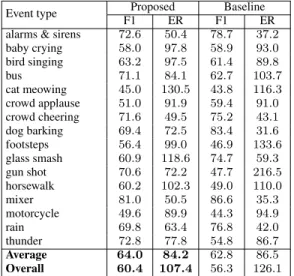
The results obtained by the proposed multi-label multi-task CRNN and the multi-label CRNN baseline on the two experimental datasets are shown in Tables 1 and 2. To further compare with existing works on the ITC-Irst dataset, we also contrast their performance with the best result previously reported in [18] using a dual-DNN approach. On the TUT-SED-Synthetic-2016 dataset, no prior event-wise results were reported, so a CRNN-based system, similar to that reporting best frame- and segment-wise performance [8], is used for a baseline here.
Results show that the proposed system outperforms the base-line on both isolated and overlapping AED tasks. In the isolated AED case with ITC-Irst, an absolute gain of0.9% was achieved on both average F1-score (i.e. the eventcategoriesare considered equally important) and overall F1-score (i.e. the eventinstancesare considered equally important) although it brings up the overall ER by0.8%absolute. The rise in ER is mainly due to insertion errors on “key jingle” and “phone ring”, which are likely due to their bi-modal behaviour. The improvement of the proposed system over the baseline becomes even more noticeable on the overlapping data in TUT-SED-Synthetic-2016. Absolute gains of1.2%on average F1-score and of4.1%on overall F1-score were achieved. Moreover, it also improves average and overall ER by2.3%and18.7%absolute, respectively. Fig. 2 further shows the confidence scores produced by the proposed system for three different event categories on one recording of TUT-SED-Synthetic-2016. Although the events over-lap heavily (and events of other categories were also present but are excluded from the plot for clarity), the proposed network seems to be able to untangle the mixtures and recognize the individual instances. Meanwhile comparing results in Tables 1 and 2, it is clear that over-lapping, or polyphonic, AED remains a more challenging task than isolated AED.
On the other hand, the proposed system significantly outper-forms the prior work (i.e. the dual-DNN system [18]) that reported the best results on ITC-Irst. Absolute gains of2.5%and2.1%were achieved on average and overall F1-score, respectively, while
aver-Table 1. ITC-Irst: the detection performances obtained by the pro-posed approach and the baseline in comparison with the best re-ported existing work [18].
Event type Proposed Baseline
Best reported (Dual-DNN [18]) F1 ER F1 ER F1 ER door knock 100 .0 0.0 100.0 0.0 100.0 0.0 door slam 100 .0 0.0 100.0 0.0 100.0 0.0 steps 100 .0 0.0 100.0 0.0 91.7 16.7 chair moving 92 .3 33.3 91.7 33.3 92.0 16.7
spoon cup jingle 100
.0 0.0 100.0 0.0 100.0 0.0 paper wrapping 100 .0 0.0 100.0 0.0 100.0 0.0 key jingle 95 .7 25.0 95.7 8.3 95.7 8.3 keyboard clicking 96 .0 8.3 86.7 33.3 91.7 16.7 phone ring 97 .4 30.4 98.0 21.7 100.0 17.4 applause 100 .0 0.0 100.0 0.0 100.0 0.0 cough 93 .8 16.7 92.9 16.7 88.0 25.0 laugh 95 .7 8.3 95.7 8.3 81.8 33.3 Average 97 .6 10.2 96.7 10.1 95.1 11.2 Overall 97 .3 11.0 96.4 10.2 95.2 11.0
Table 2. TUT-SED-Synthetic-2016: the detection performance ob-tained by the proposed approach and the baseline system.
Event type Proposed Baseline
F1 ER F1 ER
alarms & sirens 72
.6 50.4 78.7 37.2 baby crying 58 .0 97.8 58.9 93.0 bird singing 63 .2 97.5 61.4 89.8 bus 71 .1 84.1 62.7 103.7 cat meowing 45 .0 130.5 43.8 116.3 crowd applause 51 .0 91.9 59.4 91.0 crowd cheering 71 .6 49.5 75.2 43.1 dog barking 69 .4 72.5 83.4 31.6 footsteps 56 .4 99.0 46.9 133.6 glass smash 60 .9 118.6 74.7 59.3 gun shot 70 .6 72.2 47.7 216.5 horsewalk 60 .2 102.3 49.0 110.0 mixer 81 .0 50.5 86.6 35.3 motorcycle 49 .6 89.9 44.3 94.9 rain 69 .8 63.4 76.8 42.0 thunder 72 .8 77.8 54.8 86.7 Average 64 .0 84.2 62.8 86.5 Overall 60 .4 107.4 56.3 126.1
age ER was lowered by1.0%absolute.
5. CONCLUSION
This paper has proposed a multi-label multi-task CRNN in an ef-fort to treat the isolated and overlapping audio event detection tasks homogeneously. Built on top of a CRNN architecture, the recur-rent output layer of the network was designed to accommodate arbi-trary numbers of overlapping sounds, i.e. from isolated to maximally polyphonic (all event categories occurring simultaneously), at every recurrent time step. For network training, three sequential losses, including the multi-label classification loss, the distance estimation loss, and the confidence loss, were introduced to penalize the net-work on both multi-label event activity classification errors and event boundary estimation errors. Evaluating on two datasets, namely ITC-Irst for isolated AED and TUT-SED-Synthetic-2016 for over-lapping AED, we demonstrated that the proposed network outper-forms the multi-class CRNN baseline with the same network body, as well as previously published state-of-the-art results.
6. REFERENCES
[1] D. Stowell, D. Giannoulis, E. Benetos, M. Lagrange, and M. D. Plumbley, “Detection and classification of acoustic scenes and events,” IEEE Trans. Multimedia, vol. 17, no. 10, pp. 1733– 1746, 2015.
[2] A. Mesaros, T. Heittola, E. Benetos, P. Foster, M. Lagrange, T. Virtanen, and M. D. Plumbley, “Detection and classification of acoustic scenes and events: outcome of the DCASE 2016 challenge,” IEEE/ACM Transactions on Audio, Speech, and Language Processing, vol. 26, no. 2, pp. 379–393, 2018.
[3] D. Wang and G. J. Brown, Computational Auditory Scene
Analysis: Principles, Algorithms, and Applications, Wiley-IEEE Press, 2006.
[4] R. F. Lyon, “Machine hearing: An emerging field,” IEEE Signal Processing Magazine, vol. 27, no. 5, pp. 131–139, 2010. [5] “DCASE: Detection and classification of acoustic scenes and
events,”http://dcase.community/.
[6] H. Phan, M. Krawczyk-Becker, T. Gerkmann, and A. Mertins, “DNN and CNN with weighted and multi-task loss functions for audio event detection,”arXiv:1708.03211, 2017.
[7] I. McLoughlin, H. Zhang, Z. Xie, Y. Song, W. Xiao, and H. Phan, “Continuous robust sound event classification using time-frequency features and deep learning,” PLoS ONE, vol. 12, no. 9, 2017.
[8] E. C¸ akir, G. Parascandolo, T. Heittola, H. Huttunen, and T. Vir-tanen, “Convolutional recurrent neural networks for poly-phonic sound event detection,” IEEE/ACM Trans. on Audio, Speech, and Language Processing, vol. 5, no. 6, pp. 1291– 1303, 2017.
[9] G. Parascandolo, H. Huttunen, and T. Virtanen, “Recurrent neural networks for polyphonic sound event detection in real life recordings,” inProc. ICASSP, 2016, pp. 6440–6444. [10] I. McLoughlin, H. Zhang, Z. Xie, Y. Song, and W. Xiao,
“Ro-bust sound event classification using deep neural networks,”
IEEE/ACM Trans. on Audio, Speech, and Language Process-ing, vol. 23, no. 3, pp. 540–552, 2015.
[11] J. Dennis, Y. Qiang, T. Huajin, T. H. Dat, and L. Haizhou, “Temporal coding of local spectrogram features for robust sound recognition,” inProc. ICASSP, 2013, pp. 803–807. [12] J. K¨urby, R. Grzeszick, A. Plinge, and G. A. Fink,
“Bag-of-features acoustic event detection for sensor networks,” inProc. DCASE Workshop, 2016, pp. 55–59.
[13] K. Imoto and N. Ono, “Spatial cepstrum as a spatial feature using a distributed microphone array for acoustic scene analy-sis,”IEEE/ACM Transactions on Audio, Speech and Language Processing (TASLP), vol. 25, no. 6, pp. 1335–1343, 2017. [14] H. Phan, M. Maass, L. Hertel, R. Mazur, and A. Mertins, “A
multi-channel fusion framework for audio event detection,” in
Proc. WASPAA, 2015, pp. 1–5.
[15] A. Kumar and B. Raj, “Deep CNN framework for audio event recognition using weakly labeled web data,” arXiv Preprint arXiv:1707.02530, 2017.
[16] Q. Kong, Y. Xu, I. Sobieraj, W. Wang, and M. D. Plumbley, “Sound event detection and time-frequency segmentation from weakly labelled data,”arXiv Preprint arXiv:1804.04715, 2018.
[17] H. Phan, M. Maass, R. Mazur, and A. Mertins, “Early event detection in audio streams,” inProc. ICME, 2015, pp. 1–6. [18] H. Phan, P. Koch, I. McLoughlin, and A. Mertins, “Enabling
early audio event detection with neural networks,” inProc. ICASSP, 2018, pp. 141–145.
[19] I. McLoughlin, Y. Song, L. Pham, R. Palaniappan, H. Phan, and Y. Lang, “Early detection of continuous and partial audio events using CNN,” inProc. Interspeech, 2018.
[20] H. Phan, M. Krawczyk-Becker, T. Gerkmann, and A. Mertins, “Weighted and multi-task loss for rare audio event detection,” inProc. ICASSP, 2018, pp. 336–340.
[21] H. Lim, J. Park, and Y. Han, “Rare sound event detection us-ing 1d convolutional recurrent neural networks,” Tech. Rep., DCASE2017 Challenge, 2017.
[22] H. Phan, P. Koch, F. Katzberg, M. Maass, R. Mazur, I. McLoughlin, and A. Mertins, “What makes audio event de-tection harder than classification?,” inProc. EUSIPCO, 2017. [23] H. Phan, M. Maaß, R. Mazur, and A. Mertins, “Random
re-gression forests for acoustic event detection and classification,”
IEEE/ACM Trans. on Audio, Speech, and Language Process-ing, vol. 23, no. 1, pp. 20–31, 2015.
[24] X. Xia, R. Togneri, F. Sohel, and D. Huang, “Random
forest classification based acoustic event detection utilizing contextual-information and bottleneck features,” Pattern Recognition, vol. 81, pp. 1–13, 2018.
[25] T. Heittola, A. Mesaros, T. Virtanen, and M. Gabbouj, “Su-pervised model training for overlapping sound events based on unsupervised source separation,” inProc. ICASSP, 2013. [26] A. Mesaros, O. Dikmen, T. Heittola, and T. Virtanen, “Sound
event detection in real life recordings using coupled matrix fac-torization of spectral representations and class activity annota-tions,” inProc. ICASSP, 2015.
[27] H. Tran and H. Li, “Jump function Kolmogorov for overlap-ping audio event classification,” inProc. ICASSP, 2011. [28] H. Phan, L. Hertel, M. Maass, P. Koch, and A. Mertins,
“CaR-FOREST: Joint classification-regression decision forests for overlapping audio event detection,”arXiv:1607.02306, 2016. [29] E. Cakir, T. Heittola, H. Huttunen, and T. Virtanen,
“Poly-phonic sound event detection using multi label deep neural net-works,” inProc. IJCNN, 2015.
[30] C.-C. Kao, W. Wang, M. Sun, and C. Wang, “R-CRNN:
Region-based convolutional recurrent neural network for audio event detection,” inProc. Interspeech, 2018.
[31] S. Ioffe and C. Szegedy, “Batch normalization: Accelerating deep network training by reducing internal covariate shift,” in
Proc. ICML, 2015, pp. 448–456.
[32] V. Nair and G. E. Hinton, “Rectified linear units improve re-stricted Boltzmann machines,” inProc. ICML, 2010.
[33] K. Cho, B. van Merrienboer, C. Gulcehre, F. Bougares, H. Schwenk, and Y. Bengio, “Learning phrase representations using rnn encoder-decoder for statistical machine translation,” inProc. EMNLP, 2014, pp. 1724–1734.
[34] A. Temko, R. Malkin, C. Zieger, D. Macho, C. Nadeu, and M. Omologo, “CLEAR evaluation of acoustic event detection and classification systems,” Lecture Notes in Computer Sci-ence, vol. 4122, pp. 311–322, 2007.
[35] D. P. Kingma and J. L. Ba, “Adam: a method for stochastic optimization,” inProc. ICLR, 2015, pp. 1–13.