EMPIRICAL TECHNIQUES TO DETECT ROGUE
WIRELESS DEVICES
Bandar Alotaibi
Under the Supervision of Dr. Khaled Elleithy
DISSERTATION
SUBMITTED IN PARTIAL FULFILMENT OF THE REQUIREMENTS FOR THE DEGREE OF DOCTOR OF PHILOSOPHY IN COMPUTER SCIENCE
AND ENGINEERING THE SCHOOL OF ENGINEERING
UNIVERSITY OF BRIDGEPORT CONNECTICUT
EMPIRICAL TECHNIQUES TO DETECT
ROGUE WIRELESS DEVICES
EMPIRICAL TECHNIQUES TO DETECT ROGUE
WIRELESS DEVICES
ABSTRACT
Media Access Control (MAC) addresses in wireless networks can be trivially spoofed using off-the-shelf devices. We proposed a solution to detect MAC address spoofing in wireless networks using a hard-to-spoof measurement that is correlated to the location of the wireless device, namely the Received Signal Strength (RSS). We developed a pas-sive solution that does not require modification for standards or protocols. The solution was tested in a live test-bed (i.e., a Wireless Local Area Network with the aid of two air-monitors acting as sensors) and achieved 99.77%, 93.16%, and 88.38% accuracy when the attacker is 8–13 m, 4–8 m, and less than 4 m away from the victim device, respectively. We implemented three previous methods on the same test-bed and found that our solution outperforms existing solutions. Our solution is based on an ensemble method known as Random Forests.
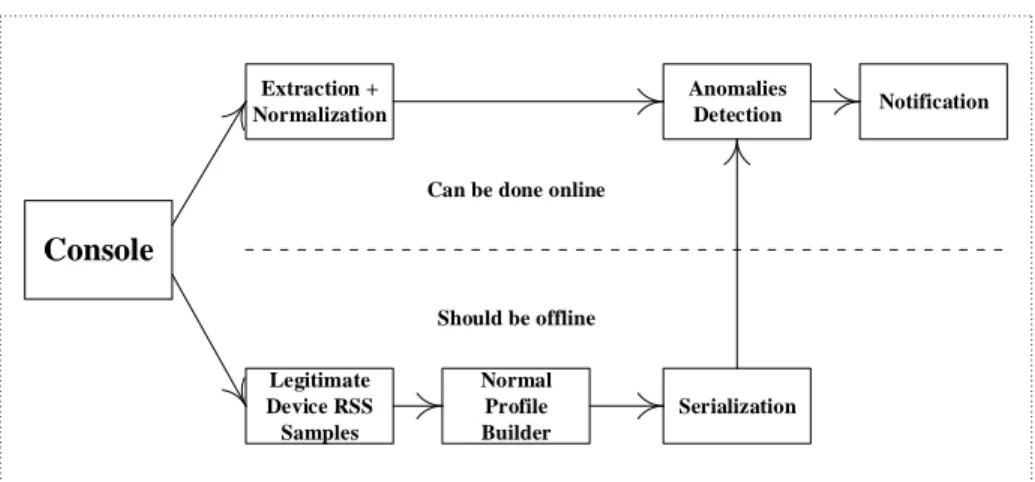
We also proposed an anomaly detection solution to deal with situations where it is impossible to cover the whole intended area. The solution is totally passive and unsu-pervised (using unlabeled data points) to build the profile of the legitimate device. It only requires the training of one location which is the location of the legitimate device (unlike the misuse detection solution that train and simulate the existing of the attacker in every possible spot in the network diameter). The solution was tested in the same test-bed and
yield about 79% overall accuracy.
We build a misuse Wireless Local Area Network Intrusion Detection System (WIDS) and discover some important fields in WLAN MAC-layer frame to differentiate the attack-ers from the legitimate devices. We tested several machine learning algorithms and found some promising ones to improve the accuracy and computation time on a public dataset. The best performing algorithms that we found are Extra Trees, Random Forests, and Bag-ging. We then used a majority voting technique to vote on these algorithms. Bagging classifier and our customized voting technique have good results (about 96.25 % and 96.32 % respectively) when tested on all the features. We also used a data mining technique based on Extra Trees ensemble method to find the most important features on AWID public data-set. After selecting the most 20 important features, Extra Trees and our voting technique are the best performing classifiers in term of accuracy (96.31 % and 96.32 % respectively).
ACKNOWLEDGMENTS
My thanks are wholly devoted to God who has helped me all the way to complete this work successfully. I owe a debt of gratitude to my family for understanding and encour-agement. I am very grateful to my mother and my father for raising me and encouraging me to achieve my goal. Special thanks go to my wife and my kids; I could never achieved this without their support. I would like also to thank my supervisor Dr. Khaled Elleithy for his valuable suggestions. Without his recommendations this dissertation has not been ever done.
Contents
ABSTRACT
. . . vACKNOWLEDGMENTS
. . . viTABLE OF CONTENTS
. . . viiLIST OF FIGURES
. . . xiLIST OF TABLES
. . . xiiABBREVIATIONS
. . . xiiiCHAPTER 1: INTRODUCTION
. . . 11.1 Research Problem and Scope . . . 6
1.2 Motivation behind the Research . . . 9
1.3 Contributions . . . 11
CHAPTER 2: 802.11 STANDARD OVERVIEW
. . . 122.1 Connection Establishment Process . . . 12
2.2 Classification of RAPs . . . 15
2.2.1 Evil-twin . . . 16
2.2.2 Improperly Configured AP . . . 18
2.2.4 Compromised AP . . . 19
2.2.5 RAP-Based Deauthentication/Disassociation . . . 20
2.2.6 Forged First Message in a Four-way Handshake . . . 21
CHAPTER 3: LITERATURE SURVEY
. . . 243.1 Available Security Countermeasures . . . 27
3.2 Classification of RAP Detection Approaches . . . 31
3.2.1 Coexistence Approaches . . . 32
3.2.2 Approaches that handle all Evil-twin sub-types . . . 37
3.2.3 Unauthorized AP Countermeasures . . . 42
3.2.4 De-auth/Disassociation Countermeasures . . . 45
3.2.5 Countermeasures that Solve Multiple Attacks . . . 52
3.3 Road Map and Future Directions . . . 56
CHAPTER 4: RESEARCH PLAN
. . . 594.1 Network Architecture . . . 59
4.2 Profiling based on Random Forests . . . 60
4.3 Anomaly Detection . . . 63
4.4 Applying the Misuse Detection on Public Dataset . . . 63
4.4.1 Bagging . . . 65
4.4.2 Random Forests . . . 65
4.4.3 Extra Trees . . . 66
4.4.4 Majority Voting . . . 66
CHAPTER 5: IMPLEMENTATION AND TEST PLAN
. . . 705.1 Hyperparameter Optimization . . . 70
5.2 Signal Strength Attenuation . . . 72
CHAPTER 6: RESULTS AND EVALUATION
. . . 746.1 Performance Measures . . . 75
6.2 Discussion . . . 77
6.3 Anomaly Detection Results and Discussion . . . 80
6.4 MAC Address Spoofing Detection by Majority Vote . . . 82
6.5 Public Dataset Results and Discussion . . . 83
6.5.1 802.11 Attacks . . . 84
6.5.2 Data set Limitations . . . 86
6.5.3 Bagging . . . 87
6.5.4 Random Forests . . . 88
6.5.5 Extra Trees . . . 89
6.5.6 Majority Voting . . . 89
6.5.7 Most Important 20 Features . . . 92
CHAPTER 7: CONCLUSION
. . . 95REFERENCES
. . . 97List of Figures
Figure 1.1 Attack scenarios for each group of attacks. . . 7
Figure 2.2 Establishing a connection for open authentication . . . 13
Figure 2.3 Deauthentication and disassociation procedure . . . 15
Figure 2.4 Four-way handshake message exchange . . . 23
Figure 3.5 Timeline of existing techniques . . . 58
Figure 4.6 Network Architecture and Profiling . . . 60
Figure 4.7 Anomaly Detection . . . 64
Figure 4.8 Misuse detection . . . 65
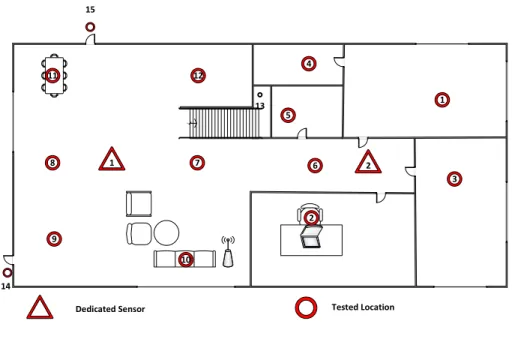
Figure 5.9 Test-bed . . . 71
Figure 5.10 Optimization and data separation . . . 72
Figure 5.11 Data distribution and attenuation . . . 73
Figure 6.12 ROC Curve of the proposed method and testing time of all the methods 77 Figure 6.13 Feature importance of three tested combinations . . . 79
Figure 6.14 Anomaly detection decision boundary and data separation. . . 80
Figure 6.15 Anomaly detection testing time. . . 81
Figure 6.16 Majority Voting testing time. . . 82 Figure 6.17 The dataset records. (a) training set records; (b) testing set records . 83
Figure 6.18 Each class classification accuracy. (a) normal class accuracy; (b) flooding class accuracy; (c) injection class accuracy; (c) impersonation class accuracy . . . 91 Figure 6.19 Most important 20 features. . . 92
List of Tables
Table 1.2 WLAN attacks and their classification. . . 8
Table 2.3 WLAN class 1, 2, and 3 frames . . . 12
Table 3.4 Coexistence techniques . . . 33
Table 3.5 All Evil-twin techniques . . . 39
Table 3.6 Unauthorized AP techniques . . . 43
Table 3.7 Deauthentication and disassociation techniques . . . 47
Table 3.8 Techniques that protect against multiple RAP types . . . 53
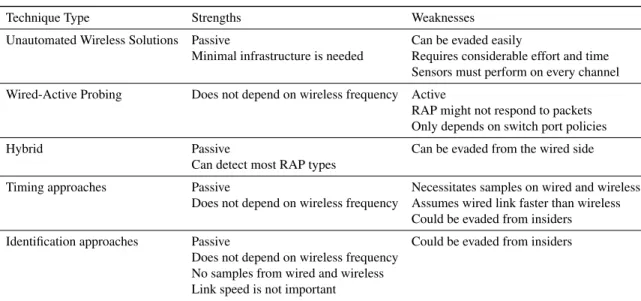
Table 3.9 Strengths and weaknesses of existing techniques . . . 57
Table 6.10 Detection accuracy by distance between locations . . . 76
Table 6.11 Testing time for all location combinations . . . 77
Table 6.12 Novelty detection accuracy . . . 81
Table 6.13 Majority voting detection accuracy. . . 82
Table 6.14 Bagging . . . 87
Table 6.15 All Features . . . 87
Table 6.16 20 Features . . . 88
Table 6.17 Random Forests . . . 88
Table 6.18 Extra Trees . . . 89
ABBREVIATIONS
WLAN Wireless Local Area Network
Wi-Fi Wireless Fidelity (some resources indicate that it is just Wi-Fi) DoS Denial of Service
IP Internet Protocol SSID Service Set Identifier RTS Request to Send
ATIM Announcement Traffic Indication Message IEEE Institute of Electrical and Electronics Engineers DNS Domain Name System
MITM Man-in-the-Middle
WPA-PSK Wi-Fi Protected Access-Pre-Shared Key WIDS Wireless Intrusion Detection System IV Initialization Vector
EAP Extensible Authentication Protocol
LEAP Lightweight Extensible Authentication Protocol TLS Transport Layer Security
PEAP Protected Extensible Authentication Protocol VPN Virtual Private Network
SVM Support Vector Machine
RSSI Received Signal Strength Indicator ISP Internet Service Provider
CA Certification Authority
TSF Timing Synchronization Function
ACK Acknowledgment
CPU Central Processing Unit
API Application Programming Interface 3D Three-Dimensional
GTK Group Temporal Key AP Access Point
RAP Rogue Access Point
IDS Intrusion Detection System MAC Media Access Control BSSID Basic Service Set Identifier CTS Clear to Send
CF Contention Free
DHCP Dynamic Host Configuration Protocol SSL Secure Sockets Layer
iOS iPhone Operating System (originally known as iPhone OS, but it can be used for iPad and iPod)
WEP Wired Equivalent Privacy
WIPS Wireless Intrusion Prevention System ICV Integrity Check Value
RADIUS Remote Access Dial in User Services MD5 Message Digest 5
TTLS Tunneled Transport Layer Security HTTP Hypertext Transfer Protocol DCF Distributed Coordinated Function RTT Round Trip Time
TCP Transmission Control Protocol PLCP Physical Layer Convergence Protocol IANA Internet Assigned Numbers Authority SSH Secure Shell
IBSS Independent Basic Service Set NAT Network Address Translation TOFU Trust on First Use
NIC Network Interface Controller PTK Pairwise Transient Key PMK Pairwise Master Key
CHAPTER 1: INTRODUCTION
The usage of wireless networks such as Wireless Sensor Networks (WSNs) and Wireless Local Area Networks (WLANs) have grown in recent years. WSN presents itself as a significant implementation for many applications due to its proficiency to monitor ob-servations and report them to a central unit. Therefore, WSNs have been adopted by several applications such as health monitoring and military surveillance. Additionally, WLANs have gained noticeable attention because of their ease of deployment and the availability of portable devices. Internet usage has moved from stationary computers that are connected to the wired side of the network to mobile devices such as smartphones, laptops, and tablets, which use radio waves to connect to an Access Point (AP) and then to the Internet. Peo-ple spend a large amount of time online, regardless of where they are. To connect to the Internet, users have to choose between two options. The first is to use a Wi-Fi network, in particular when connecting to the Internet from homes, offices, airports, shopping malls, and universities. The other, more costly option is to use mobile cellular networks. This second option has increased in popularity over the past decade. However, the influence of WLANs remains crucial, especially as Wi-Fi hotspots become ubiquitous. Most wireless users prefer WLANs because, unlike cellular networks, they are free to use [1]. APs are
an integral part of WLANs, providing a coordinated point that manages workstations and connects users to the wired network [2]. Consequently, malicious attacks have increased enormously because of the shared medium that wireless networks use to serve wireless devices [3].
The Media Access Control (MAC) address identifies wireless devices in wireless networks, yet it is susceptible to identity-based attacks. MAC address spoofing is an attack that changes the MAC address of a wireless device that exists in a specific wireless network using off-the-shelf equipment. MAC address spoofing is a serious threat to wireless net-works. One of the most common security problems faced by WLANs is the Rogue Access Point (RAP) [4], [5], [6], [7], [8], [9], [10], [11], which is a fake AP that was not installed by the network administrator. As APs have become cheaper, the ability to deploy them maliciously in WLANs has grown tremendously. In the literature, RAPs are classified into four categories: Evil-twin APs, Improperly Configured APs, Unauthorized APs, and Com-promised APs [6], [12]. There are also RAP-based DoS attacks that are not classified by the research community. These are deauthentication/disassociation attacks and the forging of the first message in a four-way handshake. It has been estimated that approximately 20% of all APs in enterprise WLANs are in fact RAPs [13], [14], [15].
Some of the early RAP detection methods assumed that the RAP has been inserted by a naive user who wants to access the Internet from, for example, a conference room. Although this was initially true, today it is more likely that the person who has inserted the RAP is a skilled attacker that knows and can evade RAP countermeasures [13]. Cur-rent mobile devices contain an array of personal information, such as photos, passwords,
business documents, and important emails. Therefore, connecting to RAPs is highly dan-gerous, because it could allow attackers to steal sensitive information. Thus, it is vital to secure WLANs and detect suspicious APs.For instance, an attacker can spoof the MAC address of a productive Access Point (AP) in WLAN-infrastructure mode and replace or coexist with that AP to eavesdrop on the wireless traffic or act as a man-in-the-middle (this attack is known as the evil twin attack) [16], [17], [18], [19], [20]. In addition, the attacker can flood the network with numerous requests using random MAC addresses to exhaust the network resources. This attack is known as resource depletion [21], [22], [23].
These threats, along with other existing threats, necessitate the existence of MAC address spoofing detection to eliminate rogue devices. MAC address spoofing detection is very significant because it is the first step to protect against rogue devices in wireless net-works. Wireless networks (such as WSNs and WLANs) are integrated into a wide range of critical settings including health care systems such as mhealth applications using machine-to-machine technology [24]. In addition, it is important to detect the presence of the rogue devices in wireless networks to protect smart grids systems such as heating, ventilation, and air conditioning (HVAC) systems [25]. The classical way to deal with spoofing is to employ authentication methods. Although authentication causes overhead and power con-sumption for wireless devices, it is even more costly to apply authentication to wireless devices that have limited resources. For instance, before authentication takes place (i.e., before establishing the session keys to authenticate frames in a WLAN) the only identifier for a given wireless device is the MAC address. Thus, two devices in the same network that have the same MAC address are treated as legitimate clients, even though one of them has cloned the MAC address of the other.
External solutions [26], [27], [28] that do not require modification to standards and protocols (such as IDSs) have gained attention for decades because of the immediate re-sponse to threats and the possibility of eliminating intruders [29]. Some of the IDSs are based on predetermined signatures of familiar attacks, which are saved on the database. The monitored frames are compared with the predetermined signatures. If the match is found, the notification takes place immediately. On the other hand, data mining or machine learning IDSs have an advantage because they do not require predefined static signatures of known attacks. Thus, it can be done automatically through classification or clustering algorithms. There are a wide range of security measurements (such as encryption mecha-nisms, authentication methods, and access control techniques), but many intrusions remain undetected. Thus, there is a demand to automate the monitoring of WLAN activities to detect intrusions.
There are two known Intrusion Detection methods: anomaly detection and misuse detection. Anomaly detection observes attacks if there is a deviation from the normal behavior by the devices that generate these attacks. Misuse detection recognizes suspicious activities regarding patterns matching of previous built known attacks. Anomaly detection techniques are more likely to detect unknown intrusions and has a high false positive rate. On the other hand, misuse detection techniques have a low false positive rate, but unknown attacks could remain undetected. Several IDSs are considered to be rule-based (in which the system fulfillment depends on security experts who build the rules). Considering the vast amount of WLAN traffic, it is so expensive and slow to build the rules. The rules have to be modified manually and applying new rules is a hard and time-consuming task. To overcome the aforementioned limitations, data mining or machine learning techniques take
place to discover important patterns of large data sets. It can build intrusions patterns which can be used for misuse detection techniques based on classification, and to build profiles for normal behavior (to detect intrusions by anomaly detection techniques).
We propose a solution that is based on the Random Forests ensemble method [30] and a hard-to-spoof metric, namely the Received Signal Strength (RSS). Random Forests-based approaches have been proposed in several applications and systems including Intru-sion Detection Systems in the wired networks [31], [32], spam detection [33], and phishing email detection [34]. However, Random Forests has not been used for similar issues as the one that we are solving in this proposal. Our problem depends entirely on the location of the legitimate and the attacker devices. The important feature that we utilize is the RSS that belongs to the physical layer. On the other hand, the wired IDSs utilize the upper layers such as Application, Transport, and Network Layers; some important features are service type (i.e., telnet, http, or ftp), the presence of JavaScript, and the number of links in the email. We also propose another solution based one class Support Victor Machines to deal with difficult situations such as unreachable locations. RSS measures the strength of the signal of the received packet at the receiver device. RSS can be affected by several fac-tors such as the transmission power of the sending device, the distance between the sender and receiver, and some environmental elements such as absorption effects and multi-path fading [35]. Normally, the wireless device does not change its transmission power, so the degradation of the signal from the same MAC address suggests the existence of MAC ad-dress spoofing [36]. We carried out an experiment in a “Small Office and Home Settings” live test-bed using WLAN devices to evaluate our proposed solution with the help of two air-monitors acting as sensors. The sensors are capable of sniffing the wireless traffic
pas-sively and injecting traffic into the WLAN. We used the sensors to paspas-sively capture the wireless traffic and send it to the centralized utility for further analysis. Finally, we pro-pose a new misuse detection framework based on some machine learning algorithms and a voting technique and discover some important frame fields that reveal the excising of the rogue device.
1.1 Research Problem and Scope
An attacker can spoof the MAC address of a given legitimate user to hide his/her identity or to bypass the MAC address control list by masquerading as an authorized user. A more effective attack that the attacker can perform is to deny service on a given wireless network [37].
Deauthentication/disassociation: In the IEEE 802.11i standard, it is necessary to exchange the four-way handshake frames before an association takes place between a wire-less device and the AP [38], [39]. Once the station is associated with the AP, a hacker can disturb this association by sending a targeted deauthentication/disassociation frame to ei-ther disconnect the AP by spoofing the MAC address of the wireless user or disconnect the wireless user by spoofing the MAC address of the AP. A more harmful deauthentica-tion/disassociation attack is to send frames to all of the wireless users using a broadcast ad-dress by spoofing the MAC adad-dress of the AP [40], [41]. After sending the frame, the AP or the user who receives the frame is disconnected and has to repeat the entire authentication procedure in order to connect again. The attacker can also send spoofed deauthentication frames repeatedly to prevent the wireless user or the AP from maintaining the connection
[42]. There are also other attacks such as the power-saving attack that prevents the AP from queuing the upcoming frames for a given station by requesting these frames for a hacker instead of a legitimate station.
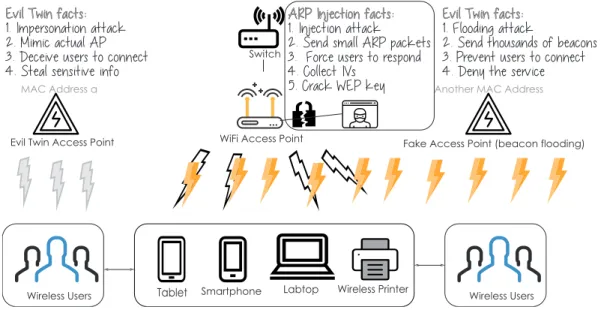
In general, there are three broad groups of attacks that target WLAN users which are flooding attacks, impersonation attacks, and injection attacks. Figure 1.1 shows and example of each group of attacks that explains the threats that WLAN users exposed to.
WiFi Access Point Switch
Evil Twin Access Point
Labtop
Tablet Smartphone Wireless Printer
Wireless Users Wireless Users
MAC Address a
Evil Twin facts:
1. Impersonation attack
2. Mimic actual AP
3. Deceive users to connect
4. Steal sensitive info
Fake Access Point (beacon flooding)
Another MAC Address
Evil Twin facts:
1. Flooding attack
2. Send thousands of beacons
3. Prevent users to connect
4. Deny the service
ARP Injection facts:
1. Injection attack
2. Send small ARP packets
3. Force users to respond
4. Collect IVs
5. Crack WEP key
Figure 1.1: Attack scenarios for each group of attacks.
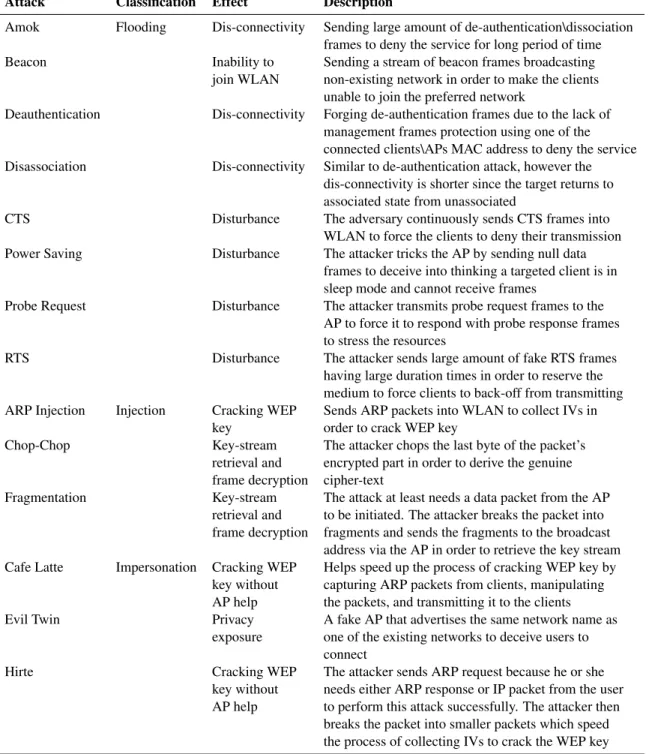
A complete list of flooding, impersonation, and injection attacks and their descrip-tion are shown in Table 1.2.
Table 1.2: WLAN attacks and their classification. Attack Classification Effect Description
Amok Flooding Dis-connectivity Sending large amount of de-authentication\dissociation
frames to deny the service for long period of time
Beacon Inability to Sending a stream of beacon frames broadcasting
join WLAN non-existing network in order to make the clients
unable to join the preferred network
Deauthentication Dis-connectivity Forging de-authentication frames due to the lack of
management frames protection using one of the connected clients\APs MAC address to deny the service
Disassociation Dis-connectivity Similar to de-authentication attack, however the
dis-connectivity is shorter since the target returns to associated state from unassociated
CTS Disturbance The adversary continuously sends CTS frames into
WLAN to force the clients to deny their transmission
Power Saving Disturbance The attacker tricks the AP by sending null data
frames to deceive into thinking a targeted client is in sleep mode and cannot receive frames
Probe Request Disturbance The attacker transmits probe request frames to the
AP to force it to respond with probe response frames to stress the resources
RTS Disturbance The attacker sends large amount of fake RTS frames
having large duration times in order to reserve the medium to force clients to back-off from transmitting
ARP Injection Injection Cracking WEP Sends ARP packets into WLAN to collect IVs in
key order to crack WEP key
Chop-Chop Key-stream The attacker chops the last byte of the packet’s
retrieval and encrypted part in order to derive the genuine frame decryption cipher-text
Fragmentation Key-stream The attack at least needs a data packet from the AP
retrieval and to be initiated. The attacker breaks the packet into frame decryption fragments and sends the fragments to the broadcast
address via the AP in order to retrieve the key stream
Cafe Latte Impersonation Cracking WEP Helps speed up the process of cracking WEP key by
key without capturing ARP packets from clients, manipulating
AP help the packets, and transmitting it to the clients
Evil Twin Privacy A fake AP that advertises the same network name as
exposure one of the existing networks to deceive users to
connect
Hirte Cracking WEP The attacker sends ARP request because he or she
key without needs either ARP response or IP packet from the user
AP help to perform this attack successfully. The attacker then
breaks the packet into smaller packets which speed the process of collecting IVs to crack the WEP key
1.2 Motivation behind the Research
Many techniques have been proposed to detect MAC address spoofing as it is a major threat to wireless networks. First, sequence number techniques [43], [44] track the consecutive frames of the genuine wireless device. The sequence number increments by one every time the genuine device sends either data or management frame. Once the de-tection system finds an unexpected gap between two consecutive frames, the attacker is detected. Second, the Operating System (OS) fingerprinting techniques [42] utilize the fact that some operating system characteristics could differentiate the attacker from the legiti-mate device when the spoofing occurs. Finally, RSS techniques [16], [17], [36], [45], [46] utilize the location of the legitimate device that should be different from the location of the attacker if they are not in the same location.
However, there are some limitations in the previous work. Sequence number ap-proaches suffer from some drawbacks: one of the main types of MAC layer frames does not have sequence numbers, which is control the frame. Thus, spoofing of control frames is possible. Also, some of the tools used by the hackers provide the capability of eavesdrop-ping and injecting frames that have sequence numbers similar to the frames of the legitimate device. OS fingerprinting techniques have some weaknesses as well. The first weakness is that the only frame type that can be detected by network layer’s OS fingerprinting is data frame. The second weakness is that some of the techniques assume that the attacker spoofs the MAC address using Linux-based operating system tools. This assumption could cause some attackers to bypass the intrusion detection system. The attackers can use a
capability that Windows operating system provides to change the MAC address of a given user. Finally, vendor information, capability information, and other similar fingerprinting techniques can be easily spoofed using off-the-shelf devices.
RSS approaches also have some limitations. Some researchers have reported that RSS samples from a given sender follow a Gaussian distribution, whilst other researchers revealed that the distribution is not Gaussian [47] or that it is not rare to notice non-Gaussian distributions of the samples [36]. As [36] reported, we found that it is not rare to find many peaks in the collected RSS samples. This suggests that the detection techniques [16], [17], [36], [45], [46] (based on clustering algorithms) that are closely related to our proposal are not the optimal solutions because these solutions assume that the samples are always Gaussian. Therefore, their solutions generate false alerts or miss some intrusions if the data is not Gaussian distributed. In addition, when the attacker and the victim devices are close to each other, the means/medians of both devices are close to each other, so distinguishing the two devices becomes hard. Furthermore, we discovered that in multi-ple cases, the distribution of the data from a single device constructs two clusters, so it is hard for the clustering algorithms-based approaches to perform well in these situations. Motivated by these concerns, we utilized a machine learning algorithm that can deal with both data that are Gaussian-distributed and, more importantly, data that are not actually Gaussian-distributed. Thus, in this article, we proposed a detection method based on Ran-dom Forests because it can determine the dataset shape in order to obtain better results and the hard-to-spoof measurement (i.e., the RSS).
1.3 Contributions
This research contributions can be summarized as follows:
1. We develop a new passive technique to detect MAC address spoofing based on Ran-dom Forests ensemble method.
2. We compare our work with existing techniques empirically in a live test-bed and find that our technique outperforms existing techniques.
3. We also propose an anomaly detection technique to deal with situations where it is hard-to-cover the whole area.
4. We propose a new WLAN misuse Intrusion Detection framework based on majority voting.
5. We apply feature selection technique based on Extra Trees classifier to improve the accuracy and more importantly to expedite the detection time.
CHAPTER 2: 802.11 STANDARD OVERVIEW
This chapter describes the 802.11 wireless standard at the abstract level. As the focal point of this proposal is APs, we briefly explain the infrastructure mode. The frame types in the 802.11 standard fall into three categories: management, control, and data as shown in Table 2.3. Each type contains several sub-types. Management frames allow WLAN devices to initiate and maintain communications. Control frames govern the wire-less links, allowing some stations to access the medium while denying access to others. Data frames convey higher-layer data [48].
Table 2.3: WLAN class 1, 2, and 3 frames
Management Control Data
Class 1 Frames Beacon, Probe Request/Response RTC, CTS, ACK Frames with false ToDS Authentication, Deauthentication and ATIM CF-END and CF-ACK or FromDS
Class 2 Frames Association Request/Response, Disassociation and Reassociation Request/Response
Class 3 Frames Deauthentication PS-Poll All data frames
2.1 Connection Establishment Process
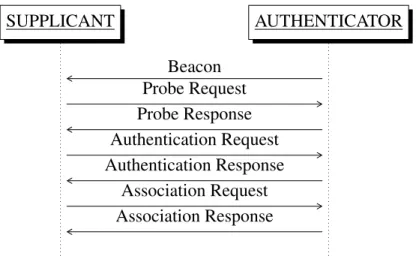
Connections are established using several management frame sub-types, as shown in Figure 2.2. The first step is network discovery, which starts when the AP advertises its
existence by broadcasting beacon frames to clients in the vicinity. Clients passively listen to the beacon frames or actively send probe requests to identify APs within range. After receiving a probe request, the AP sends a probe response frame that contains important information such as the supported rates and capabilities of the network. The second step involves the exchange of authentication and association messages. Authentication is the procedure of sending the identity of the station to the AP through the authentication request frame. Upon receiving the request, the AP either accepts or rejects the wireless user via an authentication response. In an open authentication environment, no identity checking takes place. The association request is sent by the station to enable the AP to allocate resources to the wireless user and to synchronize with the user’s NIC. The association response sent by the AP details the acceptance or rejection of the connection [27]. Subsequently, the AP and wireless user can exchange data. Establishing secure communication requires further steps after the association stage, such as the exchange of four-way handshake messages for mutual authentication in WPA/WPA2-PSK or the provision of credentials to the authenti-cation server (i.e., RADIUS [49]) in the enterprise mode before the four-way handshake exchange [50]. SUPPLICANT AUTHENTICATOR Beacon Probe Request Probe Response Authentication Request Authentication Response Association Request Association Response
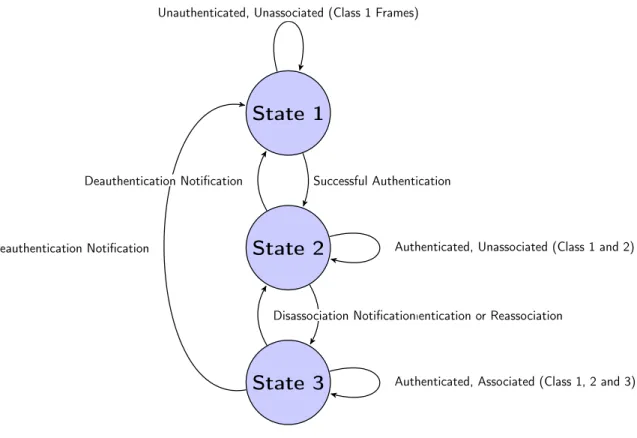
The authentication/association and deauthentication/disassociation state diagram is shown in Figure 2.2. In the first state, the station is neither authenticated nor associated. After the authentication exchange, the station becomes authenticated, but is not associated. Sending a deauthentication message at this stage causes the station to return to the first state, whereas exchanging association frames places the station in the third state, whereby the station is authenticated and associated and can exchange data. Sending a deauthentica-tion frame pushes the stadeauthentica-tion back to the first state, whereas sending a disassociadeauthentica-tion frame causes the station to return to the second state [37], [51]. To terminate an established con-nection, the AP disconnects one or all of the connected clients using the broadcast address by sending a deauthentication frame. Both the station and the AP can send a disassociation frame to end the association. For example, the wireless station can send a disassocia-tion frame when the NIC is powering off, allowing the AP to remove the stadisassocia-tion from the association table and deallocate memory. Deauthentication/disassociation frames are not protected in 802.11i, but are encrypted in 802.11w [52] after the four-way handshake (i.e., exchanging the session keys (PTKs, GTKs)). However, there are some issues regarding the deployment of this standard, namely that millions of devices need to be changed or upgraded. Hence, few WLANs worldwide have implemented this standard. Thus, deau-thentication/disassociation DoS attacks remain a problem in WLANs.
State 1
State 2
State 3
Unauthenticated, Unassociated (Class 1 Frames)
Successful Authentication
Authenticated, Unassociated (Class 1 and 2)
Successful Authentication or Reassociation
Authenticated, Associated (Class 1, 2 and 3) Disassociation Notification
Deauthentication Notification
Deauthentication Notification
Figure 2.3: Deauthentication and disassociation procedure
2.2 Classification of RAPs
In the literature, RAPs are classified into four categories: Evil-twin, Improperly Configured, Unauthorized, and Compromised. Two more types that can also be classified as DoS attacks are RAP-based deauthentication/disassociation attacks and the forging of the first message in a four-way handshake. These latter two are classified as RAPs in this article, because the deauthentication/disassociation attacks can be sent on behalf of a legitimate AP to disconnect wireless users. This is similar to the Evil-twin attack, because the attacker spoofs the MAC address of the legitimate AP to disconnect associated users. The forged message in a four-way handshake is sent by a hacker who masquerades as the
genuine AP to disturb and block the four-way handshake message exchange between the wireless user and the AP.
2.2.1 Evil-twin
Sometimes referred to as Soft AP or Spoofed AP, we use the term Evil-twin to represent this type of attack. The Evil-twin AP uses a software-based AP installed on a portable device. Thus, a portable device with an external wireless card and a tool such as airbase-ng1 are sufficient to set up this type of RAP. There are only two identifiers in the IEEE 802.11 standard that can authenticate APs to users. These are the SSID and MAC address (BSSID) of the AP [18]. As these identifiers can easily be spoofed, the AP can be fabricated by an outsider and remain undistinguishable by wireless users. Evil-twin APs come in two forms:
1. Coexistence: the legitimate AP and the Evil-twin coexist in the same location. The Evil-twin clones the SSID and MAC address of the legitimate AP [53], and increases its signal strength to force users to connect. It then relays packets through the legiti-mate AP.
2. Replacement: the Evil-twin shuts down the legitimate AP and replaces it. This form of RAP has its own Internet connection.
The first form uses two wireless cards, one built-in to the device and the other a plug-and-play wireless card. The built-in wireless card associates with the legitimate AP, while the
other wireless card masquerades as the legitimate AP. Packets are then relayed from the Evil-twin’s plug-and-play wireless card to the built-in wireless card. The Evil-twin AP is set up by an adversary to listen to users’ traffic as they browse the Internet, and to launch several attacks on the victims’ devices [4], [19], [54], [55]. The IEEE 802.11 standard states that WLAN clients must connect to the AP that has the strongest signal. To lure users, the Evil-twin can move closer to the users or increase its signal strength to be stronger than the legitimate AP. The Evil-twin then waits for users to connect to it, or may send DoS attacks via deauthentication or disassociation frames on behalf of the legitimate AP to force users to disconnect from the legitimate AP. In practice, an Evil-twin configuration involves more steps to avoid IDSs, such as masquerading AP MAC address and SSID, establishing a DNS server to connect to the Internet, and establishing a DHCP server to automatically assign connected clients with valid IP addresses.
Once a user connects to the Evil-twin, their traffic is exposed to the adversary, who may launch several attacks such as interception, replaying, and traffic manipulation. This can also occur if encryption such as SSL is employed in the user’s device. The attacker can act as the Man-in-the-Middle using his AP [18]. To do so, the attacker can easily use tools such as SSLstrip2 to decrypt the traffic and BurpProxy3to generate fake certificates. Because users trust their encryption method, most will accept the faked certificates [56], [57]. Therefore, Evil-twin APs can launch MITM attacks and decrypt encrypted traffic, modify this traffic, and hijack sessions. Evil-twin attacks are very dangerous because of their simplicity. Any mobile operating system such as iOS or Android can be used to
2An SSL stripping tool.
create an Evil-twin. Thus, creating this attack using a smartphone does not necessarily attract attention. Furthermore, easy-to-use tools such as airbase-ng and rfakeap4are readily available to help launch the attack.
The second form of Evil-twin attack replaces the legitimate AP, and uses the same Internet connection that the legitimate AP had been using. This type of Evil-twin is harder to detect than the first type, because it clones almost all of the characteristics of the legiti-mate AP. Additionally, timing approaches that depend on delay cannot detect this type of Evil-twin.
2.2.2 Improperly Configured AP
This type of RAP is not placed by an adversary: it exists in WLANs because the AP is improperly configured. There are numerous situations where the AP can be miscon-figured. An administrator who does not have a sufficient security background may choose insufficiently robust authentication or encryption settings. Another example occurs when the AP driver malfunctions or the whole device is worn out. In addition, the AP may become vulnerable after a software update (e.g., firmware with encryption enabled using WPA-PSK or WEP might cause the AP to resume without encryption) [6], [58]. This can open a backdoor to bypass the organization’s authentication, allowing unauthorized users to share network resources. This is a hardware-based RAP that is plugged into a switch or router, and there is no malicious intent behind its existence.
2.2.3 Unauthorized AP
This type of RAP is installed by an employee or naive user without the network administrator’s permission. Although, this AP is not installed by the network administra-tor, it is considered part of the actual WLAN because it is connected to the wired side of the network, like the legitimate APs. Thus, the unauthorized AP receives and sends wireless traffic from the wireless users to the wired side of the network and vice versa. This RAP can be set up for purposes of convenience, especially in large organizations, to allow employees to gain access to network resources. Unauthorized APs can also be set up maliciously to create vulnerabilities in an organization’s security, enabling outsiders to exploit these weaknesses. Thus, unauthorized users who use these RAPs share the medium with authorized users, eavesdrop the authorized users’ traffic, and launch attacks against the network resources [6], [58]. This is another hardware-based RAP.
2.2.4 Compromised AP
Security methods such as WPA-PSK and WEP use shared keys to secure the com-munication between the APs and the wireless users. If an adversary obtains the shared keys used by the APs, the AP becomes rogue [6], [58], allowing hackers to launch attacks and gain access to sensitive information. Hackers with no security background can use sim-ple hacking software; Linux-based operating systems such as BackTrack5or Kali6provide
5Linux-based distribution for ethical hacking.
multiple tools for hackers to crack the shared keys, such as Aircrack-ng7.
2.2.5 RAP-Based Deauthentication/Disassociation
This survey focuses on the deauthentication/disassociation attacks that are launched by RAPs to target wireless users. The IEEE 802.11 standard states that deauthentication frames are a notification that cannot be rejected by the receiving wireless client. Thus, the hacker can masquerade as a legitimate AP, and send deauthentication frames on behalf of the AP to the wireless clients to terminate the connection. The attacker can launch a huge number of deauthentication frames to prevent the wireless users from maintaining their connection with the real AP or vice versa. There are three ways that a hacker can launch a deauthentication/disassociation attack:
1. The attacker can create forged deauthentication/disassociation frames on behalf of a connected user, and send the frames to the AP. When the AP receives these frames, it assumes that they were sent by a legitimate user who wants to disconnect from the WLAN. Hence, the AP disconnects the user. This type of attack is beyond the scope of this survey.
2. The attacker can generate forged deauthentication/disassociation frames on behalf of the AP, and send them to a single WLAN user. Once the frame is received, the user disconnects from the WLAN.
3. The attacker can forge deauthentication/disassociation frames on behalf of the AP,
and send them to all connected users using the broadcast MAC address as a destina-tion address. This attack is severe, because all associated WLAN users are discon-nected when they receive the deauthentication/disassociation frame.
2.2.6 Forged First Message in a Four-way Handshake
The purpose of the four-way handshake messages is to verify that the station is in possession of the pre-shared key. For simplicity, we now explain the four-way handshake in WPA2-PSK; this is similar to that in enterprise mode. The PSK in WPA-personal is also known as the PMK. The PTK is derived from PMK, and is installed into the MAC layer [59].
The PTK is split into three keys. The first is known as the Key Confirmation Key (KCK), which is used to verify MIC during the four-way handshake. The other two keys (the Key Encryption Key (KEK) and Temporal Key (TK)) are created after the four-way handshake [27], [60], as shown in Figure 2.3. Before sending the first message, the authen-ticator generates a nonce (known as ANonce, generated randomly by the AP) and sends it to the supplicant along with its MAC address, known as AA, the sequence number(sn) to prevent replay attacks, and the message number (i.e., in this case msg1). The suppli-cant generates a random number known as the SNonce, and has the ANonce and the PMK (i.e., entered by the wireless user when choosing the preferred AP from the AP list). Thus, the supplicant can construct the PTK. In the second message, the supplicant sends its own nonce, MAC address, sn, and message number (i.e., msg2) to the authenticator along with the related hash value (i.e., hashed using MIC), which are generated using the PTK that just
has been computed at the supplicant device. The authenticator now has the three important components needed to compute the PTK, namely the ANonce, SNonce, and PMK (i.e., entered initially at the AP captive portal). Prior to sending the third message, the authen-ticator computes the PTK, verifies MIC, and sends a message including the hash values of ANonce, sn+1, and msg3 along with AA, ANonce, sn+1, and msg3 to the supplicant. The supplicant verifies their receipt by sending a confirmation to the authenticator using the same procedure.
The adversary can mimic the authenticator and transmit a forged first message to the supplicant. This occurs just after the second message has been sent by the supplicant, as the first message is not encrypted (see Figure 2.3). The supplicant then generates a new PTK corresponding to the new nonces that have been generated according to the new received message. Thus, this vulnerability blocks the subsequent handshakes because of inconsistencies in the PTK at the authenticator and the supplicant. Smart attackers can determine the perfect time to send the forged first message by sniffing WLAN traffic, or may simply flood the WLAN with messages, causing a DoS [61], [38].
ˆ A Sˆ Message1= (AA,ANonce,SN,Msg1) Message1 −−−−−→ Constucts−PTK
Message2=SPA,SNonce,sn,Msg2,
MICPT K(SNonce,SN,Msg2)
Message2 ←−−−−−
Constucts−PTK,verify−MIC
Message3=AA,ANonce,IncrementedSN,msg3,
MICPT K(ANonce,IncrementedSN,Msg3)
Message3 −−−−−→
Install−PTK,verify−MIC
Message4=SPA,IncrementedSN,Msg4,
MICPT K(IncrementedSN,Msg4)
Message4 ←−−−−−
Install−PTK
CHAPTER 3: LITERATURE SURVEY
Existing countermeasures can be classified based on whether the technique protects against one or more RAPs, whether the technique is passive or active, and whether it re-quires protocol modification or special hardware. The following categories are identified to classify the existing countermeasures:
Operator versus Client-side In the operator option, the IDS is implemented on an AP or a router, and the AP tasks are divided between serving the traffic of the wireless users and detecting intrusions. The client-side option focuses on detecting RAPs. There are some challenges to developing a detection system on the client machine, such as:
1. Clients might be limited by the network settings or have fewer privileges than oper-ators.
2. It is difficult for clients to gather WLAN traffic at the network gateway without the operator’s assistance.
3. Similarly, it is difficult for clients to have dedicated servers with which to detect RAPs.
Passive versus Active Passive methods simply observe RAPs through wireless traffic, whereas active approaches send test packets to the APs to examine how they react. The biggest problem with detecting RAPs is that they do not reply to active probing. This absence of collaboration has led to passive detection becoming the more popular technique.
Techniques that require special hardware Some techniques require special hardware to perform detection methods, whereas others can simply use smartphones or laptops to perform the task.
Techniques that require protocol modification Some techniques require standards or protocols implemented by the APs to be modified or changed, either by adding more cryp-tography methods or additional identifiers.
Wireless versus Wired Wireless approaches detect the RAPs using wireless traffic only, whereas wired techniques detect the RAPs by analyzing the wireless traffic that has been relayed by the router/switch at the network backbone on the wired side. Hybrid approaches combine both wired and wireless approaches. Hackers can use various methods to evade the detection methods on the wired side of the network:
1. The RAP can be hidden behind a legitimate AP:
As hotels, airports, universities, and other public WLANs have legitimate APs to which a hacker could connect, the hacker can provide access to friends or outsiders by connecting unauthorized APs to the legitimate AP. Several wired-side detection
methods depend on the usage policy of the switch port; these methods detect the legitimate wireless traffic, and cannot detect an RAP connected to a legitimate AP.
2. Modifying the pattern of the transmission:
Because wired-side detection methods depend on DCF statistics using wireless traf-fic, hackers can modify their traffic using traffic shaping methods to either add delay or reduce the delay to emulate wired traffic. Thus, an adversary that knows the Eth-ernet and WLAN speeds can add delay at the application layer to emulate wired-side traffic when the WLAN side is faster than the wired side, and vice versa.
Wireless approaches suffer from expensive sensor deployment. Hybrid techniques are gen-erally good, but hackers can evade the hybrid methods through the wired side.
Techniques that detect all or some RAPs Most techniques focus on Evil-twin detection and indirectly detect RAP-based deauthentication/disassociation attacks. Some techniques detect Unauthorized APs, but the detection of Compromised APs is rare. There is no single technique that detects all RAP types.
The ideal method is one that can detect all RAP types, is passive, does not require protocol modification, and does not require specialized hardware. All existing techniques have one or more of these features, but none of them has all four. In the next two sections, the RAP prevention and detection methods are comprehensively surveyed to identify risks and clarify the restrictions of state-of-the-art detection approaches.
3.1 Available Security Countermeasures
In this section, we explain why available security countermeasures cannot protect against all RAP types. Some countermeasures are designed for WLANs, whereas the rest are adopted from the wired world. This section introduces the most widely used protocols in WLANs to help protect against rogue devices in general, and RAPs specifically.
WEP was developed to encrypt the data transmitted on WLANs. The encryption process in WEP starts by combining the 24-bit IV and the secret key that indicates the encryp-tion/decryption key. In addition, the resulting key is used to produce the key sequence. Furthermore, the plaintext message and the ICV are XORed with the key sequence to pro-duce the cipher text. In the final step, the IV and the cipher text are concatenated. The reverse of the encryption process is the decryption process. There are two characteristic weaknesses with WEP: the IV is frequently reused, and the WEP secret key is not changed often enough. Hence, it is difficult to ensure the existence of two different key streams. Additionally, it is not difficult to attack WEP because it is possible to eavesdrop the IV that is transmitted. Thus, if the sender encrypts two messages using the same IV along with an original message, it is feasible to decrypt the encrypted messages using the XOR operation. The key can then be recovered once the attacker gathers the key streams [62]. Because WEP is not secure, it does not protect against all RAP types.
PSK is used to encrypt wireless traffic between the wireless user and the legitimate AP. One weakness of PSK is that the protocol does not allow any update or renewal property,
so distributing the key in a secure manner is difficult. Some organizations distribute the key on a printed receipt, whereas others use easy-to-guess passwords, so it is easy to intercept the four-way handshake messages and perform a dictionary attack to obtain the key. Thus, network administrators must renew the PSK on the AP manually, and provide the key to all clients that participate in the network. Therefore, this procedure is time consuming and insecure, especially if the administrator chooses an easy-to-guess pass-phrase [63]. This method can protect against Compromised APs and Evil-twins if and only if the network administrator chooses a hard-to-guess password and distributes it in a secure manner.
WPA-Enterprise Mode (802.1x) IEEE 802.1x [64] was designed as an access control method to allow users to connect to the network. It also provides port security to prevent unauthorized access to network resources. IEEE 802.1x has three important components in a given wireless network: the supplicant, i.e., the wireless user that intends to join the wireless network, the authenticator, who is responsible for providing access, and the au-thentication server, which is responsible for making auau-thentication decisions. IEEE 802.1x uses existing protocols to accomplish its objectives, such as EAP [65], [66] and RADIUS. EAP provides many methods, each having different properties that are suitable for a spe-cific wireless network environment. The system administrator is responsible for choosing which EAP method is used in the wireless network that he/she administrates [67]. EAP uses challenge/response messages. The authenticator is responsible for asking the suppli-cant to provide more information before deciding which authentication method to use in the link control phase. The EAP authentication process consists of two important elements, requests and type fields. The authentication phase uses either success or failure messages.
There are several EAP methods for different network environments, such as EAP-MD5, LEAP, TLS, TTLS, PEAP, and FAST. One of the most secure is EAP-TLS, which uses public key cryptography to provide certificates to the users. EAP-TLS provides certificates to both the client and the server, and supports mutual authentication and dynamic key derivation [68]. This method can protect against Evil-twin and Compro-mised APs, because it is hard to set up a fake authentication server that is protected by strong cryptographic methods. However, the method has to be set up by the administrator. This is difficult to implement, especially in Wi-Fi hotspots; this difficulty allows Evil-twin APs to continue to exist. Another drawback with this method is that the server certificate validation is optional, which may allow the authentication server to be faked by capturing the four-way handshake messages [69], [70].
Web-based Authentication is sometimes used in colleges, cafes, airports, malls, and ho-tels. In this type of authentication, the user is first directed to a captive portal that asks for credentials or a disclaimer. For instance, many college WLANs use software authentication systems to authenticate students or faculty members on the network. The systems belong to different vendors—either free systems or priority systems—so they are not compatible with one another. In addition, authentication is not related to the network topology, so there is no knowledge of the network’s structure. Thus, broadcasts that are sent over WLANs, such as DHCP broadcasts, could be leaked from DHCP requests prior to the authentication of a specific user on the network. This would enable an intruder to break into the network using DHCP requests. The authentication software employed in some colleges uses open WLAN, and the authentication procedure can be done using HTTP. A login webpage is
used to force the user to enter their username and password to authenticate their identity. The authentication process depends on the firewall to redirect the HTTP requests to the login webpage and block all other requests. Once the user has provided the correct cre-dentials, they are authenticated and authorized to access the network resources [71]. The problem with the open nature of WLANs and web-based authentication is that broadcasts such as DHCP frames can be seen by anyone in the network, even if they are not au-thenticated on the network or authorized to access the network resources. The broadcast frames can be seen by unauthorized users using tools such as Wireshark8 or tcpdump9. This method cannot protect against all RAPs, because it is easy to clone the login webpage and capture users’ credentials using tools such as Airsnarf10. This method does not provide mutual authentication, whereby the user and the access point authenticate each other; it can authenticate the user, but not vice versa.
VPNs are used to connect to the Internet securely from unsecure environments. To im-plement a VPN, a tunnel is created over the IP. For example, OpenVPN is open-source software that uses SSL [72]. This method cannot protect against all types of RAP, because the security of VPNs is not satisfactory, especially for portable devices. There are sev-eral unsolved attacks that target SSL, such as certificate-based attacks. Thus, it is likely that the VPN session will be aborted because of sinking management packets, forcing the connection to return to the unsecure environment.
8A network protocol analyzer. 9A command-line packet analyzer. 10A utility to set up RAPs.
IEEE 802.11w amendment protects the management and control frames once the ses-sion key has been established after the key management exchange. Because the deauthen-tication and disassociation processes are protected, it is unfeasible to forge the deauthenti-cation/disassociation frames. However, there are some issues regarding the deployment of this standard. Problems with upgrading the firmware and hardware mean that millions of WLAN devices must be changed to become compatible, so most WLANs do not currently implement the 802.11w standard.
3.2 Classification of RAP Detection Approaches
Because the aforementioned countermeasures do not protect against all RAP types, several novel approaches have been proposed by researchers. Some existing approaches use fingerprint techniques to detect the RAP. A device fingerprint aims to stamp a target device using one or more characteristics via its wireless traffic. Fingerprinting can be used for network monitoring, identification, or IDSs. It is triggered either by actively sending traffic to a target device, or passively observing the traffic generated by the target device [73]. Fingerprinting uniquely identifies devices on a WLAN without using identifiers that can be easily spoofed, such as IP addresses and MAC addresses [74]. Some approaches require standard modification, whereas others solve one type of problem. As most techniques focus on detecting Evil-twin APs, we split this section into six categories, two for Evil-twin AP solutions, one for Unauthorized AP solutions, one for deauthentication/disassociation attacks, and one for solutions that detect more than one RAP type. All forged first message approaches require protocol modifications. We do not consider these here, as this survey is
focused on approaches that do not require protocol modifications.
3.2.1 Coexistence Approaches
This subsection introduces approaches that solve the Evil-twin Coexistence sub-type, as classified in Table 3.4. This sub-type seeks to insert an RAP into the WLAN simultaneously with the legitimate AP. In [4], a timing-based scheme was presented that detects RAPs that are injected through a Linux-based machine. In the attacking scenario, the RAP can change its identity by masquerading as the legitimate AP by spoofing the legitimate AP’s MAC address and SSID. The RAP then deceives users into connecting to it by increasing its signal strength, and then launches several attacks on the users’ machines. The scheme exploits the expected two hops that occur when the user connects to the DNS server.
The authors of [4] used RTT to determine whether or not the given AP is legitimate. The RAP is detected because it relays the traffic to the DNS server via the actual AP. Therefore, the delay results from the two hops that occur between the user and the RAP, instead of the permanent one-hop process. However, the proposed solution needs further investigation, because the authors focused on only one specific cause of the delay in a WLAN. There may be various reasons for such a delay, including (but not limited to) the WLAN’s exposure to interference and collisions. Thus, this scheme is neither accurate nor robust, especially in highly traffic-loaded WLANs. Additionally, the proposed technique is more likely to detect the hotspot’s AP as an RAP.
T able 3.4: Coe xistence techniques T echnique Source Y ear Accurac y P assiv e/ A ctiv e NoProtocol Modification Wire D /Wire L ess/ H ybrid D edicated/ B undled NoSpecial Hardware DatasetSize DNS Serv er tw o hops [4 ], [55 ] 2009, 2011 60% A X L D X 2 ETSnif fer [19 ], [54 ] 2010, 2012 TPR = 99%, FPR = 1% A X L D X N A W iFiHop [75 ] 2011 TPR a = 98%, FPR b = 0.1% A X L D X N A Authentication + SVM [76 ] 2006 86% A X L D X 5 Duplicate RSSI [77 ] 2012 97% P X L D X N A Acti v e Beha vioral [78 ] 2008 N A A X L D X 5 Client-side [79 ] 2012 N A P X D D X N A Cipher T ypes [80 ] 2012 N A P X L D X N A RAPiD [81 ] 2010 N A P X D D X N A T ime Interv al [82 ] 2014 N A P X L D X 2 a T rue Positi v e Rate bF alse Positi v e Rate
An approach called WiFiHop, in which test packets are actively sent to see if the RAP relays the packets on a different wireless channel, has been proposed [75]. The authors of [76] used SVM to train and validate the precise timing measurements related to the authentication procedure to distinguish fingerprints. This method achieved an accuracy rate of 86%, but the validation considered only five APs. This technique also requires the use of another device to monitor the authentication sequences.
Kim et al. [77] simulated the launch of an RAP while the attacker’s device has more than one RSSI. Detection can be achieved using the deviation between the two APs’ received signal strength. However, this approach depends on the scenario in which the RAP relays traffic to the actual AP, which is not always the case. Bratus et al. [78] used an active behavioral fingerprinting method adopted from TCP/IP fingerprinting. This approach is implemented by network discovery and security auditing tools like Nmap11, and applies an active request–response technique. This approach sends a request frame, and then waits for the response in order to determine how the devices react to fragmented or manipulated frames. This technique has the drawback of using active detection, which can be avoided by most attackers. In addition, this technique can interfere with regular WLAN traffic.
Nikbakhsh et al. [79] proposed a multi-step approach to detect RAPs. If two APs broadcast the same SSID and MAC address, the approach checks whether the IP addresses are the same, then compares the trace routes. It is unlikely that the same trace route will be found, because having the same IP addresses at the same time would cause an IP address conflict. Thus, the only possible situation is to have the same IP addresses and different
trace routes, which is a result of IP spoofing. This approach cannot deal with such a condi-tion, as it cannot determine which AP is authorized and which is unauthorized.
A second possibility is that there are different IP addresses. The method proposed by Nikbakhsh et al. then calculates the network IDs using different IP classes to compare the IP addresses. If the method finds that the network IDs are identical, the APs are defi-nitely in the same WLAN, which is considered a result of load balancing in the WLAN. In this situation, large organizations use more than one AP to cover the whole WLAN. Thus, the IP addresses of the APs are different, but the network IDs are similar, so the proposed solution marks this situation as safe. Another possibility is that there are different network IDs and different IP addresses. In this case, the approach triggers the trace route for both APs to determine whether there is an extra hop, which would signify that the Evil-twin AP relays packets to the legitimate AP. The last possibility is that network IDs, IP addresses, and routes are different. In this situation, the attacker uses his AP to broadcast the same SSID as the legitimate AP. This situation cannot be handled by this approach, as it cannot determine which AP is legitimate. That is, the approach of Nikbakhsh et al. cannot protect against the Replacement sub-type, as it only detects the Evil-twins that relay packets to a legitimate AP.
Chumchu et al. [83] used the data rates and modulation types to differentiate be-tween legitimate and rogue wireless devices. Important information from PLCP metadata is extracted to detect the rogue devices. The data rates and modulation types rely on a rate adaption algorithm, and are difficult to spoof because they belong to the physical layer. The problem with this approach is that it is limited to the small number of modulation types and
data rates that can be used by the 802.11 standards. There is a high probability that hackers will use similar data rates and modulation types as one or more of the genuine wireless devices in the WLAN.
Chae et al. [80] used the authentication and cipher types of the AP to detect RAPs. Their method stores information on the authorized APs, such as SSID, authentication type, and cipher type, in a database. It then sniffs the beacon frames and compares the parameters with those in the database. If the information does not match that of the authorized APs, an alert is triggered. This approach is designed to be implemented on the client side for protec-tion in airports or malls. However, it is not practical, because all Wi-Fi hotspots in airports and shopping malls are restricted to open authentication (i.e., no other authentication types are used in hotspots) and have only one cipher type.
Szongott et al. [84] combined parameters such as SSID, BSSID, supported authen-tication, key management, and encryption schemes to detect mobile Evil-twin APs. They also used cell tower information as an environment identifier. Finally, they used the loca-tion of the device, as determined by the Google Play services API or through Android’s location API. If the user selects a WLAN that is not in the database, no warning message is needed. If the SSID is known, but the BSSID of this AP is not in the database, a warning message is triggered. In this situation, the user has two options. If the user trusts the AP, a profile of this AP is created in the database; otherwise, the connection process is dropped and no information is stored. The other parameters are used to determine the location of the mobile Evil-twin AP. This approach is similar to TOFU, a method used in contexts such as SSH that depend mainly on the user. This method can only detect mobile Evil-twin attacks.
It cannot detect Evil-twin APs that share the Internet with existing legitimate APs, and can-not locate other devices such as laptops or iPhones, because it depends on applications that are related to Android.
Qu et al. [81] proposed an indirect RAP detection approach, known as RAPiD, which uses the Local Round Trip Time (LRTT) of TCP packets to measure the delay. This approach is similar to several other approaches that assume any delay is a sign of RAPs. However, WLANs have two other main reasons for the delay: interference and collision. Kao et al. [82] proposed an approach based on the beacon time interval deviation. The approach takes advantage of the fact that the AP sends a beacon frame approximately every 100 ms, and the time interval between two consecutive beacon frames can be measured to identify suspicious activity. However, it is difficult to predict the time interval between two consecutive beacon frames. Additionally, this approach does not scale in real-life scenarios, because 802.11b, 802.11g, and 802.11n WLAN devices interfere with one another and Bluetooth and microwave ovens cause more interference and collisions in the frequency band. Collecting information from distributed sensors in large organizations would also be a problem, as the time interval would be different from sensor to sensor based on the distance to the AP.
3.2.2 Approaches that handle all Evil-twin sub-types
An overview of the approaches that solve both the coexistence and replacement Evil-twin sub-types is presented in Table 3.5. The authors of [20] combined ISP-based detection and timing-based detection to detect Evil-twin APs. A hotspot’s AP must have
a gateway with a global IP address to provide Internet to wireless users. A block of IP addresses is given to the ISP by IANA12, so the ISP provides a unique global IP address to customers who subscribe to this service. Information in each global IP address, such as the name of the organization, location, and assignment date, is publicly available on various websites. The proposed approach sends a request to one of these servers, and waits for the reply to obtain important information such as the source address of the AP, ISP information, and location. It was found that the hotspot APs that are connected to the same router share the same global IP address or the same ISP. The authors used the information obtained from the public servers to distinguish legitimate APs from Evil-twin APs. ISP-based detection cannot identify Evil-twin APs that share an Internet connection with one of the legitimate APs, as the Evil-twin AP uses the same Internet service, which cannot be differentiated from that of the legitimate AP. Thus, the authors developed another detection method called timing-based detection to detect Evil-twin APs that share the Internet with one legitimate AP. This approach uses active probing, which can add traffic to WLANs.
The work in [85], [86], [87] requires the modification of 802.11 standards or pro-tocols. The authors of [85] introduced a protocol entitled “Secure Open Wireless Access”, which adopts the well-known SSL protocol to distribute certificates. The SSID of a given access point is considered a unique string, and is associated with a certificate by a trusted CA. The association between the certificate and the unique string can be used to authen-ticate the AP operator. The authors of [86], [87] proposed an EAP-based authentication method, referred to as the Simple Wireless Authentication Technique (EAP-SWAT). This utilizes the SSH’s trust-on-first-use approach, whereby trust is certified for the first
T able 3.5: All Evil-twin techniques T echnique Source Y ear Accurac y P assiv e/ A ctiv e NoProtocol Modification Wire D /Wire L ess/ H ybrid D edicated/ B undled NoSpecial Hardware DatasetSize CET AD [20 ] 2014 95% a A X D D X 3 SO W A [85 ] 2011 N A A H B N A EAP SW A T [86 ], [87 ] 2008, 2010 N A A H B N A Clock Sk ew [88 ] 2010 90% P X L D X 41 Clock Sk ew [89 ] 2010 N A P X L D X 2 Clock Sk ew [18 ] 2014 N A P X L D X 388 Clock Sk ew + T emp [90 ] 2014 TPR = 90%, FPR = 10% P X L D X 12 Adjacent Channel [91 ] 2015 N A A X L D X 60 Probe Request Stimuli [91 ] 2015 N A A X L D X 60 Radio Frequenc y [92 ], [93 ] 2006, 2012 99% P X L D 130 a F or timing-based approach, the av erage of tw o results 98% and 92% is calculated to fit into our classification