Kent Academic Repository
Full text document (pdf)
Copyright & reuse
Content in the Kent Academic Repository is made available for research purposes. Unless otherwise stated all content is protected by copyright and in the absence of an open licence (eg Creative Commons), permissions for further reuse of content should be sought from the publisher, author or other copyright holder.
Versions of research
The version in the Kent Academic Repository may differ from the final published version.
Users are advised to check http://kar.kent.ac.uk for the status of the paper. Users should always cite the published version of record.
Enquiries
For any further enquiries regarding the licence status of this document, please contact: [email protected]
If you believe this document infringes copyright then please contact the KAR admin team with the take-down information provided at http://kar.kent.ac.uk/contact.html
Citation for published version
Ferguson, Heather J. and Jayes, Lewis (2018) Plausibility and perspective influence the processing of counterfactual narratives. Discourse Processes, 55 (2). pp. 166-186. ISSN 0163-853X.
DOI
https://doi.org/10.1080/0163853X.2017.1330032
Link to record in KAR
http://kar.kent.ac.uk/59818/Document Version
Author's Accepted ManuscriptPlausibility and perspective influence the processing of counterfactual narratives Heather J Ferguson 1 Lewis T Jayes 2 1 University of Kent 2 University of Southampton
RUNNING HEAD: PLAUSIBILITY, PERSPECTIVE AND COUNTERFACTUALS
Correspondence to: Heather Ferguson School of Psychology Keynes College University of Kent Canterbury Kent CT2 7NP England, UK email: [email protected] Tel: +44 (0) 1227 827120 Fax: +44 (0) 1227 827030
Abstract
Previous research has established that readersÕ eye movements are sensitive to the difficulty with which a word is processed. One important factor that influences processing is the fit of a word within the wider context, including its plausibility. Here we explore the influence of plausibility in counterfactual language processing. Counterfactuals describe hypothetical versions of the world, but are grounded in the implication that the described events are not true. We report an eye-tracking study that examined the processing of counterfactual premises that varied the plausibility of a described action and manipulated the narrative perspective (ÒyouÓ vs. Òhe/sheÓ). Results revealed a comparable pattern to previous plausibility experiments. Readers were sensitive to the inconsistent thematic relation in anomalous and implausible conditions. The fact that these anomaly detection effects were evident within a counterfactual frame suggests that participants were evaluating incoming information within the
counterfactual world, and did not suspend processing based on an inference about reality. Interestingly, perspective modulated the speed with which anomalous but not implausible words were detected.
Introduction
Much previous research has established that readersÕ eye movements are sensitive to the ease or difficulty with which a word is processed (Findlay & Liversedge, 2000; Rayner, 1998). One important factor that influences processing and the likelihood of anomaly detection is the fit of a word within the wider context (Sanford, Leuthold, Bohan, & Sanford, 2011), including its plausibility (Rayner Warren, Juhasz, & Liversedge, 2004). In this paper we examine whether signalling that the described events did not occur, through the use of a counterfactual frame (ÒIfÉ thenÉÓ), influences the processing of anomalous or implausible language during reading. In addition, we explore whether personalization (self versus third person perspective) influences the depth with which text is processed, and thus modulates the latency and severity of anomaly detection responses.
It has long been known that semantic and pragmatic anomalies elicit clear effects on the eye-tracking record. Such anomalies (e.g. ÒThis exotic spice might possibly seek the subtle flavour she cravesÓ) have been found to induce longer reading times at the anomalous word, prior to a gradual increase in regressive eye-movements (Ni, Fodor, Crain & Shankweiler, 1998; Braze, Shankweiler, Ni, & Palumbo, 2002). The influence of plausibility (i.e.
appropriateness of thematic relations) on eye movements during reading, however, is less clear. Some studies have reported little effect of plausibility in sentence parsing (Carreiras & Clifton, 1993; Pickering & Traxler, 1998), while others show an immediate disruption when readers encounter a plausibility violation (Thornton & MacDonald, 2003). Thus, Rayner and
colleagues (2004) recorded eye movements during reading to directly compare the processing of anomalous and implausible sentences to plausible, control sentences. Participants read short sentences that described a character performing an action, as in (1), and varied the thematic relation between the choice of implement and the target object noun to create anomalous (1a), implausible (1b) and plausible control sentences (1c). In this example, axe and knife are both plausible implements for the chopping event, however an axe is less plausible (in terms of
real-world knowledge) for cutting carrots than a knife. The adjectival noun (carrots) is therefore the first point at which readers could detect a violation.
(1)!a. John used a pump to inflate the large carrots for dinner. (anomalous) b. John used an axe to chop the large carrots for dinner. (implausible) c. John used a knife to chop the large carrots for dinner. (plausible control)
Results revealed differential processing across the three conditions, with anomalous target words leading to immediate disruption in gaze duration on critical words (i.e. longer first-pass reading times and longer regression path reading times), but implausible target words showing considerably delayed effects (i.e. longer regression path reading times on the post-target region). This pattern of effects has been replicated in adults and children by Joseph, Liversedge, Blythe, White, Gathercole and Rayner (2008), who also found immediate
disruption to anomalous words, and relatively delayed effects of implausibility. These results demonstrate that as the severity of a violation increases, detection occurs faster and incurs a greater disruption to reading (see also Warren & McConnell, 2007; Warren, McConnell & Rayner, 2008). Interestingly however, when event knowledge is directly normed and manipulated, plausibility violations can influence first fixations and gaze durations just as quickly as semantic anomalies (i.e. on the critical word; Matsuki et al., 2011).!
Here we explore the influence of plausibility in counterfactual language processing. Counterfactuals describe hypothetical versions of the world, but are grounded in the
implication that the described events are not true. Theoretical models of counterfactuals typically focus on how counterfactual worlds are constructed and mentally represented (e.g. Fauconnier, 1985; 1997), and have suggested that counterfactuals elicit a dual meaning, involving both the counterfactual and factual representations (Byrne, 2002; 2005; Johnson-Laird & Byrne, 2002; Thompson & Byrne, 2002). Empirical research largely supports this
proposal, showing that while readers can rapidly accommodate a counterfactual world, they experience interference from the inferred reality (c.f. Nieuwland, 2013; Nieuwland & Martin, 2012). For example, Ferguson and Sanford (2008) found that following a novel counterfactual context (e.g. ÒIf cats were vegetariansÉÓ), continuationsthat violated real-world assumptions (i.e.,cats eating carrots) led to disruptions during theearly stages of critical word integration (increased first-pass reading times), despite later eye movement measures reflecting the overall (counterfactual) sentence meaning. Similarly, Ferguson, Sanford, & Leuthold (2008,
Experiment 1) showed that readersÕ initial interpretation of events following a negated counterfactual context (e.g. ÒIf cats were not carnivoresÉÓ) reflected a conflict between the implied real-world and fictional context. That is, reading times on the critical word (first-pass fixation duration and total reading time) did not differ between counterfactual-consistent (ÒcarrotsÓ) and -inconsistent (ÒfishÓ) continuations. Further evidence for dual-representations activated by counterfactuals can be seen in Ferguson (2012), Ferguson and Cane (2015), de Vega, Urrutia, and Riffo (2007), de Vega & Urrutia, (2012), Gomez-Veiga, Garcia-Madruga, and Moreno-Rios (2010), Santamaria, Espino, & Byrne (2005), and Urrutia, de Vega, and Bastiaansen (2012).
Distinguishing reality from fiction is an important ability (Sanford & Emmott, 2012), and is particularly crucial to understanding counterfactuals; events that are anomalous or implausible in the real-world may become acceptable within a counterfactual-world (e.g. Ferguson et al., 2008; Nieuwland, 2013) or fictional context (Filik, 2008; Nieuwland & Van Berkum, 2006). Thus, plausibility can be equated with imaginability of a fictional event- the more plausible an action is, the easier it should be to imagine. One factor that can influence imaginability is perspective. In narratives, perspective is typically indicated through the use of first, second, or third person pronouns. Empirical evidence has demonstrated that first and second person pronouns, such as ÔIÕ and ÔyouÕ, activate an internal perspective (i.e. seeing an action/event from your own perspective). Third person pronouns, such as ÔheÕ and ÕsheÕ,
activate an external perspective (i.e. seeing an action/event from an observerÕs perspective; BrunyŽ, Ditman, Mahoney, Augustyn, & Taylor, 2009). Moreover, it has been suggested that these different perspectives can influence the depth with which text is processed. For instance, personalized descriptions activate more vivid representations of described events (Jackson, Brunet, Meltzoff, & Decety, 2006) and enhance memory for text (Berry, Michas, & Bersellini, 2003).
Depth of text processing has been shown to be influenced by numerous foregrounding devices, including wh-questions (Birch & Rayner, 1997; Sanford, Price, & Sanford, 2009; Sturt, Sanford, Stewart & Dawydiak, 2004), there-insertion sentences (Birch & Garnsey, 1995), and it-cleft sentence constructions (Birch, Albrecht & Myers, 2000; Bredart & Modolo, 1988). These devices enhance the specificity of linguistic representations, such that words within their scope are afforded more detailed semantic representations during reading. Preliminary experimental evidence for deeper processing of text when adopting the self perspective has been presented by Fukuda and Sanford (2008), who compared the accuracy of detecting a change in text when it was personalized with the pronoun ÔIÕ or ÔyouÕ compared to a third person pronoun (as in (2) below).
(2)![I was/ you were/ Sara was] very busy making dinner for [my/ your/ her] hungry family yesterday. [I/ You/ She] answered a call with wet hands in the kitchen. The phone was left messy and covered in flour.
Results showed that changes to the verb in the second sentence (e.g. answered to made) were detected more frequently when passages were personalized with ÔIÕ or ÔyouÕ compared to the third person case. This pattern suggests that self-reference increased the strength of the memory trace that was laid down during reading and led to finer-grained mental
Thus, increasing self-involvement in a narrative may increase the imaginability of the described event, and enhance the depth of processing, meaning that incongruent information may be more likely to be noticed, or detected faster.
In the current experiment, participantsÕ eye movements were tracked as they read counterfactual premises that manipulated both the plausibility of a described action and the narrative perspective. Participants read passages like (3) below, where a counterfactual antecedent described an action from the self or other perspective. Importantly, the thematic relation between the implement used in this action and the intended recipient in the consequent (the critical word, underlined) was manipulated to describe an anomalous, implausible or plausible event.
(3)!If [Emily/you] had used a [balloonanomalous / hookimplausible / trapplausible], [she/you] would have caught the horrible mouse quite quickly.
The first question is, therefore, whether readers modify language processing due to the counterfactual frame, which implies that the described events did not occur. If readers do suspend processing based on an inference about reality, we might expect this to be reflected in the eye movement record as cancelled or delayed detection of the anomalous or implausible word, relative to that found in previous plausibility experiments. The second question concerns whether perspective cues increase the depth with which subsequent language is processed. Thus, we predict that if the self perspective leads to deeper processing of text than third person descriptions, this could enhance sensitivity to incongruent information, leading to earlier or larger effects of the anomalous or implausible critical word. Finally, we ask whether these two variables interact to influence processing, with perspective modulating depth of processing differently for anomalous and implausible events. Eye movements during reading provide an excellent online tool to test these time-sensitive questions since eye movement data can be
examined using a variety of spatially and temporally sensitive reading behaviour measures, including early and late influences on fixations and regressions, as well as whether effects emerge at the critical word itself, or on a subsequent region of text (Liversedge, Paterson & Pickering, 1998; Liversedge & Findlay, 2000). Crucially, eye-tracking measures have been integral to psycholinguistic research for over 30 years (see Rayner, 1998; 2009), meaning that a great deal is known about different eye movement patterns and the aspects of language processing that they represent.
Method Participants
Thirty-six (all female, for consistency with the story characters) native English speakers were recruited from the student population at the University of Kent. All had vision that they reported to be normal or corrected to normal (glasses or contact lenses) and no diagnosed reading difficulties. The mean age was 19.8 years.
Materials and Design
Thirty-six experimental items were adapted from Rayner et al. (2004) and Joseph et al., (2008), as in Table 1. Each item consisted of two sentences: Sentence one described the critical event within a counterfactual (ÒIfÉÓ) frame, and sentence two was a neutral wrap-up sentence (identical across conditions). The critical sentence described an event where the choice of implement used was either anomalous (e.g. pump), implausible (e.g. axe), or consistent (e.g. knife), with respect to the desired action (preparing carrots for dinner). Importantly, the plausibility violation always occurred at the noun of the adjectival NP (the critical target word), following the infinitival verb. In contrast to Rayner et al. (2004) and Joseph et al. (2008), we used the same neutral infinitival verb for all three conditions (prepare). This removed any processing differences between conditions due to selectional restrictions between
the verb and critical noun, maintained consistency across conditions, and ensured that
sentences only differed according to the choice of implement prior to the critical word. Thus, sentences only became anomalous or implausible at the critical word, which was identical across conditions. Perspective was manipulated by changing the protagonist in the scenario so that it either described events according to another personÕs perspective (e.g. ÒIf Sophie hadÉÓ) or the self perspective (e.g. ÒIf you hadÉÓ). This resulted in a 3 (Plausibility:
anomalous, implausible, control) x 2 (Perspective: other vs. self) within-subjects design, all six conditions can be seen in Table 1.
To validate our classifications of plausibility on these adapted materials, norming data was obtained from 40 University of Kent students, similar to Rayner et al. (2004) and Joseph et al. (2008). Participants were presented with one version of each experimental scenario in one of the six conditions (crossing Plausibility and Perspective in a Latin square design) and asked to rate how likely the described event was to occur in the real world, on a 5-point scale from -2 (highly unlikely) to +2 (highly likely). Scenarios that were classified as anomalous received a mean rating of 1.54, scenarios that were classified as implausible received a mean rating of -0.94, and control (plausible) scenarios received a mean rating of 1.54. These ratings were analysed using a repeated measures ANOVA, crossing Plausibility and Perspective, which revealed a main effect of Plausibility, F(2,78) = 471.4, p < .001. Comparisons between the three conditions revealed that each significantly differed from the others (all ts > 6.5, ps < .001), such that the control condition received the highest rating, followed by the implausible condition, and the anomalous condition was rated lowest. Perspective did not emerge as a main effect, nor did it interact with Plausibility (Fs < 1).
Table 1: Example experimental item showing the six conditions and regions of analysis.
Six presentation lists were then created, with each list containing thirty-six
experimental items, six in each of the six conditions. The thirty-six experimental items in each list were interspersed randomly among 108 unrelated filler sentences to create a single random order and each subject only saw each target sentence once, in one of the six conditions. None of the filler items described counterfactual events or contained anomalous information. Six participants were randomly assigned to read each list. Comprehension questions followed half of the experimental and half the filler trials (i.e., 18 and 54 trials respectively). Participants did not receive feedback for their responses to these questions and all scored at or above 90% accuracy.
Procedure
1000 eye-tracker (viewing was binocular) with a sample rate of 1,000 Hz. All sentences were presented in size 14 Arial font style on a VDU screen, 60cm from the participantsÕ eyes.
Prior to the experiment, the procedure was explained and participants were instructed to read at their normal rate. Participants were seated at the eye-tracker and a chin rest was used to stabilize participantsÕ head position. The eye-tracker was calibrated using a series of nine fixed targets distributed across the display to establish the correlation between x/ y voltages and screen position. Before each sentence, participants performed a drift correction using a central fixation point, and then fixated a marker at the top left of the screen- where the first character of the text would be displayed. Once this calibration check was completed accurately (<0.50 degrees of error), the experimenter advanced the screen to display the next item. Adjustments to the calibration were made whenever necessary. After reading each sentence, participants clicked a button on the mouse that either led to the presentation of a comprehension question (after 50% of trials) or the next trial.
Results and Discussion Methods of Analysis
The experimental passages were divided into three regions for analysis, as used in Rayner et al. (2004) and Joseph et al. (2008), and shown in Table 1. These three regions represent the pre-target (determiner and adjective, e.g. the horrible), target (mouse) and post-target (quite easily) words in the sentences. An automatic procedure pooled fixations shorter than 80ms with larger adjacent fixations, excluded fixations shorter than 40ms that were not within three characters of another fixation and truncated fixations longer than 1200ms. Trials where two or more adjacent regions had zero first-pass reading times were removed, which accounted for less than 3% of the data reported here.
Three early measures of language processing are reported here. First fixation duration is the duration of the first fixation in a region (either a single fixation, or the first of multiple
fixations). First-pass reading time (also known as gaze duration) is the sum of the duration of fixations made on first entering a region of text until an eye-movement exits the region to either the left or right. Regression path reading time is the sum of all fixation durations from first entering a region until first exiting the region to the right (including all regressions). Thus, it measures how long it takes reader to go past a region of text after first entering it, including all the durations of regressive fixations back into previous regions of the text. These early measures provide an indication of the difficulty experienced when participants initially process a region of text. We also analysed one later measure. Total reading time is the sum duration of all fixations made within a region and provides an indication of the overall amount of time spent processing text in that region. In all cases, when a region was skipped it was treated as Ômissing dataÕ and did not contribute to analyses.
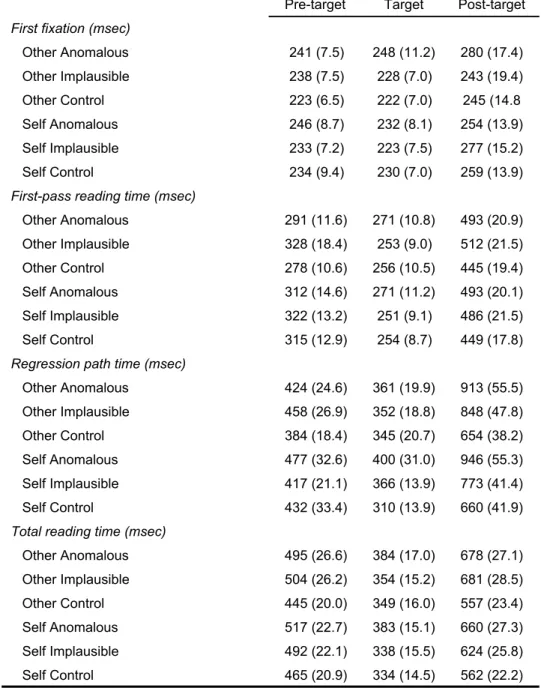
Table 2: Mean reading times for each eye-tracking measure, condition and region of analysis. Standard errors are shown in parentheses.
To analyse the data, linear mixed-effects models were constructed using the lme4 package (Bates, Maechler, Bolker & Walker, 2014) in R (version 3.3.1, R Development Core Team, 2016). Separate models were constructed for each region and measure1. Each model included the independent variables of Perspective and Plausibility as fixed effects. The two
1
Note that the same pattern of significant effects was found when data from each measure was log transformed, which corrects for the positive skew in reading time data.
Pre-target Target Post-target
First fixation (msec)
Other Anomalous 241 (7.5) 248 (11.2) 280 (17.4) Other Implausible 238 (7.5) 228 (7.0) 243 (19.4) Other Control 223 (6.5) 222 (7.0) 245 (14.8 Self Anomalous 246 (8.7) 232 (8.1) 254 (13.9) Self Implausible 233 (7.2) 223 (7.5) 277 (15.2) Self Control 234 (9.4) 230 (7.0) 259 (13.9)
First-pass reading time (msec)
Other Anomalous 291 (11.6) 271 (10.8) 493 (20.9) Other Implausible 328 (18.4) 253 (9.0) 512 (21.5) Other Control 278 (10.6) 256 (10.5) 445 (19.4) Self Anomalous 312 (14.6) 271 (11.2) 493 (20.1) Self Implausible 322 (13.2) 251 (9.1) 486 (21.5) Self Control 315 (12.9) 254 (8.7) 449 (17.8)
Regression path time (msec)
Other Anomalous 424 (24.6) 361 (19.9) 913 (55.5) Other Implausible 458 (26.9) 352 (18.8) 848 (47.8) Other Control 384 (18.4) 345 (20.7) 654 (38.2) Self Anomalous 477 (32.6) 400 (31.0) 946 (55.3) Self Implausible 417 (21.1) 366 (13.9) 773 (41.4) Self Control 432 (33.4) 310 (13.9) 660 (41.9)
Total reading time (msec)
Other Anomalous 495 (26.6) 384 (17.0) 678 (27.1) Other Implausible 504 (26.2) 354 (15.2) 681 (28.5) Other Control 445 (20.0) 349 (16.0) 557 (23.4) Self Anomalous 517 (22.7) 383 (15.1) 660 (27.3) Self Implausible 492 (22.1) 338 (15.5) 624 (25.8) Self Control 465 (20.9) 334 (14.5) 562 (22.2)
Perspective conditions were deviation coded (Other (-.5) vs. Self (.5)) to ensure they could be directly compared. To accommodate the three levels of Plausibility within the mixed-effect model analyses, we used deviation coded contrast schemes to compare each of the
experimental conditions to the reference level: Control vs. Anomalous (Control (-.33),
Anomalous (.66), Implausible (-.33)) and Control vs. Implausible (Control (-.33), Anomalous (-.33), Implausible (.66)). Models included the maximal random effects structure, including random effects for participants and items, and crossed random slopes for Plausibility by Perspective (as suggested by Barr, Levy, Scheepers, & Tily, 2013). Random effects were only removed where they lead to non-convergence due to overparameterization.
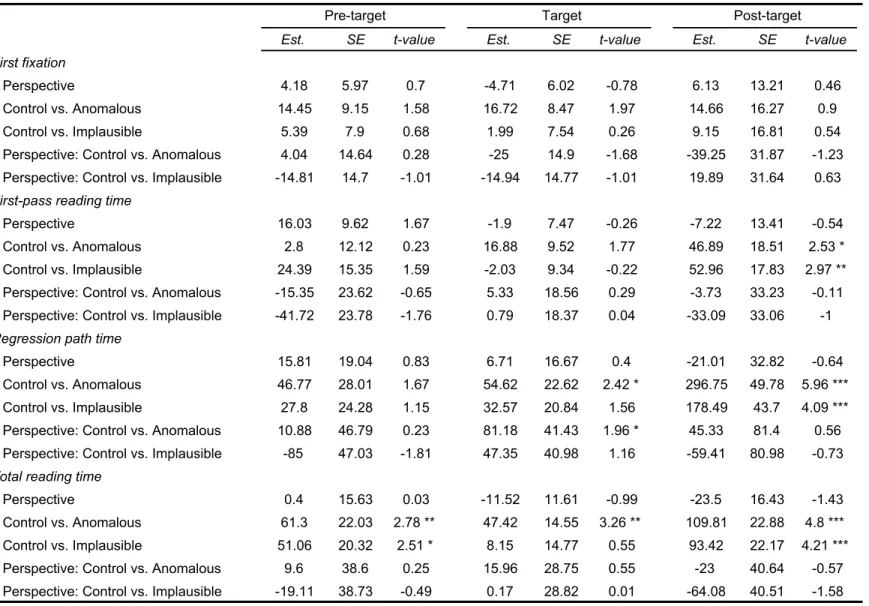
Table 3: Parameter estimates for each eye-tracking measure and region of analysis. Asterisks show significance of effects, where * = p<.05; ** =
p<.01; *** = p<.001.
Est. SE t-value Est. SE t-value Est. SE t-value First fixation
Perspective 4.18 5.97 0.7 -4.71 6.02 -0.78 6.13 13.21 0.46
Control vs. Anomalous 14.45 9.15 1.58 16.72 8.47 1.97 14.66 16.27 0.9
Control vs. Implausible 5.39 7.9 0.68 1.99 7.54 0.26 9.15 16.81 0.54
Perspective: Control vs. Anomalous 4.04 14.64 0.28 -25 14.9 -1.68 -39.25 31.87 -1.23
Perspective: Control vs. Implausible -14.81 14.7 -1.01 -14.94 14.77 -1.01 19.89 31.64 0.63
First-pass reading time
Perspective 16.03 9.62 1.67 -1.9 7.47 -0.26 -7.22 13.41 -0.54
Control vs. Anomalous 2.8 12.12 0.23 16.88 9.52 1.77 46.89 18.51 2.53 *
Control vs. Implausible 24.39 15.35 1.59 -2.03 9.34 -0.22 52.96 17.83 2.97 **
Perspective: Control vs. Anomalous -15.35 23.62 -0.65 5.33 18.56 0.29 -3.73 33.23 -0.11
Perspective: Control vs. Implausible -41.72 23.78 -1.76 0.79 18.37 0.04 -33.09 33.06 -1
Regression path time
Perspective 15.81 19.04 0.83 6.71 16.67 0.4 -21.01 32.82 -0.64
Control vs. Anomalous 46.77 28.01 1.67 54.62 22.62 2.42 * 296.75 49.78 5.96 ***
Control vs. Implausible 27.8 24.28 1.15 32.57 20.84 1.56 178.49 43.7 4.09 ***
Perspective: Control vs. Anomalous 10.88 46.79 0.23 81.18 41.43 1.96 * 45.33 81.4 0.56
Perspective: Control vs. Implausible -85 47.03 -1.81 47.35 40.98 1.16 -59.41 80.98 -0.73
Total reading time
Perspective 0.4 15.63 0.03 -11.52 11.61 -0.99 -23.5 16.43 -1.43
Control vs. Anomalous 61.3 22.03 2.78 ** 47.42 14.55 3.26 ** 109.81 22.88 4.8 ***
Control vs. Implausible 51.06 20.32 2.51 * 8.15 14.77 0.55 93.42 22.17 4.21 ***
Perspective: Control vs. Anomalous 9.6 38.6 0.25 15.96 28.75 0.55 -23 40.64 -0.57
Perspective: Control vs. Implausible -19.11 38.73 -0.49 0.17 28.82 0.01 -64.08 40.51 -1.58
Pre-target region
Statistical analyses in the pre-target region did not reveal any effects of Perspective or Plausibility in first fixation duration or regression path reading time. Perspective and
plausibility also did not influence first-pass reading time. These results replicate Rayner et al. (2004) and Joseph et al. (2008) who found no significant effect of plausibility on these early reading time measures in the pre-target region, despite numerically larger reading times in the anomalous condition compared to the implausible and control conditions (see Table 2).
Total reading times, reflecting the combination of early and late reading behaviours, did show a significant effect of Plausibility on both contrasts, reflecting longer total reading times in both the anomalous and implausible conditions compared to the control condition (506ms
vs. 498ms vs. 455ms). This pattern replicates the anomaly effect seen in Rayner et al. (2004) and Joseph et al. (2008), and the implausibility effect seen in Joseph et al. (2008) on total reading times in this pre-target region. The effect of Perspective was not significant.
Target region:
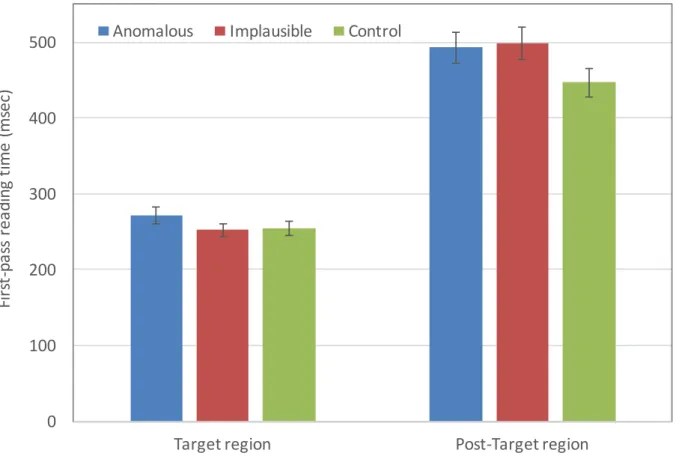
As in the pre-target region, neither Perspective or Plausibility significantly influenced first fixation duration nor first-pass reading times, despite both measures showing numerically larger reading times in the anomalous condition compared to the implausible and control conditions2 (see Figure 1). This anomaly effect was significant on first-pass reading times in both Rayner et al. (2004) and Joseph et al. (2008, adults), suggesting that there may be a slightly weaker or delayed disruption to reading from the anomalous critical word in the current study. The effect of Perspective was not significant.
2 Note that the Control vs. Anomalous contrast was not significant even when the Perspective effect and
Figure 1: First-pass reading times for each Plausibility condition (collapsed across Perspective) in the Target and Post-target regions.
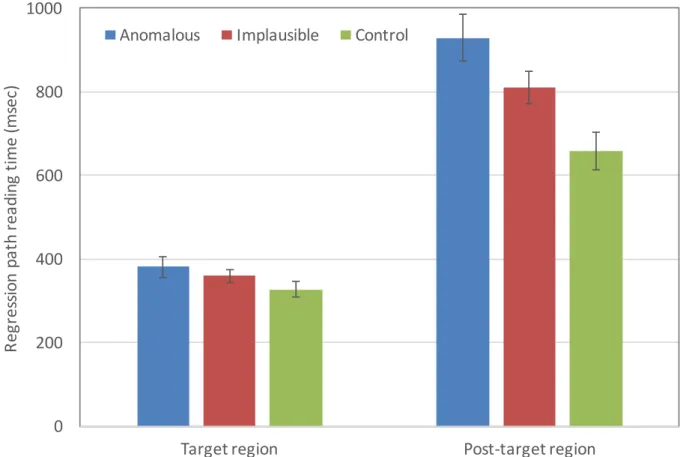
Nevertheless, regression path times revealed a significant effect of Plausibility on the Control vs. Anomalous contrast, showing that readers took significantly longer to go past the anomalous critical word compared to the control critical word (381ms vs. 327ms; see Figure 2). The Control vs. Implausible contrast was not significant, suggesting that readers did not distinguish implausible and control critical words on this early measure (359ms vs. 327ms). These effects are in line with Rayner et al. (2004) and Joseph et al. (2008) who also obtained an effect of the anomaly but not implausibility on regression path reading times at the critical word. The effect of Perspective was not significant, however Perspective interacted with the Control vs. Anomalous contrast (p=.05). This effect reflected a significant effect of anomaly (Control < Anomalous) when events were described from the self perspective (Est. = 94.12, SE
= 33.74, t = 2.79, p < .01), but no difference when the narrative was written from a third person perspective (i.e. ÔotherÕ; Est. = 13.87, SE = 29.64, t = .47, p = .64).
0 100 200 300 400 500
Target region Post-Target region
Fi rs t-p a ss r e a d in g t im e ( m se c)
Figure 2: Regression path reading times for each Plausibility condition (collapsed across Perspective) in the Target and Post-target regions.
Total reading times again showed clear effects of the anomaly, but not implausibility. These effects reflect significantly longer total reading times on the critical word in the
anomalous condition compared to the control condition (384ms vs. 341ms), but no difference between implausible and control critical words (346ms vs. 341ms). The effect of Perspective was not significant.
Post-target region:
Once again there was no effect of Perspective or Plausibility on first fixation durations. However, in line Rayner et al. (2004) and Joseph et al. (2008), both the anomalous and implausible words elicited significant effects on first-pass reading times. First-pass reading times were significantly longer following an anomalous or implausible critical word compared
0 200 400 600 800 1000
Target region Post-target region
Re g re ss io n p a th r e a d in g t im e ( m se c)
to a consistent control critical word (493ms vs. 499ms vs. 447ms). This pattern was also evident on regression path reading times; readers took significantly longer to go past the post-target region following an anomalous or implausible critical word compared to a control critical word (929ms vs. 811ms vs. 657ms). These effects therefore replicate those reported by Rayner et al. (2004) and Joseph et al. (2008, adults), who found early disruption to reading from anomalous and implausible words in the post-target region. The effect of Perspective was not significant.
Finally, total reading times in the post-target region showed a clear effect of
Plausibility, on both the Control vs. Anomalous and Control vs. Implausible contrasts. These effects reflected significantly longer total reading times on the post-target words in the anomalous condition compared to the control condition (669ms vs. 560ms), and in the implausible condition compared to the control condition (653ms vs. 560ms). Once again, the effect of Perspective was not significant.
General Discussion
Previous research has demonstrated that the difficulty readers experience when they encounter a violation during reading elicits clear effects on the eye movement record that increases as a function of the severity of the violation encountered. Specifically, anomalous words (e.g. ÒJohn used a pump to chop the carrotsÓ) leads to an immediate disruption at the anomalous word itself, while implausible words (e.g. ÒJohn used an axe to chop the carrotsÓ) elicit considerably weaker and delayed disruption (at the post-target region; Joseph et al., 2008; Rayner et al., 2004; Warren & McConnell, 2007). The current study sought to investigate whether these effects of anomaly and implausibility could be modulated by presenting the text within a counterfactual frame (ÒIfÉ thenÉÓ), which implies that the described events did not occur (e.g. Byrne & Tasso, 1999; Ferguson & Sanford, 2008). In addition, we explored whether
depth of text processing, and thus readersÕ sensitivity to anomalous or implausible events, could be influenced by personalization (self versus third person perspective).
Results revealed that the earliest point at which the anomalous critical word elicited a significant disruption to reading was the target word region, on the regression path measure; readers took longer to go past an anomalous critical word compared to a control critical word. Anomaly effects were widespread, and were also observed in first-pass reading times and regression path reading times in the post-target region, and total reading times across all three regions of interest. In contrast, the implausible critical word did not elicit any effects on the target word itself, as reading disruption was delayed to the post-target region, with longer first-pass reading times and regression path reading times compared to the plausible control
condition. Implausibility also led to increased total reading times in the pre-target and post-target regions.
Therefore, the results of the current experiment largely replicated the violation detection patterns reported in Rayner et al. (2004) and Joseph et al. (2008). Readers were sensitive to the inconsistent thematic relation in anomalous and implausible conditions, though the effects of plausibility were delayed. This contrasts with the immediate effects of
plausibility reported in Matsuki et al. (2011), because our items were based on those used in Rayner et al. (2004), and event-based conceptual knowledge was less rigorously normed. Importantly, the fact that these robust anomaly detection responses were evident within a counterfactual frame suggests that participants were evaluating incoming information according to fit with the counterfactual world, and did not suspend processing based on an inference about reality (i.e. that the described event did not occur). This finding fits with results from de Vega and colleaguesÕ offline reading-probe studies, in showing that events that are consistent with the counterfactual world remain accessible in memory immediately after reading, exactly like in factual world stories (de Vega & Urrutia, 2012; de Vega, Urrutia, & Riffo, 2007). However, the factual (not-real) situation is also computed, and this becomes
favoured over the counterfactual situation after a short delay. Thus, counterfactuals activate a momentary representation of the counterfactual situation before switching attention to a representation of the factual (not-real) situation. Our results show that within the short counterfactual sentences used here, readers favoured the counterfactual world for processing incoming information online. However, given the large body of empirical evidence that has demonstrated dual representations for counterfactuals (Ferguson, 2012; Ferguson & Cane, 2015, Ferguson & Sanford, 2008; Ferguson et al., 2008; de Vega et al., 2007; de Vega & Urrutia, 2012; Gomez-Veiga et al., 2010, Santamaria et al., 2005; Urrutia et al., 2012), it is expected that this initial counterfactual interpretation would be weakened if a longer delay was introduced between the counterfactual antecedent and the target word, resulting in reduced or delayed anomaly/implausibility detection effects. Further research is necessary to explore this.
There was, however, some evidence that readers may have modified processing of violations within this Ônot-realÕ counterfactual frame. Specifically, despite numerically longer first-pass reading times on anomalous compared to control target words (271ms vs. 255ms, p = .08), readers did not show significant disruption in the anomalous condition on this measure, whereas this effect was clearly significant in both Rayner et al. (2004) and Joseph et al. (2008). Early anomaly detection effects were, however, seen on the regression path reading time measure in this target region, suggesting that readers immediately moved backwards to revisit earlier parts of the sentence, rather than increasing processing time on that anomalous word. It is important to note that the weaker anomaly effect on first-pass reading times at the target word may be due to the slightly different anomaly constructions that have been employed across studies. Specifically, the current experiment employed the same ÔneutralÕ infinitival verb across all three conditions, meaning that anomalous items included a single thematic violation between the target object and implement (i.e. pump- prepare carrots). In contrast, previous studies manipulated the infinitival verb in anomalous sentences, meaning that this condition included two thematic violations based on selectional restrictions between the target object and
both the implement and the verb (i.e. pump- inflate carrots). Further research is needed to examine this additive effect on anomaly detection. Disruption due to the implausible target word occurred at the same place as previous studies- on the post-target region- but was evident in both first-pass reading times and regression path reading times. Neither Rayner et al. (2004) or Joseph et al. (2008) observed this implausibility effect on first-pass reading times at the post-target region. This indicates that our readers spent longer during initial reading of the post-target region, perhaps considering the incoming information according to the inferred factual representation, then moved backwards in the text to try to make sense of this implausible thematic relation. Taken together, these effects suggest that our readers have adopted slightly different processing strategies when encountering anomalous or implausible information within a counterfactual frame.
Interestingly, perspective modulated the anomaly detection effect on regression path reading times at the target word. Readers took longer to go past an anomalous target word compared to a control target word, but only when the narrative was written from the self perspective, not when written from a third person perspective. This effect therefore suggests that personalization increased the depth with which text is processed, showing deeper
processing for text that relates to the self versus other (Berry et al., 2003; Fukuda & Sanford, 2008; Jackson et al., 2006). The self-perspective acted as a focusing device to facilitate the detection of anomalous information. This is the first time that such enhanced word processing has been revealed in online measures, and contrasts with previous eye-tracking studies that have failed to find evidence that words within the focus scope are accessed more rapidly than when they are not (Birch & Rayner, 1997; Morris & Folk, 1998). Nevertheless, it is important to note that this effect only just reached significance (p=.05) on one measure at one region, and only influenced processing of the anomalous (not implausible) word. Therefore, while this novel finding of enhanced online processing of personalized information is promising, further
research is needed to replicate this pattern and understand the exact mechanisms that underlie the effect.
In conclusion, we found that readers were sensitive to the inconsistent thematic relation in anomalous and implausible conditions, though the effects of plausibility were delayed, as in Rayner et al. (2004) and Joseph et al., (2008). Moreover, these anomaly detection effects were evident within a counterfactual frame, which suggests that participants evaluated incoming information relative to the counterfactual world, and did not suspend processing based on the Ônot-realÕ inference about reality. Finally, personalising the protagonist (self versus other) influenced the time course with which anomalous (but not implausible) words were detected, suggesting that self-involvement modulated depth of processing.
References
Barr, D. J., Levy, R., Scheepers, C., & Tily, H. J. (2013). Random effects structure for confirmatory hypothesis testing: Keep it maximal. Journal of memory and language, 68, 255-278.
Bates, D., Maechler, M., Bolker, B., & Walker, S. (2014). lme4: Linear mixed-effects models using Eigen and S4. R package version, 1 (7).
Berry, D. C., Michas, I. C., & Bersellini, E. (2003). Communicating information about medication: the benefits of making it personal. Psychology and Health, 18, 127-139. Birch, S. L., Albrecht, J. E., & Myers, J. L. (2000). Syntactic focusing structures influence
discourse processing. Discourse Processes, 30, 285-304.
Birch, S. L., & Garnsey, S. M. (1995). The effect of focus on memory for words in sentences.
Journal of Memory and Language, 34, 232.
Birch, S., & Rayner, K. (1997). Linguistic focus affects eye movements during reading.
Memory & Cognition, 25, 653-660.
Braze, D., Shankweiler, D., Ni, W., & Palumbo, L.C. (2002). Readers' eye movements distinguish anomalies of form and content. Journal of Psycholinguistic Research, 31, 25-44.
Bredart, S., & Modolo, K. (1988). Moses strikes again: Focalization effect on a semantic illusion. Acta Psychologica, 67, 135-144.
BrunyŽ, T. T., Ditman, T., Mahoney, C. R., Augustyn, J. S., & Taylor, H. A. (2009). When you and I share perspectives pronouns modulate perspective taking during narrative
comprehension. Psychological Science, 20, 27-32.
Byrne, R.M.J. (2005). The Rational Imagination: How People Create Alternatives to Reality. Cambridge, M.A.: MIT Press.
Byrne, R.M.J. (2002). Mental models and counterfactual thoughts about what might have been.
Byrne, R.M.J., & Tasso A. (1999). Deductive reasoning with factual, possible, and counterfactual conditionals. Memory & Cognition, 27, 726-740.
Carreiras, M., & Clifton, C. (1993). Relative clause interpretation preferences in Spanish and English. Language and Speech, 36, 353-372.
Fauconnier, G. (1997). Mappings in thought and language, Cambridge University Press. Fauconnier, G. (1994). Mental Spaces. Cambridge, UK: Cambridge University Press.
Fauconnier, G. (1985). Mental Spaces: Aspects of Meaning Construction in Natural Language, Cambridge, MA: MIT Press.
Fauconnier, G., & Turner, M. (2003). The Way We Think: Conceptual Blending and the Mind's Hidden Complexities. New York: Basic Books.
Ferguson, H. J. (2012). Eye movements reveal rapid concurrent access to factual and counterfactual interpretations of the world. The Quarterly Journal of Experimental Psychology, 65, 939-961.
Ferguson, H. J., & Cane, J. E. (2015). Examining the cognitive costs of counterfactual language comprehension: Evidence from ERPs. Brain research, 1622, 252-269. Ferguson, H.J., & Sanford, A.J. (2008). Anomalies in real and counterfactual worlds: An
Eye-Movement Investigation. Journal of Memory & Language, 58, 609-626.
Ferguson, H.J., Sanford, A.J., & Leuthold, H. (2008). Eye-movements and ERPs reveal the time-course of processing negation and remitting counterfactual worlds. Brain Research, 1236, 113-125.
Filik, R. (2008). Contextual override of pragmatic anomalies: Evidence from eye movements.
Cognition, 106, 1038-1046.
Fukuda, Y., & Sanford, A. J. (2008). The effect of personalization on shallow processing. In
The 18th Annual Meeting of Society for Text and Discourse (Vol. 60).
G—mez-Veiga, I., Garc’a-Madruga, J. A., & Moreno-R’os, S. (2010). The interpretation of indicative and subjunctive concessives. Acta psychologica, 134, 245-252.
Jackson, P. L., Brunet, E., Meltzoff, A. N., & Decety, J. (2006). Empathy examined through the neural mechanisms involved in imagining how I feel versus how you feel pain.
Neuropsychologia, 44, 752-761.
Johnson-Laird, P. N., & Byrne, R. M. (2002). Conditionals: a theory of meaning, pragmatics, and inference. Psychological review, 109, 646.
Joseph, H. S., Liversedge, S. P., Blythe, H. I., White, S. J., Gathercole, S. E., & Rayner, K. (2008). Children's and adults' processing of anomaly and implausibility during reading: Evidence from eye movements. The Quarterly Journal of Experimental Psychology, 61, 708-723.
Liversedge, S. P., & Findlay, J. M. (2000). Saccadic eye movements and cognition. Trends in cognitive sciences,4, 6-14.
Liversedge, S. P., Paterson, K. B., & Pickering, M. J. (1998). Eye movements and measures of reading time. Eye guidance in reading and scene perception, 55-75.
Matsuki, K., Chow, T., Hare, M., Elman, J.L., Scheepers, C., & McRae, K. (2011). Event-based plausibility immediately influences on-line language comprehension. Journal of Experimental Psychology: Learning, Memory, and Cognition, 37, 913-934.
Morris, R. K., & Folk, J. R. (1998). Focus as a contextual priming mechanism in reading.
Memory & Cognition, 26, 1313-1322.
Ni, W., Fodor, J.D., Crain, S., & Shankweiler, D.P. (1998). Anomalous strings: Eye movement patterns. Journal of Psycholinguistic Research, 27, 515-539.
Nieuwland, M. S. (2013). ÒIf a lion could speakÉÓ: Online sensitivity to propositional truth-value of unrealistic counterfactual sentences. Journal of Memory and Language, 68, 54-67.
Nieuwland, M. S., & Martin, A. E. (2012). If the real world were irrelevant, so to speak: The role of propositional truth-value in counterfactual sentence comprehension. Cognition, 122, 102-109.
Nieuwland, M.S. & Van Berkum, J.J.A. (2006). When peanuts fall in love: N400 evidence for the power of discourse. Journal of Cognitive Neuroscience, 18, 1098-1111.
Pickering, M. J., & Traxler, M. J. (1998). Plausibility and recovery from garden paths: An eye-tracking study. Journal of Experimental Psychology: Learning, Memory, and
Cognition, 24, 940.
Rayner, K. (1998). Eye movements in reading and information processing: 20 years of research. Psychological Bulletin, 124, 372-422.
Rayner, K. (2009). Eye movements and attention in reading, scene perception, and visual search. Quarterly Journal of Experimental Psychology, 62, 1457-1506.
Rayner, K., Warren, T., Juhasz, B., & Liversedge, S. (2004). The effects of plausibility on eye movements in reading. Journal of Experimental Psychology: Learning, Memory and Cognition, 30, 1290-1301.
Sanford, A. J., & Emmott, C. (2012). Mind, brain and narrative. Cambridge University Press. Sanford, A. J., & Garrod, S. C. (2005). Memory-based approaches and beyond. Discourse
Processes, 39, 205-224.
Sanford, A.J., Leuthold, H., Bohan, J. and Sanford, A.J., 2011. Anomalies at the borderline of awareness: An ERP study. Journal of Cognitive Neuroscience, 23, 514-523.
Sanford, A. J., Price, J., & Sanford, A. J. (2009). Enhancement and suppression effects
resulting from information structuring in sentences. Memory & Cognition, 37, 880-888. Sanford, A. J., Sanford, A. J., Molle, J., & Emmott, C. (2006). Shallow processing and
attention capture in written and spoken discourse. Discourse Processes, 42, 109-130. Santamaria, C., Espino, O., & Byrne, R.M.J. (2005). Counterfactual and semifactual
conditionals prime alternative possibilities. Journal of Experimental Psychology:
Sturt, P., Sanford, A. J., Stewart, A., & Dawydiak, E. (2004). Linguistic focus and
good-enough representations: An application of the change-detection paradigm. Psychonomic bulletin & review, 11, 882-888.
Thompson, V., & Byrne, R.M.J. (2002). Reasoning about things that didn't happen. Journal of Experimental Psychology: Learning, Memory, and Cognition. 28, 1154-1170.
Thornton, R., & MacDonald, M. C. (2003). Plausibility and grammatical agreement. Journal of Memory and Language, 48, 740-759.
Urrutia, M., de Vega, M., & Bastiaansen, M. (2012). Understanding counterfactuals in
discourse modulates ERP and oscillatory gamma rhythms in the EEG. Brain research, 1455, 40-55.
de Vega, M., & Urrutia, M. (2012). Discourse Updating after Reading a Counterfactual Event.
Psicologica: International Journal of Methodology and Experimental Psychology, 33, 157-173.
de Vega, M., Urrutia, M., & Riffo, B. (2007). Cancelling Updating in the Comprehension of Counterfactuals embedded in narratives. Memory and Cognition, 35, 1410-1421. Warren, T., & McConnell, K. (2007). Investigating effects of selectional restriction violations
and plausibility violation severity on eye-movements in reading. Psychonomic bulletin & review, 14, 770-775.
Warren, T., McConnell, K., & Rayner, K. (2008). Effects of context on eye movements when reading about possible and impossible events. Journal of Experimental Psychology: Learning, Memory, and Cognition, 34, 1001.
Appendix
Note that for each of the items below, conditions are listed in the order: other-consistent, other-implausible, other-anomalous, self-consistent, self-implausible, and self-anomalous.
1
If Emily had used a trap, she would have caught the horrible mouse quite quickly. The mouse would surely have been very scared.
If Emily had used a hook, she would have caught the horrible mouse quite quickly. The mouse would surely have been very scared.
If Emily had used a balloon, she would have caught the horrible mouse quite quickly. The mouse would surely have been very scared.
If you had used a trap, you would have caught the horrible mouse quite quickly. The mouse would surely have been very scared.
If you had used a hook, you would have caught the horrible mouse quite quickly. The mouse would surely have been very scared.
If you had used a balloon, you would have caught the horrible mouse quite quickly. The mouse would surely have been very scared.
2
If Sophie had used a knife, she would have prepared the large carrots in time for dinner. The carrots would have been eaten last night.
If Sophie had used an axe, she would have prepared the large carrots in time for dinner. The carrots would have been eaten last night.
If Sophie had used a pump, she would have prepared the large carrots in time for dinner. The carrots would have been eaten last night.
If you had used a knife, you would have prepared the large carrots in time for dinner. The carrots would have been eaten last night.
If you had used an axe, you would have prepared the large carrots in time for dinner. The carrots would have been eaten last night.
If you had used a pump, you would have prepared the large carrots in time for dinner. The carrots would have been eaten last night.
3
If Chloe had used a rope, she would have secured the beautiful boat after the trip. The boat was supposed to be moored in the port.
If Chloe had used a shoelace, she would have secured the beautiful boat after the trip. The boat was supposed to be moored in the port.
If Chloe had used an umbrella, she would have secured the beautiful boat after the trip. The boat was supposed to be moored in the port.
If you had used a rope, you would have secured the beautiful boat after the trip. The boat was supposed to be moored in the port.
If you had used a shoelace, you would have secured the beautiful boat after the trip. The boat was supposed to be moored in the port.
was supposed to be moored in the port. 4
If Ruth had used the shortcut, she would have avoided the annoying traffic in the town center. The traffic was notoriously bad on a Friday.
If Ruth had used the loophole, she would have avoided the annoying traffic in the town center. The traffic was notoriously bad on a Friday.
If Ruth had used the money, she would have avoided the annoying traffic in the town center. The traffic was notoriously bad on a Friday.
If you had used the shortcut, you would have avoided the annoying traffic in the town center. The traffic was notoriously bad on a Friday.
If you had used the loophole, you would have avoided the annoying traffic in the town center. The traffic was notoriously bad on a Friday.
If you had used the money, you would have avoided the annoying traffic in the town center. The traffic was notoriously bad on a Friday.
5
If Lily had used the computer, she would have accessed the new data about the registers. The data would have been useful for the meeting.
If Lily had used the elevator, she would have accessed the new data about the registers. The data would have been useful for the meeting.
If Lily had used the rope, she would have accessed the new data about the registers. The data would have been useful for the meeting.
If you had used the computer, you would have accessed the new data about the registers. The data would have been useful for the meeting.
If you had used the elevator, you would have accessed the new data about the registers. The data would have been useful for the meeting.
If you had used the rope, you would have accessed the new data about the registers. The data would have been useful for the meeting.
6
If Rebecca had used a lead, she would have controlled the spotted greyhound when it ran off. The greyhound liked chasing other animals.
If Rebecca had used a joystick, she would have controlled the spotted greyhound when it ran off. The greyhound liked chasing other animals.
If Rebecca had used a shovel, she would have controlled the spotted greyhound when it ran off. The greyhound liked chasing other animals.
If you had used a lead, you would have controlled the spotted greyhound when it ran off. The greyhound liked chasing other animals.
If you had used a joystick, you would have controlled the spotted greyhound when it ran off. The greyhound liked chasing other animals.
If you had used a shovel, you would have controlled the spotted greyhound when it ran off. The greyhound liked chasing other animals.
7
If Nancy had used a brush, she would have applied the black mascara to the actressÕs eyelashes. ItÕs always important to look good on stage.
If Nancy had used a rag, she would have applied the black mascara to the actressÕs eyelashes. ItÕs always important to look good on stage.
If Nancy had used a spoon, she would have applied the black mascara to the actressÕs eyelashes. ItÕs always important to look good on stage.
If you had used a brush, you would have applied the black mascara to the actressÕs eyelashes. ItÕs always important to look good on stage.
If you had used a rag, you would have applied the black mascara to the actressÕs eyelashes. ItÕs always important to look good on stage.
If you had used a spoon, you would have applied the black mascara to the actressÕs eyelashes. ItÕs always important to look good on stage.
8
If Lucy had used a lighter, she would have lit the long cigarette for a friend. The smoke would have clouded the room.
If Lucy had used a lantern, she would have lit the long cigarette for a friend. The smoke would have clouded the room.
If Lucy had used a chemical, she would have lit the long cigarette for a friend. The smoke would have clouded the room.
If you had used a lighter, you would have lit the long cigarette for a friend. The smoke would have clouded the room.
If you had used a lantern, you would have lit the long cigarette for a friend. The smoke would have clouded the room.
If you had used a chemical, you would have lit the long cigarette for a friend. The smoke would have clouded the room.
9
If Amelia had used the password, she would have opened the important program on the computer. The program contained vital information.
If Amelia had used the key, she would have opened the important program on the computer. The program contained vital information.
If Amelia had used the spanner, she would have opened the important program on the computer. The program contained vital information.
If you had used the password, you would have opened the important program on the computer. The program contained vital information.
If you had used the key, you would have opened the important program on the computer. The program contained vital information.
If you had used the spanner, you would have opened the important program on the computer. The program contained vital information.
10
If Ella had used the toy, she would have entertained the irritated child in the waiting room. The child wouldnÕt have disturbed everyone.
If Ella had used the parody, she would have entertained the irritated child in the waiting room. The child wouldnÕt have disturbed everyone.
If Ella had used the polish, she would have entertained the irritated child in the waiting room. The child wouldnÕt have disturbed everyone.
If you had used the toy, you would have entertained the irritated child in the waiting room. The child wouldnÕt have disturbed everyone.
If you had used the parody, you would have entertained the irritated child in the waiting room. The child wouldnÕt have disturbed everyone.
If you had used the polish, you would have entertained the irritated child in the waiting room. The child wouldnÕt have disturbed everyone.
If Katie had used a ladder, she would have reached the highest spire of the cathedral. The spire was recently damaged in a storm.
If Katie had used a stool, she would have reached the highest spire of the cathedral. The spire was recently damaged in a storm.
If Katie had used a broom, she would have reached the highest spire of the cathedral. The spire was recently damaged in a storm.
If you had used a ladder, you would have reached the highest spire of the cathedral. The spire was recently damaged in a storm.
If you had used a stool, you would have reached the highest spire of the cathedral. The spire was recently damaged in a storm.
If you had used a broom, you would have reached the highest spire of the cathedral. The spire was recently damaged in a storm.
12
If Julie had used a whistle, she would have summoned the various children in the park. The children would surely have been disappointed.
If Julie had used a flare, she would have summoned the various children in the park. The children would surely have been disappointed.
If Julie had used a bottle, she would have summoned the various children in the park. The children would surely have been disappointed.
If you had used a whistle, you would have summoned the various children in the park. The children would surely have been disappointed.
If you had used a flare, you would have summoned the various children in the park. The children would surely have been disappointed.
If you had used a bottle, you would have summoned the various children in the park. The children would surely have been disappointed.
13
If Charlotte had used a trolley, she would have carried the bags of heavy shopping home from Tesco. The bags would not be carried by one person.
If Charlotte had used a helicopter, she would have carried the bags of heavy shopping home from Tesco. The groceries would not be carried by one person.
If Charlotte had used a spatula, she would have carried the bags of heavy shopping home from Tesco. The bags would not be carried by one person.
If you had used a trolley, you would have carried the bags of heavy shopping home from Tesco. The bags would not be carried by one person.
If you had used a helicopter, you would have carried the bags of heavy shopping home from Tesco. The bags would not be carried by one person.
If you had used a spatula, you would have carried the bags of heavy shopping home from Tesco. The bags would not be carried by one person.
14
If Megan had used a fence, she would have protected the lovely flowers in the garden. The flowers died when they were trampled on.
If Megan had used a sword, she would have protected the lovely flowers in the garden. The flowers died when they were trampled on.
If Megan had used a sponge, she would have protected the lovely flowers in the garden. The flowers died when they were trampled on.
If you had used a fence, you would have protected the lovely flowers in the garden. The flowers died when they were trampled on.
If you had used a sword, you would have protected the lovely flowers in the garden. The flowers died when they were trampled on.
If you had used a sponge, you would have protected the lovely flowers in the garden. The flowers died when they were trampled on.
15
If Patricia had used a telescope, she would have watched the bright comet as it passed by. The comet was said to be a wondrous sight.
If Patricia had used a microscope, she would have watched the bright comet as it passed by. The comet was said to be a wondrous sight.
If Patricia had used a broom, she would have watched the bright comet as it passed by. The comet was said to be a wondrous sight.
If you had used a telescope, you would have watched the bright comet as it passed by. The comet was said to be a wondrous sight.
If you had used a microscope, you would have watched the bright comet as it passed by. The comet was said to be a wondrous sight.
If you had used a broom, you would have watched the bright comet as it passed by. The comet was said to be a wondrous sight.
16
If Leanne had used a bucket, she would have carried the fresh water up the steps. The water was needed for the flowers.
If Leanne had used a purse, she would have carried the fresh water up the steps. The water was needed for the flowers.
If Leanne had used a fork, she would have carried the fresh water up the steps. The water was needed for the flowers.
If you had used a bucket, you would have carried the fresh water up the steps. The water was needed for the flowers.
If you had used a purse, you would have carried the fresh water up the steps. The water was needed for the flowers.
If you had used a fork, you would have carried the fresh water up the steps. The water was needed for the flowers.
17
If Jenny had used a net, she would have caught the small butterfly that was flying by. The butterfly was very pretty.
If Jenny had used a mousetrap, she would have caught the small butterfly that was flying by. The butterfly was very pretty.
If Jenny had used a hose, she would have caught the small butterfly that was flying by. The butterfly was very pretty.
If you had used a net, you would have caught the small butterfly that was flying by. The butterfly was very pretty.
If you had used a mousetrap, you would have caught the small butterfly that was flying by. The butterfly was very pretty.
If you had used a hose, you would have caught the small butterfly that was flying by. The butterfly was very pretty.
18
If Holly had used the glue, she would have held the old frame together for a long time. The frame was supposed to hold a family portrait.
If Holly had used the chopsticks, she would have held the old frame together for a long time. The frame was supposed to hold a family portrait.
If Holly had used the candle, she would have held the old frame together for a long time. The frame was supposed to hold a family portrait.
If you had used the glue, you would have held the old frame together for a long time. The frame was supposed to hold a family portrait.
If you had used the chopsticks, you would have held the old frame together for a long time. The frame was supposed to hold a family portrait.
If you had used the candle, you would have held the old frame together for a long time. The frame was supposed to hold a family portrait.
19
If Alice had used a mop, she would have cleaned the front porch before the party. It would have been a much nicer entrance.
If Alice had used a toothbrush, she would have cleaned the front porch before the party. It would have been a much nicer entrance.
If Alice had used a hairdryer, she would have cleaned the front porch before the party. It would have been a much nicer entrance.
If you had used a mop, you would have cleaned the front porch before the party. It would have been a much nicer entrance.
If you had used a toothbrush, you would have cleaned the front porch before the party. It would have been a much nicer entrance.
If you had used a hairdryer, you would have cleaned the front porch before the party. It would have been a much nicer entrance.
20
If Beth had used a duster, she would have cleaned the dirty ornaments sitting on the shelf. The ornaments had been neglected for months.
If Beth had used a hoover, she would have cleaned the dirty ornaments sitting on the shelf. The ornaments had been neglected for months.
If Beth had used a dagger, she would have cleaned the dirty ornaments sitting on the shelf. The ornaments had been neglected for months.
If you had used a duster, you would have cleaned the dirty ornaments sitting on the shelf. The ornaments had been neglected for months.
If you had used a hoover, you would have cleaned the dirty ornaments sitting on the shelf. The ornaments had been neglected for months.
If you had used a dagger, you would have cleaned the dirty ornaments sitting on the shelf. The ornaments had been neglected for months.
21
If Freya had used an anesthetic, she would have relaxed the stiff patient before surgery. The patient had been very nervous.
If Freya had used a bribe, she would have relaxed the stiff patient before surgery. The patient had been very nervous.
If Freya had used a brush, she would have relaxed the stiff patient before surgery. The patient had been very nervous.
If you had used an anesthetic, you would have relaxed the stiff patient before surgery. The patient had been very nervous.
If you had used a bribe, you would have relaxed the stiff patient before surgery. The patient had been very nervous.
If you had used a brush, you would have relaxed the stiff patient before surgery. The patient had been very nervous.
22
If Daisy had used a knife, she would have divided the smelly cheese among the dinner guests. The cheese was expensive and came from Italy.
If Daisy had used scissors, she would have divided the smelly cheese among the dinner guests. The cheese was expensive and came from Italy.
If Daisy had used a hammer, she would have divided the smelly cheese among the dinner guests. The cheese was expensive and came from Italy.
If you had used a knife, you would have divided the smelly cheese among the dinner guests. The cheese was expensive and came from Italy.
If you had used scissors, you would have divided the smelly cheese among the dinner guests. The cheese was expensive and came from Italy.
If you had used a hammer, you would have divided the smelly cheese among the dinner guests. The cheese was expensive and came from Italy.
23
If Abigail had used some paper, she would have wrapped the large present yesterday. The present was for someone at the party.
If Abigail had used some fabric, she would have wrapped the large present yesterday. The present was for someone at the party.
If Abigail had used some wire, she would have wrapped the large present yesterday. The present was for someone at the party.
If you had used some paper, you would have wrapped the large present yesterday. The present was for someone at the party.
If you had used some fabric, you would have wrapped the large present yesterday. The present was for someone at the party.
If you had used some wire, you would have wrapped the large present yesterday. The present was for someone at the party.
24
If Emma had used a knife, she would have cut the stale bread very carefully. The bread had been left out for days.
If Emma had used a saw, she would have cut the stale bread very carefully. The bread had been left out for days.
If Emma had used a spoon, she would have cut the stale bread very carefully. The bread had been left out for days.
If you had used a knife, you would have cut the stale bread very carefully. The bread had been left out for days
If you had used a saw, you would have cut the stale bread very carefully. The bread had been left out for days.
If you had used a spoon, you would have cut the stale bread very carefully. The bread had been left out for days.
25
If Molly had used a sieve, she would have drained the thin spaghetti yesterday evening. There were meatballs to be eaten too.
If Molly had used a net, she would have drained the thin spaghetti yesterday evening. There were meatballs to be eaten too.