Combinatorial semantics in the visual world: A
representational account of real-time event
processing
Christopher Charles Rowson
PhD
Psychology
February 2011
Abstract
The experiments presented in this thesis sought to establish combinatorial effects operating within novel semantic priming paradigms. These experiments
demonstrate the combining of several pieces of semantic information
(specifically, what certain items afford in terms of some form of interaction) from objects within simple visual scenes, and an account is offered based on the construction of representations from these presented items. These composite representations subsequently facilitate responses to target items, but it is only with a combination of items (e.g. a knife and a tyre) that is felicitous to a particular event (e.g. bursting) that priming to target items (e.g. a burst tyre) obtains. Priming is less evident when a combination of items is presented that does not allow the same event to occur (e.g. a ruler and a tyre). These
combinatorial processes appear to occur in longer time windows than those of automatic visual processes such as gist abstraction, and the representations activated upon viewing these stimuli appear to be specific to the objects presented.
Abstract………2
List of Tables and Figures………..7
Acknowledgements………10
Declaration………11
Chapter 1………...12
Vision and scene gist………13
Semantic priming………..19
Embodied cognition and affordances……….23
Event knowledge and the visual world………..26
Current research………29 Chapter 2………...31 Experiment 1………..33 Method………...35 Results………...38 Discussion……….40 Experiment 2………..42 Method………...42 Results………...43 General discussion………45 Chapter 3………...49 Experiment 3………..60 Method………...60 Results………...67 Discussion……….71
Experiment 4………..74 Method………...75 Results………...77 Discussion……….79 Experiment 5………..80 Method………...81 Results………...81 Discussion……….82 General discussion………83 Bird-puddle items……….84 Knife-tyre items………86
Shortened exposure durations………..89
Chapter 4………...91 Experiment 6………..93 Method………...96 Results………...97 Discussion……….98 Experiment 7………100 Method……….101 Results……….102 Discussion………..103 Experiment 8………106 Method……….106 Results……….107 General discussion……….108
Integration processes at the target?...109
Inhibition from controls?...110
Memory load?...112
Chapter 5……….118
Introduction………..118
Representational codes……….119
Perceptual grouping and the graspability of objects……….122
Object-specific representations and the visual world………123
Current experiment……….125
Experiment 9………126
Method……….126
Results……….127
Discussion………..129
Causal structure and scene comprehension………...130
Distal and proximal events……….132
Grounded cognition and simulation………..133
Ecological vision and affordances……….135
Theory of event coding………136
Further research………...138
Chapter 6……….141
Introduction………..141
Overview of empirical findings………..144
Implications for vision……….148
Implications for event representation………...151
Implications for scene gist and object recognition……….154
Limitations of the current work………..157
Further research………..162
Appendices………..164
List of tables and figures
Table 2.1: Means and standard deviations for each condition, with
second picture exposure durations of 250 ms………...34 Table 2.2: Means and standard deviations for each condition, with
second picture exposure durations of 100 ms………...38 Table 3.1: Means and standard deviations for each of the three norming
Types………63 Table 3.2: Pearson’s r values for correlations between bird-puddle prime
condition response times and each rating type……….63 Table 3.3: Means and standard deviations for each of the three norming
Types………65 Table 3.4: Pearson’s r values for correlations between knife-tyre prime
and control condition response times and each rating type……….65 Table 3.5: Means and standard deviations for each of the three norming
Types………72 Table 3.6: Pearson’s r values for correlations between knife-tyre prime
and control condition response times and each rating type………..73 Table 4.1: Means and standard deviations for each
condition………...92 Figure 2.1: An example of scenes corresponding to the target ‘drink’ in
Altmann, Charles & Gennari’s (2005) study………28 Figure 2.2: Stimuli presented in each condition for the corresponding
target word, ‘drink’………...30 Figure 2.3: Schematic of the trial procedure for the target ‘drink’………..33 Figure 2.4: Mean response times at 250 ms, with standard error bars………….35 Figure 2.5: Mean response times at 100 ms, with standard error bars………….39
Figure 3.1: An example of the stimuli for the event ‘drink’………49 Figure 3.2: An example of stimuli for the event ‘burst’………...51
Figure 3.3: An example of the procedure for each trial………...61 Figure 3.4: Mean ‘bird-puddle’ response times for both conditions,
with standard error bars………....62 Figure 3.5: Mean ‘knife-tyre’ response times for both conditions, with
standard error bars………64 Figure 3.6: Mean participant response times for both conditions, with
standard error bars………72 Figure 3.7: Mean participant response times for both conditions with
first picture exposure durations of 250 ms, with standard error bars…………...77 Figure 4.1: An example of stimuli used in each condition for the
concept ‘burst’………..90 Figure 4.2: Average participant response times in each condition.
Error bars represent standard error………...93 Figure 4.3: An example of the trial procedure in each condition for the
concept ‘burst’………..96 Figure 4.4: Average response times for both conditions………..98 Figure 4.5: An example of trial procedure for the concept ‘burst’, for
both conditions………...102 Figure 4.6: Average response times for both conditions………103 Figure 5.1: Example of the trial procedure for experiment 9……….116 Figure 5.2: Average response times for each condition, with standard
Acknowledgements
I would like to thank my supervisor Gerry Altmann for all his help and support throughout the duration of the degree course. I would also like to thank Silvia Gennari, and the members of my research committee – Gareth Gaskell and Philip Quinlan for their valued input.
Declaration
This thesis contains original work completed solely by the author under the supervision of Prof. Gerry Altmann.
Chapter 1
The notion of internal (mental) and external (physical) worlds and how entities around us are coded or internalised mentally has been a major concern of
cognitive psychology since its inception. The methodologies used to explore this have provided researchers with ways of studying the complex interplay between vision, language and action. The current chapter aims to provide an overview of literature relevant to the studies that are to be presented and discussed in
subsequent chapters. Each chapter will be organised in the following way: First, the issue that the experiments aim to address will be considered with a brief discussion of the relevant supporting studies. Next, the methods and information relating to the design of the experiment will be provided. Finally, data from the experiment will be presented with a discussion of the relevant implications and edifications that these data provide.
This thesis will explore several questions related to the aforementioned notion of internal and external worlds, and how information pertaining to both is processed and shared between them: How is the external world represented cognitively, and what form do these representations take? Is information relating to features of objects or entities routinely combined so as to aid subsequent interaction with them? And what are the approximate time windows in which these representations are constructed and utilised?
To begin with, vision research has perhaps offered the earliest insights into the nature of the representations activated as our eyes scope our visual environment. It has also provided indications as to the types of processes
involved with this extraction of information from our surroundings, and what type of information is extracted in the first place.
Vision and scene gist
Our perceptual experience as we look around our visual environment is one of a stable, richly-detailed world, with everything in our visual field experienced simultaneously. Intuitively, it would seem we build up an equally detailed inner ‘picture’ of that environment, a mental representation with which to guide appropriate visual operations (Rensink, 2000). Indeed, many early attempts to specify the role of the visual system converged on the idea that vision’s primary function is to recreate a detailed mental copy of the external world (Tsotsos, 1987). However, there is a considerable body of evidence that contends this conceptualisation of vision as some sort of ‘scene recovery’ system (Aloimonos & Rosenfeld, 1991), suggesting instead that we never build up a complete representation of everything in our visual field (e.g. Milner & Goodale, 1995; Rensink, 2000; Rensink et al., 1997).
According to Clark (1999), the main function of the visual system is to use visual information ‘cheaply’, only utilising information if it is needed at the time, to aid our real-time interaction with the external world. Earlier views of the
visual system, which present it as a means by which one can ‘throw the world away’ (Clark, 1999, p345), are thus rejected by researchers aiming to
reconceptualise the process of extracting visual information from our
view of this system, whereby the active retrieval of information is driven by a dynamic, changing concurrent visual scene.
Even though it appears we do not build up detailed representations of our surroundings, we can still derive semantic information from visual stimuli in the form of ‘gist’, within a few hundred milliseconds. The simple fact that we don’t build detailed representations might be one of the reasons we are able to
extrapolate semantic information rapidly from visual stimuli – The system is not laden with the processing of unneeded information.
Although it is a fairly poorly-defined term in the literature, Henderson and Ferreira (2004) outline three elements involved with the abstraction of gist from visual scenes. The ‘identity’ of a scene is established, along with semantic information associated with this scene and scenes of a similar nature, and also information serving to establish the global spatial layout of the scene. Henderson and Ferreira suggest that gist can be thought of as the ‘general semantic
interpretation’ of a visual scene.
Perhaps the most striking thing about gist is the speed with which we appear to extract it from visual stimuli. Various studies have suggested that gist can be picked up in as little time as 100 ms (Beeckmans, 2000; Biederman, 1981; Oliva, 2005; Potter, 1976; Rensink, 2000). Potter (1976) for example, found that even when the presentation times of singly presented pictures was short, at less than 120 ms, participants were still able to accurately detect them in a later recognition task.
The technique used by Potter to explore scene gist became known as Rapid Serial Visual Presentation (RSVP) (Potter & Levy, 1969; Potter, 1975, 1976; Potter, 1999), in which a sequence of scenes (usually colour photographs)
are presented at rates roughly similar to eye fixations. In Potter’s (1976)
paradigm, the participants’ task was either to recall the pictures in a memory test, or to search for a target picture in a sequence. Potter’s results demonstrated that even when targets had been indicated by verbal labels (instead of pictures) in the search condition, participants’ detection performance was far better than in the memory condition, even at fast presentation rates of less than 120 ms. Potter suggested that the gist of a scene could be abstracted within this time, but that the memory trace for these stimuli decayed rapidly. With regard to the accurate detection of targets that were only specified with a verbal label, Potter concluded that detection in the search condition was not dependent upon participants using the visual information associated with the target to accurately pick it out of a sequence.
Biederman’s (1981) work concerning gist abstraction also demonstrated participants’ ability to extract gist with stimulus presentation durations as little as 100 ms. In a paradigm often used by researchers in the field of visual cognition, Biederman presented participants with a scene which was quickly replaced by a pattern mask. Prior to the scene appearing on the screen, a target label was presented to participants, with a spatial marker cue appearing just after the scene had disappeared. Participants were required to establish whether the target object had appeared in the location defined by the marker. The target label did not appear on every trial, and was not always consistent with the visual scene. However, Biederman found that participants were more accurate if the target label was consistent with the scene, and they were able to derive the gist from scenes at short presentation times of 100-200 ms.
Such findings raise the question of how we are able to abstract the meaning of a visual scene so quickly, without forming adequate representations of everything in it. Rensink (2000) proposed three independent systems for the processing of visual information, of which gist was a part of the first. Before stable representations could be constructed by the second-level system, the ‘volatile’ structures of the concurrent scene are extracted in the form of gist. Rensink suggested that this extraction of the overall meaning of a visual scene could then be used to direct one’s attention to objects of interest within the visual field. Once this has been achieved, the third-level system is able to facilitate the
perception of objects.
Schyns and Oliva (1994) sought to further refine the time-course of gist abstraction, and found that the different types of gist from a hybrid of two
overlaid scenes can be affected by presentation rates. In these studies, low spatial frequency (LSF) and high spatial frequency (HSF) images were combined to form a single ambiguous scene. The LSF image in this case was an image of a street in a busy city, and the HSF image was a hallway. Participants were asked to complete a categorisation task with these hybrid ambiguous images, where they were required to judge whether it matched a subsequent normal image (the target). Schyns and Oliva found that at presentation rates of 30 ms, participants performed matching based on the images’ coarse structures (the city scene), but at longer rates of 150 ms, matching tended to be based on fine structures (the hallway).
Dell’Acqua and Grainger (1999) provided a notable demonstration of the rapidity with which semantic information can be derived from visual stimuli. These authors’ work demonstrates the activation and overlap of representations
engendered by visual and linguistic information. In this study, participants were presented with line drawings of ‘artifactual’ objects (utensils, vehicles etc.) or natural kinds (mammals, vegetables etc.), which were identical, related or unrelated to a subsequently presented target word. Participants were required to make a judgement as fast as they could as to whether the word refers to
something that is an artifactual object or a natural kind. These authors found that even with picture exposure durations as short as 17 ms, participants were able to categorise objects much faster when the objects were either identical or related, compared to when they were different from the targets. These findings suggest that unconsciously presented objects can activate semantic category information, even though they have received scant attention.
Dell’Aqua and Grainger’s results indicate that word recognition can be facilitated or ‘primed’ with the prior presentation of a visual stimulus, even at presentation times so short, that participants report not having seen the them. Oliva & Torralba (2007) argue that an important facilitator of object recognition is context. If a target has been preceded by something which seats it within a contextual frame of reference, then responses to that target are primed. For example, participants' categorisation responses to a target (e.g. a loaf of bread) are facilitated if it has been preceded by an appropriate context (e.g. a kitchen counter). This is known as the scene consistency-inconsistency effect (Palmer, 1975).
In a recent finding supporting this notion of contextual priming, Green and Hummel (2006) discovered that the relative positions of objects to one another influences object perception. In their first experiment, participants were asked to respond as to whether the second picture in a two-picture sequence
(both presented for just 50 ms) matched a label given prior to that. For example, they might have been presented with the label ‘glass’, then a picture of a jug positioned as if it were to pour liquid into a glass, and then a picture of a glass on which they were to make their decision. The objects were related (as in the jug and glass case), unrelated (e.g. a key and a glass), interacting (with the jug positioned so as to pour liquid into the glass), not interacting (objects positioned with no interaction), positive (the second object matched the label) or negative (the second object did not match the label).
Green and Hummel found that participants were significantly faster to respond when the jug interacted with the glass than when it did not. However, this performance disappeared when the ‘interacting’ objects were unrelated. In order to rule out any postperceptual account for their above data, Green & Hummel increased the stimulus onset asynchrony (SOA, the time between the onset of the prime and the offset of the target) to 250 ms. These authors
suggested that if the above results are due to postperceptual processing, then they should persist with longer SOAs. If, as the authors maintain, the effects are due to perceptual grouping, then these effects should be eliminated or significantly reduced at a longer SOA of 250 ms. As predicted, significantly less priming was evident for these stimuli at longer SOAs.
These authors’ third experiment was designed to counter the argument that the effects arise from attentional cueing: It may be that the position of the jug forced participants’ attention to the position on the screen where they expected the second object to be. In this experiment the two objects were presented in the opposite order – so participants received the glass first, then the jug. The results reported for this third experiment point to perceptual grouping
rather than attentional cueing because if it was the latter, one would expect a striking difference between the results of experiments 1 and 3. As this was not the case, Green and Hummel were able to argue that functionally interacting objects are perceptually grouped and that, consonant with previous research, object recognition is at least in part driven by the context in which objects are presented.
Semantic priming
The role of context in studies of linguistic processing is perhaps even clearer, and the benefits provided by context for the interpretation of linguistic expressions is well documented (e.g. Tabossi, 1988; Williams & Colombo, 1995; Smith et al., 1994). For example, Tabossi (1988) demonstrated priming effects for
combinations of words where context in the sentences played an important part. Tabossi found that the target word ‘thorns’ was primed by sentences such as ‘the girl was pricked by a rose’, but not sentences such as ‘the girl smelled a rose’ or ‘the girl was pricked by a wasp’. Here, the context of the sentence seemed to have a clear impact of facilitation on responses to related target words. In
addition, Tabossi found that participants responded faster to the target word ‘fat’, when presented with an appropriate priming sentence such as ‘In order to follow her diet, the woman eliminated the use of butter’, than to either a neutral
sentence: ‘Before paying, the man checked the price of butter’, or an
inappropriate priming sentence: ‘In order to soften it, the woman heated the piece of butter’. Indeed, these findings have been supported by a number of studies (e.g. Andrews et al.,1993; Seidenberg et al., 1982) and crucially, there is also
evidence to suggest that these priming effects are not due to any one word in the sentence (e.g. Potter & Faulconer, 1979).
The combining of linguistically presented concepts has also been explored within a framework of conceptual combination and compositionality (Tabossi et al., 2008; Kamp & Partee, 1995). Language is compositional in that the formation of sentence structure is done so with a particular ordering of its constituent elements. Within this framework, the meaning of sentences is gleaned from, firstly, the individual meaning of the words that make up the sentence, secondly, the syntactic arrangement of the sentence, and thirdly, the context in which the sentence is provided to the listener or reader.
Conceptual combination describes the ways in which one’s arrays of available concepts are combined to construct higher-order concepts and develop complex representations that encompass them. Estes and Glucksberg (1998) for example, found that semantic priming could account for the effect of context on the accessibility of the features of combined concepts. These authors provided participants with context passages, before asking them to make true/false judgments on subsequent probe and comprehension sentences. These authors found that participants were faster to make their responses when particular features of the sentences (requiring combination) were primed by the preceding context passages.
As robust priming effects have been established from tasks of both object and word recognition, it is not surprising that the notion of a single store of semantic information for both visual and linguistic codes has been proposed (Chase and Clark, 1972). Vanderwart (1984) found that pictures prime words to the same extent as words themselves, which provides support for this single-code
view of semantic access. In Vanderwart’s paradigm, participants were presented with a word or a picture which preceded the presentation of a target word. The prime was either (i) an identical concept (e.g. apple-apple); (ii) semantically related (e.g. apple-pie) or (iii) unrelated to the target words (e.g. apple-lamp). All stimuli were presented visually, and participants were required to make a lexical decision on the targets. The single-code view would predict that, where identical concepts have been used, reaction times to the primes should be roughly the same. Where semantically-related concepts have been used however, the single-code view would predict less facilitation than for identical concepts because in the latter case, the abstract code for the same concept will be activated by both the prime and the target.
In fact, Vanderwart found this to be the case. Participants’ lexical decisions were the fastest for repetitions, the next fastest for related concepts, and the slowest for unrelated concepts. Crucially, this progressive facilitation as the prime became more related to the target was almost identical for both pictures and words, indicating that pictures prime words to the same extent as
words themselves. These results suggest that not only do vision and language interact in both directions, but linguistic and visual information access a single semantic system, consonant with a single-code view of access to semantic knowledge. Later studies (e.g. Bajo & Canas, 1989) have also provided support for the activation of common semantic and phonetic representations for pictures and words.
Although priming paradigms reveal something about the types of semantic information activated as a result of related linguistic or visual input, their impact has been diminished by a recurrent problem. Koriat (1981) was the
first to suggest that these effects may not be due to facilitation from the prime at all – It may be that the contextual ‘appropriateness’ of a prime could be retrieved
after participants have been presented with the target. Koriat argued that the
target ‘reactivates’ the prime, and it is only until both stimuli have been processed that a relation between them is established. Koriat referred to this facilitation from the target to the prime as backward priming. According to association norms, ‘baby’ is associated to ‘stork’, but ‘stork’ is not associated to ‘baby’. Koriat found that, when asked to perform a lexical decision on the target for forward associations such as stork-baby, as expected, participants’ reaction times in a lexical decision task (LDT) were facilitated compared to controls. However, the same degree of priming was found for backward associations such as baby-stork, which is problematic for the traditional accounts of semantic priming.
It is still not clear, however, whether these problems of backward priming are due to something intrinsic about priming itself, or something intrinsic about the task. Peterson and Simpson (1989) presented observers with a prime, and then a target on which they had to make either a lexical decision or complete a naming task. Words were either unidirectional (Stork-Baby) or bidirectional (Baby-Cry) associates, and were presented in either forward or backward orders. In Peterson and Simpson’s first experiment, participants made a naming response to the target, and in their second experiment, participants made a lexical decision. Forward priming effects were reported in both experiments, but only in the second experiment, where the lexical decision had been used, were there effects of backward priming. These results confirm Seidenberg, Waters, Sanders and
Langer’s (1984) finding that backward priming effects arise with the LDT, but not with naming tasks.
Embodied cognition and affordances
Priming effects are not limited to paradigms in which responses are made on the basis of previously seen stimuli. Recent evidence has demonstrated priming not to words or pictures, but to actions. If one recalls from previous discussion that we do not seem to build up detailed 3-D representations of our surroundings, then the fact that motor responses are facilitated as we process visual stimuli in priming paradigms seems consonant with such a view.
Embodied cognition seeks to redefine the nature of cognition, shifting the perspective away from a focus on abstract symbols onto ‘situated activity’ (Anderson, 2003), where processing is seen as part of one’s active participation in a rich, complex visual world. More specifically, the world around us is computed in terms of ‘patterns of possible interactions’ (Glenberg & Robertson, 2000) that serve to aid the goal-directed behaviour of situated entities.
Much of the literature concerning embodied or ‘grounded’ cognition focuses on establishing the interplay of language, perception and action within a situated perspective. For example, objects’ orientations may have an influence on how they are processed due to the configuration of our own bodies (facing away from the object, right-handed or left-handed, and so on). Some researchers even go so far as to suggest what an object means to us is what that object allows us in
In a study that perfectly illustrates this consideration of processing as conducted by active entity, Craighero, Fadiga, Umiltà & Rizzolatti (1996) found that participants’ performance on a grasping task was facilitated by a previously seen rectangle whose orientation matched that of the object to be grasped. Some of the most notable finds in the literature include those where the demands of the task do not even require the motor action to be carried out. For example, there is a large body of evidence which demonstrates the link between the activation of motor neurons involved with controlling tool use in monkeys and the activation of those same neurons when the same tool use is merely observed (Grafton,
Fadiga, Arbib, & Rizzolatti, 1997; Murata, Fadiga, Fogassi, Gallese, Raso, & Rizzolatti, 1997). Similarly, Tucker and Ellis (1998) reported that participants’ response times were facilitated if the response was made with the same hand as that which would be used to grasp a previously seen object (e.g. a teapot).
Finally, Glenberg and Kaschak (2002) found that participants are faster to respond in a sensibility judgement task to sentences that describe an action either towards, or away from the body if the response requires them to make an arm movement in the same direction. For example, if they are required to make the judgement on the sentence ‘Open the drawer’, then they are quicker to respond if they need to make an arm movement towards their body. Participants were faster
to respond to converse sentences such as ‘Close the drawer’, but only when the response requires them to make an arm movement away from the body. This is
known as the ‘Action-Sentence Compatibility Effect’ (ACE).
Closely tied with this notion of action priming is the argument that the activation of event knowledge is crucial to our understanding of the world around us (Glenberg, 1997; Barsalou, 2008). Indeed, some authors claim that we
process visual information in terms of a pattern of potential events or interactions with our surroundings. According to Glenberg (1997) what an object, event or sentence means to us is what we can do with it in terms of some kind of
interaction.
A central construct in Glenberg’s ‘situated’ approach to cognition is that of the affordance. Affordances are simply the types of interactions that an object or entity allows because of particular surfaces or features inherent in them (see Gibson, 1979). While these affordances reflect the different ways an object can be used, they also change in accordance with the context in which one uses it. For example, a glass affords being filled with liquid, but this affordance changes if the glass is left upturned.
Glenberg describes the notion of object affordances in relation to the theory of ‘mesh’. As our surroundings could be computed in terms of patterns of possible actions, these patterns can be integrated or ‘meshed’ together and brought to bear on our comprehension of the visual environment. These meshed action patterns are constrained by the types of things an object or entity affords with regard to a particular event. These patterns are also described as being very dynamic, and readily change in accordance with changing action patterns.
This notion of meshing knowledge and representations is central to the work presented in this thesis. The combining of affordances forms part of the motivation for each current experiment: Do we readily combine semantic knowledge from two unrelated objects to form a composite representation of the event that, together, these items allow? This question is to be explored in detail in the work that follows.
Event knowledge and the visual world
In the current work, the combining of semantic information and object affordances is assumed to give rise to the activation of relevant event representations. These event representations can be used to aid subsequent processing of stimuli that is associated with the activated event. Hommel, Müsseler, Aschersleben and Prinz (2001) installed the notion of event
representation into their theory, encompassing representational domains, codes and systems. Within the ‘Theory of Event Coding’ (TEC), representations of events are assumed to be contained within a single representational domain, with information pertaining to any ‘to be-perceived’ or ‘to-be-generated’ event. These representations not only support perceptual systems, memory, and reasoning, but also action-based functions (such as action planning, control, and conduction). As a fundamental tenet of this theory is that perception and action
representations are not stored separately, perceptual codes and action codes are said to prime one another because of their overlap in this single representational domain. Hommel et al. describe perception and action planning as ‘intimately related’ and able to give rise to an unimaginable number of interactions within our environment.
Implications concerning the organisation of these types of event
representations in memory were provided by McRae, Hare, Ferretti and Elman (2001). This research investigated the activation of verbs from nouns by way of event representations, and made use of typical agents, patients, instruments, and locations as primes. By ‘typical’, these authors mean the types of agents, patients and so on, that would typically be used for a particular event. For example, a
typical agent for the event ‘praying’ might be ‘nun’. These authors predicted that the nouns used would prime verbs associated with the event typically used in conjunction with whatever the noun refers to. McRae et al. gave participants nouns which they were to read to themselves silently. They were then asked to say the verb that appeared next as quickly and accurately as they could.
As predicted, when naming verbs after typical agents (e.g. nun, praying), patients (e.g. dice, rolled), instruments (e.g. shovel, digging), and locations (e.g. arena, skating), participants were significantly faster in their naming responses, compared to when nouns which were not typical of their respective event were used. The results suggest that event memory is organised in such a way that when a particular object (or a word denoting an object) is seen, information corresponding to the types of events that it is typically used for, or in conjunction with, is activated.
Another effective method for investigating the activation of event
knowledge has been the use of tasks involving the ‘Visual World Paradigm’. The basic setup for this paradigm is to track participants’ eye movements over a concurrent visual scene as they hear a sentence referring to constituent elements of that scene. For example, Altmann and Kamide (1999) used a scene consisting of a boy, a cake, and various other distractor items. These authors found that, when participants’ eyes were tracked during the sentence ‘The boy will eat the cake’, more saccades were made to the cake during the word ‘eat’, than any other item. When ‘eat’ was replaced by something more general however, like ‘move’, participants did not show a preference for any particular item during the acoustic lifetime of this replacement word.
This was, the authors argued, because the cake was the only edible item in the scene and participants were showing evidence of anticipatory eye
movements. Rather then event knowledge being activated upon seeing a noun that could engage in, or be used for, a particular event (as in McRae et al.’s 2001 experiment) here, participants are anticipating what could be referred to based on the affordances of the items in the scene – The cake is the only item which affords eating, and so this item is anticipated on the basis that the boy will eat something in that scene.
This demonstration of anticipatory eye movements was expanded by Kamide, Altmann, and Haywood (2003). Utilising the same Visual World Paradigm, scenes were presented to participants that contained, for example, a man, a girl, a motorbike, and a fairground carousel. The idea here was that the man would be more likely to ride the motorbike, while the girl would be more likely to ride the carousel. Upon hearing the sentence ‘The man will ride the motorbike’, more eye movements were made towards the motorbike before the
word ‘motorbike’ was actually heard. Similarly, when hearing ‘The girl will ride the carousel’, more eye movements were made towards the carousel before the acoustic onset of the word ‘carousel’. What distinguishes this experiment from the Altmann and Kamide (1999) experiment is that it shows the anticipatory eye movements were not simply a product of the association between the verb ‘eat’ and cakes, but they were born from the combination of that particular verb with
Current research
The experiments to be presented and discussed in subsequent chapters will focus on many of the questions and considerations raised in this overview of
supporting literature. We know that semantic information activated in sentence comprehension tasks can be combined to aid facilitation of a target, but is this type of operation exclusive to the linguistic domain, or can a similar process operating in the visual domain be established? If so, under what conditions (e.g. exposure durations, sequencing, task demands) would these effects be borne out? There is also the notion of causality, evident in many of possible interactions between objects, that warrants investigation: Do these representations code the changes in state of certain objects resulting from some form of causal-based interaction?
The next chapter will present two experiments that both utilise a cross-modal semantic priming paradigm to establish combinatorial effects operating upon visual stimuli. These effects refer to the combining of semantic information from two unrelated objects, and the resultant facilitation of responses to targets which represent a common event. In these experiments, participants’ response times in a lexical decision task will be measured to an auditory target such as the word ‘drink’. These targets will be preceded by sequentially presented pictures which, in prime trials, afford the event denoted by the target, such as with ‘drink’, a bird and a puddle.
Subsequent chapters will expand upon the notion of combinatorial semantics introduced in the following chapter, and these effects are to be established in purely visual paradigms. An attempt will also be made to elicit
these effects at shorter stimulus exposure durations, in experiments which provide participants with a causal event structure. Experiments are then to be presented which focus on the form with which these activated representations take.
Chapter 2
The current chapter contains two experiments, both utilising a semantic priming paradigm to examine whether the affordances of visually presented items are routinely combined to form event-based representations, and what the time-course of such a process might be. Firstly, literature relevant to the current set of experiments will be described. Secondly, the methodologies and findings from these experiments will be presented. Lastly, an examination of these findings with respect to their implications for related literature will be provided.
To begin with, we know that combinations of words facilitate responses to a common related concept (Tabossi, 1988). And, as pictures appear to prime words to the same magnitude as words themselves (Vanderwart, 1984), a logical progression would be to investigate whether combinations of objects in a visual scene can facilitate activation of concepts related to the combination of items in
the scene; i.e. over and above the activation of just individual object concepts. A study which could be considered the visual equivalent of Tabossi’s (1988) experiment was conducted by Altmann, Charles and Gennari (2005). Participants were presented with spoken verbs, each one preceded by one of three corresponding scenes (see figure 2.1). In each trial, participants were required to view one of the scenes (presented for 1750 ms), and then respond to the corresponding target in an auditory lexical decision task. There were three conditions, and although participants received stimuli from each condition, they were only presented with one of the three corresponding scenes for each target word.
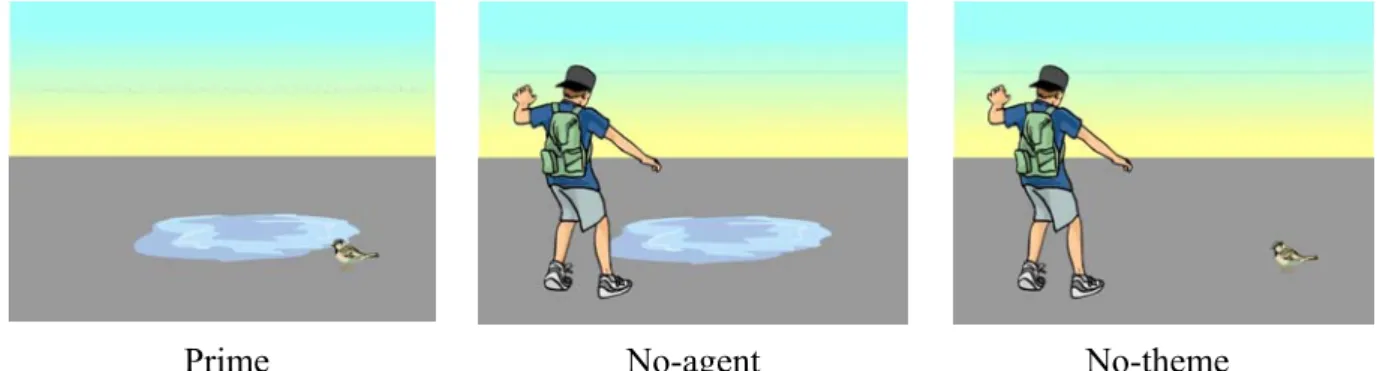
Prime No-agent No-theme
Fig. 2.1. An example of scenes corresponding to the target ‘drink’ in Altmann, Charles & Gennari’s (2005) study.
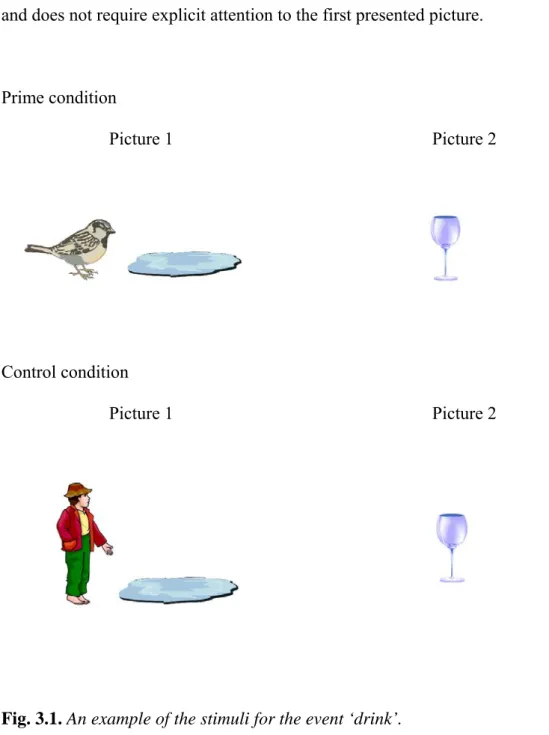
The three scenes accompanying, for example, the target word ‘drink’ are shown in figure 2.1. The ‘prime’ condition consisted of a scene comprising a bird and a puddle (priming might occur in this case because the combination of the bird and the puddle affords a drinking event); the ‘no-agent’ condition was a scene of a boy and a puddle (‘no-agent’ because there was nothing in the scene that was likely to drink from the puddle); and finally, the ‘no-theme’ condition,
comprising the boy and the bird (‘no-theme’ because there was nothing to drink from). It was predicted that the combination of the bird and the puddle in the prime condition would speed responses to the target ‘drink’, and there would be less facilitation when the puddle was presented with the boy (the ‘no-agent’ condition) or when the boy was presented with the bird (the ‘no-theme’ condition).
The authors’ predictions held, and participants were significantly faster to respond when shown the scene with the bird and the puddle, compared to when the bird was shown without the puddle, or the puddle was shown without the bird. In this case, it was only the combination of the bird and puddle which
world experiments, these findings indicate the overlap of representations
engendered by the visual information in the scenes, and representations activated by the linguistic information conveyed by the target verbs.
Although the interaction of vision and language is clear here, the
mechanisms which allow such interplay are less apparent. Are these event-based representations activated within exposure durations similar to that of the time course of gist abstraction, and do these priming effects merely arise from strategic, rather than automatic processes, given the long exposure duration of 1750 ms? (see McNamara, 2005). As we know, semantic priming has been observed even in cases where very short exposure durations of 17 ms are used, and participants do not report seeing the prime (Dell’Acqua & Grainger, 1999). Moreover, even when memory for rapidly presented pictures is not stable, conceptual information relating to them is activated (Potter, 1975; 1976).
Experiment 11
In addition to the conditions of ‘prime’, ‘no-agent’ and ‘no-theme’ used in the study conducted by Altmann, Charles and Gennari (2005), the present
experiments used an additional baseline condition, in which experimental items were neither related to the target, nor related to each other. This provided an effective comparison for the other conditions, as no priming should be expected in this case at all. Also, in the other conditions, it may have been that priming was observed from just one experimental item on its own. So, in the example of
1 Experiment 1 was conducted as a partial requirement of the degree of MSc in
Reading, Language and Cognition. Although data for this experiment were collected before the PhD course had begun, they have been included here for the
‘drink’, priming may arise from seeing either the bird on its own, or the puddle on its own. In this baseline condition, however, there is nothing to potentially prime the target word. Figure 2.2 shows an example of the stimuli used in the current experiments for the target word ‘drink’.
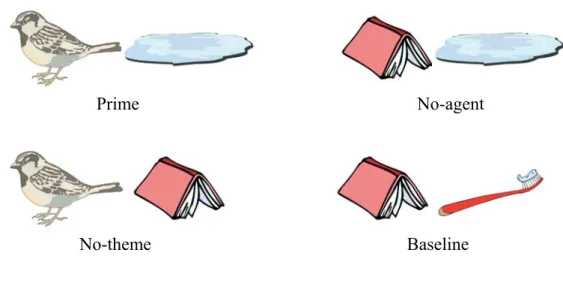
Baseline No-theme
No-agent Prime
Fig. 2.2. Stimuli presented in each condition for the corresponding target word, ‘drink’.
The stimuli in the current experiment were presented sequentially to participants (i.e. the bird first, then the puddle) because of a design issue with the Altmann, Charles and Gennari (2005) study. One reason posited by these authors as to why previously reported effects seemed to disappear with shorter stimulus exposure durations was that each object or entity to be processed was not presented in the centre of participants’ visual fields. For example, when a bird and puddle in a single scene was presented to participants for the event ‘drink’, the bird appeared to the right side of the puddle, requiring an additional saccade and fixation in on order to process all the required information in the scene. This may have resulted in a cost for the processing time of the scene.
In the current experiment, it was predicted that the combination of experimental items would facilitate participants’ responses to a related target verb in lexical decision. As in the previous study, it is likely that less priming would be observed in the ‘no-agent’ and ‘no-theme’ conditions, whereas for the baseline, responses were expected to be slower than those in any of the other conditions. The combining of information is assumed to occur during the presentation of the second picture. Consequently, the duration of this second picture was manipulated (250 ms in Experiment 1; 100 ms in Experiment 2) while keeping the duration of the first display constant (2000 ms).
Method
Participants. 36 participants from the University of York student community
took part in the experiment, and were given a sum of £2 for participating. All were native English speakers and had normal or corrected-to-normal vision.
Materials
Visual stimuli. There were four picture pairs for each of the 28 target words,
which represented the ‘prime’, ‘no-agent’, ‘no-theme’ and ‘baseline’ conditions (see appendix 1). For example, the picture pairs for the target ‘drink’, consisted of a bird and a puddle (the prime), a book and the puddle (‘no-agent’, there is nothing that will drink from the puddle), the bird and the book (‘no-theme’, there is nothing for the bird to drink from), and the book and a toothbrush (baseline, objects completely unrelated both to the target, and each other). Each target word
had its corresponding ‘prime’, ‘no agent’, ‘no theme’ and ‘baseline’ conditions. In addition, there were 112 filler pairs, each accompanied by either filler
nonwords, adjectives or nouns. The items were downloaded from
www.clipart.com, and were shown at a resolution of 640×480 on the 17” monitor of an Apple iMac computer.
Each participant saw all filler items but only one of the four corresponding experimental pairs for each target word. Participants were
assigned to one of four groups, constructed using a Latin Square. For the ‘drink’ example, therefore, the first participant (assigned to group 1) would see the prime picture pair (bird and puddle), the second participant (assigned to group 2) would see the no agent picture pair (book and puddle), and so on. Thus, a total of 28 experimental picture pairs and 112 filler picture pairs were shown to each participant.
Auditory stimuli. In addition to the 28 experimental verbs, 70 nonwords, 28
nouns, and 14 adjectives were used in the current experiments. Target words were matched for length and frequency, and were recorded by a male native English speaker at a sample rate of 44,100 Hz and a 16 bit sound resolution. Participants heard all words through headphones, and responded to them with a button box.
Procedure. Participants were seated at a comfortable distance from the computer
monitor, with the button box placed directly in front of them. The participants were then told that they would see some images appear on the screen and, when they heard a word, they were to make a decision with the button box as to
whether the word was real or not. A right button press was used to indicate ‘yes’ (the word was real), and a left button press was used to indicate a ‘no’ (the word was not real). Participants were also instructed as to the importance of
responding as quickly and accurately as they could.
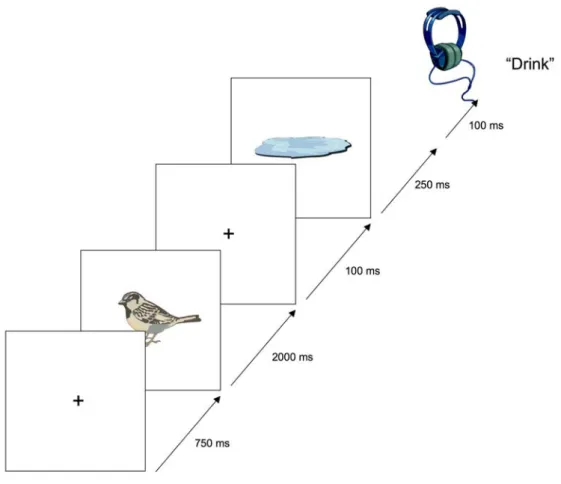
Fig. 2.3. Schematic of the trial procedure for the target ‘drink’.
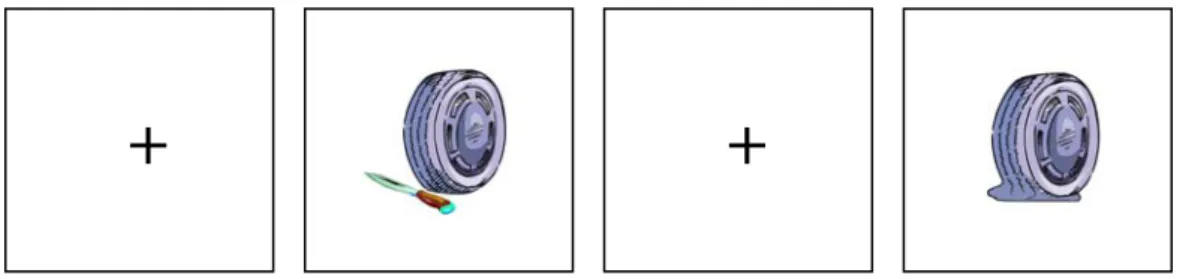
Figure 2.3 shows the procedure of an example trial, where +’s denote fixation crosses. Before each trial, the message ‘Press Key’ was displayed, and to move onto the next trial, either of the buttons on the box could be pressed. Any time this message was shown, participants could take a break if they needed one. On each trial, a fixation cross would appear first, and participants were required to fixate it. Then the two pictures would be shown, separated by another fixation
were to make a decision on. There were 142 trials in total, including six practice trials, and the experiment lasted roughly 20 minutes.
Results
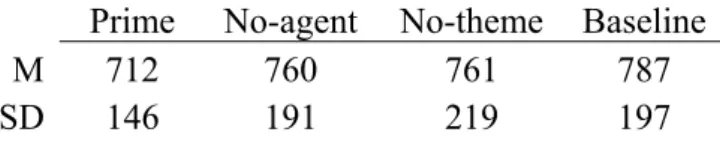
Table 2.1 shows the means and standard deviations for each of the four
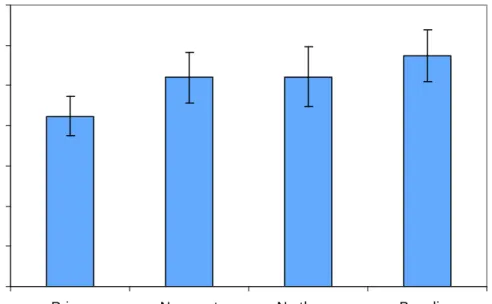
conditions, and figure 2.4 shows that, on average, participants responded fastest in the prime condition.
Prime No-agent No-theme Baseline
M 712 760 761 787
SD 146 191 219 197
Table 2.1. Means and standard deviations for each condition, with second picture exposure durations of 250 ms.
Analyses of response times for this and all subsequent experiments were conducted only on correct responses. A repeated measures ANOVA revealed a
significant main effect of picture pair type (F1(3, 105) = 4.06, p = .009; F22 (3,
81) = 2.191, p = .113). Paired comparisons revealed significant differences between ‘prime’ and ‘baseline’ conditions (F1(35) = -2.85, p = .007; F2 (27) =
-2.32, p = .028); ‘prime’ and ‘no agent’ conditions (F1(35) = -2.54, p = .016; F2(27) = -1.90, p = .068); and ‘prime’ and ‘no theme’ conditions (F1(35) =
-2.44, p = .020; F2(27) = -2.26, p = .032).
2 Where test statistics are numerically labelled, 1 refers to by-subjects analyses
500 550 600 650 700 750 800 850
Prime No-agent No-theme Baseline
Pic Type
RT
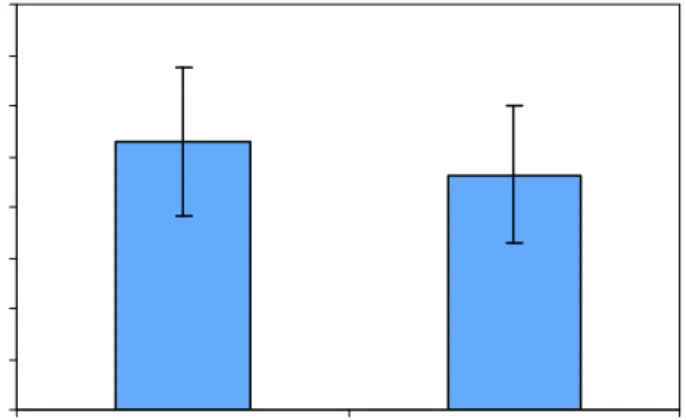
Fig. 2.4. Mean response times at 250 ms, with standard error bars.
Although participants responded faster in the ‘no agent’ than the ‘no theme’ condition, faster in the ‘no theme’ than the ‘baseline’ condition, and faster in the ‘no agent’ than the ‘baseline’ condition, these differences were not significant (all p>.05).
Participants’ accuracy in this and all subsequent experiments was measured in terms of the percentage of experimental trials in which the correct response was chosen (M = 89%, SD = 5%). To assess whether participants’ accuracy improved from the first half to the second half of trials, a one-way repeated measures ANOVA was conducted with a single factor of trial split (either the first or the second half). There was no difference in participants’ average number of correct responses between the first and second half of the experiment (p > .05).
In order to asses whether accuracy rates differed between condition, a repeated measures ANOVA was conducted with one factor of picture pair type (prime, no-agent, no-theme, or baseline), with a dependent variable of accuracy (number of correct responses across conditions). There was no main effect of picture pair type, and paired comparisons revealed no significant differences between conditions with respect to accuracy (all p > .05). Adjustments were made for all multiple comparisons using Bonferroni corrections.
Discussion
As predicted, participants were faster to respond in lexical decision when both presented pictures afforded the event denoted by the target word. To use a specific example for the event ‘drink’, faster responses were observed to the auditorially presented target verb “drink”, when it was preceded by pictures of a bird and a puddle, the combination of which affords a drinking event. Less priming was observed when there was no suitable agent to carry out the event (e.g. a bird), no suitable theme with which the event could take place (e.g. a puddle), or unrelated baseline objects were presented (e.g. a book and a toothbrush). On average, response times in the prime condition were significantly faster compared to every other condition.
These results can be interpreted with respect to the abstraction and combining of affordances from visually presented objects and agents. On priming trials, the agent in each case affords carrying out the event, and the theme affords having the event take place. Importantly, this combining of semantic information occurs across both the visual and linguistic modalities.
Continuing with the same example, it is assumed that upon seeing a puddle that has been preceded by a bird, a representation of drinking is generated. This representation overlaps with the representation engendered by the target word ‘drink’, and lexical decision response times to the target are facilitated. This notion of overlapping representations is relevant to a single-code view of
semantic access (Chase and Clark, 1972), and suggests that semantic information can be combined to form composite representations, regardless of the original source of the information (in this case words or pictures).
Although the current data provide a demonstration of combinatorial processes operating within a cross-modal semantic priming paradigm, it is unclear whether these effects can be attributed to automatic processes, or processes requiring strategic control. Faster, more implicit processing of visual stimuli is thought to be elicited at shorter SOAs of between 100-250 ms (Neely, 1991), while longer SOAs of 600-1000 ms are thought to elicit more controlled, strategic processing (Sachs et al., 2008).
With respect to strategic processing, however, an attempt was made to establish whether the number of correct responses participants were making, increased from the first to the second half of the experiment. An improvement in accuracy in the second half of the experiment may have implicated the use of strategies (such as mnemonics, see Corbett, 1977; Neisser and Kerr, 1973; and chapter 6 for more discussion) to complete the task. Although in the current experiment effects of improvement were not found, the same accuracy analyses will be conducted in the experiments that follow.
For now, The SOA in the following experiment is to be reduced in an attempt to establish the automaticity (or lack thereof) of the effects reported thus far.
Experiment 2
This experiment is essentially the same as Experiment 1, except that second picture exposure durations were shortened from 250 to 100 ms.
Method
Participants. 48 participants from the University of York student community
took part in the experiment, and each person was given £2 or course credit for participating. As with experiment 1, all were native English speakers and had normal or corrected-to-normal vision.
Materials. The same materials used in experiment 1 were used for experiment 2.
Design. The same design as experiment 1 was used for experiment 2.
Procedure. The procedure was also the same as in experiment 1, except for
Results
Table 2.2 shows the means and standard deviations for each of the four
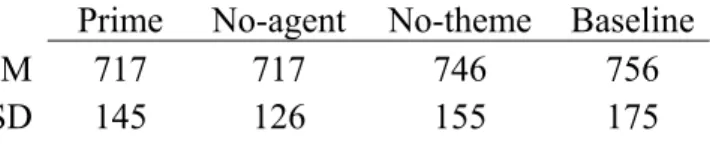
conditions with second picture exposure durations of 100 ms. Figure 2.5 shows the average response times for each condition.
Prime No-agent No-theme Baseline
M 717 717 746 756
SD 145 126 155 175
Table 2.2. Means and standard deviations for each condition, with second picture exposure durations of 100 ms.
Mauchly’s test revealed the assumption of sphericity had been violated (χ²(5) = 23.83, p < .001), so the following test was corrected using Greenhouse-Geisser estimates of sphericity. A repeated measures ANOVA revealed no significant main effect of picture type (F1(2.34, 110.03) = 1.99, p = .134; F2(3, 81) = 2.594,
600 650 700 750 800
Prime No-agent No-theme Baseline
Pic Type
Fig. 2.5. Mean response times at 100 ms, with standard error bars.
Participants did not respond any slower or faster as a function of picture type. Paired comparisons revealed no significant differences in response times
between the conditions of ‘prime’ and ‘baseline’, ‘prime’ and ‘no agent’, ‘prime’ and ‘no theme’, ‘no theme’ and ‘no agent’, ‘no theme’ and ‘baseline’, and
finally, ‘no agent’ and ‘baseline’ (all p > .0.5).
Participants’ responses were, on average, very accurate (M = 90%, SD = 4%), and there was no difference in accuracy from the first to the second half of the experiment (p > .05). In order to establish the effect of these conditions on accuracy rates, a repeated measures ANOVA was conducted with one factor of picture pair type (prime, no-agent, no-theme, or baseline), with a dependent variable of accuracy (number of correct responses across conditions). There were
no differences between conditions with respect to accuracy (all p > .05). Adjustments were made for all multiple comparisons using Bonferroni corrections.
General discussion
In experiment 1, participants’ average response times to targets were significantly faster in the prime condition (where, for example, they might receive the bird and puddle items for the first and second pictures, respectively) compared to every other condition. In addition, there was a significant difference between average response times to prime and baseline items. When the exposure duration of second picture items was reduced from 250 to 100 ms in experiment 2, there were no significant differences in participants’ average response times between any conditions.
The significant differences between the prime and all other conditions at 250 ms suggest that priming was not induced purely by one experimental item on its own, but by the combination of both. For example, for the target word ‘drink’, participants responded significantly faster when the bird was shown with the puddle (the ‘prime’ condition), than when either the bird was shown without the puddle (the ‘no-theme’ condition), or the puddle was shown without the bird (the ‘no-agent’ condition).
The results for experiment 2 suggest that at shorter exposure durations, there may not be enough time for participants to construct event representations from available item affordances. The nature of these experiments are such that any facilitation in responses to the target can only take effect once the
affordances of items have been successfully combined. Therefore, as the event representation in this case can be thought of as a composite of combined item affordances, the additional time needed in these experiments for facilitation to the target word is a reflection of the additional information that needs to be combined.
There are three major implications of these results. Firstly, that these activated representations were rich enough to contain event-based information; secondly, that these combinatorial processes are likely to require more time to operate than those of gist abstraction; and thirdly, that semantic information is smoothly integrated from one picture to another, and is not simply replaced.
To take the first implication, these results tell us something of the nature of these activated representations in that they appear to code event-based
information (the types of events a given item can engage in) along with commonly activated semantic features of the item(s) in question. Functional interactions between objects and their facilitation of task-dependent targets have been established before (e.g. Green & Hummel, 2006), but what these current experiments indicate is that representations can be activated based on the types of interaction afforded by the combination of two semantically unrelated items. For example, a bird and a puddle are not semantically related, but the affordances of each are combined only through the event that links them (drinking).
If one is to assume that recognition of these sequentially presented objects is necessary for these combinatorial processes to operate, then it is relevant that the processing requirements and time-course of gist abstraction appear to be different from those of object recognition. Loschky et al. (2007) argues that information abstracted in the form of gist is associated with holistic,
low-level properties as apposed to information pertaining to the recognition of the individual objects comprising a scene. Abstracting meaning in terms of object type is more effortful than abstracting meaning in the form of gist (Dobel, 2007) and studies of gist abstraction emphasise the use of global spatial cues (such as layout of items) to establish the ‘identity’ of visual scenes (Henderson & Ferreira, 2004). Such cues are not available in the current set of experiments, and an ‘identity’ may be more difficult to attach to two objects linked only by the nature of their possible interactions with one another. In the current set of experiments, in order for the affordances of objects to be combined, the objects have to be recognised first. It is unlikely that without this crucial step these effects are unable to operate on our lexical decision on the target word.
The last implication is that semantic information from one picture does not simply replace that of the previous one but they are combined via event-based knowledge. Indeed, our experience of the visual world is not one of discrete, self-contained packets of information, but of fluid, seamless comprehension of our surroundings (Irwin, 1991). However, studies of
information integration from one saccadic eye movement to the next suggest that although we rapidly combine separate sources of visual information, only a few representations are utilised at any one time, before being replaced by a different set of representations (Irwin, 1991). Of course, if semantic information
pertaining to a previously seen item is replaced when a second saccade is executed, it is unclear how the combining of semantic information between objects in our visual environment would occur in the first place.
Experiments serving to both establish and support semantic combinatorial effects in the linguistic domain are numerous (e.g. Tabossi, 1988; Glenberg &
Robertson, 2000; Andrews et al., 1993; Seidenberg et al., 1982; Potter & Faulconer, 1979). However, the current cross-modal paradigm may be an inconclusive demonstration of a similar effect operating in the visual domain. These experiments demonstrate priming based on overlapping representations constructed from the semantics inherent in the presented pictures and the semantics engendered by the target verb. In order to establish whether the combinatorial effects demonstrated in linguistic paradigms operate to the same degree in the visual domain, reliance on the LDT must be altered in favour of a purely visual task. Given that combinatorial effects have been established in the linguistic domain, the operation of these effects in a paradigm that utilises only visual information would indicate that these effects are not induced by linguistic stimuli alone, but are elicited to the same extent by visual objects. This is to be a focus of the experiments presented in the next chapter. These subsequent
experiments shall also provide an investigation of the causal nature of these relationships between presented items.
Chapter 3
The present chapter describes three experiments that build upon the findings presented in the previous chapter. It begins with an overview of those findings and their theoretical implications, and follows with the motivation for the new experiments. A novel paradigm will be presented and discussed that explores combinatory semantic processing through the priming of visual object
recognition using a non-linguistic task.
In experiment 1, participants were faster to respond to the word ‘drink’ in a lexical decision task if it had been preceded by a picture of a bird (the agent) and then a picture of a puddle (the theme). Crucially, if either the agent was shown without the theme or the theme was shown without the agent, response times were much slower. The verb ‘drink’ in this case is presumed to be primed by the combination of affordances derived from the bird and the puddle. The bird affords drinking from the puddle and the puddle affords being drunk from. These combined affordances are used to generate an event representation that
corresponds to these abstracted affordances. This event representation overlaps with the conceptual structure that would ordinarily be activated on hearing the target ‘drink’. Priming in this case arises from some information pertaining to drinking becoming pre-activated from the prior generated event representation. This priming from the constructed event representation then contributes to the observed facilitation of response times to the verb.
These findings offer support for the notion of a visual combinatorial process, and expand upon findings of a similar nature in the linguistic domain (e.g. Tabossi (1988), Potter & Faulconer (1979), see the ‘priming effects’
subheading in the introduction for discussion). These studies reveal the importance of context in language processing and provide examples of the modulation of response times as a function of the amount of information that can be combined in sentential events. A similar process operating on both linguistic and visual stimuli implicates a mechanism common to both domains. The combining of information to form composite representations thus becomes a cognitive function fundamental to our comprehension of our surroundings, regardless of the source from which it comes.
There are, however, two unresolved issues from experiments 1 and 2 that provide part of the motivation for the current experiment. First, these findings tell us nothing of the nature of the representations activated: Are the
event-representations coded in such a way as to include the specific agents and themes seen by the participant (thereby encoding the specific events afforded by those specific items), or are they more abstract, coded in terms of a general instance of the same event (that may be more independent of the specific items)? Second, the use of the lexical decision task is problematic for an account of a
combinatorial effect arising purely from visual perception alone. Establishing the occurrence of this combinatorial process in the visual domain is essential if it is to be maintained that this effect is an integral part of our processing of the external environment.
In addition to addressing the aforementioned issues concerning abstract representation and the use of language, the current paradigm allows deeper investigation of the causal structure of an event, and what the representations
likely contain in terms of causal information. Causal structure can be thought of in this case as the identifiable segments of a causal chain and how these
segments are linked; more simply, a ‘who did what to whom’ sequence. Each of these points shall be discussed in turn, leading to a rationale for the current experiment that aims to address these issues.
To take the first point, with respect to the nature of the activated
representations there are two accounts of the data for experiment 1. Continuing with the ‘bird-puddle’ example introduced in the previous chapter, participants’ response times to the word ‘drink’ are either speeded because the word matches an activated representation of the bird drinking from the puddle, or because the activated representation concerns a general act of drinking (which could include, for example, drinking from a glass), and it is this that matches the semantics engendered by the word.
Colcombe and Wyer (2002) argue that generalised representations of an event may be activated if that event has been experienced repeatedly. In other words, for any given event, if one has extensive experiential knowledge of it, then the representations activated upon being confronted with it again, are likely to be more abstract. Similarly, Zacks and Tversky (2001) assert that a schema or ‘script’ for a particular event may be created by repeated exposure to that
particular type of event. These abstract representations do not contain
information concerning what or who the participants in a particular event are, where the event takes place, or the amount of time the event uses from its inception to its completion.
A demonstration of the nature of these representations with respect to their level of generality could proceed as follows: If, in experiment 1,
participants were constructing abstract representations of the intended events, then an appropriate test for this would be to have participants make judgements