Visual Security Policy for the Web
Terri Oda and Anil Somayaji
Carleton Computer Security Laboratory
Ottawa, Ontario, Canada
{terri, soma}@ccsl.carleton.ca
Abstract
Many web security vulnerabilities allow parts of a page to interact when they should be isolated. Such vulnerabil-ities can be mitigated by implementing protection bound-aries between web page elements. Several methods ex-ist for creating such boundaries, but exex-isting methods re-quire relatively sophisticated knowledge of web technolo-gies. To make protection mechanisms available to a wider audience, we propose a simple web page security pol-icy language, ViSP, modelled on mechanisms for specify-ing page layout. Here we characterise ViSP and describe a simple Firefox-based prototype that allows interactive, graphical specification of per-page security policies. We also show how these tools can be used to protect against cross-site scripting (XSS) attacks on common web appli-cations.
1
Introduction
The web is currently the largest exploit vector in com-puter security: Over 80% of comcom-puter vulnerabilities in-volve the web [3]. Many web-based exploits make use of JavaScript’s ability to do intra-page modifications; as a re-sult, one popular strategy for mitigating vulnerabilities is to isolate portions of a web page from each other. Many researchers have recognized the security implications of this situation and have developed encapsulation mecha-nisms for web mashups [8, 16, 5, 1]. Given the potential vulnerabilities in common included content such as adver-tisements, search boxes, and embedded video [13], it is
arguable that many, perhaps evenmostweb pages should
be using sub-page isolation mechanisms to mitigate XSS vulnerabilities. Existing approaches, however, require a significant amount of programming expertise to be used effectively—something not possessed by the artistic pro-fessionals and amateurs that create many websites [12].
What is needed, then, are isolation mechanisms that can be understood and used by all web page creators. These mechanisms cannot require knowledge of program-ming language conventions; instead, they need to be in a language they already understand. Here we argue that the language of page layout provides the necessary vo-cabulary for specifying protection boundaries within web
pages. Layout-based protection boundaries can be speci-fied and enforced in terms of the bounding boxes used to visually separate web page elements. Layout-based poli-cies can be specified without reference to the code under-lying a page. They can be stored separately, much as a style sheet. And, they can be updated and manipulated using tools that are no more complex than those used to create and maintain web pages, all while providing pro-tection against many forms of cross-site scripting attacks, the most pervasive category of security vulnerabilities on the Internet today [4].
To support these claims, we have developed ViSP (Vi-sual Security Policy), a simple XML-based policy lan-guage for specifying protection boundaries and allowed interactions that is modelled on standard ways of specify-ing web page layout. Because ViSP directly maps to page layout conventions, developers can quickly specify which page elements should be isolated and which should be al-lowed to interact simply by graphically selecting those el-ements and selecting their policies. ViSP then can be en-forced by rewriting a page to use other, standard isolation mechanisms; alternately, web browsers can be modified to enforce ViSP directly.
To show the utility of ViSP, we explain how a simple ViSP policy could mitigate an intra-page XSS attack by an advertiser on a site. (Note this attack scenario is not addressed by many existing XSS mitigation mechanisms because they must whitelist ad servers.) We also present a remarkably simple but effective policy for Facebook, a (very) popular social networking site that has been shown to have a number of XSS vulnerabilities in the past. For future work we plan to test ViSP on a wider variety of websites and to evaluate ViSP’s usability through lab stud-ies with amateur web developers.
The rest of this paper proceeds as follows.§2 describes
the design of the ViSP policy language. §3 presents the
details of ViSP’s syntax. §4 describes a simple attack and
how ViSP can mitigate it; §5 presents a ViSP policy for
Facebook. §6 presents our prototype implementation of
ViSP and discusses alternative implementation strategies. §7 discusses our experiences with ViSP, its limitations,
2
Visual Security Policy (ViSP)
Visual Security Policy (ViSP) is an XML-based secu-rity policy language whose construction is based upon the layout of the visual elements of a page. ViSP pro-vides a way of specifying compartmentalization of an HTML page in terms of drawing visual boxes on the lay-out. Existing web mashups work has concentrated on the HTML representation of the page rather than the layout and achieved good results. It is our hope that concentrat-ing on the layout will yield usability improvements.
There are a few reasons to believe this may be true. First, the visual representation of the page is accessible to more people. While many people have little to no un-derstanding of the underlying HTML, they are typically familiar with the appearance and behaviours of a page.
Second, designers are used to separating the page tent from the page layout and style: the content is con-tained within HTML and the style is largely concon-tained within the associated Cascading Style Sheets (CSS). The separation between content and style is often cited as something which will make long-term maintenance of the page easier. Providing security as something akin to an-other type of stylesheet may yield similar benefits.
It may seem initially that layout and security have little to do with one another. However the appearance of a page is highly correlated with the way in which it is intended to be used and understood. Usability of web pages is closely linked to both convention and design reuse. Steve Krug
states that his first law of[web]usability is, “Don’t make
me think” [10]. The idea is that to be usable, pages should be as self-evident as possible. There are a variety of ways to make the page more self-evident, but many of them in-volve using familiar buttons, navigation, and other design patterns. The idea of obviousness equating with usabil-ity is borne up by user studies conducted by Nielsen et al. [11], which suggest that non-standard controls are among the worst flaws that can be found in web design.
Usability is centred around encouraging the user to be-have in ways that the system expects; security is about forcing users of the system to behave in correct ways. So if the layout of a page is already designed to help a user behave in a given way, using the same layout to add secu-rity requirements to the page allows people to more easily extend existing models to require secure behaviours.
One final benefit to using the visual parts of a page to define security is that doing so makes the security of a page much less likely to be in conflict with its appearance. This is in some ways the opposite to the previous com-ment: while design shapes the use of the page and can be used to help shape security, the opposite is also true in that security concerns can result in design modifica-tions. Working visually allows the system to help provide some shortcuts to make it easier to go from a pre-existing design to a more secure version of the same design. As
programmers, it may be tempting to ignore minor design flaws as irrelevant. But given the existing barriers towards improving web security, and given that the appearance of the page can directly affect usability, it can be surprisingly important to get appearances just right.
3
The ViSP Language
While the idea of ViSP is that policies can be repre-sented visually, for programmatic evaluation and manipu-lation, it is useful to also have an underlying textual repre-sentation of the policy. As such, ViSP is a simple, XML-based language inspired by standard HTML layout.
A visual policy only needs to refer to the larger, visi-ble regions within a page. HTML already has a tag for
referring to such regions, the <div> tag. In our
ini-tial experiments we attempted to use simplification of the
page which included only the HTML<div>tags.
Un-fortunately, this proved to be insufficiently robust since it
relied upon the page being designed to use<div>tags
and made it impossible to apply policy to some smaller re-gions. This also didn’t allow us a clear separation between policy and the page itself.
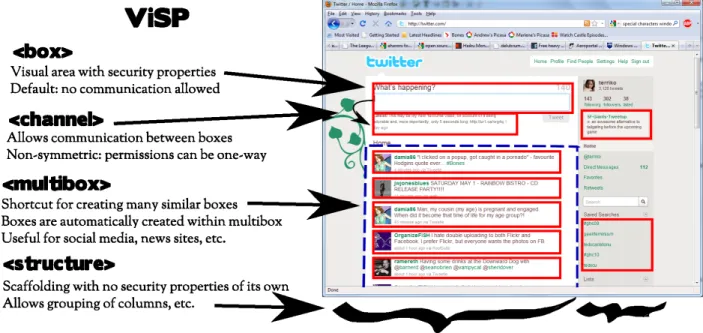
To address these problems, the ViSP language uses tags analogous to, but different from standard HTML tags. The focus of the ViSP language is to only describe the regions that are of interest security-wise, the necessary structure to explain the visual layout of these regions, and the basic communications channels between them. We also wanted to make it easy to describe regions with multiple pieces of user-generated content that all should be separated from each other. These design goals resulted in four tags from which a basic visual policy can be constructed as a sim-plification of the original HTML page. Figure 1 gives a quick visual overview of ViSP. The four tags are as fol-lows:
box The box tag defines a region of interest within the
HTML, one for which we wish to set security prop-erties and possibly communications channels. These are shown using solid boxes.
structure The structure tag defines layout which does not have security properties of its own but which is nec-essary to give the layout of defined boxes. These are not shown on the diagrams.
channel The channel tag, placed within a box, defines a single communication channel from another box to the box where it is defined. This enables creation of a directed graph of communications channels. Note that the communications channels are not symmetric: the menu of a page might be allowed to change the content, while the content is unable to modify the menu. These are shown using a black arrow.
multibox The multibox tag is a shortcut for a common construct within HTML pages. Rather than being a box itself, the multibox indicates that all sub-boxes of this HTML element should be listed as separate
Figure 1: Overview of ViSP
boxes. These are shown using dashed boxes, and the sub boxes generated from a multibox will be shown as solid boxes. The boxes created within a multi-box are by default fully isolated, just like any other newly-created box.
4
A Simple Attack
To demonstrate the use of visual policies, consider an example based upon a real site and a hypothetical exploit. CNET provides reviews for a variety of consumer elec-tronics, including phones. Like many other companies, CNET runs advertisements on sites that review their prod-ucts. This is a good place for targeted advertisements, as those looking at reviews are often planning on buy-ing a similar product. Figure 2 shows advertisements on CNET’s review section. The review is for the Palm Pre, and one of the advertisements being displayed is for a competing smartphone, the Blackberry Curve.
On a review site, like in a traditional print magazine, the advertisements are separated from the review text us-ing layout cues and text such as “paid advertisus-ing sec-tion.” While such cues distinguish advertisements from text visually, advertisements on a web page may include JavaScript code that could change other parts of the page, including the contents of a competitors review. Although there is no evidence of wrongdoing on the part of the com-panies displayed in this example, it is not unheard for for companies to use underhanded tactics to improve their re-views [14].
For this example, suppose that a malicious advertiser wishes to alter the final rating given to the phone. Sample JavaScript which could do this is shown in Listing A. Listing A: JavaScript code used to change the CNET
rat-Figure 2: Original CNET page.
ing to a 1 or Very Poor rating.
/ / g r a b t h e r a t i n g s e c t i o n
edStars = document.getElementById(” e d S t a r s ”) ; / / F i n d t h e s p a n w i t h t h e n u m e r i c a l r a t i n g / / and c h a n g e i t
spans = edStars.getElementsByTagName(” s p a n ”) ; f o r (i = 0 ; i< spans.length; ++i) { i f (spans[i] .className = ” r a t i n g ”) { spans[i] .innerHTML = 1 . 0 ; } } / / u p d a t e t h e i n t e r i o r t e x t
edStars.innerHTML = edStars.innerHTML.replace( /Very Good/ig, ” Very P o o r ”) ;
/ / u p d a t e t h e a c t u a l s t a r s d i s p l a y CSS
links = edStars.getElementsByTagName(” a ”) ;
links[ 0 ] .className = ” e d R a t e 1 t o o l T i p E l e m e n t ”;
Figure 3: CNET page with visual policy.
the review content. They are visually distinct, but we need to compartmentalize them to match the page’s layout.
Figure 3 gives a simple sample policy that does exactly that. The advertising features are enclosed in boxes which are red, and the review parts of the page are enclosed in green boxes. This colouring is just for the purpose of discussing the boxes—there need not be any functional difference in the encapsulation. The corresponding XML version of this same policy is given in Listing B.
Listing B: XML Visual Policy for CNET Review <s t r u c t u r e a l t =” Whole p a g e ”> <box i d =” d i v : 1 ” a l t =”Ad B a n n e r ” /> <s t r u c t u r e a l t =” Columns ”> <box i d =” d i v : 2 ” a l t =” S p o n s o r e d l e f t ” /> <s t r u c t u r e a l t =” Column 2 ”> <box i d =” d i v : c o n t e n t B o d y ” a l t =” Review ”> <box i d =” d i v : e d S t a r s ” a l t =” E d i t o r ∗s ”/> <box i d =” d i v : u s e r S t a r s ” a l t =” U s e r ∗s ”/> </ box> </ s t r u c t u r e> <s t r u c t u r e a l t =” Column 3 ”> <box i d =” d i v : 3 ” a l t =” S p o n s o r e d r i g h t ” /> <box i d =” d i v : 4 ” a l t =” A d v e r t i s i n g box ” /> </ s t r u c t u r e> </ s t r u c t u r e> </ s t r u c t u r e>
For the purposes of this example, assume that the policy setting for each box allows absolutely no communication in or out. Given that there is no need for the advertise-ments to modify the review, and plenty of reasons that it would be inappropriate for them to do so, this is a rea-sonable policy setting. (Although it is worth noting that the advertisement server may prefer to have at least read access to the content of the page to better target advertise-ments, let us assume a more conservative policy for the sake of simplicity.)
The attack code, as shown in Listing A, needed to gain access to the tag with the id “edStars.” However, in Fig-ure 3 the review stars are contained within a visual policy box, meaning they are protected from other parts of the page. Similarly, the advertisement where the attack code
Figure 4: Homepage for a logged-in Facebook user
is concealed has its own box, so the attack code is cut off from all of the page, not just the parts which have their own visual policy boxes. Thus, the attack will fail: the advertisement can modify only its own banner.
Note that common mitigation strategies such as tainting whitelist advertisement servers [15, 6, 9]; as a result, they cannot defend against this attack.
5
ViSP for Facebook
In the US, Facebook now accounts for 25% of total page views on the Internet [7]. It undeniably has a huge impact upon the web, and it is important that any web security solution be able to deal with Facebook or pages based upon the popular look and feel of the site. Figure 4
shows the home page of a logged in user on Facebook1.
The page is very busy, including status updates, a chat box (or chat boxes if you are talking to multiple users), a sponsored advertisement on the right hand side, menus at top, bottom and sides of the page, and a variety of other in-formation displayed. At first glance, it may appear daunt-ing. However, thanks to the multibox structure, we can easily group the centre column’s status messages rather than having to manually set policy for hundreds of status updates. We might additionally be able to do this with the left and right columns for some pages. As such, ViSP for this part of Facebook can be something like what is shown in Figure 5, with the corresponding XML given in Listing C.
Listing C: ViSP XML for Facebook home page <box i d =” d i v : f b m e n u b a r ” a l t =” Top menu ” /> <s t r u c t u r e> <m u l t i b o x i d =” d i v : h o m e s t r e a m ” a l t =” S t a t u s u p d a t e s ” b o x s p e c =” d i v : c l a s s : G e n e r i c S t o r y ” /> <box i d =” d i v : 8 3 ” a l t =” S p o n s o r e d box ” /> </ s t r u c t u r e> <box i d =” d i v : p r e s e n c e b a r ” a l t =” b o t t o m menu ”> <box i d =” d i v : c h a t c o n v ”
1This does not reflect the most recent design. Facebook changes their interface regularly but many redesigns share similar elements.
Figure 5: ViSP for Facebook
a l t =” C h a t c o n v e r s a t i o n ” /> </ box>
This is not the only possible ViSP for Facebook – one might want to add additional protections for other menus or content displayed in the left and right columns, or one might want to relax some of these restrictions, depending upon Facebook’s own goals and those of its users. How-ever, the example shows that even with a fairly complex site, the policy can be surprisingly small and manageable.
6
Implementing ViSP
A ViSP policy creation tool has been implemented in JavaScript as a Firefox 3 add-on. Once installed, it adds a menu option allowing the user to enter a policy-creation mode. In this mode, moving the mouse over the page highlights page elements, one at a time, when the mouse is over them. The current tool does so by showing a yellow border around the page element. The user then mouses over the desired page element and clicks to add it to the vi-sual security policy. Once added to the policy, the border around that element becomes red and permanent, staying even when the mouse exits the area.
The other necessary ViSP tool is one which will han-dle enforcement of policies. But at what level should we translate and enforce the policy? There are several pos-sible locations. The web developer might take the ViSP policy for the page and use some tool to create a new page which includes the compartmentalization described within the policy. Similarly, a script on the web server or on a proxy server could translate the pages before they are delivered to the user. Finally, the user’s web browser itself might be the final arbiter of any ViSP data. This method has the advantage that more appearance data can be used, but the disadvantage that it requires modifications to browsers while the others can use current technologies. The prototype ViSP policy enforcement tool currently takes as input the page and the policy, and produces a new
page which usesiframesto provide basic
encapsula-tion. The script used for enforcement could be used by the web developer, or put inline on the web server or a proxy so that it can be used directly on existing web ap-plications that use more dynamic code. The use of iframes currently results in some minor irregularities, but it is our hope that future versions can be more faithful renditions of the original page. Full implementation of ViSP, how-ever, will likely require deep browser integration as ViSP is not lexically scoped—enforcement engines must take into account the non-local interactions of HTML, CSS, and JavaScript elements.
7
Discussion
It is important to note that ViSP has a number of lim-itations, even within the focus of isolating regions of a web page from each other. ViSP has no support for iso-lating code or data that are not visually represented, e.g., code in page headers. It cannot specify partial access be-tween regions, say by originating domain or content type. Also, because our current prototype enforcement engine
uses standardiframetags, it produces clear visual
arti-facts. It may be easier to fix this problem when we can use new language constructs in HTML5 such as their seam-less<sandbox>attribute [2] .
We created basic ViSP policies for 15 web sites, specif-ically targeting blogs and other smaller sites that are often run by amateurs for their own personal interest. We exam-ined a larger number of sites ( 200) to determine whether they were likely to follow similar patterns and determine the viability of ViSP before the language was fully set.
One surprising finding is that surprisingly few of the pages we examined required communication channels of any sort. Many pages use cut-and-paste code inserts: ad-vertisements, Twitter feeds, Flickr badges, etc. that are designed so that they can be inserted anywhere. These can be isolated without incident. What is perhaps more surprising is that menus and media inserts followed sim-ilar patterns. Although there is no reason for code to be inserted only near where it is used, the reality is that common programming style choices result in easily-encapsulated code. There were a few exceptions where top-level JavaScript needed access to boxes within the page (such as for advertisements), but for the most part the pages could be divided up with little communication necessary between page elements.
This tendency towards easy encapsulation may be a side effect of choosing sites which are likely to be created by amateurs. Perhaps it is not too surprising that these sites use only a smaller, simpler subset of the capabilities of the web. This suggests that ViSP is indeed viable for these smaller, amateur sites which it is designed to pro-tect. It is less clear at this stage as to whether ViSP can be helpful with more complex sites, and whether complex sites are more rare than one might expect.
sim-plicity in order to produce a policy language that directly maps to visually representable boundaries. This is in the hope that such simplicity will make ViSP easier to learn and use regardless of background. We are currently in the process of setting up user tests to validate this hypothesis; informal user testing has already yielded positive results.
Although here we created a separate language for ViSP in order to reduce pages to a set of security-relevant boxes, future work may focus on using existing CSS and HTML constructs more directly. This would allow page creators to produce a ”security stylesheet” using CSS syntax to specify security constraints like visual styles. The hope is that this will be easier to integrate into existing tools and take advantage of existing knowledge, as well as make it possible to integrate such a security system into HTML5. We do not see ViSP as a replacement for other ap-proaches to implementing protection boundaries inside web pages; rather, we see ViSP as an approach that is “good enough” for many web pages. More importantly, we believe something like ViSP is necessary for most web pages in order to limit the impact of XSS attacks and ma-licious third-party inclusions. ViSP, then, is a small step towards security mechanisms that regular web designers will use because they give them clear benefits while im-posing few costs.
8
Conclusions
While methods already exist to create more security-hardened pages using protection boundaries, these meth-ods are designed with programmers in mind and often require a significant amount of learning, effort and time to implement on an existing website. As such, it is hard for these otherwise good solutions to gain traction among web page creators and maintainers who may not have pro-gramming skills or the time necessary to learn and imple-ment security enhanceimple-ments. ViSP deals with this prob-lem by providing a simpler method for creating web se-curity policies, one which is based upon the visual lay-out of a page. Because it is based in the visual realm in which many designers and users think, it is much easier to understand at a glance and is easier to specify, all while still protecting against a wide variety of XSS and mali-cious inclusion attacks. ViSP is thus intended to be a so-lution which better meets the needs of those who create and maintain web pages.
Acknowledgements: This work was supported by NSERC through ISSNet (www.issnet.ca) and the Discov-ery grant program. We also thank CCSL members who have provided ongoing feedback for this research.
References
[1] google-caja: A source-to-source translator for
se-curing javascript-based web content, 2009. http:
//code.google.com/p/google-caja/.
[2] HTML 5: A vocabulary and associated APIs
for HTML and XHTML. Technical Report
1.2852, World Wide Web Consortium (W3C),
Aug 2009. http://www.w3.org/TR/2009/
WD-html5-20090825/.
[3] Web application security trends report – Q3-Q4,
2009.Cenzic Inc., 2009.
[4] S. Christey and R. A. Martin. Vulnerability type dis-tributions in CVE. Technical Report 1.1, MITRE Corporation, May 22 2007.
[5] F. De Keukelaere, S. Bhola, M. Steiner, S. Chari,
and S. Yoshihama. Smash: Secure cross-domain
mashups on unmodified browsers. Technical report, IBM Research, Tokyo Research Laboratory, 2007. [6] M. Dhawan and V. Ganapathy. Analyzing
informa-tion flow in javascript-based browser extensions. In Proc. of the 25th Annual Computer Security Appli-cations Conference (ACSAC’09), Honolulu, Hawaii, Dec 2009.
[7] B. Heater. Facebook accounts for 25 percent of page
views.PCMag, 2009.
[8] J. Howell, C. Jackson, H. J. Wang, and X. Fan. MashupOS: Operating system abstractions for client
mashups. InWorkshop on Hot Topics in Operating
Systems, 2007.
[9] InformAction. Noscript. http://noscript.
net/.
[10] S. Krug. Don’t Make Me Think: A Common Sense
Approach to Web Usability. New Riders Press, 2nd edition, Aug 2005.
[11] J. Nielsen and H. Loranger.Prioritizing Web
Usabil-ity. New Riders Press, Apr 2006.
[12] T. Oda and A. Somayaji. No web site left behind: Are we making web security only for the elite? In Web 2.0 Security and Privacy (W2SP), May 20 2010. [13] T. Oda, A. Somayaji, and T. White. Content provider
conflict on the modern web. Symposium on
Infor-mation Assurance (New York State Cyber Security Conference), 2008.
[14] A. Parsa. Fresh evidence suggests belkin’s amazon sales rep was engaged in more unethical activities. The Daily Background, Jan 2009. http://www.
thedailybackground.com/2009/01/19/.
[15] P. Vogt, F. Nentwich, N. Jovanovic, C. Kruegel, E. Kirda, and G. Vigna. Cross site scripting pre-vention with dynamic data tainting and static
analy-sis. In14th Annual Network and Distributed System
Security Symposium (NDSS 2007), San Diego, CA, Feb 2007.
[16] H. J. Wang, X. Fan, J. Howell, and C. Jackson. Protection and communication abstractions for web
browsers in MashupOS. In21st ACM Symposium on