THE ASEAN ECONOMIC COMMUNITY: HOW SMEs COULD
EXPLOIT LOCAL VALUE TO COMPETE?
Sakda Siriphattrasophon*
Abstract
The development of collaboration among ASEAN country members towards the ASEAN Economic Community (AEC) at the end of 2015 has an impact on various fields of business, with direct effects on ASEAN countries’ economic structure and condition. During the full development of the AEC, small and medium enterprises (SMEs), despite a number of limitations in doing business, need to accelerate their acquisition of knowledge related to various aspects of the AEC and to prepare for arriving opportunities and increasing competitiveness. This paper, therefore, aims at describing the concept of regional economic integration, clarifying the past and present status of AEC development, and analyzing local SMEs performance and their competitiveness at the regional level. Furthermore, a number of benefits and opportunities of being the AEC have been identified. In addition, a number of ways that SMEs can compete in the region by exploiting the local value have been proposed. To strengthen competitive capacity, SMEs should think big (think all of ASEAN) and exploit their local knowledge by cooperating with other members in the region while remaining competitive. As discussed, following this strategy will effectively leading them to become a successful part of the AEC. Keywords:ASEAN Economic Community, SMEs, Local value, Competitiveness.
*Associate Professor Dr. Sakda Siriphattrasophon obtains a Ph.D. in Development Administration from National Institute of Development Administration, Thailand. Currently, he is working as President of the Association of Researchers of Thailand. This article was accepted when he was a lecturer in the College of Graduate Study in Management, Khon Kaen University, Thailand.
INTRODUCTION
It is widely known that advanced com-munication, transportation, and information technology have played a significant role in forming up modern commercialization and ini-tiating wider cross-border investments. Mod-ern commercialization, therefore, has led to international relations in terms of economy, politics, technology and culture that link indi-viduals, communities, business enterprises, and governments. Consequently, this has resulted in an emerging of globalization where free or boundless trade is implemented.
In order to ensure mutual benefits and competitiveness in globalization era, nations are enthusiastic in initiating new collaborations with one another in the same geographic re-gion and this has resulted in a wide expansion of regional economic integration which encou-rages free flow of goods, services, funds, tech-nologies, people, and production factors as well as eliminates tax regulations among mem-ber countries. Thailand, just like the other coun-tries, is also facing challenges of globalization as it has taken up a step in becoming one of the ASEAN Economic Community (AEC). This step will bring new business opportuni-ties to Thailand and hence impact the country’s strategies for managing an international busi-ness.
The ASEAN Economic Community will introduce a new, dynamic business environ-ment within the region. To clarify, this means that business competitors will not be limited to only one country but will include ten ASEAN countries. The markets will be ex-panded and a consumer database will be over 600 million people. Entrepreneurs have more freedom to set up their production bases in any member countries and they, therefore, must
be aware of the challenges and be prepared for the threats that the AEC will bring.
Although the ASEAN Economic Commu-nity seems to mainly profit large enterprises, small and medium enterprises (SMEs) also have their share. According to the International Institute for Trade and Development (ITD) (2014), SMEs is a major mechanism that drives regional economy. SMEs are consid-ered 96 percent of total ASEAN enterprises and generate income of approximate 42 per-cent of the total economic value in the region. Moreover, SMEs also secures 25 percent of the total export value, and 73 percent of em-ployability in the ASEAN economy. The sta-tistics have indicated that Indonesia has the most number of SMEs per 1,000 populations (196.90) followed by Thailand (43.94), Singapore (35.15), Brunei (23.99), and Ma-laysia (22.89).
Some research findings also point out that the ASEAN SMEs tends to value markets within the region more than larger enterprises (compares to the non-AEC member country in Asia, e.g. China). However, the ASEAN SMEs, in general, are still in need of prompt development in order to be equipped for the ‘single market’ after the official launch of the AEC in the year 2015. This paper was there-fore written on a purpose to review relevant literature in the ASEAN region and regional economic integration; theoretical background of international collaborations leading to the ASEAN Economic Community; performance of local SMEs at the regional level; impacts and challenges of AEC on SMEs as well as recommendations for SMEs to exploit local value for effectively doing business in the re-gion.
THEORY OF ECONOMIC INTEGRATION Type of Regional Economic Integration
Regional economic integration is a pro-cess whereby countries in a geographic re-gion cooperate with one another to reduce or eliminate barriers to the international flow of products, people, capital, and technologies. The group is called ‘regional trading bloc’ (Wild & Wild, 2014). The purpose of setting up a regional economic integration is not only promoting international trade and investment but also improving a living standard of people in member countries. Due to the fact that the process of structuring an economic integra-tion can be done faster than pushing naintegra-tions to action on agreements with the World Trade Organization (WTO), countries, therefore, are enthusiastically encouraging international col-laborations in the region and can be divided into five various types (Siriphattrasophon, 2012; Wild & Wild, 2014; Cavusgil et al., 2014).).
1. Free Trade Area (FTA) is a process whereby countries in a geographic region co-operate with one another to eliminate barriers and tariff regulations as well as promote a free flow of goods while operating normal tariff with non-member countries.
2. Customs Union is an arrangement to abolish barriers and tariff among member countries and set up a common external tariff used with non-member countries.
3. Common Market is an expansion of
trade agreements to promote a free flow of capital, labors, and business movement among participating countries.
4. Economic Union is considered the
most advanced type of existing economic in-tegration at the present. It is usually developed
from a common market with additional fea-tures and frameworks on the economy, fi-nance, and society.
5. Political Union is the last type of eco-nomic integration meaning a state that con-solidated nations share the same political and national security policies. As of now, there is no such official political union existed.
When compare the economic integration in ASEAN to the European region (European Union, EU), it shows that what is missing in ASEAN Economic Community is the customs union. The AEC is developed to establish the ASEAN Free Trade Area (AFTA) that aims to achieve the ‘Single Market and Production Base’ structure within the region and promote free flow of products, services, investments, skilled labors, and capital. The AEC will defi-nitely create new business opportunities to some entrepreneurs. However, it will also cause some loss to others depending on a ca-pacity of entrepreneurs themselves (Thamchai & Amornkitwikai, 2012).
Benefits of Economic Integration
Regional economic integration empowers the growth of international trades and indus-tries leading to a better living standard of people. Government earns more income from business taxes resulting in the prosperity of member countries. In general, the benefits of economic integration can be categorized into four main strands (Cavusgil et al., 2014).
1. Expand market size. Due to the abol-ishment of barrier and tariff among member countries in the same economic bloc, it con-sequently results in an expansion of markets. Businesses are no longer limited in domestic level. International trade, instead, has been actively encouraged. Sellers and buyers have
wider choices of both goods and services from member countries at a lower cost. In addi-tion, an ability to pay for imported goods of people will be increased since products price is cheaper.
2. Achieve scale economies and
en-hanced productivity. Direct benefits of mar-ket expansion i.e. ASEAN Free Trade Area (AFTA) and ASEAN Economic Community (AEC) are to increase productivity and scale economies. For example, Thai manufacturers can sell their products more, approximately eight times, as they can make more units. In addition, manufacturers will be profited from tariff abolishment, free flow of goods and a wider choice of quality raw materials produced in member countries at much lower price.
3. Attract direct investment from out-side the bloc. Regional economic integration usually attracts cross-border investments from outside its bloc as investors will get special benefits if setting up production bases or firms in those member countries.
4. Acquire stronger economic,
defen-sive and political posture. One of the rea-sons many countries are encouraging an emerg-ing of regional economic integration is that they could acquire stronger economic, defensive, political posture, and national security.
The Development of ASEAN towards the AEC
A widespread emerging of economic in-tegration around the world forced the South-east Asia nations to follow this footstep in set-ting up its own economic bloc and resulted in an establishment of the Association of South-east Asia Nations (ASEAN), formed after the Bangkok Declaration on 8th August 1967
by Indonesia, Malaysia, the Philippines, Singapore, and Thailand aiming at
preliminar-ily promoting peace and stability of its mem-bers (Prince Damrongrajanuphab Institute of Research and Development, 2012). Since then, ASEAN membership has expanded to ten countries including Brunei and newly joint countries - Cambodia, Laos PDR, Myanmar, and Vietnam (CLMV). ASEAN is considered the most powerful and dynamic body in the regional history. It performs continuous works to accelerate regional cooperation for a prepa-ration of ASEAN Economic Community and tends to play a greater role in world’s interna-tional trade.
The Importance of ASEAN
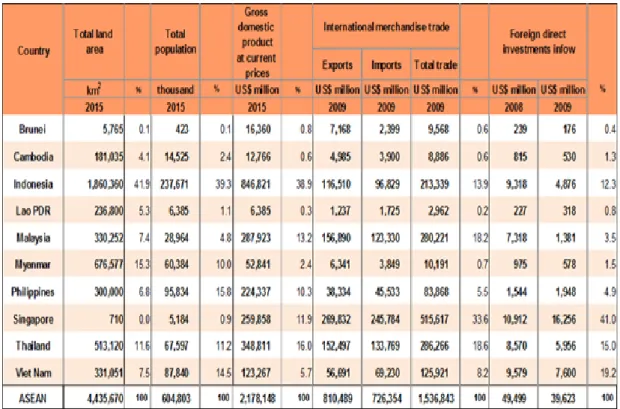
The ASEAN region has a population of over 617 million people ranking the world’s third populous area after China and India. It covers an area of 4.43 million km3 and is abundant with land and marine resources. ASEAN is also ranked ninth-largest economic region by size and World’s fifth by purchasing power parity after USA, China, Japan, and India with approximate Gross Domestic Prod-uct (GDP) of 2.18 trillion USD (ASEAN, 2015a). ASEAN is also one of the fastest growing economies with 30% annual eco-nomic growth and is generating 2.2 trillion USD of the total trade value with 25.6% earned from intra-ASEAN trading. Moreover, ASEAN is considered the biggest manufac-turer of rubber and hard disk drive compo-nents. Even though ASEAN’s preliminary fo-cus was to promote peace and political sta-bility in the region, it has also set a focus on economic cooperation among members and become one of the most powerful economic blocs in a regional and global stage. Basic data and major economic indicators of the ten ASEAN members are shown in Table 1.
Table 1 Basic data, direct trade and investment of ASEAN member countries
Source: ASEAN Secretariat (2015), “ASEAN Statistics 2014”, http://www.asean.org
Formation of ASEAN Economic Community
The Association of Southeast Asia Nations (ASEAN) was formed with aims to enhance economic and social cooperation as well as promote peace and stability within the region which leads to people’s prosperities and concrete economic, social, and cultural developments. However, ASEAN is also experiencing the challenges of globalization which influence it to set up its own economic bloc and strengthens trade collaboration among participating nations while its three main objectives: (i) enhance economic, social, and cultural development within region; (ii) retain economic stability and security within the region; and (iii) open a stage to discuss
conflicts within the region are strictly maintained (Siriphattrasophon, 2012).
Later in 1992, the ASEAN Committees set up the ASEAN Free Trade Area (AFTA) and participated in a dialogue to open a new market, service, and investment within the region. In October 2003, member states endorsed the ASEAN Concord II (Bali Concord II), which established a vision for economic integration through the ASEAN Economic Community. At the 2007 ASEAN Summit in Cebu, the committees also put great effort into developing the collaborations to become the ASEAN Economic Community in 2015 which is five years ahead of what is stated in Bali declaration.
The ASEAN Economic Community is just one of the three main pillars driving the ASEAN region. The other two are ASEAN Security Community (ASC) and ASEAN Socio-Cultural Community (ASCC). Moreover, the ASEAN Charter has been grounded to facilitate the launch of AEC and member countries have successfully drafted the AEC Blueprint to achieve AEC four characteristics (ASEAN, 2015b) which are:
1. To achieve a single market and
single production base by stimulating free flow of goods, services, investment, capital and skilled labors. This shall benefit consumers directly as it offers wider choices of goods and services as well as promote people mobility within the region. In addition, this shall enhance further cooperation to eliminate or abolish barriers; i.e., abolish tariff and non-tariff barriers and open free trade area on investment and services by 2015.
2. To be a highly competitive economic
region by giving precedence to policies
supporting economic integration i.e., fair trade, consumer protection, intellectual property protection, e-commerce, and development of infrastructures such as finance, transportation, logistics, information technology, and energy.
3. To achieve an equitable economic
development by cultivating capacity of Small and Medium Enterprises (SMEs) through different projects e.g., Initiative for ASEAN Integration (IAI) to reduce economic gap among member countries.
4. To integrate into the global economy
by adjusting AEC economic policies to comply with countries outside the group while being able to highlight and maintain its purposes. For example, initiating cooperation between ASEAN Free Trade Area and other dialogue partners, and encouraging
manufacturing and distributing networks in a global economy.
The AEC Blueprint has set up obligations for its members to follow which include the establishment of (i) free trade in goods, according to ASEAN Free Trade Area: AFTA, (ii) free trade in services, according to ASEAN Framework Agreement on Services: AFAS, (iii) free trade in investment, according to ASEAN Comprehensive Investment Agreement: ACIA, (iv) free capital flow, and (v) free flow of skilled labors (ASEAN, 2015b).
Indeed, the AEC aims to establish a regulatory framework that allows the free movement of goods, services, investment and skilled labor among member countries. Much has already been done towards this aim. Brunei, Indonesia, Malaysia, the Philippines, Singapore, and Thailand have eliminated tariffs on 99.6% of goods since the creation of the ASEAN Free Trade Area, while Cambodia, Laos, Myanmar, and Vietnam have reduced their tariffs to between 0 and 5% for 98.6 percent of goods. As announced at the ASEAN ministerial meeting in Brunei in August 2013, 79.7 percent of items in the AEC Blueprint have already been implemented (Vu Minh Khuong & Kris Hartley, 2013).
ASEAN has been working continuously in order to achieve the AEC four characteristics; e.g., elimination of tariff (implemented since 2011) and expansion of investment ceiling of prioritized sectors in service industries to 70 percent (implemented since 2008) with an aim at covering a majority of service sector by 2015 (EconNews, 2011). In addition, there has been an arrangement on a Mutual Recognition Agreement: MRA in eight major occupations i.e., physical doctor, dentist, nurse, engineering, architect,
accountancy service, surveying and tourism (ITD, 2014). These developments are directly linked to free flow of investment, capital and labor movement in the region.
The ASEAN Connectivity
In order to create unity and prepare for the launch of AEC in 2015, ASEAN Committee hosted the 15th ASEAN Summit
in Thailand during October 2009 and, for the first time, proposed the concept of ASEAN connectivity and appointed the High Level Task Force on ASEAN Connectivity (HLTF-AC) to produce a master plan on ASEAN Connectivity (MPAC) to be presented in the next ASEAN Summit. The master plan aims to shape a framework to create strong connectivity among ten ASEAN nations in terms of infrastructure, regulations, and people. This will help the region to achieve its highest goal in establishing AEC in 2015 and connecting it with neighbors such as East Asia and South Asia.
The Master Plan on ASEAN Connectivity can be divided into three main parts (ASEAN, 2015c):
1. Physical Connectivity. The ASEAN
Sectorial Bodies will be appointed to build physical connectivity within the region in the area of transportation, Information and Communications Technology (ICT), and energy infrastructure.
2. Institutional Connectivity. This
includes regional and international protocols that support the work under the institutional connectivity. To achieve this, ASEAN must promote a fast and transparent immigration, lower cost of travel and moving goods, investment from government and public sector. In addition, ASEAN must address the issues
of international crime suppression and protection, illegal labor, human trafficking, and other problems caused from the connectivity. 3. People-to-people Connectivity. The most significant strategy to connect people in ASEAN is through education, culture, and tourism. ASEAN must promote more intra-ASEAN social and cultural understanding among its people. Without this, it is not possible to build a concrete economic unity in the region.
SMEs in ASEAN Region
Small and medium-sized enterprises are an important factor for job creation and economic growth in the ASEAN region. As the AEC moves towards a higher level of market integration, new perspectives are opening for these firms. Innovative and high-growth SMEs, in particular, have an opportunity to transform their business. In the meantime, the 10 ASEAN member countries are taking steps to stimulate SME growth in order to support SMEs on taping these new possibilities (ERIA, 2014). In this part, necessary information is provided to understand the current situation of SMEs operating in ASEAN.
Definition and Contribution of ASEAN SMEs
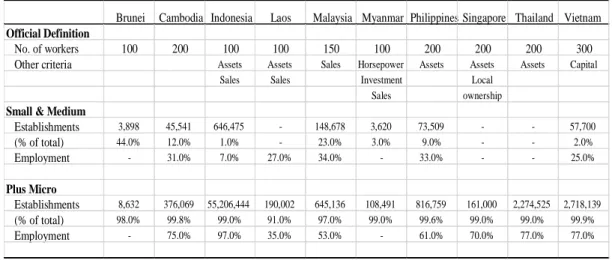
The definition and concept of SMEs vary among member countries. As illustrated in Table 2, a variety of official definitions of SMEs among the ASEAN countries indicates a comprehensive picture of ASEAN SMEs. According to Sato (2014), all the member countries use the number of workers per establishment as a common criterion.
Furthermore, most of the countries use additional criteria such as assets excluding land and buildings, annual sales, investment, and capital, some of which vary by sector. Finally, some countries have added micro-enterprises in their SME category.
One of the challenges in assessing the impact of SMEs is that ASEAN countries do not use consistent measures for their definition. For example, some use numbers of
employees, as in Brunei Darussalam, where entities employing up to 100 members of staff are deemed to be SMEs. Some use financial metrics. For example, in Indonesia business assets and annual turnover are both considered – and both criteria must be met. In Malaysia, however, companies can be defined as SMEs on the basis of either sales turnover or numbers of full-time employees. (ACCA, 2016).
Brunei Cambodia Indonesia Laos Malaysia Myanmar Philippines Singapore Thailand Vietnam
Official Definition
No. of workers 100 200 100 100 150 100 200 200 200 300 Other criteria Assets Assets Sales Horsepower Assets Assets Assets Capital
Sales Sales Investment Local
Sales ownership
Small & Medium
Establishments 3,898 45,541 646,475 - 148,678 3,620 73,509 - - 57,700 (% of total) 44.0% 12.0% 1.0% - 23.0% 3.0% 9.0% - - 2.0% Employment - 31.0% 7.0% 27.0% 34.0% - 33.0% - - 25.0% Plus Micro Establishments 8,632 376,069 55,206,444 190,002 645,136 108,491 816,759 161,000 2,274,525 2,718,139 (% of total) 98.0% 99.8% 99.0% 91.0% 97.0% 99.0% 99.6% 99.0% 99.0% 99.9% Employment - 75.0% 97.0% 35.0% 53.0% - 61.0% 70.0% 77.0% 77.0% Table 2. A comparison of official definitions of SME in the ASEAN countries
Country
GDP SME
(2015) (2011) Share Year Shae Year Share Year
Brunei -0.6% na 98.2% 2010 23.0% 2008 na na Cambodia 7.1% na 99.8% 2011 na na na na Indonesia 4.8% 2.0% 99.9% 2011 58.0% 2011 16.4% 2011 Laos 7.6% na 99.9% 2006 na na na na Malaysia 5.0% 8.4% 97.3% 2011 32.7% 2012 19.0% 2010 Myanmar 7.1% na na na na na na na Philippines 5.8% na 99.6% 2011 36.0% 2006 10.0% 2010 Singapore 2.0% 6.0% 99.4% 2012 45.0% 2012 na na Thailand 2.8% 7.9% 99.8% 2012 37.0% 2011 29.9% 2011 Vietnam 6.7% na 97.5% 2011 na na na na Share of Total Employment Share of Total Share of GDP Exports Growth Rate Source: Sato (2014)
Table 3. Significance of SMEs in the ASEAN Economy
In terms of foreign direct investment (FDI) inflows, ASEAN attracted a record US$111 billion in 2012, the highest value ever achieved since its formation. ASEAN’s share of world FDI inflows of 8.2 percent in 2012 was the first time that the region has been able to cross the 8 percent mark since 1996. These are encouraging signs of ASEAN’s ability to sustain and increase its competitiveness for trade and investments (Wong & Wirjo, 2014). Nonetheless, the relative attractiveness of ASEAN and China for investments was also assessed. Findings from the survey on ASEAN
competitiveness in 2013 reported that ASEAN was rated more attractive to China was consistent across all firm-size categories (Figure 1). Additionally, the attractiveness of each ASEAN country for investments was also rated by respondents on a scale of 0 (very low) to 10 (very high). As shown in Figure 2, Thailand received the highest average rating of 6.25. This was followed by Singapore (5.97), Indonesia (5.92), Vietnam (5.87), Malaysia (5.67) and Myanmar (5.65). Respondents were more likely to give a higher rating to the country in which they were based.
Figure 1. Attractiveness of ASEAN and China Source: Wong & Wirjo (2014)
Figure 2. ASEAN countries that organizations plan to invest or increase investments. Source: Wong & Wirjo (2014)
Performance and Competitiveness of SMEs
In general, SMEs are in a much weaker position than large firms to deal with the vicissitudes of economic volatility for many reasons. Firstly, larger firms usually have more capacities of finance and investment. Secondly, larger firms make more units and have a wider scope of marketing. Thirdly, larger firms have abilities to acquire skilled labors (O’ Case & Weerawarden, 2009). These prove that size of business always links to levels of competitiveness (Ali & Camp, 1993). The theory also stated that larger firms are capable of stronger management in terms of finance, research & development as well as marketing (Caloff, 1994; Abdul-Talib et al., 2011). As a consequence, SMEs will be forced to respond to these developments by implementing risk management strategies, speeding up customer payments, focusing on the retention of skilled staff where possible and critical for high-tech SMEs, cutting costs, diversifying into new markets, and improving their corporate governance (ERIA, 2014). However, SMEs in each ASEAN nation have varied performed and also have some different limitations.
Brunei Darussalam
SMEs in Brunei Darussalam are approximately present in every type of industry, but the top three industries where SMEs are present in large numbers are construction, wholesale, and retail of motorcycles (wholesale and retail and repair of motor vehicles and motorcycles) and accommodation and food services (Iqbal & Rahman, 2015). The number of SMEs has declined after 2008. The reason may be a closure of badly managed
firms or due to lack of finance. It has been that financial performance of small firms depends not only on firm-specific factors but also on market features and especially on a country’s economic and political risk (Majocchi & D’Angelo, 2013).
Indonesia
SMEs have historically been the main player in the Indonesian economy, especially as a large provider of employment opportunities, and hence a generator of primary or secondary sources of income for many households (Tambunan, 2006). Indonesian SMEs contribute towards entrepreneurship, innovation, employment, economic development, and economic growth. An analysis by Iqbal & Rahman (2015) indicated that SME growth rate was the highest in the year 2006 after which growth rate has declined. The decline in SME growth rate may be due to the already existing large number of SMEs. Nevertheless, the contribution of SMEs towards employment has never been less than about 96%. This shows the employment generation strength of SMEs in Indonesia. Malaysia
In Malaysia’s case, SMEs’ share of total employment is about 65.5% while their share of GDP has reached around 36.3% and share of total exports 17.6% (Wong & Wirjo, 2014). The SME growth rate in Malaysia was the highest in 2007 with a figure of 10%, but since then, it has declined to eventually recover at 8.4% (Iqbal & Rahman, 2015). However, the number of Ministries and Government Agencies involved in SME development programs in this country looks too many. It is also ineffective because there are a lot of overlapping works (SMRJ, 2008).
Philippines
In terms of a number of establishments, SMEs dominate the economy and account for almost 99.6% of the total number of establishments in 2006. However, micro enterprises accounted for the bulk, with a share or 91.6%. Overall SMEs in the Philippines represent service sector and SMEs would be contributing to overall economic growth through service sector. However, SMEs have not substantially generated sufficient value added and employment to increase competition, improve the industrial structure and increase the country’s overall manufacturing growth. The weak performance of SMEs has been largely attributed to the large number of barriers that SMEs must face particularly access to finance, technology, and skills as well as information gaps and difficulties with product quality and marketing (Milo, 2013).
Singapore
SMEs in Singapore have always contributed more than 50% to the total enterprise’s value addition in the economy. This shows the increasingly important role of SMEs in Singapore economy. Value added contributed is calculated by SMEs contribution by value to total value added of enterprises based on current market prices (Iqbal & Rahman, 2015). Moving forward, in Singapore, in future more efforts will be channeled towards helping SMEs to tap into opportunities by using a more targeted approach, such as by industry-specific SME initiatives (ACCA, 2016).
Thailand
SMEs have been an important mechanism for economic development in Thailand. The
government started to see the importance of SME development by placing it on the agenda of the National Economic and Social Development Plan from 1992. After the Asian economic crisis in 1997 originated in Thailand, the roles of SMEs became even more prominent because large enterprises faced problems in their business, both in the country and abroad (Siriphattrasophon, 2014). Similar to other countries, the situation for SMEs with respect to the main constraints is more or less similar between countries; namely, they lack technical and managerial capabilities, access to greater markets, access to finance, skilled workers, and lack of access to information which is vital to business (Tambunan, 2008). In Thailand, more constraints may be found among SMEs, such as limitations in language preventing effective communication with the business counterparts, failure to maintain consistent product quality, and risk management problems in terms of currency value, which is only 20% among Thai small-sized enterprises (Bank of Thailand, 2011). According to a survey of SMEs in Thailand in 2013, over 90% of Thai SMEs are still not ready for the AEC and are in need of urgent preparation in order to compete with competitors as their readiness is rated 0.5% (Siriphattrasophon & Saiyasopon, 2013). Vietnam
Similar to other ASEAN countries, the SMEs in Vietnam are an essential basis of the Vietnamese economy, and the SME sector in Vietnam is enjoying a high growth rate, which has contributed 53 percent of the total GDP to the country and contributed 85 percent of the total employment to the country. These reasons could explain why the SME is considered as the backbone of the Vietnamese
economy, promoting employment, generating more income, and building the welfare of people in the country (Mai Thai Thanh Thai, 2008). Vietnam has resource abundance, favorable market demand and high consumer potential, which are attractive for SME development; however, there is some concern related to the level of post-reform entrepreneurial activity. The lack of a strong tradition of entrepreneurship poses challenges to new venture creation. (Swierczek and Thai, 2003).
Implications of the AEC on SMEs
The launch of ASEAN Economic Community in 2015 has been bringing changes to businesses within and outside the bloc. It has also introduced entrepreneurs challenge and opportunity so that they must equip themselves with offensive and defensive strategies. Due to the fact that small and medium enterprises have some limited capability, SMEs in ASEAN shall put a serious effort to learn about impacts of AEC to businesses as well as other relevant regulations in order to find the most suitable strategy to achieve business goals.
Opportunities of AEC to SMEs
Even though SMEs in ASEAN is facing some difficulties in doing businesses in their countries, the AEC will bring a number of benefits and opportunities to SMEs. The benefits can be discussed and categorized by its purpose of the AEC framework as the following:
1. To achieve a single market and
production base - members of ASEAN must
reduce import duties, eliminate trade, a flow
of capital, tariff and non-tariff barriers, improve the standard of goods and implement self-certification form. Benefits of single market and production base to entrepreneurs can be described as below;
• SMEs can buy quality raw materials within the region at a lower price. This is because member countries usually have similar products and cost of transportation is much cheaper compare to importing materials from outside region. Moreover, entrepreneurs will be profited from an abolishment of import duties if buying goods from member countries. • Production base will not be limited only in one country but will be in any countries that offer lower cost of labor while providing same production quality.
• Even though ASEAN countries share some geographic, and cultural similarities, however business trends are not always the same. Due to this fact, SMEs will have more freedom to explore new markets and make differentiation to their business by importing unique products to sell in member countries.
• Some SMEs may face the challenge if their existing products can be replaced with goods from member nations which offer the same quality at lower price. They should look for new business opportunities, develop and make them different from others. Although the price is a major factor that consumers use when deciding to buy but entrepreneurs must realize there are other factors e.g., quality, product image, and creativity that also matter. Entrepreneurs must improve products continuously and find ways to reduce costs of production in order to survive in the business. 2. ASEAN is putting an effort to build good business environment which helps to promote fair trade and avoid monopoly that might exploit consumers. There should be an
initiative to protect and solve consumers’ problems, promote intellectual property protection, as well as support e-commerce. These efforts will directly result in an increase of region’s competitiveness, new innovations supporting creative industries and new ways of market penetration for SMEs
3. ASEAN is determined to promote the equitable economic development which will help to reduce the gap among member countries and is assisting ASEAN SMEs in business operations. The mentioned support will be made at the governmental level and be prioritizing under-developed countries i.e., Cambodia, Laos PDR, Myanmar, and Vietnam (CLMV). As a target of development CLMV, Thailand should be getting a lot of benefits of this development. Due to the fact that Thailand has a similar culture, climate, and geographic characteristics, there is a high chance for the entrepreneurs being able to move their production base to CLMV and exporting goods from Thailand to sell. However, the entrepreneurs must do research on consumer behavior, different cultures, and languages to achieve successful market penetration.
4. Lastly, ASEAN must integrate itself with global economy through initiatives of Free Trade Area with new trading partners, i.e., China, Japan, Korea, Australia, New Zealand and India. In order to get the best out of economic integration, the most significant factor lies in the vision of entrepreneurs. SMEs must seek for possible opportunities and turn them into profits, for example, an initiative with partners in ASEAN to produce premium goods. There are also other areas of business that most of the developed countries are now paying attention to environmental issues, corporate social responsibility (CSR), and
business ethics in which ASEAN SMEs must be aware of and include these elements when doing business.
How SMEs can compete in ASEAN
In order to exploit the local value to compete in the region, a survey conducted with foreign businessmen on preparation framework of becoming the AEC in 2015 (Department of Industrial Promotion, 2012) has suggested SMEs as the following;
1) Select the right country for business
- SMEs do not have as much resource as large companies do neither nor international business experience so it is recommended to put a focus in one location or country.
2) Try out products made in target
countries – If entrepreneurs are exporting goods to other countries, it is very useful to try out similar products made in those target countries. By doing this, SMEs can compare those products with theirs and will be able to set up a practical guideline for better quality products and learn about particular consumer behaviors.
3) Understand the regulations – Even
though ASEAN has opened a Free Trade Area, it is still necessary to learn specific regulations of your target countries. This is because it might delay the whole process in the business and, instead, increase opportunity for competitors.
4) Use the English language – SMEs
must practice using more English language at a workplace in addition to sitting in an in-house English class. This will result in an improvement of English language skills and promote professionalism.
5) Employ staff who speaks other
being used in dealing international business, however, staff who can speak ASEAN languages will help to make smooth negotiation and building a stronger relationship with customers.
6) Acquire information on target
countries from television shows – Television and media are usually a big influencer. Benefits of researching television programs in target countries will help SMEs understand interests, characters, and needs of customers and develop them to real marketing strategies.
7) Make a visit – Before shipping any goods to foreign countries, it is much necessary to make a physical visit there. The visit will give a clearer picture of the country, people, and business environment as well as opportunity to initiate new business negotiation with local partners.
8) Familiarize yourself with local media
– Media is the best source of information and business opportunities. It doesn’t matter if you don’t understand the languages because printed media usually contains lots of images which somehow describe better words.
9) Use online marketing – Online
marketing has become a very important tool for sellers to make a direct contact with customers. This includes an E-marketplace, a free online e-commerce platform developed by Department of International Trade Promotion.
10) Understand different business
cultures – Each country has its own business culture and it is very important to truly understand the practice to avoid possible conflicts. Moreover, this shows efforts to build trust with business partners.
While local SMEs recognize the opportunity for business growth driven by the
regional integration process, there are still a number of challenges they need to face. To overcome these challenges, SMEs should think big (think all of ASEAN) and set their mind on investing in training, market research, new technology, and services rather than reducing costs to be more financially viable. Finally, cooperation with strategic ASEAN members while remaining competitive will be fruitful for their sustainable growth in the region.
CONCLUSION
The establishment of ASEAN Economic Community in 2015 aims at achieving a single market and production base which would encourage a more free flow of goods, service, investment, capital and skilled labor. These will enhance the region’s competitiveness and bring up new business opportunities to members. Consumers will have wider choices of goods and services and will be benefited from a relaxation of immigration regulations. In addition, the AEC is pushing its members to become a highly competitive economic region by supporting a development of infrastructure, telecommunication, banking and finance, intellectual property protection, and promoting an equitable business development through capacity building programs for Small and Medium Enterprises as well as initiate networks and cooperation; e.g., agreement to set up free trade area between ASEAN and other trading partners.
According to the literature reviews, large business enterprises throughout the region seem to be profited from being the AEC. These benefits involve market expansion and flexibility in setting up production base which affects directly to business competitiveness. The SMEs, on the other hand, will be facing
new challenges of ASEAN free trade and investment as it will cause a highly competitive situation. It is unfortunate that Thailand has started to experience loss of competitiveness in businesses that rely on labors after the implementation of the new policy on minimum wage in 2013 that increased the high cost of production in labor-intensive industries. Nonetheless, SMEs in Thailand still stands a chance in exploring new business possibilities such as an access to niche markets, a fast market access of SMEs, e-commerce, a copy and development, cross-border trading, and economic corridors development under ASEAN connectivity master plan.
Lastly, it is very significant that government must provide proper support to improve abilities of SMEs through building awareness and knowledge of the AEC in the area of business management, trade, investment, custom, international trade regulations, exchange rate, and risk management. Governments must also own resources where its people can easily access in-depth information on investment, economy, social, culture, laws, and technology of all ASEAN nations. In addition, the governments must improve business environments to boost country’s economic growth by solving constraints (weak legal system, complex and opaque bureaucracy), corruption problems, improving consumer protection, and initiation of trade barriers to protect the entrepreneurs. These efforts will be a dynamic mechanism that truly supports the growth of SMEs and effectively enhance them for the being a successful part of the ASEAN Economic Community.
REFERENCES
Abdul-Talib, A., Salleh, M. F. M., Shamsuddin, F. M. & Ashari, H. (2011). The effects of firm size and international business experience on export attitudes.
Advances in Competitiveness Research, 19(1/2), 4-14.
Ali, A.J. & Camp, R.C. (1993). The relevance of firm size and international business experience to market entry strategies.
Journal of Global Marketing, 6(4): 91-112.
Association of Chartered Certified Accountants (ACCA). (2016). SME
Development in ASEAN. Retrieved from
http://www.accaglobal.com/content/dam/ ACCA_Global /Technical/smb/pi-sme-development-asean.pdf
Association of Southeast Asia Nations (ASEAN). (2015a). ASEAN Statistical Yearbook 2012, Retrieved from http:// www.asean.org/images/2013/resources/ statistics/statisticalpublication/ASEAN StatisticalYearbook2012.pdf
Association of Southeast Asia Nations (ASEAN). (2015b). ASEAN Economic
Community Factbook, Retrieved from
http://www.asean.org
Association of Southeast Asia Nations (ASEAN). (2015c), ASEAN Economic
Community Blueprint, Retrieved from
http://www.asean.org/archive/5187-10.pdf
ASEAN Secretariat. (2015). ASEAN Statistics 2015, Retrieved from http:// www.asean.org
Bank of Thailand. (2010). Why do SMEs not
protect the currency risk. Focus and
Quick, 12: (December 6, 2010), Economic Research Department, Bank of
Thailand, Retrieved from http:// www.bot.or.th/Thai/EconomicConditions/ Publication/FAQ_documents/FAQ_12. pdf
Calof, J.L. (1994). The relationship between firm size and export behavior revisited.
Journal of International Business Studies, 25, 367–387.
Cavusgil, S.T., Knight, G., & Riesenberger, J. (2014). International Business: The
New Realities (3rd ed.), New Jersey:
Pearson Education Inc.
Department of Industrial Promotion. (2012). Preparation and industrial networking project for the ASEAN Economic Community, Retrieved from strategy.dip.go.th/AEC/ tabid/122/ Default.aspx
EconNews. (2012). What is the ASEAN Economic Community, EconNews: 21(523), 19-21.
Economic Research Institute for ASEAN and East Asia (ERIA). (2014). ASEAN SME Index 2014: Towards competitive and
innovative ASEAN SMEs. Retrieved
from https://www.oecd.org/ globalrelations/regionalapproaches/ aseansme.htm
International Institute for Trade and Development, (ITD), (2014). The Development of ASEAN SMEs. Retrieved from http://www.itd.or.th/ research-article/436-ar
Iqbal, B. A. & Rahman, M. N. (2015).
Contribution of ASEAN-6 SMEs to
Economic Growth of ASEAN,
Economics World, December 2015. Majocchi, A., Dalla Valle, L., & D’Angelo,
A. (2013). Internationalisation, cultural distance and country characteristics: A Bayesian analysis of SMEs financial
performance. Journal of Business
Economics and Management, 16(2),
307-324.
Mai Thi Thanh Thai. (2008). The Internationalization of Vietnamese Small and Medium-Sized Enterprises. Dissertation of the University of St. Gallen, Graduate School of Business Administration, Economics, Law and Social Sciences (HSG).
Milo, M.S. (2013). The ASEAN Economic Community and the Philippines: Implementation, Outcomes, Impacts,
and Ways Forward. Discussion paper
series no. 2013-02, Philippine Institute for Development Studies. Retrieved from http://dirp4.pids.gov.ph/ris/ dps/ pidsdps1301.pdf
O’Cass, A. & Weerawardena, J. (2009). Examining the role of international entrepreneurship, innovation and international market performance in SME internationalization. European Journal of
Marketing, 43(11/12), 1325 – 1348.
Organization for Small & Medium Enterprises and Regional Innovation, JAPAN. (SMRJ). (2008). Small & Medium Enterprise Development Policies in 6 ASEAN Countries. Retrieved from http:/ /www.asean.org/storage/images/archive/ documents/SME%20Development%20Policies %20in%206%20ASEAN%20Member %20States%20-%20Part %201.pdf
Prince Damrongrajanuphab Institute of Research and Development. (2012).
AEC: The ASEAN Economic
Community. Ministry of Interior of
Thailand, Retrieved from http://www. stabundamrong.go.th
Sato, Y. (2014). Development of Small and Medium Enterprises in the ASEAN
Economies. Retrieved from http:// www.jcie.org/japan/j/pdf/pub/publst/ 1451/9_sato.pdf
Siriphattrasophon, S. (2012). International
Business Management. Bangkok:
Pearson Education (Indochina).
Siriphattrasophon, S. (2014). Internationali-zation of small and medium enterprises: A multi-case study of the Thai food sector.
International Journal of Arts & Sciences, 7(4): 321–334.
Siriphattrasophon, S. & Saiyasopon, K. (2013). Firm readiness to inter-nationalization of Thai SMEs towards
the ASEAN Economic Community.
Proceeding of The IBSM - International Conference on Business, Management and Accounting, October 2-4, 2013 in Chiang Mai, Thailand.
Swierczek, F. W. & Thai, T. H. (2003). Entrepreneurial Orientation, Uncertainty Avoidance and Firm Performance: An Analysis of Thai and Vietnamese SMEs.
The International Journal of
Entre-preneurship and Innovation, 4(1): 46-58.
Tambunan, T. (2006). Development of Small and Medium Enterprises in Indonesia
from the Asia-Pacific Perspective,
Jakarta: LPFE-Usakti.
Tambunan, T. (2008). Development of SME in ASEAN with Reference to Indonesia and Thailand. Chulalongkorn Journal of Economics: 20(1), 53-83.
Tamajai, A. & Amornkitwikai, Y. (2012).
Impacts of ASEAN Economic
Community on Industry. Faculty of
Economics, Rangsit University, Thailand. Vu Minh Khuong & Kris Hartley. (2013). Building ASEAN as a learning community.
East Asia Forum, 29th November
2013. Retrieved from http:// www.eastasiaforum.org.
Wild J.J. & Wild K.L. (2014). International Business: The Challenges of
Globalization, (7th ed.). Pearson
Prentice Hall, New Jersey.
Wong, M. & Wirjo, A. (2014). 2013 ASEAN BAC Survey on ASEAN
Competitiveness. ASEAN Business
Advisory Council. Retrieved from http://www.aseanbac.ph/index.php/ ajax/exec_ajax/file_download/697/ newsid/59/asean-bac-survey-on-asean-competitiveness.pdf