Erick Paul Beltran Canepa
New ways of working
and their impact on
future physical work
spaces
Trondheim, June 2011Master
’s
thesi
s
NT NU Nor w eg ian Uni v ers ity of S c ien c e a nd T ec hn ol og y F ac ul ty of A rc hi tec ture an d F ine A rt | E ng ine erin g S c ien c e Cent re f or Real E s tat e a nd F ac ili ti es Ma na ge m en tNORGES TEKNISK-
NATURVITENSKAPELIGE UNIVERSITET
INSTITUTT FOR BYGG, ANLEGG OG TRANSPORT
Oppgavens tittel:
NEW WAYS OF WORKING AND THEIR IMPACT ON FUTURE PHYSICAL WORK SPACES
Dato: JUNE 2011
Antall sider (inkl. bilag): 180
Masteroppgave X Prosjektoppgave Navn: Stud.techn.
ERICK PAUL BELTRAN CANEPA Faglærer/veileder:
SIRI HUNNES BLAKSTAD
Eventuelle eksterne faglige kontakter/veiledere:
Ekstrakt:
This master’s thesis aims to suggest the ways in which people will work in the future and how organizations can develop their physical spaces to support and adapt to their employees’ future ways of working.
The study hypothesizes that employees’ ways of working will be greatly affected by information technology, primarily tools that will allow them to communicate and collaborate both across the hall and across the globe. The question is: By 2022, what will the physical elements of the workplace be like in an organization with global presence? To answer this question, the study used three qualitative research methods: literature review, scenario planning and case study.
The scope of the research study was limited to Statoil, a Norwegian oil and gas company with global presence. The use of Statoil corporate scenarios enabled the study to suggest Statoil’s future ways of working, but limited the results’ validity to this organization, without the ability to generalize.
Among the findings is the fact that the workplace consists of social, virtual and physical spaces, which are
dependent on one another. Employees will probably work in different places - office buildings, satellite offices, their homes, cafes - depending on their needs and preferences. As such, office buildings will be more social hubs, because despite the advances in virtual communication, physical interaction will still matter.
A case study shows that Statoil could arrange physical spaces to best support existing work practices by providing these facilities: privacy rooms, team arenas, interplay rooms, study rooms and playstation areas.
The research recommends that in order to increase collaborative capabilities in the future, Statoil should design more collaborative work spaces to support new ways of working.
Rather than requiring employees to adapt to the physical space, organizations should take a more holistic approach to office space design so that it easily adapts to employees’ future ways of working.
Stikkord:
1. WORKPLACE
2. NEW WAYS OF WORKING 3. SCENARIO PLANNING
Preface
This report is part of the final examination of the master’s degree program in Real Estate and Facilities Management at the Norwegian University of Science and Technology (NTNU). Because the field of study covers several disciplines, the program is offered in cooperation between the Faculty of Architecture and Fine Art, and the Faculty of Engineering Science and Technology. This master thesis represents 30 credits of the total 90 credits of this master’s degree program.
The completion of this research study has been done in addition to the duties and responsibilities related to the job position Business Developer Facilities Management in Statoil ASA.
The work done in this master thesis was carried out in the period from September 2010 to May 2011, but the project work was initiated previously as part of a research design project created in the Scientific Methods course during the spring of 2010.
This master thesis highlights the relevance of future ways of working and their impact in the planning and design of office work spaces. By using scenarios and based on some assumptions, the research study reveals the ways people could work in the future. Furthermore, a description of an idea of the work spaces that possibly will support these new ways of working is presented by using a case study.
The motivation to work on this research study originated after becoming involved in a corporate initiative intended to drive new ways of working in Statoil. This initiative permitted me to recognize the potential and possibilities that it could have in the development of Statoil’s future workplace and its consequences for the Real Estate portfolio of the company. The work done in relation to this research study has contributed to understanding the complexity of the issues related to the development of the workplace, as well as the dependencies of the elements that constitute it.
I declare that this is an independent work according to the examination regulations at the Norwegian University of Science and Technology.
Trondheim, June 2011
__________________
Erick Paul Beltran CanepaAcknowledgments
I would like to express my gratitude to my employer, Statoil ASA, for the economic assistance given to complete this master’s degree program. I also thank my manager, Hans Olav Skjærvik, for his constant support and understanding during this three-year study. I would also like to express my thanks to my master’s thesis tutor and adviser, Siri Hunnes Blakstad, professor at the Department of Architecture and Management at NTNU, for her guidance, support, and engagement in this research study.
I am very grateful for the continuous support and contribution, both professional and personal, that I have received from my colleagues: Per Einar Weiseth, Mona Torsvoll, Rune Espedal and the members of the Facilities Management discipline in Statoil.
Summary and conclusions
In order to respond to increasing needs for collaboration in a globalized world and challenging business environment, organizations are working to identify the practices and tools that can better support them in the execution of their tasks and work processes. As technological developments and new IT solutions penetrate people’s daily lives rapidly, and the level of adoption of these solutions increases, the impact on the ways people communicate and connect will continue to change their ways of working during the coming years. To understand what these work practices will be like, leaders of organizations need a view of the way people will work in the future.
The purpose of this master’s thesis is to suggest people’s ways of working in the future and the impact these new work practices will make on physical work spaces.
The hypothesis of this study suggests that the development of new technologies and new collaborative tools will affect the ways we work and create new opportunities for workplace solutions. As new IT solutions are developed and adopted, it will be possible to find new types of work spaces in the future. The research question to be answered in this study is: By 2022, what will the physical elements of the workplace be like in an organization with global presence?
Three qualitative methods are utilized to approach the research question: literature review, scenario planning and case study. Due to the researcher’s active involvement with the development of the phenomena being studied, this research project can be classified as an action research study. This research is carried out within a specific frame limited by the use of scenarios and a case study based on Statoil, a Norwegian oil and gas company with global presence. The researcher is aware of the limitations that this issue can cause in generalizing the results and conclusions obtained in this study. Scenario planning methodology is utilized to describe how current workplace trends can evolve under different future settings and identify the possible outcomes and implications of these trends. Among these trends are: the importance of new workplaces and community development; the dependency on collaboration technologies and social networks; an increased demand for greater social responsibility; and more sourcing oriented organizations.
Based on the problem definition, hypothesis and research question, the following are the key findings of this study:
A workplace consists of three spaces or dimensions that enable work to be done. These spaces are the social, the virtual, and the physical. The spaces adapt to one another over time, and the workplace develops through the interaction among these spaces. The process needed to create
new workplace solutions that enable organizations to adapt and improve their ways of working is presented in this report as Workplace Development.
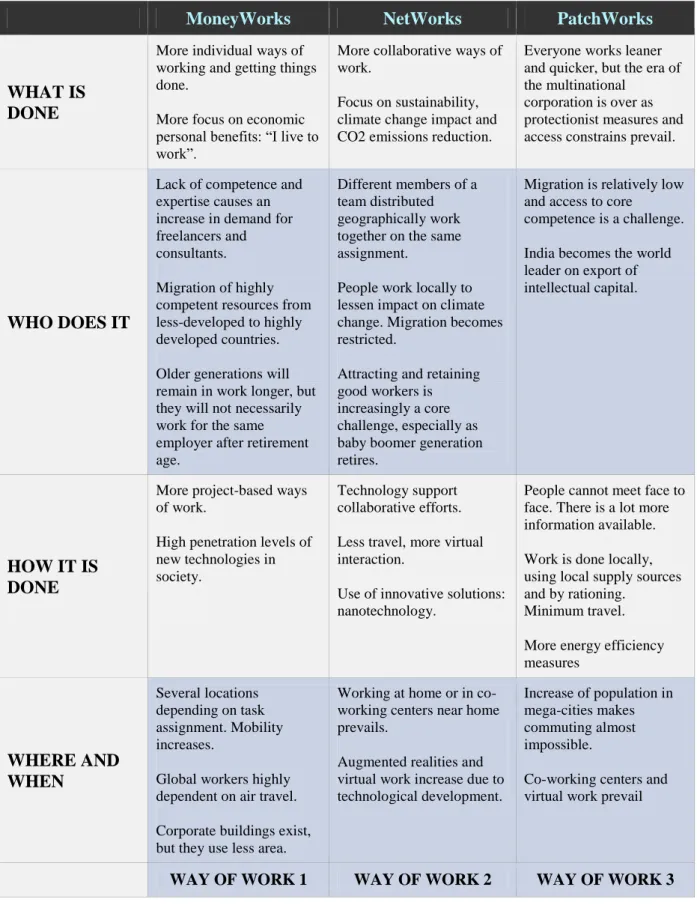
A framework to analyze work and Statoil’s corporate scenarios bring together workplace trends to suggest three different ways of working for Statoil in the future:
Way of Working 1, characterized by an individual way to execute tasks, a diverse, global and mobile workforce with a high degree of adoption and utilization of new technologies.
Way of Working 2, characterized by the collaborative nature of doing things. Focus on sustainability issues reinforces the reduction of travel. However, to support a global workforce, collaboration technologies support knowledge-sharing and access to competencies in different parts of the world.
Way of Working 3, characterized by the need to communicate and connect people present at the same physical location, but also virtually using new collaboration technologies. The idea of a global and mobile workforce is not present because travel is restricted.
Based on these new ways of working, it is possible to assert that more flexible and distributed workplaces will appear in the future. People will work in different spaces, making choices about their workplace depending on their specific needs and preferences, which will be changing continuously.
The vision of Statoil’s future workplace points to future ways of working that are different from the current ones: A greater share of employees will be members of geographically distributed teams; will divide their time among the office, home, co-working centers and working anytime and anywhere. It is possible to affirm then that less office space in form of corporate buildings will be needed, but because physical interaction between individuals will still matter, corporate office buildings will become more social hubs -- where people meet and socialize – rather than places where they go to just work.
To validate the results of this research, a case study is carried out using one of Statoil’s current building projects. The case study shows how Statoil has approached the challenge of developing new office spaces and the context in which this is happening. The following ways of working were developed by the project responsible for the construction of the building after analyzing business needs, and based on the idea that business value is created through collaboration: administrative work, concentrated work, informal dialogue, workshop, information meeting, confidential meeting, and other type of work not related to projects. Based on these work practices, five types of rooms were defined under the categories work and meeting spaces, in addition to the support rooms. The main office spaces for Statoil’s future building at Fornebu are: privacy room, team arenas, interplay room, study room, playstation area.
The following are the conclusions in this research study. These are presented using the same framework utilized to analyze work: what is done, who does it, how it is done, and where and when.
What is done
Future work practices and people’s ways of working will be different from the ones that exist today. Individual and collaborative work will be supported by new tools, and new work practices will appear based on those tools, creating the need for new workplace solutions located in different places. This corroborates the hypothesis of this research. However, the case study presented in this report has neither evidence of collaborative ways of working happening in the future across geographic borders, nor reference to individual or collaborative work outside the office building presented in this case.
Who does it
The future challenges that global companies are facing related to access to competent resources in different parts of the world, and the need for collaborative tools that enable access to those competencies and allow companywide knowledge-sharing, are increasing. The study shows that these challenges will become a characteristic of the future ways of working. On the other hand, the placement of employees in the office building used in the case study has been done using a traditional approach; employees moving to the new office building are going to be placed according to their organizational membership. This is going to enable collaboration within their organizational units. In order to support knowledge-sharing and collaboration across organizational units, efforts should also be made to place employees according to their ways of working, discipline or roles, independent of their place in the organizational chart.
How it is done
There is no doubt about the relevance of technology and IT tools in future ways of working. The case study reveals how new AV/IT tools are put in place in a pilot project to support more collaborative ways of working in a new office building. It seems that there has been more focus on the IT solutions than the tasks that need to be supported by these tools. There is a gap between the idea of Statoil’s ways of working defined by the project and the IT/AV solutions put in place in the pilot area. These IT solutions are tools supporting future ways of working and not the current ways of working defined by the construction building project. In the future, it could be an advantage to assess and understand new ways of working before
executing the processes related to choosing a specific IT solution or office space design.
Where and when
In the future, people will still need a physical room to execute their work tasks. But the physical space needed will not be restricted only to the space located in corporate office
buildings. The study shows how a mobile workforce will require Real Estate & Facilities Management units to adapt their real estate portfolios and find the balance between the number of workstations for co-located workers and those who work outside the office, from home or any other place using virtual environments. As people adopt more flexible ways of working, the flexibility of workplaces will become an issue leaders in Statoil will need to address. The more mobile and distributed nature of future workers will increase the need to adapt existing workplace solutions according to their needs. Workplace flexibility can be enabled by utilizing new IT tools and/or by designing new types of office spaces. But the importance of corporate policies and standards should not be underestimated: These policies and standards should be reviewed and eventually changed in order to adapt existing workplace solutions to the new realities created by new ways of working.
The research study recommends that Statoil establish a Workplace Development unit composed of a permanent, cross-functional group of experts from corporate staff functions that will be responsible for defining alternative workplace solutions based on future ways of working of the different business areas in Statoil and their business needs. This Workplace Development unit would also coordinate the efforts of each support function regarding future workplace developments; anchor proposals for changes with corporate management; ensure their implementation; and communicate change to the rest of the organization. Due to the focus and priority collaboration has in the company, it is also proposed that the unit responsible for Corporate Real Estate and Facility Management designs and shapes more
collaborative office work spaces to support the collaborative ways of working in Statoil, and in close cooperation with other support functions and business areas.
Further research could embrace an analysis of future ways of working in other companies with global presence using the same or a similar methodology utilized in this report. It could be interesting also to compare the type of work spaces those studies could recommend as future office work spaces.
Another topic of study could be an analysis of the organizational change processes employed by other organizations when dealing with the implementation of alternative workplace strategies and the way those companies measure the added value of the impact those strategies have on physical spaces.
Table of Contents
Preface ... i
Acknowledgments ... iii
Summary and conclusions ... v
Table of Contents ... xi
List of Figures ... xiii
List of Tables ... xv 1 Introduction ... 1 1.1 Background ... 3 1.2 Purpose ... 5 1.3 Problem definition ... 5 1.4 Definitions ... 7 1.5 Limitations ... 9 1.6 Hypothesis ... 9 1.7 Research question ... 9 1.8 Thesis outline ... 10 2 Methodology ... 13 2.1 Approach ... 15
2.2 Description of chosen methods ... 16
2.2.1 Literature review ... 17
2.2.2 Scenario planning ... 17
2.2.3 Case study ... 17
2.3 Validity and reliability ... 19
2.4 Outline of research procedure ... 20
3 Theory and literature study ... 25
3.1 Workplace concepts ... 27
3.2 A framework to analyze work ... 31
3.3 Introduction to scenario planning ... 32
3.4 Statoil corporate scenarios ... 36
3.5 Characteristics of the future workplace ... 39
3.5.1 Workplace trends shaping the future workplace today ... 39
3.5.3 Changes in the global context ... 45
3.6 Office space solutions ... 47
3.6.1 The reason: business objectives ... 47
3.6.2 Crucial decisions ... 50
3.6.3 Current work spaces solutions ... 52
3.7 Shaping the future workplace today ... 57
4 Results ... 59
4.1 Statoil’s future ways of working ... 61
4.2 Case study: Statoil’s future work spaces ... 63
4.2.1 Business drivers ... 64
4.2.2 Easy to Work: Statoil’s workplace vision ... 64
4.2.3 Use of Statoil’s personas ... 66
4.2.4 Statoil Personas applied to tasks or work processes ... 67
4.2.5 Vision translation: Statoil’s future work spaces ... 67
4.2.6 Statoil’s new office building: Project Co-Location Oslo 2012 ... 69
4.2.7 Developing new office space in Statoil ... 72
4.2.8 Pilot project ... 76
5 Discussion ... 83
5.1 Statoil’s future ways of working ... 85
5.2 Statoil’s future work spaces ... 92
6 Conclusions ... 101
Bibliography ... 105
Annex ... 109
Annex A.1 Definitions ... 111
Annex B.1 Statoil Global Scenarios: factors for each scenario ... 113
Annex B.2 Statoil Global Scenarios: scenario development timeline ... 115
Annex C.1 Capabilities of Statoil’s future workplace ... 117
Annex C.2 Statoil’s personas ... 119
Annex C.3 Ways of working of a Statoil’s profile ... 121
Annex D.1 Location of Statoil at Fornebu ... 131
Annex D.2 Building views ... 133
Annex D.3 Placement of business areas in the new building ... 135
Annex D.4 FM processes... 139
Annex D.5 Tool to analyze business needs ... 141
Annex D.6 Challenges running meetings ... 143
Annex D.7 Challenge specification – example ... 145
Annex D.8 Statoil’s pilot office space – photo impression ... 147
List of Figures
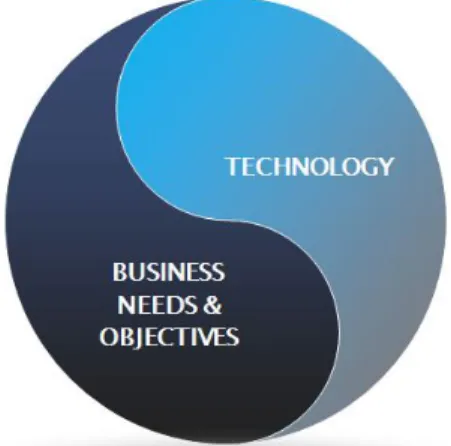
Figure 1-1: Balance between business needs and technology development ... 5
Figure 1-2: Thesis outline ... 11
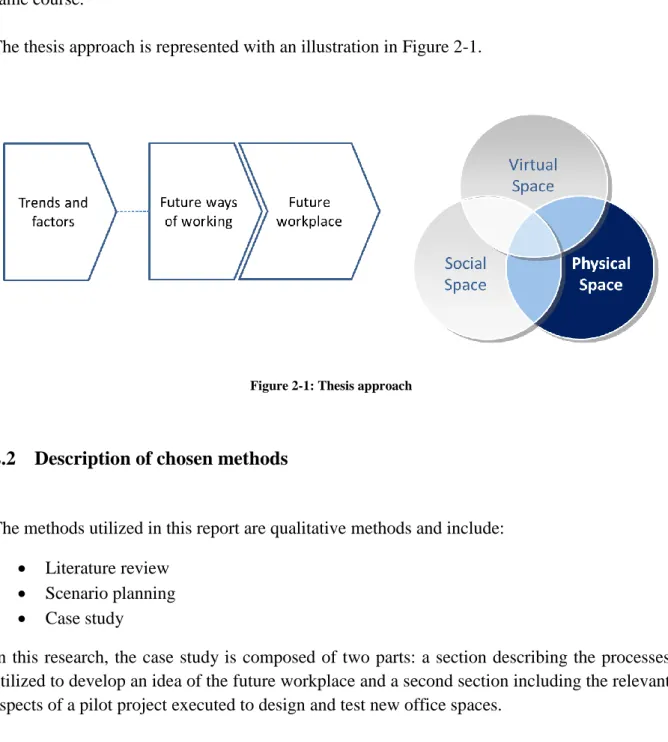
Figure 2-1: Thesis approach ... 16
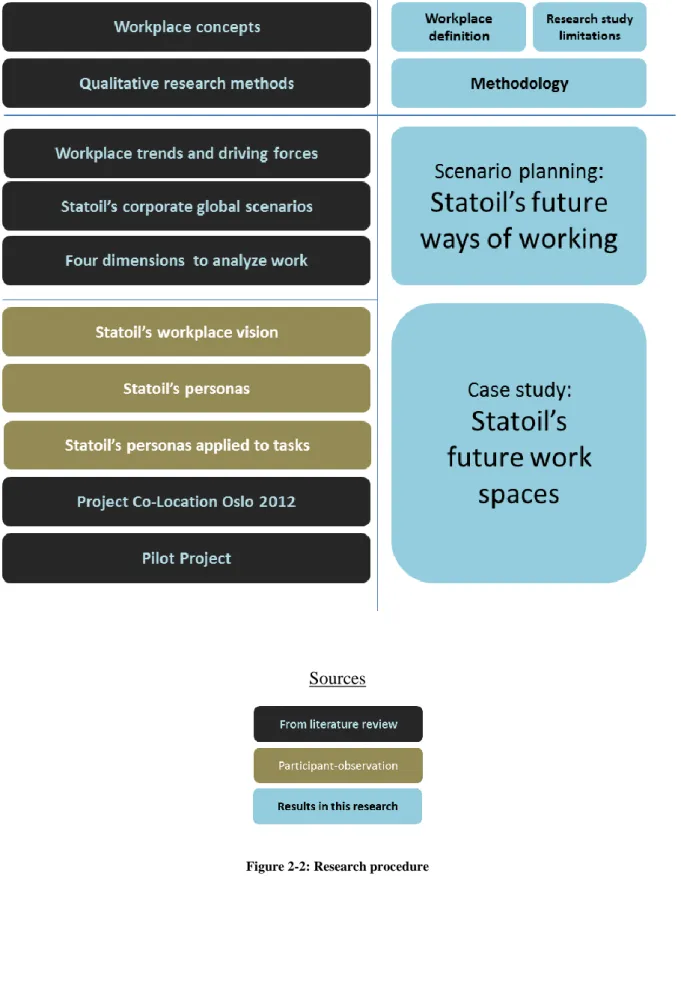
Figure 2-2: Research procedure ... 23
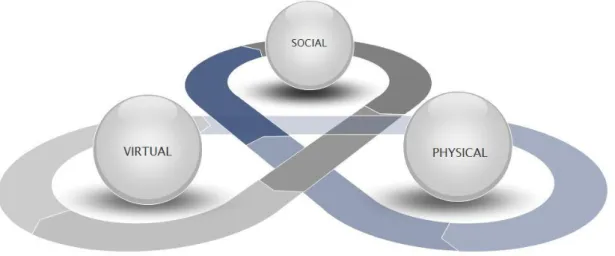
Figure 3-1: The three elements of the Workplace ... 29
Figure 3-2: Illustration of framework to analyze work ... 31
Figure 3-3: Socioeconomic planning (Øverland, 2002). ... 33
Figure 3-4: Traditional scenario planning (Øverland, 2002). ... 33
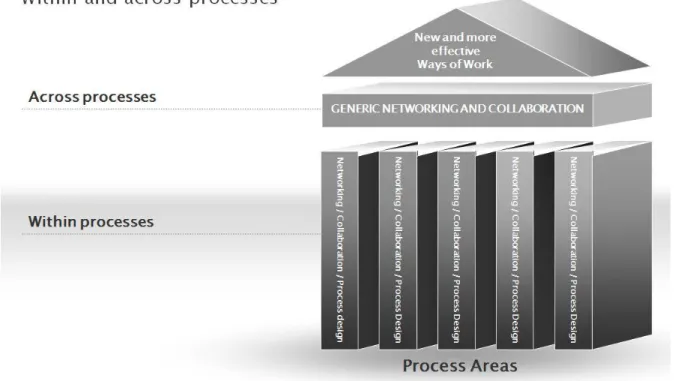
Figure 3-5: Collaboration within and across work processes... 42
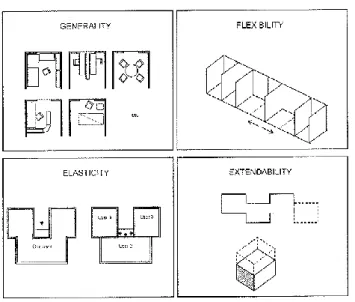
Figure 3-6: Generality, elasticity, flexibility and extendability (Blakstad, 2001) ... 48
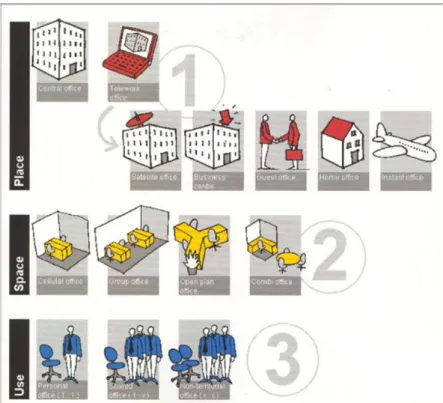
Figure 3-7: Different workplace solutions (Vos, van Meel, & Dijcks, 1999) ... 52
Figure 4-1: Framework to analyze future ways of working ... 61
Figure 4-2: Expected change in office space utilization (Weiseth & Beltran, 2010) ... 68
Figure 4-3: Main phases in the User Involvement project (Statoil ASA, 2010d) ... 71
Figure 4-4: Main phases preparing Generic office floor (Statoil ASA, 2010d) ... 73
Figure 4-5: Lamella representing an office floor (Statoil ASA, 2010d) ... 75
Figure 4-6: Standard office floor (Statoil ASA, 2010d) ... 76
Figure 4-7: Existing ways of work showing where these happen today (Statoil ASA, 2010e) 78 Figure 4-8: Ways of working where these should happen (Statoil ASA, 2010e) ... 79
Figure 4-9: Classification of activities based on collaboration needs (Statoil ASA, 2010e) ... 80
Figure 4-10: Pilot project - office space solutions (Statoil ASA, 2010e) ... 81
Figure 4-11: Pilot project - IT solutions (Statoil ASA, 2010e) ... 82
List of Tables
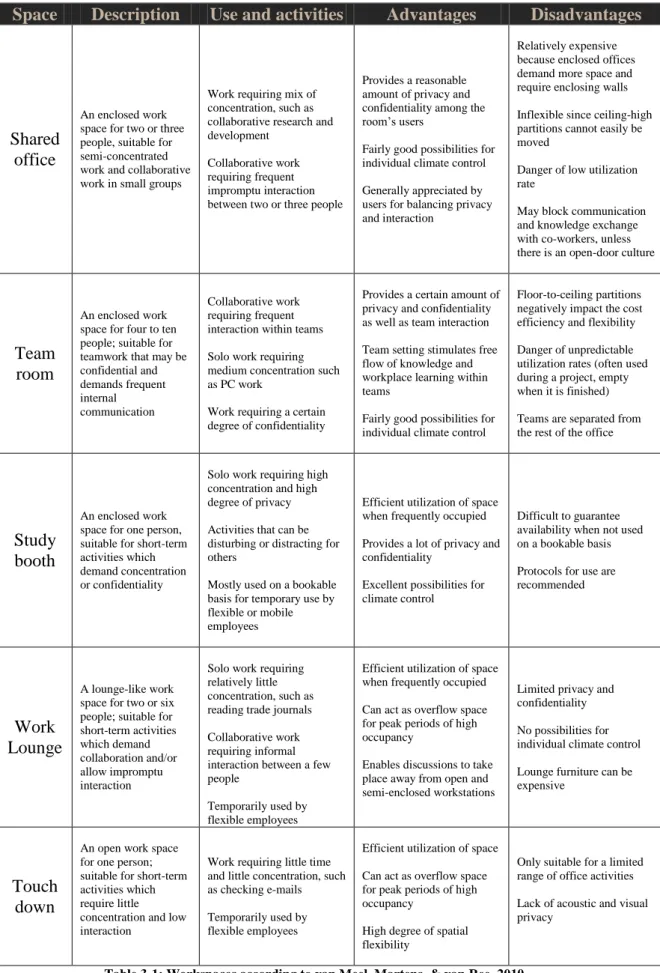
Table 3-1: Workspaces according to van Meel, Martens, & van Ree, 2010. ... 54
Table 3-2: Meeting spaces according to van Meel, Martens, & van Ree, 2010... 55
Table 4-1: Statoil's future ways of working ... 62
Table 4-2: Responsibilities between the sub-projects (Statoil ASA, 2010d) ... 70
1
Introduction
The purpose of this chapter is to introduce the topic of this master’s thesis report: to understand how new ways of working are going to make an impact on the future workplace.
To gain insight into the subject of this study, the chapter begins with a description of the background and purpose of this research. After this description, the problem for discussion will be presented, including its limitations.
Additionally, the hypothesis and research question will be presented along with a short explanation about how this research study was approached.
1.1 Background
During recent years, companies around the world have met a challenging, highly unpredictable and complex business environment. To adapt to these challenges, businesses have increased the focus on flexibility and striven for simplification of their activities. Efforts have also been made to support the execution of tasks and work processes with new and more sophisticated information technology (IT) solutions.
It is indisputable the role and relevance technology has had in supporting business needs until now. New technology trends have continuously been developed and more innovative IT solutions have been implemented to support the different ways people work.
However, the place where people work is constituted not only by technology. Despite the impact IT solutions have had in increasing business efficiency, it is still necessary to have a look at other factors and trends that are making an impact on the ways we work, and the ones that are shaping the future workplace today.
Office areas have been during the last years indispensable in ensuring employees the ability to perform and execute their tasks in a proper way. Companies facing growth and expansion in their business activities have increased the need to acquire new office buildings and spaces. This task has particularly become challenging when this expansion has happened internationally due to globalization processes.
On the other hand, those companies facing decline in their business activities have been obligated to find effective ways to dispose office buildings in their real estate portfolios to adapt to new organizational needs. These companies have been forced to find ways to adjust real estate portfolios and reduce vacancy rates according to the existing office space requirements by using different methods and management tools.
Flexibility and efficiency have become principles used by many organizations in their real estate strategies for dealing with these changes and fluctuations in a flexible manner. Flexibility and efficiency contribute to improvements in the financial performance of these organizations: The less capital is tied up in the form of an asset such as an office building -the more -the flexibility companies have to use -their financial resources, managing working capital in a better way and thereby increasing the efficiency of their primary work processes. To be in accordance with overall business and real estate strategies, the aim of workplace design has been to facilitate the creation of workplace concepts that, among other things, support organizations’ work processes, promote collaboration and contribute to higher efficiency levels. Based on these concepts, new office solutions, such as open-plan offices, have been implemented. Many organizations have followed this trend and imitated this workplace solution to achieve flexibility and efficiency at work.
Workplace solutions must support work processes, activities and tasks employees in an organization execute on a day-to-day basis. However, it is interesting to observe how many companies have tried to standardize workplace solutions without taking into consideration the tasks that are executed by an individual or a group of employees. The “one size fits all” way of thinking, used to approach the complex nature of the workplace, encompasses some risks. Current workplace trends and innovation in technology are pointing to a different future. The focus of workplace design has traditionally been on the architectural aspects of it, but the interaction among members of an organization also takes place outside the physical working space, which is usually located in an office building. The diverse nature of the work tasks, based on changing business needs, makes the idea of a common workplace solution an option destined to fail because of its lack of flexibility and capacity to adapt.
Predicting the future is a task with a high degree of complexity and uncertainty. Even so, the trends already taking place today suggest a future different from the present. If leaders recognize this fact and decide to believe in some key characteristics of the future workplace, companies will be able to set a direction and shape it. In course of action they will need to watch the development in trends and understand how their organizations should react and adapt to them (Weiseth & Beltran, 2010).
Many organizations have already started working on issues related to the future workplace and improvements on collaboration capabilities. The Norwegian-based global telecommunication company Telenor has worked with a project called Way of Working (Telenor ASA, 2006), intended to find new ways of work and improve the virtual environment of the company.
The American Microsoft Corporation has developed in The Netherlands a methodology called IMPACT (van der Bie, 2010a), which is utilized to define the effects technology has in an organization’s ways of work, considering three elements: people, places and technology. Royal Dutch Shell initiated a corporate program in 2009 in order to improve its ways of work. The program was called Shell Works and utilized the processes associated with moving to new office buildings as a catalyzer for implementing new ways of work (Statoil ASA, 2010a). These examples reflect how necessary and relevant it has become for executives of companies with global presence to find the balance between organizational business needs and the technology that is developed and available to support work processes.
To achieve this, they need an idea about how their employees will execute their tasks and work processes, and the impact technology will have on these work practices in the future.
Figure 1-1: Balance between business needs and technology development
Technology and new IT solutions are enabling people to create, communicate and connect anytime, anywhere. Because of this, providing an idea of the way people will work needs to include also an idea about the placewhere this job will get done in the future.
Despite virtual environments, the role space plays in collaboration interfaces is still important: To make collaboration happen, people need a physical space.
1.2 Purpose
This research study aims to suggest the ways of working of people in the future and the impact these new work practices will make on physical work spaces.
To achieve this purpose, the research study develops a model to describe future ways of working and provide the characteristic elements of the future workplace.
The study also suggests what future workplaces can be like, focusing on the physical elements (work space) that constitute it.
1.3 Problem definition
Leadership and management teams of organizations with global presence are struggling to have access to human resources needed to execute business-related tasks and work processes. Efforts have been made by these organizations to take advantage of competencies available in
a specific place and utilize them to support the execution of tasks in other places around the world.
Needs for communication and collaboration among people who are geographically separated from one another have increased because of, among other things, globalization of business activities and execution of international projects.
In order to stay connected and interact across geographic boundaries, the dependency on collaborative IT tools and solutions has become more relevant and, at the same time, a way for businesses to survive in a challenging business environment.
To meet business needs, new forms of cooperation based on new technologies and IT solutions have been developed. Use of video-conferencing equipment, video camera connected to PC or laptop, smart mobile telephones and other types of electronic solutions are some examples of how technology has had a major impact on the way we work today. Flexibility and efficiency in the workplace are achieved now by using distributed work teams and new IT-based solutions.
New technologies are constantly being developed and new ways of working have appeared based on these developments. The world is changing rapidly, and in order to survive in a competitive world, companies will need to adapt to these changes in the same way.
In the future, tasks and work processes are going to be carried out utilizing more new tools and methods; people’s working contexts will change and so their workplaces.
In an economy increasingly dependent on individuals who are valued at work for their availability to interpret information within a specific subject area, work is done anytime, and anywhere. A definition of the modern workplace needs to recognize this reality (PdK Consulting, 2010).
These new ways of working enabled by IT tools will have a direct impact on the way office space will look and be utilized in the future.
Therefore, it is relevant and critical to provide an idea of future ways of work and initiate today the necessary changes to shape the idea of the future workplace.
Global corporations have begun to understand these new trends and have launched various initiatives that will lead them to the development of new working and collaboration methods in the future. However, it still remains uncertain how the future work space will be influenced by these new work practices. This is the main challenge of this research study: to understand how new ways of working enabled by information technology are going to make an impact on the future workplace.
1.4 Definitions
The following section will present different definitions or meanings needed to establish a common understanding of the main concepts utilized in this report.
Workplace
Workplace consists of three elements or dimensions that enable work to be done (Vartiainen, et al., 2007). These elements are the social, the virtual, and the physical.
Physical, virtual, and social elements of the workplace are particular environments where individual workers and groups of people collaborate.
A detailed description of the term workplace is given in chapter 3 of this report.
Workplace management
Workplace management is the process concerned with changing user needs, workplace and office layouts and concepts, space standards, evaluation of effects of different workplace solutions and design examples (Blakstad & Torsvoll, 2010).
The final report of the ProWork project introduced the term workplace management as the management of the workplaces as quantitative resources, including processes in design, change and use of workplaces (Nenonen, et al., 2009).
Workplace development
To differentiate from the traditional approaches of workplace management involving processes that manage something that already exists, this report introduces the idea of workplace development.
This is based on the understanding of the current definition of Facilities Management (CEN, Comité Européen de Normalisation, 2006), which underlines both the notion of management
and development of the agreed services that support organizations’ primary activities. Since workplace is part of the Facilities Management discipline, this research study makes the distinction between the management and development of the workplace in the same way. Thus, workplace development is defined in this report as the processes needed to create new workplace solutions that enable organizations to adapt and improve their ways of working in order to achieve their goals and objectives.
Since the purpose of this research study is related to an idea of the future of work, including new ways of working which will require new workplace solutions, it is possible to say that the results of this study will have focus on workplace development. Consequently, the effects of these results will have an impact on workplace management.
Workplace solution
A product or service constituted by a combination of a determined physical space, a specific IT solution and the social environment created by these physical and IT-related elements.
Knowledge-intensive organization
Knowledge-intensive organizations are characterized by having knowledge as their primary input and output (Gjersvik & Blakstad, 2004a). Processes within these organizations are mostly related to communication, coordination, processing of information, and the combination of knowledge.
Knowledge work
Knowledge work can be defined as the creation, distribution and application of knowledge by highly skilled, autonomous workers using tools and theoretical concepts to produce complex, intangible and tangible results (Nenonen, et al., 2009).
Collaboration
Collaboration takes place when two or more people communicate and interact to reach a goal (Weiseth, Munkvold, Tvedte, & Larsen, 2006).
Other authors refer to the term collaboration in similar ways. Collaboration happens when people work together, share knowledge and expertise enabled by communication and Web 2.0 technologies to create business outcomes (Collaboration Consortium, 2009).
Organizations are more conscious about the effects good collaboration can have in business results. But some research studies (Hansen, 2009) also point out the consequences that bad collaboration – collaboration characterized by high friction and a poor focus on results - can make in teams and individuals working to achieve a goal.
According to Hansen, collaboration can happen in two ways: collaboration within a company and collaboration outside a company. When it comes to collaboration within a company, collaboration can occur across organization units, including collaboration across divisions, business units, product lines, country subsidiaries, and functions. This is what Hansen calls companywide collaboration. Companywide collaboration differs from traditional teamwork, which often refers to local teams of five to ten people within a business unit, division, or department.
Other definitions
It is difficult to prepare a list with a definition of concepts related to new ways of working. Terms and definitions change constantly in this field. The list included in Annex A.1 Definitions shows definitions of some terms utilized in this report. The main source of these definitions are the American authors Jeanne C. Meister and Karie Willyerd, two
internationally recognized writers and speakers, and founders of Future Workplace, an American-based organization working on strategy development that focuses on the re-invention and re-definition of corporate learning and human resources. (Future Workplace, 2011).
1.5 Limitations
Due to its complexity, a study about the workplace, including all the components that constitute it, will soon become a challenging task.
Based on the problem definition specified in 1.3, and the definition of the workplace in 1.4, this research study will focus on the physicalspaces of the workplace only.
Furthermore, workplace trends shaping the future workplace today presented in Chapter 3, and used to develop future ways of working, assume that no major natural catastrophes happen. In the future, the evolution of trends and external factors occur at its normal pace.
1.6 Hypothesis
In the future, the development of new technologies and new types of collaborative tools will affect the ways we work and create new opportunities for alternative workplace solutions. Workplace solutions will probably not be like the solutions that exist today. The demands and needs for office space will be different, and new workplace solutions will be developed. Over the coming years, the idea behind what we understand today as a “normal” way of working will change, and with it, the current idea of office space utilization and work spaces.
1.7 Research question
To understand future ways of working and the idea of the future workplace, this research study will analyze how the ways people work, what they work on, the tools they use, and where they work are going to look in 2022.
The year 2022 was chosen as reasonable point of reference. Ten years’ time is long enough for distinct changes to happen, without becoming a utopia.
After completing this analysis, it will be possible to establish a notion of future ways of working in a knowledge-based organization. By concentrating the efforts on understanding the way people collaborate and the impact these ways of work will have on the physical spaces in the future, it will be possible to conceive and idea of future work spaces.
The idea is to answer the following research question:
A systematic procedure for exploring and shaping the future will be utilized to approach this research question. This master’s thesis will utilize a framework to analyze future ways of work and identify the main characteristics of the future workplace in an organization with global presence. Statoil global scenarios, used in the development of Statoil’s corporate strategy, are used to give a structure and to support the analysis in this work. An analysis of these scenarios will help to identify what could become Statoil’s ways of working in 2022. The idea of Statoil’s future work spaces will be supported using a case study.
1.8 Thesis outline
This master’s thesis will comprise six chapters. After the introductory chapter, a presentation and defense of the methodology chosen in this research is presented in chapter 2.
Chapter 3 outlines the theoretical concepts related to the term workplace. It also includes a short introduction to scenario planning. The reviews on literature on the elements needed to carry out an analysis of future ways of working are presented: a framework to analyze work and Statoil’s corporate global scenarios.
Furthermore, workplace trends shaping the future workplace and a brief idea of the processes back workplace development are introduced. The theoretical background needed to understand and analyze future work spaces is also presented in this chapter.
Chapter 4 presents the results obtained in this research, while Chapter 5 will include the discussions and analysis using the problem and research question as starting points.
By 2022, what will the physical work spaces be like in an organization with global presence?
Chapter 6 establishes the conclusions of this research by articulating the results, the discussions and analysis, and presenting the final considerations and recommendations.
The thesis outline is represented with an illustration in Figure 1-2.
2
Methodology
Chapter 2, Methodology, presents the methods utilized in this study based on the problem under discussion and the research question presented in Chapter 1.
These methods are: literature review, scenario planning and case study. The chapter begins with a description about methods in general and continues with the presentation of the approach utilized to answer the research question.
The chosen methods are presented afterward, including a section to discuss their validity and reliability.
Finally, an outline of the operational procedure followed in this study is explained.
2.1 Approach
A method is about how information is collected, organized and interpreted (Larsen, 2008). This chapter gives a short description about methods in general, and the methods utilized in this research study. It also explains the procedure applied to approach the research question, including its strengths and weaknesses.
Social sciences study how people and groups of people develop in relation to each other (Olsson, 2009). In this report, the main research topic is related to the way people will work in the future and the implications of these work practices on the physical aspects of the workplace. Due to this, this master’s thesis can be classified as a social science-related study. Depending on the problem, qualitative or quantitative methods are used in research studies related to natural and social sciences. Sometimes a combination of both can be necessary to find the answer of a concrete problem or question.
A quantitative method is related to quantitative data; numbers and variables that are possible to quantify. A qualitative method is related to data that cannot be quantified, often represented by written information in forms of words or illustrations.
Qualitative research is an enquiry method that is often utilized in social studies, and it is characterized by having smaller but focused samples, and by producing results only for the particular case studied.
In this study, the problem that needs to be solved is related to future ways of working and the impact of these practices make on the physical elements of the workplace.
It is challenging to find reliable data about things that may happen. Future-related studies cannot speak about something that has not yet happened. However, it is possible in these studies to predict the consequences a particular course of action can have later under certain circumstances (Halvorsen, 2009).
The question to be answered is the following:
To answer the research question as a scientifically based future study, the consequences some factors and trends can have on current ways of working - under certain circumstances – need be described.
By 2022, what will the physical elements of the workplace be like in an organization with global presence?
These predictions will reflect possible outcomes of these trends. Based on these outcomes, it will be possible to predict people’s future ways of working. By analyzing these new ways of working, it will be possible to understand and establish an idea of the future workplace. According to the workplace definition utilized in this study, workplace is a place where people work and it is constituted by three spaces: physical, virtual and social. Based on the problem under discussion and the research question, this research will only focus on the idea of future physical spaces.
To sustain these predictions and the notion of something that has not happened, empirical data from a case study will be utilized to verify whether the outcome of trends is following the same course.
The thesis approach is represented with an illustration in Figure 2-1.
Figure 2-1: Thesis approach
2.2 Description of chosen methods
The methods utilized in this report are qualitative methods and include:
Literature review
Scenario planning
Case study
In this research, the case study is composed of two parts: a section describing the processes utilized to develop an idea of the future workplace and a second section including the relevant aspects of a pilot project executed to design and test new office spaces.
This section explains the methods mentioned above and their contribution to answer the research question in this study.
2.2.1 Literature review
To get insight into the theoretical background of the topic of this study and the methods utilized in qualitative research, a literature review was carried out. Practical information about the execution of this review is given in Chapter 2.4 Outline of research study.
2.2.2 Scenario planning
The utilization of scenarios is a method commonly used in strategic planning. It is considered a tool to predict or prepare the path for something that may happen in the future (Øverland, 2002).
The advantage of using scenarios in this research is related to the opportunities this methodology creates in order to describe and present the different alternatives that may occur in the future in connection with work practices, without being normative. A normative work would point out the way things should happen in the future, something it is almost impossible to confirm or validate in this study.
More information about the use of scenario planning can be found in Chapter 3.3 Introduction to Scenario Planning.
2.2.3 Case study
Case studies are commonly used in social science and are related to an in-depth investigation describing a contemporary event or process in its natural ambit (Yin, 2003).
According to Yin (2003), a case study answers research questions related to how and why,
whereas quantitative questions such as how many or how much can be answered by quantitative methods such as surveys and data analysis. Furthermore, case studies do not need the researcher’s control of the object in study, unlike research studies using experiments where the researcher’s involvement is needed.
Case studies are the most common research strategy used by researchers of business and management. The data and information used can be obtained through interviews, observations, physical object or the analysis of archival information (Muhdi & Daiber, 2008).
According to Yin (2003), six sources of evidence in case studies can be identified:
Documents: administrative documents, newspapers, articles, or any document that is appropriate to the research.
Archival documents: organizational records, lists of names, survey data, and other similar records.
Interviews: open-ended, focused, and structured (surveys). Open-ended interviews take place when a relevant person comments on certain events in order to provide the researcher insight into events. A focused interview happens when a person is interviewed during a short period of time and answers a set of questions. A structured interview helps to gather data using a detailed set of questions in a similar way a survey does.
Direct observations: observations that take place when a researcher visits a specific location. The idea is that the researcher collects data from the field without disturbing the context in which things happen.
Participant observation: observation where the researcher participates actively in the event being studied. This kind of observation may influence the reliability of the study, because the researcher can alter the development of events.
Physical artifacts: physical evidence such as tools or instruments collected during the study as part of a direct observation.
Case studies need to satisfy both conceptual and structural requirements (Muhdi & Daiber, 2008). The conceptual requirements are related to the validity and reliability of the case study. This issue will be discussed in Chapter 2.3 Validity and reliability.
Concerning the structural requirements, there are some elements to be considered when presenting a successful case study. A case study must be relevant for those who read it and, at the same time, it must invite them to discover the different insights, without omitting important perspectives and circumstances. It has to describe as close as possible the reality of the event without including too much data. It is therefore necessary to find a balance and include all data needed to support its validity.
In addition, a case study has to be written using a clear structure and language, and it should not be longer than necessary to present the necessary information.
Because the author of this study has actively been part of workplace development initiatives in Statoil, the study can be classified as an action research study. An action research study is a type of research that is orientated toward bringing about change, often involving respondents
in the process of investigation. In action research studies, researchers are actively involved with the situation or phenomenon being studied (Robson, 2002).
2.3 Validity and reliability
Reliability refers to the accuracy or exactness in a study. If a measurement is repeated several times and the results obtained are the same, then it is said that a study has a good reliability (Larsen, 2008).
In general, qualitative research studies have some challenges with reliability. These studies focus on reduced samples and collect high amount of information from many variables simultaneously. This fact facilitates getting a holistic idea of a concrete problem, but makes it difficult to generalize the results and apply the conclusions in a generic way.
Concerning this master’s thesis, it will be difficult to achieve satisfactory reliability levels, because it may become a demanding task to reach the same results obtained in this study in new and similar research done by others. Furthermore, the variables taken into account this time can change if the same research is carried out again later. The high level of uncertainty and complexity of future events can also influence the reliability of this study, something that may lead to different results and conclusions.
Validity is related to the relevance or applicability of a study (Larsen, 2008). Thus, a valid study is a study that measures the right things.
The data and material collected during this research have been used to answer a concrete question connected to something that may happen in the future. The research methodology utilized is in accordance with the ones utilized in similar studies (Saurin, Ratcliffe, & Puybaraud, 2008). Relevant information has been collected with the research question as background. However, the analyses presented in this report are based, focused and restricted to a concrete organization, Statoil, making the results valid only for this particular organization.
Despite this restriction, it will be still possible to apply the same methodology in other organizations using similar studies if the necessary adjustments related to the organizational variables are made.
The ambition level of this master’s thesis is restricted to a concrete research question and the organization utilized in the case study. Analyses and its understanding are valid for this concrete organization. Because the results are presented as part of a structured research process, it may be possible to apply some of the conclusions to other companies with similar challenges related to collaboration in global settings.
Because this study utilizes only qualitative methods, there are some disadvantages in connection with how much the student can generalize the results obtained with the investigation.
2.4 Outline of research procedure
The first step in the development of this master’s thesis was to find out the methods that would be helpful in answering a problem related to future research studies. The research started looking for references, publications and articles related to future studies in Norway and abroad. These sources pointed to a concrete methodology, scenario planning, which could be helpful in this type of research. Information about scenario planning and how it is utilized in this study can be found in Chapter 3.
After ensuring that the main research method was in place, a review of literature related to future workplaces and workplace trends was done. This also included a review of the terms utilized to refer to workplace. The sources utilized were mainly available on the internet and in books available in online bookstores. Several books and publications were ordered and bought for this research. This process helped to establish a common understanding of the meaning of the term workplace in this report.
Because publications related to future workplace and new ways of working are relatively scarce, it was necessary to find more information about these topics in other types of publications and articles. Reports prepared by relevant and prestigious management consulting companies, research networks and articles in online magazines were found and utilized. Membership fees were paid in some article-based online publications to get access to this information.
The search for data and relevant material was done using internet search engines. The words used as starting point in the different searches included “new ways of working”, “workplace”, “future workplace”, “future work”, “alternative workplace”, “alternative workplace programs”, and “workplace strategies”. The initial search results led to other links that made deeper and more comprehensive results possible. Some information was also found with the support of the databases such as BibSyS, after receiving training in an introduction course carried out by the institute in one of the gatherings arranged in Trondheim.
The results obtained from the review of these articles, reports and books were also the main source to support the process of mapping trends connected to future ways of working. According to scenario planning methodology, a mapping of current trends and driving forces is needed to understand a future event.
After the search of relevant qualitative information mentioned before, the main elements to define a framework to analyze new ways of working were provided. This framework constituted by Statoil’s corporate global scenarios and the four dimensions of work is presented as a contribution of this research study.
A hard copy of Statoil’s corporate global scenarios was obtained after contacting the manager of strategy and business development in Global Business Services in Statoil, Johan Leuraers. To clarify the utilization and validity of these scenarios, an open-ended interview was conducted with him.
By engaging in a creative process, the author of this research utilized the framework to bring together workplace trends and driving forces with Statoil’s scenarios in order to predict possible outcomes. The result was the establishment of a notion of future ways of working. The utilization of Statoil’s own corporate scenarios made it possible to assume that these new ways of working can be the same as Statoil’s future ways of working.
To validate the results of this analysis, a workshop was arranged and a presentation of Statoil’s new ways of working was given to a cross-functional group in Statoil. The group included representatives from the following disciplines and corporate entities: Facilities Management, Human Resources, Information Technology, Health, Security & Environment, Management Systems, Communication, and the internal supplier of business support services in the company, Global Business Services.
The workshop was part of a corporate initiative in Statoil. The author of this report took an active part in the arrangement and preparations of the workshop: preparing and presenting the idea of Statoil’s new ways of working to this reference group, and facilitating the discussion and taking notes of the feedback received from the participants. The feedback was used to prepare a new updated version, which is the one presented in Chapter 4.
Statoil’s future ways of working was the previous step to establish the idea of future work spaces. To understand the idea of future workplace, including the physical spaces that constitute it, the analysis of the ways of working was needed.
To validate the results in this research, a case study was developed. The development of the case study in Statoil included analysis, interviews, direct observation, and participant-observation.
The access to documents in Statoil was gained mainly through electronic means. The use of software to share documents is widespread in the company, and the author had access to memos, presentations, surveys, figures, pictures, minutes from meetings, and other documents that were relevant to preparing the case study. The project responsible for the execution of the new office building project located at Fornebu has a virtual space where files and documents are stored electronically. The researcher had access to this virtual space.
To get insight into the topic related to Statoil’s future work spaces presented in the case study, an open-ended interview was conducted with Mona Torsvoll, discipline adviser of Workplace Management in Statoil.
As part of work duties, the author of this research participated actively in the preparation of the following sections in the case study: Statoil’s workplace vision, Capabilities of Statoil’s
future workplace, Statoil’s personas, and Ways of working of a Statoil’s profile. The background of these activities was related to a Statoil’s corporate initiative mentioned before and not to the building project the case study refers to.
The information related to the pilot project and the new office building was obtained by reviewing documents and presentations available and stored in the aforementioned virtual space of the project.
The information regarding the use of personas in Microsoft was obtained after a visit to Microsoft offices in Amsterdam using an open-ended interview with Ilco van der Bie. The personas or archetypes presented in the case study are intended to support the conclusions obtained in Statoil’s new ways of working. These archetypes will allow the exemplification of the future ways of work in Statoil in a concrete and illustrative way.
Figure 2-2: Research procedure illustrates the different sources utilized to develop this research study and the results obtained using those sources.
On the left side of the figure, the different topics obtained from the literature review are presented. The figure makes a distinction between literature review from documents, books and articles, and the active review done by the researcher in his role as business developer in Statoil. This active review is called “participant-observation” in the figure.
The right side of the figure represents the results of this research developed as part of this thesis. The results are placed next to the input needed to develop them.
Sources
3
Theory and literature study
Chapter 3 Theory and literature study, examines the theoretical framework of this research project. It includes a review of the workplace concepts, and the introduction of a framework to analyze work which will be utilized in Chapter 4.
A short introduction to scenario planning is presented as well as Statoil corporate global scenarios.
The main characteristics of the future workplace are described: workplace trends, collaboration and collaboration technologies, and the changes in the global context making an impact on the ways people work.
All these elements mentioned above will become the fundament of the analysis of future ways of work presented in Chapter 4.
Furthermore, a description of current office space solutions is presented including the reason and the process leading to its decision.
Finally, the main elements of the processes companies engaged when designing new office spaces are briefly explained.
3.1 Workplace concepts
In a real estate and facilities management context, the word workplace is commonly associated with the physical environment, a room or office space. In an environment related to information technologies, the workplace will probably be associated with the IT tools and solutions supporting employees in executing their tasks. Human resources personnel will make some associations between workplace and the cultural or social environments, benefits and compensations, or maybe the ideas or beliefs people in an organization share. Some people could also say that some elements related to ergonomics, health, safety and security, and working environment are also related to the term workplace.
According to the dictionary, the word workplace is defined as the room or building where people work; while an area rented or sold for commercial purposes is known as workspace
(Oxford University Press, 2010). This workplace definition is not robust enough, as it omits many elements workplace is composed of. Therefore, it is necessary to present other and different meanings of this term, because a common understating of it will be needed to develop the idea of future work.
The definition used as a starting point includes two important elements that limit the idea of workplace: the words place and work. These words are quite diffuse as they do not specify clearly what kind of places and what kind of work is done.
A knowledge-intensive organization needs somewhere for its employees to work in order to perform its activities and fulfill its purpose. Workplaces for knowledge workers have traditionally been located in office buildings (Blakstad & Torsvoll, 2010). According to these authors, the workplace’s physical appearance has changed, and the work no longer is restricted to one work-desk, one office building or even to one location. The idea of a workplace related to a physical place is present, but the notion of other places, different from a work-desk, is recognized.
An implicit definition and broader idea of the workplace was given by a research project known as The Knowledge Workplace (KWP). KWP was a research initiative on new office solutions and new ways of working in knowledge-intensive organizations that had as a goal to develop knowledge about the relationships between three elements: i) organizing,
To establish a common understanding about the term “workplace”, this section introduces different ideas found in literature, and establishes the one to be utilized in this research.
organization development, and new ways of working, ii) modern information and communication technologies and, iii) architecture, new office solutions, and physical infrastructure (Gjersvik & Blakstad, 2004a).
The idea behind this initiative can illustrate and concretize the perceptions people have about the idea workplace, which was explained before as it includes organizational, technical and physical elements.
Workplace consists of three elements or dimensions that enable work to be done (Vartiainen, et al., 2007). These elements are the social, the virtual, and the physical. Physical, virtual, and social elements of the workplace are particular environments where individual workers and groups of people collaborate. Nenonen, et al. (2009) utilize a similar framework to explain the elements of the workplace.
According to Vartiainen, et al. (2007) and Nenonen, et al. (2009), the physical, virtual and social spaces/places can be understood as follows:
PHYSICAL SPACE
Physical space refers to facilities that employees use for working such as in an office, at home, in a plane or car, or at a conference, and the physical environment that supports it, such as office design and layout, equipment, temperature, light, etc. Physical space is a tangible environment. According to Nanonen, et al., when these spaces are in use, they are places that can be classified in many ways: private, semi-private and public places, quiet places, etc.
VIRTUAL SPACE
A virtual space refers to an electronic working environment, virtual workspace or collaborative working environments. These spaces can be accessed by different interfaces and both individual and collaborative activities can be performed in them.
Vartiainen, et al. (2007) say that the internet and intranet provide a platform for working places for both simple communication tools, such as e-mails; and more complex ones, such as collaborative working environments, which integrate different tools such as e-mail, audio conferencing, video-conferencing, group calendar, chat, document management and presence awareness tools.
The same authors suggest that the significance of virtual spaces will grow when members of a distributed team communicate and collaborate from different locations. They will be not only distributed in physical places but also simultaneously use virtual places (video-conference and documents shared on the intranet). They also will be related to other team members who must share common goals to be able to reach the aim, and possibly also share common ideas, beliefs and values (social/mental space).