Consumer Animosity
Hesah Saleh Aljarboa
King Saud University, Riyadh, Saudi Arabia
[email protected]
ABSTRACT
This paper provides an inclusive review of the literature concerning the consequences and antecedents of animosity on consumer purchasing intentions. Consumer animosity has attracted a lot of attention in the international marketing and business literature in previous years and was found to have various effects on consumer behavior as a result of aversion on the foreign products country of origin. The paper reviews the literature that has been conducted on animosity and focuses on certain limitations that are addressed. Suggestions for future research have been also emphasized in the paper.
Indexing terms/Keywords
International business, Country of origin effects, International marketing, Animosity, Consumer behaviour
Academic Discipline And Sub-Disciplines
Business, Marketing, Culture
SUBJECT CLASSIFICATION
Business AdministrationTYPE (METHOD/APPROACH)
Literature ReviewINTRODUCTION
International and global markets are emerging at an increasing pace, which is an outcome of several elements such as technology advancements and trade freedom (Ohmae, 1990). This contributes to many opportunities for companies in which targeting different segments across the world has become possible. Thus, marketers have shown raising
Council for Innovative Research
Peer Review Research Publishing System
Journal
: International Journal Of Management & Information Technology
Vol . 10, No 4
[email protected]
www.ijmit.com
significance to the drivers of consumer behavior in differing nations. Scholars have found that companies must have a comprehensive understanding what different international consumers prefer and desire in order to successfully compete in international markets (Ettenson & Gaeth, 1991). However, as multinationals are entering and creating new markets, different consumer behavior becomes a challenge in which multinationals will be faced with different cultures and nations that are no comparison to cultures in their home countries (Dwyer, Mesak, & Hsu, 2005).
Accordingly, as consumers are being exposed to a variety of products, whether products are domestic or international, product choice and purchasing intentions becomes influenced by several reasons. One of the main aspects of
international goods is their country of origin. Products country of origin has been seen to impact on consumers quality judgment and emphasize on purchase intentions (Bilkey & Nes, 1982). Products from developed countries are sometimes perceived to be of high quality, and are preferred over other products. However, due to variations between countries and difference in language, culture, beliefs, values, religion and beyond, tension and conflict sometimes exists that effect negatively on products image due to its country of origin (Gürhan-Canli & Maheswaran, 2000; Huntington, 1993). Tensions between China and Japan due to there historical tensions resulted in Chinese consumers discarding Japanese products. The war on Iraq has stimulated ant-US response that have harmed American brands and goods in which such products got rejected because they were merely American related goods (Leong et al., 2008). The religion related tension between the Denmark and the Muslim world has triggered ongoing boycott on Danish goods, which resulted in
multinational engaging in different proactive strategies in order to survive in such markets (Mellahi, Demirbag, & Riddle, 2011).
Klein et al., (1998) were the first to shed light on such logic in which they critically emphasized that tensions between nations might affect consumer purchase intention. Consumer animosity was initially introduced to highlight how consumers negative feelings and emotions against another country might highly affect product purchase intentions when dealing with goods from that country. Klein et al., (1998) also found that quality perception was independent from purchasing
intentions, which contradicted the earlier country of origin studies. The initial study on animosity offset a stream of studies that followed which duplicated Klein et al., (1998) work or extended on the animosity construct.
The research on animosity has contributed greatly to the international business literature in shedding light to how purchase intentions are directly effected by negative country of origin effects (Hinck, Cortes, & James, 2004; Klein & Ettensoe, 1999; Klein, Ettenson, & Morris, 1998; Nijssen & Douglas, 2004). However, when looking at the previous literature, we could see several gaps that have not been fully addressed. Most of the literature looked at the presents of consumer animosity in certain countries overlooking other important issues. For instance, standardization strategies might not be the best choice for companies who are present in countries that show animosity, and such matters have not been thoroughly researched. Also, entry modes should be a main concern for studies for companies who are interested in expanding in markets by which animosity is present. A great deal of research was dedicated to war and economic related animosity and other source of animosity such as religious and culture related animosity have been seen to have less of an impact, overlooking the extreme influence that such elements might impose on provoking animosity. Religion and culture are main aspects that create diversification amongst nations and as long as such differences exist, conflict between nations will be present (Huntington, 1993).
The aim of this paper is to review the previous research on the animosity construct, and to assess the scope in which the literature has revealed. The paper will also address the gaps that are found in the literature, some of which has been mentioned previously, and reflect on limitations in previous studies and some relevant methodological challenges. It is valuable to examine work to date on animosity and evaluate previous research, which will aim in incorporating upcoming research that will take into account the inaccuracies done in the past.
LITERATURE REVIEW
A generous amount of previous literature in developing and emerging markets anticipated that consumers desired foreign made brand in contrast to local products(Batra, Ramaswamy, Alden, Steenkamp, & Ramachander, 2000; Zhou & Hui, 2003). The country that is related to a products has been seen as an element that impacts on quality judgment of consumers (Bilkey & Nes, 1982). However, in following research, it has been found that emotional attributes of a consumer which are triggered by animosity or ethnocentrism have a dominant role in foreign product purchasing (Klein et al., 1998; Shimp & Sharma, 1987). Ethnocentrism is an outcome of patriotism and nationalism in which consumers are loyal to local and domestic products and perceived foreign products to be less of quality (Shimp & Sharma, 1987). However, animosity reflects on feelings of negativity and hatred against a certain country in which consumers forfeit products from such countries even if quality was perceived.
Klein et al. (1998) first introduced the concept of animosity in which they presented their famous animosity model of foreign product purchase. The animosity model for purchase of foreign products suggested a different approach than the country of origin method, in which a products origin directly impacts the purchasing decisions of consumers (Klein et al., 1998). While previous studies on country of origin effects relate consumer-purchasing behavior to consumer’s judgment of product quality, animosity looks at these to attributes as independently related. Consumer animosity also was seen to be negatively associated with purchasing behavior of consumers. The initial study of the animosity construct was conducted on Japanese products and analyzed how Chinese customers viewed such products. Chinese consumer negative feelings against Japan originated due to past military events in China were Japanese invasions kindled the horrific massacre in Nanjing causing 300,000 civilians to die (Klein & Ettensoe, 1999; Klein et al., 1998). Chinese consumers still embrace resentment to those previous events till date, in which anger against Japan is so prevailing that consumers forgo
Japanese goods even if their perception of quality for such goods was fairly high. Klein et al., (1998) findings regarded that consumer judgments of Japanese products were unconnected with the Chinese animosity toward Japan products. In other
words, Chinese consumers perceived that Japanese made products were of high quality however they didn’t want to purchase due to the previous hostility between the two countries. This finding contradicts previous studies that directly linked negative views of country of origin to negative quality perception of such products and reflected on purchase intentions.
Fig 1: Klein et al., 1998
Klein et al, 1998, also distinguished animosity from ethnocentrism where the latter refers to consumers objecting foreign products do to the nationalist features of the consumer and his preference for domestic products (Shimp & Sharma, 1987). Locals who deem that domestic goods should be considered when purchasing, also perceive that foreign products are less on quality in comparison to local products. In the case with ethnocentrism, consumers perceive that local goods are superior to foreign goods (Shimp & Sharma, 1987). Animosity on the other hand is denying certain foreign products due to negative views or a feeling of hatred against certain countries or even other groups that such products originate from, independently of perceived products quality, while ethnocentrism is negative views on all foreign countries and the quality of their products. Klein & Ettenson (1999) further studied the construct and found empirical evidence to support the rationality for the animosity construct and disconnect it from the ethnocentrism construct. The study was conducted on Japanese products and evaluated how US consumers viewed such products (Klein & Ettensoe, 1999). This gave much solid logic to the construct, where US consumers were also seen to reject purchase of Japanese products due to the previous hostility between the two nations.
Klein et al. (1998) and Klein and Ettenson (1999) empirical work are considered the preliminary studies in which the concept was theoretically introduced into the literature. Since then, the initial model introduced by Klein et al., 1998 was tested in different contexts amongst countries that showed apparent levels of conflict and tension (Amine, 2008; Klein, 2002; Nijssen & Douglas, 2004; Shin, 2001). A vast portion of former research that followed these two studies, was primarily replicating these two studies in different international markets or extending the applicability of the construct (Johansson, Douglas, & Nonaka, 1985; Klein, 2002; Nijssen & Douglas, 2004; Shin, 2001; Witkowski, 2000). Conflicts and tensions amongst countries ignite such research were varying consumer behavior is triggered by such events. Initially animosity has been seen as a unidimensional construct (Klein & Ettensoe, 1999; Klein et al., 1998) were it reflected on hatered against other countries solely overseeing the source of that hatered. Klein et al., (1998) looked at animosity as individual consumer animosity that has awakened as a result of war and/or economical happenings.
However, foregoing research presented animosity to be more of a multi-dimensional construct (Nijssen & Douglas, 2004). The main foundation of animosity for earlier studies was linked back to war related animosity and economic related animosity. War related animosity was mostly connected with historical brutalities caused by a certain country against the other. Literature has looked at such brutalities and how they ignited animosity. The Chinese animosity toward Japan was inflamed through the horrific massacre of the civilians (Hong & Kang, 2006; Klein et al., 1998), while the USA has aversion against Japan due to the bombing of Pearl Harbor (Klein, 2002; Klein & Ettensoe, 1999). The German occupation of the Netherlands and the Japanese on South Korea also awakened such animosity between these countries (Nijssen & Douglas, 2004; Shin, 2001). On the other hand, economic animosity was triggered from perception of unfairness when economic trade is inducted between countries. Most of the previous studies have concentrated on economic animosity in relation with war animosity (Klein et al., 1998; Nijssen & Douglas, 2004; Shin, 2001). Such studies reflected how
consumers avoided foreign products from certain countries due to perception of such foreign countries gaining economic power and advantage over their home country.
It has been found that war and economic animosity have different impacts on consumer purchasing behavior (Nijssen & Douglas, 2004). War animosity has a greater influence on reluctance in buying foreign products. War animosity has a strong direct effect on reluctance to buy foreign products whereas economic animosity affects reluctance to buy indirectly through consumer ethnocentrism. This might be due to that consumer ethnocentrism, includes matters relating to
domestic economic welfare such as threat of domestic job loss and economic consequences that effect domestic power (Nijssen & Douglas, 2004; Shimp & Sharma, 1987).
Subsequently, studies revealed political related animosity, which was reflected on differing political views between countries such as the USA and France position on war on Iraq (C. A. Russell, 2004; D. W. Russell & Russell, 2006). The French nuclear testing in the pacific also triggered political animosity from Australia whom resisted such actions (Ettenson & Klein, 2005). This was also found to have a vast impact on consumer purchasing behavior on buying foreign product from such countries that they despised.
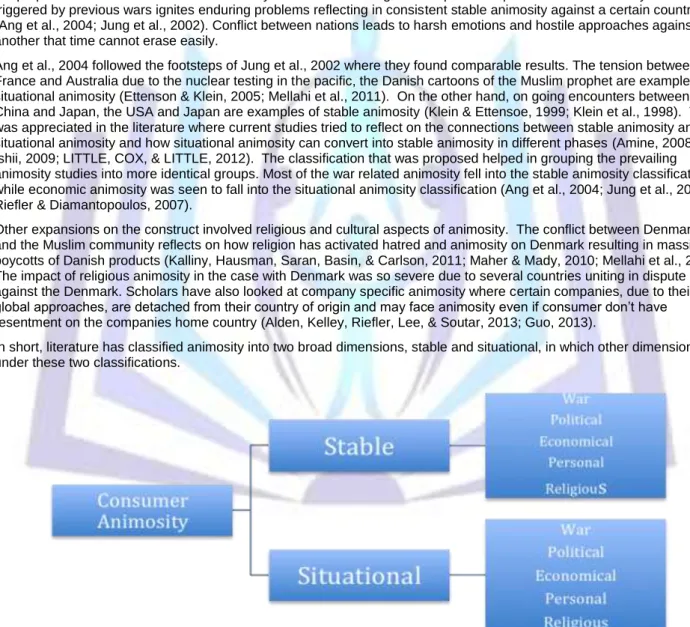
In addition to the previous extension to the construct, several other dimensions of animosity were introduced to the literature. Jung et al., (2002) presented a classification of 4 different types of animosities, which were identified as a result of the extent and the level of animosity. The classifications were determined by stable vs. situational animosity and personal vs. national animosity. Situational animosity was referred to short-lived and situational specific events that provoke animosity, while stable animosity were more long-lived historical standpoints against a certain country. On the other hand, personal animosity was reflected upon an individual’s personal experience with a foreign country and national animosity is centered on how a certain foreign country considers and deals with the home country in hand. The study was conducted on five Asian countries and how the perceived animosity against the USA and Japan, and the results sustained the proposed classification. National animosity was seen to be of greater impact than personal level animosity. Animosity triggered by previous wars ignites enduring problems reflecting in consistent stable animosity against a certain country (Ang et al., 2004; Jung et al., 2002). Conflict between nations leads to harsh emotions and hostile approaches against one another that time cannot erase easily.
Ang et al., 2004 followed the footsteps of Jung et al., 2002 where they found comparable results. The tension between France and Australia due to the nuclear testing in the pacific, the Danish cartoons of the Muslim prophet are examples of situational animosity (Ettenson & Klein, 2005; Mellahi et al., 2011). On the other hand, on going encounters between China and Japan, the USA and Japan are examples of stable animosity (Klein & Ettensoe, 1999; Klein et al., 1998). This was appreciated in the literature where current studies tried to reflect on the connections between stable animosity and situational animosity and how situational animosity can convert into stable animosity in different phases (Amine, 2008; Ishii, 2009; LITTLE, COX, & LITTLE, 2012). The classification that was proposed helped in grouping the prevailing animosity studies into more identical groups. Most of the war related animosity fell into the stable animosity classification, while economic animosity was seen to fall into the situational animosity classification (Ang et al., 2004; Jung et al., 2002; Riefler & Diamantopoulos, 2007).
Other expansions on the construct involved religious and cultural aspects of animosity. The conflict between Denmark and the Muslim community reflects on how religion has activated hatred and animosity on Denmark resulting in massive boycotts of Danish products (Kalliny, Hausman, Saran, Basin, & Carlson, 2011; Maher & Mady, 2010; Mellahi et al., 2011). The impact of religious animosity in the case with Denmark was so severe due to several countries uniting in dispute against the Denmark. Scholars have also looked at company specific animosity where certain companies, due to their global approaches, are detached from their country of origin and may face animosity even if consumer don’t have resentment on the companies home country (Alden, Kelley, Riefler, Lee, & Soutar, 2013; Guo, 2013).
In short, literature has classified animosity into two broad dimensions, stable and situational, in which other dimensions fall under these two classifications.
Fig 2: Type of Animosity
It has also been seen that brands with high global identity are detaching their connection with their home countries and are being despised by consumers in certain events, such as the case with BP’s oil spill that occurred in the Gulf of Mexico. Other studies have also looked at consumers and how they perceived certain regions of their home country and found that animosity can be present in consumers between different regions of a single country (Hinck, 2005; Hinck et al., 2004;
Shimp, Dunn, & Klein, 2004). Shimp et al., (2004) found that retentions of the US civil war might have impacted on consumer purchasing behaviors across different regions of the US.
This was referred to as domestic animosity and was evident between western and eastern Germany also. Accordingly, as pointed out previously, the nature of conflict that triggers animosity can be traced back to several
dimensions (Nes, Yelkur, & Silkoset, 2012). War, economical, political, cultural, personal or even religious measures, that might be in the form of stable or situational events, can prompt animosity. Thus far, it has been seen that war related animosity has the strongest effect on consumers and is stable in the long run (Nijssen & Douglas, 2004). However, it is easy to say that war animosity, along with economic animosity, have been the pioneers in the literature ever since the construct was initiated and they had their fair share of research. On the other hand, other dimensions of the animosity construct, such as religious animosity, haven’t had much attention as the former two (Riefler & Diamantopoulos, 2007). Religious animosity was first introduced by Kalliny & Hausman (2004), in which they emphasized on how religion might be a factor that initiates animosity and effects purchase intentions. Religion is an important factor in many consumers in different countries and has major impact on their decision-making. It has also been seen to effect a persons’ perception of others holding differing religions (Huntington, 1993). Dissimilarities amongst nations in history, language, culture and most importantly, religion are motivating forces for conflict (Huntington, 1993). History is filled with examples of wars awakened by religious differences. Hence religion is an important aspect of a consumer, and overlooking such characteristics nor respecting consumers’ beliefs and values can be harmful to companies. Several studies concentrated on Jews, whether living in the USA or Israel, and how they held animosity against other countries or groups due to their religion being depreciated (Podoshen & Hunt, 2009; Shoham, Davidow, Klein, & Ruvio, 2006). Podoshen & Hunt (2009), looked at how Jews in the USA perceive and engage in purchase of German made cars and how animosity was present. The animosity was due to the historical brutality against the Jews and their religion, which was committed by the Germans. The well-known cartoons that have been published picturing the prophet Mohammed (peace be upon him) in an insulting manner by a Danish journalist have caused a great controversy between Denmark and the Muslim world (Kalliny et al., 2011; Maher & Carter, 2011; Mellahi et al., 2011). Such actions were negatively viewed by the Muslim world and were reimbursed severely by Danish companies, who had been faced by the massive burden of boycott calls. The
multinationals witnessed severe losses due to such actions by the Muslim communities (Maher & Carter, 2011). Not only were individuals involved in the massive boycotts, companies, domestic and international, participated along with some governments in the boycotts against Danish products (Ali, 1999; Knudsen, Aggarwal, & Maamoun, 2011). Carrefour, a leading French supermarket stopped selling Danish dairy and cheese in that region in threat of loosing its customers (Abosag, 2010). Arla Foods’ prolonged established business in the Middle East region was seriously threatened by the massive boycotts initiated after the cartoons were published. The company took several preemptive actions in intent of restoring its image and gaining back its business in the region (Abosag, 2010; Knudsen et al., 2011). Arla Foods detached itself from the cartoons and criticized the cartoons in 25 top newspapers in the Middle East. The Dutch movie “Fitna” that condemned the Islamic religion was on the verge to ignite long-standing boycotts against Dutch products. Due to severity of such actions on foreign companies, and the fact that the animosity on Danish products proved to be extreme, Dutch multinationals publicized that they will hold the producer of the movie responsible for any losses that they might face (Knudsen et al., 2011). Ads were also set up denouncing the movie and describing it as an act of evil.
Out of all the different animosity dimensions that have been introduced till date, war related animosity was seen the most brutal with the utmost impact on consumers (Nijssen & Douglas, 2004). However, religion related animosity has been scarcely studied in the past and has been seen as an aspect of culture related animosity. Previous studies have seen religion as an element which can determine consumer purchasing behavior (Bailey & Sood, 1993). Consumers were seen to avoid products that might have a negative impact on their religious believes. Religion in nature is universal and a national social phenomenon were people from different religions are scattered across many countries across the world. Religion divides the world into groups of people, sharing the same beliefs and members of such groups are expected to have high commitment to their own groups (Seul, 1999). Thirty two percent of the world population belongs to the
Christian religion, twenty three percent to the Muslim religion, fifteen percent to the Hindis religion and the rest of the world population is distributed amongst other religions (Washington times, 2012). While war animosity is mostly related to brutalities in only one country, religion related animosity, is awakened by individuals from several nations and countries uniting together. Therefore we propose:
P1: Religion related animosity is more severe than any other dimension of animosity.
As observed earlier, multinationals react to negative consumer behavior resulting from animosity in different approaches. From public announcements to drastic changes in operations, it is evident that such multinationals have suffered severely as a cause of animosity (Knudsen et al., 2011). For example, Amazon.com terminated its association with the Jerusalem post after it found out that it was donating a portion of revenues to Israeli soldiers. Amazon.com was fearful of being faced by negative actions from its Middle Eastern consumers due to its association with such newspaper (Mellahi et al., 2011). McDonalds has emphasized on its objective for local welfare, were they emphasized that local capital and employees are utilized in their functions. The company has also made some adjustments to some of it products and offerings in order to gain local acceptance (Knudsen et al., 2011). McDonalds in France serves a big mac with wine, and in Egypt it added McFalafel to its menus to highlight on a local appeal to its products. Disney Euro, after facing drastic losses in its early operations, tried to accustom to the French culture and detach from the USA appeal to the parks. Disney introduced several French cartoon characters that aren’t recognized by the US population. They also stretched their “alcohol-free park” policy to accustom to the French culture and wine was available in the park (Packman & Casmir, 1999). Seeing the ongoing animosity between the USA and France, such actions were essential to implement a local image and detach euro Disney from its country of origin. Procter and gamble had its encounter with Middle Eastern markets when its popular
laundry detergent, Ariel, was not selling in that region. After investigating, it had been verified that consumers perceived the detergent to be named after the past Israeli Prime Minister, Ariel Sharon, and the star on the package symbolized the star of David (Knudsen et al., 2011). The company quickly denied such false information, and went to the extent in changing its six pointed star to a four pointed one.
Hence, it is evident that multinational react differently in trying to address the effects of animosity on their products. Most of the previous examples emphasize on how most of the multinationals try to adopt, in one way or another, to local consumers preferences in tackling the negativity that they are being faced with. However, insufficient number of studies has been conducted to reveal how multinational companies react to animosity and if there is a connection with localization strategies. A recent research showed that Chinese consumers were willing to pay more, to a certain percentage, for domestic products than to buy from Japan (Cui, Wajda, & Hu, 2012). A possible explanation is that product price can impact the purchasing process. Hence, by adopting to local consumers price preferences, purchasing might be emphasized even if animosity is present. Jain, 1989, proposed that the greater the variance in political environments between home and host country, then localization should be considered. As noted earlier, animosity can be an outcome of differences in political environments, and therefore, according to Jain (1998), localization of strategies might be the best option. Hence, it can be interpreted that localization strategies stress on maintaining, or even decrease the level of animosity being faced by a multinational. If a products country image is weak, localizing the product is strategically appropriate (Jain, 1989). When consumers have animosity against a certain country, then weakness is a perceived characteristic of that country. Hence we propose that:
P2: In general, localization of market strategies is more practical in host countries that demonstrate high levels of animosity.
Entering new international markets is a complicated process that has to be considered carefully in attempt to overcome any possible losses. The initial strategic decision when targeting foreign markets is the proper selection of entry mode into such markets. Multinational firms should assess a countries risk in tendency of making the entry decision that best suites the new market (Agarwal & Ramaswami, 1992). If such risk is relevant in a home country and perceived to be high, a multinational firm will attempt to designate the least amount of capitals in that target company to insure the capability to exit if required. Animosity plays an extreme role in stimulating a countries risk due to its war, political, economical, cultural, and religious related aspects that make it intimidating to multinationals. Kalliny and Lemaster (2005) conceptual piece reflected on how different entry modes should be evaluated prior entering host countries that had animosity against the companies’ home country. It was proposed that entering through whole owned subsidiaries in host countries with high levels of animosity is not preferred to avoid the high risk on the companies resources if the impact of animosity becomes intolerable. Joint ventures and licensing were seen the most dependent entry mode in high animosity countries (Kalliny & LeMaster, 2005). In the Middle East, it has been found that the dominant modes of entry were franchising and joint ventures while the number of USA wholly owned subsidiaries decreased from 267 affiliates in 1982 to 233 affiliate in 1998 (Mellahi et al., 2011). The decreasing number of wholly owned subsidiaries on that extended time frame might reflect on the challenges faced by such multinationals in entering host countries that bare ongoing animosity against the home country of such companies. However, in a study that exposed Australian firms reactions after the French nuclear testing in the B2B markets, it was found that French importer subsidiaries suffered more than French production subsidiaries in Australia (Edwards, Gut, & Mavondo, 2007). French businesses experienced loss of sales and boycotts from local business, which hurt their operations drastically. But the impact was found to be greater on French importer subsidiaries and they have been witnessed to engage more in public relation activities displaying anti-nuclear statements dissociating themselves from their home countries actions. This contradicts Kalliny and Lamester (2005) paper, which states that entering markets that show animosity by exporting is preferred over wholly, owned subsidiaries. However, this can be associated with the point that importers, that obtain French exports, had a higher French appeal than local established French facilities. Hence, in the case with the Australian consumers, and their dislike of French products, it is seen as an instance of situational animosity and not stable ongoing animosity (Amine, 2008). While situational animosity is based on sudden tension between the two countries, stable animosity is long termed and ongoing which is reflected on a countries risk. Hence, when entering such markets, multinationals should take into account the constant negative image that is associated with their home countries. Situational animosity, nonetheless, is mostly temporary, and by undergoing certain strategic approaches such as having local stakeholder welfare in consideration; as time passes the effects might be less than the case with stable animosity (Ang et al., 2004; Jung et al., 2002). It has also been found that situational animosity can be a function and outcome of stable animosity being previously present in the host country (Leong et al., 2008). The case with China in 2005, when it outraged against the Japanese when textbooks have been approved to cover up on Japanese war brutalities, is an outcome of former and ongoing feelings against the Japanese. Therefore, stable animosity has a greater impact on countries perceived risk than does situational animosity due to the latter being temporary in nature and its effect might even reduce with time. Hence, when country risk is highly perceived due to animosity, having local partners will help in gaining legitimacy and conceal the home country image to overcome animosity. Hence we propose, P3: in general, multinationals show higher preferences for francizing and joint ventures as entry modes in host countries with high levels of stable animosity.
Considering the previous literature on animosity, the host country of the target market extent along diverse culture settings. Individualistic and collectivistic host countries have been taken into account in previous studies. The USA, France, Australia are individualistic contexts where individuals are independent and rely on ones self in decision-making. On the other hand, China, Japan, Middle East and most of the Asian countries are collectivist contexts where individuals see themselves as a part of a group and rely on intergroup decision-making (Hofstede, 1983). Collectivism cultures emphasize on acting in a socially suitable manner that is accepted within the group, while personal emotions and feelings
are to be ignored. Individuals from collectivistic cultures might dread the consequence that might arouse from other in-group members due to their actions and beliefs that might contradict with the in-group (Triandis, 1995). Furthermore, evidence have been found that people in collectivist cultures are more palpable in engagement of information sharing and in-group behavior (Dwyer et al., 2005; Money, Gilly, & Graham, 1998). When boycotts strike, certain collectivist cultures, such as the Middle East, participate in several awareness strategies where information about the products are shared and spread around (Knudsen et al., 2011). Collectivist cultures are more interconnected than individualistic cultures, and rely more on social ties and engagements. In the purchasing perspective, a consumer from a collectivist’s culture is likely to engage in emotional bonds with products or services when such goods reflect strongly on group membership (Buttle, 1998).
Animosity results from events that harmed members of a certain country, and individuals express hatred even if such events did not harm them on the individual level but harmed other members of their country. In collectivists cultures such impact is more solid, due to the nature of such cultures where information sharing and in-group connections are higher. Information such as historical events and past wars are shared amongst individuals, and being a part of the group, individuals accept such information without rationalizing it due to the outer groups approval of such evidence. The case with China and Japan is a clear example of how China being a collective culture, has an ongoing and stable hostility against what the Japanese have caused in their previous occupation of their country. It can be possible that individual Chinese citizen expresses their negativity because they belong to the Chinese group but in some cases, individuals might not really hold such feelings and beliefs in reality. Years have pasted and still the emotions and feelings are the same, if not growing, where such grudge is past down from generation to generation (Ishii, 2009). To be a part of the Chinese group, such feelings and actions against Japan and its products must be awakened and consistent; to avoid criticism by group members and membership of such social group is maintained. However, in individualistic cultures, individuals rationalize information on their personal level. The case of opposition between the USA and France influenced on naming French fries freedom fries instead, but such actions haven’t lasted for long and was changed back to their original names after rationalizing the matter (Amine, 2008). The tension between France and USA is incomparable to China and Japan, where the former have not went to the extent of military hostility and have been seen to be friends that think differently (Amine, 2008). This can be drawn back to the individualistic culture of the USA that after individuals rationalized the extent of the Iraqi war and the resistant’s has grown by the Americans against the war, the negative perception against France has reduced in the eyes of the individual American (Amine, 2008).
In a previous study, it has been seen that country of origin effects varied within different cultures (Gürhan-Canli &
Maheswaran, 2000). It has been found that individualistic cultures demanded foreign products more, regardless of country of origin, when foreign products are superior than home country products, due to its benefited aspect to the individual himself notwithstanding the group he entails to (in our case the group is the home country of individual). However, in collectivistic cultures, foreign products from differing country of origins are evaluated in accordance to the groups approval (Gürhan-Canli & Maheswaran, 2000)
In the case with animosity, when a country has conflict with a collectivist culture, individuals of such cultures are more prone in engaging in hostile behavior that benefits the group that they belong to which are their home countries. In contrast, individualist cultures are emotionally detached and rational where their behavior will reflect the benefit the individual himself will receive rather than the group they belong to. In such case, animosity in individualistic cultures will be of less impact such that individuals make rational decision and will behave in hostility according to one judgments rather than fear of group judgments and rulings. Therefore we purpose that,
P4: The impact of animosity is more stressed in collectivistic cultures than in individualistic cultures.
LIMITATIONS AND IMPLICATIONS FOR FUTURE RESEARCH
As noted previously, most of the research followed Klein et al., 1998 approach by replicating their work in different contexts or by trying to extend on the construct itself to include further dimensions. Almost all of the studies were empirical research and mainly relied on Klein et al. (1998) method and measurement in testing the research being conducted, implementing minor adaptation to the measures. This assumes that Klein et al. 1998 measurements that focused on Chinese consumers are generalizable for different contexts and can be applied to different consumers. However, when looking back to the initial version of the measurements incorporated be Klein et al. (1998), we can see that the measurements were originally conducted in English and several measures included in the survey relied on instruments that have been previously used in other research, which have focused on western consumers and not Chinese
consumers. This sets some doubts on the validity and reliability of the survey that has been used for the initial study on the animosity model and many scholars relied on it for their following research. The measurements used in almost all the studies fall in the pseudo-epic trap, in which the scholars assume that they emphasizes on national and cultural difference in their measurements however in reality such difference are not being capture in the measurements being used. For instance, the extent and magnitude of war can be perceived differently by international consumers in which it is historical for some countries, while for others it is still current and present.
The empirical data that has been collected for previous studies has been gathered from a variety of source. Most of the samples that have been collected relied on consumer sampling from individuals in commercial areas (Ang et al., 2004; Jung et al., 2002; Klein et al., 1998). This might lead to bias outcomes where other consumers might have not been randomly included that have other means of purchasing. Some studies conducted their empirical work relying on student samples, which is opportunistic and cannot be generalizable to the whole public (C. A. Russell, 2004; Shimp et al., 2004; Shin, 2001).
In mostly all of the studies, countries in conflict where animosity is present are assumed to be known and specified in advance. There has been little exploratory research to uncover consumers’ negative feelings to different countries, as if scholars, before conducting the research, already know which country is disliked in consumers’ minds. Riefler and Diamantopoulos (2007) emphasized that such approach might overlook other countries that consumers might have greater animosity towards, and the mere mentioning of such countries might be a trigger in reminding consumers of drastic events that they have caused and negativity might be awakened.
Studies have considered the individual consumer animosity on foreign production in nearly all the studies. However, negativity against another country is mostly resulting from macro-level actors such as governments and institutes. Animosity on the B2B level was seen to also have impact on purchasing behavior such as with the individual consumer (Edwards et al., 2007), however insufficient number of studies have tackled such issues. Government related animosity is also important such that tensions between countries are mostly initiated by governmental approaches like the case with Iran and the USA (Bahaee & Pisani, 2009). No research has been undertaken to address the role of governments in provoking negative purchasing behavior of foreign products. In addition, most of the research conducted, which addressed animosity, reflected only on manufactured goods. Previous literature was salient on serviced goods, in which the former studies reflected on manufacturing companies and forgone service companies. Service companies compromise a high percentage of international companies and should be considered when studding animosity. International banks, insurance companies, supermarkets and many more are examples of services companies that are present in international markets and consumer behavior on such services should be taken into account in animosity studies.
Furthermore, most of the studies on animosity looked at the construct as a static phenomenon. Only a umber of research actually looked at animosity as dynamic in nature emphasizing on he fact that the construct can change over time (Amine, 2008; Ang et al., 2004; Jung et al., 2002; LITTLE et al., 2012). This is problematic in which animosity that was present earlier in some countries might not be existent in resent years. Research relying on such matters must take into account the dynamic nature of animosity.
Although a number of studies on animosity have been conducted in the recent years, in which significant insights on the construct have been revealed, there are some avenues for future research on distinctive issues related to the construct that yet have not been encountered. Hence, future research should accommodate costumed fitted measurements for different countries to reflect on cultural and national differences that exist across countries. Exploratory research also must be considered to see if consumers of a certain host country carry hatred on another country, rather that initially assuming the two countries before conducting the research. The effects and outcomes of animosity on multinationals should be considered deeply. How companies develop proactive strategies to confront animosity faced from a host country is an issue that should be addressed where more and more companies are transforming in multinational firms and are being faced by such challenges. Animosity should be studied in developed, developing and non-developed markets as well, to see if such model holds for all types of markets. Manufactured and service goods should both be considered for such studies.
CONCLUSION
This paper reviews the past literature on animosity and reflects on the gaps and limitations on previous research. Animosity is a distinct concept, which effects purchasing behavior without being dependent on quality judgment (Klein et al., 1998). Multinational enterprises should take into account the presence of animosity when entering foreign markets. From initially entering to actually operating in such markets, companies should take into consideration the level of animosity that might be present. Mangers should put in mind when dealing with a market that shows high levels of animosity against their products, common and usual marketing methods will not always work in boosting sales in such markets. Sales promotion, advertising, or even new designs might not work with high animosity consumers. However, several practices that engage in local stakeholder welfare have been seen to sustain and minimize the effects of animosity (Knudsen et al., 2011; Maher & Mady, 2010). Public relations have been seen the most apparent action undertaken by most of the multinationals that have been faced by animosity. International and also domestic retailers can benefit from understanding the implications of the animosity construct. Such firms can identify local consumer animosity and try to avoid dealing with international suppliers that originate from home countries despised by the local market. This can be seen with the case of Carrefour mentioned earlier in which they stopped dealing with Danish goods in the Middle East. Multinational firms can also try to disassociate themselves from their home countries actions. Also, firms can try to restrain the “made in” labels that have a direct connection with offending country.
On a wider scale, multinational and domestic firms can benefit from animosity on other competitors in positioning themselves differently. Companies can promote on being products and goods that are not from the offending country. This could be beneficial especially for local firms who are in threat of international trade affecting their operations and sales.
Finally, the animosity construct is an important concept in the international business literature, which is helpful for both domestic and international firms. The construct helps mangers understand the effects of tensions between nations have on international markets. Managers should understand which countries hold animosity on their products and implement strategic marketing and managerial decisions when targeting current and prospective consumers.
REFERENCES
[1] Abosag, Ibrahim. (2010). Dancing with macro-boycotters: the case of Arla Foods. Marketing Intelligence & Planning, 28(3), 365-373.
[2] Agarwal, Sanjeev, & Ramaswami, Sridhar N. (1992). Choice of foreign market entry mode: Impact of ownership, location and internalization factors. Journal of international business studies, 1-27.
[3] Alden, Dana L, Kelley, James B, Riefler, Petra, Lee, Julie A, & Soutar, Geoffrey N. (2013). The Effect of Global Company Animosity on Global Brand Attitudes in Emerging and Developed Markets: Does Perceived Value Matter?
Journal of International Marketing, 21(2), 17-38.
[4] Ali, Abbas J. (1999). Middle East competitiveness in the 21st century's global market. The Academy of Management Executive, 13(1), 102-108.
[5] Amine, Lyn Suzanne. (2008). Country-of-origin, animosity and consumer response: Marketing implications of anti-Americanism and Francophobia. International Business Review, 17(4), 402-422.
[6] Ang, Swee Hoon, Jung, Kwon, Kau, Ah Keng, Leong, Siew Meng, Pornpitakpan, Chanthika, & Tan, Soo Jiuan. (2004). Animosity towards economic giants: what the little guys think. Journal of Consumer Marketing, 21(3), 190-207. [7] Bahaee, Mahmood, & Pisani, Michael J. (2009). Iranian consumer animosity and US products: a witch's brew or
elixir? International Business Review, 18(2), 199-210.
[8] Bailey, Jessica M, & Sood, James. (1993). The effects of religious affiliation on consumer behavior: A preliminary investigation. Journal of Managerial Issues.
[9] Batra, Rajeev, Ramaswamy, Venkatram, Alden, Dana L, Steenkamp, Jan-Benedict EM, & Ramachander, S. (2000). Effects of brand local and nonlocal origin on consumer attitudes in developing countries. Journal of Consumer Psychology, 9(2), 83-95.
[10] Bilkey, Warren J, & Nes, Erik. (1982). Country-of-origin effects on product evaluations. Journal of international business studies, 13(1), 89-100.
[11] Buttle, Francis A. (1998). Word of mouth: understanding and managing referral marketing. Journal of strategic marketing, 6(3), 241-254.
[12] Cui, Annie Peng, Wajda, Theresa A, & Hu, Michael Y. (2012). Consumer animosity and product choice: might price make a difference? Journal of Consumer Marketing, 29(7), 494-506.
[13] Dwyer, Sean, Mesak, Hani, & Hsu, Maxwell. (2005). An exploratory examination of the influence of national culture on cross-national product diffusion. Journal of International Marketing, 13(2), 1-27.
[14] Edwards, Ron, Gut, Anne-Marie, & Mavondo, Felix. (2007). Buyer animosity in business to business markets: evidence from the French nuclear tests. Industrial Marketing Management, 36(4), 483-492.
[15] Ettenson, Richard, & Gaeth, Gary. (1991). Consumer perceptions of hybrid (bi-national products). Journal of Consumer Marketing, 8(4), 13-18.
[16] Ettenson, Richard, & Klein, Jill Gabrielle. (2005). The fallout from French nuclear testing in the South Pacific: a longitudinal study of consumer boycotts. International Marketing Review, 22(2), 199-224.
[17] Guo, Xiaoling. (2013). Living in a global world: Influence of consumer global orientation on attitudes toward global brands from developed versus emerging countries. Journal of International Marketing, 21(1), 1-22.
[18] Gürhan-Canli, Zeynep, & Maheswaran, Durairaj. (2000). Cultural variations in country of origin effects. Journal of marketing research, 37(3), 309-317.
[19] Hinck, Wolfgang. (2005). The role of domestic animosity in consumer choice: empirical evidence from Germany.
Journal of Euromarketing, 14(1-2), 87-104.
[20] Hinck, Wolfgang, Cortes, Angelica, & James, Karen. (2004). An empirical investigation of the failure of Eastern German products in Western German markets. Journal for International Business and Entrepreneurship Development, 2(1), 104-111.
[21] Hofstede, Geert. (1983). The cultural relativity of organizational practices and theories. Journal of international business studies, 75-89.
[22] Hong, Sung-Tai, & Kang, Dong Kyoon. (2006). Country-of-origin influences on product evaluations: The impact of animosity and perceptions of industriousness brutality on judgments of typical and atypical products. Journal of Consumer Psychology, 16(3), 232-239.
[23] Huntington, Samuel P. (1993). The clash of civilizations? Foreign affairs, 22-49.
[24] Ishii, Kenichi. (2009). Nationalistic sentiments of Chinese consumers: The effects and determinants of animosity and consumer ethnocentrism. Journal of International Consumer Marketing, 21(4), 299-308.
[25] Jain, Subhash C. (1989). Standardization of International Marketing Strategy: Some Research Hypotheses. Journal of marketing, 53(1).
[26] Johansson, Johny K, Douglas, Susan P, & Nonaka, Ikujiro. (1985). Assessing the impact of country of origin on product evaluations: A new methodological perspective. Journal of Marketing Research (JMR), 22(4).
[27] Jung, Kwon, Ang, Swee Hoon, Leong, Siew Meng, Tan, Soo Jiuan, Pornpitakpan, Chanthika, & Kau, Ah Keng. (2002). A typology of animosity and its cross-national validation. Journal of Cross-Cultural Psychology, 33(6), 525-539.
[28] Kalliny, Morris, Hausman, Angela, Saran, Anshu, Basin, Permian, & Carlson, Odessa Brad. (2011). THE IMPACT OF CULTURAL AND RELIGIOUS ANIMOSITY ON PRODUCT EVALUATIONS. Marketing 2011: Delivering Value in Turbulent Times, 183.
[29] Kalliny, Morris, & LeMaster, Jane. (2005). BEFORE YOU GO, YOU SHOULD KNOW: THE IMPACT OF WAR, ECONOMIC, CULTURAL AND RELIGIOUS ANIMOSITY ON ENTRY MODES. Marketing Management Journal, 15(2).
[30] Klein, Jill Gabrielle. (2002). Us versus them, or us versus everyone? Delineating consumer aversion to foreign goods.
Journal of international business studies, 345-363.
[31] Klein, Jill Gabrielle, & Ettensoe, Richard. (1999). Consumer animosity and consumer ethnocentrism: an analysis of unique antecedents. Journal of International Consumer Marketing, 11(4), 5-24.
[32] Klein, Jill Gabrielle, Ettenson, Richard, & Morris, Marlene D. (1998). The Animosity Model of Foreign Product Purchase: An Empirical Test in the People's Republic of China. Journal of marketing, 62(1).
[33] Knudsen, Kjell, Aggarwal, Praveen, & Maamoun, Ahmed. (2011). The burden of identity: responding to product boycotts in the Middle East. Journal of Business & Economics Research (JBER), 6(11).
[34] Leong, Siew Meng, Cote, Joseph A, Ang, Swee Hoon, Tan, Soo Jiuan, Jung, Kwon, Kau, Ah Keng, & Pornpitakpan, Chanthika. (2008). Understanding consumer animosity in an international crisis: nature, antecedents, and
consequences. Journal of international business studies, 39(6), 996-1009.
[35] LITTLE, JOSEPH P, COX, K CHRIS, & LITTLE, ELDON L. (2012). A GENERATIONAL COMPARISON OF
ECONOMIC-BASED AND WAR-BASED CONSUMER ANIMOSITY: THE CASES OF US CONSUMER ANIMOSITY TOWARDS CHINA AND VIETNAM. Marketing Management Journal, 22(2).
[36] Maher, Amro A, & Carter, Larry L. (2011). The affective and cognitive components of country image: Perceptions of American products in Kuwait. International Marketing Review, 28(6), 559-580.
[37] Maher, Amro A, & Mady, Sarah. (2010). Animosity, subjective norms, and anticipated emotions during an international crisis. International Marketing Review, 27(6), 630-651.
[38] Mellahi, Kamel, Demirbag, Mehmet, & Riddle, Liesl. (2011). Multinationals in the Middle East: Challenges and opportunities. Journal of World Business, 46(4), 406-410.
[39] Money, R Bruce, Gilly, Mary C, & Graham, John L. (1998). Explorations of national culture and word-of-mouth referral behavior in the purchase of industrial services in the United States and Japan. The Journal of Marketing, 76-87. [40] Nes, Erik B, Yelkur, Rama, & Silkoset, Ragnhild. (2012). Exploring the animosity domain and the role of affect in a
cross-national context. International Business Review, 21(5), 751-765.
[41] Nijssen, Edwin J, & Douglas, Susan P. (2004). Examining the animosity model in a country with a high level of foreign trade. International Journal of Research in Marketing, 21(1), 23-38.
[42] Ohmae, Kenichi. (1990). The borderless world: Power and strategy in the international economy. Mckinsey&company, Inc.
[43] Packman, Hollie Muir, & Casmir, Fred L. (1999). Learning from the Euro Disney Experience A Case Study in International/Intercultural Communication. International Communication Gazette, 61(6), 473-489.
[44] Podoshen, Jeffrey S, & Hunt, James M. (2009). Animosity, collective memory, rumor and equity restoration: Consumer reactions to the Holocaust. Consumption, Markets and Culture, 12(4), 301-327.
[45] Riefler, Petra, & Diamantopoulos, Adamantios. (2007). Consumer animosity: a literature review and a reconsideration of its measurement. International Marketing Review, 24(1), 87-119.
[46] Russell, Cristel Antonia. (2004). Now showing: global movies crossing cultural lines. Is resistance futile? San Diego State University, San Diego, CA, CIBER working paper series.
[47] Russell, Dale W, & Russell, Cristel Antonia. (2006). Explicit and implicit catalysts of consumer resistance: the effects of animosity, cultural salience and country-of-origin on subsequent choice. International Journal of Research in Marketing, 23(3), 321-331.
[48] Seul, Jeffrey R. (1999). Ours is the way of god': Religion, identity, and intergroup conflict. Journal of Peace Research, 36(5), 553-569.
[49] Shimp, Terence A, Dunn, Tracy H, & Klein, Jill G. (2004). Remnants of the US Civil War and modern consumer behavior. Psychology & Marketing, 21(2), 75-91.
[50] Shimp, Terence A, & Sharma, Subhash. (1987). Consumer ethnocentrism: construction and validation of the CETSCALE. Journal of marketing research, 280-289.
[51] Shin, Mincheol. (2001). The animosity model of foreign product purchase revisited: does it work in Korea? Journal of Empirical Generalisations in Marketing Science, 6(1), 6-14.
[52] Shoham, Aviv, Davidow, Moshe, Klein, Jill G, & Ruvio, Ayalla. (2006). Animosity on the home front: the Intifada in Israel and its impact on consumer behavior. Journal of International Marketing, 92-114.
[53] Triandis, Harry Charalambos. (1995). Individualism & collectivism: Westview Press.
[54] Witkowski, T. (2000). Effects of animosity toward China on willingness to buy Chinese products. Managing in a turbulent international business environment, 470-477.
[55] Zhou, Lianxi, & Hui, Michael K. (2003). Symbolic value of foreign products in the People’s Republic of China. Journal of International Marketing, 11(2), 36-58.
Author’ biography
Hesah Aljarboa is a Lecturer the Finance department in King Saud University who is in the process of pursing her Phd degree. Her research intersts are behavioural finace and international business.