Creative Commons CC BY-NC-ND: This article is distributed under the terms of the Creative Commons
Attribution-NonCommercial-NoDerivs 4.0 License (http://www.creativecommons.org/licenses/by-nc-nd/4.0/) which permits non-commercial use, reproduction and distribution of the work as published without adaptation or alteration, without further permission provided the original work is attributed as specified on the SAGE and Open Access pages (https://us.sagepub.com/en-us/nam/open-access-at-sage).
https://doi.org/10.1177/2053168018823957 Research and Politics
January-March 2019: 1 –9 © The Author(s) 2019 Article reuse guidelines: sagepub.com/journals-permissions DOI: 10.1177/2053168018823957 journals.sagepub.com/home/rap
Introduction
Technological change has continually shaped the labor market for centuries and the past few decades have been no exception. Labor economists have shown that during this period, increases in computing power allowed for the auto-mation of conceptually simple and repetitive “routine tasks” (Autor, Levy and Murnane, 2003). As technology has dramatically affected employment, we might expect it to also have an important effect on labor market institu-tions, notably trade unions. Many routine task jobs, such as assembly line work, were in heavily unionized plants. With technological change, however, industrial employment declined. Factories had fewer workers and workers moved into service sector occupations, which did not have histo-ries of unionization (Hirsch, 2008). Furthermore, the skill composition of the workforce became more polarized, with increased demand for high-skill workers, but also for low-skill workers (Goos, Manning and Salomons, 2014).
There is some recent evidence that technological change has been in part responsible for the decline in union density,
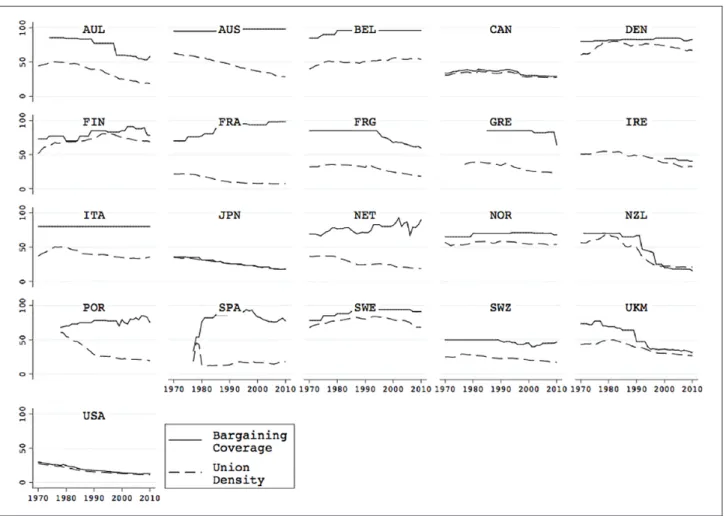
both in the USA and across the Organisation for Economic Co-operation and Development (OECD) (Dinlersoz and Greenwood, 2016; Meyer, forthcoming). But there has also been divergence in several countries between the percentage of workers who are union members, which has declined almost everywhere, and the percentage of workers who are covered by collective agreements (Figure 1). One important reason for this is that in several European countries, such as France, Spain, and Italy, the government typically extends collective agreements to firms that do not sign them, regard-less of union membership rates (Blainpain, 2005). And col-lective agreement coverage is very important; as we can see in Figure 2, there is a negative cross-country correlation
The conditional effect of technological
change on collective bargaining coverage
Brett Meyer
1and Thomas Biegert
2Abstract
Recent work in labor economics has shown that technological change has induced labor market polarization, an increase in demand for both high and low skill jobs, but declining demand for middle skill routine task jobs. We argue that labor market polarization should affect firms’ participation in collective agreements, but only in countries where laws automatically extending collective agreements to nonparticipating firms are weak. We develop an argument in which labor market polarization increases the distance between different skill groups of workers in both preferences for unionization and leverage to realize those preferences. Because of this, an increase in labor market polarization should be associated with a decline in collective bargaining coverage. We test our hypothesis about collective agreement extension and collective bargaining coverage in a cross-national sample of 21 Organisation for Economic Co-operation and Development countries from 1970 to 2010 and our hypothesis about labor market polarization in German firm-level and industry-level data from 1993–2007. We find a negative relationship in the Organisation for Economic Co-operation and Development sample between technological change and collective bargaining coverage only in countries that make little or no use of extension procedures. We find that higher workforce skill polarization is associated with lower collective agreement participation in both German firm-level and industry-level samples.
Keywords
Technological change, labor market polarization, trade unions, Germany
1Tony Blair Institute for Global Change, UK 2London School of Economics, UK Corresponding author:
Brett Meyer, Tony Blair Institute for Global Change, 50 Broadway, London SW1H OBL, UK.
Email: [email protected]
between collective agreement coverage and inequality. In the Scandinavian countries, collective agreements are in large part responsible for setting high minimum wages (Meyer,
2016). Despite this, most cross-national studies of union strength analyze union density rather than collective bargain-ing coverage.
In this paper, we address whether technological change also affects collective agreement coverage. First, we analyze collective bargaining coverage for a sample of 21 OECD countries from 1970 to 2010. We find that the effect of tech-nological change is conditional on whether the government extends collective agreements to firms that do not sign them. Where there are minimal or no provisions to extend collec-tive agreements, such as in the USA, the United Kingdom, and the Scandinavian countries, technological change is associated with a decline in collective bargaining coverage. Where collective agreements are commonly extended, as in France and Spain, there is little relationship between techno-logical change and collective bargaining coverage.
Based on this finding, we further probe the relationship between technological change and collective agreement coverage in contexts where the government has minimal involvement in collective agreement application. We develop an argument for how technological change would
Figure 1. Bargaining coverage and union density over time.
AUL: Australia; AUS: Austria; BEL: Belgium; CAN: Canada; DEN: Denmark; FIN: Finland; FRA: France; FRG: Germany; GRE: Greece; IRE: Ireland; ITA: Italy; JPN: Japan; NET: Netherlands; NOR: Norway; NZL: New Zealand; POR: Portugal; SPA: Spain; SWE: Sweden; SWZ: Switzerland; UKM: United Kingdom; USA: United States of America.
Source: Visser (2014).
Figure 2. Bargaining coverage and income inequality.
Sources: Organisation for Economic Co-operation and Development (OECD) and Visser (2014).
cause the decline of collective agreement coverage in such an environment by increasing labor market polarization. In previous generations, industrial production required large amounts of semiskilled workers performing routine tasks. Technological change has eliminated many of these jobs, resulting in increased demand for both high- and low-skill workers. Therefore, at least in part, the effect of technologi-cal change on collective agreement coverage should be due to the between-skill group polarization that it creates.
We test this argument on a sample of linked employer-employee firm and industry-level data from Germany from 1993 to 2007. While there are legal provisions to extend collective agreements in Germany, the legal hurdles to trig-gering them are high and they are much less commonly used than in other continental countries. We develop a measure of the heterogeneity of workers’ skill profiles based on education levels. We include both this and a meas-ure of routine task employment and find evidence for the skill heterogeneity effect in both the firm- and industry-level analyses. When skill heterogeneity is high, firms are less likely to participate in collective agreements and indus-try-level rates of participation are lower. This corroborates the mechanism underlying our theory—that the effect of technological change on collective agreement coverage occurs (at least in part) through its polarizing effect.
Collective agreement coverage:
Cross-national analysis
The standard argument for how technological change causes trade union decline is that the most heavily union-ized workers worked in manufacturing and industry and that these occupations were most susceptible to labor-saving technologies (Hirsch, 2008). The effect came largely through attrition; unionized jobs in industry were lost and replaced by nonunionized jobs in service sectors. In this section, we examine whether this relationship holds for collective bargaining coverage in a cross-national sample.
In addition to examining different outcome variables, pre-vious work on technological change and union decline has not accounted for how institutions might mediate this rela-tionship. Governments play an important role in the scope of collective bargaining coverage across much of Europe. In France and Spain, the government typically declares collec-tive agreements to be universally binding within a sector, even if a relatively low percentage of workers work in firms that sign these. In these countries, collective bargaining cov-erage has remained high even though union density is often very low. In English-speaking countries, where extension procedures are almost nonexistent, rates of collective agree-ment coverage track union density much more closely.
For these reasons, we expect the relationship between technological change and collective agreement coverage to be conditional on the degree to which governments extend
collective agreements. Specifically, we expect technological change to be associated with lower collective bargaining coverage only when the government does not extend collec-tive agreements.
To test this, we examine a dataset of 21 OECD countries from 1970 to 2010. Data on collective bargaining coverage, the percentage of the workforce covered by a collective agreement, come from Visser (2015).1 To capture
techno-logical change, we generate a measure of routine task employment (RTE) using data on occupational distribu-tions from European Union Labor Force Surveys for the period 1992–2010 and from the International Labor Organization pre-1992.2 We generate our measure of RTE
by computing the percentage of employment for each occu-pation within each country year, multiply each of these by the respective measures of occupational routine task inten-sity (we obtain the occupation-specific indicator for rou-tine-task intensity from Goos et al., 2014), and then sum these scores within country-year. Our measure indicates the degree of employment in routine task occupations in each country-year. If technological change is associated with declining collective bargaining coverage, we would expect
a positive coefficient on RTE; that is, bargaining coverage
is higher when RTE is higher.
Our measure of extension procedures EXT comes from Visser (2014) and consists of four categories indicating increasing presence of extension. We expect a positive rela-tionship between EXT and bargaining coverage. We also expect it to mediate the relationship between RTE and cov-erage. When EXT is high, we would expect the effect of RTE on coverage to be lower than when EXT is low. Because of this, we expect a negative coefficient on the interaction RTE × EXT.
We analyze our data using a Generalized Error Correction Model because panel unit root tests demonstrate nonsta-tionarity in our dependent variable, and cointegration tests demonstrate cointegration between RTE and bargaining coverage (DeBoef and Keele, 2008).
∆ = + + + + + + + ∆ ∆ ∆ ∆ ∆ − − − Y Y X X Z Z X Z X Z t t t t t t t t t t α τ β β β β β β 0 1 1 0 1 1 2 3 1 4 * 5 * −− − − − − + + + + + + + ∆ ∆ 1 6 1 7 1 1 1 β β β β λ γ ε X Z X Z W W t t t t k k t k k t i t * * , ,
where ΔYt represents current changes in bargaining
cover-age (the first-differenced dependent variable addresses nonstationarity). Here ΔXt and Xt−1 and ΔZt and Zt−1,
respec-tively, are vectors of the current changes and lagged levels of our two main independent variables and Yt−1 is a vector
of the lagged level of the dependent variable L.Coverage. The variables τ1 and β0 through β3 are their respective
coef-ficients. In parentheses are all possible interaction terms between the current changes and lagged levels of our two main independent variables with β4 through β7 serving as
their coefficients (Warner, 2016). Current changes and lagged levels of our control variables are represented by
ΔWk,t and Wk,t−1 with their coefficients in βk. Finally, λi
rep-resents country dummies (included in the fixed effects models), γt represents year dummies, α0 is the constant, and
ε is the error term. We standardize the coefficients so that they can be interpreted as the change in bargaining cover-age percentcover-age associated with a 1 SD increase in the respective coefficient.
We first run the models without the country fixed effects and without controls to assess potential overspecification issues or problems arising from restricted variance within countries (Models 1 and 2). Then we successively intro-duce the covariates (Models 3 and 4) and the country fixed effects (Models 5 and 6). Models 1, 3, and 5 of Table 1 regress bargaining coverage on differences and levels of RTE and EXT in random effects models without and with controls and fixed effects models with controls. Models 2, 4, and 6 present the same models but add the interaction terms between RTE and EXT. The results indicate that there
is no strong main effect of RTE on coverage. A 1 SD increase in EXT, however, is associated with approximately six percentage points higher bargaining coverage, consist-ent with our expectation.3
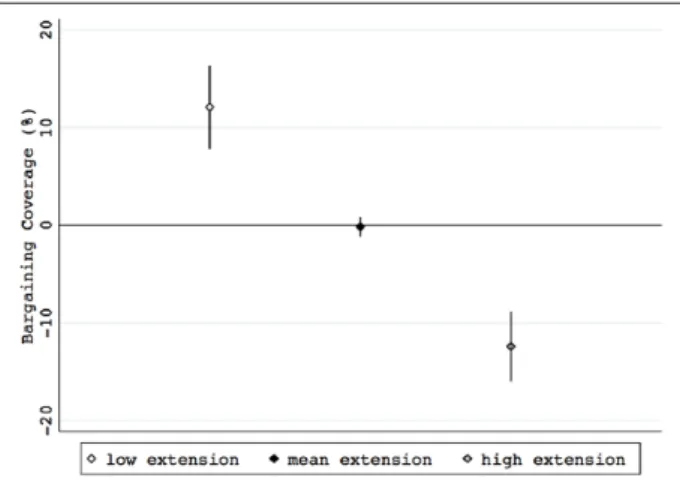
Looking at the interaction terms, we find some confirma-tion for our expectaconfirma-tions. A short-term increase in RTE has a weaker association with bargaining coverage as EXT increases. Figure 3 (based on Model 6) displays the moder-ated marginal effect for three levels of EXT (the mean and 1 SD below and above the mean). As we would have expected, when extension provisions are low, higher RTE is strongly positively associated with bargaining coverage. Notice also that when we include the interaction between RTE and EXT, the coefficient on short-run EXT becomes insignificant, fur-ther demonstrating the importance of accounting for the conditional relationship between them, as a short-run change in EXT is not associated with a change in coverage when RTE is at the mean (the 0 of the standardized variable).
While these models lend some credence to our theoreti-cal considerations, cautious interpretation is advised. Most
Table 1. Regressions of bargaining coverage on technological change and extension procedures (error correction models).
(1)
Random effects (2)Random effects (3)Random effects (4)Random effects (5)Fixed effects (6) Fixed effects L.Coverage –0.009 0.001 –0.029+ –0.024 –0.179*** –0.169*** (0.012) (0.006) (0.017) (0.016) (0.032) (0.033) D.RTE 0.495 0.192 0.122 –0.357 0.140 –0.167 (0.393) (0.391) (0.509) (0.522) (0.502) (0.515) L.RTE 0.305 0.248 0.219 0.324 0.361 0.472 (0.242) (0.189) (0.253) (0.266) (0.433) (0.417) D.EXT 6.037** 1.038 6.230** 0.849 5.530* 1.017 (2.002) (0.703) (1.933) (1.133) (2.037) (1.468) L.EXT 0.326 0.205 0.552* 0.490+ 1.424 1.425 (0.260) (0.213) (0.278) (0.275) (0.897) (0.842) D.RTE*D.EXT –12.908*** –13.842*** –12.029*** (0.506) (1.093) (1.817) D.RTE*L.EXT 0.410 –0.000 –0.229 (0.262) (0.299) (0.317) L.RTE*D.EXT 2.512* 2.593* 2.207+ (0.992) (1.146) (1.254) L.RTE*L.EXT 0.254 0.230+ 0.187 (0.206) (0.124) (0.216)
Controls No No Yes Yes Yes Yes
Year dummies Yes Yes Yes Yes Yes Yes
Constant 0.376 –0.099 0.836 0.667 6.522+ 6.510+
(0.845) (0.605) (1.171) (1.129) (3.482) (3.259)
Observations 607 607 607 607 607 607
Number of countries 21 21 21 21 21 21
Standardized coefficients, with country clustered SEs in parentheses. Controls include log gross domestic product, percentage of industrial employment, unemployment, cabinet composition, federalism, trade openness, capital account openness, female employment, union density (all from Brady, Huber and Stephens, 2014), works council rights, union organizational and strike rights, collective agreements extension procedures (from Visser, 2015), and “offshorability” (based on Goos, Manning and Salomons, 2014), migration Lee (2005), UN (1977, 1985).
***p < 0.001, **p < 0.01, *p < 0.05, +p < 0.1.
importantly, changes in EXT are very rare and thus the major interaction effect between the first differences of RTE and EXT relies on relatively few observations. This might also explain the large coefficient (e.g., an increase of approximately 13 percentage points in bargaining coverage being associated with a 1 SD increase in RTE in a low EXT context).4 This issue is exacerbated in the fixed effects
models that rely only on within-country variation. Nevertheless, the coefficient on the short-run interaction term is of consistent size across the specifications, which increases our confidence in the robustness of the result.
Labor market polarization and
collective agreements
While we have provided evidence that the relationship between technological change and collective agreement coverage is conditional on extension procedures, many countries either do not have or make minimal use of these procedures. Therefore, it is worthwhile to develop further theory about how technological change should affect col-lective agreement coverage in an environment without extension.
We build off a limited, but inciteful literature. Acemoglu et al. (2001) developed a model in which technological change causes union decline by shifting the demand for labor in favor of skilled over unskilled workers. This work builds on the concept of skill-biased technological change— that there has been a linearly increasing relationship between skill levels and demand for those skills (Goldin and Katz, 2008). Because unions compress wages between these groups, skilled workers defect from unions.
Dinlersoz and Greenwood (2016)5 argue that skilled
workers are more heterogeneous than unskilled workers and will be less likely to form unions due to their interest
heterogeneity. They find an association between skill-biased technological change and union density decline in the USA. While remaining relatively agnostic about the mechanisms, Meyer (forthcoming) finds a similar relation-ship between technological change and union density decline for a sample of OECD countries.
But while these previous explanations develop their arguments based on skill heterogeneity, the mechanisms that they posit are somewhat different from those suggested by recent work on technological change and employment. In contrast to the skill-biased technological change hypoth-esis, this recent work has shown that technological change has a polarizing effect on employment, increasing employ-ment at the high and low ends of the wage spectrum while decreasing that in the middle (Autor and Dorn, 2013; Goos et al., 2014).
In line with this new understanding of labor market change, we argue that technological change-induced labor market polarization creates a new economic cleavage between high- and low-skill workers over support for unions that impacts both trade union density and the coverage of collective agreements. Our theory follows recent work in political science on institutional development, which has shown that greater between-group heterogeneity decreases the probability of developing encompassing institutions (Ahlquist, 2010; Lupu and Pontusson, 2011). The polariza-tion of employment into high- and low-wage occupapolariza-tions and “hollowing out” of the middle part of the wage distri-bution may affect both individual preferences for unioniza-tion and the distribuunioniza-tion of preferences for unionizaunioniza-tion across the skill spectrum. High- and low-skill groups should have different preferences for unions, which equalize wages both across and within skill groups, and between firms in multi-firm agreements (Freeman and Medoff, 1984). New technology increases the demand for both pro-grammers and engineers, who create and maintain new technology, as well as for personnel and business managers to manage what are often more complicated production net-works. This gives these workers a great deal of individual wage bargaining power and less desire to be represented by unions.
As the distance between skill groups in their ability to make wage demands increases, these different groups should be less likely to agree on whether they should be covered by collective agreements, which redistribute between groups by aiming for parity in wage increases. Low-skill workers want wage redistribution, but high-skill workers do not and have high individual bargaining power in a nonunionized workplace. Furthermore, as demand for high-skill workers increases due to their importance for developing and operating new technology, their wages increase and the wage gap between high-skill and low-skill workers increases. If redistribution raises the median wage toward the mean, the amount that is redistributed from them to low-skill workers increases with the wage gap.
Figure 3. Marginal effect of RTE (short-run) on bargaining
coverage by levels of extension provisions.
Note: Marginal effects calculated from Model 6 in Table 1 (based on all three coefficients that include D.RTE).
Redistribution has greater “bite” for high-skill workers and they should be more averse to a redistributive institution, such as unions.
Polarization and collective agreement
participation: Evidence from Germany
To test this argument, we use two linked employer-employee data from Germany: the firm-level Linked employer-employee data of the Institut für Arbeitsmarkt-und Berufsforschung (LIAB) longitudinal model version 2
and the LIAB Cross-Section Model 2.6 Both of these
data-sets consist of the Institute for Employment Research Establishment Panel (Betriebspanel), a yearly survey of between 4500 and 16,000 firms with questions on firm performance, employment, training, etc., and social secu-rity records drawn for each of the firm's employees each year on June 30, containing information on sex, level of school completion, and occupation. Firms are selected in a stratified random sample according to industry, federal state, and size.7 The Longitudinal Model includes firms in
most or all years of the Establishment Panel while the Cross-Section Model consists of the full yearly sample of firms. We aggregate the latter at the industry-level to examine whether differences in skill profiles between firms are also associated with lower participation in collec-tive agreements.
In Germany, firms make the decision to participate in col-lective agreements primarily by being members of an employers' association, which concludes an industry-wide agreement with a major union, typically at federal state level (Silvia and Schroeder, 2007).8 Collective agreement
exten-sion exists in Germany, but it has a high threshold for enact-ment: 50% of firms within a sector nationwide must participate in the collective agreement and the must petition the federal government to extend it to noncovered firms. Although the employer makes the decision to participate in a collective agreement, this will be, in part, a function of employer and worker preferences and power resources, as developed in our theory. While the German case is not gen-eralizable to countries where collective agreement extension is common, it is somewhat analogous to the USA, UK, and Canada, which have, but do not always require, workplace union recognition votes.9 As we see in Figure 3, although the
percentage of firms covered by collective agreements in Germany has been declining, it remains relatively high.
We focus here (see Figure 4) on industry-level agree-ments, the predominant form of collective agreement. We perform two sets of analyses: (a) a firm-level analysis using the Longitudinal Model; and (b) an industry-level analysis using the (weighted) Cross-Section Model aggregated at the industry-level for each year. The dependent variable in the firm-level analysis is an indicator of whether the firm participates in an industry-level collective agreement. For
the industry-level analysis, it is the percentage of firms par-ticipating in an industry-level agreement. We believe that the industry-level analysis is important because workers may sort into firms based on skill level and recent work has shown that German wage inequality is increasingly being driven by differences between firms (Card, Heining and Kline, 2013).
In addition to our RTE variable, which we generate here in the same way as in the cross-national analysis, we gener-ate two measures of worker polarization. In the firm-level data, we generate the SD of worker’s education levels for each workplace-year (H.SKILL) from a six-category edu-cation variable. At the industry-level, we take the SD of mean firm-level education profiles (from the same six cat-egory variable) for all firms in that sector. We hypothesize that firms with higher levels of H.SKILL will be more likely to withdraw from collective agreements and that industries with higher levels of H.SKILL will have a lower percentage of firms participating in collective agreements. We also generate a variable for the workplace’s mean edu-cation profile (M.SKILL), which we might think, following Thelen (2014), would be associated with a higher probabil-ity of collective agreement persistence. High-skill work forces should be more likely to retain collective agreements if they are homogeneous because workers are more diffi-cult to replace.
For the firm-level analysis, we use a Cox Proportional Hazards Model, modeling the number of years until a firm withdraws from a collective agreement as a function of our covariates, plus industry, federal state (Bundesland), and industry × federal state fixed effects.10 Because there are
sev-eral instances in the data where a firm reenters a collective agreement after dropping out in some previous year, we set the data as single-record data where a firm drops out of the dataset after not participating in a collective agreement but reenters the next time it participates in a collective agreement. The clock restarts when the firm reenters a collective
Figure 4. German firms collective agreement participation.
agreement.11 For the industry-level analysis, we use Ordinary
Least Squares with fixed effects for industry and year. Table 2, columns 1 and 2, present the firm level results without and with controls respectively, whereas columns 3 and 4 present these for the industry-level data. The regres-sion coefficients in columns 1 and 2 are hazard ratios and give the odds of collective agreement withdrawal with a one-unit increase of the independent variable. Higher values are associated with a higher probability of withdrawal—a hazard ratio of 2 would indicate that with a one-unit increase in the independent variable, twice as many firms withdraw in a given period, whereas a hazard ratio of 0.95 would mean 95% as many firms withdraw. Coefficients in the industry-level regressions in columns 3 and 4 are interpretable as the percentage increase/decrease in collective agreement partici-pation with a one-unit increase in the independent variable.
As we can see, higher skill heterogeneity is associated with a higher percentage of withdrawal from collective agreements both at the firm and industry-level. With an increase in one unit of H.SKILL, firms are four percentage points more likely to withdraw from a collective agreement in a given period in both Models 1 and 2. The opposite is true for firms’ mean skill levels; with a one-unit increase in M.SKILL, firms are between three and seven percentage points less likely to withdraw. While higher levels of RTE are associated with lower probability of withdrawal, these
results are not statistically significant. This suggests that the effect is driven by polarization between workers rather than occupational change itself.
The results for skill heterogeneity in the industry-level data are similar. Here, 1 SD of skill difference between firms is associated with seven and six percentage points lower participation in collective agreements respectively. We also find a relationship with RTE; industries with higher RTE also have higher participation in collective agreements. Unlike the firm-level regressions, we do not find strong evi-dence that industries employing higher-skill workers are more likely to participate in collective agreements.
Conclusion
We find that the effect of technological change on collec-tive agreement coverage is conditional on colleccollec-tive agree-ment extension and that in Germany, where this is minimally used, the effect is primarily driven by between-worker and between-firm skill heterogeneity. We examine a sample of 21 OECD countries (1970–2010) and find that where gov-ernments regularly extend collective agreements, there is little effect of technological change on collective agree-ment coverage. But where this is uncommon, decline of RTE is associated with reduced collective bargaining cov-erage. To further probe the mechanism underlying the latter result, we develop theory about how technological change increases polarization between skill groups in union prefer-ences and test this in firm- and industry-level data from Germany. We find that skill heterogeneity is associated with lower participation in collective agreements at both the firm- and industry-level.
Our results underscore the importance of institutional factors for union strength. Although this general point is hardly original, recent work on how technological change impacts unions has not accounted for the potentially condi-tional relationship between technological change and insti-tutions. Our results suggest that even if technological change further threatens, politicians can reduce this effect on union outcomes by creating legal conditions more favorable for collective agreement coverage.
Acknowledgements
We thank Matthew Dimick, John Huber, Isabela Mares, Vicky Murillo, and Josh Whitford as well as participants of the 2014 Midwest Political Science Association annual meetings, the 2014 Columbia University Technology, Economy, Democracy (CUTED) workshop, and seminar participants at Columbia University for helpful comments on earlier drafts of this article. Declaration of conflicting interests
The author(s) declared no potential conflicts of interest with respect to the research, authorship, and/or publication of this article.
Table 2. Firm-level regressions of participation in industry or
firm-level collective agreements (hazard ratios in parentheses).
(1) (2) (3) (4) H.SKILL 1.04 1.04 –0.07 –0.06 (4.39)** (4.24)*** (–2.13)* (–1.74)+ RTE 0.99 0.99 0.07 0.10 (–1.62) (–0.78) (2.32)* (2.43)* M.SKILL 0.97 0.97 0.06 0.05 (–3.31)*** (–3.22)*** (1.50) (1.17)
Level of analysis Firm Firm Industry Industry
Controls No Yes No Yes
Industry fixed effects Yes Yes Yes Yes
Year fixed effects Yes Yes Yes Yes
Industry × year fixed
effects Yes Yes — —
Observations 53,942 22,529 510 510
SEs are clustered at the firm-level in in the firm-level analyses and by industry in the industry-level analyses. Firm-level controls in Model 2 include number of workers, percentage of goods exported, percent-age of female workers, firm profitability, works council presence, mean workforce age, and a dummy for whether the firm was founded after 1990. Models 1 and 2 contain fixed effects for federal state, industry, and federal state × industry. Coefficients in Models 1 and 2 are hazard ratios. Controls in Model 4 include for mean industrial employment and mean export percentage. Models 3 and 4 include industry and year fixed effects. Coefficients in Models 3 and 4 are percentages.
Funding
The author(s) disclosed receipt of the following financial support for the research, authorship, and/or publication of this article: Brett Meyer was funded in part by a Deutscher Akademischer Austauschdienst (DAAD) short-term research grant (A/12/72761) and a Berlin Program for Advanced German and European Studies fellowship.
Supplemental materials
The supplemental files are available at http://journals.sagepub.com /doi/suppl/10.1177/2053168018823957. The replication files are available at https://dataverse.harvard.edu/dataset.xhtml?persistent Id=doi:10.7910/DVN/FJ9UZU.
Notes
1. Bargaining coverage data for several countries is spotty. We use linear interpolation to fill these holes, although we do not interpolate before the first year or after the last year of data. 2. We do not include employment in agriculture or in the armed
forces.
3. We do not further interpret the lagged coefficients, but to arrive at the long-run multiplier, the displayed first differ-enced and lagged coefficient would have to be added and divided by 1 minus the lagged dependent variable (DeBoef and Keele, 2008).
4. The same applies to the interaction effect between lagged RTE and the first differenced EXT, which is not our central focus here.
5. Wallerstein (1990) develops a similar model showing how complementarity between different skill groups enables cen-tralized wage bargaining.
6. Data access was provided via on-site use at the Research Data Centre (Forschungsdatenzentrum) of the German Federal Employment Agency (Bundesministerium für Arbeit) at the Institute for Employment Research in both Ann Arbor, Michigan, USA and Berlin, Germany.
7. It is compulsory for employers to report the individual data, allowing creation of full firm-year profiles of each firm's workforce characteristics.
8. German establishments have historically signed only one collective agreement, which covers all of their workers. However, this has begun to change, following a 2010 Supreme Court ruling, which held that establishments could be covered by multiple agreements. The current grand coalition government has considered a law that would mandate no more than one collective agreement per workplace (that of the largest union), in part in response to persistent strikes by minority railway and pilot unions in 2015.
9. Unlike Germany, each of these countries has a formal ballot-ing procedure through which workers in individual workplaces decide whether to be represented by a union. These votes are not necessary in Canada or the USA, however, if the employer voluntarily agrees to recognize a union through a “card check” procedure, under which a substantial percentage of workers (30–50% in Canada; >50% in the USA) vote for union recog-nition. Union recognition in the UK was historically voluntary on the part of employers, as it currently is in Germany, with
the statutory recognition process having been introduced in the 1999 Employment Relations Act.
10. Industry × federal state fixed effects are especially impor-tant because collective agreements are typically concluded at the federal state level.
11. We perform three additional firm-level analyses in the Online Appendix, where we vary the method of accounting for multiple collective agreement withdrawals. The results are substantively very similar.
References
Acemoglu D, Aghion P and Violante G (2001) Deunionization, technical change, and inequality. Carnegie-Rochester Conference Series on Public Policy 55(1): 229–264. Ahlquist J (2010) Building strategic capacity: The political
under-pinnings of coordinated wage bargaining. American Political Science Review 104(1): 171–188.
Autor D and Dorn D (2013) The growth of low skill service jobs and the polarization of the U.S. labor market. American Economic Review 6(4): 1553–1597.
Autor D, Levy F and Murnane R (2003) The skill-content of recent technological change: An empirical investigation. Quarterly Journal of Economics 118(4): 1279–1333.
Blainpain R (2005) Collective Bargaining and Wages in Comparative Perspective: Germany, France, The Netherlands, Sweden, and the United Kingdom. The Hague: Kluwer Law International.
Brady D, Huber E and Stephens J (2014) Comparative Welfare States Data Set. University of North Carolina and WZB Berlin Social Science Center. Available at: https://mdl. library.utoronto.ca/collections/numeric-data/comparative-welfare-states-dataset-2014-ed (accessed 15 June 2018). Card D, Heining J and Kline P (2013) Workplace
heterogene-ity and the rise of West German wage inequalheterogene-ity. Quarterly Journal of Economics 128(3): 967–1015.
DeBoef S and Keele L (2008) Taking time seriously. American Journal of Political Science 52(1): 184–200.
Dinlersoz E and Greenwood J (2016) The rise and fall of unions in the United States. Journal of Monetary Economics 83(C): 129–146.
Freeman R and Medoff J (1984) What Do Unions Do? New York: Basic Books.
Goldin C and Katz L (2008) The Race between Education and Technology. Cambridge: Harvard University Press.
Goos M, Manning A and Salomons A (2014) Explaining job polarization: Routinization and offshoring. American Economic Review 104(8): 2509–2526.
Hirsch B (2008) Sluggish institutions in a dynamic world: Can unions and industrial competition coexist? Journal of Economic Perspectives 22(1): 153–176.
Lee CS (2005) International migration, deindustrialization, and union decline in 16 affluent OECD countries, 1962–1997.
Social Forces 84(1): 71–88.
Lupu N and Pontusson J (2011) The structure of inequality and the politics of redistribution. American Political Science Review 105(2): 316–336.
Meyer B (2016) Learning to love the government: Trade unions and late adoption of the minimum wage. World Politics
Meyer B (forthcoming) Financialization, technological change, and trade union decline. Socio-Economic Review. 08 August 2017. Available at: https://doi.org/10.1093/ser/mwx022 Silvia S and Schroeder S (2007) Why are German employers
asso-ciations declining? Arguments and evidence. Comparative Political Studies 40(12): 1433–1459.
Thelen K (2014) Varieties of Liberalization and the New Politics of Social Solidarity. New York: Cambridge University Press.
United Nations (UN) (1977, 1985) Demographic Yearbooks. Available at: https://unstats.un.org/unsd/demographic-social /products/dyb/ (accessed 23 May 2018).
Visser J (2015) Data Base on Institutional Characteristics of Trade Unions, Wage Setting, State Intervention, and Social Pacts, 1960–2015. Version 5.0. Amsterdam Institute for Advanced Labor Studies, University of Amsterdam. Available at: archive.uva-aias.net/uploaded_files/regular/ ICTWSScodebook50-2.pdf
Wallerstein M (1990) Centralized bargaining and wage restraint.
American Journal of Political Science 34(4): 982–1004. Warner Z. (2006), Conditional relationships in dynamic
mod-els. (Unpublished manuscript.) Available at: http://zach-warner.net/download/warner-conditional-relationships.pdf (accessed 7 November 2018)