Knowledge, Capabilities and
Human Capital Formation in
Economic Growth
P a u l A D a v i d
w i t h t h e a s s i s t a n c e o f
J o h n G a b r i e l G o d d a r d L o p e z
N
E W
Z
E A L A N D
T
R E A S U R Y
W
O R K I N G
P
A P E R
0 1 / 1 3
J
U N E
/ 2 0 0 1
N Z T R E A S U R Y W O R K I N G P A P E R S E R I E S 0 1 / 1 3
Knowledge, Capabilities and Human Capital Formation in Economic Growth
A Research Report to for the New Zealand Treasury
M O N T H/Y E A R June/2001
First draft: May14 August 2000 Second draft: 27 December 2000 This version: 10 April 2001
A U T H O R Prof Paul A David
All Souls College, Oxford & Stanford University All Souls College, Oxford OX1 4AL, U.K. Email Telephone Fax [email protected] or [email protected] 44+(0)1865 +279313 44+(0)1865 +279299
John Gabriel Goddard Lopez Hertford College, Oxford
N Z T R E A S U R Y New Zealand Treasury, PO Box 3724, Wellington 6008, NEW ZEALAND Email Telephone Website i n f o r m a t i o n @ t r e a s u r y . g o v t . n z 64-4-472 2733 w w w . t r e a s u r y . g o v t . n z
AC K N O W L E D G E M E N T S The present version of the text reflects the views of the principal
author, who gratefully acknowledges the able assistance of Gabriel Goddard, and the helpful comments received on previous versions from an anonymous academic reviewer and from Ron Crawford and members of the staff of the New Zealand Treasury.
D I S C L A I M E R The views expressed are those of the authors and do not
Knowledge, Capabilities and
Human Capital Formation in
Economic Growth
A b s t r a c t
This monograph, which has been prepared as a Research Report to the New Zealand (NZ) Treasury, undertakes three main tasks: (1) describing the various forms of tangible and intangible human capital, their relationship to “capabilities” affecting human well-being, and the channels through which they may contribute to economic growth; (2) reviewing the major theoretical and empirical findings on the microeconomic determinants, and macroeconomic growth effects of investment in human capital; (3) reviewing salient general implications for policies affecting human capital, and indicating measures specifically germane to the situation of the NZ economy. For these purposes, the concept of human capital is defined comprehensively, so that it embraces capacities for interpreting flows of sensory data and structured information required for goal-directed individual actions and inter-personal transactions, and for providing various physical labour service-inputs in ordinary production processes. More conventionally, it subsumes the creative faculties for generating new scientific and technological knowledge, the cognitive basis of entrepreneurship, and the competences for managing market and non-market production as well as household consumption activities. The report is organised in three main Parts that address the three major objectives, taking each in its turn. A detailed Table of Contents and an Executive Summary precede the text, which is followed by extensive bibliographic references.
A unifying conceptual framework is developed to (a) identify the micro-level processes involved in human capital formation; (b) implicitly aggregate the resulting qualities and capabilities of individuals belonging to successive population cohorts; (c) trace the interrelated influences that the forms of human capital have upon macroeconomic performance. The review of empirical evidence at the macroeconomic level features a discussion of the deficiencies of data and methods in many of the international cross-section studies, and contrasts recent econometric findings on the role of education in economic growth among the developed economies with the conclusions derived through more detailed analyses of their historical experiences. Significant policy implications do emerge from the modern macroeconomic growth literature, but these are very broad in nature and not particularly germane to the situation of small, open economies that may lack a substantial industrial base or the extensive human and institutional infrastructure required to generate the knowledge-base needed for their peoples’ well-being and their firms’ competitive success in international markets. Nor does the received literature adequately treat the implications of
such economies’ potential to rapidly alter their respective human resource endowments through differential population migration.
Consideration of human capital policies geared more closely to the specific challenges and opportunities facing New Zealand’s economy leads to the formulation of a number of novel proposals. These would reform tax treatment of education and training investments by residents and immigrants alike; subsidise new voluntary institutions developing on-the-job training programs under industry sponsorship; undertake public information infrastructure investments in order to reduce the costs of effective access to global knowledge bases in science and technology. Proposals also are considered for integrated government programmes to accelerate the closing of persistent socio-economic disparities within NZ society, such as those between Maori and non-Maori.
J E L C L A S S I F I C A T I O N H24, I28, J24, N30, O15, O38
K E Y W O R D S human capital, capabilities, knowledge, education, on-the-job
training, R&D, productivity, macroeconomic growth theory, investment taxation and subsidiesC67 (input output models), L16 (macroeconomic industrial structure)
C o n t e n t s
Abstract ... ii
Contents ... iv
List of Figures ... vi
Executive Summary... 1
Part I: Objectives, Concepts and the General Framework ... 19
I.1 Overview of the Report: Purposes, Scope, Organisation and Approach ... 19
I.2 Human Capital and Economic Growth: Concepts, Definitions, and Taxonomies... 22
Forms of Human Capital, and Human “Capabilities” ...22
Capabilities for Discovery and Invention, Entrepreneurship and Innovation ...25
Human Capital in a Broadened Framework of Growth Accounting...26
Economic Growth, Measures of Economic Welfare and Well-Being...27
“Human Capabilities” and the Welfare Nexus ...29
Social Capital ...30
I.3 Integrating the Micro- and Macro-Perspectives: A “Heuristic” Framework... 31
Tangible Human Capital Formation ...32
Intangible Human Capital Formation: “Types” and “Forms” of Knowledge ...34
Forming Research Capabilities and the Knowledge-Base for Innovation ...34
Gaps Between the Private and Social Rates of Return on Human Capital...36
Interim Conclusions ...39
Part II: Human Capital and Economic Growth: A Review of Recent Theoretical and Empirical Findings ... 41
II.1 The Microeconomics of Human Capital Formation over the Life-Cycle: Markets, Families and Social Institutions ... 41
Primary and Secondary Education ...41
Higher Education and/or Vocational Training ...43
On-the-job Training ...45
(i) Further training and financing...50
(ii) Training and the nature of specialised knowledge ...51
(iii) Formal schooling and further training...52
Midlife Training and Re-Training...52
Retirement ...53
II.2 Human Capital and Macroeconomic Growth Theory ... 55
Growth with Tangible Capital Accumulation: The Neoclassical Background ...55
Endogenous Growth Theory...58
(i) Increasing returns due to externalities of specialised tangible investment: The “AK model” ...58
(ii) Increasing returns due to externalities of investments in intangible assets ...59
(iii) Growth with human capital as a factor of production ...59
(iv) Human capital externalities and international convergence...62
(v) Intangible capital, innovation and growth ...63
(vi) Dynamic interactions: human capital investments and technological innovation ...66
II.3 Empirical Findings on Human Capital and Macroeconomic Growth ... 69
The Modern Cross-country Evidence ...69
(i) Measuring the stock and flow effects of human capital on output growth...69
(ii) Convergence, catch-up and the role of human capital...71
(iii) The limitations of the international cross-section evidence...74
Evidence from the Historical Experience of Developed Economies...78
(i) Human capital and economic growth policy in broad historical context ...78
(ii) Lessons from the long-run growth experience in the US economy...80
(iii) Comparative historical experience ...85
Part III: Public Policy Implications for New Zealand: Enhancing Economic Well-being through Human Capital Formation... 88
III.1 Meta-Implications: Orienting the Formulation of Human Capital Policies ... 89
What are “Human Capital Policies”?...89
Human Capital and Economic Growth Policies in a Human Welfare Context...90
III.2 Generic Economic Policy Pointers from Theoretical and Empirical Studies ... 92
Policy Implications from the Microeconomics of Human Capital Formation...92
(i) Taxes, subsidies and investment in human capital ...95
(ii) Migration policies and their relationship to human capital formation... 103
(iii) Human capital policies and retirement ... 106
The Coordination Challenge: Aligning Human Capital and other Investments ... 106
Policies to Promote Catch-Up and Convergence through Human Capital Formation?... 107
III.3 Human Capital Policy Implications for the New Zealand Economy... 108
New Zealand’s Situation: What Correspondence with Economic Growth Literature?109 Designing Taxes and Subsidies for Intangible Human Capital in a Small Open Economy ... 110
(i) Full deductibility of education and training costs: a new reform proposal ... 111
(iii) Tax credits and subsidies for cooperative business investments in job-
specific training ... 115
Knowledge Infrastructure Policies for a Small Open Economy ... 118
Human Capital Policy and the Economically Disadvantaged Minorities ... 121
Selected Bibliographic References... 126
L i s t o f F i g u r e s
Figure 1. Human capital: A taxonomy... 23E x e c u t i v e S u m m a r y
Objectives, Scope and Organisation of the Report Three main tasks are undertaken in this report:
1 identifying the various forms of human capital and the channels through which these may contribute to economic growth;
2 reviewing the recent economic literature for the main theoretical and empirical findings it offers regarding the factors affecting formation of human capital, and the latter’s effects upon long-run processes of economic development and productivity growth;
3 indicating the salient policy implications concerning human capital that are of general relevance, and calling attention to those that pertain more specifically to the present situation of the New Zealand (NZ) economy.
The findings are presented and discussed in three main Parts, which address each of the foregoing objectives in turn, and each of which contains three major sub-sections. This organisational structure is detailed by the Table of Contents. From the latter it may be seen that the headings in this, the Executive Summary, correspond immediately to the report’s nine major sub-sections.
An introductory overview of the report as a whole appears in the text at the beginning of Part I, pointing to the limitations as well as the strengths of the particular economic approach that has been adopted here.
Human Capital and Economic Growth: Concepts, Definitions and Taxonomies
The economist’s notion of “human capital” refers to a particular set of acquired human capabilities. These generally are taken to be durable traits, persisting over some significant portion of the life of the person who acquires them, and yielding some positive effects upon the person’s performance in one or more among a wide variety of socially valued activities.
The concept of human capital is comprehensively defined, and thus embraces:
a the capacity for interpreting flows of sensory data and structured information required for purposive individual actions and inter-personal transactions among economic agents;
b the capacity for providing a variety of physical labour service-inputs in ordinary production processes;
c the cognitive basis of entrepreneurial economic activities;
d the key resource utilised for managing market and non-market production, as well as household consumption activities;
e the creative agency in the generation of new knowledge underlying technological and organisational innovations.
The subject matter’s complexity and potential importance should be apparent from the array of distinct and salient roles that “human capital” plays in economic life. The varieties of forms in which human capital may appear are taxonomically organised by Figure 1. Figure 1: Human capital: A taxonomy
HUMAN CAPITAL Tangible Health Longevity Intangible Physiological condition: e.g., strength, eyesight, etc. Cognitive capabilities (“know-why”, “know-what”) Psycho-motor based skills (“know-how”, “can-do”) Procedural capabilities Social capabilities (“know-how”, “know-who”): e.g., diligence, loyalty, cooperativeness, trust, etc.
Problem-solving, leadership,
managing complex tasks.
Flexibility:
Multi-task performance, re-trainability. Creativeness,
Innovativeness.
Some human capital traits are classed as tangible, because they are directly perceptible in physical characteristics of the individual agent – such as stature, strength, physical endurance; whereas other elements of human capital are intangible. Cognitive ability, procedural capabilities, as well as certain psycho-motor based skills usually are taken to be the main categories comprising the individual economic agent’s “intangible” (human) capital.
Current usage of the term “human capital” among economists, however, typically refers to those intangible capabilities whose formation or acquisition through study, training and experience is costly – either in terms of material resources expended, real income (output of material goods and services) that is foregone, or both.
The quantitative economic importance that human capital thus defined has come to hold in modern advanced societies is suggested by a variety of indicators:
• Estimates of the real stocks of capital in the US (derived by cumulating constant dollar investment expenditures) find that the ratio between the total non-tangible stock and the conventional, tangible stock of capital more than doubled between 1929 and 1990, rising from 0.54 to 1.15.
• At both dates intangible human capital (formed by education and training
investments) represented about three-fourths of the total non-tangible stock; within the remaining fourth, the stock of R&D capital in 1990 was only half as large as that formed by investments health, safety and human mobility.
• Estimates of the share of gross private business product in the U.S. represented by the imputed real (private) returns on intangible human capital engaged in market production show that it has been roughly constant at 0.25 over the decades since 1929; and almost on a par with the unchanging (0.27) share attributed to the gross returns on tangible business capital.
There is increasing recognition of a wide range of “human capabilities” – only some among which are acquired through formal education – that affect economic agents’ performances other than as workers. Consumption activities, including the enjoyment of leisure and recreational pursuits, come under that heading. So does invention, entrepreneurship and related innovative economic behaviours. An understanding of the circumstances that favour successful application of one’s own capabilities, and, indeed, self-awareness of the latter, may also be included in the list of economically important human capabilities.
A recent, highly inclusive measure of the capitalised value of the flows of all market and non-market “human” services, is due to Jorgenson and Fraumeni. It places the value of the total stock of tangible and intangible human capital at 10 times the size of the contemporaneous real stock of educational capital.
It is appropriate to draw a distinction between “economic growth”, a term now conventionally used to refer to increases in real GDP per capita, and the potentially much broader concept of “economic welfare”. The former measure delimits the set of currently available commodities that are counted as satisfying the population’s material wants to just those which (typically) pass through market channels.
By contrast, “economic welfare” is a notion that has far greater potential scope. Measures of economic welfare (MEW) impute values to uses of time in non-market pursuits, such as “leisure activities”, childcare, and education beyond compulsory levels. But, the growing relative importance of the latter is not correspondingly reflected directly in the growth of GDP per capita.
In addition to being seen as an instrumental contributor to the productive resources of society, and therefore discussed under the rubric of “human capital”, the “capabilities” of human beings are more direct sources of their satisfactions and sense of well-being. Many aspects of the human condition are valued ends in themselves, as well as means of achieving material economic abundance. Certain to be included among such “ends” are the following:
• individuals’ prospects of health and longevity,
• the ability to comprehend and communicate with others about the events and forces that are affecting one’s life,
• access to the cultural and multi-cultural heritages of one’s society,
• the capability to express and protect one’s own interests through legal and political procedures.
Several further points are required to flesh out the implications of conceptualising human knowledge as a form of capital, and relating it in that way to economic development and growth:
• Knowledge can be viewed as an intangible economic asset, but this kind of capital is even less homogeneous than is the case among tangible capital goods; each and every “bit” of knowledge is truly unique.
• A distinction can be drawn between the kind of knowledge that is manifested in the possessor’s specific capacities, or substantive “task competences”, and the kind that is reflected in more generically applicable capabilities referred to as “procedural competences”.
• Knowledge that underlies “task competence” and “procedural competence” can in many instances be codified and made available as information, but there is also a
tacit dimension in some types of knowledge that may underlie either task competence or procedural competence. Both forms of competence, whether narrowly task specific or generically procedural, may thus resist being fully codified, but that too reflects the balance between economic benefits and costs.
• “Social capital” is a form of knowledge that is more a relational asset than a personal attribute possessed by individual actors. Its properties are akin to those of so-called “public goods”, enabling social capital to be concurrently shared and to resist private appropriation. It may be viewed metaphorically as a species of “glue” holding the constituent members of society together, and so permitting them to function more productively in the economic sphere. Social capital must be constructed jointly through direct human interaction, whereas such is not necessarily the case for other forms of human capital.
A Heuristic Framework: Integrating the Micro- and Macroeconomic Perspectives The unifying framework adopted in this report (a) identifies the micro-level processes involved in “tangible” and “intangible” human capital formation, respectively; (b) implicitly aggregates the resulting qualities and capabilities of individuals belonging to successive population cohorts; (c) traces the interrelated influences that the forms of human capital have upon macroeconomic performance.
“Qualitative” aspects of tangible human capital affect the level of potential labour service inputs per capita, and in that way they directly affect an economy’s potential level of output per head of population, given the level of potential (full employment) output per unit of labour service input. Underlying compositional shifts, due to demographic-economic interactions affecting the age distribution of the population, may result in changes at the aggregate level.
Substantial changes also occur in the tangible components of average “labour quality”, due to forces affecting the physical characteristics of members of the workforce (e.g. nutritional status, stature, strength, susceptibility to illness and disability, etc.). Although these characteristics are governed proximately by physiological processes, the latter are sensitive to environmental conditions and will be affected to a significant degree by past and current expenditures of material resources, as well as by the state of knowledge about how physical well-being can be protected and enhanced.
Technological and other developments affecting the codification of knowledge of different kinds shape both the formation of intangible human capital, and the latter’s relevance (and value) in economic activities. The codifiability of knowledge carries implications for the institutionalisation of educational processes, and the costs of communicating knowledge among individual economic agents and production organisations of all sorts. It therefore impinges upon the costs of transferring knowledge, and upon the access that agents have to economically useful information.
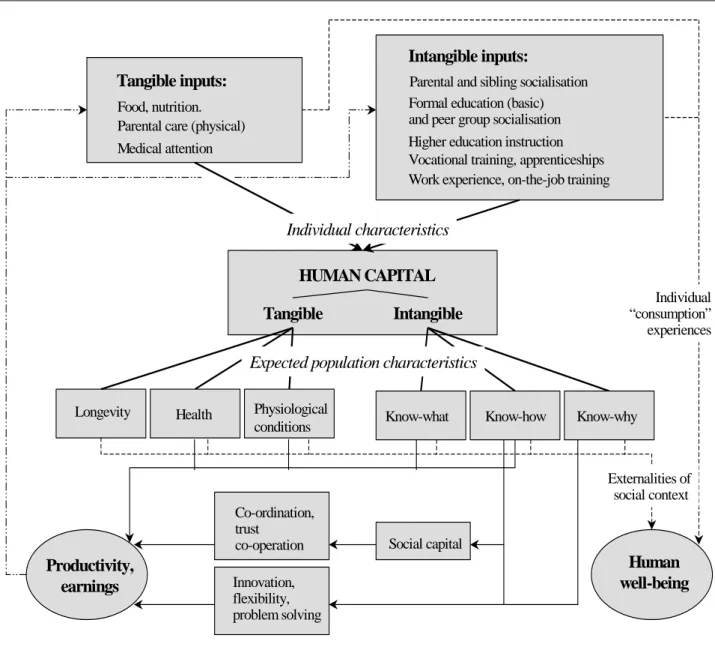
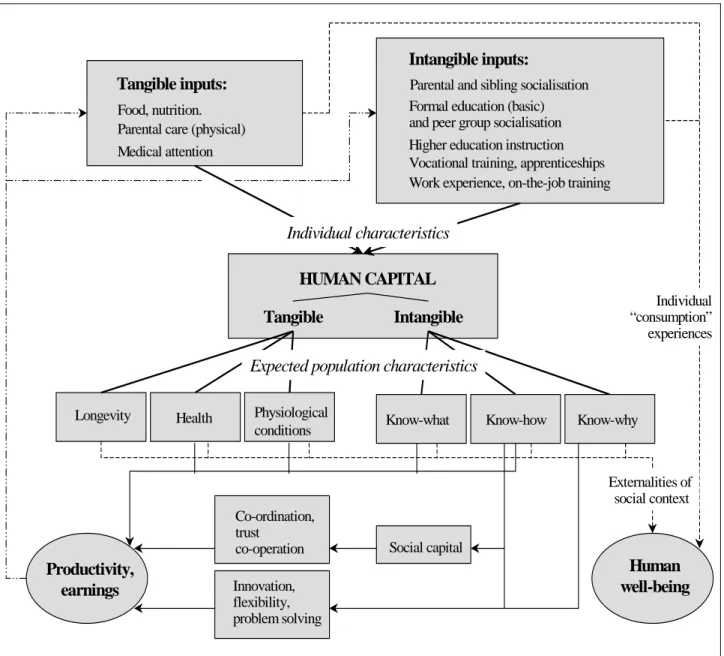
These microeconomic and macroeconomic perspectives on the relationships between human capital and economic growth may be integrated within a single schematic view, or heuristic framework. Figure 2 (below) depicts these in a simplified form. This schematic has a dual “heuristic” value: First, it indicates the connections between the micro-level determinants, and the macroeconomic effects of the various dimensions of human capital formation. Second, it highlights the positive feed-back loops in the dynamic system that connects the micro-level and macro-level outcomes. The latter create the potential for a
self-reinforcing process of growth based upon sustained increases in productivity. But, self-reinforcing dynamics may result in vicious downward spirals, as well as in virtuous upward spirals.
When human capital formation is viewed either at the micro- or the macroeconomic level, it becomes evident that there are structural and institutional features peculiar to the markets for information goods, and for the labour services of free workers, which cause those markets not to function well in terms of allocative efficiency, and to perform less well than the markets for ordinary economic goods.
Figure 2. Human capital formation and growth: Micro- to Macro-level Feedbacks
HUMAN CAPITAL
Tangible Intangible
Tangible inputs: Food, nutrition. Parental care (physical) Medical attention
Intangible inputs:
Parental and sibling socialisation Formal education (basic) and peer group socialisation Vocational training, apprenticeships
Longevity Health Physiological conditions
Productivity, earnings
Expected population characteristics
Individual “consumption” experiences Higher education instruction
Work experience, on-the-job training
Social capital Innovation, flexibility, problem solving Co-ordination, trust co-operation
Know-what Know-how Know-why
Individual characteristics
Human well-being Externalities of social context
Various specific micro-level conditions that lead to “market failures” affecting human capital formation, both tangible and intangible in decentralised system of resource allocation, can be identified under the following distinct headings:
• verification problems;
• monitoring problems;
• a variety of technical complementarities, which result in “spill-overs” of costs and/or benefits among agents;
• interdependencies among the preferences of decision-agents, which give rise to un-priced welfare effects of individual allocation decisions.
There are really only two broad classes of reasons for the appearance of gaps between private and social marginal rates of return on human capital investments. (1) The existence of non-pecuniary “externalities”, and the interdependence of individuals’ preferences over outcomes, result in some significant portions of the benefits and/or the costs of particular investments failing to accrue to the agents responsible for undertaking those projects; (2) there are persisting “market imperfections” (including incomplete and missing markets) that prevent relative prices from properly signalling relative private marginal costs and private marginal productivities.
Such conditions are likely to result in persisting differentials between the social and the private rates of return on investments in human capital. There is thus no automatic mechanism guaranteeing that the dynamic allocation of human resources in a competitive market economy will be socially optimal.
In addition to adversely affecting the society’s overall levels of human capital, the peculiar susceptibility to such “market failures” implies that the composition of the resulting human capital stock is also likely to be sub-optimal; in some instances the social rate of return on a given form of human capital investment may fall considerably below the private rate, even though the opposite state of affairs is more typical.
The Microeconomics of Human Capital Formation
Considering the choices that individual agents face over their life-cycle provides a useful framework for reviewing the microeconomic literature about human capital formation. The critical life-cycle decisions are: primary and secondary education, higher education and/or vocational training, on-the-job training, mid-career training and retraining, and retirement. Due to the complementarities that exist among those forms of investment, and the sequential nature of these choice-points, economic circumstances prevailing at the early stages of a person’s life continue (indirectly) to exercise leverage over the investment decisions that will be made at much later stages in the life-cycle.
Decisions about primary and secondary schooling rarely are left to the children, and consequently it is necessary to consider the influences impinging on the choices made by parents and other agents in the educational process. Parental education and income are important determinants of the physical, cognitive and social skills with which the children are endowed.
Parents’ choices are, however, limited by:
• their information about the options available and the consequences of these;
• the control they can exert over the children’s input into the educational process;
• governmental regulations; and,
• other influences on early education that are outside the sphere of the family
background, such as the ethnic environment or religion.
The stage of higher education and/or vocational training is closest to the main microeconomic perspective established in human capital theory: educational choices will
involve inter-temporal trade-offs between the consequences of finding a job in the labour market now, or investing time and money in additional schooling, in the expectation of gaining higher income opportunities later on.
Under a decentralised competitive market regime, several different sources of “market failure” will constrain and distort individuals’ choices with regard to investing in human capital:
• capital market imperfections limit the ability to finance many kinds of human capital;
• the economic benefits from education or training may not be fully appropriable by the agent involved in making the decision or bearing significant parts of the costs;
• the long gestation periods involved mean that decisions will be taken under conditions of fundamental uncertainty rather than calculable risk;
• where human abilities are not readily observable ex ante, hiring and related decisions by employers are made on the basis of observable but inaccurate “indicators”, including educational “credentials” that thereby may acquire private “signalling” value.
On-the-job training (combining production, learning-by-doing, and mentoring by co-workers) is important for two distinct reasons:
• It is a prime source of specific skills that cannot normally be obtained through formal education or vocational training courses, but firms may have little incentive to pay for the training because: (a) workers cannot be legally constrained from quitting, and (b) there may be conflicts between the worker and the firm about the type of training desired. If workers do not have the resources to invest in training, and there are borrowing constraints, the result is under-provision of specific skills.
• Since a large part of what people know is “tacit”, acquired experimentally, and transferred by demonstration, there is a need for workers and firms to use on-the-job training as a mechanism of knowledge transfer in which the knowledge holders actively participate.
• Specificity of certain skills has consequences beyond the under-supply of training: it can also constrain the financing that is made available to entrepreneurs.
The formation of work-based skills that are job-specific but not strictly firm-specific is a potentially important source of labour market externalities, the existence of which has a direct bearing on public policy design. To be able to establish empirically whether or not job-specific human capital accumulation (through learning by doing and formal on-the-job training) was an important feature in particular occupations and industrial sectors, obviously, would be useful. Unfortunately, despite much sophisticated econometric effort to identify various, distinct forms of experience-based “learning” from available panel data, empirically grounded general conclusions about the creation and value of transferable skills formed through OJT have proved frustratingly elusive.
That workers must finance training is not per se a market failure, but under-provision of skills can arise when workers do not have the resources to invest in training and there are borrowing constraints. There are serious issues of adverse selection and moral hazard that accentuate the credit constraints upon workers in the absence of third-party loan guarantees, and, indeed, in the absence of state backed lending for such purposes.
In an environment of technological change some skills become obsolete, which raises the matter of midlife training and retraining. A problem with retraining is that older workers have less time to recoup the investment in the form of enhanced productivity; as a
consequence, workers above a certain age will not have adequate incentives to learn new skills, nor will firms wish to finance the training they require.
The anticipation of rapid changes in industrial practices and technologies encourages: (a) workers to seek early education and training that allow them to be more flexible, and (b) firms to adopt new industrial practices that can be grouped under the heading of “just-in-time learning”. Where technological change is both rapid and disruptive, the induced demand for broader general training among the young may conflict with governmental educational policies, especially because the latter often respond to pressures from employers calling for workers with highly specific new skills.
The systemic vision of the sequence of educational choices points to the importance of corrective government intervention in early stages of the life-cycle. Because schooling is a foundation for successfully undertaking later investments in education and training, including various kinds of on-the-job training, failures affecting the formation of “educational capital” at the lower, primary and secondary stages will raise the costs or reduce the effectiveness of providing university education.
Human capital’s role in retirement generally is neglected by the microeconomics literature. Yet, people’s intangible capital needs do change when they enter retirement. In view of the demographic trends towards ageing of the population and the growing relative importance of the time and resources that retired individuals are allocating in pursuits other than market work, “education for recreation and retirement” is a subject that would seem to merit more serious attention.
Human Capital and the Macroeconomics of Growth: Theoretical Investigations
The neoclassical theory of growth developed by Solow and Swan centred macroeconomists’ attention throughout the 1960’s and 1970’s on tangible (physical) capital formation as the driver of economic growth. However, the theory showed that, because of decreasing marginal returns in substituting physical capital for labour, the accumulation of capital would not indefinitely support a steady rate of growth in labour productivity.
From this perspective it became clear that technological change, not capital formation, held the key to sustained growth in average labour productivity. Growth accounting studies of the U.S. and other advanced nations in the 20th century confirmed that total factor productivity (generally attributed to technological progress), and not the rate of accumulation of tangible capital per unit of labour (i.e., “capital-intensity”) was the proximate source of rising labour productivity.
The recent literature on “endogenous economic growth” emerged primarily as an attempt to encompass the sources of technological progress and hence of sustained productivity growth within the general equilibrium framework of neoclassical growth theory. This literature has evolved to provide several distinct explanations of the process of economic growth, each of which carried particular empirical and policy implications:
• Romer’s so-called “AK model” generates sustained growth by assuming that
technological change is the unintended result of specialising firms’ investments. Creation of capacity to produce more and more specialised intermediate products is assumed to work like Adam Smith’s division of labour principle, but at the aggregate level.
• The resulting externalities yield increasing returns to cumulative investment, and thus the production of goods can avoid the decreasing returns to rising capital-intensity that the neoclassical model posited.
• These externalities imply that the competitive equilibrium growth path does not coincide with that which could be achieved in an optimally planned economy.
The latter conclusion was reached by virtually all the theoretical analyses based upon successive formulations that belong to the family of “endogenous growth models”. It carries the implication that growth performance might be improved by public policy action. Subsequent endogenous growth models have fleshed out the process of technological change through the explicit introduction of human capital and/or knowledge:
• Lucas (1988) considers human capital to be another input in the production function, not fundamentally different from physical capital, but only formed by workers through certain activities (principally education or on-the-job training). By assuming constant returns to human capital formation – on the argument that workers’ knowledge “spills over” – the model can achieve a positive steady-state rate of growth rate in labour productivity.
• A second line of analysis shifts attention away from treating human capital as a direct input to the production of goods; instead, it focuses upon modelling other important activities pursued by skilled labour, especially innovation. Technological change resulting from R&D investment that creates a greater variety of goods, or improves the quality of existing is the main form of innovation recognised by the endogenous growth literature following Romer (1986, 1990).
This latter line of analysis brought out the significant point that when human capital is modelled as a factor affecting innovation, the long-run rate of productivity growth is positively affected by the human capital stock’s level; whereas, in the Lucas (1988) model, the rate at which human capital is being accumulated, relative to the existing stock, was seen as the critical determinant of productivity growth.
More recent theoretical contributions (e.g. by Acemoglu 1996, 1998) direct attention to the existence of complementarities and reciprocal feedbacks in the dynamic interaction between technological change, conventional tangible investment, and the formation of productive capabilities embodied in members of the workforce. This highlights the importance of the formation of co-ordinated expectations that would support a “balanced” portfolio of tangible and intangible capital formation projects yielding high productivity growth outcomes, rather than leaving the economy on a low productivity growth path. A final point concerns the debate about convergence of countries to common levels of per capita GDP. The basic neoclassical model held that economies with similar structural conditions would converge to a common level of output per capita. Most endogenous growth models hold out no prospect of automatic convergence: if a country starts at a lower capital and output per capita, it will not grow at a faster pace than a richer country, and differences will persist over time.
This non-convergence result, however, is sensitive to the supposition of the analysis that the economy is strictly closed, i.e., that in addition to there being no factor-equalising international commodity trade, there is (a) no inter-country “spill-over” in the methods of producing human capital and (b) no migration of workers. Both of these assumptions can be readily challenged; when the models explicitly allow for international diffusion of innovations, they tend to predict catch-up by poor countries in the long run.
Empirical Findings on Human Capital and Macroeconomic Growth
In the early 1990’s pioneering econometric studies (based on international panel data for a widely diverse array of countries during the post-1960 era) provided empirical support for the conclusion that human capital formation was among the factors that significantly affected the aggregate level rate of economic growth.
• They found that success in the process of catching up internationally in terms of per capita GDP (measured in purchasing power parity equivalents) was positively related to the overall social rate of human capital formation.
• Furthermore, the poor countries that were tending to catch up with the higher income economies were restricted to those that were maintaining levels of investment in formal education which were high in relation to their respective GDP levels.
More recent econometric studies have yielded three robust empirical findings:
• There is only weak empirical support for the hypothesis that changes in the human capital stock affect growth rates.
• There is strong statistical support for the hypothesis that the relative level of the stock of human capital (in relation to the labour force or aggregate output) has a positive effect on growth rates.
• The magnitude of the “level effect” of the human capital stock is itself far from uniform across the distribution of economies; the impact on growth rates does not vary linearly with the relative size of the stock but, instead, becomes proportionately smaller among the economies where the average educational attainment is already high.
The broad interpretation of these findings in the context of recent growth models is that raising the general level of educational attainment interacts positively with other forces -- among them the accumulation of complementary physical capital and the application of new technologies. Higher human capital intensity thus permits countries to accelerate their productivity growth rate and narrow the relative size of the per capita real income gaps separating them from the leading economies.
But, in the near term, at least, the potentials for such convergence are not unqualified. They appear to be bounded by conditions that limit economic integration through trade and capital movements, as well as by cultural and institutional dissimilarities – including differences in political and legal institutions. Such heterogeneities are suspected of impeding easy and effective international transfers of technological and commercial capabilities.
Cross-country economic convergence, in the form of the relative dispersion of productivity and per capita real income levels, has occurred within “clusters” of countries, both historically and in more recent times. The operation of “convergence clubs” had particularly pronounced effects in narrowing the dispersion within the upper income tier of the OECD countries during the third quarter of the 20th century; indeed, this pulled up members from the lower tail so rapidly that some among the former leaders were displaced from their positions in the upper tail (e.g., the NZ economy among them).
The rough rank ordering of national economies by levels of GDP per capita and average labour productivity exhibits considerable inertia over the span of decades. Maintaining a high average level of educational attainments, and correspondingly high rates of investment in other forms of human capital (e.g. health, internal spatial and occupational
mobility), would appear to serve as a stabilising force – although not a guarantee – against continuing secular decline in a country’s relative per capita income position. Most of the theoretical literature on economic growth focuses on the role that investment in formal education plays in modern economies. In a broad sense that emphasis is justified by the empirical evidence pertaining to aggregate economic growth performance in recent decades. Notice should be taken, however, of the disparities that do emerge among studies that undertake quantitative assessment of the impacts of human capital formation, by means of econometric and growth accounting studies which are based upon international cross-section data. Several recent studies based upon measures of schooling years per person of working age for the OECD and G-7 economies have obtained results that appear to cast doubt upon the impact of human capital formation upon labour productivity. Closer examination of this work reveals that some of their surprising findings result from inadequacies of the proxy variables that have been employed in lieu of proper measures of the stock of human capital.
Considerable caution therefore is warranted before framing concrete policy recommendations simply on the basis of the findings from international cross-section studies exercises of this kind, if only because of the many subtle international differences in the workings of educational institutions that appear outwardly to resemble one another. By considering the historical growth records of some among the presently advanced economies (even those extending back into the epoch of their proto-industrial development), however, economic historians have obtained a more informative picture of human capital’s changing role in long-term growth.
A noteworthy, and perhaps surprising conclusion from historical studies of Europe and the U.S. is that intangible human capital formation contributed comparatively little if anything to labour productivity growth before the latter part of the 19th century. This shows that the strong correlations between human capital and growth found by some modern cross-section and panel-data studies are a phenomenon particular to comparatively modern experience, not a regularity about the process of economic growth that can be expected to hold in any place and period.
Historical studies (by Abramovitz and David, 1973, 1996, 2000) suggest reasons for the rising role played by intangible human capital formation. These reasons are found in the contrasting characteristics of the U.S. economy’s growth path over the course of the 19th and 20th centuries:
• In the 19th century increasing labour productivity can be attributed to a high and rising capital intensity (measured by the tangible capital per man-hour worked), a trend that was reinforced by the prevailing tangible capital-using bias of technological progress in the 19th century.
• The main source of labour productivity and real output per capita growth in the 20th century was rising total factor productivity. A crucial aspect of U.S. growth experience in that epoch was the changing bias of technological innovation away from tangible capital-deepening, and the emergence from 1929 onwards of a strong bias towards intangible (human) capital-deepening.
• Biased technological progress has been the long-term force underlying a demand-induced reallocation of savings and the consequent secular relative rise of intangible human capital (vis-à-vis both tangible capital, and real output) during the 20th century.
• The facilitating evolution of both public and privately funded educational institutions, and company financed programmes of on-the-job training, can be seen as having
been induced directly and indirectly by changes on the demand side of the labour market.
The foregoing conclusions from the historical experience of economic growth contrast sharply with the assumptions made by growth theory. Neoclassical growth models and the pioneering contributions to the literature on endogenous growth (e.g. Romer 1986, 1990) specify that technological change always is “neutral”; they therefore fail to view “biased” technological innovation as a major force creating pressures for readjustments in the relative supply of skills and other human capabilities.
In reality, however, such pressures exist; in the absence of adequate supply-side responses, they are likely to manifest themselves in rapidly widening pay differentials or increased rates of occupational obsolescence and structural unemployment. A far more desirable outcome, of course, would be the co-ordinated, anticipatory provision of the human capital investments that are required in order to translate new technological opportunities into rising productivity and higher levels of material well-being.
Implications for Public Policies Affecting Human Capital Formation Generic policy implications, from microeconomics analysis and growth theory:
Microeconomic studies conclude that numerous structural conditions – especially those peculiar to economic transactions involving knowledge, and the services of free persons -- are likely to drive persisting wedges between the private and social rates of return to investing in human capital. These “wedges” signal the existence of mal-allocation, and carry the implication that some corrective public intervention may be warranted.
This is likely to be the case in either of two broad sets of circumstances:
• where technological complementarities give rise to non-pecuniary “externalities”, and/or the interdependence of individuals’ preferences over outcomes results in some significant portions of the benefits and/or the costs of particular investments failing to accrue to the agents responsible for undertaking those projects;
• where there are persisting “market imperfections” (including incomplete and missing markets) that prevent relative prices from properly signalling relative private marginal costs and private marginal productivities.
However, a strict economic justification for governmental (or charitable institution) interventions directed to raising human capital investment in particular categories is more demanding than the identification of such situations. Public subsidies are called for only where the respective marginal social rates of return on such investments – whether directed to human capital investment among particular population groups, or for specific categories of training – exceed both the corresponding private marginal rates, and the marginal social opportunity cost of the public tax revenues that would be absorbed by the indicated subsidy programmes. Application of this test, as a practical matter, is not so easy.
Nevertheless, the supposition is widely shared among economists that market economies exhibit overall systemic tendencies toward under-investment in human capital, due to the incomplete private appropriation of their contribution to the (external) benefits of having a labour force (and a polity) that is more highly educated and possesses a greater degree and variety of skill. This does not preclude the possibility that in some situations the behaviours of individual when left to themselves will result in a level of educational investment that turns out to be sub-optimal from their own, private standpoint, as well as
from a societal perspective. Such is too frequently the situation of young labour market entrants, whose work habits and educational preparation reflect the limitations of previous interests and judgements on their parents’ part.
The condition of overall under-investment also is quite compatible with there being socially
excessive expenditures of private and public resources for formal schooling, i.e., levels of investment that drive the social marginal rate of return below the marginal private rate. Such a situation sometimes is alleged to be the case in regard to university-level educational credentials that are sought (whether by students or their parents) primarily as “signals of quality” for prospective employers. The source of the putative inefficiency lies in the absence of some alternative institutional mechanism that would perform the socially productive, signal-supplying function of educational credentials – with equal credibility but at lower unit cost.
A systems analysis of the sequence of educational choices points to the importance of targeting policy measures to address tendencies to under-investment during the earlier stages of the life-cycle. Schooling provides intangible capital that is a foundation of the capabilities for successfully undertaking later investments in education and training, including various kinds of on-the-job training. Market failures, or public institutional failures, that result in under-provision of “educational capital” at the primary level, therefore will raise the costs or reduce the effectiveness of subsequent investments in secondary schooling, tertiary vocational and university education, and in on-the-job training.
Corrective interventions by government therefore must be formulated on a case-specific basis, once the nature and seriousness of the existing misallocation has been established. Most corrective policy actions, however, will impose some social costs of their own. These also must be taken into account in judging whether they should be recommended as “second best” solutions, or only as the “n-th best” means of addressing the identified sources of “market failure”.
On the question of the means whereby governments may intervene to alter the allocation of private investment in human capital, the literature on the economics of public finance in market regimes points almost exclusively to subsidies and taxes as the instruments of choice for effecting such corrections. A review of the generic implications of applying optimal tax and subsidy principles to the treatment of investments in intangible forms of human capital, however, suggests that existing regimes of taxation tend to be biased in varying degrees against investment in intangible human capital. Thus it is possible to arrive at some general principles for reforms aimed at correcting “government fiscal failures”, and these deserve priority of consideration over proposals to introduce specific tax or subsidy measures that would, in any case, need to be tailored to suit the relevant institutional and legal context.
Perhaps the major insight for economic policy design that emerges from the literature on macroeconomic growth models is that in an economy of any reasonable degree of complexity, especially in one where there is decentralised decision-making and competition in many sectors, crucial positive “spill-over effects” are created by technical complementarities and pecuniary externalities of exchange transactions. For these to be coordinated at the microeconomic level in a manner that reinforces growth, it is important that they become mutually aligned through widely shared expectations regarding the positive externalities that will result from investments in a variety of durable productive assets. Such expectational coordination is crucial where the payoff from “investment projects” depends on successfully matching the characteristics of newly developing
technologies, and physical capital that embodies them, with the capabilities of the available labour force, and the projects themselves have long gestation periods.
By working in partnership with the private sector, public agencies may therefore promote growth by facilitating better dynamic co-ordination. This involves increasing the flow of reliable information to shape mutually reinforcing expectations that, in turn will affect private investment decisions. Of course, because financing the necessary human capital components cannot effectively be left to either the household or the business sectors, anticipations of governmental action in the latter sphere assumes critical significance. In this context, what is required to shape expectations is the timely publicising of the state’s credible commitments to undertake long-term programmes providing subsidies and/or tax credits for basic education and training investments, as well as assistance with the financing of continuing education and re-training.
From a narrow resource allocation viewpoint, it is obviously important that subsidies in this area should have a two-part structure: in addition to promoting general education in the population, they should aim to elicit further human capital formation that is aligned specifically with indicated broad trajectories of technological development, business reorganisation, and structural reorientation related to international trade specialisation. The latter, of course, ought to be identified on the grounds of being those holding the greatest promise for the economy’s future.
The situation of the New Zealand economy, however, presents something of an anomaly in the context of modern generalisations about economic development and macroeconomic growth, and the roles played by human capital therein. Certainly there is little in the macroeconomic growth theory literature that has an immediate bearing upon the circumstances of a small, open economy. Implicitly most growth model assume that the economy is large and diversified, possessing an industrial base and abundant natural resources, as well as being about to support the fixed costs of an extensive human and institutional infrastructure that enables it to be largely self-sufficient in the R&D and human capital formation activities. All of the influential macroeconomic growth models describe the technological situation of a “global” economy, one that is closed even in regard to knowledge flows, and so must invest in R&D activities in order to generate a basis for continuing innovation.
Yet, such is not the situation in which New Zealand – along with many another high income country –finds itself. A number of implications for the design of policies relating to human capital formation (inter alia) can be seen to flow directly from that particular disjunction.
Policy Proposals Geared to New Zealand’s Special Economic Circumstances:
Although having experienced retarded productivity growth in the past two decades, New Zealand remains a high-income country with a fully developed array of research, education and training institutions. Its overall capacity for expanding the provision of educational services at the tertiary level is not a constraint. Putting aside measures that may be required to correct the supply of specialised training, which in any case might be accomplished by subsidised training overseas, public policies directed to raising the average level of human capital in the population can be focused in the first instance upon the demand side.
Reforming the tax treatment of households’ human capital investments
Here changes in existing fiscal measures (taxes and subsidies) are the appropriate instruments with which to start. Considerations of the basic issues involved in determining the proper tax-subsidy treatment of human capital investments can usefully be limited to just those concerned with the degree to which private investment incentives may be distorted (to the detriment of individual well-being) in ways that can be remedied by direct subsidies, or corrected by alterations in the tax regime.
It should be noticed that changing the after-tax rates of return on different categories of assets will generally be easier for the fiscal authorities in an economy that is open to international flows of capital and labour, as well as to trade in goods and services. This is the case because the levels of domestic wages and interest rates tends to be pegged to those in the international economy. Alterations in the relative quantities of different assets (i.e., human intangible capital vis-à-vis tangible inanimate capital), therefore, will not tend to offset the first-order effects of tax rate changes on the structure of after-tax rates of return. This increases the potential potency of the fiscal measures as a policy instrument in New Zealand’s circumstances.
Several modifications of the income-tax system could serve to augment New Zealand’s human intangible capital resources, without requiring the potentially more disruptive and administratively more costly replacement of income taxation with a consumption tax regime. Application of optimal and second-best tax principles suggests that the principal goal of a partial fiscal reform should be the elimination of the differential tax treatment of
human capital investments vis-à-vis other forms of investment by households. A
secondary, reinforcing objective is to mitigate the disincentive effects of progressive taxation of the interest component of the wage-income streams deriving from private investments in intangible human capital.
The first of these objectives would be met by making all certified direct costs of education and training fully deductible from taxable wage income; whereas, the second objective can be reached (without altering the progressivity of existing tax schedules), by the device of shifting to a later point in the life-cycle the date at which such deductions from taxable income can be exercised by private individuals on whose behalf the direct educational expenditures were made.
A new scheme of personal income tax reform that would accomplish both purposes (proposed by David 2001) seems well suited to countries with New Zealand’s characteristics. Its essential features are these:
• allow full deductibility for education and training outlays, while restricting the ability of the student/trainee and the household that bore those costs to exercise their deduction claim until some stipulated time period had passed;
• record the nominal value of the educational investment in the current income tax return filed by the student/trainee, and credit the corresponding deduction to a non-transferrable government guaranteed account established in that person’s name (identified by a taxpayer number);
• when the initial period of inaccessibility had passed, the account would be available to be liquidated in its entirely, at date chosen by the named holder, and exchanged for a consecutive annual deductions from taxable income over a following span of years;
• for as long as it remained unbroached, the surrender value of this account would grow at the nominal rate of interest on government debt, or alternatively, a fixed real rate of
interest could be stipulated and credits entered in the account could be indexed to the domestic consumer price index.
The novel asset thereby created is an untaxed, interest-bearing educational (expense) deduction account – the UIBEDA (or, phonetically, “we-bedda”). Under quite plausible assumptions about the time distribution of education-associated earnings differentials, and the progressivity of the schedule of tax rates, it would be feasible for the NZ Treasury to use such a scheme to act as a financial intermediary in the market for human capital investments in a way that satisfied an intertemporal balanced budget constraint.
It would be possible for the Treasury to recoup more than enough in extra tax revenues (deriving from the induced additional human capital investments by the resident working population) to make up for the taxes sacrificed by allowing those individuals to exercise their deduction claims. This result can be shown with plausible parameters for the scheme, under which individual account holders would have a strong incentive to defer surrendering their UIBEDA until they reached a point in their life cycle when their earnings were high and they faced correspondingly higher marginal tax rates. The extra tax revenues would then become available for other subsidies.
Further extensions of the proposed reform would apply it also to allow deductibility of the interest costs of government guaranteed loans and scheduled allowances of foregone earnings during periods devoted to education and/or enrolment in certified programmes of on-the-job training. Having such a scheme in place could be beneficial in assisting a shift from universal direct provision of educational services by the state to a mixed programme of student loans and means-tested support for students from low-income households. The coupling of educational indebtedness arising from such loans with possession of an UIBEDA, might also reduce the resistance among lower income families to having their children borrow from commercial lenders for human capital formation purposes, under the terms of a government guaranteed loan scheme. The effect of the switch in financing would be to release public funds from use for tuition and student maintenance grants in support of general education at the tertiary level, making it available for more selective forms of educational subsidies.
Tax credits and subsidies for cooperative business investments in job-specific training
Providing subsidies for human capital investments that are undertaken jointly by employers and workers does offer the benefit of more immediately realised productivity impacts, compared to the longer term effects of lifting the general quality of the workforce through schooling investments directed to the young. At the same time, OJT investments are less amenable to standardised modes of training, far more heterogeneous in the content of what is to be learned, and less amenable to external monitoring. It is in the interest of employers, as a rule, to make such investments in the most effective form possible if they internalise the benefits – whether they are spending their own money or funds provided by public agencies. Thus there is a case for avoiding government micro-managing, or even certification of the forms of training that will be subsidised.
Nevertheless, survey data as well as casual observation indicates the existence of wide and unjustified inter-firm and inter-establishment variations in training practices. This suggest that there is significant under-investment in information about best practice training methods, and that private incentives to share knowledge about the details of successful training methods remain inadequate. Hence, proactive provisions for information exchanges ought to be made a condition of receipt of public subsidies.
One way in which this latter objective could be realised is by allowing employers to form cooperative training associations whose activities would receive matching public funding according to a pre-determined formula. In effect, such organisations would be “clubs” engaged in the voluntary production of a public good, namely the augmented supply of workers suitably trained for their branch of industry. Because their efforts yielded public goods whose benefits could be shared by “non-club” firms (and their workers), direct subsidisation of private investments through tax credits for incremental training expenditures, would be appropriate.
Firms’ contributions to these organisations’ outlays should be treated as fully expensed, in keeping with general principles of taxing consumption rather than investments. Furthermore, the work of the training association could be reinforced by automatically allowing full deductibility of the foregone earnings costs incurred by the trainees enrolled in these “approved” training institutions. That, of course, would be more immediately feasible were the scheme to be implemented in conjunction with a tax incentive along the lines of the proposed UIBEDA scheme.
Romer’s (1993) advocacy of “self-organised industry investment boards” that would sponsor both R&D and specialised training programmes, is similar to the foregoing proposal in spirit. A problematic feature common to both proposals, however, is the need for close monitoring by competition authorities of the internal decision procedures and the actual investments undertaken by these organisation. Lacking such oversight provisions, it would be quite possible for these associations to become vehicles for employers’ cartels.
Selective migration policies for increasing the national human capital endowment
The NZ economy’s small size in relation to the flows of qualified workers that could be imported from abroad within comparatively short intervals carries an analogous and equally important policy implication. Measures to induce immigration by people that bring special knowledge and skills acquired elsewhere are likely to be more effective than domestic human capital formation in quickly shifting this kind of economy between growth paths.
Creating special incentives for selective immigration may be a rather complicated problem in policy design, as there are many different instruments to be considered. Furthermore, the recruitment of highly educated foreign workers and their substitution for those domestically trained may have the perverse effect of weakening the latter group’s incentives to invest in acquiring further qualifications for employment in the same areas of occupational specialisation. Nevertheless, there are some special dynamic conditions under which policies to enhance both foreign and domestic sources of labour supply can be complementary, one serving for the short run and the other for the longer run.
The provisions of the UIBEDA scheme also lend themselves quite naturally to its use as an instrument for encouraging selective immigration of workers who have received advanced education and training investments in other parts of the world. The mechanism of selection available to the government in this case is the determination of the list of eligible institutions, and the date of receipt of specified degrees and competence certifications that will be accepted as qualifying them to set up a UIBEDA account when they first enter employment in New Zealand.
As a practical matter it would be necessary to require submission of evidence to establish the direct expenditures incurred overseas in connection with obtaining those (approved) educational credentials. An alternative administratively more straightforward arrangement would permit immigrants to apply to re-finance education and training debts that they had
accumulated prior to their arrival, and to submit evidence of the repayment of these new, domestically financed debts in order to obtain deduction credits in the UIBEDA scheme. In any event, mainly for reasons of administrative convenience, but also to limit the potential for abuse of such provisions, no deduction credits whatsoever would be awarded for immigrants’ previous indirect educational investments in the form of foregone earnings.
Targeting human capital formation policies against persisting socio-economic disparities
New Zealand’s long history of near universal mass education starting at the primary level in the mid-19th century, and then moving rapidly on to secondary schooling in the first quarter of the 20th century, formed a base for the subsequent high average level of educational attainment in the majority of the population. Over the long run the socio-economic, health and educational status of the indigenous, Maori population has improved, both in absolute terms and relative to that of non-Maori. Nevertheless, recent data document the persistence of substantial disparities between indicators of material well-being for these two population groups, disparities that also appear in measures of educational attainment and professional qualifications.
Dynamic models containing multiple equilibria in human capital formation rates (e.g., Redding, 1996, and Acemoglu, 1996) suggest how an easily identified ethnic or racial segment of the population could become disadvantaged, even in the absence of over ethnic and racial discrimination in the labour market. The existence of strong positive feedbacks that reinforce a culture of poverty, creating vicious cycles that run from lower rates of secondary school completion and poor levels of health care to compromised employment experience, to reduced expected benefits from additional training investments, and weak family and peer-group support for individual efforts to seize opportunities that are likely to yield upward mobility.
To the degree that such a cycle can be said to characterise the situation of New Zealand Maori and Pacific Islanders, it is unlikely that the existing pattern of socio-economic disparities will disappear “naturally”, or that piece-meal governmental interventions will be able to replace those vicious circles with virtuous spirals leading a large proportion of those disadvantaged populations out of relative poverty.
One may contemplate an integrated programme of support designed to substantially raise average levels of human capital (the tangible as well as the intangible components) throughout these relatively disadvantaged minority groups. But, its resource costs and coordination requirements imply that such an approach would represent a major political as well as an economic commitment. Expanding the coverage of such an approach, so that it addressed the needs of economically and educationally disadvantaged families and youths throughout the NZ population, might raise its political attractiveness on grounds of equity alone. Nevertheless, the added administrative complexities of determining eligibilities for such targeted subsidies, and the potential drawbacks of establishing general programmes of entitlements to resource transfers, should not be underestimated.