Characterizing Modular Ontologies
Sarra Ben Abb`
es, Andreas Scheuermann, Thomas Meilender, Mathieu
D’Aquin
To cite this version:
Sarra Ben Abb`
es, Andreas Scheuermann, Thomas Meilender, Mathieu D’Aquin. Characterizing
Modular Ontologies. International Conference on Formal Ontologies in Information Systems
(FOIS), Jul 2012, Graz, Austria. pp.13-25, 2012.
<
hal-00710035v1
>
HAL Id: hal-00710035
https://hal.archives-ouvertes.fr/hal-00710035v1
Submitted on 19 Jun 2012 (v1), last revised 27 Jan 2012 (v2)
HAL
is a multi-disciplinary open access
archive for the deposit and dissemination of
sci-entific research documents, whether they are
pub-lished or not.
The documents may come from
teaching and research institutions in France or
abroad, or from public or private research centers.
L’archive ouverte pluridisciplinaire
HAL
, est
destin´
ee au d´
epˆ
ot et `
a la diffusion de documents
scientifiques de niveau recherche, publi´
es ou non,
´
emanant des ´
etablissements d’enseignement et de
recherche fran¸cais ou ´
etrangers, des laboratoires
publics ou priv´
es.
Characterizing Modular Ontologies
Sarra Ben Abb`es1
, Andreas Scheuermann2
, Thomas Meilender3
, and Mathieu d’Aquin4
1
LIPN - UMR 7030 Paris 13 University & CNRS, 99, avenue Jean-Baptiste Cl´ement - F-93430 Villetaneuse, France. E-mail:
2
University of Hohenheim, Information Systems 2, 70599 Stuttgart, Germany. Email: [email protected]
3
UHP-Nancy 1, LORIA (UMR 7503 CNRS-INPL-INRIA-Nancy 2-UHP), France. Email: [email protected]
4
Knowledge Media Institute, The Open University, Walton Hall, Milton Keynes, MK7 6AA, UK. E-mail: [email protected]
Abstract. Since large monolithic ontologies are difficult to handle and reuse ontology modularization has attracted increasing attention. Several approaches and tools have been developed to support ontology modular-ization. Despite these efforts, a lack of knowledge about characteristics of modularly organized ontologies prevents further development. This work aims at characterizing modular ontologies. Therefore, we analyze existing modular ontologies by applying selected metrics from software engineer-ing in order to identify recurrengineer-ing structures, i.e. patterns in modularly organized ontologies. The contribution is a set of four patterns which characterize modularly organized ontologies.
Keywords:modularization, patterns, modules, ontology.
1
Introduction
Difficulties in reusing and maintaining large monolithic ontologies have resulted in an increasing interest in modularizing ontologies. In the past, several ap-proaches and tools (e.g., SWOOP1
, NeOn Toolkit2
) have been proposed to sup-port the modularization of ontologies. Each of these approaches and tools re-spectively incorporates its own definition and notion of modular ontologies and criteria underpinning ontology modularization [5]. This proliferation is mainly due to the fact that the area of ontology modularization appears to be still in its infancy. Thus, it lacks mature, well-defined, well-understood, and commonly agreed definitions and concepts as modularization in the area of software engi-neering [18]. This lack of knowledge about ontology modularization and, particu-larly, the lack of knowledge about characteristics of modular ontologies prevents its further development. Being able to characterize modular ontologies would
1
http://www.mindswap.org/2004/
2
allow for (1) comparing different modularization approaches, (2) assessing the quality of modular ontologies with respect to manually modularized ontologies, (3) customizing ontology modularization by providing modularization criteria, and (4) improving the area of ontology modularization as a whole.
The goal of this work is to characterize modularly organized ontologies to con-tribute to a better understanding of ontology modularization. For this purpose, we (1) extract a number of existing ontologies from the web, (2) select and adopt metrics from software engineering in order to both (3) identify recurring structures (patterns) in modularly organized ontologies and (4) characterize the identified patterns. The contribution is a set of four patterns, which characterize modularly organized ontologies.
The rest of this paper is organized as follows: Section 2 provides an introduction to ontology modularization and reviews related work. Section 3 reports on the research design whereas section 4 presents and discusses the results. Section 5 draws a conclusion and points to future avenues of research.
2
Ontology Modularization
2.1 Modular Ontologies
The main idea of modular ontologies originates from the general notion of lar software in the area of software engineering. Correspondingly, ontology modu-larization can be interpreted as decomposing potentially large and monolithic on-tologies into (a set) of smaller and interlinked components (modules). Therefore, an ontology module can be considered as a loosely coupled and self-contained component of an ontology maintaining relationships to other ontology modules. Thereby, ontology modules are themselves ontologies [4].
In general, ontology modularization aims at providing users of ontologies with the knowledge they require, reducing the scope as much as possible to what is strictly necessary. In particular, ontology modules (1) facilitate knowledge reuse across various applications, (2) are easier to build, maintain, and replace, (3) enable distributed engineering of ontology modules over different locations and different areas of expertise, and (4) enable effective management and browsing of modules [11].
2.2 Approaches for Ontology Modularization
In the last years, the problem of ontology modularization attracted more and more attention and, thus, several different approaches for modularizing ontolo-gies appeared. These approaches can be classified in two main categories. The first main category comprises approaches that focus on the composition of existing ontologies by means of integrating and mapping ontologies. On the one hand, approaches addressing an integration of existing ontologies are OWL Im-port, partial semantic imIm-port, e.g., [8, 5], package-based description logics, e.g., [2]. On the other hand, mapping approaches basically aim at (inter-)linking sets
of ontology modules. The following approaches can be assigned to this area: dis-tributed description logics, e.g., [16, 3],ε-connections, e.g., [12, 9].
The second main category comprises approaches for modularizing ontologies in terms of ontology partitioning and ontology module extraction. On the one hand, ontology partitioning aims at splitting up an existing ontology into a set of on-tology modules. Approaches for partitioning ontologies are proposed by [13, 10] whereas [17] proposes a tool. On the other hand, ontology module extraction, which is also called segmentation [15] or traversal view extraction [14], aims at reducing an ontology to its relevant sub-parts. Approaches for ontology module extraction are subject of [14, 15] , and the PROMPT tool [14]. More details of these category of approaches are discussed in [5].
2.3 Criteria for Ontology Modularization
Criteria for modularizing ontologies generally aim at characterising modular on-tologies. To the best of our knowledge only [5] explicitly deals with criteria for ontology modularization. Therefore, [5] distinguish between criteria originating in software engineering, logical criteria, local criteria, structural criteria, quality of modules, and relations between modules. First, criteria from software engineer-ing comprise encapsulation and coherence whereas logical criteria include local correctness and local completeness. Structural criteria, which are also discussed by [6] focus on size and intra-module coherence. It is proposed to determine the quality of modules in terms of module cohesion, richness of the representa-tion, and domain coverage. At least, to assess the relation between modules the criteria connectedness, redundancy, and inter-module distance can be applied. Against this background, the evaluation of ontology modularization respectively applies a subset of the proposed set of criteria with respect to different scenarios and ontology modularization techniques.
Based on best practices in Ontology Engineering, ontology design patterns (ODPs) simplify ontology design by providing “modelling solution to solve recurrent on-tology design problems [1]. Several types of ODPs has already been identified, e.g., logical patterns that are used to solve problems of expressivity, or naming patterns that are conventions for naming elements. Among these types, archi-tectural ontology design patterns (AODPs) aims at describing the overall shape of the ontology. More precisely, external AODPs describe the modular architec-ture of an ontology by considering a modular ontology as an ontology network. Involved ontologies are considered as modules and are connected by the im-port operation. A semantic web im-portal3
has been proposed as a repository for ODPs. Unfortunately, to our knowledge, no work has been done on proposing and describing external AODPs.
3
3
Approach
In order to characterize reoccurring structures in modularly organized ontologies, the following approach establishes a methodological basis to guide the research programme of this work. This approach comprises six subsequent steps:
1. Search step: the goal of the first step is to gather modularly organized ontologies. Therefore, we use the Semantic Web gateway Watson4
to search for available modular ontologies from the WWW. The search query focused on import-relationships between ontologies covering the same domain. The result is a set of 77 modularly organized ontologies.
2. Cleaning up step: the second step aims at cleaning up the initial search results in order to establish a thorough basis for further experiments. This is necessary because the set of 77 modularly ontologies is afflicted with re-dundancies and incompleteness. As a result, there is a set of 38 modularly organized ontologies constituting a thorough basis for characterizing ontol-ogy modularization.
3. Selection of metrics step: the third step selects a set of appropriate met-rics to characterize modularly organized ontologies. The modular ontologies could be described by various indicators such as the distribution of classes, the network of links between modules, the number of internal links in mod-ules, etc. In general, literature comprises a plethora of various metrics, which could be applied for characterising modular ontologies. As a starting point, this work focuses on metrics originating in the area of software engineering due to its maturity. In particular, this work adopts the following metrics from software engineering to characterize modular ontologies [7]:
* Size of the module: number of classes and properties (object and datatype properties).
* Cohesion of the module: value between 0 and 1 and is specified as follows: • Hierarchical Class Cohesion (HCC): the number of direct and
indi-rect hierarchical class links.
• Role Cohesion (RC): the number of direct and indirect hierarchical role links.
• Object Property Cohesion (OPC): the number of classes which have been associated through the particular object property (domain and range).
* Coupling of the module: it takes an estimation of the inter-dependency of different modules and is specified as follows:
• Hierarchical class dependency (HCD): the number of all direct and indirect hierarchical class relationships to foreign ontologies. • Hierarchical role dependency (HRD): the number of all direct and
indirect hierarchical role relationships to foreign ontologies.
• Object property dependency (OPD): the number of roles that asso-ciate external classes to local ones.
4
• Axiom dependency: a role or a class is associated to an external ontological element through an inclusion axiom
4. Metrics implementation step: the fourth step required to implement met-rics program. The computation was performed by the OWL API5
and the reasoner HermiT6
. This step sets up the (technical) evaluation framework. 5. Analysis step: the fifth step is the analysis the basic population of
modu-larly organized ontologies.
6. Result step: the sixth step regards the synthesis and discussion of the re-sults from the analysis in order to characterize modular ontologies.
4
Results and Discussion
A set of four patterns, which characterize modularly organized ontologies MO
are proposed using previous metrics (size, cohesion and coupling). This section presents and discusses the results and the characteristics of each kind of pattern.
4.1 Pattern type 1: 1 module importing n modules
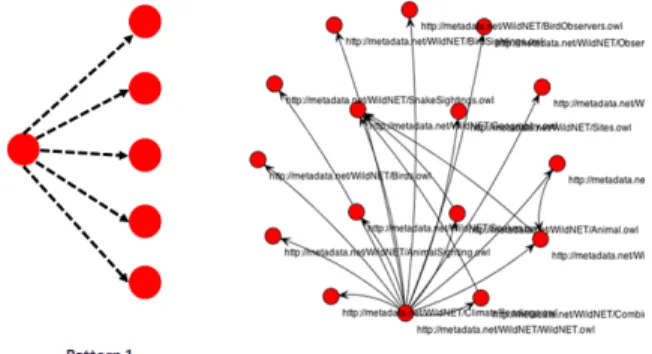
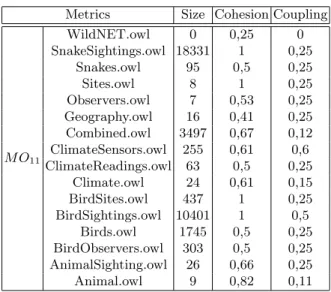
Pattern 1 contains one module which imports n others modules. For instance (Figure 1), the module WildNET.owl imports several modules such as An-imal.owl, AnimalSighting.owl, BirdObservers.owl, Birds.owl, etc. The pattern that we propose conforms to anaggregation. This pattern establishes a rela-tionship between a single module and a set of modules in the same ontology. This link is unidirectional. Applying the size metric (Table 1), the first part of
Fig. 1.1 module importing n modules
the ontology (one module) is very small (the moduleWildNET.owl contains 0 concepts) and the second part (N modules) is not structured and is respectively
5
http://owlapi.sourceforge.net/
6
bigger in size. Applying the cohesion and coupling metrics (see the table 1), the pattern 1 has a high cohesion regarding to the coupling metric. We consider pat-tern cohesion metric as an indicator of the degree to which the elements in the module belong together. The idea of this pattern is that the concepts grouped in an ontology should be conceptually related for a particular domain in order to achieve common goals.
Metrics Size Cohesion Coupling
M O11 WildNET.owl 0 0,25 0 SnakeSightings.owl 18331 1 0,25 Snakes.owl 95 0,5 0,25 Sites.owl 8 1 0,25 Observers.owl 7 0,53 0,25 Geography.owl 16 0,41 0,25 Combined.owl 3497 0,67 0,12 ClimateSensors.owl 255 0,61 0,6 ClimateReadings.owl 63 0,5 0,25 Climate.owl 24 0,61 0,15 BirdSites.owl 437 1 0,25 BirdSightings.owl 10401 1 0,5 Birds.owl 1745 0,5 0,25 BirdObservers.owl 303 0,5 0,25 AnimalSighting.owl 26 0,66 0,25 Animal.owl 9 0,82 0,11
Table 1.Results of the pattern 1 to n
4.2 Pattern type 2: n modules importing 1 module
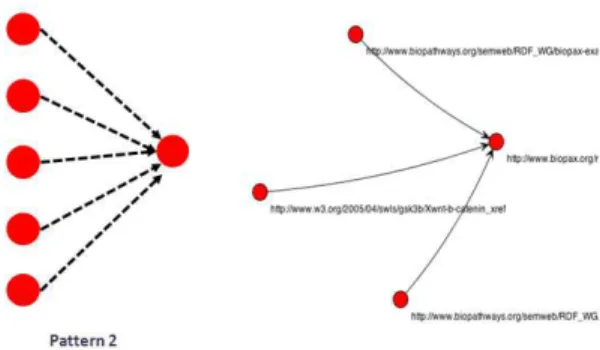
Pattern 2 contains n modules, which respectively import one module. For in-stance (Figure 2), there are three independant modules importing one module, which containes general knowledge (biopax-level1.owl). The pattern that we pro-posed is aninheritance. This pattern establishes a correspondence between a set of modules and a single module in the same ontology. This correspondence is unidirectional. Applying the three metrics (Table 2), the first part of pat-tern 2 (n modules),biopax-example-ecocyc-glycolysis.owl, biopax-example-Xwnt-b-catenin.owl andXwnt-b-catenin xref have a high coupling metric regarding to the second part of the pattern (one module)biopax-level1.owl. This means that pattern 2 is characterized by the interconnections between modules. This degree of coupling depends on how complicated the connections are and on the type of connections between modules. As we can see, the second part of pattern 2 has a high cohesion because it encloses all other modules, which are strongly related.
Fig. 2.n modules importing 1 module
Metrics Size Cohesion Coupling
M O21
biopax-example-ecocyc-glycolysis.owl 2139 0,20 0,72 biopax-example-Xwnt-b-catenin.owl 236 0 0,2
biopax-level1.owl 285 0,25 0,13 Xwnt-b-catenin xref 265 0 0,2
Table 2.Results of the pattern n to 1
4.3 Pattern type 3: n modules importing n-1 modules
Pattern 3 contains n modules, which import n-1 modules. For instance (Figure 3), we have three dependent modules:dublincore.owl,terms.owl anddcmitype.owl. The correspondence between modules is bidirectional. This pattern might be transformed in one module to n modules (pattern 1). Applying size, cohesion
Fig. 3.n modules importing n-1 modules
and coupling metrics (Table 3), the module dublincore.owl has a small size (0 concepts) regarding to other modulesdcmitype.owl andterms.owl. All modules have the same degree of relatedness of concepts (cohesion) 20%. The coupling
metric of the moduledublincore.owl is null. In this case, pattern 3 is transformed to pattern 1 and has the same characteristics.
Metrics Size Cohesion Coupling
M O32
dcmitype.owl 21 0,20 0,02 dublincore.owl 0 0,20 0
terms.owl 47 0,20 0,25
Table 3.Results of the pattern n to n-1
4.4 Pattern type 4: Pattern mix
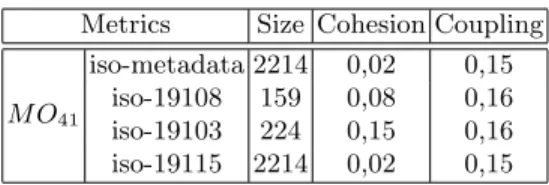
Pattern 4 combines all previous patterns (patterns 1, 2 and 3). For instance (Figure 4), we find partterns 1 (5 x Pattern 1) and 2 (3 x Pattern 2). The proposed pattern is pattern mix. The correspondence can be undirectional and bidirectional. The major characteristic of this type of pattern is the highest
Fig. 4.combination of patterns 1, 2, and 3
coupling metric regarding to the cohesion one. Two modular ontologies iso-metadata andiso-19115, have the same size, cohesion and coupling but they do not have a relationship like importor other.
4.5 Occurrence of Pattern Types
Having introduced and defined four types of patterns in order to characterize modularly organized ontologies it is necessary to depict how often these types
Metrics Size Cohesion Coupling M O41 iso-metadata 2214 0,02 0,15 iso-19108 159 0,08 0,16 iso-19103 224 0,15 0,16 iso-19115 2214 0,02 0,15
Table 4.Results of the pattern mix
of patterns respectively occur. Figure 5 provides an overview of the occurrence of the different types of patterns with regard to the basic population of 38 modularly organized ontologies. It is interesting to observe that pattern type
Fig. 5.Occurrence of Pattern Types
1 accounts for about 37%. The reason for this may be the fact that this type of pattern appears to be very intuitive. It could therefore be concluded that it implicitly constitutes the rationale underlying a large part of (semi-)automatic or manual approaches for modularizing ontologies. Similarly, pattern type 4 also accounts for about 37% of the basic population, i.e. 14 modularly organized on-tologies. Pattern type 4 mixes up pattern types 1, 2, and 3. On the one hand, it is obvious that not all modularly organized ontologies have a rather straightfor-ward structure, which could be easily characterized. This is especially true when assuming (semi-)automatic or manual modularizing approaches, which do not use clear and precisely defined criteria. And even when these criteria are clearly and precisely defined, the modularly organized ontologies could also have such a structure depending on the overall purpose of modularization. On the other hand, it is interesting to see that even more complex structures can (almost com-pletely) be characterized by more simple and straightforward structural forms. Moreover, pattern type 2 and pattern type 3 equally account for about 13%, i.e. 5 modularly organized ontologies. This is particularly interesting because pattern type 2 is reasonable. This is due to the fact that it appears obvious that there exists an ontology that is of significance for several other ontologies. On the contrary, pattern type 3 is much less reasonable than pattern type 2. It is really hard to understand why ontology modules respectively import each other.
In this context, it can be observed that domain ontologies rather incorporate a clear structure and organization. This means that modularization of domain on-tologies tend to rely on pattern type 1 or pattern type 2. In contrast, it appears that top-level ontologies have a less straightforward structure and organization particularly when compared to domain ontologies. An example for this is dublin-core.owl, terms.owl and dcmitype.owl, which can be characterized by pattern type 3 (Figure 3).
5
Conclusion and Future Work
This work aims at characterizing modularly organized ontologies to contribute to a better understanding of ontology modularization. We introduced the notion of modular ontologies, reported on approaches for ontology modularization, and re-viewed existing efforts to characterize modular ontologies. To characterize mod-ular ontologies, we followed an approach comprising six consecutive steps. This approach mainly includes the extraction and selection of modular ontologies, the selection of a set of metrics from software engineering to analyse modular ontologies, and the evaluation of the analysis results. The evaluation results in a set of four patterns, which allow for characterizing the modularly organization of ontologies. These patterns show amongst others that modularly organized do-main ontologies have a clear structure whereas top-level ontologies tend to have a rather confusing modular organisation.
Future work comprises several aspects. First, we aim at using further Semantic Web gateways such as Falcons or Swoogle to identify and extract additional on-tologies to gain a larger basic population. Second, extending the set of metrics and applying them on the ontologies would provide further insights in modular ontologies. Third, it would be interesting to create a comparison framework to conduct experiments with different modularization approaches and comparing them to each other or to manually modularized ontologies.
Acknowledgment
The authors would like to thank the organizers of SSSW’2011 and all the students who participated in the study.
References
1. Gangemi A. and Presutti V. Ontology Design Patterns, pages 221–243. Springer, Berlin, second edition, 2009.
2. Jie Bao, George Voutsadakis, Giora Slutzki, and Vasant Honavar. Package-based description logics. InModular Ontologies, pages 349–371. Springer, 2009.
3. Alexander Borgida and Luciano Serafini. Distributed description logics: Directed domain correspondences in federated information sources. In On the Move to Meaningful Internet Systems, 2002 - DOA/CoopIS/ODBASE 2002 Confederated International Conferences DOA, CoopIS and ODBASE 2002, pages 36–53, London, UK, UK, 2002. Springer-Verlag.
4. Mathieu d’Aquin, Peter Haase, Sebastian Rudolph, J´erˆome Euzenat, Antoine Zim-mermann, Martin Dzbor, Marta Iglesias, Yves Jacques, Caterina Caracciolo, Car-los Buil Aranda, and Jose Manuel Gomez. D1.1.3: Neon formalisms for modular-ization: Syntax, semantics, algebra. deliverable 1.1.3, NeOn Integrated Project, 2008.
5. Mathieu d’Aquin, Anne Schlicht, Heiner Stuckenschmidt, and Marta Sabou. Mod-ular ontologies. chapter Criteria and Evaluation for Ontology ModMod-ularization Tech-niques, pages 67–89. Springer-Verlag, Berlin, Heidelberg, 2009.
6. Frederico Luiz Gon¸calves de Freitas, Zacharias Candeias Jr., and Heiner Stucken-schmidt. Towards checking laws’ consistency through ontology design: The case of brazilian vehicles’ laws. JTAER, 6(1):112–126, 2011.
7. Faezeh Ensan and Weichang Du. A Modular Approach to Scalable Ontology De-velopment, page 79. 2010.
8. Bernardo Cuenca Grau, Ian Horrocks, Yevgeny Kazakov, and Ulrike Sattler. A logical framework for modularity of ontologies. InProceedings IJCAI-2007, pages 298–304. AAAI, 2007.
9. Bernardo Cuenca Grau, Bijan Parsia, and Evren Sirin. Working with multiple ontologies on the semantic web. InInternational Semantic Web Conference, pages 620–634. Springer, 2004.
10. Bernardo Cuenca Grau, Bijan Parsia, Evren Sirin, and Aditya Kalyanpur. Mod-ularity and web ontologies. In Patrick Doherty, John Mylopoulos, and Christo-pher A. Welty, editors, Proceedings of KR2006: the 20th International Confer-ence on Principles of Knowledge Representation and Reasoning, Lake District, UK, June 2–5, 2006, pages 198–209. AAAI Press, 2006.
11. Mustafa Jarrar.Towards Methodological Principles for Ontology Engineering. PhD thesis, Vrije Universiteit Brussel, May 2005.
12. Saket Kaushik, Csilla Farkas, Duminda Wijesekera, and Paul Ammann. An algebra for composing ontologies. InProceedings of the 2006 conference on Formal Ontology in Information Systems: Proceedings of the Fourth International Conference (FOIS 2006), pages 265–276, Amsterdam, The Netherlands, The Netherlands, 2006. IOS Press.
13. Bill MacCartney, Sheila McIlraith, Eyal Amir, and Tom´as E. Uribe. Practical partition-based theorem proving for large knowledge bases. InProceedings of the 18th international joint conference on Artificial intelligence, IJCAI’03, pages 89– 96, San Francisco, CA, USA, 2003. Morgan Kaufmann Publishers Inc.
14. Natalya F. Noy and Mark A. Musen. Specifying ontology views by traversal. In International Semantic Web Conference, volume 3298/2004, pages 713–725. Springer Berlin, November 2004.
15. Julian Seidenberg and Alan Rector. Web ontology segmentation: analysis, classifi-cation and use. InWWW ’06: Proceedings of the 15th international conference on World Wide Web, pages 13–22, New York, NY, USA, 2006. ACM.
16. Luciano Serafini and Andrei Tamilin. Drago: Distributed reasoning architecture for the semantic web. InESWC, pages 361–376. Springer, 2005.
17. Heiner Stuckenschmidt and Michel Klein. Structure-based partitioning of large concept hierarchies. In International Semantic Web Conference, pages 289–303, 2004.
18. Kevin J. Sullivan, William G. Griswold, Yuanfang Cai, and Ben Hallen. The structure and value of modularity in software design. In Proceedings of the 8th European software engineering conference held jointly with 9th ACM SIGSOFT international symposium on Foundations of software engineering, ESEC/FSE-9, pages 99–108, New York, NY, USA, 2001. ACM.