University of Central Florida University of Central Florida
STARS
STARS
Electronic Theses and Dissertations, 2004-20192018
Assessing the Impact of Multi-variate Steering-rate Vehicle
Assessing the Impact of Multi-variate Steering-rate Vehicle
Control on Driver Performance in a Simulation Framework
Control on Driver Performance in a Simulation Framework
Michael XynidisUniversity of Central Florida
Part of the Transportation Engineering Commons
Find similar works at: https://stars.library.ucf.edu/etd University of Central Florida Libraries http://library.ucf.edu
This Doctoral Dissertation (Open Access) is brought to you for free and open access by STARS. It has been accepted for inclusion in Electronic Theses and Dissertations, 2004-2019 by an authorized administrator of STARS. For more information, please contact [email protected].
STARS Citation STARS Citation
Xynidis, Michael, "Assessing the Impact of Multi-variate Steering-rate Vehicle Control on Driver
Performance in a Simulation Framework" (2018). Electronic Theses and Dissertations, 2004-2019. 6252. https://stars.library.ucf.edu/etd/6252
ASSESSING THE IMPACT OF MULTIVARIATE STEERING-RATE VEHICLE CONTROL ON DRIVER PERFORMANCE IN A SIMULATION FRAMEWORK
by
MICHAEL ATHANASIOS XYNIDIS B.A. Florida Atlantic University, 1986 M.S. University of Central Florida, 2011
A dissertation submitted in partial fulfilment of the requirements for the degree of Doctor of Philosophy
in the Department of Modeling and Simulation in the College of Engineering and Computer Science
at the University of Central Florida Orlando, Florida
Spring Term 2018
ABSTRACT
When a driver turns a steering-wheel, he or she normally expects the vehicle’s steering sys-tem to communicate an equivalent amount of signal to the road-wheels. This relationship is linear and occurs regardless of the steering-wheel’s position within its rotational travel. The linear steer-ing paradigm in passenger vehicles has gone largely unchanged since mass production of passenger vehicles began in 1901. However, as more electronically-controlled steering systems appear in con-junction with development of autonomous steering functions in vehicles, an opportunity to advance the existing steering paradigms arises. The following framework takes a human-factors approach toward examining and evaluating alternative steering systems by using Modeling and Simulation methods to track and score human performance.
Present conventional steering systems apply a linear relationship between the steering-wheel and the road wheels of a vehicle. The rotational travel of the steering-wheel is 900° and requires two-and-a-half revolutions to travel from end-stop to opposite end-stop. The experimental steering system modeled and employed in this study applies a dynamic curve response to the steering input within a shorter, 225° rotational travel. Accommodation variances, based on vehicle speed and steering-wheel rotational position and acceleration, moderate the apparent steering input to aug-ment a more-practical, effective steering rate. This novel model follows a paradigm supporting the full range of steering-wheel actuation without necessitating hand repositioning or the removal of the driver’s hands from the steering-wheel during steering maneuvers.
In order to study human performance disparities between novel and conventional steering models, a custom simulator was constructed and programmed to render representative models in a test scenario. Twenty-seven males and twenty-seven females, ranging from the ages of eighteen to sixty-five were tested and scored using the driving simulator that presented two successive driving test vignettes: One vignette using conventional 900° steering with linear response and the other employing the augmented 225° multivariate, non-linear steering.
The results from simulator testing suggest that both males and females perform better with the novel system, supporting the hypothesis that drivers of either gender perform better with a system augmented with 225° multivariate, non-linear steering than with a conventional steering system. Further analysis of the simulated-driving scores indicates performance parity between male and female participants, supporting the hypothesis positing no significant difference in driver performance between male and female drivers using the augmented steering system. Finally, com-posite data from written questionnaires support the hypothesis that drivers will prefer driving the augmented system over conventional steering.
These collective findings support justification for testing and refining novel steering sys-tems using Modeling and Simulation methods. As a product of this particular study, a tested and open-sourced simulation framework now exists such that researchers and automotive designers can develop, as well as evaluate their own steering-oriented products within a valid human-factors con-struct. The open-source nature of this framework implies a commonality by which otherwise-disparate research and development work can be associated.
Extending this framework beyond basic investigation to reach applications requiring more-specialized parameters may even impact drivers having special needs. For example, steering-system functional characteristics could be comparatively optimized to accommodate individuals afflicted with upper-body deficits or limited use of either or both arms. Moreover, the combined human-factors and open-source approaches distinguish the products of this research as a com-mon and extensible platform by which purposeful automotive-industry improvements can be real-ized—contrasted with arbitrary improvements that might be brought about predominantly to show-case technological advancements.
I proudly and lovingly dedicate this research and dissertation work to my father, Athanasios (Tom) Stathis Xynidis. His exemplary roles in family, church, country and his contributions to
ACKNOWLEDGMENTS
So many people have been there for me, and without whose love and support I may not have found the courage to follow this academic journey as far as I have. My principal guide has been Patricia Bockelman Morrow, who boldly stepped into the role of my third advisor and filled a void of uncertainty. She has been supportive, knowledgeable, and uncompromising when necessary. Peter & Poppy Kincaid, who first introduced me to Modeling & Simulation and encouraged me to pursue an advanced degree in the field, have been wonderful friends throughout the years. Peter served as my first advisor until his retirement in 2016. My bosses at UCF’s Institute for Modeling & Simulation, Brian Goldiez and Jack Stubbs, couldn’t have been better supporters as they helped keep my dissertation work highly prioritized (and funded), as well as keeping me involved in fascinating research in various areas. The completion of the very specialized driving simulator crucial to this research would not have otherwise been possible without the expertise of my friends and colleagues, Andrew Watson and Leonardo Seiji Oyama, whose programming and technical skills seemingly have no bounds. My family, my brothers and best friends Stathis and Nicholas, and my mother Despina (whose love absolutely knows no bounds) have kept me going, and continue to do so, and I expect always will. My Godmother, Despina Efstation, who somehow has the power to inspire me with nothing more than a simple smile and is often on my mind. My cousins Nicholas and Michael, who opened my eyes to the notion that we—as first-generation university scholars—could earn advanced degrees as scientists and engineers, fundamentally inspired me through their own achievements. I am also lucky enough to have longtime and loyal friends who have been there through thick and thin: Bonnie, David, and Kevin; you know who you are. My great admiration and respect for Constantine Santas, Sotirios Konstantinides, and the Reverend Fathers, Nicholas Louh and Paul Costopoulos, who—as exemplars beside my earthly father, Athanasios—set the unattainable standard by which I aspire to live my own life...I can only try.
TABLE OF CONTENTS
LIST OF FIGURES . . . xiii
LIST OF TABLES . . . xiv
CHAPTER 1: INTRODUCTION . . . 1
Background . . . 1
Current Problems . . . 3
Problems with Conventional Steering . . . 3
Problems with Mechanical Variable-rate Steering Systems . . . 5
Sparse Information Regarding Alternative Paradigms . . . 5
Motivation . . . 6
Research Taxonomy . . . 7
Current Technology in Vehicle Control . . . 7
Driver . . . 7
Simulator . . . 8
Assumptions, Limitations, and Scope . . . 8
Summary of Subsequent Chapters . . . 9
CHAPTER 2: LITERATURE REVIEW . . . 10
Overview . . . 10
Historical Milestones in Steering Systems . . . 11
The State-of-the-Art in Steering Systems . . . 12
Safety Considerations in x-by-Wire Systems . . . 14
A Human Factors Approach to (Steering System) Design Requirements . . . 19
Gender-based Bias . . . 21
Standards and Practices in Automotive Testing . . . 23
Hardware and Open-source Modeling, Simulation, and Graphics Software . . . 25
Identifying the Gap in Current Research . . . 31
CHAPTER 3: EXPERIMENTAL METHOD . . . 34
Overview of Methodology . . . 34
Research Objectives . . . 34
Question 1 . . . 34
Hypothesis 1: Drivers in a simulated environment will perform better at moderate speeds using vehicles equipped with Multivariate Steering-rate Vehicle Control, compared with vehicles equipped with con-ventional 900° steering systems. . . 34
Method by which to Test Hypothesis 1 . . . 34
Question 2 . . . 35
Hypothesis 2: Drivers in a simulated environment will prefer using vehi-cles equipped with Multivariate Steering-rate Vehicle Control, compared with vehicles equipped with conventional 900° steer-ing systems. . . 35
Method by which to Test Hypothesis 2 . . . 35
Question 3 . . . 35
Hypothesis 3: Male drivers in a simulated environment will perform no differently from female drivers at moderate speeds using vehicles equipped with Multivariate Steering-rate Vehicle Control. . . 36
Method by which to Test Hypothesis 3 . . . 36
Hypothesis 4: Younger drivers in a simulated environment will perform better at moderate speeds using vehicles equipped with
Multi-variate Steering-rate Vehicle Control than older drivers. . . 36
Method by which to Test Hypothesis 4 . . . 36
The Role of Simulation . . . 36
Simulation Objectives . . . 37
Conceptual Framework . . . 38
Research and Design Objectives . . . 38
Expected Experimental Results . . . 39
Participants . . . 39 Inclusion/Exclusion Criteria . . . 40 Data Management . . . 40 Apparatus . . . 41 Overview . . . 41 Simulator Design . . . 43 Questionnaires . . . 51 Experimental Procedure . . . 52 Sequence . . . 52 Measures . . . 54 Evaluation of Performance . . . 54 Independent/Dependent Variables . . . 55 Covariates . . . 55
Subjective Assessment of Performance . . . 55
CHAPTER 4: FINDINGS . . . 56
Descriptive Statistics . . . 56
Gender . . . 56
Age . . . 57
Race . . . 58
Number of Years Driving . . . 59
Computer Proficiency . . . 60
Statistical Analysis . . . 61
Ceiling Effect . . . 61
Residual Learning Effect . . . 62
Scoring: The Human Performance Results . . . 64
Drivers in a simulated environment will perform better at moderate speeds using vehicles equipped with Multivariate Steering-rate Vehi-cle Control, compared with vehiVehi-cles equipped with conventional 900° steering systems. . . 64
Repeated Measures Testing . . . 67
Subjective: Participant Preferences Findings . . . 68
Drivers in a simulated environment will prefer using vehicles equipped with Multivariate Steering-rate Vehicle Control, compared with vehi-cles equipped with conventional 900° steering systems. . . 68
Questionnaire Results . . . 71
Assessment: The Effect of Gender . . . 72
Male drivers in a simulated environment will perform no differently from female drivers at moderate speeds using vehicles equipped with Multivariate Steering-rate Vehicle Control. . . 72
Younger drivers in a simulated environment will perform better at moderate speeds using vehicles equipped with Multivariate Steering-rate
Vehicle Control than older drivers. . . 73
Summary: Study Results . . . 74
Research Question 1: “Will a multivariate steering-rate vehicle control sys-tem, which will allow a driver (i.e. study participant) to main-tain uninterrupted hand positioning on a steering-wheel during any steering maneuver, measurably affect driver performance in a simulated environment?” . . . 74
Research Question 3: “Compared with study participants’ respective per-formance driving a conventional steering system (in simulation) versus a multivariate steering-rate vehicle control system designed for the purposes of this research, will gender be a factor to a sta-tistical significance?” . . . 75
Research Question 4: “Compared with participants’ respective performance driving a conventional steering system (in simulation) versus a multivariate steering-rate vehicle control system designed for the purposes of this research, will age be a factor to a statistical sig-nificance?” . . . 75 CHAPTER 5: DISCUSSION . . . 76 Summary . . . 76 Evaluation of Methods . . . 77 The Simulator . . . 77 The Questionnaire . . . 77 Statistical Tests . . . 78
Conclusions . . . 79 Practical Implications . . . 79 Limitations . . . 79 Recommendations . . . 80 Additional Study . . . 81 Future Directions . . . 81
APPENDIX A: UCF IRB APPROVAL DOCUMENT . . . 83
APPENDIX B: UCF PARTICPANT CONSENT FORM . . . 84
APPENDIX C: DEMOGRAPHICS QUESTIONNAIRE . . . 85
APPENDIX D: MOULOUA USABILITY SURVEY . . . 86
LIST OF FIGURES
Figure 2.1:Conceptual mechanical nonlinear steering configuration . . . 13
Figure 2.2:BMW Active Steering configuration . . . 14
Figure 2.3:Conceptual steer-by-wire fault tree . . . 16
Figure 2.4:Conceptual steer-by-wire subsystem . . . 18
Figure 3.1:Block diagram of the research framework . . . 38
Figure 3.2:Path through a set of gates . . . 45
Figure 3.3:Path through a single gate . . . 45
Figure 3.4:Reduction mapping applied to steering input . . . 47
Figure 4.1:Distribution of participant ages as percentages . . . 57
Figure 4.2:Distribution of participant race as percentages . . . 59
Figure 4.3:Distribution of participant driving experience . . . 60
Figure 4.4:Distribution of participant computer proficiency . . . 61
Figure 4.5:Performance scores using the conventional steering-system . . . 65
Figure 4.6:Reflected and inverse converted scores using the conventional steering-system 65 Figure 4.7:Performance scores using the Multivariate Steering-system . . . 66
Figure 4.8:Reflected and inverse converted scores using the Multivariate Steering-system 66 Figure 4.9:Preference . . . 69
LIST OF TABLES
Table 2.1: Limits for upper limb joint angles . . . 20
Table 2.2: Men vs. women driving skills . . . 23
Table 2.3: Listing TORCS/Speed Dreams Citations . . . 26
Table 2.3: Listing Logitech G27 Citations . . . 27
Table 2.4: Listing Unreal/PhysX Citations . . . 29
Table 3.1: G*Power Bivariate normal model correlation . . . 39
Table 3.2: Virtual slalom track parameters . . . 44
Table 4.1: Sample population gender distribution . . . 57
Table 4.2: Sample population generational distribution . . . 58
Table 4.3: Sample population race distribution . . . 58
Table 4.4: Study participant steering-system preferences . . . 69
Table 4.5: Study participant steering-system would-recommend . . . 70
CHAPTER 1: INTRODUCTION
BackgroundConsider the function of steering. Alongside engine throttle, steering is certainly among the most-used and most important (driver) control inputs in road vehicles today—as it has been since the introduction of the automobile steering-wheel in 1894. When one considers the importance and complete ubiquity of steering systems in passenger road vehicles, the gap becomes apparent between the degree to which the fundamental paradigm and design of steering systems have ad-vanced when compared with the development of other automotive systems such as propulsion, suspension, and environmental/climate. Some of the more notable advancements in steering sys-tems have been rack-and-pinion steering by BMW in 1933 with its 303 model (Sherman, 2012) (although first introduced to the US market in the 1951 MG TD) (Green, 1997) and variable rate (variable-rack/fixed-pinion) steering by Arthur Ernest Bishop in the 1970s (Bishop, 1973). Hy-draulic power-assisted steering was patented by Francis W. Davis of Pierce Arrow in 1926 (Davis, 1932), however was later reintroduced commercially by General Motors in its Chrysler Imperial model and branded “Hydraguide” in 1951 (Lamm, 1999), and electric power-assisted steering as first seen with the Suzuki Cervo in 1988. In 1985, Honda became the first of many Japanese cars to offer four-wheel steering (Sherman, 2012).
The two areas of recent development that are relevant to this proposed research effort are (1) Variable-rate steering, and (2) Steer-by-wire systems. The former, as designed by Bishop (1973), implements a progressively higher rate of steering toward the steering-wheel ends, relative to the rate at steering-wheel center. This is intended to provide quicker vehicle response, but the overall function is not adaptable to vehicle speed. More-recent variable ratio steering systems are typically variations of BMW’s Active Steering (Kumar & Kamble, 2012), which aims to reduce the number of steering-wheel turns from the conventional two-and-a-half turn, to less than two turns in
low-speed/parking-lot situations (Koehn & Eckrich, 2004). These systems implement a combination of planetary gears and an electric motor to synthesize the effective steering input.
Steer-by-wire has been pioneered in passenger cars by Nissan with its Infinity Q50 (Ul-rich, 2014). Another vehicle employing steer-by-wire technology is the Mercedes-Benz multipur-pose auto-four-wheel-drive truck called the Unimog—although it is currently a concept vehicle, it received German “Straßenzulassung” (road legal) approval for a Steer-by-Wire system (Schmitt, 2011). Andonian et al. (2003) add a feedback actuator to provide haptic response in their steer-by-wire patent.
The task associated with this proposed research framework is to bridge these two areas (steer-by-wire and variable-rate steering), while introducing formulae for optimizing steering ra-tios (with respect to both speed and task) as well as providing a means of eliminating the need for hand-over-hand steering-wheel manipulation, which is normally necessary to maintain or regain vehicle control. The mitigation of unnecessary steering-wheel manipulation will be accomplished by constraining end-to-end steering-wheel rotation to 225°—an angle which is nominally achiev-able by a human driver without reconfiguring his or her hand placement, and (conveniently) exactly one-quarter the angular distance of conventional two-and-a-half turn (900°) steering systems. Such a steering system would require multivariate variability (i.e. vehicular velocity; steering-wheel angular displacement; rate and acceleration of the steering-wheel angular displacement) in order to dynamically vary an otherwise linear steering ratio. Without such accommodation, all steering input would simply result in a linear four-fold increase in steering ratio without regard to vehicle speed or steering task.
Even though a large steering-rate increase would result in greatly reduced steering-wheel ro-tation at low speeds, which could be advantageous and considered desirable in parking lot situations (e.g. parallel parking and three-point turns), increasing a vehicle steering rate by a four-fold linear rate at highway speeds would not be so desirable. It would make vehicle control much too difficult due to the ratio having an inverse effect on the stability and precision of a driver’s steering-wheel
movements given the effect that the increased speed would have on vehicle control. Controllabil-ity at higher speeds and manageabilControllabil-ity at lower speeds are factors that seem to present opposing requirements.
Conventional steering systems deliver a compromise that is widely accepted, but these sys-tems present a paradigm that has gone largely unchanged for several decades. In order to update the paradigm to one that is optimal for both factors, the assay of its evolution must be updated as well.
The approach followed in this study seeks to adapt steering-rate management to both vehicle velocity and the driver’s task as a system, as well as to measure the effectiveness of the system (in terms of both improved vehicle control and driver acceptance) by means of a driving simulator based experiment. In order to better understand and measure the effect of such steering-system dynamics during and following experimentation, a novel simulator that can be customized to render test scenarios and support the associated metrics is necessary.
Current Problems
The fundamental principles of automobile steering systems have remained virtually un-changed for the past 90 years. As could be expected (assuming there are existing and unaddressed shortcomings and problems with conventional steering), there is likely to be plenty of room for improvement. Moreover, any claim to have produced an improved method of steering must be evaluated, based on standardized criteria and measured through simulation and ultimately in a live environment.
Problems with Conventional Steering
Every driver explicitly and/or intuitively realizes that an n-degree angular displacement of a steering-wheel for a given time moment has a greater and greater effect as vehicle speed increases
(e.g. a 15° deflection of a steering-wheel for one second at 70 m.p.h. has a markedly greater effect on a vehicle’s path than the same maneuver at 10 m.p.h.) There exists a non-proportionality of steering input effect across the range of a vehicle’s velocity. A driver must be cognizant of the discordance between steering input and vehicle response at varying speeds if he or she is to predict the results of his or her steering inputs at various speeds. A relevant example would be over-correction, defined as excessive steering input in response to a panic reaction causing the driver to lose control of the vehicle, which is more likely to occur as vehicle velocity increases (Spainhour & Mishra, 2008).
Many maneuvers, such as parallel parking, 3-point turns, and even extreme left or right turns in city driving require releasing one’s hands from their 9-and-3 o’clock (or 10-and-2 o’clock) positions and either shuffling the steering-wheel or repeating a hand-over-hand repositioning on the wheel in order to complete the maneuver while alternating moments of two-handed control versus one-handed control. Some of these maneuvers (e.g. parallel parking) require reorientation of a driver’s upper body towards the rear of the vehicle in order to attend to and negotiate nearby obstacles and parking-space limits.
At higher speeds, if a driver encounters an emergent situation requiring quick hand-over-hand steering, he should anticipate that recovery from the maneuver (steering-wheel reversal) will necessitate similar efforts in order to recover and stabilize the vehicle. The cognitive demand for the driver who has not yet developed adequate skills to negotiate the primary and secondary task demands needed to perform vehicle recovery may exceed that of a novice driver (Patten et al., 2006); tracking the orientation of the steering-wheel (relative to center) is compounded with this sort of hand repositioning. Moreover, from the perspective of accommodating automated driver assistance, there are no standardized provisions in conventional steering systems to interface with safety mechanisms such as vehicle roll-over prevention or other interventions.
Problems with Mechanical Variable-rate Steering Systems
Mechanical variable-rate steering systems do not eliminate hand-over-hand repositioning (or shuffling), cannot be reconfigured, and (because of mechanical linkage) cannot be easily moved to accommodate a left-seat or right-seat driver or retracted in the case of semi-autonomous vehicles. Additionally, mechanical systems are not modular; the components comprising the rate-translation mechanism (usually a system of electric motors and planetary gears) cannot simply be swapped into another make of automobile, or for that matter, type of vehicle—such as watercraft or aircraft.
Sparse Information Regarding Alternative Paradigms
In and of itself, the development of a new steering system—as a component of a steer-by-wire system—should not be bound to the paradigm of conventional steering. Not without good reason, and not without a study of alternative paradigms with respect to conventional two-and-a-half turn (900°) steering systems. The objective of this study is to evaluate (through simulation) the effectiveness of a novel, programmable, computer-controllable steering system that allows a full range of steering without interrupting two-handed steering-wheel control, and similarly evaluating a conventional system for purposes of comparison. Literature addressing such technologies neither concludes nor disputes the effectiveness or adoptability of such a system. The referenced literature is reviewed in detail in the second chapter: “Literature Review of Relevant Technology”.
In order to study the effectiveness of alternative steering control schemes, the research framework would require a specialized/customizable driving simulator to both employ installable code libraries implementing necessary input/output steering algorithms, and also measure the per-formance of participant drivers in specific testing scenarios. Additionally, participants will be sur-veyed (Likert style) in order to produce a qualitative assay of preferences and adoptability. This methodology is described in detail in the third chapter: “Experimental Methodology”.
with standardized input/output communications with the steering-wheel (for steering-input/haptic-output) and standardized input/output connectivity to a laptop computer equipped with the special-ized simulator software (which corresponds to a vehicle control unit for steering-output/vehicle-speed control and inertial-measurement data). This methodology is also described in detail in the third chapter: “Experimental Methodology”.
Motivation
The need for this study is motivated by observation that advancements in automotive steer-ing technologies focussteer-ing on steersteer-ing-wheel control are relatively sparse. More specifically, few technologies challenge the paradigm of conventional steering, which requires alternating control of the steering-wheel between hands while undertaking certain steering maneuvers (i.e. hand-over-hand, or shuffle steering methods used during turns and parking). Moreover, recent technologies that do address reduction of wheel turns, do not employ methods to completely mitigate interrup-tion of two-handed control during those types of maneuvers, only to reduce it (Kumar & Kamble, 2012).
Accordingly, no study providing results associated with implementing an alternative system that would allow constant two-handed control while adequately accommodating the relevant human biomechanics involved in steering has been published. Consequently (short of building a real-world test vehicle), measuring the significance any results realized from comparing conventional with alternative steering technologies would necessitate a novel simulation framework that would do the following:
• Support programmable steering algorithm input.
• Provide a physics engine to apply the steering input to a model. • Provide a means of scoring the performance of a driver.
Research Taxonomy
The areas of interest concerning the current knowledge and technology related to the topic of this study form a clear taxonomy. The questions designed to explore this information (within the scope of this study) can be grouped accordingly.
Current Technology in Vehicle Control
1. Does the ability to maintain two hands on a steering-wheel equate to better control? 2. Does a variable-rate steering ratio equate to better control?
3. What steering-wheel ratios (relative to linear) are best suited to different speeds?
Driver
1. Kinematics: What is the ideal range of motion enabling both hands stay in place (i.e. the range of steering-wheel rotation that allows fixed hand placement through a maneuver)? 2. Will results in either acceptance or training be demographically distinguishable (e.g. novice
drivers versus experienced or expert Gamepad generation versus Slide-rule generation; male versus female)?
3. Will consumers accept/adopt or even prefer a new steering paradigm?
The intent driving this research is that it will not only contribute to the academic body of knowledge, but that industry might develop more-intuitive, better-performing, and safer steer-ing systems that can be matched with other advanced vehicle control technologies such as active-braking, active-steering, and roll-over prevention.
Simulator
1. How does industry test effectiveness of steering systems in the real world?
2. What kind of simulation environment would be sufficient to virtualize an industry-type test? 3. What is the dynamic equation that describes the effect upon the input signal from the
steering-wheel that translates to the desired road-steering-wheel control signal? 4. How should driver performance be measured?
5. How would operator acceptance be measured?
6. Can a simulator be built to employ these metrics and be affordable at an academic level? The literature relevant to the investigation of these questions is reviewed in detail in the second chapter: “Literature Review of Relevant Technology”, including a section discussing the gap in the current research and the resulting research questions driving the study.
Assumptions, Limitations, and Scope
The test track that will be simulated in the experiment will consist of a slalom course us-ing traffic cones (stanchions) interspersed at distances commonly used in industry standard vehicle testing. It is beyond the scope of this research to derive and design optimal testing parameters, with respect to track dimensions; rather, acceptable de facto slalom course parameters will be adopted, based on consultations with driving and vehicle-performance experts. It is also beyond the mone-tary resources of this study to manufacture a real-world steering input control device that could be installed in a vehicle for testing on a closed-circuit track.
The nature of the experiment requires a specialized simulation framework having specific customizable features, or access to program internals that would allow track customization, ob-ject/vehicle collection detection, 3D VR integration, and programmability to the degree of
sup-porting custom steering ratio algorithms. Limited by monetary constraints, an open-source driving-simulator platform, which is widely used in academic research, was selected and modified accord-ingly. The software platform was integrated with Commercial off-the-Shelf (COTS) hardware. The same limitation excludes the possibility of validating the specialized system in a real-world car and track. Both the software platform (TORCS/Speed Dreams and Unreal rendering engine) as well as the hardware (Logitech Wheel and Seating System; Oculus Rift) will be discussed in the Literature Review and Methodology sections.
The proposed research platform is intended to have utility beyond the scope of this exper-iment. For example, while not being specifically addressed in this research, the 3D VR device will accommodate more-complex scenarios requiring much broader fields of vision, such as paral-lel parking, decreasing-radius freeway exits, or even the “rubbernecking” phenomenon. However, practical limitations constrain this study to evaluating human performance using a slalom course on a straight track.
Summary of Subsequent Chapters
The following chapter reviews the academic and industry literature that establishes the groundwork for the final research methodology. It begins with an overview of the chapter. Subse-quent sections addressMilestonesandState-of-the-Artin steering systems,Safetyin indirect con-trollers,Human Factors considerations,Standards and Practices in Automotive Testing, an inves-tigation ofSimulation Software and Associated Hardware, and conclude byIdentifying the Gap in Current Researchand the resultingResearch Questionsthat justify the research.
CHAPTER 2: LITERATURE REVIEW
OverviewWhen one considers the major advancements made throughout automotive history, the more-dominant subjects of economy, performance, comfort and style typically come to mind. Ad-vancements in the area of steering systems accordingly take a back seat by comparison. This review will examine the major historical advancements in steering operations, and then take a look at cur-rent state-of-the-art of manual steering technology as well as the availability of software and hard-ware platforms that can be used to develop steering system theories and the framework upon which to develop them. Subsequent sections of this literature review aim to identify the problems or short-comings of conventional steering systems, as well as more-advanced steering systems in terms of both safety and contribution to steering competence. Having established these foundations, broader perspectives such as human factors and the biomechanics associated with steering will be explored in an effort to present design requirements for designing steering systems to accommodate human systems, rather than the other way around.
Testing is an important part of developing a concept before realizing a real-world end prod-uct. Accordingly, this review will investigate methods of testing employed by the automotive indus-try to evaluate their own research and development. Furthermore, since the physical construction of a steering system and incorporating it into a vehicle is beyond the practical scope of this research, a system will be virtualized as a simulation, borrowing from relevant testing methods used in the automotive industry. And finally, the components of the simulation will be addressed, as will be the topic of validating the product simulator.
Historical Milestones in Steering Systems
Alongside engine throttle, steering is certainly among the most-used (human) control inputs in road vehicles today—as it has been since the introduction of the automobile steering wheel in 1894; the first notable improvement being its placement on a raked column in 1898 by Panhard (Lay & Vance Jr, 1992). From there, other “innovations” were introduced. In 1965, the Ford Motor Company tested a concept they called, “Wrist Twist”. It consisted of two 5” rings (wheels) mounted on a two-pronged beam roughly shoulder width apart, and comfortably within driving reach (with arms on armrests). The rings were coupled, and moved simultaneously, allowing the driver to alternate ring rotation between each hand as an analog to hand-over-hand steering wheel manipulation. Although the system was not brought to mass production in standard automobiles, the concept has been applied to the more specialized area of special vehicle controls for severely disabled drivers (Bray & Cunningham, 1967).
Hydraulic power-assisted steering was invented by Francis W. Davis of Pierce Arrow in 1926 Davis (1932). Much later, General Motors commercially reintroduced hydraulic power-assist in its Chrysler Imperial as “Hydraguide” in 1951, whereas electric power-assist only appeared in 1988 in the Suzuki Cervo (Lamm, 1999). BMW introduced rack-and-pinion steering in 1933 with its 303 model (Sherman, 2012), however rack-and-pinion steering was first introduced to the US market in the 1951 MG TD (Green, 1997). In 1985, Honda became the first of many Japanese cars to offer four-wheel steering (Sherman, 2012).
Autonomous steering functions such as lane keeping and self-parking are unquestionably advancements in steering technology; however, vehicular steering autonomy does not play a role which would be considered within the scope of this research—which is manual, human-in-the-loop control—and therefore not reviewed within the context of this research. Steer-by-Wire and Variable-rate steering systems are perhaps even more-so historically significant, but because those technologies represent state-of-the-art related to this research, they are reviewed in the next section.
The State-of-the-Art in Steering Systems
Electronic Stability Control (ESC) systems currently represent an important segment of the state-of–the-art in steering systems not incorporating steer-by-wire. ESC analyzes information from vehicle sensors and corrects driver input to increase stability by limiting or decreasing vehicle speed and/or acceleration during maneuvers that would otherwise exceed the vehicle’s handling limits.
The National Highway Traffic Safety Administration (NHTSA) has concluded that ESC ap-pears to be highly effective in reducing single vehicle run-off-road crashes such as rollovers and collisions with fixed objects (Dang, 2004). It is important to note that ESC in non-steer-by-wire vehicles stabilizes vehicle yaw and traction through throttle and braking alone—there is no adjust-ment made to the driver’s steering input. Even so, vehicles with ESC in the United States have had a single-vehicle crash risk that is 41 percent lower than vehicles without ESC, which suggests that approximately 800,000 of the 2,000,000 single-vehicle crashes that occur in the US might be avoided if all vehicles were equipped with ESC (Farmer, 2004).
As part of a steer-by-wire platform, ESC could be enhanced by intervening on the driver’s steering input to more-smoothly alter the vehicle’s course while preserving both safety and vehicle performance (Yih et al., 2005). Yih goes on to describe the sensation of “connectedness” between engaging the steering wheel and feeling the response of the road wheels. A force-feedback system to accommodate such communication back to the driver would be a mandatory component of a final system—playing a pivotal role in consumer acceptance. Even though the framework presented in this research could accommodate this level of force-feedback within the simulation, it is not explored or evaluated as part of the variable ratio steering that will be utilized as part of this research. Variable-rate steering systems were originally designed as purely mechanical devices that implemented a progressively higher rate of steering toward the steering-wheel ends, relative to the rate at steering-wheel center. This is intended to provide quicker vehicle response, but the overall
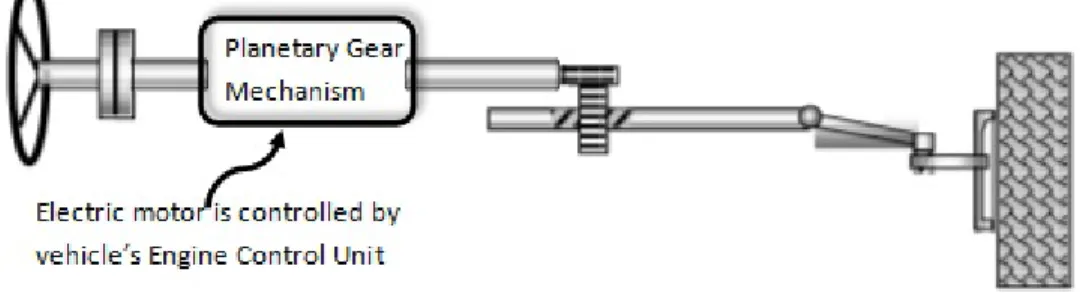
function is not adaptable to vehicle speed (Bishop, 1973). More-recent nonlinear (variable ratio) steering systems are typically variations of the Bavarian Motor Works’ (BMW) Active Steering (BMW AG, Munich, Germany) (Kuehnhoefer & Biegert, 2007; Kumar & Kamble, 2012) or Audi’s Dynamic Steering (Audi AG, Ingolstadt, Germany), which aims to reduce the number of steering-wheel turns from the conventional two-and-a-half turn, to less than two turns in low-speed/parking-lot situations (Koehn & Eckrich, 2004). These systems implement steering wheel actual input, driving a combination of planetary gears and an electric motor to synthesize the effective steering input, as illustrated in Figure 2.1. The mechanical output from the gear and motor system in turn engages a standard (power-assisted) rack and pinion gear to steer the front road wheels.
Figure 2.1: Conceptual mechanical nonlinear steering configuration
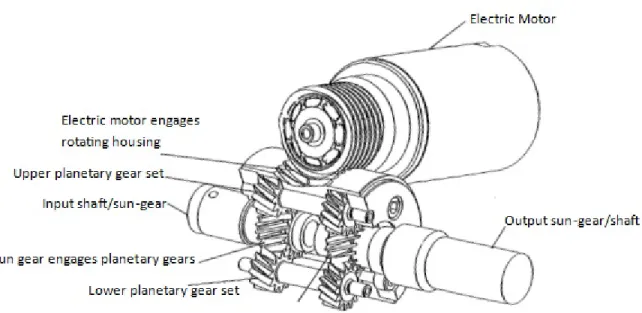
The steering wheel rotation is coupled to an drive gear at the end of the input steering column (known as a sun gear), which is translated to an output sun gear at a net 1:1 ratio coupled to the output steering column. A set of planetary gears, each of two pairs connected with a common lay shaft, engage the sun gears to a common geared, rotatable housing. This in turn engages with the electric motor. The electric motor is controlled by the vehicle’s Engine Control Unit (ECU), which ultimately varies the effective steering ratio. This configuration is illustrated in Figure 2.2 on page 14. Fault tolerance in this design consists of locking the rotatable housing, which results in a fixed 1:1 steering ratio.
Figure 2.2: BMW Active Steering configuration
Ford (Ford Motor Company, Dearborn, Michigan, U.S.) in conjunction with the automotive components supplier Takata (Takata Corporation, Tokyo, Japan) has announced Ford Adaptive Steering, which is described to accomplish the same variable-ratio steering as with the BMW and Audi systems—however, the entire mechanism is to be contained within the vehicle’s steering wheel hub.
Another vehicle employing steer-by-wire technology is the Mercedes-Benz multipurpose auto-four-wheel-drive truck called the Unimog—even though it is presently considered a concept vehicle, it received German “Straßenzulassung” (road legal) approval for a Steer-by-Wire system (Schmitt, 2011).
Safety Considerations in x-by-Wire Systems
Knight (2002) predicted the need for advances in specification, architecture, verification and process where safety-critical systems are being developed. We are already seeing a dramatic
increase in the number of safety-critical systems that are computer controlled, which are replacing more conventional mechanical systems. Robotic surgeries, from ophthalmic procedures to the da Vinci surgical robot (Intuitive Surgical, Inc., Sunnyvale, CA), is one example. Safety-critical by-wire control in both military and commercial aircraft is also pointed out by Knight.
Drive-by-wire systems, in general, can be designed and implemented in two ways: with mechanical backup, or without mechanical backup.
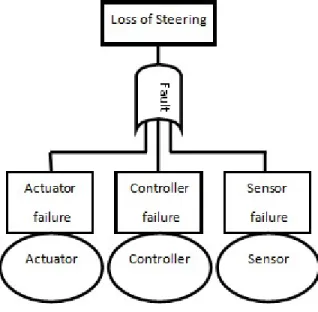
Although production of steer-by-wire vehicles is currently very limited, Isermann, Schwarz & Stölzl (2002) point out the increasing demand and address the hazard severity in designing and delivering safe drive-by-wire systems overall. Their work outlines schemes for safety/hazard analy-Because a main objective of this testing framework is to enable a steering system that re-places conventional purely-mechanical methods with electrical signals over wire (or other trans-mission medium, for that matter, e.g. fiber optics), it is necessary and prudent to mention safety options, including redundancy and fault tolerance. Dunn (2003) explains that, despite the scope and ubiquity of computer control of mechanical systems (not limited to steer-by-wire controls, but also including safety-critical applications that touch most of us: life-support systems, automated air- and surface-traffic control, and so on), they commonly fail for reasons that can be classified in one of the following three categories: Designers or users i. “have an incomplete understanding of what makes a system ‘safe’”; ii. “fail to consider the larger system into which the implemented concept is to be embedded,”; iii. “ignore single points of failure that will make the safe concept unsafe when put into practice.” Generally speaking, this view of fault possibilities is inclusive of an entire control system. In the specific implementation of a steer-by-wire steering system, the system can be separated into three subsystems—any one of which can lead to loss of steering. These are the Actuator, Controller, and Sensor subsystems, shown in Figure 2.3 on page 16, along with an illustration of how a fault in any of the subsystems can result in loss of steering. The Sensor and Ac-tuator subsystems, respectively, report the position of the road wheels (in addition to other sensors, if so designed) and set their steering angle according to the output of the Control subsystem.
sis and fault-tolerant design, as well as considerations for implementing redundant systems. These principles would be applied at the level of an overall x-by-wire system design.
Figure 2.3: Conceptual steer-by-wire fault tree
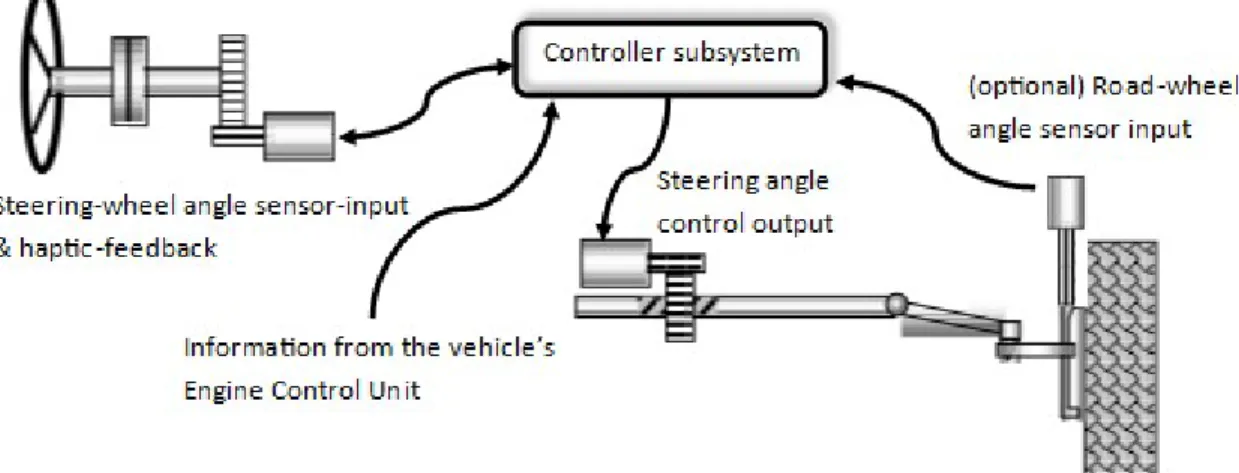
The framework being presented herein focuses specifically on the Control subsystem as further illustrated in Figure 2.4. The design of the steering system being implemented as part of this experiment also collects and utilizes the vehicle’s velocity from its ECU (through simulation), but could incorporate input from real-time sensors (e.g. road wheel angle, accelerometer, vehicle tip/rotation, etc.), as well as haptic feedback to the steering wheel.
Amberkar, D’Ambrosio, Murray, Wysocki & Czerny (2000) present a general hazard anal-ysis process for x-by-wire systems that are safety-critical systems. The process is summarized in the following 16 steps:
1. Cause-Consequence Analysis 2. Common Cause Analysis
4. Event Tree Analysis
5. Failure Modes and Effects Analysis
6. Failure Modes, Effects, and Criticality Analysis 7. Fault Tree Analysis
8. Hazard and Operability Study Hardware/Software Safety Analysis 9. Modeling
10. Root Cause Analysis 11. Safety Review
12. Sneak-Circuit Analysis
13. Software Failure Modes and Effects Analysis 14. Software Fault Tree Analysis
15. Software Hazard Analysis 16. Software Sneak Circuit Analysis
The framework presented as part of this experiment is designed as a subsystem. It is in-tended to be incorporated as a component of an overall steer-by-wire design and test system that would support such a hazard/safety analysis process.
There are currently a few consumer passenger vehicles commercially available with purely Steer-by-Wire (SBW) steering systems. A notable example is Nissan’s (Nissan, Yokohama, Japan) Infinity Q50. The Q50 employs an electronic connection, with no physical connection between the steering wheel and the road wheels. The SBW consists of a computer controller, clutch, and
steering-angle actuator to translate the driver’s input from the steering wheel to the road wheels. Similar to the BMW system, the Q50 employs variable degrees of power-assist and steering ratio to suit the steering event (Ulrich, 2013). To address fault tolerance, Nissan has designed this steering system with three independent controllers to maintain a practical level of passenger safety. Nissan also claims a unique feature (by eliminating the mechanical steering connection), which is the ability to filter out road feedback such as rough-road vibrations and impacts that are normally transmitted through the vehicle’s steering column.
Figure 2.4: Conceptual steer-by-wire subsystem
In addition to canceling the effects of road disturbance forces, Yih, Ryu & Gerdes (2005) have experimentally verified key improvements to SBW systems by leveraging inputs from Global Positioning Systems (GPS) and Inertial Navigation System (INS) sensors located in the vehicle. Their methodology seeks to adjust-for and minimize oversteer or understeer based on indications of vehicle yaw-rate and side-slip.
Zheng, Altemare & Anwar (2005) describe a fault tolerant steer-by-wire methodology using a dual motor, dual microcontroller architecture. One of the pair of microcontrollers serves as the master, while the other stands by to provide redundancy. The twin actuating motors work in unison
to share the torque used in steering the road wheels. If one fails, the system automatically switches to single motor operation.
A Human Factors Approach to (Steering System) Design Requirements
Human Anatomical Constraints
Every driver explicitly and/or intuitively realizes that an n-degree angular displacement of a steering over a given moment in time has a greater and greater effect as vehicle speed increases. For example, a 15° deflection of a steering wheel for one second at 70 m.p.h. has a markedly greater effect on a vehicle’s path than the same maneuver at 10 m.p.h. There exists a non-proportionality of steering input effect across the range of a vehicle’s velocity. A driver must be cognizant of the discordance between steering input and vehicle response at varying speeds if he or she is to predict the results of his or her steering inputs at various speeds. A relevant example would be over-correction, defined as excessive steering input in response to a panic reaction causing the driver to lose control of the vehicle, which is more likely to occur as vehicle velocity increases (Spainhour & Mishra, 2008).
At higher speeds, if a driver encounters an emergent situation requiring quick hand-over-hand steering, he should anticipate that recovery from the maneuver (steering wheel reversal) will necessitate similar efforts in order to recover and stabilize the vehicle. The cognitive demand for the driver who has not yet developed adequate skills to negotiate the primary and secondary task demands needed to perform vehicle recovery may exceed that of a novice driver (Patten, Kircher, Östlund, Nilsson & Svenson, 2006); tracking the orientation of the steering wheel (relative to cen-ter) is compounded with the fast hand repositioning involved with hand-over-hand steering or shuf-fle steering. Here, the effect of associated diminished dexterity on driving safety is presumed.
Accordingly, if two-handed steering operation is to be achieved in a way that eliminates the need for removal of the hands or hand repositioning in a maneuver, the practical limits of the
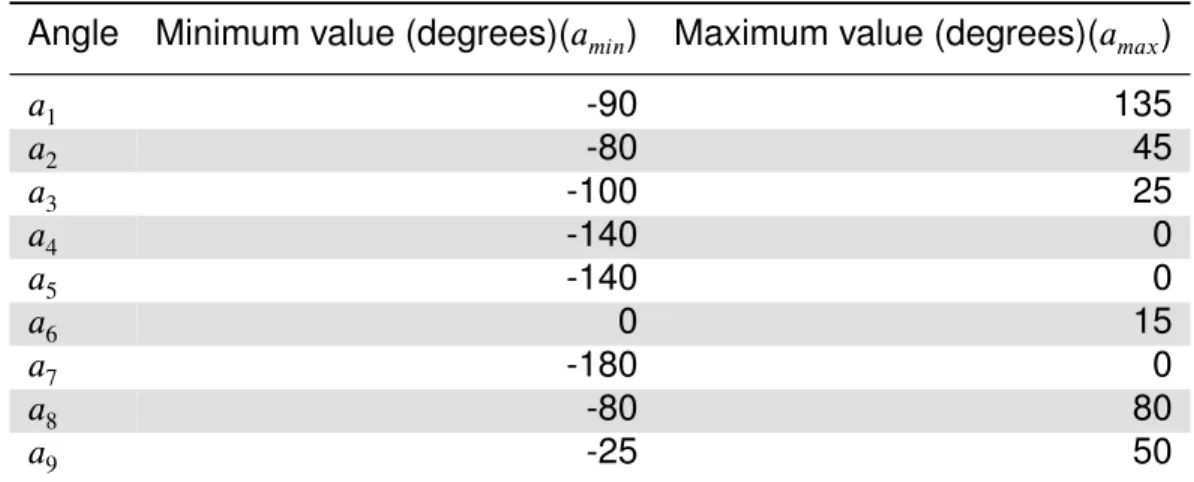
human body while engaged in steering must be examined. The maximum safe two-handed wheel position with respect to constraint torques on the human body is approximately 275° (Johnson, Van der Loos, Burgar, Shor & Leifer, 2003), but this does not address driver comfort or prefer-ences. A validated skeletal model of the upper human limb was used for further biomechanical analysis (Pennestrì et al., 2007). The model is comprised of three links: the shoulder, the elbow, and the wrist, connecting to the body the following segments: the humerus, the ulna, the radius, and the hand. It is considered a seven degrees-of-freedom model within a 3-dimensional space. The practical limits of the upper limb during steering with respect to each segment’s extension and prono-supination will be derived from Table 2.1. The table references an upper limb that is ex-tended forward (anteriorly) at a right angle from the body (perpendicularly), and that is supinated upward (thumb rotated outward). The practical application of the derived limits will be verified using a diverse set of human subjects, which will be seated in the simulator hardware proposed for this experimental study.
Table 2.1: Limits for upper limb joint angles
Angle Minimum value (degrees)(𝑎𝑚𝑖𝑛) Maximum value (degrees)(𝑎𝑚𝑎𝑥)
𝑎1 -90 135 𝑎2 -80 45 𝑎3 -100 25 𝑎4 -140 0 𝑎5 -140 0 𝑎6 0 15 𝑎7 -180 0 𝑎8 -80 80 𝑎9 -25 50
The angles𝑎𝑖in Table 2.1 above, are defined as follows: 𝑎1as the angle of the humerus w.r.t. global Y-axis;
𝑎2as the angle of the humerus w.r.t. global Z-axis; 𝑎3as the angle of the humerus w.r.t. global X-axis;
𝑎4as the relative angle between humerus and ulna (about humerus y-axis); 𝑎5as the relative angle between radius and humerus (about humerus y-axis); 𝑎6as the relative angle between radius and humerus (about humerus z-axis); 𝑎7as the relative angle between radius and humerus (about humerus x-axis); 𝑎8as the relative angle between hand and radius (about radius y-axis); 𝑎9as the relative angle between hand and radius (about radius z-axis).
Gender-based Bias
Gender is commonly referenced (particularly anecdotally) as a factor influencing driver per-formance. However, the context within which comparisons are drawn between female and male drivers when studied is historically somewhat nonspecific—and most-often examining patterns of behavior. For example, Yagil (1998) studied gender (among other demographic variables, such as youth) as a factor affecting attitudes toward the commission of driving violations. The study con-cludes that female drivers perceive a higher level of importance, and therefore demonstrated greater motivation to comply with traffic laws than their male counterparts. Additionally, the study reports that younger and male drivers are more-likely to demonstrate risky driving behavior; however, no direct evaluation is made with respect to physical driving skills–let alone having a focus on steering. Furthermore, Lechner & Malaterre (1991) tell us that most drivers resort to braking (rather than steering) when faced with a challenging situation. Accordingly, if steering response is to be singularly studied, corresponding consideration must be given to simulator design. For example, throttle and braking control can be assigned to the simulator in order to isolate a driver’s steering-response inputs.
Holland et al. (2010) looks a little-more closely at the etiology behind the riskier behavior associated with male drivers. The resulting research concludes that women, having more exter-nal Locus of Control (LOC), are more likely to integrate experience into their perception of their own driving abilities and temper driving style accordingly. Also that males, having more internal LOC, are more likely to demonstrate unsafe driving styles due to an associated negative influence towards consideration of experience. Even though this study addresses components of driving-skill self-assessment, a comparison of physical driving skills between males and females, per se, is not directly addressed.
When Özkan & Lajunen (2006) studied driving-skill differences between women and men, he examined both self-assessment of skills and driving behavior as a function of gender. The re-sults showed that perceptual-motor skills increased as a function of masculinity, while safety skills increased as a function of femininity. Even though driving-skills were evaluated, the scores were self-reported–not physically measured. Moreover, steering skills needed to control a vehicle were not specifically evaluated.
A month-long study conducted by the Road, Rail, and Transport section of “The Telegraph” (Agency, 2015) concludes that women are better drivers than men by scoring a combination of fac-tors, including both behavioral and skill-based (23.6 out of 30 versus 19.8 out of 30). Contrary to the overall results, however, data from the study listed in Table 2.2 beginning on page 23 exhib-ited higher scores in the category of Steering—indicating that further research focused on steering ideally should account for gender-bias in the resulting performance statistics.
Table 2.2: Men vs. women driving skills
Activity Men Women
Appropriate speed approaching hazards 55% 75% Stopping safely at amber traffic lights 44% 85% Negative impact on other drivers 73% 54% Adequate indication 82% 96% Adequate use of mirrors 46% 79% Effective observation 82% 71% Driving too close to the vehicle in front 27% 4% Staying within the speed limit 86% 89% Appropriate speed for the situation 64% 64% Steering / Control of the vehicle 100% 96% Cutting corners when turning 68% 43% Talking or texting while driving 24% 16% Cutting dangerously in to traffic 14% 1% Causing an obstruction on the road 25% 16% Total co-efficient (max 30) 19.8 23.6
Standards and Practices in Automotive Testing
This research does not measure driver reaction times, nor does it monitor situational vig-ilance; it does, however, seek to quantify driver steering competence in comparative scenarios. Accordingly, the testing scenarios will be oriented towards the type(s) of testing that is prevalent in the automotive industry to evaluate vehicle steering.
Smith & Sommerfeld (2011) explain that, whereas a slalom test is a de facto standard for testing steering characteristics, there is no standard interval between stanchions (gates) or number of gates that should be negotiated in a trial. He goes on to reveal that the testing at HotRod Network is conducted with seven gates spaced at 70-foot intervals on a 420 foot course.
Elfalan (2009) describes the slalom testing at Road & Track as a relatively higher-speed test consisting of eight gates at 100-foot intervals on a 700 foot course. Additionally, he explains that a managed entry speed is crucial to meaningful results.
In a study similar to this one, Andonian et al. (2003) compares conventional steering with a joystick controlled steering system. The parameters of Andonian’s slalom testing defined 50-meter intervals at a speed of 60 mph (Andonian et al., 2003). This interval contrasts the minimal legal interval specified by the Sports Car Club of America (SCCA) for stanchion positioning in an autocross slalom event. The SCCA Solo Rulebook specifies a minimum distance of 45 feet between stanchions and a minimum track width of 15 feet, although a more practical guideline that is generally observed is 20 paces, or 60 feet between stanchions (Sports Car Club of America, 2015).
In validating a simulator to study vehicle rollover prevention using a virtual test track, Yoon et al. (2010) used a constant vehicle speed of about 37 mph on a slalom course with cones spaced about 98 feet apart. His team found that comparing lateral accelerations using these metrics was within the feasible range for validation. In an experiment designed to study the maneuverability of cars controlled by joysticks, Östlund & Peters (2000) achieved results using stanchion intervals of about 38 feet.
Given these findings, the range of stanchion intervals used in vehicle control studies and automotive testing appears quite broad, ranging from 38 to 100 feet. As a starting point, a middle-of-the-road value of 50 feet (15.24 meters) was implemented as the interval value for experimentation. In addition to number of gates and the interval lengths separating them, there also needs to be consideration given to the lane width of the track itself. If the sinusoidal path driven in a slalom course is viewed as alternating lane changes, one can conclude a course width of twice the lane width of a conventional roadway. The Federal Highway Administration specifies an overall width criterion (in urban as well rural locales) for local roads and freeways, including entrance collectors and exit ways to be 12 feet (American Association of State Highway and Transportation Officials
(AASHTO), 2011). Accordingly, this experiment will initially implement a 24-foot wide track for the slalom course in this experiment.
Hardware and Open-source Modeling, Simulation, and Graphics Software
In designing a simulator to study steering characteristics of a new steering system, as well as the effect upon drivers who would use it, the efficacy of simulator is paramount. This begins with the simulator software. Given the budgetary limitations of this research (unfunded), the preferred domain for software selection included only Open Source Definition (OSD) licensing (Lee, 1999). One simulator software package fitting this criterion and licensed under General Public License (GPL) is The Open Car Racing Simulator (TORCS), an open-source, 3D, multi-platform driving simulator based on the OpenGL graphics library (Wymann et al., 2004, 2015) and its more-recent development fork, Speed Dreams (SD) (Gaëtan et al., 2012). The combination of TORCS/SD with commercial off-the-shelf hardware provides a research and development platform that is financially manageable while delivering the flexibility and function needed to design and implement a suitable simulator (Charissis & Papanastasiou, 2008).
As of 2013, over 300 research papers have been written using TORCS as a driving simula-tion platform (Wymann et al., 2015). For example, Ali et al. (2013) develop a control law model for stably platooning vehicles on a highway one meter apart using TORCS. They cite three reasons for the choice of simulation software: 1) A sophisticated physics engine (aerodynamics, traction, fuel consumption, etc.) coupled with a 3D graphics engine for visualization; 2) The software is pro-vided as C++ source code and is designed to allow development of custom controllers; 3) TORCS blends a fully customizable research-quality environment with the sophistication of commercial car racing games. In a different study, Doshi & Trivedi (2010) examined indicators of driver style on a TORCS based simulator to test the predictability and responsiveness or drivers in the real world. TORCS allowed researchers to set the complexity of the scenario and collect data for subsequent
analysis of driver dynamics. Table 2.3 shows a partial listing of published studies, experiments, and reports where TORCS/Speed Dreams had been used as the driving simulator.
Table 2.3: Listing TORCS/Speed Dreams Citations
Title Author, (Year) Ct
A Control-Theoretic Approach to Adaptive Physiological Games Parnandi et al. (2013)
10
A Novel Virtual Reality Driving Environment for Autism Intervention Bian et al. (2013) 9
An Experimental Space for Conducting Controlled Driving Behavior Studies Based on a Multiuser Networked 3D Virtual Environment and the Scenario Markup Language
Gajananan et al. (2013)
11
Design of a Virtual Reality Driving Environment to Assess Perfor-mance of Teenagers with ASD
Wade et al. (2014) 6
Evaluating Multimodal Driver Displays of Varying Urgency Politis et al. (2013) 14
Experimental Study of Steer-By-Wire Ratios and Response Curves in a Simulated High Speed Vehicle
Marks & Wellington (2013)
8
Facelight: Potentials and Drawbacks of Thermal Imaging to Infer Driver Stress
Anzengruber & Riener (2012)
1
Fatigue Driving Detection System Design Based on Driving Behavior Hailin et al. (2010) 8
Gesturing on the Steering Wheel: A User-Elicited Taxonomy Angelini et al. (2014)
3
Investigation of Cooperative Driving Behaviour During Lane Change in a Multi-Driver Simulation Environment
Heesen et al. (2012)
13
Multi-User Blood Alcohol Content Estimation in a Realistic Simulator using Artificial Neural Networks and Support Vector Machines
Robinel & Puzenat (2013)
3
OpenEnergySim: A 3D Internet Based Experimental Framework for Integrating Traffic Simulation and Multi-User Immersive Driving
Nakasone et al. (2011)
12
Optic Flow Asymmetries Bias High-Speed Steering Along Roads Kountouriotis et al. (2013)
6
Title Author, (Year) Ct
Real Time Drunkenness Analysis in a Realistic Car Simulation Robinel & Puzenat (2012)
2
Specification of Test Procedures for the Simulator Experiments Barnard et al. (2010)
3
SpeeT: A Multimodal interaction Style Combining Speech and Touch Interaction in Automotive Environments
Pfleging et al. (2011)
7
Supporting Drivers in Concurrent Lane and Speed Tracking Tasks with Novel Visual, Auditory, and Tactile Speedometer Displays
Yang et al. (2013) 2
Temporal Multimodal Data Synchronisation for the Analysis of a Game Driving Task using EEG
Sivanathan et al. (2014)
1
Using an OpenDS Driving Simulator for Car Following: A First At-tempt
Green et al. (2014) 1
The Logitech G27 (Logitech G27, Logitech, Fremont, CA) steering wheel and pedal board combination is commonly used to control PC-based simulators. Table 2.3 shows a partial listing of published studies, experiments, and reports where the Logitech G27 set was used to control a driving simulator.
Table 2.3: Listing Logitech G27 Citations
Title Author, (Year) Ct
A Control-Theoretic Approach to Adaptive Physiological Games Parnandi et al. (2013)
10
A Novel Virtual Reality Driving Environment for Autism Intervention Bian et al. (2013) 9
An Experimental Space for Conducting Controlled Driving Behavior Studies Based on a Multiuser Networked 3D Virtual Environment and the Scenario Markup Language
Gajananan et al. (2013)
11
Design of a Virtual Reality Driving Environment to Assess Perfor-mance of Teenagers with ASD
Title Author, (Year) Ct
Evaluating Multimodal Driver Displays of Varying Urgency Politis et al. (2013) 14
Experimental Study of Steer-By-Wire Ratios and Response Curves in a Simulated High Speed Vehicle
Marks & Wellington (2013)
8
Facelight: Potentials and Drawbacks of Thermal Imaging to Infer Driver Stress
Anzengruber & Riener (2012)
1
Fatigue Driving Detection System Design Based on Driving Behavior Hailin et al. (2010) 8
Gesturing on the Steering Wheel: A User-Elicited Taxonomy Angelini et al. (2014)
3
investigation of Cooperative Driving Behaviour During Lane Change in a Multi-Driver Simulation Environment
Heesen et al. (2012)
13
Multi-User Blood Alcohol Content Estimation in a Realistic Simulator using Artificial Neural Networks and Support Vector Machines
Robinel & Puzenat (2013)
3
OpenEnergySim: A 3D Internet Based Experimental Framework for Integrating Traffic Simulation and Multi-User Immersive Driving
Nakasone et al. (2011)
12
Optic Flow Asymmetries Bias High-Speed Steering Along Roads Kountouriotis et al. (2013)
6
Preferred or Adopted Time Headway? A Driving Simulator Study Gouy et al. (2013) 2
Real Time Drunkenness Analysis in a Realistic Car Simulation Robinel & Puzenat (2012)
2
Specification of Test Procedures for the Simulator Experiments Barnard et al. (2010)
3
SpeeT: A Multimodal interaction Style Combining Speech and Touch Interaction in Automotive Environments
Pfleging et al. (2011)
7
Supporting Drivers in Concurrent Lane and Speed Tracking Tasks with Novel Visual, Auditory, and Tactile Speedometer Displays
Yang et al. (2013) 2
Temporal Multimodal Data Synchronisation for the Analysis of a Game Driving Task using EEG
Sivanathan et al. (2014)
1
Epic Games (Epic Games, Inc., 1991) Unreal Engine 4 (2014) is a VR physics and rendering platform used widely in academia, as well as in the retail computer gaming industry (Batchelor, 2014).
In the months following the initial development of a custom simulator with which to present driving test vignettes for this research, Epic Games updated their end-user license agreement (EULA, 2017) such that source code and usage rights would be provided by Epic, and could be used within the scope of this research free of cost (Matulef, 2014). This policy change occurred during the Fall of 2015 and Oculus Rift licensing/integration was included during the latter part of 2016 (Graft, 2016). This licensing made the integration of Epic’s Unreal Engine 4 into the exper-imental driving simulator a very practical solution. Hence it was included as a development tool for this study to provide Oculus 3D rendering and PhysX Engine support to present the final VR testing vignettes as an ultimate replacement for the TORCS/SpeedDreams prototyping.
Prior to Epic’s pricing policy change to a general distribution of Unreal Engine 4, only select universities were granted licenses to develop projects free of charge—all others being subjected a monthly subscription fee (Nutt, 2015; Sweeney, 2015).
Table 2.4 shows a partial listing of published studies, experiments, and reports where Epic Games, Inc. Unreal Engine 4 had been used as the development platform to generate the physics and visual rendering for driving simulation dynamics or other virtual or augmented reality applications requiring accurate simulation of real-world physics.
Table 2.4: Listing Unreal/PhysX Citations
Title Author, (Year) Ct
A framework for game engine selection for gamification and serious games
(Ali & Usman, 2016)
A Game-Engine-Based Platform for Modeling and Computing Artifi-cial Transportation Systems
Title Author, (Year0 Ct
A Multifunctional VR-Simulator Platform for the Evaluation of Auto-motive User Interfaces
(Poitschke et al., 2007)
7
A realistic reaction system for modern video games (Gruenwoldt et al., 2005)
7
A Survey of Commercial & Open Source Unmanned Vehicle Simula-tors
(Craighead et al., 2007)
165
A virtual reality platform for safe evaluation and training of natural gaze-based wheelchair driving
(Ktena et al., 2015) 8
An experimental testbed to enable autodynamic difficulty in modern video games
(Bailey &
Katchabaw, 2005)
34
An Integrated Architecture for Autonomous Vehicles Simulation (Pereira & Rossetti, 2012)
25
An overview of training simulation research and systems (Barles et al., 2005)
7
ARGoS: A modular, multi-engine simulator for heterogeneous swarm robotics
(Pinciroli et al., 2011)
101
Behavioural Research in an Advanced Driving Simulator - Experi-ences of the VTI System
(Nilsson, 1993) 85
Creating 3D Virtual Driving Environments for Simulation-Aided De-velopment of Autonomous Driving and Active Safety
(Jayaraman et al., 2017)
Development of a Virtual Electric Wheelchair-Simulation and As-sessment of Physical Fidelity Using the Unreal Engine 3
(Herrlich et al., 2010)
3
Human-robot teaming for search and rescue (Nourbakhsh et al., 2005)
211
Intelligent wheelchair simulation: Requirements and arch. issues (Petry et al., 2011) 14
Mobility open architecture simulation and tools environment (Balakirsky et al., 2005)
13
OpenEnergySim: A 3D Internet Based Experimental Framework for Integrating Traffic Simulation and Multi-user Immersive Driving
(Nakasone et al., 2011)
Title Author, (Year0 Ct
Robot simulation physics validation (Pepper et al., 2007)
80
Towards quantitative comparisons of robot algorithms: Experiences with SLAM in simulation and real world systems
(Balaguer et al., 2007)
29
UnrealCV: Connecting Computer Vision to Unreal Engine (Qiu & Yuille, 2016) 10
Using the PhysX engine for physics-based virtual surgery with force feedback
(Maciel et al., 2009)
77
Virtual reality for mine safety training (Filigenzi et al., 2000)
39
A survey on position-based simulation methods in computer graphics (Bender et al., 2014)
52
Cuda fluid simulation in nvidia physx (Harris, 2009) 9
Identifying the Gap in Current Research
A review of literature describing past and current research associated with automotive steer-ing system development relevant to this topic reveals gaps in the published body of knowledge, and therefore justifies further study. The following chapter describes the experimental methodology used to address the research gaps motivating this study, the research questions predicated on the gaps, the hypotheses derived to examine (and ultimately answer) the questions, and the research framework by which the hypotheses were ultimately tested.
In Academia, the fast-growing number of researchers, coupled with the lack of common research and development frameworks has resulted in an increase of concerns regarding design research effectiveness and efficiency (Blessing & others, 2003). Blessing goes on to emphasize the importance of establishing methodology that both studies the phenomenon of design as well as supporting the design itself to improve research. Similarly, a research-framework void exists