CONTENTS
Welcome to Engineering and Computer Science ... 1
Important dates 2015 ... 1
Timetable ... 1
Staff contacts ... 2
Graduate Admission and Enrolment Procedures ... 4
International Students ... 5
Qualifications available ... 6
BSc(Hons) ... 8
BSc(Hons) in Computer Science ... 8
BSc(Hons) in Computer Graphics ... 9
BSc(Hons) in Electronic and Computer Systems ... 9
BSc(Hons) or BA(Hons) in Logic and Computation ... 10
MCompSc (Master of Computer Science) ... 10
ME (Master of Engineering) ... 11
MSc in Computer Science ... 12
MSc in Computer Graphics ... 13
MSc in Electronic and Computer Systems ... 13
MSc in Logic and Computation ... 14
Master of Advanced Technology Enterprise ... 14
Postgraduate Diploma in Science ... 16
Postgraduate Certificate in Science ... 17
PhD ... 17
COP ... 19
Preparatory Programme for Graduates of Other Disciplines ... 19
MDI in Computer graphics ... 19
Graduate Programmes in Information Systems ... 20
Planning Your Courses ... 21
COMP/NWEN/SWEN 400-level courses ... 22
ECEN 400-level courses ... 31
500-level and 600-level courses (including Theses) ... 35
Design courses for computer graphics ... 37
Academic staff—Research areas ... 38
General information ... 48
Who to contact ... 49
Student and Academic Services—Faculty of Science ... 49
Te RōpūĀwhina ... 49
WELCOME TO ENGINEERING AND COMPUTER SCIENCE
Welcome to the School of Engineering and Computer Science, a leading research department in New Zealand that stands proudly on the world stage with its distinguished faculty and research output. We back up our research with access to sophisticated, cutting-edge
equipment including the ability to run simulations on the University of Canterbury’s Blue Gene supercomputer, and our own extensive grid computing initiative. We are a member of the Kiwi Advanced Research and Education Network (KAREN), facilitating high-speed network access throughout New Zealand and connectivity to the world’s research networks.
We encourage anyone interested in graduate study to contact a relevant staff member directly by email (firstname.lastname@ecs.vuw.ac.nz). We are open to receiving your proposals for PhD and Master’s projects and provided that we have the appropriate resources and supervisory experience available, we will consider these most positively.
We look forward to hearing from you! Dale Carnegie
Head of School
IMPORTANT DATES 2015
University re-opens for Trimester 3 and Summer School 5 JanuaryWellington Anniversary 19 January
Enrolment closes for 2015 courses 10 February Trimester 3 and Summer School Examinations 16–21 February
Trimester 1 begins 2 March
Easter/Mid-trimester break 3 April–19 May
Anzac Day 25 April (public holiday 27 April)
Graduation 12–14 May
Queen’s Birthday 1 June
Examinations 12 June–1 July
Mid-year break 2 July–12 July
Trimester 2 begins 13 July
Mid-trimester break 24 August–6 September
Examinations 23 October–14 November
Labour Day 26 October
Trimester 3 begins 16 November
Graduation 9–10 December
Christmas break 22 December–2 January 2016
TIMETABLE
The timetable is online at www.victoria.ac.nz/timetables/School of Engineering and Computer Science
Te Kura M
ā
tai P
ū
kaha, P
ū
rorohiko
Location: Cotton Building, P.O. Box 600, Kelburn Parade, Wellington School Office: Cotton Building, Floor 3, Room 358.
Office Hours: Mon-Fri 8.30am to 5pm.
Telephone: 04-463 5341 from NZ +64-4-463-5341 from overseas Fax: 04-463 5045 from NZ +64-4-463-5045 from overseas
Email: [email protected]
Website: http://ecs.victoria.ac.nz
STAFF CONTACTS
Staff Research Interests Room Contact
*Please note that as parts of the School of Engineering and Computer Science will be renovated, many staff will be moving offices early in 2015. Please check the School of ECS website for current staff contact details. www.victoria.ac.nz/ecs/about/staff
DEANS AND HEADS OF SCHOOL
Prof Dale Carnegie Head of School AM224 463 7485
Prof Mengjie Zhang Deputy Head of School CO355 463 5654
Shona de Sain Associate Dean (Students) CO158 463 5092
Liz Richardson Deputy Dean (Equity) CO150 463 5748
Graduate Studies Coordinators
Dr Peter Andreae Graduate Coordinator CO336 463 5834 (Computer Science Coursework programmes)
Dr Hui Ma Adviser and Admission to International CO259 463 5657 Graduate Students (Coursework programmes)
Prof Winston Seah Thesis Coordinator AM403 463 5233
(Prospective thesis students) x8493
Dr Alex Potanin Thesis Coordinator CO262 463 5302
(Current thesis students)
*All newly arrived thesis students must have an induction meeting with Prof Winston Seah. After this meeting, their management will be transferred to Dr Alex Potanin.
PROGRAMME DIRECTORS
Dr Ian Welch Network Engineering CO337 463 5664
Dr Peter Andreae Computer Science CO336 463 5834
Dr David Pearce Software Engineering CO231 463 5833
Dr Christopher Hollitt Electronic and Computer Systems Engineering
ACADEMIC STAFF
Dr Peter Andreae Artificial intelligence CO336 463 5834
Dr Will Browne Robotics, computer systems engineering CO341 463 5233 x8489 Dr Kris Bubendorfer Mobility and distributed systems CO338 463 6484 Prof Dale Carnegie Mechatronics, digital electronics, embedded AM224 463 7485
controllers
Dr Aaron Chen Distributed computing, evolutionary computation, AM405 463 5114 machine learning
Dr Pawel Dmochowski Wireless communications, signal processing AM227 463 5948
Dr Rebecca Ford Smart grid technology CO353 463 5233
x7288 Dr Marcus Frean Machine learning, theoretical biology CO227 463 5672 Dr Qiang Fu Internet protocols, wireless and mobile CO329 463 5233
systems, network measurement and security x8829
Dr Xiaoying Gao Artificial intelligence CO339 463 5978
Dr Gideon Gouws Sensor devices and instrumentation AM225 463 5952 A/Prof Lindsay Groves Formal software development CO257 463 5656 Dr Christopher Hollitt Vision and control for robotics AM223 463 6965 Dr Ajay Kapur Robotic music, digital luthier, machine learning
for audio, musical science
Roman Klapaukh Information visualisation CO229 463 4034
Prof Bastiaan Kleijn Signal processing AM226 463 6613
A/Prof Thomas Kühne Software engineering CO233 463 5443
A/Prof John Lewis Computer graphics CO331 463 5233
x7527
Dr Hui Ma Databases CO259 463 5657
Dr Stuart Marshall Mobile devices, software visualisation CO261 463 6730 Dr Mark Moir Practical and theoretical aspects of concurrent, (Adjunct Professor)
distributed and real-time systems
Dr Ciaran Moore Nanophotonics CO 354 463 5233
x8931
Dr Bryan Ng Network engineering, stochastics AM404 463 9998
Prof James Noble Object-oriented software design CO234 463 6736
Dr David Pearce Compilers, program analysis CO231 463 5833
Dr Alex Potanin Ownership and immutability, OO programming CO262 463 5302 languages, type systems, software engineering
Dr Ramesh Rayudu Power system engineering, power electronics, CO 252 463 5223
Dr Taehyun Rhee Computer graphics CO330 463 5233 x7088 Prof Winston Seah Network engineering, wireless systems AM403 463 5233
x8493 Dr Marco Servetto Formal programming language design, 5302 CO258 463 5820
languages, type systems, software engineering Dr Mansoor Shafi Wireless communications systems
Dr David Streader Use of formal mathematical techniques in CO260 463 5655 software engineering
Dr Paul Teal Signal processing and communications AM228 463 5966
Dr Ian Welch Security and distributed systems CO337 463 5664
Dr Bing Xue Evolutionary computation, feature reduction, CO351 463 5233
classification x8874
Prof Mengjie Zhang Data mining and cachine learning, genetic CO355 463 5654 programming, evolutionary computer vision
GRADUATE ADMISSION AND ENROLMENT PROCEDURES
Enrolment Application Forms for New Zealand residents may be obtained from Student Enrolments: http://www.victoria.ac.nz/study/apply-enrol/postgraduate-admissions International students should consult the International Student office (see below). Applicants for PhD thesis and Master’s thesis programmes are advised to discuss their proposed enrolment with a member of the Engineering and Computer Science staff, either in person or by mail/email. Applicants with qualifications not from Victoria University should bring/include a copy of their transcript and details of courses they have taken.Postgraduate application forms for Master’s thesis programmes can be downloaded from
http://www.victoria.ac.nz/study/apply-enrol/postgraduate-admissions/masters-by-research
Applicants for a Master’s by thesis programme can now also apply online at
http://www.victoria.ac.nz/study/apply-enrol/postgraduate-admissions
Postgraduate application forms for PhD thesis programmes can be downloaded from http://www.victoria.ac.nz/fgr/prospective-phds/how-to-apply#forms
International students for whom English is not your first language should also bring/send a copy of your IELTS or TOEFL scores.
PhD APPLICATIONS
There are three deadlines each year for all PhD applications to be considered - 1 March, 1 July and 1 November. Students may complete an application form and speak with prospective supervisors prior to the deadline, but their application must be submitted through the Faculty of Graduate Research and formal acceptance into the programme will be made after the deadline. This admission/scholarship application process applies to both domestic and
international prospective PhD students. More information can be found on the Faculty of Graduate Research website www.victoria.ac.nz/fgr
Note: Every effort will be made to ensure that enrolment in the PhD degree is flexible where there is a demonstrated need such as for those candidates who have funding or a scholarship from outside Victoria University which must be taken up within a particular timeframe. Please contact the postgraduate thesis coordinator Prof Winston Seah at any time to discuss these issues and we will endeavour to manage your enrolment as quickly as we can.
APPLICATIONS FOR OTHER POSTGRADUATE PROGRAMMES
Applications for Master’s by thesis only (ME or part 2 of MSc) can be made at any time. Domestic students should use the special application forms for Master’s by thesis available on the University’s postgraduate enrolment page
www.victoria.ac.nz/home/admisenrol/enrol/postgrad
International students must apply through Victoria International www.victoria.ac.nz/international
Applications for postgraduate programmes with coursework (BSc (Hons), MSc with part 1, MCompSci, postgraduate diplomas) can be made prior to each trimester using the same application process as for undergraduate programmes
www.victoria.ac.nz/home/admisenrol
International students must apply through Victoria International www.victoria.ac.nz/international
INTERNATIONAL STUDENTS
Students from overseas are welcome in the School. Victoria International is the University’s office for international students. Its website www.victoria.ac.nz/international provides
information on application and immigration formalities, scholarships, New Zealand living costs, fees, academic programmes. You can contact Victoria International via the website, or email [email protected]
TUITION FEES
International students accepted for the PhD degree currently pay the same fees as domestic students. International students from Australia also pay the same tuition fee as New Zealand students for other degrees and qualifications. Students from other countries pay the full international student fees for degrees and qualifications other than the PhD. Some thesis students may have their fees paid from a scholarship or from the research grants of their supervisors.
QUALIFICATIONS AVAILABLE
Victoria University is committed to maintaining a high standard of excellence in its teaching and research. Engineering and computer science are complex and fast moving disciplines and while the undergraduate degrees provide an excellent platform for careers in these areas, it is impossible to cover the full breadth and depth of these dynamic disciplines in three or four years. Further, the technical knowledge of an engineering professional erodes rapidly,
requiring constant refreshing to maintain its currency. The Engineering and Computer Science graduate programmes bring together fresh graduates, experienced professionals, and ongoing research programmes.
The School of Engineering and Computer Science offers a variety of graduate programmes. These programmes require an undergraduate qualification in Engineering, Computer Science, Electronic and Computer Systems or an equivalent. They are suitable for new graduates seeking an advanced degree before entering the work force, professionals with an Engineering or Computer Science background seeking a more advanced professional qualification (possibly on a part-time basis), and graduates seeking research based qualifications in order to enter research or academia.
Programmes for students who do not have a first degree in Engineering or Computer Science are described on page 17; these may be taken as preparation for graduate study in
Engineering or Computer Science or as a qualification in their own right.
The School of Engineering and Computer Science offers the following postgraduate programmes:
• BSc(Hons)in Computer Science, in Computer Graphics, or in Electronic and Computer Systems. This degree is the traditional first graduate degree after a BSc in Computer Science or in Electronic and Computer Systems, and involves one year of full-time (or two years part-time) study combining course and project work.
• BSc(Hons) or BA(Hons)in Logic and Computation. These graduate degrees involve one year of full-time study in a combination of Computer Science, Mathematics, and
Philosophy.
• PGDipSc (Postgraduate Diploma of Science) in Computer Science, Computer Graphics, Electronic and Computer Systems, or Logic and Computation. The diploma is a
postgraduate qualification. As a research project is not compulsory, the PGDipSc will appeal to students wanting a postgraduate course work qualification. The PGDipSc also provides an opportunity for those students who are not able to meet the entry
requirements for the BSc (Hons) or MSc Part 1. The PGDipSc requires 120 points of post-graduate study and can be completed full-time in two trimesters or part-time up to four years.
• PGCertSc(Postgraduate Certificate of Science) in Computer Science, Computer
Graphics, Electronic and Computer Systems, or Logic and Computation. This certificate is a short postgraduate qualification that consists of 60 points of 400-level courses. The PGCertSc may include a project with permission.
• MCompSc (Master of Computer Science). This master’s degree consists of course work and a 30 point project completed over two years (or a longer period on a part-time basis).
• MSc(Master of Science)in Computer Science, Computer Graphics, Electronic and
Computer Systems, or Logic and Computation. This master’s degree has two parts. Part 1 is one year of full-time study consisting of course work. Part 2 is a thesis which typically requires 12 months of study. Students with an honours degree (including a BE with honours) or a PGDipSc take Part 2 only. Students with a BSc need to take both parts 1 and 2.
• ME (Master of Engineering). This is a master’s degree involving a thesis in Engineering and may be endorsed with a specific area (Electronic and Computer System Engineering, Network Engineering, or Software Engineering). It consists of a 120-point Master’s thesis, or a 90-point thesis plus 30 points of 400- or 500-level courses from the ME or BE
schedule.
• PhD(Doctor of Philosophy).The PhD is a research degree, involving a substantial thesis, and is open to students with a good four-year qualification or a master’s degree in
Engineering, Computer Science, or Computer Graphics.
• COP(Certificate of Proficiency). Students with an appropriate background may take individual courses without having to work towards a qualification. Students receive a Certificate of Proficiency for each such course.
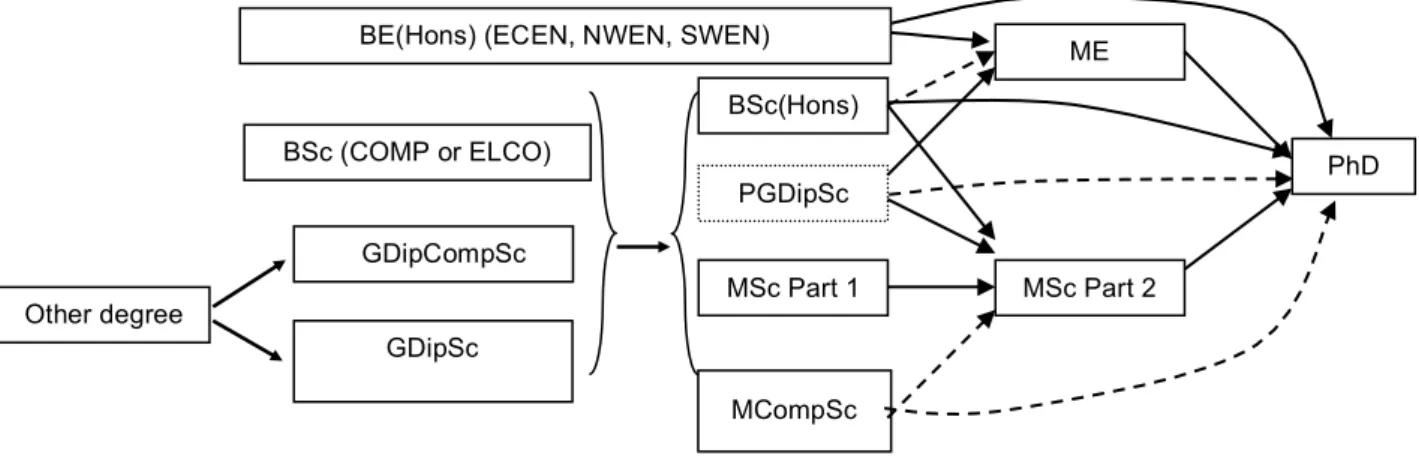
Figure 1 indicates how the various degree programmes relate to the undergraduate BSc and BE(Hons), and to each other. Candidates normally progress along the paths indicated by the solid arrows and can by permission progress along the paths indicated by dashed arrows. Previous professional experience can be taken into account.
FIGURE 1: RELATIONSHIP BETWEEN DEGREE PROGRAMMES
The BSc(Hons), MCompSc, MSc Part 1 and PGDipSc consist of courses on advanced topics in engineering, computer science, and computer graphics. Students are able to study
technology that is just finding its way into commercial implementations and concepts that will form the foundations for future technology and solutions. This combination of material
prepares our students for a successful career in areas such as software design and development, network or systems planning and management, electronics and computer systems, or for study towards a further degree. An overview of individual graduate courses
ME BSc(Hons)
Other degree
BSc (COMP or ELCO)
BE(Hons) (ECEN, NWEN, SWEN)
GDipCompSc MSc Part 1 GDipSc (COMP or ELCO) PhD MCompSc PGDipSc MSc Part 2
can be found starting on page 22. Entry to all these programmes assumes a BSc in Computer Science or Electronic and Computer Systems, or equivalent. Page 17 describes programmes to enable graduates in other disciplines to obtain an equivalent background.
The MSc Part 2, ME and PhD are all research degrees featuring a substantial research project leading to a thesis. Thesis projects are supervised by academic staff and are normally related to staff research.
Each of these programmes is described briefly below, including an indication of who the programme is designed for, the programme goals, the prerequisites for entry, and the
requirements for completion of the programme. For the complete regulations regarding these programmes, we refer you to the appropriate pages of the Victoria University Calendar, available online at www.victoria.ac.nz/about/publications/calendar
BSc(Hons)
The BSc Honours degree is the traditional first step beyond a three-year undergraduate degree and is typically taken immediately following completion of a BSc. It comprises one academic year of full-time study. With permission, it can be undertaken part-time over two years.
BSc(Hons) IN COMPUTER SCIENCE
The BSc(Hons) in Computer Science is designed both for students wishing to strengthen their studies in Computer Science before entering the work force or as a first step for students intending to pursue a research degree (MSc or PhD).
ENTRY REQUIREMENTS
Entry to the degree requires a first degree and at least 60 points in 300-level courses in Computer Science. Applicants should have attained a good standard of performance in their final year of study (normally an average grade of B+ or higher in relevant 300-level courses), and should have completed any specific prerequisites for their proposed courses of study. SUBJECT REQUIREMENTS
Candidates are required to complete 120 400-level points, which must include COMP 489 (a 30 point research project), and a further 90 points from Computer Science (including COMP, NWEN and SWEN) 400-level courses. Up to 60 points may be replaced by graduate courses from other disciplines. While we encourage Honours students to enrich their education with advanced courses in other subjects, substitution of courses will only be permitted if the
complete set of courses constitutes a coherent programme of study.Recent graduate students have taken courses in mathematics, philosophy (logic), linguistics, information systems, and physics (electronics).
BSc(Hons) IN COMPUTER GRAPHICS
The BSc (Hons) in Computer Graphics is designed as a first step for students intending to pursue a research degree (MSc or PhD in Computer Graphics) and also for students wishing to work in industry in related areas.
ENTRY REQUIREMENTS
Entry to this program requires students to have the equivalent of an undergraduate degree with a major in computer science, and to have completed several undergraduate courses in media design. Specific requirements include the completion of COMP 308, MDDN 311 and a further three 300-level courses (45 points) from COMP, NWEN or SWEN. It is normally expected that students have achieved a B+ or better average in their 300-level courses with an A- or better in computer graphics (COMP308).
SUBJECT REQUIREMENTS
Candidates are required to complete 120 points. These must include COMP 488 (a 30-point project); COMP 408, 409; 30 points from MDDN 441, 442; and a further 30 400-level points from COMP, NWEN, SWEN, IXDN and MDDN 401–479, (excluding project courses).
BSc(Hons) IN ELECTRONIC AND COMPUTER SYSTEMS
This programme is ideal for graduates with a BSc with a major in Electronic and Computer Systems, or in a related discipline that included significant electronics or signal processing studies.
ENTRY REQUIREMENTS
Entry to the degree requires a first degree and at least 60 points in approved 300-level or higher courses from BE(Hons) schedule or 300-level courses in COMP or PHYS. Applicants should have attained a good standard of performance in their final year of study (normally an average grade of B+ or higher in relevant 300-level courses), and should have completed any specific prerequisites for their proposed courses of study.
SUBJECT REQUIREMENTS
Candidates are required to complete 120 points. These must include ELCO 489 (a 30 point research project); 60 points from ECEN 401–479, ENGR440; and a further 30 points in an approved combination from 400-level courses in ECEN, COMP, NWEN , SWEN and ENGR.
BSc(Hons) OR BA(Hons) IN LOGIC AND COMPUTATION
The BSc(Hons) and BA(Hons) in Logic and Computation are designed for students seeking a graduate level qualification in the major concepts and methods of logic and their use in aspects of computer science, mathematics, and philosophy.
ENTRY REQUIREMENTS
Entry to these programmes requires a first degree, including at least 60 points in approved 300-level COMP, MATH, PHIL or SWEN courses.
SUBJECT REQUIREMENTS
The BSc Honours degree in Logic and Computation consists of 120 points in approved combination from COMP 401–489, SWEN 401–489, MATH 401–489, PHIL 421 and 422, including at least 60 points from COMP 425, SWEN 421, 431, MATH 433–435, 439 and PHIL 421 and 422. See the postgraduate prospectus for Mathematics, Statistics and Operations Research for further information on these programmes.
Note: it is possible, though not compulsory, to take a project as part of LOCO Honours.
MCompSc (MASTER OF COMPUTER SCIENCE)
The Master of Computer Science degree is a graduate qualification designed for professionals seeking to advance their knowledge of Computer Science and to obtain a formal qualification that recognises their achievement. The degree will also be attractive to new graduates who wish to advance their knowledge of Computer Science before seeking employment. The degree emphasises course work as opposed to a significant research thesis.
ENTRY REQUIREMENTS
Entry to MCompSc requires a degree with the equivalent of 60 points of 300-level courses in Computer Science, with an average grade of at least B. International applicants are expected to have an average grade equivalent to at least a B at Victoria University. The Graduate Diploma in Science (Computer Science) is one way of satisfying this prerequisite for candidates who have a degree in a subject other than Computer Science. In exceptional cases, substantial professional experience combined with a degree containing less Computer Science will be acceptable. Applicants should have demonstrated the ability to study at an advanced level, through either their previous study or work experience.
Applicants who did not complete their previous study at Victoria University should pay particular attention to the prerequisite requirements of individual courses.
DEGREE REQUIREMENTS
The degree consists of two parts, each equivalent to one year of full-time study. Part 1 consists of 120 points in an approved combination from COMP, NWEN, SWEN 401–479 (excluding the project courses). Part 2 consists of COMP 588 (30 point project), one further 500-level course from COMP (15 points), and a further 75 points from COMP, NWEN, SWEN 401–479 (excluding project courses).
Normally, candidates can proceed to Part 2 only on satisfactory completion of Part 1.
However, a candidate who has completed a four year degree or has appropriate professional experience may be exempted the requirements of all or part of Part 1, with the approval of Head of School. Note that normally only candidates who have completed a qualification equivalent to a BSc (Hons) or PGDipSci in Computer Science will be exempted the whole of Part 1.
This programme can be taken full-time or part-time. Full-time students can complete this qualification within two years. Those exempted Part 1 can complete this qualification within one year. For part-time students, the period for the two parts may be up to six years.
ME (MASTER OF ENGINEERING)
The ME degree provides a clear route for continued study for graduates with a BE(Hons) degree. The ME programme provides students with both a very attractive professional
qualification in the engineering fields as well as opportunities to carry out a significant piece of research in engineering.
ENTRY REQUIREMENTS
Entry to this programme normally requires a BE degree with first or second class Honours from Victoria University or equivalent. Those with a BSc (Hons) or a PGDipSc in Computer Science or Electronic and Computer Systems with good grades may also be accepted into the programme.
DEGREE REQUIREMENTS
The ME programme has two options:
• A 120 point Master’s thesis (ENGR 591); or
• A 90 point Master’s thesis (ENGR 592), and 30 points of approved 400-level or 500-level courses from the schedules to the BE(Hons) or ME.
Depending on the topic of the thesis, the ME degree may be endorsed with a specific area of ECEN, NWEN or SWEN.
The degree may be awarded with Distinction or Merit, but a candidate must complete the work required for the degree within 12 months to be considered for such an award. For part-time students, the period may be extended pro-rata to a maximum of two years.
MSc IN COMPUTER SCIENCE
The MSc is a postgraduate degree with a thesis as a major component. The degree is designed to provide an advanced level of professional competence with some research experience. Individuals seeking advanced expertise in one or more areas of Computer
Science and research experience in a specialised area of Computer Science will find the MSc programme attractive.
ENTRY REQUIREMENTS
This programme has two parts (see details below). Applicants seeking entry to Part 1 need to meet the entry requirements of the BSc (Honours) degree and satisfy the Graduate
Coordinator of Computer Science that they have the prospect of successfully completing the MSc thesis. Applicants who have already completed an Honours degree in Computer Science, or the equivalent, and have the prospect of successfully completing the MSc thesis, may gain direct entry to Part 2.
SUBJECT REQUIREMENTS
The MSc degree is divided into two parts:
• Part 1 is similar to the PGDipSc and the BSc Honours year (without requiring a project). • Part 2 consists of a thesis (COMP 591), equivalent to one year’s full-time study.
Candidates for Part 1 are required to complete 120 points. These points need to come from 400-level Computer Science, Network Engineering and Software Engineering courses.
Candidates may be given approval to substitute some courses from other disciplines provided the complete set of courses constitutes a coherent programme of study.
Full-time candidates taking both Part 1 and Part 2 must complete the degree within two and a half years, extended pro-rata up to five years for part-time candidates. Full-time candidates for Part 2 only must complete the degree within 12 months, extended pro rata up to two years for part-time candidates.
MSc IN COMPUTER GRAPHICS
The MSc in Computer Graphics is a postgraduate degree with a research thesis as a major component. Graduates of the MSc in Computer Graphics will have a solid understanding of the mathematical and computer science principles that underlie computer graphics. They will be familiar with common languages and advanced libraries used in computer graphics, and will be able to use these to independently develop novel solutions to computer graphics problems. Graduates will also have experience working in teams to develop graphics software involving a variety of components.
ENTRY REQUIREMENTS
This programme has two parts (see details below). Applicants seeking entry to Part 1 need to meet the entry requirements of the BSc (Hons) in Computer Graphics, which requires students to have the equivalent of an undergraduate degree with a major in computer science, and to have completed several undergraduate courses in media design. Specific requirements include the completion of COMP 308, MDDN 311 and a further three 300-level courses (45 points) from COMP, NWEN, SWEN. It is normally expected that students have achieved a minimum of B+ average in their 300-level courses with an A- in computer graphics (COMP 308). Applicants who have already completed a BSc(Hons) in Computer Graphics equivalent, and have the prospect of successfully completing the MSc thesis, may gain direct entry to Part 2.
SUBJECT REQUIREMENTS
The Programme is divided into two parts.
• Part 1 consists of 120 points which must include COMP 408, 409; 30 points from MDDN 441, 442; and a further 60 points from COMP 401–479, NWEN 401–479, SWEN 401-479, DSDN 463 and MDDN 401–479 (excluding project courses), including at least 30 COMP, NWEN or SWEN points.
• Part 2 is a 120 point Computer Graphics Thesis (COMP 595).
MSc IN ELECTRONIC AND COMPUTER SYSTEMS
The MSc in Electronic and Computer Systems deals with topics at the intersection ofcomputer science and electronics. With embedded controllers existing in almost all of modern-day electronics, the distinction between software and hardware is becoming blurred. Victoria University has expertise in communications, electronic design, network and software design, artificial intelligence, mechatronics and robotics, and signal processing. This two-year
programme offers students the opportunity to explore all of these topics in a manner which best suits their interests. Issues of design, human-machine interfacing, control and machine learning and adaptability are at the core of this MSc.
ENTRY REQUIREMENTS
Entry requirements are the same as BSc (Hons) in ELCO, which requires 60 points in
approved 300-level or higher courses from BE(Hons) schedule or 300-level courses in COMP or PHYS with at least a B+ average grade, and satisfy the Graduate Coordinator that they have the prospect of successfully completing the MSc thesis.
SUBJECT REQUIREMENTS
The programme is divided into two parts:
• Part 1 consists of 120 points including ELCO 580; 60 point from ECEN 401–440; and further 30 points in an approved combination from 400-level courses from ECEN, COMP, NWEN and SWEN.
• Part 2 is a 120 point research thesis (ELCO 591). Students who have entered the degree with a satisfactory academic background (typically a BSc (Hons) or equivalent degree) may enrol directly in Part 2. Full-time candidates for Part 2 only must complete the degree within 12 months, extended pro rata up to two years for part-time candidates.
MSc IN LOGIC AND COMPUTATION
For full details of the MSc in Logic and Computation, see the postgraduate prospectus for Mathematics, Statistics and Operations Research.
MASTER OF ADVANCED TECHNOLOGY ENTERPRISE
The Master of Advanced Technology Enterprise (MATE) is an interdisciplinary one year research programme, the first of its kind in New Zealand. The programme explores therelationship between scientific research and commercial product development by establishing teams developing high-value enterprises from research projects with real commercial
potential.
Through its unique practical approach, the programme explores the many challenges of creating successful technology enterprises, such as coping with an extended development time-frame and technology risks, balancing the often conflicting relationship between research and commercial product development, and applying best practice business activities focused around advanced technology.
The MATE programme is open to graduates of science, engineering, design, commerce and law, and graduates from other disciplines with appropriate backgrounds. MATE creates an entrepreneurial team environment to allow students to gain knowledge, skills and experience in taking an advanced technology to market.
Within the enterprise, each student assumes individual responsibilities that, when combined, form a dynamic team capable of developing a viable product concept. Students from any discipline are invited to apply to the MATE programme. In each case the individual will inject specific discipline expertise into the team. Their role will draw on expertise gained from
previous study and work experiences, and will be shaped by the needs of the particular project and enterprise.
MATE FOR ENGINEERS
The engineer in the advanced technology enterprise is charged with turning ideas into reality. The engineer assimilates requirements from marketing and design, recognises the scientific limitations, and creates a state-of-the-art technical product. The iterative cycle that follows develops promising prototypes into desirable, robust and manufactural products.
The engineer uses a variety of skills from networking, material, mechanical, electronic or software engineering and synthesises, evaluates and creates throughout the product development phases to manage the innovation process.
Supervision, mentoring and governance for the teams and individuals within the MATE programme is provided by staff from throughout Victoria University of Wellington, and by external commercial partners. Students learn from experienced technology entrepreneurs, academics and business experts, and build their own professional support network.
At the end of the year, teams present their enterprise to an audience of Victoria staff, external programme supporters and potential investors. They aim to conduct value added development of the research towards a viable product—to secure further investment for the enterprise. Individual research roles will build on each student’s prior knowledge. Research investigates the role of a discipline expert within a multi-disciplinary team, the team function, and
entrepreneurship within an advanced technology enterprise. Students create a Master’s research thesis focused on their role, and aligned with the team outcomes.
Graduates leave having developed their discipline-specific skills within an advanced technology enterprise, added a deep understanding of advanced technology business
practice, and developed into confident professionals capable of leading the next wave of new technology businesses.
ENTRY REQUIREMENTS
• A four-year degree, Honours degree or relevant postgraduate diploma with a B+ average at 400-level from a university in New Zealand or, at the discretion of the Associate Dean (Students) of the Faculty of Science, another university.
• Approved by the Programme Director and the MAdvTecEnt Board of Studies as capable of proceeding with the proposed programme of study.
• Requirement 1 may be waived by the Associate Dean (Students) of the Faculty of Science, for a candidate who has had extensive practical, professional or scholarly experience of an appropriate kind.
GENERAL REQUIREMENTS
• The course of study for the MAdvTecEnt shall consist of courses worth at least 135 points, comprising:
- Part 1: ATEN 501—a 15-point course run intensively over four weeks - Part 2: ATEN 591—a 120-point thesis and development of business plan.
• Entry to Part 2 requires the successful completion of Part 1 with at least a B+ grade and acceptance by the Programme Director and Board of Studies.
• Candidates must:
- enrol full-time for Part 1 and Part 2; and
ATEN 501 CRN 25038 ADVANCED TECHNOLOGY ENTERPRISE DEVELOPMENT
15 PTS 3/3 Practical and theoretical frameworks used in development and initiation of an advanced technology enterprise and research translation are introduced, along with collective brainstorming, team development, collaboration and communication. Emphasis is on pragmatic and practical learning in innovative behaviour development, while developing an advanced technology business idea, team formation and an independent research focus. ATEN 591 CRN 25039 ADVANCED TECHNOLOGY ENTERPRISE
THESIS
120 PTS 1/2/3 An individual supervised piece of research undertaken within an integrated team environment working on the progression of an advanced technology enterprise. Students will actively participate in a structured seminar and peer-review programme. Their value proposition will be presented to an expert panel.
ENROLMENT
Programme start date is 2 March 2015. Apply online at www.victoria.ac.nz/home/admisenrol
APPLICATION/ENQUIRY CONTACT DETAILS
David Bibby, Programme Director [email protected] 04-4635479
Shona de Sain, Associate Dean (Academic) [email protected] 04-463 5092
POSTGRADUATE DIPLOMA IN SCIENCE
The PGDipSc is a postgraduate science qualification offered in all subjects offered for the MSc. It will appeal to students wanting a postgraduate course-work only qualification since a research project is not compulsory. The PGDipSc may also provide an opportunity for some students who are not able to meet the entry requirements for the BSc (Hons) or MSc Part 1. The PGDipSc requires 120 points of post-graduate study and can be completed full-time in two trimesters or part-time over four years. The students who have successfully completed a PGDipSc may be accepted directly into a thesis program (MSc Part 2, ME or PhD).
ENTRY REQUIREMENTS
Entry to this qualification usually requires a degree of this University or another university that satisfies the prerequisites for the required courses. Candidates who do not quite meet the above entry requirements but have extensive practical, professional or scholarly experience may also be considered.
SUBJECT REQUIREMENTS
The School provides four subjects for PGDipSc:
• PGDipSc in Computer Science requires 120 points in approved courses from COMP, NWEN and SWEN 401–489.
• PGDipSc in Computer Graphics requires COMP 408, 409; 30 points from MDDN 441, 442; a further 60 points from COMP 401–479, DSDN 463, NWEN 401–479, SWEN 401–479, and MDDN 401–479 (excluding project courses), including at least 30 COMP, NWEN or SWEN points.
• PGDipSc in Electronic and Computer Systems requires 90 points from an approved combination of ECEN 401–440, ELCO 489, 580; and 30 further approved 400-level points from the BE(Hons) Schedule.
• PGDipSc in Logic and Computation requires 120pts in approved courses from COMP, SWEN 401–489, MATH 401–489, PHIL 421, 422 including at least 60 points from COMP 425, SWEN 421, 431, MATH 433-435, 439 and PHIL 421, 422.
POSTGRADUATE CERTIFICATE IN SCIENCE
This PGCertSc provides an alternative path of postgraduate study in Science for students wanting a short course-work postgraduate qualification of less than 120 points. PGDipSc students who wish to exit the qualification early may be able to transfer to the certificate. A candidate in PGCertSc will normally be enrolled for at least one trimester and must complete the requirements within two years. This program is also suitable for those who want to
complete postgraduate study in a focused area within a short timeframe while in full-time work or managing other commitments. Entry to the PGCertSc is the same as for the PGDipSc. The School provides four subjects for the PGCertSc:
• PGCertSc in Computer Science requires 60 points in approved courses from COMP, NWEN and SWEN 401–489.
• PGCertSc in Computer Graphics requires COMP 408, 409 and 30 points from MDDN 441, 442.
• PGCertSc in Electronic and Computer Systems requires 45 points from approved
combination of ECEN 401–440, ELCO 489, 580; and 15 further approved 400-level points from the BE(Hons) Schedule.
• PGDipSc in Logic and Computation requires 60 points in approved courses from COMP 425, SWEN 421, 431, MATH 433–435, 439 and PHIL 421, 422.
PhD
The PhD degree is an internationally recognised research qualification that usually involves three to four years of original research work. A PhD is generally required by those people seeking careers in a university or research laboratory such as one of the Crown research institutes. A number of private companies and government departments also carry out research and seek new employees with a PhD.
The PhD degree is designed to encourage original thought and teach disciplined research techniques. PhD candidates are frequently employed in the School as teaching assistants and gain valuable experience in teaching and communicating their knowledge. Thus the skills acquired in pursuit of a PhD are often applicable in careers other than research.
Students interested in pursuing a PhD are encouraged to discuss their plans with the Thesis Coordinator, and with staff who may supervise their research.
ENTRY REQUIREMENTS
Applicants should normally have either an Honours or Master’s degree in Engineering or Computer Science, or a closely related discipline, with at least second class (first division) honours. Applicants will also need to propose, in general terms, a research project (topic/area) that can be supervised by a member of Victoria University staff. Several months of preliminary work including background reading, discussions with prospective supervisors, and preparation of a research proposal might be required before a candidate is accepted.
SUBJECTS
The School currently provides PhD programmes in the following subjects:
• Computer Science: covering all areas in computer science including artificial intelligence, computer graphics, database and document management, data mining and knowledge discovery, distributed systems, formal methods, human-computer interaction, information retrieval, and programming languages.
• Computer Graphics.
• Electronic and Computer Systems: covering all the science aspects of electronic and computer system engineering subjects.
• Engineering: covering all areas of engineering at the University, particularly Electronic and Computer System Engineering, Network Engineering, Software Engineering, Intelligent System Engineering, and related interdisciplinary engineering programs. In special cases, candidates can also enrol in a specific engineering subject area such as Electronic and Computer System Engineering (ECEN 690), network engineering (NWEN 690), and Software Engineering (SWEN 690).
A PhD is expected to take three years of full-time study. The initial enrolment for a PhD is provisional, and is normally converted to full registration within one year, after the successful presentation of a full research proposal.
All PhD students are expected to meet regularly with their supervisors to report and discuss their progress. Together with their supervisors, they must also submit six-monthly reports on their progress in May and November each year.
PhD students are also expected to participate in the research activities of the school, in particular attending research seminars in their discipline.
There are other requirements on PhD students, for example, to do with initial enrolment, reenrolment, and thesis submission and examination. It is particularly important for new PhD students to submit the Confirmation of PhD Provisional Registration form within the first month of enrolment/provisional registration to the School, and arrange a meeting with Prof Winston Seah to complete the registration process. Students should read the School thesis information web site http://ecs.victoria.ac.nz/Main/ThesisInformation, where there are a lot of policies and guidelines as well as important links to the Faculty of Graduate Research
Current postgraduate students who have questions about the PhD programme should talk to their current supervisor, the School Administrator (Siyun Thompson), or the Thesis
COP
Students who do not want to complete a degree or diploma may take courses individually for a Certificate of Proficiency, as long as they have satisfied the prerequisites for the course(s) they wish to take. Such courses may (with certain restrictions) be credited later to a graduate degree.
PREPARATORY PROGRAMME FOR GRADUATES
OF OTHER DISCIPLINES
Graduates of disciplines other than Engineering and Computer Science will need the
equivalent 60 points of COMP, ELCO, ECEN, NWEN and/or SWEN courses at the level of the final year (300-level) of undergraduate study. For many students, the appropriate way of achieving this will be the Graduate Diploma in Science (GDipSc) containing appropriate COMP, ELCO, ECEN, NWEN and/or SWEN courses.
The GDipSc requires 120 points of 200- and 300-level science courses with at least 75 points at 300-level. Most students require a minimum of two years of part-time study because of the prerequisites of the 300-level courses.
Students with no relevant background will need an additional year to take the appropriate 100-level courses before starting the BSc. For such students, the combination of transfer credit from their previous qualification and the additional courses taken to meet prerequisites means that they could complete a BSc with only a few more courses than are required for their GDipSc.
With an appropriate selection of courses, the GDipSc may be endorsed with a specific discipline. The School provides two endorsements to the GDipSc: Computer Science, Electronic and Computer Systems. To be endorsed, the candidate’s set courses must meet the 300-level requirements of the relevant BSc major.
MDI IN COMPUTER GRAPHICS
The School of Design also offers a Master’s program in Computer Graphics under the Master of Design and Innovation (MDI). This program is different from the MSc in Computer Graphics, but it also requires a number of courses in Computer Science. The program is as follows:
(a) 60 points from MDDN 441, 442, DSDN 411, 463 or 481; (b) COMP 408, 409; and
(c) MDDN 596.
Contact the School of Design for more information about this program: www.victoria.ac.nz/design
GRADUATE PROGRAMMES IN INFORMATION SYSTEMS
The School of Information Management (SIM) offers several qualifications that may appeal to students who are more interested in information systems rather than in computer science. Their graduate programmes are designed for people who wish to develop expertise in managing information and information technologies in a corporate environment.
The Master of Information Management (MIM) is a post-experience qualification and students need at least three years of appropriate work experience. In contrast to the Computer Science graduate programmes described above, the MIM has a strong management orientation and is aimed at people who want to become effective managers or executives. SIM also offers a BCom(Hons) and an MCA in Information Systems.
For students without a degree in Information Systems, the transitional Graduate Diploma in Commerce in Information Systems may be of interest.
Contact the School of Information Management for more information about these programmes www.victoria.ac.nz/sim/postgraduate/default.aspx
PLANNING YOUR COURSES
The School offers a number of graduate level courses for the BSc (Honours), MSc and MCompSc degrees and other postgraduate qualifications. Most of these courses reflect the research interests of the staff and build on top of the third year undergraduate courses. Candidates for these courses are assumed to have a general background in undergraduate computer science, computer graphics, electronic and computer system engineering, network engineering, or software engineering in addition to any specific prerequisites indicated. The offering of graduate courses is subject to availability of staff, and not all courses will be offered in any given year. The following list shows the courses that we are currently expecting to be able to offer in 2015. However, there may be late changes to this list; please check with the school.
Note that in special cases, students may be permitted to take one (or two in exceptional cases) “reading” course(s) from the courses that are not being offered in a given year, but we make no guarantee that such courses will be available. Students should consult the School’s website at http://ecs.vuw.ac.nz for details (including prerequisites) and a timetable.
Admission to any graduate course requires the approval of the School. Students wishing to undertake graduate study should consult the School office prior to enrolment regarding the availability of the courses they wish to take and their eligibility to enrol in those courses.
COMP/NWEN/SWEN 400-LEVEL COURSES
COMP 408 CRN 23084 Computer Graphics Rendering 15 PTS Tri 2
Prerequisites: COMP 308
Coordinator: Dr Taehyun Rhee
This course covers ray tracing, advanced light tracing techniques, texture mapping and its derivatives, radiosity, photon mapping, and advanced shading and lighting techniques on modern graphics cards.
COMP 409 CRN 23083 3D Modelling for Computer Graphics 15 PTS Tri 2
Prerequisites: COMP 308
Coordinator: Dr John Lewis
A selection of modelling techniques and applications from polygon meshes, point clouds, B-Splines, subdivision surfaces, computational geometry, implicit surfaces, voxels, particle systems and animation.
COMP 421 CRN 986 Machine Learning 15 PTS Tri 1
Prerequisites: COMP 307, one further 300-level COMP, ECEN, NWEN or SWEN course
Coordinator: Dr Marcus Frean
This course covers a range of topics in machine learning, with a focus on inference and uncertainty. Topics include optimisation, Bayesian probability theory, learning from rewards, unsupervised learning, Belief networks and particle filters.
COMP 422 CRN 2324 Data Mining, Neural Networks and Genetic 15 PTS Tri 2 Programming
Prerequisites: COMP 307, one further 300-level COMP, ECEN, NWEN or SWEN course
Coordinator: A/Prof Mengjie Zhang
This course is concerned with data mining concepts and techniques, especially neural
networks and genetic programming. It mainly focuses on the following topics: data mining and knowledge discovery in databases; data mining techniques such as nearest neighbour, naive Bayes, support vector machines, neural networks, genetic algorithms and genetic (automatic) programming; image analysis operations such as feature extraction and image recognition; and performance evaluation of data mining / machine learning / Image recognition systems. The course considers applications ranging from general classification, clustering and optimisation tasks to engineering applications.
COMP 423 CRN 4962 Intelligent Agents 15 PTS Tri 1 Prerequisites: COMP 307, one further 300-level COMP, ECEN, NWEN or SWEN
course
Coordinator: Dr Xiaoying (Sharon) Gao
This course examines construction of intelligent agents—software programs that can act for themselves in some part of the human world. This course focuses on agents for improving web search and includes topics such as agents for information extraction from the web, web page clustering and classification, automatic query expansion and web page ranking.
COMP 425 CRN 990 Computational Logic 15 PTS Tri 1 Prerequisites: COMP 304; one further 300-level COMP, NWEN or SWEN course
(MATH 309 or PHIL 211 / 334 / 335 recommended)
Coordinator: TBA
This course is concerned with the application of formal logic to problems in Computer Science, and with techniques for mechanising logical reasoning. Topics may include: systems of
reasoning; logic programming; the application of temporal and modal logics; and the relationship between proofs, programs, specifications and types.
COMP 440 CRN 15202 Directed Individual Study 15 PTS Tri 1 Prerequisite: Approval of Head of School
Coordinator: Dr Peter Andreae
This course enables a student to study a topic that is not covered by other 400-level courses. It is conducted under the supervision of a staff member, and may involve attending a 300-level course, but undertaking additional 400-level assessment.
COMP 441 CRN 23169 Directed Individual Study 15 PTS Tri 2 Prerequisite: Approval of Head of School
Coordinator: Dr Peter Andreae
This course enables a student to study a topic that is not covered by other 400-level courses. It is conducted under the supervision of a staff member, and may involve attending a 300-level course, but undertaking additional 400-level assessment.
COMP 471 CRN 26217 Special Topic: Algorithms and Mathematics 15 PTS Tri 1 For Games and Graphics
Coordinator: A/Prof John Lewis
This course will introduce applications of mathematics to game and graphics programming. The concepts will be taught through computational and programming exercises with visual results. Topics may include mathematics for shading (vectors), geometric computations, linear systems with constraints, SVD, eigenvectors, numerical considerations.
COMP 488 CRN 23082 Computer Graphics Project 30 PTS Full Year Prerequisite: Approval of Head of School
Coordinator: A/Prof John Lewis
All candidates for BSc(Hons) in Computer Graphics are required to take COMP 488, which is a research project conducted under the supervision of a staff member. The purpose of the BSc(Hons) research project is to provide students with an opportunity to study a particular problem within this area. It is also intended to provide training and experience in individual study and research, and communicating the results thereof. COMP 488 is a two-trimester course. It can be done over any two consecutive trimesters.
COMP 489 CRN 1027 Research Project 30 PTS Full Year Prerequisite: A research project on a topic approved by the Head of School
Coordinator: TBA
All candidates for BSc(Hons) in Computer Science are required to take COMP 489, which is a research project conducted under the supervision of a staff member. The purpose of the BSc(Hons) research project is to provide students with an opportunity to study a particular problem within this area. It is also intended to provide training and experience in individual study and research, and communicating the results thereof. COMP 489 is a two-trimester course. It can be done over any two consecutive trimesters.
NWEN 401 CRN 18602 Distributed Systems Design 15 PTS Tri 1 Prerequisites: Two courses from (NWEN 301, 302, 303)
Restrictions: COMP 413, ECSE 431
Coordinator: Dr Aaron Chen
Lecturer: Dr Ian Welch
Text (Recommended): Andrew S. Tanenbaum and Maarten van Steen, Distributed Systems: Principles and Paradigms (2nd edition), Prentice Hall, 2007.
Distributed system concepts and techniques underlie much of modern computer technology; client-server systems based on high-bandwidth networks support applications ranging from business data processing to multimedia information systems. This course teaches the concepts and principles employed in the design and implementation of distributed systems, with practical examples, providing a suitable knowledge base for those aiming for careers in advanced system and application development, or in research.
This course is not offered in 2015.
NWEN 402 CRN 18603 Internet Engineering 15 PTS Tri 2 Prerequisites: NWEN 302, 304, 15 further 300-level COMP, ECEN, NWEN or
SWEN point
Restriction: COMP 417
Coordinator: Dr Bryan Ng
This course addresses the use of important hardware and software technologies in the design and engineering of modern Internet applications and infrastructure. The course coverage includes perspectives on the impact of economic, political and technical issues on Internet engineering that are explored through case studies and recent professional and research literature. These aspects are explored through practical group work that can incorporate distributed systems, network and Internet technology, lectures and seminars.
NWEN 403 CRN 18604 Advanced Network Engineering 15 PTS Tri 1 Prerequisites: NWEN 302, 30 further 300-level points from (COMP, ECEN,
NWEN, SWEN)
Restrictions: COMP 414, ECSE 432
Coordinator: Dr Qiang Fu
This course extends the data communications and telecommunication taught in Computer Network Design, concentrating on new developments and network case studies. The course is designed for those aiming for careers that involve networking or network research and
enhances the understanding of distributed systems through the applications of distributed systems in network management and Internet infrastructure.
NWEN 404 CRN 18605 Mobile Computing 15 PTS Tri 1 Prerequisites: NWEN 302, 30 further 300-level points from (COMP, ECEN,
NWEN, SWEN)
Restriction: COMP 415 or ECSE 433 (before 2008)
Coordinator: Prof Winston Seah
The course introduces the fundamental topics of mobile computing. In particular, the course will emphasise the network and transport layers of wireless communication protocols and network infrastructure suitable for mobile personal systems (e.g. GSM, 3G, Mobile IP, etc.). Key issues of mobility and disconnected operation with respect to mobile computing systems, and quality of service issues in mobile personal systems will be covered and how applications handle node mobility and wireless communications will be explored.
NWEN 405 CRN 18606 Security Engineering 15 PTS Tri 2 Prerequisites: NWEN 304, 30 further 300-level points from (COMP, ECEN,
NWEN, SWEN)
Restriction: COMP 418
Coordinator: Dr Ian Welch
The Internet's role as a large, public, distributed system has raised security to an issue of critical importance. This course examines security mechanisms, security policies, security evaluation and risk management, security issues in networks and operating systems, and case studies that show how these security techniques can be used to solve real-world problems such as conducting trustworthy auctions and secret ballots.
NWEN 406 CRN 18592 Distributed Computing in Grids and 15 PTS Tri 2 Clouds
Prerequisites: NWEN 301; NWEN 302 or 303
Restriction: COMP 415 in 2009, ECSE 433 in 2009 Coordinator: Dr Kris Bubendorfer
This course focuses on the design and use of distributed systems for high end computing. In particular we look at the aggregation of geographically distributed computing resources to form massive distributed computing platforms. These platforms can then be applied to solve large problems in science and industry—protein docking, seismology, medicine, astronomy, particle physics, climate prediction etc. Topics in this course typically include: e-Science, clusters, grids and clouds, service oriented architectures, workflow management, utility computing and grid economies.
NWEN 438 Special Topic: Network Engineering 1 15 PTS Prerequisite: Permission of Head of School
This course is not offered in 2015.
NWEN 439 Special Topic: Network Engineering 2 15 PTS Prerequisite: Permission of Head of School
SWEN 421 CRN 18661 Formal Software Engineering 15 PTS Tri 1 Prerequisites: SWEN 224, 30 300-level pts from (COMP, SWEN)
Restriction: COMP 426
Coordinator: Dr David Streader
Lecturer: Roman Klapaukh
This course addresses the use of mathematical logic in the specification and construction for software systems. It presents an introduction to the area of formal methods; the formal
specification of software systems; the refinement of specifications to code; and their semantic foundations.
SWEN 422 CRN 18662 Human Computer Interaction 15 PTS Tri 2
Prerequisite: SWEN 303
Restrictions: COMP 453, ECSE 434
Coordinator: Dr Stuart Marshall
This course covers principles of human-computer interaction that underlie good design of software user interfaces. Advanced topics are introduced with a focus on current research areas.
SWEN 423 CRN 18663 Object Oriented Paradigms 15 PTS Tri 1 Prerequisites: COMP 304 or SWEN 301; 15 further 300-level points from COMP,
NWEN or SWEN
Restriction: COMP 462
Coordinator: Dr Marco Servetto
Text: SWEN 423 Reader available from Student Notes.
Object-orientation is the basis for many approaches to programming, systems, languages and applications. This course discusses the design principles of object-orientation and studies advanced topics in system design, programming language, and development process.
SWEN 424 CRN 18664 Model-Driven Development 15 PTS Tri 2 Prerequisite: 30 300-level points from (COMP, NWEN, SWEN)
Restriction: COMP 471 in 2007–2009
Coordinator: TBA
An introduction to model-driven development - the modern approach to large scale software system development. Along with an introduction to the core concepts of model-driven development, the course will address the foundations and principles for infrastructures supporting model-driven development. This includes an in-depth discussion of 'meta-modelling' and a critique of existing modelling techniques. Students will get hands-on experience with using a meta-case tool.
SWEN 425 CRN18665 Design Patterns 15 PTS Tri 2 Prerequisites: SWEN 301, 15 further 300-level COMP, NWEN or SWEN points
Restriction: COMP 463 in 2008–2009
Coordinator: TBA
The course addresses a variety of advanced issues in Software Engineering, including the use for Software Patterns for software design.
SWEN 426 Advanced Software Engineering: 15 PTS Implementation
Prerequisites: SWEN 301, 15 further 300-level COMP, NWEN or SWEN points
Restriction: COMP 467
This course begins by covering issues relating to the successful implementation of a software design, including: individual software processes, metrics, the choice of a programming language, the choice of implementation tools, coding styles, code reviews and testing. The course also looks closely at the maintenance stage of software development, and the issue of quality throughout the entire development process. Issues such as software quality assurance, configuration management and software process improvement are raised.
This course is not offered in 2015.
SWEN 427 Advanced Software Engineering: 15 PTS Requirements and Design
Prerequisites: SWEN 301, 15 further 300-level SWEN points
Restriction: COMP 466
The course covers basic concepts and principles of software requirements engineering, its tools and techniques, including a survey of methods for modelling software requirements. The course also covers methods and techniques used in the design of software systems, including both architectural and detailed design. In the requirements and design areas issues such as documentation, reviews and inspections are covered.
This course is not offered in 2015.
SWEN 430 CRN 18668 Compiler Engineering 15 PTS Tri 1 Prerequisites: SWEN 224 or COMP 261; 30 further 300-level points from
(COMP, SWEN)
Restriction: COMP 431
Coordinator: Dr Alex Potanin
The course looks at a range of issues relating to the design and implementation of modern compilers. In particular, the course will focus on techniques and algorithms for code
generation, code optimisation and type checking. During the course projects, students will be working on a fully-fledged Java compiler to extend it in various ways. Students should expect to learn a great deal about how compilers work and, in particular, about the Java compiler and Java Bytecode instruction set.
SWEN 431 CRN 18669 Advanced Programming Languages 15 PTS Tri 2 Prerequisites: COMP 304, 15 further 300-level COMP or SWEN points
Restriction: COMP 432
Coordinator: Dr Marco Servetto
Text: Thompson Haskell (2nd edition) or any other Haskell book.
This course develops and extends understanding of the functional programming paradigm, by studying both its theoretical foundations and the practical aspects of programming in a
functional language.
SWEN 432 CRN 18670 Advanced Database Design and 15 PTS Tri 1 Implementation
Prerequisites: SWEN 304, 15 further 300-level COMP, NWEN or SWEN points
Restriction: COMP 442
Coordinator: TBA
This course explores a selection of the following topics: Data Warehouse, Internet and XML Databases, Object-Relational Databases, and Distributed Databases. It examines features of these advanced database systems and analyses the new applications they facilitate.
SWEN 433 CRN 18671 Web Information Systems Engineering 15 PTS Tri 2 Prerequisites: SWEN 304, 15 further 300-level COMP, NWEN or SWEN points
Restriction: COMP 443
Coordinator: Dr Hui Ma
This course gives a technology-centered introduction to web information systems and
services. On successful completion of the course students are able to explain basic concepts used in building and managing web information systems. They know central technological standards underlying web information systems and web services, understand architectural principles, and are able to evaluate and critically discuss such systems.
SWEN 434 Data Warehousing 15 PTS
Prerequisites: SWEN 304; 15 further 300-level COMP, NWEN or SWEN points
Restriction: COMP 444
This course is not offered in 2015.
SWEN 438 Special Topic in Software Engineering 1 15 PTS Prerequisite: Permission of Head of School
This course is not offered in 2015.
SWEN 439 CRN 18598 Special Topic: Information Visualisation 15 PTS Tri 2 Prerequisite: Permission of Head of School
Coordinator: TBA
This course will examine ideas and techniques used in information visualisation. Several common techniques will be investigated in detail, along with research being done to improve them. Methods for analysing data will be considered, including big data, and those techniques and issues arising when processing or visualising it.
ECEN 400-LEVEL COURSES
BE(Hons) ECEN 400-level courses can be taken by ME and BSc (Hons), MSc, PGDipSc, PGCertSc, students. Details of 100 to 300-level ECEN courses are in the SECS
undergraduate prospectus.
ECEN 403 CRN 18520 Advanced Electronics 15 PTS Tri 2 Prerequisites: ECEN 303 (or PHYS 340); ECEN 220 or MATH 243 or 244 Restrictions: ECSE 423, PHYS 423, TECH 423
Coordinator: Dr Ramesh Rayudu
Laboratories: 6 hours per week
Text: Sedra and Smith, Microelectronic circuits, 6th edition, Oxford University Press, 2010
Advanced analogue and digital electronics, design principles, transform methods of analysis, active and passive filters, oscillators, phase-locked loops, digital signal processors, digital synthesis, communication principles, RF design.
ECEN 405 CRN 18521 Power Electronics 15 PTS Tri 1 Prerequisite: ECEN 303 (or PHYS 340)
Coordinator: Dr Ramesh Rayudu
Laboratories: 3 hours per week
Text: Mohan, Power Electronics – A First Course, 3rd edition, Wiley, 2012
The course covers the theory, design and application of power electronic circuits and the transformation and control of electrical energy.
ECEN 410 CRN 18522 Advanced Communications Engineering 15 PTS Tri 2
Prerequisite: ECEN 310
Coordinator: Dr Mansoor Shafi
This course provides an introduction to the fundamentals of wireless communication systems, in particular digital wireless communications. The characteristics of fading channels are
considered, and their effect on the propagation of signals. Countermeasures such as diversity, forward error control, and modulation schemes for wireless communications are studied. Multiple-access techniques such as time-, frequency- and code-division multiple access are examined. WLAN, WPAN wireless sensor networks, cellular concepts such as capacity, congestion, interference and multiple access are also presented.