T-86.5141
ENTERPRISE SYSTEMS ARCHITECTURE:
Product Data Management
Asko Martio
Variantum Oy, www.variantum.com
19.9.2006
Variantum Oy
New Finnish company, established 2002, 9 owners
Roots in Product Data Management Group (PDMG) of HUT, established in 1992
First big project: EDMS for KONE Oyj, first remarkable document management system in Finland. Today’s status: over 1 000 000 documents, over 3000 active users. PDM and configurable
product related research projects with approx. 20 Finnish companies.
Best imaginable technological know-how
2 D.Sc. (Tech), dissertations within configuration domain, 1 Lic. Sc. (Tech), 4 M. Sc. (Tech)
Variantum products
System products
VariSelect, Product family selection tool to highlight product properties and their differences
VariSales, Sales configurator for sales order definition
VariProd, Production configurator that creates Bill of Materials
required by the specified product variant (configuration) for the ERP system
VariPDM, PDM system for product, document, product model and workflow management
Service and support products
Expert services for consultation, system training and implementation After sales support services
Contents
References, terminology
Definition of PDM
Background, motivation for PDM
PDM Functionality
Architecture
Summary
KONE case
References
Kenneth G. McIntosh
ENGINEERING DATA MANAGEMENT
A Guide to Successful Implementation, McGraw-Hill Inc.
Antti Sääksvuori, Anselmi Immonen
Tuotetiedonhallinta PDM, Talentum Media 2002
Hannu Peltonen, Asko Martio, Reijo Sulonen PDM - Tuotetiedon hallinta, IT Press 2002 M. Eigner, R. Stelzer Produktdatenmanagement-Systeme, Springer 2001
I. Crnkovic, U. Asklund, A. P. Dahlqvist
Product Data Management and Software Configuration
Management, Artech House, Inc. 2003 John Stark
Product Lifecycle Management,
Paradigm for 21st century Product realisation, Springer 2004
Rodger Burden
PDM: Product Data Management,
Resource Pub 2003 www.cimdata.com www.pdmic.com
Terminology: PDM
Almost any combination of terms is used, PDM (Product
Data Management) and PLM (Product Life-cycle
Management) seem to be most common
PDM PIM EDM TDM TIM Product Data Management Information Engineering Technical Document Enterprise PDT Technology Electronic cPDm Collaborative Asset Definition Lifecycle PLM PAM
Definition: Product
Result of industrial activity
general concept
Product family, brand, model, abstract class (cannot
type, product class,
be manufactured)
configurable product
Product configuration,
concrete class
fixed product
(can be manufactured)
Product individual
physical artifact,
Definition: Product Data (CIMdata)
All product related
information
Paper documents Digital files:
Document files: specifications, configurations, purchase orders CAD drawings, models,
assemblies, parts lists
CAE analysis, NC programs and plans
Information stored in data bases
PDM manages three different
product data life-cycles
Product type life-cycle:
product development
approval and change processes beginning and end of production
Product individual life-cycle:
engineering
production, maintenance, recycling
Definition: PDM
ISO 13584-10 Parts Library:
A representation of facts, concepts, or instructions about one or more products in a formal manner suitable for communication, interpretation, or processing by human beings or by automatic means.
Crnkovic, Asklund, Persson Dahlqvist (2003):
PDM is the discipline of controlling the evolution of a product and providing other procedures and tools with the accurate product
information at the right time in the right format during the entire Product Life Cycle
PDT (Product Data Technology)-advisory group:
Product Data Technology includes all aspects of the definition and methods of processing information pertinent to product throughout its development and operational lifecycle.
Definition: PLM (CIMdata)
What is Product Lifecycle Management
(PLM)?
A strategic business approach that applies a
consistent set of business solutions in support of
the collaborative creation, management,
dissemination, and use of product definition
information across the extended enterprise from
concept to end of life –– integrating people,
PDM system status today
PDM systems coverage is more restricted:
Current PDM systems do not include commercial data (stocks, purchase orders, invoices, cost accounting, etc.) of the company. They are managed by Enterprise Resource Planning (ERP)
systems.
Main interest of PDM lays on product support processes (R&D, etc.)
Many PDM systems do not support configurable products and product individual and production process life-cycles
Increased competition
Global markets, aggressive market behaviour Shrinking budgets, lower production costs
Products are becoming more complex, exploiting more technologies and built in vast number of variants
Quality requirements (ISO 9000 etc) and customer responsiveness are increasing
Global manufacturing (expanded teaming) Government and industry standards
Less time and money for hassling
Requirement for more efficient R&D: Concurrent Engineering
PDM motivation:
PDM motivation:
Data integration by system integration
CAD
Design/Engineering Purchasing & Finance
Production Process/Plant MRP System Customers Suppliers Project Management Manufacturing Sales/Marketing & Customer Service
PDM system benefits
direct cost savings
faster time-to-market benefits change management savings indirect cost savings
improved quality
other savings
PDM system costs
hardware, software licences
system tailoring, system integration, installation, training system maintenance
PDM Benefits, example
Metric Standard C.E. Delta (%)
Design Hours 5337 5929 4460 16%/25%
Span Time (months) 21 19 11 48%/42%
Tooling Costs $79,461 $49,993 $42,057 47%/16%
No. Changes (15 mo.) 16 24 6 63%/75%
No. Changes (30 mo.) 22 28 6 73%/79%
No. Quality Reports 23 37 4 83%/89%
No. Waivers 36 40 2 94%/95%
Mark Knodle, General Dynamics Space Systems Division
PDM Functions
As PDM becomes implemented across different industry sectors, functional priorities change.
Little support Program Management Product Structure Management Classification & Retrieval partno Length Screw axy1234 10 mm zvy3245 20 mm dgf2345 30 mm
Workflow and Process Management
ECO ECO
Item and Document Management Drawings/Documents NC 3D SPEC + Support utilities
Data vault
Central storage for
Documents
Product configuration data Product model data
Product individual data
Maintains revision and status data (e.g. electronic approval) Files (drawings, documents, etc.) are managed as “objects” Check-out and check-in control Query, browsing and reporting
Benefits
Secure, distributed storage of data
Elimination of redundant files Managed data sharing among team members
Managed electronic review and approval
Management of data relationships
Based often on commercial relational data bases
Data vault
PDM Server Meta-Database
data
Managed referenced files
Object: Document Date: 1/1/95 Project: Motor Part #: 8893-0A Revision: 2.3A Document #: 4569-29 File: A:\PDM\doc\motor\... Application: MS-Word 6.0
Item definition
Items from the PDM point of view are those product
related business objects
which are frequently referred in product related processes, e.g. products, materials,
documents, resources, activities. Use of standard items makes management and business transactions easier
PDM items
PDM corner stones
Item categories
Physical items
systems, assemblies, parts, components, accessories
Document items
Product models and software
Item views
Life-cycle view
Item revisions
Classification (type) view
Classification according to product properties
Classification hierarchy
Status view
Item approval level Item efficiency
Language view
Structure view
Structures dependent on processes
Sales (offer, sales order) structure Design structure Manufacturing structure Delivery structure Installation structure Maintenance structure
Physical product structure Functional structure
Specifying code
Parametric class hierarchy
A Basic mechanical materials and components
A2 Non-ferrous metals
− A20 Sheets and strips
• A202 Coated sheets and strips
Fasteners(Length, diameter)
Screws(Length, diameter, thread length)
− Cross head screws (Length, diameter, thread length, head diameter,
Required to search and browse items efficiently
Standards: ISO 13584 Part Libraries, IEC 61360 electric components classification scheme standard
Examples:
Basic item data
Identification
Generally approx. 8 character code
Classifying v. non-classifying Local v. enterprize wide
Description
Generally approx. 40 characters of cler text
Classification
Helps to find items
Revising Revising method Revision identification Status (recommendation class) Manufacturers, vendors Other data
Big systems: approx. 300 fields/item
Item is specified to the level that is required by its user Reference documents
Item revisions
Warning: there is no approved terminology
When an item is changed a new version, which is also an item,
is created. It is
Revision. An item of this type is generated to replace its predecessor immediately or after a transition period. Therefore, the new revision must be compatible (form, fit and function) with its predecessor.
Variant. Variant concept is sometimes used for products, parts and items with small differences. An item in this group is related to a higher-level product type.
Independent item. An item in this group is neither a variant nor a
revision of any other item. The relation to its origin is lost. Example: a new independent product
Document management
Which document types? Identification method for
documents, document revisions and variants
Approval of documents Security archives
Document tool integration to PDM
WWW user interfaces
Document structure
Document revisions Document variants
Equivalence of documents written in different languages Multilingual documents Subdocuments Multipage drawings Figure files 3D models Representations
Original,, viewing and printing formats
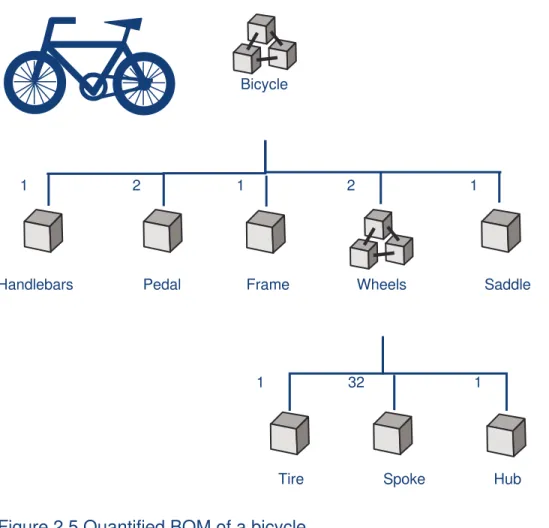
Figure 2.5 Quantified BOM of a bicycle.
Tire Spoke Hub
1 32 1 Saddle Bicycle Pedal Wheels Handlebars Frame 1 2 1 2 1
Product structure
Product (breakdown) structure
-general
All structure items represent elements which can be delivered with the product. They are often physically attached to it.
Product requisites like coatings, paints, welding wires, packages, adhesives, lubricants, chemicals are often left out of product structures.
All items are identified with a code. A clear text description is required as support information.
Physical products include only physical objects as components: non-decomposable (atomic) component, e.g. bolt, integrated circuit, cardboard package box, user manual
multipart component
subassembly, e.g. phone receiver
kit (group, no assembly process), e.g. installation accessories
Documents are linked to products:
Product - parts list, assembly drawing
Often this link is built into the identification system
Product - other manufacturing documents
Assembly instructions Test instructions
Product specifications etc.
Product - deliverable documents
deliverable documents are items in product structure
In addition to document links other type of items can be
attached to product structures
Product - jigs, fixtures
Product - tools
Product - embedded software
Product - NC software
1 Quality 2 Attributes 3 Materials 4 Process 1 Quality 2 Attributes 3 Materials 4 Process
Assembly drawing and BOM
Test Data Analysis Report Marketing Definition Phone Receiver Revision A Revision B Revision A Revision B Revision A Revision B Revision A Revision A Revision A Revision A Revision A
Workflow management
Defined and automated workflow/processes
By project, status level, product type, ... Sequential, parallel, conditional steps Voting rules and time-outs
Folder/package maintenance Notification and distribution
Audit processes and actions “triggers”
Process browse/reporting Only for stable processes
Change management Document approvals
Change process phases
Change request (ECR,
Engineering Change Request)
Internal and external product claims and messages
Change proposal (ECP)
Consolidation of change requests
Evaluation of change effects
Change order (ECO)
Decided change actions
Change follow-up
Registration of accomplished actions
Communications, E-mail Data transport
Data translation
Viewing and annotation Image services
Administration
System security control System management Password management
Utility functions
Data security services
data redundancy, disk mirroring
fault tolerant disks, RAID-technology (Redundant Array of Inexpensive Disks) automatic back-ups data encryption Authentication services Authorisation services viewing authorisation change authorisation
(approvals, document creation and changes, etc.)
PDM system architecture
Application User CAD/CAM, NC, Purchasing Documentation, Etc. CAD Private Files Managed FilesPDM Server
Meta-Database data PDM User Multiple Applications data data control WEB server WEB User Intranet Object: Document Date: 1/1/95 Project: Motor Part #: 8893-0A Revision: 2.3A Document #: 4569-29 File: A:\PDM\doc\motor\... Application: MS-Word 6.0PDM system selection and
implementation
Project definition
Evaluation of the current status
System scope definition Prioritised requirements/ feature summary /
configuration plan
Short list selection evaluation Request for proposals
Demonstration / benchmark requirements
Demonstration / benchmark Evaluation
Reference visit agenda
Reference visit evaluation Proposal evaluation
Pilot project definition
Pilot project implementation log
Pilot project analysis (vs. benefit targets)
Final evaluation summary and report
PDM Summary
Organisations which do not take PDM seriously will face
difficulties
The following factors increase PDM importance:
organisation size internationality
product complexity
number of product variants
PDM system implementation without management
support becomes a failure
Case: KONE Corporation
World’s fourth largest elevator company, onne of the world’s leading escalator companies
Modernization and maintenance of existing systems account for 2/3 of the revenue
Growth from the automatic door service business
Present in more than 40 countries with some 800 service centers Strategic alliance with Toshiba of Japan since 1998
Turnover: EUR 2,814 million Personnel: 23,800 employees
Sales: 25,000 new elevators and escalators
Maintains about 520,000 elevators and escalators and more than 210,000 automatic building doors
KONE business environment
Distributed Order-Delivery Processes
Local front line companies (40 countries) and independent distributors for sales, delivery, installation and maintenance
Global order engineering, production and logistics A lot of the production subcontracted to partners
Service Business
Long life cycles of product individuals
ASEA-Graham Lift no 1: 1898 KONE Lift no 27: 1920
Service and spare parts Information must be available
Global, distributed, networked R&D
Global products with regional adaptations
Documents at KONE
Commercial Documents
Invoices, order confirmations, shipping documents etc from ERP
Process and Quality Documents: ISO9000 etc.
Project Documentation
Project Plans, Specifications, Meeting Minutes
R&D Projects: Studies, sketches,
informal Excel lists of whatever
Order Projects: Tendering documents,
Order-specific drawings and calculations
Training Material, Product, Process and Organisational Training
Product Documentation
Marketing Material (brochures etc) Technical Instructions:
Planning (PG) and Sales (DL) instructions Owners/User's manuals
Product Descriptions and Ordering instructions (SO)
Installation instructions (AM)
Service, Maintenance and Spare Parts Instructions (AS,AR)
Drawings
3D Models, Assembly and Part drawings, Parts lists, Configuration Instructions
Testing instructions Software Binary Files
KONE document management systems
Variantum EDMS (Engineering Data Management System), (www.variantum.com)
KONE Global PDM System
Product Documentation: Drawings, Instructions, Certificates
Parts and Product Structures with documents linked into the structures Engineering Change Management
Documentum (www.documentum.com)
Archiving of ERP data (old invoices etc.)
Production of technical instructions (XML-based information management)
KONE EDMS
Statistics (13.10.2004):
Number of documents: 953205 (New in 09/2004: 25000)
Number of parts: 286664 (New in 09/2004: 1600)
Users: 6396 (New in 09/2004: 96) Document files: 320 GB (New in 09/2004: 12GB)
Users in 09/2004: 2950
Amount of data transferred over the WWW interface: 1.5GB / day
Software (Server)
Variantum EDMS Application Server Database: PostgreSQL Version 8.0.3 WWW: CGI scripts written in the TCL language (http://tcl.activestate.com/) Full text indexing: Idzebra
(www.indexdata.dk)
Linux (Fedora Core 3) Backup: IBM Tivoli TSM