1 IN THEIR HANDS: AN ANALYSIS OF SUPREME COURT INTERPRETATION OF THE
FOURTEENTH AMENDMENT AND THE FATE OF SCHOOL DESEGREGATION, 1954-2007
A Dissertation
Presented to the Faculty of the Graduate School
of Cornell University
In Partial Fulfillment of the Requirements for the Degree of
Doctor of Philosophy
by
Ranjini Govender January 2012
2 © 2012 Ranjini Govender
3 IN THEIR HANDS: AN ANALYSIS OF SUPREME COURT INTERPRETATION OF THE
FOURTEENTH AMENDMENT AND THE FATE OF SCHOOL DESEGREGATION, 1954-2007
Ranjini Govender
Cornell University 2012
Through its judicial interpretation of the fourteenth amendment and equal protection clause, the U.S. Supreme Court has profoundly impacted racial diversity in the nation’s public schools. This study found four shifts in judicial interpretation that align with actual changes in racial-make up of students. Second, this study examined the 2007 Parents Involved decision and the future of desegregation student assignment policies. The Supreme Court’s initial endorsement of
segregation during the time period 1899-1938 resulted in widespread legally sanctioned school desegregation. The second phase of judicial interpretation is marked by the Court’s eventual move towards ending K-12 segregation by first outlawing racial segregation in institutions of higher education during the time period 1938-1954. In 1954 the Court entered its third phase of interpretation as marked in the iconic Brown v. Board decision thus, beginning a nearly two decade phase wherein racial segregation in public schools sharply declined. However, by 1974 the Court began a fourth phase of interpretation wherein it refused to expand its interpretation of the equal protection clause to further promote methods of desegregation. This fourth phase parallels an increase in school segregation through present day. Second, this study examined the ways in which the recent Parents Involved (2007) Court decisions will influence future student assignment policies. Schools districts seeking to pursue racial integration face barriers such as patterns of intense residential and economic segregation. Because the Parents decision held race cannot be used as the deciding factor in student assignment policies, schools and districts
wishing to promote integration must do so through assignment plans that do not violate the 2007 holding. Several methods of legally permissible integration plans are reviewed.
4 BIOGRAPHICAL SKETCH
Ranjini Govender grew up in the Finger Lakes region of central New York. After completing her undergraduate education at William Smith College she taught in an urban preschool in
Cambridge, Massachusetts. After two years teaching, she entered law school with an interest in urban education at Syracuse University. Subsequent to her studies at SU Ranjini practiced law and most importantly, taught high school social studies in two school districts. Her interest in understanding how the law affects education, and particularly access to equal educational opportunity and issues of race in schools, has driven her doctoral work at Cornell.
5 ACKNOWLEDGEMENTS
6 TABLE OF CONTENTS
CHAPTER I: INTRODUCTION Page
I. Overview………..…………8
II. Importance of Research……….………10
III. Current Context of the Problem……….…12
IV. Research Questions………17
V. Historical Context of Supreme Court Cases: Brown I and II………18
VI. Historical Context of Supreme Court Cases: Green- Parents………..……….……22
VII. Overview of Policy Initiatives and Empirical Evidence 1954-2007………….…26
VIII. Researcher Orientation………...35
IX. Limitations……….36
CHAPTER II: LITERATURE REVIEW I. Overview………37
II. Literature in Support of Integration: Empirical Evidence and Theory……….….38
III. Literature Evaluating Desegregation Legislation and Policy………...…...45
IV. Literature on Shifts in Judicial Interpretation of the Fourteenth Amendment…...57
V. The Color-Blind Constitution……….………...62
VI. Literature Post-Parents ………..………..……65
. CHAPTER III: METHODOLOGY I. Overview………68
II. Legal Analysis………...……69
III. Categorizing by Constitutional Interpretation………...…71
A. Methods of Interpretation B. Strict Scrutiny IV. Data Collection………..76
V. Definitions……….………78
. CHAPTER IV: FINDINGS I. Introduction………..…..80
II. Summary of Findings……….…81
III. Data: Supreme Court School Desegregation Litigation……….90 A. The Cases
i. Phase I: Endorsement of segregation ii. Phase II: Higher Education cases iii. Phase III: Expansion of Interpretation iv. Phase IV: Plateau of Interpretation B. Analysis of Judicial Interpretation
7
IV. Data: General Desegregation Statistics………161
V. Parents ………..167
A. Alternative Plans Promoting Integration i. Socio-economic status based plans ii. Controlled choice plans iii. Plans based solely on family income iv. Grade Configuration Plans v. Neighborhood Schools and Site Selection vi. Other Policies to Promote Integration B. General Considerations for Future Integration Plans C. Implications Affecting Charter Schools and NCLB provisions D. Implications Beyond K-12 Education CHATER V: CONCLUSION………...203
I. Resegregation and the Benefits of Integration……….203
II. Desegregation Cases………...………...205
III. Phases of Interpretation………....207
IV. Current State of Law………....208
V. Implications for Theory and Policy………...209
VI. Further Research………..…214
8 Chapter l: Introduction
I. Overview
In June 2007, the United States Supreme Court handed down its opinion in Parents 551
U.S. 701 (2007) - the Court’s most recent decision directly impacting school desegregation
issues. Reaction to the decision among parents, administrators, policy makers, and academics was diverse and highly charged. Many scholars, policy-makers, and school administrators accused the Court of disregarding precedent set forth in Brown v. Board of Education 347 U.S. 483 (1954)and making the goal of integrated public schools impossible (Sneed, 2007).
However, schools were required to immediately follow the law as set forth in the lengthy opinion: race cannot be considered as the deciding factor in school assignment policies even when the ultimate goal is racial balancing within districts. In 1954 Brown was a symbol of change and progress, but it also marked the beginning of over half a century of litigation
centered on the issue of school desegregation. It remains no secret that now more than 50 years after the monumental Supreme Court opinion in Brown v. Board of Education, the nation continues to struggle with issues of equal educational opportunities and racial integration in public schools. Now more than ever it is important to consider the ways in which the Supreme Court has influenced the path of desegregation given the recent growth of resegregation in the nation’s schools and the Court’s most recent school desegregation decision in Parents.
Because schools must work within the bounds of the law when structuring desegregation plans, major desegregation issues turn on how the Supreme Court, the High Court of the nation, interprets the Constitution. In particular, judicial interpretation of the 14th amendment directly impacts the ways in which schools can achieve integration because historically, the Court has
9 applied the equal protection clause of the 14th amendment to evaluate desegregation cases.
Access to education is not guaranteed under the Constitution but the Court has invoked the equal protection clause to rule racially segregated schools unconstitutional and to subsequently
evaluate methods of integration.
In this study, I first analyze the ways in which the Court’s judicial interpretation of the fourteenth amendment has evolved over time and how the current law will influence future integration efforts. My second research analysis aligns the evolution of judicial interpretation with national changes occurring in racial make-up of public school enrollment during the period from 1954-2007. My research questions were based on the hypothesis that because the Supreme Court directly influences the ways in which schools can legally implement methods of
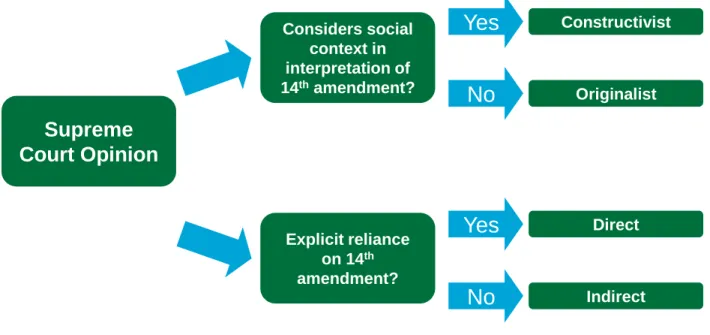
desegregation, an examination of the Court’s interpretation method would reveal a correlation between the Court’s approach to interpreting the fourteenth amendment and actual racial makeup in schools during roughly the last fifty years. After conducting my research, I found that shifts in the Court’s interpretation do indeed influence the racial makeup of schools. The Court has shifted its interpretation four times over the course of the time period studied. These shifts parallel distinct changes in school enrollment. When I examined specific modes of already defined modes of constitutional interpretation (i.e., constructivist, originalist) I found no relationship exists between school enrollment and methods of interpretation as commonly defined and established under constitutional law tenant. Further, I found the Parents decision will greatly influence the ways in which schools can integrate. Schools are currently
implementing diverse assignment plans within the bounds of the law but the widespread effects of the 2007 decision are great.
10 Through examining these issues, this study seeks to build upon and contribute to
scholarship that has addressed the impact of Brown and subsequent Court decisions on schools and students. Analysis of desegregation cases has focused on evaluating outcomes of Supreme Court decisions with respect to student achievement or school composition. Central to the questions already currently examined in current literature is whether or not the original goals of
Brown have been met. This study seeks to push the evaluation of desegregation issues further by examining how the Court’s interpretation of the Constitution and changes in schools align to improve understanding of the path desegregation has taken since 1954. Further, this study provides a framework of where desegregation law, as promulgated by the Supreme Court stands today, thus helping schools address the problem of de facto segregation within the bounds of the law.
II. Importance of the Research
The Supreme Court and its interpretation of the Constitution with respect to school
desegregation has been the subject of heightened attention and analysis since the controversial
Parents case. In 2004 much attention was given to the 50th anniversary of the Brown decision (Clotfelter, 2004; Ferguson and Mehta, 2004; Friedman, 2004; Gay, 2004; Ladson-Billings, 2004). Much discussion surrounds the nation’s struggle with racial integration in public schools. However, current literature stresses the role of the Supreme Court through individual cases, sometimes grouping opinions into different ‘eras’ for desegregation. However, little work has been conducted evaluating judicial interpretation of the 14th amendment as basis for Court opinions, that which, at its heart, has driven all the desegregation cases. At this time, linking the
11 Court to the actual issues schools are and have been battling serves the important purpose of evaluating where desegregation stands today.
Second, after the Parents decision, schools have been left to structure integration plans in compliance within the bounds of the law as dictated by the Court. By considering the ways in which the Court’s 2007 interpretation of the 14th
amendment may or may not allow for the implementation of student assignment policies, schools can evaluate legally permissible plans for integration. This dissertation will provide a clear picture of the Court’s interpretation of the 14th amendment as it juxtaposes actual changes in racial make-up of public schools. Establishing an understanding of this juxtaposition will show the extent to which the Supreme Court has
influenced actual changes in schools over the time period studied. Further, in order to avoid lengthy and costly litigation schools must focus on legal integration plans. These plans must conform with federal law as promulgated by the Supreme Court thus, making a clear
understanding of the law paramount to the successful future of school integration. This study will provide a clear framework of current federal law as promulgated by the Supreme Court thus allowing schools the ability to confidently structure legal assignment plans.
Third, this research builds upon current research on desegregation litigation by broaching the topic from a new perspective: judicial interpretation. Judicial interpretation is the way in which the Court interprets the law, and in this study specifically how the Court interprets the fourteenth amendment. While current literature does address desegregation cases and the Supreme Court’s role, little attention is paid to examining changes in 14th
amendment judicial interpretation over time specifically in the desegregation case law. While much research and literature exists closely surrounding my two major areas of inquiry (Supreme Court and
12 desegregation), I believe a gap exists between the literature that addresses the Supreme Court and its role in desegregation and literature on judicial interpretation. This research adds to foundational work on segregation in schools, desegregation and the law, and current evaluations of federal law by considering the role interpretation of the 14th amendment plays within the broader scheme of desegregation literature. The intended audience for my research is three-fold. First, I intend to speak to scholars in law who focus on constitutional law and Supreme Court judicial interpretation. Second, I intend my research to be relevant to scholars in both law and education focusing on analyzing and commenting on school desegregation. Lastly, this research will serve those involved in crafting school assignment policies including school administrators and parents.
III. Current Context of the Problem
The nation’s schools have experienced wide-spread resegregation in recent years. This has occurred at the same time as public school enrollment in the aggregate has become as racially diverse as it ever has been (Frankenberg, 2007). Latinos are the largest minority group among public school students and by 2050, more than half of the nation’s students will be
‘minority’ (Orfield & Lee, 2005). African-American students are now more racially isolated than in 1960, a time before the Civil Rights Act or major Supreme Court decisions such as Swann or
Green wherein the Court approved integration methods such as bussing or ruled several aspects of the school must be fully integrated beyond simply allowing African-American students to enroll (Orfield, 2001).
This reality is also reflected in the racial make-up of schools themselves. A total of 70.2 percent of African-American students attend predominantly minority schools, up from 62.9
13 percent in 1980 (Orfield, 2001). Since 1990, the percent of African-American students attending schools with over 50 percent minority student enrollment has increased from 66 percent to 72 percent (Orfield and Lee, 2004, p.20). Further, African-American students attending schools with over 90 percent minority students rose from 34 percent to 38 percent, showing an increase in intensely segregated minority schools (Ibid). A study by Frankenberg and Lee (2002) commissioned by the Civil Rights Project1 in 2002, examined the Department of Education’s National Center for Education Statistics Common Core of Data (CCD). The CCD collects fiscal and non-fiscal data from all public schools, districts, and state education agencies in the United States. The study (2002) found that levels of inter-racial exposure had declined since 1986 in virtually all of the 239 largest districts in the country (enrollment over 25,000). Districts showing the least amount of resegregation were mainly in the south. Orfield and Lee (2004) cite
supporting evidence:
The four most segregated states in 2001 for black students by two different measures (Black Exposure to White and Percent Black in Majority White Schools) were New York, Michigan, Illinois and California. In California and New York, only one black student in seven was in a majority white school and the typical black student was in a school with 82 percent nonwhite students in New York and 77 percent in California. (p.26)
The most pronounced trends in segregation affect Latino students. While segregation is often highlighted as the separation between African-American and White students, important to note is that Latino students are also segregated in public schools. In 1973 the Supreme Court in
Keyes ruled that Hispanic students are not only constitutionally entitled to desegregation
1 The Civil Rights Project/ Proyecto Derechos Civiles is a University of California Los Angeles-based group of
scholars, lawyers, policy-makers and education whose mission is to help in renewing the civil rights movement to achieve equity across society. Led by Gary Orfield, the Project is widely respected and conducts numerous studies and analyses on inequities in education.
14 remedies, but that schools must help Hispanic students be proficient in English. Wells (1989) examines the situation of Hispanic students in today’s schools:
Gaps in educational attainment and earning between Hispanics and non-Hispanics continue to widen, offering strong evidence that segregated schools are not
preparing the rapidly growing Hispanic student population to succeed in a predominantly non-Hispanic society… Many Hispanic students attend school districts with low per-pupil expenditures, high pupil-teacher ratios and limited resources. If current practices continue, Hispanics are not only destined to become the nation’s largest minority group, but also the most disadvantaged. (Wells, 1989, pp. 2-4).
In 1998, 36.6 percent of Latino students attended schools with a minority enrollment above 90 percent (Orfield, 2001). In addition, Native American students attend schools in which more than a third of their peers are also Native American (Ibid).
Impossible to ignore is the link between school segregation by race and segregation by poverty in the nation’s schools. Racially segregated schools are also schools with high
concentrations of poverty, the exception being racially segregated schools with majority white students (Orfield, 2001). Similarly, Darling-Hammond (2007) cites inequities based on funding:
African-American and Hispanic American students continue to be concentrated in central city public schools, many of which have become ‘minority’ in the past decade while their funding has fallen further behind that of the suburbs…The continuing segregation of neighborhoods and communities intersects with the inequities created by property tax revenues, funding formulas, and school administration practices that create substantial differences in the educational resources made available in communities serving White and minority
children…Not only do funding policies create a situation in which urban districts
receive fewer resources than their suburban neighbors, but schools with a high concentration of minority students receive fewer resources than other schools within these districts (pp. 320-321, emphasis added).
However, important to note is that residential segregation and school desegregation do not always go hand in hand. A study released by Logan (2002) of the Mumford Center for
15 Comparative Urban and Regional Research indicates that segregation by race in schools is increasing while residential segregation for African-American students is slightly declining. In addition, the study found that segregation works to benefit White students. Lee (2004) supports these findings and concludes:
there is strong evidence that districts where desegregation orders have
been weakened or vacated show a trend towards resegregation that is over and
above what would be expected by demographic [and residential] changes alone (p.9).
Logan (2002) also examines the link between race and poverty in schools. Logan (2002) found that during the 1999-2000 school year,
the average poor student attended a school that was 63 percent poor, while the average nonpoor student attended school that was only 27.5 percent poor. White students were in schools that were 30 percent poor, black students were in schools that were 65% poor, Hispanic students were in school that were 66 percent poor, and Asian students were in school that were 42 percent poor. This suggests that racial segregation works to the benefit of white students, placing them in very different schools from minority students.
Further, Logan (2002) found that the national average level of segregation of African-American elementary school children from their White peers increased by 2 points during the 1989-1990 school year whereas residential segregation declined by 3-4 points the same year (Logan, 2002, p.4).
The following table illustrates the relationship between segregation and poverty through showing schools with high percentages of minority students are those where the majority of students receive free and reduced lunch:
16 Public School Enrollment Data in Schools with High Minority Populations,
2007-2009 Academic Year, McNeal (2009)
Ethnicity (%) Total (%) Total (%)
Public School District
Black Latino Asian Native American White Students of Color Free & Reduced Lunch Atlanta 86 4 1 1 8 92 75 Boston 41 35 9 1 14 86 71 Chicago 49 39 3 1 8 92 85 Detroit 90 5 1 1 3 97 70 Los Angeles 11 73 4 3 9 91 76 St. Louis 82 2 2 0 14 86 82
Student achievement has been influenced by both the resegregation of schools and the standards-based and market-based reforms of recent years. Graduation rates are declining - down from 77 percent in 1969 to 69 percent in 2000 (Barton, 2005 as cited in Darling-Hammond, 2007, p.318). Further, while graduation rates were increasing from the 1950s to a high of 75 percent for African-American students during the 1980s, rates have not risen since (Darling-Hammond, 2007, p.321). Further, dropout rates have increased as graduation rates actually declined in some states in the wake of standards-based reforms (Ibid). Recent resegregation in schools is linked to student achievement, poverty, and racial isolation for both white and minority students.
17 IV. Research Questions
This study builds upon past and current research focused on the Supreme Court’s role in desegregation issues in America’s public schools. This analysis centers on chronicling the path of judicial constitutional interpretation as employed by the Court and as administered to desegregation cases with specific attention paid to interpretation of the 14th amendment. In addition to this major research question, analysis of judicial interpretation is then applied to established research on how desegregation and subsequent resegregation actually occurred in the nation’s schools from 1954-2007 by using student enrollment data from secondary sources. Using both the basic analysis of Supreme Court constitutional interpretation and the currently established research on the racial make-up of school enrollment, this study will provide current and legally permissible frameworks for how schools can structure plans through which
integration can occur today given the most recent Court decision affecting K-12 desegregation in
Parents.
Research Questions:
1. What were the shifts, if any, of the United States Supreme Court’s judicial interpretation of the 14th amendment as shown in Court case law relating to desegregation in public schools from the period of 1954-2007?
2. How, if at all, did these shifts parallel general changes in racial make-up of student populations in public schools from 1954-2007?
3. Given the most recent 2007 decision, what is the current state of federal desegregation law and how can schools structure legally permissible integration plans? What, if any, are the effects of the Parents decision both on schools and institutions outside of K-12 education?
18 V. Historical Context of Supreme Court Cases: Brown I and II
The significance of current resegregationcannot be understood without considering the critical role Brown played not only in the context of education, but also in American history. Historical contexts within which Supreme Court decisions are issued play a crucial part in evaluating goals and outcomes of the Court of the Schools, especially in the highly-charged area of school desegregation. This overview is meant to be an introduction to Supreme Court
desegregation case law; Chapter IV will include a detailed discussion of this topic.
The end of Jim Crow laws began with the Court’s decision in Brown, marking a turning point not only for integration in schools, but integration in all aspects of society. It is for this reason that Brown is one of the most famous cases ever decided by the Court (Friedman, 2004). Friedman writes,
From the end of Reconstruction to the 1950s, a vast legal structure was in place that effectively kept the black population in a second-class status. Laws segregated schools, parks, libraries, and public facilities, as places of public accommodation. It was a crime for a black person to go into places that the laws preserved for whites. Placing blacks in such an inferior position made it virtually impossible for them to use political power to correct their situation. Education was clearly the heart of the problem. First, segregation in education affected the largest number of black citizens- the tens of millions of children of school age. Second, segregation and lack of
political power by blacks necessarily led to inferior schools with few books or
teachers, and no science labs or other teach tools. It made it difficult or impossible for the black population to acquire then necessary skills to raise itself from its second-class status. (Friedman, 2004, p.viii)
Friedman (2004) makes an important connection between schools and society. School
segregation was simply one facet of discrimination African-Americans suffered pre-Brown. Jim Crow laws, the laws upholding de jure segregation in public facilities, were powerful tools used to maintain the status of African-Americans as ‘second-class’ citizens.
19 It would be incorrect to think, however, that Brown was decided quickly. A long struggle fought by activists to end school segregation began as early as the late 1800s. The Supreme Court ruled in favor of state’s rights to implement racial segregation in public facilities as long as these facilities were ‘equal’ in Plessy v. Ferguson (Plessy v. Ferguson, 163 U.S. 537 [1896]). In 1899 the Court upheld a Georgia school board’s right to close an African-American school while still collecting taxes from all to support the white schools citing the state’s reserved power to control schools. (Cumming v. Board of Education of Richmond County, 175 U.S 528 [1899]). Further, in 1908, the Court upheld racial segregation in institutions of higher education (Berea College v. Commonwealth of Kentucky 211 U.S. 45 [1908]).
Several cases to reach the Supreme Court pre-Brown dealt with issues of segregation in higher education and were headed by the NAACP Legal Defense Fund. The NAACP’s legal strategy was to challenge segregation in higher education, first with law schools, and then other colleges or professional schools (Friedman, 2004, p.ix). In Missouri ex rel Gaines v. Canada
(305 U.S. 377 349 [1938]) the Court ruled that the University of Missouri policy, one that offered no law school for African-American students, thus requiring them to seek a law degree outside the state, was unconstitutional. The Court ruled the state must provide a law school for African-Americans. This was the first in a series of Court opinions striking down segregation in higher education (Sipuel v. Bd of Regents of the University of Oklahoma (332 U.S. 631 [1948]),
McLauren v. Oklahoma State Regents Board of Higher Education (229 U.S. 336 [1950]). The most progressive of these cases was decided four years before Brown wherein the Court ruled an African-American student be admitted to the University of Texas Law School on the same terms as white students (Sweat v. Painter (339 U.S. 629 [1950]).
20 In the mid-1950s, parents and students began to challenge K-12 public school segregation, shifting direction from the Defense Fund’s initial strategy. The case commonly known as Brown v. Board of Education is actually a set of five cases all challenging the same issue of segregation by race in the nation’s public schools. The cases originated in Kansas, Delaware, Virginia, South Carolina, and the District of Columbia. As Kluger (1975) recounts, the South Carolina case originated from a lawsuit filed by African-American parents demanding a school bus for their children citing the white students had more than 30 buses for transport to school. The case soon became a challenge to the basic idea of segregated schools and unequal education in general. Similarly, the case in Virginia challenged inadequate educational facilities for African-American students. The Court issued one opinion in Brown because all five of the cases challenged the same fundamental issue: desegregation in K-12 public schools. The opinion is brief, uses simple language, and is clear in its impact on public education:
In the field of public education the doctrine of ‘separate but equal’ has no place. Separate educational facilities are inherently unequal…School children
irrespective of race and color shall be required to attend the school in the district in which they reside and that color or race is no element of exceptional
circumstances warranting a deviation of this basic principal (347 U.S. 483 [1954]) The Court’s decision in Brown was brief but resonated as a symbol of change and progress. The Court ruled segregation unconstitutional based on the14th amendment which states that,
All persons born or naturalized in the United States, and subject to the jurisdiction thereof, are citizens of the United States and of the state wherein they reside. No state shall make or enforce any law which shall abridge the privileges or
immunities of citizens of the United States; nor shall any state deprive any person of life, liberty, or property, without due process of law; nor deny to any person within its jurisdiction the equal protection of the laws. (U.S. Const., Fourteenth Amendment, sec. 1)
21 The Court’s legal rationale rested on the 14th
amendment’s equal protection clause and centered on the fact that segregated schools denied African-American children equal protection of the law as guaranteed by the clause.
Important to note, however, was the absence of a time-line for desegregation or a mandate for how long schools had to comply with the opinion. Lack of any articulation by the Court concerning either a practical directive or time-line for desegregation allowed for massive resistance on the part of those schools, communities, and states opposed to desegregation. The decision was met with resistance by the Southern states and school districts through methods such as closing schools (e.g., in VA), or simple inaction. When it was clear Southern schools would resist the original decree in Brown, the Supreme Court issued a second opinion commonly called Brown II in 1955 (349 UC. 294 [1955]) wherein it mandated schools to integrate with ‘all deliberate speed.’ The Court recognized the need to implement a flexible standard - the method and speed of integration would be determined locally. Peter Moran (2005) examines Brown II in relation to the original decision:
The implementation decree was handed down in May 1955 and bore a striking resemblance to the style and language of the original decision. The decree invested district courts with the authority to determine ‘whether the action of school authorities constitutes good faith implementation of the governing Constitutional principles.’ Furthermore, it ordered segregated school districts to ‘make a prompt and reasonable start towards compliance’ with the 1954 decision. Again, the language was exceedingly vague, and no definitive timeline was established. In one respect the 1954 and 1955 Brown decisions marked the culmination of more than two decades of NAACP litigation challenging the legitimacy of ‘separate but equal’ On the other hand, the Brown decisions marked only the beginning of another protracted series of legal campaigns to define the standards of ‘all deliberate speed,’ ‘earliest practicable date,’ and ‘compliance.’ The reactions to the ruling ranged from immediate compliance and desegregation to complete intransigence. (Moran, 2004, p.9)
22 Moran references here the continued resistance by many Southern schools against integration. Many Southern members of Congress signed the Southern Manifesto, denouncing the Supreme Court’s decision (Clotfelter, 2004, p.23). The Supreme Court did not hear any cases relating to public school integration for the better part of the decade post-Brown and Brown II. During this time integration occurred slowly (p.25).
Many argue that it was not until the passage of the Civil Rights Act in 1964 that any real progress was made in achieving integration, a full 9 years after the Court’s opinion in Brown
(Friedman, 2004, p.xiii). The Civil Rights Act prohibits recipients of federal financial assistance from discriminating against individuals because of their race, color, religions, sex, or national origin. In addition, Title VI of the Act grants authority to the United States Attorney General to investigate all public and most private schools and colleges.
VI. Historical Context of Supreme Court Cases: Green-Parents
Given widespread resistance to integration across the nation, the Supreme Court turned to an era of supporting specific methods of integration such as bussing. After Brown II to the passage of the Civil Rights Act in 1964 many schools resisted integration. These years included National Guard deployment to oversee the integration of Little Rock High, and Price Edwards County, Virginia schools, which had closed down for five years in order to avoid integration mandates. In 1968 the Court made clear its support for integration methods in Green.
In Green the Court ruled ‘freedom of choice’ plans unconstitutional based on the precedent set in Brown. Freedom of choice plans allowed students to choose which schools within the district they wanted to attend. There was no barrier to African-American students
23 attending previously white schools but the schools implemented no plans to support or push for integration. In many cases, schools remained segregated even though these plans were put in place. Often times, African-American students enrolled in ‘white schools’ were intimidated and harassed (Caldas & Bankston, 2005, p. 24). The Court ruled these plans operated to “burden students and their parents with a responsibility which Brown II placed squarely on the School Board” (Green v. County School Board of New Kent County [1968]). The Court writes,
Where a "freedom of choice" plan offers real promise of achieving a unitary, nonracial system, there might be no objection to allowing it to prove itself in operation, but where there are reasonably available other ways, such as zoning, promising speedier and more effective conversion to a unitary school system, "freedom of choice" is not acceptable. (Green v. County School Board of New Kent County [1968])
Green also required schools to come forth with a plan to integrate schools until it was clear ‘state-imposed’ integration had ceased. Lastly, Green required integration must be achieved in several aspects of the schools: facilities, staff, extracurricular activities, and transportation.
Caldas and Bankston (2005) identify a period of litigation marked by the Court’s ruling on specific methods of integration (p.24). In Swann (Swann v. Charlotte-Mecklenburg Board of Education 402 U.S. 1 [1971)]) the Court ruled that bussing in the Charlotte school districts was constitutional even when the school districts were segregated not through deliberate action on the part of the school districts, but was a result of a student’s geographical proximity to the school. 14,000 African-American students in the Charlotte, North Carolina school district attended schools that were over 99% black even though de jure segregation had ended fifteen years earlier. This was largely due to geographical segregation in the city. This decision was crucial because the Court also recognized there were limits to judicial oversight in dismantling segregated schools. Along with approving bussing, the Court also ruled that,
24 neither school authorities nor district courts are constitutionally required to make year-by-year adjustments of the racial composition of student bodies once the affirmative duty to desegregate has been accomplished. Swann v. Charlotte-Mecklenburg Board of Education 403 U.S. 1 [1971])
The period between 1970 and 2000 is marked by the Court’s willingness to release districts from court-ordered desegregation if they had made reasonable efforts to integrate their schools.2 This release from court-ordered segregation is called being granted ‘unitary status,’ meaning a dual system of ‘black and white schools’ had ended and a unified school system implemented (Swann (1971)).
In the 1974 case of Milliken, the Courtruled that cross-district bussing was unconstitutional. This was a pivotal case as it was an illustration of the Court’s intent to return power to the localities in which segregation existed. In Milliken the Court ruled that bussing of Detroit City School district students to one of Detroit’s 51 suburbs was unconstitutional. The Court wrote,
Before the boundaries of separate and autonomous school districts may be set aside by consolidating the separate units for remedial purposes or by imposing a cross-district remedy, it must be first shown that there has been a Constitutional violation within one district that produces a significant segregative effect in another district; i.e., specifically, it must be shown that racially discriminatory acts of the state or local school districts, or of a single school district have been a substantial cause of inter-district segregation. (Milliken v. Bradley 418 U.S. 717 [1974])
The Court here implicitly recognized residential segregation and again, its own limits on authority in local schools.
2 Important to note is an exception to the series of cases wherein the Court began to release schools from
court-ordered desegregation mandates. In Keyes (1973), the Court ruled that the City of Denver, Colorado school district was operating an intentional de facto segregated school district, and thus, even though not segregated by law, the segregation was unconstitutional. The Court’s decision recognized that the neighborhood school districts in Denver were segregated by race due to district rezoning policies. The Court recognized that these policies resulted in the establishment of de facto segregated schools and that the African-American schools were largely inferior to the
25 Many believe the Court began its most obvious abandonment of integration efforts in the 1990s. (Orfield and Eaton, 1996). Orfield and Eaton (1996) argue that
After decades of bitter political, legal, and community struggles over civil rights, there was surprisingly little attention to the new school resegregation policies spelled out in the Court’s key 1992 decisions in Board of Education of Oklahoma v. Dowell, Freeman v. Pitts, and Missouri v. Jenkins. The decisions were often characterized as belated adjustments to an irrelevant, failed policy. But in fact, these historic High Court decisions were a triumph for the decades-long powerful, politicized attacks on school desegregation. The new policies reflected the victory of the conservative movement that altered the federal courts and turned the nation from the dream of Brown toward accepting a return to segregation. (p.1)
In Dowell (1991)the Court ruled that once a school district had achieved ‘unitary status’ and had shown ‘good faith compliance’ the district was released from its obligation to maintain
desegregation. The Court identified ‘good faith compliance’ as the school’s showing of its reasonable effort to adhere to federally mandated desegregation. Here, the Court continues its line of reasoning from Swann (1971), wherein it reaffirms the idea that judicial intervention can only go so far and that reasonable efforts on the part of a district to integrate should be
acknowledged. In Freeman (1992), the Court ruled that unitary status could be granted to a district even when integration had not yet been achieved in all previously mandatory areas spelled out in Green (1968)(facilities, staff, extracurricular activities, and transportation). In
Missouri (1995)the Court ruled that states could not be mandated by law to pay for implementing state-wide remedial programs or teacher salary increases to resolve racial
inequities in schools through tax increases. Missouri v. Jenkins (515 U.S. 70 [1995]). In the 2007
26 plans within districts3. This study will unpack the ambiguity around this decision thus providing a current legal framework for integration.
VII. Overview of Policy Initiatives and Empirical Evidence 1954-2007
Black’s law dictionary defines policy as ‘a course of action adopted or pursued by a government’ (Black’s Law, 2006). While this study will not focus on federal policy as pursued by the executive or legislative branch, it is important to consider ways in which federal policy as adopted by these branches outside the judiciary have influenced school desegregation. The three branches together in totality comprise federal law and policy on school desegregation and therefore a brief review of policy initiatives will help understand how school segregation has evolved over time beyond the Supreme Court. Additionally, a major basic tenant of this study and of desegregation law is based on the general fact that integrated schools are a beneficial and worthy goal in K-12 schools. Here, empirical evidence on how and why racial integration is beneficial to students, schools, and student achievement levels is discussed. The widening present-day achievement gap highlights the gross disparities in educational opportunity between races, socioeconomic status, and between urban and suburban education. From a policy
perspective, the nation’s schools are currently facing an overwhelming task: raising academic achievement and evening the playing field in terms of educational access in the face of growing economic and residential inequalities.
Brown represented a marker of social progress and was an important part of the Civil Rights Era. The case sparked a new wave of policy: “education reform, integration, and social
3Note because in depth discussion of the Parents decision will occur in Chapter IV, only a brief summary of the
27 progress” (Pitre, 2008, p.552). Although schools resisted, the Court insisted on desegregation through a continued commitment to legal support for integration plans through court-orders and a growing body of case law. In addition, policy after Brown was also influenced heavily by federal legislation and the Executive Branch. Policy initiatives were fueled by empirical
evidence supporting integration, though the two were not always harmoniously aligned. Need for action arose because while the Court is endowed as being the highest and most powerful court in the nation, it has no power of enforcement. The Court does not have the power to implement the law, but must simply rule on Constitutional issues brought before it on appeal.
Social science research during the 1960s and 1970s influenced political support for general desegregation efforts but did not justify specific methods of integration such as busing. Evidence showed benefits for African-American students in several areas of achievement. Attainment of higher education for African-American students was a factor supporting integration. By the early 1970s research revealed African-Americans in racially mixed schools were more likely to complete high school and go onto college (Crain, 1970). Crain and Mahard (1978) found
African-Americans students in the North who graduated from predominantly white high schools were more likely to reach their third year of college. Research at the K-12 level also supported integration. African-American first graders who transferred from metropolitan to suburban schools had math scores three grade levels higher than their peers remaining in segregated schools (Zdep, 1971). Release of Coleman’s report “Equality of Educational Opportunity” in 1966 fueled the integration policy movement. The report focused on equality in opportunity as measured by educational outputs (achievement) rather than resource input (money spent on the school). Using data from over 600,000 students and teachers in 3,000 school districts, Coleman found that achievement was more tied to the social composition of the school than to educational
28 resources available to students (such as per pupil expenditure and size of school library). That is, school quality did not influence achievement of students from comparable social backgrounds as much as factors such as the background of a student’s peers. One message summarized the movement for integration: African-American students could achieve more if put in white
schools. Further, the Report supported the conclusion that it was school composition, not school resources that influenced achievement. While the report and relevant research was unequivocal in this, the means to achieve such integration was unclear.
The use of busing as an effective and reasonable method by which to achieve integration was the subject of much research. While research supporting the positive outcome of integration itself was widespread, research specifically on busing produced mixed conclusions (Schoefield, 1976). A 1971 report released by the Department of Health, Education, and Welfare (HEW), analyzed the effect busing would have on 39 urban districts and found that busing seemed a reasonable solution to the barriers of neighborhood segregation because it did not exceed practical budget or reasonable travel time limitations. The study also showed that in most of the 29 districts substantial decreases in racial isolation could occur without transporting students who lived within walking distance of their neighborhood schools. The report emphasized the effective use of existing levels of busing instead of employing additional busing and reviewing the assignment of those already bused to school. The increase in transportation time was found to be trivial when compared to time spent in pickup for neighborhood school systems. In
contrasting findings, a 1971 report issued by Syracuse University’s Research Center did not support the conclusion that busing was an effective solution to the problem of segregated schools, citing further problems with research methods such as inaccurate busing routes leading
29 to inconclusive findings. Coleman released another report in 1975 showing busing had failed as an integration method due to the massive ‘white flight’ from desegregating districts.4
During the 1960s and early 1970s, executive branch influence on the issues of integration and busing was notable while the Court decided several cases showing its approval and support of integration (Cooper, Griffin, Green). President Johnson oversaw several key pieces of
legislation centered on school desegregation and educational equity as part of his ‘Great Society’ agenda for social reform during his time in office from 1963-1969. Johnson was known as the ‘Education President’ and highlighted education reform as a major issue facing America during his 1964 campaign (Boone, 1992). Humphrey, Johnson’s VP , described Johnson as an
‘education nut’ who felt that education was the best thing he could provide the American people, often believing in miracle cures to education problems (Boone, 1992, p. 4). Johnson appointed the Gardner Commission in 1965 with the purpose of evaluating the issue of federal education aid to the states. Ultimately, the Commission recommended federal aid be linked to Johnson’s War on Poverty and recommended targeted aid to help poor children (Thomas & Brady, 2005, p.52). The War on Poverty articulated three main goals: to prevent entry into poverty, provide exits from poverty, and provide support for those who could not benefit from funding for the first two goals (Vinovskis, 2005). Johnson viewed education as a crucial mechanism by which to aid in achieving goals, especially at the secondary school level (Vinovskis, 2005).
The Elementary and Secondary Education Act (ESEA) of 1965 grew out of this push for equal educational opportunity (Vergon, 1990, p.5) and has remained the single largest financial support legislation for educationally vulnerable children (Thomas & Brady, 2005). The overall
30 purpose was to improve educational opportunities for poor children and provided states with the funds to implement plans aimed at improving the teaching of reading and other subjects (Pub.L. 89-10, 79 Stat. 27, 20 U.S.C. ). Title I of the ESEA provided funds for aid in math and reading to schools with disproportionate numbers of low-income students and was “to provide financial assistance to local educational agencies serving areas with high concentrations of children from low-income families to expand and improve their education programs by various means” (cited in Thomas & Brady, 2005, p. 52). Because the South was one of the poorest regions of the country, Southern schools had much to gain through compliance with federal legislation and desegregation laws.
Important to note is the explicit role of the federal government as articulated in the language of the ESEA. The federal government was not to exercise any “direction, supervision, or control over the curriculum, program of instruction, administration, or personnel, or over the selection of any instructional materials in any educational institution of school system” (as cited in Thomas & Brady, 2005, p.52). Many argue that this language allowed for the initial misuse of ESEA appropriated funds (Vinovskis, 2005; Thomas & Brady, 2005).
In the first four years after passage of the ESEA, Congress appropriated $4.3 billion to schools, but was widely criticized for allowing funds to be inappropriately distributed and misused (Martin & McClure 1969). Immediately subsequent to passage of the legislation, Congress debated heavily on whether or not funds should be restricted to only poor students, or if aid should also be distributed to academically vulnerable students (Thomas & Brady, 2005). Due to ambiguity in language of the ESEA, funds were legally able to be distributed to both types of students. In the 1970s, 94% of schools received some form of ESEA aid (Ibid). In the
31 1969 report “Title I of ESEA: Is It Helping Poor Children?” authors Martin and McClure found about 15% of ESEA funds had been misused because funding had not reached eligible children nor were they given to the areas most in need. Common examples of federal money being misused included supplanting local tax efforts and the building of swimming pools and other facilities that would benefit all students.
National policies and initiatives for implementing bussing began in earnest with the Court decision in Swann. Writing for the majority, Chief Justice Burger cited the inadequate measures taken to integrate schools to date including freedom-of–choice plans (see Green) or deliberate resistance and the now-common use of bussing to transport children to school. Burger recognizes that 39% of the school children nation-wide were transported to school by bus and identifies bus transportation as “perhaps the single most important factor in the transition from the one-room schoolhouse to the consolidated school district” (Swann). From 1921 to 1971 the number of students transported to schools by bus rose from 600,000 to nearly 20 million. The number of vehicles had grown from about 60,000 to over 250,000 (Commission on Civil Rights, 1972). In many cases, desegregating schools reduced the amount of busing. For example, the practice of busing black children past white schools to a faraway black school ended. Between 1965 and 1969, 42 districts in Georgia saw a decrease of 173,000 in total student miles travelled as a result of bussing to desegregate (Commission on Civil Rights, 1972). Similar numbers were seen in Mississippi. Specific to the Charlotte school district, Justice Burger recognizes the average bused student travelled more than an hour a day even before the desegregation busing plan was implemented.
32 Given the emphasis on the role of bussing in Swann, thedecision resulted in over a decade of forced busing though resulted in even more racial isolation in the nation’s schools (Reynolds, 1984). The Court had approved bussing as a constitutional means for combatting racial imbalance in schools, though many parents resisted the busing methods. This resulted in what they deemed to be ‘unnecessary’ traveling to schools by enrolling their students in private schools or moving outside of the city to avoid forced busing (see Milliken). Public resistance to bussing was widespread: in 1971 two buses were overturned and buses were burned in Denver and Pontiac, MI (Commission on Civil Rights, 1972). White-flight resulting from this resistance created increased racial residential and therefore increased school segregation.
The majority of those in Congress also disagreed with the Swann decision. Congress considered an anti-busing amendment to the Constitution as a way to combat the Court’s
decision (McKay, 1975). In 1972 President Nixon voiced his opposition to busing and called for a stop to forced busing in the long run and constructive alternatives to it in short term (McKay, 1975). No such amendment was ever realized, but Congress’ long opposition to busing can be seen in its decision to prohibit federal funds to be used for student transportation to overcome racial imbalance through mandates within the ESEA.
Despite this, the Brown decision and subsequent pieces of legislation led to progress in academic achievement and school desegregation (Orfield, 2001) Academic progress as measured by college attendance as well as access to resources improved post-Brown (Arrington, 1981). Student access to qualified teachers increased as did racial gaps in student achievement (Darling-Hammond, 2007, p. 271).
33 By 1971, the Department of Health, Education, and Welfare statistics showed that the South had become the most racially integrated region in the nation. Research from the last decade now documents that dropout rates declined by two to three percent post- Brown nation-wide and graduation rates increased as a result of desegregation orders and legislation (Ashenfelter,
Collins, & Yoon, 2006). The percentage of African-American students in majority White schools rose from two to thirty-three percent between 1964 and 1970. By 1968, the number of African-American attending majority white schools had risen to 32% (Arrington, 1981). By the late 1980s the number had reached an estimated 44% (Epperson, 2008, p.5).
The early 1990s stands out as a turning point in the progress made post-Brown in terms of progress towards integration and policy shifts. The Supreme Court heard and decided three desegregation cases during the early 1990s that may have been contributing factors to lower academic achievement because the cases made it is easier for schools to achieve unitary status and is considered a general shift away from school desegregation by the Court (Orfield, 2001). Simultaneously, academic achievement has slowed and in some ways regressed since the 1990s. The widening achievement gap is evidence of inequitable educational opportunity and access to resources for the nation’s public schools students. Disparities between races and students of different socioeconomic backgrounds in academic achievement are now evident in college enrollment, grades, test scores, drop-out rates, and course curriculum (Harris & Herrington, 2006).
The Reagan administration also played a major role as an obstacle to desegregation during the 1980s. During his time in office, Reagan continued to implement policies resulting in road blocks specific to progress towards integrated schools. Reagan opposed enforcement
34 proceedings against desegregating schools by the Executive Branch and also supported the abolishment of the Department of Education altogether (Epperson, 2008, p.6). The Reagan administration opposed desegregation orders and research came to a halt. As Vergon (1990) argues, the Reagan administration sought to turn control over education to the states and local communities. The federal role was cut back through limiting federal funding for research and the revocation of federal government regulations governing educational program (Vergon, 1990, p.7). Important to note is that the Reagan administration did support one area of research in regard to desegregation in schools. However, this small area of research centered on ‘white-flight’ and was used by the Reagan administration to justify opposition to integration (Frankenberg & Orfield, 2007, p.4).
Obstacles to school desegregation continued during the presidency of George H.W. Bush. Under the direction of Bush I’s administration, the OCR released eight states from any
obligations under Title VI of the Civil Rights Act of 1964. Under Bush I, Dowell was decided making it easier for schools to gain unitary status. This was the first time the Justice Department argued against mandatory school desegregation and succeeded (McAndrews, 2009).
After the Reagan administration, standards-based policies became known as the America 2000 Program under Bush I. Under Clinton the Program became federal law known as Goals 2000 and then reauthorization of the ESEA in 1994 propelled the standards movement ahead by requiring all states to adopt a system of standards and accountability to measure achievement in order to qualify for federal funding (Frankenberg & Orfield, 2007). Under President Clinton, the number of investigations conducted by the Office of Civil Rights doubled. The OCR targeted overrepresentation of minorities in special education programs and their underrepresentation in
35 gifted and talented programs (McAndrews, 2009). The Supreme Court showed its intention to proceed against Clinton’s focus by deciding Jenkins in 1995 by rejecting both compulsory busing and court-mandated implementation of magnet schools.
In 2001 the ESEA was again reauthorized as the No Child Left Behind Act with a school choice component under Bush II. Although Bush did not specifically focus on issues of race in public schools, education was a major theme on which he often spoke out publically (McAndrews, 2009). For Bush, schools were not separated by race but rather by quality:
“In Bush’s color-blind vision of American education, there are not Black schools or White schools. There are only “failing” and “succeeding” schools. When he unveiled his No Child Left Behind Act, the only statistic Bush cited did not allude to the public schools of Chicago, St. Louis, Cleveland, Detroit, and Baltimore, where over eight percent of the students were Black or Latino, or to the seventy percent of African-American children in the country who attended predominately minority schools, but to the high-poverty schools where nearly seventy percent of fourth-graders are unable to read at a basic level (McAndrews, 2009, p.70). Bush spent as much in the first two years of his administration on public education as had been spent in the eight years prior to his presidency (McAndrews, 2009). NCLB focused on
vouchers and transfer out options for students in failing schools. Parents was decided during the Bush administration and the Court’s interpretation of the fourteenth amendment as intolerant of any racial distinctions parallels Bush’s attitude towards issues of race in schools.
VIII. Researcher Orientation
This study rests at the intersection of law, policy, and education because of my
background in both education and law. I approach this research with a strong law and policy background given my previous practice as an attorney. My research interest is also founded
36 in my teaching experience as a former high school classroom teacher. My true interest has always lied with education and specifically with issues of race and equity in schools. I became interested in these issues because throughout my own K-12 education I was the only person of color not only in my grade or school, but in the entire school district. At a very early age I was aware of the role race plays in education. From my own experience grew a desire to understand why schools remain segregated, how segregation is tied to equity, and what legal factors influence progress towards racial integration.
While pursuing my law degree with a focus on public policy, I simultaneously earned my teaching certification. After earning my law degree I taught social studies at an urban school outside of Boston, Massachusetts and then at a suburban school in Syracuse, New York. My experience teaching in these two districts coupled with my knowledge of policy drove me to seek further understanding of how the law influences education through pursuing a doctorate degree in education with a focus on social policy. This research study is influenced by my own experience in a racially segregated school district, my experience teaching in K-12 classrooms, and my training and understanding of the law and the ability it has to profoundly influence education.
IX. Limitations
This study focuses on the legacy of desegregation-related Supreme Court cases through the intersection of law and educational policy and practice. State and lower federal court cases have been excluded from this analysis as I am primarily concerned with the role of the United States Supreme Court. The case law analysis draws from cases within the specific time period 1954-2007, only those dealing with desegregation in K-12 schools and, where
37 appropriate, higher education issues. Further, this study considers only secondary sources to provide student enrollment statistics, mainly from the work of Clotfelter (2004). Secondary sources will include periodicals, journal articles, and sourcebooks of historical documents (Cohen, 1985, p.6). A study of primary sources to ascertain the racial make-up of student enrollment during the time period falls outside the scope of this study. Further, I align Court interpretation with student enrollment data for African-American students throughout the time period studied. While other racial groups are undoubtedly important to consider in issues of equity, race, education, and integration, I chose to focus only on African-American students as student enrollment data throughout the time period studied is most complete for this racial group. Additionally, I have positioned myself primarily in the field of education although this is a study of how law and education align. Therefore, while literature within the field of law will be consulted especially regarding judicial interpretation, the major focus will be literature in the field of education on the topic of desegregation.
Chapter II: Literature Review
I. Overview
In addition to massive commentary on the legacy of Brown in the year of its 50th
anniversary, recent literature addresses the impact of the 2007 Parents decision. Fundamental to issues of integration in schools is literature examining the basic goal of integration and its benefits to school-aged children. Therefore, in this chapter I review the three main areas of scholarship within the wide breadth of literature addressing desegregation in K-12 education.
38 Literature citing both empirical evidence and the theory supporting integration will be reviewed. Second, there exists much scholarship evaluating the great impact of Brown and subsequent integration policy. This literature evaluates the extent to which the decision and the series of desegregation cases subsequent to it actually resulted in progress and is well established in the field of education. Third, the recent 2007 Court decision resulted in speculation on the future of racial integration in the nation’s schools. This third section of the literature review will be advanced in Chapter IV given that my third research question will require an analysis of where the future of desegregation is headed post Parents.
II. Literature in Support of Integration: Empirical Evidence and Theory
Despite recent resegregation, the benefits of school desegregation are well established in education research and literature. Research supports the fact that integration helps students in many ways while segregation produces negative results on student achievement. Rothstein (2004) found that while family income level does indeed affect achievement, even when income level is equal, African-American students still fare worse than their white peers if enrolled in racially segregated schools. Further, Kurlaender & Yun (2006) found that desegregation can help achievement as measured by individual ability to interact and feel comfortable with peers from different ethnic and racial backgrounds. Further, Orfield and Lee (2004) identify three primary categories of student outcome in relation to desegregation: higher achievement (as measured by test scores), greater educational or occupational aspirations and attainment, and increased social interaction among members of different racial and ethnic backgrounds. Additionally, Martinez & Klopott (2005) found three of the five strongest predictors of minority student college attendance
39 are directly related to school environment. More than 70 of the largest schools districts in the county are majority minority students (Pitre, 2009). Minority students are aware of the inequities in educational opportunity (Sortz, 2008). Sortz (2008) found that urban middle school students were angry about and aware of the shortcomings in their education due to lack of proper materials, lack of permanent teachers, and lack of funding.
Wells and Frankenberg (2007) identify two major themes in the literature on negative impact of segregation on schools and students: the first strand focuses on inequitable inputs to schools (i.e, resources), the second on the outcomes of segregation (p. 180). The author’s conclude that
Within the first strand, four characteristics of segregated schools stand out: concentrated poverty, poor teacher quality and high turnover, inadequate curriculum and supplies, and limited aspirations and social networks. The second strand emphasizes low academic achievement and graduation rates as well as instability and lack of support. Taken together, all of these factors demonstrate the layered, all-encompassing nature of racial inequality and its impact on separate public schools (p. 182).
The authors go on to reason that despite some arguments citing the need for socio-economic integration instead of racial integration in schools, race is a strong predictor of where students live regardless of socioeconomic status. The authors point to the fact that black and Latinos with relatively high incomes are far more likely to live in poor communities than whites with similar incomes: “Race is a strong predictor of whether or not a child will live in a mostly poor
community and attend a mostly poor school” (p. 181).
Further, in a qualitative study examining the long-term affects of attending racially diverse schools on adult graduates confirms the basic and logical conclusion that students who attend racially integrated high schools prepare young people for participation and inclusion in a
40 diverse society (Wells, Duran, & White, 2008). The researchers concluded that graduates of racially mixed schools felt they were more accepting and comfortable with people of other racial backgrounds. Second, they felt such schooling prepared them for a global economy and society. Third, and interestingly, most adult graduates of mixed schools felt they would have grown up in racial isolation but for their experience in mixed schools.
A major theme in education theory has been support for integrated schools based not only on empirical evidence but also notions of equity, justice, and the intrinsic value of mixed-race classrooms. Wells, Duran, & White (2008) cite the goal of eradicating structural inequality. This theme is founded on the notion that there exists a legacy of racism and racial inequality in the nation’s schools. Second, inherent in the goal of integrated schooling is the theory that students benefit from being in diverse classrooms. Not only is this supported by empirical research, as just discussed (see Wells, Duran, & White, 2008), but in multicultural education theories as well.
Multicultural education theory supports the implementation of racially mixed schools and classrooms on two fundamental levels. While multicultural education and its goals is not a major focus of this study, it is beneficial to survey basic tenants within multicultural education as they provide further support for the benefits, both empirical and theoretical, of racially integrated schooling. First, the multicultural literature connects equal opportunity to racial integration. Second, multicultural literature emphasizes the need to end institutionalized racism evident in schools and to promote diversity as a democratic principle. A basic tenant in multicultural literature is equal educational opportunity for students of all races. Banks (1997) writes,
Multicultural education incorporates the idea that all students- regardless of their general and social class and their ethnic, racial, or cultural characteristics- should have an equal opportunity to learn in school. (p.3)