Xavier University of Louisiana Xavier University of Louisiana
XULA Digital Commons
XULA Digital Commons
Electronic Thesis and Dissertation5-2020
A Causal Comparative Analysis of the Academic Self-Efficacy of
A Causal Comparative Analysis of the Academic Self-Efficacy of
Black Male High School Students taught by a Black or White Male
Black Male High School Students taught by a Black or White Male
Teacher.
Teacher.
Joseph Jones Jr.XXavier University of Louisiana, [email protected]
Follow this and additional works at: https://digitalcommons.xula.edu/etd
Part of the Educational Administration and Supervision Commons, Educational Assessment, Evaluation, and Research Commons, and the Educational Psychology Commons
Recommended Citation Recommended Citation
Jones, Joseph Jr., "A Causal Comparative Analysis of the Academic Self-Efficacy of Black Male High School Students taught by a Black or White Male Teacher." (2020). Electronic Thesis and Dissertation. 17.
https://digitalcommons.xula.edu/etd/17
This Dissertation is brought to you for free and open access by XULA Digital Commons. It has been accepted for inclusion in Electronic Thesis and Dissertation by an authorized administrator of XULA Digital Commons. For more
A CAUSAL COMPARITIVE ANALYSIS OF THE ACADEMIC SELF-EFFICACY OF BLACK MALE HIGH SCHOOL STUDENTS TAUGHT BY A BLACK OR WHITE MALE
TEACHER
By
JOSEPH JONES JR.
A dissertation submitted in partial fulfillment of the requirements for the degree of
DOCTOR OF EDUCATION XAVIER UNIVERSITY OF LOUISIANA
Division of Education and Counseling
© Copyright by JOSEPH JONES JR., 2020 All Rights Reserved
ACKNOWLEDGMENT
I would like to thank God, for seeing me through this entire process. If it were not for him, there is no way I would have been able to do this work. Secondly, I would like to thank my parents, Joseph Jones Sr. and Stephanie Jones. It is because of you two that I am driven to this work. You both pushed and made me believe that anything is possible, and it is because of that, I was able to embark on this journey. To my sister, my confidant, my love, my heart, and my soul—Thank You. There is no me, without you. To my Ridgegang family, thank you for taking me in at such a vulnerable time and allowing me to focus strictly on this work, I appreciate and love you all so much. To my KIPP New Orleans family, thank you for always supporting me and allowing me to do this work. To my principal, Towana, I love you so much. Words cannot express my gratitude. To my soulmate and friend Brandi Michelle, there’s been countless nights where you allowed me to just vent to you and you have always motivated me to do more, Thank you. Thank you to David and Rhonda Lastie who truly believed in me as a teenager. If it weren’t for you two and your generosity, I would not be here. To my sisters, brothers and cohort members, (Tamara, Joey, Kimmie, Winston, Nick, Darren, Brantley, Meka, Amber, Dr. Derousselle, Dr. Parker and Dr. Jones)—Thank you guys for being a shoulder whenever I needed you. To my committee members, Dr. Perkins, thank you for always pushing me and going over and beyond to ensure my work is the best. Dr. David Robinson-Morris, you have no idea how much respect and
admiration I have for you! Thank you for both pushing and believing in me. Dr. Signal, since day one, you accepted nothing but the best from me and for that I am extremely thankful. Lastly, to my chair, Dr. Akbar. You are truly God sent. You’ve always believed in me when I didn’t believe in myself and for that I am grateful. There is no way I could have made it through this journey without you and for that I am forever grateful to you.
A CAUSAL COMPARITIVE ANALYS IS OF THE ACADEMIC SELF-EFFICACY OF BLACK MALE HIGH SCHOOL STUDENTS TAUGHT BY A BLACK OR WHITE MALE
TEACHER
by Joseph Jones Jr., Ed.D Xavier University of Louisiana
May 2020
Chair: Renée Akbar
Abstract
The aim of this study was to determine if there was a difference in the academic-self efficacy among Black male students taught by a Black male teacher compared to the academic self-efficacy of Black male students that are taught by a White male teacher. Academically, Black male students lag behind their peers in academic achievement indicators such as grade point average, standardized test scores, and high school graduation rates (Schott Report, 2015). Existing literature regarding Black male academic achievement focuses on exploring the
academic achievement gap that exists, but little to no research investigates how to close that gap. Using Albert Bandura’s (1977) academic self-efficacy theory as a theoretical framework, this study investigated whether or not Black male teachers have an impact on the academic self-efficacy of Black male students by comparing the academic self-self-efficacy of Black male students taught by a Black male teacher compared to the academic self-efficacy of Black male students taught by a White male teacher.
The study was guided by the following research question:
Is there a difference in the academic self-efficacy of Black male students taught by a Black male teacher compared to the academic self-efficacy of Black male students taught by a White male teacher.
To answer the question, a quantitative causal comparative research study was employed using an adapted Academic Self Efficacy Scale (Gafor & Ashraf, 2006). Findings resulting from this study is significant, as it aims to serve as a platform for future research on methods to close the gap in academic achievement for Black male students.
TABLE OF CONTENTS
ACKNOWLEDGMENT... iv Abstract ... v List of Tables ... x CHAPTER ONE ... 1 Problem Statement ... 3 Purpose of Study ... 4Research Question and Hypotheses ... 4
Research Question (RQ1): ... 5 Hypothesis: ... 5 Significance of Study ... 6 Overview of Methodology ... 6 Delimitations/Assumptions ... 7 Definition of Terms... 7
Stereotype Threat Theory – A situational predicament where people feel themselves to be at risk of confirming negative stereotypes ... 8
CHAPTER TWO ... 9
LITERATURE REVIEW ... 9
Black Male Students and the Achievement Gap... 9
Stereotype Threat ... 12
Black Male Teachers... 14
Self-Efficacy ... 17
Academic Self-Efficacy ... 18
Summary ... 20
CHAPTER THREE ... 22
METHODOLOGY ... 22
Introduction/Overview of Study/Organization of Chapter ... 22
Rationale for Research Design and Methodology ... 22
Research Approach ... 23
Research Question (RQ1): ... 24
Hypothesis... 24
Population/Sampling ... 24
Instrumentation ... 25
Data Collection and Procedures ... 26
Data Analysis Procedures ... 27
Conclusion ... 27
CHAPTER FOUR ... 28
Introduction ... 28
Description of Site(s)/Population ... 29
Statistical Analysis: Research Question #1... 30
Conclusion ... 47
CHAPTER FIVE ... 49
Overview of the study ... 49
Discussion and Analysis of Findings ... 51
Difference in Academic Self-Efficacy ... 52
Ability to Accomplish a Challenging Task ... 54
Years of Experience ... 54
Limitations ... 57
Recommendations for Policy, Practice, & Future Research ... 57
Implications for Policy, Practice, and Future Research ... 59
Conclusion ... 60
References ... 633
APPENDIX A. ... 755
List of Tables
Table 1 Demographics of Sample Population ... 30
Table 2 One Way ANOVA Mean Results ... 31
Table 3. One Way ANOVA Results for Question Number 39 ... 32
Table 4 One Way ANOVA Results for Questions 1-40 ... 33
Table 5 Descriptives ... 35
Table 6 Reading = 4.3 ... 37
Table 7 Learning Process = 4.472 ... 37
Table 8 Comprehension= 4.06 ... 38
Table 9 Memory = 3.60 ... 39
Table 10 Peer Relationship = 4.1 ... 39
Table 11 Utilization of Research = 3.5 ... 40
Table 12 Curricular Activities = 3.875 ... 41
Table 13 Time Management = 3.318 ... 42
Table 14 Teacher Student Relationship = 4.13 ... 42
Table 15 Goal Orientation = 4.13 ... 43
Table 16 Adjustments = 3.76 ... 44
Table 17 Examination = 3.64 ... 46
CHAPTER ONE INTRODUCTION
More than 50 years after the landmark court case Brown v. Board of Education (1954), Black students, specifically Black males, are more likely to be suspended, least likely to be enrolled in gifted and talented classes and are not graduating high school at the same rate as their peers (Lewis, 2011; McMillian, 2003; Rhoden, 2017). Literature on Black male students (Brown and Donner, 2011) illuminate the dismay of structural systems within urban communities and the United States public education systems that contribute to academic barriers that Black male students face. It is because of these systematic barriers that often Black male students are reported as academically falling behind their peers (Nogguera, 2009). According to the Schott Report (2015), Black male students had a graduation rate of 59% while their White male counterparts have a graduation rate of 80%. The disparity between Black and White male students’ graduation rate is one of just many indicators that contribute to what theorists call the achievement gap. Boykin, Tyler, Watkins-Lewis, and Kizzie (2006) describe the achievement gap as the difference in test scores, grades, and high school graduation rates between groups of students. If not closed, the achievement gap has huge implications on the socio-economic futures of Black male students (McKinsey & Company, 2009).
There has been a large body of research (Grissmer, Flanagan & Williamson, 1998; Chubb & Lawless, 2002) that discusses ways in which school districts can close the achievement gap. Some of these strategies include smaller class sizes, charter schools, and school vouchers. However, there has been little to no progress in minimizing the gap for disadvantaged students (Blank, 2011). School districts have enacted several mandates such as No Child Left Behind (2001) and Every Student Succeeds Act (2015) in hopes of providing a fair and equitable
education to all students. However, despite these mandates, Black male students are still graduating high school at lower rates than their White counterparts, have lower grade point averages, and are more likely to be suspended (Schott Foundation for Public Education, 2015).
Researchers have also begun exploring student-centered approaches, as well as
investigating the socio-psychological milieu that Black males face at their schools. For example, research from King (2016) and DeFreitas and Bravo (2012) discusses the student-centered positive relationship that academic self-efficacy has on academic performance. In their meta-analysis, researchers Robbins, Lauver, Le, Davis, and Langley (2004) found that academic self-efficacy and academic performance in college were related. Steele and Aronson (1995) believe that poor educational outcomes for Black males are rooted in psychological barriers such as stereotype threat. Stereotype threat consists of the sociological, racial, gender, and educational intersections of being Black, Male, and the failure to support their needs for academic self-efficacy. (Pennington, Heim, Levy, & Larkin, 2016)
As another approach to improve Black male academic achievement, several researchers have explored the potential of positive impacts that Black male teachers can have on Black male students (Blake et al., 2016; Irvine, 2003; Pabon et al., 2011). Currently, Black male teachers make up only 2% of the teaching population (Milner, 2016). School districts across the country struggle to recruit and retain Black male teachers (Irvine, 2003). One factor that influences the low recruitment and retention of Black male teachers are the number of Black male students that enter into college. Brown and Butty (1999) noted that the number of African American males who go into teaching is influenced by the number of African American males who attend college, which is influenced by the number of high school graduates.
Gordon (2000) suggested that Black students in college do not believe teaching is a lucrative or attractive career choice. Research in education also suggests that Black males who enter the teaching force also struggle to pass two of the American teacher certification exams, such as the Praxis I and Praxis II (Albers, 2002). In a study that explored the performance and passing rate difference between Black and prospective teachers of other ethnicities, research revealed that Black first-time-test takers had a significantly lower pass rate (Nettles, Scatton, Steinberg, & Tyler, 2011).
For those that are successful in passing the Praxis exam, their presence in the classroom is extremely impactful. Milner (2010) found that Black male teachers are often role models for Black male students. Black male teachers also develop curriculum and instructional practices that align with the needs and interest of Black male students. Further, they develop and implement equitable disciplinary practices in their approach rather than the standard approach that has led to the massive suspension and expulsion of Black male students (Milner, 2010). Problem Statement
Due to the structural injustices within the public-school system that has led to Black male students being expelled and suspended at higher rates than their peers (Milner, 2010), there is a gap in academic achievement between Black male students and their academic peers (Ford & Moore, 2013). While school districts have attempted to close the academic achievement gap, Black male students still lag academically behind their classmates (Schott Foundation for Public Education, 2015). Research conducted by Reid (2013) discussed the positive impact that self-efficacy has on Black male students. Additionally, recent research (Lewis, 2011; Pabon et al., 2011) illuminated the positive impact that Black male teachers have on Black male students in academic settings. However, little to no research discusses the academic impact that Black male
teachers have on Black male students. It was the intention of this study to determine whether or not there is a difference in Black male student’s academic self-efficacy if they are taught by a Black male teacher when compared to a White male teacher. Academically and socially, Black male teachers share an understanding of the unique experiences and challenges that Black male students experience in academic settings (Pabon et al., 2011). However, despite the positive impact that Black male teachers have on Black male students, school districts are not recruiting and retaining Black male teachers (Lewis, 2006).
Purpose of Study
The purpose of this study was to determine if there is a difference in the academic-self efficacy of Black male students taught by a Black male teacher compared to the academic self-efficacy of Black male students when taught by a White male teacher. One factor that affect the achievement gap for Black male students is their academic self-efficacy. Bandura (1997) defines academic self-efficacy as a person’s belief in whether or not he or she can perform an academic task. Bandura (1997) suggested in his research that a student’s self-efficacy will affect their academic performance. In his examination of high achieving Black Male students at
predominantly white institutions, King (2016) points out that self-efficacy was vital in their academic achievement. Using Bandura’s Self -Efficacy Theory as the lens through which to explore the academic relationship between Black male students and black male teachers, the aim of this study is to determine if there is a difference in the academic self-efficacy for Black male students taught by a Black male teacher compared to the academic self-efficacy of Black male students when taught by a White male teacher.
This study set out to understand whether or not Black male teachers have an impact of Black male student’s academic self-efficacy. Specifically, the research will determine if there is a difference in the academic self-efficacy of Black male students when taught by a Black male teacher compared to Black male students taught by a White male teacher. To this end, the research question and hypothesis are as follows:
Research Question (RQ1):
1.) Is there a difference in the academic self-efficacy of Black male students when taught by a Black male teacher compared to the academic self-efficacy of Black male students taught by a White male teacher?
Hypothesis:
H1A: Black male students taught by a Black male teacher have a higher mean score of academic self-efficacy compared to Black male students taught by a White male teacher.
The research question was answered through a quantitative research study that utilized Gafor and Ashraf’s (2006) adapted Academic Self-Efficacy Scale to measure Black male students’ academic self-efficacy. The results of this test, which is a psychometric test that measures self-efficacy on cognitive processes, was used to answer a question about Black male student’s academic self-efficacy. Second, to determine the difference in Black male students’ academic self-efficacy, this study employed a causal comparative research design to compare the differences in academic self-efficacy of Black male students taught by a Black male teacher to Black male students who are taught by a White male teacher. The results of the research approach will be used to test the hypotheses posed in this study. Figure 1 reflects the hypothesized mediating model. Solid lines represent positive relationships, dashed lines represent negative relationships.
Figure 1 Mediation Model:
Significance of Study
This study provide insight into the relationship that Black male teachers have on Black male students’ academic self-efficacy. Additionally, results from this research will help close the gap in existing literature that examined the impact that Black male teachers have on Black male students. While there is limited research on the positive impact that Black male teachers have on Black male students (Graham & Erwin, 2011), this research focuses specifically on the
difference in Black male students’ academic self-efficacy when taught by a Black male teacher compared to the academic self-efficacy of Black male students taught by a White male teacher. Overview of Methodology
This study employed a sample of Black male high school seniors 18 years or older currently enrolled in a high school mathematics class located in the Southeastern region of the United States. Demographics questions included participants’ age, gender, race, and current grade level. Academic self-efficacy was measured using an adapted form of Gafor and Ashraf’s (2006) self-efficacy questionnaire. Black male teachers Black male student’s academic self-efficacy Black male student’s academic performance White male teachers
Research conducted by DeFreitas and Bravo (2012) and King (2016), the study’s
hypothesis is that Black male students have a higher mean score of academic self-efficacy when taught by a Black male teacher compared to Black male students who are taught by a White male teacher. To test the hypothesis, the researcher used a causal comparative research design.
Delimitations/Assumptions
One assumption in this study is that participants answered the survey questions
completely and honestly. There is also an assumption that teachers and students who identify as male are cisgender males. Further, based on literature conducted by Bandura, 1993; Schunk, 1995; Pajares, 1996, there is an assumption that high academic self-efficacy leads to increased academic achievement. White and Black refer to phenotypical designations with assumed general cultural values and lived experiences.
Delimitation of this study is the age of the participants, their grade level, and the classes that the students are enrolled in. This study surveyed 18-year-old senior high school students enrolled in two mathematics classes in a public high school to determine the differences in Black male student’s academic self-efficacy when taught by a Black male teacher to Black male
students who are taught by a White male teacher. With such a small sample size, results did not fully identify the differences in academic self-efficacy. Additionally, participants of the study were18-year-old seniors enrolled in schools in the Southeastern region of the United States. Participants did not fully represent the entire Black male student population.
Definition of Terms
For this study, the following terms are defined:
Black Male Students – Students enrolled in High School aged 18 years or older that identify as both Black and Male
White male teacher – A full time teacher who identifies as both White and Male.
Black male teacher– A full time teacher who identifies as both Black and Male.
Academic Self Efficacy – An individual’s belief that they can successfully attain a specific
academic task
Academic Achievement – A student’s success in reaching their educational outcomes. These
outcomes are typically represented by Grade Point Averages (GPA), standardized assessment scores, and ability to graduate.
Achievement Gap – The gap in academic performance between groups of students Cisgender –A designation thatrelates to a person whose personal identity and gender corresponds to the sex they were given at birth.
Stereotype Threat Theory– A situational predicament where people feel themselves to be at risk of confirming negative stereotypes
In Chapter One of this study, background information regarding the academic achievement of Black Male students was introduced. Also included, is the purpose and significance that this research will have on closing the achievement gap. Through Albert Bandura’s (1977) Self-Efficacy Theoretical Framework, this study explored the impact that Black male teachers have on the academic-self efficacy of Black male students. Outlined in this chapter is the research question, proposed methodology, and definition of specific terms. Also included are the assumptions, delimitations, and limitations of the study.
Chapter two will provide relevant literature to the study that focuses on Black male students, Black male teachers, Stereotype Threat Theory, and Self-Efficacy Theory. Chapter three will outline the methodological approach that will be used to explore the impact that Black male teachers have on the academic self-efficacy of Black male students.
CHAPTER TWO LITERATURE REVIEW Introduction
There are studies that have been conducted that discuss the impact of the achievement gap on Black male students (Ladson-Billings, 2006; Schott Foundation for Public Education, 2015). However, there is a gap in the literature regarding varying factors that have hindered Black male students academic achievement and the impact that Black male teachers have on Black male students’ academic achievement. This study focused on four major themes which emerged throughout the literature. These themes are Black male students and the achievement gap, the impact of stereotype threat on Black male students’ academic achievement, the impact of Black male teachers on Black male students, and the impact that academic self-efficacy has on academic achievement. While the literature presents these themes in varying contexts, this research focused on their application as it relates to Black male student’s academic self-efficacy. Black Male Students and the Achievement Gap
Literature on Black male achievement points to the many institutional barriers that impact Black male academic achievement, such as stereotype threat, cultural incongruence, and the lack of Black male teachers (Milner, 2010; Rai & Kumar, 2017; Steele &Aronson, 1995). Due to these barriers, Black male students are graduating at lower rates than their peers, are more likely to be suspended or expelled, and score lower than their counterparts on standardized tests (Schott Foundation for Public Education, 2015). Black males make up 15.4% of the national K-12 public school population (Kena et al., 2014), yet they are more likely to be referred for special
education services (Blanchett, 2006; Ford & Moore, 2013), and are more likely to be suspended or expelled (Gordon, 2017). As a result, Black male students across the country are encountering what is known as the achievement gap. The achievement gap is defined as the gap in academic
achievement between disadvantaged minority students and their White counterparts (Ladson-Billings, 2006). According to the National Education Association, indicators of the achievement gap are performance on standardized tests (ACT), outcome attainments (e.g., high school
diploma), and grades (National Education Association, 2012).
It has been estimated that the 2012-2013 Adjusted Cohort Graduation Rate (ACGR) for Black male students was 59%. Comparatively, Latino males had an ACGR of 65% and White males with an ACGR of 80% (Schott Foundation for Public Education, 2015). While there may be several factors that affect the graduation gap betweenBlack male students and their academic counterparts, one of the most significant factors is the Black male suspension rate (Schott
Foundation for Public Education, 2015).
According to a report from National Center for Education Statistics, in the 2013-2014 school year, 17.6% of Black male students received out of school suspensions (Kena et al., 2014). School suspensions are common discipline outcomes that aim to deter students from exhibiting problem behaviors within the school setting. Black male suspensions were almost twice the percentage of American/Indian/Alaska Native males (9.1%) and were more than twice the percentage of White males (5%) (Kena et al., 2014). Noltemeyer, Ward, and Mcloughlin (2015) found significant relationships between suspension rates and increases in student drop-out rates. In an industry where 80% of the teaching workforce are White females, their conscious or unconscious beliefs in negative stereotypes of Black male students has resulted in Black male students being suspended/expelled at higher rates and referred to special education at higher rates than their peers (Schott Foundation for Public Education, 2015).
When examining the impact of suspensions on academic performance, data shows consequential effects of in-school and out-of-school suspension on student’s academic
performance (Noltemeyer et al., 2015). Chu and Ready (2018) tracked a group of students throughout their high school career and revealed that suspended students were three times less likely to pass math and English classes compared to semesters when they were not suspended. For all students, out-of-school suspensions not only impacted their academic achievement but also their ACFGR (Chu & Ready, 2018). This is a problem because this means that Black males are not only failing to graduate from high school at rates that are similar to their peers, but they are also leaving high school underprepared to meet the demands of college.
Another indicator that impacts the achievement gap for Black male students is their academic performance on standardized tests, such as the American College Testing Exam (ACT). The ACT is a standardized test that colleges use to measure students’ abilities and
college readiness in five areas: English, Math, Science, Reading, and Writing. While there’s little to no data on Black male ACT scores, on the 2017 ACT, there was a five-point gap in ACT scores for Black students (17.1) compared to their White counterparts (22.4) (The National Center for Educational Statistics, 2017). Representation in advanced placement courses is also an indicator of the academic achievement that may impact the achievement gap. Often, Black students are assigned to lower-level classes and underrepresented in Advanced Placement (AP) and gifted classes (Corra, Carter, & Carter, 2011). However, Black females are more likely to enroll in and take AP examinations than their male counterparts and have higher levels of college enrollment than Black male students (Corra et al., 2011). Often, AP classes serve as
“gatekeepers” that either enhance or limit opportunities for students. Black male students are often ineligible to these classes that provide rigorous instruction and prepare high school students for college (Corra et al., 2011).
According to Burdman (2000), “Students who are successful in AP and honors courses are more likely to succeed in and graduate from college.” In 2016, the National Center for Educational Statistics reported that 31% of black males between the ages of 18-24 years old were enrolled in 2-4-year colleges or universities (Kena et al., 2016). However, Black men graduate from four-year programs in six years at a rate of 33% and from two-year programs in four years at a rate of 35%. On the other hand, White males graduate at a rate of 44% from four-year programs (McFarland et al., 2018). Although there are several indicators that impact the
achievement gap, there are also factors that contribute to the gap as well. The difference between Indicators and factors of the achievement gap is that indicators signify the state or level of the achievement gap whereas factors are what have influenced the achievement gap. Stereotype threat, Black male teachers, and academic self-efficacy are factors that may impacts on Back Male students’ academic achievement. In this next section, a discussion of these factors will be presented.
Stereotype Threat
One factor that also impacts the academic achievement of Black male students is
Stereotype Threat. Stereotype Threat Theory originates from research conducted by Steele and Aronson (1995) which explains how negative academic stereotypes impact Black students in college. The current stereotypes that are affecting Black males is the notion that they are unintelligent and lazy (Johnson, 2008). According to Steele and Aronson (1995), Stereotype Threat is the risk of confirming or being at risk of confirming negative stereotypes about one's identity group. For Black male students, stereotype threat may have negative impacts on academic achievement (Fischer, 2010; Steele, 1992, 1997). These stereotypes have strong implications for Black male students, especially in college settings, as they may potentially
undermine the ability of Black male students to successfully matriculate and graduate with a college degree. (Johnson-Ahorlu, 2013). This study examines if these same factors and effects occur in high school Black male students. Stereotype Threat also has an effect on how Black male students perform on standardized tests (Fischer, 2010). This same concept has been the target of Black males throughout their school career.
In a study conducted by Aronson, Fried, and Good (2002), researchers investigated how Stereotype Threat impacted the academic performance of Black undergraduate students. Results revealed that Black college freshman and sophomores performed worse on standardized tests when their race was made relevant or conspicuous by situational features. When race was not emphasized, however, Black students performed equally or better than their counterparts (Aronson et al., 2002).
Stereotype Threat hinders academic performance (Johnson-Ahorlu, 2013). According to researchers “Students perform more poorly on academic tests when tested under stereotype threatening conditions.” (Steele and Aronson, 1995). Steele, Spencer, and Aronson (2002) believe that continuous exposure to stereotype threat can result in long-term disengagement. Disengagement is the disinterest that happens when stereotype threat is activated. Continuous disengagement results in disidentification in which individuals may devalue performance on specific tasks (Hines, Rivadeneyra, & Zimmerman, 2014). Continued disidentification in any task results in a holistic disbelief in a person’s ability to complete specific tasks. These findings suggest that if Black male students are regularly threatened with the stereotype of being
academically inferior to their peers, ultimately, they will believe that they are, and their efforts on academic tasks will decrease.
In support of the large body of research that examines the negative outcomes of stereotype threat (Aronson, Fried, & Good, 2002; Steele, 1997; Osborne, 1999), there is also research that explores methods to reduce stereotype threat. One method in particular involves employing Black male teachers as role models for Black male students. According to Blanton, Crocker, and Miller (2000), exposure to positive role models can improve academic
performance. “Thoughts about our group members whose performance is superior in a domain can interfere with performance and providing role models demonstrating proficiency in a domain can reduce stereotype threat effects.” (Blanton, Crocker & Miller, 2000). Along similar lines, other research provides further support that providing role models that challenge stereotypic assumptions can eliminate stereotype threat (McIntyreet al., 2003; McIntyre, et. al, 2005). For Black male students, those role models are Black male teachers (Milner, 2010).
Role models are pivotal in the development of adolescents, especially minority students. In a 2002 study conducted by Sirkel, results concluded that students with the same gender role models at the beginning of the study performed better academically than students without a race and gender matched role model. Additionally, research suggests that Black students who have role models have higher educational aspirations, better grades, and higher persistence (Joyner, 2013, Smith, 2015).
Black Male Teachers
The representation of Black male teachers in the United States is practically nonexistent (Milner, 2016). Black male teachers make up only 2% of the teaching population (Milner, 2016). The lack of Black male teachers in the United States is important because studies have shown that Black students who have been taught by just one black teacher in the 3rd – 5th grades lower their chances of dropping out by 19 percent; for Black males it is 39% (Gershenson, Hart,
Constance, & Papageorge, 2017). Additionally, Black male teachers in the classroom are strong disciplinarians who are able to create strong, culturally relevant environments in which black students can excel (Irvine, 2003). Yet, research reveals that the number of Black male teachers have not risen past 2% of the teaching population (Milner, 2016).
The percentage of Black male teachers has not always been low. According to the 1890 census, among Black teachers, 49% were male and 51% were women (Fultz, 1995). During the mid-19th century, as the country’s public-school system emerged, so did the number of women entering the teaching profession. However, during the 1940s, that number decreased drastically; Black males made up 21% of the Black teaching population and Black women made up 79% (Ingersoll, 2012). Little to no information is provided that explains causes for the decrease in Black male teachers during this period. However, one plausible explanation is that Black males were likely eager to join the robust industrial industry that flourished during Reconstruction (Bristol, 2014), thus decreasing the number of Black male teachers. Additionally, after the
Brown (1954) Supreme Court ruling, schools across the United States were mandated to
desegregate, causing a large portion of the Black teaching population to lose their jobs
(Karpinski, 2004). Over 30,000 Black teachers and administrators lost their jobs (Fultz, 2004). Furthermore, in the 1970s, the Black teaching population decreased drastically again due to the new teacher-certification requirements that were imposed (Tillman, 2004). In summary, these periods in which Black males were not retained or actively recruited into teaching has not only contributed to the 21st century deficiency in Black male teachers but also brings attention to the long-term recruitment of Black male teachers into the school systems.
Brown and Butty (1999) and Graham and Erwin (2011) discuss the positive impact that Black male teachers have on students. According to Graham and Erwin (2011), Black male
teachers address problems that stem from cultural incongruence. Cultural incongruence is the lack of cultural similarities between people in a relationship (Rai & Kumar, 2017). Tyler, Boykin, Boelter, and Dillihunt, (2005) assert that cultural incongruence between Black students and White teachers emerge when White teacher pedagogical and classroom management practices are opposite of Black male students’ lives. For example, white teachers often interpret the behaviors of Black males as defiant, disrespectful, and intimidating (Ferguson, 2005; Monroe, 2005). This interpretation has led to unfair discipline policies that are more harsh for Black male students compared to their White counterparts (Monroe, 2005; Skiba, 2001). Black male teachers potentially address issues with cultural incongruence by providing a diverse perspective that pushes culturally relevant and culturally responsive pedagogy in the classroom (Tyler et al., 2005). Lynn (2006) contends that Black men see teaching as an opportunity to correct social barriers that exist for Black students and teach in ways that attempt to end racial inequality (Lynn, 2002). For Black male students, Black male teachers are often regarded as role models and mentors (Milner, 2010). In their research, (Milner, 2016) discuss not only the
positive impact that Black male teachers have on Black male students but also the culturally responsive pedagogy that they apply during instruction.
Culturally responsive pedagogy, allows teachers to build upon vantage points and experiences of students and communities in the development of curriculum (Milner, 2016). It emphasizes that teachers use students’ experiences to increase students opportunities to learn (Ladson-Billings, 2009; Gay 2010). Gay conceptualizes culturally responsive pedagogy as
Using cultural knowledge, prior experiences, frames of reference, and performance styles of ethnically diverse students to make learning encounters more relevant to and effective for them. It teaches to and through the strengths of these students . . . [it] is the behavioral expressions of knowledge, beliefs, and values that recognize the importance of racial and cultural diversity in learning. (p. 31)
According to Milner (2013), culturally responsive pedagogy is validating and affirms the knowledge of backgrounds, experiences, and ideas. Culturally responsive pedagogy is also empowering and pushes students to excel academically and reach their full potential (Ladson-Billings, 2009). In their study of Black male teacher’s use of culturally responsive pedagogy, researchers (Milner, 2016) discovered that it both validated student’s experiences but also empowered students to take on challenging tasks and become academically successful. While culturally responsive pedagogy is one way Black male teachers impact Back student’s academic success, the presence of Black males in teaching and leadership roles may also enhance Black male students’ academic and social development, specifically their academic self-efficacy (Styles, 2017).
Self-Efficacy
Self-Efficacy Theory was first proposed by Albert Bandura in 1977 as a unifying behavior theory that would explain behavior change in relation to psychological interventions and psychotherapy (Bandura, 1977). It is grounded in a larger theoretical framework, Social Cognitive Theory (Pajares, 1996; Schunk, 199;). Social Cognitive Theory developed by Albert Bandura, is a belief that human achievement is dependent upon factors such as environmental conditions, behaviors, and personal beliefs and/or thoughts. Bandura (1993) defines self-efficacy as “People’s beliefs about their capabilities to produce designated levels of performance that exercise influence over events that affect their lives.” There is a belief that self-efficacy determines how people feel and think about themselves. In relation to Black male student
achievement, there is a body of research that explores the impact of self-efficacy on black males’ academic achievement (Bandura, 1993; King, 2016).
Bandura (1997) proposes that self-efficacy is one of the most important determinants of human behavior. Humans with a strong sense of self-efficacy attempt difficult tasks no matter how hard those tasks may be. Adversely, humans with low self-efficacy avoid difficult tasks (Bandura, 1994). According to Bandura (1994), individuals’ beliefs about their self-efficacy is influenced by four main sources of influence: Performance attainments and failures, vicarious performances, verbal persuasion, and imaginal performances.
Performance attainments and failures are individuals’ experiences with mastering a specific skill. Continuous and successful experiences of mastering a skill lead to higher levels of self-efficacy. However, avoiding a task would weaken it. Vicarious performance leads to higher self-efficacy when individuals observe those similar to themselves perform and succeed at a task. Similarly, verbal persuasion leads to higher self-efficacy when others encourage individuals to perform a task. Through constructive feedback, verbal persuasion convinces individuals that they are capable of performing a task. Lastly, physiological states relate to moods and emotions influence individuals’ abilities. When individuals are nervous or highly stressed, they tend to doubt themselves more and have lower self-efficacy. If individuals feel confident, they tend to have a higher sense of self-efficacy. (Bandura, 1994). This study used Bandura’s (1977) Self-Efficacy Theory as theoretical support for the causal comparative research design to determine whether or not there is a difference in Black male student’s academic self-efficacy when taught by a Black male teacher compared to Black male students taught by a White male teacher. Academic Self-Efficacy
Academic self-efficacy is grounded in Bandura’s (1977) Self-Efficacy Theory. According to Bandura (1997), academic self-efficacy refers to an individual’s belief that he or she can achieve a specific academic goal. There has been a large body of research that explores how
academic self-efficacy impacts black male student’s academic success (Reid, 2013; Styles, 2017; Williams, 2017). There has been extensive research suggesting that academic self-efficacy relates to positive academic outcomes (Bandura, 1997; Pajares, 1996; Schunk, 1995). Academic self-efficacy is regarded as a task orientated trait that may differ across academic domains (Sharma & Nasa, 2014). Academic self-efficacy is regarded as a multidimensional construct that is differentiated across multiple academic domains of functioning (Sharma & Nasa, 2014). Linenbrink and Pintrick (2003) reported that academic self-efficacy is significantly associated with students' learning, cognitive engagement, analytical thinking, academic commitment, strategy use, persistence, susceptibility to negative emotions and achievement. In his research, Bandura (1993): identifies indicators (or characteristics) of self -efficacy as they:
1. view problems as challenges to be mastered instead of threats and set goals to meet the challenges, are committed to the academic goals they set, have task-diagnostic
orientation;
2. have a task-diagnostic orientation, which provides useful feedback to improve
performance, rather than a self-diagnostic orientation, which reinforces the student’s low expectation about what he or she can accomplish;
3. view failures as a result of insufficient effort or knowledge, not as a deficiency of aptitude; and
4. increase their efforts in cases of failure to achieve the goals they have set.
In his research, Schunk (1995) asserted that teachers play vital roles in instilling positive perceptions of academic self-efficacy through goal setting, strategy training, modeling, and feedback (Schunk, 1995). According to Bandura (1977), people exhibit higher self-efficacy when they see someone similar to them performing a task. Based on this logic, it is reasonable to infer
that Black male students are able to observe Black male teachers perform academic tasks, thus increasing their academic self-efficacy. The relationship between Black male teachers and Black male students is extremely important because both groups experience the intersectionality of what it means to be Black and male in an educational landscape where Black male teachers represent 2% of the teaching population (Styles, 2017). In his research on how self-efficacy impacts Black male undergraduate students, Noble’s (2011) findings concluded that vicarious experiences had the greatest impact on Black males’ achievement in mathematics. Additionally, according to Bandura (1997) children who are still developing skills rely on vicarious
experiences of someone they trust and respect (i.e., teachers) to inform their social identity. Educationally, Black male teachers provide Black male students with the vicarious experiences needed to increase their academic self-efficacy. It is through vicarious experiences in academic settings that Black male students are able to increase their academic self-efficacy and academic performance.
Summary
Black male students are graduating high school at lower rates, performing lower on standardized tests, and are more likely to be suspended or expelled. (Schott Foundation for Public Education, 2015). Within their academic settings, Black male students experience
stereotype threat (Steele & Aronson, 1995), which is the risk of confirming negative stereotypes. In other words, Black male students feel threatened by the stereotype that they are academically inferior to their peers. Research conducted by Aronson, Fried, & Good (2002) revealed that students who experienced higher levels of stereotype threat performed lower on standardized tests. As an intervention to reduce stereotype threat, presenting role models that share similar experiences to those students were influential in decreasing levels of stereotype threat (Aronson,
et al., 2002) For Black male students, those role models are Black male teachers, who additionally, increase levels of academic self-efficacy.
The purpose of this literature review was to highlight the educational experiences of Black male students and Black male teachers and to explore relevant literature related to the research study. Within this literature review was an analysis and exploration of Bandura’s Self-Efficacy Theory (Bandura, 1977) which grounds this research. Additionally, presented were gaps in the literature regarding the quantitative academic impact that Black male teachers have on students, specifically, Black male students.
CHAPTER THREE METHODOLOGY Introduction/Overview of Study/Organization of Chapter
This chapter will provide a rationale for the intended research design and methodology for this study. Following this section, the chapter provides an explanation of the population of students and sample chosen to participate in the study. It will describe the instrumentation used as well as the data collection and analysis procedures and any intended delimitations and limitations to the study.
Rationale for Research Design and Methodology
The selection of research methods is influenced by factors such as worldviews, the research problem and the research question posed (Creswell, 2014). Worldviews represent a fundamental set of beliefs which guide actions (Creswell, 2012). It is important to examine worldviews as they relate to the selection of research methods because they will help to explain the researcher’s rationale for the chosen research method. The following sections briefly outline the major tenets of four worldviews and discusses the selection process for the research methods for this study.
In selecting the appropriate research method for this study, qualitative methods and mixed methods were eliminated for three reasons. First, the study did not seek to understand the perceptions or experiences of Black male students, an objective which requires open-ended questions. second, qualitative methods yield results that are not intended to be generalized for a population. Such results would not align with the primary objective of this study, which is to determine whether or not there is a difference in the academic self-efficacy of Black male students taught by a Black male teacher compared to the academic self-efficacy of Black male
students taught by a White male teacher. Third, because the study is not using a combination of open-ended and closed-ended questions, a mixed methods approach was eliminated.
Research Approach
Since the research was primarily concerned with finding a solution to a real-world problem--poor educational outcomes for Black male students- the Pragmatic worldview is most suitable for this study. The Pragmatic worldview is a problem-oriented philosophy that utilizes either a quantitative or qualitative approach to answer a relevant research question (Creswell, 2014). Results from this study focused on addressing the current gap in quantitative research which demonstrates the difference in academic self-efficacy between Black male students taught by a Black male teacher compared to the academic self-efficacy of Black male students taught by a White male teacher. To this end, the research question will be answered using a causal
comparative design to determine if there is a difference in Black male students’ academic self-efficacy when taught by a Black male teacher compared to Black male students who are taught by a White male teacher.
A causal comparative design is a research design that seeks to find relationships between dependent and independent variables after an action has occurred (Ragin & Zaret, 1983). For this research, the independent variables are Black and White male teachers, the dependent variable is Black male student’s academic self-efficacy. In order to minimize the effects of other variables, the controls in this research are the student’s grade level, age range, and the course taught by the teacher. Levels of academic self-efficacy when taught by a Black male teacher compared to Black male students who are taught by a White male teacher was measured. To measure Black male students’ academic self-efficacy, Gafor and Ashraf (2006) academic self-efficacy survey will be administered. This study is guided by the following research question:
Research Question (RQ1):
1.) Is there a difference in the academic self-efficacy of Black male students when taught by a Black male teacher compared to the academic self-efficacy of Black male students taught by a White male teacher?
Hypothesis
Black male students taught by a Black male teacher have a higher mean score of academic self-efficacy compared to Black male students taught by a White male teacher. The research question will be answered through a quantitative research study that entails distributing Gafor and
Ashraf’s (2006) adapted Academic Self-Efficacy Scale to measure Black male students’ academic efficacy. To determine the difference in Black male students’ academic self-efficacy when taught by a Black male teacher compared to the academic self-self-efficacy of Black male students taught by a White male teacher, this study employs a causal comparative research design to compare any difference that exist in the academic self-efficacy of Black male students taught by a Black male teacher to Black male students who are taught by a White male teacher. To test the hypotheses, the researcher utilized a causal comparative study to analyze whether a difference exists in Black male students’ academic self-efficacy when taught by a Black male teacher compared to Black male students’ academic self-efficacy when taught by a White male teacher.
Population/Sampling
To explore the differences between Black male students’ academic self-efficacy when taught by a Black male teacher compared to the academic self-efficacy of Black male students taught by a White male teacher, the intended population were students enrolled in a high school located in the southeast region of the United States that are 18 years or older. Participants were
required to be 18 years or older to participate in the study. Individuals under the age of 18 years old would not be able to participate because of the need for parental consent. In order to answer the research question, a matching technique was utilized to select the sample. Matching is a technique that researchers use to identify one or more characteristics and selects participants who have these characteristics for both the control and the experimental group (Creswell, 2014). For this experiment, a purposive sampling technique was used. Purposive sampling requires the researcher to select participants based upon the needs of the study (Creswell, 2014). Participants chosen were classified as a 12th grader, identified as a Black male, and enrolled in a senior level mathematics course taught by either a Black male teacher or a White male teacher. Based on the setting of this study, the senior level mathematics class was chosen because it was the only subject in the specific setting that had both a Black male and a White male teacher as the
identified instructor of the same course. Both class classes are mathematics, senior level classes, which is why 12th grade students were also chosen as a part of the sample.
Instrumentation
The survey instrumentation and questionnaire were provided to participants 18 years or older enrolled in a senior level mathematics class taught by either a Black or White male teacher. Prior to distribution, the research ensured the chosen teachers identified as either a White or Black male teacher. To collect information from the participants, informed consent was obtained using an approved written consent form signed by participants. A copy was provided to the participants in the study. In order to identify the difference in Black male students’ academic self-efficacy when taught by a Black male teacher compared to the academic self-efficacy of Black male students taught by a White male teacher, a self-administered, academic self-efficacy questionnaire adapted from Gafor and Ashraf (2006) self-efficacy questionnaire study will be
utilized to collect academic self-efficacy data from the participants. Students reported their confidence on a 40 item five-point Likert scale questionnaire, ranging from exactly true to exactly false. A Likert scale is a construct, which is a five-point or seven-point scale that was developed by psychologist Rensis Likert (Creswell, 2014). Typically, the choices range from strongly agree to strongly disagree. For this study, the Gafor and Ashraf (2006) academic self-efficacy questionnaire is based on the idea that the self-efficacy of students in each dimension of academic work, contributes to their academic-self efficacy. The dimensions of academic work were Reading, Learning process, Comprehension, Memory, Peer Relationship, Utilization of resources, Curricular Activities, Time Management, Teacher Student relationship, Goal
Orientation, Adjustment, and Examination. There are both 20 positive and negative statements. Participants responded to each statement by choosing any of the five choices: Exactly true, Nearly true, Neutral, Nearly false, and Exactly false. Participants marked an “X” for his/her best response. For the positive statements, five scores are provided: 5 points for exactly true, 4 points for nearly true, 3 points for neutral, 2 points for nearly false, and 1 point for exactly false. Negative statements were scored in reverse (Gafor & Ashraf, 2006).
Data Collection and Procedures
Data collection and storage practices were required to ensure confidentiality. Participants remained anonymous. After the researcher collected the names of the potential survey
participants, they were contacted in person and given a written document that explained the study. Once consent was received, they were given a copy of the survey instrument.
Adopting methods and strategies outlined by Radhakrishna (2007) and Newton and Shaw (2014) the survey instrument was validated using two methods: Content and Concurrent validity. Content validity was assured through expert judgements of inclusion of items from the
dimensions of the construct (Gafor & Ashraf, 2006). Concurrent validity was assured against The General Self-Efficacy scale used in Jerusalem and Schwarzer’s (1992) study. Reliability was assured in Gafor and Ashraf’s (2006) study. Test-retest coefficient of correlation =.85 (N=30); Split half-Reliability of the scale = .90 (N=370).
Data Analysis Procedures
Given the nature of the survey instrument, descriptive statistics (frequencies, mean, median, mode, percentages, etc.) were used to analyze data and determine the relationship between the identified dependent and independent variables. In order to determine the difference in Black male student’s academic self-efficacy when taught by a Black male teacher compared to the academic self-efficacy of Black male students when taught by a White male teacher, a one-way ANOVA will be conducted. A one-one-way ANOVA is used to test for relationships between two or more groups (Zhang & Liang, 2014). This test determines whether or not there is a significant difference between groups based on their mean score (Salkind, 2010). For this study, the two comparative samples are, Black male students taught by a Black male teacher and Black male students taught by a White male teacher. Data cleaning was the first step in analyzing the distribution of factors.
Conclusion
The goal of this chapter was to outline the research methodology used to answer the presented research question and hypothesis. Included in this chapter is the research question, hypothesis, rationale for design, sampling method chosen, and instrumentation used.
CHAPTER FOUR FINDINGS Introduction
Academically, Black male students are not performing at the same rate as their academic peers (Ford & Moore, 2013). Although school districts around the country have attempted to close the achievement gap between Black male students and their classmates, Black male students are still not academically achieving at the same rate as their peers (Schott Foundation for Public Education, 2015). In his research, Albert Bandura (1997) suggests that a student’s self-efficacy will impact their academic performance. Academic self-efficacy is a student’s belief in whether or not they can perform an academic task. Recent research by King (2016) suggests that there is a relationship between a student’s academic self-efficacy and their academic performance.
The purpose of this study was to determine if there is a difference in the academic-self efficacy of Black male students taught by a Black male teacher compared to the academic self-efficacy of Black male students taught by a White male teacher. This study was conducted using quantitative research study that entails distributing Gafor and Ashraf’s (2006) Academic Self-Efficacy Scale to Black male high school students all 18 years or older, enrolled in two Mathematics class taught by a Black male teacher or a White male teacher, to measure Black male students’ academic self-efficacy to answer the following research question:
1.) Is there a difference in the academic self-efficacy of Black male students taught by a Black male teacher compared to the academic self-effiacy of Black male students taught by a White male teacher?
The chapter began with an analysis of the quantitative data collected from the students, 18 years or older, enrolled in a high school in Southeastern Louisiana. The overview of the
analysis will include the description of the population, description of the participants, the statistical analysis, and procedures. The results of student’s responses to the following self-efficacy dimensions of academic work of: Reading, Learning process, Comprehension, Memory, Peer Relationship, Utilization of resources, Curricular Activities, Time Management, Teacher Student relationship, Goal Orientation, Adjustment, and Examination were measured. Students reported their confidence on a 40 item five-point Likert scale questionnaire, ranging from exactly true to exactly false. The end of chapter 4 present a summary of the data findings as they relate to the research question.
Description of Site(s)/Population
In order to answer the study’s research question, the research utilized data collected from a Likert-scale academic self-efficacy survey instrumentation that was adapted from Gafor and Ashraf (2006) academic self-efficacy survey. The instrument was internet-based and each student was given a web address to access the survey to keep all the information confidential. The target population for this research study consisted of Black male students, 18 years or older, enrolled in a high school located in the southeastern region of the United States, who are in the two same level mathematics class taught by either a Black male or a White male teacher. A recruitment script was read to the target population (see Appendix A). As aforementioned, the survey was housed online (www.surveymonkey.com/r/Academicselfefficacy). Data was collected from 22 respondents and analyzed using SPSS (Statistical Package for Social Sciences).
Twenty-two of the twenty-three Black male students aged 18 years or older, enrolled in the same level mathematics class, agreed to participate in the research. The actual sample represented in this research study consisted of 22 Black male students aged 18 years or older,
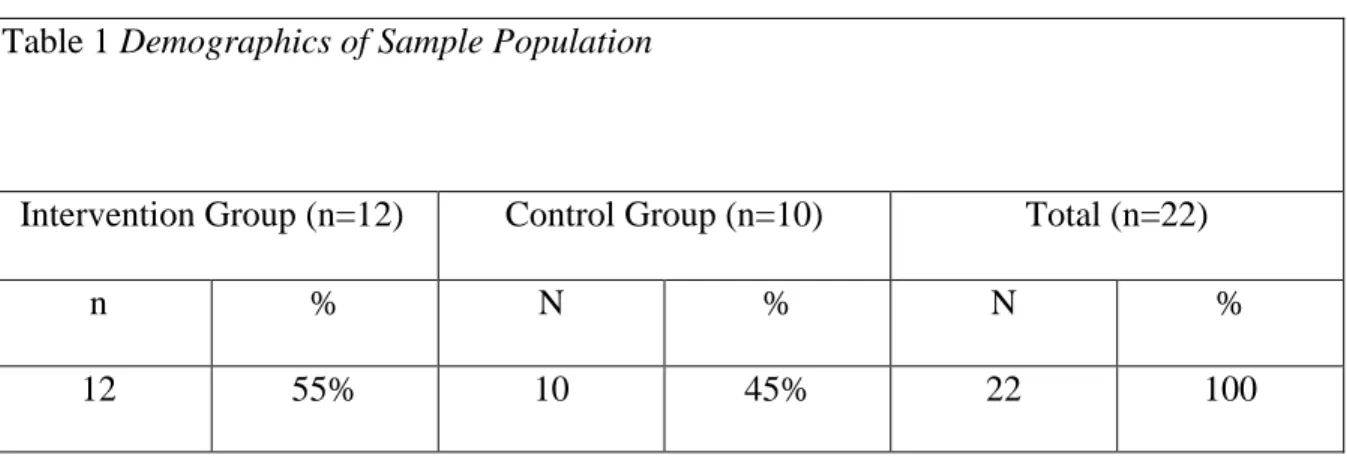
enrolled in the same level mathematics class taught by either a Black or White male teacher (n=22). While serving in the role of a school administrator, the researcher accessed school data to gather information about students. Participation in this study was 100% voluntary. The research did not coerce students to participate in the study. The average response rate was 100% for each question asked. The intervention group (n=12) consisted of 12 students who were enrolled in a mathematics class taught by a Black male teacher. The control group (n=10) consisted of 10 Black male students who were enrolled in a mathematics class taught by either a Black or White male teacher.
Table 1 Demographics of Sample Population
Intervention Group (n=12) Control Group (n=10) Total (n=22)
n % N % N %
12 55% 10 45% 22 100
Statistical Analysis: Research Question #1
The research study investigated the following research question. “Is there a difference in the academic self-efficacy of Black male students taught by a Black male teacher compared to the academic self-efficacy of Black male students taught by a White male teacher?” In order to determine whether or not there is a difference in the academic self-efficacy of Black male students taught by a Black male teacher compared to the academic self-efficacy of Black male students taught by a White male teacher, a one-way ANOVA was performed to compare the academic self-efficacy of the two groups using an adapted academic-self efficacy questionnaire
(Gafor & Ashraf, 2006). There were 40 total positive and negative statements (20 positive and 20 negative). Participants responded to each statement by choosing any of the five choices: Exactly true, Nearly true, Neutral, Nearly false, and Exactly false. Participants were required to mark an “X” for his/her best response. For the positive statements, five scores were provided: 5 points for exactly true, 4 points for nearly true, 3 points for neutral, 2 points for nearly false, and 1 point for exactly false. Negative statements were scored in reverse (Gafor & Ashraf, 2006). A mean score of 5 equates to high academic self-efficacy and a score of 1 equates to a low academic-self efficacy.
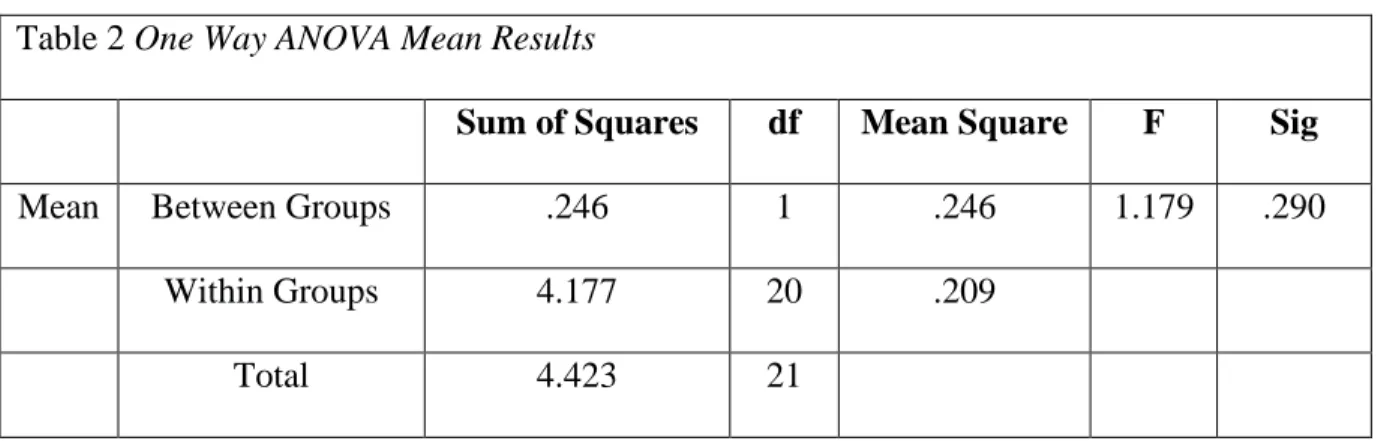
A One-Way ANOVA test was performed to determine if there was a statistical difference in the mean scores between the academic self-efficacy of Black male students taught by a Black male teacher compared to the academic self-efficacy of Black male students taught by a White male teacher. Overall, the sum of squares between Black male students taught by a Black male teacher compared to Black male students taught by a white male teacher was .246. The degree of freedom (df) was 1. The Mean Square was .246 and the F ratio was 1.179. The significance (P value) between both groups were .290 (p=.290), which indicated that there is no significant difference in the academic self-efficacy between both groups. Because the value was not less than 0.05, the variation in the academic self-efficacy was not statistically significant and the study’s hypothesis was rejected.
Table 2 One Way ANOVA Mean Results
Sum of Squares df Mean Square F Sig
Mean Between Groups .246 1 .246 1.179 .290
Within Groups 4.177 20 .209
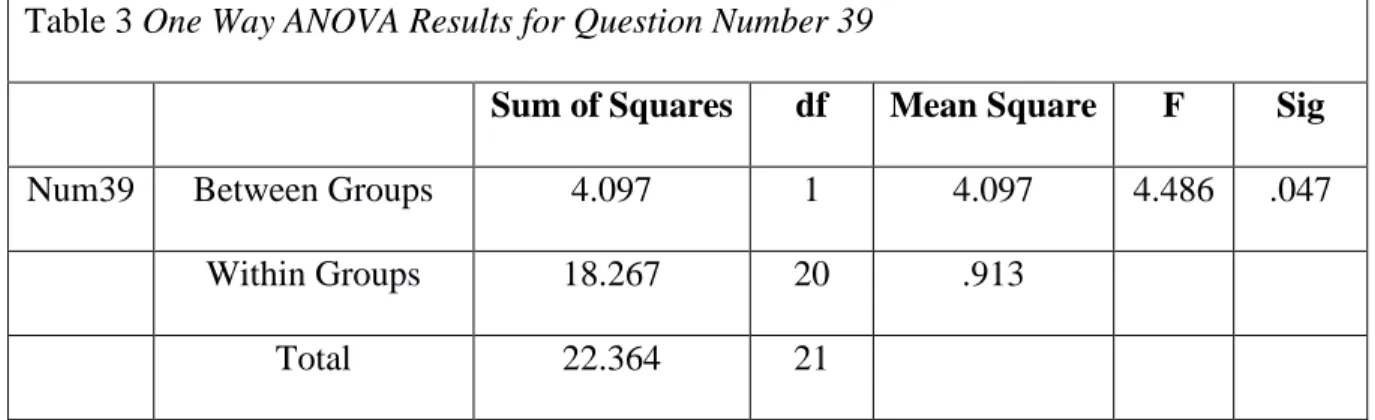
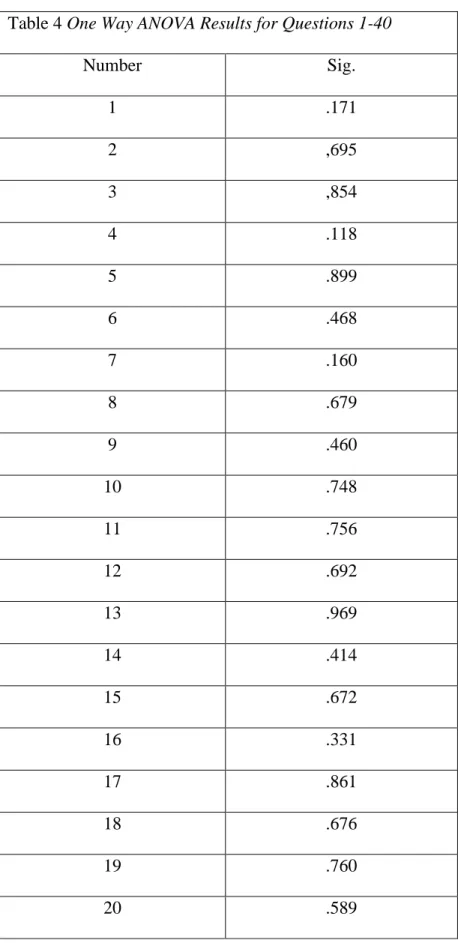
A One-Way ANOVA was also conducted to determine the difference in how both groups responded to questions 1-40 on the (Gafor & Ashraf, 2006) academic self-efficacy survey. The significance (p value) for all questions with the exception of question number 39 (Appendix 1) was not less than 0.05, which indicated there was no statistically significant difference in the participants’ responses. For question number 39 (Table 3), the Sum of squares between Groups was 4.097, the degree of freedom (df) was 1, the Mean square was a .246, and the significance between both groups’ response was a .047 (p=.047). Because the value was less than 0.05, the variation is their responses were statistically significant. Table 4 lists each question and the p value for each question.
Table 3 One Way ANOVA Results for Question Number 39
Sum of Squares df Mean Square F Sig
Num39 Between Groups 4.097 1 4.097 4.486 .047
Within Groups 18.267 20 .913
Table 4 One Way ANOVA Results for Questions 1-40 Number Sig. 1 .171 2 ,695 3 ,854 4 .118 5 .899 6 .468 7 .160 8 .679 9 .460 10 .748 11 .756 12 .692 13 .969 14 .414 15 .672 16 .331 17 .861 18 .676 19 .760 20 .589
21 .277 22 .935 23 .162 24 .307 25 .544 26 .092 27 .162 28 .606 29 .135 30 .535 31 .080 32 .241 33 .218 34 .416 35 .733 36 .212 37 .366 38 .858 39 .047 40 .870 Mean .290
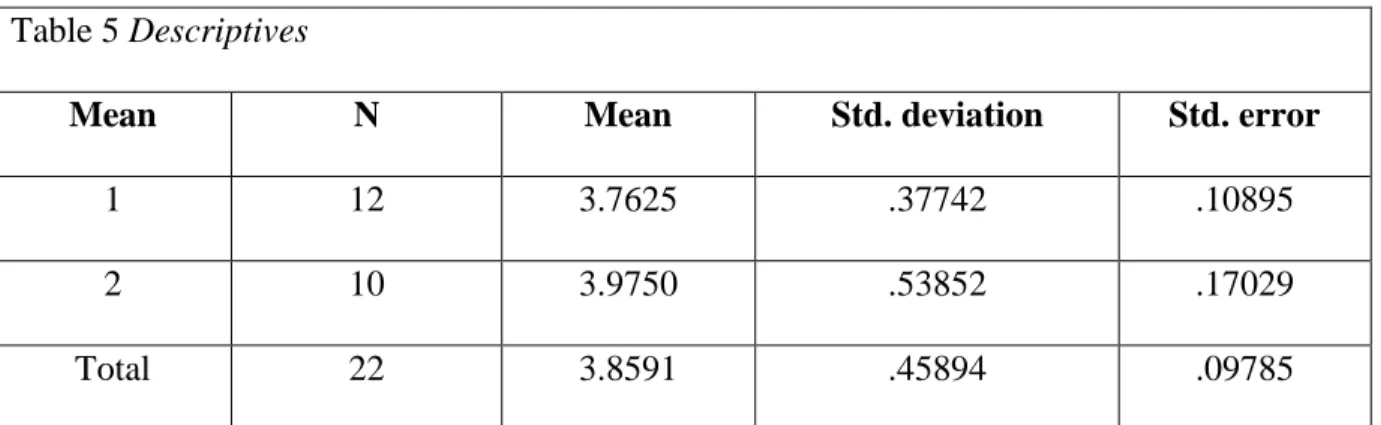
A One-Way ANOVA was used to compare the means of the academic self-efficacy of Black male students taught by a Black male teacher compared to the academic self-efficacy of Black male students taught by a White male teacher (Table 3). The intervention group (n=12) had a mean score of 3.7625 which was lower than the control group (n=10) that had a mean score of a 3.9750. Based on these results, Black male students taught by a White male teacher had higher levels of Academic Self-Efficacy compared to Black male students taught by a Black male teacher. Overall, all participants (n=22) had a mean score of a 3.8591 out of a scale of 5.
Table 5 Descriptives
Mean N Mean Std. deviation Std. error
1 12 3.7625 .37742 .10895
2 10 3.9750 .53852 .17029
Total 22 3.8591 .45894 .09785
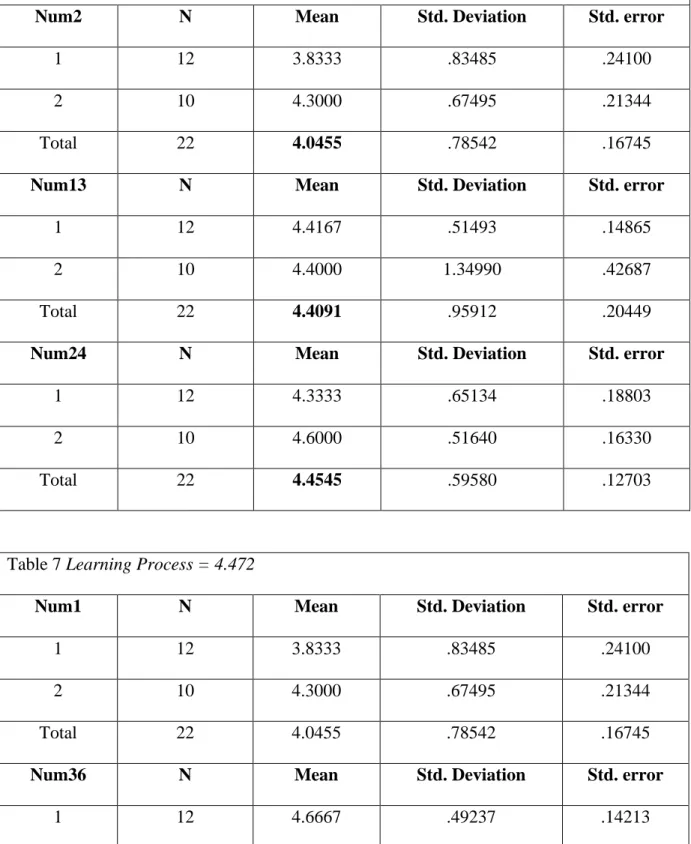
The 40 Questions from the Gafor and Ashraf (2006) adapted Academic Self-Efficacy Survey were divided into 12 dimensions of academic self-efficacy. The dimensions were Reading, Learning process, Comprehension, Memory, Peer Relationship, Utilization of resources, Curricular Activities, Time Management, Teacher Student relationship, Goal
Orientation, Adjustment, and Examination. Questions 2, 13, and 24 were categorized as Reading. Questions 1 and 36 were categorized as Learning Process. Questions 3, 15, and 23 were
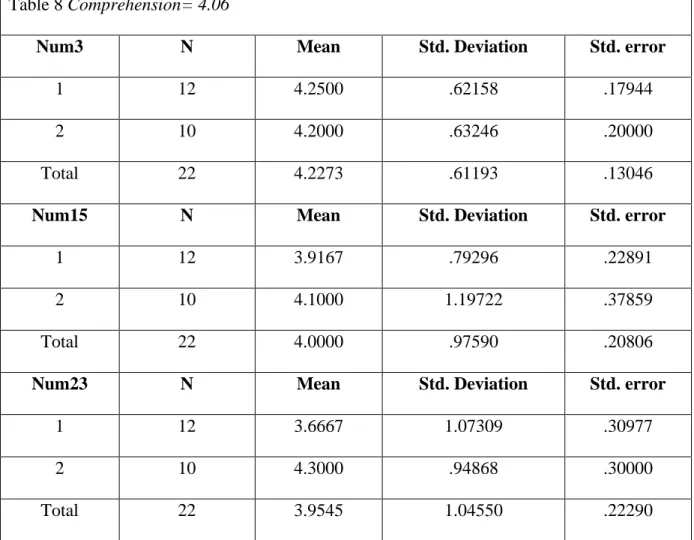
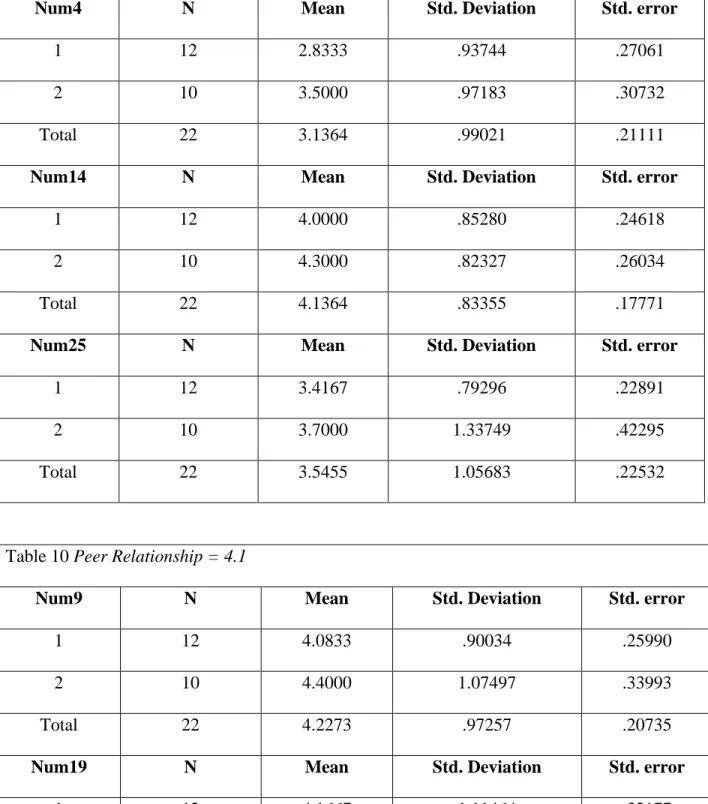
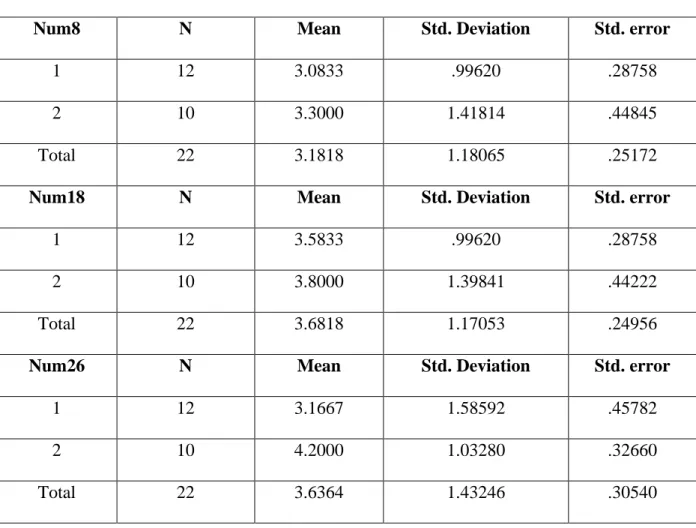
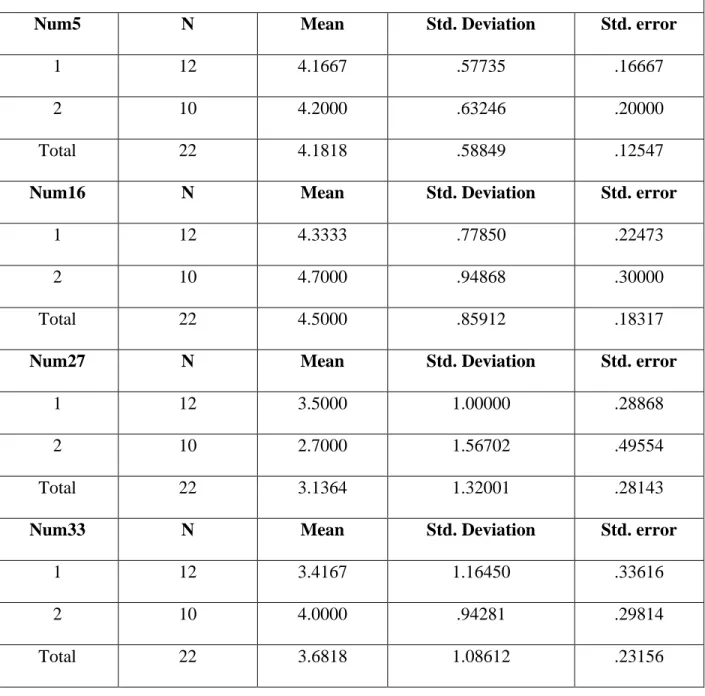
categorized was Comprehension. Question 4, 14, and 25 were categorized as Memory. Questions 9 and 19 were categorized as Peer Relationship. Question 8, 18, and 26 were categorized as Utilization of resources. Questions 5, 16, 27, and 33 were categorized as Curricular Activities.
Questions 6 and 17 were categorized as Time Management. Questions 7 and 29 were categorized as Teacher Student Relationship. Question 10 and 21 were categorized as Goal Orientation. Question 11, 20, 28, 31, 34, 37, and 39 were categorized as Adjustment. Question 12, 22, 30, 32, 35, 38, and 40 were categorized as Examination. From a scale of 1-5, 5 being the highest, the average mean score in Reading was a 4.3. The average mean for Learning process was 4.472. In the comprehension category, the average mean was 4.06. The average mean for memory was 3.60. Peer relationship’s average mean was 4.1. The mean score of Utilization of research was 3.5, Curricular activities was 3.875, Time management was 3.318, Teach student relationship was 4.13, and Goal orientation was also 4.13. The category Adjustments average mean score was a 3.76 and Examination was 3.64.
Participants scored higher mean scores in the Learning Process dimension with a mean score of 4.472. Both groups of students earned their highest mean scores on question number 36 (Appendix A). The intervention group’s mean score was 4.667 and the control group’s mean score was 4.900. Participants’ lowest average mean score (3.318) of academic self-efficacy was in the Time Management dimension (Appendix A). The intervention group’s lowest mean score was earned on question number 4 in the memory dimension, with an average mean score of 2.8333. The control group’s lowest mean score was earned on question number 27 in the Curricular Activities dimension, with an average mean score of a 2.7000.
Table 6 Reading = 4.3
Num2 N Mean Std. Deviation Std. error
1 12 3.8333 .83485 .24100
2 10 4.3000 .67495 .21344
Total 22 4.0455 .78542 .16745
Num13 N Mean Std. Deviation Std. error
1 12 4.4167 .51493 .14865
2 10 4.4000 1.34990 .42687
Total 22 4.4091 .95912 .20449
Num24 N Mean Std. Deviation Std. error
1 12 4.3333 .65134 .18803
2 10 4.6000 .51640 .16330
Total 22 4.4545 .59580 .12703
Table 7 Learning Process = 4.472
Num1 N Mean Std. Deviation Std. error
1 12 3.8333 .83485 .24100
2 10 4.3000 .67495 .21344
Total 22 4.0455 .78542 .16745
Num36 N Mean Std. Deviation Std. error
1 12 4.6667 .49237 .14213
2 10 4.9000 .31623 .10000
Table 8 Comprehension= 4.06
Num3 N Mean Std. Deviation Std. error
1 12 4.2500 .62158 .17944
2 10 4.2000 .63246 .20000
Total 22 4.2273 .61193 .13046
Num15 N Mean Std. Deviation Std. error
1 12 3.9167 .79296 .22891
2 10 4.1000 1.19722 .37859
Total 22 4.0000 .97590 .20806
Num23 N Mean Std. Deviation Std. error
1 12 3.6667 1.07309 .30977
2 10 4.3000 .94868 .30000