An exploration of ethnic differences of the influences of home and school on the
development of young people’s educational expectations for university study
between ages 14 to 16
Michael Tzanakis
Department of Quantitative Social Science Faculty of Policy and Society Institute of Education, University of London
Thesis submitted for the degree of Ph.D. London 2014
Thesis Abstract
Class analysis suggests a strong positive link between parental social position and adolescent educational expectations. Yet, Indian, Pakistani, Bangladeshi and Black Caribbean pupils with disadvantaged parents maintain much higher expectations for university study compared to their white peers from more advantaged families. Ethnicity is key to understanding this paradox. Yet, quantitative research has not explained how ethnicity impacts on adolescent expectations or whose expectations it impacts most. This thesis investigates whether the longitudinal association between parental social position at age 14 and pupils expectations at age 16 is mediated by parent-child conflict, pupils’ homework engagement, feelings about school and pupils’ assessments of teacher effectiveness at pupils’ age 15, net of all prior influences at age 14. It then explores whether these mediational routes are moderated by maternal ethnicity. Ecological systems theory informs a longitudinal latent variable mediation model estimated on panel data from waves 1-3 of the Longitudinal Study of Young People in England.
Parental social position at age 14 does not affect pupils’ expectations at age 16 via the hypothesised home and school factors at age 15. Its longitudinal influence is weak on white, modest on Black Caribbean and Pakistani and insignificant on Indian and Bangladeshi pupils’ expectations at age 16 casting doubt on classical sociological models. Moderation by maternal ethnicity strengthens the positive longitudinal influence of home-related factors on expectations and tones down the negative effect of family disadvantage or other negative influences particularly on South Asian pupils’ expectations at age 16. Pupils’ expectations at age 14 significantly impact on home and school factors and expectations at age 15 and are the primary indirect route of influence on expectations at age 16. Moderated by maternal ethnicity, this mediational mechanism allows South Asian pupils to develop and maintain higher expectations than white pupils despite family disadvantage.
Declaration and word count.
I hereby declare that, except where explicit attribution is made, the work presented in this thesis is entirely my own.
The copyright of this thesis rests with the author and no quotation from it or information derived from it may be published without the prior written consent of the author.
Word count (excluding appendices and references): 84,313
Table of Contents
Page
Thesis abstract 2
Declaration and word count. 3
Table of Contents 4
List of Tables 8
List of Figures 10
Dedication 11
Acknowledgement 12
Chapter 1: Research aims and questions 13
Introduction 13
1.1 Background and theoretical argument 15
1.2 Research questions involving longitudinal mediation, cross-lagged and
feedback effects and moderation – and the contribution of the thesis 19
1.3 The plan of the thesis. 22
Chapter 2. Review of literature 23
Introduction 23
2.1 Minority ethnic groups in the UK: a brief historical profile 23
2.2 Educational expectations in UK minority pupils 26
Influences on adolescent expectations 27
2.3 The paradox of high adolescent expectations from low class parental
backgrounds in UK minorities 30
Social class and educational performances of UK minority pupils 31 Ethnic gaps in adolescent educational performances and expectations over time 33 The reversal in academic progress in primary and secondary education 34 2.4 Explaining the paradox through the dominant sociological perspectives 35
Rational action theory and educational expectations 35
Coleman’s theory of social capital and educational expectations 37
Bourdieu’s theory of social and cultural reproduction 38
2.5 Factors potentially associated with adolescent educational expectations
examined in this thesis. 41
Parent-child conflict 41
Pupils’ engagement with homework 44
Pupils’ feelings about school 46
Pupils’ assessments about teachers’ control and discipline 47
2.6 Conclusions 49
Chapter 3 Ecological systems theory in relation to the present thesis 51
Introduction 51
3.1 Principles and topology of ecological systems theory 51
Principles of ecological systems theory 51
Locating factors and relations in my analysis in Bronfenbrenner’s ecological
topology 53
3.2 The conceptualisation and specification of the model based on EST 56
Model conceptualisation 56
Model specification 57
Specifying my model as a Person-Process-Context-Time model 58
3.3 Conclusions 61
Introduction 62 4.1 Latent variables and confirmatory factor analytic models 66
Longitudinal autoregressive CFA/SEM models 70
Assumptions tested explicitly in autoregressive models, advantages and limitations 71 4.2 The building blocks of model 7: autoregressive models 1-6 74 Model 1: Parental social position and family material circumstances (level of
deprivation) (FAMCIRC, truncated to FAM in certain Tables in chapter 7) 78
Model 2: Parental-child conflict (PAR) 80
Model 3 Pupils’ engagement with homework (HW) 81
Model 4 Pupils’ feelings about school (school affect, SCH) 82 Model 5 Pupils’ assessments of teachers’ effectiveness (TCH) 83 Model 6 Young people’s educational expectations for university study (YPEX) 84 4.3 Model 7: combining models 1-6 to assess the role of multiple mediators on
pupils’ expectations 86
4.4. Assessing the case for the presence of mediation and moderation 89 Measurement assumptions in testing for mediation effects 89 Measurement assumptions in testing for moderation effects 96
4.5 Conclusions 99
Chapter 5: Setting up the data, managing sub-groups and the description of
key variables in the analysis 101
Introduction 101
5.1 The Longitudinal Study of Young People in England (LSYPE) dataset 101
LSYPE sampling 102
LSYPE response rate 104
Instrument content and LSYPE interviews 105
5.2 Treatment of the LSYPE dataset for the needs of the analysis 105
Weighting the data 109
Clustering 109
Missingness, data imputation and derivation of covariance matrices as input 111
Analysis of missingness and imputation procedure 111
5.3 Description of key variables in the analysis 113
5.4 Conclusions 124
Chapter 6: Results for research questions 1 and 2: Assessing moderated
longitudinal change in models 1-6 125
Introduction 125
6.1 The need for longitudinal and cross-group measurement
invariance/equivalence tests 127
Model fit, chi-square difference tests and alternative fit indices 129 6.2 Results regarding the goodness of fit to data of models 1-6 131 Comparison of structural estimates of models 1-6 across ethnic groups 144 Moderated longitudinal change between ages 14 to 15 in parental social position
(model 1) 148
Moderated longitudinal change between ages 14 to 16 in reported parent-child
conflict (Model 2) 148
Moderated longitudinal change between ages 14 to 15 in pupils’ engagement with homework (model 3)
Moderated longitudinal change between ages 14 to 16 in pupils’ feelings about school (model 4)
149 149
Moderated longitudinal change between ages 14-15 in pupils’ assessments about
their teachers’ effectiveness (model 5) 150
Moderated longitudinal change between ages 14 to 16 in pupils’ educational
expectations (model 6) 150
6.3 Comparing latent means and intercepts. 151
Cross-group differences in latent means and intercepts in parental social position
(model 1) 156
Cross-group differences in latent means and intercepts in parent-child conflict
(model 2) 158
Cross-group differences in latent means and intercepts in pupils’ engagement with
homework (model 3) 157
Cross-group differences in latent means and intercepts in pupils’ feelings about
school (model 4) 160
Cross-group differences in latent means and intercepts in pupils’ assessments
about teachers’ effectiveness (model 5) 161
Cross-group differences in latent means and intercepts in pupils’ educational
expectations (model 6) 162
6.4 Discussion 164
6.5 Conclusions 167
Chapter 7 Results for research questions 3 and 4: Assessing mediational
routes to pupils’ expectations between ages 14 to 16. 168
Introduction 168
7.1 Direct, indirect and total effects for each type of mediation 170 7.1.1 Type 1: mediation of the effect of parental social position at age 14 on
pupils’ expectations at age 16 via parent-child conflict, pupils’ homework engagement, feelings about school and assessments about teachers’
effectiveness at age 15. 184
The influence of parental social position on parent-child conflict, pupils’
engagement with homework, feelings about school and assessments of teachers’
effectiveness (a effects). 185
The influence of parent-child conflict, pupils’ engagement with homework, feelings about school and assessments of teachers’ effectiveness on pupils’ expectations (b
effects). 186
Direct effects of parent-child conflict on expectations 187 Direct effects of pupils’ engagement with homework on pupils’ expectations 187 Direct effects of pupils’ feelings about school on expectations 187 Direct effects of pupils’ assessments of their teachers’ effectiveness on expectations 188 Indirect effects of parent-child conflict on pupils’ expectations 188 Indirect effects of pupils’ engagement with homework on expectations 189 Indirect effects of pupils’ feelings about school on their expectations 190 Indirect effects of pupils’ assessments of their teachers’ effectiveness on pupils’
expectations 190
7.1.2 Type 2: mediation of earlier effects of parent-child conflict, pupils’ homework engagement, feelings about school and assessments about teachers’ effectiveness at age 14 on pupils’ expectations at age 16 via one another’s
cross-lagged effects at age 15. 190
Direct cross-lagged effects 191
7.1.3 Type 3: mediation of earlier feedback effects of pupils’ expectations at age 14 on themselves at age 16 via parent-child conflict, pupils’ homework engagement, feelings about school and assessments about teachers’
effectiveness and expectations at age 15. 194
Direct feedback effects of expectations at age 14 on the four mediators at age 15 195
Indirect feedback effects 195
7.2 Evidence for moderation by maternal ethnicity based upon tests of
cross-group differences 198
7.2.1 Moderation in the first type of mediation: b and c΄ effects 198
Moderated b effects 200
Moderated c΄ effects 201
7.2.2 Moderation in the second type of mediation involving cross-lagged effects 202 7.2.3 Moderation in the third type of mediation involving direct and indirect
feedback effects of pupils’ earlier expectations at age 14 on later expectations
at age 16 via the four mediators and themselves age 15 203
7.3 Discussion and concluding remarks 205
Chapter 8 Discussion and Concluding Remarks 213
Introduction 213
8.1 Answering the research questions 213
8.2 Findings by ethnicity group 218
White pupils 218
Indian pupils 219
Pakistani pupils 219
Bangladeshi pupils 221
Black Caribbean pupils 222
8.3 Strengths and limitations of my modelling approach 223
8.4 Parental social class, education and achievement across minority ethnic
groups 226
8.5 Implications for the paradox of minority pupils’ high expectations from
disadvantaged homes, and directions for further study 229
8.6 Implications for policy interventions 234
Appendix 1: Comparison of parameter estimates (indicator loadings and intercepts) for models 1-6 under the full (n=7578) and the reduced (n=1000)
samples of the white group 240
Appendix 2: AMOS and SPSS syntax for models 1-7, as well as for data
imputation and selection of datasets. 242
A2.1 AMOS Syntax: Multigroup FINAL (model7) 242
A2.2 SPSS Syntax: Conversion of a correlation matrix into an augmented
covariance matrix (in this case for the white n=1000 sample) 251 A2.3 Multiple imputation syntax (shown here for the white n=1000 sample) 251 A2.4 Selection of datasets containing fully-productive mothers in LSYPE
waves 1-3 (shown here only for the white group; identical syntax was used for
the other groups) 250
A2.5 Selection of 1000 randomly-selected cases of white mothers 252
Appendix 3 Rationale and sequence of tests of invariance 253
Appendix 4: Discussion of Differential Item Functioning (DIF) 256 Appendix 5: Tests of longitudinal structural invariance (stationarity) and
Appendix 7 Personal Communication referenced in the thesis 262 A7.1 Order of measurement invariance tests: communication with Roger
Millsap 262
A7.2 Comparison between bootstrapped and asymptotic standard errors for
structural parameter estimates: communication with Irini Moustaki 263 A7.3 Formula for the standard errors of the total indirect effect:
communication with Scott Maxwell 263
A7.4 Feasibility of model 7: communication with Scott Maxwell (reference in the thesis: Maxwell (2013b;c) and David MacKinnon (reference in the thesis:
MacKinnon (2013) 264
A7.5 possible bias from sample discrepancy in multigroup comparisons and the decision to reduce the white sample of mothers from 7578 to 1000: communication with Irini Moustaki (Moustaki, 2013c) and Scott Maxwell
(Maxwell, 2013d) 267
Bibliography 268
List of Tables 8
Table 4.1: Operationalisation of models 1-7 75
Table 4.2 Type, name and description of each structural path in model 7 88 Table 5.1: Age distribution of Young Person (YP) at Wave 1 102 Table 5.2: Young Person’s self-reported ethnic group (grouped) by gender,
Waves 1-3 103
Table 5.3: Overall response by LSYPE Wave 1-3 104
Table 5.4 Sample sizes of mothers’ groups 106
Table 5.5 NS-SEC for father’s and occupations by ethnic group at LSYPE
waves 1-2 114
Table 5.6: Family-level material circumstances (deprivation) by ethnic group
at LSYPE waves 1-2 114
Table 5.7 Income distributions of gross household income by ethnic group at
waves 1 and 2 115
Table 5.8 Level of qualification of mothers at LSYPE wave 1 116 Table 5.9: Pupil-reported likelihood to go to university (heposs9YP) by ethnic
group. LSYPE waves 1-3 117
Table 5.10: Pupil-reported likelihoods of being accepted to university if
applied (hlikeYP), by ethnic group at LSYPE waves 1-3 117
Table 5.11: Mother-reported frequency of arguing with young person (parqual) by ethnic groups, LSYPE waves 1-3
117 Table 5.12: Mother-reported frequency of how well she gets on with young
person (kiddif) at LSYPE waves 1-3
118 Table 5.13 Young person-reported number of evening per week spent on
homework (hwndayYP) at LSYPE waves 1-2
118 Table 5.14: Young person-reported frequency of how often he/she was given
homework per week at term (hwdoYP) at LSYPE waves 1-2
118 Table 5.15: Pupils’ agreement with ‘I’m happy when I am at school’ (yys1YP)
by ethnic at LSYPE waves 1-3 120
Table 5.16: Pupils’ agreement with ‘on the whole I like being at school’
Table 5.17: Pupils’ agreement with ‘Most of the time I don’t want to go to
school’ (yys4YP) by ethnic group at LSYPE waves 1-3 120
Table 5.18: Pupils’ agreement with ‘I’m bored at lessons’ (yys9YP) by ethnic
group at LSYPE waves 1-3 120
Table 5.19: Pupils’ responses to how many of their teachers the statement ‘The
teachers in my school make it clear how we should behave’ (yys15YP) applies by
ethnic group at LSYPE waves 1-2. 121
Table 5.20: Pupils’ responses to how many of their teachers the statement ‘The teachers in my school take action when they see anyone breaking school rules’
(yys16) applies by ethnic group at LSYPE waves 1-2. 121
Table 5.21: Pupils’ responses to how many of their teachers the statement ‘I
like my teachers’ (yys18) applies by ethnic group. LSYPE waves 1-2. 122
Table 5.22: Pupils’ responses to how many of their teachers the statement ‘My
teachers can keep order in class’ (yys19) applies by ethnic group. LSYPE waves
1-2. 122
Table 5.23: Means, standard deviations, skew and kurtosis for all indicator
variables entering models 1-6 by ethnic group, LSYPE waves 1-3 123 Table 6.1: Overall fit of the final models 1-6 with achieved configural, metric
and scalar longitudinal invariance 132
Table 6.2: Estimated measurement parts of models 1-6 by maternal ethnicity
with configural, metric and scalar invariance achieved. 134
Table 6.3a Tests for longitudinal invariance of models 1-2 135 Table 6.3b Tests for longitudinal invariance of models 4-5 136
Table 6.3c Tests for longitudinal invariance of model 6 137
Table 6.4: Structural parts of models 1-6 by ethnic group 138
Table 6.5a: Tests of cross-group invariance for models 1-3 142 Table 6.5b: Tests of cross-group invariance for models 4-6 143 Table 6.6a: Tests of cross-group structural invariance for models 1-2 146 Table 6.6b: Tests of cross-group structural invariance for models 3-6 147 Table 6.7a: Scaled point differences in latent means and intercepts for models
1-3 by ethnic group 155
Table 6.7b: Scaled point differences in latent means and intercepts for models
4-6 by ethnic group 156
Table 7.1: The measurement model (indicator loadings) of model 7 175 Table 7.2: Unstandardised (b) and standardized (β) estimates, SE and p values
for direct dependence, mediational, cross-lagged and feedback effects by
ethnic groups 178
Table 7.3 Standardized direct effect matrix with bias-corrected bootstrapped
two-tailed significance (in parenthesis) by ethnic group 180
Table 7.4 Standardized total indirect effect matrix with bias-corrected
bootstrapped two-tailed significance (in parenthesis) by ethnic group 181 Table 7.5 Standardized total effect matrix with bias-corrected bootstrapped
two-tailed significance by ethnic group 182
Table 7.6 Decomposition of standardised total indirect effects into specific indirect effects of parent-child conflict, pupils’ homework engagement,
feelings about school and assessments about teachers effectiveness at age 14 on
pupils’ expectations at age 16 via one another’s occasions at age 15. 194 Table 7.7 Decomposition of specific standardised indirect effects of pupils’
conflict, pupils’ homework engagement, feelings about school and assessments
about teachers effectiveness at age 15. 197
Table 7.8 Tests of structural invariance for model 7 involving the three types
of mediation 200
Table A1.1 Comparison of indicator loadings for models 1-6 under the
reduced and the full sample of white group 240
Table A1.2: Comparison of indicator intercepts for models 1-6 under the
reduced and the full sample of white group 241
Table A4.1: Estimated intercepts for models 1-6 by ethnic group 257 Table A5.1: Tests of equilibrium over time for models 2, 4 and 6 259 Table A5.2: Tests of longitudinal structural invariance (stationarity) for
models 2, 4 and 6 260
Table A6.1: Indicator error, factor and disturbance term variances and their
standard errors in model 7 by ethnic group 261
List of Figures 10
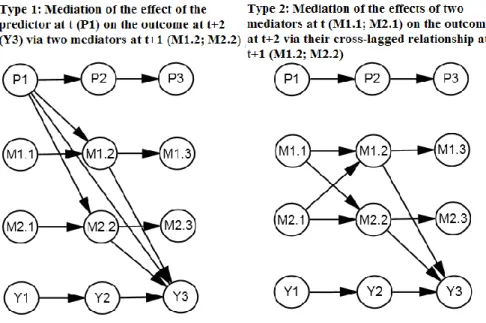
Figure 4.1 Three types of potential mediation showing mediation of the background effects at age 14 of the predictor (type 1), the mediators (type 2)
and the outcome (type 3). 63
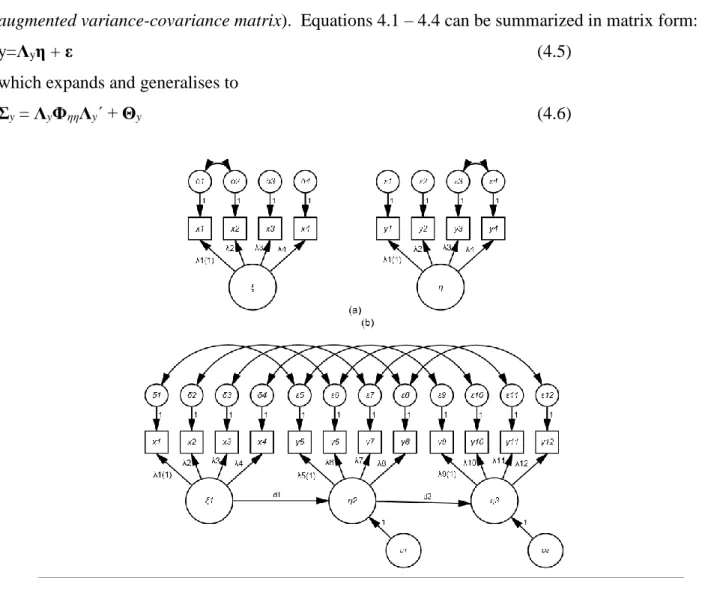
Figure 4.2: X and Y notation for a congeneric latent variable with two correlated errors (a) and a longitudinal autoregressive SEM with an
autocorrelated error structure (b) 68
Figure 4.3: The autoregressive model for FAMCIRC (Model 1) with metric
and scalar invariance constraints in place. 79
Figure 4.4: The autoregressive model for PAR (Model 2) with metric, scalar
and theta invariance constraints in place. 81
Figure 4.5: The autoregressive model for HW (Model 3) with metric and
scalar invariance constraints in place. 82
Figure 4.6: The autoregressive model for SCH (Model 4) with metric and
scalar invariance constraints in place. 83
Figure 4.7: The autoregressive model for TCH (Model 5) with metric, scalar
and theta invariance constraints in place. 84
Figure 4.8: The autoregressive model for YPEX (Model 6) with metric and
scalar invariance constraints in place. 84
Figure 4.9: The final model 7 (showing only the structural model and
hypothesised structural relations) 85
Figure 7.1 The three types of hypothesised mediational routes affecting pupils’ expectations at age 16 estimated by model 7 (only part of which is illustrated
Dedication
Acknowledgement
Simply put, my PhD project would have been impossible had his Eminence Archbishop Gregorios of Thyateira and Great Britain not shown rare kindness and benefaction to my person. The
consideration and help I received from him since 2007 amounted to no less than a miracle. I shall for ever be in his debt.
Special thanks are also due to my current supervisors, Professors Alice Sullivan, John Micklewright and Richard Wiggins at the Department of Quantitative Social Science, my former supervisor, Professor Emeritus Shirley Dex, and Dr Emily Midouhas at the Department of Human Development, Institute of Education. Professors Scott Maxwell, University of Notre Dame; Eirini Moustaki, London School of Economics; Roger Millsap and David P. MacKinnon, University of Arizona offered many useful comments on earlier drafts of the thesis. Their help is greatly appreciated. Naturally, all responsibility for any limitations in any aspect of this thesis lies solely with me.
I am also grateful to the A.G.Leventis Foundation for the scholarship grant I received in support of my PhD study as well as the Student Aid Office, Institute of Education for the financial help I received.
Michael Tzanakis London, 2014
Chapter 1: Research aims and questions
Introduction
This thesis presents a quantitative analysis of ethnic differences in the development of adolescent educational expectations for application and successful entrance to university (henceforth referred to simply as ‘expectations’). It studies groups of white, Indian, Pakistani, Bangladeshi and Black Caribbean young people in England at ages 14 to 16. The data source is the Longitudinal Study of Young People in England (LSYPE), a panel study of a cohort of about 16,000 adolescents born in 1989-90 in England initially interviewed in 2004 at age 14 and followed in seven consecutive yearly waves. This thesis uses LSYPE waves 1-3 that provided panel data for ages 14 to 16.
There is a voluminous research literature on the impact of ethnicity on the educational performances of adolescents in the United Kingdom (UK). There is comparatively less research focusing on the longitudinal change of adolescents’ educational expectations during ages 14 to 16. This two-year time window is short but critical to the lives of adolescents. Age 16 (year 11) represents the end of compulsory education in England. It therefore marks an important transition during which the decision to prepare for university study or entry to the workforce materialises. During ages 14-16, many influences from pupils’ experiences at home and school are likely to play a role in shaping the development of their educational expectations. Based on past research in the UK, it is plausible to expect that these home and school-related factors will be impacted differentially by ethnicity. However, there is almost no quantitative research on the ways ethnicity potentially impacts on the developmental change of adolescent expectations from ages 14 to 16.
There are two probable reasons for this selective focus. First, almost all past quantitative research on ethnicity and educational performance has treated adolescent educational expectations as one of a possible set of mediators between social class or its correlates and educational performance. Mediators refer to variables accounting for the association between predictors and outcomes (Kenny, 2013). Thus, social class was assumed to affect expectations first. Expectations then affected educational performance. Expectations were therefore expected to explain, or ‘mediate’, at least in part, the relationship between social class and educational performance. This mediation model is implicit in the dominant theoretical perspectives in sociology regarding the connection of
however, did not study expectations as a developmental outcome in itself. Thus, while previous quantitative research pointed to considerable differences in expectations among white pupils and their minority peers during adolescence, it could not easily explain why expectations developed differently in UK minority groups. It is likely that minority pupils’ environments and experiences at home and school impact on their expectations differently (Modood, 2003; 2005). Thus, the potential influence1 of parental social class on minority adolescents’ expectations is also likely to be
mediated in complex ways by more than one potential mediator at home and school. This possibility remained unexplored because research focused on educational performances rather than educational expectations.
A second reason could be that past quantitative research has treated ethnicity along with gender, social class or its correlates, as direct causes of educational performance. However in the case of educational expectations, ethnicity may function not as a direct predictor but as a moderator of the development of educational expectations. A moderator refers to a variable that impacts on the magnitude and direction of the associations between predictors, mediators and outcomes by ‘interacting’ with the predictor and the mediator (Hayes, 2012). Thus, the same web of relations between social class and expectations may change as a function of different ethnic membership. To test this hypothesis explicitly, we need a quantitative approach able to examine whether each hypothesised relationship involving the predictor, mediator and the outcome changes in magnitude or direction across categories of ethnic membership.
This thesis addresses those two gaps in UK research. It studies the development of pupils’
expectations to study at university as the main outcome of interest. It explores the role of two home-related influences (or factors), parent-child conflict and engagement with homework; and two school-related influences (or factors), pupils’ feelings about school and assessments of teachers’ effectiveness, in the development of pupils’ expectations between ages 14 to 16. It treats ethnicity as a moderator rather than as a direct predictor of pupils’ expectations by systematically comparing influences on pupils’ expectations across samples of white, Indian, Pakistani, Bangladeshi and Black Caribbean pupils and their mothers. One of the central research questions this thesis asks therefore is the following: Does maternal ethnic group membership moderate the ways the influence of parental social position and associated family material circumstances (referred to as ‘parental social position’
henceforth) at age 14 on pupils’ expectations at age 16 is potentially mediated via pupils’ home and school-related experiences at age 15? Other research questions which are presented below explore whether such moderation also occurs in related longitudinal routes of influence on expectations at age 16. These involve potential cross-lagged effects (time-lagged influences from one mediator on another between ages 14 and 15) and feedback effects (time-lagged influences from the outcome at age 14 on the mediators at age 15).
In the rest of chapter, I present the theoretical argument in section 1.1. In section 1.2, I explain why the longitudinal mediation, the cross-lagged and the feedback effects are both interesting and necessary to estimate as potential routes of influence on expectations. Then, I present the subsidiary and the main research questions, and the contribution of the thesis. Finally, I outline the plan of the thesis in section 1.3.
1.1 Background and theoretical argument
It is well established that young people from poor backgrounds tend to have lower educational expectations and performances than their better-off peers (Hofferth, 1980; Leibnowitz, 1974; Murmane, Maynard and Otis, 1981; Rosen and Aneshensel, 1978; Sewell, Hauser and Wolf, 1980). More recent evidence has generally confirmed this association (Breen and Goldthorpe, 1997;
Buchmann and Dalton, 2002; Sacker, Schoon and Bartley, 2002). UK ethnic minority groups vary in their socio-economic status, but most are relatively disadvantaged compared to whites (the main exception to this is the Indian people). So, one might expect minority ethnic children to have lower educational expectations than whites, and to make less progress in school. Yet precisely the opposite is the case. This presents the paradox of high expectations among less advantaged ethnic minority youth in the UK.
There are several dimensions to this paradox. The first dimension concerns the relation of social class to the educational performances of young people in minority groups. These performances are much higher than expected based on their social class profiles. Some UK research suggests that social class strongly predicts adolescent academic achievement (Rothon, 2005). But other quantitative research showed that social class was a weak predictor of academic performance, particularly of UK minority adolescents (Strand, 2007; 2008). Typically, parental socioeconomic
(Goodman, Gregg and Washbrook, 2011; Kintrea, 2009). Based on the first wave of LSYPE, Strand (2007) showed that parental SES typically explained little of the variation in minority adolescents’ academic performances and expectations.
The second dimension concerns ethnic gaps in adolescent educational expectations over the years. These gaps in favour of minority pupils have largely persisted during the last thirty years (Francis et al., 2003; Gillborn and Mirza, 2000; Modood, 2003). The gaps remained, even when family-level multiple deprivation, gender and school effectiveness were controlled (Butler and Hamnett, 2011; Strand, 2010; Sylva et al., 2004). They also remained when changes in the socioeconomic gaps between minority and white parents were taken into consideration (Archer et al., 2012; Clark and Drinkwater, 2000; DeWitt et al., 2010; DeWitt et al., 2011; Hakanen, Schaufeli and Ahola, 2008; Modood, 2003; 2005; Strand, 2007; 2008; Van Houtte and Stevens, 2010).
The third dimension refers to an inconsistency in pupils’ academic progress between
pre-adolescence and pre-adolescence. Between ages 7 and 11, Black Caribbean, Black Other and Pakistani pupils were reported to have progressed less and Bangladeshi and Chinese pupils more than their white peers (DfES, 2006; Melhuish et al., 2006; Modood, 2003; Strand, 1999). However, the trend was reversed between ages 11 and 16. Pupils from all minority ethnic groups were reported to have made much more progress than their white peers (Modood, 2003; 2005). Ages 15 and 16 were highlighted as the most critical in terms of improvement in the performance of minority pupils as compared to their white peers (Wilson, Burgess and Briggs, 2005). By age 16, white British pupils were reported to have fallen behind all other UK minority ethnic groups in academic performance (Demie and Strand, 2006; DfES, 2006). As a result, many UK minority ethnic groups were overrepresented among university entrants particularly to post-1990 UK universities (Modood, 2003; Wilson, Burgess and Briggs, 2005).
Dominant theoretical perspectives in sociology are limited in explaining the above paradox. In chapter 2, I discuss three perspectives important in the UK sociology of education that involve educational expectations explicitly: rational action theory and the relative risk aversion mechanism (Breen and Goldthorpe, 1997; Goldthorpe and Breen, 2000); social capital (Coleman, 1988) and social and cultural reproduction (Bourdieu and Passeron, 1977). I agree with Modood (2003; 2004) that minority families possess orientations that are not defined by their relatively disadvantaged class position. Young members of minority groups may have deficits in class-defined cultural
capital but they succeed academically by possessing peculiar variants of social and cultural capital (Basit, 2012; Siraj-Blatchford, 2010), not predicted by the above theories.
To explain the driving ‘motor’ of minority pupils’ success, scholars have explicitly or implicitly assigned parental ethnicity a causal role in explaining the above paradox (Bowden and Doughney, 2012; Modood, 2004; Shah, Dwyer and Modood, 2010; Sylva et al., 2004). But the mechanism(s) linking ethnicity to pupils’ expectations remain unidentified quantitatively (Rutter and Tienda, 2005a; 2005b; 2005c). Minority members’ ability to overcome large-scale, sociologically corroborated disadvantages (Modood, 2004), remains therefore unexplained.
The literature offers some tentative evidence in this direction. We know that positive attitudes to school for example, are strongly associated with higher expectations to remain in education. These attitudes are in turn significantly associated with positive home learning environments, family SES and individual characteristics (Marjoribanks, 2003a; 2003b). Minority pupils’ higher academic self-concept, peer support and a higher commitment to schooling indicated by amount of homework and positive attitudes to school and teachers accounted for most of the variance in aspirations across UK minority ethnic groups (Strand and Winston, 2008; Stryker, 2007). Also, more ambitious, higher class parents invest in better schools (Haveman and Wolfe, 1995) which provide better facilities and teacher quality (Connelly, Sullivan and Jerrim, 2014). More efficient teachers are more likely to exercise better and more effective control and discipline (Butler and Hamnett, 2011), maintain a better in-class climate and promote a more favourable environment to learning (Micklewright et al., 2014). Teachers who are better able to exercise effective control in class are in turn more likely to inspire higher educational expectations in pupils (Furlong, 1985). Studies based on large-scale, nationally representative samples like the LSYPE (Strand, 2007; 2008) reported that the gaps in educational expectations between white British and the Indian, Pakistani, Bangladeshi and Black Caribbean pupils were explained mostly by home- and school-related factors rather than social class per se, offering support to previous studies such as Phillips (1998) and Sylva et al.(2004). This matter is discussed at greater length in chapter 2.
However, factors such as positive home environment, pupils’ homework, feelings about school and ideas about teachers may impact on adolescent expectations differently at different ages between age 14 and 16. Further, these factors may play multiple roles in impacting adolescent expectations, and
mediate longitudinally the influence of parental social position at pupils’ age 14 on adolescent expectations at age 16, as most of the literature has assumed. Alternatively, they may affect one another by means of mutual cross-lagged effects between ages 14 to 15 prior to influencing
expectations at age 16, independently of parental social position. Finally, pupils’ prior expectations at age 14 may affect these factors at age 15 and via those factors and expectations at age 15, impact on later expectations at age 16. These potential routes of influence on expectations at age 16 may be thought of as ‘feedback effects’ of earlier expectations at age 14 on later expectations at age 16. In a complex social reality, all these potential roles may be acted out simultaneously. However, past quantitative research on educational expectations has not explored the potential roles the above factors may play in relation to expectations nor studied their possible interrelations simultaneously. The thesis follows a quantitative approach that investigates the roles that parent-child conflict, pupils’ engagement with homework, feelings about school and assessments about teachers’
effectiveness in enforcing discipline may play in influencing the development of pupils’ educational expectations between ages 14 to 16. I justify the selection of these four factors and their substantive importance for educational expectations in chapter 2. These factors represent the subjective
perceptions of people who engage in enduring forms of social interaction at home or school. The thesis will investigate whether these factors at age 15 potentially mediate to pupils’ expectations at age 16 three types of prior effects at pupils’ age 14: (a) parental social position; (b) their own prior effects; (c) the feedback of pupils’ prior expectations. The proposed quantitative model and
methodology will allow studying these potential mediational roles simultaneously as well as testing the hypothesis that their underlying relations change as a function of maternal ethnicity. I discuss the model and methodology in chapter 4.
The thesis is theoretically guided by ecological systems theory (Bronfenbrenner; 2005). The ecological perspective originated in developmental psychology. However its theoretical principles are easily recognized in much earlier sociological theories. It has been one of the main theoretical influences of the life-cycle perspective (Elder, 1999). Ecological systems theory offers a practical interface to test the sociological assumptions of the present thesis. It offers theoretical support to testing the hypothesis that individuals develop being exposed to multiple influences from their home and school environments, both proximal (immediate) and distal (remote). More specifically,
ecological systems theory embeds phenomena that statisticians refer to as longitudinal mediation, cross-lagged and feedback effects under a unified theoretical framework. That framework justifies
why it is plausible to expect these influences to (a) change over time; (b) operate simultaneously; and (c) change as a function of maternal ethnicity. I connect the statistical approach I will follow to ecological systems theory when I discuss it in chapter 3.
1.2 Research questions involving longitudinal mediation, cross-lagged and feedback effects and moderation – and the contribution of the thesis
Longitudinal mediation occurs when a relationship between a presumed prior cause and a later outcome is explained completely or in part by a third variable intervening over time between the cause and the outcome (Cole and Maxwell, 2003; Kenny, 2013). Mediation is considered key to understanding an association between two variables (MacKinnon et al., 2002). Longitudinal cross-lagged relationships describe reciprocal influences between two variables over time. Their
estimation is necessary particularly when influences of multiple mediators at later time points on an outcome are likely to be conditional on influences of these mediators on one another at earlier time points. For example, pupils’ homework engagement and level of parent-child conflict at home at age 15 may be a direct function of earlier levels of these factors at age 14. Yet, they may also be a function of longitudinal influences on each other between ages 14 and 15. Feedback mechanisms concern the degree to which the outcome at an earlier time point acts on its presumed causes at a later time point and via them on itself at a subsequent time point. For example, early pupils’ expectations at age 14 may impact on parent-child conflict at age 15, and via this factor, on pupils’ expectations at age 16. Estimation of feedback effects is important both for substantive and
statistical reasons as will be explained in chapter 4. Moderation occurs when any of the causal relationships suggested by longitudinal mediation, cross-lagged or feedback effects change as a function of the level or category of a third variable, which is not part of the causal model (Judd and Kenny, 1981; Wu and Zumbo, 2008). Presence of such moderation will indicate how ethnicity may impact on pupils’ expectations. The structural equation model (SEM) developed for the needs of this analysis will test whether parent-child conflict, pupils’ engagement with homework, feelings about school and assessments of teachers’ effectiveness impact on pupils’ expectations in ways which are consistent with any or all of the above causal routes. Furthermore, they will test the hypothesis that each hypothesised relationship assumed under the above causal routes is moderated by maternal ethnicity.
The thesis addresses two subsidiary (1, 2) and two main (3, 4) research questions (RQ): 1. Do parental social position and family material circumstances, parent-child conflict,
engagement with homework, feelings about school, assessment of teachers effectiveness and adolescent expectations change between ages 14 and 16?
2. Is this change different across the white, Indian, Pakistani, Bangladeshi and Black
Caribbean pupils? In other words, are changes in these trajectories moderated by maternal ethnicity?
3. What are the potential interrelations of parent-child conflict, engagement with homework, feelings about school, assessment of teachers’ effectiveness and adolescent expectations? Do they impact on adolescent expectations at age 16 by mediating at age 15 (a) the effects of parental social position at age 14; (b) their own prior effects at age 14 or (c) the feedback effects of prior expectations at 14? Are these potential influences exerted on the outcome, directly or indirectly?
4. Does the potential impact of parent-child conflict, pupils’ engagement with homework, feelings about school, and assessment of teachers’ effectiveness on adolescent pupils’ educational expectations change over time as a function of white, Indian, Pakistani, Bangladeshi and Black Caribbean maternal ethnicity?
The null hypothesis of no difference either longitudinally or across groups of different maternal ethnicity is tested systematically in all research questions, against the alternative hypothesis that significant longitudinal and cross-group differences exist. Specific alternative hypotheses regarding the direction and magnitude of expected effects per ethnic minority group will be spelled out in chapters 6 and 7. Research questions 1 and 2 are prerequisites for addressing to RQ 3 and 4. They explore the extent to which the latent factors that form the building blocks of the final mediator model conform to the measurement assumptions required to render those factors comparable over time and across ethnic groups. For this comparison to take place, necessary levels of longitudinal and cross-group measurement invariance must be demonstrated. The term refers to the degree of statistical equivalence exhibited by the multiple repeated measures of the above factors across time and ethnic groups. The degree of longitudinal and cross-group equivalence of these factors will determine their feasibility as building blocks in the final mediation model and therefore their inclusion in it. Provided that appropriate levels of longitudinal measurement invariance hold, then any change in the latent construct over time, as shown in its structural parameters (factor variances,
covariances, means, intercepts and connecting paths) can be interpreted as ‘true change’, i.e., as emanating from the construct itself (Chan, 1998). Research question 1 establishes whether ‘true change’ can be said to occur in each latent construct from ages 14 to 16. Research question 2 then examines whether such change can also be said to be moderated by maternal ethnic group
membership, provided that cross-group in addition to longitudinal measurement invariance holds. So, while for example the substantive interest of this thesis is not on parental social mobility, I estimate longitudinal change in parental social position between pupils’ ages 14 to 15 as part of the necessary process of including parental social position as a predictor in the final model. However, as research question 2 and 4 make clear, moderation by maternal ethnicity will be assessed both by means of the subsidiary as well as the main analyses. Provided measurement invariance assumptions are met, I will draw heavily on the findings for research question 1 and 2 to address research
questions 3 and 4. I present all the models in chapter 4, the analysis addressing research questions 1 and 2 in chapter 6 and that addressing research questions 3 and 4 in chapter 7.
The thesis fills a gap in present UK research on adolescent educational expectations. There are bodies of literature in sociology, psychology and related disciplines regarding parent-child conflict, engagement with homework, feelings about school and assessments of teachers’ effectiveness. However, recent comprehensive literature reviews in the UK suggest there is no literature on the association of those factors with adolescent educational expectations (Gorard, 2012; Gorard, See and Davies, 2012). This is the first time that the above factors are systematically linked to
adolescent educational expectations in a longitudinal model using panel data.
The statistical model will explore mediation, cross-lagged and feedback effects simultaneously and allow systematic assessment of their potential moderation by maternal ethnicity. To the best of the author’s knowledge at the time of writing, this is the first time this type of modelling is used to explore the potential link of ethnicity to adolescent educational expectations. This thesis is an important contribution to past research on ethnicity and expectations. The potential influence of maternal ethnicity on the development of adolescent expectations is studied under rigorous tests of the required measurement assumptions associated with longitudinal modelling in general and longitudinal mediation modelling in particular. These measurement assumptions are discussed in chapter 6.
It is also the first time comparisons across white, Indian, Pakistani, Bangladeshi and Black
Caribbean groups in England across ages 14 to 16 are attempted under a psychometric longitudinal modelling framework at the individual level. It is expected to offer enhanced insight on possible pathways via which adolescent expectations developed between ages 14 to 16 and on whether these pathways were moderated by maternal ethnic group membership.
1.3 The plan of the thesis.
Chapter 2 discusses the pertinent literature on the UK Indian, Pakistani, Bangladeshi and Black Caribbean minorities focusing on their educational achievement and expectations. The chapter will also review the evidence on parent-child conflict, pupils’ engagement with homework, feelings about school and assessments about teachers’ effectiveness and their interrelations. Chapter 3 presents the basic tenets of ecological systems theory and the Process-Person-Context-Time
ecological research framework on which I draw. It shows why mediation, cross-lagged and feedback effects and moderation can be embedded into a unified theoretical perspective capable of examining these relationships over time. Chapter 4 reviews the methodological literature on the fundamental assumptions, concepts, advantages and limitations of the measurement methodology, and formally presents the estimation procedure and the latent variable SEMs to be estimated in the analysis. Chapter 5 describes the LSYPE as the data source of this analysis, discusses how the data used in the analysis were treated (weighting, missingness, imputation, handling of sample discrepancy, preparation of input data files) and offers descriptive information for each variable.
Chapter 6 addresses research questions 1 and 2 and presents the estimation of the building blocks of the final model. These include all the longitudinal latent SEMs for the hypothesised predictor, the mediators and the outcome. Systematic tests of longitudinal and cross-group measurement
invariance are also performed before comparing each model across the white, Indian, Pakistani, Bangladeshi and Black Caribbean groups. Chapter 7 presents the estimation of the final longitudinal SEM which combines all the building blocks developed and estimated in chapter 6. The final model addresses research questions 3 and 4 as it estimates potential longitudinal mediation, cross-lagged and feedback effects involving the above four factors as well as potential moderation by maternal ethnicity. Chapter 8 (conclusions), summarizes the findings for each ethnic group in the analysis, discusses the strengths and limitations of the analysis and makes suggestions for further research.
The Annex provides the Appendices that include the necessary syntax files, supplementary analyses not included in the body of the thesis, as well as my personal communications with a number of scholars.
Chapter 2. Review of literature Introduction
In this chapter I will discuss the literature on adolescent educational expectations focusing on the paradox of high expectations for UK ethnic minorities associated with low parental social class backgrounds. In section 2.1, I first set the scene with a brief historical account of the socio-economic experiences of the UK Indian, Pakistani, Bangladeshi and Black Caribbean minority groups. Against that background, I discuss the literature on the adolescent educational expectations of UK minority groups in section 2.2. This is followed by a more focused discussion of the evidence on the various dimensions of the above paradox in section 2.3. In search of theoretical support for the paradox, I examine the dominant sociological theories involving adolescent expectations in section 2.4, and argue that they do not satisfactorily explain the observed trends. In section 2.5, I discuss the literature on the two home-related and two school-related factors I introduced in chapter 1: parent-child conflict, pupils’ engagement with homework, feelings about school and assessments about teachers’ effectiveness in maintaining discipline. I argue that since educational performance and educational expectations are related, it is possible that the proposed factors which affect educational performance may also affect educational expectations and thus help us understand the paradox. 2.1 Minority ethnic groups in the UK: a brief historical profile
The socioeconomic experience of UK ethnic minorities is the result of a complex set of push and pull factors at origin and destination that shaped their patterns of migration (Castles and Davidson, 2000) and affected their market integration at destination (Dustmann and Glitz, 2011). The
migrants’ qualification profiles, particularly English language skills, were the result of selection mechanisms at work at the country or origin (Rutter and Tienda, 2005c). The initial settlement patterns and geographic clustering of the migrant first generation were functions of their selection and the reception environment at destination (Butler and Hamnett, 2011). Different migration policies addressing different labour market needs (Tienda, 2005), discrimination and the socioeconomic and demographic profiles of the migrants themselves largely shaped both the reception environment and their market integration.
Black Caribbean people were the first to arrive to the United Kingdom. Their migration started soon after the end of WWII and peaked around the late fifties and sixties. Few Black Caribbean migrants
were highly qualified, and most lacked transferable qualifications (Modood, 2003). First generation Black Caribbean women were more likely to be English-fluent (Shaw, 2007) and much more likely to be qualified than men (Modood et al., 1997). As a result, they responded well to a market demand in the health industry, particularly in nursing (Owen, 2003) and were relatively protected from discrimination and institutional racism (Owen et al., 2000). The second generation of Black
Caribbean people still lagged behind their white counterparts in general, while Black Caribbean men made the least progress. Third generation Black Caribbean women made the most dramatic progress reaching parity with the white group in the 1990s. In contrast, Black Caribbean males were reported to have the lowest employment probabilities (Modood, 2003).
The post-war migration of Black Caribbean people in the 1940s was soon followed by a massive wave of migrants from the Indian subcontinent in the 1950s and 1960s corresponding to growing demands for labour in the expanding British economy. Better qualified Indian people migrated into Britain from East Africa in the early seventies (Bhachu, 1985). Their migration created important within-group differences in the UK Indian group. In general, migrants from the Indian subcontinent were still much less qualified than their counterparts who migrated from East Africa (Maughan, 2005). The latter were urban professionals possessing transferable qualifications and skills in much larger proportions and were more successful in securing better jobs and faster market integration (Dale et al., 2002; Dustmann et al., 2003). These qualities gave them a head start in the resettlement process in the UK (Shaw, 2007). Indian migrants from the Indian subcontinent searched for work mainly in Birmingham, Manchester, Leeds and other industrial cities where the manufacturing industries and public sector services were available (Owen et al., 2000). Their greater concentration in less developed inner-city boroughs and greater lack of transferable qualifications created ethnic penalties in their economic adjustment and integration. These penalties were mostly evident in the first generation of these migrants but became less severe in the second generation, due to parental investments in their offspring’s education. In general, Indian people reached parity with the white group in the third generation (ONS, 2012). They are overrepresented in university entrants, well exceeding the proportions of their white counterparts (Modood, 2006; Owen et al., 2000). Pakistani and Bangladeshi people marked the third wave of immigration into the UK during the eighties and early nineties. Most of the Pakistani and Bangladeshi migrants came directly from rural farming communities such as Mirpur, possessed few qualifications and practically no English
qualifications. The overwhelming proportions of Pakistani and Bangladeshi women possessed no formal qualifications and could not speak English (Maughan, 2005). The restructuring of the British economy in the 1980s meant that these migrants could not follow in the footsteps of the earlier migrants due to the scarcity of manufacturing jobs in the periphery. As a result, a considerable proportion of those migrants was oriented towards the service sectors of the economy. Many became small business proprietors and taxi drivers in Greater London (Dale et al., 2002) or filled market niches that did not attract local labour (Dench et al., 2006b). The first generation of these migrants and a good proportion of their offspring suffered ethnic penalties and greater unemployment than similarly educated native groups (Heath, Rothon and Kilpi, 2008). There was marked improvement in the market integration of the second generation but earning and unemployment gaps remained (Algan et al., 2009). Indian, Pakistani and Bangladeshi people are among the fastest growing UK minorities (Owen, 2003). However, most inner-city concentrations of the above minority population are associated with severe area disadvantage. Over two thirds of Britain’s Muslim minorities are concentrated in its 88 most fiscally-deprived districts compared to only about 10% of the general population (Tienda, 2005). Their concentration is attributed to the recency of their arrival, low language skills and to their less effective establishment in the labour market (Dench et al., 2006a). Disadvantage was further compounded by their much larger family sizes and the unemployment of economically active women (Modood, Beishon and Virdee, 1994).
Comparatively speaking, Indian people made the most progress in increasing their proportions with A-level or higher qualifications surpassing their white counterparts. In contrast, Bangladeshi people made the least progress. In general however, greater proportions of Indian, Pakistani, African Indian and Chinese people gained GCE or equivalent qualifications than their white counterparts during early adulthood (Modood, 2003). Attainment gaps undoubtedly narrowed in the third generation. Yet, Pakistani and Bangladeshi people still lag behind their white counterparts. They have the highest proportions of 16-24 year-olds without qualifications (Dustmann and Glitz, 2011; Maughan, 2005) and are the least likely to speak, write and read English fluently (Dustmann and Fabbri, 2003). Further, Black Caribbean and Bangladeshi men leave full-time education about half a year earlier than their native counterparts (Algan et al., 2009).
In terms of market integration, with the exception of Black Caribbean women, migrants found it very difficult in the beginning to secure a niche in the labour market (Khan, 1979). They suffered
and culture prohibited Muslim women from working in the service sector. On the contrary, Sikh and Hindu women from India could find work in unskilled or semi-skilled factory jobs (Khan, 1979). Institutional racism is argued to have held many minorities back in the 1990s despite the relatively higher qualifications in relation to whites of the children of South Asian immigrants (Butler and Hamnett, 2011). Yet, progress in the occupational profiles of minority parents has undoubtedly occurred between the first and the second generation (Algan et al., 2009). Members of the second generation acquired academic and vocational qualifications in Britain. As a result, ethnic minority groups are now overrepresented in certain professions (Dale et al., 2002; Modood, 2006). Despite progress, unemployment remained high in the 1990s and 2000s, particularly among Pakistani,
Bangladeshi and Black Caribbean males (Maughan, 2005). Pakistani and Bangladeshi women are still overrepresented among those without formal qualifications (Tienda, 2005). Pakistani, Bangladeshi and Black African males are currently at least twice as likely (16%) and Black Caribbean males almost three times as likely (18-20%) to be unemployed compared to Indian males who reached parity with white British (8.1%)(ONS, 2010).
Older patterns of disadvantage still persist in various degrees among South Asian and Black
Caribbean minorities (Heath and Cheung, 2006; Platt, 2007). Given that disadvantage, it is puzzling to see persistently higher parental and adolescent educational expectations for the pursuit of higher education in UK minorities as compared to their white counterparts. Educational expectations in connection to this paradox are discussed below.
2.2 Educational expectations in UK minority pupils
Educational aspirations and expectations are related but distinct concepts (Quaglia and Cobb, 1996). In sociology both terms have been used (Alexander and Eckland, 1975; Kerckhoff, 1977; Sewell, Haller and Portes, 1969; Sewell, Hauser and Wolf, 1980). In psychology the term aspirations is preferred (Ritchie, Flouri and Buchanan, 2005). In theory, adolescent aspirations are argued to describe unrealistic or idealistic perceptions of future education or occupation (Goyette, 2008; Portes, McLeod and Parker, 1978; Woelfel and Haller, 1971) including fantasies (Furlong and Biggard, 1999) during a natural developmental stage (Gottfredson, 1996). Aspirations are heavily gendered and reflect a limited perception of surrounding market reality (Furlong, 1986; Kelly, 1989). Expectations, on the other hand, are realistic assessments or predictions of future attainments, job category (Woelfel and Haller, 1971) and available resources (Thompson, Alexander and
Entwisle, 1988). This thesis is concerned with young people’s reported probability estimates for applying to university after year 11 and for being accepted if applied (see chapter 4). Pupils’ responses were therefore more likely to reflect reality-based expectations rather than idealistic aspirations about post-16 university study. Accordingly, the term expectations is used in this thesis. Minority young people’s expectations are likely to be shaped by a number of structural and cultural factors that may explain why their expectations are higher than those of their white peers. I review the evidence on such influences below.
Influences on adolescent expectations
Minority pupils’ exposure to culturally different home environments and different school experiences has been linked to their generally higher educational expectations. Minorities differ greatly in terms of their typical family structure. Black Caribbean women have been noted in the literature for having the greatest probabilities of being lone mothers and of being household heads (Dale, Lindley and Dex, 2006). However, Black Caribbean lone-mother households represent atypical lone-parent families with very unique mother-daughter ties (Modood et al., 1997; Shaw, 2007). Shaw (2007) argued that the current pattern of Black Caribbean household formation in Britain is a continuation of Caribbean matrilineal culture that explains lone motherhood and close ties between women across generations (Shaw, 2007, p. 275).
Unlike the typical white double-earner nuclear family, Pakistani and Bangladeshi nuclear families represent different points in multigenerational family formation. Nuclear Pakistani and Bangladeshi households typically comprise parts of larger family formations living nearby. Kinship ties remain strong and traditional particularly regarding child-care (Shaw, 2007, p. 277). Because of this fact, these nuclear families are likely to follow different traditions about the nature of relationships among family members (Beishon, Modood and Virdee, 1998). Parenting practices that may have an impact on adolescent educational expectations are likely to be more traditional (Modood et al., 1997).
US evidence suggests that in general, gainfully employed higher SES mothers in double-earner nuclear families exerted stronger maternal influences on daughters’ than on sons’ aspirations, self-perceptions and occupational orientations (Hofferth, 1980; Hoffman, 1979; 1985; 1989; Leibnowitz, 1974; Murmane, Maynard and Otis, 1981). More recent studies also confirmed that both adolescent
boys’ and girls’ educational aspirations depended more on mothers’ educational capital compared to those of fathers and teachers (Marjoribanks, 1999). Educated mothers in employment in particular, provided a career role model for high educational and occupational expectations for their adult daughters (Buchmann and Dalton, 2002; Kalmijn, 1994; Modood, 2005; Shu and Mooney-Marini, 1998). More recent UK longitudinal studies reached similar conclusions. Flouri (2008) found that mothers’ expectations had significant positive effects on daughters’ but not on sons’ adult outcomes.
However, none of the above research studied ethnic groups. This focus has neglected the possible moderating influences that parental ethnicity may have on adolescent expectations. A working mother’s achievement orientation may be moderated by her ethnicity in complex ways and might not necessarily be class-based or sex-stereotypical. Some qualitative evidence in the UK has
suggested for example that some working class Muslim families with low educational qualifications supported greater opportunities for education and work for their daughters than for their sons
(Dwyer and Shah, 2009 p. 69). On the other hand, a daughter’s scholastic performance and
educational aspirations may also influence her mother’s expectations. As a result, a lower-educated mother with traditional family values may de-emphasise those values in support of her daughter’s future achievement. Qualitative evidence suggests that the higher the daughters’ educational achievement, the greater her ability to negotiate and contest patriarchal restrictions. Daughters in today’s Muslim families had higher chances of forming higher educational expectations for a market-based career (Bagguley and Hussain, 2007; Dwyer and Shah, 2009; Mohammad, 2005). Minority people’s cultural predispositions emphasising the successful pursuit of educational achievement affect parental and adolescent expectations across UK minority groups. Practically all minority parents valued education highly (Modood et al., 1997). Indian, Pakistani and Bangladeshi adolescents and their parents maintained very high expectations about continuing to university after age 16 (Strand, 2007). Differential parental employment and disadvantage among minority groups did not seem to lower the value attributed to education. Higher parental expectations were just as likely among Indian and Black Caribbean women with greater likelihoods of employment (Modood et al., 1997) as among Pakistani and Bangladeshi women who were much less likely to be employed outside the home (Khan, 1979; Modood, 2003). Black Caribbean (Rhamie, 2012; Rhamie and Hallam, 2002) as well as Indian, Pakistani and Bangladeshi (Crozier and Davies, 2006; 2007; Siraj-Blatchford, 2010) pupils’ expectations were developed at home and supported by the community.
Apart from the family and community, the school is also an important ecological environment for the adolescent (Bronfenbrenner, 2005). It is therefore linked to the development of minority pupils’ educational expectations (Maughan, 2005; Strand, 2008). However, the school experiences of minority pupils are unique for a number of reasons. Because family structures in UK minority groups are atypical, family-school links are likely to be atypical as well (Crozier and Davies, 2007). Some evidence suggests that this is true for most Pakistani and Bangladeshi parents’ school contacts (Bhatti, 1999) owing to different parental cultural values (Sharp, Keys and Benefield, 2001);
institutional racism (Goulbourne and Solomos, 2000); or lack of understanding by the school authorities (Crozier and Davies, 2006). Thus, disadvantage, seclusion and reliance on ethnic community networks, cause some minority parents to have unequal access to educational resources (Maughan, 2005) or high-achieving schools (Gillborn and Youdell, 2000).
The within-school experiences of minority pupils are different as suggested by ethnographic accounts of the school experiences of South Asian (Abbas, 2002; 2003; Ahmad, 2001; Basit, 2012; Mirza, 2003; Siraj-Blatchford, 2010) and Black Caribbean pupils who were found to be
discriminated against in schools (Archer and Francis, 2005; Connoly and Neill, 2001; Furlong, 1986; Gillborn, 1995; Mac an Ghaill, 1988). Teachers’ negative perceptions about Black Caribbean pupils were argued to create negative staff-room cultures. These cultures are conducive to lower examination tier placements of these pupils (Modood, 2003). Black Caribbean pupils react to what they perceive as ‘mainstream’ white culture with the dice loaded against them (Furlong, 1985), become confrontational and are more frequently excluded than other minority pupils (Rhamie, 2012; Strand, 2012). Pupils in different minority groups may therefore form different interpretations about their school environment and teachers’ effectiveness reflected in their feelings about school and assessments of teacher effectiveness. Based on wave 1 of the LSYPE data, Strand (2007; 2008) found that such feelings about school and pupils’ ideas of teachers’ control were positively related to academic performance (Strand, 2008). These factors together explained more variance in pupils academic achievement at age 16 than parental SES. These impressions may affect their educational expectations as well but this hypothesis remains untested so far.