THE ROLE OF INFORMATION FLOW AND TECHNOLOGY IN
SUPPLY CHAIN COLLABORATION – A CASE STUDY OF LOGWIN
LOGISTICS
ABSTRACT
Owing to the challenges of today’s hyper-competitive business environment firms are increasingly realising that greater focus should be placed on collaboration across the supply chain, especially with respect to costs, information and technology. The positivism research philosophy was used in case approach to determine the role of information flow and technology in supply chain collaboration of a logistics services provider. The unit of analysis of the study was LOGWIN Logistics. The results reveal that that LOGWIN is dependent on technology to boost supply chain collaboration. In addition, the benefits derived from technology and information flow included increased end customer satisfaction, shorter lead times, improved information from between LOGWIN, its suppliers and its customers, as well as internal information flow. The findings suggest that technology and information flow does have a positive effect on supply chain collaboration. Management should invest in implementing technology and training of employees to enhance information flow and to boost supply chain collaboration.
KEYWORDS: Information flow; information sharing, technology; supply chain
INTRODUCTION
Globalisation has intensified hyper-competition amongst local firms, multinational firms and across supply chains. This has widened market opportunities and has conversely increased logistical challenges such as network design, the flow of information as well as increasing high transport costs (Ahmed & Ullad, 2012). Firms are increasingly outsourcing and subcontracting to logistics service providers, which may be foreign based, to reduce the risks associated with foreign trade. Foreign-based logistics service providers have experience in foreign markets (which may be their home markets) and established networks that enable business transactions to be conducted with greater ease. However, this presents firms with various challenges, among them foreign exchange risks, technology disruptions, international transaction costs and increasing customer demands (Ahmed & Ullad, 2012; Kohli & Jensen, 2010; Simatupang, 2004).
Owing to these challenges, firms are increasingly realising that greater focus should be placed on collaboration across the supply chain, especially with respect to costs, information and technology (Childress, 2016; Lambert, 2015; Singh & Teng, 2015; Kache & Seuring, 2014: Oats, 2006; Simatupang, 2004). A supply chain should be able to quickly react to changes, be adaptable and collaborate to survive hyper-competition. If not, a supply chain will suffer from incompatibility between demand and supply and will experience opposing outcomes such as price mark downs, stock outs and excessive inventories which can result in the loss of customers (Simatupang, 2004).
Collaboration occurs when “two or more independent companies working jointly to plan and execute supply chain operations with greater success than when acting in isolation” (Ahmed & Asad, 2012:2). To be the most competitive, innovative strategies should be adopted to allow for cost reductions, flexibility, and revenue enhancements (Kohli & Jensen, 2010:2). Supply chain collaborations can be adopted as a strategy to enhance a firm’s competitiveness (Childress, 2016). Over the years, there has been an increase in collaboration and integration amongst firms in supply chains. With such collaboration companies accrue benefits, such as decreased inventories and associated costs, as well as an increase in operational speed, improved service levels and customer satisfaction (Benavides, De Eskinazis & Swan, 2012).
Today’s globalised business environment is characterised by complexities in supply chain design, communication and coordination (Oats, 2006). The sharing of information and
technology resources is vital to the efficient operation of supply chain (Ahmed & Ullad, 2012; Kohli & Jensen, 2010; Simatupang, 2004; Hudnurkar, Jakhar & Rathod, 2014; Ramanathan, & Gunasekaran, 2014; Ramanathan, 2014; Lambert, 2015; Childress, 2016). The availability of information and technology enables logistics service providers to access the necessary information to meet customer needs, as set out in agreements with customers.
Information and technology have facilitated global trade and enhanced companies’ competitiveness. Companies are able to track and trace shipments, manufacture on large scales, supply products to different regions and maintain low inventory levels owing to technology (Masten & Kim, 2015; Salam, 2017). Technology has changed the manner in which both individuals and firms operate within the supply chain, information sharing, as well as improved end-user satisfaction (Simatupang, 2004). Members in a supply chain choose to collaborate and share information due to the fact that, together they can provide better services than when operating individually (Ahmed & Ullad, 2012). Without the reliability, affordability, ease-of-use of technology and accurate processing of information, businesses would not be able to lower inventory levels and transport costs, nor improve the efficiency of track-and-trace services, coordination and overall collaboration within the supply chain (Ahmed & Asad, 2012; Kohli & Jensen, 2010; Simatupang, 2004). Technology is constantly upgrading; therefore, businesses should question whether their innovative technology resources are flexible enough to manage the expected changes in business. Technology resources in a supply chain should not be rigid, but agile to keep up with changing customer demands and the volumes of information available.
The collective efficiency gains derived from collaboration can be maximised when trust between collaborating firms exists (Schmitz, 1999). The success of collaborative firms is endogenous to the supply chain and therefore trust is essential to ensure that firms devote their operations to their collective success rather than rivalry. Trust enables collaborating firms to share company information through technology resources to help increase collaboration (Kohli & Jensen, 2010).
LOGWIN Logistics
LOGWIN, established in 1976 in South Africa, is a global supply chain company and a leading logistics service provider (LOGWIN, 2016). The company offers access to the latest supply chain innovative solutions. Collaboration facilitates innovation and facilitates the configuration
of customised end-to-end solutions resulting in an increased competitive advantage (LOGWIN, 2016). LOGWIN has maintained its market share by utilising technology solutions that enable customers worldwide to access their services. The system integrates orders and inventory, by optimising inventory, to reduce overall inventory carrying costs. These technology solutions support tools that ensure efficiency for all collaborators and networks. LOGWIN provides full transparency by means of shipment and status information during transportation.
LOGWIN services include providing direct deliveries throughout South Africa and into a number of neighbouring African countries, as well as air- and ocean freight to major international trading centres (LOGWIN, 2016). LOGWIN provides online services, available 24 hours a day, allowing their customers complete visibility throughout the entire supply chain (LOGWIN, 2016). Customers can access shared information using the internet or through shared inventory management systems (LOGWIN, 2016). The online tools available for LOGWIN customers, allow them access to information on their shipments throughout the supply chain, through a direct link into their system and includes online ordering, warehouse management, order and parcel tracking, and digital, electronic billing (LOGWIN, 2016). As a logistics provider, LOGWIN strives to move their client’s goods as efficiently as possible, and the client’s ability to access information is the key to the management process and end-user satisfaction. Therefore, technology assists in meeting client demands through information handling and encourages collaboration within their supply chain.
LOGWIN offers purchase order management, which is suitable for customers who require their order and transport processes visualised (LOGWIN, 2016). With the combination of purchase order management and the shipment status information, a high level of transparency along the supply chain is provided to give their customers the information required for use in the supply chain (LOGWIN, 2016). Purchase order management and the provision of shipment status information are high performance programs that track transferable consignments, analyse system-based issues and reports feedback and customs clearing in one single interface. Therefore, integration of collaborators through information technology offers market-leading benefits (Cooper et al., 1997).
Owing to the rapidly changing technological environment in a depressed economy such as in South Africa, characterised by a highly competitive logistics sector, it is necessary to determine to what extent information flow and technology can be used to increase supply chain collaboration in LOGWIN Logistics.
RESEARCH OBJECTIVES Primary objective
The primary research objective is to determine the role of information flow and technology in supply chain collaboration in LOGWIN Logistics.
Secondary objectives
The primary objective will be addressed through the following secondary objectives:
To analyse how technology is used to increase supply chain collaboration through information sharing;
To describe how technology has improved LOGWIN information sharing processes and supply chain collaboration.
LITERATURE REVIEW
The role of information and technology in supply chain collaboration
Collaboration aims to address industry specific problems through partnerships between supply chain members who are able to add value to the required aspect (Addleson, 2013; Dillenbourg, 1999; Mohrman et al., 2008). The complex nature of supply chain collaboration includes proficient communication, information technology and efficient co-ordination of resources. The resultant benefits of supply chain collaboration, particularly through the utilisation of third-party logistics (3PL) providers include improvements in relationships among supply chain members, improved business performance and competitiveness (Hinkka, Främling & Tätilä, 2013).
One major component of supply chain integration and collaboration is partnership visibility of customers, retailers and suppliers through information sharing (Barratt & Oke, 2007). Pfahl and Moxam (2014) proposed three approaches to supply chain visibility. Firstly, electronic customer relationship (ECR) which capitalises on supply chain collaboration to maintain high customer service levels at a reduced cost. Secondly, radio frequency identification (RFID)
enables automatic object identification and improves information and material flows. Lastly, Pfahl and Moxam (2014) proposed that supply chain visibility could be promoted through information sharing which could result in improved inventory availability and planning accuracy.
Several studies confirm that information sharing is a vital element in supply chain collaboration (Ahmed & Ullad, 2012; Childress, 2016; de Leeuw & Fransco, 2009; Kohli & Jensen, 2010; Lin & Lin, 2014; Sandberg, 2005; Singh & Teng, 2015; Simatupang, 2004; Tang & Zimmerman, 2013). Companies have realised the difficulty in gaining competitive advantage as individuals. Both partnership building and collaboration are the best ways to obtain a competitive advantage (Handfield & Bechtel, 2002; Fawcett & Magnan, 2004; Sheu et al., 2006; Masten & Kim, 2015; Zhang, Wang & Zhou, 2015).
The use of technology improves information exchange, process flow and control in procedures, operations and customer responsiveness (Kohli & Jensen, 2010). De Leew and Fransco (2009) found that technology links all supply chain partners, which in-turn increases transparency, visibility and coordination in the entire supply chain (Lin & Lin, 2014; Tang & Zimmerman, 2013). Singh and Teng (2015) stated that technology facilitates value-added partnerships and boosts coordination.
A study by Simatupang (2004) on e-businesses found that businesses are able to collaborate with their customers and suppliers online, which is considerably faster and easier. This increases transparency, reduces costs and eliminates errors. Time is a commodity to supply chain parties and through the assistance of technology; it will enable parties to gather information rapidly obtaining an accurate response to gain global competitiveness (Kohli & Jensen, 2010).
In contrast to all the benefits that information technology may offer, Sandberg (2005) highlighted that it may present a security risk. Technology avails access to sensitive company information and increases the risk of disclosure of company secrets. Kohli and Jensen (2010) stated that information sharing across supply chain partners would only be successful if trust exists. Lack of trust in a supply chain, will adversely impact supply chain performance (Handfield & Bechtel, 2002). Sandberg (2005) further supported this view of trust by stating that trust is necessary for information sharing to be beneficial. This is in contrast to Singh and
Teng (2015) who suggested that technology will encourage closer buyer-supplier relationships, which fosters trust and supports collaboration in the supply chain.
Farcoo and Brien (2008) postulated that technology is changing and that it might result in additional costs for companies to keep up with constantly changing technology. Training expenses, employee layoffs and resistance to change are some of the negative effects of technology in the supply chain that should be considered (Farcoo & Brien, 2008). Sandberg (2005) added that technology can only be successful when implemented correctly. Furthermore, some forms of information technology, such as database access, are impersonal and limit person-to-person collaboration (Ahmed & Ullah, 2012). It should also be considered that technology might be time-consuming to set-up and maintain owing to the volume and level of detail of data involved (Ahmed & Ullah 2012:14).
Technology is an effective contributor to a company’s competitive advantage owing to the benefits it has on inventory control (Childress, 2016). Technology enables shipments to be tracked and traced through scanning, tagging and other forms of identification markings that prevent theft (Childress, 2016). Since products can be scanned from a distance multiple parts can be scanned simultaneously (Tang & Zimmerman, 2013). Tracking is an advanced function of information technology, which is one of many examples of the information technology solution, particularly in the demanding industry of supply chain and logistics management (Wamba, 2012). Tang and Zimmerman (2013) supported tracking and tracing as a benefit of technology in supply chain, as well as the cost and time efficiency that technology holds.
Pahdi and Cross-Ruyke (2015) found that there are high costs associated with the implementation of sophisticated technology and that there will always be concerns regarding privacy and security. Companies investing in new information technology solutions, have expectations of improved performance and competitiveness in the market. New information technology is expected to address factors that impact company revenue, such as cost, productivity and quality (Hinkka et al, 2013).
Zhang et al. (2015) found that companies are increasingly utilising the services of third-party logistics (3PL) and fourth-party logistics (4PL) providers to form alliances, partnerships and to enhance competitive advantages. Zhang et al. (2015) further found that collaboration involves partnership selection and partnership establishment. Partnership selection and establishment were found to have a positive influence on supply chain collaboration and improved innovation and effective service performance (Dyer & Singh, 1998).
The 2015 Third-party Logistics Study has been tracking a phenomenon known as the ‘IT GAP’, “which is defined as the difference between the percentage of shippers indicating that IT capabilities are a necessary element of 3PL expertise and the percentage of the same shippers who agree that they are satisfied with 3PL IT capabilities” (Langley. & Capgemini, 2015: 17). The study found information technology as one of the value-added benefits of 3PL services, especially where inventory is concerned.
A technology solution software platform supports improved collaboration and innovative performance for market leadership (Duo, 2013). The 3PL and express delivery services are the fastest-growing industries in China. According to Chinese industry analysts, the expansion and increased popularity of information technology solutions will result in increased demand for express delivery services that will far exceed capacity in the next five years (State Post Bureau of China, 2012). If collaborators adopt a cooperative approach to inter-organisational system (IOS) solutions, tracking can be integrated as part of the operation and improvement in supply chain management (Hinkka et al., 2013). Supply chain innovation solutions, incorporate customers and suppliers in all industries and geographic areas and achieves a competitive advantage in 3PL service provision. The integrated solution is to provide a geographic outlook of 3PL performance and maximum customer satisfaction (Collin et al., 2009).
RESEARCH METHOD
From a positivism research philosophy perspective an exploratory study was conducted using a quantitative method collecting primary data by means of a survey strategy. The data were collected using self-completed structured questionnaires, delivered to LOGWIN and collected once completed.
The unit of analysis was LOGWIN. LOGWIN was selected because it comprises 190 own branches worldwide and numerous partner businesses. It has four branches in South Africa and access was granted to the Gauteng branch.. Within LOGWIN, purposive sampling was used to include personnel that use technology, such as those working in the logistics, IT and the operations division in LOGWIN. The target sample size was 30 participants. According to the Central Limit Theorem a “sample size of 30 or more will usually result in a sampling distribution for the mean that is very close to a normal distribution” (Saunders, Lewis & Thornhill, 2016: 280). Data was captured from the self-completed questionnaires into an Excel spreadsheet. Descriptive statistics were computed and the results are presented in graphs.
RESULTS AND DISCUSSIONS Demographic profile of respondents
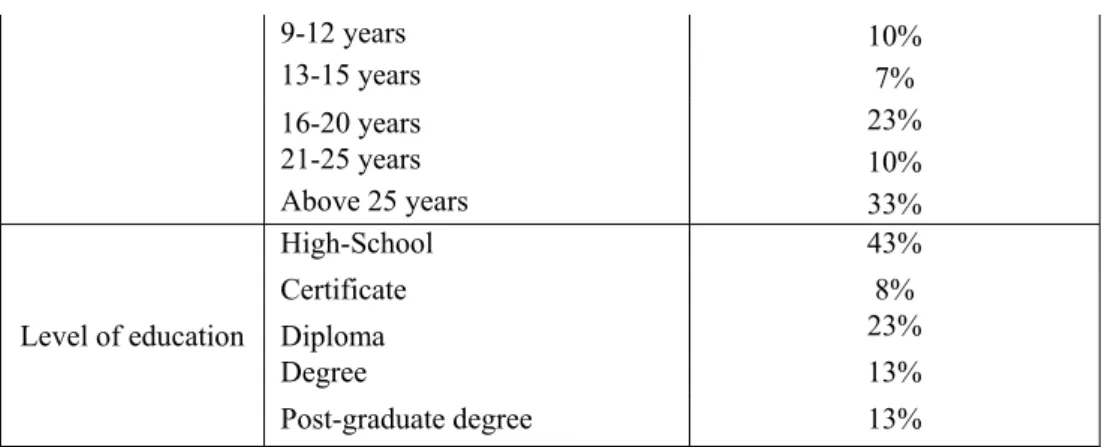
The demographic data of the 30 respondents who completed the questionnaires appear in Table 1.. More than half (57%) of the respondents were male. Most (90%) of the respondents were older than 30 years, with an equal percentage (90%) having more than 5 years of work experience and tho thirds (66%) having more than 15 years of work experience. . More than half (55%) of the respondents had post-matric qualifications. Most of the respondents are either managers (40%) or controllers (30%). Thus it could be deemed that the respondents had adequate work, life and job experience to provide meaningful answers.
Table 1: Demographic profile of respondents
Characteristics Respondents % Gender Male 57% Female 43% Age 21 - 30 years 10% 31 - 40 years 37% 41 - 50 years 33% 51-60 years 17% Above 60 years 3% Occupation Manager 40% Controller 30% Clerk 13% Administrator 7% Director 7% Assistant 3% Work experience 1-2 years 7% 3-4 years 3% 5-8 years 7%
9-12 years 10% 13-15 years 7% 16-20 years 23% 21-25 years 10% Above 25 years 33% Level of education High-School 43% Certificate 8% Diploma 23% Degree 13% Post-graduate degree 13%
Internal technology and information flow
To determine the role of technology in facilitating ease of information flow within LOGWIN, the respondents were asked judge the level of technology utilisation within the firm, depicted in Figure 1. All the respondents confirmed that the company maintains integrated databases to facilitate information sharing and maintain shot lead times for access of information. The majority (93%) of respondents agreed that LOGWIN maintains access methods, while 83% confirmed that internal information sharing is effective. Of the respondents 90% confirmed that real-time data capturing takes place.
Figure 1: Internal technology and information flow
Impact of technology and internal information flow on supply chain collaboration 22 23 24 25 26 27 28 29 30 31 Maintenance of intergrated information sharing database Short lead times for access of information Maintenance of access methods Effective internal information sharing Capturing of real data Number of respondents
Internal technology and information flow
No Yes
Respondents rated their perceptions on the impact of technology and internal information flow on supply chain collaboration. Nearly two thirds of respondents (60%) agreed that collaboration with their partners improved as a result of technology and information flow. ^0% of the respondents indicated that information sharing between customers and suppliers did not add value to the organisation. Most respondents either agree or strongly agree that top management is involved and emphasises the importance and benefits that sharing information and technology has on operational performances. The respondents also perceived sharing information and technology as beneficial to operational performances. Additionally, the results revealed that information technology improved report generation capabilities and improved information management.
The main research question of this study is how technology contributes to the ease of information flow within LOGWIN, to increase supply chain collaboration levels. From the above analysis, it is clear that respondents agree that there is a positive relationship between technology and information flow, and increased supply chain collaboration. Technology therefore, according to the results, contributes to an integrated database to facilitate information sharing, enables immediate access to information, maintains an access to information sharing, shares information between departments and captures real time data. Technology and information sharing, if implemented correctly, improves supply chain collaboration for all members of the supply chain who gain value from sharing information and using technology. The results correspond with the findings of Hinkka et al (2013), stating that proficient communication, information technology and effective coordination is needed, to improve relationships and business performances. In addition, this corresponds to Sandberg’s (2005) findings that technology is only successful when implemented correctly.
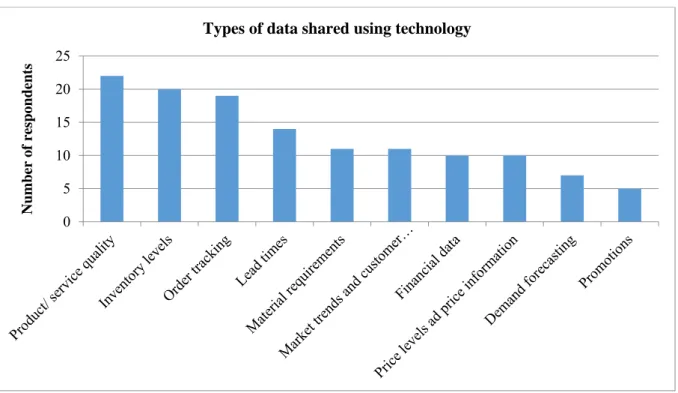
Respondents were asked to rate how technology is used within the company as illustrated in Figure 2. From the figure, it is evident that technology is mostly used to share information regarding product or service quality, inventory levels as well as order tracking. This is followed by lead-time information and material requirement information, market trends and customer preferences, financial data, price levels and price information, demand forecasting as well as promotions being the least used categories. The logistics department and operations department used technology the most, followed by manufacturing, sales and marketing and finance departments, which relates to the availability of information for not just internal, but external use as well.
Figure 2: Types of data shared using technology
There is an expectation that technology is user friendly and when the respondents were asked to comment on whether or not the technology in their company is user friendly or not, the majority said yes as shown in Figure 3. Additional comments included that at first, some training or learning guide is needed, and that there are still a lot of improvements required.
Figure 3: User friendliness of technology
0 5 10 15 20 25 Number of respondents
Types of data shared using technology
87% 13%
User friendliness of technology Yes No
As pointed out by Farcoo and Brien (2008), it is costly to stay up to date with constantly changing technology and training staff for new technology. Ahmed and Ullah (2012) also pointed out that technology is time consuming if businesses want to stay up to date with new trends. It is therefore important to know how LOGWIN stays up to date with technology.
In terms of how the company stays up to date with technology. The question was open ended and therefore, the results were coded. Based on the results, almost a third of all respondents are dependent on the IT department for any technological updates. Frequent technology updates allow businesses to adapt quickly to changes in technology. The second highest response for staying up to date with technology was to monitor their mother company and adopt new technology changes from them. In addition, the results revealed that training of Logwin staff was provided on a regular basis to ensure that communication with services providers was maintained and feedback from customers was monitored. Additional remarks by staff working in the IT department indicated that staff from other departments do not know how their company stays up to date with technology. This is an important finding as technology has been shown to be important in facilitating information sharing; management should therefore ensure that staff are informed of the latest available technology to facilitate collaboration with supply chain partners.
About training offered to employees in terms of the company providing training to stay up to date with technology changes, the biggest response was that only induction or basic training is provided. A non-response rate of 23.3 % was recorded for this question, which could be the result of misunderstanding of the question. This presents a limitation of the study as high response rates weaken the findings.
With reference to the reliability of the information provided, the majority of respondents agree that reliable information systems exists that support effective information flow. This is in line with the findings of Sandberg (2005) that technology is only successful when implemented correctly. More than half of respondents agreed that without information flow and technology, it would be difficult to respond to customer needs. This then refers to the trust that needs to exist between supply chain partners. Unreliable information such as incorrect data reporting was highlighted as a source of conflict in collaborative relationships. With technology, it is faster to connect with all parties in the supply chain, gather information and accurate responses.
In addition, the results correspond with what was found by Pfahl and Maxum (2014) that electronic customer relationships and visibility through information flow will increase customer-supplier partnerships and therefore, increasing supply chain collaboration. De Leew and Francoo (2009), states that through sharing information, all supply chain partners are linked and therefore, increasing collaboration. Simatupang (2004) added that it is faster and easier to communicate with technology and it will increase transparency. Technology and information flow will add to cost reductions, improving services as well as improving customer satisfaction (Kohli & Jensen, 2010).
From the responses, it is clear that most respondents do not know how their company stays up to date with technology and that they rely on the IT Department to keep technology up to date. Some basic virus updates and software updates were run on a weekly basis. It was also evident that more frequent training was needed for employees to be aware of new changes. Farcoo and Brien (2008) stated that keeping up to date with technology, training staff on new technology and resistance to change are some of the disadvantages of technology and that these factors bring about additional costs for the company.
Figure 4: Importance of technology in supply chain collaboration
30%
67%
3% 0% 0%
Importance of technology in supply chain collaboration
Strongly agree Agree
Neutral Disagree
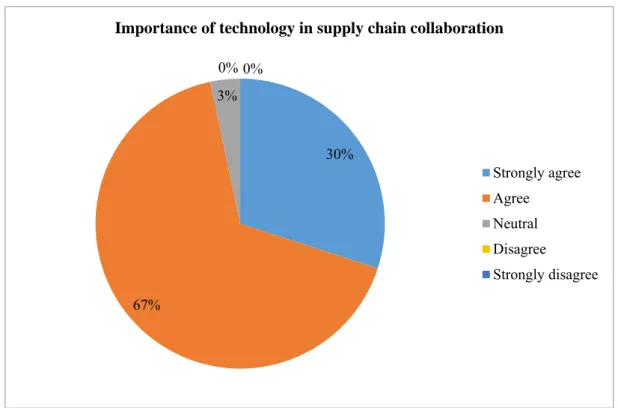
With a high level of dependency on technology, there is a risk that power failure can affect the use of such technology, which bodes the question of how prepared LOGWIN is for such an eventuality. The results establish that LOGWIN has a recovery plan in case of power failure and most responses included that they have backup power supply, such as generators to use. As respondents agree that their company is dependent on technology to enhance supply chain collaboration and information flow, as per Figure 4. There is a basic requirement for systems to mitigate the risk of the non-transmission of such information between supply chain partners and this is not only specific to LOGWIN, but to all companies operating in the age of technology.
Kohli and Jensen (2010) found that using technology increases operational effectiveness, overall speed of information flow, more control over procedures as well as increase in customer responses, reducing inventory costs, and cycle times and improve new product development. Simatupang (2004) added that supply chain partners can communicate and collaborate faster and easier on line, technology increases transparency, reduces cost, eliminates errors, as well as increase sales and profits. Technology will improve overall accuracy, responses and faster information gathering, as well as increase market competitiveness and increased customer satisfaction. Childress (2016) found that technology and information flow will benefit inventory control, tracking and tracing, and increase warehouse management. Tang and Zimmerman (2013) added that technology and information flow will increase better communication, increase visibility and coordination in the supply chain, increase information flow to and from customers, as well as internally, with the overall increase of communication within the supply chain.
Pahdi and Cross-Ruyke (2015) found that technology improves material handling, data quality, production, space utilisation and end customer satisfaction. All of these benefits were listed in a table and the respondents were asked to indicate on a scale from strongly agree to strongly disagree, if they agree or not with each statement. Most respondents agreed with each statement. 34.48 % strongly agreed that technology improves the overall improvement of product and service quality, 30 % strongly agreed with technology assisting in end customer satisfaction and 30% strongly agreed with technology adding to overall accuracy. 66.67% agreed that technology reduces inventory costs, 68.97 % agreed that overall communication within the supply chain improved due to technology and information flow. 3% of respondents
disagreed with technology reducing inventory costs and cycle times as well as reducing overall costs in the company.
MANAGERIAL IMPLICATIONS
Based on the research, the main finding is that respondents agree that there is a positive relationship between technology and information flow, and increased supply chain collaboration. Technology contributes to an integrated database to facilitate information sharing, enables immediate access to information, maintains an access to information sharing, shares information between departments and captures real time data. Therefore, management should invest and maintain technology to enhance information flow and to boost supply chain collaboration. Technology and information sharing also improves supply chain collaboration and all parties gain value from technology and information flow. Technology and information sharing will also improve product or service quality, inventory levels as well as order tracking.
CONCLUSIONS AND RECOMMENDATIONS
The aim of this study was to determine how technology and information flow could increase collaboration in the supply chain. This study explained why technology plays an important role in the daily activities of a logistics company and how it can assist in increase market competitiveness for the company.
It is also evident that LOGWIN is dependent on technology to boost supply chain collaboration. Most respondents also agreed that the benefits derived from technology and information flow, included increased end customer satisfaction, shorter lead times, improved flow of information to and from LOGWIN’s suppliers and customers, as well as internal information flow. The findings suggest that technology and information flow have a positive effect on supply chain collaboration. It is recommended that the company focus more of involving all employees in the process of staying up to date with technology, as technology is used widely within the company. It is also recommended that more training is prearranged for employees on technology and information flow. As Saunders, Lewis & Thornhill (2005), pointed out, technology is only successful when implemented correctly.
One limitation of this study is the fact that only one company in the supply chain was researched. This does not provide the full picture of the role that technology and information flow plays in the supply chain. Where such results may be applicable to one partner in the
supply chain and not in another. Without researching other companies, these differences will not be recorded. A second limitation is the sample size of 30 respondents , is small, even though it is suitable for quantitative research, , which limits the big picture of the role of technology and information flow in a supply chain, to only the perception of the 30 participants. A third limitation might be respondent bias, where respondents may have answered questions in a way that made their own organisation appear to be applying to all the questions. Therefore, not receiving the truthful answers one needs, but answer the participants want you to have.
Future suggestions for research include adding more participants from other sections of the supply chain. This will allow a wider view of how technology plays a role in the overall supply chain. Increasing the sample size will in addition benefit the perspective of how technology is used and its level of importance, with more participants adding their views.
REFERENCES
Addleson, M. (2013). Will the real story of collaboration please stand up so we can see it properly? Knowledge Management Research & Practice, 11, 32-40.
Ahmed, S. & Ullah, A. (2012). Building Supply Chain Collaboration: Different collaborative approaches. Internal Review- A Journal of Management, 5(1), pp. 8-21.
Antai, I. (2013). Interaction: a new focus for supply chain vs supply chain competition.
International Journal of Physical Distribution & Logistics Management, 43(7), pp. 511-528.
Benavides, L., De Eskinazis, V., & Swan, D. (2012). Six steps to successful supply chain collaboration, Supply Chain Quarterly, 2, pp.79-83.
Botha, Z. (2004). Collaboration vital to supply chain progress. Engineering news.
http://www.engineeringnews.co.za/print-version/collaboration-vital-to-supplychain-progress-2004-08-20 [Accessed on 12/02/2016].
Bouchard, D. (2014). What is a True Integrated Logistics Services Partner and How Do You Find One? Inbound Logistics Magazine, Available from:
http://www.inboundlogistics.com/cms/article/what-is-a-true-integrated-logistics-services-partner-and-how-do-you-find-one/ [Accessed: 05/03/2016].
Childress, C.W. (2016). Supply chain, logistics and global economics. Technology Education. North Carolina State University. North America.
Cooper, M.C., Lambert, D.M. and Pagh, J.D. (1997). Supply chain management: more than a new name for logistics. International Journal of Logistics Management, 8(2), pp. 1-14. Coyle, J. (2013). 9th edition, Managing supply chains: A logistics approach, pp. 109 – 110.
South-Western. United States.
De Leeuw, S. & Fransoo, J. (2009). Drivers of close supply chain collaboration. One size fits all? International Journal of Operations and Production Management, 20(7)., pp 57-68.
Dillenbourg, P. (Ed.) (1999). Collaborative learning: cognitive and computational approaches. Oxford, England: Pergamon, Elsevier Science Ltd.
Dyer, J.H. & Singh,H. (1998)). Inter-organizational Competitive Advantage. Competitive Advantage. The Academy of Management Review, 23(4).
https://www.uzh.ch/iou/orga/ssl-dir/wiki/uploads/Main/TAW_Dyer_Singh.pdf [Accessed: 05/03/2016]
Fawcett, S.E. & Magnan, G.M. (2004). Ten guiding principles for high-impact SCM.
Business Horizons, 47 (5): pp. 67-74.
Fynes, B., de Bu ́rca, S. & Marshall, D. (2004). Environmental uncertainty, supply chain relationship quality and performance. Journal of Purchasing and Supply
Management, 10(4), pp. 179 - 190.
Handfield, R.B. & Bechtel, C. (2002). The role of trust and relationship structure in improving supply chain responsiveness. Industrial Marketing Management, 31 (4):, pp. 367-382
Hinkka, V., Främling, K, & Tätilä, J. (2013). Supply chain tracking: aligning buyer and supplier incentives. Industrial Management & Data Systems, 113(8), pp 57-68.
Holden, P. & Lynch, P. (2001). Choosing the appropriate methodology- Understanding research philosophy. Waterford. Institute of Technology
Holmstro¨m, J., Fra¨mling, K., Kaipia, R. & Saranen, J. (2002). Collaborative planning forecasting and replenishment: new solutions needed for mass collaboration. Supply Chain Management: An International Journal, 7(3), pp. 136-145.
Holmstro¨m, J., Hoover, W., Vasara, A. & Louhiluoto, P. (2000). The other end of the supply chain. McKinsey Quarterly, 1, pp. 1-8.
Hudnurkar, M., Jakhar, S. & Rathod, U. (2014). Factors affecting collaboration in supply chain: A literature review. Procedia - Social and Behavioral Sciences, 133: pp.189 – 202.
Kache, F., & Seuring, S. (2014). Linking collaboration and integration to risk and performance in supply chains via a review of literature reviews. Supply Chain Management: An International Journal, 19(5), pp. 664 - 682
Kohli, A.S. & Jensen, J.B. (2010). Assessing Effectiveness of Supply Chain Collaboration -
An Empirical Study. Supply Chain Forum. An International Journal, 11(2), pp. 55-70. Lambert, M. (2015). Partnerships in the Supply Chain. Supply Chain Management Institute,
http//scm-institue.org/Partnership-in-the-supply-chain.htm [Accessed: 16/02/2016]. Lee, C. W., Kwon, I. G. & Severance, D. (2007). Relationship between supply chain
performance and degree of linkage among supplier, internal integration, and
customer. Supply Chain Management: An International Journal, 12(6), pp. 444–452. Lin, T. H. & Lin, I.C. (2014). Factors for information technology acceptance, willingness
and adoption in Logistics Industry from a supply chain perspective. International Journal of Electronic Business management, 12(3), pp. 167-177.
LOGWIN (2016). https:www.logwin-logistics.com
Langley, J. & Capgemini. (2015). 2015 Third-Party Logistics Study – The state of logistics outsourcings.
https://www.fr.capgemini-consulting.com/resource-file-access/resource/pdf/2015_3pl_study.pdf [Accessed: 03/03/2015].
Masten, K.A. & Kim, S.L. (2015). So many mechanisms, so little action: the case for 3rd party supply chain coordination. International Journal of Production Economics, 168 (1) (2015), pp. 13-20.
Mohrman, S. A., Mohrman Jr, A. M., Cohen, S. G., & Winby, S. (2008). The collaborative learning cycle: Advancing theory and building practical design frameworks through collaboration. Handbook of Collaborative Management Research, pp. 509-530 Oats, J.G. (2006). An assessment of information flow as an enabler to collaboration in supply
chain with a South African context. Masters, University of Pretoria; Gordon Institute of Business Science.
Pfahl, L. & Moxham, C. (2014). Achieving sustained competitive advantage by integrating ECR, RFID and visibility in retail supply chains: a conceptual framework. Production Planning & Control, 25(7), pp. 548 – 571.
Phadi, S.S. & Gross-Ruyeken, P.T. (2015). Improving logistics in India. More manufacturers are adopting sophisticated supply chain tracking technology. Industrial engineering. Available at www.iienet.org, pp. 42-47, [Accessed: 04/03/2016].
Price Waterhouse Coopers. (2012). Future prospects in Africa for the transport and logistics industry. Africa Gear. South Africa.
Ramanathan, U. & Gunasekaran, A. 2014. Supply chain collaboration: Impact of success in long-term partnerships. UK. International Journal of Production Economics, 147: 252–259
Ramanathan, U. 2014. Performance of supply chain collaboration – A simulation study. Expert Systems with Applications, 41: pp. 210–220.
Salam, M.A. 2017. The mediating role of supply chain collaboration on the relationship between technology, trust and operational performance: An empirical investigation. Benchmarking: An International Journal, 24(2), pp.298-317,
https://doi.org/10.1108/BIJ-07-2015-0075.
Samaddar, S., & Kadiyala, S.S. (2006). European Journal of Operational Research, (170), pp. 192–210.
Sandberg, E. (2005.). Logistics collaborations in Supply chain, A survey of Swedish Manufacturing companies. Dissertation from the International Graduate School of Manufacturing and Industrial Engineering, IMIE No 93, Linkoping University. Saunders, M., & Lewis, P. (2016). In Thornhill, A. Research methods for business
students, 7thedition. Essex, England: Pearson.
Saunders, M., Lewis, P. & Thornhill, A. (2012.). Research Methods for Business Students. 6th edition. Essex, England: Pearson.
Sheikh, Z. & Rana, S. (2012.). Rule of third party Logistic Providers with advanced IT to increase customer satisfaction in supply chain integration. International Journal of Academic Research in Business and Social Science 2012, 2, pp 1-23.
Sheu, C., Yen, H.R. & Chae, B. (2006). Determinants of supplier-retailer collaboration: evidence from an international study. International Journal of Operations and Production Management, 26(1), pp. 24-49
Simatupang, T.M. (2004). Supply Chain Collaboration. Institute of Information Sciences and Technology, Massey University.
Singh, A. & Teng, J.T.C. (2015). Enhancing supply chain outcomes through information technology and trust. Computers in human behaviour, Published: Elsevier North America.
Storey, J., Emberson, C., Godsell, J. & Harrison, A. (2006). Supply chain management: theory, practice and future challenges. International Journal of Operations & Production Management, 26(7), pp. 754 – 774.
Tang, C. S., & J. Zimmerman. (2012). Information and Communication Technology for Managing Supply Chain Risks. Communications of the ACM 56 (7): pp. 27–29. Wamba, S.F. (2012). Achieving supply chain integration using RFID technology: The case of
emerging intelligent B to B e commerce processes in a living laboratory. Business Process Management Journal, 18(1) pp.58-81.
Xu, D., Wong, T. N. & Sculli, D. (2013). Software Platform to Support Collaboration in Express Delivery Services. Journal of International Technology and Information Management, 22(2).
Zhang, H., Wang, H. C., & Zhou, M. F. (2015). Partnership management, supply chain collaboration, and firm innovation performance: An empirical examination. International Journal of Innovation Science, 7, pp 127-138.
Zhao Cai, Z., Huang, Q., Liu, H., & Liang, L. (2016). The moderating role of information technology capability in the relationship between supply chain collaboration and organizational responsiveness: Evidence from China. International Journal of Operations & Production Management, Vol. 36 Issue: 10, pp.1247-1271.