IERI Procedia 2 ( 2012 ) 24 – 29
2212-6678 © 2012 Published by Elsevier B.V. Selection and peer review under responsibility of Information Engineering Research Institute doi: 10.1016/j.ieri.2012.06.046
2012 International Conference on Future Computer Supported Education
Research and Practice on CDIO-based Application-oriented
Practical Teaching System of Computer Major
Guo Lingling, Tang Guowei, Fu Yu, Li Jinghui, Zhao Wanping*
School of Computer & Information Technology Northeast Petroleum University, Daqing Heilongjiang, 163318, ChinaAbstract
On the basis of in-depth understanding of the teaching model of CDIO project education, practice teaching system of computer major was constructed. The "project driven" based practical model was used to deepen the students’ understanding of theoretical knowledge, to equip students with the ability to develop actual engineering systems, and to train the ability of students to solve actual problems and the innovation and team spirit. Practice proved that CDIO is an effective practical teaching model.
© 2012. Published by Elsevier B.V.
Selection and peer review under responsibility of Information Engineering Research Institute Keywords: CDIO, practical teaching, project driven
1. Introduction
According to statistics, there was at least 40 million software talent gap in China's software industry in 2010, and this gap is still growing at a growth rate about 20% per year. On the other hand, data released by the Ministry of Personnel showed that the initial employment rate of college graduates in recent years was only about 70%. The talent supply and demand dilemma of "difficult for graduates finding a job and difficult for software companies recruiting staff" appeared in the software industry was mainly due to the
over-* Guo Lingling. Tel.: 086-0459-6503148.
E-mail address: [email protected].
© 2012 Published by Elsevier B.V.
Selection and peer review under responsibility of Information Engineering Research Institute
Open access under CC BY-NC-ND license.
emphasizing on theory while contempt on practice in the traditional disciplinary system, which only stressed on the knowledge-based training without paying sufficient attention to improve the skills and qualities of students[1-3].
Due to the constraints of traditional education teaching philosophy, experimental curriculum was often attached to specific theory course. The experimental contents were mainly the validation, demonstration experiments. The method of teacher-centered feeding teaching was applied, in which teachers were at the center in the whole process of practical teaching. To a large extent, students just passively followed the teacher's idea to learn experimental methods and skills, it is difficult to play and develop students' abilities of knowledge applying and innovation[4-5]. Currently, most institutions attached great importance to the practical teaching, the average ratio of practical teaching and theoretical teaching hours is about 48:52, and specialized courses to meet or exceed 1:1. Under the premise of practical hours and other conditions to be guaranteed, it is particularly important to organize the practical teaching to obtain the training objective of knowledge applying ability[6]. In order to develop students' proficiency and innovation abilities to meet the community's requirements of "application-oriented" personnel, the current practical teaching methods should be reformed.
According to the current status of IT education and training, institutions were active in carrying out exploration and practice of engineering education reform. One of the most important practices is to introduce the international advanced engineering education reform achievements - CDIO engineering education philosophy. The purpose of this paper is to improve students' practical ability of software development and sense of innovation[7-8]. Combined with years of teaching experiences and advanced education concept of CDIO, the application of project-driven teaching method in practical teaching for computer major was discussed, and a practical teaching system meeting the requirements of application-oriented computer major was created.
2. Basic idea of practical teaching system
2.1. CDIO education model
CDIO (Conceive, Design, Implement, Operate) is a new model of engineering education. It works as an education concept and methodology system to guide the reform of engineering education training model. It takes conception, design, implement and whole operation process as a carrier to train the students the engineering capability. It is consistent with the law of modern engineering and technical personnel training[9]. It has become a common mode of the international engineering education.
CDIO emphasizes the importance of engineering practical teaching, emphasizes to train the students the abilities of active learning, practice, problem-analyzing and problem-solving, and emphasizes to train the vocational skills, professional ethics, as well as teamwork and communication. These requirements were fully reflected in this study of practical teaching system reform and practice.
2.2. Project-driven teaching model
Project-driven approach originated in the 1980s in Germany. It is based on constructivist learning theory. It is a new teaching method, which is different from the traditional teaching method. Construction is both a new understanding and mastery of knowledge, but also contains the transformation and restructuring the original experience and knowledge, integrating them to form a new knowledge structure. This method is student-centered. In the whole process, teachers play the roles of organizer, mentor, helper, and facilitator. Project-driven model of teaching can stimulate students' interest and desire for knowledge, and develop abilities of
independent learning and analyzing and solving problems[10]. During the teaching, taking a case as the guide, all courses are around the project, students can learn in "doing", focus is on solving practical problems, so as to cultivate students to be familiar with standard process of software industry and to have the ability to undertake software development business.
3. Building of practical teaching system
3.1. Framework of practical teaching system
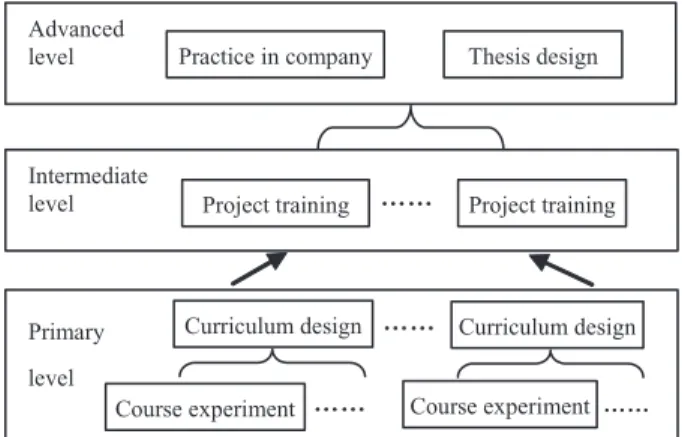
According to the training objective of software professionals, with the combination of project-driven teaching philosophy, CDIO-based practical teaching system was established, as shown in Fig.1. In the system, project training contents were designed in accordance with the progressive laws of capacity training, which were divided into three levels of primary, intermediate and advanced. Through a variety of practical teaching, a sub-level, multi-modular practical system framework was formed.
The primary level contains curriculum experiment and course design. Curriculum experiment runs through the entire semester, in connecting with all study aspects of the course. Curriculum design is set in the short term to evaluate the overall understanding situation of the course. Focus is on the training of basic skills[11]. Intermediate level included project training. It is the main part to train students the project capacity. Through the project training, the students' comprehensive ability of the software design is greatly enhanced. Advanced level includes practice in software company and thesis design, with the focus of cultivating students’ comprehensive practical ability and innovative ability.
Primary level Curriculum design Course experiment ĂĂ Curriculum design Course experiment ĂĂ ĂĂ Intermediate
level Project training ĂĂ Project training Advanced
level Practice in company Thesis design
Advanced:Assessment of the overall quality of software professionals Intermediate:Comprehensive training in software design capabilities Primary:Arranged according to the design of the course
Arranged according to the course content section Fig. 1. Schematic diagram of experimental teaching system framework
In addition, "university student innovative pilot scheme" was combined throughout the entire process of practical teaching reform. Students were actively guided to apply university level, provincial and national project of "university student innovative pilot scheme". These projects adhere to the dominant position of students, monitoring the implementation process to ensure the implementation of the project quality. Students
were encouraged to organize timely the achievements of the projects, summarize and publish research papers or patent applications.
3.2. Specific means of implementation x Strengthen the laboratory building
According to the laboratory situation, the management system and operation mechanism were reformed, so as to strengthen the construction and management of specialized laboratories, hardware laboratories and open laboratories. These laboratories had become the main places for students to engage in various course experiments and innovative activities, and become an important place for teaching and research[12]. During the construction, the engineering training philosophy was taken as the guiding ideology, the system software, CASE tools, development tools were taken as the core, the integrated development environment was formed by .NET, J2EE, Linux, ARM, Web development and so on, a platform for a variety of presentations was built, all of these provided a strong protection for the practical teaching.
x Build a platform for practice innovation
Practical teaching emphasis is on students' practical ability and creative ability, Practice is especially important in the process of growth of college students. For this reason, the freshmen were led to visit the software company, enterprise software engineer or software architect were regularly invited to carry out seminars, students were organized to visit successful alumni, students were encouraged to participate in university level, provincial and even national level software design contest, competition, and so on. These activities built a platform for students to participate in scientific research, social practice and innovation. x Establish research interest group
Many teachers have their own research laboratories with a specific research direction. In order to enable students to participate in the actual research activities of teachers, various interest groups were established at these research laboratories to support undergraduate students to join the project team involved in the actual project development[13-14]. The instructor would introduce the research topics, allocate tasks and give appropriate technical guidance to the students. Students could gradually develop their own software development and scientific research capabilities.
x School business co-culture
Software companies were warmly invited to carry out co-culture of students with school. Some students were sent in groups to the software companies to practice. So that students could learn the process and specifications of enterprise development projects, methods to do things, good habits, deeper level of perception of the importance of teamwork, so as to improve their employability and competitiveness.
4. Practical effects
Through the research and practice on CDIO-based application-oriented practical teaching system for computer major, more than 20 program design teams were established. In 2010, we received provincial awards 27 times, national awards 6 times. In 2011, we received provincial awards 45 times, national awards 8 times. Especially, in the national finals of 2011 Software Development and Design Competition, the first-year students in my school competed with students from universities across the country and won two national second prizes.
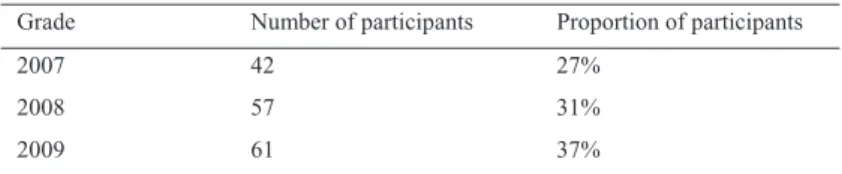
By participating in actual research projects, students developed their self-learning ability and independent operating skills, stimulated the curiosity of students and overall ability to think. Table 1 shows the number and proportion of the students of the computer major to participate in research projects.
Table 1. Statistics of students to participate in research projects
Grade Number of participants Proportion of participants
2007 42 27%
2008 57 31%
2009 61 37%
5. Conclusions
The contents of this study were implemented from 2010 in computer major. After two years of hard work, CDIO-based practical teaching system was gradually perfected. Good results had been made in application-oriented training, not only improving students' practical ability, but also to some extent training students’ employability and career migration capabilities. The overall quality of students had been improved significantly and the employment situation was getting better. During the teaching reform, the quality of teachers was improved at the aspects of practical teaching and scientific research.
In summary, good effect was achieved by CDIO-based Application-oriented Practical Teaching System for Computer Major. This system was widely recognized and praised by the students. It effectively enhanced the competitiveness of computer science graduates, and effectively implemented the seamless docking of the computer professional training with the actual needs of the employer.
Acknowledgements
This work is sponsored by the Teaching Reform of Higher Education of Heilongjiang Province of China (Construction and Implementation of Practical Teaching System of 3-element Driven Software Development Ability).
References
[1]Wang Guicheng, Fu Yonghong, Lu Zhangping. Implementing four-in-one teaching reform and enhancing students' engineering awareness[J]. Journal of Higher Education Management, 2009, 3(3):90-92.
[2]Lei Huan, Tang Weiyi, Edward F. Crawley. Cultivating innovative, multi-level and professional engineering personnel[J]. Research in Higher Education of Engineering, 2009, (5):29-34.
[3]Zhang Laibin. A macro-view of engineering and the reform of higher engineering education[J]. China Higher Education Research, 2009, 18(22):8-10.
[4]Fu Youjia, Yang Changhui. Discussion on C language teaching[J]. Computer Era, 2009, (9):67-68.
[5]Guo Lingling, Yuan Man, Fu Yu (2010). Exploration and Practice on Case-driven Research-based Teaching Model. Education Technology and Computer (ICETC), 2010 2nd International Conference (pp. V1-209 - 211). Shanghai, China.
[6]He Jingyuan, Zhu Zhengyu. An exploration about content fundamentals of computer technology[J]. Computer Education, 2010, (2):25-27.
[7]Li Wenze, Kong Lu. Research on learning interest and autonomy in computer teaching for vocational college student[J]. Journal of Kaifeng Institute of Education, 2010, (4):109-111.
[8]Niu Yi, Dong Ani. Fostering students' interest in learning C language [J]. Journal of Dongguan University of Technology, 2006, (1):110-113.
[J]. Computer Education, 2010, 17:57-60.
[10]Guo Lingling, Tang Guowei and Fu Yu, “Study on Interest-driven Based Practical Teaching Model,” International Conference on Information and Education Technology (ICIET 2011), vol. 2, p. 82–84, February 2011.
[11]Tang Song, Li Chaolin, Cai Huai. Reform on computer practice teaching in independent colleges[J]. Computer Education, 2010, (17):54-56.
[12]Liu Wenjing, Fan Jiuming, Zhao Shushan. Deepening reform of experimental teaching and cultivating creative talents[J]. Experimental Technology and Management, 2007, (10):223-225.
[13]Tan Haoqiang. C language programming[M]. Beijing: Tsinghua University Press, 2005.
[14]Sun Yajuan, Guo Li. How to improve the effectiveness of experimental teaching c language[J]. Journal of Zhengzhou College of Animal Husbandry Engineering, 2009, (3):61-62.