FOR CYBER CLOUD SECURITY
NGOC T. LE, DOAN B. HOANG∗
Abstract. Cyber space is affecting all areas of our life. Cloud computing is the cutting-edge technology of this cyber space and has established itself as one of the most important resources shar-ing technologies for future on-demand services and infrastructures that support Internet of Thshar-ings (IOTs), big data platforms and software-defined systems/services. More than ever, security is vital for cloud environment. There exist several cloud security models and standards dealing with emerg-ing cloud security threats. However, these models are mostly reactive rather than proactive and they do not provide adequate measures to assess the overall security status of a cloud system. Out of existing models, capability maturity models, which have been used by many organizations, offer a realistic approach to address these problems using management by security domains and security assessment on maturity levels. The aim of the paper is twofold: first, it provides a review of cyber space, cyber security, cloud security models and standards, cyber security capability maturity models and security metrics; second, it proposes a cloud security capability maturity model (CSCMM) that extends existing cyber security models with a security metric framework. CSCMM aims to present a credible overall security assessment of a cloud system to senior managers and to enable security experts to predict and identify necessary security measures.
Key words. cloud security model; capability maturity model; security maturity model; cyber security; security metrics framework.
AMS subject classifications.
1. Introduction. The definition of cyber security has evolved greatly over the past decades. The fundamental concept of security is defined as the quality or state of being secure - being free from danger [1]. For example, national security can be known as a system of multilayered processes that protect the resources of a state against all kinds of ”national” crises [2]. Similarly, cyber security can be thought of as a system of processes that protect the resources of a cyber space. However, definitions of cyber security vary with different organizations, some using the term cyber security but others using the terms information security or IT security [3]. This difference in usage is mostly due to the different perspectives on cyber space and cyber security. The definition of cyber space has changed considerably since Wiener defined cybernetics in 1948 as control and communication in the animal and the machine [4]. Over the last few decades, academic organizations focused on the tangible elements in the cyber space when they paid more attention to the infrastructure components of IT systems, and on intangible elements such as the data or the applications within these systems. Recently, the cyber space has grown to include social networks, clouds, Internet of Things (IOTs), smart cities, smart grids, and other software-defined systems [5].
In order to protect a cyber space from numerous security threats, many security models and standards have been developed. Each focuses on a particular security angle such as risk, asset, identification, physical components, network, data, and application. Few security models consider the security of a system as a whole. It is known that a single minor vulnerability can bring down the whole system and there are myriads of these vulnerabilities. Moreover, these models established a comprehensive security assessment process because they lack meaningful and relevant quantitative security metrics.
∗Virtual Infrastructure and Cyber Security lab (VICS), Faculty of Engineering and IT, University of Technology Sydney ([email protected] or [email protected]). Questions, comments, or corrections to this document may be directed to those email address.
In recent years, several security maturity models have been proposed for overall security management. These draw on the theoretical framework of the capability maturity model. In 1989, Humphrey recommended a capability maturity model for software quality assessing [6]. This basic model has been adapted for cyber security for a number of reasons. First, security models based on capability maturity model have been applied with reasonable successes for many fields such as IT, business. Second, maturity models provide a completed management process for cyber security. Third, they can be extended to cover many security aspects or domains.
Recently, maturity models have been applied for securing many important tradi-tional cyber spaces such as e-government, e-commerce, education, health, particular in critical national infrastructures such as electricity, water supply, petrol, and trans-portation [7]. However, few focus on cloud computing security.
Despite having the abovementioned benefits, maturity models revealed many drawbacks. One of which is that when organizations use maturity models, they look at each maturity level as a target and build their goal to reach the next level up. The problem is that a maturity level is often determined arbitrarily and subjectively. Another issue is that security metrics mainly depend on qualitative measurements, suitable for checking compliance rather than inspiring security action.
Therefore, to overcome the weaknesses and to take advantages of maturity models, we aim to propose a novel security capability maturity model for a particular cloud cyber space (Cloud Security Capability Maturity Model, CSCMM) with a new metrics framework that allows not only managers to assess the security state of the cloud system for decision making process but also security practitioners to identify security gaps and to implement security responses systematically and quantitatively.
The remainder of this paper is organized as follows. Section 2 revises knowl-edge about cyber security, cloud security models, cyber security maturity models, and security metrics. Section 3 proposes CSCMM including its structure and im-plementation process. Section 4 introduces the security metrics framework that is developed to support the CSCMM model. Section 5 discusses the importance of the quantitative security metrics in security assessment process of the CSCMM model and introduces several advanced security metrics that can be applied for the model. Section 6 concludes the paper with future research.
2. Review of cyber space, cyber security, cloud security models, secu-rity matusecu-rity models, and secusecu-rity metrics.
2.1. Cyber space and cyber security.
Cyber space. According to Oxford dictionary, it is a single word cyberspace.
How-ever, some authors use two words as in cyber space, and others prefer cyber-space. Some organizations use the term information as cyber or cyber space. In terms of the concept of cyber space, it has been defined and redefined over the years in order to take into account not only emerging technological developments but also the com-plexity of modern social networks. From the ITU [8], the cyber environment includes users, the Internet, the computing devices that are connected to it and all applica-tions, services and systems that can be connected directly or indirectly to the Internet, and to the next generation network (NGN) environment, the latter with public and private incarnations. With this definition, a cyber space covers computing elements, resources, and the interconnecting infrastructure as well as users. However, it does not entail interaction among these elements.
Different countries, in their cyber security strategies, define cyber space in a nar-row sense. According to Australias Cyber Security Strategy [9], cyber security refers
to the safety of computer systems. This implies that cyber space is just about com-puter systems and many elements are not included. According to Canadas Cyber Security Strategy [10], cyber space is the electronic world created by interconnected networks of information technology and the information on those networks. It is a global common where people are linked together to exchange ideas, services and friendship. According to The Netherlands National Cyber Security Strategy [11], Cy-ber security refers to efforts to prevent damage caused by disruptions to, breakdowns in or misuse of Information and Communication Technology (ICT). Cyber space is all things within the realm of the ICT. According to Germanys Cyber Security Strategy [12], cyber space is the virtual space of all IT systems linked at data level on a global scale. According to New Zealands Cyber Security Strategy, cyber space is considered as the global network such as the Internet [13]. The definition of cyber space is thus diverse that leads to different emphases in the definitions of cyber security.
Elements of the cyber space. In order to clearly identify elements of the cyber
space, many authors classify them into categories. Damir Rajnovic [14] differentiated three broad categories of elements: tangibles, intangibles and network-related items in the definition of cyber space. Rain Ottis and Peeter Lorents [15] took into account the time and human elements in defining cyber space. They defined cyber space as a time-dependent set of interconnected information systems and the human users that interact with these systems. With this definition, human and interaction are at the center of operation of cyber space. Shackelford [16] noted two aspects of cyber space including a physical interconnected critical infrastructure and a conceptual space for interaction.
From the discussion above on the definition of cyber space by various govern-ments and organizations, we suggest that a cyber space consists of 3 key elegovern-ments: real and virtual entities, interconnecting infrastructure, and interaction among entities through the infrastructure. Real and virtual entities include real things of physical devices such as computers, sensors, mobile phones, electronic devices and virtual ab-straction of entities such as data/information, software, and services (i.e., things in Internet of Things). Infrastructure includes networks (e.g., the Internet), databases, information systems and storage that interconnect and support entities in the space. Interaction encompasses activities and interdependencies among cyber space entities (that are capable of interacting including human beings) via the interconnecting in-frastructure and the information within concerning communication, policy, business and management.
In order to provide a common understanding of the space and its security, we suggest a unified definition of the cyber space as the space that embraces all three key elements: real and virtual entities, interconnecting infrastructure, and interaction among entities. In particular, the emphasis is on interaction as it is fundamental to security; without interaction among entities, including human beings, the question on security may not make sense.
Cyber security. As mentioned earlier, before the term cyber security came to
ex-istence, the terms computer security, IT security, or information security were used in security documents and literature. We highlight several definitions of cyber secu-rity for discussion and clarification. According to Gasser and Morrie [17], computer security, also known as cyber security or IT security, is the protection of information systems from theft or damage to the hardware, the software, and to the information on them, as well as from disruption or misdirection of the services they provide. ITU [18] defines Cyber security as the collection of tools, policies, security concepts, security
safeguards, guidelines, risk management approaches, actions, training, best practices, assurance and technologies that can be used to protect the cyber environment and organization and users assets. From these definitions, it is apparent that informa-tion security emphasizes the confidentiality, integrity and availability of informainforma-tion whereas computer security focuses on the availability, integrity, and correct operation of systems. Cyber security, however, is more comprehensive in that it emphasizes the protection of all of the organizations assets using tools, processes, concepts and necessary interaction among elements within. Therefore, we suggest the following definition:
Cyber security can be considered as a collection of systems, tools, processes, practices, concepts and strategies that are used to prevent and protect the cyber space from unauthorized interaction by agents with elements of the space and to maintain and preserve the confidentiality, integrity, availability, and other properties of the space and its protected resources.
We believe that this definition unifies previous definitions and importantly it clar-ifies the scope of cyber security in three aspects. Firstly, the term cyber security is used instead of the terms information security or IT security to focus attention on the security of cyber space rather than security in a narrower sense. Secondly, pre-vention, not just protection is an integral part of the definition. It makes sense to look at security in a wider context where prevention and protection are interrelated. Preventing some vulnerability from being exploited can be considered protecting the space and on the other hand, knowing how to protect the cyber space implies to some extent the knowledge of how security breaches occur and how they can be prevented. Thirdly, with rapid emergence of many modern technologies, such as cloud, the Inter-net of Things, and social Inter-networks, additional considerations, including adaptability, non-repudiation or safety may be added to the triad rules of CIA (Confidentiality, In-tegrity, and Availability) of cyber security. Today, in order to achieve a model that is invariant to new and emerging technologies, additional properties such as authenticity, accountability and safety may need to be included in the definition.
2.2. Cloud security models and standards. Cloud is a particular cyber space. Based on virtualization and shared IT resources, cloud computing is seen as a technological evolution of cyber space. It plays an important role in the world IT development and it will continue to evolve extensively over the next decades [19]. However, clouds, as cyber infrastructures, with three service models (IaaS, PaaS, and SaaS), four deployment cloud types (Private, Public, Hybrid, and Community) are facing challenging security issues. According to IDC survey, the top challenge for 74% of CIOs in relation to cloud computing is security [20].
Identified cloud security aspects include governance and compliance, virtualiza-tion, identity management [21][22][23], and various threats aspects [24][25]. Cloud Se-curity Alliance (CSA) published the seSe-curity report namely The Treacherous Twelve Cloud Computing Top Threats in 2016 providing organizations with the awareness of cloud security issues in making educated risk-management decisions [26].
To combat cloud security problems, researchers, businesses, and organizations have been making efforts to mitigate cloud security risk and tackle security threats by development cloud security standards and models. In 2014, the European Union Agency for Network and Information Security (ENISA) [27] released the report Cloud standards and security to provide an overview of standards relevant for cloud com-puting security. Cloud Security Alliance (CSA) introduced and developed security guidance for critical areas of focus in cloud computing through 3 versions including
Version 1.0 [28], Version 2.1 [29] (2009), and Version 3.0 [30] (2011). The latest ver-sion (Verver-sion 3.0) is tailored for meeting the security demand change. The aim of this guidance is to introduce better standards for organizations to manage cyber se-curity for cloud by implementation sese-curity domains. The guidance approached cloud architecture with cloud service model (SaaS, PaaS, and IaaS) and four deployment models (Public, Private, Community, and Hybrid Cloud) with derivative variations that address specific requirements. The guidance principal is based on thirteen differ-ent domains which are divided into two general categories: governance and operations. The governance domains focus on broad and strategic issues as well as policies within a cloud computing environment, while the operational domains focus on more tactical security concerns and implementation within the architecture.
This guidance is relevant to cloud computing, its service models and its deploy-ment models. Regarding cloud security managedeploy-ment, the guidance focuses on cloud-specific issues: interoperability and portability, data security, and virtualization. Di-viding the implementation domains into two groups with strategic and tactical cate-gories is another salient point of the guidance. This approach allows cloud consumers and providers to bring financial and human resources into security consideration. Furthermore, the guidance can be mapped to existing security models such as Cloud Control Matrix [31], international cyber security standards ISO/IEC 27002 and other NIST Special Publications. Despite of benefits, however, the guidance has a number of drawbacks. The guidance lacks assessment guide for each domain. It does not consider security metrics for security practices. Therefore, organizations find difficult to determine the security level of a domain.
In addition, there are a number of standards concerning cloud security. The ISO/IEC 27017 Standard illustrates the information security elements of cloud com-puting. It assists with the implementation of cloud-specific information security con-trols, supplementing the guidance in ISO 27000 series standards, including ISO/IEC 27018 on the privacy aspects of cloud computing, ISO/IEC 27031 on business con-tinuity, and ISO/IEC 27036-4 on relationship management. The NIST released the following standards on cloud computing: NIST SP 500-291, Cloud Computing Stan-dards Roadmap, NIST SP 800-146, Cloud Computing Synopsis and Recommenda-tions, NIST SP 800-1, Guidelines on Security & Privacy in Public Cloud Computing, NIST SP 500-292, Cloud Computing Reference Architecture and NIST SP 500-293, US Cloud Computing Technology Roadmap.
2.3. Cyber Security Maturity Model. A fundamental question that has to be asked concerning a cyber space or a system is whether the cyber space or the system is secure or at least to what level it is secure. For example, is a cyber space secure when a huge number of bugs, viruses, spams and malwares have been found and fixed? Or is a cyber space secure when substantial investment in a firewall system and an IDPS (intrusion detection and prevention system) has been made? It is difficult to claim that a cyber space is safe and secure based on the numbers of vulnerabilities found and fixed as there may be a number of bugs still undetected. This implies that vulnerability is only one of the many aspects of security. Yet, many of the current security models deal with security problems in an ad hoc manner; a specific security measure is put into action simply to treat the issue at hand without regard to or understanding its impact on the whole cyber space. These models handle security from a bottom-up perspective and are case specific. They provide no assurance of the overall level of security of the protected entity.
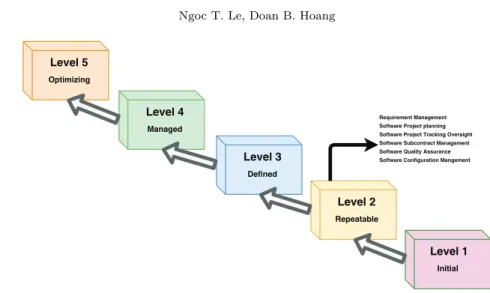
Fig. 2.1.Capabilities maturity model process levels (Humphrey 1989)
perspective to produce a security model that allows us to make an assessment of the overall security level of the entity requiring protection. Furthermore, the model should allow us to identify the entitys weaknesses and the appropriate measures to deal with them. Measures may include an investment in resources, and the enforcement of practices. Among those proposed models, the cyber-security maturity model provides organizations to some extent with a roadmap for measuring, assessing, and enhancing cyber security. Relative to other models, it provides managers with sound footing for making an informed security assessment of their organization.
As mentioned above, Maturity Models are based on the Capability Maturity Model (CMM). Humphrey [6] recommended the CMM to assess quality of software and to help software organizations improve the maturity of their software processes by evolving from ad hoc, chaotic processes to mature, disciplined software processes. The fundamental ideas of CMM are as follows: (1) the model is divided into 5 levels from initial to optimizing level, from simple to complex, from low requirement to higher requirement; (2) each level has maturity requirement. It means that to achieve the definite maturity level, the standard requirements of quality and technology need to be implemented by several sets of practices; (3) to reach the higher level, the software must pass all lower levels (see the Figure 1). Eventually, maturity models show the level of perfection or completeness of certain capabilities. They define maturity levels which measure the completeness of the analyzed objects via different sets of (multi-dimensional) criteria (Figure 2.1).
The structure of the cyber security maturity model can be described in terms of its functions, key components, and types of maturity model [32]. There are three main functions of a maturity model: a means of assessing and benchmarking performance; a roadmap for model-based improvement; and a means to identify gaps and develop improvement plans. The key components include maturity levels which are the se-curity measurement scale or transitional states; sese-curity domains are logical groups of practices, processes; attributes which are core contents of the model arranged by domains and levels; diagnostic methods for assessment, measurement, gap identifica-tion, and benchmarking; improvement roadmaps to guide improvement efforts such as Plan-Do-Check-Act or Observe-Orient-Decide-Act. The three types of maturity models are progression, capability, and hybrid. While a progression model describes
levels as higher states of achievement, as with maturity progression for human mobil-ity being from crawl, walk, jog to run, a capabilmobil-ity model shows levels as the extent to which a particular set of practices has been institutionalized. The hybrid model is the combination of the best features of progression and capability maturity models. So that maturity levels express both achievement and capability. Most recent cyber security maturity models are hybrid models which take security levels and domains into the integrated framework.
In our previous paper [33], we compared twelve security maturity models in or-der to investigate their strengths and weaknesses. Cyber security maturity models have shown that they help managers to better manage security of their organizations [34][35]. They allow better security risk management, produce cost saving, promotes self-improvement, and support good security procedures and processes. More impor-tantly, they encourage all stakeholders to take steps along a secure mature path as mapped out by the maturity model, rather than activate security controls blindly without regard to the security of the overall organization. Despite all these bene-fits, maturity models only provide a bare minimum compliance model rather than an aspired cyber security model that can deal with emerging cyber environment, its demanding usage, as well as its sophisticated attacks. Therefore, three specific issues from security maturity models should be addressed: First, identifying the maturity levels of cyber security of each domain is arbitrary and subjective as a result of check-ing for compliances; a security model should be more than compliance. Second, most cyber security maturity models draw on International cyber security standards such as ISO27000 series or NIST. Security practices in these standards are mainly mea-sured by qualitative metrics/processes; quantitative metrics should be essential for any security assessment. Third, the model should be flexible for addressing specific dimension of a cyber space or extensible for dealing with emerging cyber spaces.
2.4. Cyber security metrics.
Metrics and measures. To assess the level of a security state, metrics or
measure-ments have been used. The usage these two terms, however, has different meanings and implications. Metrics imply tools to facilitate decision making and improve per-formance and accountability through collection, analysis, and reporting of relevant performance-related data. A measure is a concrete, objective attribute, such as the percentage of systems within an organization that are fully patched, the length of time between the release of a patch and its installation on a system, or the level of access to a system that a vulnerability in the system could provide. Measures are quantifiable, observable, and objective data supporting metrics [36]. According to the Information Assurance Technology Analysis Center (IATAC), a measurement is the act or the process of measuring, where the value of a quantitative variable in comparison to a (standard) unit of measurement is determined. A measure is a variable to which a value is assigned as a result of the measurement. A metric is a system of related measuring enabling quantification of some characteristic of a system, component or process. A metric is composed of two or more measures [37].
Importance of security metrics. Lord Kelvin [38] stated that when you can
mea-sure what you are speaking about, and express it in numbers, you know something about it; but when you cannot measure it, when you cannot express it in numbers, your knowledge is of a meager and unsatisfactory kind. Therefore, metrics is needed to assess the security of the cyber space. In terms of software quality assessment, Humphrey [39] insisted that quality management is impossible without quality mea-sures and quality data. As long as software people try to improve quality without
measuring and managing quality, they will make little or no progress.
However, it is difficult to measure the cyber security state for 3 reasons: vul-nerabilities is hard to measure by anyone, even the owner of the system; the set of weakness (vulnerabilities) known to the observer is not known by the owner of the system and thus is not measured by the owner; no system owner can know the total-ity of his adversaries. Despite having several difficulties in securtotal-ity measuring, cyber security metrics can support organizations in (1) verifying that their security controls are in compliance with a policy, process, or procedure, (2) identifying their security strengths and weaknesses; and (3) identifying security trends, both within and outside the organizations control [40].
Security metrics categories. Security metrics can be categorized by what and how
they are measured. What are measured may include process, performance, outcomes, quality, trends, conformance to standard, and probabilities. How these things are measured may be categorized by the methods such as: maturity; multidimensional scorecards; value; benchmarking; modeling; and statistical analysis [41]. Based on fundamental characteristics of metrics, they can be grouped as follows: (1) Quanti-tative/Qualitative: Quantitative metrics (e.g., number of failed login attempts) are preferable than qualitative metrics (e.g., self-assessment levels); (2) Dynamic/Static: Dynamic metrics evolve with time while static metrics do not. Dynamic metrics are more useful than static because best practices change over time with technology; (3) Objective/Subjective: Objective metrics (e.g., mean annual downtime for a system) are more desirable than subjective metrics (e.g., amount of training a user needs to securely use the system); (4) Direct/Indirect: Direct metrics are generated from ob-serving the property that they measure (e.g., the number of invalid packets rejected for a fire-wall). Indirect metrics are derived by evaluation and assessment.
In terms of management/organizational perspective, there are several security metric categorizations. In [42], the Center for Internet Security (CIS) divided secu-rity metrics into three groups which are Management, Operations, or both. Chew et al. [43] grouped security metrics by Implementation, Effectiveness and Efficiency, and Business Impact. Savola [44] differentiated metrics into Management, Operational, and Technical. These categorizations may overlap as well as interrelate. However, these taxonomies tend to simplify complex socio-technical or practice-theory relation-ships [45].
Security metrics requirement. In a metrics system, several requirements of a good
security metric are considered carefully and have been proposed by organizations and researchers. Jaquith [40] asserts that security metrics requirements should include consistently measured, cheap to gather, expressed as a cardinal number or percentage and using at least one unit of measure, and contextually specific. According to Wesner [46], security metrics should be SMART (Specific, Measurable, Actionable, Relevant, and Timely). Brotby [47] proposes PRAGMATIC requirement with P for Predictive, R for Relevant, A for Actionable), G for Genuine, M for Meaningful, A for Accurate, T for Timely) I for Independent, and C for Cheap. Herrmann [48] considers that a good security metrics is one that possesses Accurate, Precise, Valid, and Correct characteristics.
Security metrics program. Once the security metrics have been decided by an
organization for its system, a security metrics program has to be established to pro-vide the organization with a map to manage, control, or improve the system security domains [49]. Several methods to build up a security metrics program are deployed. First, Payne [50] proposed Seven Steps model to establish security metrics including:
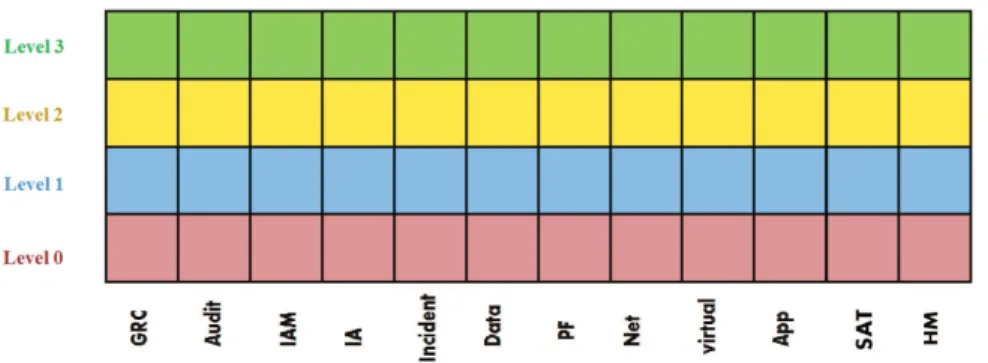
Fig. 3.1.CSCMM Model Architecture
defining the metrics program goal(s) and objectives; deciding metrics to generate; de-veloping strategies for generating the metrics; establishing benchmarks and targets; determining metrics are reported; creating an action plan and act on it; and estab-lishing a formal program review/refinement cycle. NIST also considered the metrics development and selection cycle via seven steps from identify stakeholders and interest to business mission impact [51].
Chew et al. [?] proposed five key components of making a metrics program plan: program initiation; development of information security metrics; analysis of information security metrics; reporting information security metrics; maintaining an information security metrics program. Campbell and Blades [52] listed five steps in a security metrics program: identifying the business drivers and objectives for the security metrics program; determining who your metrics are intended to inform and influence; identifying the types and locations of data essential for actionable security metrics; establishing relevant metrics; establishing internal controls to ensure integrity of data and data assessments and to protect confidentiality.
3. Cloud security capability maturity model (CSCMM). To solve all above problems from cloud models and cyber security maturity models, we developed a Cloud Security Capability Maturity Model (CSCMM) with two dimensions includ-ing domain and maturity level (Figure 3.1). The first dimension presents twelve cloud security domains. Each domain is a set of cyber security practices. The practices within each domain are a number objectives achievement that specify for cloud secu-rity. The second dimension shows four maturity levels which apply seperately to each domain. The maturity levels indicate a paralel progression of maturity: general and specific.
The model is built from a combination of existing cyber security standards, frame-works, and innovation. It provides the guidance to support the organizations imple-ment and enhance their cyber security capabilities on cloud system. The model tend to be in general, therefore they can be tailored for their consistent goals with different cloud service model (IPSaaS) and deployments (Public, Private, and Hybrid Cloud).
3.1. CSCMM domains. There is not a complete cloud security standard be-cause cloud technology is evolving far faster than standards [53]. Therefore, creating a set of security domains just based on the current security standards is not ade-quate to take into account emerging issues and attack surfaces. For CSCMM , we
ID Domains/Models CSA CSCC ENISA IBM CISCO ISIMC FedRAMP PCIDSS SANS SSE-CMM ES-CMM RMM ISO NIST-CSF Number
1 Infrastructure and facilities security 3 3 3 3 3 3 3 3 3 3 3 3 3 13 2 Identity and access management 3 3 3 3 3 3 3 3 3 3 3 11 3 Governance, Risk, and Compliance 3 3 3 3 3 3 3 3 3 3 3 11 4 Incident response, threat management 3 3 3 3 3 3 3 3 3 9 5 Data and information protection 3 3 3 3 3 3 3 3 8
6 Human resources management 3 3 3 3 3 3 3 7
7 Application security 3 3 3 3 3 3 3 7
8 Security awareness and training 3 3 3 3 3 3 6
9 Audit and accountability 3 3 3 3 3 5
10 Operability and portability 3 3 3 3
11 Virtualization 3 3 3 3
12 Cloud connections and
communication 3 3 3 3
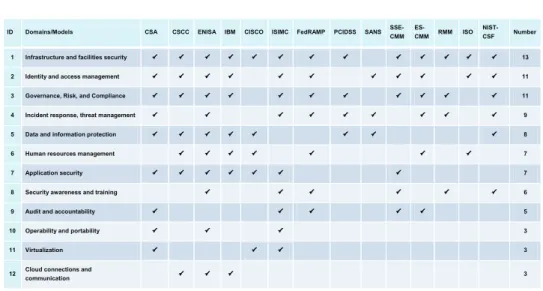
Fig. 3.2.The appearance of security domains in security model
choose a systematic review approach on existingcloud security models and standards, traditional security maturity models as well as trends in emerging technologies. Sys-tematic review methodology is a means of evaluating and interpreting all available research relevant to a particular research question, topic area, or phenomenon of interest [54]. As a result, we investigated fourteen security models including five traditional and nine cloud security models. We found twelve in twenty one security domains with the highest number of appearances in fourteen models (Figure 3.2). In which, eight security domains are from traditional maturity models and standards including infrastructure and facilities security; identity and access management; gov-ernance, risk, and compliance; incident response and threat management; data and information protection; human resources management; security awareness and train-ing; audit and accountability. There are four cloud specific security domains such as cloud connections and communication; operabability and portability; virtualization; and application secuirty. Based on different perspective of security domains categories from ISO (strategic, tactical, and operational), CSA (governance, operational), IBM (Process, Technical, and Operational), and Karola (Technical, Social), we settle for these twelve security domains as they cover comprehensive aspects of cyber security and accommodate emerging security issues.
The main contents of these 12 domains are summarized below:
1. Governance, Risk, and Compliance management (GRC): This domain fo-cuses on establishing, operating, and maintaining cyber security risk management programs that identify, analyse, and mitigate cyber security risk to the organization. This means governance and compliance policies and procedures established to protect stakeholders property. This covers implementations of compliance following regula-tory requirements between stakeholders. Compliance management is to maintain and provide compliance. It relates to execution of internal security policies, and different compliance requirements such as regulatory, legislative.
2. Audit and Accountability: This domain aims to provide information about roles, responsibilities, and compliance regarding auditing. It addresses auditing of security controls including checking for proper server maintenance and controls to
make sure that it is properly done and security policies are being enforced. The policy may set the level and detail of auditing and specify types of events to be audited. The major procedures of this domain are auditable events; content of audit records, audit processing and monitoring; audit reduction and report generation; protection of audit information; and audit retention.
3. Identities and Access Management (IAM): This domain ensures authentication, authorization, and administration of identities. The main concerns of this domain are related to identity verification, granting a correct level of access to cloud resources, policy managements, and role-based access controls. The purpose of IAM is to prevent unauthorized access to physical and virtual resources as this can threaten the confi-dentiality, availability, integrity, and other properties of users services and data. These domains can be applied by standards or technologies such as LDAP (Lightweight di-rectory Access Protocol) to provide access to didi-rectory servers and SAML 2.0 (Security Authorization Mark-up Language) for exchange of authentication and authorization data between security domains.
4. Data and Information protection (Data): Data protection is one of the critical security challenges in cloud computing. Control of data and compensating controls can be used to tackle the loss of physical control when moving data to the cloud. The concern of information management is who has onus for data confidentiality, integrity, and availability. Therefore, security controls as expressed in ISO 27002 including as-set management, access control and cryptography can be applied. Other technologies such as HTTPS for regular connections from cloud services over the internet, VPN using IPSec or SSL for connections also can be used for implementing this domain. Moreover, encryption keys should be used by KMIP (the Key Management Interop-erability Protocol) that supports a standardized way to manage encryption keys.
5. Incident response: This domain concentrates on incident detection, response, notification, and remediation. The major concerns in Incident response are related to establishing and maintaining plans, procedures, and technologies to detect, analyse, and respond to cyber security incidents and events. The incident response lifecycle as expressed in the National Institute of Standards and Technology Computer Security Incident Handling Guide (NIST 800-61) should be used in this domain.
6. Infrastructure and facilities security: The security of an IT system also depends on the security of its physical infrastructure and facilities. In the case of cloud com-puting, this extends to the infrastructure and facilities of the cloud service provider. The customer must get assurance from the provider that appropriate security controls are in place. ISO 27007 can be used to ensure protection against external and envi-ronmental threats like fire, floods, earthquakes, civil unrest or other potential threats that could disrupt cloud services; control of personnel working in secure areas; equip-ment security controls; and supporting utilities such as electricity supply, gas supply, telecommunications.
7. Human resource management: People are often described as the weakest en-tity in any security system. This domain focuses on human resource process, from pre-employment, during employment, and through termination, to ensure that poli-cies and procedures are in place to address security issues. The three areas of human resources security concerned are prior to employment; during employment; termi-nation and change of employment. Human Resources Security in ISO 27002:2013 (Information Security Management) can be used for this domain.
8. Security awareness and training: This domain aims to create a culture of se-curity and ensure the ongoing suitability and competence of all personnel. Consistent
training throughout the entire process ensures that employees and contractors are fully aware of their roles and responsibilities and understand the criticality of their actions in protecting and securing both information and facilities.
9. Cloud application security: This domain focuses on determining the application software on which type of cloud platform (SaaS, PaaS, or IaaS) for securing. The Open Web Application Security Project (OWASP) or Secure Software Development Life Cycle (SSDLC) can support cloud service entities to secure application running on cloud systems. In terms of technologies and techniques in cloud application security, we can use firewall to control access. We also can consider VPNs to limit access to application to users for these domains.
10. Virtualization and isolation: This domain focuses on the security issues re-lated to system/hardware virtualization, rather than a more general survey of all forms of virtualization. This domain is associated with multi-tenancy, VM isolation, VM co-resident, hypervisor vulnerabilities, and other virtualized artefacts. Isolation is the technique that is used to protect each entity within the cloud infrastructure component of a system from unwanted interferences. Isolation is used to identify virtual and physical boundaries, partition containers, processes or logical functional entities, and isolate policy-based security violations.
11. Interoperability and portability: This domain is one of the special domains in cloud computing. It is the ability to move data/services from one provider to another, or bring it entirely back in-house. To ensure this domain, we can use open virtual-ization formats to provide interoperability, while virtualvirtual-ization can help to remove concerns about physical hardware, distinct differences exist between common hyper-visors. It deals with different technologies virtual machine images are captured and ported to new cloud providers such as Distributed Management Task Force (DMTF) and Open Virtualization format (OVF).
12. Cloud connections and communication security: A cloud service provider must allow legitimate network traffic and block malicious network traffic. However, unlike many other organizations, a cloud service provider may not necessarily know what network traffic its customers plan to send and receive. Nevertheless, customers should expect certain external network perimeter safety measures from their cloud providers. For this domain, ISO/IEC 2703332 standards can be used to provide detailed guidance on implementing the network security controls that are introduced in ISO/IEC 27002.
In these twelve domains, we integrate isolation into virtualization domain to gen-erate new domain namely virtualization and isolation and offer domain interoperabil-ity portabilinteroperabil-ity as a new domain. It is clear that virtualization and isolation have been important techniques in cloud security. Virtualization is considered as the cloud enabling technology and hence it is at the centre of cloud security. However, with emerging attacks recently on the virtualization layer, this domain has to be taken seriously. Isolation technique has been emerged as a new approach for securing cloud computing. The development of isolation theory with assessing process is necessary.
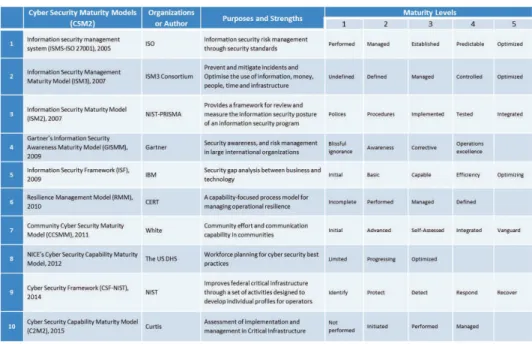
3.2. Security maturity levels. To investigate the common features of each maturity level in previous security maturity models, we compared ten prominent professional security maturity models (Figure 3.3). As a result of this investigation, we adopt four maturity levels (SMLs) for our CSCMM model. Maturity levels are identified by the following attributes: (1) the SMLs apply independently to each domain. For instance, an organization could be implementing at SML1 in one domain, SML2 in another domain; (2) the maturity level of a domain is determined by the
Fig. 3.3.Investigating Cyber Security Maturity Models
minimum of all security practices implemented in that domain. For example, to gain security maturity level at SML2 in one domain, the organization has to implement all the security practices in SML1 and SML2; (3) SML achievement should align with business objectives and organizations security strategy.
Expressed below are common features that define each maturity level.
- SML0 (Undefined): at this level organizations are at the starting point with a commitment to establish a security maturity assessment model. They have no plan to check or test security processes.
- SML1 (Initiated): at this level, most organizations focus on basic security prac-tice. Some basic security physical hardware devices or networks need to be imple-mented on IaaS, basic protection on virtual machine monitor, access control and encryption on PaaS, basic application security and multi-tenancy on SaaS.
- SML2 (Managed): at this level, organizations focus on building and planning Information Security programs and apply cloud security standards. Cloud security stakeholders such as provider, consumer, and third-party are identified and involved. Cloud security activities need to be guided by policies. Some cloud automatic secu-rity tools are applied such as intrusion detection and prevention systems. Especially, security metrics system needs to be applied at this level to support security decision making. For IaaS, security mechanisms to protect network and data are applied to achieve selected security standards compliance. For PaaS, it is ensured that the vir-tual machine monitor needs to be protected by higher security policies. For SaaS, automatic security system for web-based, software, or database need to be imple-mented.
- SML3 (Optimized): it is defined as the highest maturity level. This is real-time protection level. All the security program support 24/7 staffed operations and fully automated. It is assured that all security policies and procedures are implemented. This is the ideal cloud security status with optimal use of resources from facilities, time
to costs and human. This level is called resilience when the organization can detect and tackle with security threats automatically proactively and the time to achieve resilience status is almost zero. And all people in the organization have adequate skills and knowledge about security on cloud.
4. Security metrics framework. To assess the maturity level of CSCMM model in general and a security domain or a security activity in particular, we propose a security metrics framework with the following steps (Figure 4.1).
Inputs. This first step describes the requirements for the security metrics
frame-work: security practices and activities, goals and objectives, security requirements. A set of security practices for a particular domain or multiple domains is defined and/or selected. This depends on the demand of upper management or the schedule of assessment process of the CSCMM model. These securities then determine what to measure. What-to-measure may be one security activity or several security activities from the selected domains. Stakeholders are identified which include upper managers who decide on information requirements, managers who carry out the directive, prac-titioners who implement the security metrics, and security metrics consumers. Goals and Objectives define the goals and objectives of security metrics plan or program from the stakeholders viewpoint.
Metric plan. Classification of security activities or practices is also necessary to
indicate the type of measurement ( governance, management, operational, and techni-cal) and to decide on the metrics plan and the method to measure as security metrics should be SMART [46]. or PRACMATIC [47]. Security metrics components iden-tification identifies the elements or dimensions related to the metrics. These may include real-virtual, infrastructures, and interaction of entities in the (cloud) cyber space, and others factors such as cost, time, threats, and vulnerabilities. Determina-tion of measuring methods is based on the qualitative or quantitative nature of the security practices. Quantitative metrics are usually based on mathematical models and numerical data. The unit of measurement for each component of security metrics program is then derived. Data collection has to be planned to meet the characteristic requirements such as obtainable, cheap to collect, quantitative express, automatically.
Measuring. Relevant and measurable metrics have already determined and
se-lected from previous steps, this step carries out the actual measurement according to the measuring method and the data collection plan. In general, a security metrics is a function of its measured components:
x=f(x1, x2, x3, .., xn)
x1, x2, x3, .., xn are security metrics components x could be a countable value based on a maturity benchmarking (next step). f is a function of the specification of security metrics identified in the metric plan. If x does not yield a value or it is impossible to implement the measurement one has to go back to the metric plan step define the set security components and their impacts.
Analyze. This step consists of several operations such as holistic analysis,
inter-pretation, and consolidation. Holistic analysis means that the analysis takes into account not only the measured metrics but also the elements of the inputs and the metric plan steps of the metrics framework. This is important as some quantitative metrics lose their original meanings when reduced to a pure numerical number. Inter-pretation of the obtained metrics is to decipher the true security status of the cyber space under protection. Interpretation also provides the reasons and their impact on
Fig. 4.1.CSCMM metrics framework diagram
the measured result. The effectiveness and efficiency of the proposed metrics should be evaluated.
Maturity level determination:. Benchmarking is the process of comparing ones
own performance and practices against peers within the industry or noted best prac-tice organizations outside the industry. Benchmarks can be used, for example, to de-termine a minimum essential configuration for workstations, servers, laptops, routers, firewalls, and other network devices or for the holistic system. The method for as-signing maturity level depends on the specification of the security metrics. It could be assigned as a percentage range from Level 0 (say, 0-25% to Level 4 (say, 75-100%); a weighted value; a value interval, or times to security incident response from months (level 0), days (level 1), hour (level 2), to real-time (level 3) [55].
Report. The last step is reporting that shows and informs the ultimate impact
and consequences to metrics consumers. All steps of the metrics need to be described. The frequency of reports depends on requirement of the organization and its upper managers. On the one hand, the report provides the assessed security status of the cloud system relates and explain clearly the impact of the security status to the
management on the organization business plan and direction. On the other hand, to the security experts and practitioners, the report identifies security weaknesses and suggests action plans for remedy and provides a roadmap for strengthening the security of the system.
5. The selection of advanced security quantitative metrics. With the proposed security metrics framework, the overall security assessment can be balanced and complemented between existing qualitative assessment for senior managers of an organization and quantitative assessment for its security experts. In terms of the qualitative assessment, capability maturity model theory provides senior managers with a sound picture of security compliance of their system in terms of practices but it does not relate well the impact of the security assessment to their business plan and direction. In terms of quantitative assessment, advanced security metrics allow mappings between the outcome of security assessment and costs/benefits to the organization. Furthermore, good quantitative security metrics allow the identification of a specific domain or an individual practice of the model and suggest appropriate security measures for achieving a higher level of maturity.
Among many quantitative security metrics, Mean Failure Cost (MFC) metrics [56] is an excellent candidate metric for CSCMM. MFC is the predictive quantitative metrics that quantifies the costs each (among many) stakeholder needs to invest to the mission for better security or the benefits the stakeholder stands to lose due to the lack of security. MFC is considered as an advanced security metrics for a number of reasons. First, it includes the stakeholders, the impact of security properties on stakeholders, and the threats that can affect system. Second, it can embrace traditional metrics such Mean time to failure (MTTF), Mean Time To Explore (MTTE), and Mean Time Between Breaches (MTBB). Third, it meets many essential security metrics requirements such as SMART or PRAGMATIC.
In addition, the assessment process in the CSCMM model can deploy other state-of-art quantitative metrics including check-list based; state-based stochastic, Fuzzy Analytic Hierarchy, Attack graph based, Dynamic Bayesian Network (DBN) based, Tree weighting. For check-list base metrics, it proposes an advanced security measure-ment system that reflects the characteristics of each field (critical infrastructure facili-ties) to achieve effective information security management [57]. State-based stochastic metrics focuses on progression of an attack process over time. This applies for 4 types of significant attacks: Buffer Overflow, Man-in-the-middle, SQL injection, and Traffic Sniffing [58]. Fuzzy Analytic Hierarchy presents a quantitative framework based on Fuzzy Analytic Hierarchy Process (FAHP) to quantify the security performance of an information system [59]. Attack graphs based AGB provides a method for quanti-tatively analyzing the security of a network using attack graphs that are populated with known vulnerabilities and likelihoods of exploration and then exercised to ob-tain a metric of the overall security and risk of the network [60]. Dynamic Bayesian Network (DBN) based model is used to capture the dynamic nature of vulnerabilities that change overtime. An attack graph is converted to a DBN by applying condi-tional probabilities to the nodes, calculated from the Common Vulnerabilities Scoring System [61]. Tree weighting proposes an initial framework for estimating the security strength of a system by decomposing the system into its security sensitive components and assigning security scores to each component [62].
6. Conclusion. This paper reviewed and revised a number of security concepts and models including cyber space, cyber security, cloud security models, security capa-bility maturity models, and security metrics. The security capacapa-bility maturity models
are of particular interest as they systematically cover all important aspects of a cyber-infrastructure. The paper proposed a Cloud Security Capability Maturity Model that includes cloud-specific security domains and provides quantitative assessment of the overall security of the cloud under consideration. To support the measuring of se-curity maturity level, sese-curity metrics framework was introduced. This framework includes relevant quantitative metrics for measurable assessment. It presents a bal-ance assessment of the overall security of an organisation/system qualitatively and quantitatively. For senior managers, CSCMM offers a meaningful security assessment of the security status of their infrastructure for making decision concerning business plan and direction. For security experts or practitioners, CSCMM with its quan-titative metrics enables proactive measures and responsive actions. The paper also suggested future research with advanced metrics that involve various stakeholders, components of cloud security systems.
REFERENCES
[1] M. Whitman and H. Mattord,Management of information security, Cengage Learning, 2013. [2] Wikipedia,National security, 2015.
[3] R. Von Solms and J. Van Niekerk,From information security to cyber security, computers & security, 38 (2013), pp. 97–102.
[4] N. Wiener, Cybernetics or Control and Communication in the Animal and the Machine, vol. 25, MIT press, 1961.
[5] S. Cirani, M. Picone, and L. Veltri,A session initiation protocol for the internet of things,
Scalable Computing: Practice and Experience, 14 (2014), pp. 249–263. [6] Humphrey,Cmm, IEEE, 1 (1989).
[7] P. D. Curtis and N. Mehravari,Evaluating and improving cybersecurity capabilities of the energy critical infrastructure, in Technologies for Homeland Security (HST), 2015 IEEE International Symposium on, pp. 1–6.
[8] ITU,Overview of cybersecurity (ITU-T X.1205), 04/2008.
[9] A. Government,Strong and secure. a strategy for australias national security, 2013. [10] C. Government,Canadas cyber security strategy. for a stronger and more prosperous canada
(2010), 2010.
[11] T. N. Government,National cyber security strategy 2: From awareness to capability (2013), 2013.
[12] G. Government,Cyber security strategy for germany (2011), 2011. [13] N. Z. Government,New zealand’s cyber security strategy, 2015. [14] D. Rajnovic,Cyberspace what is it?, July 26, 2012.
[15] R. Ottis and P. Lorents,Cyberspace: Definition and implications, in Proceedings of the 5th International Conference on Information Warfare and Security, pp. 267–270.
[16] S. J. Shackelford, Toward cyberpeace: Managing cyberattacks through polycentric gover-nance, Am. UL Rev., 62 (2012), p. 1273.
[17] M. Gasser,Building a secure computer system, Van Nostrand Reinhold Company New York, NY, 1988.
[18] D. Craigen, N. Diakun-Thibault, and R. Purse,Defining cybersecurity, Technology
Inno-vation Management Review, 4 (2014).
[19] M. C. Lacity,Advanced outsourcing practice: Rethinking ito, bpo and cloud services, Palgrave Macmillan, 2012.
[20] C. Clavister,Security in the cloud, White paper, (2008).
[21] A. Behl and K. Behl,An analysis of cloud computing security issues, in Information and
Communication Technologies (WICT), 2012 World Congress on, pp. 109–114.
[22] D. Catteddu,Cloud Computing: benefits, risks and recommendations for information secu-rity, Springer, 2010, pp. 17–17.
[23] C. S. C. Coucil,Security for cloud computing ten steps to ensure success version 2.0, report, March, 2015.
[24] W. R. Claycomb and A. Nicoll, Insider threats to cloud computing: Directions for new research challenges, in 2012 IEEE 36th Annual Computer Software and Applications Con-ference, pp. 387–394.
and Secured Transactions (ICITST), 2011 International Conference for, pp. 214–219. [26] C. S. ALLIANCE,The treacherous twelve - cloud computing top threats in 2016, 2016.
[27] ENISA,Security standards for cloud usage, report, August 2014.
[28] J. Archer and A. Boehm,Security guidance for critical areas of focus in cloud computing, Cloud Security Alliance, 2 (2009), pp. 1–76.
[29] G. Brunette and R. Mogull,Security guidance for critical areas of focus in cloud computing v2. 1, Cloud Security Alliance, (2009), pp. 1–76.
[30] C. Alliance,Security guidance for critical areas of focus in cloud computing v3. 0, Cloud Security Alliance, (2011).
[31] B. Swain, P. Agcaoili, M. Pohlman, and K. Boyle,Cloud controls matrix, 2010.
[32] J. Allen and N. Mehravari,How to be a better consumer of security maturity models, report, Citeseer, 2014.
[33] N. T. Le and D. B. Hoang,Can maturity models support cyber security?, in 2016 IEEE 35th International Performance Computing and Communications Conference (IPCCC), pp. 1–7. [34] M. Siponen and R. Willison, Information security management standards: Problems and
solutions, Information & Management, 46 (2009), pp. 267–270.
[35] B. Stevanovi,Maturity models in information security, International Journal of Information, 1 (2011).
[36] P. E. Black, K. Scarfone, and M. Souppaya,Cyber security metrics and measures, Wiley Handbook of Science and Technology for Homeland Security, (2008).
[37] B. Bates, K. M. Goertzel, and T. Winograd,Measuring Cyber Security and Information Assurance: A State-of-the Art Report, Information Assurance Technology Analysis Center, 2009.
[38] W. Thomson,Lord kelvin: Electrical units of measurement. popular lectures and addresses, 1889.
[39] W. S. Humphrey,A discipline for software engineering, Addison-Wesley Longman Publishing Co., Inc., 1995.
[40] A. Jaquith,Security metrics, Pearson Education, 2007.
[41] W. K. Brotby, Information security management metrics, A definitive guide to effective security monitoring and, (2009).
[42] C. f. I. Security,The cis security metrics, 2010.
[43] E. Chew, M. Swanson, K. Stine, N. Bartol, A. Brown, and W. Robinson,Performance measurement guide for information security, 2008.
[44] R. Savola, Towards a security metrics taxonomy for the information and communication technology industry, in Software Engineering Advances, 2007. ICSEA 2007. International Conference on, IEEE, pp. 60–60.
[45] S. Kowalski, R. Barabanov, and L. Yngstrm,Information security metrics: Research di-rections, (2011).
[46] J. P. Ravenel,Effective operational security metrics, Information Systems Security, 15 (2006), pp. 10–17.
[47] W. K. Brotby and G. Hinson,Pragmatic security metrics: applying metametrics to infor-mation security, CRC Press, 2013.
[48] D. S. Herrmann,Complete guide to security and privacy metrics: measuring regulatory
com-pliance, operational resilience, and ROI, CRC Press, 2007.
[49] S. E. Schimkowitsch,Key Components of an Information Security Metrics Program Plan, thesis, 2009.
[50] S. C. Payne,A guide to security metrics, SANS Security Essentials GSEC Practical Assignment Version, 1 (2010).
[51] W. Jansen,Directions in security metrics research, Diane Publishing, 2010.
[52] G. Campbell and M. Blades,Building a metrics program that matters, Journal of healthcare protection management: publication of the International Association for Hospital Security, 30 (2014), p. 116.
[53] B. Duncan and M. Whittington,Compliance with standards, assurance and audit: does
this equal security?, in Proceedings of the 7th International Conference on Security of Information and Networks, ACM, p. 77.
[54] B. Kitchenham,Procedures for performing systematic reviews, Keele, UK, Keele University, 33 (2004), pp. 1–26.
[55] R. Lentz,Security intelligence maturity model, 2015.
[56] M. Jouini, A. B. Aissa, L. B. A. Rabai and A. Mili, Towards quantitative measures of Information Security: A Cloud Computing case study, International Journal of Cyber-Security and Digital Forensics (IJCSDF), 1 (2012), pp. 248-262
Journal of Supercomputing, 72 (2016), pp. 3443–3454.
[58] J. Almasizadeh and M. A. Azgomi,A stochastic model of attack process for the evaluation
of security metrics, Computer Networks, 57 (2013), pp. 2159–2180.
[59] S. Thalia, A. Tuteja, and M. Dutta,Towards quantification of information system security, Springer, 2011, pp. 225–231.
[60] S. Noel, S. Jajodia, L. Wang, and A. Singhal,Measuring security risk of networks using attack graphs, International Journal of Next-Generation Computing, 1 (2010), pp. 135–147. [61] M. Frigault, L. Wang, A. Singhal, and S. Jajodia,Measuring network security using dy-namic bayesian network, in Proceedings of the 4th ACM workshop on Quality of protection, ACM, pp. 23–30.
[62] C. Wang and W. A. Wulf,Towards a framework for security measurement, in 20th National Information Systems Security Conference, Baltimore, MD, pp. 522–533.