Northumbria Research Link
Citation: Ali, Mohammed Banu, Wood-Harper, Trevor and Mohamad, Mostafa (2018) Benefits and Challenges of Cloud Computing Adoption and Usage in Higher Education. International Journal of Enterprise Information Systems, 14 (4). pp. 64-77. ISSN 1548-1115
Published by: IGI Global
URL: https://doi.org/10.4018/IJEIS.2018100105 <https://doi.org/10.4018/IJEIS.2018100105> This version was downloaded from Northumbria Research Link: http://nrl.northumbria.ac.uk/42546/
Northumbria University has developed Northumbria Research Link (NRL) to enable users to access the University’s research output. Copyright © and moral rights for items on NRL are retained by the individual author(s) and/or other copyright owners. Single copies of full items can be reproduced, displayed or performed, and given to third parties in any format or medium for personal research or study, educational, or not-for-profit purposes without prior permission or charge, provided the authors, title and full bibliographic details are given, as well as a hyperlink and/or URL to the original metadata page. The content must not be changed in any way. Full items must not be sold commercially in any format or medium without formal permission of the copyright holder. The full policy is available online:
http://nrl.northumbria.ac.uk/pol i cies.html
This document may differ from the final, published version of the research and has been made available online in accordance with publisher policies. To read and/or cite from the published version of the research, please visit the publisher’s website (a subscription may be required.)
Benefits and Challenges of Cloud Computing Adoption and
Usage in Higher Education: A Systematic Literature Review
Ali, Mohammed Banu Wood-Harper, Trevor Mohamad, Mostafa
[email protected] [email protected] [email protected]
University of Manchester IMP Innovation, Strategy and Sustainability Alliance Manchester
Business School - Innovation Management and Policy Division Manchester Institute of Innovation Research IMP Innovation, Strategy and
Sustainability
Sackville Street Building Room J14 Manchester
M13 9PL
University of Manchester IMP Innovation, Strategy and Sustainability Alliance Manchester Business School
- Innovation Management and Policy Division Manchester Institute of Innovation Research IMP
Innovation, Strategy and Sustainability C6, Booth Street East
Manchester M15 6PB
University of Salford Salford Business School 617 Maxwell Building Salford Business School University of Salford Manchester,
M5 4NT
Dr Mohammed Ali
Mohammed is a doctoral scholar who has an emerging profile in the areas of Cloud Computing, Enterprise Resource Planning, and Virtual learning systems. He recently, published in the journal of Small Business Innovation, and the British Academy of Management Proceedings. He is currently investigating the area of cloud education, including different technical, organizational, and political issues associated with its adoption.
Professor Trevor Wood-Harper
Trevor is a Chair and Professor of Information Systems at Alliance Manchester Business School. He has broad research areas are: Socio-Technical Systems; Systemic Change and Action Research. He has published over 250 research articles and co-authored or co-edited 20 books. Since 2001, 25 journal papers and 7 texts were published on a wide range of topics including: the Multiview Methodology; Social Informatics; Information Systems in Developing Countries; Electronic Governance, Commerce and Communities; Action Research; Ethical Considerations in Systems Development. He is currently a member of the Editorial Board of the Information Systems Journal.
Dr Mostafa Mohamad
Mo is a senior Lecturer of Information and Innovation Systems at Salford Business School. He has a sustained record of publications in areas of information systems development, financial technologies, and digital innovation systems. His research expertise covers mixed methods, qualitative interviewing, foresight analysis, and action research. Mo is part of the editorial team for two The Journal of Internet Banking and Commerce” and “Information Systems Research Journal”.
Abstract: The aim of this paper was to provide evidence pertaining to cloud computing (CC) adoption in education, namely higher education institutions (HEIs) or Universities. A systematic literature review (SLR) of empirical studies exploring the current CC adoption levels in HEIs and the benefits and challenges for using CC in HEIs was performed. A total of 20 papers were included in the SLR. It was discovered that a number of Universities have a keen interest in using CC in their institution, and the evidence indicates a high level of successful CC adoption in the HEIs reviewed in the SLR. In conclusion, the SLR identified a clear literature gap in this research area: limited empirical studies focusing on CC utilisation in HEIs.
Keywords
Cloud computing, adoption, benefits, challenges, education, higher education, implementation, e-learning.
1.
INTRODUCTION
Cloud computing (CC) according to the National Institute of Standards and Technology (NIST) is “a model for enabling ubiquitous, convenient, on-demand network access to a shared pool of configurable computing resources (e.g., networks, servers, storage, applications, and services) that can be rapidly provisioned and released with minimal management effort or service provider interaction. This cloud model is composed of five essential characteristics, three service models, and four deployment models.” (Mell & Grance, 2011) In Sultan’s view, CC is a computing style where elastic and scalable IT-driven capabilities are made possible via internet technologies (Sultan, 2010).
Krelja et al. indicate that CC is a highly innovative technology for businesses to adopt and provides a new technology platform to enable them to develop and deploy their own applications. For the end-user, CC is a more cost-effective and flexible way of using applications (Krelja et al., 2014; Kyriazis & Jeffery, 2018). Through the delivery of many cloud-based applications to potential users, such as teachers and students, which can support their educational needs, CC can provide greater scalability, flexibility and mobility in the utilization of resources for teaching purposes (Alharthi et al., 2015; Scholten, 2017; Stergiou et al., 2018).
Since CC is an internet driven technology, it brings many advantages and also disadvantages, besides to the educational cloud (Alharthi et al., 2015; Lakshminarayanan et al., 2013; Yuvaraj, 2016). The benefits include cost efficiency, collaboration, greater flexibility, improved availability, reduced environmental impact and user satisfaction (Krelja et al., 2014; Shayan et al., 2014; Sultan, 2010; Verma & Rizvi, 2013), whereas the limitations include security, maturity and cultural resistance (Alharthi et al., 2015; Amron et al., 2017; Haider, 2014; Shakeabubakor et al., 2015; Sultan, 2010). In addition, CC is a highly compatible technology, which makes it usable in a number of everyday activities, including education. As well as delivering various cloud-based applications and services to teachers and students, which can be used in both formal and informal education, CC can provide greater scalability, flexibility and mobility in the utilization of computing resources for teaching and learning purposes, increased collaboration, communication and resource sharing, and allows institutions to establish virtual communities for teaching and learning i.e. a customised learning environment (Askari et al., 2018; Kayali et al., 2016; Willcocks et al., 2014).
1.1
Research Motivation
Existing research on CC usage in education only focus on CC frameworks, security and implementation, and there is a lack of studies that explicitly focus on the benefits and challenges of CC adoption and usage the in education context, particularly in higher education institutions (HEIs), such as Universities (Hussein & Omar, 2015; Jawad et al., 2017; Mokhtar et al., 2016; Scholten, 2017).
This paper aims to identify and evaluate empirical evidence pertaining to the benefits and challenges of CC adoption and usage in the higher education context by employing a systematic review method. This research will help to identify the potential challenges and gaps in the existing literature and recommend areas for further research going forward.
2.
Research method
A systematic literature review (SLR) is essentially a process in which the researcher identifies, assesses and interprets all available literature and empirical evidence in an attempt to provide answers for specific research questions. To support the researcher during the SLR procedure, Kitchenham’s and Charters’s method of conducting SLRs was adopted (Kitchenham & Charters, 2007; Salleh et al., 2011). The search procedure involved the use of various online databases, such as ScienceDirect, IEEE, Springer, Scopus and ACM.
2.1
Research questions
This SLR included a range of empirical studies, exploring the benefits and challenges of CC adoption and usage in higher education (HE). Research papers that have explored usage and/or implementation of CC in education, besides other studies that have determined a particular outcome for successful CC implementation in HE were included. Therefore, researches that merely presented a proposed framework or research design without any empirical assessment were omitted from the SLR. Basically, the SLR only included studies that have explored and examined data pertaining to CC adoption in HE or other researches that have conceptualised CC implementation in HE.
The focal point of this SLR was to provide awareness and determine whether or not Universities and higher education institutions (HEIs) have adopted CC to support their teaching and learning activities. While the main justification for CC use in HE is to reduce IT-infrastructure costs and facilitate the teaching and learning process (organisational level), students can also take advantage of not having to purchase additional computing equipment as they can learn via the cloud (user level), which does not require extra resources, just an Internet connection, and so that they can collaborate and communicate effectively with other students and teachers on the cloud (Al-Badi et al., 2017; Babin & Halilovic, 2017;
Lin et al., 2014; Shayan et al., 2014; Truta, 2015). The SLR is organised into two categories to assess CC adoption: determining whether or not Universities have adopted CC and specific outcomes regarding the successful implementation of CC in HE. For that reason, the SLR aimed to answer the following research question (RQ):
RQ1: What evidence can support the successful adoption of CC in HEIs?
Sub-questions:
RQ1.1: What benefits and challenges support/hinder the successful adoption of CC in Universities? RQ: 1.2: What specific model/frameworks of CC have been used to support CC implementation?
2.2
Identifying appropriate literature
The researcher applied the following strategy to support the keyword search process (Kitchenham & Charters, 2007; Salleh et al., 2011):
Searching for papers concerning CC in HE;
Citing familiar keywords mentioned in primary studies;
Determining synonyms for use, and usage was the best one, as well as determining sub-topics of CC in HE e.g. e-learning management systems in education;
Using Boolean OR to incorporate alternative spellings and synonyms;
Using Boolean AND for linking key terms from the population, intervention, and outcome. The following search strings were initially used to search for the appropriate literature:
Cloud computing AND education or cloud computing AND higher education. Petticrew and Roberts, and Salleh highlighted two key issues on carrying out an SLR search: sensitivity and specificity of the search (Petticrew & Roberts, 2008; Salleh et al., 2011). Sensitivity occurs when there are many studies retrieved from the search, whereas specificity occurs when there are minimal irrelevant studies retrieved from the search. During the initial research process when applying the previously defined search strategy, the search results were very high and thus many studies were yielded from the search. For
example, there were over 533 search results retrieved from IEEE, ScienceDirect and Springer. Therefore, this required the researcher to deepen the search, and used search strings, such as “cloud OR cloud computing” AND “adoption OR usage” AND “education OR e-learning” AND “benefits OR challenges”. The revised search provided the researcher a more sizable and relevant set of studies, and from there, chose the appropriate empirical studies.
2.3
Inclusion/Exclusion criteria
In the SLR, the following inclusion criteria was applied:
1. Studies exploring and have gathered data pertaining to CC adoption or usage in HE, as well as the benefits and challenges of the technology;
2. Studies highlighting a specific outcome or implemented cloud solution for HEIs; 3. English written papers.
With regards to the exclusion criteria, studies that failed to provide any empirical evidence pertaining to CC adoption or usage, as well as other studies that merely provided assumptions or opinions and a descriptive framework pertaining to CC adoption without any empirical evidence were all omitted.
2.4
Data extraction
In order to facilitate the data extraction process, the researcher designed a form to support the gathering of evidence concerning the RQs, and to assess the quality of these empirical studies. The form considered the following items:
Paper ID; Research aim; Methods;
Hypotheses/Research questions; Analysis method;
Sample size;
Summary of findings; Limitations
Specific implementation outcomes.
Assessing the quality of the chosen studies was carried out throughout the data extraction stage and the researcher referred to the quality checklist highlighted in Kitchenham’s and Charters’, and Salleh’s papers (Kitchenham & Charters, 2007; Salleh et al., 2011).
3.
Findings and discussion
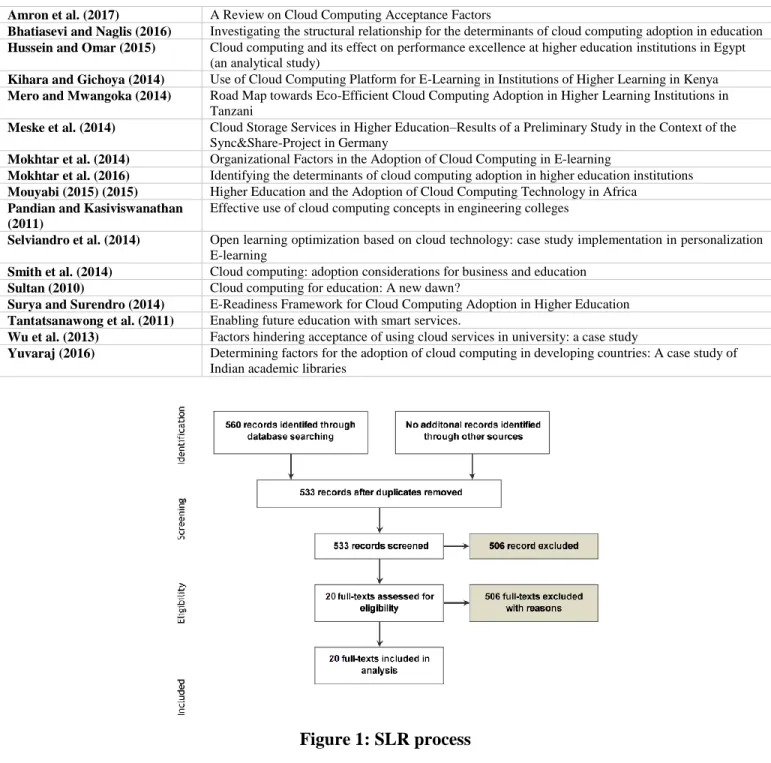
This section showcases the results of the SLR, beginning with an analysis of the literature. IEEE was the primary database used for inclusion, and each article was compared with the present list of studies retrieved from the database. Screening was also performed so as to avoid duplication. A total of 533 papers were retrieved from the search process, 20 of which were considered appropriate papers for inclusion in the SLR. Each of the 20 identified papers were filtered in relation to the inclusion and exclusion criteria prior to acceptance for evaluation. Carefully checking for duplicate studies was also performed. Based on the empirical searches, the 20 studies for inclusion were eventually accepted for evaluation after a careful check of each abstract in these studies. A final point worth mentioning is that the SLR only includes studies indexed in online databases, such as journal articles and conference papers. Table 1 presents the deduced studies for inclusion, while Figure 1 summarises the different phases of the SLR:
Table 1: SLR Studies on CC Adoption in HE
Author/Year Title
Al-Badi et al. (2017) Financial Incentives for Adopting Cloud Computing in Higher Educational Institutions
Alharthi et al. (2015) An overview of cloud services adoption challenges in higher education institutions
Amron et al. (2017) A Review on Cloud Computing Acceptance Factors
Bhatiasevi and Naglis (2016) Investigating the structural relationship for the determinants of cloud computing adoption in education
Hussein and Omar (2015) Cloud computing and its effect on performance excellence at higher education institutions in Egypt (an analytical study)
Kihara and Gichoya (2014) Use of Cloud Computing Platform for E-Learning in Institutions of Higher Learning in Kenya
Mero and Mwangoka (2014) Road Map towards Eco-Efficient Cloud Computing Adoption in Higher Learning Institutions in Tanzani
Meske et al. (2014) Cloud Storage Services in Higher Education–Results of a Preliminary Study in the Context of the Sync&Share-Project in Germany
Mokhtar et al. (2014) Organizational Factors in the Adoption of Cloud Computing in E-learning
Mokhtar et al. (2016) Identifying the determinants of cloud computing adoption in higher education institutions
Mouyabi (2015) (2015) Higher Education and the Adoption of Cloud Computing Technology in Africa
Pandian and Kasiviswanathan (2011)
Effective use of cloud computing concepts in engineering colleges
Selviandro et al. (2014) Open learning optimization based on cloud technology: case study implementation in personalization E-learning
Smith et al. (2014) Cloud computing: adoption considerations for business and education
Sultan (2010) Cloud computing for education: A new dawn?
Surya and Surendro (2014) E-Readiness Framework for Cloud Computing Adoption in Higher Education
Tantatsanawong et al. (2011) Enabling future education with smart services.
Wu et al. (2013) Factors hindering acceptance of using cloud services in university: a case study
Yuvaraj (2016) Determining factors for the adoption of cloud computing in developing countries: A case study of Indian academic libraries
Figure 1: SLR process
3.1
Review of the literature
Table 2 presents the main issues deduced from the SLR.
Table 2: Key issues deduced from SLR
Issue Paper
Anytime anywhere access (mobility and flexibly)
Tantatsanawong et al. (2011); Alharthi et al. (2015); Amron et al. (2017)
Awareness of CC Surya and Surendro (2014) (Wu et al., 2013)
Collaboration Al-Badi et al. (2017); Sultan (2010); Tantatsanawong et al. (2011); Wu et al. (2013); Yuvaraj (2016)
Compatibility Mokhtar et al. (2014); Mokhtar et al. (2016); Alharthi et al. (2015)
Cost-efficiency Mokhtar et al. (2014); Mokhtar et al. (2016); Chandra and Malaya (2012); Amron et al. (2017)
Enhanced academic teaching and learning
Al-Badi et al. (2017); Kihara and Gichoya (2014); Yuvaraj (2016)
Improved availability, accessibility and affordability
Tantatsanawong et al. (2011); (Wu et al., 2013; Yuvaraj, 2016)
Improved centralised data management
Chandra and Malaya (2012); (Al-Badi et al., 2017) Improved content/resources
sharing
Tantatsanawong et al. (2011); Sultan (2010); Chandra and Malaya (2012)
Return on investment (ROI) Mokhtar et al. (2014); Mokhtar et al. (2016); Hussein and Omar (2015)
Security, privacy and trust issues Sultan (2010); Chandra and Malaya (2012); Alsufyani et al. (2015)
Technological readiness Mokhtar et al. (2014); Mokhtar et al. (2016) Wu et al. (2013); Alsufyani et al. (2015)
Upgrading existing/outdated technologies
Sultan (2010); Bhatiasevi and Naglis (2016)
3.1.1 Primary RQ: What evidence can support the successful adoption of CC in HEIs?
From the synthesis of evidence, it was deduced that 10 of the 20 studies for inclusion explicitly explored the benefits and challenges of CC adoption in education (Al-Badi et al., 2017; Alharthi et al., 2015; Kihara & Gichoya, 2014; Masud et al., 2012; Mokhtar et al., 2014; Mouyabi, 2015; Sultan, 2010; Surya & Surendro, 2014; Tantatsanawong et al., 2011; Wu et al., 2013; Yuvaraj, 2016). Generally, these studies have demonstrated a growing interest from Universities and their students to migrate to the cloud.
In Tantatsanawong et al. (2011), the infrastructure services for Thai education were explored. It was found that factors, such as availability, accessibility, affordability were vital towards successful CC adoption in HEIs. Education information services which are expected to provide Universities and other institutions data integrity capabilities were also explored. Lastly, the study previewed various learning
services, such as cyber learning systems, E-TV and Teacher TV among others, which enabled teachers to share contents anytime, anywhere with easy access and use, and creation and reuse capabilities. Furthermore, learning cloud services were found to have a number of integrated applications ranging from interactive applications, and picture and video sharing capabilities to collaborative tools e.g. email, messaging, blog, Skype and video conferencing system, and access to e-journal libraries. In conclusion, this indicated a growing interest in cloud technology.
Similarly, in Mokhtar et al. (2014) the organisational factors impacting the adoption of CC in HE, with particular focus on e-learning systems were explored. Four key organisational elements for adopting CC in HEIs were identified: 1) needs assessment, 2) readiness assessment, 3) organisational change, 4) budgeting and return on investment (ROI).
In Masud et al. (2012), the significant features of the educational cloud so as to exploit the affordance of CC in HEIs’ teaching and learning activities were explored. A roadmap for CC in HE, which pays close attention to adoption strategies was also proposed. By following this framework and its steps carefully, it ensured that HEIs would become successful adopters CC. Similarly, in Masud and Huang (2012), another framework called the “education cloud” for higher education institutions to adopt CC was proposed. It aimed to support the sharing of computing resources, and is expected to deliver various functionalities, such as collaboration, digital library, easy access, ESaaS, interoperability, online storage, provisioning and security/privacy.
In Kihara and Gichoya (2014), the main issues surrounding the Strengths, Weaknesses, Opportunities and Threats (SWOT) of CC adoption in Kenyan HEIs for hosting their e-learning services were investigated. This helped to evaluate the implementation level of CC in HEIs, and a framework was suggested to raise awareness of the cloud benefits and the issues surrounding CC adoption in HEIs. HEIs currently using CC were found to have supported their existing e-learning services, which enabled
their students to perform better academically, and thus have the appropriate knowledge and skills expected from the market.
In (Surya & Surendro, 2014), empirical evidence was obtained pertaining to the application of an eReadiness framework in measuring the degree of IT readiness level before adopting CC. By adopting the IT governance COBIT 5, the evaluation discovered a low readiness level of CC adoption in HEIs situated in West Java. The most significant aspects identified for adopting CC in HEIs were: having a degree of awareness of CC, the ways it must be developed and assessed, and analysing how CC can potentially influence HEIs’ organisational strategy.
3.1.2 Sub-question 1: What benefits and challenges support/hinder the successful adoption of CC in Universities?
There are a number of studies that have highlighted the benefits and challenges of CC adoption in the HE context.
In Sultan (2010), the factors that influence the migration to the cloud were explored, especially the benefits and challenges of migrating to the cloud in HEIs. Similarly, additional studies investigated, the CC adoption on both a general and contextual level (Al-Badi et al., 2017; Alharthi et al., 2015; Yuvaraj, 2016). A case study based on a UK University situated in Westminster, revealed that the institution’s interest to adopt was down to their current email system being out of date, thus a CC Gmail system was proposed. However, what hindered the university’s intention to adopt the technology centred on the security and privacy issues surrounding the transfer from the traditional email system to the CC SaaS Gmail system. It was concluded that despite the results suggesting that the Gmail system did encourage the likes of collaborative learning and the ability to share resources efficiently, the university did not go ahead with the adoption process due to the legal implications of transferring all of their data to a new system they were unfamiliar with and trusting a third party with it (Voas & Zhang, 2009).
In Behrend et al. (2011), the main focus of the research was the usage of CC and how the technology benefits particular stakeholders in educational settings. It aimed to influence community colleges to adopt and use CC, as well as to provide a series of recommendations for successful usage. The Technology Acceptance Model (TAM) by Davis (1989) was used to assess community colleges’ influence to adopt and use CC and interviews were conducted to extract these adoptive behaviours from students within their respected institution (Venkatesh & Bala, 2008). The study compared each stage of the TAM model and the relationship between them, such as perceived usefulness, perceived ease of use, attitude towards adoption, behaviour intention to adopt and actual usage. It was found that the ease of use perception influenced CC adoption more than the usefulness perception, thus indicating that the students of these community colleges may be familiar with using CC technologies, but maybe demotivated to use it due to its user unfriendliness (Behrend et al., 2011). The study concluded that without students feeling that CC utilisation can actually support them in their educational setting, as well as the tool being a reliable and easy alternative, they would more than likely reject it, and thus the HEI will not be benefitted.
Similarly, in Alkhater et al. (2014), the factors that impact on CC adoption, non-adoption and usage in an organisational and educational context were explored. The study aimed to determine organisations’ adoptive decisions of CC by examining those factors that impact on such decisions using the Technology-Organisation-Environment model (TOE). The TOE model was used to examine the adoptive factors of CC, while semi-structured interviews were used to gather data on the existing factors, identify new factors not mentioned in previous studies, and to subsequently improve the TOE model presented in the research. Twenty IT experts in Saudi Arabia were interviewed who worked for various organisational departments and some in education. It was found that security, privacy and trust issues, as well as availability of cloud service, compatibility and cost savings were among the most significant factors to influence a firm’s adoptive decision of CC (Akin & Matthew, 2014; Al-Badi et al.,
2017; Armbrust et al., 2010; Yuvaraj, 2016). The study concluded that there are number of benefits that influence a firm’s decision to adopt CC, like cost reduction, flexibility, and green IT, though shifting from an existing system to the cloud is still impacts of firm’s decision and remains one of the greatest influences of non-adoption (Alkhater et al., 2014).
In Wu et al. (2013), the factors that impact on CC adoption, with particular focus on those challenges that hinder the adoption and usage of CC in HEIs is also explored. The aim of the study was to introduce a new evaluation framework that would support an investigation into the root causes that hinder CC adoption/acceptance and usage in universities. It was suggested that an evaluation framework that used both the TAM model by Davis (1989) and the duo-theme decision making trial and evaluation laboratory (DEMATEL) model that was founded by 14 of the world’s leading organisations (Herat et al., 2012). The model was tested on a case university after the CC services were proposed to them. The findings showed that perceived ease of use is the most important facet to drive CC adoption, while better productivity and usefulness or perceived usefulness were seen as a necessity towards successful CC usage within universities. It was concluded that both perceived ease of use and perceived usefulness determines whether or not a university will adopt CC, more so hinders rather than improves their intentions to use the technology, since many universities are unaware of the benefits of incorporating a CC solution (Wu et al., 2013).
In Chandra and Malaya (2012), the way CC plays a fundamental role in education, with particular reference to CC SaaS application in educational institutions was explored. It aimed to systematically review those CC services currently employed in educational institutions. A series of statistics were presented, some of which showcased projected figures of CC worth and usage by 2020. The study projected based on a number of similar studies, which investigate the role of CC in education, that by 2020 the estimated worth of CC in education will be $159.3bn (Alam, 2013; Mouyabi, 2015). With reference to CC SaaS, the study outlined that many HEIs do not require to spend money or purchase a
commercial licence software, since the likes of Google Apps provide HEIs free access to word processing and presentation software, as well as a free email service without any charge (Chandra & Malaya, 2012). A case study of an Israeli university was conducted, which had recently adopted a new “Storage on Demand” model to support their CC services. The results showed that there was a 65% to 83% reduction in storage management requirements within the university, as well as encouraging efficient usage of the CC SaaS. Chandra and Malaya (2012) concluded that the adoption, usage and the subsequent application of resources via CC will support the fulfilment of the huge demand for high speed data processing, thus allowing to achieve the educational development of radical changes in the CC trend. Moreover, factors such as enhancing educational resource usage, reduce costs, centralised data management, ease of use and enhancing information security were among the most significant towards improving CC usage in HEIs.
3.1.3 Sub-question 2: What specific model/frameworks of CC have been used to support CC implementation?
Some studies have even introduced specific products for CC implementation in the HE context.
In Selviandro et al. (2014), the learning architecture and the idea of open education resources among other areas were discussed. The study had developed an architecture known as IOER. Open learning was used to encourage the development of the Indonesia Open Educational Resources (IOER) concept in relation to CC adoption. Based on their evaluation, the authors discovered that CC usage in open learning fulfils users’ needs. In terms of accessibility in the cloud, open learning provides easy access for users. The final evaluation revealed that by successfully implementing a cloud-driven open learning portal, it could potentially lead up to a 59% reduction in investment costs when compared to traditional e-learning systems. In support of Selviandro et al. (2014), Meske et al. (2014) produced a similar
product known as the Sync&Share NRW-project in Germany, attracting up to 500,000 users given its cost-efficient and highly accessible nature.
In Chandran and Kempegowda (2010) a CC product was also introduced, which is a hybrid e-learning platform derived from existing learning architecture models. Furthermore, the issues in existing e-learning applications were analysed and the potential benefits of CC adoption were also discussed. The authors proposed three scenarios for utilising the hybrid cloud. One, migrating a standalone system to a virtual environment, two, adopting e-learning applications to introduce to the HEI, and three, introducing a new derivative program like the National Assessment Program for Literacy and Numeracy (NAPLAN).
Similarly, in Pandian and Kasiviswanathan (2011), a strategy was proposed to help various engineering colleges in Indian city of Tirunelveli to successfully implement a CC solution. CC implementation allows for remote sharing of resources, particularly high-end applications connected via high-speed networks, such as the National Knowledge Network (NKN). It was suggested to install a new centralised server to enable college students easy access to software to support their learning.
4.
Implications for research
The SLR revealed that there is limited empirical evidence to support CC adoption in the HE context. The majority of the papers identified merely focused on implementations and proposed frameworks of CC services. Some studies mentioned the factors, namely the benefits and challenges that affect CC in HE (Al-Badi et al., 2017; Alharthi et al., 2015; Chandra & Borah, 2012; Mokhtar et al., 2014; Mokhtar et al., 2016; Sultan, 2010; Wu et al., 2013), while others reported having developed and implemented specific CC systems in HE (Chandran & Kempegowda, 2010; Meske et al., 2014; Pandian & Kasiviswanathan, 2011; Selviandro et al., 2014). However, the SLR did reveal a number of interesting
issues pertaining to the adoption of CC in HE, ranging from cost efficiency to security issues in the educational cloud (see Table 2).
This paper has also identified a number of frameworks used in the SLR studies, such as TOE, TAM and CORBIT. However, it was surprising to discover that none of the studies have used the multi-view IS methodology to explore CC adoption. This an interesting IS framework developed by Bell & Wood-Harper (Bell & Wood-Wood-Harper, 2014), which supports the analysis, design and development of IS, as well as evaluating possible solutions to IS related issues from multiple perspectives: technological, organisational and personal. It therefore provides a broader picture of IS development: in the context of this paper, cloud computing adoption. Therefore, future studies could potentially adopt this framework to support their CC research, as well as future studies on CC adoption.
In short, it appears that Universities are taking interest in all CC services, while others argue that Universities are more inclined to use cloud Software as a Service (SaaS) (Meske et al., 2014), which could be a potential area for further investigation going forward.
5.
Conclusion
CC is now the new paradigm of IT services, including the rental of computing resources situated in the cloud and in IT development going forward. Today, the number of people doing work online is increasing, from writing and editing documents, checking email, and collaboration via watching videos to storing personal data online. CC usage in HE is vast and is becoming widely recognised in the educational arena. According some authors, the introduction of CC in HE is mainly down to the cost-efficient nature of this technological innovation (Chandra & Borah, 2012; Razak, 2009), though it is important to note that CC also has creative capabilities, since it encourages and facilitates the creation, use and sharing of ideas, knowledge and thoughts. However, it is expected from HEIs and their stakeholders, such as students and teachers to embrace and accept CC, as well as becoming familiar with the potential benefits and challenges of the technology.
This SLR has presented a host of current studies pertaining to the usage of CC in education. The findings suggest that Universities are beginning to show a keen interest in utilising CC. Furthermore, some authors have developed specific systems or cloud implementation e.g. IOER in Indonesia. To close, there appeared to be limited empirical evidence pertaining to CC adoption in HE and thus opens to potential future studies for researchers to consider about CC usage in HE going forward, as well as to discover the current systems that universities are using before implementing a cloud-driven educational system or developing a cloud framework.
6.
REFERENCES
Akin, O. C. & Matthew, F. T. (2014). The Impact and Challenges of Cloud Computing Adoption on Public Universities in Southwestern Nigeria. International Journal of Advanced Computer Science and Applications (IJACSA),5(8), 13-19.
Al-Badi, A., Tarhini, A. & Al-Kaaf, W. (2017). Financial Incentives for Adopting Cloud Computing in Higher Educational Institutions. Asian Social Science,13(4), 162.
Alam, M. T. (2013). Cloud computing in education. Potentials, IEEE,32(4), 20-21.
Alharthi, A., Yahya, F., Walters, R. J. & Wills, G. (2015). An overview of cloud services adoption challenges in higher education institutions. 1-8.
Alkhater, N., Wills, G. & Walters, R. (2014). Factors influencing an organisation's intention to adopt cloud computing in Saudi Arabia.
Alsufyani, R., Safdari, F. & Chang, V. (2015). Migration of Cloud Services and Deliveries to higher Education. School of Computing, Creative Technologies and Engineering, Leeds Beckett
University, Headingley, Leeds, 1-10.
Amron, M. T., Ibrahim, R. & Chuprat, S. (2017). A Review on Cloud Computing Acceptance Factors. Procedia Computer Science,124639-646.
Armbrust, M., Fox, A., Griffith, R., Joseph, A. D., Katz, R., Konwinski, A., Lee, G., Patterson, D., Rabkin, A. & Stoica, I. (2010). A View of Cloud Computing. Communications of the ACM, 53(4), 50-58.
Askari, S. H., Ahmad, F., Umair, S. & Khan, S. A. (2018). Cloud Computing Education Strategies: A Review. Exploring the Convergence of Big Data and the Internet of Things. IGI Global.
Babin, R. & Halilovic, B. (2017). Cloud Computing e-Communication Services in the University Environment. Information Systems Education Journal,15(1), 55.
Behrend, T. S., Wiebe, E. N., London, J. E. & Johnson, E. C. (2011). Cloud computing adoption and usage in community colleges. Behaviour & Information Technology,30(2), 231-240.
Bell, S. & Wood-Harper, T. (2014). The Innovation of Multiview 3 for Development Professionals.
The Electronic Journal of Information Systems in Developing Countries,63(1), 1-25.
Bhatiasevi, V. & Naglis, M. (2016). Investigating the structural relationship for the determinants of cloud computing adoption in education. Education and Information Technologies,21(5), 1197-1223.
Chandra, D. G. & Borah, M. D. (2012) Published. Cost benefit analysis of cloud computing in education. Computing, Communication and Applications (ICCCA), 2012 International Conference on, 22-24. 1-6.
Chandra, D. G. & Malaya, D. B. (Year) Published. Role of cloud computing in education.
Computing, Electronics and Electrical Technologies (ICCEET), 2012 International Conference on, 2012. IEEE, 832-836.
Chandran, D. & Kempegowda, S. (Year) Published. Hybrid E-learning platform based on cloud architecture model: A proposal. Signal and Image Processing (ICSIP), 2010 International Conference on, 2010. IEEE, 534-537.
Davis, F. D. (1989). Perceived usefulness, perceived ease of use, and user acceptance of information technology. MIS quarterly, 319-340.
Haider, A. (2014). Business Technologies in Contemporary Organizations: Adoption, Assimilation, and Institutionalization: Adoption, Assimilation, and Institutionalization, E-Content Generic Vendor.
Herat, A. T., Noorossana, R. & Serkani, E. S. (2012). Using DEMATEL-Analytic network process (ANP) hybrid algorithm approach for selecting improvement projects of Iranian excellence model in healthcare sector. African Journal of Business Management,6(2), 627.
Hussein, A. & Omar, M. (2015). Cloud computing and its effect on performance excellence at higher education institutions in Egypt (an analytical study). European Scientific Journal, 1.
Jawad, Z. M., Ajlan, I. K. & Abdulameer, Z. D. (2017). Cloud Computing Adoption by Higher Education Institutions of Iraq: An Empirical Study. Journal of Education College Wasit University,1(28), 591-608.
Kayali, M. H., Safie, N. & Mukhtar, M. (Year) Published. Literature Review of Cloud Based E-learning Adoption by Students: State of the Art and Direction for Future Work. IOP Conference Series: Materials Science and Engineering, 2016. IOP Publishing, 012087.
Kihara, T. & Gichoya, D. (2014) Published. Use of cloud computing platform for E-Learning in institutions of higher learning in kenya. IST-Africa Conference Proceedings, 1-6.
Kitchenham, B. & Charters, S. (2007). Procedures for performing systematic literature reviews in software engineering. Keele University & Durham University, UK.
Krelja, K., Tomljanović, J. & Bronić, K. (2014). Usage of cloud applications by students. Zbornik Veleučilišta u Rijeci,2(1), 13-26.
Kyriazis, D. & Jeffery, K. G. (2018). Cloud forward: From distributed to complete computing. Elsevier.
Lakshminarayanan, R., Kumar, B. & Raju, M. (2013). Cloud computing benefits for educational institutions. Higher College of Technology,, 1-7.
Lin, C., Yu, W.-C. W. & Wang, J. (2014). Cloud Collaboration: Cloud-based Instruction for Business Writing Class. World Journal of Education,4(6), 9-15.
Masud, A. H. & Huang, X. (Year) Published. A novel approach for adopting cloud-based e-learning system. Computer and Information Science (ICIS), 2012 IEEE/ACIS 11th International
Conference on, 2012. IEEE, 37-42.
Masud, M., Huang, X. & Ong, J. Y. (Year) Published. Cloud computing for higher education: a roadmap. Computer Supported Cooperative Work in Design (CSCWD), 2012 IEEE 16th International Conference on, 2012. IEEE, 552-557.
Mell, P. & Grance, T. (2011). The NIST definition of cloud computing [Online]. Available:
https://www.nist.gov/sites/default/files/documents/itl/cloud/cloud-def-v15.pdf [Accessed 20th Feb 2018].
Mero, R. & Mwangoka, J. (Year) Published. Road map towards eco-efficient cloud computing adoption in higher learning institutions in tanzania. Science, Computing and
Telecommunications (PACT), 2014 Pan African Conference on, 2014. IEEE, 154-159.
Meske, C., Stieglitz, S., Vogl, R., Rudolph, D. & Öksüz, A. (2014). Cloud Storage Services in Higher Education–Results of a Preliminary Study in the Context of the Sync&Share-Project in
Germany. Learning and Collaboration Technologies. Designing and Developing Novel Learning Experiences. Springer.
Mokhtar, S. A., Al-Sharafi, A., Ali, S. H. S. & Aborujilah, A. (Year) Published. Organizational Factors in the Adoption of Cloud Computing in E-learning. Advanced Computer Science Applications and Technologies (ACSAT), 2014 3rd International Conference on, 2014. IEEE, 188-191.
Mokhtar, S. A., Al-Sharafi, A., Ali, S. H. S. & Al-Othmani, A. Z. (Year) Published. Identifying the determinants of cloud computing adoption in higher education institutions. Information and Communication Technology (ICICTM), International Conference on, 2016. IEEE, 115-119. Mouyabi, M. (2015). Higher Education and the Adoption of Cloud Computing Technology in Africa.
Pandian, R. & Kasiviswanathan, K. (Year) Published. Effective Use of CloudComputing Concepts in Engineering Colleges. Technology for Education (T4E), 2011 IEEE International Conference on, 2011. IEEE, 233-236.
Petticrew, M. & Roberts, H. (2008). Systematic reviews in the social sciences: A practical guide, John Wiley & Sons.
Razak, S. F. A. (Year) Published. Cloud computing in Malaysia universities. Innovative
Technologies in Intelligent Systems and Industrial Applications, 2009. CITISIA 2009, 2009. IEEE, 101-106.
Salleh, N., Mendes, E. & Grundy, J. (2011). Empirical studies of pair programming for CS/SE teaching in higher education: A systematic literature review. Software Engineering, IEEE Transactions on,37(4), 509-525.
Scholten, J. (2017). The determinants of cloud computing adoption in The Netherlands: a TOE-perspective. University of Twente.
Selviandro, N., Suryani, M. & Hasibuan, Z. A. (Year) Published. Open learning optimization based on cloud technology: case study implementation in personalization E-learning. Advanced Communication Technology (ICACT), 2014 16th International Conference on, 2014. IEEE, 541-546.
Shakeabubakor, A. A., Sundararajan, E. & Hamdan, A. R. (2015). Cloud Computing Services and Applications to Improve Productivity of University Researchers. International Journal of Information and Electronics Engineering,5(2), 153-157.
Shayan, J., Azarnik, A., Chuprat, S., Karamizadeh, S. & Alizadeh, M. (2014). Identifying Benefits and risks associated with utilizing cloud computing. arXiv preprint arXiv:1401.5155,3(3), 416-421.
Smith, A., Bhogal, J. & Sharma, M. (2014) Published. Cloud computing: adoption considerations for business and education. Future Internet of Things and Cloud (FiCloud), 2014 International Conference on. IEEE, 302-307.
Stergiou, C., Psannis, K. E., Kim, B.-G. & Gupta, B. (2018). Secure integration of IoT and cloud computing. Future Generation Computer Systems,78964-975.
Sultan, N. (2010). Cloud computing for education: A new dawn? International Journal of Information Management,30(2), 109-116.
Surya, G. & Surendro, K. (Year) Published. E-Readiness framework for cloud computing adoption in higher education. Advanced Informatics: Concept, Theory and Application (ICAICTA), 2014 International Conference of, 2014. IEEE, 278-282.
Tantatsanawong, P., Kawtrakul, A. & Lertwipatrakul, W. (Year) Published. Enabling future
education with smart services. SRII Global Conference (SRII), 2011 Annual, 2011. IEEE, 550-556.
Truta, F. (2015). Increased Collaboration Touted As the #1 ‘Symptom’ of Cloud Adoption in HBR
Study [Online]. Available: https://blog.4psa.com/increased-collaboration-touted-as-the-1-
symptom-of-cloud-adoption-in-hbr-study/?utm_source=in-house&utm_medium=content&utm_campaign=collaboration%20touted%20as%20symptom [Accessed 21st April 2018].
Venkatesh, V. & Bala, H. (2008). Technology Acceptance Model 3 and a Research Agenda on Interventions. Decision Sciences,39(2), 273-315.
Verma, K. & Rizvi, M. (Year) Published. Impact of cloud on E-learning. Computational Intelligence and Communication Networks (CICN), 2013 5th International Conference on, 2013. IEEE, 480-485.
Voas, J. & Zhang, J. (2009). Cloud Computing: New Wine or Just a New Bottle? IT Professional, 11(2), 15-17.
Willcocks, L., Venters, W. & Whitley, E. (2014). Moving to the Cloud Corporation, Palgrave Macmillan.
Wu, W.-W., Lan, L. W. & Lee, Y.-T. (2013). Factors hindering acceptance of using cloud services in university: a case study. The Electronic Library,31(1), 84-98.
Yuvaraj, M. (2016). Determining factors for the adoption of cloud computing in developing countries: A case study of Indian academic libraries. The Bottom Line,29(4), 259-272.