Coffee and Climate Change
Desk Study: Impacts of Climate Change in four Pilot Countries
of the Coffee & Climate Initiative
Jeremy Haggar, University of Greenwich & Kathleen Schepp
TABLE OF CONTENTS
INTRODUCTION
4
I SUMMARY OF FINDINGS
5
General impacts of climate change on coffee
5
Climate change impacts on coffee in Guatemala
6
Climate change impacts on coffee in Brazil
6
Climate change impacts on coffee in Tanzania
7
Climate change impacts on coffee in Viet Nam
8
Climate change mitigation and adaptation in the coffee sector
9
Monitoring climate change in coffee growing regions
9
Adaptation strategies
9
Climate modules and codes
9
Mitigation Strategies
9
Recommendations for the Coffee & Climate initiative
10
Impacts on the Coffee Arabica plant
12
Impacts on the Coffee Robusta Plant
12
Impacts on the Coffee Industry
13
Climate Change Impact Assessment Tools
13
1. COUNTRY PROFILE GUATEMALA
15
Summary of Findings
15
1.1 Projections of future climate change
15
Predicted climate changes
15
Climate variability
15
1.2 Impacts of climate change
16
Impacts and limitations to adaptation
19
1.3 Initiatives for adaptation to climate change
20
1.4 Mitigation options
21
1.5 Recommendations of priorities for Adaptation and Mitigation in Guatemala
22
2. COUNTRY PROFILE BRAZIL
23
Summary of findings
23
2.1 Past and Future Projections of Climate Change
24
Past Climate Tendencies
24
Regional Climate Models (RCM) estimate temperature and precipitation
24
Climate Change Impact Scenarios
25
2.2 The Coffee Sector in Brazil
27
Summary of Status of Coffee Sector in Brazil
27
Climate Change vulnerability of Brazilian Coffee Sector
29
Coffee Sector Organizations
29
2.3 Expected Changes in Coffee Production
29
2.4 Proposed Adaptation Measures to Climate Change
34
2.5 Climate Change Adaptation and Mitigation Initiatives in Brazil
35
3. COUNTRY PROFILE TANZANIA
37
Summary of country findings
37
3.1 Past and future projections of changes in climate
37
Past climate tendencies
37
Global climate model estimates of future temperature
38
Global climate model estimates of change in Precipitation
38
Coffee sector organizations
39
3.3 Changes in coffee production
40
Coffee and climate change predictions for Kenya
40
Coffee in Uganda
41
Conclusions re impacts on coffee in Tanzania
41
3.4 General Adaptation Measures
42
3.5 Initiatives in Adaptation and Mitigation of Climate Change in Tanzania
43
3.6 Recommendations of priorities for Adaptation and Mitigation in Tanzania
46
4. COUNTRY PROFILE VIET NAM
48
Summary of findings
48
4.1 Past and Future Projections of Climate Change
48
Past Climate Tendencies
49
Global Climate Model (GCM) estimates temperature and precipitation
49
Climate Change Impact Scenarios
49
4.2 The Coffee Sector in Vietnam
50
Summary of Status of Coffee Sector in Viet Nam
50
Climate Change vulnerability of Vietnamese Coffee Sector
52
Coffee Sector Organizations
53
4.3 Expected Changes in Coffee Production
54
4.4 Proposed Adaptation Measures to Climate Change
55
4.5 Climate Change Adaptation and Mitigation Initiatives in Vietnam
56
International Support Programs
56
National Support Programs
57
III STRATEGIES FOR ADAPTATION AND MITIGATION OF CLIMATE CHANGE IN THE COFFEE SECTOR
59
Monitoring of climate change in coffee growing regions
59
Strategies for Adaptation
59
Climate Modules and Codes
62
Strategies for Mitigation of Climate Change
62
IV RECOMMENDATIONS
64
REFERENCES
65
ANNEX I
68
List of stakeholders and contact persons
68
I
NTRODUCTION
Gustav Paulig Ltd., Joh. Johannson Kaffe AS, Löfbergs Lila AB, Neumann Gruppe GmbH, Tchibo GmbH, Fondazione Giuseppe e Pericle Lavazza Onlus, and the Deutsche Gesellschaft für Internationale Zusammenarbeit (GIZ) on behalf of German Federal Ministry for Economic Cooperation and Development (BMZ) are implementing a supra regional Development Partnership with a focus on coffee and climate change. The objective of the initiative for Coffee & Climate (C&C) is that producers and service providers along selected green coffee supply chains in key coffee regions have access to adequate knowledge and instruments that enable them to apply and finance effective climate change adaption and mitigation strategies. In order to be better prepared for the impacts of climate change, scientific research on a regional basis is necessary. Therefore short country portfolios on coffee and climate change had been developed for the four pilot countries Brazil, Vietnam, Tanzania and Guatemala.
For the present work several stakeholders at international level and national level in the four pilot countries were contacted (see annex I). They provided information on the national coffee sector, climate change data and impact scenarios as well as research studies on climate change impacts on coffee production and trade, so far available.
All available information was studied and systematized to give an overview of perceived and expected climate change impacts on the national coffee sector in each of the four pilot countries. Relevant stakeholders and climate change initiatives at national and international level were screened and some potential partners for strategic alliances or other forms of collaboration in the framework of the
C&C initiative were identified. In order to support the project s main objective to develop a toolbox of adaptation and mitigation measures the authors furthermore identified based on existing knowledge and data the climate vulnerability of the coffee sector in each country. Consequently, they highlighted some important adaptation needs and identified potential mitigation options.
I
S
UMMARY OF
F
INDINGS
Stakeholders in the coffee value chains in all four countries already perceive changes in coffee production that can be linked with changing climate conditions, although only two of the countries can count on specific climate predictions. In Guatemala and Brazil, where scientific institutions provide suitability maps, large changes in the distribution of the coffee are expected over the next forty years with a smaller net loss in the total area suitable for coffee production. These predictions serve very well to start the development of adequate adaptation strategies. In Viet Nam climate impact scenarios, are accessible for agriculture, but there are no estimates of impacts on Robusta cultivation, while Viet Nam is the world s largest Robusta producer. Nevertheless, the institutional framework in Viet Nam appears to be very supportive of climate change initiatives and representatives at governmental and academic institutions are highly motivated to cooperate. In Tanzania climate change data based on international research are generally available, but coffee impact scenarios only exist for the neighbouring countries of Kenya and Uganda. Also the institutional framework is rather weak. Consequently, the C&C initiative should invest in building institutional capacities in Tanzania and also in Viet Nam as well as in generating baseline information.
Without question, all four pilot countries are still suffering from climate change impacts and are expected to experience more or less severe changes in the suitability of their current coffee cultivation areas. Surprisingly there are few practical adaptation and mitigation measures being implemented to cope with climate change. The only coffee specific adaptation actions are in Guatemala and Central America, and some agricultural initiatives in Tanzania. Nevertheless, the experiences and lessons learnt from existing public and private initiatives that aim at practical implementation such as AdapCC, Coffee under Pressure or the cooperation project between Starbucks and Conservation International should be considered well when designing a toolbox for climate change in the coffee sector.
General impacts of climate change on coffee
Temperature and rainfall conditions are considered to be important factors in defining potential coffee yield. Both factors interfere in the crop phenology, and consequently in productivity and quality. The Arabica coffee plant responds sensitively to increasing temperatures, specifically during blossoming and fructification. Scientific literature is varying concerning marginal temperatures for Arabica. Marcelo Camargo from the Agronomic Institute of the University of Campinas in Brazil (IAC) states that mean temperatures above 23 C hinder the development and ripening of cherries and a continuous exposure to daily temperatures as high as 30 C could result in reduced growth or even in yellowing and loss of leaves. The FAO EcoCrop model gives information on optimal and absolute temperatures for coffee Arabica, ranging from 14 to 28 C and 10 to 30 C, respectively. Besides the direct impacts of high temperatures on the coffee crop the increase of pests and diseases is supposed to be a consequence of increasing temperatures. Raquel Ghini and other scientists at Embrapa in Brazil studied the impact of climate change on the distribution of nematodes and leaf miner and expect an increasing occurrence. Also water stress affects the physiological activity of the Arabica plant causing a reduction in photosynthesis.
Robusta coffee is better adapted to slightly higher temperatures, but is much less adaptable to lower temperatures than Arabica. The FAO Ecocrop model determines the optimal and absolute temperatures for Robusta, ranging from 20 to 30 C and 12 to 36 C, respectively. Much less literature is available concerning the impacts of temperatures and rainfall distribution on the Robusta plant. This may also have led to less concern about the impacts of climate change on Robusta, but could also be due to the lower trading volume on the world s coffee market (30%) compared to Arabica (70%). A factor that is not well understood is the response of coffee to increased carbon dioxide concentrations that are also part of climate change. Many plants respond favourably to increased CO2
some of the negative consequences of increased water stress related to changing temperature and rainfall. Researchers in Brazil and at CATIE are initiating research to elucidate the real potential for the amelioration from the CO2 fertilization effect of climate changes impacts on the growth of the coffee.
Nevertheless, increasing mean and maximum temperatures and changing distribution of rainfall are expected, and undoubtedly will affect coffee production. In addition, coffee plantations are frequently affected by more severe and more frequently occurring extreme weather events. Specifically for tropical regions an increase in extreme weather events is predicted. Scientific research and participatory assessments show, that many of the current coffee growing regions are already suffering from these changing conditions and are very likely to be affected in the near and long-term future. This might have severe consequences, not only for the farmers, but for all actors of the coffee value chain as for the production costs, the coffee price and world market conditions.
Climate change impacts on coffee in Guatemala
Guatemala is projected to experience an increase in temperature of between 2 - 2.5 C by 2050 and a reduction in rainfall in the July-August-September period, the later obviously is critical for agricultural productivity. There is also a history of damage from severe weather events associated with hurricanes in the Caribbean causing loss in coffee production and processing infrastructure. Although the effects are less well documented, El Nino conditions lead to droughts in the region which particularly affect producers in the east of the country In general it is expected these extremes are likely to become more accentuated.
The changes in suitability for coffee production across the country vary, with loss of suitability for coffee in Eastern and Southern Guatemala and all areas below 1000 masl, while Central and Western Guatemala maintain suitability, with the possibility of new areas becoming suitable for coffee in the northern Sierras that are not currently coffee growing areas. These changes are subject to revision depending on improvements in the modelling of the response of coffee to climate change to take into account response to increase in CO2, socioeconomic factors, and climate variability. Work to improve these models is being undertaken between CATIE, CIRAD and CIAT.
There are several initiatives to promote adaptation to climate change among coffee producers in Central America and at least two in Guatemala: Coffee Under Pressure a collaboration between CRS, CIAT and funded by GMCR; and a collaboration between ANACAFE and Universidad del Valle. These projects currently concentrate on development of adaptation plans and promoting sustainable production practices. The CUP project analyses livelihoods analysis and models of suitability for coffee and other crops. Potentially this creates a strong integrated analysis of the threats to livelihoods and their capacity and options to adapt. How this can be translated into effects on adaptation is still being evaluated. Nevertheless, it is considered that more scientific research is required to develop adaptation technologies that go beyond simply reinforcing sustainable production practices.
Mitigation of the impacts to climate change has also been analyzed in the region by ANACAFE, SAN, Universidad del Valle and CATIE. Options can be divided into reducing the contribution to climate change from green house gas emissions ‒ primarily as result of nitrogen fertilizer use ‒ or reducing the carbon footprint from coffee production. There are also options for sequestering carbon through reforestation on coffee farms, but at present there is no process to recognize the carbon conserved in shaded coffee agroforests.
Climate change impacts on coffee in Brazil
Brazil is one of the leading countries concerning regional climate modelling and climate change forecasts with high resolution of 50 km. Excellent data and climate change scenarios until the end of this Century are available for the whole South American continent due to the fact that Brazil is running Regional Climate Models (RCM) nested into Global Climate Models (GCM), such as Hadley Centre HadAM3P in UK. The leading institutions are CPTEC (Centro de Previsao de Tempo e Estudos Climáticos) and INPE (National Institute of Spatial Research) with excellent capacities. Brazil published its second National Communication to the UNFCCC in October 2010. For southern Brazil
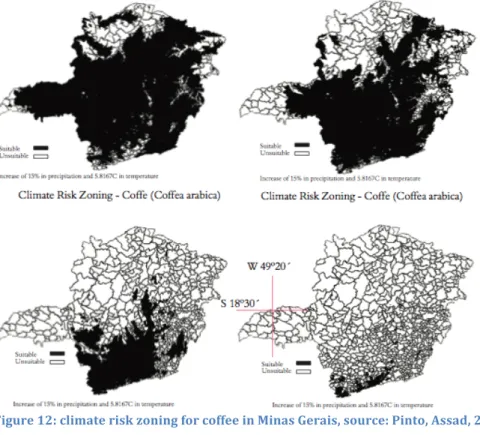
mean annual temperatures are expected to increase above 4 C in summer and 2 to 5 C in winter until the end of the Century. An increase of rainfall of above 20% in Southeast Brazil in form of more intense and more frequent extreme events is expected. Furthermore, impact scenarios forecast increasing evapotranspiration, water scarcity and an increasing number of areas with high climate risk, leading to less suitability for agricultural production. In order to predict climate change impacts on agricultural production CPTEC simulated the climate outlook for each Brazilian municipality in 2020, 2050 and 2070 for the IPCC A2 and B2 scenarios. Based on these predictions, Hilton S. Pinto and Eduardo D. Assad, at Embrapa and Unicamp, developed impact scenarios for nine important agriculture crops. According to their studies Arabica coffee is the crop, which will suffer most evident geographical redistribution. It is likely to lose up to 33% of current area in Sao Paulo and Minas Gerais, the two main coffee producing states in Brazil and increases in suitable area in Paraná, Santa Caterina and Rio Grande do Sul. Due to temperature increase the risk of frost in southern parts will decrease, thus becoming more suitable for coffee cultivation than previously. Despite the predicted increase in the South there will be an overall loss of suitable area for coffee cultivation. Based on available impact scenarios Marcelo B. Camargo proposes adaptation measures for coffee cultivation, that range from shade management (arborization), planting at higher densities, vegetated soil, irrigation, genetic breeding for pest management and other measures. Despite the excellent research work, no practical implementation of adaptation or mitigation measures in coffee sector in Brazil could have been identified. Hence, it is urgently required to start the implementation of adequate adaptation measures that may prevent serious economic losses. All necessary baseline data are available and the existing institutional framework and excellent capacities serve very well to realize adaptation in practice efficiently. In the North eastern municipalities of Pintadas a pilot project aimed at strengthening the adaptive capacity of communities has successfully combined adaptation with poverty alleviation by installing efficient irrigation systems. The experiences of the pilot project can be transferred to the coffee sector in other Brazilian regions. An ongoing cooperation between Brazil and Germany aims at the evaluation of results from this project and the potential to scale it up. This initiative can be a valuable partner for the present initiative on Coffee & Climate (C&C) in order to design a toolbox for adaptation and mitigation practices in the coffee sector.
Climate change impacts on coffee in Tanzania
Past climate tendencies in Tanzania have been for steadily rising temperatures, decreasing rainfall and periodic droughts and excess rainfall associated with El Nino/La Nina cycles. Nevertheless models of future climate indicate an increased rainfall in both rainy seasons in the bimodal Northern Highlands, but probably some intensification of the dry season in the unimodal southern highlands, with a slight decrease in total rainfall.
The National Adaptation Plan quotes a study that estimates the impacts of climate change on coffee production and found that an increase in temperature of 2oC and higher rainfall would increase
productivity by 16-18%, but with a 4oC increase in temperature production would become limited in the
southern highlands. This contrasts with findings from Kenya and Uganda that indicate that climate change would lead to a significant redistribution of coffee growing areas with the minimum altitude for Arabica production increasing by up to 400 m, and Robusta cultivation moving to higher rainfall zones. Surveys of farmers show a very strong belief that climate is changing with greater irregularity of rainfall patterns and less rainfall leading to lower productivity. Changes in the altitude suitable for coffee production could obviously lead to considerable socio-economic impacts as farmers have to change their livelihoods, and environmental impacts as coffee production needs to expand at higher altitude areas competing with forestry and natural ecosystems (e.g. on Kilimanjaro)
The National Coffee Development Strategy aims to double coffee production by 2020, but does not consider the potential threat of climate change and climate variability to the success of that strategy, despite the known impacts of La Nina droughts on coffee productivity. At present there appear to be very few initiatives on adaptation and mitigation of climate change in the coffee sector of Tanzania,
although there are agricultural adaptation projects in execution such as that coordinated by NRI and the University of Dar Es Salam.
Climate change impacts on coffee in Viet Nam
Viet Nam published its second National Communication to the UNFCCC in December 2010 with strong support from international institutions such UNEP and GEF. Hence, the access to climate change data and impact scenarios for Viet Nam is very good. According to GCM the temperature in Viet Nam is expected to increase by 1.4 to 4.2 C by 2090s. The number of hot days (above 25 C) is expected to increase by 23 to 55% by 2090s, mainly in the wet season. For the Central Highlands, where coffee is grown, the number of hot days is even expected to rise to 94 in 2020, 134 in 2050 and 230 in 2100. The impact on Robusta coffee is not yet analysed but need to be considered. Furthermore, GCM indicate increasing rainfalls (-1 to +33% by 2090s), mainly in the wet season, but this is expected to be offset by predicted decrease of rainfall in the dry season (-62 to 23% by 2090s). The total rainfall is expected to increase by 2 to 14% by 2090s, mainly due to increasing extreme weather events from June to October.
National impact scenarios predict serious impacts on water resources, costal zones and the agricultural production map of Viet Nam. River flows in the South are expected to decline. Groundwater is expected to drop up to 11m compared to the current level. Evapotranspiration, also in the Central Highlands, is expected to increase and the demand for irrigation in agriculture is calculated to be two- to threefold compared to current demand.
Viet Nam is the world s largest producer of Robusta coffee. Robusta, covering 95% of the total production, is grown on more than 500,000 ha, mainly in the Central Highlands. The Vietnamese coffee sector has the highest yields and productivity (3.5 t/ha) worldwide. But this is due to intensive monoculture associated with deforestation, land degradation, water over-exploitation and the intensive use of fertilizer (2t/ha/year). Unsustainable cultivation practices make coffee plantations and farmers highly vulnerable to currently perceived and future climate change. The main problem is the over-irrigation and inefficient water use. Irrigation is required during the dry season from December to April in order to achieve a 270 days growth period for optimal yield. Dave D Haeze and other researchers studied the irrigation practices and found out that irrigation currently uses between 1,500 and 3,000 m3
of water per ha per year. Three waterings are applied every year in order to break bud dormancy and induce fruit setting. Each watering uses between 600 to 900 litres per tree. The scientists state that this enormous amount of water is far too much and recommend reducing it to only 320 litres per tree and watering. Efficient irrigation will probably be one of the most critical factors in the near future given the climate change impact scenarios on water resources that predict a decline in rainfall, river flows and the drop of groundwater level, specifically in the Central Highland coffee cultivation area.
Viet Nam is currently suffering from damage caused by the unusual extreme drought that affected the country in 2009/10. Supported by FAO the Vietnamese government institutions have developed national policies to confront the impacts of this severe drought and designed strategies to reduce the risk of future drought events. According to latest press releases the coffee sector is already suffering from climate variability as the 2010/11 harvest output is expected to decline by 20% compared with previous harvest due to extreme drought period and delayed rainfalls.
Numerous national and international climate change activities exist. The Ministry for Agriculture is implementing the Action Plan Framework on Climate Change Adaptation in Agriculture, but without any specific focus on coffee production, although this is the second most important agriculture product. Few coffee research institutions are working on climate change issues, and so far data on impacts and suitability scenarios are not available at all. The proposed adaptation measures for the coffee sector range from efficient irrigation and water management strategies, the application of sustainable cultivation practices and diversification of the production system and farmers income. In order to develop a toolkit for adaptation practices the various climate change activities and institutions involved in the issue should be involved in the activities of the present Coffee and Climate initiative.
There is a high interest and willingness to cooperate among all actors that were interviewed in the framework of the present study.
Climate change mitigation and adaptation in the coffee sector
Monitoring climate change in coffee growing regions
One of the limitations to understanding the impacts of climate variability on coffee production is the lack of precise meteorological data from coffee growing areas. This is critical for the development of climate-based insurance amongst other aspects of adaptation. We would recommend that the Programme establish simple meteorological stations in each of the regions where it works monitoring maximum and minimum temperature and precipitation. Different indicators should be reviewed with local experts in each country, but it would be useful to have a minimum set compiled across all countries where the project works, which would to some degree compensate for lack of long time series. Such information would need to be correlated to the productivity of coffee plantations, unfortunately long series of data ‒ ideally over 20 years - are required to generate conclusions, but it is never too late to start.
Adaptation strategies
As is illustrated in the country profiles there are a number of initiatives to promote adaptation in the sector, covering a lot of important strategic elements. Some approaches focus on the farmers and their organizations and are more holistic in their strategies (AdapCC, innovations project) while others are more technical or specific in approach (CafAdpt, index based insurance), or look to combine these approaches (Coffee Under Pressure). Although initiatives to promote the principles of sustainable production are an essential pre-requisite to achieve adaptation to climate change, they are not a sufficient response to buffer the magnitude of impacts that are expected. Investment is required from public and private sources to develop technologies that will enable coffee producers to better adapt to climate change. These processes have been started by CATIE/CIRAD/CIAT in Central America and University of Campinas/Embrapa in Brazil. The strategies for adaptation to climate change typically include the following elements all of which may be considered necessary to achieve the ultimate goal of sustaining coffee producers and the industry in the face of climate change:
• Community-based analysis of climate risks and opportunities
• Sustainable production techniques, such as shade management, new varieties better adapted to future climate conditions, conservation of soil and water sources, diversification of the production system and income sources
• Improved access to climate information for coffee producers • Weather insurance products
• Financing to invest in adaptation and mitigation • Payment for environmental services
• Organization among small-scale farmers • Value chain adaptation strategies
Climate modules and codes
The Sustainable Agriculture Network and the Common Code for the Coffee Community have developed climate modules or add-ons to their normal standards. The two are similar in the processes they wish to reinforce namely the development of climate adaptation and mitigation plans for the farm and associated community, the promotion of management practices that should reduce greenhouse gas emissions and/or increase carbon sequestration, and the promotion of sustainable production practices that should increase the resilience to climate change.
Mitigation Strategies
i. Reducing the contribution of coffee production to greenhouse gas emissions, this is primarily a function of the carbon footprint of coffee production.
ii. Sequestration of carbon in the shade trees or forest areas of the coffee farms, the conservation of existing trees could potentially be recognized under REDD+, while planting of new trees on land previously without trees have established protocols as mitigation against other emissions.
Studies of carbon footprints from coffee production indicate that on-farm emissions, and in particular nitrogen fertilization account for about 40% of the carbon footprint of the whole coffee chain (PCF 2008). Pressure or incentives to reduce the carbon footprint of coffee production currently come primarily from the industry and indirectly consumers. Recently Coopedota in Costa Rica announced their coffee as carbon neutral (www.coopedota.com).
Recommendations for the Coffee & Climate initiative
1. Although it is relatively clear the general effects of climate change on Arabica coffee production, this is not the case for Robusta coffee. Specific studies are required to determine the factors that may affect Robusta and where these may have most impact.
2. The project should explore options to reinforce efforts of research projects in Central America and Brazil to develop technologies to enable the adaptation of coffee production to future climatic conditions, as well as how to build on the results of these initiatives for adaptation of production systems in East Africa and SE Asia.
3. There is need to define climate variables for monitoring in producer areas to determine the actual nature of climate variability and its impact on coffee productivity and quality.
4. Engage or initiate research and validation of shade for climate resilience, adaptation and mitigation in countries where shade is not traditional, i.e. Brazil, Vietnam and Tanzania, through interchanges with regions where shade is traditional e.g. Central America and India. It is important that any trials should be well designed and managed as otherwise introduction of poorly managed shade can lead to rapid declines in productivity.
5. Given that climate variability and extremes are likely to be a considerable part of climate change, it would seem that greater effort should be put into testing and resolving the outstanding issues around the viability of weather insurance.
6. Training, facilitation and financing are required to scale up the adoption of the SAN Climate module, the 4C climate code and the adoption of the climate adaptation and mitigation measures in general to increase the resilience of coffee producers to climate change.
7. We consider that it is necessary to validate the effects of the mitigation aspects of the climate modules in order to gain credibility and so that compliance with these criteria can bring economic and market benefits to farmers.
8. Also both systems promote farmers maintaining some register of GHG emissions. Tools need to be developed to enable farmers to keep reasonable measures, nevertheless we consider that it is probably necessary to develop a specialist service to process this information to provide reliable orientation as to the tendencies in GHG emissions, this could include the calculation of a farm carbon balance or footprint.
9. There is certain confusion in the industry on the relationship between the carbon footprint of the coffee chain and the apparently high emissions from on-farm against the carbon stocks and potential sinks from shaded coffee production. A synthesis of the information available should be conducted to try to resolve the relationship between these two processes and evaluate the potential for on-farm sinks to compensate emissions and contribute to a climate friendly carbon neutral coffee industry.
10. The programme has the opportunity to facilitate value chain adaptation strategies to manage variations in the supply of coffee due to climate change so as to not affect the long-term relationships between actors.
II
G
ENERAL
I
NFORMATION ON POSSIBLE
C
LIMATE
C
HANGE
I
MPACTS IN
C
OFFEE
C
ROP
Impacts on the Coffee Arabica plant
Thermal and rainfall conditions are considered to be the most important factors in defining potential coffee yield. Arabica coffee vegetates and fructifies very well in tropical highlands. It is native to the tropical forests of East Africa at altitudes ranging from 1,500 to 2,800 m, where air temperature shows little seasonal fluctuation and rainfall is well distributed over the year. The distribution of rainfall and air temperature interfere in the crop phenology, and consequently in productivity and quality. Above 23 C, the development and ripening of cherries are accelerated, often leading to loss of quality. Continuous exposure to daily temperatures as high as 30 C could result not only in reduced growth but also in abnormalities such as yellowing of leaves. A relatively high air temperature during blossoming, especially if associated with a prolonged dry season, may cause abortion of flowers. The process of photosynthesis becomes limited when water stress occurs, due to closing of the stomata and reduction in other physiological activities of the plant (Camargo, 2009). It should be noted, however, that selected cultivars under intensive management conditions have allowed arabica coffee plantations to be spread to marginal regions with mean annual air temperatures as high as 24-25 C, with satisfactory yields, such as in the Northeast and North regions of Brazil (Fazuoli et al, 2007; Bergo et al, 2008). On the other hand, in regions with a mean annual air temperature below 18 C, growth is largely depressed. Occurrence of frosts, even if sporadic, may strongly limit the economic success of the crop (Camargo, 2009).
As regards water needs, the coffee plant requires moist soil during the period of vegetatitive growth and fructification, and drier soil in the periods of fruit maturing and harvest.
A quality problem could arise, from the faster plant growth that will lead to lower coffee fruit quality. Besides, high maximum temperatures during summer months may cause an excessive fruit ripening, against fruit quality. Coffee trees are resistant to high summer temperature and drought, but the increase of extreme conditions can be responsible for physiological stresses, such as the reduction of photosynthetic efficiency. Other critical phases are flowering, in relation with the breaking of bud dormancy break, and grain fill. Moreover high temperature and dry conditions during the reproductive phase can be critical for the optimum coffee production and quality. The setting of adequate air temperature limits for coffee is decisive for the distribution and economic exploitation of the crop (Camargo, 2009).
The scenarios on climate change of the International Panel on Climate Change (IPCC) predict for most parts of the Central American region an increase in mean annual temperature between 1-2 C until 2050. Dry seasons are expected to become even drier and precipitation is predicted to reduce, in some areas up to 30%, and to be distributed less regularly (IPCC, 2007). Consequently, the optimal climate conditions for Arabica coffee cultivation in most of the current production regions are likely to change. In addition, higher temperatures improve living conditions for pests and diseases. Increasing pest attacks lead to the loss of quality of the coffee beans or even to the destruction of yield and plants.
Impacts on the Coffee Robusta Plant
Robusta coffee is native to the lowland forests of the Congo River basin, with extend up to Lake Victoria in Uganda. This species developed as a midstorey tree in a dense, equatorial rainforest. In that region, the annual mean temperature ranges from 23 to 26 C, without large oscillations, with abundant rainfall superior to 2000 mm distributed over 9 to 10 month period. High temperatures can be harmful, especially if the air is dry (Coste, 1992). Robusta is much less adaptable to lower temperatures than arabica. Both leaves and fruits do not withstand temperatures below 6 C or long periods at 15 C. As altitude relates to temperature, robusta coffee can be grown between sea level and 800 m, whereas arabica coffee grows better at higher altitudes and is often grown in hilly areas,
as in Colombia and Central America. Robusta coffee grows better in areas with annual mean temperature among 22 to 26 C, as in the Republic of Congo, Angola, Madagascar, Ivory Coast, Vietnam, Indonesia and Uganda. In Brazil the main areas that cultivate the robusta are the lowlands areas of the Espirito Santo and Rondonia states (Camargo, 2009).
Robusta coffee (Coffea canephora), as its name suggest, is less sensitive to climate changes. With its origins in the low equatorial regions of the Congo basin, with a hot and humid climate, the plant adapts well to much higher temperatures, with annual averages of 22 C to 26 C. However the coffee plant, in general, is far less tolerant of the cold. Temperatures of -3,5 C provoke damage to leaf tissue and trunks. Other publications consider temperature below 5 C lethal. These levels can be practically lethal to the plant, depending on the topographic conditions of the plantation. The crop is more vulnerable to frost when located in valleys, where the air builds up on cold nights (Camargo, 2009). The EcoCrop model of FAO summarizes optimal and absolute conditions for arabica and robusta coffee as follows:
Arabica Robusta
Optimal Absolute Optimal Absolute
Min Max Min Max Min Max Min Max
Temperature 14 28 10 34 20 30 12 36
Rainfall 1400 2400 750 4200 1700 3000 900 4000
Soil pH 5.5 7 4.3 8.4 5 6.3 4 8
Source: EcoCrop/FAO, 2011, http://fao.org/ecocrop
Impacts on the Coffee Industry
The already perceived and for the future predicted impacts of climate change on coffee production will not only threat small-scale farmers as they are at risk of losing their yield and family income. Moreover, all actors of the value chain, including the consumer will be affected. Reduced areas suitable for production will influence the world coffee market, especially for high quality or gourmet coffees or brands with Denomination of Origin status, and will increase the pressure on the price. More coffee may need to be grown under irrigation, thereby increasing pressure on scarce water resources. All the foregoing will increase the cost of production whereas in the future fewer parts of the world may be suitable for coffee production. If so then the already evident growth in concentration could become even more pronounced, bringing with it an increased risk of high volatility. For example if an extreme event should severely curtail the output of one of the major producers (Läderach et al, 2010).
Leo Peskett from the Overseas Development Institute related the IPCC scenarios (A1F1, A2, B1, B2) with the international coffee market and found out that under all scenarios global coffee production will fall leading to significant price rises . In consequence, the competition for high quality products might become more serious, keeping in mind the steadily growing demand for certified high quality and environmentally friendly coffee. Some market actors surely will be able to benefit from rising prices, but it is obvious, that on the other hand this will create a lot of climate change losers, among them small-scale farmers, whose livelihoods heavily rely on the income from coffee production (ICC, 2009).
Climate Change Impact Assessment Tools
The climatic variability is the main factor responsible for the oscillations and variation of the coffee grain yield in the world. The relationships between the climatic parameters and the agricultural production are quite complex, because environmental factors affect the growth and the development of the plants under different forms during the phenological phases of the coffee crop. Agro-meteorological models related to the growth, development and productivity can supply information for the soil water monitoring and yield forecast based on the air temperature and water stress derived by a soil water balance during different crop growth stages, quantifying the effect of the available soil
water on the decrease of the final yield. The processes of photosynthesis become limited when water stress occurs, due to closing of the stomata and reduction in other physiological activities in the plant. Other climatic factors can reduce the productivity, such as adverse air temperatures happened during different growth stages. An meteorological study was conducted aiming to develop an agro-meteorological model (Camargo et al., 2006) that monitors and assesses the quantitative influence of climatic variables, such as air temperature and soil water balance on the coffee crop phenology and yield for different Brazilian regions. That kind of model could be an efficient tool to assess the environmental effects of new technologies, and future climate change scenarios.
Especially Brazilian scientists since many years are studying the impacts of climatic variability and climatic events on quality and yield of the coffee beans. They assessed the impacts of pests and diseases, frost attacks, heat waves and water stress or water shortages on the fruit, mainly of Arabica coffee. In Viet Nam, where mainly Robusta is grown and intensive irrigation is applied, scientists started assessing the demand for irrigation and are developing more efficient irrigation systems. But there is still a high level of uncertainties, first of all regarding future climate change modelling and secondly regarding the real impacts that will affect coffee yield and quality in the future. Harvest output, productivity and fruit quality depend on a complex system of more or less interrelated environmental, technological and social factors. Temperature and rainfall distribution are just two of them. In addition, the fertilization impact of additional CO2 in the atmosphere needs to be considered, when forecasting climate change impacts on coffee production. Although some institutions started investigations on that issue, up to now very few information is available.
Drought and high and low temperatures are undoubtedly the major threats to agricultural crop production, and the possibility to develop projections of drought occurrence at the regional scale is a necessary step toward the definition of suitable adaptation strategies for the coffee sector. In deriving drought projections from regional climate scenarios, the capability of climate models to reproduce the key feature of the hydrological regime should be examined. In addition, from a risk analysis standpoint there is a pressing need to quantify uncertainties in the projections and provide probabilistic assessments of the impacts of climate change, including frost (Camargo, 2009).
III Country Profiles
1.
C
OUNTRY
P
ROFILE
G
UATEMALA
Summary of Findings
i. Guatemala is projected to experience an increase in temperature of between 2 - 2.5 C by 2050 and a reduction in rainfall in the July-August-September period, the latter obviously is critical for agricultural productivity.
ii. The changes in suitability for coffee production across the country vary, with loss of suitability for coffee in Eastern and Southern Guatemala and all areas below 1000 masl, while Central and Western Guatemala maintain suitability, with the possibility of new areas becoming suitable for coffee that are not currently.
iii. These changes are subject to revision depending on improvements in the modelling of the response of coffee to climate change to take into account response to increase in CO2, socioeconomic factors, and climate variability.
iv. There are several initiatives to promote adaptation to climate change among coffee producers in Central America and at least two in Guatemala, these currently concentrate on development of adaptation plans and promoting sustainable production practices. It is considered that more scientific research is required to develop adaptation technologies v. Mitigation of the impacts to climate change can be divided into reducing the contribution to
climate change from green house gas emissions ‒ primarily as result of nitrogen fertilizer use ‒ or reducing the carbon footprint from coffee production. There are also options for sequestering carbon through reforestation on coffee farms, but at present no process to recognize the carbon conserved in shaded coffee agroforests.
1.1 Projections of future climate change
The following summarises the predictions of change in climate presented in the First National Communication on Climate Change in 2002:
Predicted climate changes
Temperature increases ‒ it is probable that the temperature will increase by the year 2050 between 1.5 C (optimistic scenario) and 4.5C (pessimistic scenario) with the month of May being the hottest one with temperatures exceeding 28C; an expansion of the areas with higher temperatures is to be expected at the expense of the one where currently there are lower temperatures such as the mountainous areas.
Precipitation reduction ‒ all three scenarios (optimistic, moderate, pessimistic) point to an average reduction in precipitations by the year 2050 for the trimester July-September with the month of August presenting the most severe reduction.
Climate variability
In recent years (between 2001 and 2007) storms and droughts have had the highest human and economic impact in Guatemala, with losses for the period 1997-2006 averaging 0.51% of GDP ‒ 485,662 people (around 5% of the country s population) have been affected by storms (3 events) with the cost of the damages reaching US$1 billion and 113,596 people (around 1% of the country s population) have been affected by droughts (1 event) with the cost of damages reaching US$14 million. The damage inflicted by Hurricane Stan alone amounted to economic losses totalling 3.1% of GDP in 2004 According to the Guatemalan Ministry of Agriculture, Hurricane Stan, which hit the
country in 2005, damaged an agricultural area of 720,000 hectares. The crop losses were estimated to be 50% in the case of yellow maize, 80% for black beans, 30% for white maize, 90% for banana, sorghum and sesame and 5% for sugar cane. It is also estimated that in some areas of the western departments, 100% of the small livestock died as a consequence of the disaster (UNDP 2009). The UNDP report makes no mention of losses from the coffee sector, although reports from ANACAFE and FECOCAGUA at the time indicate a loss of 20% in coffee production from the Pacific slope region amounting to $4 million of losses. CEPAL 2005 report a 3.3% reduction in the expected coffee production for 2005 due to Stan.
Current projections of climate change cannot account for climate variability, nevertheless, there is reason to believe that climate variability will increase (Elsner et al 2008) and indications that the frequency and duration of the El Nino/La Nina cycles have become more pronounced (Gergis & Fowler 2009). It is probable that it is years of extreme climatic conditions that will actually eliminate areas in coffee production. This could happen in a number of different ways.
a. In La Nina years hurricanes and persistent tropical storms are favoured and primarily cause flooding, landslides and erosion. During Hurricane Stan the Pacific Slope of Guatemala and Chiapas was affected, road infrastructure was destroyed just prior to the harvest, and there was some direct losses on coffee farms of wet mills and coffee plantations. In areas not affected by these physical impacts the persistent rainfall, and high humidity can lead to fruit fall and accentuate outbreaks of diseases such as Pellicularia koleroga, which normally only have localized effects.
b. In El Nino years there are two effects firstly drought due to reduced rainfall in the wet season and then a longer subsequent dry season leading to complete defoliation of coffee (and even shade trees) and die back of plants (as witnessed in S Nicaragua in 2006/2007, after less than 1000 mm of rain fell in 2006 and the dry season extended into a 7th month).
The second effect at higher altitudes is increased persistence and intensity of cold fronts in the northern winter (Conde et al 2008), this could limit the upward movement of coffee in response to increased average temperatures.
1.2 Impacts of climate change
Guatemala has a higher vulnerability in Latin America in general to climate change, especially in the areas of risk of extreme weather events (70%), dependence on rain-fed agriculture (95%), and employment dependent on agriculture (40%) (UNDP 2009).
Impact on Agriculture
The main crops cultivated in Guatemala are corn, beans, rice, sorghum and wheat (UNDP 2009). According to climate change scenarios to analyze the vulnerability of basic grain production to climate change in Guatemala for the year 2030, increases in temperature of 1.7C (optimistic scenario), 1.2C (normal scenario) and 2.4C (pessimistic scenario) along with variation in precipitation ranging from average 6% increases (optimistic scenario) to 18% decrease (pessimistic scenario) for corn, beans and rice will mainly lead to yield decreases as follows: i) yield increases for corn of up to 15% or yield decreases of up to 34% depending of the zone; ii) dramatic yield decreases of up to 66% for beans for zone 3 of the valley of Asuncion Mita Jutiapa and Monjas Jalapa or modest yield increases of up to 3% for the farmlands of Amatitlan, San Jose Pinula, Palencia and Villa Nueva and iii) yield decreases of up to 27% for the lower areas of the Polochic river basin.
Effects on coffee
The projections of changes in altitude suitable for growing Arabica coffee from Laderach and Eitzinger (n.d.) in Mesoamerica, coincide in that the lower limit would rise from 600-700 masl to about 1000 masl. The upper limits are affected by the land area available for production, which in the case of Nicaragua is very limited, i.e. there is very little land above 1800 masl. Even in Chiapas it was estimated that the area of high suitability for coffee production would be reduced from 265,000 ha to
just 6000 ha (Schroth et al 2010). Thus it is probable that the projections for Guatemala would be very similar, and probably closer to Chiapas, as high elevation land is present.
Changes in altitudinal range apt for Arabica coffee production (minimum 30% suitability) interpreted from Laderach and Eitzinger (n.d.) and Schroth et al (2010)
Country Actual 2050
Min Max Min Max
Chiapas/Mexico 700 m 1950 1000 2150
Nicaragua* 600 1600 1000 n/d
*There is effectively no land for production above 1800 masl in Nicaragua, so it is not possible to calculate a future upper altitudinal limit.
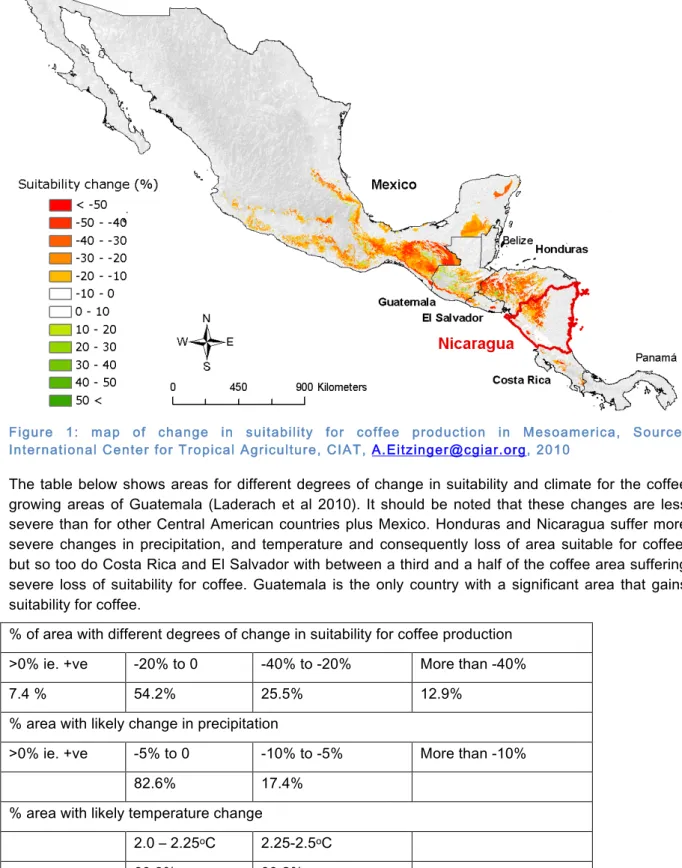
The preliminary Mesoamerican (Central America plus Mexico) distribution maps from Laderach et al (2010) indicate that although low altitude areas in Guatemala would lose suitability for coffee production, there is substantial area where suitability would increase, especially around the high plateau of central and western Guatemala, some of this area is currently not a coffee growing region. A visual interpretation of the maps summarizes the effects by department are as follows, these impressions should be verified using more precise means:
i. The primary areas that would uniformly lose suitability for coffee are the eastern departments of Jalapa, Santa Rosa, Jutiapa and Chiquimula
ii. The lower coffee growing areas along the Pacific volcanic range (San Marcos, Quetzaltenango, Retalhuleu, Suchitepequez and Escuintla) and also Alta Verapaz, would also lose suitability, but not the high altitude areas
iii. The departments that maintain conditions are Guatemala, Antigua, Chimaltengango, Solola and Huehuetenango
iv. Those areas that gain conditions suitable for coffee are Huehuetenango (higher into the Chuchumatane mountains), and also the high mountains of Quiche and Baja Verapaz v. Map of change in suitability for coffee production in Mesoamerica (Source International
Figure 1: map of change in suitability for coffee production in Mesoamerica, Source: International Center for Tropical Agriculture, CIAT, [email protected], 2010
The table below shows areas for different degrees of change in suitability and climate for the coffee growing areas of Guatemala (Laderach et al 2010). It should be noted that these changes are less severe than for other Central American countries plus Mexico. Honduras and Nicaragua suffer more severe changes in precipitation, and temperature and consequently loss of area suitable for coffee, but so too do Costa Rica and El Salvador with between a third and a half of the coffee area suffering severe loss of suitability for coffee. Guatemala is the only country with a significant area that gains suitability for coffee.
% of area with different degrees of change in suitability for coffee production >0% ie. +ve -20% to 0 -40% to -20% More than -40%
7.4 % 54.2% 25.5% 12.9%
% area with likely change in precipitation
>0% ie. +ve -5% to 0 -10% to -5% More than -10%
82.6% 17.4%
% area with likely temperature change
2.0 ‒ 2.25oC 2.25-2.5oC
60.8% 39.2%
There are also two important caveats that may ameliorate the projections of impacts of climate change on coffee distribution, and one that may intensify them.
i. As mentioned above current climate models do not include climate variability, the models are based on projections of average climatic conditions, but do not take into account climate variability, and especially the El Nino/La Nina cycles that dominate the climate in the region. Thus the extremes of climatic conditions either excess rainfall or droughts are not well accounted for in these models, especially the possibility that these cycles may intensify. It will
probably be extreme climatic events, whether drought or excess rain, that will actually be the cause of the loss of coffee plantations.
ii. The projections made are based on the climate conditions of the present distribution of coffee; however it is important to realize that current distribution is a function of the site productivity versus the costs of production. Thus the lower altitudinal limits indicated from the Laderach study are not the physical limits for Arabica coffee plant growth. In both Guatemala and Nicaragua coffee can be found at a lower elevation, with some commercial plantations down to 450 masl, and remnants of previously commercial coffee as low as 300 masl. This low elevation coffee has largely been abandoned because the lower and more variable productivity was not sufficient for it to be economically viable, but if coffee price rises were sustained this situation could rapidly change.
iii. The other consideration is that current models are based on response to temperature and rainfall, but do not consider the plants positive response increased concentrations of CO2. To date there has been no published research to know the magnitude of this response for Arabica coffee, but there is the potential for effects increasing productivity and water use efficiency, which could ameliorate the effects of increased water stress with higher temperatures or lower rainfall.
At present we consider that the changes in coffee distribution developed by Laderach and Eitzinger (n.d.) represent the worst effects that could occur for the degree of climate change modelled (although the climate change predictions used are the average of a large number of models, and not the worst case scenarios), at least in the sense they do not include adaptation of the coffee plant, nor the economics of production.
Impacts and limitations to adaptation
A study between the Universidad del Valle and ANACAFE (Castellanos et al 2008) on the perspectives of farmers indicates that 57% of farmers lost coffee in 2006, 27% due to excess rainfall and 26% due to lack of rain. Overall 39% of respondents were concerned about effects on coffee of drought, 30% heavy rains, and 23% hurricanes. Most considered the frequency of these events has increased, but little can be done a part from shade management in some cases (mostly for drought). A survey by HRNS of farmers in 2010 conducted for the Coffee Climate initiative indicated weaker concerns about climate change than in some other countries, the main concerns were about the effects of excess rainfall and physical damage such as from landslides, and greater variability and more extremes in the climate.
Laderach et al 2010 discuss the adaptation options in the face of climate change. Although suitability mapping indicate that there is potential for coffee to move higher to altitudes that are still suitable for coffee there may be other restrictions to this occurring. Firstly, much of the higher altitude land on the Pacific volcanic change is in forest protecting water and soil resources on very steep slopes, although much of this area is not formally protected it is questionable as to whether it would be appropriate to allow expansion of coffee. This was seen as a significant limitation and threat in analysis of the effects of climate change on coffee and forests in the Sierra Madre of Chiapas (Schroth et al 2010). More detailed mapping should be undertaken to determine the true land area that would be suitable for coffee production between 1900 and 2100 masl.
At the other extreme is consideration of the environmental impacts of abandonment of coffee production at lower altitudes. Medina et al conducted an evaluation of the changes in coffee area during the coffee price crash between 2000 and 2004, and found that a third of coffee had been eliminated below 700 masl, most of this coffee had been under a diverse coffee agroforest system. If the area suitable to Arabica production to a higher altitude the considerable area under coffee agroforests between 700 and 1,100 masl could come under threat affecting biodiversity, carbon stocks, and soil and water conservation.
1.3 Initiatives for adaptation to climate change
AdapCC:
The AdapCC project run by Cafédirect and GTZ (www.adapCC.org), promoted the development of adaptation strategies by coffee cooperatives in Nicaragua, Mexico and Peru. These strategies concentrated on improving disaster preparedness, promoting sustainable production practices ‒ especially soil conservation, tree planting etc, and introducing solar driers to preserve coffee quality during the harvest. Mitigation measures included reforestation to offset emissions and reducing energy use in the mills. It also recognized the need for broader responses such as the development of coffee varieties with a broader adaptability to a range of climatic conditions.
Coffee Under Pressure
Coffee Under Pressure a project between Catholic Relief Services with scientific support from CIAT, and financed by Green Mountain Coffee Roasters, works in Mexico, Guatemala, Nicaragua and El Salvador. Models of changes in suitability for coffee production have been amplified to cover all Central America and Mexico. Subsequently communities have been studied to determine their vulnerability to climate change in three aspects:
i. Exposition which is the change in suitability for coffee production over the next 40 years.
ii. Sensibility which is the degree to which families livelihoods are likely to be affected by climate change
iii. Capacity of families to adapt to the consequences of climate change on their livelihoods.
The exposition is derived from the models of change in suitability. Sensibility and capacity for adaptation are obtained from family interviews of the livelihood strategies of coffee producers (Baca et al 2010). The results of these analyses indicate that the differences in these parameters from family to family, even within a community, can be very great. The project has also mapped the probably changes in suitability for some 30 crops that could provide alternatives to coffee production, and which also contributes to the valuation of the capacity to adapt. Georeferencing of individual farms can permit individual evaluation of the probable change in suitability for coffee, and which other crops may maintain or improve in their suitability for that site. The tool is in development ‒ but hopefully could become a publically available service.
Although fairly specific predictions can be made as regards to the changes in agroclimatic suitability of different crops, this does not take into account suitability of soil, type nor the economic viability of the product. However, the socioeconomic and livelihood capacities for adaptation are much more family and community specific. The development of adaptation strategies therefore requires local processes of identification of sensibility and needs to improve the capacity to adapt.
Climate Insurance
The Government of Guatemala has one instrument in place that supports the agriculture sector in managing climate risks, GUATEINVIERTE. This is a program (a fund) that guarantees lines of credit from private banks to the agriculture sector. As part of the guarantee scheme, the banks are required to request agricultural insurance coverage from borrowers. The program can subsidize up to 70% of insurance premiums according to the crop and location of the farmer.
Over the past three years there has been an initiative by the Inter American Development Bank and World Bank to work with national governments and the Inter American Federation of Insurance companies to develop climate insurance for the agriculture sector. Part of this work is to validate index based climate insurance for coffee producers. CATIE with CIRAD have been contracted to evaluate whether a model can be developed for index based climate insurance for coffee in Nicaragua, initial results are expected by end of April 2011. It is understood that a similar project is being undertaken in Guatemala between La Ceiba Insurance, FEDECOCAGUA with technical assistance from the University of Berkley. From a personal interview with the general manager of La Ceiba it is apparent