EXPLORING THE LIMITS OF NŌ THEATRE
Adapting the traditional elements of nō in shinsaku plays
MARET NUKKE
ACADEMIC DISSERTATION
To be publicly discussed, by due permission of the Faculty of Arts at the University of Helsinki,
in auditorium XV, University Main Building, on 3February 2018, at 12 o’clock noon.
ISBN 978-951-51-3855-2 (printed) ISBN 978-951-51-3856-9 (PDF)
http://ethesis.helsinki.fi
Dipri Tallinn 2018
ABSTRACT
The study of nō theatre, a 14th century traditional Japanese performing art form, has focused primarily on the classical plays, while no extensive studies of the new nō plays or shinsaku nō have been made in Western scholarship.Since all nō plays, classical and new, are theatrical scripts that adapt their themes and characters from literary or other sources, they are viewed in this study as adaptations. Nō plays are a type of adaptations that adapt their sources in a conservative manner, relying on many limits defined by the specific rules of the genre called nō theatre. In this study, nō plays are divided into two categories: genre adaptations, which adapt literary or other sources and involve the change of genre from literature to theatrical script, and kinetic adaptations, which appropriate material from existing plays. In order to clarify the concept of nō plays as adaptations ten adaptation strategies are discussed and examples provided from classical nō plays, forming a theoretical framework for the analysis of shinsaku plays.
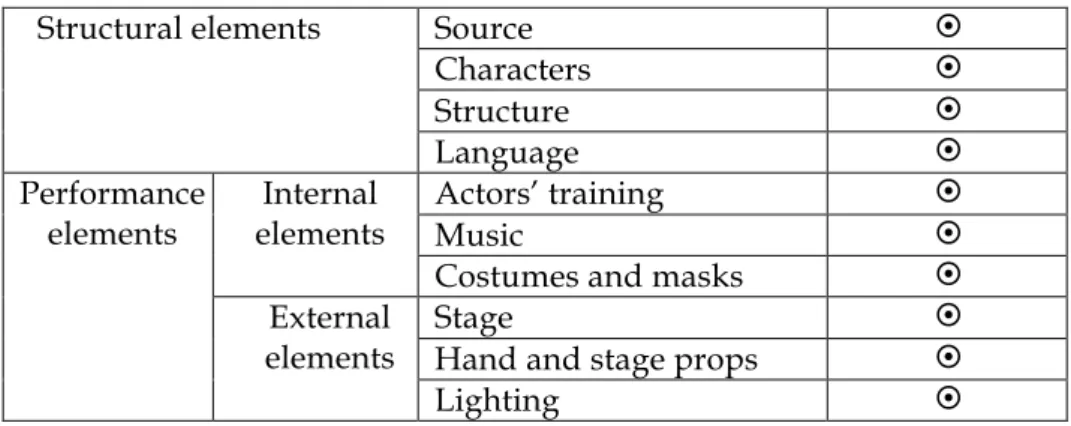
The main focus of this study is on exploring the ways in which source materials have been transformed to create the main characters and intertextuality in shinsaku plays. For creating a comprehensive basis for the analysis, the traditional elements of nō theatre are divided into four structural and six performance elements. All structural elements and three performance elements (the actors’ training, music, costumes and masks) form internal elements of nō plays the modification of which to the extremes causes serious deviance from the limits of the genre. On the other hand, remaining three performance elements as external elements of nō plays (the stage, properties and lighting) offer more freedom and creativity in adaptation.
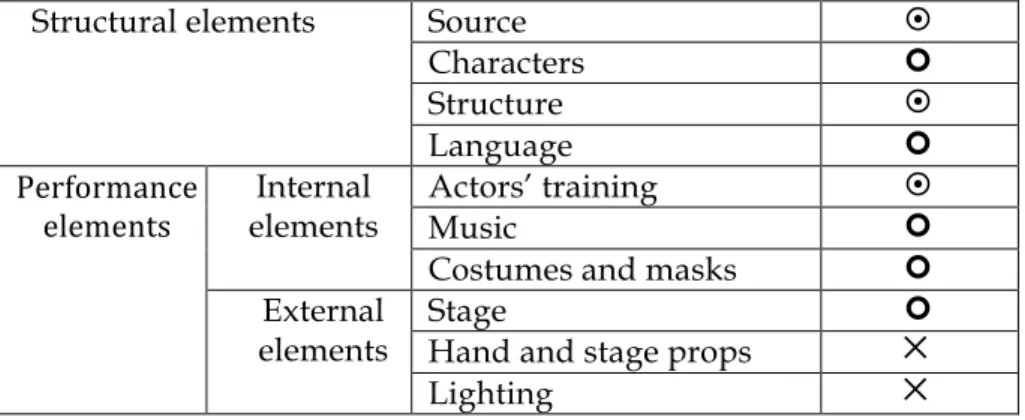
Analysis of the practical application of various adaptation strategies in five shinsaku nō plays revealed that multiple strategies and techniques similar to those in classical plays have been applied simultaneously in the new plays. Some of the structural elements such as the design of characters, use of language and creation of allusiveness were modified to some extent in the new plays, and the prominence of religion was diminished. The internal performance elements were generally adapted within the limits of the nō canon, while the external performance elements were adapted more freely.
ACKNOWLEDGEMENTS
I would like to express my very great appreciation to my supervisor, Professor Rein Raud, and the Institute of World Cultures and staff of the office of postgraduate studies at the University of Helsinki for their support throughout the long years of this study.
This study would not have been possible without the Research Fellow scholarship from the Japan Foundation that enabled me to conduct my research at the Tsubouchi Memorial Theatre Museum of Waseda University in 2004. During my stay in Japan I interviewed eight outstanding persons from the contemporary nō world whose profound insight guided me in my research. I am particularly grateful to Professor Takemoto Mikio from Waseda University whose seminars on Zeami’s treatises helped me to better understand classical nō theatre. He kindly introduced me to Professor Nishino Haruo from Hōsei University whose enthusiasm for the study of new plays influenced me to change my research topic to shinsaku nō. Professor Takemoto also introduced me to renowned nō scholar and playwright Yokomichi Mario whom I had a chance to meet and from whom I later received a personal letter with his thoughts on shinsaku, for which I am particularly grateful. In addition to Professors Takemoto and Nishino I would like to thank nō scholar Professor Yamanaka Reiko from Hōsei University; shinsaku playwright, poet and Kita School actor Baba Akiko; Kanze School actor Uzawa Hisa; senior Hōshō School actor and instructor Kondō Kennosuke; Komparu School actor Sakurama Kinki; and contemporary theatre director Okamoto Akira, for allowing me to interview them.
I am especially grateful to Dolores Lindsay who kindly helped me with the language editing of my thesis, and for financial assistance with editing provided by Tallinn University where I have been working as lecturer in Japanese Studies during my extended postgraduate studies.
I would also like to express my gratitude to my family, especially my late father Arvo for his encouragement to continue my research in times of doubt and uncertainty. I therefore dedicate this study to him, but also to my son Markus and to my dear friend Walter, for their support and abiding faith in me.
ABBREVIATIONS
MYSZ = Mikan yōkyokushū zokuhen (An Incomplete Collection of Nō Plays, Continued, 22 vols., 1987–1998). Tokyo: Koten Bunko
NKBK = Nihon koten bunko (Japanese Classical Literature). Tokyo: Kawade Shobō
NKBT = Nihon koten bungaku taikei (Collection of Japanese Classical Literature, 102vols., 1957–1968). Tokyo: Iwanami Shoten
SNKBT = Shin Nihon koten bungaku taikei (Collection of Japanese Classical Literature, New Edition, 1989–). Tokyo: Iwanami Shoten
SNKBZ = Shin Nihon koten bungaku zenshū (Complete Collection of Japanese ClassicalLiterature, New Edition, 1994–). Tokyo: Shōgakukan
LIST OF TABLES
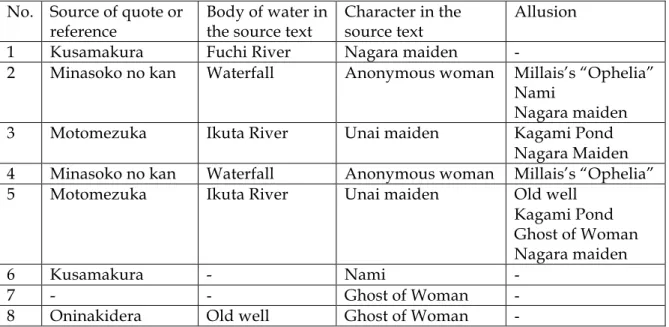
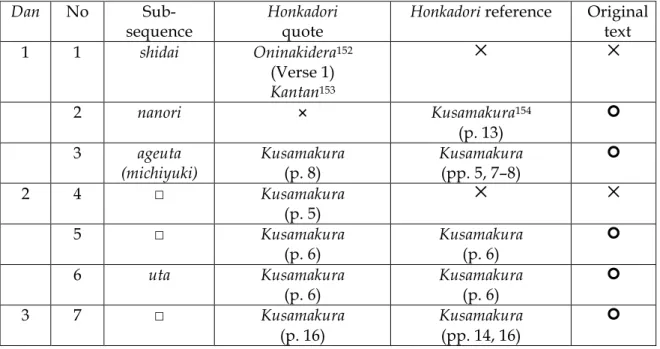
Table 1. Summary of intertextuality in the kuse section of Kusamakura 139 Table 2. Structural analysis of honkadori loans and other references in
Kusamakura 140
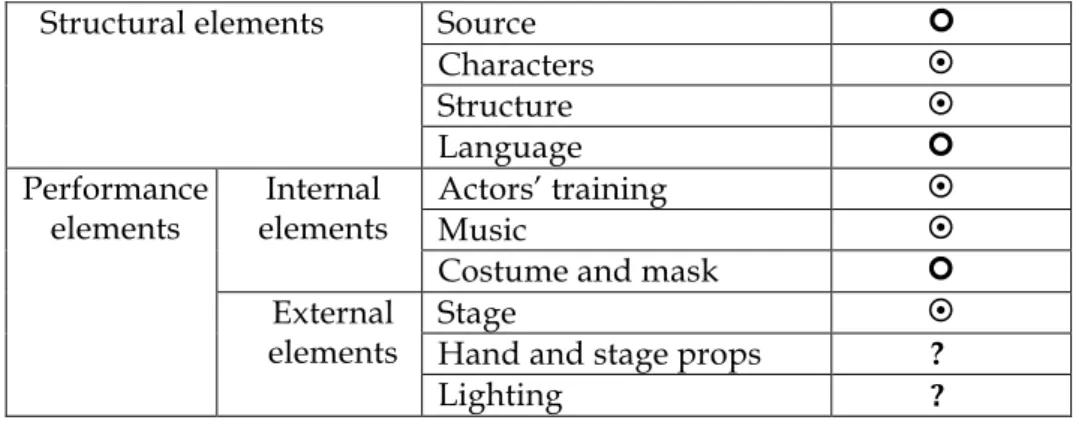
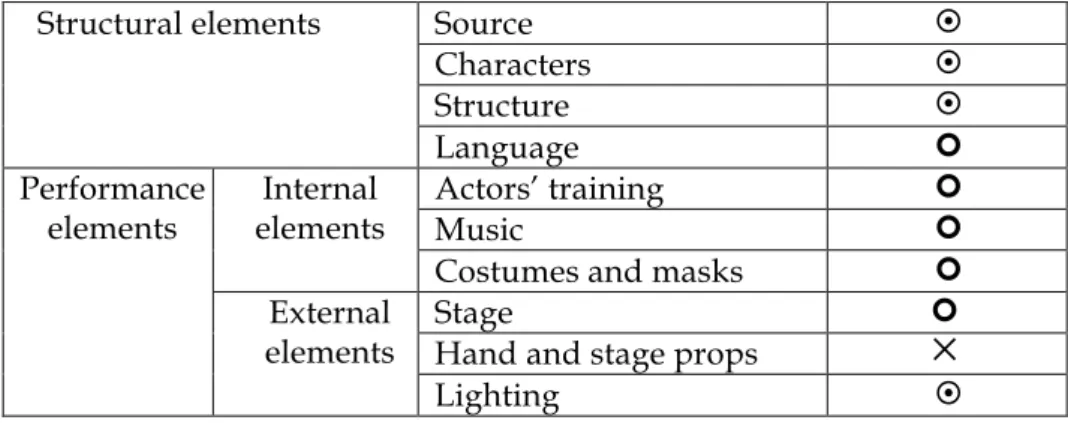
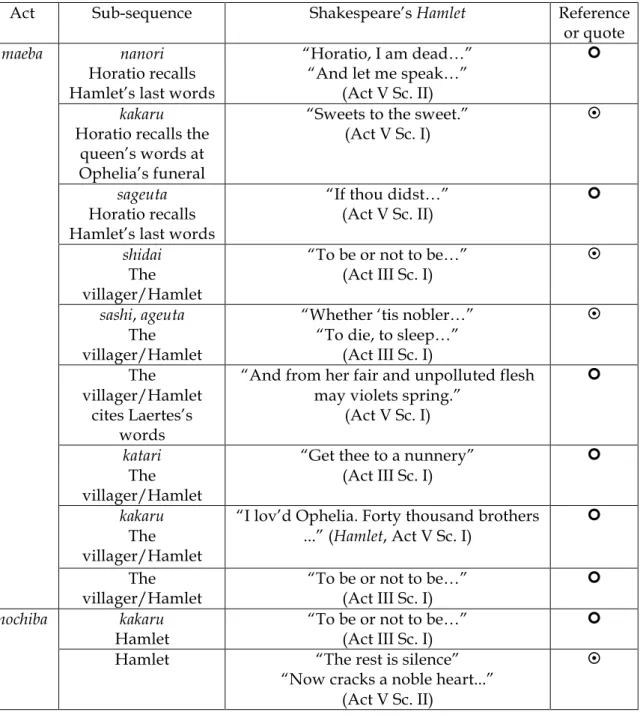
Table 3. Web of nō elements in the shinsaku play Kusamakura 149 Table 4. Web of nō elements in the shinsaku play The Gull 165 Table 5. Web of nō elements in Toki Zenmaro’s Aya no tsuzumi 176 Table 6. Quotes and references in the structure of Nō Hamuretto 182 Table 7. Web of nō elements in the shinsaku adaptation Nō Hamuretto 191 Table 8. Web of nō elements in the shinsaku re-adaptation Takahime 206 Table 9. Structural elements in shinsaku plays 207 Table 10. Performance elements in shinsaku plays 214
TABLE OF CONTENTS
INTRODUCTION 3
CHAPTER 1. NŌ PLAYS AS ADAPTATIONS 14
1.1 Canonical nō plays as adaptations 18
1.2 Strategies for writing genre adaptations 22
1.2.1 Condensation and omission of characters 26
1.2.2 Addition of roles and creation of a fictional story 28
1.2.3 Rearrangement of the logic of the narrative 29
1.2.4 Honkadori as a technique of adapting poetry 30
1.2.5 Creating a play about a meisho or “famous place” 34
1.3 Historical changes in canonical plays as kinetic nōadaptations 35
1.3.1 New interpretation of characters or a play 41
1.3.2 Revision of a script 42
1.3.3 Elimination or addition of characters 43
1.3.4 Reviving a play by combining different historical variants 44
1.3.5 Adaptation of haikyoku plays by extensive rewriting 45
1.4 Conclusion: ten adaptation techniques for creating nō plays 46
CHAPTER 2. ADAPTATION OF THE TRADITION IN SHINSAKU PLAYS 47
2.1 Structural elements of nō plays 50
2.1.1 Source material and characters 50
2.1.2 Structure of the plays 54
2.1.3 Language 60
2.2 Performance elements of nō plays 65
2.2.1 Internal performance elements 65
2.2.2 External performance elements 69
2.3 Additional elements of shinsaku plays 73
2.3.1 Intentions and knowledge of the playwright 74
2.3.2 The role of the director in nō theatre 85
2.3.3 Actors’ right and eligibility to be involved in shinsaku projects 89
2.4 The web of structural and performance elements 90
CHAPTER 3. SHINSAKU NŌ: THE PLAYS, AUTHORS, AND CATEGORIES 94 3.1 Nishino’s thematic categorisation of shinsaku plays 94
3.1.1 Classical themes in new plays 96
3.1.2 Innovative sources of new nō plays 101
3.1.3 Plays about “everyday topics” 103
3.1.4 Characteristics of the thematic categorisation of shinsaku plays 108
3.2 Eigo nō or ”nō plays in English” as possible shinsaku 111
3.3 The categorisation of shinsaku plays as adaptations 115
3.3.2 “Adapted” shinsaku as kinetic adaptations 119
CHAPTER 4. ANALYSIS OF SHINSAKU GENRE ADAPTATIONS 124
4.1 “Original” shinsaku plays: Nishino’s Kusamakura 124
4.1.1 Adapting modern literature to nō plays 125
4.1.2 Creating the shite and waki characters 127
4.1.3 Structure of the play 131
4.1.4 Creating intertextuality with a honkadori collage technique 135
4.1.5 Language of the play 142
4.1.6 Innovative performance elements 147
4.1.7 Conclusion 148
4.2 Shinsaku plays in English: Marlatt’s The Gull — nō for a foreign audience 149
4.2.1 Extracting a story from the aural tradition 149
4.2.2 Creating symbolic characters 151
4.2.3 Structural elements 152
4.2.4 Creating intertextuality in the play 155
4.2.5 Language of the play 159
4.2.6 Adapting the performance elements 161
4.2.7 Conclusion 164
CHAPTER 5. ANALYSIS OFKINETIC SHINSAKU ADAPTATIONS 166
5.1 Shinsaku adaptations of canonical plays: Toki’s revision of Aya no tsuzumi 167
5.1.1 The ancestral nō play Aya no tsuzumi 169
5.1.2 The Kanze School’s Koi no omoni as a variant play of Aya no tsuzumi 170
5.1.3 Toki Zenmaro’s revised play Aya no tsuzumi 172
5.1.4 Conclusion 175
5.2 Transcultural nō adaptations: Ueda’s Zen Buddhist Nō Hamuretto 176
5.2.1 The long path to Nō Hamuretto 176
5.2.2 Adapting Hamlet’s story and characters for nō theatre 177
5.2.3 Honkadori borrowings in the structure of the play 180
5.2.4 From medieval tragedy to Zen Buddhist nō 183
5.2.5 Adapting the language of Shakespeare to the form of nō 186
5.2.6 Conclusion 189
5.3 Re-adaptations into the nō form: Yokomichi’s Takahime 191
5.3.1 Zeami’s Yōrō as a “god play” 193
5.3.2 Yeats’s At the Hawk’s Well, a symbolist play inspired by Zeami’s Yōrō 194
5.3.3 Yokomichi’s re-adaptation Takahime 197
5.3.4 Conclusion 205
CONCLUSION: THE LIMITS OF NŌ IN SHINSAKU PLAYS 207
BIBLIOGRAPHY 219
INTRODUCTION
Nō theatre is a traditional Japanese performing art form that dates back to the
14th century Muromachi period. Nō plays are generally based on existing texts,
primarily literary works. Borrowings from medieval novels, tales and Heian period poems are used to create intertextuality and allusiveness. These literary borrowings of characters, situations and quotes from famous poems that are
woven into the script are special characteristics of the genre. In this study, nō
plays are viewed as theatrical scripts that are drawn from literary or other
sources, and that in the light of contemporary adaptation theories, all nō plays,
classical and new, can be regarded as adaptations.The methods of adapting the
traditional elements of nō theatre to new plays are examined. New nō plays,
called shinsakunō, are generally excluded from the regular repertory, as they are
commonly considered to be of low quality and unsuitable for performing on a professional stage, among other reasons due to their usage of contemporary sources.
The special focus of this study is on exploring the ways unconventional source materials are transformed to create the main characters and
intertextuality in shinsaku plays. The premise is that because of the similarity of
shinsaku plays to classical plays the adaptation of source materials should in principle occur in the same way as in classical plays. Although the sources of
shinsaku plays are modern orcontemporary literature or other kinds of materials,
the adaptation of themes and characters and the creation of allusiveness to other works in the new plays are achieved using adaptation strategies and techniques that are similar to those used in classical plays.
Relevance of current research and the sources
Western scholarship pertaining to traditional Japanese theatre, including nō, has been marginal compared with other fields of Japanese studies, such as religion,
literature and society. In the past, the study of nō theatre has focused primarily
on the history of nō, and on the analysis of theoretical treatises and the scripts of classical plays; research on shinsaku plays seems to have been negligible. Only a
few papers on shinsaku nō have been presented at academic conferences and
seminars, and no extensive studies of shinsaku history and plays in Western
languages have yet been undertaken. Shinsaku has interested very few scholars
even in Japan, where Hōsei University has for many years been the main centre
of the study of shinsaku plays, due primarily to the enthusiasm and contribution to the field on the part of Professor Nishino Haruo, former Director of the Nogami Memorial Noh Theatre Research Institute. Nishino’s research papers on shinsaku history and plays have been published in the journal of the institute,
categorisations. These comprise basically the only sources of research on
shinsaku, although some studies of other scholars interested in the shinsaku
movement in nō theatre have occasionally been published, such as papers by
Professor Yamanaka Reiko and Oda Sachiko.
Just as research on shinsaku plays seems to interest only a few Japanese
scholars, the new plays are also not easily accessible compared with classical
plays. While classical plays that belong to the active repertory of the five nō
schools are publicly available in many different collections of plays, such as two
volumes published in the series ofCollection of Japanese Classical Literature (Nihon
koten bungaku taikei) in 1960 and 1963 (edited by Yokomichi Mario and Omote Akira) and the new edition in one volume (published in 1998, edited by Nishino
Haruo), the only extensive source of shinsaku plays is the twenty-two-volume
edition of An Incomplete Collection of Nō Plays (Mikan yōkyokushū). The collection was edited by Tanaka Makoto from 1987 to 1998 and includes manuscripts and published versions of shinsaku plays arranged in Japanese alphabetical order and containing information about the authors, details of premiere performances, and editorial comments.
In addition to the abovementioned collection of shinsaku plays as the main
source of scripts, and the descriptions and critiques of performances as
secondary sources, in this study I also use material from three interviews I
conducted in 2004 during my research as a Fellow of the Japan Foundation at the Tsubouchi Memorial Theatre Museum of Waseda University. These interviews
include my conversations about the meaning and development of the shinsaku
movement with some of the connoisseurs of the nō world, such as Professor
Nishino Haruo from Hōsei University, shinsaku playwright and Kita School actor
Baba Akiko, and Kanze School actor Uzawa Hisa.1 In addition, I also refer to a
personal letter from acknowledged nō scholar Yokomichi Mario, which contains
an outline of his thoughts on shinsaku andhis famous play Takahime.
General characteristics of classical nō plays
Nō theatre was developed in the 14th century by two creative actors, father and
son Kan’ami Kiyotsugu (1333–1384) and Zeami Motokiyo (1363–1443). The plays
1 I interviewed altogether eight outstanding persons from the contemporary nō world who helped me
to better understand the “shinsaku movement” – the creation of new nō plays and the place shinsaku
plays occupy in the nō theatre. Besides the recorded conversations with Nishino, Baba and Uzawa, I
conducted interviews also with Professor Takemoto Mikio from Waseda University, nō scholar
Yamanaka Reiko from Hōsei University, senior Hōshō School actorand instructor Kondō Kennosuke,
Komparu School actor Sakurama Kinki, and contemporary theatre director Okamoto Akira. The total length of recordings of the interviews (in the form of mp3) is more than ten hours. However, due to the transformation of research interests during the writing process of this study I decided to use here only three interviews as an empirical material about the nature of nō theatre and shinsaku plays.
in the nearly 700-year-old traditional Japanese art form generally focus on the story of the protagonist, the shite (literally “doer”), who is often cast as a ghost or
demon. The supporting role of the waki (literally “side”) is usually cast as a
travelling Buddhist monk, Shinto priest, or warrior, whose function in the play is
to urge the shite to tell his story at the beginning of the play, and to offer
consolation by saying a prayer for the soul of the protagonist at the end. Both the
shite and the waki may be accompanied by one or more tsure (literally
“companion” or “follower”), whose character intensifies the image of the shite or waki in the play. Between the two acts there might be an interlude performed by
a kyōgen actor who gives additional information about the shite’s story in
colloquial language. All nō plays have a chorus of six to eight shite actors and a
nō ensemble of four instruments — a taiko drum, an ōtsuzumi hip drum, a
kotsuzumi shoulder drum, and a nōkan flute. There are five schools for shite
actors, and separate schools for waki actors (three schools), kyōgen actors (two
schools), and musicians (eleven schools for the four instruments in a nō
ensemble).
Classical nō plays can be categorised in several different ways, according to
the type of main character, structural matrix, timeline and dramatic elements.2
The traditional categorisation is derived from a full-day program seldom
performed today, and is based on the principle of jo-ha-kyū development and
rhythmic progression. The traditional five types of nō plays include god plays
(kami nō or waki nō), warrior plays (shura nō), woman plays (kazura-mono or “wig
plays”), plays about madness (monogurui-mono or kyōjo-mono), and demon plays
(kichiku nō or kiri nō).3 However, in his treatise Fūshikaden (Teachings on Style and the Flower) Zeami described nine different types of roles (SNKBZ 88: 219–
229),4 which implies that the traditional division of plays based on the type of
main character does not reflect all the types of roles found in classical nō plays.
The modern categories were developed by two nō scholars, Sanari Kentarō
(1890–1966) and Yokomichi Mario (1916–2012). They categorised the plays
according to the nature of the shite character, the timeline and structure, and
divided them into phantasmal (mugen nō) or realistic (genzai nō), depending on
whether the play has a ghost or living person as the main character, a dream-like or logical timeline. While the traditional five-category classification of nō plays is
based on the type of shite role and the change of mood over the course of the
2 Additionally, there is a categorization of nō to dramatic nō (geki nō) and spectacle nō (furyū nō) that
bases on the notion whether the play has more dramatic elements or elegant dance movements in it.
3 Sometimes there are also used the alternative names of the five categories that correspond to the
order the plays are performed in a full-day nō program, such as shobanme-mono (“the first play”),
nibanme-mono (“the second play”) etc. These alternative names of the categories are quite technical terms, which do not convey fully the meaning of the category they describe, but instead they point to
the overall change of mood during the nō program.
4 The nine role types include women (onna), old men (rōjin), roles played without mask (hitamen),
mad persons (monogurui), Buddhist priests (hōshi), warriors (shura), gods (kami), demons (oni) and Chinese roles (karagoto).
one-day program, the modern classification is based on their structure, and is derived from the development of or change in the main character.
In addition to the traditional and modern categorisations of nō plays there
is another type that is based on the overall structure of the play. According to
this categorisation nō plays are divided into one-act and two-act plays (the first
act being the maeba and the second the nochiba). In one-act plays the shite does
not leave the stage during the play and the events take place in one location.
Most phantasmal nō (or mugen nō) plays take place in two acts, the shite
appearing in disguise in the first act and revealing his true nature in the second
after changing his costume offstage.5 Thus, the structural composition of a play
is based on a functional need that is derived from the type of main character and the plot of the play.
During the long history of nōtheatre approximately 3000 plays are known
to have been created, and there are about 250 plays in the current repertory (genkō-kyoku). Some plays are seldom performed (“thrown-away pieces” or haikyoku), and they are counted among the nearly 2750 plays that have been
excluded from the active repertory (“out-of-repertory” or bangai-kyoku). More
than 300 shinsaku plays from the Meiji and Heisei periods, written in the 20th and
21st centuries, are generally excluded from the repertory with some rare
exceptions: the Kanze School has one shinsaku play in its current repertory and
the Kita School has five new plays on its playlist.
Developing the contemporary meaning of the word ‘shinsaku’
The literal meaning of the word “shinsaku” is “newly created”, denoting a new
nō play. In its broader meaning, all nō plays were “new” at the time of their
creation. Hence, new plays written in the Muromachi and Edo periods were also
shinsaku plays at the time of their completion and premiere performance. Their
elevated artistic quality and popularity, as demonstrated by numerous staging opportunities, eventually earned these plays a special place in the canonised repertory, making them “classical” or “traditional” from the perspective of
contemporary nō theatre. In the early Edo period, new plays were called shingi
nō or “nō in the new style”, which implies a different attitude toward newly
created plays of the modern era as compared with classical plays. By the end of the Edo period the term shinsakumono or “new pieces” was adopted to describe
modern nō dramaturgy (Nishino 2006: 1–2). Hence, the term “new play” was
first used to distinguish them from earlier, canonised plays.
5 Various nō pieces combine these two types of nō, and are called semi-two-act plays. In this type of
plays shite remains on stage as in one-act plays, but changes his costume onstage, not offstage, as it
would be conventional for two-act plays. Only few plays in the category of mugen nō are in one act,
and the number of this kind of plays does not exceed one tenth of all mugen nōpieces (Yokomichi
A specific meaning of the word shinsaku as “other” or “out-of-repertory” emerged with the plays commissioned by warlord Toyotomi Hideyoshi (1537– 1598). Today these plays are referred to as the hōkō nō or taikō nō plays (“the
duke plays”). Taikō nō plays, which celebrated the victories of living warriors
and involved somewhat politicised performing protocols, led to the connotation
of shinsaku as plays of lesser value, with the result that they were considered
unworthy of inclusion in the regular repertory. Also, the fact that taikō nō plays
were only performed during the lifetime of Hideyoshi probably helped to
establish the image of shinsaku as plays that are experimental in nature,
performed once or twice for a special occasion and then forgotten.
However, already in the Muromachi period, when Komparu Zempō (1454–
1520) and his contemporaries experimented with more expressive forms and used new thematic sources for their “spectacle nō” plays, the experimental image
of “new” or shinsaku works emerged. Later, the shift from medieval to early
modern society witnessed the wide popularity of nō theatre, including nō plays
that were performed by Kyoto courtesans and commoners (Groemer 1998). Nō
plays that were written and performed by amateur actors were not part of the repertory, which was decided by officials of the Tokugawa Shogunate, and probably increased the perception of new plays as works that were outside the tradition.
During the Kyōhō years (1716–1735) of the Edo period, the leaders of the
Tokugawa Shogunate initiated the process of canonising the repertory.6 As
Professor Nishino Haruo observed, the Kyōhō years marked the peak of shinsaku
writing, and the total number of new plays created during the Edo period has
been estimated at one thousand to one thousand five hundred (Nishino 1983:
104–105).7 The novelty of these plays lay in their themes and in the diversity of
their authors, who belonged to different social strata.8 Nishino found that the
majority of the plays from the Kyōhō years have little or no literary or artistic
value, and only two of them have survived to the present day(Ibid., 134, 136).9
Nō scholar Hata Hisashi also confirms that approximately half of the newly created plays from the Edo period were merely adaptations or imitations of
earlier plays (Hata 1987a: 308). He found that these plays lacked originality in
terms of themes, characters, and sources. The other half was comprised of original shinsaku works that drew their plots from well-known classical sources.
6 In the Edo period, the repertory of all five schools was canonised, and almost all plays included in
the list today were created during the Muromachi period, belonging to the ancient (kodai) and
medieval (chūsei) period of nō dramaturgy. The vast majority of the plays out-of-repertory belong to
kinsaku (early modern period) nō from Azuchi-Momoyama period to Edo period.
7 The exact number of Edo period shinsaku plays is hard to define, because scholars have provided
different data. Hata Hisashi, for instance, gives 2000 for the total number of early modern plays (Hata 1987a: 311).
8 The five categories of plays written during the Kyōhō years are explained in Nishino’s paper (1983:
131–134).
9 The two plays created during the Kyōhō years and still included to the repertory are Mugen no kagami (The Mirror of Dreams) and Chūshingura (Forty Seven Loyal Samurai).
However, unlike medieval plays, which mostly used materials from Heian and Kamakura periods, the literary material of the Edo period new plays came from
medieval Japanese sources. Hence, in the Edo period, the authors of new nō
plays continued the tradition of Muromachi period playwrights, who also tended to draw the material for their plays from the literary heritage of earlier historical periods.
In addition to the usage of more contemporary sources, two other
developments characterise shinsaku plays of the Edo period: the comparatively
minor impact of Chinese literary sources, and the gradually diminishing influence of Buddhist themes in the plays. Hata Hisashi hypothesised that the reason for the lack of performance history of many Edo period plays might be that they were either not meant to be performed (written merely as literary exercises) or that after their premiere the scripts were not prepared to be
performed asnō plays, or yōkyoku(Ibid., 311). His view is supported by the fact
that a large number of Edo period plays were written by amateurs (Nishino
1981: 104), and not by professional nō actors, as was common practice until the
end of the Muromachi period.10
However, despite their exclusion from the repertory, some plays from the
Edo period seem surprisingly fresh to a contemporary reader,as Nishino Haruo
commented in his interview (Nishino 2004b), thus contradicting the general
evaluation of shinsaku plays as lacking in quality per se. His opinion indicates that some of the plays might have been unjustly neglected solely because of the
politics that prevailed during the Edo period when the nō repertory was
canonised.
Importance of shinsaku plays
It could be argued that the time in which shinsaku plays were created appears to be one of the main reasons why they were not included in the active repertory of
the five nō schools. The intrinsic contemporaneity of shinsaku plays is not a
weakness or indication of inferiority, as some orthodox leaders of the nō world
have frequently insisted. On the contrary, the introduction of innovative themes that are important to contemporary audiences and are capable of moving them is
10 From there can be made two conclusions, the first of which would be that amateur playwrights had
simply much less knowledge about the nō as an art form, and therefore they failed to create plays that
would have been successfully staged or been interesting enough to attract an attention of professional
nō troupes. This conclusion is supported by Nishino Haruo, who noticed that due to rather simple structure of nō plays, which is similar to the fixed patterns of haiku and tanka poems, there would have been probably many authors, who wrote nō plays just as a part of literary exercise (Nishino
2004b). Another possible conclusion would be that as professional nō groupes performed court music
at the ceremonies of the Tokugawa Shogunate, the plays by amateur playwrights were not suitable for performing on professional stage. Perhaps, the regulations set by the Shogunate, or the pride of professional actors did not allow performing the new plays at the time.
a quality that would be expected of any nō play, whether canonical or shinsaku. The process of adaptation can make important themes more accessible to potential audiences. Julie Sanders has commented, “adaptation can also constitute a simpler attempt to make texts ‘relevant’ or easily comprehensible to new audiences and readerships via the process of proximation and updating,”
(Sanders 2006: 19). In nō theatre, “updating” texts or making them “relevant”
applies adaptation as a technical device to bring canonical source material to a more abstract level. Thus, one benefit of adapting classical literary sources to create new plays would be making temporally distant material available to new generations of audiences. One might think of it as creating new “editions” of classics in theatrical form.
In addition, an important feature of shinsaku plays is their ability to address entirely new themes, such as recent events or significant social issues, which
could breathe new life into nō as an art form. In the terminology of cuisine,
staging the traditional repertory as a menu à la carte is important to improving
mastery of the art.11It is also essential to offer audiences fresh or unusual
“meals” — the new plays — to accustom them to the taste of new ingredients or unusual designs by employing innovative structural and performance elements. Creating new plays helps to hone audiences’ “sense of taste” and prepares them for the quality of “food” they might be served in the future.
Certainly, creating and performing new plays testifies to the vitality of a centuries-old art form. This process is also necessary for attracting new
audiences and making the traditional art form palatable to them.12 New
audiences also demand a change of repertory, whether by offering fresh interpretations of traditional plays or by introducing new themes. Thus, the
shinsaku movement is of vital importance to the survival of nō theatre in the
contemporary world, because it can prevent it from becoming a mere museum attraction for tourists, as has already happened with many Asian theatre traditions.
11 For example, Kanze Hisao explained in his interview with Albert Harris that nō actors “are always
repeating the same plays” learned already in their youth „and each time [they] try to improve [their]
acting from the previous time” (Harris 1986: 329), thus indicating that when performing plays
included to the canonical repertory they only polish their techniques they need for executing the familiar patterns. Kanze Hideo (1971: 11), the brother of Hisao, also criticized this kind of acting practice where “[a]ll that matters is how closely you can approximate the predetermined pattern”. Albert Harris (1986: 101) called this practice a “kind of automatic reproduction”.
12 This kind of necessity derives from the continuous crisis in the nō world that is related to its aging
audiences, which constitute of relatively closed community of experts of the genre, professional and amateur actors alike. For its survival the nō theatre needs desperately to expand its audiences to
include also young generation who would become expert spectators of nō in the future, and perhaps
Shinsaku – a threat to classical nō?
Shinsaku nō or new nō plays are commonly thought to be inferior to classical nō
plays in terms of quality. One reason for this judgement might be the notion that
shinsaku plays often deviate from canonical nō texts and performances due to
their frequent usage of unconventional topics and contemporary literary materials, which might seem to exclude the possibility of employing the traditional elements of nō in the new plays.
Another reason for excluding new plays from the active repertory might
have sprung from a deeply felt concern in nō circles that the adaptation of
traditional elements in the new plays somehow compromises nō theatre as a
classical form of theatre. Many orthodox nō connoisseurs think that nō theatre
should remain unchanged, as they believe it has for centuries. However, the
view that the tradition of nō theatre developed in the 14th century has been
delivered intact and in its authentic form to contemporary actors and audiences might be somewhat incorrect.
Today there are two competing views of nō theatre, the first supported by
the authorities of the nō world, that over its long history the art of nō has
remained unchanged, and the second that it has undergone significant changes. Nō researcher Amano Fumio explains these opposing views by saying that the
former focuses on nō theatre as a theatrical genre developed at the end of the
Muromachi period (1337–1573), while the latter takes into consideration the
history of nō theatre until the present (Amano 2000: 29). He points out that the
first of these interpretations of the history of nō theatre is based on the notion that most of the plays in the active repertory were created during the Muromachi
period, while the second describes the history of nō performances from the
standpoint of nō theatre as a living theatrical art form (Ibid.).
The first approach to nō research concentrates solely on classical nō texts and authors, while the second can be divided into sociological research on the study of performers, historical interpretation of the records of actual performances, and written chronicles that describe festivals, dances and other
details concerning nō theatre (Ortolani 1984: 167). Although these two
approaches set different limits for the observed period of time and have
dissimilar research objectives, it can be concluded that the essence of nō theatre
as a performing art form, or the traditional elements of nō, has not changed
despite its historical development over an extended period of time.
It would appear that the view of nō theatre as a static art form originated
during the Meiji period, when the opinion prevailed in nō circles that the
traditional art form should always be performed according to ancient kata or
patterns (Omote and Amano 1987: 193). Consequently, at some point between
the Meiji Restoration in 1868 and the early years of the Shōwa period (1926–1989)
the myth of the “unchanging nature of nō” was created, implying a certain static
stage of nō theatre that needed to be protected. The mistaken view of the
some outstanding actors of the Meiji era (1868–1912), such as Umewaka Minoru (1828–1909), who at first participated actively in the revival and later in the
preservation of the nō canon, believing it to have been the original tradition of nō
theatre (Nagao 1997: 117).
This misconception created the impression that the true tradition of nō
theatre had been transmitted intact for generations. Darko Suvin called the
legitimisation of a standardised nō tradition in the Tokugawa period the
“invented history” of nō theatre (Suvin 1994: 525). He borrowed the concept
from Eric Hobsbawm, who called it “a set of practices […] which seek [to] inculcate certain values and norms of behaviour by repetition, which automatically implies continuity with the past” (Hobsbawm 1983: 1). The repetition of ancient forms in scripts and performances became the most important part of the preservation of the tradition during the Meiji period, and this practice continues in contemporary nō theatre.
However, Nagao Kazuo explains that there are some difficulties associated with the “interpretation of the meaning of ‘tradition’ (dentō)”, and that it is “the Japanese concept of ‘form’ (keishiki)” that has created this mistaken understanding (Nagao 1997: 115). According to Nagao, the Japanese concept of the static nature of form has led to a misconception of the meaning of tradition,
which has been transmitted in the nō world for decades or even centuries as a
distorted conviction in the “unchanging” nature of nō (Ibid.).
Despite popular belief in the “unchanging” nature of nō, some outstanding
nō actors have expressed rather critical opinions on the issue.13 The various
developments in nō theatre that were described earlier in the introduction
demonstrate that from a historical perspective nō theatre has undergone
significant changes, and therefore the view of nō as an “unchanged tradition” is not valid. Nevertheless, traditional elements and ways of adapting source
materials in creating scripts form the core of the tradition of nō theatre, which
defines the nature of the art.
Therefore, all nō plays, whether canonical or shinsaku, can be analysed
according to the mode and degree of adaptation of the source material and
traditional elements. The creation of shinsaku plays provides an opportunity to
expand the limits of nō theatre due to the usage of unconventional source
materials. It is only natural that orthodox connoisseurs of the nō world would
fear that employing new source materials and creating innovative performance elements would somehow compromise the art. Eric Hobsbawm has written about the confrontation between “invented tradition” and attempts at change
(Hobsbawm 1983: 2), which could instigate protection of the tradition and
provoke resistance to any kind of development. The main research interests of
this study are, first, how the traditional elements of nō are adapted in shinsaku
13 See for instance the opinion on the issue by Kanze Hideo (Harris 1986: 351; Kanze 1971: 11) and
plays, and second, which traditional elements are most likely to be modified in creating new nō plays.
Structure of the research
This study is comprised of five chapters: the first three provide the rationale for
the in-depth analysis of shinsaku plays that follows in the last two chapters.
Chapter 1 describes canonical nō plays as adaptations according to theories of
film adaptation. Because the strategies of film adaptation are not directly
applicable to nō theatre, nō plays are divided into two categories: genre
adaptations that adapt literary sources, and kinetic adaptations that appropriate
material from existing plays. Ten adaptation strategies inherent in classical nō
plays will be discussed in this chapter: five strategies for creating genre adaptations, and five for producing kinetic adaptations. The application of these adaptation strategies will be illustrated with examples from classical plays.
As it would be difficult to analyse the new plays without knowledge of the
traditional elements of nō theatre, Chapter 2 provides an overview of the
traditional structural and performance elements. This chapter also introduces some additional factors that are essential to the creation of shinsaku plays, such as the playwright’s intention to create a nō play and his knowledge of the nō canon,
as well as the actors’ entitlement and eligibility to be involved in shinsaku
projects. In order to illustrate the importance of the playwright’s knowledge of
nōtheatre and intention to create a nō play, a few plays will be analysed, which,
despite the presence of the word “nō” in their subtitles, are shown to be mere
imitations of nō plays. In addition, this chapter also provides an explanation of
the meaning of directing in nō theatre, and gives some examples from the
staging practices of past shinsaku projects. Lastly, a theory of the web of structural and performance elements for non-canonical nō plays and productions will be presented, which will provide a basis for analysing the adaptation of traditional elements in shinsaku plays.
Chapter 3 provides an overview of new nō plays that have been written in
the last one hundred years. Some of the shinsaku plays are adaptations of
classical themes in nō theatre, but the majority have contemporary themes or
adapt unconventional source materials. A common characteristic of new plays is that they have rarely been staged and are often neglected by professional performance troupes. A review of modern and contemporary shinsaku plays and authors in this chapter provides background information on various
developments that have taken place in the nō world during this time. As
information about shinsaku plays is generally lacking in books about the history of nō theatre, this study aims to contribute to filling this gap.
Classical nō plays are variously categorised according to the type of main
character, structural matrix, timeline and dramatic elements. Professor Nishino
traditional classification of canonical plays by the type of protagonist or theme.
However, the innovative sources and contemporary issues on which shinsaku
plays are based presuppose the creation of entirely new types of characters, and categorising them thematically would seem to limit the possible types of characters they might potentially feature. Therefore, this chapter offers a system for distinguishing shinsaku plays as adaptations, by dividing them into two basic categories: first, as “original” shinsaku plays written in Japanese or English, and
second, as shinsaku adaptations of canonical plays and Western classics, and
re-adaptations of western dramas into nō form.
Chapters 4 and 5 contain an analysis of the structural and performance
elements in five shinsaku plays, based on the theory of the nō web of elements.
Two “original” shinsaku plays and three “shinsaku adaptations” are analysed as
genre and kinetic adaptations respectively, in order to demonstrate the practical application of various adaptation strategies in shinsaku plays.
The conclusion summarises the ways in which the traditional elements of nō have been adapted in shinsaku nō plays. This section identifies the elements of nō that are most likely to be adapted in shinsaku plays, the ways in which they
are adapted to conform to the traditional nō canon, and the factors that
CHAPTER 1. NŌ PLAYS AS ADAPTATIONS
Nō plays are generally understood to be theatrical scripts that use existing texts, primarily literary works, as their sources. Borrowing from novels, tales and poems in order to create intertextuality and allusions has been discussed in the nō academic literature.14However, if adaptation theories are applied, the concept of borrowing from literary sources in order to compose a nō play could be
defined as a process of adapting source materials that results in a script in the
form of a classical Japanese drama.
The main object of this study is to explore the ways of adapting source materials and traditional elements of nō to shinsaku plays based on new literary and other sources that appeal to contemporary audiences, but are not common to the classical plays in the current repertory of the five nō schools. Creating shinsaku plays provides a good opportunity to expand the limits of nō theatre because of their usage of unconventional classical or contemporary source materials. Adapting new sources also requires new patterns of movement, hand props, and costumes that do not exist in the classical plays. This leads one to conclude that the key element in the creation of nō plays is the adaptation of source material and the mode of its adaptation; therefore, all nō plays, including canonical and shinsaku plays, can be analysed according to the mode and degree of adaptation of (literary) source materials.
Research on adaptations of nō plays
Nō theatre was developed in the 14th century; it makes extensive use of Japanese
and Chinese classical literature, folklore and legends as its source material, as well as quotations from Japanese traditional waka poems. Classical nō plays are generally not understood to be adaptations, although some studies have analysed nō adaptations of dramas or dramatic adaptations of nō plays from different viewpoints. The traditional approach to nō plays as adaptations is exemplified by the doctoral dissertation of Leo Shing Chi Yip titled Reinventing China: Cultural Adaptation in Medieval Japanese Nō Theatre (2004), which analyses the adaptation of Chinese motifs in karagoto-mono or “Chinese” nō plays. In his
14 For instance, in his monograph Komparu Kunio writes briefly about honkadori as allusive
variations that are a literary device employed to echo earlier works in nō plays, and can be understood as one of “many techniques of playing with language” (Komparu 1983: 153). Thomas Hare also speaks about honkadori as rhetorical techniques involving associations, wordplays and allusive variations, and honzetsu as the source, situation or famous place on which a nō play is based (Hare 1986: 291, 294). Similarly, Karen Brazell does not mention adapting literary sources to another genre or media when she writes about “using an earlier text” (honzetsu) or “the art of allusion” (honkadori), although she summarises the theme in the title of the subchapter that describes “intertextuality” (Brazell 1998: 33–34).
study Yip discusses the socio-political relations between Japan and China at the time, the authenticity of the image of China portrayed in the plays, and the strategies of interpreting and adapting Chinese materials (Yip 2004: 2). He argues that the images of China presented in the nō plays were not the result of “ambivalent acts” of adaptation, but rather that they reflect Japanese perceptions of themselves in their relations with China during that period (Ibid., 4). In brief, Yip’s research analyses the adaptation of literary sources and cultural images of China in “Chinese” nō plays in the context of exploring the “fluid” Japanese self and the “constructed” Chinese other (Ibid., 4–5).
The earliest research on nō plays as sources for Western dramas is Belinda Sue Saxon’s Master’s thesis “Borrowing from the East”: A Study of Types of Western Theater Adaptations of Chinese Opera, Japanese Noh, and Kabuki (1992). In her thesis she explores the methods in which the theatrical conventions of Chinese opera, Japanese nō and kabuki can be adapted to Western theatre. Her research is based on an analysis of choices made by theatre directors who adapted East Asian theatrical conventions to their productions. Saxon posits three modes of adapting Asian theatre: direct, effect, and syncretic. Direct adaptation follows the original production as closely as possible through literary and cultural translation; effect adaptation uses only a few unrelated features or “segments of theatrical conventions” from the source theatre; and syncretic adaptation blends some elements of the source theatre with those of conventional Western theatre, which results in the emergence of a new art form (Saxon 1992: 6).
In her research Saxon acknowledges the problems associated with analysing the adaptation techniques used by Western theatre directors, such as the difficulty of differentiating between effect and syncretic adaptations, and the limited number of examples for analysis (Ibid., 6–8). Saxon uses Yukio Mishima’s
Lady Aoi (a modern adaptation of the classical play Aoi no ue) and Benjamin Britten’s Curlew River (an adaptation of the play Sumidagawa to opera) as examples of direct adaptation, and William Butler Yeats’s At the Hawk’s Well (a symbolist dramatic adaptation of the play Yōrō) as an example of effect adaptation. In her thesis Saxon concludes that in their direct adaptations both Mishima and Britten “approached the adaptation textually […] contain[ing] the plot and atmosphere of the original nō plays”, although they made some changes to the lines and characters. Yeats’s At the Hawk’s Well, which Saxon finds to be “the most typical form of effect adaptation”, did not create a new art form and thus does not fit the category of syncretic adaptations; she commented that Yeats’s use of “Asian theatre as a rebellious tool to break away from the pre-existing conventions” only added an “Asian atmosphere” to the play (Ibid., 70, 81, 86).
In contrast to Saxon’s research, which primarily analysed Western adaptations of nō texts, Judith Virginia Halebsky’s doctoral dissertation
Transformation, Transmission, Translation: Japanese Noh in West Coast Arts Practice in San Francisco and Vancouver (2009) examined the practice of translating and transforming Japanese nō theatre in the context of contemporary experimental
theatre in North America. Her case study of three theatre productions focuses not only on the scripts, but also on the philosophical aspects of nō theatre and “its formal qualities such as movement, acting, vocal technique, and compositional structure” (Halebsky 2009: ii). In her research she analyses three aspects of nō theatre: compositional structure (categories, themes, and structure of the plays), aesthetic structure (concepts of time and space, and acting techniques), and physical structure (stage, costumes, masks, props, staging methods) (Ibid., 3).
Halebsky’s research includes three case studies: June Watanabe’s Noh Project II ‘Can’t’ is ‘Night’, Yuriko Doi’s laboratory theatre project at the Theatre of Yūgen, and Pangae Art’s production The Steveston Noh Project: The Gull, which are respectively collaboration, fusion and transcultural projects. Halebsky summarises Watanabe’s translation of the special relationship between nō theatre performers and spectators into Western theatre as the development of “an attitude of compassion through sharing the moment” between audience and collaborators (Ibid., 81). A thorough analysis of the actors’ training process at the Theatre of Yūgen leads Halebsky to conclude, “Doi departs from the function of
nō but strives to maintain the substance of nō in the training of her students in the United States.” (Ibid., 148) According to Halebsky, the Steveston project translated the language of a nō production in such a way that the performance resonated with the history of Japanese Canadians (Ibid., 165). She acknowledges the success of translating all three aspects of nō theatre: compositional, physical and aesthetic, commenting, “The themes of The Gull as well as many aspects of
nō’s production language created a stage performance with a high degree of similarity to traditional nō.” (Ibid., 167, 212)
The latest research on nō adaptations is by Robert Neblett (2011), who in his doctoral dissertation titled Dramaturgical Crossroads and Aesthetic Transformations: Modern and Contemporary Adaptations of Classical Nō Drama investigates various dramaturgical strategies applicable to contemporary intercultural adaptations of
nō plays. Neblett’s approach to his comparative study is quite innovative as he derives its theoretical basis from the classical division between direct and indirect adaptations, and then proposes four new adaptation strategies for the purposes of analysis. These four adaptation strategies are: first, the correlative strategy, which he deems the most “faithful” method, in which the adaptation is similar to a translation and retains all the elements found in the original text; second, the extrapolative method, in which “the distinctive features of the proto-text remain intact and recognizable, though their correlative markers may have altered slightly”; third, the interpolative strategy, in which the original is merely the inspiration for a new play; and fourth, the stylistic method, which draws on the essence of a genre or style in the creation of a new work (Neblett 2011: 12– 14). In his analysis Neblett uses Yukio Mishima’s modern nō plays as “a comparative lens” through which he “evaluate[s] the quality of other nō adaptations” (Ibid., 20). He focuses on contemporary American nō plays, such as Kenneth Yasuda’s Martin Luther King, Jr.: A Nō Play, and Deborah Brevoort’s
Blue Moon Over Memphis, which Neblett considers to be appropriations of “traditional nōstructures and conventions […] convert[ed] […] into an American theatrical idiom” (Ibid., 178).
Of these approaches, the most relevant to the current study is Robert Neblett’s, which explores contemporary nō adaptations from the perspective of various elements and aspects. In the same way that Neblett’s study uses a holistic framework to focus on the intercultural adaptations of nō, this research analyses shinsaku plays through the lens of the web of traditional elements of nō plays, part of which are strategies for adapting source material for nō plays. However, the difference between this study and Neblett’s research is that his subjects of analysis are from outside the nō world — contemporary dramatic adaptations of nō theatre. He acknowledges that his aim “is not to develop the scholarly tradition of classical nō studies”, as his research belongs to the field of comparative theatre studies (Ibid., 6). This study, on the contrary, purports to explore the limits of nō theatre by analysing new plays that belong to the nō world, using tools and strategies that have been developed within the tradition. It aims to discover the methods by which traditional elements of nō theatre are adapted in new plays, especially focusing on the way new source materials are adapted to create main characters and intertextuality in shinsaku plays.
Adaptation studies and the definition of adaptation
Adaptation theories constitute a relatively new theoretical basis for analysis that is generally used to analyse film adaptations of literature, while translation studies traditionally focus on the adaptation of plays for the stage in order to create a performable translation of a script in another language for a specific target audience. Pascal Nicklas and Oliver Lindner, the editors of a collection of articles on adaptation titled Adaptation and Cultural Appropriation (2012), distinguished three main fields of study in adaptation research: intermedial, intercultural and cognitive. Intermedial studies in adaptation research focus on the ways the source content has been adapted to the new form and the ability to recognise the original in the new medium, which gives rise to the question of the fidelity of the adaptation to the original. The intercultural approach explores the process of cultural appropriation, making use of comparative literature and imagology as analytical tools. The cognitive approach concerns the “aesthetic and epistemological implications of adaptation” in researching the historical, systematic and theoretical aspects of adaptations with respect to their recipients and the market; in simple terms this approach seeks to analyse how an adaptation is received by the audience (Nicklas and Lindner 2012: 2–4).
In his book Contemporary British Drama (2010) David Lane proposes a general definition of adaptation as “the act of taking an existing book, play text or screenplay and transposing it to another context” (Lane 2010: 157). For film theorist Dudley Andrew the process of adaptation is “the appropriation of a
meaning from a source text”, which in a sense narrows the concept of adaptation to producing a version of the source text (Andrew 1984: 97). Marta Minier acknowledges that the term “adaptation” has been widely used to refer to “filmic reimaginings of literature”; although she admits that it could also be applied to all kinds of texts that in the general sense of the word adapt source texts to various media and genres, from literary texts to operas, cartoons and comic books (Minier 2014: 17–18). Katja Krebs, the editor of the book Translation and Adaptation in Theatre and Film (2014), puts forward a different meaning of adaptation as “a creative version of, rewriting of or commentary on a source text, as opposed to translation which, it is assumed, offers sameness and strives for equivalence” (Krebs 2014: 3).
1.1 Canonical nō plays as adaptations
Understanding nō plays as adaptations is applicable to canonical as well as non-canonical (or new) plays, although the meaning of adaptation is different in each case. Therefore, in order to evaluate how the adaptation of source materials and traditional elements occurs in shinsaku plays it is first necessary to define the ways in which source material is adapted in classical plays, because they are the models for creating shinsakuplays.
A close analysis of the canonical nō plays in the current repertory (or
genkōkyoku) of the five nō schools reveals two facts: first, that most nō plays are actually adaptations of various sources, such as literature, poetry and folklore from previous eras, mainly from the Heian (794–1185) and Kamakura periods (1185–1333); and second, that many classical plays are not in the form in which they were originally created, but rather are adapted or revised versions of plays written during the Muromachi period (1336–1573) or later.This study views nō plays as scripts that adapt literary (or other) sources, and argues that all nō plays — classical and new — could be regarded as adaptations in the light of contemporary adaptation theory.
The context of transposition in nō plays
British playwright and dramaturgist David Lane views adaptations as works that re-contextualise the source in three ways: first, transposition of the medium; second, transposition of the original story to a new work; and third, transposition of the story to a new audience (Lane 2010: 157-159). Re-contextualising the source in these three ways means changing the genre of the adaptation as compared with its source; this is a process that often gives rise to the question of fidelity to the original, as well as the recognition and evaluation of the adaptation as a cognitive act on the part of the audience. When these three
contexts of transposing a source are applied to nō theatre the characteristics of nō plays as adaptations become apparent.
According to the first approach Lane introduced in his book, the process of adaptation is a shift of context from one medium to another, which occurs, for instance, when a literary work is transposed to the screen or stage. This change of medium can be observed in nō theatre, because from the traditional Japanese point of view nō plays do not belong to the genre of literature, but rather to theatre. Yōkyoku or “plays ready for staging” include not only the textual part of the play, but also the libretto and the instrumental score, which convey the mood of the play and are considered as important as the text. Therefore, the use of literature or other sources in creating nō plays always involves a shift from one genre to another — from literature to performance. Linda Hutcheon speaks about adaptations as the result of a shift of literary source material from the telling to the performance mode, which is the most common way of transforming material into another work of art(Hutcheon 2006: 23–25, 38).
In light of this knowledge about the nature of adaptation, it can be seen that adapting literary material into the conventional form of nō theatre occurs within defined limits, such as special requirements for the characteristics of the protagonist, the use of sources, and the placement of quotations in the script.The rigidity of these formal conventions seems designed to thwart the ease of adapting source materials; for this reason Diego Pellechia refers to moulding sources into the canonical form of nō theatre as “conservative adaptation” (Pellechia 2014: 77).
Julie Sanders defines adaptation to another genre as “an act of re-vision” (Sanders 2006: 18). Consequently, an adaptation is often considered to be merely a commentary on the original work, and therefore the value of an adaptation is generally thought to be inferior to the original. In theoretical analyses of film adaptations of literary sources, fidelity to the source has become a standard for evaluating the success of the film. This could lead to the assumption that one of the main requirements of an adaptation is following the original as closely as possible in every respect, without deviating from the nature, interpretation, or substance of the characters and events. This gives rise to the main issue concerning adaptations: to what extent should an adaptation remain faithful to its source material? In partial response to that question Julie Sanders states that
“it is usually [at] the very point of infidelity that the most creative acts of adaptation and appropriation take place”, thus presuming that adaptation
involves a certain degree of infidelity to the source material (Ibid., 20).
Linda Hutcheon stresses that one of the specific characteristics of adaptations is that they are received as adaptations and are thereafter compared with the originals(Hutcheon 2006: 21). In the case of nō plays this characteristic of adaptations proves to be incorrect, because instead of comparing a nō play with its source material the nō theatre audience draws familiar associations from the intertextual web of the script. The acknowledgement of nō plays as adaptations of particular texts is not as important as the existence of allusions in