Conditional Functional Dependencies for Data Cleaning
Philip Bohannon
1Wenfei Fan
2,3Floris Geerts
3,4Xibei Jia
3Anastasios Kementsietsidis
3 1Yahoo! Research
2Bell Laboratories
3University of Edinburgh
4Hasselt University/
Transnational Univ. of Limburg
[email protected] {wenfei,fgeerts,xjia,akements}@inf.ed.ac.ukAbstract
We propose a class of constraints, referred to as condi-tional funccondi-tional dependencies (CFDs), and study their ap-plications in data cleaning. In contrast to traditional func-tional dependencies (FDs) that were developed mainly for schema design, CFDs aim at capturing the consistency of data by incorporating bindings of semantically related val-ues. ForCFDswe provide an inference system analogous to Armstrong’s axioms forFDs, as well as consistency analy-sis. SinceCFDsallow data bindings, a large number of in-dividual constraints may hold on a table, complicating de-tection of constraint violations. We develop techniques for detectingCFDviolations inSQLas well as novel techniques for checking multiple constraints in a single query. We ex-perimentally evaluate the performance of our CFD-based methods for inconsistency detection. This not only yields a constraint theory forCFDsbut is also a step toward a prac-tical constraint-based method for improving data quality.
1
Introduction
Recent statistics reveals that dirty date costs US busi-nesses billions of dollars annually (cf. [6]). It is also es-timated that data cleaning, a labor-intensive and complex process, accounts for 30%-80% of the development time in a data warehouse project (cf. [18]). These highlight the need for data-cleaning tools to automatically detect and ef-fectively remove inconsistencies and errors in the data.
One of the most important questions in connection with data cleaning is how to model the consistency of the data,
i.e., how to specify and determine that the data is clean? This calls for appropriate application-specific integrity con-straints [16] to model the fundamental semantics of the data. Unfortunately little previous work has studied this issue. CommercialETL(extraction, transformation, loading) tools have little built-in data cleaning capability, and a significant portion of the cleaning work has still to be done manually or by low-level programs that are difficult to write and main-tain [16]. A bulk of prior research has focused on the merge-purge problem (e.g.,[8, 10, 15, 20]) for the elimination of
approximate duplicates, or on detecting domain discrepan-cies and structural conflicts (e.g.,[17]). There has also been recent work onconstraint repair[2, 5, 7, 19], which
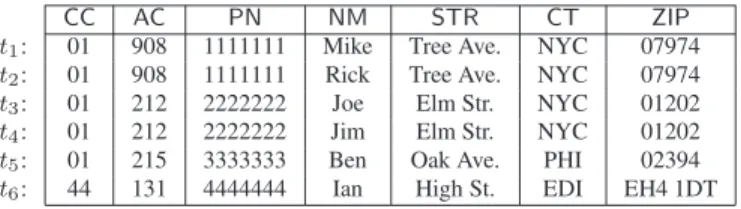
speci-CC AC PN NM STR CT ZIP
t1: 01 908 1111111 Mike Tree Ave. NYC 07974
t2: 01 908 1111111 Rick Tree Ave. NYC 07974
t3: 01 212 2222222 Joe Elm Str. NYC 01202
t4: 01 212 2222222 Jim Elm Str. NYC 01202
t5: 01 215 3333333 Ben Oak Ave. PHI 02394
t6: 44 131 4444444 Ian High St. EDI EH4 1DT Figure 1. An instance of the cust relation
fies the consistency of data in terms of constraints, and de-tects inconsistencies in the data as violations of the con-straints. However, previous work on constraint repair is mostly based on traditional dependencies (e.g.,functional and full dependencies, etc), which were developed mainly for schema design, but are often insufficient to capture the semantics of the data, as illustrated by the example below. Example 1.1:Consider the following schema, which spec-ifies a customer in terms of the customer’s phone (coun-try code (CC), area code (AC), phone number (PN)), name (NM), and address (street (STR), city (CT), zip code (ZIP)). An instance of custis shown in Fig. 1. Traditional func-tional dependencies (FDs) on acustrelation may include:
f1: [CC,AC,PN]→[STR,CT,ZIP] f2: [CC,AC]→[CT]
(Recall the semantics of an FD: f2 requires that two cus-tomer records with the same country- and area-codes also have the same city name.) TraditionalFDsare to hold on all the tuples in the relation (indeed they do on Fig. 1). In contrast, the following constraint is supposed to hold only when the country code is 44. That is, for customers in the
UK,ZIPdeterminesSTR:
φ0: [CC= 44,ZIP]→[STR]
In other words,φ0is anFDthat is to hold on the subset of tuples that satisfies the pattern “CC= 44”, rather than on the entirecustrelation. It is generallynotconsidered anFDin the standard definition sinceφ0includes apatternwithdata valuesin its specification.
The following constraints are again not consideredFDs:
φ1: [CC= 01,AC= 908,PN]→[STR,CT=MH,ZIP] φ2: [CC= 01,AC= 212,PN]→[STR,CT=NYC,ZIP] φ3: [CC= 01,AC= 215]→[CT=PHI]
The first constraintφ1assures that only in theUS(country code 01) and for area code 908, if two tuples have the same PN, then they must have the sameSTRandZIPvalues and
furthermore, the citymustbeMH. Similarly,φ2assures that if the area code is 212 then the city must beNYC; andφ3 specifies that for all tuples in theUSand with area code 215, their city must bePHI(irrespective of the values of the other attributes). Observe thatφ1andφ2 refinethe standardFD f1given above, whileφ3refines theFDf2. This refinement essentially enforces a binding of semantically related data values. Note that while tuples t1 andt2 in Fig. 1 do not violatef1, they violate its refined versionφ1, since the city
cannot beNYCif the area code is 908. 2
In this example, the constraintsφ0, φ1, φ2 andφ3 cap-ture a fundamental part of the semantics of the data. How-ever, they cannot be expressed as standardFDsand are not considered in previous work on data cleaning. Indeed, con-straints that hold conditionally may arise in a number of domains. For example, an employee’s pay grade may de-termine her title in some parts of an organization but not in others; an individual’s address may determine his tax rate in some countries while in others it may depend on his salary, etc. Further, dependencies that apply conditionally appear to be particularly needed when integrating data, since de-pendecies that hold only in a subset of sources will hold only conditionally in the integrated data.
This paper introduces a novel extension of traditional
FDs, referred to as conditional functional dependencies
(CFDs), that are capable of capturing the notion of “correct data” in these situations. A formal framework for modelling
CFDsis the first contribution of this paper (Section 2). Our second contribution consists of techniques for rea-soning aboutCFDs(Section 3). We show that the analysis ofCFDsintroduces new challenges. For example, a set of
CFDsmay have conflicts (i.e.,inconsistencies), a problem not encountered when dealing with traditionalFDs. We de-velop techniques for determining the consistency ofCFDs. We also extend Armstrong’s axioms for traditionalFDs(see,
e.g.,[1]) by providing a sound and complete inference sys-tem, and give an algorithm to compute a minimal cover for a set ofCFDs. These are not only useful for data cleaning as an optimization technique by minimizing the inputCFDs, but also yield aCFDtheory analogous to the theory ofFDs.
Our third contribution is the development ofSQL tech-niques for detectingCFDviolations (Section 4). SinceCFDs incorporate data values, they may in some cases be phys-ically large, and straightforward techiques may lead to a very large number of detection queries. We develop non-trivial techniques to merge and efficiently checka set of
CFDseven with a very large number of conditions. These guarantee: (a) a singlepair ofSQL queries are generated, with a bounded size independent of the data values in the
CFDs, and (b) only two passes of the database are needed. Our fourth contribution is an experimental study of the performance of our detection techniques as data size and constraint complexity vary (Section 5). We find that our
(a) TableauT1ofϕ1= (cust:[CC,ZIP]→[STR], T1)
CC ZIP STR 44 (b) TableauT2ofϕ2= ([CC,AC,PN]→[STR,CT,ZIP], T2) CC AC PN STR CT ZIP 01 908 MH 01 212 NYC (c) TableauT3ofϕ3= ([CC,AC]→[CT], T3) CC AC CT 01 215 PHI 44 141 GLA Figure 2. Example CFDs
techniques allow violations ofCFDswith even a large num-ber of conditions to be checked efficiently on large data sets. However, we also find that care must be taken to present the complicated whereclauses generated by our technique to the optimizer in a way that can be easily optimized.
Finally, we present some observations, including anNP -completeness result, on constraint repair withCFDs, but de-fer further development to a later report (Section 6).
Our conclusion is thatCFDsare a promising tool for im-proving data quality. We discuss related and future work in Section 7.
2. Conditional Functional Dependencies
We next defineCFDs. Consider a relation schemaR de-fined over a fixed set of attributes, denoted byattr(R). Syntax. ACFDϕonRis a pair(R:X →Y, Tp), where (1)X, Y are sets of attributes fromattr(R), (2)R:X →Yis a standardFD, referred to as theFDembedded inϕ; and (3)Tpis a tableau with all attributes inXandY, referred to as thepattern tableauofϕ, where for eachAinXorY and each tuplet∈Tp,t[A]is either a constant ‘a’ in the domain
dom(A)ofA, or an unnamed variable ‘ ’. IfAappears in bothX andY, we use t[AL] andt[AR]to indicate theA
field oftcorresponding toAinXandY, respectively. We writeϕas(X →Y, Tp)whenRis clear from the context.
Example 2.1:The constraintsφ0, f1, φ1, φ2, f2, φ3oncust given in Example 1.1 can be expressed asCFDsϕ1(forφ0),
ϕ2 (forf1, φ1 andφ2, one per line, respectively) andϕ3 (forf2, φ3and an additional [CC= 44,AC= 141]→[CT=
GLA] to be used in Section 4), as shown in Fig. 2. 2 If we represent both data and constraints in a uniform tableau format, then at one end of the spectrum are rela-tional tables which are composed of data values without logic variables, and at the other end are traditional con-straints which are defined in terms of logic variables but without data values, whileCFDsare in the between.
Semantics. Intuitively, the pattern tableauTpofϕrefines the standardFDembedded inϕby enforcing the binding of semantically related data values. To define the semantics of
ϕ, we first introduce a notation. For a pattern tupletc in
Tp, we define an instantiation mappingρto be a mapping
fromtcto adata tuplewith no variables, such that for each
attributeAinX∪Y, iftc[A]is ‘ ’,ρmaps it to a constant
indom(A), and iftc[A]is a constant ‘a’,ρmaps it to the
samevalue ‘a’. For example, fortc[A, B] = (a, ), one
can define an instantiationρsuch thatρ(tc[A, B]) = (a, b),
which mapstc[A]to itself andtc[B]to a valuebindom(B).
A data tupletis said tomatcha pattern tupletc, denoted
byt tc, if there is an instantiationρsuch thatρ(tc) =t.
For example,t[A, B] = (a, b)tc[A, B] = (a, ).
A relationIofRsatisfiestheCFDϕ, denoted byI|=ϕ, if foreach pairof tuplest1, t2in the relationI, and foreach
tupletcin the pattern tableauTpofϕ, ift1[X] =t2[X] tc[X], thent1[Y] = t2[Y] tc[Y]. That is, ift1[X]and
t2[X]are equal and in addition, they both match the pattern tc[X], thent1[Y]andt2[Y]must also be equal to each other and both match the patterntc[Y]. Moreover, ifΣis a set of
CFDs, we writeI|= ΣifI|=ϕforeachCFDϕ∈Σ. Example 2.2: Thecustrelation in Fig. 1 satisfiesϕ1 and ϕ3of Fig. 2. However, it does not satisfy ϕ2. Indeed, tu-plet1violates the pattern tupletc = (01,908, , ,MH, ) in tableauT2 ofϕ2: t1[CC,AC,PN] = t1[CC,AC,PN]
(01,908, ), butt1[STR,CT,ZIP](,MH, )sincet1[CT]
isNYCrather thanMH; similarly fort2. 2
This example tells us that while violation of a standard
FDrequirestwotuples, asingletuple may violate aCFD. Two special cases ofCFDsare worth mentioning. First, a standard FDX → Y can be expressed as aCFD(X → Y, Tp)in which Tp contains a single tuple consisting of ‘ ’ only. For example, if we letT3ofϕ3in Fig. 2 contain only ( , , ), then it is theCFDrepresentation of theFDf2
given in Example 1.1. Second, an instance-levelFDX →Y
studied in [13] is a specialCFD(X → Y, Tp), whereTp
consists of a single tuple consisting of only data values.
3
Basic Properties of CFDs
Having seen thatCFDsare an extension of standardFDs, it is natural to ask whether or not we can still effectively rea-son aboutCFDsalong the same lines as theirFDcounterpart. Is there an inference system, analogous to Armstrong’s Ax-ioms forFDs, to effectively determine whether or not a set ofCFDsimplies (entails) anotherCFD? Does a set ofCFDs make sense,i.e.,are theCFDsconsistent?
These questions are not only fundamental toCFDs, but are also important for data cleaning. Indeed, if an input set
Σof CFDsis found inconsistent, then there is no needto check (validate) theCFDsagainst the data at all. Further, it helps the user discover errors inCFDspecification. WhenΣ is consistent, an effective implication analysis would allow
us to find a minimal coverΣmcofΣthat is equivalent to
Σbut contains no redundantCFDs, patterns or attributes; it is typically more efficient to use Σmc instead ofΣwhen detecting and removing inconsistencies from the data.
We answer these questions in this section. We show that as opposed to standard FDs, a set of CFDs can be incon-sistent. Furthermore, the implication analysis for CFDs is more complicated than theirFDcounterpart. However, we show that in many practical cases the consistency of a set of
CFDscan be determined efficiently. We also provide a sound and complete inference system for the implication analysis ofCFDs, which is analogous to but is more involved than Armstrong’s Axioms forFDs. Based on these we present a technique for computing a minimal cover of a set ofCFDs.
3.1
Consistency of CFDs
One can specify any set of standardFDs, without worry-ing about consistency. This is no longer the case forCFDs. Example 3.1: ConsiderCFDψ1 = (R : [A] → [B], T1), where T1 consists of two pattern tuples ( , b) and (, c). Then no nonempty instanceIofRcan possibly satisfyψ1. Indeed, for any tupletinI, while the first pattern tuple says thatt[B]must bebno matter what valuet[A]has, the sec-ond pattern requirest[B]to bec.
Now assume thatdom(A)isbool. Consider twoCFDs
ψ2 = ([A] →[B], T2)andψ3 = ([B] →[A], T3), where T2 has two patterns(true, b1),(false, b2), andT3 contains
(b1,false)and(b2,true). Whileψ2andψ3can be separately satisfied by a nonempty instance, there exists no nonempty instanceI such thatI |= {ψ2, ψ3}. Indeed, for any tuple
t inI, no matter what Boolean valuet[A]has,ψ2 andψ3 together forcet[A]to take the other value from the finite do-mainbool. This tells us that attributes with a finite domain
may complicate the consistency analysis. 2
Theconsistency problem forCFDsis to determine, given a set ΣofCFDs defined on a relation schemaR, whether there exists a nonempty instanceIofRsuch thatI|= Σ.
This is a nontrivial problem that is not encountered when dealing with standard FDs. It is intractable (by reduction from the non-tautology problem), due to finite-domain at-tributes involved in CFDs which, as Example 3.1 shows, complicate the consistency analysis.
Theorem 3.1:The consistency problem isNP-complete. 2
For data cleaning in practice, the relation schema is often fixed, and only CFDsvary and are treated as the input. To this end we develop an efficient algorithm for checking the consistency of a given set ofCFDs, by generalizing the chase process forFDs(see,e.g.,[1] for chase).
Theorem 3.2: Given any set Σ of CFDs on a relation schema R, the consistency of Σ can be determined in O(|Σ|2)time, if either the schemaR is predefined, or no attributes inΣhave a finite domain. 2
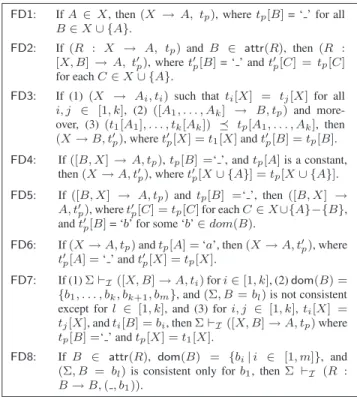
FD1: IfA∈ X, then(X → A, tp), wheretp[B]= ‘ ’ for all
B∈X∪ {A}.
FD2: If (R : X → A, tp)and B ∈ attr(R), then(R :
[X, B]→A, tp), wheretp[B]= ‘ ’ andtp[C] = tp[C]
for eachC∈X∪ {A}.
FD3: If (1) (X → Ai, ti) such thatti[X] = tj[X]for all
i, j ∈ [1, k], (2) ([A1, . . . , Ak] → B, tp) and more-over, (3) (t1[A1], . . . , tk[Ak]) tp[A1, . . . , Ak], then (X→B, tp), wheretp[X] =t1[X]andtp[B] =tp[B]. FD4: If([B, X]→A, tp),tp[B] =‘ ’, andtp[A]is a constant, then(X→A, tp), wheretp[X∪ {A}] =tp[X∪ {A}]. FD5: If([B, X] → A, tp)andtp[B] =‘ ’, then ([B, X] →
A, tp), wheretp[C] =tp[C]for eachC∈X∪{A}−{B}, andtp[B]= ‘b’ for some ‘b’∈dom(B).
FD6: If(X→A, tp)andtp[A] =‘a’, then(X→A, tp), where
tp[A] =‘ ’ andtp[X] =tp[X].
FD7: If (1)ΣI([X, B]→A, ti)fori∈[1, k], (2)dom(B) =
{b1, . . . , bk, bk+1, bm}, and(Σ, B=bl)is not consistent except forl ∈ [1, k], and (3) fori, j ∈ [1, k],ti[X] = tj[X], andti[B] =bi, thenΣI([X, B]→A, tp)where
tp[B] =‘ ’ andtp[X] =t1[X].
FD8: IfB ∈ attr(R), dom(B) = {bi|i ∈ [1, m]}, and (Σ, B = bl)is consistent only forb1, thenΣ I (R : B→B,(, b1)).
Figure 3. Inference Rules for CFDs
3.2
An Inference System for CFDs
Armstrong’s Axioms forFDsare found in almost every database textbook, and are fundamental to the implication analysis ofFDs. We next provide an inference system for
CFDs, analogous to Armstrong’s Axioms forFDs.
Theimplication problem forCFDsis to determine, given a setΣofCFDsand a singleCFDϕon a relation schemaR, whether or notΣentailsϕ, denoted byΣ|=ϕ,i.e.,whether or not for all instancesIofR, ifI|= ΣthenI|=ϕ.
Two setsΣ1andΣ2ofCFDsareequivalent, denoted by
Σ1≡Σ2, if for any instanceI,I|= Σ1iffI|= Σ2. For the implication analysis of CFDs, we provide a set of inference rules, denoted byI, in Fig. 3. To simplify the discussion we considerCFDsof the form(R:X→A, Tp),
where A is a single attribute and Tp consists of a single
pattern tupletp, written as (R : X → A, tp). This does not lose generality since a CFD of the general formϕ =
(R : X → Y, Tp) is equivalent to a set Σϕ of CFDs of the form above such that for each A ∈ Y andtp ∈ Tp,
(R:X →A, tp[X∪A])is inΣϕ. That is,Σϕ≡ϕ. Given a finite setΣ∪ {ϕ}ofCFDs, we useΣ I ϕto denote thatϕis provable fromΣusingI.
Example 3.2:Consider a setΣofCFDsconsisting ofψ1=
(A → B,(, b))andψ2 = (B → C,(, c)), and a single
CFDϕ= (A→C,(a, )), all defined on the same relation schema. ThenΣIϕcan be proved as follows:
(1)(A→B, (, b)) ψ1 (2)(B→C, (, c)) ψ2
(3)(A→C, (, c)) (1), (2) andFD3 (4)(A→C, (a, c)) (3) andFD5 (5)(A→C, (a, )) (4) andFD6 2
The theorem below tells us that analogous to Arm-strong’s Axioms for FDs, the inference rules ofI charac-terize the implication analysis ofCFDs,i.e.,for any setΣof
CFDsand a singleCFDϕ, ifΣ|=ϕthenΣIϕ (complete-ness), and vice versa (soundness).
Theorem 3.3: The inference system I is sound and com-plete for implication ofCFDs. 2
While the rulesFD1,FD2andFD3inI are extensions of Armstrong’s Axioms forFDs,FD4—FD8do not find a counterpart in Armstrong’s Axioms. Below we briefly il-lustrate the inference rules inI.
FD1andFD2extend Armstrong’s Axioms reflexivityand augmentation, respectively, and are self-explanatory. A subtle issue arises whenB =A, whenB appears in both theLHSandRHSof the embeddedFD[X, B] →A. If so, we usetp[BL]= ‘ ’ instead oftp[B]= ‘ ’ to refer to theB
at-tribute in[X, B](recall from Section 2 that in a tupletp, the
occurrences ofB in theLHSandRHScan be distinguished by usingtp[BL]andtp[BR], respectively).
FD3extendstransitivityof Armstrong’s Axioms. To cope with pattern tuples which are not found in FDs, it em-ploys an order relation , defined as follows. For a pair
η1, η2 of constants or ‘ ’, we say that η1 η2 if either η1=η2 =awhereais a constant, orη2=‘ ’. The re-lation is naturally extended to pattern tuples. For instance,
(a, b)(, b). Intuitively, the use ofinFD3assures that
(t1[A1], . . . , tk[Ak]) is in the “scope” of tp[A1, . . . , Ak],
i.e., the pattern tp[A1, . . . , Ak] is applicable. In
Exam-ple 3.2,FD3can be applied becauset1[B] =bt2[B] = , wheret1, t2are the pattern tuples inψ1, ψ2, respectively.
FD4 tells us that for a CFD ϕ = ([B, X] → A, tp), if
tp[B] =‘ ’ andtp[A]is a constant ‘a’, then it can be sim-plified by dropping theBattribute from theLHSof the em-beddedFD. To see this, consider a relationIandanytuple
t inI. Note that sincetp[B] =‘ ’, ift[X] tp[X]then
t[B, X]tp[B, X]andt[A]has to bearegardless of what
valuet[B]has. Thusϕentails(X →A, tp).
FD5 says that in a CFDϕ = ([B, X] → A, tp) one can substitute a constantbfor ‘ ’ intp[B]. To see this, consider
a relationIand any tuplest1, t2inI. Ift1[X] =t2[X] tp[X] and moreover, tp[B] = t1[B] = t2[B] = b, then certainly t1[B, X] = t2[B, X] tp[B, X], and hence ϕ
still applies. Thusϕimplies([B, X]→A, tp).
FD6tells us that in aCFDϕ = ([B, X] → A, tp)we can substitute ‘ ’ for a constantaintp[A]. This is because, for
a, thent1[A] =t2[A]tp[A] =‘ ’. Thusϕ|= ([B, X]→
A, tp). Example 3.2 shows howFD6is applied.
FD7andFD8deal with attributes of finite domains, which are not an issue for standardFDssinceFDshave no pattern tuples. They are givenw.r.t.a setΣofCFDs. Specifically one needs to determine, givenΣon a relation schemaR, an attributeB inattr(R)with a finite domain and a constant
b ∈ dom(B), whether or not there exists an instanceI of
R such thatI |= Σand moreover, there is a tuplet inI
such thatt[B] = b. We say that(Σ, B = b)isconsistent
if and only if such an instanceI exists. That is, since the values ofBhave finitely many choices, we need to find out for which b ∈ dom(B), ΣandB = bmake sense when put together. For example, consider the setΣ = {ψ2, ψ3} given in Example 3.1, and theboolattributeA. Then neither
(Σ, A=true)nor(Σ, A=false)is consistent.
FD7 says that for an attribute B of a finite domain and
w.r.t. a given setΣofCFDs, if Σ I (X → A, ti)when
ti[B]ranges over all b ∈ dom(B)such that (Σ, B = b)
is consistent, thenti[B]can be “upgraded” to ‘ ’. That is, for any instance I, if I |= Σ, then I |= (X → A, tp), wheretp[B] =‘ ’. This is because for all sensible values of
dom(B)that ‘ ’ intp[B]may take,I|= (X→A, ti).
FD8handles a special case: w.r.t.a given setΣofCFDsand for an attribute B of a finite domain, if there is a unique valueb∈dom(B)such that(Σ, B=b)is consistent, then for any instanceI, ifI|= Σ, we have thatt[B] =bfor each tupletinI; this can be expressed as aCFD(B→B,(, b)).
From these one can see that due to the richer semantics ofCFDs,I is more complicated than Armstrong’s Axioms. It is thus not surprising that the implication analysis ofCFDs is more intriguing than their standardFDcounterpart. The intractability of the theorem below is verified by reduction from the non-tautology problem to the complement of the implication problem.
Theorem 3.4: The implication problem forCFDsis
coNP-complete. 2
The good news is that when the relation schema is prede-fined as commonly found in data cleaning applications, the implication analysis of CFDscan be conducted efficiently, as stated by the next theorem. The implication checking al-gorithm is based on a generalization of the chase process forFDimplication.
Theorem 3.5: Given a setΣ of CFDs and a singleCFD ϕdefined on a schemaR, whether or notΣ |= ϕcan be decided inO((|Σ|+|ϕ|)2)time, if either the schemaRis predefined, or no attributes inΣhave a finite domain. 2
3.3
Computing Minimal Covers of CFDs
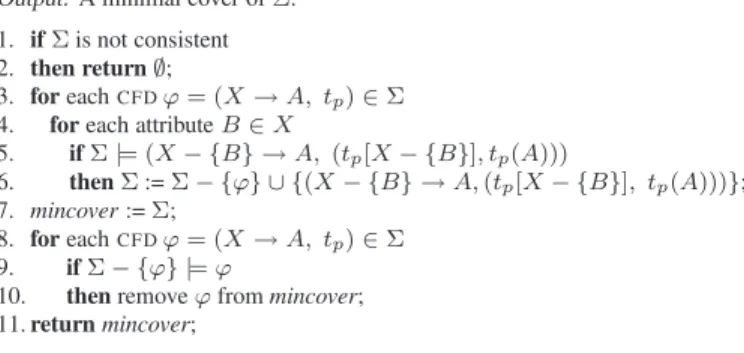
As an application of consistency and implication analy-ses ofCFDs, we present an algorithm for computing a
mini-Input:A setΣofCFDs.
Output:A minimal cover ofΣ. 1. ifΣis not consistent 2. then return∅;
3. foreachCFDϕ= (X→A, tp)∈Σ
4. foreach attributeB∈X
5. ifΣ|= (X− {B} →A, (tp[X− {B}], tp(A)))
6. thenΣ:=Σ− {ϕ} ∪ {(X− {B} →A,(tp[X− {B}], tp(A)))}; 7. mincover:=Σ;
8. foreachCFDϕ= (X→A, tp)∈Σ
9. ifΣ− {ϕ} |=ϕ
10. thenremoveϕfrommincover; 11.returnmincover;
Figure 4. AlgorithmMinCover
mal coverΣmcof a setΣofCFDs. The coverΣmcis equiv-alent to Σbut does not contain redundancies, and thus is often smaller than Σ. Since the costs of checking and re-pairingCFDs are dominated by the size of theCFDs to be checked along with the size of the relational data, a non-redundant and smallerΣmctypically leads to less validating and repairing costs. Thus finding a minimal cover of input
CFDsserves as an optimization strategy for data cleaning. Aminimal coverΣmcof a setΣofCFDsis a set ofCFDs such that (1) each CFDinΣmc is of the form(R : X → A, tp) as mentioned earlier, (2)Σmc ≡ Σ, (3) no proper
subset of Σmc implies Σmc, and (4) for each ϕ = (R : X → A, tp)inΣmc, there exists noϕ = (R : X → A, tp[X∪A])inΣmcsuch thatX⊂X. Intuitively,Σmc
contains no redundantCFDs, attributes or patterns.
Example 3.3: LetΣconsist ofψ1, ψ2andϕgiven in Ex-ample 3.2. A minimal coverΣmc ofΣconsists of ψ1 =
(∅ → B,(b)) andψ2 = (∅ → C,(c)). This is because (1){ψ1, ψ2} |=ϕ(Example 3.2), (2)ψ1can be simplified toψ1 by removing the redundant attribute A(by the rule
FD4inI), and (3) similarly,ψ2can be simplified toψ2. 2 We give an algorithm,MinCover, for computing a min-imal cover in Fig. 4. It is an extension of its standardFD
counterpart [14]. First,MinCoverchecks whether or notΣ is consistent (lines 1-2). IfΣis consistent, it proceeds to remove redundant attributes in the CFDsofΣ(lines 3–6). We use (tp[X − {B}], tp(A)) to denote the pattern tuple
tp such thattp[A] = tp[A] andtp[C] = tp[C] for each
C ∈ X− {B}. Next, it removes redundantCFDsfromΣ (lines 8–10). From Theorems 3.2 and 3.5 it follows that MinCover is able to compute a minimal cover efficiently when the schema is predefined, inO(|Σ|3)time.
4
Detecting CFD Violations
A first step for data cleaning is the efficient detection of constraint violations in the data. In this section we develop techniques to detect violations ofCFDs. Given an instanceI
of a relation schemaRand a setΣofCFDsonR, it is to find all theinconsistent tuplesinI,i.e.,the tuples that (perhaps
QCϕ2 select t from custt,T2tp
where t[CC]tp[CC]ANDt[AC]tp[AC]AND t[PN]tp[PN]AND
(t[STR]tp[STR]ORt[CT]tp[CT]ORt[ZIP]tp[ZIP])
QVϕ2 select distinctt[CC], t[AC], t[PN] from custt,T2tp
where t[CC]tp[CC]ANDt[AC]tp[AC]ANDt[PN]tp[PN]
group byt[CC],t[AC],t[PN]
havingcount(distinctt[STR],t[CT],t[ZIP])>1
Figure 5. SQL queries for checking CFDϕ2 together with other tuples inI) violate someCFDinΣ. We first provide an SQL technique for finding violations of a singleCFD, and then generalize it to validate multipleCFDs.
4.1
Checking a Single CFD with SQL
Consider aCFDϕ= (X →Y, Tp). The following two
SQLqueries suffice to find the tuples that violateϕ:
QCϕ select t from R t, Tptp
where t[X1]tp[X1]AND. . .ANDt[Xn]tp[Xn]AND
(t[Y1]tp[Y1]OR. . .ORt[Yn]tp[Yn])
QVϕ select distinct t.X from R t, Tptp
where t[X1]tp[X1]AND. . .ANDt[Xn]tp[Xn] group by t.X having count(distinctY)>1
whereXi(resp.Yj) ranges over attributes inX (resp.Y);
t[Xi]tp[Xi]is a short-hand for theSQLexpression (t[Xi]
=tp[Xi]OR tp[Xi]= ‘ ’), whilet[Yj] tp[Yj]is a short-hand for (t[Yj]=tp[Yj]ANDtp[Yj]=‘ ’).
Intuitively, detection is a two-step process, each con-ducted by a query. Initially, queryQCϕ detectssingle-tuple
violations,i.e.,the tuplestinIthat match some pattern tu-pletp ∈Tpon theX attributes, buttdoes not matchtpin theY attributes due to aconstantvaluetp[Yi]different from
valuet[Yi]. That is,QCϕ finds inconsistent tuples based on
differences in the constants in the tuples andTppatterns.
On the other hand, query QVϕ finds multi-tuple viola-tions,i.e.,tuplest inI for which there exists a tuplet in
Isuch thatt[X] =t[X]and moreover, bothtandtmatch a patterntpon theXattributes, butt[Yj]=t[Yj]for some
attributeYj inY. QueryQVϕ uses thegroup by clause to
group tuples with the same value on X and it counts the number of distinct instantiations inY. If there is more than one instantiation, then there is a violation. It catches both tuplestandtmentioned above as violations, although it is possible that bothpassthe test of queryQCϕ.
To be precise,QVϕ returns only theXattributes of
incon-sistent tuples (this is caused by the group by). However, this has the advantage that the ouput is more concise than when we would return the complete tuples. Moreover, the complete tuples can be easily obtained from the result of the two queries by means of a simpleSQLquery.
Example 4.1: RecallCFDϕ2given in Fig. 2. Over acust instanceI, theSQLqueriesQCϕ2 andQVϕ2 shown in Fig. 5 determine whether or not I satisfies ϕ2. Executing these queries over the instance of Fig. 1, it returns tuplest1,t2 (due toQCϕ2), andt3andt4(due toQVϕ2). 2
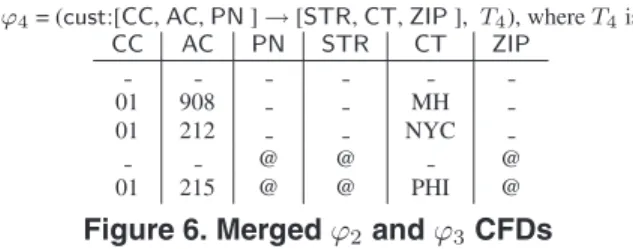
ϕ4= (cust:[CC,AC,PN]→[STR,CT,ZIP], T4), whereT4is
CC AC PN STR CT ZIP
01 908 MH
01 212 NYC
@ @ @
01 215 @ @ PHI @
Figure 6. Mergedϕ2andϕ3CFDs
A salient feature of ourSQLtranslation is that tableauTp
is treated an ordinary data table. Therefore, each query is bounded by the size of the embedded FD X → Y in the
CFD, and is independentof the size (and contents) of the (possibly large) tableauTp.
4.2
Validating Multiple CFDs
A naive way to validate a setΣof CFDsis to use one query pair for each CFD ϕ inΣ. This approach requires
2× |Σ|passes of the underlying relation. We next present an alternative approach that only requires two passes. The key idea is to generate asinglequery pair to check all the constrains inΣ. The proposed solution works in two phases. In its first phase, it performs a linear scan of all the tableaux belonging toCFDsinΣandmergesthem, generating a sin-gle tableau calledTΣ. Intuitively, tableauTΣis such that it captures the constraints expressed by all the tableaux of the
CFDsinΣ. Then, in its second phase, it generates a query pair that finds inconsistent tuples violatingCFDsinΣ. 4.2.1 Merging Multiple CFDs
Consider a setΣwhich, without loss of generality, contains just twoCFDsϕandϕonR, whereϕ= (X →Y, T)and
ϕ = (X → Y, T). There are two main challenges for the generation of the merged tableauTΣ. The first challenge is that tableaux T and T may not be union-compatible,
i.e.,X =XorY =Y. We thus need to extend tableauT
(resp.T) with all the attributes inZ= (X∪Y)−(X∪Y)
(resp.(X∪Y)−(X∪Y)forT). For each attributeA
inZ and each tupletc in the original tableauT, we set the
value oftc[A]to be aspecial symboldenoted by ‘@’, which
denotes intuitively adon’t carevalue. After this extension, the resulted tableaux are union-compatible. Then, tableau
TΣ is defined to be their union. Figure 6 shows how the CFDsϕ2andϕ3of Fig. 2 can be made union-compatible.
Given the presence of “@”, we need to reformulateCFD
satisfaction. Consider a tupletc[X, Y]in a tableau that in-cludes ‘@’. We useXtfreec andY
free
tc to denote the sub-set of X and Y attributes of tc that is ‘@’-free, i.e., it
has no ‘@’ symbol. A relation I ofR satisfies the CFD ϕ, denoted byI |= ϕ, if foreach pair of tuplest1, t2 in the relationI, and foreachtupletc in the pattern tableau
Tp of ϕ, if t1[Xtfreec ] = t2[X free tc ] tc[X free tc ], then t1[Ytfreec ] =t2[Y free tc ]tc[Y free tc ].
For the second challenge, consider the translation of a singleCFDinto anSQLquery pair. Note that the translation assumes implicit knowledge of which attributes are in the
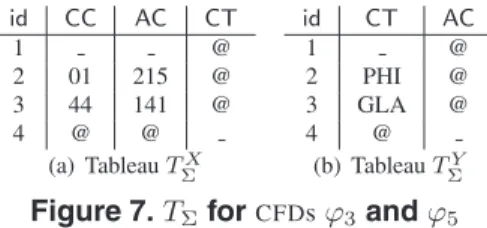
id CC AC CT 1 @ 2 01 215 @ 3 44 141 @ 4 @ @ (a) TableauTΣX id CT AC 1 @ 2 PHI @ 3 GLA @ 4 @ (b) TableauTΣY
Figure 7.TΣforCFDsϕ3andϕ5
X andY sets and treats the translation of each attribute set differently. Now, consider two simpleCFDsonR, namely,
ϕ = (A → B, T)andϕ = (B → A, T). Suppose that we have made the tableaux of theCFDsunion-compatible. One might want to take the union of these two tableaux to generateTΣ. How can we translate tableauTΣinto anSQL
query pair? Clearly, we cannot directly use the translation given earlier since we do not know how to treat the join of an attribute like, say, A. AttributeAis inX for tuples coming fromϕ, while it is part ofY for tuples coming from
ϕ. Thus we need to distinguish the two sets of tuples and treat the translation of each set separately.
We accommodate this by splitting the tableauT of each
CFDϕ = (R : X → Y, T)into two parts, namely,TX
andTY, one tableau for theX and one forY attributes of
ϕ. Then, tableauxTΣX(and similarlyTΣY) is generated by making all theTX tableaux inΣunion-compatible. Note that an attribute can appear in bothTΣXandTΣY. To be able to restore pattern tuples fromTΣXandTΣY, we create a dis-tincttuple idt.idfor each pattern tuplet, and associates it with the corresponding tuples inTΣXandTΣY. For example, considerCFDϕ3shown in Fig. 2 andϕ5= (cust: [CT]→
[AC], T5), where T5 consists of a single tuple(, ). Fig-ure 7 shows their mergedTΣX andTΣY tableaux. Note that attributesCTandACappear in both tableaux.
4.2.2 Query Generation
During the second phase of our approach, we translate tableauTΣ into a singleSQLquery pair. This translation, however, introduces new challenges. Recall that queryQVϕ, for someCFDϕ= (R :X →Y, T), requires agroup by clause over all theX attributes. Now, consider tableauTΣX
in Fig. 7. It is not hard to see that if we use thegroup by clause over all the attributes inTΣX, we are not going to de-tect all (if any) inconsistencies since, for example, for the first three tuples in TΣX the ‘@’ in attributeCTindicates that, while detecting inconsistencies, we should only group by the first two attributes and ignore the value of attribute CT. Similarly for the last tuple inTΣX, the ‘@’ in attributes
CCandACindicates that while detecting inconsistencies for these tuples, we should only consider the value ofCT. The example suggests that ourSQLquery should change the set ofgroup by attributes, based on the contents of each tu-ple. In what follows, we show how this can be achieved while still keeping the query size bounded by the size of the embeddedFDX → Y andindependentof the size of the tableau. Central to our approach is the use of thecase
clause ofSQL(supported by commercialDBMSlike DB2). Consider the merged tableauxTΣXandTΣY from a setΣ ofCFDsover a relation schemaRand letIbe an instance ofR. Then, the following twoSQLqueries can be used to detect inconsistent tuples ofIviolatingϕ:
QCΣ select t from R t, TΣXtXp, TΣYtYp wheretXp.id =tYp.idAND
t[X1]tXp[X1]AND. . . t[Xn]tXp[Xn]AND
(t[Y1]tYp[Y1]OR. . . t[Yn]tYp[Yn])
QVΣ select distinct tM.X from MacrotM
group bytM.X
havingcount(distinctY)>1 whereMacrois:
select(casetXp[Xi]when“@”then“@”elset[Xi]end)ASXi. . .
(casetYp[Yj]when“@”then“@”elset[Yj]end)ASYj. . .
from R t, TΣXtXp, TΣY tYp wheretXp.id =tYp.idAND
t[X1]tXp[X1]AND. . . ANDt[Xn]tXp[Xn]
wheret[Xi] tp[Xi]now accounts for the ‘@’ and is a
short-hand for (t[Xi]= tp[Xi] OR tp[Xi]= ‘ ’ OR tp[Xi]
= ‘@’), whilet[Yj] tp[Yj]is a short-hand for (t[Yj] =
tp[Yj]ANDtp[Yj]=‘ ’ANDtp[Yj]=‘@’).
More specifically, query QCΣ is similar in spirit to the SQLquery that checks for inconsistencies of constants be-tween the relation and the tableau, for a single CFD. The only difference is that now the query has to account for the presence of the ‘@ ’symbol in the tableau. Now, we turn our attention to relationMacrowhich is of the same sort asTΣX
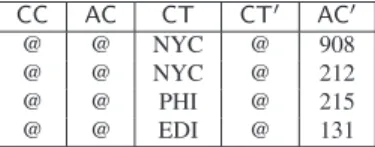
andTΣY (we rename attributes that appear in both tableaux so as not to appear twice). RelationMarcois essentially the join onX of relationI with the result of the join on tuple idt.idof the two tableaux. The value of each attribute, for each tupletM in Marco, is determined by thecase clause. In more detail,tM[Xi]is set to be ‘@’ iftXp[Xi]is ‘@’, and ist[Xi]otherwise; similarly fortM[Yj]. Note that relation
I is not joined onY with the tableaux. Thus if for some tupletwitht[X]tXp[X], there exists an attributeYjwith
tYp[Yj]a constant andt[Yj]=tYp[Yj](i.e.,tis inconsistent
w.r.t.tp) thentM[Yj]is set to bet[Yj]. This creates no
prob-lems since this inconsistent tuple is already detected byQCΣ. Intuitively, Macro considers each tuple in the tableau, and uses it as amaskover the tuples of the relation. If the tableau tuple indicates adon’t carevalue for an attribute, all the (possibly different) attribute values in the relation tuples are masked and replaced by an ‘@’ in Macro. Figure 8 shows the result of joining the fourth tuple of tableauxTΣX and TΣY in Fig. 7 with the cust relation of Fig. 1. Note that the query masks the attributes values of CC andAC. This masking allows the subsequentgroup by over X to essentially consider, for each tuple, only the subset of X
that does not have anydon’t carevalues. Note that although
X ={CC,AC,CT}, thegroup by by queryQVΣessentially performs a group by over onlyattributeCT. The query returns theNYCtuples which violateϕ5.
CC AC CT CT AC
@ @ NYC @ 908
@ @ NYC @ 212
@ @ PHI @ 215
@ @ EDI @ 131
Figure 8. Marco relation instance
In this way we generate asingle pairofSQLqueries to validate asetΣofCFDs, while guaranteeing that the queries are bounded by the size of the embeddedFDsinΣ, inde-pendentof the size of the tableaux inΣ. Furthermore, to validateΣonly two passes of the database is required.
5
Experimental Study
In this section, we present our findings about the perfor-mance of our schemes for detectingCFDviolations over a variety of data sizes, and number and complexity ofCFDs. Setup: For the experiments, we used DB2 on an Apple Xserve with 2.3GHz PowerPC dual CPU and 4GBof RAM. Data:Our experiments used an extension of the relation in Fig. 1. Specifically, the relation used models individual’s tax-records and includes 8 additional attributes, namely, the stateSTa person resides in, her marital statusMR, whether she has dependentsCH, her salarySA, tax rateTXon her salary, and 3 attributes recording tax exemptions, based on marital status and the existence of dependents.
To populate the relation we collected real-life data: the zip and area codes for major cities and towns for all US states. Further, we collected the tax rates, tax and income brackets, and exemptions for each state. Using these data, we wrote a program that generates synthetic tax records.
We vary two parameters of the data instance in our ex-periments, denoted by SZ andNOISE. SZ determines the tuple number in the tax-records relation andNOISEthe per-centage of dirty tuples. As the data is generated, with prob-abilityNOISE, an attribute on theRHSof aCFDis changed from a correct to incorrect value (e.g.,a tax record for aNYC
resident with a Chicago area code).
CFDs:We usedCFDsthat represent real-world constraints such as (a) zip codes determine states, (b) zip codes and cities determine states (a city by itself does not suffice since many states have cities with the same name), (c) states and salary brackets determine tax rates (a tax rate depends on both the state and employee salary), etc. We varied ourCFDsusing the following parameters:NUMCFDs deter-mined the number of CFDs considered in an experimental setup, NUMATTRsthe (max) attribute number in theCFDs,
TABSZ the (max) tuple number in the CFDs, and NUM
-CONSTsthe percentage of tuples with constants vs. tuples with variables in eachCFD.
SQL query evaluation: There are two alternative evalu-ation strategies for the SQLdetection queries of Section 4. Key distinction between these two strategies is how we eval-uate thewhere clause in each detection query. Specifically,
note that thewhere clause of ourSQLdetection queries is in conjunctive normal form (CNF). It is known that database systems do not execute efficiently queries inCNFsince the presence of the OR operator leads the optimizer to select inefficient plans that do not leverage the available indexes. A solution to this problem is to convert conditions in the where clause into disjunctive normal form (DNF). This conversion might cause an exponential blow-up in the num-ber of conjuncts, but in this case, the blow-up isw.r.t. the number of attributes in theCFD, which is usually very small.
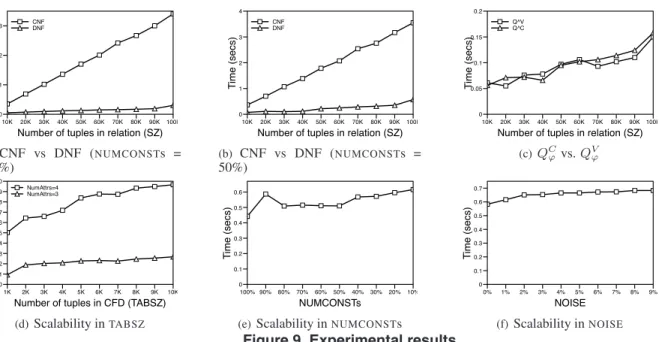
CNFvs.DNF: In this experiment We considered both eval-uation strategies, under various settings, to determine the most efficient one. In more detail, we considered relations withSZfrom 10K to 100K tuples, in 10K increments, and 5% NOISE. We considered tworepresentativeCFDs, each with NUMATTRs 3, where the first CFDhad NUMCONSTs 100% (tuples with only constant) while the second had
NUMCONSTs50% (half the tuples had variables). In terms of CFD size, we set TABSZ to 1K. Figures 9(a) and 9(b) show the evaluation times for both evaluation strategies, for each of the twoCFDs. As both graphs show, irrespective of data size and the presence of constants or variables, theDNF
strategy clearly out-performs theCNFone. Furthermore, the figures illustrate the scalability of our detection queriesSZ.
QCϕ vs. QVϕ: In this experiment, we investigated how the detection time is split between theQCϕ andQVϕ queries. We considered relations with SZfrom 10K to 100K tuples, in 10K increments, and 5% NOISE. For the CFD, we con-sider one with NUMATTRs equal to 3, TABSZ to 1K and
NUMCONSTs100% (we made similar observations for other values of NUMCONSTs). Figure 9(c) shows the evaluation times for each query in isolation and shows that both queries have similar loads and they follow the same execution trend. Scalability in TABSZ: This was to study the scalability of the detection queries with respect to TABSZ. In more de-tail, we fixedSZto 500K with 5%NOISE. We considered twoCFDswhose sizes varied from 1K to 10K, in 1K incre-ments. TheNUMATTRswas 3 for the first, and 4 for the sec-ondCFDconsidered. For allCFDs,NUMCONSTswas 50%. Figure9(d) shows the detection times for the 2CFDs. As is obvious from the figure,TABSZhas little impact on the de-tection times and dominant factors here are (a) the size of the relation, which is much larger than the tableaux, and (b) the number of attributes in the tableau, since these result in more complicated join conditions in the detection queries. Scalability inNUMCONSTs:We studied the impact of vari-ables on the detection times. We considered a relation with
SZ100K andNOISE 5% and aCFDs withTABSZ1K, and
NUMATTRs= 3. We variedNUMCONSTsbetween 100% (all constants) and 10% and we measured the detection times over the relation. Figure 9(e) shows that variables do affect detection times and (not shown in the figure) moreover, as
10K 20K 30K 40K 50K 60K 70K 80K 90K 100k Number of tuples in relation (SZ) 0 1 2 3 T ime (secs) CNF DNF (a) CNF vs DNF (NUMCONSTs = 100%) 10K 20K 30K 40K 50K 60K 70K 80K 90K 100k Number of tuples in relation (SZ) 0 1 2 3 4 T ime (secs) CNF DNF (b) CNF vs DNF (NUMCONSTs = 50%) 10K 20K 30K 40K 50K 60K 70K 80K 90K 100K
Number of tuples in relation (SZ) 0 0.05 0.1 0.15 0.2 T ime (secs) Q^V Q^C (c)QCϕ vs.QVϕ 1K 2K 3K 4K 5K 6K 7K 8K 9K 10K
Number of tuples in CFD (TABSZ) 0 1 2 3 4 5 6 7 8 9 10 T ime (secs) NumAttrs=4 NumAttrs=3 (d)Scalability inTABSZ 100% 90% 80% 70% 60% 50% 40% 30% 20% 10% NUMCONSTs 0 0.1 0.2 0.3 0.4 0.5 0.6 T ime (secs)
(e)Scalability inNUMCONSTs
0% 1% 2% 3% 4% 5% 6% 7% 8% 9% NOISE 0 0.1 0.2 0.3 0.4 0.5 0.6 0.7 T ime (secs) (f)Scalability inNOISE
Figure 9. Experimental results
we increased both the percentage of variables and the num-ber of attributes with variables, detection times increased noticeably. This is apparent, given that variables restrict the use of indexes while joining the relation with the tableau. Scalability inNOISE: Here, we variedNOISEbetween 0%
and 9% in a relation withSZ100K, and we measured
detec-tion time, for aCFDwithTABSZ30K (we used all possible
zip to state pairs, so as not to miss a violation),NUMATTRs 2, andNUMCONSTs100%. As we can see in Fig.9(f), the level ofNOISEhas negligable effects on detection times. MergingCFDs:Our experiments indicate (not shown) that
CFDmerging is mainly beneficial for highly-relatedCFDs, as might be expected. However, the performance of the merged scheme is hampered by the difficulty faced by our optimizers when handlingwhere clauses inCNF. The con-version toDNFis not an option here, because each disjunct inCNFconsists of 3 terms, and thus the translation ofCNF
toDNFresults in awhere clause with3kconjuncts, where
kis the number of attributes in theCFD. In practice this is much worse than the2kincrease that results from translat-ingQCϕ orQVϕ intoDNF. We speculate that improvements inCNFevaluation may make the merge technique more use-ful. Also, we are investigating techniques to factor out work from multipleCFDviolation detections in a manner similar to [4], and expect the merged representation to be a conve-nient basis for optimizations of this form.
6
CFD Repairing: Discussion
To clean data, an effective method should be in place for removing inconsistencies from the data, in addition to inconsistency detection. That is, if a databaseIof a relation schemaRviolates a setΣofCFDsonR, we want to find a
minimal repairIofIsuch thatI |= ΣandI minimally differs from the original databaseI, obtained by performing
repair operations on I [2]. Following [3, 7, 19] we allow attribute-value modifications as repair operations.
RepairingCFDsis nontrivial. Indeed, consider the CFD repairing problem, which is to determine, givenI,Σand a positive integerk, whether or not there exists an instanceI
ofRsuch that (1)I |= Σand (2)Iis obtained fromIby at mostkrepair operations. This problem is intractable (by reduction from the set cover problem).
Theorem 6.1:The repairing problem isNP-complete. 2
Repairing CFDs introduces challenges not encountered when repairing standardFDs. For example, it is known [3] that if a pairt1, t2of tuples violate anFDX →A, one can resolve the inconsistency by modifyingt1[A]ort2[A]such thatt1[A] = t2[A]. That is, FD violations can always be resolved by modifying values of somet1(ort2) attributes in theRHSofFDs, without changing theLHSsuch thatt1[X]= t2[X]. In contrast, this strategy no longer works for CFDs. To see this, consider a schemaRwithattr(R)=(A, B, C), an instanceIofRconsisting of(a1, b1, c1)and(a1, b2, c2), and a setΣofCFDsincluding(A → B,(, ))and(C → B,{(c1, b1),(c2, b2)}). Then I |= Σ and moreover, any repairIhas to modify values of some attributes in theLHS
of theFDsembedded in theCFDs.
In light of Theorem 6.1 we have developed a heuristic algorithm for finding a repair of a database, overcoming the new challenges. We defer report on the heuristic pending the completion of implementation and experimental study.
7
Concluding Remarks
We have introducedCFDsand shown thatCFDscan ex-press semantics of data fundamental to data cleaning. For reasoning about CFDswe have provided techniques and a sound and complete inference system for their consistency and implication analyses. For applications ofCFDsin data
cleaning, we have developedSQL-based techniques for de-tecting inconsistencies as violations ofCFDs. We have also experimentally evaluated our detection techniques.
There has been work on data cleaning based on con-straints (e.g., [2, 5, 7, 19]). Research in this area has mostly focused on two topics, both introduced in [2]: repairis to find another database that is consistent and minimally dif-fers from the original database (e.g.,[2, 5, 7]); and consis-tent query answeris to find an answer to a given query in every repair of the original database (e.g.,[2, 19]). Most ear-lier work (except [7, 19]) considers traditional full (subsum-ing functional) dependencies and denial constraints, which do not allow patterns with data values and are quite dif-ferent from CFDs. Beyond traditional dependencies, logic programming is studied in [7] for fixing census data. Closer toCFDsis the tableau representation of full dependencies, which also allow data values [19]. The work of [19] differs from ours in that it focuses on condensed representation of repairs and consistent query answers. As remarked in Sec-tion 2, a class of instance-levelFDsis studied in [13], which are a special case ofCFDs. [13, 7, 19] consider neither con-sistency analysis and inference system, nor detection of in-consistencies by means ofSQLqueries.
Codd tables, variable tables and conditional tables have been traditionally used in the context of incomplete infor-mation [11, 9]. The key difference between these table formalisms and pattern tableaux in CFDs is that each of these tables is used as a representation of possibly infinitely many relation instances, one instance for each instantiation of variables. No instance represented by these table for-malisms can include two tuples that result from different instantiations of a table tuple. In contrast, a pattern tableau is used to constrain–as part of a CFD–asinglerelation in-stance, which can contain any number of tuples that are all instantiations of the same pattern tuple. Closer to our pat-tern tableau is the notion ofmapping tablesstudied for data sharing [12], for which no inference system is developed.
As remarked in Section 1, there have been ETL tools (see [16] for a comprehensive survey) and merge-purge al-gorithms (e.g.,[8, 10, 15, 20]) for data cleaning. Related to our work are also theAJAXsystem [8] which proposes a declarative language for specifying data cleaning programs, and the Potter’s Wheel system [17] that extracts structure for attribute values and uses these to flag discrepancies in the data. While a constraint repair facility will logically be-come part of the cleaning process supported by these tools and systems, we are not aware of analogous functionality currently in any of the systems mentioned.
There is naturally much more to be done. First, as re-marked in Section 6 we are implementing ourCFD-based algorithms for repairingCFDs. Second, to clean data, con-straints beyondCFDsare certainly needed. We are studying data cleaning based on bothCFDsand conditional inclusion
dependencies. Third, we are developing automated meth-ods for discoveringCFDsand repairing inconsistentCFDs. Acknowledgment.Wenfei Fan is supported in part by EP-SRC GR/S63205/01, GR/T27433/01 and BBEP-SRC BB/D006473/1. Floris Geerts is a postdoctoral researcher of the FWO Vlaanderen.
References
[1] S. Abiteboul, R. Hull, and V. Vianu. Foundations of Databases. Addison-Wesley, 1995.
[2] M. Arenas, L. E. Bertossi, and J. Chomicki. Consistent query answers in inconsistent databases. InPODS, 1999. [3] P. Bohannon, W. Fan, M. Flaster, and R. Rastogi. A
cost-based model and effective heuristic for repairing constraints by value modification. InSIGMOD, 2005.
[4] Z. Chen and V. Narasayya. Efficient computation of multiple group by queries. InSIGMOD, 2005.
[5] J. Chomicki and J. Marcinkowski. “Minimal-Change In-tegrity Maintenance Using Tuple Deletions”. Information and Computation, 197(1-2):90–121, 2004.
[6] W. W. Eckerson. Data Quality and the Bottom Line: Achiev-ing Business Success through a Commitment to High Qual-ity Data. Technical report, The Data Warehousing Institute, 2002.http://www.tdwi.org/research/display.aspx?ID=6064. [7] E. Franconi, A. L. Palma, N. Leone, S. Perri, and F. Scar-cello. Census data repair: a challenging application of dis-junctive logic programming. InLPAR, 2001.
[8] H. Galhardas, D. Florescu, D. Shasha, E. Simon, and C. Saita. “AJAX: An Extensible Data Cleaning Tool”. In SIGMOD, 2001.
[9] G. Grahne.The Problem of Incomplete Information in Rela-tional Databases. Springer, 1991.
[10] M. A. Hernandez and S. Stolfo. “Real-World Data is Dirty: Data Cleansing and the Merge/Purge Problem”. Data Min-ing and Knowledge Discovery, 2(1):9–37, 1998.
[11] T. Imieli´nski and W. L. Jr. Incomplete information in rela-tional databases.JACM, 31(4):761–791, 1984.
[12] A. Kementsietsidis, M. Arenas, and R. J. Miller. Data map-ping in P2P systems: Semantics and algorithmic issues. In SIGMOD, 2003.
[13] E. Lim and S. Prabhakar. Entity identification in database integration. InICDE, 1993.
[14] D. Maier. Minimum covers in relational database model. J. ACM, 27(4):664–674, 1980.
[15] A. Monge. Matching algorithm within a duplicate detection system.IEEE Data Engineering Bulletin, 23(4), 2000. [16] E. Rahm and H. H. Do. Data cleaning: Problems and current
approaches.IEEE Data Engineering Bulletin, 23(4), 2000. [17] V. Raman and J. M. Hellerstein. “Potter’s Wheel: An
Inter-active Data Cleaning System”. InVLDB, 2001.
[18] C. C. Shilakes and J. Tylman. Enterprise information portals, Nov. 1998.
[19] J. Wijsen. Condensed representation of database repairs for consistent query answering. InICDT, 2003.
[20] W. Winkler. Advanced methods for record linkage. Techni-cal report, StatistiTechni-cal Research Division, U.S. Bureau of the Census., 1994.