Sabine Hafner-Zimmermann, Michael J. de C. Henshaw
The future of trans-Atlantic
collaboration in modelling and
simulation of Cyber-Physical Systems
A Strategic Research Agenda for Collaboration
The future of trans-Atlantic collaboration in modelling and simulation of Cyber-Physical Systems
Authors:
Sabine Hafner-Zimmermann (Steinbeis-Europa-Zentrum, Germany) Michael J. de C. Henshaw (Loughborough University, UK)
Contributors:
Peter Brook, Sofia Ahlberg-Pilfold, Luminita Ciocoiu, Lipika Deka, Murray Sinclair, and Carys Siemieniuch (Loughborough University, UK)
John Fitzgerald and Zoe Andrews (Newcastle University, UK) Meike Reimann (Steinbeis-Europa-Zentrum, Germany)
TAMS4CPS acknowledges the support from the five US universities involved in the project: Professor Alexander H. Levis (George Mason University); Professor Dimitris Mavris and Dr. Kelly Griendling (Georgia Institute of Technology); Prof. Daniel DeLaurentis and Dr. Inseok Hwang (Purdue University); Professor Gregg Versonder (Stevens Institute of Technology); and Professor Mo M. Jamshidi (Uni-versity of Texas, San Antonio).
The TAMS4CPS project is co-funded by the European Community’s Horizon 2020 Programme under grant agreement no 644821. This publication is the Final Strategic Research Agenda for Collaboration developed within the project.
p. 12 | ©Parris Cope/Fotolia.com p. 14 | ©TAMS4CPS consortium
p. 20 | ©H. Stöber/Steinbeis-Europa-Zentrum
p. 29 | ©RioPatucaImages/Fotolia.com | ©Antrey/Fotolia.com | ©folienfeuer/Fotolia.com | ©jamesteohart/Fotolia.com (from left to right)
p. 33 | ©zhudifeng/Fotolia.com p. 35 | ©zapp2photo/Fotolia.com p. 38 | ©Sashkin/Fotolia.com p. 40 | ©beebright/Fotolia.com p. 41 | ©putilov_denis/Fotolia.com p. 45 | ©vallepu/Fotolia.com p. 48 | ©ra2studio/Fotolia.com
p. 50 | © European Union, 2016 (EC – Audiovisual Service/Photo: Jennifer Jacquemar) p. 55 | ©TAMS4CPS consortium
The future of trans-Atlantic
collaboration in modelling and
simulation of Cyber-Physical Systems
A Strategic Research Agenda for Collaboration
© 2017 Steinbeis-Edition
All rights reserved. No part of this book may be reprinted, reproduced, or utilised in any form by any elec-tronic, mechanical, or other means now known or hereafter invented, including photocopying, microfil-ming, and recording or in any information storage or retrieval system without written permission from the publisher.
Sabine Hafner-Zimmermann, Michael J. de C. Henshaw
The future of trans-Atlantic collaboration in modelling and simulation of Cyber-Physical Systems A Strategic Research Agenda for Collaboration
1st edition, 2017 | Steinbeis-Edition, Stuttgart
ISBN 978-3-95663-121-4 Layout: Steinbeis-Edition
Cover picture: ©jamesteohart/Fotolia.com
This book is also available as printed version. ISBN 978-3-95663-112-2
Steinbeis is an international service provider in entrepreneurial knowledge and technology transfer. The Steinbeis Transfer Network is made up of about 1,000 enterprises. Specialized in chosen areas, Steinbeis Enterprises’ portfolio of services covers research and development; consulting and expert reports as well as training and employee development for every sector of technology and management. Steinbeis Enterprises are frequently based at research institutions, especially universities, which are constituting the Network’s primary sources of expertise. The Steinbeis Network comprises around 6,000 experts committed to practical transfer between academia and industry. Founded in 1971, the Steinbeis-Stiftung is the umbrella organizati-on of the Steinbeis Transfer Network. It is headquartered in Stuttgart, Germany. Steinbeis-Editiorganizati-on publishes selected works mirroring the scope of the Steinbeis Network expertise.
Table of Content
1 Executive Summary ... 8
2 Introduction ... 14
3 Recommendations for Future Action in Trans-Atlantic M&S Research Collaboration ... 17
4 Policy Context of EU-US Collaboration ... 22
5 Modelling and Simulation – an Introduction ... 26
5.1 Model Classification ...26
5.2 Simulation ...29
5.3 Problem Scale ...30
6 Collaborative Agenda in Modelling and Simulation for CPS ... 32
6.1 The M&S for CPS collaborative research agenda ...33
6.2 Dream Projects ...43
6.3 Illustrative Scenario ...48
7 EU-US Research Collaboration to-date – Funding Themes relevant to CPS ... 51
8 Enhancing Trans-Atlantic Collaboration ... 56
8.1 Incentives for and Barriers to EU-US Collaboration ...56
8.2 Mechanisms for Enhancing Collaboration ...58
9 Conclusions ... 65
Figures index
Figure 1: A general classification of models ...28
Figure 2: Framework for M&S classification according to CPS type: Individual, Group Collaborative, Federated, and Enterprise ...31
11 Annexes ... 71
11.1 Annexe 1: Test beds for CPS ...71
11.2 Annexe 2: Good practices on trans-Atlantic collaboration ...88
11.3 Annexe 3: Interview partners ...98
11.4 Annexe 4: Participants List TAMS4CPS Validation Workshop, 16 / 11 / 2016 ...99
Table index
Table 1: Distinguishing Characteristics of Models ...291
Executive Summary
The need for EU-US collaboration in modelling and simulation for CPS – Scope of TAMS4CPS
Smart systems, in which sophisticated software / hardware is embedded in phys-ical systems, are part of everyday life. From simple products with embedded de-cision-making software, to massive systems in which hundreds of systems, each with hundreds or thousands of embedded processors, interoperate the use of Cy-ber-Physical Systems (CPS) will continue to expand.
Through highly developed analysis of sensor data, CPS respond appropriately to changes in their environment to undertake complex activities of benefit to society. CPS may operate as individual systems, but are more usually networked as Systems of Systems (SoS) displaying complex behaviours that cannot be adequately predicted with current modelling capabilities. When CPS are networked by the internet, the resulting complex system is sometimes referred to as an Internet-of-Things (IoT), which is considered to be the basis for a new industrial revolution through which so-cietal, commercial, and technological benefits are expected to accrue across diverse sectors (healthcare, transport, manufacturing, defence and security, energy, etc.). There has been substantial investment in CPS research in Europe and the Unit-ed States (US). Through a series of workshops and other events, the TAMS4CPS Support Action has established that there is mutual benefit in the European Union (EU) and US collaborating on CPS research. An agenda for collaborative research into modelling and simulation (M&S) for CPS is set forth. The agenda includes models for many different purposes, including fundamental concepts, design mod-els (e. g. architectures), predictive techniques, real-time control, human-CPS inter-action, and CPS governance.
Recommendations to the European Commission (EC)
As a result of analysis of inputs from CPS modelling experts from the EU and from the US, the following recommendations are made:
1. The EC should work with appropriate US funding agencies to create test beds for CPS and to create suitable collaborative structures for effective joint ex-ploitation of existing test beds.
2. For jointly funded activities between the EU and US, the EC should target US funding agencies whose support focuses on applied research at Technology Readiness Levels above fundamental science.
3. The EC and appropriate US funding agencies should take deliberate action to simplify the framework for trans-Atlantic collaboration by adopting best practice, as exemplified in the EU-NIH agreement.
4. The EC should establish a joint project with US agencies to create a common plan for collaborative CPS development and should ensure a single point of contact for US stakeholders.
5. As a matter of urgency, Europe and the US should collaborate on CPS-related standards to protect their industries from the imposition of standards from elsewhere.
6. The EC should increase the funding of researcher mobility between EU and US, including mainstreaming this in future EIT KICs.
Recommendations to researchers and the European Commission
7. The EC should promote joint programmes in the technical areas described in the agenda (below).
8. European researchers should seek to identify and collaborate with US leaders in the technical areas identified in the agenda (below).
Collaborative agenda in modelling and simulation for CPS
The following research themes are of mutual interest to the EU and the US and form an agenda for collaboration based on complementary capabilities.
Theme 1: Test beds. Generally, test beds are mainly required for ensuring interop-erability between CPS and for verification either of models or of the CPS them-selves. This theme can be approached in two ways: firstly, the joint funding and development of test beds for particular purposes, which would then be operated as a shared resource or, secondly, creation of suitable collaborative structures for ex-isting test beds to be more widely used by researchers from EU and US. This theme emerged so strongly as an essential requirement of researchers that it is identified through a specific recommendation (recommendation 1 above) to the EC.
Theme 2: Inclusion of human factors in modelling and simulation. Many of the challenges associated with CPS deployment concern their integration into the hu-man environment, with particular reference to safety, security, and acceptability. Improvements in the modelling of human interaction with CPS are required (both on the individual and societal level) so that more effective simulations may be created that include human behaviour reliably within the CPS design and op-erating models. Furthermore, models that enable both humans and CPS to gain good situational awareness are required to advance the overall use of CPS.
Theme 3: Open framework for model interoperability. Increasing complexity of CPS and more dynamic reconfiguration of CPS networks mean that different models must interoperate to create sophisticated and accurate models of complex behaviours. An open framework is required to support runtime execution of mod-els and validation of systems of modmod-els at the point of interoperation.
Theme 4: Incorporation of security architectural features into models. Although providing many benefits, networked CPS also create new and complex vulnera-bilities, especially with respect to privacy and commercial security. Development of security metrics and the architecture patterns that can be used to ensure better protection of systems is an area of common interest.
Theme 5: Combining formal verification and simulation technology. In highly complex CPS, the use of formal verification may be impractical either for reasons of complexity or of cost (time). The use of simulation technology in combination with formal methods may offer a new and affordable approach to verification.
Theme 6: An evolutionary approach to testing and evaluation of adaptive / resil-ient CPS. Current testing to support verification and certification is largely based on static models, but research into models that integrate streaming data into CPS design could eventually lead to new ways for certifying the safety of CPS. Research would include the fundamental methods for using streaming data and analytics together with creation of a new paradigm under which evolutional testing and evaluation is recognised as a legitimate way to establish assurance.
Theme 7: Big-data analytics modelling via machine learning. CPS with high levels of autonomy operating in complex environments poses a control problem. It is con-sidered that big-data analytics may offer a means through which massive amounts of sensor data may be used to train CPS or to provide reliable decision making ap-proaches. This applies in two ways: real-time control in which environment data is quickly analysed and faster-than-real-time decision making capabilities are achieved; the second concerns the continued updating of CPS models based on sensor data.
Collaboration mechanisms
There are various collaboration mechanisms through which the above agenda may be implemented; these work at different levels of intensity and are briefly described here:
1. Establishment of high-level bilateral agreements, elaboration of a joint and agreed agenda and setting up working groups to implement agreements (iden-tification of fields for cooperation and concrete implementation measures). 2. Establishment of thematic, targeted funding programmes with relevance to
the respective science, technology and innovation policies to more effectively implement the respective policy agendas.
3. More frequent application of joint calls, twinning of research projects, and co-fund schemes open to the respective partners (such as in ERA-Nets, FET Flagships, EIT KICs, Joint Programming Initiatives (JPIs)). Using a single funding pot would be a suitable way to fund these activities.
4. Facilitating US participation in mainstream H2020 projects.
5. Funding of joint workshops, conferences or series of seminars as well as travel support to conferences on the other continent is a highly effective and low-cost means to foster the establishment of new networks, increase knowl-edge exchange, build trust among partners and thus facilitate the set-up of col-laborations.
6. Actively support the mobility of researchers, staff exchange, fellowships to students, trans-Atlantic training and education approaches. This is the longest-standing and probably most successful avenue of EU-international col-laboration. Thus, this should become a strategic priority in the future and be supported on a broad scale.
7. Supporting broader based access to research infrastructure, sharing of equipment (as is done already in ITER, ISS, and LHC).
8. Enhancing the visibility of EU / US programmes, e. g. by establishing an Of-fice for trans-Atlantic collaboration, Contact Points for access to EC Frame-work and other European Funding Programmes, infodesks, roadshows on EU/ US funding possibilities, communication measures and others is a main corner stone to increase participation in each other’s funding programmes.
9. Support to technology transfer, sharing of knowledge and application-ori-ented cooperation is a means to increase collaboration between companies and closer-to-market research organisation working on higher technology readiness levels (TRLs).
10. Enhancing framework conditions for trans-Atlantic collaboration
(de-velopment of joint open standards, suitable regulations, public procurement rules, and an appropriate IP regime, handling of ITAR and EAR in trans-At-lantic STI collaboration).
Conclusion
Th ere are many areas for potential collaboration be-tween EU and US research-ers in the area of modelling and simulation for CPS. Seven important themes in which complementarity will be achieved have been
iden-tifi ed. To ensure that collaboration takes place, there are a variety of mechanisms that the EC may put into place. Actions have been recommended above.
2 Introduction
CPS growth as an essential economic concern for Europe and the US
Smart systems, in which sophisticated software / hardware is embedded in physi-cal systems, are part of everyday life. From simple products with embedded deci-sion-making software, to massive systems in which hundreds of systems, each with hundreds or thousands of embedded processors, interoperate, it is clear that the use of Cyber-Physical Systems (CPS) will continue to expand. Such expansion will be in the numbers deployed, the sophistication of the systems and applications, the levels of autonomous (machine) decision-making, and the degree of networking. Significant research effort is taking place internationally to exploit the new oppor-tunities created by CPS, while at the same time managing the increasing levels of complexity that are concomitant with these expansions.
CPS is a key enabling technology vital for a leading position in future science & innovation, but both risks and opportunities are insufficiently tackled yet. These challenges can best be met by the cooperation of the European Union (EU) and the United States of America (US), and will benefit both EU and US industry and economy. Thus, collaborative research with the US is an opportunity to advance European M&S capabilities for CPS.
As mentioned, risks and opportunities with regard to the definition, design and implementation of CPS are not fully clear and well-defined (esp. in terms of short- and medium-term benefits), thus industry commitment to advance the present state of knowledge will need to be underpinned by public support. This is also underscored by the European Commission (EC) Communication ”En-hancing and focusing EU international cooperation in research and innovation: a strategic approach“ and the corresponding roadmaps for international coopera-tion1 which call for a more strategic integration of international cooperation into
Horizon 2020, the present EU-funded Framework Programme for Research and Innovation.
TAMS4CPS aims to enhance Europe and US collaboration in M&S for CPS
The overall aim of the TAMS4CPS-project was to lay the foundations for concrete EU-US collaboration in modelling and simulation for CPS. It considered antici-pated needs for M&S for CPS research and suitable (publicly supported) mecha-nisms for collaboration. The
publica-tion at hand features the Strategic Research Agenda for Collaboration (SRAC) which is the main output from TAMS4CPS. It recommends fu-ture trans-Atlantic collaborative re-search opportunities and appropriate collaboration mechanisms through which they could be implemented.
How the strategic agenda has been generated
The findings in this document are based on a large number of small-scale work-shops held in both the EU and the US, supported by desk research and interviews. A draft of this SRAC was the subject of a TAMS4CPS stakeholder workshop held on 16th November 2016 in Brussels (participants listed in annexe 4). During this
workshop, draft recommendations were presented and debated with the
ipants. The participants broadly endorsed the recommendations without major changes to any of them. Thus, the recommendations made in chapter 3 below reflect the main issues with regard to trans-Atlantic collaboration in the field of M&S for CPS. These are consistent with the recommendations and conclusions of previous activities2 conducted by various groups.
3
Recommendations for Future Action
in Trans-Atlantic M&S Research
Collaboration
Prologue:
The TAMS4CPS recommendations concerning M&S for CPS follow below un-der the headings of recommendations for the European Commission and recom-mendations for research community and the EC.
The recommendations are consistent with the findings of similar projects (e. g. CPS-SUMMIT, T-AREA-SoS, PICASSO, BILAT USA), which to some extent validates them as genuine requirements from the M&S community and for the development of mutually beneficial outcomes for the EU and the US.
There have been significant and largely unexpected shocks to the worldwide po-litical and economic landscape and it is recognized that immediate action on the recommendations is likely to be deferred until greater certainty about political relationships is established. Nevertheless, the convergence of recommendations across various support actions and programmes provides reasons for optimism that the EC and other relevant stakeholders will endeavor to put the recommendations into action in order to enhance EU-US collaboration in CPS in the future.
To the European Commission:
1. The EC should work with appropriate US funding agencies to create test beds for CPS and to create suitable collaborative structures for effective joint exploitation of existing test beds.
From the TAMS4CPS workshops and activities, it is clear that the availability of test beds is of concern to the whole research community, both in the EU and the US. Thus, a call should be issued in the coming work programmes to fund a project mapping all available test beds in the field of CPS / IoT and inquiring into the possibility of joint EU-US actions within the framework of the
respec-tive test bed(s), i. e. by federating existing test beds. In this way, links between appropriate European and US partners can be established. This activity could be realised by a call for project or tender, containing activities similar to the EC tender on promoting cooperation between EU Key Enabling Technologies (KETs) technology platforms3. During this activity, an inventory of relevant
platforms was established and their services mapped to enable companies to easily get in contact with suitable service providers. Similarly, an inventory of test beds could be established and a search facility for research / development / technology / service offers and demands could be set up to facilitate identifica-tion of and interacidentifica-tion with suitable partners on both sides of the Atlantic. A non-exhaustive list of test beds for CPS has been compiled in Annexe 1. This could form the basis for a wider study and is intended as an enabler for devel-oping links between the EU and US in this area. The list includes information about the type of testing and advises on access, although in each case specific contractual arrangements would need to be established by the organisations wishing to collaborate.
In addition, as the access to sufficiently rich datasets to validate models and simulations is needed, a call for setting up of one or several (federated) test beds that can be used for existing CPS and that may form a building block towards new CPS in the future should be issued. An area of priority is test beds that enable exploration and validation of CPS embedded in the human environment, particularly from safety perspectives.
2. For jointly funded activities between the EU and US, the EC should target US funding agencies whose support focuses on applied research at Tech-nology Readiness Levels above fundamental science.
As US federal agencies are more focused toward applied research and are thus more easily aligned to Horizon 2020 objectives, they should be targeted for coordinated calls, e. g. National Laboratories such as Sandia. In this case, calls should be highly co-ordinated and criteria for selecting projects well-aligned. Also, as a considerable alignment between EU and US is needed when setting up and implementing joint calls, the EC should rather target setting up calls in
the Horizon2020 Excellent Science-pillar (e. g. FET) instead of the Industrial Leadership pillar which is targeting closer-to-market activities.
3. The EC and appropriate US funding agencies should take deliberate ac-tion to simplify the framework for trans-Atlantic collaboraac-tion by adopt-ing best practice, as exemplified in the EU-NIH agreement.
From a strategic point of view, the EC should aim to further simplify the frame-work conditions for trans-Atlantic collaboration. The new Implementing Ar-rangement which was signed in October 2016 is a step in the right direction4.
In addition, the EU-NIH agreement to reciprocally fund project partners in each other’s programmes is a very successful best practice5, similar initiatives
should also be initiated in other fields. This is aligned to the need to further harmonise views and priorities within the European Commission internally; to better coordinate RTDI policies and programmes, and to learn from exist-ing knowledge and experiences. Better aligned and informed technology- and policy-focused activities will increase efficiency in political interaction as well as in implementation of trans-Atlantic project activities.
4. The EC should establish a joint project with US agencies to create a com-mon plan for collaborative CPS development and should ensure a single point of contact for US stakeholders.
Related to the above and an equally important point is to increase the infor-mation on European funding programmes in the US and on suitable contact points both in the EU and the US. Collaboration could be increased if better support mechanisms were established, e. g. if more EU contact points in the US lobbied more actively for collaboration, and if a single entry point for US officials into the European Commission was established. With regard to CPS specifically, it would be beneficial in the coming work programme to fund a project to better align CPS definitions and (especially) roadmaps across Eu-rope and the US. This would be a relatively small-scale activity, but an impor-tant step to establish a common basis for future trans-Atlantic CPS research and development.
4 See European Commission 2016d and case studies in Chapter 8 below. 5 See also case study in Chapter 8 and Annexe 2 below.
5. As a matter of urgency, Europe and US should collaborate on CPS-relat-ed standards to protect their industries from the imposition of standards from elsewhere.
The development and establishment of standards is another vital issue for EU-US collaboration, where both Europe and the EU-US should be keen (and are aware of ) the need to proactively establish standards and develop regulations before the scene is set by others. To facilitate action in this field, the EC should set up mechanisms and activities to make increased use of international / trans-Atlantic organisations and networks6 as enablers and facilitators to foster
the development of (open) standards, regulations, procedures for handling in-tellectual property rights (IPR) and other framework conditions as well as to enhance exchange / sharing of equipment and infrastructure.
6. The EC should increase the funding of researcher mobility between EU and US, including mainstreaming this in future EIT KICs.
Increasing researcher mobility would be an important and easy to implement step towards increased collaboration. Increasing researcher mobility should become a strategic priority in European Commission policy and practice. As new work models are evolving, more flexibility in how people work together will be an important competitive advantage in the future. Here, the EC could be an important enabler in establishing framework conditions and financially supporting EU-US researcher (and staff in general) mobility to establish last-ing bonds across the Atlantic. To further facilitate collaboration in this field, a number of administrative, IPR and regulatory issues need to be resolved. Col-laboration in this field should not only include mobility but also setting up joint educational programmes including workshops, seminars and conferenc-es. In this context, it is recommended to include trans-Atlantic collaboration as a mainstream activity in all EIT KICS7 in the future (which have education
as an important pillar anyway). The same should be investigated for Commis-sion-supported Public-Private-Partnerships and other, similar networks.
6 See also case studies below, such as IMS, IEEE, EIT Digital, PPPs etc.
To the research community and the EC:
7. The EC should promote joint programmes in the technical areas discussed in chapter 6 of this report (“the Agenda”) through a variety of collabora-tive mechanisms with US funding agencies.
The technical areas have been selected as the most significant, based on the input from EU and US specialists from industry, academia, and scientific civil service. The primary criterion has been that it is considered to be important by both EU and the US, and that it is an area in which each desires collaboration. Thus, the agenda is not designed as a prioritization for CPS research in general, but as an agenda for collaborative research between EU and the US.
8. European researchers should seek to identify and collaborate with US leaders in the technical areas identified in chapter 6 of this report (“the Agenda”) in order to establish long-term strategic development of model-ling and simulation to support CPS for the mutual benefit of EU and US.
The areas identified through expert workshops are not only of mutual interest for EU and the US, but also represent areas where each can bring complimen-tary expertise and / or facilities. There is likely, therefore, to be benefits in terms of efficiency or development acceleration that can be achieved through well-se-lected collaboration. The Dream Projects sketched during the TAMS4CPS workshop and outlined in section 6.2 below provide illustrative examples of how joint research endeavours could look like.
4
Policy Context of EU-US Collaboration
Grand challenges affecting all public and private actors
During the first years of the twenty-first century, there have been rapid economic and societal changes, accompanied by grand societal challenges such as globali-sation, security threats, resource constraints, climate variability and demographic change. Organisations must adapt to remain competitive in such an environment and respond to the concomitant changes in the research and innovation land-scapes. Researchers need to compete worldwide on scientific findings but also co-operate internationally to increase scientific excellence. Companies co-operate within global value chains and are competing internationally for new customers and mar-kets, but they must collaborate with specialised suppliers and partners to realise the benefits of international collaboration for their competitive advantage. Public policy makers are expected to support regional / national development with regard to increased general welfare, growth and employment. But this is increasingly out of the sphere of influence of public policy, so that new approaches to transnational innovation governance need to be established and tested.
Thus, the challenge lies in designing research, technology development and inno-vation (RTDI) policy to effectively address these grand challenges by optimally tailoring joint efforts and longer-term investments in next generation science, technology and innovation (STI).
European strategies for smart innovation and growth
The Europe 2020 strategy for smart, sustainable and inclusive growth, as well as national RTDI strategies in several countries8 are examples of attempts (at
differ-ent governance levels) to provide a new policy framework calling for smart gov-ernance of innovation systems. This includes open and collaborative approaches integrating actors from a vast range of fields as well as from various locations, both from within Europe and worldwide. Thus, this needs to be taken into account by both companies pursuing an open innovation approach to successfully integrate themselves into global value chains and (public and private) RTDI actors pursuing open collaboration activities for increased scientific and technological excellence. Both aim to unlock unexploited innovation potential and gain a larger share of innovative products and services.
The European Commission’s strategy on the re-industrialisation of Europe aims to raise industrial activity to 20% of EU GDP by 2020 by building on European strengths in engineering, automotive, aeronautics and others. This is enhanced by innovative enabling and digital technologies, new business models and high-qual-ity services as part of the European Commission’s Digital Agenda for Europe9. To
move forward with this endeavour, European industry needs to take full advantage of the possibilities arising from the increased application of CPS as one of the Key Enabling Technologies. Thus, an excellent science base, as well as a close collab-oration between researchers worldwide on CPS is a precondition for increased competitiveness and as a means to tackle the grand societal challenges mentioned above. This also implies that advances are required in modelling and simulation to cover technical, societal, and commercial aspects of CPS.
8 Such as the German High-Tech Strategy 2020 with its motto “Ideas / Innovation / Prosperity”. See Bundesministerium für Bildung und Forschung (BMBF). Ideas. Innovation. Prosperity. Bonn; 2010.
Building strength through EU-US collaboration
As the world’s largest economy (and most important currency) and with its domi-nation of the list of most highly ranked universities10, the US is an attractive
part-ner for cooperative research for the EU and individual EU Member States (MS). STI cooperation has a long track record in bottom-up schemes such as research-er mobility and the setting up of ovresearch-erseas branches by (large) companies. Formal government agreements have also been established for trans-Atlantic STI coopera-tion. The first EU-US Agreement on Science & Technology Cooperation entered into force in 1998 and was renewed in 2004, 2009 and 2014.11 This agreement
manifests the commitment of both parties to joint collaboration and is also driven by the insight that upcoming /perceived global challenges need to be tackled by way of a deepened cooperation of the world’s largest economic areas. The EU has developed a strategic priority for international cooperation within Horizon 2020 and stressed that international cooperation is a cornerstone of further develop-ment of the European Research Area (ERA).
„By engaging in more joint research, the EU and the US can produce greater scientific break-throughs, encourage new industries and provide more solutions to societal problems. We can speed up those breakthroughs by putting our best brains together across academia and industry, and by fostering joint projects at sufficient scope and scale. I am personally committed to this goal.“
Speech given by European Commission Director-General Robert-Jan Smits during the EU-US Joint Consultative Group Meeting on Science and Technology Cooperation in Washing-ton (12/02/2013)
„Science is a global enterprise. We look forward to strengthening our cooperation with the EU to improve the lives of our citizens and citizens around the world.”
US Assistant Secretary of State Kerri-Ann Jones during the EU-US Joint Consultative Group Meeting on Science and Technology Cooperation in Washington (12/02/2013)
10 https://www.timeshighereducation.com/world-university-rankings/2017/world-ranking#!/page/0/length/25/ sort_by/rank/sort_order/asc/cols/stats
Collaborative research with the US will be an opportunity to advance European M&S capabilities for CPS – and ultimately increase European innovation ca-pacities. To this end, TAMS4CPS identified relevant research and development priorities in the field and forged collaborative links between interested research-ers on both sides of the Atlantic. This strategic agenda thus provides a sound basis for future funding activities in M&S for CPS, be it in the US, the EU, or bi- or multilaterally, thus directly contributing to supporting the European policy objectives.
5
Modelling and Simulation –
an Introduction
The use of models is fundamental to all forms of enquiry: a model is always a rep-resentation of reality12, but its form is dependent upon the type of enquiry and,
often, the discipline in which that enquiry is pursued. If CPS are considered to fall into the domains of science and engineering, then mathematical models might be deemed appropriate, but the integration of CPS within the human landscape has significant social, political, and economic implications. Thus, logico-linguistic models are also appropriate in the study and development of CPS. It is certainly true that all models must originate from conceptual models. It is also true that all models are an abstraction of reality, in which complexity is stripped away to focus on those aspects that are considered most important and relevant to the enquirer.
TAMS4CPS considers that any form of modelling could be relevant as the ba-sis for collaboration in CPS M&S and that for any particular enquiry several different types of model might be used, either in concert or as independent means of enquiry. Models outside of the technical design space (e. g. business, economic, or environmental) are in scope because the whole lifecycle of CPS should be considered.
Because models do not all serve the same purpose, there is no “scale” that can be used to distinguish different model types or to provide a measure of model “goodness” when comparing types. However, having defined desirable model qualities relative to the purpose, it is possible then to distinguish between relative applicability (appro-priateness) of different types and relative quality between models of the same type.
5.1
Model Classification
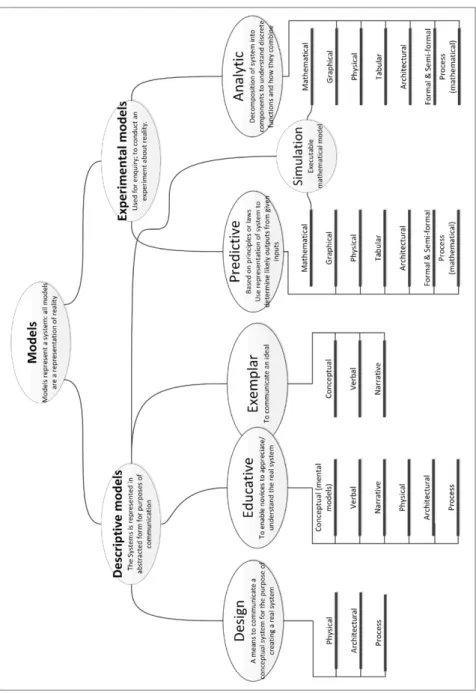
Because there are many aspects of CPS that one may wish to analyse, a some-what general classification, based on purpose, can be contemplated (Figure 1). Of
course, this classification is not applicable to CPS only, but within the categories at the bottom of the diagram specific CPS-applicable techniques may be defined. Descriptive models are used for communication: in general, they are not math-ematical although they may be quantitative in terms of physical dimensions. For CPS, they may be used for construction, legal questions, user / human interfaces, and questions of a philosophical nature.
Experimental models refer generally to models that enable prediction or analysis: in general, these are mathematical, using calculation for prediction or analysis of behaviour. For CPS, these are relevant to system design and prediction of behav-iour, system control and monitoring, and verification. Simulation is an executable mathematical model used to predict the behaviour of the CPS over time. It should be noted, though, that simulation may also be used as a communication tool. The term, “prescriptive” has also been used as the contrast to descriptive models within the context of Model-Driven Engineering13, but this appears to focus on the
pre-dictive element shown in Figure 1. From a purely logical point of view, an experi-mental model must always be preceded by a descriptive conceptual model, though it may not have been formally recorded.
Much of the research into modelling and simulation concerns the ability to cope with increasingly complex systems and the need to move to abstractions that in-clude high levels of detail (fidelity). One unique class of model concerns the case when the system becomes a model of itself; i. e. the enquirer chooses instruments to investigate the system during operation.
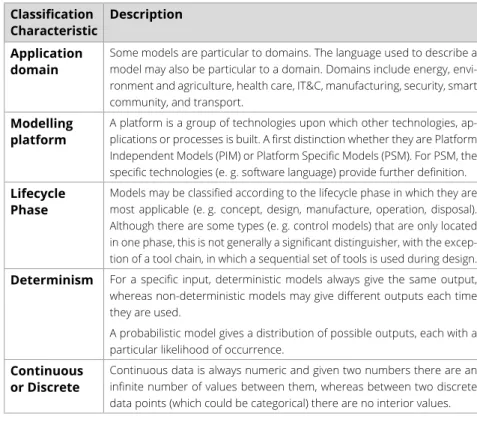
There are a number of other characteristics of a model through which it may be classified, and these are summarised in Table 1.
In addition to the more fundamental characteristics, there are also distinctions ac-cording to whether the model is proprietary or open (source, standards, etc.), and its maturity in terms of application.
Figure 1: A general classification of models (the lines represent inclusion within from lower to upper). Source: Michael Henshaw/TAMS4CPS.
Classification
Characteristic Description
Application domain
Some models are particular to domains. The language used to describe a model may also be particular to a domain. Domains include energy, envi-ronment and agriculture, health care, IT&C, manufacturing, security, smart community, and transport.
Modelling platform
A platform is a group of technologies upon which other technologies,
ap-plications or processes is built. A first distinction whether they are Platform Independent Models (PIM) or Platform Specific Models (PSM). For PSM, the specific technologies (e. g. software language) provide further definition.
Lifecycle Phase
Models may be classified according to the lifecycle phase in which they are
most applicable (e. g. concept, design, manufacture, operation, disposal). Although there are some types (e. g. control models) that are only located
in one phase, this is not generally a significant distinguisher, with the excep -tion of a tool chain, in which a sequential set of tools is used during design.
Determinism For a specific input, deterministic models always give the same output,
whereas non-deterministic models may give different outputs each time
they are used.
A probabilistic model gives a distribution of possible outputs, each with a particular likelihood of occurrence.
Continuous or Discrete
Continuous data is always numeric and given two numbers there are an
infinite number of values between them, whereas between two discrete
data points (which could be categorical) there are no interior values.
Table 1: Distinguishing Characteristics of Models
5.2 Simulation
A Simulation is “a model that behaves like a given system when provided a set of controlled inputs”14; it is usually based on a mathematical model (which in turn
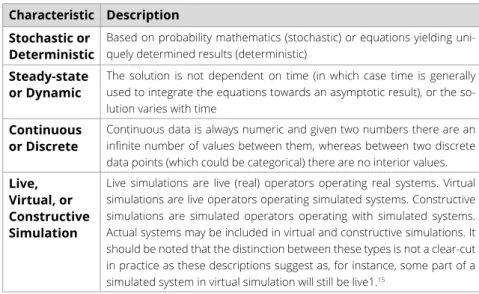
rests on a set of modelling assumptions), which allows a user to observe the pre-dicted system behaviour over time. However, a simulation can also take the form of a physical model, in which systems and / or humans perform a pre-determined set of operations and the resulting behaviour is observed. Similarly to the distin-guishing characteristics of Table 1, a set of characteristics for simulation can be contemplated (Table 2).
Characteristic Description Stochastic or
Deterministic
Based on probability mathematics (stochastic) or equations yielding uni-quely determined results (deterministic)
Steady-state or Dynamic
The solution is not dependent on time (in which case time is generally used to integrate the equations towards an asymptotic result), or the so-lution varies with time
Continuous or Discrete
Continuous data is always numeric and given two numbers there are an
infinite number of values between them, whereas between two discrete
data points (which could be categorical) there are no interior values. Live,
Virtual, or Constructive Simulation
Live simulations are live (real) operators operating real systems. Virtual simulations are live operators operating simulated systems. Constructive simulations are simulated operators operating with simulated systems. Actual systems may be included in virtual and constructive simulations. It should be noted that the distinction between these types is not a clear-cut in practice as these descriptions suggest as, for instance, some part of a
simulated system in virtual simulation will still be live1.15
Table 2: Distinguishing Characteristics of Simulations.
Co-Simulation is an important term for CPS M&S. This refers to the coupling of distributed simulations, that each models some part of a larger problem. Usually the independent simulations are treated as black boxes which are coupled together through some form of data exchange.
5.3
Problem Scale
Models (and simulations) can also be classified according to the scale of the CPS situation that they are supposed to represent. This is shown in Figure 2, in which the CPS situation increases in complexity from a single, isolated, device to an ex-tensive and heterogeneous network of devices. Whilst it is possible for a modelling approach, or type, to be useful at more than one problem scale, generally models will be designed to address one particular scale.
15 See Ciocoiu 2016.
manuelle
Fußnote
CPS configuration : In divi dual CPS config uratio n : Grou p Collaborativ e CPS config uratio n : Grou p Collaborativ e CPS configuration: Group Collaborative CPS confi gurati o n: Federate d CPS config uratio n: Federate d CPS config uratio n: Federate d CPS configuratio n: Federate d CPS configuration : Federated Device with embedded software with capability to monitor and respond to its local environment. Specific functional purpose. CPS config uratio n: Enterp rise CPS config uratio n: Enterp rise CPS config uratio n: Enterp rise CPS confi guratio n: Enterp rise CPS config uratio n: Enterp rise CPS confi gurati o n: Enterp rise CPS config uratio n: Enterp rise CPS config uratio n: Enterp rise CPS confi gurati o n: Enterp rise CPS confi gurati o n: Enterp rise CPS config uratio n: Enterp rise CPS confi guratio n: Enterp rise CPS configuration: Enterp rise Collection of devices with embedded software that exchange data to provide a range of services asso ci ated with the use rs’ local environment and activities. Large network of similar devices providing co -ordination and optimisation of resources to many users. Flexible interconnectio n of heterogeneou s device s offering multi-modal provision of a range of services Single vehicle + “driver” e.g. current vehicles giving driver assistance Collective vehicles
(e.g. convoys), communication
between vehicles City/Regional Traffic control (100’s-100,000); interactions between vehicles and infrastructure Management of multi-modal transport at regional or national leve l Image of
Figure 2: Framework for M&S classification according to CPS type: Individual, Group Collaborative, Federated, and Enterprise. Source: Michael Henshaw / TAMS4CPS.
6
Collaborative Agenda in Modelling
and Simulation for CPS
Through a series of paired workshops (one in the US followed by one in the EU) together with feedback webinars, a set of collaboration opportunities has been identified in TAMS4CPS. These research opportunities are the strategic research agenda; in each case the research opportunity satisfies the following three criteria:
There is a recognised technical gap in M&S that requires research the filling of which will lead to genuine improvements in the ability to design, construct, or operate CPS.
→ It is important to recognise that the research focuses on an aspect of mo-delling and simulation; it does not include more general research into CPS.
There is mutual interest and benefit to collaboration between EU and US re-searchers.
→ An implication of this requirement is that some significant technical gaps may not be included, because (for whatever reason) it is more appropriate for the EU and US to follow independent research paths.
Realistic research objectives can be set.
→ As an agenda, rather than a roadmap, the research themes identified are a point of departure for a collaborative research activity. Generally, there is not an end point, in the sense that a programme of research may continue to increase M&S capabilities through successive stages of research and deve-lopment. Nevertheless, there should be achievable medium term (<5 years) objectives through which the value of collaboration can be demonstrated. Another way to express this is that the research may include fundamental research but, ultimately, must have applied outcomes that can be realised through M&S methods and tools for CPS.
6.1
The M&S for CPS collaborative
research agenda
Research Theme 1: CPS test beds
Objectives of Collaboration
To create common test beds in order to verify or test CPS models and / or prototypes; To use common test beds to ensure interoperability of CPS models and / or CPS products.
Rationale for Collaboration between EU and US
There are many different types of test bed that could be beneficial for CPS M&S research, but for all the types, the main benefits of collaborative research between the EU and US are inter
-operability and verification.
Interoperability
Interoperability is a key enabler of export for sophisticated systems; in particular, the need for CPS products to interoperate with other extant systems can be an important consideration
with respect to purchase. Through the use of test beds, interoperation and compliance with standards can be assured. Trans-Atlantic interoperation is an enabler for both EU and US
businesses, also facilitating export to other parts of the world.
Verification
The complexity of emerging CPS (particularly networked CPS) means that verification of either models or products is a major challenge. Conventional methods of verification may need to
change in order to meet this challenge. At the product level, the motivation for collaborative
test beds is to enable access to markets (i. e. EU-US trade). In terms of verification of models,
the principal reason for collaboration is to enable the creation of tool-chains including sup-pliers from both sides of the Atlantic.
Description of collaborative research
Technical (System scale, Model types, Activities)
1) Large-scale test beds for CPS (especially autonomous vehicles)
The embedding of autonomous systems within the human and natural environment poses many challenges associated with safety, security, emergent behaviour, and multi-modal
inter-actions. This is especially exemplified by self-driving vehicles (land, air and maritime).
Large-scale test beds are required for several purposes:
Validating models of complex, multi-modal behaviours:
Demonstrating technologies in controlled, but realistic environments
MCity is an example of such a facility (http://www.mtc.umich.edu/test-facility) sponsored by US
Government and Industry. The testing environment is the model (of a realistic environment) in which new technologies may be tested.
2) Evaluation of cross-domain architectures
Cross-domain architectures are the structures which are supposed to enable activity across
domains that may have differing security levels. For CPS, the architecture may include diffe -rent software domains, but also physical domains as well. Assurance of the architectures is challenging, and the creation of software testbeds to enable evaluation of architectures is required. Assurance is required to enable greater integration of domains, providing agility in
CPS exploitation.
3) Combining formal verification and simulation technology See below
4) Testing and evaluation of resilient systems
There is a need to develop virtual testing environments in which emergent behaviour can be studied with appropriate visualisations. The eventual paradigm shift to continuous testing re-quires the development of an understanding of what to test and development of associated metrology to better relate testing to potential emergent behaviours. The test bed(s) would
enable a direct link to be made from model-based engineering to complex systems behaviours.
5) Simulated environments for human-automation interaction
As the complexity of CPS and, especially, networked CPS increases, so the interactions bet
-ween humans and CPS also become more complex. In particular, situational awareness of humans in relation to CPS and the representation of situation within CPS require significant
development of psychological and physiological aspects. The development of simulations to support design of appropriate interfaces is an essential requirement. Both the simulation ap-proaches and the test beds in which they are deployed should be developed.
6) Interoperability demonstration
Interoperability is an essential requirement for the marketability of most CPS. The develop -ment of open test beds is required for testing interoperability and demonstrating it to
po-tential customers. Such test beds would be an important enabler for small / medium sized
businesses for which significant testing is often a barrier to entry into the market.
Structure (Timeframe, Contributions)
Such projects would create platforms into which users integrate their prototype or model. The structure for collaboration is partly determined by the type of platform.
Physical platforms have a geographical location, which may pose problems for accessibility
and security. Such facilities need to include appropriate services (technicians, etc.) and
suf-ficient flexibility to change with changing requirements. The usual model for such facilities is
cost sharing across a consortium. The role of EC and US funding agencies would most likely be to incentivise co-operation through capital and maintenance contributions.
Synthetic or mixed environment platforms permit distributed access and would be enabled by
the use of open source contributions to computational capabilities….
Interoperability test environment consisting of hardware and middleware would be an enabler
of SME exploitation of CPS products. The link to M&S research is somewhat tenuous; however, it would be a simulation environment that enables transition into service of CPS devices. Joint EU / US development of the simulation environment would provide wider markets for CPS producers; this could be a sponsored project, however, it is recognised that the arrangements around IP could be challenging.
For all types of platform, the need is for immediate action and the timeframe for exploitation
of the test beds is 5-7 years. Technical advances are outstripping policy in the area of
auto-nomous transport systems and the need to validate models of networked CPS and verify the competence of CPS vehicles for deployment is urgent. Whilst test beds could be developed independently in the US and EU (and are being anyway) the benefits of cost sharing on shared objectives and common standards for verification should encourage the identification of ap -propriate structures for shared test bed platforms.
Research Theme 2: Inclusion of Human Factors in modelling and simulation
Objectives of Collaboration
To develop models of human behaviour appropriate to human-CPS interaction;
To include validated models of human behaviour within CPS models, simulations, and archi -tectures (Models of individual human behaviour and societal behaviour are both in scope). Rationale for Collaboration between EU and US
The motivation for collaboration in this theme is, quite simply, common interest. CPS are neces -sarily embedded in the human landscape and, for IoT in particular, the optimisation of human
and machine co-working is an essential objective for development. Across all the TAMS4CPS technical workshops, the inclusion of models of humans was identified as a significant “next
step”. Whilst development of better models of human behaviours is an important independent step, the nirvana is to include human behaviours within current technology models.
An area of particular concern is situational awareness, both of humans in the presence of CPS and of CPS themselves. The models used to provide the operating pictures for both are an
important area for development.
Description of collaborative research
Technical (System scale, Model types, Activities)
The following research endeavours are relevant to human-CPS interaction:
1) Modelling behaviour and performance of human interacting with CPS
This involves both lay people who have no interest in the system other than its performance as
well as trained operators co-working within CPS, human augmentation, and novel interfaces such as exoskeletons
2) Modelling of decision and control within CPS
This addresses matters of the allocation of authority and responsibility; situation awareness, informed command and informed consent; etc.
3) Physiological and psychological behaviour of CPS enhanced performance
The use of CPS to provide medical enhancement (e. g. insulin control in diabetics) or to pro
-vide physical enhancement for extreme performance (e. g. exoskeletons) is still in its infancy. Models to study the short and long term effects are required.
The following research endeavours concern the management and societal implications of CPS:
4) Modelling of governance of CPS
This covers accountability, regulations both to assure compliance with legal aspects and to
create a ‘level playing field’ for CPS within society.
5) Modelling of societal aspects within business models
This enables the exploration of Corporate Social Responsibilities, Responsible Research and
Innovation, and other aspects such as integrity, trust and acceptability.
Structure (Timeframe, Contributions)
Although there are many models of human behaviour, their direct relevance to CPS is compa
-ratively immature. The research is, therefore, of rather a fundamental nature and the benefits
of collaboration lie in sharing data and information and in a collective endeavour to improve the reliability of modelling human aspects. The most appropriate structures are those in which aligned research between EU and US is pursued, with each participant funded according to their geographical location. The role of the Commission in such endeavours will be to enable aligned programmes, in time and scale, through appropriate funding structures.
The use of large datasets to support the development of models will require open publication
Research Theme 3: Open framework for model interoperability
Objectives of Collaboration
To create an open framework kernel supporting modular IP integration with components on tooling and model level;
To create the open framework to support runtime execution of models;
To create the capability to validate the overall system of models, providing confidence in the
composition of models and simulation.
Rationale for Collaboration between EU and US
This activity will increase the variety and coherence of simulation tools available to CPS devel
-opers, facilitating more effective design and operation of CPS in the future. It will likely also
reduce the costs of development by creating greater competition in the choice of tools from which to construct tool chains.
Description of collaborative research
Technical (System scale, Model types, Activities)
The purpose of creating an open framework kernel is to enable the rapid integration of
mo-dels into systems of momo-dels; this could be valuable for real time modelling as well as design tool chains. This concerns the integration of computational and / or data-based methods, but could potentially enable mixtures of live, virtual, and simulated methods in the sense of real systems integrated with simulation or emulation models. This is applicable to all levels of CPS model, but is chiefly focused on group, federated, and enterprise models. Two major activities can be contemplated: the first concerns the creation of the kernel, which will enable any model to be integrated with others using IP modules (a component that enables a non-net -worked device or model to connect to a network system). The second area of research would be the creation of validation methods for systems of models. This is an area of fundamental research likely to require new paradigms of validation to be invented.
Structure (Timeframe, Contributions)
The role of the Commission is at the policy level of incentivising the creation of open
frame-works and tool development to fit within such frameframe-works. It is likely that tool vendors may be
reluctant to engage in open frameworks, although such an approach is likely to be an enabler, rather than a barrier, to the suppliers of good tools (that can thus gain an increased market share).
There is comparatively little research associated with the objective of creating an open
fra-mework, but a considerable effort is required in standardisation. However, the objective to
create a capability to validate overall systems of models should be viewed as a long term research activity.
Research Theme 4: Incorporation of security architectural features into models
Objectives of Collaboration
To develop and agree metrics for secure CPS;
To identify architectural features related to system security. Rationale for Collaboration between EU and US
Improvements in the security of CPS, especially from the perspective of individual privacy and commercial security could be considered to be societal benefits. The highly, and increa
-singly connected CPS network transcends geographic boundaries and so collaboration that will enable more secure CPS, because of better representation of security in models an ar -chitectures is of mutual and interrelated advantage to the EU and US. Research would be of a comparatively fundamental nature and focus on principles that could be implemented
within architecting activities. Collaboration to collectively advance this area justifies a EU-US
collaborative approach.
Description of collaborative research
Technical (System scale, Model types, Activities)
Although security architectures patterns have been developed for software systems, these
are not proven and for CPS the incorporation of physical security features must also be achie -ved. In general, the architectures in question refer to federated or enterprise level. Research
would address architecture patterns and would comprise the identification of architectural
features associated with security and the representation of these within standard architec-ture practices.
The question: how good is a system’s architecture? Can be answered in many ways and for many qualities of an architecture a complete set of meaningful metrics are yet to be defined. Research into appropriate metrics for security is essential to the identification of suitable patterns. This research would be carried out using small, well-defined CPS (e. g. a pacemaker);
developing and validating metrics of relevance. A key feature of this research would be the interaction between security and non-security personnel to share understanding about this domain.
Structure (Timeframe, Contributions)
As comparatively fundamental research, the appropriate structure would be aligned pro-grammes between the EU and US with appropriate mechanisms to share good practice as it develops. Researchers would be funded according to their geographical location.
Research Theme 5: Combining Formal Verification and Simulation Technology
Objectives of Collaboration
To combine formal verification and simulation of CPS in the specific domains.
[Note that whilst a general solution to this problem is probably unachievable, there is the
possibility to achieve this is specific domains.]
Rationale for Collaboration between EU and US
Verification of CPS represents a major challenge to the deployment of increasingly sophistica
-ted CPS. Projects based on this theme assume that formal verification can be applied to highly complex systems (of systems). The EU and US can collectively bring data from a wider range of applications and models to give greater confidence in the outcome of trying to combine formal verification with simulation of CPs.
Description of collaborative research
Technical (System scale, Model types, Activities)
Formal verification concerns proving the correctness of mathematical formulations for soft
-ware; for CPS, it is necessary to introduce a means of “proving” the physical aspects and this may be done using simulation; however, simulation serves to build confidence, not prove,
predicted behaviours. The use of formal testbeds, similar in design to simulation testbeds,
offers the possibility to reduce the cost of design checking, if it can be done early enough in the
design cycle. Research is required into the architecting of formal testbeds and development
of federated testbeds would enable multi-national collaboration in CPS development. Such testbeds could have a library of “off-the-shelf” (open) simulation components, increasing the opportunities for SME involvement in development of CPS. [linked to test beds (above)]
Structure (Timeframe, Contributions)
Typically, projects participants would be funded by their respective funding bodies (US
Research Theme 6: An evolutionary approach to testing and evaluation of adaptive / resilient CPS
Objectives of Collaboration
To create an evolutionary approach to testing and evaluation (T&E) of adaptive CPS, signalling
a paradigm shift in T&E.
Rationale for Collaboration between EU and US
Ultimately, such (long-term) research could lead to an entirely new way to test and evaluate
CPS, essentially adopting a paradigm of continual testing that would change the way that ve
-rification and certification are carried out. It is essential that such changes are adopted univer
-sally, in order that they may be exploited for EU export CPS items. In many ways, this particular theme would benefit not only from collaboration between EU and Us, but also with other
technologically advanced nations. Eventually, such a paradigm shift could lead to new ways for
certifying safety of CPS.
Description of collaborative research
Technical (System scale, Model types, Activities)
Current techniques of model-based design need to be combined with (or replaced by)
data-driven models (see “big data”). Continuous testing relies on the analysis of streaming data
to update models and enable predictions of future behaviour. The comparative cheapness and ubiquity of sensors enable this change in paradigm from traditional model-based design that uses static data to models that are driven by dynamic data. Research would focus on the
development of models that integrate streaming data into CPS design.
Structure (Timeframe, Contributions)
Two types of projects are required: the first, which would collaborative and most likely funded by
co-ordinated calls, concerns the development of the fundamental methods for using streaming data and the analytics that accompanies it. The second type would be the creation of the para-digm under which evolutional testing and evaluation is recognised as a legitimate way to establish
Research Theme 7: Big-data analytics modelling via machine learning
Objectives of Collaboration
To enable interpretation of big data (heterogeneous, sometimes very large datasets) to
instru-ment models;
To develop big data analysis for faster than real time applications. Rationale for Collaboration between EU and US
Big data is already a key enabler of commercial advantage in the ICT world, with major com-panies using data analytics to target customers and to analyse behaviours to understand
security threats. Within the CPS world, the ubiquity of sensors in the environment facilities two major areas of development. The first concerns real-time control and the second the improve
-ment of CPS models through update with new information (data) as it becomes available. Both
concern machine-learning. The motivation for collaboration is partly mutual interest and partly the need for common adoption of new design paradigms and design codes as viable and valid
methods for CPS development
Description of collaborative research
Technical (System scale, Model types, Activities)
The first type of research is described above in testing and evaluation. The second type requi -res the development of model frameworks that are predicated on an evolutionary approach under which they develop at an appropriate rate to accommodate new data as it becomes
available. Prioritisation of data and, in particular, the retirement of old data is key problems. Although much work on this has been done in the ICT space, the application to CPS requires
further research.
Structure (Timeframe, Contributions)
Jointly funded calls and aligned projects would be the main vehicle for this research. The sharing of data for testing (i. e. access to big data) would also be an important feature of collaboration.
6.2
Dream Projects
To elicit potential project activities from experts in modelling & simulation, ap-plied to CPS, the concept of “dream projects” was used in the TAMS4CPS work-shops. Dream projects were described as the type and subject of projects upon which the experts would like to collaborate. These projects arose from the research themes, outlined above. A very brief description of the dream projects is provided below; these could be used as an input to a future Horizon 2020 call or the theme of a proposal for collaboration between EU and US.
DP1: Characterise and improve entry and use of CPS. This project concerns
federated or enterprise level CPS and addresses a number of important questions concerning introduction of CPS within existing infrastructure. Models are re-quired to support: policy, regulation and guidance (i. e. consideration of risks due to emergent behaviours), economic and technical integration (business models etc.), and design / architecture at the enterprise level. The project would include sharing data associated with particular domains (e. g. transport) and the develop-ment of tools and methods for reasoning about introducing new CPS within leg-acy infrastructure.