Volume 4, Issue 1, Jan - Feb, 2017
(www.ijetr.org)
ISSN (E): 2347-5900 ISSN (P): 2347-6079PSO Optimized Fuzzy SMART Based MCDM ANS Algorithm
Aleksandar Tudzarov
1, Goce Stefanov
21 Faculty of Electrical Engineering, University Goce Delcev, Stip, R.Macedonia
2 Faculty of Electrical Engineering, University Goce Delcev, Stip, R.Macedonia
Abstract
In the next generation of heterogeneous wireless networks (HWNs), a large number of different radio access technologies (RATs) will be integrated into a common network. In this type of networks, selecting the most optimal and promising access network (AN) is an important consideration for overall networks stability, resource utilization, user satisfaction, and quality of service (QoS) provisioning.
Work conducted in this paper proposes a AN scheme to solve the access network selection (ANS) problem in the HWN using natural expired algorithms for solving optimization of processes for network selection. Scheme presents a design of general multicriteria software assistant (SA) that consider user, operator, and QoS parameters required by the users and operator in heterogeneous environment. Combined fuzzy logic (FL) optimized with use of Particle Swarm Optimization method (PSO) for optimization of membership function in fuzzy logic controllers (FLC) and multicriteria decision making (MCDM) have been used in order to address proper treatment of all influencing factors (criteria’s) and constantly changing environment in ANS algorithm. Simulation results show that the proposed scheme for SA ANS has better and more robust performance over the random-based selection and service based selection algorithm which are used as a reference radio resource management RRM scheme in analyzed heterogeneous networks
.
Keywords: Author Guide, Article, Camera-Ready Format, Paper Specifications, Paper Submission.
1. Introduction
Common RRM (CRRM) and joint RRM (JRRM) are two types of the processes that enable radio resource management between the different RATs in heterogeneous networks.
CRRM is a RRM architecture proposed by 3GPP to make cooperation between UMTS and GSM/GPRS networks. It is responsible for coordinating the individual RRM entities of each RAT in UMTS and GSM/GPRS networks.JRRM is RRM architecture and mechanism similar to CRRM, but it is not restricted to GSM and
UMTS and complements the CRRM with additional features and algorithms. Both JRRM and CRRM imply the use of some new RRM mechanisms such as access network selection (ANS), joint admission control (JAC), joint scheduling control (JSC), and vertical handover (VHO). In this paper focus is concentrated on the first JRRM mechanism mentioned above, ANS, Main goal of ANS is selection of most suitable access network (AN) based on the discovered RAT characteristics, Radio signal strength, QoS constraints, as well as policies applied by operator, and user specific characteristics like mobile speed and technology price preferences.
Usually ANS algorithms that can be found in literature are concentrated on single selection criteria and their focus is placed on radio signal strength thresholds for each AN as a criteria upon which RAT is selected. Mobile terminal compares the RSS of given RAT with the signal thresholds and decides if it should invoke vertical handoff procedure. The ways that these ANS algorithms operate have certain limitation regarding its reaction to the changing environment conditions.
Usually these algorithms cannot cope with the different viewpoints and goals of the operators, users, and QoS requirements which make them inefficient for a multicriteria problem such as ANS problem.
The main contribution of this paper is the development of a new class of ANS algorithms that are based on hybrid parallel fuzzy logic (FL) decision, generated and optimized by PSO (Particle Swarm Optimization) algorithms, implementing multiple-criteria decision making (MCDM) systems in a final phase of RAT selection in heterogeneous environments. This algorithm is used to develop adaptive, flexible, and scalable ANS system that can utilize hybrid parallel FL decisionmaking systems and MCDM systems. FL systems are used in this algorithm in order to introduce flexibility and to deal with uncertainty that arises from constant changes of radio conditions that impacts radio
(www.ijetr.org)
© Copyright reserved by IJETR (Impact Factor: 0.997) 53 technologies as well as to be able to use selection
mechanism based on different types of inputs that are normally incomparable due to their incompatibility by the nature and behavior. By introducing FL in the selection algorithm possibility for using of different input parameters by their nature arises and increases flexibility and overall usability of the algorithm. Considering this fact, input variables are in practice normalized in dimensionless values which magnitude represents their impact in selection criteria for each RAT. All of the outputs are normalized and receive values from [0 to 1] interval. In order to simplify implementation of FL and to
give some clearance parallel FLC are used.
Implementation of Parallel FLC reduces the complexity of inference rules used in the fuzzy-based solutions. Furthermore use of nature inspired algorithms like PSO – “Particle Swarm Optimization” for optimization of FLC and MCDM systems in order to incorporate past knowledge of network behaviors in these systems. Proposed scheme to solve the ANS problem as well as Software assistant (SA) based on the proposed scheme in coexisted CDMA-TDMA based systems is described in Simulation bellow.
2. ANS solving scheme
In general, any ANS solution has to take into its account the following general requirements:
(i) The solution has to solve the ANS problem in a simple way to give a reasonable and acceptable delay before the decision appears.
(ii) The solution has to cope with the different view points and goals of the operators and the users and to give both parties the right and fair role in the selection process. (iii) The solution has to react to the changing environment conditions and accumulated human knowledge about the problem.
(iv) The solution has to allow any type of inputs and to be applicable to any type of ANs.
(v) The solution has to be able to handle the increasing number of RATs and it also has to be able to handle a large number of criteria.
The ANS procedure can be divided into three phases, initiation phase, decision phase, and execution phase.
The objective of the initiation phase is to recognize the need for ANS and subsequently initiate it and find out the required information and measurements for the decision phase.
In the decision phase, a comparison of the information and the measurements calculated from a variety of sources including networks measurements, QoS
requirements, user preferences, and operator policies is done. This comparison lead to the identification of the best available AN according to the defined performance evaluation metrics.
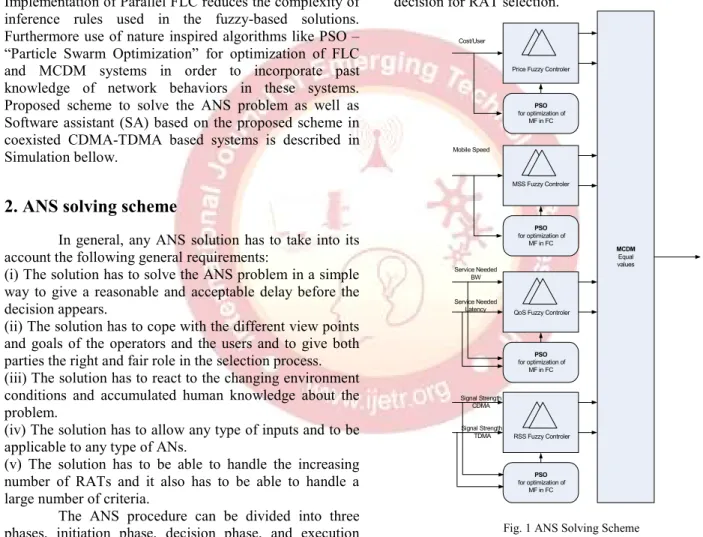
A generic scheme to solve the ANS problem and any other similar selection problem is shown in Figure 1. The scheme decision phase consists of three main components, the first component contains a set of small parallel fuzzy logic (FL)-based subsystems, second component is a PSO optimization criteria systems implemented on Fuzzy membership functions in order to create optimized FC, third component is multiplecriteria decision making (MCDM) system that makes the final decision for RAT selection.
MCDM Equal values PSO for optimization of MF in FC RSS Fuzzy Controler Price Fuzzy Controler
MSS Fuzzy Controler
QoS Fuzzy Controler Cost/User Mobile Speed Service Needed BW Service Needed Latency Signal Strength CDMA Signal Strength TDMA PSO for optimization of MF in FC PSO for optimization of MF in FC PSO for optimization of MF in FC
Fig. 1 ANS Solving Scheme
The scheme decision phase can be described in more detail as follows:
(i) The heterogeneous wireless environment contains up to
n ANs (RAT1, RAT2, . . . , RATn) and the framework has
to select the most promising one or to rank the RATs according to their suitability.
(ii) The selection depends on multiple criteria up to i (c1,
from different sources to cover the different view points of the users, the operators, the applications, and the network conditions. Each criterion is measured then passed to its FL-based control subsystem in the first component. (iii) Using the PSO system FLC optimization of Fuzzy MF is conducted based on measured inputs and wanted output behavior in order to create most suitable FLC that corresponds to input variable ranges and values. Optimization is conducted by minimizing of MSE between wanted and calculated outputs from Fuzzy Controller that is being optimized.
(iv) Every FL-based subsystem produced by PSO gives an initial score for each RAT that reflects the suitability of that RAT according the FL subsystem criterion. The different sets of scores (d1, d2, . . . , di) are sent to the MCDM in the third component..
(v) Using the initial scores coming from the first component and the weights that are assigned manually (they are equal for each FLC input) the MCDM will select the most promising AN or will rank the available RATs according to their suitability.
Proposed algorithm utilizes the advantages of parallel FL control, PSO optimization and MCDM, scheme is presented on Figure1.
The idea of the parallel FLC reduces the complexity of the inference rules used in the fuzzy-based solutions. In general data that have to be taken in to account in ANS algorithm are very dissimilar, imprecise and even contradictory to each other having in mind that they come from different sources. For example, data like SNR, cell load, and signal strength from different RAT are not directly comparable and can be deceiving if compared directly. That’s why use of Fuzzy logic which is tolerant to imprecise and contradictory data was a logical choice in implementation of ANS solution. Parameters of FLC that have to be considered while constructing the fuzzy logic are shape of Membership Functions and type of fuzzy inference system. There are different kinds of shapes implemented in Fuzzy controllers and there for in order to get better performance testing of this parameter should be considered. In general there are two types of FIS which main difference are in aggregation and defuzzification process (Sugeno & Mamadani). In this work after short analyzes it is determined that it would be best if FLC are based on Mamadani FIS and triangular MF.
Particle swarm optimization (PSO) is a population based stochastic optimization technique inspired by social behavior of bird flocking or fish schooling. The system is initialized with a population of random solutions and searches for optima by updating generations. ANS problem is a multicriteria problem by nature there for flexible and complementary ANS multicriteria solution have to be used in order to provide a
solution that can cope with the different viewpoints and goals.
AS MCDM solution enhanced version of simple multiattribute rating technique (SMART) has been used. SMART is one of the simplest and most efficient MCDM
methods. The ranking value xj of alternative Aj is obtained
simply as the weighted algebraic mean of the utility values
associated with it, that is, aij according to (4):
∑
∑
= ==
m i ij m i ij i jw
a
w
X
1 1 , j =1,2,….,n (4)SMART employs relatively uncomplicated and
straightforward manipulation method, which makes it stronger and easier to use in a hybrid and more complex models such as the proposed one in this paper. In proposed algorithm, there are two alternatives for the MCDM, one is a CDMA-based network and the other is a TDMA-based network. The input criteria of the MCDM are the outputs of the FL-based control subsystems in the first component. Weights Wi for criteria i are assigned to reflect their relative importance. The criteria with more importance to the operator and user can be assigned higher weight. Since all the outputs of FL subsystems are in the range [0, 1], there is no need to scale the criteria performance against alternatives, and there for all weights in this case are set to equal values. The weights of the input criteria {Wv,Ws,Wt ,Wu} as previously mentioned are set to equal values (0,25).
3. Simulation Model
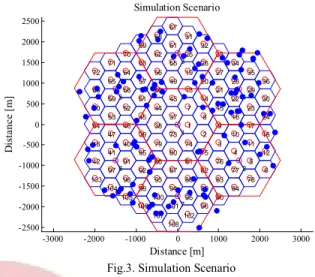
Proposed scheme for (SA) and Selection Algorithm are evaluated using the simulation approach. MATLAB mathematical software and a set of functions called RUNE [1] “RUdimentary Network Emulator” have been used for the simulation. The system model considers the coexistence of a CDMA-based WWAN network with seven macro cells with omnidirectional antenna and cell radius = 1000 m and a TDMA-based WLAN network with hundred and eight microcells with omnidirectional antenna and cell radius = 250 m. In the system environment, each mobile has a velocity and is moved with a random distance and a random direction at defined time steps. The velocity is a vector quantity with magnitude and direction. The velocity of the i-th mobile is updated according to (7);
X
v
P
P
v
v
i i*
1
*
mean*
2 1+
−
=
− ; (7)(www.ijetr.org)
© Copyright reserved by IJETR (Impact Factor: 0.997) 55
Where
࢜
is the complex speed [m/s]. P is the correlationof the velocity between time steps. It depends on both amean
that is the mean acceleration of the mobile user and vmean
which is mean velocity of mobile user. P is calculated according equation (8):
−
=
mean meanv
a
dt
P
*
(8)X is Rayleigh distributed magnitude with mean 1 and a
random direction.
࢜
ࢋࢇis the mean speed of mobiles.࢜
ࢋࢇwas set to 10 km/h andࢇ
ࢋࢇhas been set to 1km/h2
Figure 3. shows the users, in red spots, over the simulated environment.
Four types of services are considered in the simulation and they are equally distributed among the users, the voice calls, the low bit rate real-time video telephony, the high bit rate video, and the nonreal-time data traffic. N mobile users are created and they are randomly distributed among the defined service types. In general their requirements from the wireless network are simulated as pair of values defined as:
[service_LAT, service_BW] (9) {[100, 64];[200,128];[400 256];[800 512]}
The traffic is modeled according to Poisson process. The main holding time is assumed to be 50 seconds. For the purpose of simulation Fuzzy logic controllers where designed that fits the FLC parallel scheme. Considering that two RAT technologies are analyzed in the scenario two outputs from every FLC are taken. Outputs from the FLC present degree of membership of each RAT scaled to input variables regarding FL rules. Taking into account that most of ANS algorithm are based on Radio Signal Strength and that this parameter has the biggest impact on final decision in ANS, special Particle Swarm Optimization (PSO) algorithm described above is used in order to produce FLC which membership function are tuned to measured signal strengths from simulation.
Fig.3. Simulation Scenario
PSO algorithms uses Swarm size of 50 particles and maximum number of iteration = 50. Evaluation function is based on minimizing the mean square error (MSE) comparing to expected predefined values. Expected values are defined as values taken from humanly decision that would be made if access network selection is done by human for every point in time and separately for each analyzed criteria. Where c1 and c2 as acceleration constants in Eq. (1) for this simulation are 0,9 and velocity of swarm is changed n interval from (30 to 0,7).
This subsection shows some simulation results and compares the performance of proposed solution to two different reference ANS algorithms.
The first algorithm is a servicetype-based selection algorithm where high bit services with low propagation delay requirements are sent to the WLAN and the low bit rate services with the high propagation delay requirements are sent to the WWAN. The second algorithm is a random-based selection algorithm where the users are assigned randomly to the two networks. All solutions have been simulated, evaluated, and compared for the same objective optimization and that is to maximize the percentage of assigned to the networks with stronger signal strength (Pq). Several runs of simulation have been carried out for different number of users in simulation scenario (from 100 to 1000 with step of 100). Figure 4. shows Pq values in all solutions. The horizontal axis shows the number of users while the vertical axis shows the Pq values. From both Figure SS and the numerical samples for Pq values shown in Table 1, the great improvement in the percentage of the users assigned to networks with stronger received signal can be seen in every simulation scenario for different number of users.
Nr. Users PSO-Fuzzy MCDM ANS Service Type based ANS Random based ANS -3000 -2000 -1000 0 1000 2000 3000 -2500 -2000 -1500 -1000 -500 0 500 1000 1500 2000 2500 1 2 3 4 5 6 7 8 9 10 11 12 13 14 15 16 17 18 19 20 21 22 23 24 25 26 27 28 29 30 31 32 33 34 35 36 37 38 39 40 41 42 43 44 45 46 47 48 49 50 51 52 53 54 55 56 57 58 59 60 61 62 63 64 65 66 67 68 69 70 71 72 73 74 75 76 77 78 79 80 81 82 83 84 85 86 87 88 89 90 91 92 93 94 95 96 97 98 99 100 101 102 103 104 105 106 107 108 1 2 3 4 5 6 7 Distance [m] D is ta n c e [ m ] Simulation Scenario
100 0,740 0,470 0,420 200 0,790 0,505 0,530 300 0,700 0,507 0,470 400 0,740 0,508 0,585 500 0,786 0,516 0,508 600 0,775 0,475 0,480 700 0,746 0,469 0,506 800 0,805 0,523 0,521 900 0,844 0,516 0,490 1000 0,796 0,493 0,513
Table 1. Percentage of satisfied users
For example, with 900 users in the scenario it can be seen from Table.1 that Pq for proposed algorithm is 0,844 that means that 84% of the users are assigned to RAT with better signal strength and by that means with better QoS, while in that same scenario it can be seen that reference algorithms can achieve Pq factor of around 50%. In average, proposed solution achieves around 27% enhancement over the random-based selection algorithm.
4. Conclusions
A novel scheme to solve the multicriteria ANS problem has been presented in this paper. The proposed scheme is scalable and is able to handle any number of RATs with a large set of criteria. The scheme can cope with the different and contrast view points and goals of the operator and users. The proposed scheme has been used to present and design a multicriteria ANS solution
References
[1] J. Zander and S. Kim, Radio Resource Management forWireless Networks, Artech House, Boston, Mass, USA, 2001.
[2] J. Kennedy, R.C. Eberhart, Particle swarm optimization, in: Proceedings of the IEEE International Conference on Neural Networks, vol. 4, pp. 1942–1948, 1995.
[3] S. Doctor, V. K. Venayagamoorthy, “Navigation of mobile sensors using PSO and embedded PSO in a fuzzy logic controller”, IEEE Industry Applications Conference, vol. 2,pp. 1200-1206, Oct. 2004.
[4] M. Clerc, J. Kennedy, The particle swarm explosion, stability, and convergence in a multidimensional complex space, IEEE Transaction on Evolutionary Computation, vol.6, pp. 58–73, 2002.
[5] J. P´erez-Romero, O. Sallent, R. Agust´ı, andM. A. D´ıaz-Guerra, RadioResourceManagement Strategies in UMTS, JohnWiley & Sons, New York, NY, USA, 2005.
[6] L. Giupponi, R. Agust´ı, J. P´erez Romero, and O. Sallent, “A novel joint radio resource management approach with reinforcement learning mechanisms,” in Proceedings of the
24th IEEE International Performance, Computing, and Communications Conference (IPCCC ’05), pp. 621–626, Phoenix, Ariz, USA, April 2005.
[7] R. Agust´ı, O. Sallent, J. P´erez-Romero, and L. Giupponi, “A fuzzy neural based approach for joint radio resource management in a B3G framework,” in Proceedings of the 1st International Conference on Quality of Service in Heterogeneous Wired/Wireless Networks (QSHINE ’04), pp. 216–224, Dallas, Tex, USA, October 2004.
[8] A.Wilson, A. Lenaghan, and R. Malyan, “Optimizing wireless access network selection to maintain QoS in heterogeneous wireless environments,” in Proceedings of the Wireless Personal Multimedia Communications (WPMC ’05), Aalborg, Denmark, September 2005.
[9] S. Doctor, V. K. Venayagamoorthy, “Navigation of mobile sensors using PSO and embedded PSO in a fuzzy logic controller”, IEEE Industry Applications Conference, vol. 2, pp. 1200-1206, Oct. 2004.
[10] A. Hajizadeh, L. Norum, M. A. Golkar - “Fuzzy-PSO Based Controller for Hybrid Fuel Cell Power Systems during Voltage Sag” 2nd International Conference on Clean Electrical Power, Renewable Energy Resources Impact (ISBN: 978-1-4244-2544-0/08)