Networks
by
Yuhang Dai
A thesis submitted to the University of London for the degree of
Doctor of Philosophy
School of Electronic Engineering & Computer Science
Queen Mary University of London
United Kingdom
Sep 2018Excessive buffering brings a new challenge into the networks which is known as Bufferbloat, which is harmful to delay sensitive applications. Wireless access networks consist of Wi-Fi and cellular networks. In the thesis, the performance of CoDel and RED are investigated in Wi-Fi networks with different types of traffic. Results show that CoDel and RED work well in Wi-Fi networks, due to the similarity of protocol structures of Wi-Fi and wired networks.
It is difficult for RED to tune parameters in cellular networks because of the time-varying channel. CoDel needs modifications as it drops the first packet of queue and the head packet in cellular networks will be segmented. The major contribution of this thesis is that three new AQM algorithms tailored to cellular networks are proposed to alleviate large queuing delays.
A channel quality aware AQM is proposed using the CQI. The proposed algorithm is tested with a single cell topology and simulation results show that the proposed algo-rithm reduces the average queuing delay for each user by 40% on average with TCP traffic compared to CoDel.
A QoE aware AQM is proposed for VoIP traffic. Drops and delay are monitored and turned into QoE by mathematical models. The proposed algorithm is tested in NS3 and compared with CoDel, and it enhances the QoE of VoIP traffic and the average end-to-end delay is reduced by more than 200 ms when multiple users with different CQI compete for the wireless channel.
A random back-off AQM is proposed to alleviate the queuing delay created by video in cellular networks. The proposed algorithm monitors the play-out buffer and postpones the request of the next packet. The proposed algorithm is tested in various scenarios and it outperforms CoDel by 18% in controlling the average end-to-end delay when users have different channel conditions.
I, Yuhang Dai, confirm that the work presented in this thesis is my own work and it is original except where due reference has been mentioned.
I attest that I have exercised reasonable care to ensure that the work is original, and does not to the best of my knowledge break any UK law, infringe any third party’s copyright or other Intellectual.
I accept that the College has the right to use plagiarism detection software to check the electronic version of the thesis. I confirm that this thesis has not been previously submitted of for the aware of a degree by this or any other university.
The copyright of this thesis rests with the author and no quotation from it or information derived from it may be publish without the prior written consent of the author.
Signature: Date:
First of all, I would like to express the depth of my gratitude to my supervisor, Dr. Vindya Wijeratne, for he constant encouragement and guidance. She has walked me through all the stage of my Ph.D. study.
I would also like to express my gratitude to Dr. John Schormans for his priceless advices in my research and effort in my thesis writing. Without his consistent and illuminating instructions, this thesis could not have its present form.
I would also like to thank Prof. Yue Chen for her valuable suggestion and discussions in the group meeting.
Meanwhile, I would like the thank you all the college and friends at Queen Mary. It is a great to meet all of you.
I would also like to thank my family and girlfriend, who gives me support and courage through my Ph.D.
Abstract i
Delaration ii
Acknowledgments iii
Table of Contents iv
List of Figures viii
List of Tables xii
List of Abbreviations xiv
1 Introduction 1
1.1 Motivation . . . 2
1.2 Aims and Objectives . . . 2
1.3 Novelty and Contributions . . . 3
1.4 Outline of the Thesis . . . 4
2 Background and Literature Review 5 2.1 Introduction . . . 5
2.2 End-to-end Congestion Control . . . 7
2.2.1 Loss based TCP . . . 7
2.2.2 Delay based TCP . . . 9 iv
2.2.4 Multi Path TCP . . . 10
2.3 Hop-by-Hop Congestion Control . . . 13
2.3.1 Understanding Traffic Control (TC) within a Node . . . 13
2.3.2 AQM Algorithms . . . 14
2.3.3 Scheduling Scheme . . . 18
2.4 Literature Review . . . 20
2.5 Summary . . . 35
3 Performance Evaluation of Active Queue Management on Wi-Fi Access Networks 36 3.1 Introduction . . . 36
3.2 Background of Traffic Pattern . . . 37
3.2.1 Validation of Traffic Pattern . . . 40
3.3 Evaluation Design . . . 45
3.4 Simulation Results and Discussion . . . 47
3.4.1 Traffic Scenario I (10 FTP Flows and 1 VoIP Flow) . . . 47
3.4.2 Traffic Scenario II (10 VoIP Flows and 1 FTP Flow) . . . 49
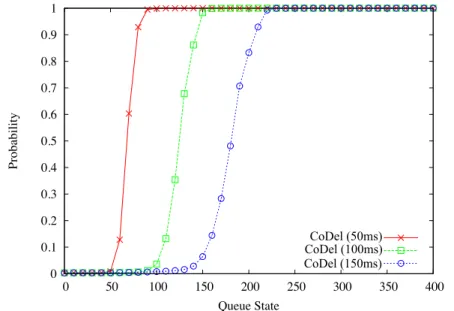
3.4.3 CoDel with Different Target . . . 50
3.5 Summary . . . 54
4 Channel Quality Aware Active Queue Management in Cellular Net-works 56 4.1 Introduction . . . 56
4.2 Implementation of CoDel in RLC Layer . . . 58
4.3 CQI-Aware Queue Management . . . 59
4.4 Simulation Setup . . . 63
4.5 Results and Discussion . . . 64
4.6 Conclusions . . . 67
works 69
5.1 Introduction . . . 69
5.2 QoE Estimation . . . 71
5.2.1 Kingman Formula . . . 71
5.2.2 IP Multimedia Subsystem . . . 73
5.2.3 QoE for VoIP . . . 75
5.3 Design of QoE Based Active Queue Management . . . 76
5.3.1 Estimating the Queuing Delay . . . 76
5.3.2 Dropping Policy . . . 76
5.4 Simulation Results and Discussions . . . 77
5.4.1 Simulation Setup . . . 77
5.4.2 Simulation Results . . . 78
5.5 Conclusions . . . 81
6 Active Queue Management for Dynamic Adaptive Video Streaming over HTTP 83 6.1 Introduction to DASH . . . 83
6.2 Design and Implementation of AQM for DASH . . . 85
6.3 Simulations and Results . . . 88
6.3.1 Scenario I . . . 88
6.3.2 Scenario II . . . 93
6.4 Discussion . . . 95
6.5 Conclusions . . . 99
7 Conclusions and future work 101 7.1 Summary . . . 101
7.2 Key contributions . . . 102
7.3 Future work . . . 103
References . . . 105
2.1 Internet Host . . . 6
2.2 Bottleneck Link . . . 6
2.3 Congestion Window of Tahoe and Reno . . . 8
2.4 Multi Path TCP Illustration . . . 11
2.5 Multi Path TCP Illustration . . . 11
2.6 Head-of-Line Blocking . . . 12
2.7 Traffic Flow Chart in Linux Kernel . . . 13
2.8 TC with different Components . . . 14
2.9 RED AQM . . . 15
2.10 PIE AQM . . . 17
2.11 Round Robin Scheduler . . . 19
2.12 Weighted Round Robin Scheduler . . . 19
2.13 Deficit Round Robin Scheduler . . . 20
2.14 Common Topology . . . 24
2.15 Protocol Stacks of Cellular Network . . . 29
2.16 Abnormal TCP Behavior (Figure 7 in [JLW+12]) . . . 30
3.1 ON-OFF Traffic Source. . . 37
3.2 Bursty Traffic Queuing . . . 38
3.3 Packet Traffic Queuing . . . 38
3.4 Poisson Arrival Process Illustration. . . 39
3.6 Topology for multiple source validation. . . 41
3.7 Single Source Validation over UDP. . . 42
3.8 Two Sources Validation over UDP. . . 43
3.9 Five Sources Validation over UDP. . . 43
3.10 VoIP Traffic Validation (Load=0.6). . . 44
3.11 VoIP Traffic Validation (Load=0.7). . . 44
3.12 VoIP Traffic Validation (Load=0.8). . . 44
3.13 VoIP Traffic Validation (Load=0.9). . . 45
3.14 VoIP Traffic Validation (Load=0.95). . . 45
3.15 Simulation Topology. . . 46
3.16 CDF of Queue State with Different Queue Management Techniques in Traffic scenario I. . . 47
3.17 CDF of Delay of FTP and VoIP Flow with different Queue Technique. . . 48
3.18 CDF of Queue State with Different Queue Management Techniques in Traffic scenario II . . . 49
3.19 CDF of Delay of FTP Flow and VoIP Flow with differnt Queue Techniques. 50 3.20 CDF of Queue State of CoDel with Different Target in Traffic Scenario I . 51 3.21 CDF of Queue State of CoDel with Different Target in Traffic Scenario II 52 3.22 CDF of Delay of CoDel with Different Target in Traffic Scenario I . . . . 52
3.23 CDF of Delay of CoDel with Different Target in Traffic Scenario II . . . . 53
4.1 Cellular Network Structure . . . 57
4.2 RLC Packet Segmentation . . . 59
4.3 Dropping probability function of the proposed method. . . 62
4.4 Simulation Topology. . . 64
4.5 Average Queuing Delay at RLC Layer with Increasing Number of UEs. . . 65
4.6 Drop Probability . . . 66
4.7 Goodput with Increasing Number of UEs. . . 67
5.1 Queuing System [PS01] . . . 71
5.2 G/G/1 Queue . . . 72
5.3 IP Multimedia Subsystem . . . 74
5.4 Structure of EPS Bearer . . . 74
5.5 Simulation Topology. . . 78
5.6 Average End-to-end Delay with Increasing Number of UEs. . . 79
5.7 Drop Probability . . . 79
5.8 QoE Level . . . 80
5.9 Jain’s Fairness Index . . . 81
6.1 DASH Architecture . . . 84
6.2 Media Presentation Model . . . 85
6.3 Dash Architecture on a Node . . . 87
6.4 Simulation Topology . . . 88
6.5 Average Goodput of each Flow with Increasing Number of UE (CQI 15) . 89 6.6 Average End-to-end Delay with Increasing Number of UE (CQI 15) . . . . 90
6.7 Jain’s Fairness Index with Increasing Number of UE (CQI 15) . . . 91
6.8 Average Goodput of each Flow with Increasing Number of UE (CQI 8) . . 92
6.9 Average End-to-end Delay with Increasing Number of UE (CQI 8) . . . . 92
6.10 Jain’s Fairness Index with Increasing Number of UE (CQI 8) . . . 93
6.11 Average End-to-end Delay with Increasing Number of UE . . . 94
6.12 Average Goodput . . . 95
6.13 Jain’s Fairness Index . . . 95
6.14 Average End-to-end Delay of the Proposed Algorithm with different Thresh-olds . . . 96
6.15 Jain’s Fairness Index (server with 100 Mbps bandwidth) . . . 97
6.16 Average Goodput of each flow (server with 100 Mbps bandwidth) . . . 97
6.17 Average End-to-end Delay (server with 100 Mbps bandwidth) . . . 98
2-A Summary of State of the Arts . . . 35
3-A Parameters of the ON-OFF source for single source validation over UDP . 41 3-B Parameters of the ON-OFF source for two source validation over UDP . . 41
3-C Parameters of the ON-OFF source for five source validation over UDP . . 41
3-D Parameters of the ON-OFF source for validation of VoIP Traffic . . . 42
3-E Parameters in Simulation . . . 46
3-F Drop Rate in Traffic Scenario I . . . 48
3-G Drop Rate in Traffic Scenario II . . . 50
3-H Drop Rates in Traffic Scenario I . . . 53
3-I Goodput in Traffic Scenario I . . . 53
3-J Drop Rate in Traffic Scenario II . . . 53
4-A 4-bit CQI Table [ETS] . . . 61
4-B Parameters in Simulation . . . 65
5-A Parameters in Kendall’s Notation . . . 72
5-B Distribution Types . . . 72
5-C Parameter in G/G/1 Queue and Kingman Formula . . . 73
5-D Quality Ratings and Associated MOS Score . . . 76
5-E Parameters in Simulation . . . 78
6-A Parameters in all Scenarios . . . 88
6-C Scenario I Parameters (CQI 8) . . . 89 6-D Scenario II parameters (variant CQI) . . . 94
3GPP Third Generation Partnership Project 4G Fourth Generation
ACK Acknowledgement AM Acknowledged Mode AP Access Point
AQM Active Queue Management ARED Adaptive RED
ARPANET Advanced Research Projects Agency Network AWND Advertised Window
BS Base Station BBU Baseband Units BER Bit Error Rate
CA Congestion Avoidance
CAGR Compound Annual Growth Rate CoDel Controlled Delay
CWND Congestion Window
CPRI Common Public Radio Interface CQI Channel Quality Index
CSCF Call Session Control Function CSI Channel State Information DRR Deficit Round Robin
DRWA Dynamic Receive Window Adjustment DWRR Deficit Weighted Round Robin
eNB eNode Base Station EPS Evolved Packet System E-RAB E-Radio Access Bearer FCFS First Come First Serve FIFO First In First Out FQ Flow Queuing FRED Fair RED
FWMRED Fair Weighted Multi-Level Random Early Detection GBR Guaranteed Bit Rate
HSS Home Subscriber Server IoT Internet of Things ISP Internet Service Provider
IID Independent and Identical Distributed IP Internet Protocol
IMS IP Multimedia Subsystem I-CSCF Interrogating CSCF
KPI Key Performance Indicator
LEDBAT Low Extra Delay background Transport LTE Long Term Evolution
MPTCP Multi Path TCP
MOS Mean Opinion of Source
MPD Media Presentation Description mmWave Millimeter Wave
NIC Network Interface Card NGN Next Generation Network NS3 Network Simulator 3 P-CSCF Proxy CSCF
PDN Packet Data Network
PIE Proportional Integral Enhanced PSTN Public Switched Telephone Network PUCCH Public Uplink Control Channel PUSCH Public Uplink Share Channel QoS Quality of Service
QoE Quality of Experience
RCPQD Rate Controlled Priority Queuing Discipline RED Random Early Detection
RLC Radio Link Control RR Round Robin
RTAC Receiver-side TCP Adaptive queue Control RTT Round Trip Time
RTP Real Time Transport Protocol RTSP Real Time Streaming Protocol RWND Receiver Window
SABRE Smooth Adaptive Bit Rate S-CSCF Serving CSCF
SIP Session Initiation Protocol
TCP Transmission Control Protocol TID Traffic Identifier
TM Transient Mode
TTI Transmission Time Interval TPP TCP Packet Pacing
UDP User Datagram Protocol UE User Equipment
UMTS Universal Mobile Telecommunications System VoIP Voice over IP
WRR Weighted Round Robin
WiMAX Worldwide Interoperability for Microwave Access WLAN Wireless Local Area Network
Introduction
Mobile devices are becoming increasingly powerful these days. It is quite common that one person has multiple devices connected to the network, which leads to the rise of global data traffic. Smart phones and tablets facilitates people’s life. Nowadays, people can have access to the Internet with different type of equipment and almost whenever and wherever they want. Increasing numbers of devices accessing to the Internet causes the growth of Internet traffic. As a result, delay of packets increases as packets waiting to be transmitted in the queue along the Internet path. Increasing queuing delay of packets has drawn researchers’ attentions. The phenomenon here referred to as Bufferbloat. Three conditions are essential to trigger Bufferbloat. First is the bursty traffic which makes it too hard to transmit packets at the intermediate node in the network in time; second is that the node has a large buffer; third is that packets in the buffer are for different clients. Bufferbloat potentially causes high latency and jitter, as well as reducing the overall network throughput as a consequence of TCP synchronization.
Bufferbloat can happen in both wired and wireless networks. The access points (AP) in wireless networks are often considered as the bottleneck of the whole path of a connection. The unique features of wireless access networks, such as the time-varying channel, multi-path fading, high bit error rate and etc. [CT14][JBT14], make it more challenging to
solve Bufferbloat issues.
1.1 Motivation
Ludwing, R., et al.[LRK+99] first pointed out the potential issue of over-buffering in
cellular networks in 1999, focusing on GPRS networks. Studies [JBT14][JWLR12] have also confirmed that Bufferbloat indeed exists not only within cellular networks but also in Wi-Fi networks and pointed out that it can lead to RTT in the order of seconds for cellular networks. However, recent studies [HKT+17][GPKC17] focus on WiFi and
Satellite Networks but few papers focus on cellular networks. With the growth of hand-held devices (e.g., smartphones and tablets) and with most devices equipped with both Wi-Fi and cellular interfaces, wireless access to the Internet is growing fast. A forecast [cic17] from CISCO shows that the global mobile data traffic of 2021 will be aroud 7 times of that of 2016 due to growth of smart mobile devices, data-demanding applications and services such as gaming, video and VoIP. Such kind of interactive applications, are delay-sensitive. It can be seen that wireless networks are becoming an increasingly important technology to access the Internet. Different from wired network with a fixed bandwidth, wireless access networks have variable bandwidth as the number of users are changing and there are interferences. As pointed out by [AGG+13], wireless networks have become
an integral part of day-to-day-life and suffer the most from large RTT, while minimal work is done so far in solving long RTT in cellular networks. It is truly significant and timely to focus on buffer de-bloating in wireless environments.
1.2
Aims and Objectives
The aim of this research is to mitigate Bufferbloat in wireless access networks by devising AQM algorithm tailored to the target environment. The objective is
2. Evaluate AQM algorithms in wireless access networks. 3. Reduce the queuing delay of each packets
The measurable outputs are end-to-end delay, packet loss probability, link utilization and Jain’s Fairness Index. Jain’s Fairness is defined in terms of throughput. Results are discussed in later chapters.
1.3 Novelty and Contributions
The novelty of the research presented in this thesis mainly comes from the three novel AQMs proposed and deployed in wireless access networks. Existing works to solve the Bufferbloat issues mainly focus on wired networks and Wi-Fi networks. This thesis focuses on cellular networks. The contributions are:
1. Evaluate DropTail, CoDel and RED in Wi-Fi access networks with FTP and VoIP Traffic.
2. Involve cross layer information in dropping decisions of AQMs.
3. Involve the Quality of Experience (QoE) metric to balance the drop and delay of packets.
4. Propose AQMs for specific delay sensitive applications, VoIP and Dynamic Adap-tive Stream over HTTP (DASH).
1.4 Outline of the Thesis
Chapter 2 reviews the techniques of network congestion control algorithms and state-of-the-art technologies fighting against Bufferbloat issues. Chapter 3 evaluates and analyses the performance of RED and CoDel in Wi-Fi Networks with FTP and VoIP traffic. Chapter 4 proposes a novel AQM to alleviate congestion in cellular networks. The proposed algorithm takes the channel conditions into consideration, which improve the performance of the proposed algorithm. Compared with CoDel, the proposed algo-rithm can further reduce the delay and keeps fairness among different users. Chapter 5 proposes a novel AQM helping to enhance the Quality of Experience (QoE) of VoIP traffic in cellular networks. The proposed algorithm uses QoE as the performance metric and is based on queuing theory. Compared with CoDel, the proposed algorithm makes a balance between drop and delay, hence improving the QoE of VoIP traffic. Chapter 6 proposes a novel AQM for video traffic. The video contents nowadays are mainly based on DASH. The proposed algorithm is deployed in the DASH client. It monitors the play out buffer of the client and reduces queuing delay of packets by delay the request of following video contents. The proposed algorithm is compared with CoDel and it outperforms CoDel in controlling the queuing delay. Chapter 7summaries the work in this thesis and discuss the future work.
Background and Literature
Review
2.1
Introduction
In 1984, congestion in communication networks was first pointed out by John Nagle in [Nag84] and two years later, the Advanced Research Projects Agency Network (ARPANET), which is considered as the original of the Internet, suffered “congestion collapse” [Jac88]. Congestion collapse occurs when huge amounts of traffic is injected into the networks, which results in large numbers of packets being dropped and few of packets being deliv-ered. Congestion often happens at bottleneck links where the incoming traffic rate is higher than the outgoing traffic. The initial solution that engineers came up with at that moment is to increase the bandwidth. However, the “congestion collapse” came over again and again until 1988 when Van Jackson enhanced the Transport Control Pro-tocol (TCP) [Jac88] where the Additive Increase and Multiplicative Decrease (AIMD) of the window size were proposed. Although “congestion collapse” is gone, researchers and engineers never stop fighting with congestion as the traffic keeps increasing (see Cisco’s forecast [cic17]). Meanwhile, the number of devices is also increasing, as shown
in Fig 2.1. With the increasing number of devices and traffic, congestion happens when
Figure 2.1: Internet Host
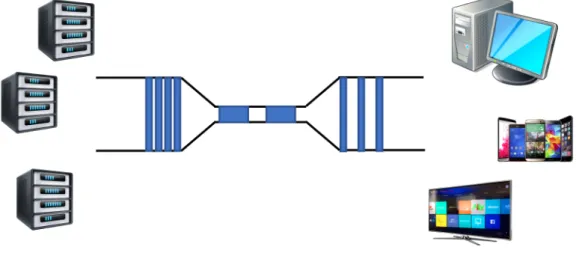
the total number of packets in flight approaches the processing capacity of the network. Congestion often happens at bottleneck links where the traffic comes faster than the depletion rate of the packets in the buffer as shown in Fig 2.2. Packets are injected into
Figure 2.2: Bottleneck Link
the Internet and accumulated in the buffer where there is a bottleneck link. Accord-ing to the locations of the congestion control algorithms, they can be either end-to-end congestion control algorithms, such as TCP and its variants, or hop-by-hop congestion
algorithms, such as AQMs. These are discussed in Section 2.2 and 2.3.
2.2 End-to-end Congestion Control
End-to-end congestion control algorithms are implemented at the end host, which detect the congestion of the network according to the data transmitted or acknowledgements (ACKs) received. TCP and its variants play an important role in end-to-end congestion control. TCP tries to make full use of the bandwidth by increasing the sending rate when the ACKs of packets sent before are being received. Defined in [Pos03], TCP is a protocol for reliable transmission. TCP is connection oriented by establishing a flow between tow machines. Each TCP flow is identified by 5-tuples which are source IP address and port, destination IP address and port and the protocol. The reliability of TCP is assured by sending ACKs back to the sender confirming the received packets. Each packet has a unique sequence number in its header hence the receiver can respond to the sender exactly which packet it receives. Since October 1988, when TCP was first improved [Jac88], many efforts have been made to further enhance the performance of TCP. According to the type of the mechanisms, there are now loss based, delay based and hybrid TCP.
2.2.1 Loss based TCP
Loss based TCP controls congestion by decreasing the sending rate when the loss of packets occurs. Duplicate (usually 3) ACKs or timeout of waiting for the ACK is used as a signal of congestion in loss-based TCP, such as TCP Tahoe and Reno as shown in Fig 2.3. Except for the mentioned AIMD algorithm, they both have Slow start (SS), Congestion Avoidance (CA), and fast retransmission. In the SS phase, the Congestion Window (CWND) size increases exponentially. In the CA phase, the CWND is increased by 2/CW N D each time an ACK is received. When a TCP connection is established, the CWND is initialized with 2 and TCP enters SS phase. A threshold, ssthresh, is the
upper bound of the SS phase. Once CWND exceeds ssthresh, TCP enters CA phase. A timer will expire if the ACK of a packet is not received, which is called timeout. Timeout usually means the loss of a packet or congestion in the networks. Once timeout happens, CWND will be reset and TCP enters SS phase. Timeout is a way to detect the loss of a packet, however it will take too long for TCP to react to the loss. Fast retransmission is proposed to take advantage of three duplicate ACK. When three duplicate ACK are received, the TCP sender will retransmission the lost packet without waiting timeout. The difference between TCP Tahoe and Reno is that Reno also has a Fast Recovery algorithm. Fast Recovery sets the ssthresh to half of the current value of the CWND and the CWND is set to ssthresh plus 3 more segments. There are other loss based
2 4 6 8 10 12 14 Transmission Round 0 2 4 6 8 10 12 14 16
Congestion Window (CWND) Size
Tahoe Reno
ssthresh
new ssthresh Fast Recover & Fast Retransmission Congestion Avoidence
Figure 2.3: Congestion Window of Tahoe and Reno
TCP with different algorithms to adjust the CWND, such as Cubic TCP [HRX08], which uses a cubic function to adjust the CWND. The idea of loss based is simple and straightforward. However, due to the abuse of buffering in today’s networks, excessive packets are kept in the buffer in case of packet dropping due to bursts of traffic, which results in the failure to detect congestion in loss based TCP.
2.2.2 Delay based TCP
In order to overcome the issues brought about by loss-based TCP, delay-based TCP (which uses delay as the symptom) are designed, and TCP Vegas [BOP94] is the most typical one. Vegas monitors the change of Round Trip Time of the packets in flight and adjusts the CWND according to the difference between the expected throughput and actual throughput. The expected throughput is calculated by Eq. 2.1 where BaseRT T
is the minimum RTT when there is no congestion in the network. The actual throughput is calculated by Actual = CW N DRT T where RT T is the actually measured RTT value of each packet. The difference is calculated by Dif f = (Expected−Actual)∗BaseRT T. Then, the difference is compared withα and β. α and β are predefined constant values.
Expected= CW N D
BaseRT T (2.1)
Actual = CW N D
RT T (2.2)
Dif f = (Expected−Actual)∗BaseRT T (2.3)
CW N D= CW N D+ 1 if Dif f < α CW N D−1 if Dif f > β (2.4)
Delay-based TCP is effective when dealing with large buffers. However it is not as competitive as loss-based TCP, because when the packets accumulate in the buffer, delay-based TCP begins to decrease the sending rate while loss-based TCP still keeps increasing the sending rate, which will cause a fairness problem [JCH84] considering the throughput of each user.
2.2.3 Hybrid TCP
Hybrid-TCP uses both packet loss and delay as a combined symptom, such as TCP-FIT [WWZH11]. TCP-TCP-FIT is designed to solve the fairness issue of delay-based TCP. TCP-FIT adjusts CWND by Eq. 2.5, where N is the number of TCP flows using TCP-FIT algorithm. From Eq.2.5, it can be seen that CWND is updated every RTT. However, the flow with larger RTT will have a lower frequency of updating their CWND. To solve this issue, γ = RT T /RT T0 is introduced as the normalization factor andRT T0 is the
statistical “floor” of the RTT values in the network. The number of flows is estimated by Eq. 2.6 where αis a preset parameter and Qis the estimation of the packets queued in the networks. Q is estimated as Eq. 2.7.
Each RT T : CW N D ← CW N D + γN Each Loss: CW N D ← CW N D − (CW N D/2N) (2.5) Ni+1 = max{1, Ni + (α − Q CW N DNi)} (2.6) Q = (avg_rtt − rtt_min)CW N D avg_rtt (2.7)
There are other Hybrid TCPs with different algorithms to adjust the CWND, such as Compound TCP [TSZS06] specific for Windows Operating System, and TCP West-wood [CGM+02].
2.2.4 Multi Path TCP
Multi Path TCP (MPTCP) is proposed to allow a single TCP connection to take advan-tage of multiple paths to transmit data simultaneously, as shown in 2.4. Compared with traditional TCP flows, sub-flows are established to transmit packets from the same
Figure 2.4: Multi Path TCP Illustration
flow. MPTCP has advantages in competing the bandwidth and MPTCP can be used to stablize a connection. Nowadays, mobile devices are often equipped with two dif-ferent types of interfaces accessing the Internet Wi-Fi and Cellular. As is shown in Figure 2.5, MPTCP establishes multiple paths instead of a single path. MPTCP wants to distribute the load onto other available paths, hence improve the link utilization of net-work resources [FRHB13]. Each sub-connection behaves like a standard TCP. MPTCP
Figure 2.5: Multi Path TCP Illustration
requires sub-flow management and congestion control in sub-flows to work well [ZDZ+17].
As there are multiple connections between the server and the client, MPTCP needs to carefully schedule packets into different sub-flows. Each sub-flow is possibly in different
network conditions. Take Figure 2.5 as an example. The sub-flow with Wi-Fi connection has lower Round Trip Time (RTT) compared with the RTT of sub-flows with cellular connection. It will bring the Head-of-Line (HOL) blocking issue [SK] as TCP guaran-tees in-order delivery. As shown in Figure 2.6, packets are transmitted through 3 paths and packet 1 is lost somehow and hence being retransmitted. Assuming that the buffer can only contain 9 packets, before packet 1 is received correctly by the receiver, other packets will be held in the receiver’s buffers. If packets with larger sequence number
Figure 2.6: Head-of-Line Blocking
are scheduled into sub-flows with lower RTT, they have to wait in the buffer until the arrival of packets with smaller sequence number. HOL blocking will increase delay of packets and hurt delay sensitive applications. To solve HOL blocking issues, different schedulers can be used. A round robin (RR) scheduler equally shares packets into all sub-flows which can be used if all the sub-flows are homogeneous. If the sub-flows are heterogeneous, priority scheduler can be used to put more packets into the sub flow with lower RTT. Schedulers will be discussed in section 2.3.3. As there are many versions of TCP algorithms, different flows can use different kinds of TCP, which makes it hard to control congestion on the Internet.
2.3 Hop-by-Hop Congestion Control
In hop-by-hop algorithms, the intermediate network routers are responsible for detecting congestion and providing feedback to the sender indicating network conditions [Jac88]. End-to-end algorithms work well for traffic that is responsive to congestion e.g. TCP traffic. However, non-responsive traffic, e.g., UDP traffic, may still cause congestion since it does not react to congestion. Hence, hop-by-hop congestion control algorithms have drawn increasing attention [JWLR12][FODA14][PKTH16][GQC+16].
2.3.1 Understanding Traffic Control (TC) within a Node
In the operating systems of a electronic device, traffic control is a set of technology, including queuing systems, scheduling schemes and etc. To control congestion within a device, the mechanism of how TC works is introduced. Taking Linux OS for example, figure 2.7 shows how packets go through the kernel stacks. When packets are received by
Figure 2.7: Traffic Flow Chart in Linux Kernel
Network Interface Card (NIC), a de-multiplexer is involved to decide whether a packet is for the local node or not. After de-multiplexing, forwarding decide where the packet is forwarded. The output queue model is where packets is waiting to be sent. Since the first AQM algorithm was proposed [FJ93] in 1993, a variety of components have been proposed to improve the performance of queue management algorithms. As shown in Figure 2.8, traffic control nowadays has multiple components which allow devices to give more specific control of the traffic. When packets arrive at the output queue, they can be firstly classified into different sub-queues where different AQMs can be applied. Then
Figure 2.8: TC with different Components
traffic shapers, such as Token Bucket, will allocate bandwidth to each traffic. Finally, the scheduler can give priority to certain types of traffic or improve throughput fairness among different traffic flows.
2.3.2 AQM Algorithms
2.3.2.1 Random Early Drop
Random Early Drop (RED) [FJ93] works by monitoring the average queue length. As shown in Figure 2.9, RED has two thresholds: the minimum threshold (minth) and the maximum threshold (maxth). When the average queue length is smaller than theminth, no packets are dropped. When the average queue length is bigger than themaxth, each arriving packet is dropped. When the average queue size is between the two thresholds, each arriving packet is marked with probabilitypa, wherepa is a function of the average queue length as shown in Figure 2.9. A general discard probability function is shown as Eq 2.8.
pa=pmax∗
qlenavg −minth
maxth−minth
(2.8) whereqlenavg is the moving average queue length; minthis the minimum threshold and
Figure 2.9: RED AQM
the moving average queue length, RED has a fixed parameter, called queue weight (wq). Then, the average queue size is calculated by Eq 2.9 if the queue is not empty.
qlenavg = (1−wq)∗qlenavg+wq∗qlen (2.9)
If the queue is empty, the average queue length is calculated by Eq 2.10, wheretimeis the current time andq_timeis the start of the queue idle time.
qlenavg = (1−wq)time−q_time∗qlenavg (2.10) As RED is easy to implement and effective, many variants of RED have been pro-posed such as Adaptive RED (ARED) [FGS+01], Modified RED (MRED) [DK13] and
SmRED [PKTH16]. They will be discussed Section 2.4.
2.3.2.2 CoDel AQM
Aiming to solve the parameter setting issue and the Bufferbloat, a novel AQM was proposed in 2012, called CoDel. CoDel is different from prior AQMs [NJ12] as it does not use queue length or as the parameter. Instead, CoDel uses the waiting time of the
first packet in the queue, i.e. HOL queuing delay. CoDel uses fewer parameters compared with prior AQMs. The threshold in CoDel is called target, which is the minimum HOL delay that the algorithm wants to keep. Another parameter is the interval to decide whether a packet needs to be dropped. CoDel monitors the sojourn/waiting time for each packet through the standing queue. The sojourn time is then compared to the target (5ms by default). If the sojourn time is above the target, it will trigger the dropping algorithm which will be introduced later. It also explains why the target is the minimum HOL delay as all the value above the target will trigger the dropping algorithm. Although queuing delay can be calculated by queue length, it depends on the bandwidth, which results in the issues of tuning parameters. By using HOL delay, the performance metric is directly related to user-perceived performance.
CoDel works in two phases. When a packet arrives at the buffer, CoDel enqueues the packet if the buffer is not full, and adds a timestamp to it. On depature of each packet, the timestamp is extracted and the sojourn time for the packet is obtained by calculating the difference between the current time with the time recorded. This is the first phase. The second phase is about making drop decisions. CoDel operates over a certain period, which is called interval (100 ms by default) as mentioned above. At the departure of the last packet during the interval, if the lowest queuing delay is above the target, then the packet is dropped and the next interval is shortened according to Eq. 2.11
interval= 100√2
n, n= 1,2,3, ... (2.11)
where nis the sum of packets being dropped. It can be seen that the more packets are dropped, the shorter the interval becomes, and CoDel can drop packets more quickly. Once the sojourn time goes below the target value or there is no packet in the queue, the counter, n, will be reset to 0 and the interval is reset to 100ms. CoDel leaves the dropping mode.
CoDel is a promising method as it controls the latency directly to address the Bufferbloat
2.3.2.3 PIE AQM
Similar to most AQMs, PIE [PNP+13] drops packets randomly from the tail of the
queue. The drop probability pdrop is updated every λ = 30ms by Eq 2.12. E[T] and
E[T]oldare the current and previous estimate of queuing delay.τ is the target as defined in CoDel.α is a tuning parameter that controls how deviation of current queuing delay fromτ affectspdrop.β controls how the trend of the queuing delay affectspdrop, i.e., the queuing delay is increasing or decreasing.
pdrop←pdrop+α∗(E[T]−τ) +β∗(E[T]−E[T]old) (2.12)
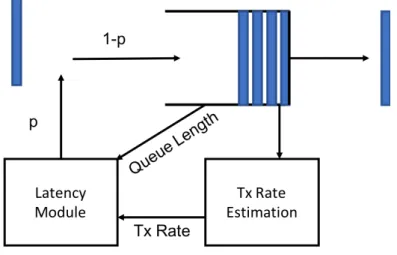
PIE consists of 3 components, as shown in Figure 2.10. The first part of PIE is the dropping algorithm, which drops a packet randomly on the arrival of a packet. The second part is the algorithm that updates the dropping probability periodically. And the third part is the algorithm that estimates the departure rate of packets. The dropping
Figure 2.10: PIE AQM
probability of PIE is updated every 15ms by default, which is theinterval in PIE. The calculation of the dropping probability is based on the dropping probability from the last period, the deviation of the current delay from the target value and the tendency of the latency, e.g. going up or down. In this way, PIE adjusts the dropping probability dynamically according to how severe the congestion is seen to be.
2.3.3 Scheduling Scheme
First-in-first-out (FIFO), also known as First-Come-Fist-Serve (FCFS), is the simplest scheduling scheme. In FIFO, traffic flows from different source or applications share the same buffer and as its name implies, it does not give any priority to any flows. Packets are stored in the queue according to the order of arrivals. The contents in the queue are depleted from the head to the tail of the queue. FIFO queue are widely deployed in the networks. However, delay-sensitive applications such as Voice over IP (VoIP), Video and gaming, requires higher level of QoS which allows packets pass the queue first. Non-FIFO scheduling enables this kind of operation. Non-FIFO scheduling uses multiple sub-queuing systems and by adopting different kinds of schedulers, it allows packets from different sub-queues to leave the queue first. The most common schedulers are discussed below.
2.3.3.1 Round Robin
The Round Robin (RR) scheduler is shown in Figure 2.11. A device with RR scheduler has separate queues for different traffic flows. Using this scheduler, the first packet in each queue takes turn to be served. The predefined value of the number being served in each turn is one. If the packets size of each traffic flow is different, then different amount of data is served during each cycle, which causes a fairness issue.
2.3.3.2 Weighted Round Robin
The Weighted Round Robin Scheduler is shown in figure 2.12, where wis the weighting factor. WRR is first proposed in [KSC91]. Static weights are assigned to different queues. It cycles through queues transmitting amount packet from each queue according to its weight. It was designed especially for ATM networks where the size of packet is fixed. In today’s IP networks with variable size packets, the weighting factor needs to
Figure 2.11: Round Robin Scheduler be normalized.
Figure 2.12: Weighted Round Robin Scheduler
2.3.3.3 Deficit Round Robin
To solve the drawbacks of RR scheduler, an enhanced round robin called Deficit Round Robin (DRR) [SV95]. A DRR scheduler is shown in Figure 2.13. As its name suggests, DRR improves fairness with the help of a counter called Deficit Counter. The counter has a predefined value and each queue is served. Or else the packets are queued and will be served in the next round. In the meantime the counter is increased by a quantum
value. When a queue being served has no packets, the counter is reset to its initial value.
Figure 2.13: Deficit Round Robin Scheduler
2.4
Literature Review
This section introduces the effort researchers have made to fight against delays in a chronological order. This section reviews the state-of-the-art technologies for designing the mechanisms to reduce the delay of packets.
As previously mentioned, after the “congestion collapse” [Jac88], TCP is enhanced by Van Jackson with the AIMD algorithm. Five years later in 1993, RED [FJ93], the first AQM, was proposed. Giving a set of fine-tuning parameters, RED provides good perfor-mance, however with the fast advance of both hardware and software, new services and equipment keep emerging in the Internet, which makes it hard to tune RED. Inspired by RED, variants versions of AQM are proposed such as Fair RED (FRED) [LM97] and Adaptive RED (ARED) [FGS+01]. Compared with RED, FRED is more fair to different
types of flows. FRED tracks the flows that have packets in the buffer and for each active flow, FRED has 2 parameter, minq and maxq which are the minimum and maximum packets that can be buffered. ARED aims to solve the issue of RED that parameters need to be pre-configured. It monitors the average queue length to make the decision
whether ARED should be aggressive or conservative, i.e., drop more or less packets. It uses AIMD mechanism to adjust the maximum drop probability,maxp, instead of using a static value. Users define the target delay andminth, the minimum threshold, is chosen according to the target delay and the link bandwidth. A recent study [TSH+18]
com-pares RED and ARED in the Benchmark Scenarios from RFC 7928 and the results show that ARED outperforms RED if there are no abrupt changes in traffic load. [RAT13] compares ARED with RED and CoDel in wired networks. Results in [RAT13] show that the advantage of ARED is less drop of packets but lower link utilization.
AQMs are initially proposed for wired networks. For wireless networks, the potential issue of over buffering in wireless link was first pointed out in [LRK+99] in 1999. The
work traces packets at different layers and finds the mismatch between the load and the link capacity, which is caused by the improper setting of the buffer size. This work shows the negative effects of over-sized buffers such as inflated RTT and degraded user experience of web browsing which may take several seconds due to the standing queue. The over buffering issue becomes severe as the link capacity of cellular network increases rapidly with the advance of transmission technology, as larger buffer are required in the networks to absorb the burst of traffic.
In [SCHW01], a Markov model for the Rayleigh fading channel and the link layer is built to evaluate the buffer overflow issue. The work takes the standing queue into consider-ation and reveal the relconsider-ation of TCP sending rate, queue length and queuing delay. In [SLMP03], a new queue management technology, called Packet Discard Prevention Counter (PDPC) is proposed by Ericsson and it is accepted as the default queue/buffer management by 3GPP. Compared with RED, it exploits the link’s capacity to set the minimum threshold of the instantaneous queue size rather than the average queue size. The PDPC algorithm has a counter and for each packet drop will initialize the counter with the value of n. When the queue length exceeds the minimum queue length, one sin-gle packet is dropped and the counter is triggered. For each arriving packet the counter will be down counted and as long as the counter is with positive value and the queue length is below maximum threshold, the arriving packets will be accepted. If the queue
is empty, the counter is set to be 0 to recover the discard policy. By doing this, PDPC prevents losing multiple packets from certain traffic flow and ensures the congestion is notified by dropping a packet immediately after the queue builds up.
Research work [AGG+13] investigates the interaction between different TCP versions
and buffering used in cellular networks. Their results are convincing since the measure-ments are performed in the commercial 3G, 3.5G and 4G cellular networks with the mixture of long and short TCP flows. The TCP versions tested are CUBIC, New Reno and WestWood+. They have claimed that the excessive buffers occupied by long flows will obviously increase the delay of short flows.
Research work [SJS14] analyses the Bufferbloat in IEEE 802.11n wireless networks, which points out that the excessive buffers occupied by long flows, such as transferring files by FTP, can lead to the RTT exceeding 4.5 seconds. This work proposes MAC-layer pro-tocol to alleviate the issue but more measurements are required for real time flows, such as VoIP. Another research work [HJKT+17] explores the 802.11 performance anomaly.
Based on the conclusion from previous work [SJS16] that neither deploying AQM or reducing the buffer size to Wi-Fi interface can provide same delay reduction as for wired links, it points out that the queuing in lower layers is the reason for the limited per-formance of the mentioned algorithms. The work makes modifications to the queuing protocol stacks in the Access Point (AP) as it is easier to deploy and it also takes the aggregation mechanism into consideration. The algorithm it proposed contains three part. The First part is the AQM at the enqueue stage. If the queue limitation is reached, the arriving packet is dropped. Otherwise, the arriving packets are hashed into a sub queue according to the DiffServ markings, Traffic Identifiers (TIDs). The second part is at the dequeue stage. When a sub queue needs to dequeue a packet, a DRR scheduler is applied to the queue. The third part is the scheduling algorithm which focus on airtime fairness. Different from Jain’s Fair Index which is based on throughput, airtime fairness is based on time. In wired network, the airtime is equal to transmit same amount of data for the links with same speed as the connection is stable. However, for wireless access networks, the connection between each station and the AP are with variable link speed
due to variable distance, interference from other devices and the multipath fading. The scheduling algorithm in this work aims to achieve airtime fairness among different con-nections. The proposed algorithms in this research work can reduce the latency however it sacrifice the throughput of the users with poor connection.
Another research work in Ericsson [Tan09] focus on the uplink of LTE and proposed a delay based AQMs specifically for LTE scenario. The proposed AQM is deployed at the Radio Link Layer (RLC) layer of eNode Base stations (eNB), named Receiver-AQM. The receiver refers to the base station and it aims to reduce the queuing delay in uplink direction. Compared with AQMs deployed in each UE (transmitter), Receiver-AQM is easier to deploy as it only requires the eNB to install the AQM.
In 2009, Dave Reed reported large RTT with low packet loss rate in 3G networks during daytime in the end-to-end mailing list. In the night, the RTT became much short as the number of flows reduced. The large RTT was believed to be caused by excessive buffer-ing. However, it didn’t draw too much attention until in 2011, Bufferbloat [CJWG11] in wired networks was pointed out. The author noticed a latency up to 1.2 seconds in his home network. The high latency is captured in both cable modems and fibre net-works. It reveals the fact that abuse of buffer will cause high latency. This work indicate that essence of Bufferbloat is the latency under load. Bufferbloat will not be noticed if researchers only test the latency when the link is idle. As is pointed out by [Get11], the side effect of Bufferbloat appears every time the link is saturated. Network services, such as DNS, will fail due to the large latency induced by Bufferbloat. High frequency traders treasure 1ms advantage to their competitors. Web browsing will be annoying as contents need seconds to be loaded. [CJWG11] also points out that although there are AQM algorithms such as RED, few networks are running with them.
The abuse of buffer is actually everywhere. TCP needs to keep unacknowledged packets in the buffer. Buffering is necessary to absorb burst of traffic and even the device drivers also have large buffers. If looking inside the operating systems, Bufferbloat will be found at multiple layers, as pointed out by [CJWG11]. Hence, there is no single solution to solve the issue. To mitigate Bufferbloat, it needs the cooperation of Internet Service
Providers (ISPs), application vendors and device manufactures. One of the most effec-tive way to alleviate Bufferbloat is deploying AQM in home routers. RED, mentioned previously, is a good starting point. RED makes the drop decision according to the average queue length. However, as the packets size and link capacity differs from each other, average queue size cannot give enough information to predict the latency.
In 2012, CoDel, mention in section 2.3.2.2, was proposed to solve the issue in wired networks. CoDel uses a local minimum queue as a more reliable and accurate measure of standing queue and hence is able to use a single state variable to show whether the latency is below or above the target value. As is mentioned in the previous section,
targetis the minimum delay that CoDel wants to keep. CoDel labels a queue “good” or “bad”. A “good” queue accommodates incoming packets and turns bursty arrivals into smooth departures. While a “bad” queue accumulates packets and create unnecessary delay.
[KLM14] compares the performance of CoDel and RED in the most common topology as shown in Figure 2.14, where A and B are the servers and E and F are the client. C and D are routers and the bottleneck is the link between C and D. This work simulates
Figure 2.14: Common Topology
the process of downloading a file of 10MB and points out that CoDel outperforms RED in reducing the latency. However the downloading process with CoDel costs 42% longer than that with RED. Hence, RED can also be considered as a candidate to mitigate Bufferbloat.
Inter-net. [RAT13] evaluates the effectiveness of CoDel with different versions of TCP in wired networks. In the simulation, the bottleneck bandwidth and number of TCP flows are varied. CoDel is compared with RED and ARED. The results show that CoDel achieves high link utilization and reduces the queuing delay. This work also points out that the effectiveness of CoDel in wireless networks remains to be evaluated.
PIE, mentioned in the previous section, is proposed after CoDel. [CR15] evaluates the performance of Compound TCP with PIE. It uses a fluid model of TCP and points out PIE is unstable when the queuing delay gets larger. [Whi15] evaluates PIE in cable net-works. Compared with DropTail queue, PIE reduces the upstream latency by hundreds of milliseconds which can significantly improve the user experience of web browsing, VoIP and online games.
Flow Queue (FQ) CoDel [HJMT+14] is proposed then providing isolation among
differ-ent flows. FQ-CoDel uses a hashing algorithm to distinguish packet from differdiffer-ent flows. The hashing is based on a 5-tuple of source IP, destination IP, source port, destination port and protocol number. Byte-based DRR scheduler is used to keep fairness among all the sub queues. CoDel algorithm is applied in each sub queue. [KKFR15] evaluated the performance of CoDel and FQ-CoDel in capacity-limited networks with large RTT. The results show that both CoDel and FQ-CoDel have difficulties in reducing latency properly with default configurations. In rural broadband scenario, CoDel and FQ-CoDel with default settings drop too many packets resulting in a very low link utilization. This work proposes a new set of parameters that can provide higher link utilization while maintain a lower queuing delay. Although CoDel is claimed to be parameterless and insensitive to link capacities and RTTs [NJ12], it is not the case according to the test of this work.
[JK17] proposes a new AQM that can handle rapid changes of load by predicting the load in the near feature. Compared with CoDel and PIE, the proposed AQM provides shorter flow completion time. The work also points out that CoDel and PIE cannot handle queues containing packets with small RTTs.
through bottlenecks with PIE, FQ-CoDel and FQ-PIE. LEDBAT [SHIK12] stands for Low Extra Delay Background Transport. It is based on UDP and reacts to both delay and loss. LEDBAT aims to help bulk transfer applications, such as software updates. LEDBAT utilizes available bandwidth with a delay threshold of 100 ms. Default setting of CoDel allows a minimum delay of 5 ms which is much lower than 100 ms. Results in [ASAB17] show that AQM algorithms lead to poor link utilization of LEDBAT. [KNAB17] explores the effective of AQM algorithms on Internet of Things (IoT) appli-cation flows in home broadband networks. FQ-CoDel, FQ-PIE and PIE are tested in this work. With the emergency of smart devices, such as sensors and health monitors, IoT application flows are quite common in home broadband networks. IoT flows [PA14] are often require low bandwidth as the packet size is small, but they often have strict QoS requirements. For example, dropping packets from a health monitor device is very dangerous as important information is possibly dropped. Competition with other flows over a shared bottleneck will hurt IoT flows as single-queue AQM algorithm will dis-tinguish packets from different flows. [KNAB17] points out that FQ-AQM algorithms provide good flow isolation and hence protect IoT flows.
[AOAL17] makes modification to the famous RED algorithm. As different classes of flows have different QoS requirements, this work proposes a Fair Weighted Multi-Level Random Early Detection (FWMRED). The definition of fair weighting factor is defined according to the quality of server, in terms of delay and bandwidth. Multiple-Level RED means a RED algorithm with adaptive parameters which are decided by average queue length. The results from this work show that the proposed algorithm improves band-width fairness and reduce the latency compared with RED and ARED. However, RED and ARED were proposed quite a long time ago, hence the proposed algorithm needs to be compared with new emerging algorithms such as CoDel and PIE.
[KRB+17] explores the operating range of CoDel and PIE, in terms of RTT, bottleneck
bandwidth and congestion level. PIE allows more queuing delay with default settings, but both CoDel and PIE result in poor performance in data center and rural broadband networks. Although CoDel claims parameterless and try to be adaptive, manual tuning
is unavoidable.
As video streaming traffic accounts for a large proportion of Internet traffic, extensive research work has been done on optimization on video delivery technology. [JDSL14] focus on the coding scheme when the content is dominated by different colours. [LCTA12] proposed a network management algorithm to improving the quality of mobile IPTV. It takes advantage of network performance metrics such as bandwidth, jitter, delay and packet loss to decide the coding schemes of the delivered video. [SVS14] proposed a QoE-driven framework for RTP based video due to the limitation of available QoE model. Although QoE on DASH video has drawn the attention of researchers, [HSVT12] points out the challenge in developing a proper QoE model. The retransmission mechanism in TCP makes it complex when it comes to packet loss and other network impairments. User activities such as Pause, Resume, Switching among different resolutions and time shifting when watching the video will influence the QoE [MCLC11]. Some research work point out that initial delay, stalling and rate changing are the main factors in evaluating the QoE of video content [SCW+16][HSBP13].
• Initial delay refers to the time between content request and start of the actual playout of the content. The QoE of live steams is more sensitive to initial delay. • Stalling refers to the phenomenon when the frame freezes which is due to lack of
contents in the buffer. Playback will be resumed when the buffer is refilled. • Rate changing refers to the phenomenon that the resolution of the video changes
during playback. It is normally due to the change of network conditions such as the bandwidth. Rate changes when congestion happens in the network, which can avoid stalling.
[CJWG11] points out one video stream from YouTube and one video stream from Net-flix can completely saturate the buffer of a home router. [MVSA13] proposed a Smooth Adaptive Bit RatE (SABRE) algorithm to mitigate the Bufferbloat issue in residential networks. This work tests the performance of RED and points out that RED
outper-forms DropTail but the queuing delay still remains hundreds of milliseconds. According to the results from the work, it is because the threshold of RED is not properly set. RED allows too many packets in the buffer before it starts to drop a packet. The proposed SABRE algorithm monitors the socket buffer level at the client and it changes the value of RWND to reduce the number of packets sent by the erver. If the buffer level is reaches 75%, SABRE will reduce the RWND and if the buffer level is lower than 75%, it will increase the RWND. However, the results in this work only compares DropTail queue after it points out the drawbacks of RED.
With the deployment of modern AQMs in home router, the interaction between DASH and AQMs is complex as DASH will try to adapt to the networks conditions and AQMs will trigger the adaptive nature of DASH by dropping incoming packets. [KAB16] studies the impact of AQMs on DASH delivery. Results shows that a flow queuing scheduling scheme with PIE algorithm in the sub queues gives the best throughput. [AG16] improves DASH performance by using multiple TCP connections and measures the occupancy of the buffer in the home router. It can be seen that the queue keeps full which causes the Bufferbloat issue. [KA17] proposes a chunklets algorithm to optimize DASH over AQM enabled gateways. The essence of chunklets is to use parallel TCP connections for DASH content which makes DASH more aggressive in competing for bandwidth with other flows.
Lots of work have been done in wired networks. Bufferbloat in cellular networks has also drawn the attentions from both researches and device manufactures. Compared with Wi-Fi and wired network, the protocol stack of cellular networks is different to those of wired and Wi-Fi networks. Data transmitted between the base station and the UE is carried by a virtual concept, “bearer” [CPG+13], which means each UE has a dedicated
buffer for communication in the base station. As shown in Figure.2.15, the RLC Layer and PDCP Layer, where the queuing of packets for different UE happens. Each UE, when connected to an eNB, will be allocated a dedicated PDCP and RLC buffer for downlink data transmission. RLC layer has three different transmission modes, Tran-sient Mode (TM), Unacknowledged Mode (UM) and Acknowledged Mode (AM) mode.
Figure 2.15: Protocol Stacks of Cellular Network
• TM Mode: it does not make any modifications to data, which means no headers are added or removed, no segmentations created and no aggregations. And it does not require any ACK/NACK from the receiver.
• UM Mode: it is similar to TM mode but the difference is that UM mode has its own headers and it can segment or concatenate data.
• AM Mode: it is used to guarantee reliable transmission which requires ACK/NACK from the receiver. It can also segment or concatenate data and has its own headers. Moreover, it will make a copy of the transmission buffer for a possible retransmis-sion.
TM mode and AM mode are used in the control plane and UM mode is used for trans-mitting data. Our algorithm is deployed in the UM buffers so that it does not affect the control and signaling messages. An AQM tuned for cellular networks is proposed in [PKTH16] and this is a variation of RED and it is implemented in the RLC layer. The authors change the control function from linear function to non-linear and simula-tion results show that it outperforms RED from the aspect of end-to-end average delay.
However, it is based on RED and cannot solve the tuning issue as the length of the queue is not directly related to delay.
Queue aware scheduling, such as reported in [AEN16], gives priority to real time (RT) traffic. However, most of the traffic in cellular networks are RT traffic, so giving priority is not easy and it can be conflict with the priority settings of 3GPP specifications. [JLW+12] and [JWLR12] exploit the Bufferbloat phenomenon in 3G/4G networks. Both
of the works are taken in real cellular networks which are operated by the 4 main carriers in the USA. [JLW+12] confirms the Bufferbloat issue is in the cellular part instead of the
Internet part. They also point out the abnormal behaviour of TCP in smart phones as shown in Figure 2.16. It can be seen from the figure that TCP in iPhone and Android Phone behave differently compared with that in Windows Phones. Knowing the TCP
Figure 2.16: Abnormal TCP Behavior (Figure 7 in [JLW+12])
congestion control mechanism, [JLW+12] reveals the reason why TCP in iPhone and
Android can give a flat CWND. To prevent the side-effects of large buffers, ISP gives hard limit of the Receiver Window (RWND) size over the air interface to stop the pack-ets accumulating in the buffer, hence stops the inflations of TCP flows. Such limit of RWND will result in the degradation of throughput for long-lived TCP flows. Then, a light-weight AQM called Dynamic Receive Window Adjustment (DRWA) [JWLR12]
is proposed which makes modifications to the size of RWND. It uses the timestamp option in TCP to get accurate estimation of the RTT and the estimation of RTT is used to control the RWND size. The proposed algorithm reduces latency at the sacrifice of throughput of high speed links with small RTT. However, it improves the throughput iofn high speed links with large RTT.
Research work [ZMZ+17] evaluates the performance of CoDel and DRWA in millimeter
wave (mmWave) links. As there are massive spectrums available in mmWave, the band-width is much higher than existing networks. Although using mmWave can significantly increase the bandwidth, there are also side effects. MmWave are easily blocked or atten-uated by building materials such as brick [PK11][ZMS+13][AR04][ASC08], and even a
human body can cause 35dB attenuation [LSCP12]. Hence, mmWave has very high data rate but high variability. This work suggests that a cross layer design that MAC and RLC layer can cooperate with each other is necessary.
In the Packet Data Convergence Protocol (PDCP) buffer in each UE, there is a timer to control whether to drop a packet or not. When the PDCP buffer receives a packet from higher layers, the discard timer is started. If the packet is not sent by the UE when the timer expires, the packet will be dropped. To dig out the potential of the default queue management, [TWTGG11] tries to optimize the performance of the discard timer by figuring out the proper setting. It does a series of the test however fixed settings cannot meet the requirement of today’s complicated mixture of traffic. the optimized performance under one circumstance is sub-optimized in another scenario.
A research work in Nokia [SV15] also contributes in managing the buffer at PDCP layer. They propose two mechanisms. One is called TCP Packet Pacing (TPP) and another is Advertised Window (AWND) management. The TPP has three components, first is to measure the real depletion rate of the PDCP buffer and then a ACK shaper shapes the rate of ACKs and hence the rate of ACK matches the depletion rate of TCP. Sec-onds is to adopts a virtual discard mechanism at the reverse ACK flow. It will insert duplicated ACKs (identical copies of already transmitted ACKs) in the reverse ACK flow to give the sender a fake signal of congestion. The third component is to deploy fair
queuing at the PDCP buffer to further improve the fairness among different flows. The AWND management also calculates the depletion rate of the PDCP buffer and uses the reverse ACK flow to feedback the AWND information to the sender. Research papers [JWLR16] and [IJLB16] try to control the traffic sending rate by making modification on the congestion RWND. Both of the works take advantage of (RTT) and aim to solve Bufferbloat in cellular networks. [JWLR16] is primarily based on the estimated RTT and the minimum RTT value. The estimated RTT is the average of RTT value from all the samples of RTT and if the estimated RTT is larger than the minimum RTT, the RWND will be reduced. Work [IJLB16] controls RWND by monitoring queue states. The queue state is estimated using the difference between the minimum RTT value and the real RTT value. It assumes that the minimum RTT value is the RTT when there is no queue in the buffer. However, when there is no queue in the buffer, the dynamic nature of wireless channel and the number of UEs competing for the bandwidth will also affect RTT. Additionally, the calculation of RWND in their work is a function of the dropping function of AQM deployed in the router and different AQMs may behave very differently. [PKTH16] proposed a variation of RED specially for LTE networks. Based on the conclusion from [PZR02], they modified the drop function of RED. When the traffic load is low and the link bandwidth is not fully utilized, a small drop probability is needed to prevent further reducing the link utilization. When the traffic load is high and the link is fully utilized, a large drop probability is need to prevent the latency. The proposed smart RED algorithm uses different functions to calculate the dropping probability when the traffic load changes. This work also emphases that a cross layer design is needed to make AQM in LTE scenario more practical. This work compares the proposed algorithm with RED which is proposed long time ago. Comparison with recent algorithms need to be done.
Work [AEN16] focus on the real time application in LTE scenario. It classified appli-cations into categories, namely real time (RT) appliappli-cations, such as VoIP and video, and non-real time (nRT) applications such as web browsing and file transfer. It then proposes a two-level scheduling scheme which is called Rate-Controlled Priority Queuing
Discipline (RCPQD). The proposed algorithm is based on the deficit weighted round robin (DWRR). The RT traffic are classified into high priority queues and the nRT traf-fic are classified into low priority queues. The scheduler will keep processing the high priority queues as long as they have packets in the queue. The low priority queues will be processed if the high priority queues are empty. To keep the fairness, the high priority queues has a counter. When certain number of packets from high priority queues are processed, low priority queues will be served for a period of time which is decided by the delay requirement of the RT traffic.
A recent study [BNPF17] evaluates two promising AQM algorithms, i.e. CoDel and PIE, in cellular networks by simulation. The results show that CoDel and PIE lower the link utilization and induce too many losses of packets when the bottleneck link is of high variation. This work proposes a new metric, queue balance, for designing effective congestion control in cellular networks. Queue balance is the difference between arrival and departure rates f packets, and there is work [ALLY01] trying to find the mismatch between the arrival and departure rate. The effective of the congestion control using queue balance still remains to be seen.
With the prevalent of distributed systems, in the future 5G network, traditional base sta-tions are decoupled into two components. One is called distributed radio heads (RRHs) which are with radio frequency functions supporting high capacity in hot spots, and the baseband units (BBUs) clustered as a BBU pool providing large-scale collaborative processing cooperative radio resource allocation (CRRA) in a centralized location. The BBU pool communicates with RRHs via common public radio interface (CPRI) protocol. When it refers to resource allocation, the most common assumption is the infinite queue backlogs and stationary channel conditions such as [BHL+14] and [KWL15], as pointed
out in [PSL+16]. However, the time-varying radio channel and standing queue in the
devices have significant effect to the performance. Parameters from the physical layer play an important role in cellular communications, e.g. CQI which indicates the quality of the wireless channels for data transmission. CQI is measured at the UE side and reported to eNB using the Public Uplink Control Channel (PUCCH). The Modulation
and Coding Scheme is selected at eNB according to the CQI reported by a specific user which reduce the Bit Error Rate (BER) [KHH+12]. CQI is also used in the data link
layer as a parameter in scheduling schemes. More resource blocks are allocated as a com-pensation of bad channel quality so as to achieve fair throughput and low delay. It can also be used in another way such as maximizing the overall throughput by giving priority to UEs with good channel quality. Research work [ZNSH12] exploits the average arrival rate, service rate and delay via packet flow model of queue theory and the numerical results in [CL13] show the trade off between the Channel State Information (CSI) and the average queuing delay. It can be seen that research work at MAC layer has begun to consider the effect of queuing in cellular networks. In conclusion, quite a lot receiver-side mechanism focusing on the TCP flows, however many real time application traffic does not use TCP and such traffic are often with high QoE requirement. The existing AQMs or just modifications to TCP are not enough.
More and more functions are integrated on mobile devices and with the rapid increase of smart devices such as smart watches, monitors, sensors together with phones and tablets, mobile traffic will be inflated obviously. Cellular networks are becoming an increasingly important technology to access the Internet.
As pointed out by [AGG+13], wireless networks have become an integral part of
day-to-day-life and suffer the most from performance issues, while there minimal work done so far. Even though a whole variety of AQMs and variation exist, most of these focus on wired networks such as adaptive RED (ARED) [SJS16], flow-queue CoDel (fq-CoDel) [HJMT+14]. Evaluations and tests have also been done in wireless networks such as in
[HJHB15], [JBT14] and [SJS14] but none of them considers the effect of wireless features. Existing AQMs are primarily based on the status of the queue (queue size or the delay each packet suffers in the queue). Hence, it is truly significant and timely to focus on buffer de-bloating in wireless environments.

![Figure 2.16: Abnormal TCP Behavior (Figure 7 in [JLW + 12])](https://thumb-us.123doks.com/thumbv2/123dok_us/10127231.2913479/49.892.196.751.560.857/figure-abnormal-tcp-behavior-figure-jlw.webp)