
PDXScholar
PDXScholar
Dissertations and Theses Dissertations and Theses
Spring 6-8-2017
A Brief Intervention to Increase the Use of
A Brief Intervention to Increase the Use of
Precorrection and Praise by Elementary School
Precorrection and Praise by Elementary School
Teachers
Teachers
Dustin Bindreiff
Portland State University
Follow this and additional works at: https://pdxscholar.library.pdx.edu/open_access_etds Part of the Educational Leadership Commons, and the Elementary Education Commons
Let us know how access to this document benefits you.
Recommended Citation Recommended Citation
Bindreiff, Dustin, "A Brief Intervention to Increase the Use of Precorrection and Praise by Elementary School Teachers" (2017). Dissertations and Theses. Paper 3640.
https://doi.org/10.15760/etd.5524
This Dissertation is brought to you for free and open access. It has been accepted for inclusion in Dissertations and Theses by an authorized administrator of PDXScholar. For more information, please contact
A Brief Intervention to Increase the use of Precorrection and Praise by Elementary School Teachers
by
Dustin F. Bindreiff
A dissertation submitted in partial fulfillment of the requirements for the degree of
Doctor of Education in
Educational Leadership: Special and Counselor Education
Dissertation Committee: Randall L. De Pry, Chair
Amy Donaldson Randy Hitz Sheldon Loman
Portland State University 2017
Abstract
There is an evidence base supporting the use of positive behavior supports in schools; however effectively and efficiently transferring these interventions into classroom settings remains a challenge. Precorrection is a highly-regarded behavior support strategy that relies on antecedent prompting to reduce problem behavior and teach
socially appropriate skills. This study examined how a brief training in precorrection and praise paired with regular feedback impacted the behavior of four Title I elementary school teachers and students. As a result of the intervention, the four teachers increased use of precorrection and praise, while concomitantly reducing their use of reprimands. Limitations and suggestions for future research are provided.
Table of Contents
ABSTRACT ... i
LIST OF TABLES … ... iv
LIST OF FIGURES…. ...v
CHAPTER 1: PROBLEM STATEMENT...1
Introduction ...1
Background of the Problem ...2
School-wide positive behavior support ...4
Implementation of behavior supports ...7
Implementation barriers ...9
Statement of the Research Problem ...12
Significance of the Research Problem ...13
Impact of problem behavior ...16
Methods and Research Questions ...17
Definitions of Key Concepts ...18
CHAPTER 2: LITERATURE REVIEW ...19
Theoretical Framework ...19
Environmental modification ...20
Instruction ...21
Review of the Research Literature ...23
Critique of Research ...29
Review of the Methodological Literature ...31
Summary of the Research literature and Application to Study ...35
CHAPTER 3: RESEARCH METHOD ...36
Research Method ...37
Participants ...38
Setting ...40
Procedures ...41
Intervention ...41
Instruments and Measures...44
Role of the Researcher ...46
Data Collection and Analysis...46
Social validity ...47
On-task behavior ...48
FACTS ...48
CHAPTER 4: RESULTS ...50
Analysis of Data ...50
Presentation of Results ...52
Teacher and student dyad 1...56
Teacher and student dyad 2...60
Teacher and student dyad 3...66
Teacher and student dyad 4...71
Interobserver agreement (IOA) ...75
Social validity ...76
Demographic data ...76
Interpretation of Findings ...78
Changes in teacher behavior ...78
Changes in student behavior ...80
FACTS and student behavior ...80
Limitations of Study ...81 CHAPTER 5: DISCUSSION ...84 Introduction ...84 Synthesis of Findings ...87 Larger Context ...89 Replication findings ...90
Precorrection and prevention ...92
Teacher training implications ...93
Social validity ...95
Research Context ...96
Evidence based practice potential ...97
Implications...100
Predictable problem behavior ...100
Implementation of supports ...101
Considerations for future research ...102
Conclusion ...103
BIBLIOGRAPHY ...106
APPENDIX A: CONSENT FORMS ...124
APPENDIX B: DATA COLLECTION FORM ...127
LIST OF TABLES
Table 1: Research Findings on Teacher Skills and Values Surrounding Behavior
Interventions ...12
Table 2: Sample Precorrection Plan ...18
Table 3: Comparing Procedures for Addressing Academic and Social Problems. 23 Table 4: Comparison Between Correction and Precorrection Procedures ...25
Table 5: Methods Comparisons of Precorrection Training Research ...34
Table 6: Comparing a Precorrection Plan with Teacher Training Model ...37
Table 7: Behavior Categories and Operational Definitions ...45
Table 8: Mean use of Precorrection, Praise, Reprimands and Student On-task (Question 1) ...53
Table 9: Social validity survey results ...77
Table 10: Demographic Data of Participating Teachers ...78
Table 11: Teacher precorrection-to-reprimand and praise-to-reprimand ratios ....79
Table 12: Comparison of FACTS results with changes in student behavior ...81
Table 13: Comparison between correction and precorrection procedures ...88
Table 14: Social validity survey results ...96
LIST OF FIGURES
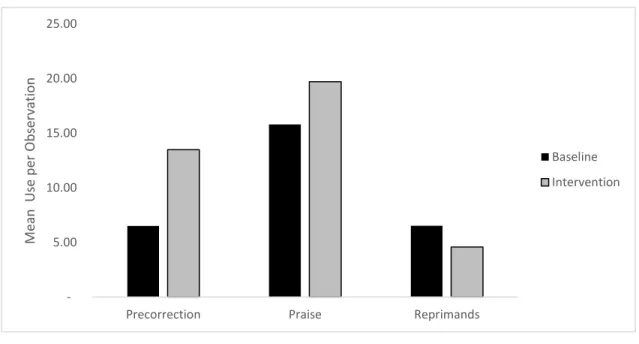
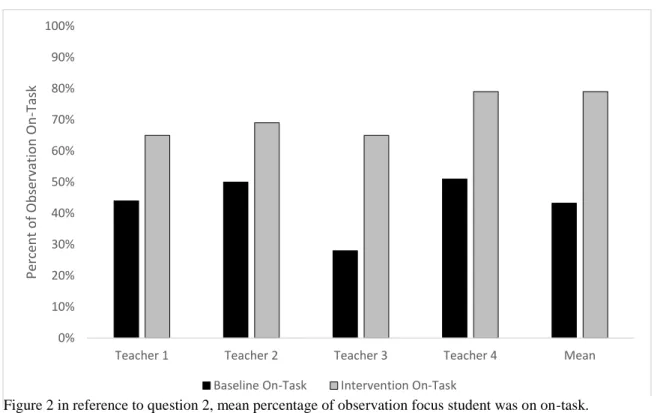
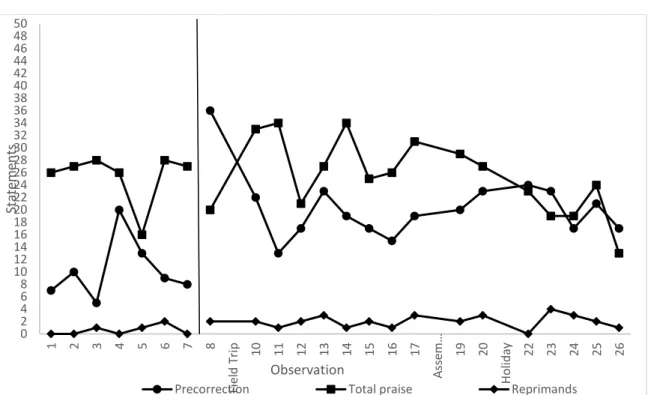
Figure 1: In Reference to research question 1, mean rate of Precorrection, Praise and Reprimands during baseline and intervention ...52 Figure 2: In reference to question 2, mean percentage of observation focus student was on on-task...54 Figure 3: In reference to research question 2, daily percent of observation focus student was on-task ...55 Figure 4: Observation results for teacher and student 1 ...57 Figure 5: Mean statements delivered by Mrs. Brown directly to the student of focus
...60 Figure 6: Observation results for teacher and student 2 ...63 Figure 7: Mean statements delivered by Mrs. Cook directly to the student of focus
...65 Figure 8: Observation results for teacher and student 3 ...67 Figure 9: Mean statements delivered by Mrs. Sims directly to the student of focus
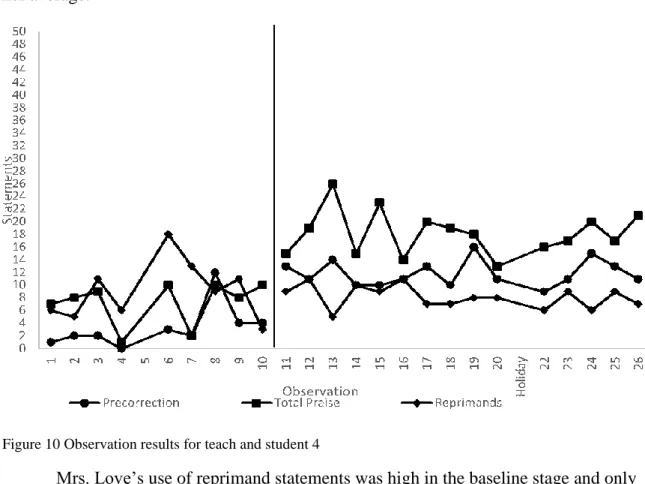
...70 Figure 10: Observation results for teacher and student 4 ...73 Figure 11: Mean statements delivered by Mrs. Love directly to the student of focus 74
Chapter 1: Problem Statement Introduction
The challenge of managing the behavior of twenty to thirty or more students for six hours a day has long been recognized as one of the greatest concerns teachers face (Ayers, 2004; Rose & Gallup, 1999; Stoughton, 2007; Wald & Losen, 2003).
Moreover, policy revisions have placed greater demand on educators to go beyond the academic needs of students and support their social emotional and behavioral needs as well (Crimmins, 2006; Losen, 2011). In response to these challenges and policy mandates, many schools are turning to the Technical Assistance Center for Positive Behavioral Interventions and Supports for guidance.
The Technical Assistance Center for Positive Behavioral Interventions and
Supports was formed to define, develop, implement, and evaluate a multi-tiered approach to student behavior that supports the implementation of tiered systems of behavior
support in education (Lewis, Barrett, Sugai & Horner 2010). Initial implementation focuses on providing universal supports to ensure all students have access to a high-quality learning environment (Collins & Arthur, 2007; Cook, Wright & Gale, 2007; Sugai et al., 2000). These interventions have been shown to reduce suspensions, improve academic engagement, and school climate (Bradshaw, Mitchell, Leaf, 2010; Horner, Sugai, Smolkowski, Todd, Nakasato, & Esperanza, 2009). Unfortunately, to this point, research has shown that the ability of school sites to consistently provide support for students with more intensive behavior support needs has yet to be established (Cook et al. 2007; Van Acker, Boreson, Gable, & Potterton, 2005). The purpose of this research is to
examine whether a brief, individual training can help struggling teachers increase the on-task behavior of students in need of additional support. This training centered on
elements of a precorrection plan; training these teachers to analyze a student’s problem behavior, clearly define expected behaviors, to utilize prompts to teach this desired behavior, and finally to provide students with specific praise. As Colvin, Sugai and Patching (1993) explain: “Precorrection procedures are antecedent manipulations
designed to prevent the occurrence of predictable inappropriate behavior and facilitate the occurrence of more appropriate replacement behavior” (p. 145). Precorrection has been shown to be an effective, low intensity, prevention-based support that builds on well-established instructional practices (Colvin & Sugai, 1998; De Pry & Sugai, 2002; Stormont & Reinke, 2009). Before examining precorrection in detail, it is important to review the School-wide Positive Behavior Interventions and Supports (SW-PBIS) framework and the impact it has had on schools and students.
Background of the Problem
In the past, schools often took a passive approach to student behavior, expecting students to arrive at school with an acquired set of social competencies already in place (Kerr & Nelson, 2006; Valenti, 2011). However, the 1997 reauthorization of the Individuals with Disabilities in Education Act (IDEA) required schools to focus on empirically based behavior supports and interventions (Cohen, McCabe, Michelli, & Pickeral, 2009; Nelson, Mathur, Rutherford, 1999; Turnbull, Wilcox, Swoe, Raper & Hedges, 2000; Sugai & Horner, 2009; Yell & Katsiyannis, 2000). Recognizing the complex interaction between behavior and disability, the federal government required
educators to pay attention to situations where a child’s behavior is impacting his/her learning (Nelson, Mathur & Rutherford, 1999; Yell & Katsiyannis, 2000). These revisions, coupled with the subsequent 2004 IDEIA revision and civil rights data reporting, have created an increased focus on behavior in schools.
These policies required schools to conduct a functional behavioral assessment of the problem behavior and develop a behavior intervention plan when (a) suspending or removing a student with a disability from their least restrictive environment for 10 days, (b) prior to changing a student’s educational placement, and (c) adding behavior goals and objectives to a student’s Individual Education Plan (IEP) (Allday, Nelson, & Russel, 2011; Armstrong & Kauffman, 1999; Yell & Katsiyannis, 2000). Interestingly, as awareness of the utility of function-based behavior supports has expanded, the use of this process has increasingly been adopted for students beyond those defined in the policy. In fact, Solnick and Ardoin (2010) found that more than one-third of function-based
behavior plans were for students without disabilities.
In the early 2000’s the traditional practice of suspending students for problem behavior had more than doubled since the 1970’s (Losen, 2011). As a result, schools experienced increased political, legal, and social pressure to reduce the use of
suspensions for problem behavior. However, if these higher expectations are not accompanied with the support and training necessary to understand how to address student behavior, teachers may simply be overwhelmed. Fortunately, policy makers realized that in order for these laws to have the desired impact, educators would need support. One effort to ensure quality implementation following IDEA reauthorization in
1997 was establishing the National Technical Assistance Center on Positive Behavioral Interventions and Supports (PBIS) (Lewis, Barrett, Sugai, & Horner, 2010). This center is a collaboration of university and resource partners whose primary purpose is to “gather and disseminate evidence-based behavioral interventions and practices that enhance social behavior development, school climate and safety of all students, especially
students who are at risk of or display problem behavior within the school context” (Lewis et al., p 2).
School-wide positive behavior support. The SW-PBIS framework has been implemented in over 24,000 schools and is often having a dramatic impact on school climates (see pbis.org). This framework has been shown to drastically reduce the need for suspensions and improve the school climate (Collins & Arthur, 2007; Cook et al., 2007; Sugai et al., 2000). The adoption of the PBIS framework begins with the recognition that student behavior is a fundamental area of concern (Collins & Arthur, 2007; Cook et al., 2007; Sugai et al., 2000). Building on this recognition, the PBIS Technical Assistance Center has developed resources that outline a process to aid schools in the development of an organizational structure which focuses on improving school culture and student conduct (Lewis et al., 2010).
These tiered supports are based on the premise that universal supports will prevent problem behavior for 80% of students school-wide. The second tier, sometimes referred to as targeted interventions, is designed to reduce the number of students exhibiting problem behavior with efficient and rapid responses. These interventions are meant to support approximately 15% of students with at-risk behavior. The third tier, or
intensive intervention group, is aimed at addressing existing cases of problem behavior that are resistant to primary and secondary efforts. The pyramid structure helps schools remain responsive to the varying needs of all students, by supporting students performing well and providing targeted interventions to those that need more support.
The success of the PBIS framework at the universal level increases the capacity of schools to focus on those students with more persistent and pervasive problem behavior, which can be challenging. Changing a child’s learned behavior is not a simple task. In many instances a particular problem behavior, such as physical aggression, may have served a useful function for a child for many years. Implementing supports to change this behavior often requires advanced behavior intervention skills and highly controlled environments (Gable, Hendrickson, & Smith, 1999; Van Acker et al., 2005). This is, typically, different from the natural classroom setting and the skill level of most classroom teachers.
The contrast between a research-controlled setting and a general education classroom has raised concerns about the impact intensive behavior supports can have in classrooms (Allday et al., 2011; Ellis, 2004; Sugai et al., 2000). The complexity of a busy classroom can make it especially demanding for teachers to alter the environment, control antecedent variables, and consistently distribute consequences (Scott, Liauspin, Nelson & Jolivette, 2003). For example, managing how peers respond to a student’s problem behavior can be particularly challenging. Also, there will typically be a
dramatic difference in the training and skill level of a classroom teacher, when compared to the skills of an experienced behavior therapist (Benazzi, Horner, & Good, 2006; Reid
& Nelson, 2002). Combined, there is often a difference in environmental variables, instructor skills, and student demographics between the settings where many behavior supports were researched and the classrooms where they are often implemented.
Some of the interconnected concerns surrounding targeted behavior supports frequently discussed in research tend to revolve around three broad questions:
1. Can educators, with existing knowledge, conduct a high-quality, functional behavior analysis (Gresham & Quinn, 1999; Nelson et al., 1999; O’Neill & Stephenson, 2009; Reid & Nelson, 2002; Solnick & Ardoin, 2010; Van Acker et al., 2005)?
2. Are the resources available to implement research based behavior interventions (Hieneman, Dunlap, & Kincaid, 2005; Nelson et al., 1999)?
3. Do educators have the skills necessary to implement behavior interventions (Allday et al., 2011; Conroy, Clark, Fox, & Gable, 2000; Gresham & Quinn, 1999; Reid & Nelson, 2002)?
In particular, time is typically one of the most precious resources for teachers. The numerous competing demands on educators limits the time they have available to implement supports (Allday et al., 2011; Hieneman et al., 2005). As Bambara et al. (2009) found, issues related to time were identified as a key concern for 88% of those surveyed regarding behavior supports. Participants identified three time-related barriers in particular. The lack of available time for team members to meet regularly was the first barrier. The second barrier was the perception that behavior supports created extra burdens for school personnel, especially teachers. The third time-related barrier was that the entire process itself was often viewed as too time-consuming or labor-intensive. These time constraints can create a major deterrent to sustained teacher and
In classrooms, the result of these limiting factors can be low-quality supports and inconsistent implementation. Cook et al. (2012) evaluated 320 behavior plans, and concluded that nearly 90% of the plans developed by school site personnel were
inadequate. Even the behavior plans written by the most experienced professionals were found lacking, with 35% of their plans considered inadequate. A particular concern was that many of the plans were found to lack any proactive environmental manipulations and/or teaching strategies. These are the foundations of behavior change, so the inability of more than one-third of plans to include these fundamental pathways is concerning. This research confirmed the work of Van Acker et al. (2005), who evaluated 71 intervention plans following a statewide training program. The researchers concluded that the adequacy of the submitted plans was disappointing. Approximately half of the plans contained multiple shortcomings that would likely lead to poorly designed and ineffective behavior interventions (Van Acker et al., 2005). Nearly 70% of plans didn't identify a target behavior and 25% failed to identify a function of behavior; two
fundamental aspects of behavior interventions.
Implementation of behavior supports. Implementation is a necessary precursor to success with any intervention plan. Unfortunately, evidence suggests that high fidelity of implementation of behavior interventions should not be assumed (Albin, Lucyshyn, Horner, & Flannery, 1996; Benazzi, Horner, & Good, 2006; O’Neill & Stephenson, 2009; Reid & Nelson, 2002). Heckaman, Conroy, Fox and Chait (2000) warned that in many instances, plans are not implemented or are done so in a haphazard manner.
in mind when litigation is a risk. In these cases, one of the first questions mediators will ask is whether the interventions were implemented (Etscheidt, 2006). Additionally, if the plan is not implemented with a high degree of fidelity, the effectiveness of the plan can’t be measured (Gresham & Quinn, 1999). When this happens, critical placement and intervention decisions may be made based on inaccurate data. Addressing the
implementation issue in behavior interventions is an important next step if schools are to make informed placement and service decisions, as well as to minimize legal risk.
While the failure to properly implement a behavior plan can put educators at legal risk, if they are able to implement behavior interventions the process can have exciting results. Cook et al. (2012) found that when quality plans were implemented with a high degree of fidelity, (a) identified problem behaviors are reduced, (b) general positive behaviors are increased, (c) appropriate replacement behaviors are increased, and (d) academic performance is improved. However, these researchers recognize that implementation is a major hurdle to behavior change. For this reason, they stress the importance of diligently monitoring and ensuring the fidelity of implementation.
In order for teachers to implement an intervention with fidelity, it will need to contain a strong fit with their classroom, as well as their skills and values (Crone & Horner, 2003; Elliott, Witt, Kratochwill, & Stoiber, 2002; O’Neill & Stephenson, 2009). This is often referred to as the contextual fit between a support and the setting where it will be used(Albin et al., 1996). In Van Acker et al.’s (2005) review of behavior
intervention plans throughout Wisconsin, the most popular interventions were changes to the physical setting (37%), changes in teacher behavior (34%) or curriculum changes
(25%). Each of these depends largely on the classroom teacher to manage. Additionally, changing a child’s learned behavior in a busy classroom is a challenge that is impacted by factors such as the teacher’s self-efficacy, their belief that the child’s behavior can be altered, and their belief that the selected supports will result in change (Albin et al., 1996; Elliott et al., 2002).
Implementation barriers. Unfortunately, when responding to problem behavior, many teachers rely on ineffective procedures such as detention, suspension, or other consequence-based measures (Maag, 2001; Smart & Igo, 2010; Valenti, 2011). Student problem behavior is a fundamental concern for teachers, yet many do not feel equipped to prevent or address the behavior (Allday et al., 2011). Teachers have consistently reported feeling under-educated and unprepared to manage challenging behaviors (Clunies-Ross, 2008; Martin, Linfoot, & Stephenson, 1999). For example, when Baker (2005) surveyed teachers, nearly half of their sample felt ill-equipped to manage student behavior.
Teacher frustration around student behavior is compounded by Baker’s (2005) finding that more than one in five teachers were described as not willing to make managing student behavior an active part of their daily planning. This resistance and lack of confidence can create resentment toward students with challenging behavior and undermines the potential of any support efforts. In order to begin moving past this resistance and sense of helplessness, it is important that educators are exposed to training on behavior supports that have a strong contextual fit with their classroom, skills and values.
Teacher confidence drops even further when facing more severe problem
behavior. Under these circumstances, teachers perceived their management strategies to be largely ineffective and reported implementing them inconsistently (Baker, 2005; Main & Hammond, 2008). Additionally,there is often a sharp drop in use, efficacy, and teacher confidence as they move from universal behavior intervention practices to individualized behavior support (Crimmins, 2006; Main & Hammond, 2008; Smart & Igo, 2010). This may explain why teachers are more likely to avoid or retreat from students with problematic behavior profiles than intervene (Abidin & Kmetz, 1997; Abidin & Robinson, 2002; Ratcliff, Jones, Costner, & Savage-Davis, 2011).
Another factor that limits the efficacy of behavior supports is the numerous competing demands on educators. These competing demands can limit the ability of teachers to modify the classroom environment or control the other variables needed for behavior supports. In order to improve the implementation of behavior supports, it is important to understand the limitations and values of educators. As Kaff, Zabel and Milham (2007) concluded from their research into teacher perceptions of behavior supports, many of the supports commonly taught in teacher preparation programs are perceived by teachers to be too complex to implement, in some instances, ineffective. Kaff et al. (2007) explored the labor intensity, frequency of use, and perceived
effectiveness of behavior interventions by special educators. They found, as the
perceived labor intensity increased, the use of that intervention decreased. Similarly, as labor intensity increased, the perceived effectiveness of that intervention decreased.
From an instructional perspective, the modern classroom can be a daunting place. According to Baker’s (2006) description of an urban, high-poverty classroom, as many as 17 out of every 30 students need varying degrees of academic and/or behavior
accommodations. The range of academic and behavioral accommodations needed in today’s classrooms requires a great deal of time, confidence and a wider skill set than in the past. Unfortunately, in spite of the frequent support of differentiation, research suggests it is not a common instructional practice (Fuchs, Fuchs, & Stecker, 2010; Gersten, 2009; Kapusnick & Hauslein, 2001; Tomlinson, 1999).
As the field of PBIS continues to grow, it is important to remain focused on the implementation of supports by teachers with limited skills, confidence, and available time. Table 1 summarizes the research discussed earlier regarding the skills and attitudes of classroom teachers around behavior supports. The pattern emerging from this
examination of the behavior support practices of teachers shows that many teachers initially rely on consequences and universal practices to address problem behavior (Couvillon, 2006; Smart & Igo, 2010; Valenti, 2011). If problem behavior persists, teachers quickly lose confidence and resort to retreatism or discipline measures (Baker, 2005; Clunies-Ross, 2008; Ratcliff et al., 2011). Finally, there appears to be an inverse relationship between how effective teachers perceive a behavior intervention to be and the use of a particular intervention with the labor intensity of the intervention (Kaff et al., 2007).
Table 1
Research Findings on Teacher Skills and Values Surrounding Behavior Interventions
• Reactive strategies tend to disrupt instructional time,
• Many teachers lack confidence regarding individualized interventions,
• High intensity interventions are rarely used and lack perceived effectiveness,
• Strategies aimed at teaching expectations seem to be the most popular and effective,
• Limited differentiation of academic or behavior instruction,
• Many teachers lack individual intervention skills, causing them to resort to punitive measures,
• Punitive measures are not seen as effective.
So, the more demanding an intervention is of teacher’s time the more likely a teacher is to see the intervention as ineffective and not use it. The result is that many commonly recommended supports aren’t used or trusted by educators due to their labor intensity. When these challenges to implementation are coupled with the difficulty of changing a child’s learned behavior, the list of behavior supports available narrows. This challenge makes exploring low-intensity and research-based supports that can improve behavior and academic achievement especially valuable.
Statement of the Research Problem
As students continue to arrive at school grappling with pervasive and complex social issues, the need for strategies to prevent and address the academic and behavior problems that will often ensue grows (Collins & Arthur, 2007; Nolle, Guerino, Dinkes, & Chandler, 2007; Skiba & Peterson, 2000). In response to these needs, federal policy has required educators to implement positive behavior support, when the behavior of a student with an IEP is interfering with learning. This policy has placed significant demands on educators, requiring behavior support skills and time beyond that which many instructors feel comfortable. In order to meet these legal and ethical demands, there is a need to develop interventions that address the complex needs of students, the
significant legal requirements, and the implementation constraints of educators around behavior support in a general education classroom setting.
The efficacy of positive behavior support is well established (Carr et al., 2002, Sugai et al., 2000). The question now is not “if” behavior interventions can change student behavior, but “how” to implement behavior interventions in a general education classroom setting. Increasing the capacity of teachers to use research-based practices is a critical component of implementing behavior supports in classrooms. Precorrection, the focus of this dissertation, is a highly-regarded behavior support strategy based on
instructional principles of re-teaching and antecedent prompting (Colvin, Sugai, & Patching, 1993). This makes examining how to increase the use of the strategy an valuable piece of research.
Significance of the Research Problem
Teachers today face growing demands, including a legal and ethical requirement to meet the behavioral needs of students. Not only are teachers expected to individualize instruction for a growing range of students, they are also expected to provide supports for the growing range of behavioral, emotional, and physical needs of students. In many instances these needs will exceed the ability of educators. When teachers are unable to prevent problem behavior they may be more likely resort to punitive discipline practices, such as verbal reprimands, time-outs, office discipline referrals, and suspension.
Unfortunately, there is little evidence that this practice improves student behavior and often places students at greater risk (Couvillon, 2006; Skiba, 2002). Research has shown that teachers prefer prevention-based supports, and generally view supports based on
positive reinforcement as more acceptable than punishment-based interventions (Iwata, Rolider, & Dozier, 2009; Jones & Lungaro, 2000). Yet, often, there remains a gap between what teachers would prefer to do and what happens in a busy classroom when students engage in problem behavior.
The correlation between problem behavior and this gap in instructional capacity may help explain why teachers report that “uncivil” behavior is increasing to the point that it is a threat to effective learning (Skiba & Peterson, 2000). Teachers report instances of simple disrespect, noncompliance, poor peer interactions, cursing, making fun of one another, grabbing, pushing and being off-task as common occurrences in their classrooms (Collins & Arthur, 2007; Nolle et al., 2007). Unfortunately, many teachers feel that they are unable to prevent these behaviors from disrupting their classroom routines (Baker, 2005). California administrators confirm the reports of teachers: four out of five school administrators in California ranked student discipline and behavior
management as a concern (EdSource, 2012).
According to Harrison and Vannest (2012) “externalizing behaviors are the greatest behavioral concern of teachers and the most frequent reason for ODR (office discipline referrals” (p. 61). Routine minor behaviors related to self-control seem to be particularly pervasive. Their effort to identify the most common behavior problems according to teachers found that just under 30% of children were almost always or often generally distracted, 15% of children often exhibited excessive motion, and 12% were almost always distracted during lectures and lacked concentration. Confirming this prevalence of externalizing behavior at the classroom level, Snider (2002) identified
distractibility in 73% of children observed. In Harrison and Vannest’s research teachers also reported high rates of problem behavior associated with compliance. This research confirms the ability of educators to work with students that lack self-control and struggle to follow directions is becoming an important skill for educators.
Even, early childhood teachers are reaching out for more training on behavior management (Kupersmidt, Bryant, & Willoughby, 2000; Rimm-Kaufman, Pianta, & Cox, 2000). Early child care providers continue to list coping with challenging behaviors as their number one need for additional training, technical assistance, and support (Dunlap et al., 2006). According to Hauqing and Kaiser (2003) 12% of preschoolers have
behavior that is impairing their learning; and in low-income preschools, estimates may be as high as 31% of preschoolers struggling with internalizing disorders and 57%
exhibiting externalizing problems. The high rates of problem behavior of these young students certainly challenges the notion that students are coming to school ready to learn.
In order to comply with legal mandates to provide students with disabilities a free and appropriate public education in the least restrictive environment, schools are required to include students with Emotional Disturbance (ED) and other challenging behaviors in general education settings (Cheney & Barringer, 1995; Collins & Arthur, 2007; Main & Hammond, 2008; McCurdy, Mannella, & Eldridge, 2003; McLeskey, Henry & Hodges, 1999). Students with Emotional Disturbance typically require more attention,
individualized strategies, and often do not respond to typical classroom management practices. Although students with ED make up one to five percent of the student
Sprague, Horner, & Walker, 2000; Taylor-Greene & Kartub, 2000). This helps explain why children with behavioral difficulties are often considered to be among the most difficult students to include in regular classrooms (Avramidis & Norwich, 2002; Croll & Moses, 2000; Hodkinson, 2006).
Impact of problem behavior. Problem behaviors contribute to disruptive school environments that can lead to an increase in emotional stress for students, and ultimately impacting achievement (Payne, Gottfredson, & Gottfredson, 2003; Wehby, Lane & Falk; 2003). Persistent minor problem behaviors will often interfere with a teacher’s ability to teach class effectively, which will impede learning (DeVoe et al., 2003; Gottfredson & Gottfredson, 2001; Valenti, 2011). As The National School Climate Council has pointed out, student achievement is impacted when the learning environment does not allow students to feel safe, cared for, supported, and gently encouraged to learn (Cohen et al., Pickeral, 2009).
Teachers often cite behavior management issues as one of the most daunting aspects of their jobs, resulting in emotional and physical stress (Liu, 2005). Behavior management challenges have repeatedly been shown to be a significant factor in the stress and burnout of both novice and experienced teachers (Martin et al., 1999).
Teachers are also three times more likely than students to be victims of violence resulting from extreme challenging behaviors (Kondrasuk, Greene, Waggoner, Edwards, & Nayak-Rhodes, 2005). The combination of stress, frustration, and risk of injury explains why Ingersoll (2001) found that nearly one-third of teachers leaving the profession cited behavior management issues as their primary reason for leaving the classroom.
Student misbehavior appears to be especially stressful for new educators
(Markow, Kim, Liebman, 2007). Novice teachers report low confidence in their abilities to effectively manage student behavior (Hertzog, 2002; Meister & Melnick, 2003; Smart & Igo, 2010). This is not an issue unique to the United States of America: The Australian Education Union (n.d.) national survey of 1,200 beginning teachers identified behavior management as the second most significant concern for new teachers. The emotional toll student problem behavior can have on new teachers may be one reason nearly one quarter of teachers leave the profession within five years (Hertzog, 2002; Ingersoll, 2001).
Methods and Research Questions
The independent variable in this project was a brief, individualized training with elementary teachers struggling to prevent student problem behavior. This training helped each teacher analyze the problem behavior of a child on whom they wish to focus. Having analyzed this behavior, the training then helped them define a desired behavior. Next, the teacher created and practiced a precorrective prompt, to remind the student of the desired behavior. Finally, the teacher practiced delivering specific praise--typically a valuable reinforcement with elementary students. Utilizing a multiple baseline across teachers research method, this research project aimed to answer two questions:
1. How does a brief teacher training on precorrection and praise paired with regular feedback impact teacher behavior, as measured by use of
precorrection, praise and reprimands?
2. How do changes in the teacher’s use of precorrection and praise impact student on-task behavior?
Definitions of Key Concepts
A precorrection plan, as explained by Colvin, Sugai and Patching (1993), is a seven-step intervention plan. The seven steps are (a) Identify the context and problem behavior, (b) Define the expected behavior, (c) Systematically modify the context, (d) Rehearse the desired behavior, (e) Prompt the expected behavior, (f) Provide strong reinforcements for the desired behavior, and (g) Monitor student progress. Table 2 is a sample precorrection plan adapted from Colvin, Sugai and Patching (1993).
Table 2
Sample Precorrection Plan
Steps in a Precorrection Plan Intervention 1. Identify the context and
the predictable behavior
Teacher and researcher identify the context (instructional period) linked to low academic engagement and increased problem behavior. 2. Specify expected
behaviors
Academic engagement is operationally defined 3. Systematically modify the
context
Teacher and researcher identify the optimal environmental modifications that will elicit the expected behaviors 4. Conduct behavior
rehearsals
Teacher and researcher agree on the best time and method to have the student rehearse the behavior
5. Provide strong reinforcement for expected behaviors
Teacher will verbally praise and/or deliver an acknowledgement (PBS ticket) contingent upon a demonstration of academic engagement. 6. Prompt expected
behaviors
Teacher and researcher agree on a prompting plan daily use during instruction
7. Monitor the plan Researcher and teacher will meet weekly to review outcome data Adapted from: Precorrection: An instructional approach for managing predictable problem behaviors. Colvin, G., Sugai, G., & Patching, B. (1993).
Chapter 2: Literature Review
The PBIS framework helps schools implement an instructional approach to behavior supports by focusing on designing effective environments and providing direct instruction of desired behaviors. Similarly, a precorrection plan is a targeted support that aligns with the universal practices of the PBIS framework. A variety of researchers have demonstrated the effectiveness of precorrection across a range of settings, group sizes, and student demographics. This makes closely examining the research methods used in this and the prior precorrection research worthwhile.
Theoretical Framework
Behavior supports typically rely on two interconnected paths to behavior change: environmental modifications and teaching new behaviors (Horner, Sugai, Todd & Lewis-Palmer, 2000; Sugai et al., 2000). As Crone and Horner (2003) explain, behavior plans should detail strategies for (a) modifying the predictors that set off the problem behavior, (b) teaching an appropriate or alternate behavior and (c) modifying ineffective
consequences that have maintained the problem behavior. Supports that modify the predictors and consequences of behavior rely on altering environmental factors, or what is happening around the child. These supports aim to reduce the child’s need to use the problem behavior and/or change the value of the problem behavior (Horner et al., 2000). However, even if a plan is able to eliminate the need and value of a problem behavior, replacing a learned behavior with a socially appropriate alternative will require
instruction and practice. If this is not done a child may simply replace one problem behavior with another.
Environmental modification. A learned behavior is a behavior that a person engages in expecting a certain result (Cooper, Heron & Heward, 2007; Kazdin, 1989; Skinner, 1953). Many behavior supports are designed to alter the connection between a problem behavior and the expected results (Crone & Horner, 2003). Increasing the value of the desired behavior and decreasing the efficacy of the problem behavior is done by altering the environment around the child (Carr et al., 2002). Environmental alterations focus not only on changing the physical environment, but also on changing how adults and peers around the child behave (Drasgow, 2002; Horner et al., 2000; Sugai et al., 2000). The PBIS framework is designed to create effective school climates by encouraging schools to create consistent discipline practices, a high quality positive acknowledgement system, and consistent, school-wide expectations that are directly taught to students. By designing more effective environments, supports can reduce the need for and value of problem behavior (Sugai et al., 2000).
By altering the learned relationship between an antecedent, a behavior, and a consequence, environmental modifications can change how a student gets what s/he needs (Horner et al., 2000; Wolery, Bailey, & Sugai, 1988). Additionally, many behavior supports change the consequence a child derives from particular behaviors (Kazdin, 1989; Sugai et al., 2000). Altering the consequences of both desired and problem behavior is an important feature of behavior support planning, that requires careful and disciplined control of the environment around the child. However, without sufficient training, opportunities for practice and feedback, teachers will struggle to control the
many environmental variables that may be triggering or rewarding a child’s problem behavior.
Instruction. Behavior supports are not designed to control a child or to repress the child’s needs. Rather, the focus is on teaching prosocial skills that will improve the quality of the child’s life (Carr et al., 2002; Sugai et al., 2000; Sugai & Horner, 2009). Behavior supports are based on the belief that if a child is taught a better and more socially acceptable way to get a need met, the child will be inclined to replace the problem behavior with the preferred behavior. Horner et al. (2000) explain that
“…effective behavior support is not just about defining the consequences that will punish or control problem behaviors, but about teaching the student the skills that will make problem behaviors irrelevant and comparatively inefficient” (p. 210). Then the authors concluded:
Teaching is the most powerful behavior support strategy available in schools. Most BSPs should include an instructional objective. We seldom think of teaching new skills as part of behavior support, but recent research suggests that teaching new, adaptive skills is perhaps the single most powerful strategy for producing durable behavior change. (Horner et al., 2010, p. 210) (emphasis added)
As the authors point out, many educators overlook the critical role of teaching news skills in behavior support planning. If educators do not make time to teach a socially
appropriate way for children to get their needs met, the child may simply substitute one problem behavior for another. This emphasis on the direct instruction of behavior is consistent with the school-wide PBIS implementation process; a fundamental expectation of this process is that schools make time to directly teach students their expectations across settings (Lewis et al., 2010; Sugai, et al., 2000).
Learning a new behavior requires instruction and practice. Often, a child’s problem behavior has been functioning to effectively get the child’s needs met for some time. Changing this pattern of behavior will require direct instruction and rehearsal for the child to learn a more socially appropriate way to get his or her needs met (Crone & Horner, 2003). In order for the child to learn the connection between a new behavior and its’ applications and non-application, the child will require consistent practice under a variety of settings (Cooper et al., 2007).
Educators do not teach comma placement solely by telling students where not to place commas. Similarly, spelling is not taught by telling students all the ways not to spell a word. Unfortunately, this is often how educators respond to problem behavior. Problem behaviors are often seen as deliberate acts by the student, as opposed to academic errors, where good intent by the student is assumed (Colvin & Sugai, 1988). As a result, social supports have often been addressed through punishments and
consequences, rather than teaching prosocial behaviors. Table 3 summarizes Colvin and Sugai’s (1988) work explaining how social behavior problems can be viewed from an instructional perspective, comparable to academic skills. As this table shows, the different assumptions regarding academic and social errors lead to radically different pathways to correcting the errors. Academic error correction tends to focus on re-teaching and other antecedent changes, whereas traditional behavior error correction tends to focus on consequences and punishment. However, if educators are able to maintain an instructional view of problem behavior, they can help students change their behavior in much the same way as they help correct academic errors.
Table 3:
Comparing Procedures for Addressing Academic and Social Problems Common procedures for
academic problems
Common procedures for social problems
An instructional approach to social problems
Assume student has learned incorrectly.
Assume student refuses to cooperate
Assume student has incorrectly learned how to get a need met. Assume student has been taught
incorrectly.
Assume student knows what is right and has been told often.
Assume student has been taught incorrectly.
Identify the error pattern or misrule.
Provide negative consequences.
Identify functional relationship between behavior and environment. Identify the desired skill. Provide more negative
consequences.
Identify expected or acceptable behaviors.
Modify examples and lessons to focus on skill and reduce opportunity for practice of error.
Refer for outside support Modify environment to increase expected behaviors and reduce inappropriate behaviors. Teach and provide increased
practice of rule
Teach and provide opportunities to practice expected behaviors. Provide feedback so correct
responses are strongly reinforced.
Provide more negative consequences.
Provide feedback so correct responses are strongly reinforced. Assess and monitor progress Assume student has
“learned” lesson and will behave in future.
Assess and monitor progress
Integrate skill with academic goals and curriculum
Withdraw student from normal context
Generalize the desired behaviors into the school day.
Adapted from: Proactive strategies for managing social behavior problems: an instructional approach. Colvin and Sugai (1988)
Review of the Research Literature
Much like the process educators use to prevent predictable academic errors, precorrection is a systematic way of anticipating and preventing predictable problem behavior (Colvin et al., 1993; Crosby, Jolivette & Patterson, 2006). To review, there are seven steps to a precorrection plan (see Table 2). First, the intervention team identifies the context and problem behavior. Then, the team defines the expected behavior. Having
defined the behavior, the team systematically modified the environment. Precorrection plans stress the need for student to have the opportunity to rehearse the desired behavior. Upon implementation, the teacher prompts the expected behavior and provides strong reinforcements for the desired behavior. Finally, the support team monitors student progress.
Beyond maintaining an instructional approach to behavior interventions, the second critical element of a precorrection plan is a shift from consequence-based
correction to antecedent prompting (Colvin et al., 1993). Precorrection shifts the teacher’s focus from office discipline referrals, suspensions, or other negative consequences, to instruction and prompting (Crosby, Jolivette & Patterson, 2006). This shift from more common behavior management practices of reacting to a problem behavior with sanctions or negative consequences, and instead focuses on identifying, teaching, prompting, and reinforcing a more socially acceptable behavior.
Colvin et al. (1993) provides a comparison of the traditional practice of correcting problem behavior after it has occurred, to precorrection, or reminding the student of the expectations before the problem behavior occurs (see Table 4). The authors explain that this approach has the potential to deliver a number of desirable outcomes. (a) serious problem behavior may be prevented, (b) students who have been labeled as at-risk may be directed toward more appropriate and normal levels of
functioning, (c) the behavior of students may be strengthened and occasions for
appropriate modeling may be increased, and (d) improvement in student behavior may be maintained. Precorrection focuses on the use of teacher input and on empowering
children by teaching them how to get their needs met in more socially appropriate ways (Colvin et al., 1993). The use of precorrection addresses one of the most common criticisms of traditional punishment-driven responses to problem behavior: that at best, punishment teaches a child what not to do, but fails to teach them how to get their needs met (Maag, 2001).
Precorrection has been used to effectively improve the behavior of students across a variety of ages, sample sizes, behavior intensities, skills, and settings. In Stormont and Reinke’s (2009) discussion of research-based practices that teachers can effectively implement, the authors explain that:
Precorrective statements can be used across any setting and are very helpful for all children. These instructional and proactive statements are especially important for young children who have not learned these types of behavioral routines and for children who struggle with behavioral expectations due to inconsistent environmental expectations and/or within-child characteristics that make it challenging for them to be successful when transitioning from one setting to another. (p. 27)
Table 4:
Comparison Between Correction and Precorrection Procedures
Correction Precorrection Reactive Proactive
Consequences are Manipulated Antecedents are manipulated May lead to negative teacher student interactions May lead to positive teacher student
Interactions
Focuses on inappropriate behavior Focuses on appropriate behavior May lead to escalating behavior May lead to appropriate behavior Focuses on immediate events Focuses on future events
Note. Taken from: Colvin, G., Sugai, G., & Patching, B. (1993). Precorrection: An instructional approach for managing predictable problem behaviors. Intervention in School and Clinic, 28, 143–150.
The effectiveness of precorrection across subjects and settings led the authors to conclude that precorrection should be seen as a universal support that can improve the behavior of all students (Stormont & Reinke 2009).
Initial research demonstrating the effectiveness of precorrection began with a focus on large group and non-classroom settings. Colvin, Sugai, Good and Lee (1997) first used precorrection to improve school-wide transitions. A brief, fifteen-minute staff training, with minimal follow up, was effective in reducing problem behavior at
transitions throughout the school, traditionally one of the most problematic times of the day. Lewis, Colvin and Sugai (2000) then found that precorrection reduced the problem behavior of elementary students at recess. The authors were encouraged “that a relatively simple intervention was effective in promoting generalized social responding beyond the training setting, the classroom, to a setting that is typically replete with challenging behavior” (p. 118). This research shows that precorrection can be used to address group, or even school-wide, behavior problems.
De Pry and Sugai (2002) targeted a group of sixth graders exhibiting problem behavior. Applying all seven steps of a precorrection plan resulted in a significant improvement in behavior. In addition to reducing problem behavior, the teacher described the intervention as both valid and effective, and recommended it to others. Demonstrating precorrection as an instructional strategy, Miao, Darch, and Rabren (2002) used precorrection to improve reading performance for students with mild learning disabilities. By using precorrection to improve reading performance, the
researchers demonstrated that this support can be used for behavior supports, and is also a strategy for academic support.
Faul, Stepensky, and Simonsen (2011) explored the relationship between teacher prompting and off-task behavior for two middle school students. The authors concluded: “To be clear, these results suggest that providing one prompt at the beginning of class may result in a decrease in off-task behavior immediately following the prompt” (p. 52). The researchers also noted comments by teachers that academic performance improved when the student was prompted, and they were eager for the study to end so they could consistently use prompting with their students.
Stormont, Smith, and Lewis (2007) began using precorrection strategies to improve the interactions of three Head Start teachers who were struggling with student behavior. According to the authors, when the teacher delivered a precorrection at the beginning of a lesson both the student and teacher seemed to engage in more appropriate behavior. The authors concluded: “Overall, through the use of a relatively simple
intervention each of the three teachers was able to reduce overall rates of student problem behavior during a small group setting” (p. 287). Covington-Smith, Lewis, and Stormont (2011) continued to focus on students in Head Start classes in their follow-up study. For this study, they trained teachers in the use of precorrection and praise to improve the engagement of a focus student with low rates of on-task behavior. The authors explained that “after teachers began to use these strategies all three children who demonstrated problem behavior improved in their overall behavior; children’s on-task behavior improved and their aggression decreased” (p.12). The authors also noted a marked
decrease in the use of reprimands across all three teachers, and found encouraging maintenance findings.
Other researchers coupled prompting and strong reinforcement to teach desired behavior to students engaging in frequent problem behavior. For example, Gena (2006) researched the impact of prompting as a correction procedure for four students with Autism. She was able to conclude it may be effective in increasing the social initiations toward classmates, as well as increasing responses to peer initiations. Flood et al. (2002) also used prompting practices to reduce the off-task behavior of students with ADHD. Crockett and Hagopian (2006) even modified the prompting procedure to support a
student with intellectual disabilities, deafness, and severe problem behavior during demand situations. The strategy reduced the problem behavior that was allowing the student to avoid assigned tasks, to the point that the student’s task completion went from an average of 1.5 highly difficult tasks per observation to an average of 6.2 tasks per observation. Combined, the authors cited in this paragraph, used precorrection steps to improve the behavior of students with Autism, ADHD, Emotional Disturbance, and intellectual disabilities.
In sum, precorrection has been effectively used to impact behavior across a range of settings, group sizes, and student demographics. It was used to support school-wide behaviors, small groups of students, targeted students within a class, and individuals. It has also been used to impact Head Start students, middle school students, students with moderate disabilities, students with severe disabilities, and general education students. The effectiveness of precorrection with such a diverse range of students and settings
suggests that precorrection may be a highly durable and transferable behavior support strategy.
Critique of Research
Precorrection has often been described as a form of behavioral prompting (Colvin et al., 1997; Lewis, Colvin, & Sugai, 2000). Recent researchers have come to use the terms precorrection and prompting as largely interchangeable terms (Faul et al., 2012; Simonsen, Myers & DeLuca 2010; Stormont et al., 2007). This may help explain why researchers have described precorrection as a universal support (Stormont & Reinke, 2009; Stormont et al., 2007). Yet, the precorrection research is largely based on students in need of additional support (Covington-Smith et al., 2011; Miao et al., 2002; Stormont et al., 2007). Precorrection, in its various forms, has been shown to be a valuable behavior support for students engaging in high rates of problem behavior. As discussed in the previous chapter, implementing behavior supports in a general education classroom often poses a number of challenges. Fortunately, a precorrection plan may address many of these hurdles.
As Ratcliff, et al. (2011) found reactive strategies tend to disrupt instruction. However, a precorrection plan is prevention-based, so it is likely less disruptive to
instruction. Many teachers view behavior supports that are labor-intensive as ineffective, and so they are rarely used (Kaff et al., 2007). Fortunately, a precorrection plan is a minimally labor-intensive support. Also, precorrection builds on common instructional practices, so it has the potential to increase teacher confidence in their ability to utilize behavior supports by building on existing instructional skills.
Rather than engaging in supports that remove the child from the learning context, a precorrection plan maintains an instructional focus and re-teaches students that did not respond to universal instruction. Because precorrection is a low-labor-intensity,
antecedent- and instruction-driven support, it shows greater promise for implementation then more labor-intensive supports. This may explain why, when Covington-Smith et al. (2011) surveyed the three teachers in their research implementing precorrection practices, overall the teachers “strongly agreed” (the highest possible rating) that precorrection was (a) teacher-friendly and simple to implement, (b) effective and efficient for reducing minor problem behavior, (c) useful and would therefore continue its use, (d) worth recommending and sharing with others, (e) worth using in additional setting (one teacher rated this response four out of five possible), (f) beneficial for students with challenging behavior, and (g) successful overall. Similarly, when De Pry and Sugai (2002) surveyed the teacher in their study, the teacher felt the precorrection plan was an effective and efficient way to reduce minor problem behavior, recommended these strategies for others, and planned to use the support again. Finally, the three teachers surveyed in Stormont et al.’s research (2007) also rated the practice positively.
Precorrection has been demonstrated to be an effective behavioral support across a range of settings in the school day. The precorrection process aligns with traditional instructional practices focusing on teaching desired behaviors rather than stopping problem behaviors. This alignment with instructional practices, social validity, and effectiveness points to a need to explore how the use of precorrection by teachers can be increased.
Review of the Methodological Literature
The research documenting the potential efficacy of precorrection made exploring interventions that can increase teacher use of precorrection a valuable avenue of research. This section reviews the research methods used in the prior precorrection literature and their application this to project. The precorrection research discussed earlier in this chapter utilized multiple baseline design. Consistent with this, the current research utilized a multiple baseline across teachers research design. The purpose of multiple baseline research is to verify a functional relationship between a behavior and an intervention (O’Neill, McDonnell, Billingsley, & Jenson, 2011). By collecting data frequently, over an extended period of time, researchers are able to make better conclusions about the immediacy, consistency, and degree of effect the independent variable has on the dependent variables (O’Neill et al., 2011). In this research, the independent variable was a brief training that utilized five of the steps in a precorrection plan: analyzing a child’s problem behavior, identifying desired behaviors, prompting students, delivering a meaningful reinforcement, and regular feedback to monitor progress. The dependent variables were teacher use of precorrection, reprimands, and praise, and then how any changes subsequently impact rates of on-task behavior by students of focus.
The strength of multiple baseline research is the quality and quantity of data documenting the impact of the intervention on a particular subject. However, because this form of research relies so heavily on a case-study approach, it can be difficult to make conclusions regarding how the support may transfer to other students or settings
(Cooper et al., 2007). For this reason, multiple baseline research relies on replication (Horner et al., 2005). To demonstrate the experimental control necessary to establish a functional relationship, the intervention was replicated across four teachers which increased the reliability of the impact of the independent variable and so alternative explanations for any changes in behavior can best be eliminated.
Initially Colvin et al. (1997) and then Lewis et al. (2000) used multiple baseline research to measure the behavior of students in common areas. Later, De Pry and Sugai (2002) and then Miao et al (2002) used a multiple baseline research design to measure the impact of precorrection on students in classroom and small group settings. Subsequent research has remained focused on using multiple baseline research to measure changes in student behavior in classrooms (Covington-Smith et al., 2011; Stormont et al., 2007).
Much of the previously cited precorrection research gathered data across a single baseline and a single intervention phase. Others also incorporated a mixed method
approach incorporating teacher behavior ratings or staff surveys with single case methods (see Covington-Smith et al., 2011). Next, the researchers replicated the intervention across three or more settings, students or times. For example, Lewis et al. (2000)
replicated the precorrection intervention prior to three different recess periods. Like prior researchers, the current research utilized sequential baseline phases, staggering the length of time each teacher-student dyad spent in the baseline stage.
In prior precorrection research, the number of sessions ranged from thirteen sessions (Faul et al. 2011) to fifty-three sessions (Simonsen et al., 2010). However, most of the researchers used sessions at or below twenty. Similarly, the length of each session
varied from thirteen minutes (Simonsen et al., 2010) to forty-five minutes (DePry & Sugai, 2002). With most the researchers using sessions at twenty minutes or
below. Consistent with this prior research, direct observation was used for 26 sessions. Each session will be twenty minutes.
This research replicated the critical elements of research done by Covington-Smith et al. (2011), examining the impact of a one-on-one teacher training on the use of precorrection on teacher and student behavior. In 2011, these researchers used a teacher training lasting up to ninety minutes to increase the use of precorrection and praise by Head Start teachers and the on-task behavior of individual students identified as having low levels of appropriate behavior. Their research suggests teachers can quickly be trained in the use of precorrection and praise. This project extended this line of research beyond Head Start classrooms into traditional general education elementary classrooms. Table 5, below, compares the research methods used by Covington-Smith et al. (2011) with the methods used here. As this table shows, Stormont et al., (2007) first trained Head Start teachers to use precorrection as a classroom management tool, which reduced problem behavior for students in small group circle settings. Then in 2011, they used the training to help Head Start teachers increase the on-task behavior of targeted individual students in need of additional support. The current research focused on using precorrection and praise to change the behavior of targeted students as Covington-Smith et al. did in 2011.
Summary of the Research Literature and Application to Study
Table 5:
Methods Comparisons of Precorrection Training Research
Stormont, Covington-Smith and Lewis (2007)
Covington-Smith, Lewis and Stormont (2011)
Bindreiff (2017)
Teacher Participants
3 Head Start teachers using more reprimands than specific praise
3 Head Start teachers with low rates of praise and high rates of reprimands
4 elementary teachers with high rates of office discipline referrals Student
Participants
Small groups (7 to 9 students) of Head Start students
Teachers nominated 3 students with low levels of appropriate social skills and high rates of problem behaviors
Teachers nominated 3 students with low levels of appropriate social skills and high rates of problem behaviors
Setting Teacher directed small group setting
Teacher directed large group activity (circle greeting time)
Teacher directed large group activity Teacher behavior measures Precorrection, specific behavioral praise, reprimands Precorrection, specific behavioral praise, reprimands
Precorrection, specific behavioral praise, reprimands Student behavior measures
Problem behavior per minute by whole group
On task behavior and aggression
On-task behavior
Social validity
7 question 5 point Likert scale
7 question 5 point Likert scale 7 question 5 point Likert scale
Intervention Individual 30-minute training with each teacher to instruct and practice the use of precorrection and specific praise. Daily feedback on use of each intervention
Up to 90-minute individual instruction and practice on the use of precorrection and specific praise. Then Daily feedback on the use of the intervention.
Up to 90-minute
individual instruction and practice on the use of precorrection and specific praise. Daily feedback on the use of the
intervention. Design Single subject multiple
baseline across teachers
Single subject multiple baseline across teachers
Single subject multiple baseline across teachers Limitations Need to corroborate
findings. Inability to disaggregate individual impact of precorrection and praise statements. Inability to disaggregate impact on specific children.
Included only Head Start teachers. Exploring the impact in different settings, long term effects. Which strategies impacted student behavior the most?
Included only elementary teachers. No long term effects measured. Which strategies impacted student behavior the most?
Throughout the PBIS framework there is an emphasis on an instructional approach to behavior (Carr et al., 2002; Lewis et al., 2010). Precorrection is a behavior intervention strategy that aligns with this instructional approach by utilizing instructional principles to reteach students and prevent problem behavior (Colvin et al., 1993).
Researchers have used precorrection interventions to improve the behavior of individuals (Crockett & Hegelian, 2006), student pairs (Miao, et al.,2002), small groups of students (Stormont et al., 2007), entire classes (De Pry & Sugai, 2002; Faul et al., 2012; Flood et al., 2002; Gena, 2006; Simonsen et al., 2010), and schools (Colvin et al., 1997; Lewis et al., 2000). Researchers have used precorrection to reduce problem behavior, reduce self-injurious behavior (Crockett & Hegelian, 2006), increase engagement (Faul et al., 2002; Flood et al., 2002; Miao, et al., 2002), and improve reading scores (Miao et al. 2002). Additionally, researchers have gathered feedback showing that teachers consider precorrection a socially valid intervention that they can continue to use and will share with others. The consistent success of precorrection in reducing problem behavior and improving engagement makes further research into how teachers can be trained to incorporate this strategy into their practice worthwhile.
Chapter 3: Research Methods
This research systematically replicated the research published by Stormont et al., (2007) and then by Covington-Smith et al. (2011). These researchers demonstrated how a brief individual training on precorrection and praise impacted the instructional practices of Head Start teachers. This research extended their findings by exploring how a brief individual training on precorrection and praise impacted the instructional practices of elementary teachers and the behavior of targeted elementary students. Utilizing a multiple baseline across teachers research design, this project aimed to answer two questions: (1) How does a brief teacher training on precorrection and praise paired with regular feedback impact teacher behavior, as measured by use of precorrection, praise and reprimands and (2) How do changes in the use of precorrection and praise by teacher impact the on-task behavior of targeted students?
The independent variable for this project was a brief individualized training with elementary teachers, who have students with a history of problem behavior and low rates of on-task behavior. The purpose of the training was to understand if teachers with a history of having students with high rates of problem behavior or in need of additional training on classroom management could effectively incorporate the precorrection process into their instruction and to measure the subsequent impact on student behavior. This training began by guiding each teacher through an analysis of the problem behavior for the identified student in their class. Once the problem behavior was identified, the researcher and each teacher discussed PBIS principles, shifting the focus to desired behaviors and developing a clear vision of their expectations during math. Once the






![Biverkningarna är överdrivna [Tea tree oil adverse events exaggerated]](data:image/gif;base64,R0lGODlhAQABAIAAAP///wAAACH5BAEAAAAALAAAAAABAAEAAAICRAEAOw==)