CAN SYNCHRONOUS ONLINE COUNSELLING
INCREASE UPTAKE OF COUNSELLING SERVICES IN
SECONDARY SCHOOLS AND WHAT CAN PROMOTE OR
INHIBIT IMPLEMENTATION?
Kevin John Glasheen
M.Social Science (Counselling)
B.Educational Studies
Diploma of Teaching
Submitted in fulfilment of the requirements for the degree of Doctor of Philosophy
School of Psychology and Counselling Queensland University of Technology
ONLINE COUNSELLING IN SECONDARY SCHOOLS iii
Keywords
adolescents; Australia; chat rooms; computer mediated
communication; cyber-counselling; e-therapy; gender divide; help-seeking behaviours; intention to use; internet counselling; mental health; online counselling; school counsellors; secondary school; secondary students; stressors; synchronous online counselling; wellbeing.
iv ONLINE COUNSELLING IN SECONDARY SCHOOLS
Abstract
The aim of this research was to examine the proposal of online counselling in schools; to understand the attitude of school counsellors and students to its
implementation, and to establish whether young people would seek help through this medium. Adolescence can be a stressful time for young people with 10-20%
exhibiting mental health problems. However only one in four affected by poor mental health seek appropriate professional help. The impact of these untreated conditions on the educational outcomes and long-term mental health of young Australians has a negative social and economic cost (Department of Health and Ageing, 2013; Sawyer, Miller-Lewis & Clark, 2007). School counsellors (sometimes referred to as ‘guidance counsellors’ or ‘guidance officers’) are often the first
professionals to become aware of the mental health issues of students. However,
even though face-to-face counselling is available in schools, it is not used by many
who need support.
The role that technology plays in the lives of young people has been
acknowledged and utilised by community agencies such as Kids Help Line in
Australia which provides online counselling to young people. An analysis of
community based services indicates the benefits of an online service for some young people. It is surprising that school counsellors, who are located in the place where young people spend most of their time, have not also offered online counselling
within the school setting. Therefore the availability of synchronous text-based online
counselling in secondary schools may provide a pathway to professional help for students. The research was designed to extend the body of knowledge in the
ONLINE COUNSELLING IN SECONDARY SCHOOLS v in schools by counsellors, and second by identifying if students would access the counsellor through online technology.
This thesis by publication consists of four papers supported by a review of the literature and a final discussion. Paper One introduces the concept of online
counselling and the rationale and justification. An examination of the literature includes evidence that online counselling does have the potential to be an effective means of providing support to some people when they seek help, and the proposition of implementing online counselling into school-based counselling services is
presented.
Paper Two reports on the findings of an exploratory qualitative study conducted to ascertain the understanding school counsellors and students have of online counselling and their attitudes towards its implementation in secondary schools. Qualitative data from two focus groups of school counsellors and six groups of secondary school students indicated that counsellors were not convinced of the effectiveness or need for online counselling at school. They felt unprepared to offer online counselling however they were prepared to consider the idea if initial training was provided to assist them with the technical skills and deal with potential ethical issues. The apprehension expressed by the counsellors was not repeated in the student groups. The students demonstrated greater enthusiasm to use online
counselling at school, though they cautioned that security protocols were necessary and not all students would want to communicate online with the school counsellor. This qualitative data was used to develop surveys for later administration to school counsellors and secondary school students.
Paper Three describes the survey administered online to 210 school
vi ONLINE COUNSELLING IN SECONDARY SCHOOLS
counsellors not provide online counselling? It examined the perceptions of online
counselling held by school counsellors and identified their reasons for being reluctant to adopt online counselling into their school-based counselling practice. The survey confirmed much of the qualitative data and found that school counsellors were prepared to conduct online counselling if they could be assured that students would accept it and use it appropriately. They were not prepared to implement online counselling before its effectiveness could be verified. The need for skill training in using the technology and professional development in the perceived ethical, legal and privacy issues was regarded as essential if school counsellors were to
successfully implement online counselling in schools.
Paper Four addresses the second research question-if online counselling was
provided by the school counsellor, would students use it? This second online survey
of 215 secondary students measured their level of intention to use a school-based online counselling service and identified the problems students would prefer to discuss in online counselling. The students’ survey also included the shortened version of the Depression Anxiety and Stress Scale (DASS21) to assess levels of
psychological distress and the impact this would have on the intention to use online
counselling. This enabled characteristics of those students most likely to use online
counselling to be identified. Students indicated an intention to use online counselling with over 80% of students saying they definitely would or might use online
counselling if it was offered by the school counsellor. There was no gender
difference in the intention to use school-based online counselling, however a greater percentage of students in the first and last year of secondary school were more likely to seek help online. Students with moderate and high levels of psychological distress endorsed a greater likelihood of accessing the counsellor online than those with
ONLINE COUNSELLING IN SECONDARY SCHOOLS vii lower levels of distress. If students were to use online counselling at school, they would most likely discuss sensitive issues more than their concerns about future careers.
The implications of this research are discussed in the final chapter of this thesis. The finding that online counselling may appeal equally to both male and female students, suggests that online counselling may be a means of assisting male
students who until now have been reluctant to seek face-to-face counselling when
they experience difficulty. The knowledge that stressed and depressed students particularly endorsed an indication to use online counselling may encourage school counsellors to further investigate how to use the technology, develop online skills and offer online counselling as part of their service delivery. The thesis concludes with suggestions of possible directions for future research and recommendations on how this intention of young people to use online services could be realised and translated into effective help-seeking.
ONLINE COUNSELLING IN SECONDARY SCHOOLS ix
List of Publications Relevant to the Thesis
Journal Articles Paper 1
Glasheen, K. J., & Campbell, M. A. (2009). The use of online counselling within an
Australian secondary school setting: A practitioner’s viewpoint. Counselling
Psychology Review, 24, 42-51.
Paper 2
Glasheen, K.J., Shochet, I., & Campbell, M.A. (not submitted). School counsellors
and students’ perceptions and attitudes to the availability of online counselling for students in secondary schools: A qualitative study.
Paper 3
Glasheen, K.J., Campbell, M.A., & Shochet, I. (2013). Opportunities and challenges:
School guidance counsellors’ perceptions of counselling students online.
Australian Journal of Guidance and Counselling, 23, 222-235. doi:
http://dx.org/10.1017/jgc2013.15
Paper 4
Glasheen, K.J., Shochet, I., & Campbell, M.A.(submitted). Online counselling in
secondary schools: Would students seek help by this medium? International
x ONLINE COUNSELLING IN SECONDARY SCHOOLS
Referred Conference Paper (Appendix A)
Glasheen, K. J., & Campbell, M. A. (2008, December) School counselling launches into cyberspace: An action research study of a school based online
counselling service. In Australian Association for Research in Education
(AARE), Brisbane. Retrieved from
http://ocs.sfu.ca/aare/index.php/AARE_2008/AARE/paper/viewFile/270/171
Notes
The publications listed were produced during the candidate’s PhD program of research and relate to the present research. The papers are the result of distinct stages during the period 2008 to 2014.
ONLINE COUNSELLING IN SECONDARY SCHOOLS xi
Table of Contents
Keywords iiiAbstract iv
List of Publications Relevant to the Thesis ix
Table of Contents xi
List of Figures xvi
List of Tables xvii
List of Abbreviations xviii
Statement of Original Authorship xix
Acknowledgements xx
CHAPTER 1: INTRODUCTION 1
1.1 The Mental Health of Adolescents 2
1.1.2 Consequences of mental health problems in adolescence 2
1.1.3 Adolescents’ Help-seeking Behaviours 3
1.1.4 The Connected Generation 4
1.2 School Counselling and Technology 5
1.3 Rationale 7
1.4 Thesis Research Questions 7
CHAPTER 2: OVERVIEW OF THE RESEARCH PROGRAM BY PUBLICATION 11
2.1 Chapter Outlines 11
xii ONLINE COUNSELLING IN SECONDARY SCHOOLS
2.3 The Methodology 18
2.4 Summary 19
CHAPTER 3: A REVIEW OF THE LITERATURE 21
3.1 The Challenge 21
3.1.1 The Occurrence of Mental Health Difficulties During Adolescence 22
3.1.2 Impact on Educational Outcomes and Wellbeing in Later Life 22
3.1.3 Young People do not Seek Help 23
3.1.4 School Counsellors Provide Student Support 24
3.1.5 Integration of Technology in Lives of Students 25
3.1.6 Online Help for Young People 26
3.1.7 Online Counselling 27
3.2 The Stakeholders: School Counsellors 30
3.2.1 The Nature of Counsellors and their Use of Technology 30
3.2.2 Evidence of Effectiveness 31
3.2.3 Online Competencies 33
3.2.4 Ethical Concerns 34
3.2.5 Legal Concerns 35
3.3 The Other Stakeholders: Students 36
3.3.1Adolescents’ Help-seeking Behaviours 36
3.3.2 The Negation Effect 39
3.3.3 Connectedness to Others 40
3.3.4 Health Information Online 41
3.3.5 Online Counselling and the Therapeutic Relationship 41
3.3.6 Building the ‘Online’ Therapeutic Relationship 43
ONLINE COUNSELLING IN SECONDARY SCHOOLS xiii
3.3.8 Sense of Anonymity 45 3.4 Integrating Technology into School Counselling Services 47 3.4.1 Online Counselling in Schools as a ‘Pathway’ to Other Interventions 48 3.5 Summary 49 CHAPTER 4: BACKGROUND AND CONTEXT 51 Introductory Notes and Relevance to Thesis 51
Paper 1: The use of online counselling within an Australian secondary school setting: A practitioner’s viewpoint 54
CHAPTER 5: THE STAKEHOLDERS’ PERSPECTIVE 77
Introductory Notes and Relevance to Thesis 77
Paper 2: School counsellors’ and students’ perceptions and attitudes to the availability of online counselling for students in secondary schools: A qualitative study 79
CHAPTER 6: SCHOOL COUNSELLORS 110
Introductory Notes and Relevance to Thesis 110
Paper 3: Opportunities and challenges: School guidance counsellors’ perceptions of counselling students online 113
CHAPTER 7: SECONDARY SCHOOL STUDENTS 138
Introductory Notes and Relevance to Thesis 138
Paper 4: Online counselling in secondary schools: Would students use this medium? 141
CHAPTER 8: GENERAL DISCUSSION 171
8.1 School Counsellors 173
xiv ONLINE COUNSELLING IN SECONDARY SCHOOLS
8.1.2 Lack of Traditional Counselling Cues 174
8.1.3 Changes the Power Balance 175
8.1.4 Perceived Lack of Honesty 176
8.1.5 Lack of Technical Skills 178
8.1.6 Lack of Confidence 179
8.1.7 Differences Between Focus Groups and Survey Results 180
8.2 Students 181
8.2.1Gender Difference 181
8.2.2 Difference of Intention Related to Year Level 182
8.2.3 Psychological Distress 182
8.2.3.1 Mental health 183
8.2.4 Confidentiality 183
8.2.5 Issues Discussed Online 184
8.2.6 Career Development 184
8.2.7 Student Attitude to Online Counselling 185
8.3 Counsellor and Student Perceptions 185
8.4 Integrating All of the Findings 186
8.5 Strengths of Current Research 187
8.5.1 Originality 187
8.5.2 Awareness Raising 187
8.5.3 School Counsellor Perspective 188
5.5.4 Provision of Pathway to Care for Students 188
8.6 Limitations of Current Research 189
8.7 Directions for Future Research 192
ONLINE COUNSELLING IN SECONDARY SCHOOLS xv
8.7.2 The Role of Honesty 193
8.7.4 Pacing the Technological Developments 193
8.7.5 Integrating Online Counselling Into a School Setting 193
8.7.6 Peer Online Counselling Skills 193
8.8 Impact of Findings on Practice 194
8.9 Recommendations 195
8.9.1 Recommendation 1: Provide Professional Development for
School Counsellors 195
8.9.2 Recommendation 2: Conduct Trials of Online Counselling 196
8.9.3 Recommendation 3: Establish Best Practice 197
8.10 Conclusion 197
REFERENCES 199
APPENDICES 232
Appendix A: Peer Reviewed Conference Paper 231
Appendix B:Participant’s Information – School counsellors 252
Appendix C: Consent form –School counsellors 254
Appendix D: Participant’s Information – Students 255
xvi ONLINE COUNSELLING IN SECONDARY SCHOOLS
List of Figures
Figure 1.1 Research questions 9
ONLINE COUNSELLING IN SECONDARY SCHOOLS xvii
List of Tables
Paper 3
Table 1: Pattern matrix for PCA with Oblimin Rotation of four factor
solution of the online counselling questionnaire items 123
Table 2: Hierarchical multiple regression analysis summary 125
Paper 4
Table 1: Intention to use online counselling by gender, prior
counselling experience and year level 151
Table 2: Frequency of DASS 21 scores of students (moderate and higher)
intention to use online counselling 152
xviii ONLINE COUNSELLING IN SECONDARY SCHOOLS
List of Abbreviations
CMC Computer mediated communication
DASS 21 Depression anxiety & stress scale. Shortened version
F2F Face-to-face
ONLINE COUNSELLING IN SECONDARY SCHOOLS xix
xx ONLINE COUNSELLING IN SECONDARY SCHOOLS
Acknowledgements
This thesis could not have been completed without the support of my supervisors, colleagues, family and friends. In the first instance I wish to
acknowledge the untiring support of my supervisors, Professor Marilyn Campbell and Professor Ian Shochet who have provided the encouragement to initially venture onto the path of Doctoral studies, but also who have provided the professional mentoring and expertise to guide me through the complexities of higher studies. If not for their continual encouragement and expert guidance, I would have not persevered to completion. Marilyn’s ability to honestly appraise my work was balanced with warm affirmation. I will always be indebted to her for initially encouraging me to set off on the PhD journey, and positively supporting me
whenever I entertained self-doubt. I was also fortunate to have Ian affirm my initial ideas and the concept for my research. His clarity of thought and kind patience shown to me when I was working through the statistics was highly valued, and his ability to direct me back on track was a quality I greatly appreciated.
I wish to acknowledge the support of Robyn Garland who has guided me through the statistical aspects of the quantitative sections of this thesis. Her generous assistance in the data gathering phase of the research and the consequential tedious task of transcribing was greatly appreciated.
I would like to thank the number of people who assisted in the administering of surveys, in the organisation of students to attend focus groups, and the administrators in schools who enabled me to conduct my research in the various schools, and those who generously distributed surveys through the various associations and
ONLINE COUNSELLING IN SECONDARY SCHOOLS xxi and students who participated in focus groups and completed surveys. Without these counsellors and students, the research would have been impossible. Of course student participation is not possible without the support of their parents, teachers, guidance counsellors, guidance officers and ultimately the principals of their schools, who generously offered to be part of this study. My heartfelt thanks and appreciation is offered to this large group of people, too many to mention individually. Many other people in my workplace encouraged me to continue on my research journey and the understanding of my friends who may have been confused as to why I would embark on such an endeavour at my stage of life, was transformed into emotional support and encouragement and at times, practical assistance.
Finally I would like to thank my family for their continual support and
encouragement. In particular I would like to thank my sisters Patricia and Roslyn for their never ending interest and help. Patricia’s practical assistance with some of the more tedious aspects of proof reading and the checking of references was most appreciated. Finally I would like to acknowledge my mother, Joyce who has
consistently been there for me as I have studied over the years and together with my late father Jack Glasheen, who always believed in my ability to achieve my goals.
Kevin Glasheen September 2014
ONLINE COUNSELLING IN SECONDARY SCHOOLS 1
Chapter 1: Introduction
Adolescence is a time of crucial development when young people may experience many stressors and challenging situations. During this developmental stage, 10-20% of the world's younger generation exhibit mental health problems (Kieling et al., 2011). This is acknowledged in Australian secondary schools by the employment of school counsellors, nurses, chaplains and a variety of other support staff. Mental health problems have deleterious effects on school performance and social interactions as well as having long term negative effects on an individual’s wellbeing as an adult (Patel, Flisher, Hetrick, & McGorry, 2007; Sawyer et al., 2001). Despite having the support services available in schools to assist them, it is known that young people are hesitant to seek appropriate professional help when they most need it (Rickwood, Deane, Wilson, & Ciarrochi, 2005).
Instead young people depend on their peers when they need help (Duckworth,
2011; Swords, Hennessy, & Heary, 2011) and value being connected to them through social media and other forms of technology (Loubser, B. 2012). They have integrated
technology into their social interactions as an adjunct to face-to-face communication
as well as using online resources to seek health information(Havas, de Nooijer,
Crutzen, & Feron, 2011; Santor, Poulin, LeBlanc, & Kusumakar, 2007). Perhaps more young people would access counselling if the counselling was offered through technology in the school setting. The young people who do access help choose to go to the school counsellor when they experience difficulties (Cooper, 2006). Despite this, counsellors in Australian schools have not adopted technology in the form of online counselling into their service delivery to secondary school students. This raises two questions -what is preventing school counsellors offering this and would school students use a school-based online counselling service? This chapter
2 ONLINE COUNSELLING IN SECONDARY SCHOOLS introduces the rationale underpinning this thesis and concludes by developing the main questions which this program of research sought to answer.
1.1 The Mental Health of Adolescents
There is an increasing prevalence of mental health difficulties among young people not only in Australia (Australian Bureau of Statistics, 2010; Sawyer et al., 2001; Thapar, Thapar, Collishaw, & Pine, 2012) but also in other western countries such as the United Kingdom (Collishaw, Maughan, Natarajan, & Pickles, 2010) and Norway (Andersen & Svensson, 2013). As many as one in five Australian children aged from 4 to 17 years have significant mental health concerns (Zubrick, Silburn, Burton, & Blair, 2000) with one in four teenagers experiencing at least one major
episode of depression by the age of eighteen (Kessler, 2001). Such mental health
conditions in adolescence has the potential to impact on future health status (Sawyer, Afifi, Bearinger, Blakemore, Dick, Ezeh, & Patton, 2012), educational attainments, completion of education (Leach & Butterworth, 2012), and post-school career decision-making (Walker & Peterson, 2012).
1.1.2 Consequences of Mental Health Problems in Adolescence
Poor mental health costs the nation in economic and social terms. It has been estimated that by the time an individual with mental health problems reaches the age of twenty-eight years, the cost to the nation may be as much as ten times that of those without clinical symptoms (Sawyer, Miller-Lewis, & Clark, 2007). The presence of mental illness in the workforce has an economic cost estimated at $10.9 billion a year (beyondblue, PricewaterhouseCoopers, 2014) as well as being associated with other emotional and behavioural difficulties and high risk health behaviours (Sawyer et al., 2001; Sawyer, Miller-Lewis, & Clark, 2007).
ONLINE COUNSELLING IN SECONDARY SCHOOLS 3 The immediate impact of poor mental health on an adolescent’s self-esteem, relationships and school performance has been acknowledged and addressed by a
number of national mental health initiatives such as MindMatters (De Jong &
Griffiths, 2008; Rowling, 2007) andBeyond Blue. Untreated depression and anxiety
amongst adolescents and its negative consequences for their school performance, self-esteem and relationships, is even more pronounced for adolescent males. Young Australian men have been shown to have poorer educational outcomes, more
incarceration, illness and completed suicides than young women (Sawyer et al., 2001). If these negative consequences are to be avoided, it is important for all young people who are experiencing depression and other affective disorders to be able to find a person at school that they can easily talk to (Graetz, 2006). This immediacy of having an adult situated where students are is crucial in providing the professional interventions required.
1.1.3 Adolescents’ Help-seeking Behaviours
There is not only a gender difference in the occurrence and impact of poor mental health, but there exists a gender imbalance in the help-seeking behaviours of those who experience mental health difficulties (Husky, McGuire, Flynn,
Chrostowski, & Olfson. 2009). In particular, adolescent boys who experience mental
health difficulties are more reluctant than girls to seek help through face-to-face
counselling. Males tend to believe that they should be able to deal with their own problems and to seek help is to be less than masculine (Addis, & Mahalik, 2003). This apparent lack of help-seeking skills amongst adolescents generally and amongst males in particular is an issue for secondary school counsellors. Even though
counsellors are readily available within the school, and students are encouraged to make appointments and consult with the school counsellor, many students do not
4 ONLINE COUNSELLING IN SECONDARY SCHOOLS seek help when they experience difficulties. This research endeavours to further understand the relevant aspects of adolescent help-seeking behaviours and how these behaviours could be developed and nurtured.
1.1.4 The Connected Generation
The young people of the current generation are described as digital natives (Prensky, 2001). The fact that young people have grown up in a world where sophisticated online technology has always existed, has meant that they are like natives of a country who have grown up with their native language. The relative ease with which young people have seamlessly integrated technology into their social interactions has led to them being described by some in marketing as generation ‘C’ implying that the young person has an insatiable need to be connected to his or her friends and the wider community ‘24/7’(Solis, 2012). Young people not only use
technology, but need it to complement their face-to-face communication with their
peers. The importance placed on social media highlights the basic need of this
generation for computer-mediated-communication (CMC). With the integration of
online communication into the social lives of young people, it is logical that just as in traditional relationships, the communication can also be negative and used for
bullying and abuse (Mishna, McLuckie, & Saini, 2009). However, the existence of the online world for the young person is a key factor in their development and has the potential to be a positive influence (Davies & Eynon, 2013).
This generation not only uses technology such as texting for general personal communication but also for building and sometimes terminating romantic
relationships (Morey, Gentzler, Creasy, Oberhauser & Westerman, 2013). Young people also use technology to build their knowledge. They have come to expect the answers to life’s questions to be found online. If there is not an appropriate ‘app’
ONLINE COUNSELLING IN SECONDARY SCHOOLS 5 available, they expect it to be developed (Gardner & Davis, 2013). They use and rely on the internet as their source of all forms of information. The fact that they seek health information online has been acknowledged by the flourishing development of a number of websites focusing on adolescent health needs (Bowler, Hong, & He, 2011; Gray, Klein, Noyce, Sesselberg & Cantrill, 2005; Moreno, Ralston, &
Grossman, 2009; Nicholas, Oliver, Lee & O’brien, 2004). A number of community agencies have combined this need for information with the need for ‘real-time’
support by offering online counselling such as that available through Kids Help Line
(King et al., 2006) and more recently via e-chat at the national mental health service
of Headspace (McGorry et al., 2007).
1.2 School Counselling and Technology
The dependence on technology by young people may not be fully appreciated by school counsellors who provide services to them. Though this professional group are comfortable using email for administrative tasks they are hesitant to use
interactive technology for therapeutic interventions with their clients (Carlson, Portman, & Bartlett, 2006). There is little or no evidence that they use synchronous communication such as chat rooms to provide immediate ‘real-time’ counselling
even though they are well placed to offer online help (Bain, 2012;Burrow-Sanchez,
Call, Zheng, & Drew, 2011).Though school based counsellors may use websites as
sources of information and direct students to these online resources, they have
generally relied on face-to-face counselling as their primary modus operandi. This
current state of underutilisation of technology for providing online counselling to students is puzzling and this thesis seeks to understand the reasons for this reluctance to offer an online counselling service in secondary schools.
6 ONLINE COUNSELLING IN SECONDARY SCHOOLS If counsellors are to provide online counselling in schools, it is necessary to establish their level of readiness to implement such an initiative. It is for this reason that the variables of gender, counselling experience, familiarity with online
technology, and attitudes to student behaviour online were considered in this
research. Thus the first phase of this research focused on school counsellors, using a qualitative and then quantitative approach to address the first research question of this thesis.
Why do school counsellors not offer online counselling?
In general there has been little research into student use of online counselling. Evidence from community agencies that offer online counselling for young people indicates that it does provide another avenue of support for certain individuals
especially those who find face-to-face counselling too confronting (Bambling, King,
Reid, & Wegner, 2008).A trial which offered online counselling in an Australian
secondary school was undertaken by the author (Glasheen & Campbell, 2008) – See appendix A. This pilot found that students did access the online counselling service and the characteristics of these young people were quite diverse. This was a small, though promising study, and was the impetus for this thesis. As students with varying needs seek help in different ways, it is important to establish if students with specific issues are more likely to seek help through the online mode. As gender, age and computer experience of students are variables which could influence this uptake the sample of students being investigated included student cohorts at different stages of their secondary schooling. There was a need to establish if young people would avail themselves of an online counselling service if it was provided within the school setting. This therefore was the second research question of this thesis
ONLINE COUNSELLING IN SECONDARY SCHOOLS 7 would students use it?
1.3 Rationale
This thesis proposed that one way to increase help-seeking by young people in secondary schools could be to offer online counselling by the school counsellor. An objective of this research was to identify the perceived barriers that prevent school counsellors from implementing online counselling and what initiatives are required to encourage counsellors to offer this form of support. Subsequently, secondary school students were asked their opinions about this mode of counselling and if they would use it if it were made available in school. Additionally the
characteristics of those students most likely to use online counselling were explored and analysed together with the issues that they are most likely to discuss online.
As it is not possible to compare those who have experienced online counselling at school with a control group consisting of those who have not
experienced this form of interaction, this research assessed the factors that contribute to a student’s intention to use online counselling. Correlations were analysed
between student variables such as age - defined by year level, gender, the types of problems young people experience and their intention to use online counselling. The characteristics of potential users of school-based online counselling were
investigated.
1.4 Thesis Research Questions
The main focus of this research was to establish if help-seeking behaviours of young people would be enhanced by providing online counselling in a school setting. The major stakeholders in this research are the counsellors and the students. As
counselling is a relationship between the counsellor and the client, both groups’ perceptions needed to be explored. The first research question addressed the fact that
8 ONLINE COUNSELLING IN SECONDARY SCHOOLS school counsellors do not currently offer online counselling in secondary schools in Australia, and asked
Why do school counsellors not offer online counselling?
The objectives for this first question were to investigate
1 (a) What attitudes do school counsellors have towards online counselling? 1 (b) What are the barriers, both perceived and real, that stops school counsellors from using online counselling?
1 (c) What would facilitate the implementation of online counselling by school counsellors?
1 (d) Are there specific characteristics of those counsellors most likely to offer online counselling?
The second research question investigated how young people would respond to the availability of online counselling in school and if they would consider it useful:
Would secondary school students use online counselling?
The objectives for this second question were
2(a) What is the intention of secondary students to use online counselling if it was provided by the school counsellor?
2(b) What are the characteristics of students who intend to use school-based online counselling?
2(c) What are the issues that students are most likely to discuss in online counselling interactions with the school counsellor?
ONLINE COUNSELLING IN SECONDARY SCHOOLS 9
Figure 1. 1: Research Questions
The overview presented in the following chapter outlines how each of these questions is addressed by the specific papers contained in each chapter.
1(b) Barriers 2(b) Student variables 2(a) Intention to use Online counselling in secondary schools
Why do school counsellors not offer online counselling? 1(a) Attitudes Would secondary school students use online counselling? Secondary school counsellors Secondary school students Key participants
Secondary school students experience difficulties Many do not seek help
Would the introduction of online counselling by the school counsellor promote adolescent help-seeking?
Research questions 1(c) Facilitators 1(d) Counsellor traits 2(c) Counselling issues
ONLINE COUNSELLING IN SECONDARY SCHOOLS 11
Chapter 2: Overview of the Research Program by
Publication
2.1 Chapter Outlines
Chapter One stated how the wellbeing of Australian young people is impacted by the quality of their mental health. It described how many young people
experience difficulties in their adolescent years which in turn, impact on their educational outcomes, their career prospects and their well-being in adulthood. The alarming fact that approximately only 25% of those young people who experience mental health problems seek appropriate professional help, highlights the lack of help-seeking behaviours within this demographic. The chapter concluded with the conceptual framework for this research and identified the two major research questions.
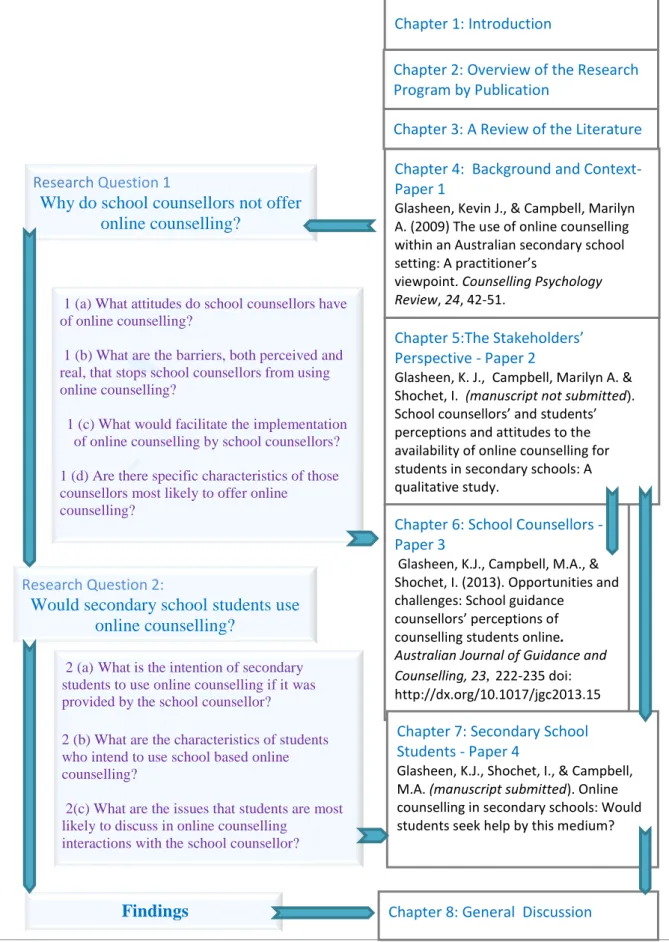
In this chapter (Chapter Two), the thesis structure is presented. It provides an overview of individual chapters and how the publications contribute to the research program and how each paper addresses the research questions. A map of how each publication is positioned is diagrammatically presented in Figure 2.1. Chapter Three reviews the relevant literature pertaining to the research and in particular examines the theories of adolescent help-seeking. The chapter explores the reasons for young people’s resistance to seeking help and identifies the ‘negation effect’ in the help-seeking process. Literature is reviewed which demonstrates the importance of connectedness as a protective factor for good mental health. The value that adolescents place on being connected to their peers through technology is explored and explains why this demographic group has been dubbed by some as generation ‘C’. The ‘digital’ nature of this cohort provides the basis for investigating the possible use of technology as a way of nurturing help-seeking behaviours for
12 ONLINE COUNSELLING IN SECONDARY SCHOOLS adolescents. The argument is made that technology and the online world is an
integrated reality for most young people in Australia and internationally. The chapter continues with an explanation of how young people access the internet to source all varieties of information, including websites which specialise in assisting young people and consequently promote the development of their mental health literacy. It highlights how practitioners and community agencies have responded to the needs of adults and young people by providing psychological assistance from online
counsellors. The findings of research in this nascent method of counselling are investigated and the inherent advantages and disadvantages are discussed and the nature of the online counselling alliance is explored. The popularity of online counselling provided by community based organisations indicates the potential usefulness of such services as a means of promoting help-seeking behaviours in adolescents.
The review of literature concludes with a discussion of those who would provide this service in secondary schools, that is, school counsellors. The apparent resistance of school counsellors in Australia to adopting an online presence is challenged. The possible reasons for this hesitancy to provide students with
technological avenues to support provide the starting point for the current research. Chapter Three highlights the potential benefits of using online technology for
assisting young people experiencing mental health difficulties and other stressful life events. This led the author to initially investigate and examine the factors that are hindering the introduction of online counselling in secondary schools by school counsellors.
The justification for the current research is further developed in Chapter Four. This chapter consists of a peer reviewed propositional paper published in the journal
ONLINE COUNSELLING IN SECONDARY SCHOOLS 13
Counselling Psychology Review. The argument is made that online counselling has
been found useful and effective in adult populations and community-based agencies report its successful use with young people. It proposes that as young people are reticent to seek help from traditional sources, online counselling may be a means of increasing help-seeking behaviours while young people are attending school. However, it leaves unanswered the question why school counsellors do not offer online counselling in schools.
A trial of online counselling conducted by the author is reported in a published peer reviewed conference paper which is included as an appendix to this thesis and which was presented during candidature. It is not part of the current research and its inclusion is for referral purposes only. This pilot study is an example of how synchronous text-based online counselling could be used in a school
situation. The model of online counselling presented is a reference point in
subsequent discussions of what constitutes online counselling in a school situation. However, this case study does not investigate the factors that facilitate or inhibit the introduction of online counselling into secondary schools.
Chapter Five consists of a prepared manuscript (Paper 2) which outlines the initial qualitative investigation into the perceptions, understanding and attitudes of the stakeholders namely the school counsellors and the students. A series of focus groups was used to collate data and to gauge the preparedness of both counsellors and students to adopt the introduction of online counselling in the school setting. As there is a lack of research into the use of online counselling by school counsellors, this exploratory qualitative investigation provided a basis from which to develop measurement tools in the form of online surveys.
14 ONLINE COUNSELLING IN SECONDARY SCHOOLS
Chapter Six consists of a peer reviewed paper published in the Australian
Journal of Guidance and Counselling. This third paper focused on the role of school
counsellors who are major stakeholders in any process of changing the service delivery of school counselling services. This paper reported the findings of a survey that was developed from data collated from the focus groups of school counsellors. It identified the issues that school counsellors believe hinder the uptake of online counselling in schools and the factors that would encourage these practitioners to implement the initiative. The findings of this chapter essentially answer why school counsellors have not adopted online counselling, and provide an indication of what needs to be done to encourage the implementation of online counselling in a school setting. Crucial to the implementation of synchronous online counselling within the school setting, is the belief by practitioners that this form of counselling is effective and worth the effort. Current counsellor attitudes and beliefs need to be appreciated and addressed to understand why online counselling is not being offered in schools. This study answered the first research question:
Why do school counsellors not offer online counselling?
What attitudes do school counsellors have towards online counselling?
What are the barriers, both perceived and real, that stops school counsellors
from using online counselling?
What would facilitate the implementation of online counselling by school
counsellors?
Are there specific characteristics of those counsellors most likely to offer
online counselling?
Chapter Seven directs attention to the students who are the other major stakeholder group in this research and the potential clients of school-based online
ONLINE COUNSELLING IN SECONDARY SCHOOLS 15 counselling. This chapter consists of a paper prepared for publication which discusses the findings of the student survey that was built upon the findings of the focus groups of secondary students. It highlights the characteristics of those students most likely to use an online counselling service in school, and what issues they are most likely to discuss in these online sessions. This study of secondary students addresses the second research question namely,
Would secondary school students use online counselling?
The student survey includes items designed to establish the characteristics of students who intend to use school based online counselling. In particular,
What influence does gender, year level, prior counselling experience, and
levels of psychological distress have on students’ intention to use online counselling?
What are the issues that students prefer to discuss in online counselling
interactions with the school counsellor?
These published and unpublished manuscripts which combine to constitute
this thesis result in a number of findings with implications for practice and further research. Chapter Eight draws these findings together in a discussion of how the results build on previous research and indicates possible directions for future investigation. Each publication is the core of individual chapters and together with the introductory chapter, this chapter, the review of the literature, and general discussion, combine to address the two research questions of this PhD research.
2.2 Design of the Research Program
As with any innovation, preliminary research is required to establish the level of need or intention to use the service. This is similar to market research undertaken by corporations prior to investing financial and human resources into a
16 ONLINE COUNSELLING IN SECONDARY SCHOOLS proposed project. It is for this purpose that it is necessary to assess the need and the potential use of online counselling within the school by the students. There is a need to identify how students perceive online counselling within the secondary school and what is their intention to use online counselling. This is achieved by investigating the relationship between predicted usage by students and specific factors.
The empirical studies contained in this thesis were planned and conducted according to ethical requirements of the sponsoring university. The mapping of the studies and the links to the research questions is presented in Figure 2.1.
ONLINE COUNSELLING IN SECONDARY SCHOOLS 17
Chapter 4: Background and Context- Paper 1
Glasheen, Kevin J., & Campbell, Marilyn A. (2009) The use of online counselling within an Australian secondary school setting: A practitioner’s
viewpoint. Counselling Psychology Review, 24, 42-51.
Chapter 8: General Discussion
Chapter 3: A Review of the Literature Chapter 2: Overview of the Research Program by Publication
Chapter 1: Introduction
Research Question 1
Why do school counsellors not offer online counselling?
1 (a) What attitudes do school counsellors have of online counselling?
1 (b) What are the barriers, both perceived and real, that stops school counsellors from using online counselling?
1 (c) What would facilitate the implementation of online counselling by school counsellors?
1 (d) Are there specific characteristics of those counsellors most likely to offer online
counselling?
Chapter 6: School Counsellors
-Paper 3
Glasheen, K.J., Campbell, M.A., & Shochet, I. (2013). Opportunities and challenges: School guidance
counsellors’ perceptions of counselling students online. Australian Journal of Guidance and Counselling, 23, 222-235 doi: http://dx.org/10.1017/jgc2013.15 Chapter 5:The Stakeholders’ Perspective - Paper 2
Glasheen, K. J., Campbell, Marilyn A. & Shochet, I. (manuscript not submitted). School counsellors’ and students’ perceptions and attitudes to the availability of online counselling for students in secondary schools: A qualitative study.
Chapter 7: Secondary School Students - Paper 4
Glasheen, K.J., Shochet, I., & Campbell, M.A. (manuscript submitted). Online counselling in secondary schools: Would students seek help by this medium?
Research Question 2:
Would secondary school students use online counselling?
2 (a)What is the intention of secondary students to use online counselling if it was provided by the school counsellor?
2 (b) What are the characteristics of students who intend to use school based online counselling?
2(c) What are the issues that students are most likely to discuss in online counselling
interactions with the school counsellor?
Findings
18 ONLINE COUNSELLING IN SECONDARY SCHOOLS
2.3 The Methodology
As synchronous online counselling within the secondary school is not a reality, the methodology employed in this research had to have the capacity to measure and assess intended behaviours rather than observed behaviours. It is not possible to compare those who have experienced school online counselling with a control group of those who have not as there is no school online counselling
available. This research is thus an exploration and investigation of perceptions and attitudes of both school counsellors and secondary students and their subsequent intention to utilise online counselling. A mixed method was used incorporating both qualitative and quantitative measures (Brannen, 2008). Because this investigation is innovative within the developing field of online counselling in schools, there is an absence of appropriate quantitative instruments available for this nature of research. For this reason qualitative studies consisting of focus groups were initially conducted to scope the main themes identified by secondary school counsellors and of
secondary school students. These initial qualitative studies provided the required data to develop online surveys in order to collate quantitative data from larger samples of secondary school counsellors and secondary school students. Consequently, the research used a format where the qualitative component preceded the quantitative.
Both studies were necessary to provide a comprehensive appreciation of those who intend to provide the service of online counselling and those who intend to use the service. The findings of the two studies complement each other and provide a sound foundation for further research in the provision of online counselling in
schools.
ONLINE COUNSELLING IN SECONDARY SCHOOLS 19 This chapter specifies the aims and scope of this research. An overview is provided of each chapter in the thesis. The contextual background is provided by explaining how the current research developed from a previous pilot study conducted by the author. The fact that young people are digitally competent and depend on technology for communication was highlighted as the genesis of the research questions that focus on both stakeholders; the school counsellors and the students. The evidence on the effectiveness of this medium in providing assistance to distressed young people and the ‘up to now’ reluctance of school counsellors to engage with the technology, sequentially and logically leads to the queries posed by the two research questions. The answers to these questions are designed to inform the general debate on the effectiveness of online counselling, and specifically, if this medium contributes to the promotion of help-seeking behaviours among adolescents. It is only by establishing whether school counsellors would provide online
counselling and confirming if students would make use of it that the question of whether online counselling would promote help-seeking can be answered. The questions relating to the client’s psychological status, demographics and the identification of the possible issues that young people would bring to an online counselling session provide a means to examine which variables would or would not contribute to a young person’s intention to use this avenue of help.
ONLINE COUNSELLING IN SECONDARY SCHOOLS 21
Chapter 3: A Review of the Literature
3.1 The ChallengeThis chapter reviews the body of literature relevant to the implementation of online counselling within the secondary school setting. It builds on the proposition presented in Chapter One that the mental health needs of adolescents are not
adequately supported by traditional forms of counselling and this in turn impacts on their educational outcomes and wellbeing in later life resulting in substantial social and economic costs. This chapter identifies the counselling services that are available in secondary schools for students. Factors which have been identified as possible causes for young people to not seek professional assistance are presented. The fact that school counsellors are well placed in secondary schools to support students suggests there is a need to explore ways that would make them more accessible to students. As young people have integrated technology into their lives, the concept of school counsellors providing online counselling as part of the school support system, may provide an appropriate way to engage young people with professional help. However, the reasons why school counsellors currently do not offer online counselling need to be investigated.
Literature that highlights the importance of technology in the lives of secondary school students is considered. Emphasis is placed on literature that examines how technology plays a pivotal role in the relationships of young people and the consequent need of adolescents to be connected with others. The cited research demonstrates the potential that technology has for connecting young people to professional help when faced with difficulties. The argument that psychological distress may be addressed by the availability of online resources leads to the review of literature related to advantages and disadvantages of using online counselling. The
22 ONLINE COUNSELLING IN SECONDARY SCHOOLS current research into the use of technology for the delivery of counselling services by community based practitioners anticipates the question of whether students would use online counselling if it was made available by the school counsellor. The school counsellor is a key stakeholder in this process and the reasons for their apparent hesitancy to adopt online counselling are considered. In the final part of the chapter, a justification for the current research is drawn from a summary of the relevant findings related to the implementation of online counselling within the school setting.
3.1.1 The Occurrence of Mental Health Difficulties During Adolescence
As indicated in Chapter One, young people experience stressors which can contribute to mental health difficulties. While this state of adolescent mental health is a global concern (Kieling et al., 2011), it is more pronounced in developed countries such as Australia (Birleson, Sawyer, & Storm, 2000; Sawyer et al., 2001; Sawyer et al., 2012; Smith, 2012; Zubrick, Silburn, Burton, & Blair, 2000), the United Kingdom (Collishaw, Maughan, Natarajan, & Pickles, 2010), Canada (Miller, 2012), the Netherlands (Vanheusden, van der Ende, Mulder, van Lenthe, Verhulst, & Mackenbach, 2009) and Norway (Andersen & Svensson, 2013). The fact that only 25% of those who experience mental health problems obtain the professional support that they require, is a challenge to practitioners who work with these young people. This is especially true for those responsible for the guidance and counselling of students in schools (Evans, 2010).
3.1.2 Impact on Educational Outcomes and Wellbeing in Later Life
Of those who suffer from mental health difficulties, the most prevalent affective disorders experienced by young people are anxiety and depression (Thapar, Thapar, Collishaw, & Pine, 2012). Awareness and understanding of the impact of
ONLINE COUNSELLING IN SECONDARY SCHOOLS 23 untreated anxiety and depression on educational outcomes is the starting point for nurturing effective learners. Ultimately, unless appropriate interventions are implemented, the effects will have repercussions for the young person’s long-term mental health as well as affecting their physical health and emotional wellbeing (Leach, & Butterworth, 2012; Sawyer et al., 2012; Sulkowski, Demaray, & Lazarus, 2012). An appreciation of how early intervention can determine the quality of a student’s adult mental health status, emphasises the need for appropriate counselling support in schools.
Not only does poor mental health in early life have a personal cost, the cumulative effect of the younger generation being mentally unwell also has a social and economic cost. A recent government report estimated that mental illness in males aged 12-25 costs the Australian economy $3.27 billion per annum or $387,000 per hour in lost production . Furthermore “suicide has been found to be the largest single cause of death in young Australian males aged 15–24 years” (Degney et al., 2012). These facts highlight the importance of good mental health not only for ensuring productive educational outcomes, but for general wellbeing and positive mental health in later life. The need to address not only the social and economic costs has provided the impetus for government action in this area. Significant government financial commitment has been made to bettering and nurturing the mental health for Australian young people. This has resulted in a number of
initiatives such as MindMatters (De Jong & Griffiths, 2008; Wyn, Cahill,
Holdsworth, Rowling, & Carson, 2000), KidsMatter (Fasano & Cavanagh, 2009) and
the establishment of Headspace centres across the nation (McGorry et al., 2007).
24 ONLINE COUNSELLING IN SECONDARY SCHOOLS As the school is the place where young people spend much of their time, it is only appropriate to provide services in schools. The reasons why young people at risk often do not avail themselves of the counselling services within the school may be due to a number of factors which determine the effectiveness of their help-seeking skills. Though there has been research into the help-seeking behaviours of young people, there has been a lack of clarity in defining and conceptualising help-seeking in terms of how it is measured. Rickwood and Thomas (2012) have addressed this
issue and attempted to give form to this area of research.As a result, a working
definition of help-seeking is provided:
“In the mental health context, help-seeking is an adaptive copingprocess that
is the attempt to obtain external assistance to deal with a mental health concern.” (p. 180)
The fact that some students do not seek help at school is not due to the absence of support staff. The school counsellor, sometimes referred to as the school guidance counsellor or guidance officer, is a permanent staff member of schools in the state of Queensland.
3.1.4 School Counsellors Provide Student Support
Counselling is a primary role of the school counsellor in the secondary school. Their importance as a key professional who can provide appropriate assistance to young people with mental health difficulties was highlighted in the findings of a national survey of mental health and wellbeing. It was found that when young people do seek professional help, school counsellors are second only to general practitioners as the preferred source of help (Sawyer, Miller-Lewis, & Clarke, 2007). The vital role schools have in promoting the mental health of young people is now recognised in other countries such as the United Kingdom (Hornby &
ONLINE COUNSELLING IN SECONDARY SCHOOLS 25 Atkinson, 2003). Counsellors in Australian secondary schools are in an ideal position to provide students with appropriate professional support when they experience mental health difficulties.
The school-based counsellor is readily available to secondary students at school and is usually a permanent member of staff. Their presence in the school gives the school counsellor an appreciation of the ethos of that particular school and
knowledge of available local resources. Even though face-to-face counselling
services are available to students in high schools, and school counsellors are the second most preferred professional for young people, the majority of students ‘at risk’ of developing serious mental health difficulties still do not access the school counsellor (Cigularov, Chen, Thurber, & Stallones, 2008). A Brisbane study of secondary school adolescents revealed that students who require assistance and had sought assistance from the school counsellor appreciated the fact that the counsellor was readily available. However, the same study also highlighted the fact that many students were not willing to access the school counsellor due to a number of
perceived barriers. One of these barriers that students were concerned about was the issue of confidentiality (Sheffield, Fiorenza, & Sofronoff, 2004). However, some young people do seek help in an online environment where some of these barriers are perceived to not exist.
3.1.5 Integration of Technology in the Lives of Students
The value which young people put on social networking sites and mobile phones is evidence of the importance they place on the need to be connected with their peers. This need to be connected has led to some in the marketing world to dub
Gen-Y as the main participants of the connected generation or the ‘C’ generation
26 ONLINE COUNSELLING IN SECONDARY SCHOOLS increasing role in the social lives of the Y and even more so in the current Gen-Z. Young people treat the mobile phone as an essential necessity of life and depend on their use mainly for relational purposes either for talking or texting to
communicate with their friends (Campbell, 2005). Young people also increasingly
use social networking platforms such as FaceBook, Twitter, Instagram and Tumblr.
Relationships are often developed online and social networking sites are used to monitor potential romantic partners.
3.1.6 Online Help for Young People
As technology and the internet are a familiar resource for young people, it is logical that they would seek assistance for health concerns, including mental health, from this source (Figge, 2014) and in 2003 it was estimated that 67% of adolescents would use e-resources to seek medical information (Skinner, Biscope, Poland & Golberg, 2003). As a result there is a need to provide appropriate websites that provide therapeutic information for young people (Gray, Klien, Noyce, Sesselberg & Cantrill, 2005; Reynolds, Griffiths, & Christensen, 2011). A number of ‘youth
friendly’ websites have been developed in Australia such as Reachout
(http://reachout.com.au) and Sane Australia’s itsallright.org (http://itsallright.org)
mental health site. However, the information presented is mostly limited to static
presentations in the form of Frequently Asked Questions, fact sheets and suggested
links to other sites.
At the same time within the wider community, there is the developing use of online counselling for adults with mental health problems as evidenced by the increasing library of manuals and handbooks for the online therapist (e.g. Evans, 2009; Kraus, Zack & Stricker, 2004). Therefore the provision of online counselling within the secondary school setting may assist students experiencing such difficulties
ONLINE COUNSELLING IN SECONDARY SCHOOLS 27 and though an initial trial indicated potential benefits for students (Glasheen & Campbell, 2008), it has not been integrated into the practice of Australian school counsellors.
As indicated earlier, the use of technology in the treatment of mental health problems is becoming a reality in the wider community. Rickwood (2012) has
described this as the e-spectrum where a variety of interventions now exist. Not only
do these innovations supplement traditional face-to-face support, but they provide
creative and new levels of intervention in terms of online counselling.
3.1.7 Online Counselling
In essence, ‘online counselling’ is the use of computers and the internet by counsellors and clients to communicate for the purpose of attaining some therapeutic
and productive relationship. Richards and Vigano (2012) describe online
counselling as the
“ delivery of therapeutic interventions in cyberspace where the
communication between a trained professional counselor and client(s) is facilitated using computer-mediated communication (CMC) technologies provided as a stand-alone service or as an adjunct to other therapeutic
interventions” (p. 699).
This definition includes two forms of online communication, namely asynchronous
communication such as emails where there is a time delay between interactions, and
synchronous communication where the written dialogue is immediate as occurs in an
online chat room.
For the purposes of this research, the definition of online counselling provided by
28 ONLINE COUNSELLING IN SECONDARY SCHOOLS
the use of synchronous online text-based chat facilities for the conduct of a
counselling intervention.
The effectiveness of online counselling has been found to be at least equal to
face-to-face counselling (Barak, Hen, Boniel-Nissim, & Shapira, 2008; Richards &
Vigano, 2013). A comparison study conducted into the effectiveness of the two
mediums offered through Brisbane based Kids Help Line, an Australian national
telephone and online counselling service for youth, found that the session impact of online counselling was not as strong as telephone counselling (King, Bambling, Reid, & Thomas, 2006). However, in another study of this service, it was found that online counselling was less threatening for many young people (King, et al., 2006). Hanley (2009) who used both quantitative and qualitative instruments found that the quality and nature of the online alliance could be rated as medium to high for users
of the U.K. service, Kooth.com. A later study indicated the need for online
counsellors to be aware of a young person’s motivation to seek counselling online as this impacts on the therapeutic relationship which is crucial to counselling outcomes (Hanley, 2012).
However, in spite of generally positive findings about online counselling,
many school counsellors believe that online counselling is not as engaging as
face-to-face counselling. Early research indicated that online counselling may not suit
everyone and all conditions (Abbott, Klein, & Ciechomski, 2008). However, the potential benefits of the ‘disinhibition effect’ as described by Suler (2005) which is present in the online interaction, often leads to early disclosure of personal
information and may in fact mean that the length of rapport building may be reduced online. The fact that young people tend to be more uninhibited online may be an advantage when fostering help-seeking avenues with ‘at-risk’ youth. It seems that
ONLINE COUNSELLING IN SECONDARY SCHOOLS 29 the opportunity that online counselling may provide for young people experiencing various forms of distress, may be a positive force in building help-seeking behaviour among this cohort.
Richards and Viganò (2013) reviewed the literature across the spectrum of online interventions which included video conferencing, email and chat. A meta-analysis of the processes and outcomes of online interaction such as the disinhibition effect, the loss of cues and ethical considerations, concluded that even if practitioners have reservations about the effectiveness of online counselling, clients have adopted the technology and will continue to seek help online. As young people are dependent on technology in many areas of their lives, it is logical that they will increasingly seek help through technology (Figge, 2014).
The argument for providing online counselling for students at school is based on a number of further considerations. The first of these is that online counselling within the school setting provides students with easier access to the school
counsellor. The school counsellor is usually known to the students, and the use of computer technology facilitates the ability of students to contact the counsellor by ‘a click on their laptop’. This availability of school counselling services means that young people are not reliant on their parents to arrange and pay for professional counselling within the community. In the secondary school students can access the counsellor without parental consent which also contributes to counsellor
accessibility. However, in spite of the counselling services within the school being
readily accessible, the face-to-face services are not attracting a large proportion of
those who need help (Rickwood, Deane, & Wilson, 2007). The provision of an online counselling service has the potential to address some of the issues hindering students from using school counselling services. Possibly the provision of online