i
STAKEHOLDER MANAGEMENT IN CONSTRUCTION
PROJECTS: A LIFE CYCLE BASED FRAMEWORK
By
JURBE JOSEPH MOLWUS
B.Sc., M.Sc. (UniJos), MNIOB, Registered Bldr. (CORBON)
A thesis submitted in partial fulfilment of the requirements for the award of Doctor of Philosophy in Construction, of Heriot Watt University, Edinburgh
October, 2014
The copyright in this thesis is owned by the author. Any quotation from the thesis or use of any of the information contained in it must acknowledge this thesis as the
i
ABSTRACT
Although stakeholder management has long been acknowledged as a means of increasing the propensity for successful delivery of construction projects, the full benefits of stakeholder management have yet to be tapped. Previous research efforts indicate lack of comprehensive stakeholder management process since the existing frameworks in construction either focussed on a particular construction stage or failed to incorporate important considerations such as the impact of procurement routes, internal stakeholder collaboration, responsibility for stakeholder management and project life cycle.
This research aims to develop a comprehensive framework for stakeholder management in construction projects in order to enable the industry tap the full benefits of stakeholder management. In order to achieve this aim, previous work on stakeholder management is reviewed. The current practice of stakeholder management within the construction industry, the effects of procurement routes and contract forms on stakeholder management process, the relationship among the critical success factors for stakeholder management in construction projects are investigated using an industry survey among construction professionals practicing within the United Kingdom. Data collected is analysed using a combination of qualitative approach and appropriate statistical techniques including structural equation modelling (SEM) to investigate the current practice of stakeholder management in construction projects, effects of procurement routes and contract conditions on stakeholder management process, and the interrelationships among the critical success factors for stakeholder management in construction projects.
Based on a combination of the findings from literature review and data analyses, a life cycle based framework for stakeholder management in construction projects is developed using Integrated Defiinition0 (IDEF0) modelling. The framework is validated by practising industry professionals and is identified as a comprehensive guide to construction industry practitioners for carrying out stakeholder management in construction projects.
ii
DEDICATION
To the blessed memory of my late father Nde Joseph Kassem Pakgyit Molwus who laid the foundation for my education but could not live to see me achieve its peak and all others who have departed this world.
To all, whose lives have been cut short by acts of terrorism in different parts of the world.
iii
ACKNOWLEDGEMENTS
One’s efforts alone cannot achieve this research work and preparation of thesis. Many individuals and organisations have contributed directly or indirectly, knowingly and willingly or otherwise, acknowledging them therefore, is inevitably necessary.
I would like to start by expressing my sincere appreciation to my primary supervisor, Dr. Bilge Erdogan who through unconditional, sacrificial and untiring constructive criticisms, guided and encouraged me to accomplish this study. My sincere gratitude also goes to my second supervisor, Prof. S. O. Ogunlana, for his supportive guide including moral support and prayers. I am also grateful to Dr. Derek Thomson who got me started on the study.
I would like to thank the school of Built Environment, Heriot Watt University, Edinburgh, for funding my tuition throughout the study. I also thank the University of Jos for approving my study leave. I am also grateful to Dr. S. A. Oyegoke, Dr. Roshani Palliyaguru, Prof. Bayo Adeloye, Mr. Angus Kennedy, Rev. Dr. Alistair Donald, Rev. Frs: Giani, Kevin and Ian; Bldrs. D. D. Jambol, E. P. Datok and K. Attsar; Mrs Christy Wakjissa (my mother in-law), Prof. David L. Wonnang, Augustine Ajijelek, Isah Jabil, Yususf Nakaka and Smart Habila Bako for their support to me in different ways. I also thank the Head and entire staff of the Department of Building, University of Jos, Nigeria for their encouragement.
To the Nigerian community and other friends in Heriot Watt University and Edinburgh at large, I am grateful for your company, friendship and encouragement. To my colleagues in SBE who sincerely shared their experiences and encouraged me, I remain indebted in gratitude. To the administrative/support staff at SBE who were always there to help in times of need, many thanks for your help and smiles. To all my friends whose support and encouragement regardless of physical distance, never ceased, I am grateful. My mother (Mrs Helen Nnang Joseph), Sisters, cousins, aunts, uncles and my entire extended family (including friends I consider part of my family) have been wonderfully supportive in different ways, I appreciate them all. To my loving Wife: Delmwa and kids: Jurritka and Nenrin, I appreciate your support, encouragement, patience and understanding throughout my absence on account of this study. I am grateful to my In-laws for their support to me in many ways.
iv
Lastly but one, I whole heartedly appreciate all those whose names I have not mentioned here, even though their contributions have added up in making this work possible; especially those who helped in data collection.
Finally and above all, I give God Almighty the glory for His unfailing grace, love and mercies throughout the study period and my entire life.
v
DECLARATION STATEMENT
ACADEMIC REGISTRY Research Thesis Submission
Stakeholder Management in Construction Projects: A life Cycle Based Framework
Name: Jurbe Joseph Molwus
School/PGI: School of the Built Environment/CofEx
Version: (i.e. First, Resubmission, Final)
Final Degree Sought
(Award and
Subject area)
PhD (Construction)
Declaration
In accordance with the appropriate regulations I hereby submit my thesis and I declare that: 1) the thesis embodies the results of my own work and has been composed by myself
2) where appropriate, I have made acknowledgement of the work of others and have made reference to work carried out in collaboration with other persons
3) the thesis is the correct version of the thesis for submission and is the same version as any electronic versions submitted*.
4) my thesis for the award referred to, deposited in the Heriot-Watt University Library, should be made available for loan or photocopying and be available via the Institutional Repository, subject to such conditions as the Librarian may require
5) I understand that as a student of the University I am required to abide by the Regulations of the University and to conform to its discipline.
* Please note that it is the responsibility of the candidate to ensure that the correct version of the thesis is submitted.
Signature of Candidate:
Date:
Submission
Submitted By (name in capitals):
JURBE JOSEPH MOLWUS Signature of Individual Submitting:
Date Submitted:
For Completion in the Student Service Centre (SSC) Received in the SSC by (name in
capitals):
Method of Submission
(Handed in to SSC; posted through internal/external mail):
E-thesis Submitted (mandatory for final theses)
vi
TABLE OF CONTENTS
ABSTRACT ……….i
DEDICATION………..ii
ACKNOWLEDGEMENT………..iii
DECLARATION STATEMENT………v
TABLE OF CONTENTS……….vi
LIST OF TABLES………..xiii
LIST OF FIGURES………xvi
Method of Submission ... vE-thesis Submitted (mandatory for final theses) ... v
1.
CHAPTER ONE: INTRODUCTION ... 1
1.1 Background ... 1
1.1.1 Who are construction project stakeholders ... 1
1.1.2 Link between stakeholder management and project success in construction 2 1.1.3 Stakeholder management process ... 4
1.1.4 Justification for the research ... 5
1.2 Research Questions ... 6
1.3 Research Aim and Objectives ... 7
1.4 Research Methodology ... 8
1.5 Thesis structure ... 11
2.
CHAPTER TWO: LITERATURE REVIEW ON
STAKEHOLDER MANAGEMENT IN CONSTRUCTION
PROJECTS ... 15
2.1 Introduction ... 15
2.2 Stakeholders Definition ... 15
2.3 Stakeholders’ Classification ... 17
2.3.1 Classification according to Stakeholders’ attributes (Power, Legitimacy, Proximity and Urgency) ... 17
2.3.2 Classification according to vested interest-impact index (viii) ... 20
2.3.3 Classification according to contractual relationship ... 23
2.3.4 Classification according to stakeholder attitudes towards the project ... 23
vii
2.5 Need to Manage/Engage Stakeholders in Construction Projects ... 27
2.6 Critical Success Factors (CSFs) for Stakeholder Management/ Engagement in Construction Projects ... 30
2.7 Stakeholder Management Approaches/Frameworks ... 41
2.8 Tools and Techniques for Stakeholder Management ... 51
2.8.1 Design Charrette... 51
2.8.2 Contingent Value Method ... 52
2.8.3 Delphi Technique ... 53
2.8.4 Strategic Needs Analysis... 53
2.8.5 Stakeholder cycle ... 55
2.8.6 Public hearing ... 56
2.9 Chapter Summary ... 56
3.
CHAPTER THREE: LIFE CYCLE, SUCCESS, PROCUREMENT
ROUTES; AND STAKEHOLDER COLLABORATION IN
CONSTRUCTION PROJECTS ... 58
3.1 Introduction ... 58
3.2 Project Life Cycle ... 58
3.3 Project Success and Key Performance Indicators in Construction Projects .... 61
3.4 Procurement Routes in Construction ... 67
3.5 Relating Stakeholder Management (SM) to the Procurement Routes ... 71
3.5.1 Stakeholder Management vs. Traditional method ... 71
3.5.2 Stakeholder Management vs. Integrated procurement methods ... 72
3.5.3 Stakeholder Management vs. Management oriented procurement methods 73 3.6 Stakeholders’ Collaboration in Construction ... 77
3.7 Conceptual Measurement and Structural Models of Critical Success Factors for Stakeholder Management in Construction ... 80
3.8 Chapter Summary ... 86
4.
CHAPTER FOUR: RESEARCH METHODOLOGY... 89
4.1 Introduction ... 89
4.2 Research Design Concepts ... 89
4.2.1 Research philosophy ... 94
4.2.2 Research Approaches ... 97
4.2.3 Research Strategies ... 98
4.2.4 Research Choices ... 101
4.2.5 Time Horizons ... 103
4.2.6 Data Collection and Data Analysis ... 104
4.3 Research Design (Methodology) Adopted ... 104
4.3.1 Literature Review ... 105
4.3.2 Research Design ... 106
viii
4.4 Data Analyses Techniques ... 112
4.4.1 Mean rating ... 112
4.4.2 Kruskal-Wallis Test ... 112
4.4.3 Mann-Witney U Test... 113
4.4.4 Correlation... 113
4.4.5 Structural equation modelling (SEM) ... 113
4.4.5.1 Basic principles and Justification for using SEM ... 113
4.4.5.2 Model fit indices in SEM ... 118
4.4.5.3 Sample size ... 120
4.5 Summary ... 121
5.
CHAPTER FIVE: CURRENT PRACTICE OF STAKEHOLDER
MANAGEMENT IN CONSTRUCTION PROJECTS ... 123
5.1 Introduction ... 123
5.2 Stakeholder Management Decisions and responsibilities ... 123
5.2.1 Stakeholder management decisions ... 123
5.2.2 Change of Stakeholders’ Interests/Disposition towards Projects ... 124
5.2.3 Stakeholder management collaboration ... 127
5.2.4 Stakeholder management leadership/coordination ... 129
5.3 Techniques for Stakeholder Engagement/Management ... 132
5.4 Qualitative Responses (general comments) on Ways to Improve Stakeholder Management in Construction Projects ... 133
5.5 Chapter Summary ... 135
6.
CHAPTER SIX: EFFECTS OF PROCUREMENT ROUTES
RELATED CHARACTERISTICS OF STAKEHOLDER
MANAGEMENT AND CONTRACT FORMS ON STAKEHOLDER
MANAGEMENT PROCESS IN CONSTRUCTION PROJECTS .... 137
6.1 Introduction ... 137
6.2 Investigating the effects of procurement routes related characteristics on stakeholder management process ... 137
6.3 Correlation analysis of procurement routes related characteristics of stakeholder management process ... 139
6.4 Investigating relationships between client type and procurement routes related characteristics of stakeholder management ... 140
6.5 Investigating relationships between years of experience and procurement routes related characteristics of stakeholder management ... 142
6.6 Assessing the effects of forms of contracts on stakeholder management process 145 6.6.1 Forms of contract used by respondents ... 145
6.6.2 Effects of forms of contract on stakeholder management process in construction projects ... 146
ix
6.6.3 Investigating client type difference in the extent to which forms of
contract influence stakeholder management in construction projects ... 147
6.7 Investigating relationships between forms of contract and procurement routes related characteristics of stakeholder management ... 149
6.8 Discussion of Results ... 154
6.9 Summary and Conclusions ... 156
7.
CHAPTER SEVEN: MODELLING THE
INTERRELATIONSHIPS AMONG THE CRITICAL SUCCESS
FACTORS (CSFs) FOR STAKEHOLDER MANAGEMENT IN
CONSTRUCTION PROJECTS ... 159
7.1 Introduction ... 159
7.2 Measurement Model of Critical Success Factors for Stakeholder Management in Construction ... 159
7.2.1 Preliminary analysis for consistency checks ... 160
7.2.2 Evaluation of Measurement Model of Critical Success Factors for Stakeholder Management in Construction Projects ... 162
7.3 Evaluation of the Structural Model of Critical Success Factors for Stakeholder Management in Construction Projects and Hypothesis Testing ... 168
7.4 Discussion of Results and Conclusions ... 174
8.
CHAPTER EIGHT: DEVELOPMENT OF LIFE CYCLE BASED
FRAMEWORK FOR STAKEHOLDER MANAGEMENT IN
CONSTRUCTION PROJECTS ... 179
8.1 Introduction ... 179
8.2 Overview of the Life Cycle Based Framework for Stakeholder Management in Construction ... 179
8.2.1 Background to framework development ... 179
8.2.2 Framework development approach-IDEF0 ... 181
8.2.2.1 IDEF Techniques ... 181
8.2.2.2 IDEF0 Technique ... 182
8.3 Features of the Framework ... 185
8.3.1 Conceptual framework ... 185
8.3.2 Actors in the framework... 187
8.3.2.1 Project Director (PD) ... 187
8.3.2.2 Stakeholder management leader (SML) ... 187
8.3.2.3 Stakeholder management team (SMT) ... 187
8.3.2.4 Regulatory authorities ... 187
8.3.3 Framework for stakeholder management in construction – idef0 process modelling overview ... 188
x
8.4.1 Identify stakeholder characteristics and project characteristics - SMIS/A1 197
8.4.1.1 Define stakeholder management mission ... 197
8.4.1.2 Identify project stakeholders and their characteristics ... 198
8.4.1.3 Constitute stakeholder management team ... 198
8.4.1.4 Identify stakeholder characteristics and prepare preliminary classification ... 198
8.4.2 Carryout stakeholder analyses – SMIS/A2 ... 198
8.4.2.1 Classify stakeholders ... 199
8.4.2.2 Draw up stakeholder maps/matrices ... 199
8.4.2.3 Identify possible conflicts and coalition among stakeholders ... 199
8.4.3 Map stakeholder dynamism – SMIS/A3 ... 200
8.4.3.1 Draw up stakeholder relationships maps/matrices at IS ... 200
8.4.3.2 Draw up change in stakeholder interests maps at IS ... 200
8.4.3.3 Draw up change in stakeholder influence map at IS ... 201
8.4.4 Plan stakeholder engagement/empowerment strategies – SMIS/A4 ... 201
8.4.4.1 Draw up stakeholder engagement/communication plan at IS ... 201
8.4.4.2 Plan change tracking and feedback mechanisms at IS ... 202
8.4.5 Implement stakeholder management plan – SMIS/A5 ... 202
8.4.5.1 Do feedback and change tracking report ... 203
8.4.5.2 Prepare SMIS evaluation report ... 203
8.5 IDEF0 Model of SMDS ... 203
8.5.1 Identify stakeholder characteristics and project characteristics - SMDS/A1 203 8.5.1.1 Update stakeholder management mission at DS... 204
8.5.1.2 Update stakeholder list at DS... 204
8.5.1.3 Update stakeholder characteristics and profile at DS ... 204
8.5.2 Carryout stakeholder analyses – SMDS/A2 ... 205
8.5.2.1 Update stakeholder classification at DS ... 205
8.5.2.2 Update general stakeholder maps/matrices at DS ... 205
8.5.2.3 Update possible conflicts and coalition report at DS ... 206
8.5.3 Map stakeholder dynamism – SMDS/A3 ... 206
8.5.3.1 Update stakeholder relationships maps/matrices at DS ... 206
8.5.3.2 Update change in stakeholder interests maps/matrices at DS... 207
8.5.3.3 Update change in stakeholder influence maps/matrices at DS ... 207
8.5.4 Plan stakeholder engagement/empowerment strategies – SMDS/A4 ... 207
xi
8.5.4.2 Assign engagement responsibilities at DS ... 208
8.5.4.3 Plan change tracking and feedback mechanisms at DS ... 208
8.5.5 Implement stakeholder management plan – SMDS/A5 ... 209
8.5.5.1 Prepare change tracking and feedback report for DS ... 209
8.5.5.2 Prepare SMDS evaluation report ... 209
8.6 IDEF0 Model of SMCS ... 210
8.6.1 Identify stakeholder characteristics and project characteristics - SMCS/A1 210 8.6.1.1 Prepare report on potential impact of construction activities on stakeholders ... 210
8.6.1.2 Update stakeholder list and profiles at CS ... 211
8.6.1.3 Prepare preliminary stakeholder priority list at CS ... 211
8.6.2 Carryout stakeholder analyses – SMCS/A2 ... 211
8.6.2.1 Update stakeholder classification at CS... 212
8.6.2.2 Prepare stakeholder priority and impact report at CS ... 212
8.6.2.3 Prepare updated stakeholder maps/matrices at CS ... 212
8.6.3 Map stakeholder dynamism – SMCS/A3 ... 213
8.6.3.1 Update change in stakeholder relation map at CS ... 213
8.6.3.2 Update change in stakeholder interests’ map at CS ... 214
8.6.3.3 Update change in stakeholder influence map at CS ... 214
8.6.4 Plan stakeholder engagement/empowerment strategies – SMCS/A4 ... 214
8.6.4.1 Plan stakeholder engagement/communication strategies at CS ... 215
8.6.4.2 Plan change tracking and feedback mechanisms at CS ... 215
8.6.5 Implement stakeholder management decisions – SMCS/A5 ... 215
8.6.5.1 Prepare feedback and change tracking report for CS ... 216
8.6.5.2 Prepare SMDS evaluation report at CS ... 216
8.7 IDEF0 Model of SMOS ... 217
8.7.1 Identify stakeholder characteristics and project characteristics at – SMOS/A1 ... 217
8.7.1.1 Prepare end product use/management plan ... 217
8.7.1.2 Prepare preliminary end users’ classification ... 218
8.7.1.3 Prepare preliminary end users’ expectation report ... 218
8.7.2 Carryout stakeholder analyses – SMOS/A2 ... 218
8.7.2.1 Prepare final end-users’/stakeholders’ expectation report at OS ... 219
8.7.2.2 Finalise end users’ classification at OS ... 219
8.7.2.3 Prepare possible conflicts and coalition report at OS ... 219
xii
8.7.3.1 Map possible change in stakeholder expectation at OS ... 220
8.7.3.2 Draw up change in stakeholder relation map/matrices at OS ... 221
8.7.4 Plan stakeholder engagement/empowerment strategies – SMOS/A4 ... 221
8.7.4.1 Plan end-users’/stakeholders’ consultation/communication strategies at OS 221 8.7.4.2 Plan stakeholder assessment strategies at OS ... 222
8.7.4.3 Plan change tracking and feedback mechanisms at OS ... 222
8.7.5 Implement stakeholder management decisions - SMOS/A5 ... 222
8.7.5.1 Do users’ satisfaction report at OS... 223
8.7.5.2 Do owners/financiers’ satisfaction report at OS ... 223
8.7.5.3 Prepare SMOS evaluation report ... 223
8.8 Chapter Summary ... 224
9.
CHAPTER NINE: VALIDATION/EVALUATION OF THE
FRAMEWORK FOR STAKEHOLDER MANAGEMENT IN
CONSTRUCTION PROJECTS ... 225
9.1 Introduction ... 225
9.2 Aim and Objectives of Framework Validation/Evaluation ... 225
9.3 Methodology Adopted for Framework Validation/Evaluation ... 226
9.4 Results of Framework Validation/Evaluation ... 231
9.4.1 Quantitative Results ... 231
9.4.2 Qualitative Results ... 235
9.4.2.1 Main benefits of the framework... 236
9.4.2.2 Barriers to the use of the framework ... 236
9.4.2.3 Recommended improvements for the framework ... 237
9.5 Chapter Summary ... 238
10.
CHAPTER TEN: SUMMARY, CONCLUSIONS AND
RECOMMENDATIONS ... 239
10.1 Introduction ... 239
10.2 Summary of the Overall Research ... 239
10.3 Conclusions and Recommendations for Practice ... 244
10.4 Limitations of the Research ... 245
10.5 Recommendations for Further Research ... 246
References ... 247
Appendices ... 264
xiii LIST OF TABLES
Table 1.1 Mapping of objectives with corresponding data collection and analysis
Techniques ... 10 Table 2.1 Summary of stakeholder classification ... 25 Table 2.2 Critical Success Factors (CSFs) for Stakeholder Management in Construction
Projects... 32 Table 2.3 Stakeholder salience shaping strategies (adopted from Aaltonen et al., 2008)
... 36 Table 2.4 Summary of Stakeholder management processes actions in construction
projects ... 42 Table 2.5 Approaches for engaging stakeholders (Chinyio and Akintoye 2008) ... 48 Table 3.1 Categorisation of construction procurement routes ... 70 Table 3.2 Summary of stakeholder management related characteristics of procurement
routes ... 76 Table 3.3 Constructs and indicators of conceptual measurement model of CSFs for
stakeholder management in construction ... 82 Table 4.1 Comparison of consideration in the four research design models ... 94 Table 4.2 Comparison of four branches of research philosophies (Saunders et al., 2009)
... 96 Table 4.3 The logics of Inductive and Deductive research approaches (Blaikie, 2007) . 98 Table 4.4 Quantitative, Mixed and Qualitative methods (Creswell, 2009) ... 102 Table 4.5 Quantitative, Qualitative and Mixed methods approaches (Creswell, 2009) 106 Table 4.6 Respondents' profiles ... 121
xiv
Table 5.1 Preferences for involvement of internal stakeholders in stakeholder
management at different stages of construction projects ... 128 Table 5.2 Preferences of who should lead stakeholder management at different stages of
construction projects ... 130 Table 5.3 Rating of stakeholder engagement/management techniques ... 132 Table 6.1 Mean rating and ranking of the effects of procurement routes related
characteristics on stakeholder management ... 138 Table 6.2 Statistically significant correlation between procurement routes related
characteristics of stakeholder management ... 140 Table 6.3 Kruskal Wallis Test of the rating of procurement route related characteristics
of stakeholder management process by respondents working for different client types ... 141 Table 6.4 Kruskal Wallis Test of the rating of procurement route related characteristics
of stakeholder management process by respondents with different years of
professional experience... 143 Table 6.5 Median scores of procurement routes related characteristics of stakeholder
management process by respondents with different years of professional experience ... 144 Table 6.6 Other forms of contracts used by respondents ... 146 Table 6.7 Mean rating of the extent to which forms of contracts facilitated stakeholder
management ... 147 Table 6.8 Multivariate test statistics for the rating of the influence of contract forms on
stakeholder management by respondents working for different clients ... 148 Table 6.9 Mean rating of the influence of contract forms by respondents employed by
different client type ... 149 Table 6.10 Kruskal Wallis Test of the rating of procurement routes related
xv
Table 6.11 Mean ranks of the rating of procurement routes related characteristics by
respondents using different forms of contracts ... 153
Table 7.1 Mean rating and ranking of Critical Success Factors for Stakeholder Management... 161
Table 7.2 Result of GOF measures for both Conceptual and best fitting measurement models of the CSFs for stakeholder management in construction... 164
Table 7.3 Standardised path coefficients of observed variables’ loading on latent variables ... 166
Table 7.4 Standardised correlation and covariance coefficients of the best fitting measurement model of CSFs for stakeholder management in construction ... 167
Table 7.5 Realigned critical success factors for stakeholder management in construction projects ... 168
Table 7.6 Final indicators of the constructs of the structural model of CSFs for stakeholder management in construction projects ... 170
Table 7.7 Standardised path coefficients of the conceptual structural model of the interrelations among CSFs for stakeholder management in construction ... 173
Table 7.8 Result of GOF measures for both Conceptual and best fitting structural models ... 174
Table 8.1 IDEF Techniques and their Purposes (Aguilar-Saven, 2004) ... 182
Table 8.2 Table 8.2 IDEF0 Interfaces and their Meanings ... 183
Table 8.3 Node Index for SMIS Process Model ... 195
Table 9.1 Background information of the validators ... 229
Table 9.2 Validation responses on scoring of key aspects of the framework ... 233
Table 9.3 Percentage scores of the key aspects of the framework based on the scale points ... 234
xvi LIST OF FIGURES
Figure 1.1 Relationships among the objectives of the study ... 8
Figure 1.2 Thesis Structure ... 11
Figure 2.1 Categories stakeholders based on their attributes (Mitchell et al., 1997) ... 19
Figure 2.2 Stakeholder matrices ... 22
Figure 2.3 Categorisation of stakeholders (Winch, 2010). ... 24
Figure 2.4 Strategic stakeholder management chart (Manowang and Ogunlana, 2010) 46 Figure 2.5 Framework for successful stakeholder management in construction (Yang et al., 2009) ... 49
Figure 2.6 Diagram of Delphi Technique process (Orndoff, 2005) ... 53
Figure 2.7 Problem solving stages and the Strategic Needs Analysis process (Smith and Love, 2004) ... 55
Figure 3.1 Grouping of Construction project success factors (adopted and modified from Long et al., 2004) ... 65
Figure 3.2 Framework for factors affecting project success (adopted and modified from Chan et al., 2004). ... 66
Figure 3.3 Grouping of construction procurement routes ... 70
Figure 3.4 Conceptual Measurement Model of CSFs for Stakeholder Management in Construction ... 81
Figure 3.5 Hypothesised structural model of critical success factors for stakeholder management in construction ... 86
Figure 4.1 Nested research model (Kagioglou et al., 2000)... 90
Figure 4.2 The research 'onion' (Saunders, et al., 2009) ... 91
xvii
Figure 4.4 Framework for research design (Creswell, 2009) ... 93
Figure 4.5 Research choices (Saunders et al., 2009)... 103
Figure 4.6 The research process ... 105
Figure 4.7 Research design for this study ... 107
Figure 5.1 Reasons for change in stakeholders' interests ... 125
Figure 5.2 Means of tracking changes in stakeholders' interests ... 126
Figure 6.1 Mean rating of procurement routes related characteristics of stakeholder management by respondents of different client types and years of experience ... 142
Figure 6.2 Forms of contracts used by respondents ... 145
Figure 6.3 Mean ratings of procurement routes related characteristics of stakeholder management by respondents of different years of experience and forms of contract ... 154
Figure 7.1 Conceptual Measurement Model of CSFs for Stakeholder Management in Construction ... 160
Figure 7.2 The Best Fit Measurement Model of CSFs for SM in Construction ... 165
Figure 7.3 Hypothesised structural model of critical success factors for stakeholder management in construction projects ... 172
Figure 7.4 Final structural model of critical success factors for stakeholder management in construction projects ... 173
Figure 8.1 IDEF0 Box and Arrow Graphics (adapted from IDEF0, 2003) ... 183
Figure 8.2 Decomposition of IDEF0 Diagram ... 184
Figure 8.3 Conceptual life cycle based framework for stakeholder management in construction projects ... 186
Figure 8.4 Overall stakeholder management in construction projects Model SM/A-0 Process ... 188
xviii
Figure 8.5 Life cycle based framework for stakeholder management in construction
projects – SM/A0 Process ... 189
Figure 8.6 SMIS Model – A0 Process ... 191
Figure 8.7 SMDS – A0 Process ... 192
Figure 8.8 SMCS – A0 Process ... 193
Figure 8.9 SMOS – A0 Process ... 194
Figure 8.10 Identify stakeholder characteristics and project characteristics - SMIS/A1 ... 197
Figure 8.11 Carryout stakeholder analyses – SMIS/A2 ... 199
Figure 8.12 Map stakeholders’ dynamism – SMIS/A3 ... 200
Figure 8.13 Plan stakeholder engagement/empowerment strategies – SMIS/A4 ... 201
Figure 8.14 Implement stakeholder management plan – SMIS/A5 ... 202
Figure 8.15 Identify stakeholder characteristics and project characteristics - SMDS/A1 ... 204
Figure 8.16 Carryout stakeholder analyses – SMDS/A2 ... 205
Figure 8.17 Map stakeholders’ dynamism – SMDS/A3 ... 206
Figure 8.18 Plan stakeholder engagement/empowerment strategies – SMDS/A4 ... 208
Figure 8.19 Implement stakeholder management plan – SMDS/A5 ... 209
Figure 8.20 Identify stakeholder characteristics and project characteristics - SMCS/A1 ... 210
Figure 8.21 Carryout stakeholder analyses – SMCS/A2 ... 212
Figure 8.22 Map stakeholders’ dynamism – SMCS/A3 ... 213
Figure 8.23 Plan stakeholder engagement/empowerment strategies – SMCS/A4 ... 215
xix
Figure 8.25 Identify stakeholder characteristics and project characteristics at –
SMOS/A1... 217
Figure 8.26 Carryout stakeholder analyses – SMOS/A2 ... 219
Figure 8.27 Map stakeholders’ dynamism – SMOS/A3 ... 220
Figure 8.28 Plan stakeholder engagement/empowerment strategies – SMOS/A4 ... 221
Figure 8.29 Implement stakeholder management decisions - SMOS/A5 ... 223
1
1.
CHAPTER ONE: INTRODUCTION
1.1 Background
Construction projects are traditionally divided into series of activities or operations undertaken by different individuals or groups who may have different levels of interest and or involvement in the project (Egan, 1998). Construction projects are generally unique in nature based on their fragmentation, processes and interaction with numerous parties; and just like any other venture, are constrained by time and resources (both human and material) which are needed for the projects to be delivered (Ibrahim and Nissen, 2003; Bourne, 2005; Olander, 2006). Therefore, the lengthy process of design and execution of construction projects constitutes a complex system which involves collaboration and negotiations among many stakeholders which may include but not limited to the clients, designers, contractors, local authorities and the general project environment (Cheeks, 2003; Winch, 2010). The different parties involved both directly and indirectly on the project are referred to as the project stakeholders whose management is vital to achieving project success (Cleland, 2002). Stakeholder management therefore, has been recognised as an important strategy for achieving project success in construction projects.
1.1.1 Who are construction project stakeholders
Knowing the stakeholders and their characteristics relative to the project is an important step in stakeholder management (Cleland, 2002) but this can only be achieved through an adequate definition of stakeholders. However, despite the recognition of stakeholder management as an important strategy for achieving project success, the definition of stakeholders is not clearly certain as project stakeholders have been defined in different ways (see section 2.2 for more details). While some definitions of project stakeholders are criticised for being too narrow (Smith, et al., 2001; Smith and Love (2004); Olander, 2007; Walker et al., 2008), others suffer criticisms for being too broad (Freeman, 1984; Juliano, 1995; Awakul and Ogunlana, 2002; PMI, 2004; Takim, 2009; Winch, 2010). Relying on the too narrow definition will expose the project management team to the risk of leaving out some important stakeholders. Similarly, relying on the too broad definition will expose the project management team to the risk of involving too many stakeholders including those who are not important to the project (Leung and
2
Olomolaiye, 2010). Therefore, the following definition has been coined out of the different definitions for the purpose of this study:
“Construction project stakeholders are individuals or groups/organisations who have some aspects of right or ownership in the project and can contribute to it; or will incur or justifiably perceive they will incur a direct benefit or loss as a result of either the works during the project or the outcome of the project.”
This definition will be used for this study and the term “stakeholder” will be used to refer to stakeholders both as individuals and as group(s) of individuals.
Different classifications have also been adopted for stakeholders by scholars (Mitchell et al., 1997; Newcombe, 2003; Bourne and Walker, 2005; Olander, 2007; Aaltonen et al., 2008; Chinyio and Akintoye, 2008; Winch 2010) depending on their possession of certain attributes and disposition towards the project. Winch (2010) for instance, classify construction project stakeholders into two categories according to their relationship with the client: (1) internal stakeholders which are those who are in legal contract with the client and (2) external stakeholders which also have direct interest in the project though not necessarily having direct contracts with the client. He further broke them down as follows: internal stakeholders into those (stakeholders) clustered around the client on the demand side and those on the supply side, while external stakeholders are broken down into private and public actors. The stakeholder classification by Winch (2010) is used as a guide throughout the study.
1.1.2 Link between stakeholder management and project success in construction The focus of construction project management over the years has been on the processes leading to the effective planning and management of the complex series of activities involved in delivering successful projects (Morris 1994). According to Takim (2009), the complex interaction and interrelationships that take place among the parties involved in a construction project determine the overall successful completion of the project. Furthermore, project success has been linked to the effective continuous engagement/management of all the project’s stakeholders (Cleland, 1999; Bourne and Walker, 2005; Olander, 2007; Aaltonen et al., 2008; Ward and Chapman, 2008; Chinyio and Akintoye, 2008). The traditional perception of project success being judged based on cost quality and time has changed over time to include; micro and macro viewpoints, reduced conflicts and disputes, environmental friendliness and stakeholder satisfaction
3
(Lim and Mohamed, 1999; Cookie-Davies, 2002; Bryde and Brown 2005; Low and Chuan 2006; Toor and Ogunlana 2010). Previous researches have attributed project failures to either lack of or in adequate stakeholder management during the project (Black, 1995; Akintoye et al. 2003; Bourne, 2005; Olander and Landin, 2008). Therefore, in order to achieve project success and in line with the current perception of construction project success, it is important to engage/manage stakeholders effectively in the course of carrying out the project. The question however, still remains of how effective stakeholder management can be carried out in construction projects.
The following have been identified to be among the causes of project failure: poor scope and work definition; in adequate resources assigned to the project; unforeseen regulatory changes; and negative community reaction to the project (Black, 1995). Most of these could be associated with either uninformed or ineffective stakeholder management on the project; for instance, the early involvement and considerations of the interests of stakeholders is vital to being able to clearly define and set out the project scope and goals which could also help to avert negative community reaction to the project. Mere involvement of these key stakeholders is however, not a guarantee for achieving a successful project; it also needs to be properly done.
Furthermore, the success or failure of a project is influenced very strongly by the expectations and perceptions of the stakeholders involved on the project and failure to balance and or address the concerns of the stakeholders has resulted in many projects failing (Bourne, 2005; Chinyio, 2010). Similarly, differing or conflicting objectives among the project stakeholders are among the factors that impede the achievement of best value in construction projects (Akintoye et al. 2003). Therefore, involving the stakeholders at the front end planning and further integrating them into the project team can help to avoid/overcome problems associated with stakeholder issues. Such problems could be in the form of conflicts and controversies which can obstruct the project implementation process and consequently lead to delays, cost overruns, dissatisfaction and claims (Faniran et al., 1999; Jergeas et al., 2000; Karlsen, 2002; Olander and Landin, 2005; Yu et al., 2007; Yang et al., 2011). For instance, Jeargeas et al., (2000) found that problems caused by stakeholders due to their lack of involvement in the project could negatively affect projects in terms of budget, schedules and relationship with the stakeholders. Therefore, managing stakeholders becomes a vital skill for construction project management team since the successful completion of projects depends on among other things, meeting the expectations of the stakeholders and
4
ensuring a smooth running of the project (Cleland, 1995; Vinten, 2000; Newcombe, 2003; Bourne 2005; Aaltonen et al., 2008).
Stakeholders’ interests and influences are not constant and can vary from one stage to another and even from time to time in a particular stage of the project lifecycle (Cleland, 1995; Jergeas et al., 2000; Olander, 2007; Aaltonen et al., 2008; Ward and Chapman, 2008;). This is an indication of the dynamic relationships that exist among the stakeholders themselves as well as between the stakeholders and the project which also shows that events and actions are interdependent on each other (Pajunen, 2006; Olander, 2007; Nash et al., 2010). The stakeholders involved may have their respective expectations from the project and satisfying the expectations of project stakeholders throughout the life cycle of the project is instrumental to the successful completion of construction projects (Atkin and Skitmore, 2008). In pursuing their interests and expectations on projects, stakeholders can behave in different ways including cooperative potential, competitive threats, opposite position and neutral attitude (Yang et al., 2014). Therefore, stakeholder involvement and management should not stop at the front end project planning stage or at any stage at all but continue throughout the entire lifecycle of the project (Takim, 2009). Olander and Landin (2008) argued that “if there is no clear strategy for how to manage and involve stakeholders in the project implementation process, the project manager will end up in a rearguard action, fending off claims from stakeholders”. However, the suggestion that the project manager is responsible for stakeholder management is arguable; as this will depend substantially on the procurement route being used, the stage at which the project is and other project characteristics.
1.1.3 Stakeholder management process
The main steps involved in stakeholder management in construction projects include stakeholder identification, stakeholder analysis, stakeholder classification and formulating/adopting stakeholder management strategy (Cleland, 1999). Moreover, the effective use of communication, negotiations, intuition, incentives, concessions, and workshops/meetings are useful operational principles for managing stakeholders (Chinyio and Akintoye, 2008). In line with these, scholars (Newcombe, 2003; Bourne and Walker, 2005; Olander, 2007; Reed et al., 2009 etc) have proposed approaches for stakeholder identification and analysis but less attention has been paid to the practical use of these approaches except in the works of (Smith and Love, 2004; Chinyio and Akintoye, 2008; Jepsen and Eskerod, 2009). Consequently, project managers for
5
instance, have been reported to be having difficulties in analysing the stakeholders adequately before adopting a stakeholder management strategy (Jepsen and Eskerod, 2009). This indicates the need to study the current practice of stakeholder management in construction projects.
The emphasis of stakeholder management in construction projects has been on procurement and site management related activities which are mainly based on the internal stakeholder relationships (Atkin and Skitmore, 2008). Rwelamila (2010) suggested either the use of hybrid traditional procurement methods or a different procurement method that enables cooperation and collaboration between the teams and among the team members to improve stakeholder management in construction projects. However, there is a paucity of empirical evidence of studying the impact of procurement routes on the process of stakeholder management in construction projects. 1.1.4 Justification for the research
It is necessary to carryout stakeholder management from the inception stage and continue throughout the project in order to minimize problems of protest and delays in construction projects (Smith and Love, 2004; Chinyio and Olomolaiye 2010). The need for a formally coherent approach for stakeholder management in construction projects has been raised in previous research (Cleland, 1999; Karlsen, 2002; Olander and Landin, 2005; Chinyio and Akintoye, 2008) and has yet to be addressed. This coherent approach needs to span from the project inception stage to design and construction to operation stage focussing on ensuring collaboration between the design professionals and the construction management professionals as well as the facility management organisation.
Previous research efforts in the field of stakeholder management in construction projects have focussed on the aspects of identifying, analysing, classifying, visualising, predicting and managing the stakeholders. However, very little research has focused on the formulation of a comprehensive framework for stakeholder management in construction except the work of Yang et al. (2009) which is discussed in section 2.7. Furthermore, previous studies have identified and studied the critical success factors (CSFs) for stakeholder management in construction projects (Jergeas et al., 2000; Chinyio and Akintoye, 2008; Olander and Landing, 2008; Yang et el., 2009; Jepsen and Eskerod, 2009; Li et al., 2011). For instance, Yang et al. (2009) explored and grouped
6
15 CSFs for stakeholder management and Li et al., (2011) studied the hierarchical groupings of 16 CSFs for stakeholder management. More details on these factors are given in section 2.6. It is hereby argued that to study the relationships (or interdependencies) among these factors in order to understand how they affect and or influence each other is necessary to inform a holistic and coherent stakeholder management.
The review of previous studies on stakeholder management in construction projects points to the existence of a number of problems (gaps) in stakeholder area management in construction projects including: Lack of continuity in the stakeholder management process, lack of clear definition or agreement as to who should be responsible for stakeholder management, lack of a comprehensive framework that covers all the stages in the construction process, lack of clear delineation of the relationships between the critical success factors for stakeholder management in construction projects, lack of recognition of the influence of procurement routes and form of contracts on stakeholder management process.
Therefore, it is necessary to explore the relationships amongst groups of critical success factors for stakeholder management in construction; to investigate the current practice of stakeholder management in construction projects; to investigate the impact of procurement routes and contracts on the stakeholder management process; to identify who should be responsible for stakeholder management; and to create collaboration between the internal stakeholders at all stages in carrying out stakeholder management in order to ensure continuity in the process.
1.2 Research Questions
The main research question is: How can stakeholder management be improved to enhance the propensity of achieving successful construction projects execution? The sub research questions are as follows:
1. What is the current practice (is stakeholder management done as a personal intuitive initiative or based on a conscious strategy for doing so) of stakeholder management in construction projects?
2. What are the critical success factors for stakeholder management and how could they be used to improve stakeholder management?
7
3. How are the critical success factors for stakeholder management in construction projects related?
4. What are the techniques and tools for stakeholder management in construction projects and to what extent are they used?
5. How do procurement route and contract forms affect stakeholder management in construction projects?
6. Who is (or should be) responsible for doing stakeholder management in construction projects?
7. How can stakeholder management be carried out throughout the project lifecycle in construction projects with multiple stakeholders?
1.3 Research Aim and Objectives
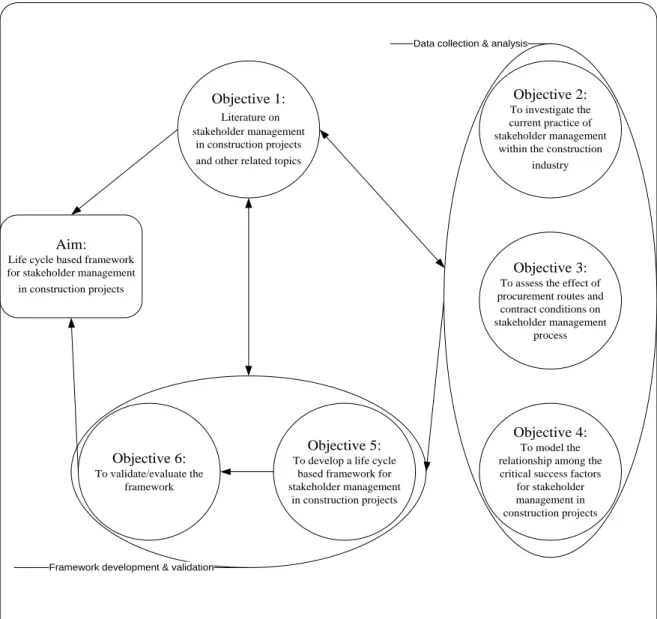
The overall aim of this study is to explore the formulation of a comprehensive framework for stakeholder management in construction projects with demanding stakeholder issues (projects with multiple and diverse stakeholders and interests), which integrates and links the different stages of the project life cycle considering the effects of the procurement route. In pursuing this aim, the following objectives which are related as shown in Figure 1.1 are set:
1. To review previous work on stakeholder management in construction projects. 2. To empirically investigate the current practice of stakeholder management
within the construction industry.
3. To empirically assess the effect of procurement routes and contract conditions on stakeholder management process.
4. To model the relationship among the critical success factors for stakeholder management in construction projects.
5. To develop a comprehensive life cycle based framework for stakeholder management in construction projects.
8
Objective 1: Literature on stakeholder management
in construction projects and other related topics
Objective 4: To model the relationship among the critical success factors
for stakeholder management in construction projects
Objective 3: To assess the effect of procurement routes and
contract conditions on stakeholder management process Objective 2: To investigate the current practice of stakeholder management
within the construction industry
Objective 5: To develop a life cycle
based framework for stakeholder management in construction projects Objective 6: To validate/evaluate the framework Aim:
Life cycle based framework for stakeholder management
in construction projects
Data collection & analysis
Framework development & validation
Figure 1.1 Relationships among the objectives of the study
1.4 Research Methodology
There are different ways to design research to achieve the aim and objectives of any research venture. According to Blaikie (2007), there are two ways to solving research problem(s); either to adopt one approach or explore a combination of appropriate approaches for the research depending on the nature of the problem(s) to be investigated. In other words, research problems can be addressed either by using qualitative, quantitative or mixed methods research design (Creswell, 2009).
Given the complex nature of the issues associated with construction project stakeholder management, it is difficult to adopt a single research strategy towards achieving the aim and objectives of this study. The issues to be addressed in this research are considered
9
complex because they involve different interdependent aspects as shown in Figure 1.1 to be addressed. Moreover, in a complex system, sequences of interaction will normally involve feedback loops, on the long and short terms as well as positive and negative; while the positive feedbacks stimulate or enhance the activities of the system, the negative feedbacks inhibits or restricts the activities of the system (Cilliers, 2005). Similarly, complex systems have the potentials of producing unpredictable and novel outcomes from the interactions that take place between the parts that make them up to be complex (Blaikie, 2007). It is therefore necessary to adopt appropriate strategies as would enable the research objectives to be achieved leading to viable solutions to the research questions.
The methodology adopted to achieve the aim and objectives of this research (see Chapter four for more details) consist of the combination of the following methods: literature reviews, questionnaire survey, framework development and validation/evaluation.
The literature review consists of the following reviews: review of previous studies on construction stakeholder management, review of construction project success and key performance indicators (KPIs), procurement routes, the review of collaborative working in construction and review of literature on research methodology. These reviews were based mainly on secondary documentation and sources of information such as journal papers, conference papers, books; and primary sources of information such as PhD theses. The literature review was used to establish the research gaps and identify critical success factors (CSFs) for stakeholder management in construction projects.
In order to investigate the current practice of stakeholder management in construction, a questionnaire administered to practitioners in the industry within the United Kingdom was used to survey the opinions and experience of respondents regarding the current practice and who should be responsible for leading stakeholder management at the various stages of the construction project life cycle. The respondents were construction professionals with relevant industry experience of at least five years.
The identified critical success factors for stakeholder management in construction were evaluated through the same questionnaire. This was done with the view to ascertaining any causal or interdependent relationship among the critical success factors for stakeholder management in construction projects. The data obtained was analysed using
10
structural equation modelling (SEM) to explore the interrelationships among the CSFs based on their groupings and between them and project success. The same questionnaire was used to explore the influence of procurement routes and contracts type as well as other project characteristics on stakeholder management process.
Based on the results obtained from the above processes (literature review and industry survey), a comprehensive framework for construction projects’ stakeholder management was developed. The framework was developed using integrated definition (IDEF0) process modelling.
To evaluate/validate the framework, a survey was carried out with selected industry practitioners using structured interview and questionnaire. The quantitative and qualitative data collected from the validation interview sessions were analysed using appropriate statistical techniques and thematic analyses respectively.
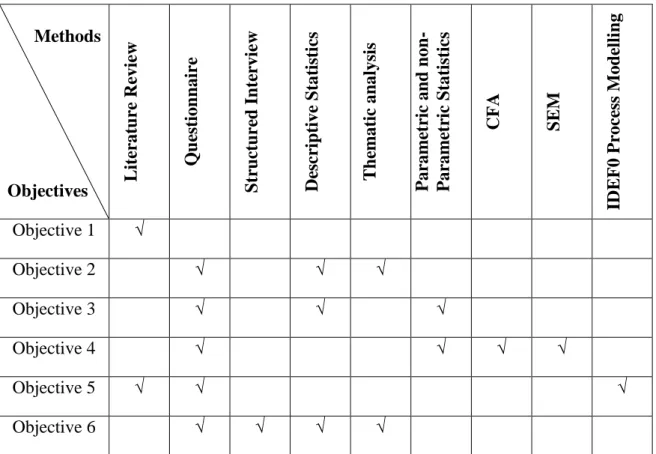
Table 1.1 shows a mapping of the objectives of the study with their corresponding data collection techniques and analysis tools.
Table 1.1 Mapping of objectives with corresponding data collection and analysis Techniques Methods Objectives L ite rat u re R eview Qu estion n aire S tr u cture d In te rvie w De sc rip tive S tat isti cs T h em at ic anal ysis Par ame tr ic and n on -Par ame tr ic Stat istics CFA SE M IDEF0 Pr oc ess Modelli n g Objective 1 √ Objective 2 √ √ √ Objective 3 √ √ √ Objective 4 √ √ √ √ Objective 5 √ √ √ Objective 6 √ √ √ √
11 1.5 Thesis structure
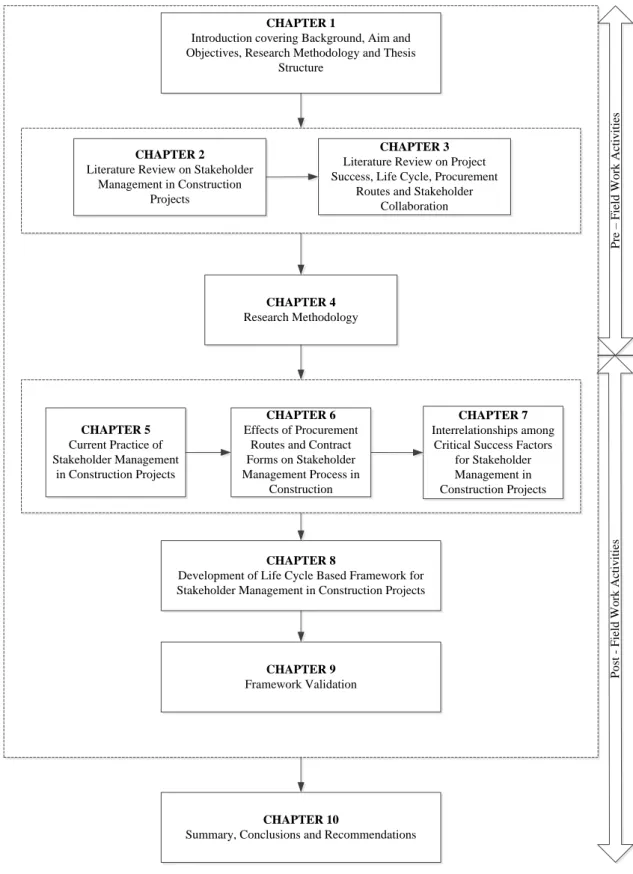
The thesis is presented in ten chapters. This section gives a brief introduction of the chapters in order to outline the chronological flow (Figure 1.2) of the different parts of the thesis.
CHAPTER 2
Literature Review on Stakeholder Management in Construction
Projects
CHAPTER 3 Literature Review on Project Success, Life Cycle, Procurement
Routes and Stakeholder Collaboration
CHAPTER 4 Research Methodology
CHAPTER 7 Interrelationships among
Critical Success Factors for Stakeholder Management in Construction Projects CHAPTER 6
Effects of Procurement Routes and Contract Forms on Stakeholder Management Process in Construction CHAPTER 5 Current Practice of Stakeholder Management in Construction Projects CHAPTER 10
Summary, Conclusions and Recommendations CHAPTER 9
Framework Validation CHAPTER 8
Development of Life Cycle Based Framework for Stakeholder Management in Construction Projects
CHAPTER 1
Introduction covering Background, Aim and Objectives, Research Methodology and Thesis
Structure P re – F ie ld W o rk A ct iv it ie s P o st F ie ld W o rk A ct iv it ie s
12 Chapter One: Introduction
This chapter presents an introduction to the study by giving background to the research topic; research questions; aim and objectives; brief statement of methodology and structure of the thesis.
Chapter Two: Stakeholder management
This chapter presents the findings of a literature review on stakeholder management in construction covering: stakeholder definition; stakeholder classification; need to manage stakeholders in construction projects; critical success factors for successful stakeholder management in construction; and stakeholder management approaches.
Chapter Three: Project success, procurement routes, project life cycle and stakeholder collaboration
This chapter presents a literature review on construction project life cycle, construction project success, construction procurement routes and stakeholder collaboration in construction. It also presents the conceptual models of CSF for stakeholder management in construction identified in chapter 2.
Chapter Four: Research methodology
This chapter discusses the research methodology for this study. It starts by giving a general background and comparison of the concepts guiding research design, explains the main components of the research design model found most suitable and adopted in this study for guiding research design and then presents the research design and methodology adopted for the study reported in this thesis as well as research validity and reliability.
Chapter Five: Current practice of stakeholder management in construction projects
This chapter presents data analysis results obtained in respect of investigation the current practice of stakeholder management in construction projects covering stakeholder management decision, responsibilities, collaboration and techniques. Data obtained from the questionnaire about stakeholder management decisions and responsibilities; change in stakeholder interests/disposition towards the project; stakeholder collaboration; stakeholder dynamics; techniques for stakeholder
13
engagement/management; and general comments of respondents were analysed and presented. Finally, a summary of findings and conclusions drawn from these results are highlighted.
Chapter Six: Effects of procurement routes related characteristics on stakeholder management in construction projects
This chapter presents the results of data analyses in respect of investigating the effects of procurement routes alongside contract forms on stakeholder management in construction projects. Firstly, the extent to which procurement routes related characteristics of stakeholder management can influence stakeholder management process in projects is analysed and presented followed by relationships between client type and procurement routes related characteristics, relationships between contract forms and procurement route related characteristics and effects of forms of contracts on stakeholder management in construction projects.
Chapter Seven: modelling the relationships among CSFs for stakeholder management in construction projects
This chapter addresses the evaluation of the conceptual measurement and structural models of the critical success factors for stakeholder management developed in chapter 3.
Chapter Eight: Development of life cycle based framework for stakeholder management in construction projects
This chapter presents the development of the framework for stakeholder management in construction resulting from this study. The chapter starts with an overview of the framework for stakeholder management followed by framework development approach, features of the framework, IDEF0 process models of framework for stakeholder management and then chapter summary.
Chapter Nine: Framework validation/evaluation
This chapter presents the validation/evaluation of the life cycle based framework for stakeholder management in construction projects presented in chapter 8. It begins with an explanation of the aim and objectives of validating/evaluating the framework followed by an explanation of the methodology adopted for the validation/evaluation.
14
Next is presentation of the analyses of the data collected during the framework validation/evaluation process. Following this, the suggested improvements, barriers to the use of the framework and further development of the framework are presented. The results obtained are then discussed and the chapter summary is presented.
Chapter Ten: Conclusions, Limitations and Recommendations for further research
This chapter summarises the overall research undertaken in pursuing the research aim and evaluates it against the specific research objectives set out. The conclusions reached are then presented and the research limitations are discussed. The Chapter also presents recommendations for practice and further research.
15
2.
CHAPTER TWO: LITERATURE REVIEW ON STAKEHOLDER
MANAGEMENT IN CONSTRUCTION PROJECTS
2.1 Introduction
This chapter presents the findings of a literature review on stakeholder management in construction covering: stakeholder definition; stakeholder classification; need to manage stakeholders in construction projects; critical success factors for successful stakeholder management in construction; and stakeholder management approaches.
2.2 Stakeholders Definition
This section critically reviews different views on the meaning and definitions of “stakeholders” and coins a definition for this study.
In seeking to improve project delivery and success/performance, stakeholder management offers a great opportunity; hence it is an important consideration. However, despite its growing popularity, there is no common definition for “stakeholders” agreed by all researchers. Different authors have defined stakeholders differently, though mostly similar, depending on the nature of their stakes. According to Freeman (1984) stakeholders are any group or individual who can affect or are affected by the achievement of the cooperation’s purpose. He traced this back to a memo of Stanford research institute in 1963, which states that stakeholders are those groups without whose support the organisation will cease to exist. Similarly, Juliano (1995) argued that stakeholders could be an individual, individuals, team or teams affected by the project. Smith, et al. (2001) define stakeholders as representatives, direct and indirect, who may have an interest and can contribute to the proposed project. Awakul and Ogunlana (2002) defined construction project stakeholders in similar vein but they argued, non-governmental organisations, government officials, academics and other interested stakeholders should be added to the list of parties that are likely to be involved in a large construction project. Smith and Love (2004) are of the view that stakeholders are direct and indirect representatives of interests who can make contributions to the proposed project, and may include:
16
Senior managers/executives, facilities managers, project managers,
Staff or employees,
Purchasers, subcontractors, suppliers, and other process or service providers,
Tenants, residents, community representatives, neighbours,
Visitors, customers (potential and future), users, partners, or other interest groups,
Design team members (if appropriate) and
Others, depending on the project and attitude of the organization to participation and involvement in the process.
Olander (2007) defined project’s stakeholders as a person or group of people who has a vested interest in the success of the project and the environment within which the project operates. He further referred to them as, representatives of the various interests that will be affected during the different stages of the construction project from initiation to handover both positively and negatively. Walker et al. (2008) defined stakeholders as individuals or groups who have an interest or some aspect of rights or ownership in the project, and can contribute to or be impacted by, either the work or the outcomes of the project. The PMI (2004) refer to stakeholders as individuals or organisations who are actively involved in the project or whose interests may be affected as a result of the project execution or completion.
Takim (2009) define stakeholders as those who can influence the activities/final results of the project, whose life or environment are positively or negatively affected by the project, and who receive direct and indirect benefits from it. He limited these to five groups namely: client, consultant, contractor, end-users and the community of the project.
Winch (2010) defined it as those actors which will incur or perceive they will incur a direct benefit or loss as a result of the project. Li et al. (2012) defined stakeholders as “those who can influence the project process and/or final results, whose living environments are positively or negatively affected by the project and who receive associated direct and indirect benefits and or losses”.
17
The definitions of (Freeman, 1984; Juliano, 1995; Awakul and Ogunlana, 2002; PMI, 2004; Takim, 2009; Winch, 2010) can be criticized for being broad because they merit everyone at all to be considered as stakeholders on a project. On the other hand, the definitions of (Smith, et al., 2001; Smith and Love (2004); Olander, 2007; Walker et al., 2008) can be criticized for being narrow because they tend to exclude some relevant group of stakeholders. The narrow definition of stakeholders is only useful for identifying those stakeholders with direct stakes and economic relationships with the project and excludes those without direct economic relationships but may be capable of influencing the project implementation process (Leung and Olomolaiye, 2010). This means that relying on the broad definitions alone for identifying project stakeholders will lead to including those who do not really have any stake in the project and relying on the narrow definitions alone will also lead to the exclusion of some important stakeholders both of which situations can be dangerous to the smooth running of the project. With both views having their strengths and weaknesses, it is important for this study to adopt a definition that will guide further considerations of who stakeholders are. The following definition is therefore coined:
“Construction project stakeholders are individuals or groups/organisations who have some aspects of right or ownership in the project and can contribute to it; or will incur or justifiably perceive they will incur a direct benefit or loss as a result of either the works during the project or the outcome of the project.”
This definition combines the features of both the narrow and broad definitions of stakeholders. The next section discusses the different classification of stakeholders.
2.3 Stakeholders’ Classification
This section discusses different stakeholders’ classifications according to their possession of certain attributes, contractual relationships with the project and with each another and attitudes towards the project; these are discussed in the following sub sections:
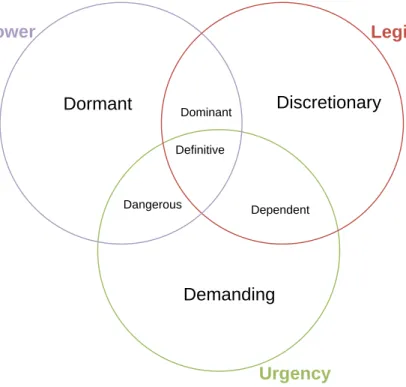
2.3.1 Classification according to Stakeholders’ attributes (Power, Legitimacy, Proximity and Urgency)
Stakeholders possess certain attributes that determine their relationship and ability to make claims and impose their will on the project. These are power, legitimacy,