This item was submitted to Loughborough’s Institutional Repository
(
https://dspace.lboro.ac.uk/
) by the author and is made available under the
following Creative Commons Licence conditions.
For the full text of this licence, please go to:
978-1-4244-1970-8/08/$25.00 ©2008 IEEE October 22 – 25, 2008, Saratoga Springs, NY
Towards Constructivist Laboratory Education: Case
Study for Process Control Laboratory
Mahmoud Abdulwahed and Zoltan K Nagy
Loughborough University, [email protected], [email protected] Abstract - Laboratory education is an integrated part of
engineering and science degrees. Many research papers refer to poor constructivist learning during the laboratory sessions, indicating the need for reforming the laboratory education in a way that facilitates constructivist learning as well as conceptual understanding. In this paper we present a model of conducting laboratories, based on the well known Kolb’s experiential learning cycle, implemented with recent available technologies, and applied to an undergraduate process control lab. There are four main stages in Kolb’s model, namely: concrete experience, reflective observation, abstract conceptualization, and active experimentation. To implement these stages, the hands-on lab is chands-onducted in chands-onjunctihands-on with supplemental activities such as experiments performed in the classroom remotely through the internet, using virtual lab and preparation sessions, and conducting pre and post lab tests. The paper presents how the supplemental activities are mapped with Kolb’s cycle to promote the constructivist laboratory education. The quantitative analysis showed reasonable enhancement of learning outcomes of the experimental groups compared with the control group. The paper presents a novel model of conducting experiential education based on well known pedagogical approach facilitated with recent information and communication technology (ICT) developments. Index Terms – Laboratory engineering education, remote and virtual laboratories, Kolb’s experiential learning.
INTRODUCTION
The importance of laboratory experience in engineering education curricula has been emphasized in a large number of science and engineering education articles [1]-[5]. The essential role of laboratories can be correlated with the fact that engineering is, in general, an applied science that requires very good hands-on skills and involves elements of design, problem solving, and analytical thinking. Well designed laboratories during undergraduate engineering degrees can improve these skills of the future engineers.
Engineering started as a result of the accumulation of hands-on experiences. It had been taught as a pure hands-on subject up to the 18th century. However, engineering education has benefited from the advances in science and it began to embed deeper theoretical concepts by the end of the 19th century, especially in the US schools initially [3]. Since
then, the pedagogical emphasis in engineering education has been shifted more towards classroom and lecture based education, and gradually less attention has been given to the laboratory education, particularly during the last 30 years [2], [6], [7]. Wankat [8] observed that only 6% of the articles published in the Journal of Engineering Education from 1993-2002 had ‘Laboratory’ as a keyword. Laboratory pedagogy has been recently reported to be a fertile arena of research for the coming years [2], [3], especially in the context of the increasing need to make more use of the new developments in information and communication technology (ICT) for enhancing the laboratory education.
The impact of laboratory education on student learning is often not recognized [9]. One reason for rethinking the role of the laboratory in engineering and science education is the recent shift towards constructivist pedagogy, which embraces the philosophy of considering the essential role of experience in knowledge construction, and places a more important role on student autonomy in the learning process. One important contribution of laboratory education in the engineering curricula is ‘enjoyment’ as a motivating factor for students, which has been reported in many studies during the last few decades [2]. This is in particularly important in the view of the recent increase in the industrial need for engineering graduates and the continuous drop in student numbers taking engineering and science fields as their career option. Enhancing laboratory education can serve on one hand as a motivating factor toward engineering career but on the other hand is the main mean of developing the transferable skills required for engineering graduates.
KOLB’S EXPERIENTIAL LEARNING MODEL
Kolb has introduced his theory on experiential learning in more than 20 years ago [10]. His experiential learning model has been well accepted as an efficient pedagogical model of learning [11] (e.g. Google scholar will indicate 6568 citation [12] of Kolb’s book on experiential learning theory [10]).
Kolb’s experiential learning theory can be classified under the constructivist pedagogy paradigm, the two being strongly linked. The constructivist pedagogy can be considered as a pedagogical framework rather than a theory [13], whereas the experiential learning theory provides more clear mechanisms of teaching and learning design, which are strongly underlined with the constructivist view on the way people construct their knowledge. In our opinion, experiential learning is nothing else but a more well-defined form of constructivist pedagogy. Experiential learning
978-1-4244-1970-8/08/$25.00 ©2008 IEEE October 22 – 25, 2008, Saratoga Springs, NY
theory emphasizes the role of experience in learning and the importance of developing links between classroom practices and the real world [10]. Similarly, constructivist pedagogy promotes the importance of authentic learning [14].
In his book “Experiential Learning, Experience as the Source of Learning and Development” [10], Kolb introduced the basis of a holistic approach for learning, which integrates experience, perception, cognition, and behavior in the learning process. He called this concept Experiential Learning Theory. Kolb suggested that effective learners should have four types of abilities:
• Concrete Experience Ability (CE);
• Reflective Observation Ability (RO);
• Abstract Conceptualization Ability (AC);
• Active Experimentation Ability (AE).
Hence, the optimal learning takes place when learners have adequate balance of these four characters. They must be able to immerse in new experiences (CE), they should have reflective skills and multiple views of observation (RO), they must be able to conceptualize the observations and the experiences by integrating them into theories (AC), and finally they must be able to use these theories for making decisions and solving problems (AE).
Kolb defines learning as the process whereby knowledge is created through transformation of experience through the aforementioned four stages [10]. According to Kolb, learning requires that individuals first should detect, depict, or grasp knowledge, and then a phase of construction should take place to complete the learning process. This construction is a transformation of the grasped knowledge into mental model through experiencing this knowledge. Kolb proposed that the optimal learning would pass through a cycle of the Concrete Experience, Reflective Observation, Abstract Conceptualization, and Active Experimentation. It is not necessary that these stages occur in the mentioned sequence, but involvement of the four stages is important. The combination of the previous four stages is called Kolb cycle of experiential learning and is shown schematically in Figure 1.
The vertical axis represents the knowledge grasping dimension, or prehension dimension, by which knowledge can be grasped through Apprehension (the concrete experience extreme) or by Comprehension (the abstract conceptualization extreme), or by mix of both. The horizontal axis represents the knowledge transformation or knowledge construction dimension. The construction can be done via Intention (the reflective observation extreme), or via Extension (Active Experimentation). Kolb hypothesis of the two dimensional nature of knowledge building, the prehension dimension and the transformation dimension, was drawn from convergent evidences from philosophy, psychology, and physiology. Previous to this hypothesis, literature used not to distinguish between grasping and transformation, combining them in one axis. Kolb’s model distinguishes apprehension and comprehension as independent modes of grasping knowledge and intention and
extension as independent modes of transforming experience. Furthermore he states that the four modes are adequately important in contributing for the learning process, which is in disagreement with Piaget’s seeing that comprehension and intension are superior processes [10]. In thoughtful look at the current traditional teaching methods in higher education, especially in Europe, one can easily realize that in most cases Piaget’s model of comprehension-intention superiority is followed. These ‘traditional’ teaching methods emphasize much more on theory taught in classical classroom settings and on reflection on this theory by written exams. In contrast, Kolb’s experiential learning theory have strong implication on allowing balanced room for each mode, apprehension, comprehension, intention, and extension in the learning process. Hybrid combination of these elementary modes in the learning process produces higher level of learning.
During the laboratory session, students are mainly involved in the “Active Experimentation” stage of Kolb’s cycle, because the emphasis is on doing the experiment. However, learning something from the experiment, or in other words, the transformation phase for constructing new knowledge through the experimentation, requires first the information to be grasped or depicted.
Proposition 1:We think that, poor learning outcome of the laboratory session is mainly due to weak activation of the prehension dimension before coming to the lab, hence the lab session turns into algorithmic and procedural following of the lab manual instead of actively constructing meaningful knowledge out of it.
To test this assumption, we designed a pedagogical experimental procedure and applied it in the second year process control laboratory for chemical engineering students at Loughborough University, United Kingdom.
CASE STUDY:THE PROCESS CONTROL LAB
The process control lab is part of the second year Instrumentation, Control and Industrial Practice module at the Chemical Engineering Department at Loughborough
Abstract Conceptualization Concrete Experience Reflection Observation Active Experimentation FIGURE 1 KOLB’S LEARNING CYCLE.
978-1-4244-1970-8/08/$25.00 ©2008 IEEE October 22 – 25, 2008, Saratoga Springs, NY
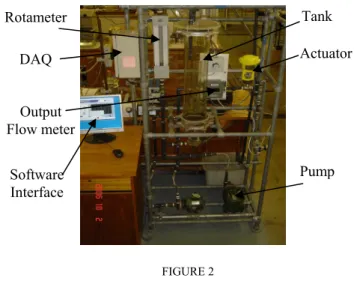
FIGURE 2 PROCESS CONTROL TEST RIG.
Tank Actuator Output Flow meter Rotameter Pump Software Interface DAQ University. The experimental rig for the hands-on process
control lab was designed as a surge tank system. Figure 2 shows a picture of one of the six hands-on experimental rigs. The laboratory is a compulsory part of the module designed for undergraduate engineering master (MEng), bachelor (BEng), and bachelor in science (BSc) programmes in chemical engineering at Loughborough University. The lab aims to introduce students to the principles of control engineering, such as the main components and instruments of a feedback loop, the concept of open-loop control, feedback control, proportional-integral-derivative (PID) control, and PID controller tuning. Educational software was also designed that represents a virtual version of the laboratory. The Process Control Virtual Laboratory allows students to perform all experiments in a simulation mode using an interface identical with the real operator interface in the lab. A remotely operated version of the lab was also developed and used in the classroom to illustrate the theoretical concepts on real-life experiments. The software allows remote operation and provides real-time video transmission for creating the feeling of ‘telepresence’. Software and hardware was based on National Instrument LabView (version 8.0) and NI USB-6000 series USB data acquisition (DAQ) device. The additional two modes of the laboratory operation (virtual and remote) were developed for supporting constructivist learning in conjunction with the hands-on experience from the lab. The developed educational software, the Process Control Virtual Laboratory, can be downloaded from http://www-staff.lboro.ac.uk/~cgzkn/).
The hands-on laboratory consists of two 3 hours sessions, scheduled for two consequent weeks. In the first week the students are introduced into the elements of typical feedback loops such as sensors, actuators, controller, and process. The main objectives of the first session are:
• Calibration and hysteresis of the level sensor;
• Calibration, hysteresis, installed characteristics and relative resistance of the control valve.
During the second week, students are introduced into control engineering concepts. The aims of the experiments in the second week are to help students appreciating the advantages of automatic control compared to manual operation, and to equip the students with qualitative evaluation of the differences among proportional (P), proportional-integral (PI), and proportional-integral-derivative (PID) controllers. In general, all students were asked to prepare for the lab by reading the lab manual before the session and by downloading the virtual laboratory software. It was expected that few will respond voluntarily to this request. Hence, we designed a pedagogical experimental procedure to test Proposition 1.
PEDAGOGICAL EXPERIMENTATION
The number of students registered for the class was about 70. In the lab 6 experimental rigs were used, with students
working in groups of 2 or 3 at each rig. Students were divided into four session groups, each of which consisted of 16-18 students. Each group used the rig for 2 consecutive weeks to complete the experiments. The lab teaching spreads over 8 weeks from the academic week 2 until the academic week 9 of the first semester. In week one an introductory lecture was organized in a classroom to all students when the experiment was described. In this session the laboratory was “brought into the classroom” by using the remote laboratory module. A pre lab preparation session was also organized during which students came to the computer room and worked on the virtual laboratory software following the procedure form lab manual working in group under basic supervision.
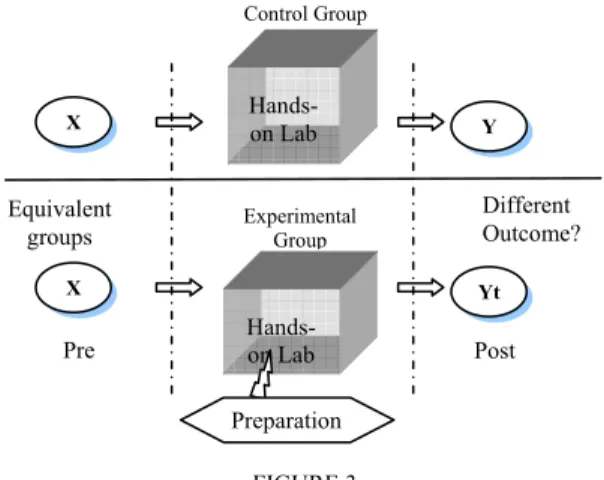
This procedure was applied to session Groups 3 and 4, whereas Groups 1 and 2 had no treatment. To guarantee equivalence as much as possible among the four groups, students were distributed evenly based on their GPA in the previous academic year. The average GPA of each group is about 63%. There have been 8-10 students each time who responded to our request of attending the preparation session. Groups 1 and 2 formed the control group, whereas the students from Groups 3 and 4 who responded to our request in attending the preparation session were considered the experimental group. Figure 3 illustrates the methodology used for the pedagogical experiment, with X representing the equivalent groups (control and experimental before treatment) and Y and Yt the results from the control and the experimental groups after treatment, respectively. The treatment is the preparation session using the virtual lab. For the evaluation of the statistically significant difference between the control and the experimental group in response to the treatment the null hypothesis was used [15]. For accepting or rejecting the null hypothesis, the Mann-Whitney
non parametric test [15] was used. According to this approach the null hypothesis is accepted (meaning that there is statistically significant difference between the data) if the significance value of the test is less than 0.05.
978-1-4244-1970-8/08/$25.00 ©2008 IEEE October 22 – 25, 2008, Saratoga Springs, NY X X Hands-on Lab Hands-on Lab Preparation Pre Post Experimental Group Equivalent groups FIGURE 3
CONCEPTUAL MODEL OF THE EXPERIMENTAL METHODOLOGY. Different Outcome? Control Group Y Yt TABLE I PRE-LAB TEST RESULTS* Question Exact Significance (Mann-Whitney U test) Means % (Experimental / Control) Q1 Q2 Sum Q3 to Q7 0.002 0.002 0.166 73.89 / 40.00 55.28 / 21.67 72.33 / 58.23
* Number of samples (Experimental/Control) is 18/30.
TABLE II POST-LAB TEST RESULTS* Question Exact Significance (Mann-Whitney U test) Means % (Experimental / Control) Q1 Q2 Q7 Q8 Sum Q3 to Q10 Sum Q1 to Q10 0.302 0.025 0.034 0.026 0.124 0.031 90.56 / 72.81 76.67 / 59.22 64.72 / 39.53 65.83 / 37.97 50.10 / 39.06 56.86 / 44.45
* Number of samples (Experimental/Control) is 18/32
Testing the activation of the Prehension Dimension:
For evaluating whether the virtual lab preparatory session helped activating the prehension dimension in Kolb’s experiential learning cycle, a pre lab test was to designed which was completed just before starting the hands-on session. Some of the questions aimed to test the students overall grasp of information needed to progress in the hands-on lab sessihands-on.
Questions Q1 and Q2 of the pre lab test of Week I are strongly related to the hands-on laboratory session. In these questions, students were asked to develop an experimental procedure that they will follow for calibrating and deriving the characteristics of the level sensor of the tank, and the control valve that controls the outflow rate of the tank. Questions Q3-Q7 were mainly designed to test relevant general knowledge of the students that they may have gathered through the lecture theory, through the remote lab demonstration that was conducted in the first lecture, or through reading the lab manual. The results of the evaluation of the pre lab test are shown in Table I. Using the Mann-Whitney test, the exact significance value of Q1 and Q2
were smaller than 0.05 indicating that the null hypothesis can be rejected, hence there is indeed strong statistical evidence that exposing the students to preparatory session using the virtual laboratory has lead overall to enhanced grasp of the information needed for performing in the lab. This demonstrates that a better activation of the prehension dimension has occurred due to the virtual lab preparatory session. The lower mean of the control group students is related to the fact that those students never or poorly prepared for the lab. The poor preparation may be because they have only read the manual and have not experienced the procedure with the virtual lab. The simulated process does not have the hysteresis feature of the control valve built in. This may have generated the lower mean for question Q2 for the experimental group. The realism factor in calibrating the level sensor is higher, which can explain the larger average score for Q1. These experiments have showed that students of the experimental group have better activation of the prehension dimension of Kolb’s cycle. Experiments were designed to evaluate whether this has lead to better learning outcome (more in depth learning) in the laboratory session to verify the hypothesis in Proposition 1.
Table II shows the results with the analysis of the post lab test. In question Q1 from the post lab test from week one, we asked the students to create a qualitative plot of the characteristics curve of the level sensor, based one their observations and the data they have collected during the experiment. The level sensor characteristics is simple linear with no hysteresis. The students’ answers were adequate for both the experimental and the control groups. The exact significance value for Q1 is 0.302 which is larger than the threshold of 0.05, indicating that there is no significant difference between the control and the experimental groups. In question Q2, students were asked to plot the control valve characteristic, which is nonlinear and shows hysteresis. A significantly larger portion (more than double) of the students from the experimental group observed these features (which requires more in depth ability) than from the control group. The statistical significance value of Q2 is 0.025. This value is smaller than the threshold of 0.05 indicating a high probability (97.5%) that the higher score is not by chance, hence the null hypothesis can be rejected. Questions 7 and 8 were purely conceptual, testing the students understanding of open and closed loop systems. Students from the experimental group performed overall much better in these questions than students from the control group (see Table II). These results provide evidence hat
students who had better activation of the prehension dimension prior to the lab session have had more in depth learning during the hands-on lab session. In other words, the transformation of knowledge through the lab experience into mental theoretical models has been more successful for students who worked on improving their prehension dimension.
Note that the simulation of the control valve in the virtual lab is not identical to the real behavior of the physical control valve in the test rig. The simulated control valve has
978-1-4244-1970-8/08/$25.00 ©2008 IEEE October 22 – 25, 2008, Saratoga Springs, NY
a linear characteristics and no hysteresis, hence these features were not observed by the students from the experimental group in the preparation session. Nevertheless, they showed better ability of detecting these characters than the control group students. The statistical test of the in depth question from the post lab test from week two, has also revealed acceptable significance for rejecting the null hypothesis (exact significance was 0.013 < 0.05). This also indicates that constructivist learning in the hands-on lab session (which corresponds to AE stage of the Kolb’s cycle) can be improved by more activation of the other stages of the Kolb’s cycle. We also noticed a different behavior during the laboratory in the case of the experimental group students compared to the control group students. The former showed more interest in the hands-on lab session and insisted more on answering the pre and post lab tests compared to the control group students.
AN IMPLEMENTATION APPROACH OF KOLB’S CYCLE FOR LABORATORY EDUCATION
During the introductory lecture of the Instrumentation and Control module, students were introduced to the lab using a PowerPoint presentation. During this session the lab was also operated remotely in the classroom with the aim of providing the realism feeling (telepresence) to students. The aim was to implement the CE of the Kolb’s cycle. At the end of the semester in the module questionnaires students were asked whether this has stimulated their interest in the lab. A significant portion, 80.6%, of the students answered ‘Yes’. One of the lectures of the course was devoted to PID control. In this lecture the theoretical background of the PID control approach was explained and the main features of the control algorithm were illustrated by using the remote lab in the classroom. Again, a significant potion of students, 78.1%, found this combination useful in understanding the theory more, hence enhanced the AC part of the Kolb’s cycle. In the design of the pre lab test, the contextualizing factor as well as the reflective factor were provided in a way that they highlighted the important issues of the laboratory session. The post lab test gave students a chance to reflect over their experience in the lab session. Students were asked questions which helped implementing a meaningful model of the knowledge in their memory, based on the lab session experience. In their response to our survey, the students found the pre and post lab tests very useful.
According to Kolb, constructivist learning occurs in a cyclic spiral way. The optimal learning happens when all four phases of the learning cycle are activated. As the first cycle ends by transferring knowledge into mental (or theoretical) model through experience, a further higher order cycle can be started for constructing higher order knowledge, and so on. Therefore, it is an important objective of engineering education, in particular, laboratory education to motivate students towards further higher levels of learning. In the last lecture of the course, we surveyed the students’ opinions about the lab. One of the questions in the questionnaire was: “Would you like the idea of conducting
post lab real experimentation through the Internet (i.e. from your home PC) after the lab for enhancing your report or testing further ideas?”. The possible answers were on a marked scale from 1 (not at all) to 6 (very much). The responses of the two groups differed considerably. The average of the control group is 4.19/6 while the average of the experimental group is 5.27/6. The Mann-Whitney non parametric test gives the exact significant value of 0.027, which is smaller than 0.05 hence the null hypothesis can be rejected. This demonstrates again that the preparation session using the virtual lab has a statistically significant impact on motivating students towards further inquiry and experimentation; therefore providing a better constructivist experience for laboratory education.
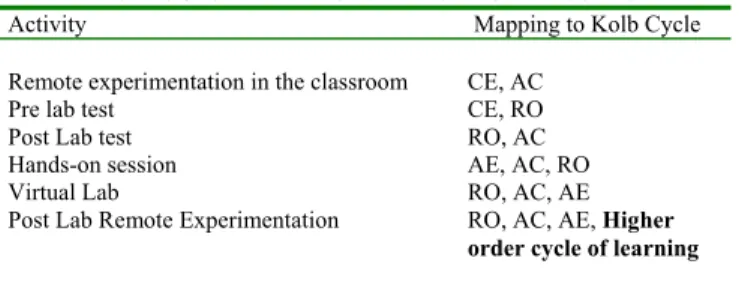
Poor outcome of laboratory education can be correlated with the fact of poor balance of the other stages of Kolb’s experiential learning cycle. The results of the pedagogical experimentation showed in this section, indicate that modifications can be introduced to the methodology according to which classical hands-on laboratories are taught. These modifications with the aim to enhance constructivist learning are suggested in the context of Kolb’s experiential learning cycle and are implemented using recent advances in information and communication technologies (ICT). The mapping of the different elements of the laboratory education system to Kolb’s cycle is proposed in Table III.
TABLE III
KOLB’S CYCLE MAPPING FOR LABORATORY EDUCATION
Activity Mapping to Kolb Cycle
Remote experimentation in the classroom Pre lab test
Post Lab test Hands-on session Virtual Lab
Post Lab Remote Experimentation
CE, AC CE, RO RO, AC AE, AC, RO RO, AC, AE RO, AC, AE, Higher order cycle of learning
TOWARDS CONSTRUCTIVIST LABORATORY MODEL As a novel constructivist laboratory model we propose the implementation and use of the three modes of laboratory education, (i) hands-on lab, (ii) virtual and (iii) remote lab in combination. Blending the three modes in the framework of an effective pedagogical model, such as Kolb’s model, significantly improves the students’ meaningful learning as well as their motivation towards engineering career. The preparatory sessions enhance the prehension dimension of the students’ learning cycle. The use of the virtual lab emphasizes this enhancement and provides superior performance compared to preparation from the manual only. Class stimulation and pre lab tests can contextualize the students’ learning during the lab and allow them to concentrate on the main laboratory objectives. The post lab test provides a chance for students to reflect on their
978-1-4244-1970-8/08/$25.00 ©2008 IEEE October 22 – 25, 2008, Saratoga Springs, NY
experience in the lab session and to construct meaningful models out of this experience. Remote lab can facilitate students’ higher order cyclic learning by giving them the chance to go beyond the objectives of the hands-on session and test further hypotheses. The schematic representation of the new model of constructivist laboratory education based on the combination of the three modes (hands-on, virtual and remote), the so-called TriLab concept, in conjunction with pre and post lab preparation sessions, tests and assignments, in the context of Kolb’s cycle, is illustrated in Figure 4.
CONCLUSIONS
In this work, the learning outcomes of the laboratory session are corroborated in the context of well known pedagogical theory, Kolb’s experiential learning cycle. A proposition is introduced in which we consider that the often poor learning outcome of the laboratory session is mainly due to weak activation of the prehension dimension of the learning cycle, before coming to the lab. The pedagogical experiments based on combined application of pre and post lab tests and the TriLab concept (application of combination of hands-on, virtual and remote experiments) have provided statistical evidence of the proposition. The results demonstrate that designing engineering laboratory education based on well-developed pedagogical theory can lead to better learning outcomes. Based on the pedagogical experiments, a novel model of laboratory education was introduced that has its pedagogical background in the experiential learning theory of Kolb. An algorithm of implementing Kolb’s cycle utilizing virtual and remote modes of the hands-on lab, as well as, by introducing additional lab activities has been proposed.
ACKNOWLEDGMENT
Financial support by the Engineering Center of Excellence in Teaching and Learning (engCETL), Loughborough
University, UK, and by The Higher Education Academy, Engineering Subject Centre, UK, mini-project is gratefully acknowledged.
REFERENCES
[1] Johnstone, A, H, Al-Shuaili, A, “Learning in the laboratory; some thoughts from the literature”, University Chemistry Education, 5, 2001, pp. 42-51.
[2] Hofstein, A, Lunetta, V, N, “The laboratory in science education: Foundations for the twenty-first century”, Science education, 88, No 1, 2004, pp. 28-54,
[3] Feisel, L D, Rosa, A, J, “The role of the laboratory in undergraduate engineering education”, J. Eng. Educ., 94, No 1, 2005, pp. 121-130. [4] Kirschner, P, A, “The laboratory in Higher Science Education,
Problems, Premises, and Objectives”, Higher Education, 17, No 1, 1988, pp. 81-90.
[5] Ma, J, Nickerson, J, V, “Hands-on, simulated, and remote laboratories: A comparative literature review”, ACM Comput. Surv. 38, No 3, 2006, pp. 1-24.
[6] Hofstein, A, Lunetta, V, N, “The role of the laboratory in science teaching: Neglected aspects of research”, Review of Educational Research, 52, No 2, 1982, pp. 201-217.
[7] Feisel, L, D, Peterson, G, D, “A Colloquy on learning objectives for engineering education laboratories”, In Proceedings of ASEE Annual Conference & Exposition: Vive L'ingenieur!, Montreal, Canada, 2002. [8] Wankat, P, C, “Analysis of the first ten years of the Journal of
Engineering Education”, J. of Eng. Educ., 93, No 1, 2004, pp. 13-21. [9] Roth, W, M, “Experimenting in a constructivist high school physics
laboratory”, J. of Res. in Sci. Teach., 31, No 2, 1994, pp. 197-223. [10] Kolb, D, A, “Experiential learning: experience as the source of
learning and development”, Prentice-Hall, 1984.
[11] Tennant, M, “Psychology and adult learning”, Second Edition. London, Routledge, 1997.
[12] http://scholar.google.com/scholar?q=KOLB+1984&hl=en&lr=&btnG =Search, retrieved on 21.03.2008.
[13] Richardson, V, “Constructivist Pedagogy”, The Teachers College Record, 105, No 9, 2003, pp. 1623-1640.
[14] Doolittle, P, “Constructivism and online education” in Proc. of the Int. Conf. on Teaching Online in Higher Educ., Fort Wayne, USA, 1999. [15] Conover, W, J, “Practical Nonparametric Statistics”, 3rd ed. John
Wiley, 1998.
AUTHOR INFORMATION
Mahmoud Abdulwahed, Engineering education researcher, Engineering Center of Excellence in Teaching and Learning and the Chemical Engineering Department, Loughborough University, United Kingdom, [email protected].
Zoltan K Nagy, Senior lecturer, member IEEE, Chemical Engineering Department, Loughborough University, United Kingdom, [email protected].
Hands-on Lab
Remote Lab
Post-Lab test Class Stimulation
Pre Lab Session (Virtual Lab)
Pre-Lab test
AE, AC, RO CE, RO, AC
FIGURE 4
ABDULWAHED-NAGY CONSTRUCTIVIST LABORATORY
EDUCATION MODEL AND TRILAB CONCPET.
Higher order learning with AE,AC, RO