This work is protected by copyright and other intellectual property rights and
duplication or sale of all or part is not permitted, except that material may be
duplicated by you for research, private study, criticism/review or educational
purposes. Electronic or print copies are for your own personal,
non-commercial use and shall not be passed to any other individual. No quotation
may be published without proper acknowledgement. For any other use, or to
quote extensively from the work, permission must be obtained from the
Teaching decision-making and
professional ethics for pharmacy
practice: a mixed methods study
Maria Donna Allinson
Thesis submitted to Keele University for the partial fulfilment of
the degree of Doctor of Pharmacy
ii
Abstract
Little has been published on whether or not ethics teaching during undergraduate study effectively prepares pharmacy students for dealing with dilemmas in future practice. The aim of this study was to explore the user’s perspectives on the effectiveness of Values Exchange (Vx), an online decision-transparency tool, in facilitating pharmacy students’ learning and development in professional ethics and decision-making, and its potential use by pharmacy graduates.
A mixed methods approach was employed. A profession-specific test (the PEP test) measuring moral reasoning was applied for the first time in the UK to provide a measure of principled thinking across 4 cohorts of Pharmacy students and alumni. Descriptive and inferential statistics were applied to the data. In addition, semi-structured interviews were undertaken with 9 pre-registration trainees (PRTs) and 9 early career pharmacists
(ECPhs) to ascertain their experiences of ethical dilemmas in practice and views on Vx.
It is clear from the findings of this study that Vx was perceived by the interviewees as a valuable tool for undergraduates in the development of ethical and professional decision-making skills. Consideration should also be given to the incorporation of Vx into
postgraduate teaching and policy. Its use in professional practice was perceived as limited.
Although Vx appears to help MPharm students prepare for facing ethical dilemmas in practice, real world experience is also necessary. Interviewees continued to learn during their pre-registration year and early practice through interactions with their pre-registration tutors and other pharmacists and staff, and by supporting each other via social media networks. Positive role models were valued, but participants also learned how not to behave through working with negative role models. Findings also suggest a need for
iii
further training of pre-registration tutors to improve support for PRTs, as well as more widespread adoption of peer supervision.
This study was unique since no previous research has explored the impact of long-term use of Vx during undergraduate education on practice, or considered the potential longer-term impact on practice of having used this tool. In addition, this study is the first to use the PEP test outside Australia.
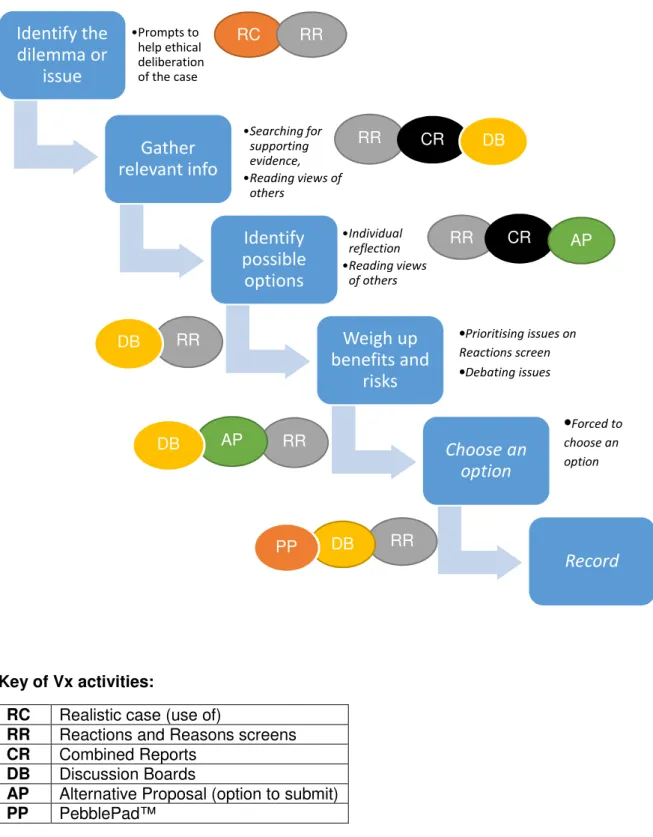
The study is also unique in that it has provided a pedagogical underpinning for Vx which has been mapped to Vx activities and to the Royal Pharmaceutical Society’s Exercising professional judgement model of decision-making. This output provides, therefore, both theoretical pedagogical reasons and also data-driven evidence to support the use of Vx as a teaching tool to help MPharm students develop the skills to make professional decisions in practice.
iv
Acknowledgements
This has often felt like a long and tortuous journey and one that, at times, I did not think I would complete. The fact that I have completed it is due to the help and encouragement of many people.
First of all I must send huge thanks to Professor Patricia Black, my long suffering supervisor, for whom I have delayed a fully enjoyable ‘non-retirement’ as she kindly continued to support and encourage me right to the end – for this I am eternally grateful. Thank you Pat. My sincere thanks also goes to Dr Simon White who stepped in for the last year as my second supervisor, and offered me so much advice and guidance- my reflexivity guru. As my line manager, I’m also grateful to Simon for enabling me to ‘free up’ my time so I could focus on my writing. I’d also like to thank those I call my ‘pseudo-supervisors’, Dr Judy Rees and Dr Alison Gifford who freely gave up their time to share their expertise. I really do appreciate the time and effort you have gone to.
Importantly, I must thank my past students who completed questionnaires, and particular thanks must go to my interviewees who trusted me with their experiences, hopes and fears in practice- I have tried my utmost to tell your story as you presented it to me. Words of thanks must also go to my brilliant team- thank you so much for all the hugs and words of encouragement to keep me going, and especially for not letting me feel guilty about going to all those writing retreats- you have all been stars!
My final thanks must go to Abi, Aisha and Ciaran. Thank you for putting up with my books all over the dining room, and my endless weekends in the library to write my thesis. I know for a fact that I would not have completed this journey without your enduring love and support- I love you all so much, thank you.
v
Publications and conference proceedings
Allinson MD and Black P. (2018) Students views of an online decision-support tool,
Currents in Pharmacy Teaching and Learning, 10(2), pp. 226-230.
Allinson M. (2017) Impact of undergraduate use of an online professional decision-making tool on pre-registration and early careers practice. Paper presented to International
Pharmaceutical Federation (FIP) conference, Seoul, South Korea (oral presentation).
Allinson M and Black P. (2017) An exploratory study of ethical dilemmas faced by alumni from one school of pharmacy. International Journal of Pharmacy Practice Vol 25 (Suppl 1) pp 26-27
Allinson M and Black P. (2016) Developing moral reasoning skills for pharmacy practice.
International Journal of Pharmacy Practice Vol 24 (Suppl 2) pp 4-5
Publication arising:
Allinson MD, Black P and White S.Transition from undergraduate education to early careers practice: preparedness for dealing with ethical and professional dilemmas in practice. Conference abstract. HSRPP 2019.
vi
TABLE OF CONTENTS
ABSTRACT ... II ACKNOWLEDGEMENTS ... IV PUBLICATIONS AND CONFERENCE PROCEEDINGS ... V LIST OF TABLES ... X LIST OF FIGURES ... X ABBREVIATIONS ... XII PREFACE ... XIV
OVERVIEW OF THESIS ... XIV MY PERSONAL JOURNEY ... XVIII
My professional career to date ... xviii
The challenge - a professional doctorate and the need for a reflexive approach ... xix
Why professional ethics and Values Exchange™? ... xxii
My personal ethical stance ... xxv
CHAPTER 1: INTRODUCTION ... 1
1.1. AN OVERVIEW OF ETHICS ... 1
1.1.1. Definitions and terminology ... 2
1.1.2. Ethical theories ... 3
1.2.MORAL PSYCHOLOGY ... 6
1.2.1. Cognitive Moral Development theory ... 6
1.2.2. The Four Component Model of Morality ... 10
1.2.3. Measuring moral reasoning: The Defining Issues Test (DIT) ... 11
1.2.4. Using DIT to measure moral reasoning in the educational setting ... 13
1.3.PROFESSIONAL ETHICS ... 18
1.3.1. The professional decision-making process ... 19
1.3.2. Ethical challenges in healthcare ... 23
1.3.3. Research on ethics in Pharmacy practice: Search strategy ... 27
1.3.4. Research pre-2000- quantitative research ... 28
1.3.5. Research from 2000 onwards – the move to qualitative research ... 31
1.3.6. Codes of ethics ... 39
1.4.TEACHING ETHICS ... 42
1.4.1. Recent history of ethics teaching for medical and pharmacy students in the UK .... 43
1.4.2. Methods of teaching ethics ... 45
1.4.3. Scoping exercise ... 47
1.4.4. Teaching ethics at Keele University School of Pharmacy ... 48
1.4.5. Values and Values-based Decision Making (VDM): The importance of values ... 49
1.5.SUMMARY OF CHAPTER 1 ... 51
CHAPTER 2: VALUES EXCHANGE™ ... 53
2.1.USING VALUES EXCHANGE™ TO TEACH ETHICS AT KEELE UNIVERSITY SCHOOL OF PHARMACY ... 53
vii
2.2.THE PEDAGOGY UNDERPINNING VX ... 56
2.2.1. Kolb’s learning cycle ... 57
2.2.2. Deep versus surface learning... 58
2.2.3. Bloom’s taxonomy ... 59
2.2.4. Deliberating on cases ... 60
2.2.5. Constructivism ... 61
2.2.6. Mapping pedagogical theory to Vx activity and RPS guidance ... 63
2.3.EVIDENCE SUPPORTING VALUES EXCHANGE™ ... 66
CHAPTER 3: RATIONALE, AIM AND OBJECTIVES OF STUDY ... 74
3.1.RATIONALE FOR STUDY ... 74
3.2.AIM AND OBJECTIVES ... 76
CHAPTER 4: METHODOLOGY ... 77
4.1.UNDERPINNING ASSUMPTIONS IN THE STUDY ... 77
4.2.QUALITY OF MY RESEARCH ... 85
4.3.ETHICAL APPROVAL... 88
CHAPTER 5: MEASURING MORAL REASONING ... 90
5.1.METHOD ... 90
5.1.1. Choosing a data collection tool ... 91
5.1.2. The PEP test ... 92
5.1.3. Sampling and selection ... 94
6.1.4. Data collection ... 96
5.1.5. Data analysis ... 98
5.2.RESULTS ... 99
5.2.1. Response rate ... 99
5.2.2. Demographics ... 100
5.2.3. Assessing distribution of the data ... 104
5.2.4. Descriptive analysis... 106
5.2.5. Comparing P scores across demographics ... 108
5.2.6. Comparison of responses to each scenario in the PEP test ... 111
5.3.DISCUSSION ... 112
5.3.1. Summary of results ... 112
5.3.2. P score results ... 113
5.4. SUMMARY ... 118
CHAPTER 6: QUALITATIVE METHODS - VOICES OF PRE-REGISTRATION TRAINEES AND EARLY CAREER PHARMACISTS ... 120
6.1.DEVELOPMENT OF THE MAIN STUDY INTERVIEW SCHEDULE ... 120
6.2.SAMPLING AND RECRUITMENT ... 122
6.3.DATA COLLECTION ... 124
6.4.DATA ANALYSIS ... 125
viii
CHAPTER 7: THEME 1 - ETHICAL DILEMMAS IN PRACTICE ... 131
7.1.ETHICAL AWARENESS ... 133
7.1.1. Defining ethical dilemmas ... 133
7.1.2 ‘Ethical’ versus ‘professional’ decision-making ... 135
7.1.3 Sector of professional practice ... 137
7.1.4. Ethical dilemmas in practice ... 138
7.2.PERSONAL FACTORS THAT IMPACT ON DEALING WITH DILEMMAS ... 146
7.2.1. Personal values and beliefs ... 147
7.2.2. Professional values ... 148
7.2.3. Experience ... 156
7.2.4. Confidence as a practitioner ... 158
7.3.WORKPLACE FACTORS THAT CREATE DILEMMAS ... 162
7.3.1. Time constraints ... 162
7.3.2. Culture of the organisation ... 163
7.3.3. Professional Isolation ... 165
7.3.4.Relationships with medical practitioners ... 166
7.4. SUMMARY ... 167
CHAPTER 8: THEME 2 – TRANSITION TO PROFESSIONAL PRACTICE ... 170
8.1.COURAGE AND CONCERNS IN PRACTICE ... 172
8.1.1. Willingness to challenge ... 172
8.1.2. Stress and moral distress ... 174
8.2.LEARNING THROUGH PRACTICE AND CONTINUING PROFESSIONAL DEVELOPMENT ... 176
8.2.1. Positive role-modelling... 178
8.2.2. Negative role-modelling ... 178
8.2.3. Continued learning in practice ... 180
8.3.SUMMARY ... 186
CHAPTER 9: THEME 3 – FACILITATING LEARNING AND PROFESSIONAL DEVELOPMENT ... 188
9.1.THE VX LEARNING ENVIRONMENT ... 190
9.1.1. General views of Vx ... 190
9.1.2. The technology ... 195
9.2. LEARNING AND REFLECTION ... 196
9.2.1. Deep approach to learning ... 196
9.2.2. Approaches to decision-making ... 199
9.2.3. Exposure to cases in preparation for practice ... 206
9.3. POTENTIAL ENHANCEMENTS FOR LEARNING AND PROFESSIONAL APPLICATION ... 208
9.3.1. Potential improvements to Vx ... 208
9.3.2. Professional application ... 212
9.4. SUMMARY ... 216
CHAPTER 10: FINAL DISCUSSION... 219
10.1.OVERVIEW OF FINDINGS ... 219
10.1.1. Ethical decision-making in practice ... 223
10.1.2. Transition from undergraduate to pre-registration and early career as a pharmacist 231 10.1.3. Teaching and learning with Values Exchange™ ... 240
ix
10.2.STRENGTHS AND LIMITATIONS... 250
10.2.1. Strengths and limitations of the PEP test ... 250
10.2.2. Strengths and limitations of the in-depth interviews ... 252
10.2.3. Reflexive thoughts on the research... 253
10.3.IMPLICATIONS AND RECOMMENDATIONS FOR PRACTICE ... 257
10.4.FURTHER STUDIES ... 258
CHAPTER 11: CONCLUSIONS ... 261
REFERENCES ... 263
APPENDICES ... 282
APPENDIX1:PRECIS OF INITIAL STUDY ... 282
APPENDIX2:OUTLINE OF ETHICS TEACHING ACROSS THE CURRICULUM ... 285
APPENDIX3:OVERVIEW OF VX CASES ... 287
APPENDIX4:WORKING THROUGH A CASE ON VX ... 292
APPENDIX5:LETTER OF APPROVAL (ETHICS COMMITTEE) ... 295
APPENDIX6:INFORMATION SHEET FOR PHARMACY STUDENTS ... 297
APPENDIX7:INFORMATION SHEET FOR KEELE ALUMNI (PEPTEST) ... 300
APPENDIX8:CONSENT FORM FOR PEP TEST ... 303
APPENDIX9:CONSENT FORM FOR INTERVIEWS ... 304
APPENDIX10:CONSENT FORM FOR USE OF QUOTES ... 305
APPENDIX11:PEPTEST ... 306
APPENDIX12:INFORMATION SHEET FOR ALUMNI (INTERVIEW) ... 312
APPENDIX13:COVER LETTER ... 315
APPENDIX14:REMINDER LETTER ... 317
APPENDIX15:ASSESSING DISTRIBUTION OF DATA ... 318
APPENDIX16:INFERENTIAL STATISTICAL TESTS ... 326
APPENDIX17:INTERVIEW SCHEDULE ... 341
APPENDIX18–ETHICS COMMITTEE LETTER OF APPROVAL FOR EXTENDED DATA COLLECTION PERIOD. ... 346
x
LIST OF TABLES
Table 1 Six stages in the concept of cooperation ... 7
Table 2 Neo-Kholbergian moral schemas ... 9
Table 3 Six steps in RPS Exercising Professional Judgement ... 23
Table 4 Mapping pedagogical theory to Vx activity ... 64
Table 5 Comparison of published studies evaluating Vx ... 67
Table 6 PEP test P score algorithm ... 93
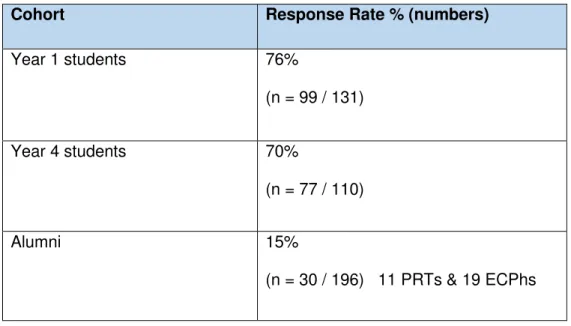
Table 7 Response rates by cohort ... 100
Table 8 Demographic breakdown of participants across study cohort groups and compared to year of entry cohort groups ... 101
Table 9 Age-ranges of total participants ... 103
Table 10 Spread and average P scores across cohort groups ... 106
Table 11 Spread and average P scores pre- and post- 1 year of study ... 108
Table 12 Independent t-tests with bi-variate variables and P score ... 109
Table 13 Results of ANOVA tests with multiple variables and the P score ... 110
Table 14 Average scores for individual scenarios (max. score of 9 possible) by cohort group ... 111
Table 15 Demographic profile of interviewees ... 128
Table 16 Organisation of key themes ... 130
Table 17 Ethical dilemmas in practice ... 132
Table 18 Transition to professional practice ... 171
Table 19 Facilitating learning and professional development ... 189
Table 20 Mapping of skills perceived to have been developed through use of Vx to RPS Exercising professional judgement (2018)... 245
Table 21 Recommended improvements to ethics teaching using Vx ... 247
LIST OF FIGURES
Figure 1 Rest's Four Component Model of Morality ... 10Figure 2 Kolb's Learning Cycle ... 57
Figure 3 Bloom's Taxonomy (new version) ... 59
xi
Figure 5 Diagrammatical overview of research methods... 79
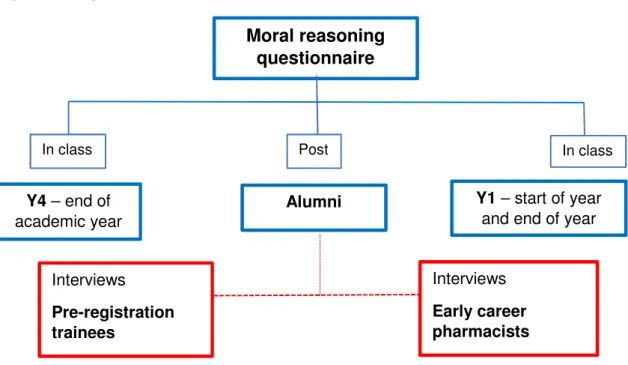
Figure 6 Overview of quantitative research strand ... 96
Figure 7 Gender by cohort group ... 102
Figure 8 Ethnicity ... 103
Figure 9 Religious beliefs ... 104
Figure 10 A normal Q-Q plot of P scores ... 105
Figure 11 Mean P score with standard errors across the four cohort groups ... 107
Figure 12 GPhC Professional Standards Wheel ... 149
xii
ABBREVIATIONS
ACE
ANOVA
Academic Clinical Educator Analysis of Variance
APPLET Advancing the Provision of Pharmacy Law and Ethics Teaching
BME Black and Minority Ethnic
CIT Critical Incident Technique
CMD Cognitive Moral Development
CPD Continuing Professional Development
DERJT Dental Ethical Reasoning and Judgement Test
DEST Dental Ethical Sensitivity Test
DIT Defining Issues Test
ECPh Early Career Pharmacist
FCM Four Component Model (of morality)
FIP International Pharmaceutical Federation
GPhC General Pharmaceutical Council
HEFCE Higher Education Funding Council for England
ICM Intermediate Concept Measure
ILC Intermediate-Level Concept
IME Institute of Medical Ethics
MDT Multidisciplinary team
MUR Medicines Use Review
OSCE Objective Structured Clinical Examination
OTC Over-the-counter (medicine)
PEP Professional Ethics in Pharmacy
PG Postgraduate
PROI Professional Role Orientation Inventory
xiii
RPS Royal Pharmaceutical Society
RPSGB Royal Pharmaceutical Society of Great Britain
SoP School of Pharmacy
UG Undergraduate
xiv
PREFACE
Overview of thesis
This thesis maps my journey of discovery into teaching professional ethics and decision-making at Keele University School of Pharmacy. An online decision-transparency tool, Values Exchange™ (Vx), is instrumental in the School delivery of its teaching on the subject of ethics. This tool has been in use since the inception of the School in 2006, but has not been evaluated. Research exists supporting short-term use of the tool, but its long term use and its potential impact on professional pharmacy practice has not been studied.
Before presenting my study I take a step back and consider my personal journey, reflecting on how I got to where I am now, why I wanted to research the teaching of professional ethics, and Vx in particular, with a focus on the insider researcher aspect of my study, and all that that entails. I finish the chapter by considering my personal ethical stance, where I confirm that I am not ethically perfect!
I then begin in Chapter 1 by providing an overview of ethics, touching briefly on philosophical ethical theories before moving on to moral psychology, with a focus on cognitive moral development. This section includes an introduction to the Four
Component Model of Morality, which is grounded in psychological research, and outlines the key processes which are believed to be important in the production of moral
functioning. Moral psychology is relevant because Vx does not align with any particular ethical theory, rather it supports users in moral reasoning, helping them to make a moral judgement or decision on a specific scenario. The focus is on the process of decision-making rather than the actual outcome of the decision itself. The hypothesis of the study is, therefore, that it could potentially support the development of skills necessary for good ethical decision-making in pharmacy practice.
xv
I then move on to consider the development of professional codes of ethics. Although important in setting the standards that professionals are expected to attain, they do not, in themselves, support an individual in ethical or professional decision-making, particularly as standards can conflict. Ethical decision-making models aim to support ethical
deliberation in a systematic way, and I highlight the challenges pharmacists might be faced with in practice, when ethical decisions have to be made.
After setting this context for my research, I review the literature in relation to ethics in pharmacy practice, and, having demonstrated that pharmacists are, and are likely to continue to be, faced with ethical and professional dilemmas in practice, I critically review the literature on the teaching of professional ethics and decision-making. At this point, I explain how ethics is taught at Keele School of Pharmacy (SoP), and introduce Vx, the online ethical decision-transparency tool that is used throughout the undergraduate course.
In Chapter 2 I theorise what I believe to be the underpinning pedagogy associated with the tool to support its use in teaching. I highlight the importance of considering values in decision-making and review the literature supporting the use of Vx. My research
specifically addresses the gaps mentioned previously, of the impact of long-term use of Vx in undergraduate study, its application in Pharmacy, and the perceived impact of
undergraduate use of Vx on later practice. From this I developed the aim and specific objectives of my study, which are included in Chapter 3.
In Chapter 4 I discuss the methodological aspects in relation to my study. I was keen to explore in-depth the views of Keele Pharmacy alumni on their experiences of dealing with dilemmas in practice, as well as their views on Vx. My research, therefore, needed to be primarily a qualitative study. Semi-structured interviews were chosen as they allowed for deep exploration of views whilst ensuring all key issues were addressed. Being aware that self-reported explanations of cognitive processes (such as decision-making) were
xvi
limited, as people can only share their conscious understanding of their thoughts, a questionnaire measuring moral reasoning was also applied. This provided a measure of implicit knowledge that drives decision-making. A mixed methods, pragmatic approach best suited my research needs and strengthened my methodology.
In Chapter 5 I present my quantitative strand of research. I had two pre-validated tests of moral reasoning to choose from: the Defining Issues Test (DIT) and the Professional Ethics in Pharmacy (PEP) test. I explain why I chose the profession-specific PEP test, and the rest of the chapter details my application of the test, with a presentation of my findings and associated discussion. There were four cohorts to test: Year 1 Pharmacy students (as a baseline comparator), Year 4 Pharmacy students, pre-registration trainees (PRTs) and early career pharmacists (ECPhs) up to two years qualified. Although not statistically significant, the test results revealed an interesting trend with moral reasoning scores increasing from Year 1 to Year 4, decreasing in PRTs to below Year 1 average score, then increasing again in ECPhs, but still averaging below Year 1 students; this warrants further investigation.
Chapters 6 to 9 are devoted to the qualitative strand of my research. I detail my methods and present an overview of my qualitative results in Chapter 6, followed by detailed analyses and brief discussions on each of my three themes in Chapters 7 to 9. The three main themes that emerged from my rich data were: ethical dilemmas in practice, transition to professional practice, and facilitating learning and professional development. Of note, interviewees reported that they were practising ethically on the whole, with an empathetic, person-centred approach generally demonstrated. They reported being faced with
professional challenges at times that caused worry, but, ECPhs in particular, appeared to have the confidence to make difficult decisions in the best interests of their patients. PRTs reported lacking the confidence needed at times to make and action difficult decisions. Interviewees perceived Vx to be an effective tool in developing moral reasoning skills, and ethical sensitivity also, but felt it could not substitute the experience of facing real life
xvii
dilemmas. They suggested expanding the use of Vx beyond undergraduate education, and indicated that they would value further support on decision-making during pre-registration year and when first qualified. In Chapters 5, 7, 8 and, particularly, 9 of this thesis, I demonstrate that I have met all individual study objectives, thereby meeting the overall aim of my study.
I highlight my key overarching discussion points in Chapter 10, including triangulating my findings from both my qualitative and quantitative strands of research. This was the first application of the moral reasoning test, the Professional Ethics in Pharmacy (PEP) test, outside of Australia, its country of origin. Although it did not translate entirely in the UK setting, probably due to the different healthcare systems of the two countries, an interesting trend in scores as mentioned previously was observed. It could be
hypothesised that the trend in average scores across cohorts could possibly be explained by a change in levels of confidence reported by interviewees when starting in practice. The trend in scores could reflect limited moral courage to action difficult decisions in practice, as opposed to actual changes in moral reasoning skills.
Students are taught that they should follow Royal Pharmaceutical Society (RPS) guidance on exercising professional judgement when in practice, using a step-wise approach to dealing with dilemmas. Having theorised the underpinning pedagogy of Vx in Chapter 2, I mapped this to the RPS guidance. In Chapter 10, I also mapped to the RPS guidance the skills perceived by interviewees to have been developed through use of Vx. In so doing I have provided both theoretical pedagogical reasons and data-driven evidence that support use of Vx as a tool to develop skills necessary for students to exercise
professional judgement. Based on my data, I suggest ways to develop teaching with Vx and expand its use outside of undergraduate education. I end the chapter by considering the strengths and limitations of my study, implications for practice and identify further studies to emerge from my research. Finally, in Chapter 11 I present a brief conclusion summarising my findings.
xviii
My Personal Journey
My professional career to date
I began my career in Pharmacy as an undergraduate (UG) student at Manchester University over twenty years ago. I have no memory of ethics teaching beyond an awareness of the Professional Code of Ethics. I remember feeling excited and a little anxious about graduating but spent little time reflecting on what I might be faced with in practice. I had worked in a community pharmacy during summer and Christmas holidays and so knew generally what to expect, but I had not reflected on the kind of pharmacist I wanted to be. I did not have any real sense of identity of, for example, being patient-focused, of wanting to raise standards or of aspiring to be the best pharmacist that I could be. My head was simply full of scientific and clinical knowledge with a basic
understanding of underpinning law. We had no professional student code of conduct so the idea of being a ‘professional’ pharmacist had always felt very remote to me as an UG student.
I worked in community pharmacy and primary care before moving to academia. I have worked in three different roles at Keele University School of Pharmacy (SoP) over fifteen years, moving from an initial role reviewing clinical evidence in 2003 to working in the UG SoP as an Academic Clinical Educator (ACE) teaching therapeutics, and then to my current position as Lecturer in Pharmacy Practice. I was lead trainer in a previous post in primary care so it felt like a natural progression to move to teaching in academia. On completing my Masters degree at Keele in 2001, I accepted the position of honorary lecturer on the postgraduate (PG) diploma in community pharmacy, so had training and experience in PG teaching prior to taking up the ACE role. From here I progressed to become a lecturer as I was keen to undertake research. Ethics is not a subject that I was particularly interested in up to this point, but rather teaching it was thrust upon me due to circumstances. I have become the School lead on ethics and researching on my teaching
xix
of ethics seemed a logical step. I hoped that by undertaking a professional doctorate I would grow as a professional, as opposed to developing research skills alone studying a PhD. I believed the DPharm would help me improve as a lecturer, enabling me to better support my students and my organisation. I hope that, like my previous experience with further education, that it will open the door to new opportunities in my career also.
The challenge - a professional doctorate and the need for a reflexive approach
Lee (2009) proposes that professional doctorates are undertaken to acquire knowledge and research skills that can enhance professional practice. She identifies a commonality across all professional doctorates, namely the relationship between professional practice, the topic under investigation and the practitioner-researcher role. I have chosen to consider how I teach ethics. I have thought of the wider context of how ethics is taught and what the evidence is on how best to teach ethics, but ultimately this is an opportunity for me to reflect on how I teach ethics, and how best I can facilitate students’ learning in this area.
To undertake doctoral level research I need to become critical in my approach to teaching and research. Carr and Kemmis (1986) claim educational research must “reject positivist notions of rationality, objectivity and truth”. Any educational theories developed from research must be based in the self-understandings of teachers, whom themselves must provide some view of how any distorted self-understandings can be overcome. They suggest that educational theory be transformational in relation to the way teachers see themselves and their situations.
xx
“The cognitive ability to move fluidly back and forth between an inside and outside perspective on oneself, giving oneself up to the experience of ‘self as other’ whilst also retaining a grounding in one’s familiar sense of self.”
I am reflexive in my approach to conceptualising, analysing and making transparent my relationship with my research. As well as increasing the credibility of my research, Lee’s work (2009) advocates that this should contribute to my interpretation of it. Carr and Kemmis (1986) believe educational research will make practice more ‘theoretical’ by enriching it with a critically reflective approach, whilst remaining ‘practical’ as problems are identified and theories formulated grounded in the reality of educational practice. They see the active participation of teachers as researchers to be “an indispensable necessity”
(p.126) as they will have experienced problems first hand. Drake and Heath (2011) highlighted one of the difficulties of insider or practitioner research to be integrating new professional and technical knowledge gained from within your profession with new academic or analytical knowledge of academia. Researchers must therefore transform their existing models of professional knowledge to become more critical and analytical reflectors on their professional knowledge. I had the advantage of already being an ‘academic’ and having undertaken a Masters degree, so hope that this will not be so difficult for me.
As an ‘insider practitioner’ I am in a vulnerable position, as I fluctuate between lecturer and doctoral student. Drake and Heath (2011) identified strengths of insider research such as the inherent knowledge of the organisation and established relationships, collegial connections and professional status which can provide opportunities to gain easier access to people and the possibility of enhanced rapport. It is not, however, without its
challenges. It may be more difficult for an insider researcher to remain neutral, and
maintain a broad perspective. There may be internal resistance to the research and it may impact on relationships with colleagues. For me, maintaining a neutral stance could be difficult as my experience of teaching with Vx means that I have pre-formed assumptions.
xxi
I know that I need to, therefore, at all times acknowledge any potential biases and be transparent as it will be impossible to remain totally objective. I have a vested interest in Vx being a successful tool. If, as a School, we decide not to continue using Vx based on my findings, there is a chance that no further time would be allocated to ethics teaching to replace Vx due to time pressure within the timetable.
The fact that my research subjects are current and former students brings both
opportunities and challenges. An obvious benefit is easy access to current students as research subjects. Within my research I move from a position of power and authority, to being reliant on the support of my students. For the integrity and validity of my data I need students and alumni to be honest and truthful, yet the fact that an experienced lecturer will be conducting the interviews is likely to impact on responses. Some may feel inclined (or even obliged) to participate if they know me well, yet may be less willing to make negative comments for fear of upsetting me or the relationship we have. There are further
relationships that need to be made transparent; for example, myself and the SoP. Drake (2010) argues that neutrality is impossible to achieve within the politics of the workplace. As lead for Vx within the School, my research is unlikely to affect my relationship with close work colleagues but this professional doctorate will, arguably, be a reflection of my effectiveness or ineffectiveness as a teacher up to now. It might expose my failings within the organisation, or identify institutional issues affecting teaching and learning that will need to be addressed. I have the added dimension that ‘teachers’ are also my work colleagues. Not holding a senior position, however, probably makes that relationship more acceptable and less awkward. I also need to consider my relationship with the developer of Vx, and the developer of the PEP test, the moral reasoning tool I use for some of my data collection. I had built up a relatively close professional relationship with them both, and the developer of Vx in particular has a vested interest in my findings. I need to ensure that these relationships do not impact on the way I view my data.
xxii
Why professional ethics and Values Exchange™?
When I started teaching in the UG School my teaching was therapeutics-based. At this time I felt that pharmacy practice, including law and ethics, was ‘dry and boring’. I was, however, interested in getting involved with research again so when the opportunity arose for a lectureship in pharmacy practice, I applied. Within the team, aside from some minimal specialisms, all pharmacists could be asked to teach all aspects of practice, law and ethics. I did not have a strong desire to teach ethics but rather ‘fell into it’ as I initially was simply available to teach the timetabled sessions. As timetables rolled over I
delivered the same teaching year-on-year and developed an interest in the subject. I think many students see ethics as a ‘soft’ subject based on opinion whereas, in realty, it
requires application of analytical skills and the development of well-formed arguments to justify positions on any given topic.
When I was initially asked what I would like the focus of my professional doctorate to be, I found myself thinking through various options before deciding on ethics teaching. My choice of ethics teaching as a research topic was cemented by the reading of a paper by Wingfield, Bissell and Anderson (2004) entitled The scope of pharmacy ethics-an
evaluation of the international research literature, 1990-2002. The authors identified a need for further research on the teaching and assessment of ‘ethical competence’ prior to practice, and this sparked my interest. Insider researchers often choose to research issues that they have been working with for a number of years (Drake and Heath 2011) and I am no exception. Using Vx within the curriculum is an area that I manage alone so I will have autonomy over any potential changes to its use. Basing my professional
doctorate on ethics teaching encourages me to deepen my learning on basic ethical theories and concepts, as well as addressing my teaching methods. On reflection, this means that I will be introducing a further level of complexity to my learning as I would expect most people who undertake a professional doctorate to be experts within their particular specialism. My expertise is in teaching per se, so the fact that my underpinning
xxiii
knowledge of ethics is self-taught is secondary. I have been informed that around half of all UK SoPs do not have a staff member with a formal qualification in ethics so I am not alone (personal communication, Joy Wingfield, Aug 2014). I have perhaps relied on Vx, however, due to my insecurities, fearing that my knowledge in ethics may be lacking. I have suffered with ‘imposter syndrome’ (Clance and Imes 1978) throughout my academic life. This is the belief that I am less capable or inadequately fulfil my role compared with what others think of me (I hope!). I can be filled with self-doubt and a feeling of what Clance and Imes described as ‘intellectual phoniness’. A study by Knights and Clark (2013) among academics working in business schools identified anxiety and insecurity associated with a sense of being unable to live up to the ideals of being a “proper”
academic of ‘incredible intellect and eloquence’. I continually aspire to do better, and after completing this thesis, may undertake further studies in ethics by way of credentialing my knowledge.
In Keele University SoP there is a core module on bioethics that is taught by an external ethicist in the first year of the course, but additional teaching on ethics and
professionalism is included across years 1, 3 and 4, with teaching via Vx across all four years. Vx had initially been run by my senior lecturer and I assisted. After one year of joint working I facilitated all teaching and assessment on my own. I was keen to develop it and, in my first year, introduced discussion boards that enabled students to debate online. Before embarking on my research I also introduced a number of new Pharmacy-based scenarios. I had heard students complain about having to complete Vx, but did not know if this discontent was related specifically to the activity or the volume of work. Even work colleagues had grumbled about how ‘boring’ ethics was. I was quite apprehensive before my Initial Study as I was worried students’ evaluation would be very poor. I was,
therefore, very pleased and relieved with the positive findings that emerged (see Appendix 1). I acknowledge that possible selection bias means that I am probably more likely to hear views from people who enjoy ethics and enjoyed using Vx. Nevertheless, this
xxiv
encouraging finding has strengthened my conviction that teaching with Vx is worth exploring in more depth.
I believe that there is scope to integrate ethics teaching much more into the MPharm curriculum and, in line with the revised Consensus Statement published by the Institute of Medical Ethics (2010), think that all staff have an obligation to share in its teaching. We are all role models working in different disciplines, and understanding the specific nuances of each discipline could mean the identification of specific issues to teach that others may not be aware of. For example, a scientist teaching about animal experimentation may have experience, or a greater understanding of, the conditions animals are kept in, and the level of experimentation animals are exposed to. Similarly, my background is working in community pharmacy and primary care so there may be ethical issues within hospital pharmacy that I am not privy to.
I would argue that the ultimate aim must be to achieve virtuous professionals through ethics teaching, one of the stated purposes of the revised core curriculum for medical education in the UK (IME 2010). This may not be achievable through classroom teaching alone, but I would argue that we can equip students with a greater awareness of ethical issues, the ability to reason through complex dilemmas and help them to develop a strong identity of being a professional with a sense of duty to put the patient first. By so doing, I hope that ultimately they will become caring, compassionate pharmacists that make the right choices when under pressure in practice. My view is that the more exposure to ‘real’ practice students receive throughout UG training, the more opportunity they will have to internalise the values that I am trying to instil.
xxv My personal ethical stance
As an experienced pharmacist I believe that my ethical stance has evolved over time, as I would expect to happen to all reflective practitioners. I was probably quite naïve when I first graduated from university. At that time I would never have contemplated breaking any rules or laws under any circumstances. I have a strong sense of integrity and
probably have what some people might consider to be quite a high moral grounding. This may be due to the influence of my parents who are both deeply religious and who instilled strong values in me from a young age. I would consider myself always to be a very fair person with a strong sense of justice and the need to look out for and support those either less fortunate or, in a work environment, less experienced than myself. That is not to say that I always ‘do the right thing’. Throughout my time as a professional I have learned to see the grey areas in different situations and have, at various times, been willing to bend rules when I have felt justified in doing so. An American study has shown that ethicists are no more likely to undertake ethically justified acts such as returning library books, donating to charity or choosing to be blood or organ donors than non-ethicists of a similar social background (Schwitzgebel 2014). I probably, therefore, fit the norm whereby, despite deliberating on ethical issues and teaching ethics, I am not ethically perfect!
I have reflected on the impact of undertaking this research on my practice in my final discussion (Chapter 10).
1
CHAPTER 1: INTRODUCTION
1.1. An overview of ethics
Socrates said of morality:
“We are discussing no small matter, but how we ought to live.” Socrates, in Plato’s
Republic (ca. 390B.C.)
In this chapter I introduce the subject of ethics, addressing a broad overview of the most common ethical theories, and consider general approaches to moral reasoning. After looking briefly at the philosophical underpinnings, I consider in more detail, the psychology around moral decision-making, and consider moral reasoning within the context of four processes important in moral functioning.
I then move on to look at professional ethics with a particular focus on professional decision-making. I consider the broader ethical challenges facing healthcare
professionals today, and then review the literature around ethical dilemmas faced in pharmacy practice specifically. This sets the context within which Pharmacy students will be expected to work, and demonstrates a need for students to be equipped with skills to deal with the many dilemmas that they will face in practice.
At this point I move to consider how ethics is taught, including what we are trying to achieve in the MPharm course by teaching ethics, how best to incorporate it into the curriculum, and report on some methods that have been employed to teach ethics thus far. From here I describe how we teach ethics at Keele University School of Pharmacy (SoP), and introduce Values Exchange™ (Vx), an online decision-transparency tool that is employed widely on the MPharm course at Keele.
2 1.1.1. Definitions and terminology
Ethics has been described as “critical reflection on human conduct” (Mitcham 2005) and is essentially the study of how we ought to live. It is the study of moral principles or values held or shown by an individual. Morality relates to human behaviours or characters considered good or bad. It relates to the distinction between right and wrong or good and evil actions, desires or character (OED 2018). The word ‘ethics’ is derived from the Ancient Greek word ethikos, relating to nature or disposition, whilst the Latin word moralis
means ‘custom’ (Wingfield & Badcott 2007).
There does not seem to be one generally accepted distinction between ethics and morals (Rest & Narvaez 1994) although some distinctions have been debated within
philosophical literature (Piercey 2001). I have, therefore, used the terms interchangeably in this thesis.
Normative and nonnormative ethics
Ethics can be described as either ‘normative’ or ‘nonnormative’ in character. Normative, prescriptive ethics is used to assess what ought to be done, or what is ethically valuable. It concerns considering what is the right thing to do in any given scenario (Cohen 2004). Prescriptive ethics, therefore, focuses on how one ought to behave and deals with moral reasoning. In contrast to this, the objective of nonnormative ethics is to establish ethical facts or concepts. There are two types of nonnormative ethics: descriptive ethics which describes behaviour, and metaethics which involves analysing language, concepts and methods of reasoning in normative ethics (Beauchamp and Childress 2009).
According to Cohen (2004), moral encounters (inquiries, discussions or arguments) can occur at three different levels: normative principles, normative issues and casuistry or
3
moralising. One can consider normative principles as general moral principles or the standard according to which people should behave, for example, tell the truth or the Golden Rule (do unto others as you would have them do unto you). Some principles can conflict. Normative issues are less general, and relate to specific ethical issues, for example abortion or whistle-blowing. The least general level is casuistry, and this is the study of moral choices within individual scenarios. At this level, any case should be discussed in context with individual circumstances considered. Any judgement or
decision, however, should be informed by the general moral principle that one subscribes to.
Cohen (2004) also provides a ‘minimalist’ description of what a moral or ethical concern is by discussing six formal conditions that should apply, namely impartiality (must go beyond self-interest in coming to a decision), universalisability (judgement can apply to everyone), justifiability (ethical opinions must be able to be defended with reasons), overridingness (moral opinion overrides other opinions), non-negotiability (it should not be brushed aside), and action-guiding (moral reasoning is practical; it is reasoning for the sake of acting).
1.1.2. Ethical theories
There are many normative ethical theories that can be applied to an ethical issue or concern when coming to a judgement but it is not within the bounds of my thesis to detail them. I will, however, provide a brief overview of the most common which are
consequentialism, deontology and virtue ethics. Consequentialism refers to the ‘best’ action as that which achieves the best overall consequences or result. This however raises questions of what the best consequences are, and best for whom? One is required to achieve these best consequences by whatever means necessary so the nature of the action is considered less relevant (Wingfield & Badcott 2007). Utilitarianism, a version of
4
consequentialism, was first proposed by David Hume (1711-1776) but argued most famously by Jeremy Bentham (1748-1832) and John Stuart Mill (1806-1873). They theorised that actions should be judged solely on outcome, that nothing else mattered, that outcome is measured by the amount of happiness or unhappiness created, and that each person’s happiness is equally important (Rachels and Rachels 2006).
Deontological ethics is based on rule following and doing one’s duty. Duty-based
principles reflect what is right and must be followed, irrespective of the outcome. Particular emphasis is given to respect and dignity of the person, and cannot be overridden. All people are deemed to be equally important, irrespective of being mentally or physically compromised, very young or very old, or even deceased (Wingfield & Badcott 2007). Jean-Jacques Rosseau (1712-1778) and, in particular, Immanuel Kant (1724-1804), and later John Rawls (1921-2002) were major proponents of this viewpoint.
Virtue ethics considers that the moral uprightness of the individual and development of a virtuous attitude or character is most important. Virtuous choices would then take
precedence over vicious ones. Examples of virtues are trustworthiness, loyalty and generosity, but these can be conflicting in some situations and should be expressed in moderation (Wingfield & Badcott 2007).
Four Principles approach
The ‘Four Principles approach’ to biomedical ethics proposed by Beauchamp & Childress (2009) provides a theoretical framework from which to analyse ethical situations in
medicine. It is worthy of specific mention as it is often referred to during the teaching of medical ethics. The four clusters of moral principles in question are: respect for autonomy
(the right of the patient to hold views, make choices, and take actions based on personal values and beliefs), nonmaleficence (avoid causing harm), beneficence (provide benefits
5
and balance benefits against risks) and justice (ensure a fair distribution of benefits, risks and costs). These are underpinned by more detailed rules and provide a framework for moral deliberation. Often the principles or rules that pertain to a given situation conflict and a process of weighing and balancing needs to be undertaken. Critics have accused this approach as being imperialist, inapplicable, inconsistent and inadequate (Huxtable 2013) but it is the starting point of moral deliberation for many healthcare students.
Up to now I have described what ethics is, and discussed some of the ethical theories that can underpin decisions. The next section addresses the practical application of ethical or moral reasoning.
Moral reasoning
Moral reasoning has been characterised as “an attempt to bring moral principles and specific judgements into harmony, consistency or alignment” (Cohen 2004). There are a number of approaches to moral reasoning. Top down reasoning involves application of moral principles to a given situation. In this case, the principle is the immovable authority and if a judgement clashes with the principle to which the judger subscribes, then that judgement may need to be modified accordingly. Bottom-up reasoning is an alternative approach where the individual makes an initial judgement, their moral reaction to a situation, and this ground-level judgement is what drives the moral reasoning. Principles are then framed to align with the judgement so that they fit. In the early 1970s, John Rawls (1971) introduced the concept of reflective equilibrium where neither principles nor judgements take precedence and are non-negotiable, rather both are important, and it is the interplay between them that drives moral reasoning. With reflective equilibrium, reasoning can work in both directions so that there is a genuine interrelation between principles and judgements, with modifications of both principles and judgements possible so that they are consistent with each other. Within the context of Pharmacy, my
6
understanding would be that, in any given situation, a pharmacist is driven to decide on an outcome based on their personal beliefs and experience (inductive bottom-up reasoning), which may be revised to align with professional standards (deductive top-down
reasoning). The choice of professional standard with which to align with may also change within the negotiating process until there is coherence with both our personal beliefs and the standard. At this point a morally acceptable reflective equilibrium will have been reached.
1.2. Moral psychology
Up to this point, I have discussed moral philosophy, which provides an important underpinning knowledge, but a key focus of my research centres on work originated in moral psychology, that is, the study of how we make decisions, as opposed to what moral decisions we should make. Specifically, my interest centres on the Four Component Model of Morality, developed by Rest (1983), which built on earlier work by Kohlberg (1969).
1.2.1. Cognitive Moral Development theory
A pharmacist faced with an ethical dilemma must choose the best decision from the options available. Cognitive Moral Development theory (CMD), developed by Kohlberg (1969), purports that a person operating at a higher level of moral development will be more likely to choose to ‘do the right thing’ when faced with an ethical dilemma than a person at a lower level. CMD theory is interested in how people think, and the process of arriving at decisions, as opposed to the final decision itself. Kolhberg describes 3 levels with 6 stages of cognitive moral development, consisting of a Preconventional level
7
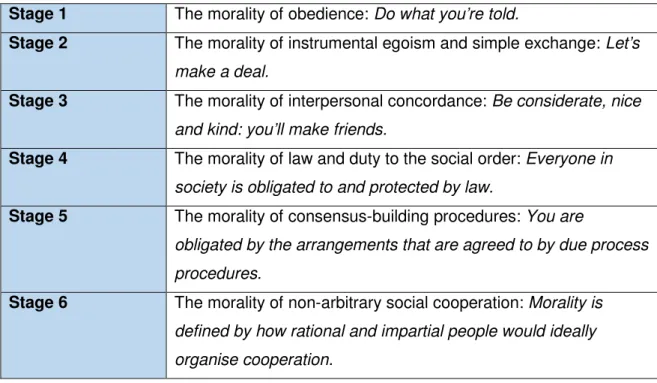
(stages 1 and 2), a Conventional level (stages 3 and 4) and a Postconventional (or principled) level (stages 5 and 6). There have been many ways of describing Kohlberg’s six stages, including the well-known description of the stages in terms of an individual’s understanding of how to organise society-wide cooperation for establishing rights and duties (Rest and Narvaez 1994). It considers how individuals inter-connect with others (see Table 1).
Table 1 Six stages in the concept of cooperation
(Taken from Rest, J and Narvaez, D. (1994) Moral development in the professions. Hilldale, New Jersey: Lawrence Erlbaum Associates Inc. pp.5)
Stage 1 The morality of obedience: Do what you’re told.
Stage 2 The morality of instrumental egoism and simple exchange: Let’s make a deal.
Stage 3 The morality of interpersonal concordance: Be considerate, nice and kind: you’ll make friends.
Stage 4 The morality of law and duty to the social order: Everyone in society is obligated to and protected by law.
Stage 5 The morality of consensus-building procedures: You are
obligated by the arrangements that are agreed to by due process procedures.
Stage 6 The morality of non-arbitrary social cooperation: Morality is defined by how rational and impartial people would ideally organise cooperation.
In the Preconventional level individuals are mainly concerned with their own self-interests and make decisions based on direction from those in authority (e.g. a parent) or the promise of punishment or reward. In the Conventional level, relationships with others become more important; a person determines what is ‘right’ by conforming to the rules of society. A person who is performing at stages 5 or 6 bases their decisions on personally held beliefs relating to universal human rights, values or principles. At this
Postconventional (or principled) level, an individual will act according to a personally held belief based on principles, even if this means violating a law in the process. Kholberg’s
8
CMD theory assumes that people develop both general and moral thinking skills along a stage-sequence continuum i.e. everyone starts at stage 1 with the most simplistic form of problem-solving and moves on to stage 2, then stage 3 and so on as they develop their moral problem-solving strategies (Rest and Narvaez 1994). Those functioning at the higher stages compared with lower stages are considered able to deal with more complex social problems. The morally right decisions at stages 5 and 6 are those based on
principles that shape the laws and role systems within a society.
Developmental moral schemas
CMD theory was further developed by Rest et al. (1999a) who proposed the Neo-Kohlbergian model of moral judgement that evolved from Kohlberg’s initial six stages. Kohlberg’s stages focused on justice and social cooperation, but critics have called this a narrow view and identified competing orientations to morality, for example, Gilligan’s (1982) ethic of care which focuses on having a voice and the need for responsiveness in relationships. In contrast to this, the Neo-Kohlbergian model was not grounded in any particular moral theory, but rather on the fact that as a person develops, their basic understanding also develops, enabling them to achieve judgements on more complex moral problems. The Neo-Kohlbergian approach by Rest et al. (1999a) replaces Kohlberg’s six stages with three successive developmental moral schemas, where schemas are described as networks of knowledge that reside in long-termmemory and which are evoked by new information resembling previous experiences. Unlike Kohlberg’s view of moving from one stage to the next in a stepwise approach, Rest envisages moral development as shifting distributions, with an increasing frequency in the use of more complex problem-solving abilities as moral development grows. In other words, individuals can be functioning in more than one schema when faced with different decisions, but as moral development grows, higher schemas will be accessed more frequently. The three moral schemas are described in Table 2.
9
Table 2 Neo-Kholbergian moral schemas
1. Personal Interest Schema derived from Kohlberg’s stages 2 and 3
People who function mainly in this schema do not address problems from a sociocentric perspective. They may analyse what each stakeholder has to gain or lose, and justify their decision by the personal stake one has in the consequences of an action. This is a more primitive form of thinking.
2. Maintaining Norms (or Conventional) Schema derived from Kohlberg’s stage 4
People who function mainly in this schema are developmentally more advanced in attaining a sociocentric perspective. They will consider how people they do not know personally are going to co-operate. They are interested in maintaining the established social order and believe that authority must be obeyed out of respect for the social system – the ‘rule of law’.
3. Postconventional Schema derived from Kohlberg’s stages 5 and 6
People who function mainly in this schema are those who are developmentally most advanced in their moral thinking. Moral criteria are considered most important in any dilemma, with moral obligations based on shared ideals which are open to debate and tests of logical consistency.
Most adults operate within the ‘Maintaining Norms’ and ‘Postconventional’ schemas. A major difference between them is that people functioning at the level of the Maintaining Norms schema establish a moral consensus by appealing to established practice and existing authority i.e. law and order, with the focus on maintaining good relationships. In contrast, individuals functioning at the level of the Postconventional schema will refer to moral principles and logical coherence in their arguments, while also understanding and usually accepting the laws of society.
10
1.2.2. The Four Component Model of Morality
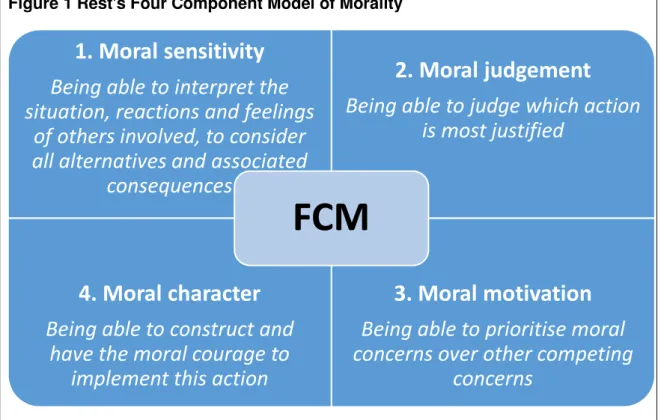
Although a high level of moral cognitive development might be expected to lead to good moral behaviour, Blasi (1980) identified only a weak link between them. This suggested that additional moral processes alongside moral judgement were involved in overall moral behaviour or ‘functioning’. The Four Component Model (FCM) of Morality was designed by Rest (1983) to address a view of moral functioning in which people make decisions on real-life situations which are presumed to be highly contextual, affected by their moods and attitudes, and subject to competing pressures and needs. The FCM outlines the key components which are believed to be important in the production of moral functioning (see Figure 1).
Figure 1 Rest's Four Component Model of Morality
This is not a linear model although all four components are thought to be important and necessary for adequate moral functioning. You and Bebeau (2013) tested all four components against five cohorts of dental students (n = 385) and found that the components were independent, i.e. competence in one did not predict competence in
1. Moral sensitivity
Being able to interpret the
situation, reactions and feelings
of others involved, to consider
all alternatives and associated
consequences
2. Moral judgement
Being able to judge which action
is most justified
4. Moral character
Being able to construct and
have the moral courage to
implement this action
3. Moral motivation
Being able to prioritise moral
concerns over other competing
concerns
11
another. Rest and Narvaez (1994) proposed that moral failure can occur due to a
deficiency in any of the four components as they are the combined determinants of moral action. My study focuses on the process of moral reasoning. This falls under component 2, ‘moral judgement,’ and is discussed in more detail in the following section.
1.2.3. Measuring moral reasoning: The Defining Issues Test (DIT)
A range of tests have been developed to measure the four components of morality individually (Bebeau 2002). Examples include the Dental Ethical Sensitivity Test (DEST) (Bebeau and Thoma 1994) for component 1, moral or ethical sensitivity, and the Defining Issues Test (DIT) (Rest 1979) for component 2, which measures moral reasoning. The Professional Role Orientation Inventory (PROI) (Bebeau et al. 1993) is a measure of moral motivation (component 3), found to be closely linked with identity formation. Performance-based assessment such as Objective Structured Clinical Examinations (OSCEs) (Hochberg et al. 2010) can be used to assess ethical implementation, i.e. moral character (component 4) and also clinical competence.
The Defining Issues Test (DIT; Rest 1979) was a multiple-choice test devised to measure moral reasoning. Rest et al. (2000) asserted that schemas facilitate information
processing and the DIT has been described as a device for activating moral schemas to the extent one has developed them. The DIT provides some information on an ethical case but relies on the individual to fill in the gaps (Narvaez & Bock 2002). Analysis of the patterns of ratings and rankings obtained through using the test provides estimates of the relative strength of the three moral schemas at which a person is functioning (see Table 2 p. 9). A P score, which is a measure of higher level principled thinking, is calculated from the test. This represents the percentage of an individual’s overall moral functioning at the Postconventional level. The DIT can, therefore, differentiate between Conventional and Postconventional reasoning. The DIT has been reported in over 400 published articles.
12
Rest et al. (2000) presented seven criteria that they state have been demonstrated through the studies and therefore prove the reliability and validity of the test.
The DIT-2 test was introduced in 1999 as a shorter revised version of the DIT. It included new dilemmas set in modern contexts and language, and a new method of analysis, the N2 score (Rest et al. 1999b).The N2 score can be viewed as a modified P score that is adjusted by the degree to which the individual discriminates clearly between lower and higher stage items listed within the test. The DIT-2, therefore, measures a person’s moral judgement (P score) and also the relative ease or difficulty a person has in making a decision (N2 score). Rest et al. (1999b) determined that the DIT-2 has better
psychometric properties and reliability checks, and so has superseded the DIT test.
Why do we want to develop moral reasoning skills?
An important question to ask, is why do we want to develop moral reasoning skills in Pharmacy students? Blasi (1980) identified a weak link between higher principled thinking and the demonstration of honest and altruistic behaviour. It has also been reported that moral reasoning is a strong predictor of clinical performance across different healthcare professions including Medicine, Nursing and Pharmacy (Sheehan et al. 1980; Krichbaum
et al. 1994; Latif et al.1998). Sheehan et al. (1980) concluded that high moral reasoning virtually excluded the possibility of poor clinical performance, but findings from the other two studies suggested that high moral reasoning skills accounted for some (but not all) of the variance observed in standards of clinical performance. This would suggest that Postconventional moral reasoning is the level of moral reasoning at which healthcare professionals should be aiming to practice. Thesestudies, however, used the Defining Issues Test (DIT) to measure moral reasoning, which is a test focused on justice. According to the DIT, those who focus on relationships are considered to be displaying a Conventional level of reasoning. Current health care practice shows a move towards a
13
more person-centred care approach (DH 2010), with a focus on building relationships, and it could be argued that a Conventional level of reasoning, as indicated by the DIT scores, may be more appropriate in some cases.
As discussed previously, the level of moral reasoning is a proxy measure of moral behaviour as the Four Component Model (FCM; Figure 1, p.10) recognises other components also at play. Trevino (1986) argued that behaviour is also affected by situational factors (e.g. job pressures), and individual variables such as ego strength (the resilience to cope with stress). Other factors specific to Pharmacy have also been
identified, for example, isolation of community pharmacists and the culture of
subordination to doctors have been found by Cooper et al. (2009) to result in ethical problems, whilst fears of legal prosecution or disciplinary procedures appeared to have resulted in ‘ethical inaction’ among some pharmacists (Cooper et al. 2008; Deans 2010). Measuring moral reasoning can perhaps be seen as a ‘surrogate marker’ for moral behaviour. Acknowledgment of all these factors highlights the difficulty associated with measuring and interpreting scores for moral reasoning skills alone.
1.2.4. Using DIT to measure moral reasoning in the educational setting
Historically the Defining Issues Test (DIT) has been used to measure moral reasoning based on cognitive developmental theories posited by Piaget (1932), Kohlberg (1969) and Rest (1986a). A review by Bebeau (2002) of over fifty studies that used the DIT within professional education found that a minimum of 20 to 29 contact hours of a teaching intervention was required to achieve a significant gain in DIT scores. Face-to-face discussion of ethical dilemmas was the most frequent method used, but alternative
methods also showed significant gains in moral reasoning such as presenting and judging well-reasoned arguments in advance of small group discussion. Largest gains were obtained through student-centred moral discourse.
14
Contrary to the view that moral reasoning increased with increasing levels of education, for example, from high school through to higher education, previous studies have long found that moral reasoning scores regressed among medical students throughout their studies (Self and Balwin 1994). More recently Hren et al. (2011) found that medical
students regressed from Postconventional to Maintaining Norms schema-based reasoning after entering the clinical part of their curriculum. This was a well-designed study that accounted for increasing age and a potential cohort effect. The authors concluded that the regression was due to the effect of the clinical learning situations, possibly due to the hierarchy within clinical practice, the specific nature of the dilemmas faced, and the hidden medical curriculum i.e. not openly intended learning whereby values and beliefs can be transmitted to students that may undermine messages from formal teaching.
Studies measuring moral reasoning skills in Pharmacy
Many of the earliest studies which measured moral reasoning skills among students within Schools of Pharmacy (SoPs) were conducted in the USA. Worryingly, Rest and Narvaez (1994) found that first year Pharmacy students ranked lowest in their moral reasoning skills when compared with students from Medicine, Physical Therapy, Dentistry, Veterinary Science and Nursing, with Pharmacy students being the only students not classified in the highest level of moral reasoning. In fact, a study by Dolinsky and Gottlieb (1986), which assessed moral reasoning in fourth-year Pharmacy students, found that two-thirds of the explanations given for decisions on ethical dilemmas were classified at Kohlberg’s stage 3 or below, so at the personal interest schema level. This is, perhaps, unsurprising given that Pharmacy students have traditionally had limited clinical practice compared with other professions.
A larger study by Latif (2004) across 24 SoPs in the USA found a similar low score on moral reasoning, and also that the average score did not increase between first year and