Testing for Altruism and Social Pressure in Charitable Giving
∗
Stefano DellaVigna
UC Berkeley and NBER
John A. List
U Chicago and NBER
Ulrike Malmendier
UC Berkeley and NBER
This version: June 17, 2010.
(First version: May 2009)
Abstract
Every year, 90 percent of Americans give money to charities. Is such generosity necessar-ily welfare enhancing for the giver? We present a theoretical framework that distinguishes two types of motivation: individuals like to give, e.g., due to altruism or warm glow, and individuals would rather not give but dislike saying no, e.g., due to social pressure. We design a door-to-door fund-raiser in which some households are informed about the exact time of solicitation with a flyer on their door-knobs. Thus, they can seek or avoid the fund-raiser. Wefind that theflyer reduces the share of households opening the door by 10 to 25 percent and, if the flyer allows checking a ‘Do Not Disturb’ box, reduces giving by 30 percent. The latter decrease is concentrated among donations smaller than $10. These findings suggest that social pressure is an important determinant of door-to-door giving. Combining data from this and a complementaryfield experiment, we structurally estimate the model. The estimated social pressure cost of saying no to a solicitor is $3.55 for an in-state charity and $1.36 for an out-of-state charity. Our welfare calculations suggest that our door-to-door fund-raising campaigns on average lower utility of the potential donors.
∗We thank Saurabh Bhargava, David Card, Gary Charness, Constanca Esteves-Sorenson, Bryan Graham, Zachary Grossman, Lawrence Katz, Patrick Kline, Stephan Meier, Klaus Schmidt, Bruce Shearer, Joel Sobel, Daniel Sturm and the audiences at the Chicago Booth School of Business, Columbia University, Harvard Uni-versity, HBS, University of Amsterdam, University of Arizona, Tucson, UC Berkeley, USC (Marshall School), UT Dallas, University of Rotterdam, University of Zurich, Washington University (St. Louis), Yale University, the NBER Summer Institute (Labor Studies), the San Francisco 2009 Applied Micro Conference, the 2009 Berkeley Conference in Behavioral Economics, the 2010 UCSB Conference on Experimental Economics, the Munich Workshop on “Natural Experiments and Controlled Field Studies”, and the ASSA 2009 Meetings for helpful comments. We also thank Daniel Acland, Diane Alexander, Jim Cai, Matthew Levy, Xiaoyu Xia, and especially Gautam Rao for excellent research assistance.
1
Introduction
In the U.S., approximately 90% of individuals donate money each year. There is at least one capital campaign to raise $25 million or more under way in virtually every major pop-ulation center in North America. Smaller capital campaigns are even more numerous, with phoneathons, door-to-door drives, and mail solicitations increasing in popularity. Despite the ubiquity of fund-raising, we still have an imperfect understanding of the motivations for dif-ferent forms of giving and the welfare implications for the giver (see, e.g., Andreoni, 2006).
In this paper, we consider two broad classes of motivations. First, individuals may give because they enjoy giving. For example, they care about a specific worthy cause or like the warm glow of giving. Second, individuals may give, despite not liking to give to the charity, because the solicitor effectively placed them under social pressure to give. Such givers would rather avoid the personal interaction with the solicitor. The two views have very different welfare implications. The altruism (or warm glow) model (Becker, 1974; Andreoni, 1989 and 1990) posits that giving is mostly supply-driven, and that it is utility-maximizing for the giver to give. Under this model, the above transaction increases the giver’s utility and represents an overall enhancement of societal welfare. The social pressure model (Akerlof and Kranton, 2000) posits that giving is mostly demand-driven, and that giving may be utility-reducing for the giver.
We test for these two types of motivations in the context of personal, unsolicited donation requests. Building on a theoretical model, we design afield experiment that allows us to test whether giving is welfare-enhancing or welfare-reducing for the giver. Using the reduced-form experimental evidence, we estimate the parameters of the model structurally. We decompose the share of giving that is due to altruism versus social pressure and quantitatively evaluate the welfare effects for the giver. In this way, the empirics and theory are intertwined in a manner that is rare in this literature. While the door-to-door set-up is specific, it showcases a general methodology and provides afirst step towards better understanding the underpinnings for giving more generally.
Our field experiment revolves around a door-to-door fund-raising drive for two charities, a local children’s hospital, which has a reputation as a premier hospital for children, and an out-of-state charity, that most solicitees are unaware of. We approached 7,668 households in the towns surrounding Chicago in the period between April and October 2008. The crucial aspect of the experimental design is to allow individuals to sort, i.e., to either seek or avoid the solicitor. In ourfirst treatment, aflyer on the doorknob notifies households one day in advance about the one-hour time interval in which a solicitor will arrive at their homes the next day. In the second treatment, ‘Opt-out,’ theflyer also includes a box to be checked if the household does ‘not want to be disturbed.’ We compare these two conditions to a baseline treatment, wherein solicitors approach households in the usual manner without a flyer. We estimate the
treatments effects on both the share of households that open the door and the share that give. This design allows for a simple test of (pure or impure) altruism versus social pressure in door-to-door giving. If altruism is the main driver of giving, theflyer should increase both the presence at home and giving. Since giving is utility-enhancing, households should sort into staying at home, provided alternative ways of giving to these charities require more effort. In addition, households who intend to give in response to theflyer but who find it too costly to be at home should give to the charity via other means. Conversely, if social pressure is the main driver of giving, the flyer should lower both the frequency of opening the door and the frequency of giving. Since being asked to give is welfare-diminishing, households should sort out of opening the door. In addition, the households that are not at home during the visit of the solicitor will not give via other means, such as mailing a check, since these forms of donation are not subject to social pressure.
We report four main reduced-form results. First, the flyer treatments lower the frequency of opening the door. Relative to a rate of 41 percentage points in the baseline treatment, the share of households opening the door is 10 percent lower after receiving theflyer and 25 percent lower after receiving theflyer with opt-out box.1 The effect is similar for both charities.
Second, the mere presence of a flyer on the door-knob has no effect on actual giving: 6.3 percent of all households give in both the baseline and theflyer treatment. However, if theflyer includes an opt-out checkbox, giving decreases by 30 percent relative to the baseline group. The treatment effect is again similar for both charities, though the level of giving is higher for the local charity in all conditions.
Third, the decrease in giving in the opt-out treatment is driven by small donations up to $10. Donations above $10, instead, increase slightly (not significantly) in the treatments with sorting relative to the baseline.
Fourth, there is no effect on donations via mail or Internet. In contrast to the substantial donation rates in person, only one household out of 7,668 gave through these other means.
Overall, the reduced form estimates indicate that both altruism and social pressure are important determinants of giving in this setting, with stronger evidence for the role of social pressure. The lower frequency of households opening the door after receiving aflyer indicates that households are on average trying to avoid the solicitors, consistent with social pressure. The lack of an effect of the baselineflyer on giving is consistent with opposing effects of altruism and social pressure approximately cancelling each other out. The decrease in giving after a
flyer with opt-out box supports the role of social pressure: When the cost of avoiding the solicitor is lowered (a simple check on a box suffices), giving due to social pressure decreases. This interpretation is consistent with the reduction occurring almost exclusively among small donations, which are more likely due to social pressure than large donations. The social
1
We include households that opt out among the households not opening the door. In this case, we do not knock at the door.
pressure interpretation is also consistent with the lack of donations via mail or Internet. To assess the welfare effects of giving, we structurally estimate the parameters in the model. We combine data from the above treatments with complementary field experiments on the value of time, run in the same areas in 2008 and 2009. In these experiments, we ask 11,900 households to complete a survey. We vary the payment ($0, $5, or $10), the duration (5 or 10 minutes), and whether the surveys are announced (with a flyer, with or without opt-out option). Wefind that higher payments and shorter duration increase the presence at home by 5 to 15 percent and increase the share willing to undertake the survey by 20 to 80 percent. The sensitivity to monetary incentives estimated in these treatments helps to identify the underlying parameters structurally.
We use a minimum-distance estimator on the combined data from the charity and the survey experiments. The estimator minimizes the distance between the moments predicted by the model and the observed moments. The moments are the probabilities of opening the door, of giving different amounts, of completing a survey, and of opting out. Key parameters are the curvature of the altruism function, the mean and variance of altruism, and the social pressure cost of saying ‘no’ in person to a solicitor. We estimate that the utility from giving due to altruism is steeply concave in the amount given, with almost no predicted donation above $50, consistent with warm-glow rather than pure altruism. The mean solicitee is estimated to dislike the charities, but there is substantial heterogeneity: 11.8 percent of households contacted are altruistic enough towards the in-state charity to give a positive amount even absent social pressure, with a smaller share of altruists for the out-of-state charity, 8.5 percent. The estimated social pressure cost is $3.55 (and significantly different from $0) for the in-state charity and $1.36 (and insignificant) for the out-of-state charity. As a result of social pressure, a majority of donors gives more than they would have liked to. We estimate that half of donors derive negative utility from the fund-raising interaction, and would have preferred to sort out. Given the large social pressure costs on non-givers, our door-to-door campaigns lower utility of the solicited households on average. For the in-state charity, a visit is estimated to lower welfare by $1.08 and to raise a net donation of only $0.25, for each household contacted. If we take our fund-raising campaigns to be representative of door-to-door solicitations, unsolicited campaigns lead to utility losses for the givers in the order of hundreds of millions of dollars. The campaigns may, of course, still be welfare improving overall, though only if the charities spend the money very effectively.
An important qualification is that our design identifies reasons for marginal, as opposed to infra-marginal, giving. Households that do not give to our fund-raiser, or give only due to social pressure, likely contributed to other charities. The motives for giving identified in this paper may not generalize to infra-marginal giving, which is more likely motivated by altruism and desire for status. By the same token, however, it would be a mistake to ignore the high-pressure giving requests studied in this paper, or to assume that the motives for infra-marginal
giving studied in the literature apply. Small capital campaigns, like the one studied in this paper, are common and reveal a different facet of the motivations for giving.
The results in the paper have implications for the optimal taxation of charitable giving. The tax advantaged status has its roots in the assumption that giving increases societal welfare including, presumably, the welfare of the giver. This assumption was untested, up to now. We provide evidence that welfare-decreasing motives to give are at least as important in door-to-door solicitations as welfare-increasing motives. This raises the question whether charities that mostly use high social-pressure solicitations should have tax-advantaged status.
Ourfindings can also be used as an argument to introduce a do-not-solicit or do-not-call list for charities. However, they also suggest a simple alternative: providing households with the opportunity to sort or, even better, to opt out. Introducing sorting opportunities in fund-raising limits, or eliminates altogether, the welfare losses for the solicitees. Interestingly, introducing sorting can also increase charitable fund-raising, and be a win-win solution: even a limited amount of ‘sorting in’ of altruistic givers, who give larger amounts, is likely to counterbalance the sorting out of givers motivated by social pressure, who give smaller amounts.
A methodological contribution of this paper is the close tie between a behavioral model and a field experiment, allowing for structural estimation of the underlying parameters. Among the behavioralfield experiments (surveyed in Harrison and List, 2004, and DellaVigna, 2009), we are only aware of Bellemare and Shearer (2009) which estimates a model of reciprocity using data from a gift exchange field experiment. In other fields, a literature from Burtless and Hausman (1978) and Johnson and Pencavel (1984) and more recently including Card and Hyslop (2005) and Duflo, Hanna, and Ryan (2009) combines field experiments and structural estimation. A small number of other papers in Structural Behavioral Economics estimate behavioral models on observational data, including Laibson, Repetto, and Tobacman (2007) and Conlin, O’Donoghue, and Vogelsang (2007).
Beyond its methodological contribution, our paper adds to several literatures. First, it provides field evidence of behaviors that have been found to be important in laboratory ex-periments (Fehr and G¨achter, 2000; Charness and Rabin 2002). Most closely related to this paper, a recent laboratory literature examines the impact of allowing subjects to sort out of the giving situation andfinds that this leads to a substantial decrease in transfers (Dana, Caylain, and Dawes, 2006; Lazear, Malmendier, and Weber, 2009). We alsofind a decrease in giving in response to sorting, but only when costs are lowered sufficiently through an opt-out option.
Second, it complements the literature that explores optimal fund-raising approaches using
field experiments (e.g., List and Lucking-Reiley, 2002; Landry et al., 2006; Ariely, Bracha, and Meier, 2009; Croson and Shang, 2009; Fong and Luttmer, 2009; Huck and Rasul, 2009), as well as to a theoretical literature on the reasons for giving (see, e.g., Andreoni, 2004). The tighter link between the model and the experimental design in our paper hopefully helps bridge the gap between the theoretical and the empirical literature.
Third, it builds on a literature in psychology (Asch, 1951, and Milgram, 1963), in economics (Garicano, Palacios-Huerta, and Prendergast, 2005; Falk and Ichino, 2006; Mas and Moretti, 2009), and in political science (Gerber, Green, and Larimer, 2008) on the effect of social pressure. Our model of social pressure is a reduced-form representation of utility-diminishing models of giving, whether driven by social pressure, social norms (Bernheim, 1994), or self-and other-signaling (Bodner self-and Prelec, 2002; Benabou self-and Tirole, 2006; Grossman, 2009). In this respect, the opt-out treatment suggests that self- and other-signaling is unlikely to explain door-to-door giving, since checking a do-not-disturb box is presumably a strong signal of unwillingness to give.
The rest of the paper proceeds as follows. In Section 2 we present a simple model of giving with altruism and social pressure. We introduce the experimental design in Section 3 and discuss the reduced-form results of the treatments in Section 4. In Section 5, we struc-turally estimate the underlying parameters of the model. In Section 6 we discuss alternative interpretations, and in Section 7 we conclude.
2
Model
We model an individual’s response to a solicitor who visits a home and asks for a donation. We distinguish between the standard case of an unanticipated visit and an anticipated visit (household received a flyer). In the latter case, the giver can alter the probability of being at home and opening the door. If theflyer has a do-not-disturb option, the adjustment is costless; otherwise, it is costly.
Setup. We consider a two-stage game between a potential giver and a solicitor. For convenience, we denote the potential giver, or solicitee, simply as ‘giver.’
In thefirst stage, the giver may receive aflyer of the upcoming visit of the solicitor and, if so, notices theflyer with probability r∈(0,1].
In the second stage, the solicitor visits the home. The giver opens the door with probability
h. If she did not notice the flyer (or did not receive one), h is equal to a baseline probability
h0 ∈(0,1). If she noticed the flyer, she can adjust the probability toh∈[0,1] at a cost c(h), with c(h0) = 0, c0(h0) = 0, and c00(·) >0. That is, the marginal cost of small adjustments is small, but larger adjustments have an increasingly large cost. We do not require symmetry aroundh0 and we allow for corner solutions at h= 0 orh= 1.
If the giver is present, she donates an amountg≥0. If she is absent, there is no in-person donation (g= 0). The giver can donate an amount through other channels, such as via mail or online, after learning about the charity from the solicitor or theflyer.
The giver has utility
Private consumption is the pre-giving wealth W minus the donations given to the solicitor (g) and through other channels, such as via mail (gm). Notice that the utility of private consumption can include the utility from infra-marginal giving to other charities. Giving through other channels gm involves additional costs, such as finding an envelope and stamp, equal to (1−θ)gm, with 0≤θ < 1. The charity therefore receives θgm.2 The private utility satisfies standard properties: u0(·) > 0 and u00(·) ≤0. We allow for giving to exceed current wealth, that is, the caseg+gm > W. In practice, this case is unlikely to matter.
The utility of giving in person to the charity, v, allows for pure altruism (Becker, 1974) and impure altruism (warm glow, Andreoni, 1989 and 1990). Since the experiment is not designed to separate pure from impure altruism but rather altruism from social pressure, we use a specification that is general enough to encompass both motivations. We also allow for negative social preferences, or spite (Levine 1998), towards the charity.
In the case of pure altruism, the agent cares about the total contributions to the charity,
G−i+g+θgm, whereG−i is the giving of others. In this case, we can think ofv(G−i+g+θgm) as the production function of the charity, which is increasing in the donationgbut has decreas-ing returns: v0g(·,·) > 0, vg,g00 (·,·) <0, and limg→∞v0(g,·) = 0.The parameter a≥0 denotes the level of altruism3, and the overall utility from giving isav(G−i+g+θgm).
In the case of impure altruism, the agent cares about the warm glow from givingg, implying that the utility v(·) does not necessarily depend on the giving of others, G−i. In this case,
a≥ 0 captures the intensity of the warm glow. We make the same assumptions v0g(·,·) > 0, v00g,g(·,·)<0,and limg→∞v0(g,·) = 0.4
Finally, in the case of spite towards the charity, the agent dislikes giving to the charity. The utility isav(G−i+g+θgm), witha <0 capturing the intensity of spite. It is natural to assume that the disutility of giving increases with the donation in a convex manner: vg0(·,·) >0 and
v00g,g(·,·)>0. Here we are abusing notation since the function v() differs fora≥0 (altruism)
anda <0 (spite);v() is concave in thefirst case and convex in the second. When the distinction
is important, we use v+() to denote the function for a≥ 0, v−() to denote the function for
a <0, and v() to denote the function that equals v+() for a≥0 and v−() fora < 0. Notice
that it is important to consider the case of spite because, unlike in a standard model of giving, even spiteful individuals may give to the charity for high enough social pressure costs (see below). In practice, however, the social pressure costs are unlikely to be so high.
The third element in the utility function is social pressure. The giver pays a utility cost
s(g) =S·(gs−g)·1g<gs ≥0 if she givesg while the solicitor is present. The cost is highest for
2
The key results generalize to afixed cost of giving by mail, but the algebra is more complex. 3The parameteracan also capture the belief of the donor about the quality of the charity. 4
Under the warm-glow model, an alternative interpretation ofθis that the charity receives the full amount gm(i.e., there are no costs of giving via mail), but giving through an impersonal mean yields a lower warm-glow
the case of no donation (s(0) =Sgs), then decreases linearly ing, and is zero for donations of
gs or higher. This captures the idea that the agent pays a social-pressure cost for giving zero or small amounts. If the giver is away from home during the fund-raising visit, she does not incur a social pressure cost. This assumption captures that individuals dislike to be seen as not giving, whether because of identity (Akerlof and Kranton, 2000), social norms, or self-signalling (Bodner and Prelec, 2002; Grossman, 2009). The standard model is simply the special case of
S= 0 (no social pressure) anda= 0 (no altruism or warm glow). We further assume that the giver is aware of her own preferences and rationally anticipates her response to social pressure. Giving In Person. We solve the model working backward. In the second stage, condi-tional on being at home and answering the door, the giver choosesg to maximize (1). Notice that, conditional on answering the door, the giver always prefers an in-person donationgto a mail donationgmsince mail donations involve an additional cost (1−θ)gand do not eliminate the social pressure cost.
We characterize the solution g∗ as a function of the parameters a and S. It is useful to define the three thresholds
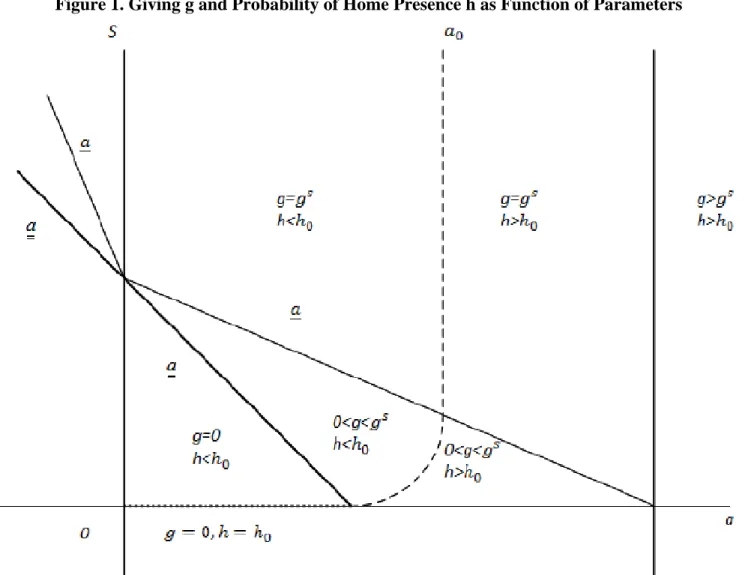
a(S)≡ ( u0(W)−S v+0(0,G−i) if u 0(W)≥S u0(W)−S v−0(0,G−i) if u 0(W)< S , a(S)≡ ( u0(W−gs)−S v+0(gs,G −i) if u 0(W−gs) ≥S u0(W−gs)−S v−0(gs,G −i) if u 0(W−gs)< S , and ¯a ≡ u0(W −gs)/v0(gs, G−i), with a(S) ≤ a(S) ≤ ¯a for a given S and a(0) = ¯a. The thresholds a(S) and a(S) can be negative for high S, while ¯a is always positive. Figure 1 illustrates the thresholds for the case of linear private utility u() and the case v+0(0) =
v−0(0), which are the assumptions used for the structural estimation. The proofs, unless stated otherwise, are in Appendix A.
Lemma 1a (Giving In Person). For any type a, there is a unique optimal donation g∗(a, S), conditional on being at home, which is weakly increasing inaand takes the form: (i)
g∗(a, S) = 0 for a≤ a(S) ; (ii) 0 < g∗(a, S) < gs for a(S) < a < a(S) ; (iii)g∗(a, S) =gs for a(S)≤a≤a¯; (iv) g∗(a, S)> gs for a >¯a.
Giving is an increasing function of the altruism parametera. When altruism is sufficiently low (case (i)), the individual does not give to the charity. For a higher level of altruism (case (ii)), the individual gives a positive amount, but less thangs. For even higher altruism (case (iii)), there is bunching of giving atg∗ =gs,which is the lowest level of giving associated with zero social pressure cost. Finally, for large enough a (case (iv)), the donor gives more than
gs. Any giving above gs is due to altruism (hence the threshold ¯a > 0 does not depend on the social pressure costS), while donations smaller thangs may be due to altruism or social pressure. Giving can occur also with spiteful agents (a < 0) if the social pressure cost S is large enough (S > u0(W) and hencea <0).
Giving Via Mail. Conditional on not being at home, a giver who was informed about the fund-raising via a flyer decides whether to give via mail gm. Note that the only reason to
give via mail is altruism. Define am ≡u0(W)/θv+0(0;G−i),witham ≥a(S) for allS.
Lemma 1b (Giving Via Mail). For any type a and provided 0 < θ < 1, there is a unique optimal donation via mail g∗m(a) (conditional on not being at home), which is weakly increasing in aand takes the form: (i)gm∗(a) = 0 for a≤am;(ii) gm∗ (a)>0 for a > am;(iii) for a≤a(S), g∗(a;S) =gm∗ (a) = 0and for a > a(S), g∗(a;S) > θgm∗ (a). In the case θ= 0, g∗m(a) = 0 for all a.
Giving via mail is increasing in altruism, provided θ > 0. The level of giving via mail received by the charity (θg∗m(a)) is always smaller than the level of giving in person conditional on being at home (g∗(a, S)) for a given altruisma.
Presence at Home. In thefirst stage, we distinguish two cases. If the visit is unantici-pated,which occurs in the No-Flyer treatment and with probability 1−rin the Flyer treatment, the giver opens the door with probability h0. If the visit is anticipated, the agent optimally chooses h given her utility from being at home, u(W−g∗) +av(g∗, G
−i)−s(g∗), and her utility from not being at home,u(W −g∗m) +av(θgm∗, G−i):
max
h∈[0,1]h[u(W −g
∗) +av(g∗, G
−i)−s(g∗)] + (1−h) [u(W −g∗m) +av(θgm∗, G−i)]−c(h). Lemma 2 characterizes the solution forh∗ as a function of the parametersaand S.
Lemma 2 (Presence at Home). For anya, there is a unique optimal probability of being at home h∗(a, S) that is weakly increasing in a. ForS = 0(no social pressure), h∗(a,0) =h0
for a ≤ a(0) and h∗(a,0) > h0 for a > a(0). For S > 0 (social pressure), there is a
unique a0(S) ∈ (a(S),¯a) such that h∗(a, S) < h0 for a < a0(S), h∗(a0(S), S) = h0, and
h∗(a, S)> h0 for a > a0(S).
The optimal probability of being at home h∗(a, S) is (weakly) increasing in altruism: the more the giver cares about the charity (or about the warm glow), the more likely she is to be at home. The exact pattern, however, depends on the degree of social pressure (Figure 1). In the case of no social pressure (S = 0), sufficiently altruistic agents, a > a(0), plan to give if at home and actively seek to be at home (h∗> h0) given that the utility of giving in person is higher than the utility of giving via mail. (Recall the assumption θ <1.) The probability of being at home is increasing in the altruism parameteraup to the corner solution h= 1.Less altruistic agents, a≤a(0), instead, do not plan to give either at home or via other channels. They are indifferent as to being at home or not, and hence do not alter the baseline probability
h0.
In the case of social pressure (S >0), agents with sufficiently low altruism, a≤a(S), do not plan to give and avoid the fund-raiser in order not to pay the social pressure cost. More altruistic agents witha(S)< a≤a0(S) give a small amount but still prefer to avoid the fund-raiser. Their giving is either entirely due to social pressure, or suboptimally high compared to their giving in the absence of social pressure. Agents with sufficiently high altruism,a > a0(S),
care enough about the charity that they seek the interaction with the fund-raiser, despite the fact that social pressure may distort their giving upward.
Opt-Out. So far we have assumed that it is costly for the agent to reduce the probability of being at home. We now allow for an ‘opt-out’ option (such as a Do-Not-Disturb check box) that costlessly reduces the probability of being at home to zero. Formally, c(0) = 0 and c(h) as above forh >0.5
Opting out does not affect the giving decisions g∗(a) (conditional on being at home) and
g∗m(a) (conditional on not being at home) characterized in Lemmas 1a and 1b. It affects, however, the probability of being at home h∗(a) of Lemma 2. The next Lemma refers to
a0(S) defined in Lemma 2. (We break ties by assuming that if the agent is indifferent between
h=h0 and h= 0,the agent will choose not to opt out, that is, h=h0.)
Lemma 3 (Opt-Out Decision). For S = 0 (no social pressure), the agent never opts out. ForS >0 (social pressure), the agent opts out for sufficiently low altruism,a < a0(S).
In the absence of social pressure, the agent has no reason to opt out, and the solution for
h∗(a) is the same as without the opt-out option. In the presence of social pressure, however, the agent opts out to avoid all cases in which the interaction with the fund-raiser lowers utility, that is, for a lower than a0(S). For higher altruism levels, the agent derives positive utility from giving and hence she does not opt out; the solution then is as in Lemma 2.
Note that opting out also allows us to distinguish social pressure from models of self- or other signaling (Benabou and Tirole, 2001; Grossman, 2009). In our model, checking the opt-out box has no cost to the agent. Under self- and other-signalling, instead, checking a do-not-disturb box can be associated with a significant cost, since this option signals avoidance of giving. If the agent has a very high opt-out cost, she will never utilize the opt-out option, and the Opt-Out treatment reduces to the simple Flyer treatment.
Testable Predictions. To complete the solution of the model, we assume that the pop-ulation of agents is heterogeneous in a, which is distributed with c.d.f. F. While we allow for any altruism distribution F and any social pressure cost S ≥ 0,to focus ideas it helps to consider two special cases: (i)Altruism and No Social Pressure (F(a(0))<1 and S = 0); (ii)
Social Pressure and Limited Altruism (S > 0, F(a0(S)) = 1,and F(a0(S))−F(a(S))>0). The first case corresponds to the standard assumption of no social pressure, but a positive share of altruistic individuals (that is, individuals with a > a(S)). The second case allows for social pressure, but assumes a zero-probability mass of sufficiently altruistic individuals, that is, individuals with a > a0(S). The assumption F(a0(S))−F(a(S)) > 0 eliminates a trivial case. We compare the predictions for the three treatments of No Flyer (N F–no notice is provided, and hence r = 0), Flyer (F–notice provided), and Opt-Out (OO–notice with 5While this formalization only allows a costless reduction ofh to 0 but not to other levels, this is not a restriction because any agent who prefers to lowerhbelowh0(at a positive cost) will strictly prefer to lowerh to 0 at no cost.
costless opting-out).
We consider first the probability of being at home in the No-Flyer (NF), Flyer (F), and Opt-Out (OO). Lemma 2 implies that these probabilities are
P(H)N F =h0, P(H)F = (1−r)h0+r Z ∞ −∞ h∗(a, S)dF, P(H)OO= (1−r)h0+r Z ∞ aOO h∗(a, S)dF,
whereaOO=−∞ forS= 0 and aOO=a0(S) for S >0.
Proposition 1. With Altruism and No Social Pressure, the probability P(H) is higher with flyer than without: P(H)F = P(H)OO > P(H)N F. With Social Pressure and Limited Altruism, P(H) is lower with flyer and lowest with opt-out: P(H)N F > P(H)F ≥P(H)OO. Proof. We start from comparing P(H)F and P(H)OO. For S = 0, aOO=−∞and hence
P(H)F = P(H)OO. For S > 0, P(H)F ≥ P(H)OO follows from h∗(a, S) ≥ 0. We turn to comparing P(H)N F and P(H)F, which depends on h0 ≷
R∞
−∞h∗(a, S)dF. In the case of Altruism and No Social Pressure, h∗(a;S) =h0 for a≤ a0(0) = a(0) andh∗(a, S) > h0 for
a > a0(0) = a(0) (Lemma 2 for S = 0). Given 1−F(a(0)) > 0, this implies P(H)F >
P(H)N F. In the case of Social Pressure and Limited Altruism, h∗(a, S) < h0 for a < a0(S) (Lemma 2 forS >0). Given F(a0(S)) = 1, this implies P(H)N F > P(H)F.
In the case of Altruism and No Social Pressure, the flyer increases the presence at home relative to the control group since the agent seeks to meet the solicitor. The opt-out option has no differential effect since no one avoids the solicitor. Under Social Pressure and Limited Altruism, the opposite is true: the flyer lowers the presence at home, as agents seek to avoid the fund-raiser. In this case, the opt-out possibility lowers the presence at home further, as it makes the avoidance costless.6 In the case in which both altruism and social pressure are present, the probability of being at home is higher for theflyer group if the altruism force dominates the social pressure force, but the opt-out option always lowers the presence at home. The next Proposition illustrates the impact of the different treatments on the unconditional probability of in-person giving, P(G), in the No-Flyer (NF), Flyer (F), and Opt-Out (OO) treatments. Lemma 1a implies that these probabilities are
P(G)N F = [1−F(a(S))]h0 P(G)F = (1−r)[1−F(a(S))]h0+r Z ∞ a(S) h∗(a, S)dF P(G)OO= (1−r)[1−F(a(S))]h0+r Z ∞ a0(S) h∗(a, S)dF
6A sufficient (not necessary) condition for the inequalityP(H)
F ≥P(H)OO to be strict is a positive mass
Proposition 2. With Altruism and No Social Pressure, the probability P(G) is higher with flyer than without: P(G)F = P(G)OO > P(G)N F. With Social Pressure and Limited Altruism,P(G) is lower with flyer and lowest with opt-out: P(G)N F > P(G)F ≥P(G)OO.
Proof. We start from comparing P(G)F and P(G)OO. Because h∗(a, S) ≥ 0 for all a and a0(S) ≥ a(S), P(G)F ≥ P(G)OO follows, with P(G)F = P(G)OO for S = 0 (given
a0(0) =a(0)). We turn to comparingP(G)N F andP(G)F,which depends onh0[1−F(a(S))]≷
R∞
a(S)h∗(a, S)dF. In the case of Altruism and No Social Pressure, h∗(a,0) > h0 for a >
a0(0) =a(0) (Lemma 2 for S= 0). Given 1−F
¡
a(0)¢>0, this implies P(G)F > P(G)N F. In the case of Social Pressure and Limited Altruism, given F(a0(S)) = 1, the inequality becomesh0[F(a0(S))−F(a(S))] ≷
Ra0(S)
a(S) h∗(a, S)dF which, using F(a0(S))−F(a(S))>0 and h∗(a, S)< h0 fora < a0(S) (Lemma 2 forS >0), impliesP(H)
N F > P(H)F.
Under Altruism and No Social Pressure, theflyer and opt-out treatments lead to the same probability of giving, since there is no reason to use the opt-out option in the absence of social pressure. The probability of giving in these flyer treatments is higher than in the no-flyer treatment, since some agents seek opportunities to stay at home. Under Social Pressure and Limited Altruism, instead, the probability of giving is higher in the no-flyer treatment than in theflyer treatment, and even lower in the opt-out treatment. In general, if both altruism and social pressure are present, the net effect of aflyer depends on whether the giving is more due to real altruism (which works to increase giving) or to social pressure (which has the opposite effect).
The third result on charitable giving, summarized by Proposition 3, regards the probability of giving conditional on opening the door.
Proposition 3. The probability of giving conditional on being at home, P(G|H), is higher in the Flyer (F) and Opt-Out (OO) treatment than in the No-Flyer (NF) treatment:
min (P(G|H)F, P(G|H)OO)≥P(G|H)N F .
Altruism and social pressure both lead to increases in the conditional probability of giving withflyer: altruistic people are more likely to be home, and non-givers sort away from home. Hence, conditionally on reaching an agent who is home, giving is higher with theflyer (simple or with opt-out option) than without.
The next proposition focuses on gift size. We distinguish between large donation, defined asg > gs, and small donations, g≤gs.
Proposition 4. (i) The unconditional probability of a large donation, P(GHI), satisfies
P(GHI)F =P(GHI)OO ≥P(GHI)N F (with strict inequality if F(¯a) <1). (ii) The uncondi-tional probability of a small donation, P(GLO),satisfies P(GLO)F =P(GLO)OO if S = 0and
P(GLO)F > P(GLO)OO if S >0 and F(a0(S))−F(a(S))>0.
A flyer (with or without opt-out option) increases large donations given that altruistic donors increase their probability of being at home. The impact of a flyer on small donations
is less obvious since small donations can reflect moderate altruism or social pressure. Aflyer with opt-out unambiguously lowers the probability of small donations relative to a simpleflyer, given that it simplifies the sorting out of donors motivated by social pressure.
Next, we consider the impact of the treatments on the probability of giving via mail. Proposition 5. The unconditional probability of a donation while not at home P(Gm) satisfies 0 =P(Gm)N F ≤P(Gm)F ≤P(Gm)OO.
The giver never gives by mail when she can give in person. As a consequence, in the No-Flyer condition, giving via mail is zero, since the giver is only informed about the fund-raiser if she is at home. In the Flyer and Opt-Out treatments, however, the giver receives a notice of the fund-raiser and hence may give even if not at home, so long as their altruism parameter
a is above am. Giving via mail is at least as high under the Opt-Out condition than in the Flyer condition because some of the individuals that opt out because they would have given too much in person give a smaller amount via mail.
Survey. In addition to donation requests, we also analyze the response to survey requests, varying again prior notice (flyer versus no flyer) as well as the pay and the duration. The purpose of these treatments is to structurally estimate the underlying social pressure and altruism parameters. In Section 5, we will use two parametric assumptions: (i) quadratic cost of avoidancec(h) = (h−h0)2/2η and (ii) linear private utility of consumptionu(x) =x. We denote bySS the social pressure cost of saying no to a request of survey completion.
We assume that consumers have a baseline utilitys of completing a 10-minute survey for no monetary payment. The parameterscan be positive, if individuals are happy to contribute to surveys, or negative, if they dislike surveys. In addition, individuals receive utility from a paymentmfor completing the survey, and receive disutility from the time cost tof the survey. Given the assumption of (locally) linear utility, we can add these terms to obtain the overall utility from completing a survey: s+m−t. We assume that the willingness to complete a surveysis distributed s∼FS, while m andt are deterministic.
The agent undertakes the survey if s+m−t is larger than −SS. The threshold ¯sm,tS = −SS−(m−t) is the lowest level ofssuch that individuals will accept to complete the survey if asked. An increase in the social pressure SS or in the pay m, or a decrease in the cost of time t will lower the threshold and hence increase the probability of survey completion. We can write the decision problem of staying at home conditional on receiving a notice as
max h∈[0,1]hmax ¡ s+m−t,−SS¢−(h−h0) 2 2η .
Taking into account corner solutions for h∗, this leads to a solution for the probability of being at home: h∗ = max£min£h0+ηmax¡s+ (m−t),−SS¢,1¤,0¤. In Section 5, we com-bine insights gained from the fund-raising and survey solicitations to obtain estimates of the underlying parameters of the model.
3
Experimental Design
Charities. The two charities in the fund-raising treatments are La Rabida Children’s Hospital and the East Carolina Hazard Center (ECU). While both charities are well-respected regional charities, we chose them so that most households in our sample would prefer one (La Rabida) to the other (ECU). To document these preferences, we included two questions in our survey treatments. Thefirst question asks survey respondents to rankfive charities, with rank coded as a number from 1 (least liked) to 5 (most liked). The charity with the highest average rank is the La Rabida Children’s Hospital (average rank 3.95) followed by Donate Life (rank 3.79), the Seattle Children’s Hospital (rank 3.47). At the bottom of the rank, below the Chicago Historical Society (rank 2.96), is the East Carolina Hazard Center (rank 2.54). We obtain similar results when we ask the respondents to allocate $1 that ‘an anonymous sponsor has pledged to give’ to one of the five charities.7 Out of 255 respondents, 147 pledge the donation to the La Rabida charity, and only 7 choose the ECU charity. La Rabida appears to be highly liked both because it is an in-state charity well-known to residents in the area around Chicago, and also because it provides health benefits to children. ECU appears to be least liked both because of its out-of-state status and because of its mission.
Door-To-Door Fund-Raising. Our experiment uses a door-to-door campaign because it offers the easiest implementation of the advance notice treatment. While door-to-door campaigns are common and previously studied in economics (Landry et al., 2006), it is hard to quantify how much money they raise. To provide some evidence, our survey asked respondents to recall how many times in the past 12 months people have ‘come to your door to raise money for a charity.’ We asked similarly phrased questions about giving via phone, via mail, and ‘through other channels, such as employer or friends.’ Of 177 respondents who answered these questions, 73 percent stated that they had received at least one such visit, and 46 percent of respondents reported at least three such visits. This frequency is smaller than, but comparable in magnitude to, other solicitation forms: phone (84 percent received at least one call), mail (95 percent with at least one mailing) and other forms (85 percent with at least one contact). We also asked how much the respondents gave to these solicitors in total over the last 12 months. Of all the respondents, 40 percent reported giving a positive amount to a door-to-door campaign, compared to 27 percent giving in response to phone, 53 percent in response to mail, and 76 percent in response to other solicitations. The average reported total door-to-door donation in the past 12 months (including non-donors) is $26, compared to $89 by phone, $897 by mail, and $1,867 by other means. However, this estimate is very sensitive to a small number of individuals reporting large sums given (in two cases $50,000 and $60,000) which could be due to measurement error or self-aggrandizing claims. If we cap the donations at $1,000, the numbers are $26 by door-to-door, $59 by phone, $114 by mail, and $283 by other
means. Hence, door-to-door solicitations are quite common, at least in the area where the survey took place, and they raise a smaller, but not negligible, amount of money.
Logistics. We employed 92 solicitors and surveyors, mostly undergraduate students at the University of Chicago, who were paid $9.50 per hour. All solicitors elicited contributions within at least two treatments, and most over multiple weekends, and similarly for surveyors. Each solicitor and surveyor’s participation in the study typically followed four steps: (1) an invitation to work as a paid volunteer for the research center, (2) an in-person interview, (3) a training session, and (4) participation as a solicitor and/or surveyor in the door-to-door campaign. Details about the recruitment process are in Appendix B.
Thefield experiment took place on Saturdays and Sundays between April 2008 and October 2008 (both charity and survey treatments) and then again between April 2009 and November 2009 (survey treatments). The locations are wealthy towns around Chicago,8 with average household income from the 2000 Census of around $100,000.
We reached a total of 8,906 households in the charity treatments, 2,018 households in the 2008 survey treatments, and 10,594 households in the 2009 survey treatments. From this initial sample, we exclude 1,391 observations in which the households displayed a no-solicitor sign (in which case the solicitor did not contact the household) or the solicitor was not able to contact the household for other reasons (including for example a lack of access to the front door or a dog blocking the entrance). We also exclude 559 solicitor-day observations for 5 solicitors with substantial inconsistencies in the recorded data.9 Thefinal sample includes 7,668 households in the charity treatments, 1,865 households in the 2008 survey treatments, and 10,035 households in the 2009 survey treatments.
The randomization of the treatments takes place for each solicitor-hour and is at the street level within a town. Each solicitor is assigned a list of typically 25 households per hour, for a daily workload of either 4 hours (10am-12pm and 1-3pm) or 6 hours (10am-12pm and 1-5pm). Every hour, the solicitor moves to a different street in the neighborhood and typically enters a different treatment. Solicitors do not know whether a treatment involves aflyer, though they can presumably learn that information from observing flyers on doors. Solicitors are trained to either do charity treatments or survey treatments. A solicitor assigned to La Rabida on a given day will only do treatments for La Rabida, and similarly for ECU or survey.
Treatments. In the treatments withoutflyer, solicitors knock on the door or ring the bell and, if they reach a person, proceed through the script (see Appendix C). They inform the household about the charity (La Rabida or ECU), ask if they are willing to make a donation, and if they receive a gift leave a receipt. In the survey treatment, the solicitor inquires whether
8
Burr Ridge, Countryside, Flossmoor, Kenilworth, Lemont, Libertyville, Oak Brook, Oak Forest, Oak Park, Orland Park, Park Ridge, Rolling Meadows, Roselle, Schaumburg, Skoke-Evanston, and Willowbrook.
9
Thesefive solicitors indicate the presence offlyers on the door or on the floor also for households in the no-flyer treatment.
the household member is willing to respond to survey questions about charitable giving. The solicitor informs the household member about the duration of the survey (5 or 10 minutes) and about the payment for the survey, if any ($10, $5, or none).
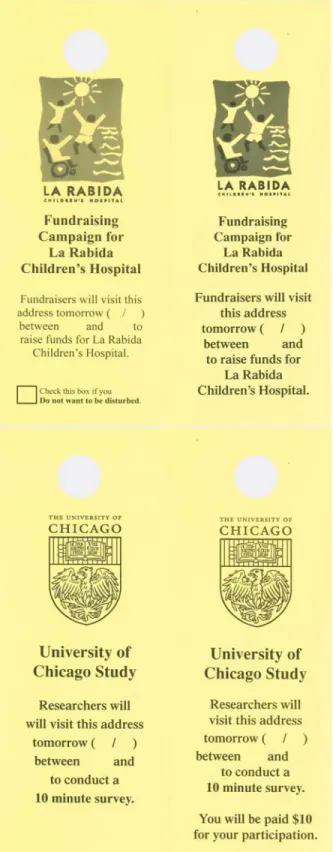
In theflyer treatments, the solicitor’s script is identical, but in addition a different solicitor leaves aflyer on the door knob on the day before the solicitation. The professionally prepared
flyer indicates the time of the upcoming fund-raising (or survey) visit within a one-hour time interval. Figure 2 provides examples of twoflyers used for the fund-raising treatment and two
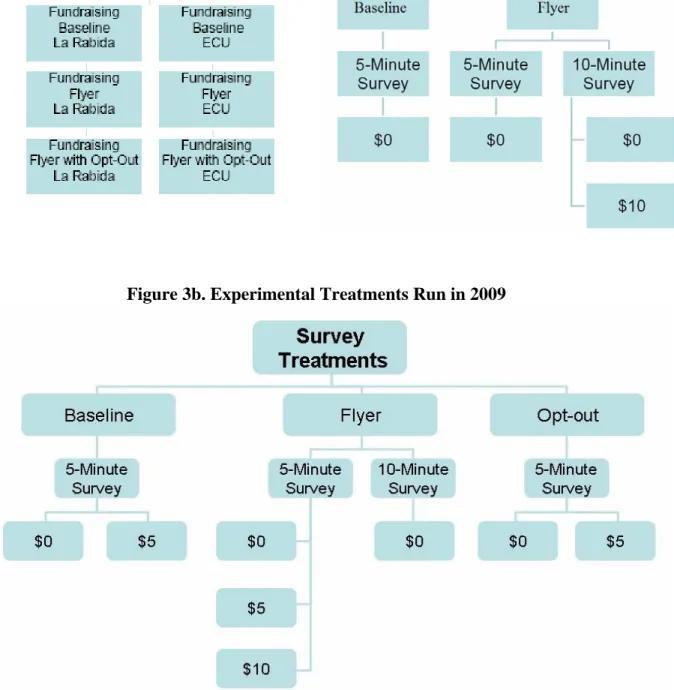
flyers used for the 2008 survey treatments.10 In the opt-out treatments, the flyer has a box ‘Check this box if you do not want to be disturbed.’ If the solicitorsfind the box checked, they do not knock on the door. The charity treatments are summarized in Figure 3a.
The survey treatments are aimed at estimating the elasticity of the presence at home and of the response rate to incentives. In Section 5, we use these elasticities to estimate the social pressure and altruism parameters. The survey questions are mostly about patterns of charitable giving in 2008 and about voter participation in 2009.11 Figure 3a summarizes the survey treatments run in 2008 and Figure 3b the survey treatments run in 2009.
4
Reduced-Form Estimates
We report the differences across the treatments in the share of households answering the door, the empirical counterpart of P(H), and the share of households giving to the charity in person, corresponding toP(G). We also present results on giving conditional on being at home, corresponding toP(G|H), on the frequency of small and large donations,P(GLO) and
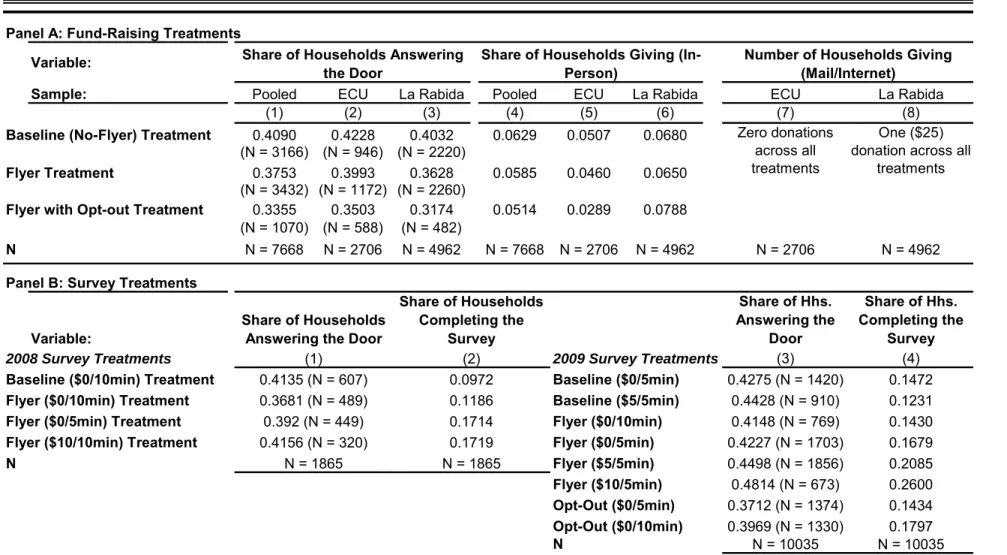
P(GHI), and on giving via mail and Internet,P(Gm). We then turn to the survey treatments. Table 1 presents the summary statistics on the key treatment outcomes. The rate at which the respondents open the door varies between 41 and 42 percent in the Baseline treatments for La Rabida, ECU, and in the 2008 survey treatment. Since households did not know the task at hand, these averages ought, indeed, to be close. The share answering the door is smaller for the Flyer treatment and smaller yet for the Opt-Out treatment. The share of givers is substantially smaller for the ECU charity than for the La Rabida charity, consistent with our survey evidence that the La Rabida charity is more liked than the ECU charity. For ECU, the share of givers is substantially lower in the Opt-Out treatment than in the other treatments. For La Rabida, instead, giving is somewhat higher in the Opt-Out treatment. In the survey treatments, the share opening the door and the share completing the survey are generally
10
For a small number of observations, theflyer does not indicate the exact time of the visit, but only that there will be a visit in the next two weeks. Results for this sub-group are qualitatively similar to the results for theflyer with the one-hour interval of visit. We therefore present the results combining these treatments. Excluding the observations with the two-week window does not change any of the results.
11
In the 2009 survey treatments, about half of theflyers specify that the survey will be ‘about voter partici-pation.’ The results are similar for the two types offlyers and hence we pool them in the analysis.
larger for the treatments with higher pay and shorter duration both in 2008 and 2009.
While the summary statistics provide suggestive evidence on the impact of the treatments, the raw statistics are potentially confounded with randomizationfixed effects. As discussed in Section 3, treatments were randomized within a date-solicitor time block, but not all treatments were run in all time periods. Hence, estimates that do not control for the randomizationfixed effects may be confounded, for example, by time effects–we ran more La Rabida treatments earlier in the sample when donation rates also happened to be higher. It turns out that all directional effects indicated in the summary statistics, except for the higher giving to La Rabida under Opt-Out, are confirmed once we add the randomizationfixed effects.
We now present the benchmark empirical specification which controls for solicitor i and day-townt fixed effects.12 As such, the identification comes from within-solicitor, within-day variation in treatment. The vector of control variables Xi,t,h includes (i) six dummies for the hourly time blocksh starting at 10am, 11am, 1pm, 2pm, 3pm, and 4pm; (ii) dummies for a subjective rating by the solicitor of the quality of the houses visited in that hour block on a 0-10 scale. The latter control provides a rough measure of the wealth level of a street not captured by the townfixed effects. We run the OLS regression
yi,j,t,h=α+ΓTi,t,h+βECUdECU+ηi+λt+BXi,j,t,h+εi,j,t,h (2) where the dependent variable yi,j,t,h is, alternatively, an indicator for whether individual j opened the door (yH), gave a positive amount to the charity (yG), gave a small amount (yGLO), or gave a large amount (yGHI). The vector T
i,t,h contains indicators for the various fund-raising treatments, with the baseline No-Flyer treatment for La Rabida as the omitted group. As such, the point estimates for Γ are to be interpreted as the effect of a treatment compared to the Baseline.13 We cluster the standard errors at the solicitor×date level.
We also estimate the impact of the fund-raising treatment separately for the two types of charities (ECU and La Rabida), using the following OLS regression model:
yi,j,t,h=α+ΓLaRTi,t,hdLaR+βECUdECU+ΓECUTi,t,hdECU+ηi+λt+BXi,j,t,h+εi,j,t,h (3) wheredchis an indicator variable for charitych∈{LaR, ECU}.The omitted treatment is the No-Flyer Treatment for La Rabida. In Figures 4a-4b, we plot the estimated coefficients from this specification. The estimated impact for the Baseline No-Flyer treatment for La Rabida is 12On almost all days, we visited only one town, so that the day-townfixed effects are essentially equivalent to dayfixed effects.
13The specification assumes that the impact of thefixed effects on the relevant outcomes is additive. We obtain essentially identical results using solicitor-time-datefixed effects. These fixed effects, however, do not allow us to identify the difference in outcomes between La Rabida and ECU, since on any given date each solicitor raised money for only one charity.
ˆ
α, estimated from specification (3) with no fixed effects and controls. The estimated impact for the other treatmentsk are ˆα+ ˆγLaRk for La Rabida and ˆα+ ˆβ+ ˆγECUk for ECU.
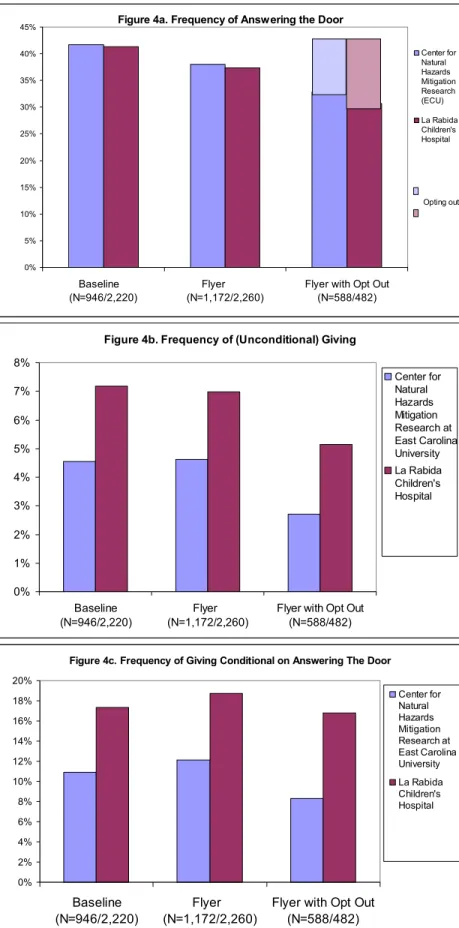
Answering the Door. Figure 4a presents the results on the probability the household opens the door for the La Rabida and the ECU solicitor. For both charities, a flyer on the door knob announcing the visit reduces the share of households opening the door by about 4 percentage points relative to the Baseline treatment with no flyer. As Table 2 shows, the difference is statistically significant at conventional levels. The share of households opening the door is further lowered, by an additional 5 to 6 percentage points, by the presence of an opt-out condition (‘Check this box if you do not want to be disturbed’) on theflyer. Hence, the Flyer and the Opt-Out conditions lower the probability of opening the door by, respectively, 10 percent and 25 percent, an economically large effect that is similar for both charities. We interpret this evidence as suggestive of social pressure: when informed of a visit by a solicitor, households attempt to avoid the interaction, especially when doing so has little cost, as in the Opt-Out treatment. Notice that the reduction in the probability of opening the door in the presence of a flyer can be due to two factors: a lower probability of being at home, or a lower probability of opening the door conditional on being at home. The variable we measure captures the sum of these two effects.
Opting Out. Figure 4a also presents evidence on the share of subjects in the Opt-Out treatment that check the Opt-Out box: 12 percent of all households for the La Rabida charity and 9.9 percent for the ECU charity. Households that, in the Flyer treatment, are explicitly avoiding the solicitor by not answering the door, instead use the Opt-out option when available. This result is consistent with the assumption that checking the opt-out box is a cheaper way to avoid a solicitor.
Unconditional Giving. Figure 4b present the results on the unconditional giving prob-ability, including households that do not answer the door. Not surprisingly, giving is higher for the preferred charity, La Rabida, than for ECU in each treatment. The pattern of effects across treatments is similar for the two charities. The Baseline and the Flyer treatments have essentially the same share of giving. The lack of a difference between these treatments is estimated quite precisely because we overweighted the Baseline and Flyer treatments. The Opt-Out treatment, instead, lowers giving by 2 percentage points for both charities. This difference is statistically and economically significant (see Table 2): the effect amounts to a reduction in giving of about a third relative to the other treatments.
Thefirst result–that theflyer per se does not affect giving–is consistent with both social pressure and altruism affecting charitable giving. The advance notice increases the presence at home of the altruistic givers and lowers the presence of those who give due to social pressure. To the extent that these two forces have about the same size, we expect no overall impact. Note that this result does not contradict our previousfinding that theflyer significantly reduces the share of households opening the door. In the presence of social pressure costs, non-givers also
avoid being at home when notified with aflyer. This avoidance does not impact the probability of giving, but it lowers home presence.
The second result–that the opt-out option significantly lowers giving–points to the im-portance of social pressure: in the Opt-Out treatment the cost of avoiding the fund-raiser is substantially lowered, and giving decreases proportionally. If giving was primarily due to altruism, the opt-out option should not affect giving rates or levels.
Conditional Giving. Figure 4c presents the results for giving, conditional on answering the door. The conditional giving for each treatment is the estimated unconditional giving, Figure 4b, divided by the estimated share of households answering the door, Figure 4a. For both charities, conditional giving is higher in the treatments with flyer than in the Baseline treatment. This increase is consistent with Proposition 3 since the flyer allows sorting in by donors who want to give and sorting out by those who do not want to give. In the Opt-Out treatment, however, conditional giving is lower. This effect is inconsistent with Proposition 3, though not statistically significant at conventional significance levels.
Amount of Giving. In our model, individuals who give due to social pressure give at mostgS, while individuals who give due to altruism may contribute higher amounts. Hence, relative to the control treatment, the Flyer treatment may both decrease smaller donations (sorting out of social-pressure givers) and increase larger donations (sorting in of altruists). The Opt-Out treatment, which further facilitates sorting out but not sorting in, should lower the share of small donations but not the share of larger donations (Proposition 4).
To test these predictions, we split donations based on the median amount given, $10, and label donations smaller than (or equal to) $10 as small and donations larger than $10 as large. Figure 5a presents the results. In the Baseline treatment, 4 percent of households give small donations, and 2 percent give large donations. The percentage giving a small donation decreases slightly in the Flyer treatment and decreases by 2.1 percentage points in the Opt-Out treatment. Hence, the opt-out option more than halves the likelihood of a small donation, a significant difference as shown in Table 2. The pattern is very different for large donations. The flyer somewhat increases the incidence of larger donations, though not significantly, and the opt-out option has no effect. This pattern is consistent with Proposition 4.
Figure 5b presents additional information on the distribution of the amount given across treatments. The Opt-Out treatment, compared to the Baseline treatment, induces a decrease in the donations up to $10, but a modest increase for larger donations. The histogram also provides evidence of bunching at $5 and $10. In the structural model, we use this information and consider $10 as the amount that eliminates all social pressure from not giving, gs.
Finally, in Column (7) of Table 2 we consider the effect of the different treatments on the amount given. There is no significant effect of the Flyer treatment, and a marginally significant reduction in giving with the Opt-Out treatment.
from the households in our sample over the time period of the fund-raising campaign. The results are reported in Columns (7) and (8) of Table 1. There was not a single donation to ECU, and only one donation to La Rabida — a striking difference to the 3 to 7 percent of households donating in person for the same charities. The near absence of donations provides further evidence on the motivations of giving. If giving was due to pure altruism, individuals who see the flyer but cannot be at home during the fund-raiser would donate via mail or Internet. The cost of this form of giving (captured byθ in our model) attenuates giving, but not likely to zero. A model of warm glow can betterfit the data if we assume that the warm glow arises only from in-person donations (i.e.,θis close to zero). The lack of mail or Internet donations is also consistent with social pressure: giving arises only under high social pressure. Financial Crisis. While a majority of our solicitations took place from May to August 2008, 22 percent date from September and October 2008, the peak of thefinancial crisis. While variation between the two periods is obviously not experimental since other factors can differ, it is still interesting to consider the heterogeneity of treatment effects.
Thefinancial crisis did not impact the share of households that open the door in the different treatment, but it lowered giving substantially (Columns (7) and (8) in Table 2), in the Baseline treatment from 7 percent to 3 percent. Giving in the Opt-Out treatment does not decrease as much. These results are consistent with the crisis reducing giving due to altruism, since it increases the marginal utility from private consumption, or due to social pressure, since it lowers the social pressure cost of turning away a solicitor (‘sorry, times are tough’).
Survey. For the survey treatments, we estimate a specification parallel to equation (2), separately for the 2008 and the 2009field experiments. In the 2008 experiments (Figure 6a and Column (1) of Table 3), a flyer announcing a $0-10-minute survey reduces the share opening the door by 15 percent (though not significantly), compared to the same survey without flyer. In addition,flyers for more attractive surveys with either shorter duration (5 minutes) or higher payment ($10) lead to a 10 to 15 percent increase in the share of households opening the door, indicating that households sort into shorter and better-paid surveys, though the difference is again not significant.
The share completing the survey is comparable (about 10 percent) for the $0-10-minute conditions with and without flyer (Figure 6a and Column (2) of Table 3). Interestingly, the willingness to complete an unpaid 10-minute survey is higher than the willingness to give money even to an in-state charity. Also, compared to the $0-10-minute survey withflyer, surveys with shorter duration or payment have a higher completion rate of 17-18 percent, a 70-80 percent increase. The increase is very similar for the two groups, indicating a high value of time for survey completion, consonant with the sample population characteristics discussed above.
Figure 6b and Columns (3) and (4) of Table 4 report the results for the 2009 survey. Within the treatments withflyer, the share answering the door is increasing in the amount paid (from $0 to $5 to $10). In addition, the share answering is significantly lower for the treatments
with opt-out, especially the treatment with no payment. These findings are consistent with the findings for 2008 and confirm a sizeable responsiveness of the presence at home to the attractiveness of the task.
The 2009 treatments also indicate a strong response of survey completion with respect to duration and payment. The survey completion rate in treatments with flyer increases monotonically from 14.8 percent for a $0-10-minute survey to 25.5 percent for a $10-5-minute survey. The latter completion rate is remarkably high: over 50 percent of the people opening the door took the survey. There is a similar increase of survey completion with respect to payment in the Opt-Out treatments, though not in the treatments withoutflyer.
5
Structural Estimates
The reduced-form estimates provide qualitative evidence on the importance of both altruism and social pressure, but they do not allow for a quantitative estimate of the underlying social preferences. We now estimate the model parameters structurally, combining the results of the fund-raising and the survey experiments.
Set-up. We use the model of Section 2, imposing six additional assumptions: First, the private utility of consumption is linear, u(W−g) = W −g. This assumption is not unduly restrictive since utility should be locally linear in a standard expected utility framework. Second, we set the altruism function
v(gi, G−i) = (
log (G+gi) for a≥0
egi/G for a <0,
a function that is increasing and concave in givinggi for positive altruismaand decreasing and concave in gi for spite.14 The parameterGgoverns the concavity of the altruism function for
a >0: a largeGimplies that the marginal utility of giving, given bya/(G+gi), declines only
slowly in the individual givinggi,consistent with pure altruism—the individual cares about the overall donation and her individual giving is only a small part. A small G instead indicates that the marginal utility diminishes steeply with the individual giving, more consistent with warm glow. Third, the altruism parameterais normally distributed, with meanμand variance
σ2. Fourth, the level of giving gS from which on there is no social pressure cost is $10, the median donation. Fifth, the cost of leaving homec(h) is symmetric aroundh0 and quadratic:
c(h) = (h−h0)2/2η. Sixth, to capture the observed lack of giving by mail, we set θ= 0. The vector of parameters ξ that we estimate are: (i) h20080 and h20090 —the probabilities of opening the door in the 2008 and 2009 no-flyer treatments; (ii)r—the probability of observing 14The exact specification of the altruism function for a < 0 is largely immaterial. As long as the social pressure costS is smaller than $10, individuals with negative altruisma will never give, and hence the shape of the utility forgi>0 does not matter. The current formulation has the property that the marginal utility of
(and remembering) theflyer; (iii)η—the responsiveness in adjusting the probability of opening the door to changes in the utility of being at home; (iv)μS—the mean of the distributionFS of the utility of completing a 10-minute survey; (v)σS—the standard deviation of the distribution
FS; (vi) vS—the value of one hour of time spent completing a survey; (vii) SS–the social pressure associated with saying no to the survey request; (viii) μcha (where ch= LaR, Ecu)— the mean of the distribution F from which the altruism parameter ais drawn; (ix) σach (with
ch = LaR, Ecu)—the standard deviation of the distribution F; (x) G—the curvature of the
altruism function, which is assumed to be the same for the two charities; (xi) Sch (ch =
LaR, Ecu)—the social pressure cost associated with a donation request. For convenience, the
tables display the social pressure cost associated with giving zero,SgS = 10S.
To estimate the model, we use a minimum-distance estimator. Denote bym(ξ) the vector of moments predicted by the theory as a function of the parametersξ, and by ˆmthe vector of observed moments. The minimum-distance estimator chooses the parameters ˆξ that minimize the distance (m(ξ)−mˆ)0W(m(ξ)−mˆ), where W is a weighting matrix. As a weighting matrix, we use the diagonal of the inverse of the variance-covariance matrix. In this case, the estimator minimizes the sum of squared distances, weighted by the inverse variance of each moment.15 As a robustness check, we also use the identity matrix as weight. While a part of the model is solved analytically, we compute numerically a0, ah∗=0 and ah∗=1 using a hybrid bisection-quadratic interpolation method, pre-implemented in Matlab as the fzero
routine.16 To calculate the theoretical moments for the probability of opening the door and the probability of giving, we use a numerical integration algorithm based on adaptive Simpson quadrature, implemented in Matlab as thequad routine.
As moments m(ξ) to identify the model we use the following probabilities (where j =
F, N F, OO and ch= LaR, Ecu): (i) the probability of opening the door in the various
char-ity treatments (P(H)chj ); (ii) the probability of checking the opt-out box in the Opt-Out treatment (P(OO)chOO); (iii) the unconditional probability of giving in the various charity treatments (P(G)chj ); (iv) the probability of giving an amount of money in different ranges (P(0< G <10)chj ,P(G=gs = 10)chj ,P(10< G≤20)chj ,P(20< G≤50)chj , andP(G >50)chj ); (v) the probability of opening the door in the various survey treatmentsk(with varying dollar amounts, minutes, andflyer conditional), P(H)Sk, run in 2008 and in 2009; (vi) the uncondi-tional probability of completing the survey in the various survey treatments,P(SV)Sk, run in 2008 and in 2009; and (vii) the probability of checking the opt-out box in the survey Opt-Out treatments (P(OO)Sk). The corresponding empirical moments ˆmare estimated in a first stage model using the same controls as in the main regressions, and are listed in Appendix Table 1. 15Given the large number of moments, weighting the estimates by the inverse of the full variance-covariance matrix is problematic computationally.
16The parametersa
h∗=0 andah∗=1are the threshold values of altruism at which a household optimally sets the probability of answering the door to 0 and 1, respectively.