GRADING PRACTICES AND MINDSET DEVELOPMENT: THE GROWTH OF BOTH by
JULIE THIELE
B.S., Kansas State University, 2004 M.A., University of Northern Iowa, 2009
AN ABSTRACT OF A DISSERTATION
submitted in partial fulfillment of the requirements for the degree
DOCTOR OF PHILOSOPHY
Department of Curriculum and Instruction College of Education
KANSAS STATE UNIVERSITY Manhattan, Kansas
Abstract
This study examined the impact grading policies have on students’ mindsets in urban Midwestern middle schools. The components of this quasi-experimental, causal comparative survey research relied on the grading policies in place at the school level and the students’ reporting of their mindset. Data was collected using a questionnaire containing eight Likert-type questions from the Implicit Theories of Intelligence scale (Dweck, 2006), as well as additional questions seeking the students’ perceptions of grading practices implemented in their buildings. Descriptive statistics, frequencies, t-tests and ANOVA tests were run measuring the impact that a variety of perceived grading practices had on students’ mindset levels.
The findings from the research demonstrated no statistically significant differences between the mindset levels of students from schools with different grading policies. Further analysis revealed inconsistencies between student perceptions of the grading practices and the schools’ actual stated grading policies. It appears standards based and traditional grading
practices, although specifically stated at the building level, appear to have blended together in the large school district, which may have led to the inconclusive results. Of significance was the finding that students perceived to understand the meaning of their grade, even if it is misaligned with the schools’ policy, reported a growth mindset in comparison to students that reported they did not understand their grade. These findings begin to explore the impact grading practices have on students, especially during the transition from traditional to standards based grading.
Further research is needed to fully examine the transition between grading practices and students’ perceptions of those policies. When students’ perceptions of the standards based grading policy do not align with the actual policy, it is assumed that it will have no impact on students’ mindset levels. Future research would seek to understand ways in which educators
making a transition from traditional to standards based grading can seek clarity of policies, seek accuracy of implementation and monitor students’ perceptions in alignment with the policies and practices.
GRADING PRACTICES AND MINDSET DEVELOPMENT: THE GROWTH OF BOTH by
JULIE THIELE
B.S., Kansas State University, 2004 M.A., University of Northern Iowa, 2009
A DISSERTATION
submitted in partial fulfillment of the requirements for the degree DOCTOR OF PHILOSOPHY
Department of Curriculum and Instruction College of Education
KANSAS STATE UNIVERSITY Manhattan, Kansas
2016
Approved by: Major Professor Dr. Sherri Martinie
Copyright
JULIE THIELEAbstract
This study examined the impact grading policies have on students’ mindsets in urban Midwestern middle schools. The components of this quasi-experimental, causal comparative survey research relied on the grading policies in place at the school level and the students’ reporting of their mindset. Data was collected using a questionnaire containing eight Likert-type questions from the Implicit Theories of Intelligence scale (Dweck, 2006), as well as additional questions seeking the students’ perceptions of grading practices implemented in their buildings. Descriptive statistics, frequencies, t-tests and ANOVA tests were run measuring the impact that a variety of perceived grading practices had on students’ mindset levels.
The findings from the research demonstrated no statistically significant differences between the mindset levels of students from schools with different grading policies. Further analysis revealed inconsistencies between student perceptions of the grading practices and the schools’ actual stated grading policies. It appears standards based and traditional grading
practices, although specifically stated at the building level, appear to have blended together in the large school district, which may have led to the inconclusive results. Of significance was the finding that students perceived to understand the meaning of their grade, even if it is misaligned with the schools’ policy, reported a growth mindset in comparison to students that reported they did not understand their grade. These findings begin to explore the impact grading practices have on students, especially during the transition from traditional to standards based grading.
Further research is needed to fully examine the transition between grading practices and students’ perceptions of those policies. When students’ perceptions of the standards based grading policy do not align with the actual policy, it is assumed that it will have no impact on students’ mindset levels. Future research would seek to understand ways in which educators
making a transition from traditional to standards based grading can seek clarity of policies, seek accuracy of implementation and monitor students’ perceptions in alignment with the policies and practices.
Table of Contents
List of Figures ... x List of Tables ... xi Acknowledgements ... xii Dedication ... xiii Chapter 1 - Introduction ... 1 Chapter Overview ... 2Traditional Grading Practices ... 2
Standards Based Grading Practices ... 3
Mindsets – Growth and Fixed ... 4
Theoretical Framework ... 5
Statement of the Problem ... 8
Research Purpose ... 9
Research Questions ... 9
Significance of the Study ... 9
Limitations of the Study ... 11
Operationalization of Terms ... 12
Chapter Summary ... 13
Chapter 2 - Literature Review ... 15
History of Grading Practices ... 15
Concerns with Grades ... 20
Purposes of Grades ... 24 Interpretation of Grades ... 27 Impact on Students ... 29 Mindset Development ... 31 Chapter Summary ... 35 Chapter 3 - Methodology ... 36
Research Questions and Hypotheses ... 36
Research Design ... 37
Sampling Techniques ... 41
Data Collection ... 44
Data Analysis ... 45
Reliability and Validity ... 46
Summary ... 47
Chapter 4 - Results ... 49
Response Rate ... 50
Research Question One ... 51
Research Question Two ... 54
Research Question Three ... 58
Summary ... 62
Chapter 5 - Discussions and Implications ... 63
Students’ mindset levels not impacted by written school policy or students’ perceptions of grading practices ... 64
Inconsistency and misalignment of students’ perception and school policy ... 66
Two grading policies converge within one district ... 68
Students’ perceived understandings impact students’ mindsets ... 69
Summary ... 71
References ... 73
Appendix A - Email Solicitation ... 80
Appendix B - Follow-up Email ... 81
Appendix C - Appendix C – School District Written Permission Request ... 82
Appendix D - Informed Consent Form ... 83
Appendix E - Appendix E – Debriefing Statement ... 87
List of Figures
Figure 1: The Two Mindsets by Nigel Holmes ... 32 Figure 2: Research Design ... 39 Figure 3: Example of Standards Based Grade Report ... 43
List of Tables
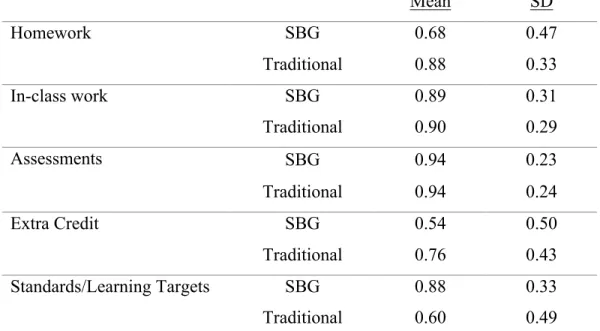
Table 1: Participant Numbers ... 50 Table 2: Descriptive Statistics: Individual responses to mindset survey ... 52 Table 3: Descriptive Statistics: Grading policy and students’ perceptions of items included in
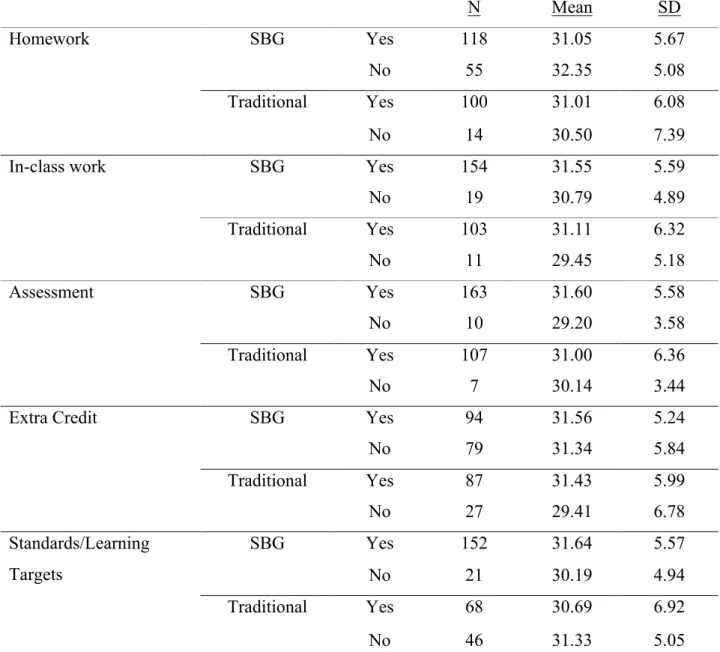
their grade ... 54 Table 4: Descriptive Statistics: Students’ perception of items included in their grade and total
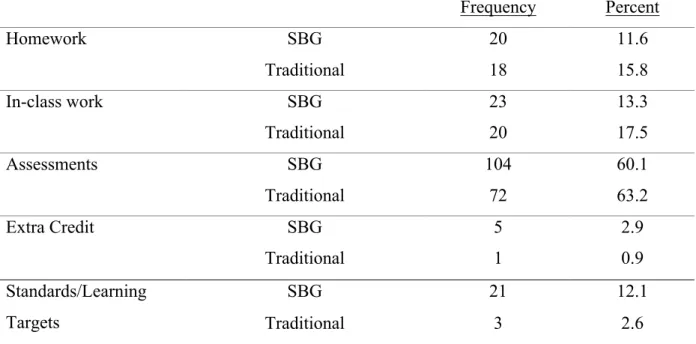
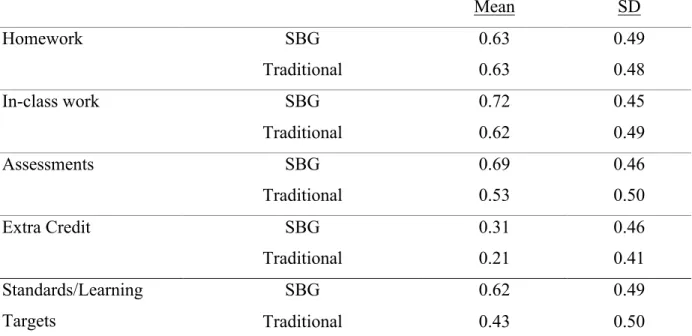
mindset level, by grading practice ... 56 Table 5: Frequency: Students’ perceptions of items that have the most impact on grade ... 58 Table 6: Descriptive Statistics: Students’ perceptions of items that can be retaken/redone ... 60
Acknowledgements
I would like to thank all those that have played an influential role in my education and career. If it weren’t for each and every one of you, I would not be where I am today.
To my committee chair, and now close friend, Dr. Sherri Martinie, I can’t imagine where I would be in life right now if you wouldn’t have taken the time to meet with me when Dr. Gail Shroyer and Dr. Todd Goodson walked me to your office. I appreciate all the guidance you have given and am very excited about where the future will lead us. Thank you for all the advice, feedback and help.
To my committee, Dr. David Allen, Dr. Chepina Rumsey, Dr. Craig Spencer and Dr. Rebecca Gould. Thank you for your commitment, guidance and feedback throughout my journey at Kansas State. I have been extremely lucky to work alongside and develop relationships with each of you. I look forward to continuing our work together.
To Kathy Slaman, the other half of my brain. I can’t thank you enough for all the years of mentorship you provided, both as a colleague and a friend. You took a chance on me as a first year teacher and we have been inseparable ever since, even with the many miles between us. I love you and miss you every day.
To the many colleagues and class mates I have had throughout this journey, know that each of you have left a lasting impression on me and again, I wouldn’t be where I am today without your friendship and guidance.
To my students, past, present and future. Thank you for always reminding me of the importance of learning and growing. I truly hope my love of learning was shown to you by my actions and that you will always continue to grow.
Dedication
I dedicate this to my family.To my husband, Shawn. I know this has been a big commitment for us both and I truly appreciate all of the times you took care of things at home so I could meet this goal. Thank you for your never ending support and love. I love and appreciate you more than you will ever know!
To my girls, Tessa, Taryn and Teagen. I never imagined going back to school when I had young children, but I hope that you see the importance that education plays in my life and yours. I am sorry that I missed some days and nights at home, but I pray that someday you too will have a passion for knowledge and grow up to be life-long learners. I love you and can’t wait to see where your educational journeys take you!
To my parents, Bob and Rita Weatherford. You have always set a great example for me of working hard to achieve your goals. I can’t say thank you enough for helping us through this crazy time in our lives as we have started a family, moved, started new careers and new
educational journeys. Thanks for always listening to me talk about school and work and giving me advice along the way.
To my brother, Justin Weatherford. You were always my inspiration growing up, especially in school. Thanks for always standing up for me and being there for me.
To my in-laws, Lynn and Deb Thiele, Chad and Katrina Wilcott and CJ Thiele. Thanks for always being there for us and for being a sounding board for me. I truly appreciate that I can rely on all of you to support me in this process. I am so proud to call you my family.
To all my family and friends that have supported me, to those that babysat, helped clean my house, helped plan kids’ birthday parties and were just here to listen and help, I dedicate this
Chapter 1 - Introduction
An 8th grade girl, Nadine, is sitting at her desk, trying to finish her assessment. She finally hands it to her teacher and sits down. The teacher marks the assessment and then what? What happens next with that assessment can have a profound impact on Nadine. The grade. What will it look like? What will be included in the grade? Will it be a number, a percent, or a letter? Will she pass/ or fail? Does Nadine really understand all of the aspects that go into this grade? Will it allow her to continue learning and can she learn from this experience?
Receiving a grade is an emotional experience, that is predominately a negative one, filled with disappointment or embarrassment and can be life changing (Guskey, 2015). Think back to Nadine; once the paper leaves her hand, in a traditional classroom, there is little she can do. A day or two later, she gets the assessment back and there it is a letter grade, maybe a percent, maybe just some marks, but it is permanent, and already included in her final grade for the course. This type of grading practice dates back nearly 300 years; yet little research has been conducted to validate the effectiveness of the traditional grading practices currently being used in a majority of schools at all levels of education (Durm, 1993).
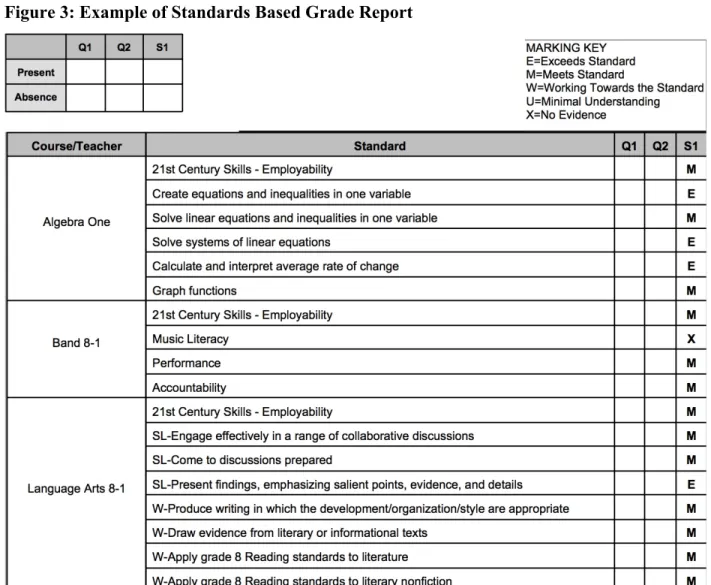
Let’s re-envision Nadine, now in a different classroom. She just got her grade back from the teacher, now what? In a standards based graded classroom, Nadine has many options. The grade is not a letter or number, but a standard or objective and a clear picture of how she is achieving on that specific standard. Her ‘grade’ shows exactly what she knows and what she needs to keep working on. It is not a permanent mark in the grade book, just on a piece of paper. She presumably knows there is still time to learn and she is still expected to learn, but still at question is if Nadine really understands this grading process.
Receiving a grade can cause students to feel a variety of emotions. As students progress through school, they are often exposed to a myriad of grading practices that influence their lives. Points for participation, homework, tests, or a number of other non-academic factors that are often included in grades impact students’ lives in and out of the classroom. Teachers do not consistently give grades that show the true picture of student learning (Marzano, 2000, O’Connor and Wormeli, 2013, and Brookhart, 2011). Parents/guardians, teachers, college administration, basically anyone viewing this grade can, and historically have, made judgments about the student (Durm, 1993). More important than the judgment of others, and the focus of this research, is the judgments students make about themselves based on the grades they receive, their perceptions of what impacts a grade and the various structures of teachers’ grading practices. The findings in the literature review confirm the notion that these internal judgments can ultimately impact students’ mindset development and actions in and out of the classroom.
Chapter Overview
This introduction provides an overview of traditional and standards based grading practices as well as an overview of the fixed and growth mindset. A brief theoretical framework for this study follows the initial overviews. The remainder of the chapter includes the statement of the problem, purpose of the study, research questions, and the significance of the research. The chapter concludes with the limitations of the study, definition of terms, and an overview of the remaining chapters.
Traditional Grading Practices
Teachers have spent nearly 300 making small changes to and recreating grading practices to which, based on research in the past 20 years, there is still great inconsistency and
ineffectiveness (Durm, 1993). Traditionally, teachers make decisions about grading practices in their own classrooms or schools that encompass almost every aspect of grading.
Traditional grading practices are difficult to pinpoint or define as they vary greatly from one teacher to the next, even within the same school. Practices including what is accounted for in the grade and how the grade is calculated and interpreted range from minimalistic emphasis to high priority. Teachers include a number of academic factors in grades, such as classwork, homework, participation, effort, growth, ability, extra credit and assessments, as well as non-academic factors, such as bringing in boxes of tissues or reams of paper (Brookhart, 2011). In the traditional setting, teachers use a variety of weightings assigned to specific items to calculate and curve grades, typically organized by type of item (Wormeli, 2006). Interpretations of a grade vary greatly based on the emphasis placed on grades and the impact it can have on students.
The many diverse factors of traditionally graded classrooms can lead to confusion and frustration on the part of students, parent/guardian, administration, and other stakeholders in education. More details regarding the concerns, purposes, uses and interpretations of traditional grading practices will be explored in the literature review.
Standards Based Grading Practices
Standards based grades report the objectives and exactly what they students know and don’t know (Guskey & Bailey, 2010). These reports can be used to make decisions both for the whole class and individual students. Standard based grading takes the focus away from earning a grade to focusing on learning (Shippy, Washer, and Perrin, 2013). Allowing teachers and
students to have a clear understanding of what they know allows struggling students to receive additional supports and advanced students to extend their learning opportunities (Tierney, Simon, & Charland, 2011). Standards based grading practices enable teachers, parents, students
and all stakeholders to look at a grade and understand its’ meaning and purpose because of the accuracy and consistency that these practices provide. Brookhart (2011) suggests, “Standards-based grading is “Standards-based on the principle that grades should convey how well students have
achieved a standard. In other words, grades are not about what students earn, they are about what students learn” (p. 11). Standard based grading allows all stakeholders in education to focus on learning and how to best help students learn the expected outcomes.
Mindsets – Growth and Fixed
Many students sit in traditional classrooms and receive grades that are permanently recorded in a grade book that claim to show what the student knows. These types of traditional grading policies are common in educational settings, but may have a negative effect on students’ mindsets and willingness to learn new information. Researchers in the field of evaluation and reporting have found that many students place learning and gaining an understanding of the content second to performance on examinations (Becker et al., 1968, Miller and Parlett, 1974, and Snyder, 1971 cited by Crooks, 1988). A permanent letter grade makes a statement about a student’s ability level in a class and compared to peers. Simpson (1981) states,
Grades are singular symbols taking on unidimensional comparative meaning from the abstract numerical system which defines them. Frequent grading is capable of reducing even relatively complex performances to a single dimension, because grades reduce information to numbers, because these numbers can be averaged, and because teachers and student peers can use these numbers to place students on a single global stratification scale. (p. 124)
measure you forever” (p. 26). Traditional grading practices send this fixed mindset signal loud and clear. Students complete the work, they get a score, and it goes directly into their final grade for the course. Every single answer must be correct, right now, because that is a final grade, fixed both in their minds and the grade book.
In a standards based graded classroom, growth mindset should be a key part of the policy. Dweck (2006) describes growth mindset “as the belief that your basic qualities are things you can cultivate through your efforts…everyone can change and grow through application and experience” (p. 7). This belief is intertwined in standards based grading policies and illustrated when an assignment or assessment is not considered final and is not included in the grade. Instead practices allow for retakes and highlight the importance of the learning process. These reform grading practices show exactly what students know, what they don’t know, and what they need to keep working on, indicating they are still capable of learning the material, long after the initial assignment is turned in or test is checked.
Theoretical Framework
Mindset development revolves around the idea that knowledge is formed and can continuously be developed based on students’ experiences (Dweck, 2006); therefore, constructivism is the theoretical framework through which this study is situated. The
constructivist believes “that different people may construct meaning in different ways, even in relation to the same phenomenon” (Crotty, 1998, p. 9). This research will be more narrowly focused on the theory of social constructivism. Flick (2009) states that the social constructivist researcher believes that “knowledge is constructed in processes of social interchange” (p. 71). Historically, the roots of social constructivism have been derived from many modes of thought. Social constructivism can be traced back to the “seminal work of Vygotsky. Social
constructivism regards individual learners and the realm of the social as indissolubly
interconnected. Human beings are formed through their interactions with each other as well as by their individual processes” (Sriraman & English, 2010, p. 43). Berger and Luckman (1967) state “it is from Marx that the sociology of knowledge derived its root proposition - that man’s consciousness is determined by his social being” (p. 17). According to Crotty (1998), Dilthey negates that there is a clear distinction between the social reality and the natural reality in which we live, whereby he believes that different means of research are needed to study the two realities. Windelbrand and Rickert take this notion of two realities one step further to imply that there are differences to state “there is a logical distinction, one posited by the mind” (Crotty, 1998, p. 67). With varying significance of differences, all rely on the same foundation that knowledge is gained through a person’s understanding of the world and that this understanding is impacted by the experiences people have lived.
The ideology that makes up the social constructivist theory “is concerned with the individual’s construal of a world, it is asserted that all knowledge is personally construed by the learner on the basis of his or her own lived experiences” (Proulx, 2006). This idea of
constructing knowledge can be linked back in history to Piaget’s biological theories of how humans develop and learn and to Einstein’s ideas about the creation of the mind (Proulx, 2006). These constructivist theories have been used as a backbone for many constructivist researchers, including those mentioned above.
The growth mindset relies on many factors that control a person’s knowledge level, not just their given talents, but their efforts, experiences, and interactions. Brookhart (1994) suggests that the social makeup and expectations of the classroom setting have a great impact on students’
of a person’s thought process on their motivation and action. They emphasize the importance of social interactions and observations as keys to developing a person’s thought process. The goal of the social constructivist epistemology is to understand how people view the world; knowing full well that different factors influence one’s knowledge and impact their understanding even in the same circumstances. Creswell (2013) states “the goal of research, then is to rely as much as possible on the participants’ views of the situation” (p. 25).
Sriraman and English (2010) state, “social constructivism places emphasis on: the importance of all aspects of the social context and of interpersonal relations, especially teacher-learner and teacher-learner-teacher-learner interactions in learning situations including negotiation, collaboration, and discussion” (p. 46). To fully examine the mindset students must have to be successful in this type of setting, and their experiences during the transition phase, the researcher must take into account the relationships students have with one another and their teacher. Schifter (1996) describes constructivism as
a perspective that informs the principles guiding the current movement for mathematics education reform: that individuals necessarily approach novel situations by interpreting them in the light of their own established structures of understanding; that the
construction of new concepts is provoked when those settled understandings do not satisfactorily accommodate a novel circumstance; and that this constructive activity is not simply an individual achievement but one embedded in and enabled by contexts of social interaction. (p. 496)
Grounding this study in social constructivism as described by Schifter (1996), it is necessary for the researcher to explore the understandings that students have about their own mindsets and
their perceptions of grading practices and policies, as they play an active role in the classroom environment.
Statement of the Problem
Grading and evaluation practices impact students, specifically their perceptions, self-efficacy, and motivation (Crooks, 1988). The initial overview of traditional and standards based grading practices set the stage for the confusion and disorganization that is currently seen in the traditional grading practices of teachers. The inaccuracy and inconsistency of grading practices send a mixed message to students regarding the purpose for and interpretation of grades. The current call for reform education relies on students having a growth mindset, being able to take content to a deeper level of understanding based on experiences in and out of the classroom and continually strive to learn and grow. Lying in the constructivist approach, learning is formed in many ways and is not a permanent quality of a person; standards based grading practices allow students to see their learning and to work with those around them to continue learning.
Traditional grading practices primarily align with the fixed mindset, by representing each attempt at learning as a final, fixed, mark in the grade book.
Theoretically, it would seem this study is setting itself up as a comparison of two grading practices and the mindsets that develop based on these policies. However, as is noted in the introduction, little research has been conducted on the practical applications of grading policies, specifically, how various policies can impact students. It is one thing to have a theoretical stance that aligns with the grading policy and what should happen in the classroom, but another to research the implications of those actions. This study hopes to examine the implications that various grading practices have on students in a real-world setting, knowing full well that
Research Purpose
The purpose of this quasi-experimental, causal-comparative survey research study was to examine the impact that grading policies have on students’ mindsets in four urban Midwestern middle schools. The components of this research relied on the grading policies in place at the school level and the students own reporting of their mindset.
Research Questions
The specific research questions for this study are:
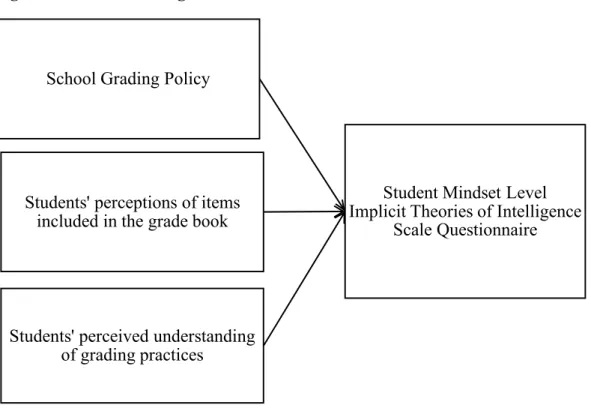
1. Do statistically significant differences exist between the mindset level of students enrolled in a traditionally graded school and the mindset level of students enrolled in a standards based graded school?
2. Do statistically significant differences exist between the students’ perceptions of the items included in the grade book (classwork, homework, assessments, extra credit, standards) and the students’ mindset level?
3. How do students’ perceived understandings of grading practices impact student mindset levels?
Significance of the Study
Effective grading practices rely on the alignment of assessments and standards. Educators are experiencing a unique situation at this time, as the Common Core State Standards are being implemented in school districts throughout the United States. Now is the time to examine these experiences and dig deeper to get a better understanding of the impact this will have on the education system in our country (NCTM Research Committee, 2013). Guskey (2015) states, “In the modern educational reform initiatives that move us in this direction, grading and reporting remain the one element still pitifully misaligned” (p. 4). Standards based grading practices align
closely with the ideals of the Common Core State Standards, to ensure consistently high levels of learning for all students, grades kindergarten through twelfth, across the country (Spencer, 2012). There is no better time to implement standards based grading practices than now, as educators are making adjustments to curriculum, teaching strategies, assessments, and other factors related to education. While this research doesn’t completely fill the gap in research on grading practices, it does address part of the gap related to the impacts that grades have on students.
This study focuses specifically on the impact that grading practices may have on students’ mindset levels based on the Implicit Theories of Intelligence Scale developed by Dweck (2006). The inconsistency of implemented grading practices and the message being sent to students through grades provided this research with a starting point. It is evident when students receive grades, they have a reaction. However, what is not observable is the long term implications that those reactions to grades have on students’ mindset towards learning.
There is a large gap in the research on grading practices, following up what was referenced by Guskey (2015) earlier in this chapter. O’Connor (2009a) clearly states, “many journal articles and reports have been written on grading, but most of them…are summaries of previous work and the opinion(s) of the authors” (p. 21). Guskey (2015) states, “We’ve learned a great deal about the effects on students of different grading policies, particularly those that diminish motivation and confound the meaning of grades,” but there is much more to be done on the effects of reform grading practices (p. 110). This lack of research and data provides an opportunity for this research to enhance the grading practices that are currently in place. In an extensive look into the research on grades and grading practices, Brookhart (1994) found the focus of research in this field to be aimed at determining if teachers are following the
practices. As educators make strides in implementing new practices, research needs to be conducted that shows how these changes are impacting students and, in the case of this study, their mindset to be life-long learners.
Whether or not grades impact students is not the question to be answered, but how and what type of impact do grades and student’s perceived understandings of grading practices have on a students’ mindset levels regarding the learning process. As there is limited research in this field of study, the findings of this study can help educators make decisions about the
implementation process of grading practices that can promote life-long learning for all students. Limitations of the Study
The limitations of this study are primarily related to participant selection. As the study was designed as a quasi-experiment, non-randomization strategies were used to select
participants (Creswell, 2014). Participants were selected based on their enrollment at a specific school, employing either traditional or standards based grading practices. However, once the school selection had been made, all enrolled students had an equal opportunity of being a
participant in the study. The schools chosen to participate in this research were selected based on meeting the criteria of implementing traditional and standards based grading practices within the same district. This allowed the researcher to collect demographic data and select comparable schools to invite to participate in the study. It also allowed the research to control for some of the issues of transient students, as a majority of the students have attended similar elementary
schools prior to their enrollment at the middle level. As in any real-world, educational research, the researcher also relied on the schools’ written grading policies to determine which schools were asked to participate, knowing that policy does not always equate to practice. This notion will be further examined in the literature review.
This causal-comparative study was also limited by the biases that the researcher may have based on prior experiences in traditional and standards based graded classrooms. However, based on the nature of the study, being a quantitative comparison of students own reporting of their mindset development, these biases were not reflected in the findings of the study, as the objective nature of the results overpowered the subjectivities of the researcher.
The total response rate of the study was 14% which limited the generalizability of the findings. Given the unique transitioning that the district was involved in the study lacked overall generalizability to the entire middle school population as many districts may not follow the same pattern of transition from traditional to standards based grading practices. Measures outlined in the Dillman Tailored Design Method (Dillman, Smyth, & Christian, 2009) were implemented to decrease the nonresponse rate including providing multiple types of interactions including, email, phone and personal letter. All interactions took place within an appropriate amount of time utilizing positive regards throughout.
Operationalization of Terms
1. Fixed Mindset – Dweck (2006) defines a fixed mindset being one in which people “believe their qualities are carved in stone” (p. 6)
2. Growth Mindset – Dweck (2006) states a “growth mindset is based on the belief that your basic qualities are things you can cultivate through your efforts” (p. 7).
3. Middle level students – students in grades six through eight between the ages of 11-14.
4. Mindset – Dweck (2006) defines mindset as the belief a person holds about themselves, both their intelligence and ability, that can impact every part of life.
5. Standards/Objectives – The National Governors Association (2010) in the Common Core State Standards initiative defines standards as statements that “clearly
demonstrate what students are expected to learn at each grade level, so that every parent and teacher can understand and support their learning” (p. 1).
6. Standards based grading practices – Guskey & Jung (2009) define standards based grading practices as using report cards that “includes grades or marks based on carefully articulated learning standards in each subject area” (p. 1).
7. Traditional grading practices – Hooper & Cowell (2014) defined traditional grading practices “as students earning points on various types of assignments and
assessments throughout a grading period and a teacher averaging those points on a 100-point scale to determine a student’s overall grade” (p. 59).
Chapter Summary
This introduction provided a brief overview of traditional and standards based grading practices and mindset development. There are theoretical ties between grading practices and mindsets, but this study examined the practical implications of this relationship. The growth mindset focuses on the long-term beliefs of students to continue gaining new abilities and increasing intelligence filters through standards based grading practices. Traditional grading practices primarily send the message that grades are the end, the final statement of learning, thus can be associated with the fixed mindset.
This study examined the mindsets of students in traditional and standards based graded classrooms to uncover underlying beliefs that are ingrained in the grading policy set forth by teachers. The findings of this study provided evidence for teachers to suggest the need for focused efforts to be placed on grading policies and practices. No matter the specific outcomes
of the survey research, ideas about the practical implications of grading practices on students were explored, which sets the stage for future research in the realm of reform grading practices and mindset development.
The remaining chapters include a review of literature in chapter 2, organized by examining the concerns, purposes, and interpretations of grades, as well as the impact grades have on students, specifically the development of their mindset. Chapter 3 details the
methodology of the study, including the research design, participants, and data collection and analysis. The results of this study are discussed in chapter 4, followed by further conclusions and discussions in chapter 5.
Chapter 2 - Literature Review
This literature review begins with an in-depth look into the history of grading practices in the United States. The remainder of the review is structured by looking at the concerns, purposes, and interpretations of grades, both traditional and standards based. This leads to a review of the literature regarding the impact grades have on students and how students’ mindsets develop. Standards based grading practices provide a more internal aspect to grading, which is where the literature on students’ mindsets will be explored (Wormeli, 2006, Marzano, 2000 & 2006, & Guskey, 2015).
A number of articles have been published sharing opinions or suggested best practices, but not necessarily research-based practices. Guskey (2015), Marzano (2000), and O’Connor (2009a) specifically mention the lack of research that has been conducted on grading practices and the impact they have on students. Primarily, the studies on grading practices have focused on the ineffectiveness of traditional grading practices, teachers’ understandings and meanings of grades, and teachers’ adherence to district policies and practices. As these findings are not the direct focus of this study, a few are referenced to provide an understanding of the concerns and purposes of grades, but few research studies have been conducted on the impact grades have on students or the connection to their mindset development.
History of Grading Practices
This examination of the history and evolution of grading practices focuses on the
progression of grading practices from the roots of grading or markings used by professors in the early 1700s to the current state of traditional grading practices. One specific area of interest that is a focus throughout this progression is the intended purpose of grading. As grading practices shift throughout eras, it is important to note why they may have shifted and what impact this may
have had on all stakeholders involved. These key areas are examined throughout the course of this section on the history of grading, which will be situated in a timeline progression.
Little research has been conducted to validate the effectiveness of the traditional grading practices currently being used in a majority of schools (Marzano, 2000). Guskey (2015) states throughout history, “grades have remained the primary indicator of how well students performed in school and the basis for making important decisions about students” (p. 3). With such an emphasis on the importance of grades and grading practices, a look back to the roots of grading is essential to understand the current state of traditional grading practices and the current call for reform grading practices. Grades, or ‘marks’ as they were then referred to, date back to the early 1700’s. These grades were primarily used to rank or make note of the students’ socio-economic status (Durm, 1993). In the latter 1700s, rankings were not as common, but feedback was provided. Marzano (2000) states, “prior to the late 1700s, students were not given grades per se. Rather, teachers gave students feedback on their performance through narrative comments” (p. 11). This shift from marks used to rank students based on social positions to feedback was one of the first steps in the progression of grades. Grades slowly progressed throughout the century to be more descriptive, use scales, and provide feedback, like a combination of standards based and traditional grading (Marzano, 2000).
In the late 1700s and early 1800’s, ‘marks’ that were given earlier in the century progressed to number ‘grades’. Smallwood (1935), as quoted by Durm (1993), stated, “that marking, or grading, to differentiate students was first used at Yale. The scale was made up of descriptive adjectives” (p. 295). Marzano (2000) reiterates this idea, stating, “in 1780, Yale University began using a system that was probably the most identifiable precursor to the current
scales was primarily to provide feedback to students on their achievements, but ranking also became prevalent at this time. Durm (1993) stated,
After 1813 the records show a variety of attempts to evaluate and grade students…the following classification of students was used: No. 1. The first in their respective classes; No. 2. Orderly, correct, and attentive; No. 3. They have made very little improvement; No. 4. They have learnt little or nothing. (p. 295)
Various scales, similar to the one mentioned above, were used at institutions, primarily at the collegiate level well into the 1800s.
In examining the history of grading, one must note the type of institutions that were most prevalent at this time. Collegiate institutions were on the cutting edge of grading, using scales with descriptive indicators throughout the 1800s. Durm (1993) states, “Before 1850 descriptive adjectives and various numerical systems of evaluation had been tried. Throughout the next fifty years, several new scales of merit and demerit were devised” (p. 295). One evolutionary step in the history of grading as noted by Marzano (2000); “in 1877, Harvard began classifying students into ‘Divisions’” (p. 11). These divisions were broken down into segments of percentages with the following ranges: 90-100, 75-90, 60-74, 50-59, 40-49, and below 40. These ‘divisions’ show a clear progression step from earlier systems to the traditional grading system currently used in most schools (Marzano, 2000). These divisions were later translated into the letter grades that we currently use. Durm (1993) notes in 1883 “at Harvard there is a reference to a student making a B. This apparently was the first use of a letter for a grade that can be found” (p. 296). From the 1890s to our current time, letter grades, with a variety of scales, became prevalent at most levels of education. Most of the information shared thus far has taken place at the collegiate level. As enrollment increased, teachers began to heavily rely on the use of the scale breakdown of
percentages, that we commonly use today; as the need to efficiently report student progress and understanding arose (Guskey, 2015).
On the other end of the spectrum from the collegiate level where the one-room school houses that were popular at this time. Guskey (2015) states, “throughout much of the 19th century, most schools grouped students of all ages in one-room schoolhouses…the teacher reported students’ learning progress orally to parents” (p. 24). As times changed and the need for formal education became more attractive, teachers at lower levels of education began evaluating students through ‘grades’. Guskey (2015) states, “as the number of students increased in the late 1800s…new ideas about curriculum and teaching were tried…one of these ideas was the use of formal progress evaluations of students’ achievement in school” (p. 24). Throughout the 1800s, these evaluations were similar in nature to that of standards based grades, as the teacher would write down the skills or objectives the students had mastered and the skills they were still
working on and report this to parents, mainly for the benefit of the student. At this time, students were not permitted to move on to the following level until they had mastered all skills at their current level (Guskey, 2015). The one-room school houses that were prevalent throughout the 1800s began to lose popularity to more sophisticated groupings of students.
Between 1870 and 1910, school attendance laws changed the format of schooling and subject area classes became prevalent at the secondary level. While elementary teachers still used similar written notes about students achievement based on a set of skills, secondary teachers were more likely to provide a percentage grade to students. Guskey (2015) noted Kirschenbaum, Simon and Napier (1971) stating, “this was the beginning of the grading and reporting systems that exist today” (p. 24). Throughout the remainder of the 1800s and into the 1900s, grading
systems, similar to the percentage and letter grade scales that we see today gained popularity due to the increase in student enrollment and the changes in curriculum.
The percentage grades and letter grade scales that were gaining popularity at the end of the 1800s continued to grow in the 1900s. Reedy (quoted in O’Connor, 2009a) stated, “since the introduction of percentage grades in public schools in the early 1900s, grading and grade
reporting have recycled rather than evolved” (p. 21). Moll noted a similar trend; “From 1911 to 1960, school systems experimented with various letter and number reporting conventions. Percentage grading was the most popular system during the latter half of the 19th century and the early part of the 20th century.” Although there was little research to defend the popularity of percentage and scale grading systems, this trend continued to gain acceptance in the latter years of the 1900s as technology enhancements gave teachers the opportunity to use computer or internet based grading systems that thrived on the calculation of grades based on percentage points (Guskey, 2015). Teachers could include hundreds or thousands of points to be combined into a single grade with ease due to these technological advances, however, this led to even greater variations in grades.
Throughout the 1900s, a few teachers and researchers became concerned with the validity of percentage or letter grades. Guskey (2015) shares the work of Starch and Elliot (1913) on the reliability of percentage grading. In their research, they gave geometry papers to 128 teachers and found that identical papers where given percentages with a difference of sixty-seven points. This led to a slight reduction of the use of percentage points to scales conversions, like those seen today, based on ten point ranges for each letter grade (Guskey, 2015). However, this pattern did not continue across the entire education system and today, as these ten point scales make up a majority of grading policies. The ten-point range for letter grades A – F has continued to grow in
popularity since this study in 1913. O’Connor (2009a) shares that a “survey of high schools by the College Entrance Examination Board (1998) reveals that 91 percent of schools were using A-F letter grades or numeric grades and that 93 percent of schools were not considering changing the grading system in the following three years” (p. 24). With such a high percentage of schools using the A – F letter grades or other form of percentage grade, it is obvious to ask, why would anyone want to change this long-standing tradition.
Marzano (2000) goes on to share his thoughts by saying, “today’s system of classroom grading is at least 100 years old and has little to no research to support its continuation” (p. 13). There is still little consistency among the various aspects of grades. Iamarino (2014) suggests that “grading practices are rife with complexity and contradiction. They are remnants of archaic conventions, and hybrids of newer methodologies not yet tried by time and application” (p. 9). This brief history into the grading practices of teachers throughout the last 300 years provides the need for research on reform grading practices, such as standards based grading, and their impact on students.
Concerns with Grades
As noted throughout the reflection on the history of grading practices, these concerns are built off of the premise that most teachers do not set forth with a true purpose when selecting a grading practice. Marzano (2000) explains,
Virtually all of the criticisms [of grading systems] focus on one or more of three problem areas: (1) teachers consider many factors other than academic achievement when they assign grades, (2) teachers weight assessments differently, and (3) teachers misinterpret single scores on classroom assessments. (p. 3)
Cross & Frary (1999) express that grading practices have been a topic of high controversy since the beginning of the 20th century. Marzano (2000) echoes these by stating, “grades are so imprecise that they are almost meaningless” (p. 1). The concerns in this section revolve around the key topics of controversy, including: the contents included in grades, the importance placed on a single letter grade, the lack of teacher preparedness to implement effective grading
practices, and the lack of purpose given to grades.
In a traditional setting, Cross & Frary (1999) found that teachers’ practices were not aligned with their ideals and that students seemed to be confused by the various grading practices of their teachers, such as including ability, effort, participation, and conduct and raising the grades of low-achieving students. Randall & Engelhard (2010) found similar results in their study, with slightly more consistency amongst what was included in a grade, but in borderline cases, near the letter grade cut-off, they found that teachers were more likely to assign a higher letter grade based on non-academic factors. Guskey (2009) synthesized from his research the following list of items traditionally included in grades:
major exams or compositions, homework completion, class quizzes, homework quality, reports or projects, class participation, exhibits of students’ work, effort, laboratory projects, attendance, students’ notebooks or journals, punctuality of assignments,
classroom observations, class behavior or attitude, oral presentation, and progress made. (p. 17)
Based on the comparison of two studies, one conducted by Robinson & Carver (1988) and the other by Mazano & Kendall (1996) regarding the percentage of districts and the percentage of teacher’s reporting the use of effort, behavior, and attendance in grades, Marzano & Kendall (1996) state that educators have developed a situation in grading in which one teacher’s grade
might mean something completely different from another teachers or even the same teacher at a later time.
Hooper & Cowell (2014) suggest two overarching shortcomings to be the inability of traditional grades to clearly communicate student learning because they are organized by type of activity instead of by standards or objectives and the culmination of all of these scores on items in a grade book resulting in one letter grade per content area. Wormelli (2006) shares that because of the inaccuracy and inconsistency of grading practices, grades are more subjective, likely to be distorted, and not good indicators of student mastery. Wormelli (2006) reiterates this by stating, “we’ve aggregated so much into one little symbol, it’s no longer useful” (p. 90). Although these statements are made about traditional grades, the emphasis placed on grades as an important, or the sole, indicator of student success in school is still prevalent. O’Connor (2009b) goes a step further, stating that grades should be organized by essential learning
expectations and not the traditional homework, tests, organization that is typically used; even if the grade is still shown by a single letter, the list of expectations will provide more reliable information to parents, teachers, and the student. This is important to note, specifically in the transition times from traditional to standards based, it is not unheard of to assign a single letter grade, but eventually the need for and reliance on that grade will be lessened (O’Connor 2009b). One of the challenging issues to initiate is the lack of teachers’ willingness or desire to make changes in their grading practices.
Teachers are naïve in their lack of understanding, ability to implement, and willingness to challenge or change their grading practices (Guskey, 2015). Due to the lack of teacher
only 40% of teachers were aware of or understood their schools grading policy. This lack of awareness and understanding is another important factor in the ineffectiveness of grading policies. Guskey (2015) reconfirms this stance, and adds another dimension noting the impact that teacher’s unawareness of the lack of reform grading practices continues to add to the inconsistent and ineffective grading practices used in schools. These unclear purposes pose as one of the greatest concern expressed by leading grading experts (Marzano, 2000). Another study discussed by O’Connor (2009b) conducted by Howard, Clymer, and Wiliam (2006/07) found that if teachers had appropriate grading design and purpose they were more likely to identify and provide more appropriate learning opportunities to students that needed help. Tierney, Simon, and Charland (2011) developed a set of principles that help teachers align their practices with those associated with standards based grades:
1. When the purpose of grading is to report on student achievement, grades should be referenced to the curriculum objectives or learning expectations (criterion
referenced).
2. A grade should be an accurate representation of achievement, so non-achievement factors should be reported separately to permit valid interpretation by stakeholders. 3. Results from multiple assessments should be combined carefully, with weighting that
reflects the learning expectations, to ensure that the grade accurately summarizes achievement.
4. Information about grading should be clearly communicated so that grades are justified and their meaning is understood by students, parents, and other teachers. (p. 212)
These principles should be followed to help shift traditional grading practices into more
meaningful, consistent, and useful grade reports. The vast majority of the concerns about grading practices lie in the traditional grading setting because it is common practice that teachers or schools select their grading practices, not based on research, but on the ideas or experiences of others (Guskey, 2015, Marzano, 2000 & 2006).
Purposes of Grades
No matter the format of grading, most educators agree that the purpose of grading must be the focus when making decisions about grading practices (Guskey, 2015). Having a purpose seems like a valid place to start, but educators have yet to agree on a purpose of grading that is consistent across grade levels or content areas. Hooper & Cowell (2014) state that the lack of definition of purpose is an inherent challenge of grading. Airasian (1994) provides five purposes to include, administration purposes of retention, student placement, and college entrance, student feedback, future course or career guidance, teacher instructional planning, and motivation. Wormelli (2006) found six reasons that teacher share as the purpose of grading including: documenting student and teacher progress, providing feedback, making instructional decisions, and motivating, punishing, and sorting students. Gronlund & Linn (1990) similarly state that there are four uses for grading: instructional, communicative, administrative and guidance. Brookhart (1993) echoes these concerns in the findings of her survey research study with 84 teachers. She found that teachers had diverse purposes and meanings of grades, but all could fall under one of the four categories listed by Gronlund & Linn (1990). There seems to be a
consensus amongst researchers and grading experts that the purpose of grading is multifaceted and requires careful attention, however, this is not always the case in practice.
To more deeply understand the uses of grading practices, this literature review includes research that examined what meaning teachers gave to grades and how they assigned grades. Tierney, Simon & Charland (2011) found that teachers using standards based grading practices in their study agreed, with approximately 80% consensus, on the elements that should or should not be included in the grade, however, effort and the use of zeros were not agreed upon.
Polloway, Epstein, Bursuck, Roderique, McConeghy & Jayanthi (1994) conducted a study including 225 districts and found that 65% had a written grading policy and the most common type of grade used was letter grades (83%). However, in the interest of reform grading practices, 24% of the respondents chose that checklists were included in their grading policy and 37% noted the use of criterion-referenced grades. The numerous items included or not, and the multiple formats of traditional grading practices continue to build upon the inconsistency and ineffectiveness of these strategies.
O’Connor and Wormeli (2013) state, “grades should be accurate, consistent, meaningful, and supportive of learning” (p. 40). To further add to the discussion of what grades should look like, Guskey (2015), Marzano (2000), O’Connor and Wormeli (2013), and Brookhart (2011), all pinpoint the highest priority of grading to be that of providing feedback about student
achievement, however, Guskey (2015) notes that grades have historically served the purpose of sorting students and accentuating the differences among students. These two priorities are still not aligned in our current education system. Guskey (2015) emphasizes that coming to a consensus on the purpose of grading is the first place to start the reform grading practices initiative. Austin & McCann (1992) conducted a content analysis study by examining policy documents of 144 school districts. They found the top three purposes listed for grading to include, “providing information about student progress, providing information for instructional
planning, and providing information about a student’s current level of achievement and/or performance” (p. 4). As educators try to align with all of the purposes it can be the cause of ineffective grade reporting, because in turn the report card does not fully meet any of the purposes, thus becoming unreliable (Guskey & Bailey, 2010).
So the question remains, what is the purpose of a grade? This lack of purpose or focus is due in part to the fact that grades are reflected through factors including homework, class participation, extra credit, and numerous other non-academic factors. The purpose of standards based grades is to show a report of the objectives and exactly what they students know and don’t know; instead of or accompanied by the averaged letter grade (Wormeli, 2006). These reports can be used to make decisions related to instruction, both for the whole class and individual students, placements in specific classes, career guidance and communicate a clear message about the students’ understanding of the content. Wormeli (2006) states, “…grades are used to guide instructional decisions and chart progress” (p. 162). Standards based grades take the focus away from earning a grade to focusing on learning. Shippy, Washer, and Perrin (2013) suggest, “when instructors are clear regarding which standards are mastered and which need more work, they can adjust instruction to help students. This can be helpful to students on both ends of the spectrum” (p. 14). Allowing teachers and students to have a clear understanding of what they know allows struggling students to receive additional supports and advanced students to extend their learning opportunities.
Traditionally, teachers have decided what to include in a grade, how to weight the grade, basically what makes up a letter grade. Based on those outlined above, the many purposes of grading rely on students’ grades being a true reflection of their learning and understanding, but
purposes of grades outlined above, grades must be a reliable, accurate, and consistent measure of student learning (Marzano, 2006). Reform based grading practices, that outline students’
progress towards the standards, provide a more consistent and accurate picture of what students know and are able to do (Wormelli, 2006). The picture portrayed by standards based grading allows future teachers, administrators, counselors, parents and students themselves to interpret their grade in a meaningful manner.
Interpretation of Grades
Many students can make it through school earning good grades, but have little
understanding of concepts. Others can have tremendous gains in their knowledge, but this may not be reflected in their grade. Kohn (1999) offers the plot that “grades are spurious precision – a subjective rating masquerading as objective evaluation” (p. 60). This is due in part to the fact that grades are reflected through a combination of academic and numerous non-academic factors. Brookhart (1993) conducted a study in which teachers were provided grading scenarios and were asked to give each student scenario a grade. In this study, Brookhart (1993) found that teachers varied significantly on the letter and number grade that they assigned to each scenario, due to the fact that various aspects were or were not included in the grading process for different teachers. Brookhart (1993) also concluded the study with the finding that most teachers believed that “a grade was a form of payment to the students” (p. 131) instead of a picture of their learning as leading experts in grading would suggest. Marzano (2000), O’Connor and Wormeli (2013), and Brookhart (2011), agree that the inconsistency, weighting of items, and inclusion or lack of inclusion of particular graded components all contribute to the weaknesses and ineffectiveness of traditional grading practices.
School districts continually write and update grading policies, but more time and energy must be devoted to explaining these policies and checking for accurate implementation and interpretations. It cannot be left up to the individual teacher to designate and create grading practices in the classroom, especially when students see multiple teachers for various content areas. These differing policies lead to further student and parent confusion about grades and their purpose (Cross & Frary, 1999). As Quinn (2013) states, “if we want to produce lifelong learners and not simply grade earners…then we must make sure that students are not focused on grades at the expense of developing intrinsic motivation to learn” (p. 108). To better meet the needs of students by providing clear evidence of what they are or are not learning, teachers can shift the focus from completing assignments and cramming for the big test to learning and understanding. Standards based grading allows teachers and students to focus on the learning the content, instead of counting points, to compile a “grade” for students. Sanders & Anderson (2010) depict grades as, “prototypical measures of academic success, but often they do not adequately depict student learning or classroom success” (p. 54). Allowing teachers and students to have a clear interpretation of a grade, based on the standards they know or don’t know, allows struggling students to receive additional supports and advanced students to extend their learning opportunities.
Using more effective measures and means of grading allows teachers to provide students with a more realistic picture of their knowledge. Iamarino (2014) states that students become highly confused and their learning can be hindered when inconsistent evaluation criteria are used to grade or assess students. Sanders & Anderson (2010) conducted interviews with student asking about their perceptions of grades. They found that students did not believe that grades
were outwardly upset when they received unsatisfactory grades, which were anything less than an A. Farr (2000) states that it is also difficult for parents to interpret grades when they are not associated with some form of standards and are ever changing from year to year and teacher to teacher. The inaccurate interpretations of grades and grading practices stems from the lack of awareness, inconsistency and variety of purposes of grades that are included in these policies. Dweck (2006) states, “Mindsets frame the running account that’s taking place in people’s heads. They guide the whole interpretation process” (p. 215), which in the school setting would include evaluation processes, grading and reporting. Aldman, Gates and Deterra Sims (2001) report the potential of standards based grading practices to have a profound impact on student learning and as grading practices improve, communication and instruction will follow.
Impact on Students
The focus of this study was not to solely analyze the different grading practices, but to explore the impact these practices have on students, thus a firm understanding of the concerns and purposes of traditional and standards based grading practices was needed, as well as a look into the interpretation of grades by students. Kohn (1999) states, “grade orientation’ and a ‘learning orientation’ are inversely related” (p. 64), thus stating that when the focus is on
grading, as is traditionally the case, students become less interested in learning. Iamarino (2014) suggests that standards based grading, as opposed to traditional grading practices, break free from the point gathering and allow the focus to be on learning. The standards based learning environment highly emphasizes the importance of natural inquiry and learning for the sake of learning. Brookhart (1993) states that students’ feelings or opinions about learning can have a profound impact of the learning process and the development of their cognitive abilities.
This idea of impacting students with practices was the basis for this study. Masters
(2014) concludes that the reporting method we use and the message we send to students via those reports sends a strong message to students, both about their academic abilities and the way they approach learning in general. Masters (2014) goes on to state, “assessment and reporting processes shape student, parent, and community beliefs about learning – sometimes in
unintended ways” (p. 4). Traditional grading practices often leave students feeling frustrated and stuck, whereas standards based grading practices focus on learning and understanding.
Traditional grading practices are often seen as gatekeepers and as Ricci (2014) puts it, “due to the school and/or educator’s fixed mindset and gatekeeping practices, a child who was ready to embrace a challenge and be successful now believes that she cannot do so” (p.28.) This idea that teachers’ beliefs, which influence their actions, in turn impacts students in a very critical way.
In the classroom, teachers note the changes that take place when focusing on learning, as standards based grading practices suggest. Aldman, Gates & Deterra Sims (2001) interviewed teachers and found that when they implemented standards based grading practices they had to look more deeply into each students’ understandings, lessening the chance for students’ successes and failures to go unnoticed. In alignment with the current reform movements, standards based grading practices allow teachers to ensure learning for all students, because the focus is no longer on the class averages or letter grades, but on each students’ level of
understanding of the content. Munoz & Guskey (2015) summarize the impact that grading practices have on students prophetically, by stating, “ultimately, grading and reporting are other important tools for what matters most: improving student learning” (p. 68). Improving student learning truly conceptualizes from the students’ beliefs about how they can improve their
Mindset Development
Much of the concerns, purposes, interpretations and impacts of traditional and standards based grading practices can be filtered into one of two mindset categories. Dweck (2006) states,
Every word and action can send a message. It tells children…how to think about
themselves. It can be a fixed-mindset message that says: You have permanent traits and I’m judging them. Or it can be a growth-mindset message that says: You are a developing person and I am interested in your development. (p. 173)
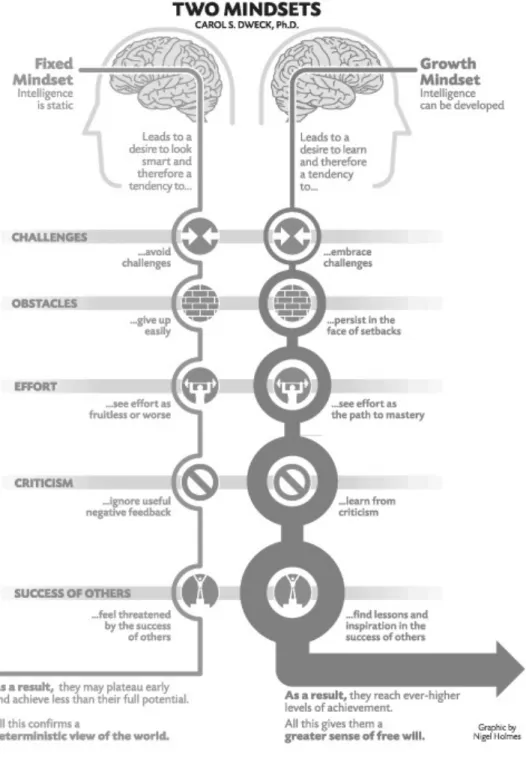
Traditional grading practices uphold much more rigid and permanent features as seen in the fixed mindset. Dweck (2006) refers to students in the fixed mindset as seeing failures and struggles as permanent setbacks and not fulfilling potential. When traditional grades are presented as stagnant and unchangeable, praise or consequence is based on the person, implying that their level of ability came from within and is fixed (Gunderson, et al, 2013). On the other side of this is the growth mindset, in which students feel that initial failures or challenges are a starting point for learning; these are the students who chose the difficult task because it promotes learning over the easy to complete problems. The following graphic, created by Nigel Holmes, and found in Dweck (2006) outlines the basic characteristics of the fixed and growth mindset (p. 245).
Figure 1: The Two Mindsets by Nigel Holmes
profound (Dweck, 2006). This was taken a step further by Ricci (2013) in her book, “Mindsets in the Classroom,” where she emphasized the importance of shifting students’ mindsets. She states, “breaking down the belief that intelligence is static can be a challenge, but with the proper
groundwork and education, little by little a mindset can shift” (p. 4). Brainology, as set of modules, designed by Mindset Works (2011), outlines specifically how educators can help guide students towards a growth mindset, aligning with the current research on brain development.
Researchers in the field of educational neuroscience have devoted decades of research to show the impact that specific brain training can have on students’ mindset and academic
performance. Dweck (2006) describes work of Dr. Aaron Beck, a psychiatrist in the 1960s, in which he used the idea of cognitive therapy to reshape the beliefs that people held about
themselves, their intelligence and their abilities. She states that mindset training goes further into “changing the internal monologue from a judging one to a growth-oriented one” (p. 216). More recent works that have demonstrated the brains ability to adapt and grow through adulthood (Doidge, 2007) and that aspects of intelligence can be impacted through learning (Nisbett et al., 2012, Sternberg, 2005) follow the same perspectives that the brain and brain development can be impacted by specific actions. Ericcson, Charness, Feltovich & Hoffman (2006) went a step closer to the mindset training, stating that how people react to difficult situations or processes are key to their achievement. Ricci (2014) states, “recent brain research negates the notion that intelligence is ‘fixed’ from birth” (p. 5). These studies exemplify the impact that mindsets and mindset development have on individuals’ abilities to learn new information and react to successes and obstacles. Although not all of these studies took place in the classroom setting, Ricci (2014) and Dweck (2006) confirm that these same findings can be seen in the school environment as they are highly transferrable to students’ beliefs.