Louisiana State University
LSU Digital Commons
LSU Doctoral Dissertations Graduate School
2013
Developmental education programs : students'
perceptions of the effectiveness at the community
college level
Thad David Mitchell
Louisiana State University and Agricultural and Mechanical College, [email protected]
Follow this and additional works at:https://digitalcommons.lsu.edu/gradschool_dissertations Part of theEducation Commons
This Dissertation is brought to you for free and open access by the Graduate School at LSU Digital Commons. It has been accepted for inclusion in LSU Doctoral Dissertations by an authorized graduate school editor of LSU Digital Commons. For more information, please [email protected]. Recommended Citation
Mitchell, Thad David, "Developmental education programs : students' perceptions of the effectiveness at the community college level" (2013).LSU Doctoral Dissertations. 1714.
DEVELOPMENTAL EDUCATION PROGRAMS: STUDENTS’ PERCEPTIONS
OF THE EFFECTIVENESS AT THE COMMUNITY COLLEGE LEVEL
A Dissertation
Submitted to the Graduate Faculty of the Louisiana State University and Agricultural and Mechanical College
in partial fulfillment of the requirements for the degree of
Doctor of Philosophy in
The Department of Educational Leadership, Research, and Counseling
by
Thad D. Mitchell
B.S., Southeastern Louisiana University, 1999 M.A., University of Southern Mississippi, 2007
ii
© Copyright 2013 Thad Mitchell All rights reserved.
iii
ACKNOWLEDGEMENTS
I would like to take this opportunity to recognize the people for whom without their guidance, support, and encouragement this achievement would not be possible.
My committee, your constructive critiques challenged me, but ultimately made me a better writer and researcher. Dr. Roland Mitchell, I consider you a friend and mentor. Thank you for giving me an opportunity, your guidance, and believing in my ability. Dr. Jennifer Jolly, thank you for taking the time to read my work and providing me with feedback that was critical to my success. Dr. Cheek and Dr. Richardson, thank you for your encouraging advice and being supportive of my research. It was a pleasure working with all of you.
My wife, this achievement would not have been possible if not for your love and support. You are a beautiful person, and being with me during this journey makes me love and appreciates you more. Thank you!
My family, your prayers and faith have been a blessing to me. Thank you for being understanding and on my side when things did not go as planned. It meant a lot that everyone believed in me and was praying for my success.
My friends and colleagues, Doctors Monique Cain, Kim LeSage, and Kim Tynes, WE DID IT! I may have taken a little longer than you guys, but we made a pact and we all made it to the end! It is such a blessing that God made a way for our paths to cross. You are all amazing people and I will always cherish your friendship.
There are many others that helped me through the past seven years, and if I have failed to mention you in the acknowledgement, please forgive me.
Sincerely,
iv
TABLE OF CONTENTS
ACKNOWLEDGEMENTS ... iii
LIST OF TABLES ... vii
LIST OF FIGURES ... viii
ABSTRACT ... ix
CHAPTER 1 INTRODUCTION ... 1
Higher Education in Louisiana ... 3
Purpose of the Study ... 5
Components of Developmental Education ... 8
Research Questions ... 9 Limitations ... 10 Definition of Terms ... 10 CHAPTER 2 LITERATURE REVIEW ... 12 Introduction ... 12
American Ideology and Education ... 12
Education and Community College Development ... 20
Louisiana Community Colleges ... 21
Developmental Education ... 24
State of Developmental Education... 25
Student Success ……….. 26
Diversity and Access ... 29
Protecting Academic Standards ... 31
Developmental Policy ... 32
Cost of Remediation ... 35
Transfer and Retention ... 35
Social Integration and Student Involvement ... 36
Underlying Theory ... 39
Epistemological Reflection Model ... 39
Summary of Literature Review ... 40
CHAPTER 3 METHODOLOGY ... 43 Introduction ………… ... 43 Setting ...43 Research Design...44 Framework ...44 Sampling…. ...45 Data Collection …….. ...46
v
Step 1…………. ...47
Step 2…………. ...47
Step 3…………. ...47
Data Analysis……….. ...48
Research Question 1: How do students in a developmental education program at the community college level perceive the effectiveness of the program? ...48
Research Question 2: Which developmental education components are perceived by students as most beneficial to success and development of knowledge and skills needed to successfully attain academic goals?...50
Pilot Study………….. ...51
Validity and Reliability ...52
Mode of Representation ...52
Demographics of the Study Participants ...53
Educational Background ...54
CHAPTER 4 RESEARCH FINDINGS ...59
Developmental Education Program ...60
Open-Ended Survey Question and Student Interviews Results ...67
Mandatory Assessment ...68 Mandatory Placement ...70 Advising/Counseling ...71 Tutoring ...74 Evaluation ...76 Institution Selection ...79 Academic Objectives ...81 College Readiness ...83 Learning Environment ...86 Summary ...89 CHAPTER 5 DISCUSSION ……. ...99
Epistemological Reflection Model ...101
Implications for Practice ...102
Implications for Students ...103
Implications for Instructors ...106
Implications for Community Colleges ...106
Suggested Future Research ...107
REFERENCES ...110
APPENDIX A: STUDENT SURVEY ...119
vi
APPENDIX C: IRB APPROVAL FORM ...135 VITA ...140
vii
LIST OF TABLES
3.1 Age of Study Participants ... 54
3.2 Program of Study ...55
3.3 Number of Developmental Courses Enrolled, Required, Completed ...56
3.4 Academic Goal...57
3.5 Demographics of Interviewed Students ...58
4.1 Students’ Perception of Program Effectiveness ...62
4.2 Students’ Perception of Mandatory Assessment and Placement ...63
4.3 Students’ Perception of Advising/Counseling ...64
4.4 Students’ Perception of Tutoring ...65
4.5 Students’ Perception of Program Evaluation ...66
4.6 Students’ Perception of Centralized Department ...66
4.7 A Priori Categories and Associated Sub-Categories ...67
viii
LIST OF FIGURES
ix ABSTRACT
Developmental education and the surrounding issues of academically underprepared students have been an ongoing source of debate within American higher education. While secondary education systems are frequently blamed for failing to adequately prepare students, community colleges, state colleges, and universities offer developmental programs to aid students in need of remediation in the form of developmental courses. Reading, Math, and English are subjects that are often taught on a developmental level. These courses are designed to provide students with the basic skills needed to be successful in higher education.
This research was designed to examine students’ perception of the effectiveness of developmental education programs in a community college setting in Louisiana. The data was collected through a qualitative study using student surveys and interviews. For this study, effectiveness was defined in two ways: in evaluating students’ perception of whether the
developmental courses taken address their deficiencies in each developmental course subject and through comparison of components of developmental programs to established indicators that facilitate developmental program success.
Theoretical framework for the study drew on Baxter Magolda’s Epistemological
Reflection Model. This study contributes to the discussion of effective developmental education pedagogy and the development of programs that enhance underprepared students’ transitional development into a postsecondary educational setting.
1 CHAPTER 1 INTRODUCTION
The student population of community colleges is diverse, and it is difficult to
disaggregate the effects of community colleges from the characteristics of students who can enter them (Cohen & Brawer, 2008). The students that enter higher education at the community college level, when compared to students entering at a university level, are generally from a lower socioeconomic class and have lower academic ability. In addition, the students are more likely to be first-generation status, enrolled part-time, married, and possibly parents. Community college goals for these students include:
Entering college
Enrolling in transfer-credit courses
Persisting in any courses
Complete a vocational training program
Complete an associate degree program
Transferring to the university at any point
Transferring to the university at the junior level (Cohen & Brawer, 2008). Approximately 40% of traditional students will be required to partake in at least one developmental course during their undergraduate curriculum (Woodham, 1998). Students are only permitted to complete their intended program of study after successfully passing required developmental coursework; however, those who fail to pass remediation coursework must resolve to bear the cost of retaking the course or pursue other interests, such as vocational/career training or entering the workforce. Developmental education is the gateway to postsecondary education.
2
Louisiana is of particular focus of this study due to the current reorganization of higher education in the state. These changes include building stronger vocational education programs at technical and community colleges (Master Plan, 2011). University systems such as the
Louisiana State University System and the University of Louisiana System governed Louisiana technical and community colleges until 1999, when the Louisiana Community and Technical College System was created (About LCTCS, 2012). This new system allowed for new technical schools and community colleges to be created and enrollment grew rapidly. This also allowed Louisiana universities to increase admission standards by passing the responsibility of providing remedial or developmental education to community colleges with open admission. The Board of Regents of Louisiana currently plans to eliminate all developmental education from four-year universities by 2014 (Master Plan, 2011). In the fall of 2010, 16% of first-time freshmen at four-year universities were enrolled in one or more developmental courses (Board of Regents, 2011). In contrast, 72% of first-time freshmen in two-year colleges were registered in one or more developmental courses. These statistics indicate that Louisiana students who need
developmental course are primarily attending two-year colleges to address their educational needs, and by 2014 all students who need developmental courses will be required to attend a two-year college before transferring to a four-year university (Master Plan, 2011). The current Louisiana transfer/retention rates of two-year college students to four-year universities are low (Board of Regents, 2011). In the fall of 2010, 4.7% of four-year university freshmen transferred from two-year colleges. This data reflects a significant trend in the effectiveness of
developmental education programs in Louisiana and illustrates the need for evaluation and research in the area of developmental education in Louisiana.
3
Higher Education in Louisiana
Louisiana’s Board of Regents 2011 data illustrates that 36% of first-time freshman are enrolled in one or more developmental courses (Board of Regents, 2011). At four-year institutions in Louisiana, 16% of first-time freshmen are enrolled in developmental courses; at two-year institutions, this number increases to 72%. According to American College Testing (ACT) results in 2011, merely 16% of Louisiana’s college-bound students met all four of College Readiness Benchmark Scores, which evaluate skills in English, Math, Reading, and Science. The national average College Readiness Benchmark Score is 25% (ACT Profile Report, 2011). According to these findings, 84% of first-year students in Louisiana are unprepared for college coursework in English, Math, Reading, or Science. Louisiana state guidelines effective in the fall of 2012, state that any student who fails to obtain a minimum ACT score of 18 in English and 19 in Math will be required to enroll in developmental coursework (Minimum Admission, 2011).
The Louisiana Community and Technical College System (LCTCS) was created in 1999 (About LCTCS, 2012). Compared nationally, this is an especially young system. Illinois, Texas, California, and Mississippi all started systems of “junior colleges” in the early part of the 20th century. Despite the youth of the Louisiana system, it has seen a constant growth in student enrollment. The total number of students enrolled in LCTCS has increased from 58,454 in the spring of 2009 to 67,862 the spring of 2010 (News & Media, 2010).
As a result of the desegregation case United States versus Louisiana, the Consent Decree in 1981 established a mandate that created Baton Rouge Community College (Race Equity and Diversity,2004). Both the Louisiana State University and Southern Systems were selected to govern Baton Rouge Community College (BRCC). This structure would allow developmental
4
education to be moved from the four-year institutions to the community college level. In addition to this ruling, the Louisiana Board of Regents implemented an admission policy aimed at raising academic standards at four-year institutions by calling for an elimination or reduction of developmental courses (Louisiana Public University Minimum Admissions Criteria, 2011). Louisiana four-year institutions that have successfully eliminated developmental courses include Louisiana State University (LSU) and Nicholls State University (Board of Regents, 2011). As a flagship institution, LSU relocated its developmental courses to local community colleges in 1999 (Board of Regents, 2011). Other four-year institutions have not yet eliminated
developmental courses, but are attempting to be more selective by admitting students who require only one developmental course, rather than multiple remediation courses.
While transferring developmental responsibility to community colleges does effectively give students the opportunity to access a postsecondary education typically with economical tuition and smaller classes, it also creates additional issues. The Board of Regents addressed the issue of two-year college student transfer to four-year institutions in 2009 with a plan that suggests:
The Board of Regents will work with the four postsecondary systems to develop a comprehensive articulation policy to encourage persistence, facilitate transfer, and generate greater success at every level. The policy will be designed to promote transfer student progression and encourage institutions to develop initiatives to
push baccalaureate-seeking students to the university, especially upon completion of a degree or certificate, and to pull them from the community colleges into baccalaureate programs. Push/pull efforts may include new policies on transfer articulation, statewide incentives for students to complete a credential before transferring, and support to strengthen transfer orientation programs (Master Plan, 2009).
In 2010, BRCC and LSU created the “Bears 2 Tigers” academic partnership (Ballard, 2010). This partnership marked the first step of implementation of the Board of Regents’ Master Plan. This agreement creates an easier articulation process for students
5
who want to pursue a bachelor’s degree at LSU after gaining an associate’s degree from BRCC. The Louisiana Transfer Degree Guarantee, implemented in 2010, created an associate degree curriculum in which sixty credit hours are transferred from the
community college to four-year institutions upon completion (Louisiana Transfer Degree Guarantee, 2010). This program was designed to provide clear guidelines for students attempting to transfer between educational institutions in Louisiana.
Purpose of the Study
The purpose of this qualitative research study was to assess students’ perception of the effectiveness of a developmental education program at a community college in Louisiana. Effectiveness was defined as students’ perception of the benefit of developmental coursework in meeting addressing their deficiencies in the subject matter. Literature-based developmental education components which include central program organizational structure, mandatory assessment of students, mandatory placement of students, tutor training, advising/counseling services, and program evaluation, were investigated for student perceptions of the benefits of a developmental education program (Boylan et al., 1997). This further defined effectiveness of a developmental education program by comparing program components to established indicators of developmental program success.
Developmental education is a philosophy that takes the research from postsecondary student development and applies it to students who need improvement in academic competence (Higbee, 2012). The ultimate goal is the development of the whole student and the creation of well-rounded students prepared for college coursework as lifelong learners. The idea of developmental education is different from remedial education, which strictly focuses on academic deficiencies. Developmental education in Louisiana is currently undergoing a
6
transition in which technical and community colleges are encompassing an expanded role in higher education by providing developmental education to all underprepared students (Master Plan, 2011). This transition, in conjunction with statistical data reflecting low retention and transfer rates from two-year to four-year institutions in Louisiana, illustrates the need for an evaluation of developmental education programs in this setting (Board of Regents, 2011).
By researching the perceived effectiveness of a developmental education program at a community college in Louisiana, the researcher aims to illustrate developmental education from the perspective of the students. Effectiveness will further be delineated through comparing key components of a successful developmental education program as developed by Boylan et al. (1997). This study will evaluate the ability of a developmental education program at a community college in Louisiana to meet the needs of the developmental education students through addressing academic deficiencies as well as meeting the component of a successful developmental education program.
Over the last decade, developmental coursework has been an ongoing source of debate within the higher education community (Kozeracki, 2002; Soliday, 2002). One opinion suggests that students enrolled in developmental courses are not sufficiently competent in academia to be admitted into college (Harwood, 1997; Marcus, 2000; Trombley, 1998). This perspective argues that by admitting developmental students, four-year institutions diminish their academic
standards to enable these students to advance through college (Bennett, 1994; Traub, 1995). In addition, these opinions argue that developmental classes significantly overwhelm students on the developmental level. Given that these classes do not award credit toward a program of study, the likelihood of abandoning any academic pursuit increases (Deil-Amen & Rosenbaum, 2002; Rosenbaum, 2001). For these reasons, many researchers suggest that developmental education
7
be eliminated from four-year institutions, so that the students can be better served at the
community college level. Others argue that developmental education is essential to insuring that access to higher education remains open. Those with this view see developmental education as providing an opportunity for minority students and students from low-socioeconomic status (Deil-Amen & Rosenbaum, 2002; Rosenbaum, 2001). Developmental education is an important access point for many students, and is of the utmost importance that these programs be effective.
Students that begin their higher education at two-year institutions but state that their desire is to obtain a bachelor’s degree, are less likely to reach that goal than students who begin at four-year institutions (Choy, 2002). Students beginning their college careers at a two-year college were found to be 15% less likely to earn a bachelor’s degree when compared to student enrolled in a four-year university (Pascarella & Terenzini, 2005). Regardless of the fact that retention and transfer rates are low, community colleges in Louisiana are preparing to play a growing role in higher education (Master Plan, 2011).
When examining the faculty of community colleges, Cohen and Brawer (2008) explains that they are different from instructors of any other type of school. Compared to a university, the proportion of men is lower; however, that proportion is higher than secondary schools. Most of the faculty holds a master’s degree (some lack a master’s degree but have work experience in their teaching field), but they are less likely to have advanced degrees. They conduct little research and their primary responsibility is to teach. A full-time instructor will teach up to five classes in a term; over half of the faculty are part-time and teach one or two classes. Community colleges depend heavily on time instructors, and approximately 63% of the faculty is part-time. Many of full-time and part-time community college instructors hold other jobs in order to earn additional income. This data suggests that community college instructors have larger
8
workloads regarding the number of classes taught. This information also explains that while instructors may hold advanced degrees in their subject field, they lack teacher education training.
Components of Developmental Education
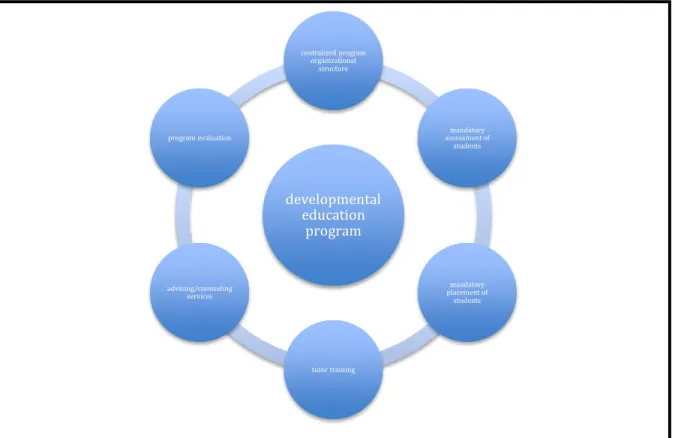
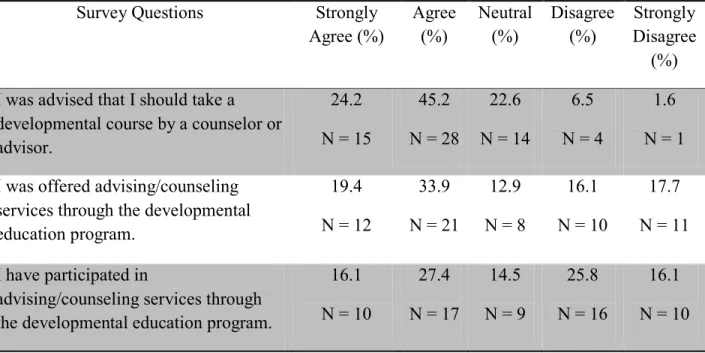
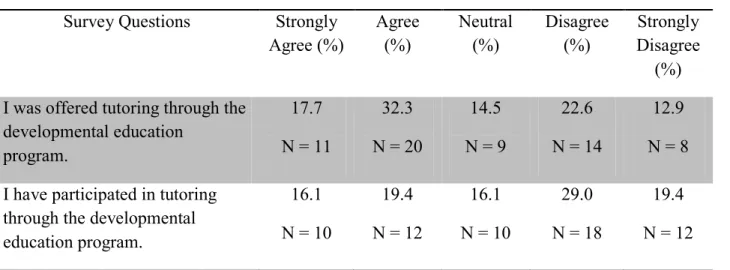
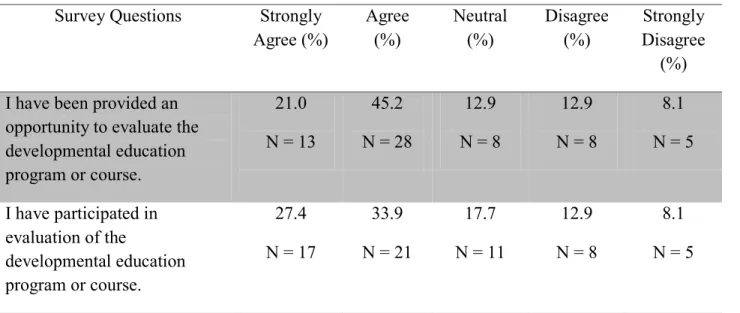
According to Boylan et al. (1997), six distinct components have been discovered as the foundation of student success in developmental education programs. These six components are a centralized program organizational structure, mandatory assessment of students, mandatory placement of students, tutor training, advising/counseling services, and program evaluation (Figure 1.1). A centralized program organizational structure refers to the use of a core education department through which all developmental courses and services are operated. The use of a centralized organizational structure rather than a decentralized structure has been linked to increased student retention. Mandatory assessment refers to the required testing of incoming students to an institution. This is considered in conjunction with mandatory placement, in which students are placed in developmental courses based on the results of mandatory assessment.
While mandatory assessment positively influences student success, both mandatory assessment and placement have been shown to negatively affect retention (Boylan et al., 1997). Tutor training is based in the idea that optimal tutoring services begins with training of the tutors. Developmental programs that offer tutor training as a component of the tutoring service have resulted in higher student passage rates and grade point averages. The inclusion of advising and counseling services within an institution has also been linked to improved course passage rates among students. The component of program evaluation is confidently related to student retention at two-year institutions in addition to success in developmental courses. Engaging in evaluation may assist program staff in monitoring and improving performance in those
9
systematic components, it is impossible to determine how successful developmental courses or activities may be. The six key components of Boylan et al. provide a framework for comparison and evaluation of the component implementation in a community college in Louisiana.
Figure 1.1 Components of a Developmental Education Program
Research Questions
1. How do students in a developmental education program at the community college level perceive the effectiveness of the program?
2. Which developmental education components are perceived by students and as most beneficial to success and development of knowledge and skills needed to successfully attain academic goals?
developmental education program centralized program organizational structure mandatory assessment of students mandatory placement of students tutor training advising/counseling services program evaluation
10 Limitations
Remediation is a personal topic for this researcher. The researcher completed developmental courses as an entrance requirement into a four-year regional institution in Louisiana. The researcher participated in developmental Reading and English courses his first semester of college in the fall of 1995. Despite not receiving credit toward his program of study, the researcher graduated in December of 1999. Having participated in developmental classes, the researcher recognizes that biases exist based on his personal experience; however, the developmental program that is part of this research examines the community college setting rather than a four-year institution.
The researcher also recognizes that the results of this study may or may not be applicable to other community colleges in other states or regions. The results can, however, be applied to the community college that participated in the study. In addition, the results may or may not be applicable to four-year universities that offer developmental courses.
Definition of Terms
Community College—A post-secondary institution that provides developmental education,
associate degrees, and vocational certifications.
Technical Community College—A post-secondary institution that traditionally provides
developmental education and vocational training but is expanding to provide associate degrees.
Matriculation—Progression through a program of study, in the context of transition from
community college to a university.
Developmental Education—Education that is required of students who are deemed not ready
11
University—A four-year post-secondary institution of education that provides programs of
studies that reward bachelors, master, and doctorate degrees.
Vocational Education—Education in which students are taught a skill or trade for employment
in a specific career field.
Meritocracy—The philosophy or belief that through hard work and dedication anything can be
achieved.
12
CHAPTER 2
LITERATURE REVIEW Introduction
There exists a plethora of literature providing background on the subject of post-secondary developmental education. The literature research of Fike and Fike (2008), Sheldon and Durdella (2010), Merisotis and Phipps (2000), Shaw (1997), Boylan et al. (1997), Attewell, Lavin, Domina, and Levey (2006), and Clark (2008) provide the foundation for the proposed research. American ideology and the development of meritocracy and democracy will first be discussed. The history of community college systems in use throughout the United States, with a specific emphasis on Louisiana, will then be assessed. Next, the definitions of remediation and developmental education as it relates to higher education will be established. Current research will then be detailed regarding contemporary issues surrounding community colleges and developmental education. Recent views regarding the location of developmental education will be illustrated, as well as student success and diversity. Limiting access will be explored,
especially as it relates to developmental education policy. The cost of remediation and its effect on academic standards will additionally be investigated. Transfer and retention, as well as student integration and involvement will be reviewed. Finally, Baxter Magolda’s
Epistemological Reflection Model (1992) will be acknowledged in order to provide a lens through which the researcher will examine student perception of mandatory participation in developmental education.
American Ideology and Education
Meritocracy and democracy are ideals uniquely intertwined in the American education system (Somerville & Santoni, 1963). The philosophy of meritocracy attempts to create an unbiased system in which the best and brightest are rewarded access to resources of
13
achievement. When applied to college access meritocracy is basis of college entrance exams. Students with high test scores are rewarded with access to higher education and the luxury of choosing a university setting. American ideology also highly values a democratic ideal that grants everyone an opportunity to achieve goals through hard work and dedication. Students wishing to gain access to higher education but fail based on past academic performance are given the opportunity to prove themselves. This is where community colleges fit into the hierarchy of higher education. In order to protect meritocracy and ensure that only best and brightest are allowed into the universities, community colleges provide democratic open admission policies that grant access to all. The community college proves developmental courses and vocational training. Once a student has worked hard and completed coursework, the student is then granted access to universities to continue their studies. Students who score high on admissions test are granted immediate access to universities and give more academic choices. Students who do not perform well on admissions test must first deem themselves worth of access to a university by achieving success at a community college. This system protects meritocracy while also accommodating democratic American ideology.
In their book, Ethics, Dewey and Tufts define democracy as, “a moral ideal is thus an endeavor to unite two ideas which have historically often worked antagonistically: liberation of individuals on one hand and promotion of a common good on the other (Somerville & Santoni, 1963, p.498).” Thomas Jefferson believed a “natural aristocracy” would be created to protect the common good. He wrote in a letter to John Adams, “…For I agree with you there is a natural aristocracy among men. The grounds for this is virtue and talents…There is also an artificial aristocracy, founded on wealth and birth, without either virtue or talents; for with these it would
14
belong to the first class. The natural aristocracy I consider as the most precious gift of nature, for the instruction, the trusts, and government of society (Somerville & Santoni, 1963, p. 266).” Michael Young, an English sociologist, first coined the term “meritocracy” in his 1958 essay entitled The Rise of Meritocracy (Young, 1958). Young intended his essay to be a satirical novel and he believed that meritocracy is truly classism (Fox, 2002). Young expressed the idea that individual merit should replace nepotism, bribery, and inheritance.
Early universities served as an instrument used to create an elitist class designed to be leaders of the new republic, the United States (Thelin, 2004). Of early admissions requirements, Thelin states that a lack of consistent primary and secondary education resulted in loose
admissions standards and the provision of basic education to ensure continued revenue for a college. Upper class males were allowed entrance into universities due to their class status. If a student failed to meet the admissions requirements, they would gain access to higher education on the basis of social status alone; they were provided developmental education based on their educational background.
Developmental education courses were taught throughout the eighteenth century as higher education spread throughout the country (Thelin, 2004). Important events in American history provided students increased access to higher education, such as women’s enrollment, the First and Second Morrill Acts, and the enrollment of African Americans. The American Civil War provided an important turning point in the advancement of women. Barbara Solomon (1985) explains that the Civil War enabled women to transition from a domestic life to part of a labor force. In particular, Reconstruction fostered the placement of women in educational institutions as both students and teachers. Women took advantage of remediation to gain access
15
into higher education, and as teachers they played a vital role in preparing students for post-secondary education.
Another important event in the nineteenth century was the passage of the First and Second Morrill Acts. These acts expanded access to higher education by establishing Land Grant Colleges (Rudolph, 1962). The Second Morrill Act established black land-grant colleges. James Anderson (1988) explains that in the South, the post Reconstruction era education system consisted of primarily private liberal arts colleges. Between 1870 and 1890, federal funding established nine black land-grant colleges in the South. By 1915, sixteen such schools existed. Anderson also points out that only one of these colleges provided college level instruction. Remediation and developmental education were large components of the black-land grant colleges, particularly in the South. Lack of funding for the newly develop K-12 public school system increased the need for remediation in both types of land-grant colleges. Developmental education in higher education was a typical part of the college curriculum and was not disputed until the twentieth century.
In the twentieth century, higher education saw an explosion in enrollment. The increasing demand for the college experience led to the creation of the community college (Thelin, 2004). By 1920, the Association of Junior Colleges, later known as the American Association of Community Colleges, was formed (Higher Education in America, 2006). At their conception, these post-secondary two-year institutions had the primary purpose of providing remedial education and the first two-year of college coursework. This would culminate with the awarding of an associate degree, and allowed students to matriculate to four-year institutions. American higher education saw a dramatic increase in demand in the early 1900’s, especially with the GI Bill, which provided financial assistance to veterans returning from war. With the
16
creation of selective admissions policies at four-year institutions, more students chose to enroll in community colleges for remediation and entry to higher education. These selective admission policies were created for administrators to manage rising numbers of applicants, which also afforded them the luxury of determining the size and social composition of the student body. In this sense, administrators became the gatekeepers to the college.
During the 1950’s and 60’s, the Supreme Court case Brown versus The Board of Education Topeka, Kansas, the civil rights movement, and affirmative action all led to an extraordinary increase in college enrollment (Greenblatt, et al, 2006; Brunner, 2007). As these new students applied for admissions, additional remedial education was needed to accommodate the new students (Thelin, 2004; Lucas, 1994). The new open-access policies allowed increased opportunities for disadvantaged student (Richardson, 2005). In the 1980’s, a call for higher standards began to move across the higher education. Clark (2008) explains:
The conflict between open-door admission and performance of high quality often means a wide discrepancy between the hopes of entering students and the means of their realization. Students who pursue ends for which a college education is required but who have little academic ability gain admissions into colleges only to encounter standards of performance they cannot meet. As a result, while some students of low promise are successful, for large numbers failure in inevitable and structured (p. 10).
Throughout the 1980s and 1990s, the debate over increasing academic standards and limiting access continued. Lucas (1994) found opposing views of education. One such view featured an elitist line of thought rooted in meritocracy where only the selected few would be admitted. This maintained an idea that higher education was a privilege of few. The alternative deemed
education as open to all. This view focused on allowing all to strive for higher education but preserved institutional standards of academic success.
Laura Rendon (1997) explains that two dichotomies exist when examining access to higher education in America. Rendon identifies one side as preserving individualism in a
17
“…color-blind, meritocratic view that emphasized individual freedom to succeed or fail under universally agreed standards of merit” while another perspective “…is a collectivist view formulated around the sharing of wealth and power (p.57).” These two ideas on admissions policies, one based on merit and the other on social justice, are competing to allocate higher education and define a contemporary American college student body. It should be noted that both philosophies consider their purpose as ultimately pursuing justice and fairness. Education is at the forefront of the battle between these two worldviews, as seen in the debate over access and admissions.
The admissions policies of many colleges focus on an index that assesses students’ qualifications. The ACT is one examination that high school students can take in order to gain entrance into college based on their achieved score. According to Louisiana State University’s admissions requirements (2011), “Preference for admission to LSU will be given to those students whose credentials indicate the greatest promise of academic success. Admission decisions are based, in part, upon meeting the needs and capacity requirements of LSU” (Para. 3). Academic success in this case is defined by two primary factors. The first is a grade point average of at least 3.0 in a college-preparatory curriculum; the second is a composite ACT score of 22. This policy clearly rewards merit, and states as much in the admissions policy. This conflict between meritocracy and democracy is illustrated in ACT data collected in 2011, which shows that the average score for Caucasian students in Louisiana is 22 (ACT Profile Report, 2011). This means that the average Caucasian student can gain access to a Louisiana university. The average score for African American students is 17.8 which translates to the majority of African American students will gain access to higher education through community colleges. The current average ACT score for Louisiana high school students is 20.7. In LSU’s flagship
18
agenda, one stated goal is to increase campus diversity (LSU Flagship Agenda, 2006). Is LSU committed to this goal of diversity at the cost of other stated goals? This question represents one of the social dilemmas created by such policies that are meritocratic, while simultaneously attempt to be democratic. To accommodate this dilemma, community colleges are experiencing an expanded role which is providing an important access point to higher education in Louisiana for students who are deemed unprepared for college coursework.
There have been a number of policies that have been developed with the goal of making access more democratic. According to Laura I. Rendon (1994):
Democratic access ensures that all students, regardless of social background,
race/ethnicity or gender, are provided a fair and equal opportunity to graduate from high school, enter college of their choice, graduate from college, and enter the graduate or professional program of their choice (p.64).
Oberlin College, founded in 1833, was a pioneer in creating an admissions policy that did not discriminate against women or people of color (Thelin, 2004). This case is of interest due to the historical context in which it is surrounded. The implementation of this progressive Oberlin College policy occurred thirty-years before The American Civil War and the end of slavery, and even longer before women achieved suffrage.
Furthering the move to democratic access, Teddlie and Freeman note that the first endeavor of the American government toward equal treatment of African Americans was to provide education (2002). This education was to be “separate but equal” as defined by the Supreme Court Case Plessey v. Ferguson in 1896. This attempt failed in general, but provided for the establishment of Historically Black Colleges and Universities. The advantage of this policy, the provision of some type of education for African Americans, was utterly
19
The Brown case provided another milestone for the advancement of a more democratic higher education system (Alger, 2003). Albert L. Samuels (2004), explains, “In time, it laid the groundwork for the expansion of antidiscrimination principle to include gender, religion, national origin, sexual orientation, age, and disability--- the so called rights revolution (p. 11).” With this court decision, America faced the challenge of desegregating higher education. Applying Brown to higher education was not an unproblematic undertaking and was met with furious protest, particularly in the South. Additional legislation was passed expedite the desegregation of schools.
Two major legislations of the 1960s, “affirmative action” of 1961 and the Higher Education Act of 1965, were passed in order to demonstrate the government’s commitment to providing financial support to lower and middle-income students, while also ensuring that minorities were given access to higher education (Samuels, 2004). As student populations increased as a result of open-admission policies, institutions began to investigate the problem of the underprepared student. While becoming more democratic in terms of providing equal access to higher education, the meritocratic tradition that existed in American society created a conflict with new policies. These new policies provided access to higher education, the backlash they created called for higher standards to be implemented.
Rendon (1997) argues that merit definitions focus on admittance into college and ignore educational deficiencies and the need to foster ongoing student success. Merit can be seen as a competitive test of survival. Rendon emphasizes that merit definitions disregard student potential and do not benefit the majority. Clark (2008) rebuttals with the idea that competence allows selection of worthy individuals who are deemed more proficient in educational pursuits.
20
The contradicting ideals of meritocracy and democracy, as they related to college admissions, continue to pull policies in opposing directions. One seeks to fulfill the mission of creating diversity, while the other seeks to preserve institutional prestige. Community colleges were created as a means of accommodating these two conflicting ideals by providing an open admission policy for all students seeking postsecondary education. This also protects the prestige of universities by allows adherence to higher admissions standards at such universities while shifting the educational responsibility for underprepared students to the community college setting.
Education and Community College Development
Developmental education has been a part of American higher education since its colonial era beginnings (Thelin, 2004). The expansion of education beyond the traditional elite focus to reach women and minorities prompted an increased need for developmental education. Thelin (2004) notes that Ivy League institutions provided developmental education for students due to lack of available standard primary or secondary education. Colleges provided this service to raise money and to create cohorts of students. It is important to note that during this era, the student population consisted of only upper class white males. Developmental courses continued to be taught throughout eighteenth century as higher education spread throughout the country (Thelin, 2004). Important events in American history such as women’s enrollment, the First and Second Morrill Acts, and the enrollment of African Americans, provided students increased access to higher education.
In the hierarchy of higher education, community colleges hold an important position (Cohen & Brawer, 2008). They provide an access point for a variety of students. Community colleges are economical and provide quality education, which make them attractive to student
21
with diverse backgrounds. The American community college began in the twentieth century in response to an increased need for trained workers. The rapid growth of these institutions is also attributed to social movements that demanded greater access to post-secondary education. It is predicated that enrollment at community college will continue to grow and exceed 6.3 million students by 2012 (Gerald & Hussar, 2002).
Louisiana Community Colleges
The community college system in Louisiana was originally set up to be administered by the university systems; however, due to the loss of revenue from the “oil bust” in the 1980s, higher education underwent a major reorganization in order to operate more effectively (About LCTCS, 2012). Throughout the 1980s and 1990s, Louisiana governors tried to establish a single board of higher education. The most recent effort to form this board occurred in the form of a constitutional amendment proposed by Governor Foster in 1996; however, this amendment failed due to lack of support. Government officials believed that Louisiana had too many institutions to be effectively governed in a single system. After this defeat, Governor Foster commissioned a group of educational advisors to examine the current system of Higher Education. This group concluded that the current Board of Regents and the three university systems were adequate, and that improvements could be made to the current system without another attempt for a
constitutional amendment.
Governor Foster's next initiative was to create another higher education board that would establish training for people who did not intend to go to a university for four years and for people who wanted workforce training (About LCTCS, 2012). The Legislature supported the initiative by passage of ACT 151 and ACT 170 during the First
22
establishment of a separate board of the community colleges and the technical college campuses -- The Louisiana Community and Technical College System Board of Supervisors. This board became operational in May 1999, and brought together five community colleges that were under the University of Louisiana System and one under the Louisiana State University and Southern University Joint Management Board. It also took the reins of Louisiana Technical College, which operates 42 campuses across the state, from the Board of Elementary and Secondary Education.
Delgado is the oldest and largest community college in the state of Louisiana (History, 2008). The campus and school that would become Delgado Community College opened in 1921 as Delgado Central Trades Schools. The school transformed to Delgado Institute in the latter part of the 1950s, and became a junior college offering associate degree programs. During the 1960s and 70s, the name of the college was first changed to Isaac Delgado College, then to Delgado Vocational-Technical Junior College, before finally being renamed Delgado Community College in 1981 (History, 2008).
Many of the older community colleges in Louisiana have a history similar to Delgado, in that they began as a school focused on vocational education. Bossier Parish Community College (BPCC) was created as a pilot program by the Louisiana legislature in 1966 (History of BPCC, 2006). The purpose of this venture was to determine the need for and cost of establishing community colleges throughout the state. The college opened in 1967 and offered a number of vocational programs; it was not until 1979 that the college was able to award associate degrees. In 1995, the school formed an articulation agreement with six institutions, including Louisiana Tech University, Northwestern State University, Grambling State University, Southern Arkansas
23
University, Kilgore Junior College, and Louisiana State University-Shreveport. Two years later, BPCC became a member of University of Louisiana System.
The Louisiana State Legislature created Baton Rouge Community College (BRCC) in the summer of 1995 as an open-admission, two-year institution (About BRCC, 2008). The primary focus of this institution was to provide greater access to higher education in and around the Baton Rouge metropolitan area. Initially, Louisiana State University and Southern University administered the college jointly, and the college operated on the campus of Louisiana State University. Baton Rouge Community College currently offers programs in a variety of associate degrees, transfer credits, diplomas, and certifications (About BRCC, 2008). An articulation agreement was reached between BRCC and the following four-year institutions: Louisiana State University, Southern University, and Southeastern Louisiana University. Another important agreement was reached in 2001 between BRCC and the East Baton Rouge School System. This agreement allowed high school students to enroll in classes at BRCC, through which the student would receive college credit. Today, BRCC continues to increase its enrollment and the size of its campus in order to better serve the people of Baton Rouge.
Louisiana Technical College (LTC) was established in 1930 as trade schools focused on instruction in “manual arts” (About LCTCS, 2012). Through legislative acts in 1938, 1942, 1946, and 1972, the college system saw tremendous growth and expansion throughout the state. The LTC system currently features forty campuses statewide, and offers 75 diploma programs and 38 associate degree programs.
Louisiana’s community colleges were developed to provide vocational and associate degrees to students not planning to attend a four-year university (About LCTCS, 2012). Today, Louisiana’s Board of Regents seeks to expand the role of community colleges to provide an
24
access point to higher education by eliminating developmental courses at the university level (Board of Regents, 2011). Students deemed academically underprepared must complete developmental coursework at a community college. It is imperative that the developmental courses are effective and facilitate retention and transfer to four-year institutions.
Developmental Education
Developmental education, or remediation, serves as the resolution to balance meritocracy and democracy. Grubb et al. define remediation as “a class or activity intended to meet the needs of students who initially do not have skills, experience, or orientation necessary to perform at the level that the institutions or instructors recognize as ‘regular’ for those student” (as cited in Perin, 2006, p. 339 ). Much literature suggests that junior or community colleges are the
appropriate venue for developmental education in higher education. The “definition of the junior college role and function… as a place of higher education distinguished from the four year college or university only by the brevity not the content or quality of curricula” (Dobberstein 1987: 16 as cited in Deil-Amen & Rosenbaum, 2002, p.252) further contributes to the case of a two-year verses four-year curriculum.
Remediation can be viewed in three strikingly different perspectives. Manno (1995) and McGrath and Spear (1991) define remediation as “a key component of access, equal opportunity, and assimilation to higher education” or “a symptom of academic degradation of the academy and a contributor to “dumbing down” entire institutions.” Rhoads and Valadez (1996) further define remediation as “an imposition of middle-class values on marginalized groups of students in a form that serves to preserve social inequalities” (as cited in Mills, 1998, p. 674). The first perspective describes developmental education as an important point of access that allows minorities and poorer students an opportunity to gain access to the resources provided by a
25
college education. The second perspective sees developmental education a threat to higher education that ultimately causes a drastic decease in academic standards and decline in academic integrity. The last view explains that remediation is a tool of hegemony, forcing minorities and lower-class students into ineffective developmental programs and ultimately setting them up for failure.
State of Developmental Education
Several states have begun to move developmental education from public four-year universities to two-year community colleges (Bettinger & Long, 2005). Many argue that
developmental education has historical roots in higher education and should be strengthened, not eliminated, especially since the minorities and lower socioeconomic groups make up the
majority of developmental students. In a study by Bettinger and Long (2005), remediation is examined at the community college level. The researchers highlight that the current policy of many states is to restrict developmental classes to community colleges. They explain the
rationale for this trend by stating that faculty and administration at four-year universities feel that two-year institution are the most appropriate place to provide this type of instruction due to cost efficiency and ability to provide more individual instruction. The researchers examine
participation in developmental classes, ranging from placement to completion, and effects of remediation on students at community colleges. Bettinger and Long conclude that “remediation does not appear to have a negative effect” on students, but improvements still need to be made (p.25). The authors also suggest more research is needed on programs that increase the positive effects of remediation.
26 Student Success
Attewell, Lavin, Domina, and Levey’s (2006) study New Evidence on College Remediation looks at the National Educational Longitudinal Study (NELS:88) to gather data identifying the quantity of remediation occurring in postsecondary education and the diversity of students enrolled in such courses. The study further focuses on graduation rates, time to degree attainment, and detrimental effects of placement in multiple developmental courses. The study argues that though academically ill-prepared high school graduates most often take
developmental classes, those students are capable of success in postsecondary education. Developmental classes are not found to be associated with decreased probability of academic achievement; however, remediation did increase time spent pursuing a degree. The authors conclude by identifying developmental education as a gatekeeper and means of quality control.
With community colleges taking on developmental education, the issue of “cooling out” becomes a concern for unprepared students (Deil-Amen & Rosenbaum, 2002). Clark (2008) describes “cooling out” as a counseling process that community colleges use to convince students that their goal of obtaining a bachelor’s degree is unrealistic while encouraging pursuance of vocational training or associate degree programs. Deli-Amen and Rosenbaum (2002) researched community colleges that try to eliminate the stigma of developmental placement in hope that students will be better able to achieve their desired academic goals. The authors found that students misinterpreted their educational progression due to the
institution’s avoidance of labeling of developmental education programs and lack of counseling (p. 263). This can result in unanticipated financial and time consequences for the students.
Merisotis and Phipps (2000) describe the research on the effectiveness of developmental education as “sporadic, underfunded and inconclusive (p.75).” Crowe (1998) reports The
27
Southern Regional Education Board has observed that most states lack exit standards for developmental classes and many states lack data to support a successful program. For the most part, evaluation of developmental programs did not exist until the mid 1960s (Kulik, Kulik & Schwalb, 1983). It was during that time period that federal money began to flow into higher educational programs specifically designed to increase equal access and opportunity. With the use of federal money, it became required to document the effectiveness of developmental programs (Boylan, 1982).
Donovan (1975) provided one of the first reports on the effectiveness of developmental programs in postsecondary education. His research design used standardized pre/post-testing with students who took developmental classes in Mathematics, English, or Science. The results of Donovan’s research were positive, and showed that students improved their skills with
remediation. Several other studies with a similar design, such as Allarie (1978), Bellucci (1981), Carter (1976), Moore (1977), and Swindling (1982) all yielded similar results; however, it was acknowledged that while students did improve their skills as based on standardized test and locally developed achievement measures, the extent of the improvement was varied from subject to subject and between different institutions.
In contrast to other studies, Suen (1979) examined programs designed to raise the grade point average of underprepared students using a Step-Wise Regression. This design isolated certain methods used in a developmental program to determine if there was a significant influence on grade point average. Through this research, it was found that developmental programs did significantly influence improved grade point averages.
Adelman (1998) evaluated the college transcripts of students from the national high school class of 1982. Adelman found an inverse relationship existed between the extent of
28
remediation needed and degree completion. When examining the students who earned more than a semester of college credit by age thirty, Adelman found that sixty percent of those students who were not required and did not participate in developmental courses completed the
requirements for a bachelor’s or associate’s degree. Fifty-five percent of students who participated in one developmental course gained a degree, while only 35% of students who required more remediation achieved a degree completion. Adelman also found that students who were required to take a reading developmental course were more likely to be required to enroll in more than one developmental course. This resulted in degree completion by only twelve percent of students enrolled in developmental reading. This percentage drops to nine percent when student are required to enroll in more than one developmental course. It is then concluded that when the need for remediation stems from reading, the probability of persisting is very low.
Fike and Fike (2008) found that first year retention in the community college setting can be predicted from taking developmental reading, writing, and mathematics. The authors support student assessment for need of developmental programs, placement within a program, and evaluation of developmental program efficacy. Success strategies for underprepared community college students were the subject of Amey and Long’s (1998) study. The authors identify completion of developmental reading and English courses as indicative of future success. The authors support mandatory placement in developmental courses and recommend completion of such courses as early as possible in students’ curriculum.
Sheldon and Durdella (2010) studied success of students taking compressed length verses regular length developmental courses in the community college setting. Compressed length coursework was linked to more likely completion and student success. Kolajo’s 2004 study of community college student experience from developmental education to graduation analyzed
29
three years of data. Kalajo identifies a positive link between the number of developmental courses taken and time to graduation.
Diversity and Access
Community colleges serve a diverse student population, including more non-traditional students and students of varying ethnic background in comparison to four-year institutions (Community College Fact Sheet, 2012). The average community college student is 28 years of age, and 45% of the student body is between the ages of 22 and 39. Students who are enrolled full-time in coursework while working part-time make up 50% of the population, while 40% of students are enrolled part-time in coursework while working full-time. Women currently make up 57% of the American community college student body. Ethnic minorities account for 46% of the community college population. Multi-ethnic students enrollment in community college is predicted to further increase (Wolgemuth, Kees, & Safarik, 2003). Miller, Pope, and Steinmann (2005) identify multiple divisions of community college students. One group seeks community college as a terminal education role while another group views community college a step toward admission to a four-year institution. For this second group, community college is deemed “an obstacle to get out of the way” (Miller, Pope, & Steinmann, 2005). This second group also encompasses students in need of developmental education in order to meet their goal of transfer and retention to a university.
Timothy Leinbach (2005) reports that more than half of black students pursuing
education through a community college drop out of school within six years. Black community college students demonstrate lower rates of transfer to four-year institutions as well as earning of certification or degrees when compared to white community college attendees. This illustrates the vital access point that developmental education and community colleges provide to minority
30
groups. This also elucidates the need for developmental education reform in order to increase effectiveness.
Another aspect of developmental education that deserves attention is the participation in this type of instruction by many older non-traditional students (Age and Remediation, 2006). In an article by Calcagno et al. (2006), the authors note that older students are affected by outside commitments such as work and a family, and that colleges need to be more flexible with class scheduling, provision of child care options, and inclusion of added distance learning programs to accommodate non-traditional students. When examining non-traditional participation in
developmental courses the authors found that overall, participation decreased probability of graduation. In addition, the authors state, “Thus, enrollment in remedial classes had less negative relationship to the probability of graduation for an older student than for a younger student. This finding may reflect the varying motivations and goals of older students. (p. 4).”
In a study by Haveman and Smeeding (2006) on the effects of higher education and social mobility, the researchers stress the importance of community colleges acting as an access point for minorities and the underprivileged. Havenman and Smeeding support the research by Bettinger and Long (2005) in saying students who complete remediation can improve
academically. The authors suggest a number of possible reforms for higher education. They conclude, “the U.S. system of higher education reinforces generational of income inequality and is far less oriented toward social mobility than it should be” (p. 143).
During the 1960s, reforms in higher education developed the concept of open admissions, which allowed any high school graduate to take part in postsecondary education (Mcalaxander, 2000). In an article comparing the remediation philosophies of Mina Shaughnessy and K.
31
their work to the modern issue of remediation. While both support open admission as a means of general admission regardless of performance on college admissions exams, Cross deems
remediation as elitist and recommends technical education as an alternative program. Shaughnessy recommends improvement in the methods of remediation.
Lavin and Weininger (1998) suggest preventing students who need remediation from attending four-year institutions could greatly decrease the likelihood of those students obtaining bachelor’s degrees. They also suggest that such policies are designed to limit access to higher education for students of color, students from less affluent families, and students for whom English is their second language.
Protecting Academic Standards
In a qualitative study by Dolores Perin (2006), the question is raised if community colleges can safeguard access and standards. Participants in the study are interviewed individually or in small groups. In addition to the interviews, Perin uses college catalogs, instructional reports and state policy documents to examine developmental practices. Data is collected from 15 participating community colleges that differ in location, size and urbanicity. The researcher concludes “remedial assessment and placement policies seemed to reflect unsuccessful attempts to protect standards and access goals at the same time” (p. 339). Perin also suggests community college’s developmental education programs need to be extensively evaluated in order for policy reform to adequately protect standards and access.
Kett (2001) suggests that remediation in basic skills is directly related to the decline of academic standards, grade inflation, and pressures by administrators to increase enrollment. Kett criticizes that most students participating in remediation are not prepared for college level
32
and observes that students lack the ability to comprehend and write on an “acceptable level” (p. 6). This research proposes that by providing developmental education, four-year institutions are accommodating students that lack the skills to be successful within the institutions. This
ultimately leads to a decrease in academic standards and prestige.
Developmental Policy
Kathleen M. Shaw (1997) also uses qualitative data to examine the developmental policies of community colleges. Data is collected from eight urban community colleges with a large minority population and a high rate of transfer to four-year universities. The data is collected by a group of ethnographers adept in sociology, education, and anthropology. The ethnographers use a wide range of methods to collect informational interviews of students, faculty, and administration, as well as observations in formal and informal settings. More than 1000 data elements are gathered for this analysis. In this study Shaw, finds that different
community colleges have varying interpretations of state developmental policies. The researcher believes that in order for remediation to be successful, the interpretation of policy must be
consistent.
Ronald Roach’s (2000) article Remediation Reform explains California’s recent change in
remediation policy. Incoming freshman are required to complete all developmental courses within one year of enrollment. Failure to pass these courses results in dismissal from the university. In the first year of policy implementation, developmental course completion increased from 40% to 79%. While states like New York have eliminated developmental courses completely, California is actively looking to improve academic standards without limiting access.
33
In an article that evaluated developmental education in colleges and universities,
Merisotis and Phipps (2000) suggest three strategies to improve developmental education. These include inter-institutional collaboration, making remediation a comprehensive program, and utilizing technology. Inter-institutional collaboration within a region or state greatly increases the opportunities for collaborative research, while at the same time providing evaluation and creation of best practices. Not only is this beneficial to student, but to faculty as well, by providing a new pedagogy for teachers teaching this particular population of students.
Illich and Hagan’s (2004) study of policy implications regarding performance in college courses among students enrolled in developmental education found that college level pass rates are lower among students who fail to successfully complete remediation. Furthermore, the authors state that students who complete developmental education are typically successful in later coursework. Policy implications suggested include focusing on the overall development of the student, rather than a specific area of educational deficiency in order to optimize student success.
In Jeanita W. Richardson’s (2005) article, “Who Shall be Educated?”: The Case of Restricting Remediation at the City University of New York, the researcher examines the history of remediation in New York and criticizes the current policies of the City University of New York (CUNY). Richardson explains that the open admissions policies were created in the 1960s in order for minority and lower economic status students to have access to higher education. The author argues that this expanded access was the reason for the university’s inception, and that the elimination of developmental programs undermines the intended purpose. Richardson also points out that the State University of New York, with a majority white middle class cliental, was not required to drop developmental courses. Richardson shows strong conviction on the subject
34
of open access, as described in her closing statement: “unfortunately, for the thousands of African American, Hispanic, immigrants, and low-income individuals, prospects for access to higher education and social mobility are slipping like sand through their fingers” (p.186). By delegating developmental education to community colleges and removing such programs from four-year institutions, Richardson feels that the resulting effect will place a barrier between minority students and education.
Making remediation a comprehensive programrequires setting into policy the best practices for providing developmental education that are found to be the most effective by research. Massachusetts’s community colleges conducted research to establish best practices for providing developmental education within their system (Massachusetts, 1998). These practices include:
Assessment and Placement- this would require all students to be assessed in reading, writing, and mathematics. Students would be placed in the appropriate level of remediation in accordance with the results of the mandatory
comprehensive instrument.
Curriculum Design and Delivery- this involves the creation of clear goals and objective for the developmental program that can be easily communicated to the students.
Support Services- it is important to realize individual differences among student in a developmental classroom. In order to identify a student’s weakest area, “intrusive” advising is used to create more individualized help.