INFORMATION ENVIRONMENT OF BLENDED
LEARNING: ASPECTS OF TEACHING AND QUALITY
Tatyana N o s k o v a , T a t y a n a P a v l o v a , Olga Y a k o v l e v a Herzen State Pedagogical University of Russia, Russian Federation
[email protected] Nataliia M o r z e
Borys G r i n c h e n k o K y i v University, Ukraine n . m o r z e @ k u b g . e d u . u a
M a r t i n Drlik
Constantine the Philosopher University in Nitra, Slovakia m d r l i k @ u k f . s k
Abstract: The aim of the study in frame of the international project IRNet -International Research Network for the study and development of new tools and methods for advanced pedagogical science in the field of ICT instruments, e-learning and intercultural competences is to understand how the quality of digital learning environment and a new methodology for teaching activities contribute to achievement of learning outcomes sought by modern society. The data from a comparative analysis of regulations in the field of e-learning in some countries participating in the project is represented. The article substantiates indicators of virtual educational environment in accordance with European standard of quality in higher education. The psychodidactic approach based on accounting of general concepts: information, communication and interaction management in a network learning environment used for evaluation of teaching activities in blended learning. The study hypothesis is based on the data obtained from analysis of the students' views and attitudes towards various educational processes in digital learning environment and represents a set of conditions for system formation of university virtual educational environment and the effective use of e-learning technologies. At a later stage of research teachers in all the universities involved in project will be surveyed.
Keywords: e-learning, International Research Network, survey, quality, digital learning environment, advanced pedagogical practice.
74 Т. Noskova, Т. Pavlova, О. Yakovleva, N. Morze, M. Drlik INTRODUCTION
The world is becoming digital, its inhabitants must possess digital technologies and use them effectively in a variety of sectors, including education, science, and business. In such circumstances, the key points are the access to knowledge, functioning in different environments in any place and at any time, the ability to interact with this knowledge, to use it in solving urgent problems. These points can be attributed to the necessary conditions for the development of education, innovation and entrepreneurship.
The modern system of higher education focused not only on the development of future professional competence in a narrow professional field, but also aimed to prepare for a flexible professional work in the new intellectual environment in a changing digital world. For this educational environment must reflect current trends and provide effective and perspective means of professional, educational and self-education activities.
Teachers need to comprehend that the modern generation evaluate and operate not only in the traditional classroom environment, but also in virtual environments. They differ in information and communication behaviour in comparison with the preceding generations; they changed their educational needs. Therefore, the learning environment should be changed appropriately processes occurring in current global world. This poses the problem for education how to prepare new generations for safe and effective learning, professional and social interactions in global information environment. Specific requirements are associated with rapidly changing technology in all professional activities and increasing academic mobility of students and teachers. The article describes several research directions within the European IRNet Project.
The article discusses the new features of the educational environment, organized by the widespread use of information and communication technology. Main directions of assessing quality of a virtual learning environment of the modern university are defined. As an integral part of an educational environment is the teaching activity, special attention is paid to changes in its nature and content. Analysed the legal basis of teaching and educational activities in the open information space. Substantiated research tools of teacher's attitude for the implementation of professional work under new conditions in different countries. Proposals for the efficient organization of blended learning in the modern university incorporated in hypothesis of the study.
1. REGULATORY FRAMEWORK OF "BLENDED LEARNING" Blended learning is a model of education program in which student learns at least in part through online delivery of content and instruction. Babu M, Sameer (2009) defines Blended Learning as a fruitful effort in integrating live classroom activities including face-to-face instructions along with e-learning to reap the maximum benefits by utilising the best elements of all through effective practices. Different
countries have different legal bases of e-learning using in implementation of educational programs. In Russia over the recent few years there have passed several laws concerning the issues of e-learning, development of infrastructure with the use of ICT, and Internet access. For example, Federal law "About Education" (adopted in December 2012) officially provides the ability to use e-learning and distance learning technologies. Organizations engaged in educational activities are able to use e-learning and distance education technologies in the implementation of educational programs.
Special attention in current Federal Educational Standards is paid to self-teaching activities of students during their professional practice with their fixation in the information environment.
The document "Strategy 2020" (developed in 2011) introduces the concept of long-term development of Russia. One of the trends is the orientation of ICT on the development of human capital, especially in the field of education.
Federal Initiative "Our New School" (adopted in February 2010) names the main characteristics of students as citizens: the ability to give innovative solutions, the ability to choose a professional way, the willingness to learn throughout life. Also, the document names the main trends of education modernization and innovative development: improvement of the school infrastructure, gradual teachers training, and the implementation of inclusive education. All the listed initiatives are impossible to carry out without the wide use of ICT and e-learning.
In the federal state educational standards and licensing regulations to the security of the students of higher educational institutions access to electronic scientific and educational resources are fixed only requirements to ensure every student of higher education access to e-library system of the university and the simultaneous use of the higher education institutions of one or more of the electronic library systems. In the Federal Target Program "Research and scientific-pedagogical specialists of innovative Russia" there are some common guidelines for the development of University information educational environment, which should be characterized by: openness, innovation, information saturation, high adaptability, etc.
In Ukraine the informatization of society has become a public policy at the beginning of the 90's. At the legislative level, this was confirmed in 1993-1994 by the President's of Ukraine Decree "On public policy Informatization of Ukraine "and the Act of Cabinet of Ministers of Ukraine" Issues of information ".
In the Law of Ukraine "On Higher Education" (the first addition was in February 2002, and the latest - in July 2014) is created the Section 42 of Article 7 "The organization of the educational process," in which is stated that, along with the official remote form it is permitted to introduce a distance form of education in Ukraine.
The next step for the introduction of distance learning in Ukraine was the Act of the Cabinet of Ministers "On approval of the Program of development of distance
76 Т. Noskova, Т. Pavlova, О. Yakovleva, N. Morze, M. Drlik education for 2004-2006". The main objectives of the program were the implementation of legal, institutional, scientific and methodological, informational | and telecommunication, logistical, human, economic and financial procuring of distance learning; improvement the structure of the distance learning system by expanding the centres network; quality assurance in distance learning system through the introduction of the practice of examination courses and tech distance learning; development of distance learning in higher education for all areas of training; vocational training and psychological support to certain groups, including the unemployed, people with disabilities, conscripts, persons who are in prison, etc. Today the main normative acts, which directly regulate distance learning, are:
- Ministry of Education and Science of Ukraine on July 7, 2000 № 293 "On Creation Ukrainian Center for Distance Education";
- The concept of distance education in Ukraine, approved by Ministry of Education and Science of Ukraine on 20 December 2000;
- Ministry of Education and Science of Ukraine on April 25, 2013 № 466 "On Approval of the Regulations on distance learning".
The essence of this form of education is reflected in the Schedule of distance learning: remote individualized learning refers to the process of acquiring knowledge, skills and ways of human cognitive activity and mainly is a mediated interaction between distant from one another participants of the learning process in specialized environment that operates on the basis of modern psycho-educational and informational and communication technologies.
The importance of the implementation of distance learning is reflected in the Law of Ukraine "On Basic Information Society Development in Ukraine in 2007-2015 years". The above-mentioned official documents provide full implementation of distance learning in our country and organization of high-quality training of specialists in different areas of qualification, including Masters, which are competitive in today's job market.
However, the listed laws and regulations do not give definite answers to the following question: what are the conditions of the e-learning and distance learning use as a legal way of learning and teaching at secondary and high school? For example, the relation between the number of hours in the remote mode and in the traditional "face-to-face" mode has not been set definitely.
In comparison, in Poland the number of hours in remote mode does not exceed 60 % of the total number of hours of classes according to the Regulation of the Minister of Science and Higher Education of 9 May 2008.
Because the clear rules and norms of e-learning are not fixed at the state level, it is indispensably to develop regulations of blended learning implementation at the university level. The experience of universities in different countries may be useful, because e-learning is intruding almost everywhere.
77
2. GENERAL CHARACTERISTICS OF THE MODERN UNIVERSITY EDUCATIONAL ENVIRONMENT
The dynamic and actively functioning global information environment alters human consciousness of information civilization. Informatization of modern human activity determines the inevitable transition from the use of signs to sign systems (Tikhomirov 1988), to fundamentally different intellectual methods of solving professional problems, new forms of knowledge representation and communication in advanced multivariate spatial and temporal coordinates. The answer to these calls should be fundamental changes in education, overcoming the inertia of the system dedicated to the reproduction of human capital. This overcoming factor can be and should be, in our opinion, the new part of the educational environment - its virtual network part.
Nowadays the information educational environment based on ICT has already been created and with varying degrees of success is functioning at almost all universities. In many institutions of higher education it is applied as a medium of remote support of full-time study, and the organization of extracurricular homework. But, unfortunately, as experience shows, virtual part of the educational environment often occurs in the same pedagogical paradigm (all threads of educational management underpinned by the teacher and the student acts only as executor of instructions and regulations). Therefore, in this part of the environment does not appear innovative "growth points" and new students motivations, and respectively it does not manifest a new quality of educational activities.
Nowadays the anthropocentric approach to building an educational environment is relevant. Its foreground is not only the tasks of teaching, but also the goals of personal professional evolution in the modern world. The determination of essential conditions in educational environment (information infrastructure and resources, communication, management) is based on a synthesis of knowledge of computer science, psychology and pedagogy. Such a synthesis of knowledge allows modelling and designing a new educational processes and interactions in a virtual network space.
The humanistic sense of the educational environment is stressed by many authors. For example, I. Baeva determines the educational environment as a psychological and pedagogical reality containing specially arranged conditions for the personality formation, as well as opportunities for its evolution included in the social and spatial-objective environment (Baeva 2009). For virtual learning environment, as well as for real, the most important characteristics are the saturation (or resource potential), as well as its structuring (or methods of organization). D. Ivanov emphasizes new specific features of the virtual educational environment as the most important indicators of its quality: the degree or level of local and external interaction for all users and the personal ability to convert (change, enrich) educational environment, operate in it. (Ivanov 2006).
78 Т. Noskova, Т. Pavlova, О. Yakovleva, N. Morze, M. Drlik In 2007 in Russia were published the results of several studies based on psychodidactic approach to educational activities. One study (Gel'fmane Kholodnaya 2007) is dedicated to the problem of educational texts design aimed on the intellectual student's evolution. The findings of this study open new perspectives for digital educational resources design. In another study (Panov 2007) revealed the conditions of student's creativity and self-development needs actualization in special forms of cooperation between the learners and the teacher and among the students themselves. In the third study the main concepts of the educational environment (information, communication and educational activities management) were highlighted. These concepts are essential for both classical and virtual environment (Noskova 2007), but only in conditions of interrelated and purposeful change in all these concepts can be predicted the achievement of a new quality level in educational activities.
In its goals and objectives digital network part of the educational environment
complements and enriches classic interaction. It implements new technologies of extracurricular learner's activities, supports the current progress of information and communication processes, contributes to modern educational student's inquiry and actualizes network logic of interactions. Pedagogically this environment is built as a nonlinear, multivariate, providing personal multiple choices in rich digital resource base and different methods of communication in solving educational problems. Thus, the educational environment changes dynamically, being adjusted and transformed by the demands of the students and challenges of social and professional environment.
How can we evaluate the quality of a virtual learning environment of high school? How to manage the processes of its purposeful formation? These questions have no definite answer and investigated by researchers in different countries. In particular these problems are included in the work packages of the project IRNet with the participants from the universities of Poland, The Netherlands, Spain, Slovak Republic, Portugal, Czech Republic, Australia, Ukraine and Russian Federation.
3. PEDAGOGICAL ACTIVITIES IN PERSPECTIVE VIRTUAL EDUCATIONAL ENVIRONMENT
In the aspect of educational interactions quality within a virtual learning environment there should be assessed, primarily, pedagogical approaches implemented in it. If these approaches are similar to the traditional, we witness an extensive development of the integrated educational environment. An innovative development is signified by the new teaching methodologies, which result in a new quality of the new aspects of professional competence formation. Such an innovative environment is estimated as a system of educational conditions running on the basis of information and communication technologies, complementary to the traditional processes of socialization and professionalization of a student. In such an innovative environment the new, modern information and communication behaviour of young
people is taken into consideration. Generalized goal of socialization and professionalization can be formulated as the adoption and implementation of teaching strategies "learning through life," the transformation of the virtual learning environment into a multifunctional tool of students' variable of educational activities (on-line, off-line, their combinations, the channels of mass communication, and social media).
Accordingly, it is necessary to assess such factors as the breadth of subjects of educational interaction, the range of solvable new educational and developmental problems, the individualization of student's educational path, the resource richness, the interactivity and sociability in the implementation of educational technologies. What changes should occur in a teacher's work within the expanded educational environment interactions?
Firstly, a modern teacher needs to learn solving professional problems effectively, both in the classroom, and in the specially created and managed virtual part of the educational environment. It is important to "see" and guide a student's actions in this environment, using appropriate pedagogical techniques. Moreover, it is necessary to organize not only training, but also educational, upbringing interaction.
Secondly, a teacher needs to change the attitude to a student demonstrating any kind of activity in the virtual learning environment. The virtual learning environment is especially helpful for the motivated, active, initiative students. Accordingly, in contrast to the traditional learning process, here the driving forces are: motivation, activity, initiative, and self-organization of students. Students begin to interact with the resources of the environment, with each other, and with the teacher. It is important that educational communications centre is being shifted from the teacher to the learner, who organizes interaction, assimilation of knowledge and the fonnation of competencies. In such practices the conversion from mass classroom training to more individualized extracurricular educational activities in the network environment is being encouraged.
Thirdly, a teacher needs to start "movement towards" the modern educational needs of young people. Growing up in a rapidly changing information environment, interacting with electronic information from early childhood determines a different information and communication behaviour of the rising generation. Young people have their own ideas about how to be in the electronic environment, and to deal effectively with various problems.
Social networks are the bright examples of such behaviour when young people are active and highly motivated. Actions in social networks are nonlinear, and mostly based on self-organization. Consequently, the virtual learning environment interactions should also use the new forms and formats of electronic resources. Fourthly, in the new, innovative part of the environment there has to be implemented the principle of new educational and professional practice goals and
80 Т. Noskova, Т. Pavlova, О. Yakovleva, N. Morze, ML Drlik objectives, together with the radically new forms of modern specialists' professional competences.
According to the global online survey of e-learning specialists from 146 universities in 47 countries, conducted in 2008, the list of strategic issues of e-learning for 2008-2015 was specified (V. Uskov, A. Uskov 2008). The top ten issues of e-learning were identified as follows: organization administration, educational content, evaluation system, a level of teacher training, financial issues, construction of infrastructure, teaching methods in e-learning, intellectual property, application of innovative technologies, quality.
From the results of this survey, we can conclude that the important issues are related to teacher training technology and implementation of innovative methods focused on the ICT use in the educational process.
The IT competencies formation of teachers, staff and managers of educational institutions, is the reliable basis and an integral part of the innovative educational technologies implementation. The efficiency of a modern university as an institution that trains students for the national economy depends on them. What is more, the information components of such competencies should be updated permanently, depending on the objective changes that occur in education.
Today, it is advisable to speak about the second-generation of information competences of high school teachers. In conditions of the rapid development of ICT-technologies the world is moving from Web 1.0 ICT-technologies to Web 2.0; from e-learning 1.0 to e-e-learning 2.0, based on LMS courses. The e-learning management systems are supplemented by the learning content management systems (LCMS) and by the rapidly developing e-courses and technologies such as wikis, social networks and bookmarks, blogs, applications that provide access to multiple databases. Similarly to the XXI century skills for a student, we can highlight the new information competencies requirements to a professor of the XXI century.
According to the materials of the mentioned above survey there have been allocated new e-learning teacher's abilities that will be required for the period until 2015. They include: the ability to communicate using advanced technologies; the ability to present an academic material with the use of remote technologies and new educational environments; the ability to motivate students to e-learning; the ability to include students in the process of e-learning; the ability to quickly establish contacts in the medium of e-learning; the ability to manage e-learning course; the ability to adapt to the individual needs of students; the ability to be innovative in the use of advanced technologies; the ability to create educational content for e-learning; the ability to adapt the methods and means of innovative e-learning.
In the period up to 2015 the following technologies during the implementation of e-learning are expected to be widely used: educational portals, digital libraries and institutional repositories, management of educational content, streaming technology, electronic evaluation and assessment, wireless technologies and mobile devices, peer
communication and dialogue, open educational content, online modelling, computer and online games, tools for synchronous online presentations, Web 2.0, etc.
In the context of e-learning implementation the whole training process needs to be reorganized. In particular there is needed a modernization of classroom forms and methods, together with the change of teachers' and students' extracurricular work types. A new system requirements need to be introduced: the new standards of teaching and learning materials, the new system of assessing students. As most teaching materials are placed on the training portal and are available to students at any time, lectures need to be changed: an instructor should express important, complex themes and concepts, while students should study independently the remaining material. In addition, during the lectures students should get acquainted with the appropriate information sources, including Internet sources and a teacher should demonstrate the potential of software created for training on this course. Thus, the acquaintance with the real educational workspace established for the specific academic discipline takes place.
The techniques of organizing and conducting seminars, workshops are also being modified. For their management a teacher explains the system of electronic counselling and works out with the students the skills of professional communications. A teacher should plan and provide training to carry out such group work in network-distributed environments. In solving typical problems there should be widely used computer models and applications.
Under these conditions, the created virtual learning environment can become not just a "zone of proximal development" learning (Vygotskiy 2001), as it happens in the classroom practices, but the area of actual self - the development relevant to a particular student, because it corresponds to the personal aspirations in training and future professional activity. It stimulates the implementation of personal strategies of educational activities, it reveals critical thinking, multifaceted vision of problems. Enriched with a personal information culture, such environment expands the range of formed competencies, especially in today's network format. Moreover, modern cognitive strategies, willingness to share information, collaborative skills, self-actualization, and the desire to go beyond the standard, "anticipation" are being developed.
Thus, we can say that a virtual learning environment, which is closely interconnected with the activities in the classroom, should be deployed in the new teaching methodology. Then, within the walls of the educational institution a student begins to build and implement his/her own strategy of "learning through life" in the knowledge society. The launch of these processes in the educational environment was considered a manifestation of a new quality of educational activities in response to the challenges of contemporary society to education.
For a comparative study of quantitative and qualitative indicators of the high school virtual learning environment within the IRNet project there was developed a questionnaire, the structure that defines the basic qualities of the virtual educational
82 Т. Noskova, Т. Pavlova, О. Yakovleva, N. Morze, M. Drlik environment. Among the main categories evaluated are: the legal support of e-learning university infrastructure and information security; the monitoring of the learning process by using e-learning technologies; the creation of a database of electronic resources the assessment of the educational interaction quality in a virtual environment; the management of the of virtual learning environment development.
4. HYPOTHESIS AND RESEARCH M E T H O D 4.1. Hypothesis of the study
Hypothesis of the study is the following:
A full and varied effect of the e-learning technologies introduction in a university can be obtained with the application of the environmental approach to the transformation of the educational process, i.e. provided purposeful formation of the virtual network environment educational interactions as a part of a holistic educational environment of the university. Considering the close relationship and mutual influence of classroom and extracurricular interactions, in the virtual learning environment should be solved problems, not duplicating the classroom practice. The new problems should be focused on achieving new quality of students' skills, relevant current and future needs of society, employers, among them a special significance should be preparation for "long life learning."
System formation of a university virtual educational environment and the effective use of e-learning technologies occur under the following conditions:
- Regulatory support of a blended learning contributes to the significant
intensification of the educational environment transformation processes. Requirements for blended learning, supported at the institutional level, stimulate the systematic change of teaching. In particular, fixed correlation of classes in the traditional and distant mode, together with the developed regulations for teachers' actions in the electronic environment allow the flexible choice of the optimal scenario for the interaction within different disciplines in accordance with the specific subject content and competencies of the teacher in the implementation of remote support students' independent work.
Developed at the institutional level requirements for the content and structure of electronic educational resources for e-learning allow making more systematic process of network educational environment formation. System of electronic educational resources evaluation and monitoring, acting at the institutional level, contributes to a greater transparency and manageability of the network educational environment. In the process of estimating the functioning of electronic resources it is necessary to analyse related resource settings: content, structure and teaching information technologies used in the educational process.
- Clear assessing criteria for teachers' competence in the field of e-learning and purposefully organized teacher training at the university level result in the
improvement of these competencies and in systematic introduction of e-learning technologies in the learning process. Gradually, teachers begin acting in a unified methodology, setting the new classes of solution-oriented educational objectives. For the formation of the university network educational environment there is required a transparent system of motivation for teachers in the development and use of e-learning technologies in the educational process, guided by the new forms of knowledge representation and communication in extended spatial and temporal coordinates.
- Evaluation of the e-learning quality in blended model of educational process can solve detected problems and increase the influence of "innovative growth points" in terms of long-term and effective network of pedagogical practices. If students participate in the evaluation of electronic resources and the process and results of remote educational interaction it allows taking into account communicational and educational inquiry of modern students.
- Open educational resources of a university not only play a role of the educational process information support, but also increase the openness of the university educational environment, lead to increased contacts and cooperation with external partners (in the implementation of the network educational programs, in the approval of the university status in the educational community, in the implementation of cultural and educational mission of the university). External monitoring of open educational resources contributes to an objective assessment of the e-resource base formation management.
- The development of the university information infrastructure, the organization of all information processes using a single database, the reliable information security system allow a flexible management of the educational process, a variability of educational interactions, and provides evaluation tools.
To confirm the hypothesis the study is carried out in three directions: study of university information environment quality indicators ; study of student's activity in virtual learning environment; study of teaching activities in a virtual learning environment.
4.2. Tools for university information environment quality indicators
study.
What is the essence of the pedagogical perspective virtual educational environment for blended learning and what new quality indicators it sets?
To determine the role of virtual part of the educational environment various quantitative and qualitative indicators of educational interaction in the digital space have to be evaluated. In an aspect of the quantitative ratios considered the main role of virtual interaction in organization of extracurricular students activity. The required part of self-extracurricular educational work during the implementation of educational programs officially defined in the federal standards of the Russian
84 Т. Noskova, Т. Pavlova, О. Yakovleva, N. Morze, M. Drlik higher education. Extracurricular independent work in bachelor programs can be up to 50%; in master's programs it is up to 75% and more than 90% in graduate programs. It is obvious that at the stage of post-graduate training and corporate training it can reach 100%.
To provide virtual educational processes in digital space it is indispensably to improve the technical information infrastructure of the university, but simultaneously the effectiveness of its use has to be evaluated. In functional digital learning space all persons (students, teachers, administration) possess special profiles. Complex learning systems provide the facilities for collaboratively creation, cataloguing, publishing, editing and tracking content, for managing user's database, for students' behavioural tracking. There are different approaches to the evaluation of the quality of a virtual learning environment. Formal methods analyse information system data using conventional statistical methods or utilizing the advanced data mining methods. Among relatively new, closely related, contemporary research areas are Educational Data Mining and Learning Analytics, comprising systematic harvesting of data generated during the interaction of stakeholders with the virtual learning environments (Drlik, Svec, Skalka 2014). Necessarily to analyse the objective data describing the availability and use of electronic resources, openness of environment, virtual communications activity, effectiveness of evaluation and control mechanisms in a virtual educational environment.
But not in all cases objective data analysis of the functioning system may contribute to the quality of educational outcomes evaluation.
Consider a European standard of quality in higher education (ESG) the main directions of university virtual environment quality assessment can be distinguished:
• University e-learning policies and procedures for quality assurance;
• Approval, monitoring and periodic evaluation of the digital support of programs and qualifications;
• Information infrastructure and information systems; • Information publicity;
• Learning resources and student's support in e-learning; • Competence of teachers in e-learning;
• Evaluation in e-learning.
For each of the directions to determine the e-learning quality we have identified the relevant rubrics which analysis can be done on the basis of quantitative indicators.
85 T a b l e 1. Quantitative indicators and tools for determination the quality of the university
information environment Number Quantitative of indicators in indicator international quality framework
Rubrics for University virtual environment evaluation
I.3 Policies of universities and quality assurance procedures
I.1.1 Availability of educational policy
I.1.2 Internal University ratings to implement research activities
I.1.3 Open scientific resources I.1.4 Results of the survey of students I.1.5 Corporate standards
I.1.6 Implementation of ISO 9001quality management system Regulations for adoption, evaluation and monitoring programs and qualifications
I.2.1 Description of the expected learning outcomes I.2.2 Availability of curriculum
I.2.3 Availability of training programs
I.2.4 Availability of different forms of learning I.2.5 Learning materials for training courses I.2.6 Availability of electronic register
I.2.7 Special (external) quality evaluation commission schedule
Assessing students knowledge
I.3.1 Special department for managing quality
I.3.2 Systematic monitoring of students learning outcomes I.4.1 Survey of teachers
I.4.2 Availability of ICT competency standards for teachers I.4.3 Public reports of teachers
I.4.4 Open portfolio of teachers I.4.5 System of teachers training I.4.6 Teachers rating system
I5 Learning I.5.1 Educational materials availability anytime and resources and anywhere (Internet access, centralized or decentralized e-student environment components)
I.1
I.2
I.4 Quality assurance of teaching staff
86 Т. Noskova, Т. Pavlova, О. Yakovleva, N. Morze, M. Drlik support I.5.2 Accounting student learning styles: training materials
in various forms (audio, video, tables, plain text, diagrams, etc.)
I.5.3 The implementation of students digital resources and services demands by the means of personal learning electronic environment
I.5.4 Digital educational resources quality monitoring I.5.5 Monitoring the level of satisfaction of students providing electronic learning materials
I.6 Information
Resources
I.6.1 Records of all student activities I.6.2 Accounting student learning outcomes
I.6.3 Availability of special department on graduates employment
I.6.4 Availability of public information about the teachers I.6.5 Availability of public information about accreditation and its procedure
I.6.6 Openness and e-representation of qualitative and quantitative accreditation indicators for all training directions
I.7 Information
publicity
I.7.1: Openness of key indicators of the University activities I.7.2. Openness of research results
I.7.3: Openness of University accreditation indicators I.7.4 Openness of University rating indicators at the state level
For a comparative study of the development of information educational environment in the partner universities involved in the project IRNet, developed a questionnaire for teachers using e-learning. Structure of the questionnaire determined by the main directions of evaluating virtual learning environment quality. Among the main estimated parameters are:
• legal support e-learning;
• university information infrastructure and information security; • monitoring e-learning the learning process;
• creation of electronic resources database and open recourses;
• quality assessment of educational interaction in a virtual environment • virtual learning environment management
The survey is conducted to obtain data to facilitate solution of the following research questions:
Do the legal, ethical, human, techniques, social factors influence, determine the development of ICT, e-learning and intercultural competence development in each partner country, each university? Is the university conducting the monitoring of teaching and how? Is the university conducting the assessment of the quality of teaching and IT competences and how? Does the university maintain an electronic resources database and provide information security and how? Is the IT university infrastructure being developed and how? Is the university creating the e-learning platform as well as developing distance courses, on in which scale? Are intercultural competences of teachers and students in each partner country and university developed and, on which level?
4.3. The questionnaire, detecting student's information behavior and attitude towards different networking activities in university information environment
In order to prove the close relationship and mutual influence of classroom and extracurricular interactions in the virtual learning environment the results of the questionnaire for students can be analysed. To achieve the aims of the project the research group developed a questionnaire which is purposed to gain data on the students' views and attitudes towards various educational processes in their educational environments, entailing modes of ICT implementation, intercultural and professional competences. The diagnostic research instrument of more than 60 questions was translated in the students' native languages and presented in on-line versions by the university survey system LimeSurvey and by Google Drive. The questionnaire covered the following topics: 1) Sociological data required for the purposes of the research; 2) The group of questions, in the area of intercultural competences; 3) The group of questions, concerning ICT competences, using social media for extracurricular activities of students; 4) The survey questions which are reflective in nature, revealing students' opinions about the courses and their assessment in terms of substantive, methodological, technological, organizational aspects, and e-learning as a technology, method and a form of obtaining education. Generally, within the IRNet Project, more than 1000 students from partner universities (http://www.irnet.us.edu.pl/partners) are planned to take part.
To characterize the information behavior of university students the special section of questionnaire was formed. The questionnaire covered the following topics:
• students' preferred methods to obtain information about educational and extra-curricular activities;
• students' level of communication activity in a virtual environment; • students' attitude towards a teachers' activity in the information and
88 Т. Noskova, Т. Pavlova, О. Yakovleva, N. Morze, M. Drlik • students' educational strategies;
• students' readiness and attitude to e-learning as an educational technology. As in all mentioned universities applied the distance learning platform Moodle, a special section of questions was designed to explore the self-reported behavior and attitudes of students to the educational activities in e-learning. In this section, not all questions were included as mandatory, as for example in the Herzen University e-learning is not a compulsory form of educational process organization, and some students do not have experience of participation in remote mode courses. Therefore, students answered these questions relying on existing ideas.
Regardless of whether they use or not distance courses, all students have basic knowledge and competence of modern information and communication technologies as learning result of the information cycle disciplines. For example, in accordance with the federal state educational standards of higher pedagogical education in Russia, all first year students have in their schedule the discipline "Information Technology", as a part of a basic section of the educational program.
4.4. The questionnaire, detecting specific features of pedagogical activities in university information environment.
For a comparative study of the development of information educational environment in the partner universities involved in the project IRNet, developed a questionnaire for teachers using e-learning. Structure of the questionnaire determined by the main directions of evaluating virtual learning environment quality. Among the main estimated parameters are:
• legal support e-learning;
• university information infrastructure and information security; • monitoring e-learning the learning process;
• creation of electronic resources database and open recourses;
• quality assessment of educational interaction in a virtual environment • virtual learning environment management
The survey is conducted to obtain data to facilitate solution of the following research questions:
Do the legal, ethical, human, techniques, social factors influence, determine the development of ICT, e-learning and intercultural competence development in each partner country, each university? Is the university conducting the monitoring of teaching and how? Is the university conducting the assessment of the quality of teaching and IT competences and how? Does the university maintain an electronic resources database and provide information security and how? Is the IT university infrastructure being developed and how? Is the university creating the e-learning
platform as well as developing distance courses, on in which scale? Are intercultural competences of teachers and students in each partner country and university developed and, on which level?
The next stage of the research involves the correlation of the overall level of development of the information environment of the University, particularly the information behaviour of students in blended learning and attitudes of teachers: who are involved in this process.
5. R E S E A R C H R E S U L T S A N A L Y S Y S
This article is focused only on a part of the research that is aimed to prove the correlation between the actual state of a university virtual educational environment development and students' activity in it. Consequently, only these aspects of the questionnaire for students will be described. Below the comparative results of the respondents from three partner universities - Herzen State Pedagogical University of Russia (HSPU), Saint-Petersburg, www.herzen.spb.ru; Constantine the Philosopher University in Nitra (UKF), Slovak Republic, www.ukf.sk; Borys Grinchenko Kyiv University (BGKU), Ukraine, www.kubg.edu.ua.
Table 2 shows the quantitative data of the respondents from three partner universities - HSPU, BGKU and UKF.
T a b l e 2. The quantitative data of the respondents from HSPU, BGKU and UKF
Source: own research, 2014
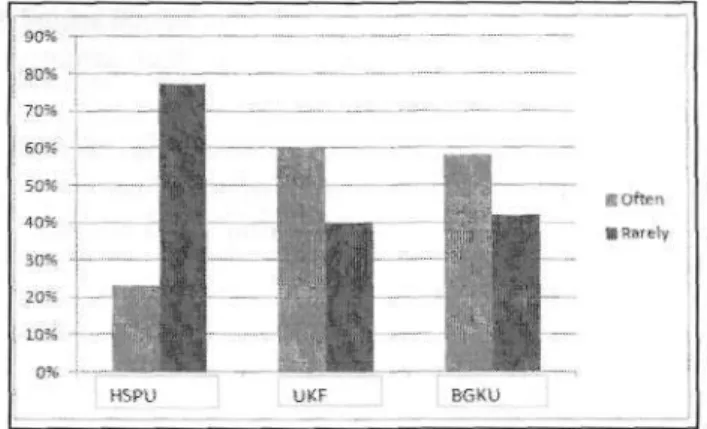
During the research students were asked to evaluate the extent of their personal use of the information available for students on the university website. The results are shown on the Figure 1.
HSPU BGKU UKF Total number of students 100 100 100 1 course 53% 79% 30% 2 course 42% 18% 40% 3 course 5%. 1% 10% 4 course 1% 20% 5 course 2% 0% Professional areas 26%, pedagogic (primary and secondary education) 17%, sociology and philosophy 42%, psychology 15%.
74%, Institute for the Humanities, Institute of Human 26%
100%) study program of applied informatics
90 Т. Noskova, Т. Pavlova, О. Yakovleva, N. Morze, M. Drlik
Figure 1. The use of the university website by students
The results prove that students from BGKU and UKF confirm that the website of the university represents the main source of information about the events, schedule of academic year and teachers' contacts. The university site is not the major source of educational information for students from HSPU. They prefer using university pages in social networks.
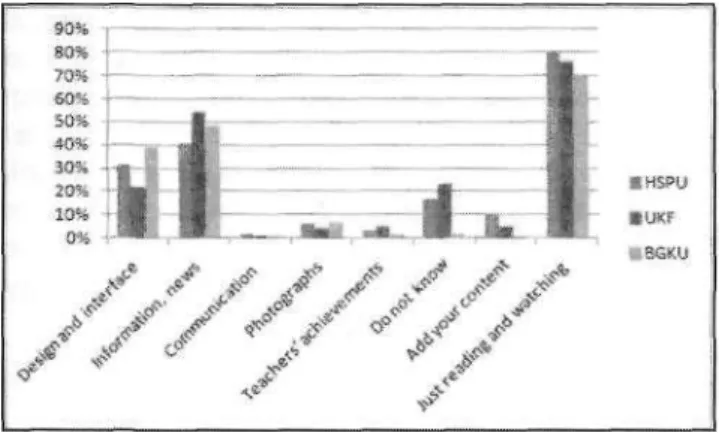
During the research students were asked which sections of information for students on the university website they consider most important. The answers are shown in Figure 2.
Figure 2. The most important sections of the university website for students Students named the most important features that make a university site attractive for students. The results are shown in Figure 3.
The results show that students do not intend to show a high activity on the university website. This can be explained by the supposition that students do not realize all the opportunities of the virtual educational environment. Consequently, they need to be shown and explained all the opportunities by academic teachers.
Figure 3. The most important features that make a university site attractive for students
The question of students' attitude to teachers' activities on the university site and the university pages in social networks was also researched. The results are shown on Figure 4.
Figure 4. Students' attitude to teachers' activities on the university site and the university pages in social networks
Students from HSPU and UKF are interested in both teachers' and other students' activities in the social networks. It means that the witness activities of others can motivate students to be more active themselves. Comparing the universities the activities of teachers mostly motivate the students of BGKU.
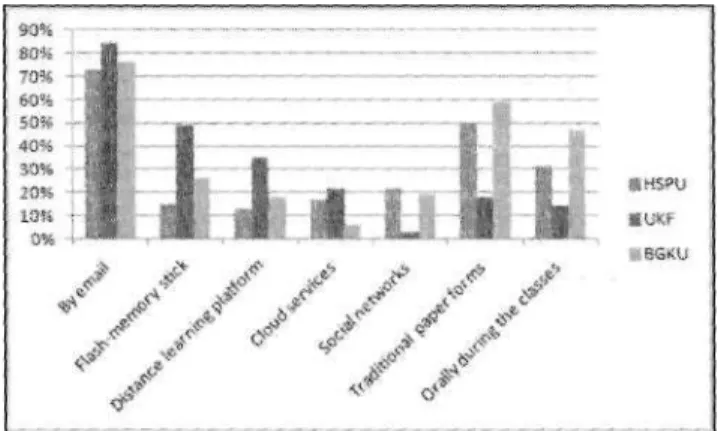
It was also important to find out what methods of transferring the final works for checking to the instructor students consider the most effective. The results are shown in Figure 5.
The obtained data shows that not in all universities students are deeply involved in e-learning. It depends on the university educational policy. However, students are accustomed to transfer their results by electronic methods and consider such way rather effective.
92 Т. Noskova, Т. Pavlova, О. Yakovleva, N. Morze, M. Drlik The obtained results prove the close relationship and mutual influence of classroom and extracurricular interactions in the virtual learning environment. The virtual learning environment is effective when it reflects students' interests and demands: not only the educational information (teachers' contacts and timetables) but also employer information and suggestions for work, invitations to participate in events (conference, contests), photo gallery and reports on past events, resources for distant learning and other educational resources. Students need to see the results of all the environment participants activity; in this case their own activity probably will increase.
Figure 5. The most effective methods of transferring the final works for checking to the instructor
CONCLUDING REMARKS
Innovative becomes such a learning environment in which its two parts - a classical part and virtual, network part are aimed at addressing not the same, but discrepant goals and objectives. Classical classroom learning environment, localized, stable, stores and consistently develops traditions. Virtual, the network part of the environment - distributed, changeable and adaptive - should be directed to launch innovations. It must reflex the specific character of modern information and communication processes. Teaching activity in e learning should contribute to generation of distinctive psychological and pedagogical conditions for the implementation of individual educational strategies, personal students' development. New quality of educational activities in the virtual learning environment must comply with the principles of actualization, learning, attended self-development of students, involved in multiform network educational activities. In this case advanced web-based educational technologies implemented in the new pedagogical approaches, will affect the classroom practice, transforming the whole educational environment to the "high-tech" form. Formation and development of all information educational environment components must be balanced.
Information Environment of Blended Learning ... 93 Teachers of the information age have to master a virtual learning environment as a new area of their career, as a "new stage" of the educational conditions. Therefor they must be in possession of new pedagogical methodology, innovative approaches for educational interactions. They have to comprehend the specific psychological and pedagogical background of activities in this environment, from mass, in-line training turn to personal-oriented processes based on modern information and communication behavior of young people.
Ongoing research will reveal more precise relationship between student's information behavior, teaching activities in blended learning and virtual learning environment qualities providing perspective educational outcomes for modern society.
ACKNOWLEDGEMENTS
This paper is published thanks to the support of the IRNet Project (project financed by the European Commission, under the 7th Framework Programme, within the Marie Curie Actions International Research Staff Exchange Scheme, Grant Agreement No: PIRSES-GA-2013-612536).
REFERENCES
Anderson, L., Fyvie, В., Koritko, В., McCarthy, K., Murillo, Paz, S., Rizzuto, M, Tremblay, R., Sawyers, U., 2006: Best practices in synchronous conferencing moderation. International Review of Research in Open and Distance Learning, 7(1) [online] at www.irrodl.org/index.php/irrodl/article/ download/308/511 (accessed 15 May 2014)
Collins, A., Neville, P., Bielaczyc K., 2000: The Role of Different Media in Designing Learning Environment. International Journal of Artificial Intelligence in Education, 11, pp. 144-16
Emanuel, J., 2013: Digital Native Librarians, Technology Skills, and Their Relationship with Technology. Information technology and libraries, 09, pp.20-33
Feldstein, D. I., 2010: Priority areas of psychological and educational research in terms of significant changes in the child's situation and its development. Pedagogy: Scientific theory journal of the Russian Academy of Education. №7, pp.3-11
Howe, N., Strauss, W., 2000: Millennials Rising: The Next Greatest Generation. New York: Vintage Books
Junco, R., Mastrodicasa, J., 2007: Connecting to the Net.Generation: What Higher Education Professionals Need to Know About Today's Students. Washington, DC: NASPA
94 Т. Noskova, Т. Pavlova, О. Yakovleva, N. Morze, M. Drlik Karvonena, S., Young, R., Westb, P., Rahkonenc, O., 2012: Value
orientations among late modern youth a cross-cultural study. Journal of Youth Studies. Vol. 15, No. 1, February 2012, pp. 33-52
Kulikova, S., Yakovleva, O., 2013: The Virtual Environment Influence on the Socialization of Today's Youth. ARPN Journal of Science and Technology, Vol. 3, NO. 4, pp. 386-389.
Manuel, K., 2002: Teaching Information Literacy to Generation Y. New York: Haworth Press
Michalickova, V., Lovaszova, G., 2014: Fostering Higher Order Thinking Skills within an Online Learning Environment. DIVAI 2014 The 10th International Scientific Conference on Distance Learning in Applied Informatics, pp.411-420.
Morze, N.V., Glazunova, O.G., 2013: What Should be E-Learning Course for Smart Education /ICT in Education, Research and Industrial Applications: Integration, Harmonization and Knowledge Transfer/ CEUR Workshop Proceedings, Vol-1000, pp 411-423. ISSN 1613-0073 [on-line] at http://ceur-ws.org/Vol-1000/ICTERI-2013-MRDL.pdf (accessed December 2013)
Morze, N.V., 2013: Creation of the university's information and education space as a catalyst for the formation of teachers' ic competence In: E-learning & Lifelong Learning. Monograph Scientific Editor: E.Smyrnova-Trybulska, University of Silesia, Studio-Noa, Katowice - Cieszyn, 2013, pp. 39-54 Katowice ISBN: 978-83-60071-66-3
Noskova, Т., Kulikova, S., Pavlova Т., Yakovleva, O., 2013: New conditions for the formation of information culture specialist XXI: Monograph. St.
Petersburg: HSPU Publishing House.
Noskova, T.N., Yakovleva, O.V., 2012: Student's communication competence in the modern information educational environment. Izvestija of Saint-Petersburg state forest technical university 19:255-265
Obiinger, D., Oblinger, J., 2005: Is It Age or IT: First Steps Toward Understanding the Net Generation, in Educating the Net Generation, ed. Diana G. Oblinger and James L. Oblinger (Boulder, CO: Educause, 2005), 2.2, [online] at http://net.educause.edu/ir/library/pdf/pub7101.pdf (accessed 15 May 2014)
Prensky, M., 2001: Digital Natives, Digital Immigrants. On the Horizon, Vol. 9 No. 5
Scardamalia, M., Bereiter, C, 1994: Computer support for knowledge-building communities. Journal of the Learning Sciences, 3(3), pp. 265-283
Stein, J., Sanburn, J., 2013: The New Greatest Generation. Time. 5/20/2013, Vol. 181 Issue 19, p26
Tulgan, В., 2009: Not Everyone Gets a Trophy: How to Manage Generation Y. 1st ed. USA: Jossey-Bass A Wiley Imprint