IMPLEMENTING SOCIAL LEARNING FOR MORE
EQUITABLE COLLABORATION IN
INTRODUCTORY COMPUTER SCIENCE
EDUCATION
A Dissertation
Presented to the Faculty of the Graduate School of Cornell University
in Partial Fulfillment of the Requirements for the Degree of Doctor of Philosophy
by Seongtaek Lim
c
2019 Seongtaek Lim ALL RIGHTS RESERVED
IMPLEMENTING SOCIAL LEARNING FOR MORE EQUITABLE COLLABORATION IN INTRODUCTORY COMPUTER SCIENCE
EDUCATION Seongtaek Lim, Ph.D. Cornell University 2019
Despite the collaborative nature of software engineering practice, computer sci-ence (CS) education has focused on individual-centric pedagogy in teaching how to program. Existing approaches to teaching it, consequently, often end up ignoring important elements of training in professional programming practice, such as working with teams and solving collaborative challenges in systematic manners.
My research investigates approaches driven by a learning theory to teach-ing novice students how to collaboratively program. This work first reviews Vygotskian learning theory that informs about how learning happens in social learning contexts. This social development theory says that effective learning occurs in the zone of proximal development where a learner can perform tasks with assist from more knowledgeable others. It also emphasizes the significance of sign systems, tools, and language during the learning process, since they me-diate both the direct interaction with others and the indirect interaction with the broader society that embraces the domain of learning.
From the perspectives of student interaction as the source of learning, this work builds and tests a real-time interactive student discussion tool, named MOOCchat, in an online learning platform. The evaluation said that student in-teraction can improve the performance in quiz solving tasks, even in the isolated
online settings. Shifting from the online learning environment to physical class-room settings, this work also reports on an exploratory study to understand how students are currently guided to collaborative learning in programming practice. The results showed that teachers are experiencing a lack of technology support and the standard curriculum for teaching proper ways of collaboration. To implement the social learning in CS classrooms and meet the needs the prior work identified, this work proposes lesson plans and software tool (GLIDE) built around them. An observational study with the educational in-tervention in an actual high school classroom with GLIDE found supporting evidence for the learning outcomes and the better balanced contributions from peer collaborators. Finally, this study reports on quantitative evaluations on the consequences of the educational intervention on the students’ learning ex-perience, arguing that the proposed approach increases student engagement, psychological ownership in their projects, and perceived fairness in collabora-tion.
BIOGRAPHICAL SKETCH
Seongtaek Lim’s research area falls in the intersection of human-computer in-teraction (HCI), computer-supported cooperative work (CSCW), and education technology. He builds interactive end-user systems and studies how the soft-ware interacts with users and how it changes user behaviors. The softsoft-ware tools he built address various topics including education, social computing, informa-tion visualizainforma-tion, and informainforma-tion access and retrieval. He has worked at Fuji Xerox Palo Alto Laboratory and KAIST since he received his B.S. in Computer Science and M.S. in Cognitive Engineering from Yonsei University.
ACKNOWLEDGEMENTS
Looking back my 7 years, I have learned the meaning of being humble through the toughest time of my life. It has been much more valuable lesson from God than any other knowledge I was able to learn.
I wish to thank Tapan Parikh for the guidance, inspiration, and support dur-ing my graduate studies. I deeply cherish the time I have spent workdur-ing with him. I have also benefited greatly from knowing and working with Steven Jack-son, Ross Tate, and Rene Kizilcec at Cornell University. In addition, I appreciate all the chances that Marti Hearst at UC Berkeley and Patrik Chiu at FXPAL gave me.
I would not have been able to survive without the encouragement from the numerous colleagues at Cornell University. I would like to thank Sujay Bhatt, Vibhore Vardhan, Anthony Poon, Eugene Bagdasaryan, Neta Tamir, and Samar Sabie. I also can’t even forget the support from the folks at UC Berkeley includ-ing Adam Calo, Sarah Van Wart, Richmond Wong, and Noura Howell.
I would like to also acknowledge the financial support from many institu-tions, which made me possible to pursue my goal. The execution of my study was possible in part by the research grants from Google Social Interaction Pro-gram and National Science Foundation. I also appreciate the research coopera-tion from Informacoopera-tion Technology High School in Queens, NY and Youth Radio in Oakland, CA.
Finally, I owe the biggest thanks to my family and Gracepoint Church in Alameda, CA for their priceless love and support.
TABLE OF CONTENTS
Biographical Sketch . . . iii
Acknowledgements . . . iv
Table of Contents . . . v
List of Tables . . . viii
List of Figures . . . ix
1 Introduction 1 1.1 Review of the Previous Curriculum Development in CS . . . 1
1.2 Current Learning Resources for Introductory Programming . . . 5
1.3 How Can CS Education Support Collaborative Learning? . . . 7
1.4 Outline of the Dissertation . . . 8
2 Literature Review 12 2.1 Social Development Theory . . . 12
2.2 Computer-Supported Collaborative Learning . . . 16
2.3 Foundations for Theory-Driven Approach to Collaborative Pro-gramming Education . . . 18
3 Study1: Bringing Student Interaction into Online Learning 21 3.1 Motivation . . . 21
3.2 Methodology . . . 23
3.2.1 Participants . . . 23
3.2.2 Design of Software and Tasks . . . 23
3.2.3 Data Collection . . . 25
3.3 Results . . . 26
3.4 Discussion . . . 27
3.5 Summary . . . 30
4 Study 2: “Work Together on What and How?”: Potentials and Chal-lenges in Teaching Collaborative Web Programming 32 4.1 Motivation . . . 32 4.2 Related Work . . . 33 4.3 Methodology . . . 34 4.3.1 Participants . . . 34 4.3.2 Data Collection . . . 35 4.3.3 Data Analysis . . . 35 4.4 Theoretical Background . . . 37
4.4.1 Cognitive Load Theory . . . 38
4.4.2 Cognitive Apprenticeship . . . 39
4.5 Results . . . 41
4.5.1 Task Types . . . 41
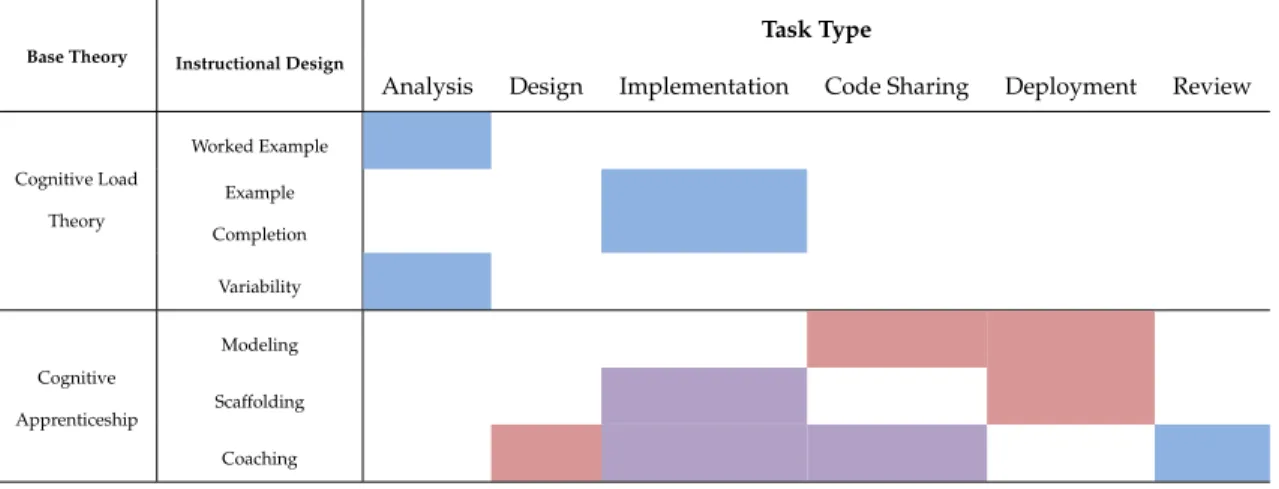
4.5.3 Collaborative Approaches Interacting with Task Types . . 44
4.5.4 How to Support Discussion for Analysis and Review Tasks 46 4.5.5 What Works Well or Not in Supporting Implementation Task . . . 48
4.5.6 What Makes It Hard to Teach Design, Code Sharing, and Deployment Tasks . . . 52
4.6 Discussion . . . 55
4.6.1 Align Knowledge Types, Instructional Designs, and Task Types. . . 55
4.6.2 Have Concrete Plans for a Certain Task and How Instruc-tional Designs or Collaboration Would Help. . . 56
4.6.3 Teach and Support End-to-End Collaborative Workflows. 56 4.7 Summary . . . 58
5 Study 3: Observation of How Novice Students Learn a Scaffolded Col-laborative Workflow 59 5.1 Motivation . . . 59
5.2 Related Work . . . 61
5.3 Proposed Approach and Research Questions . . . 62
5.3.1 Educational Context . . . 62 5.3.2 Lesson Plans . . . 63 5.3.3 GLIDE . . . 66 5.3.4 Research Questions . . . 69 5.4 Methodology . . . 71 5.4.1 Participants . . . 71 5.4.2 Procedure . . . 72 5.4.3 Data Collection . . . 73 5.4.4 Data Analysis . . . 75 5.5 Results . . . 76
5.5.1 Learning Gains through GLIDE Approach . . . 76
5.5.2 Utilitarian Benefits of Using GLIDE . . . 86
5.5.3 Fair Contribution in Collaborative Web Programming . . . 90
5.6 Discussion . . . 95
5.7 Summary . . . 99
6 Study 4: Quantitative Evaluation of Students’ Learning Experience with GLIDE 101 6.1 Motivation . . . 101
6.2 Hypotheses . . . 101
6.3 Methodology . . . 104
6.3.1 Participants . . . 104
6.3.2 Procedure and Experimental Design . . . 104
6.3.3 Data Collection . . . 105
6.4 Results . . . 108
6.4.1 Survey Data . . . 108
6.4.2 Focus Group Interview Data . . . 111
6.5 Discussion . . . 112
6.6 Summary . . . 116
7 General Discussion and Conclusion 117 7.1 Benefits . . . 117
7.1.1 Practical Contributions of MOOCchat . . . 117
7.1.2 Practical Contributions of Exploratory Study on Instruc-tional Designs . . . 119
7.1.3 Practical Contributions of GLIDE . . . 119
7.2 Theoretical Implications . . . 121
7.2.1 Revisiting MOOCchat and GLIDE: Focusing on Social De-velopment Theory . . . 121
7.2.2 Theoretical Contributions of Exploratory Study on In-structional Designs . . . 124
7.3 Limitations and Challenges . . . 125
7.4 Future Work . . . 126
7.4.1 How to Better Facilitate Student Discussion through Bet-ter Matching Schemes? . . . 126
7.4.2 How Will GLIDE Approach Help Learning Advanced Level Techniques? . . . 127
7.4.3 How Can Non-CS Majors Benefit from GLIDE Approach? 128 7.5 Conclusion . . . 129
LIST OF TABLES
3.1 Survey questionnaire and responses from MOOCchat participants 27
4.1 Interview participants for exploratory study . . . 36
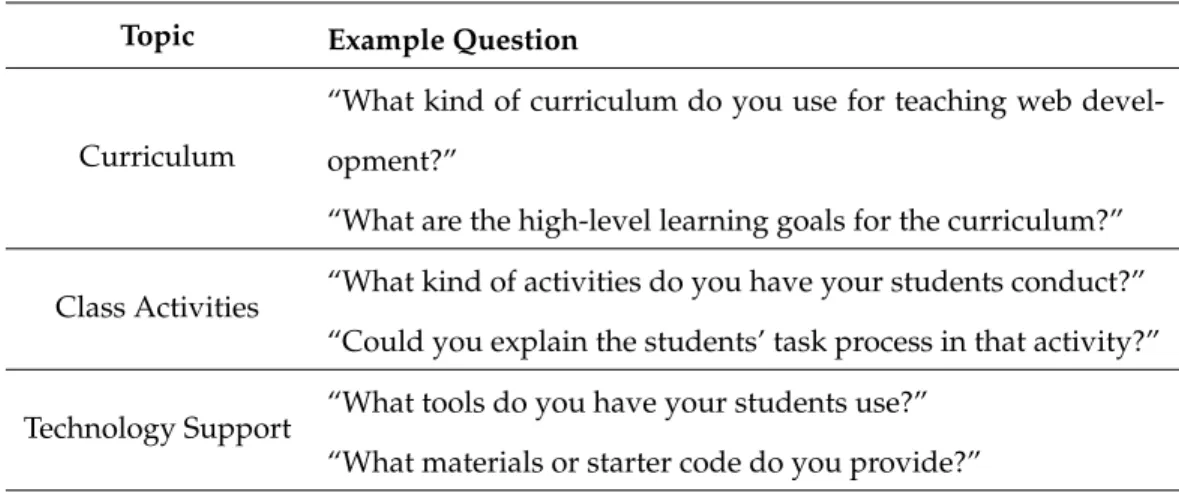
4.2 Examples of interview questions per topic for teachers . . . 37
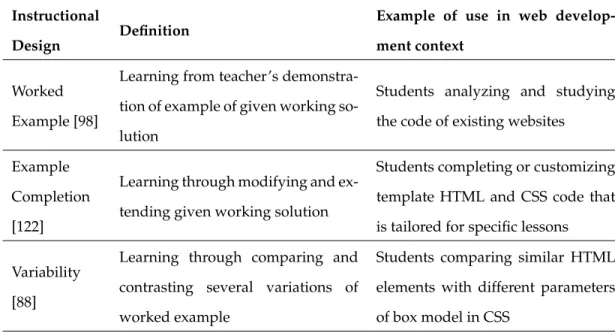
4.3 Instructional designs according to cognitive load theory . . . 39
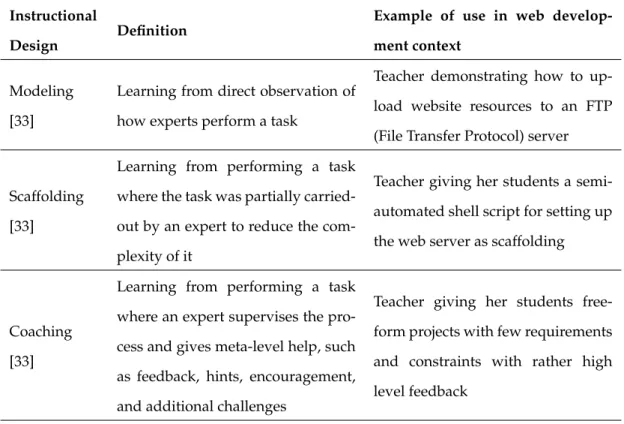
4.4 Instructional designs according to cognitive apprenticeship . . . 40
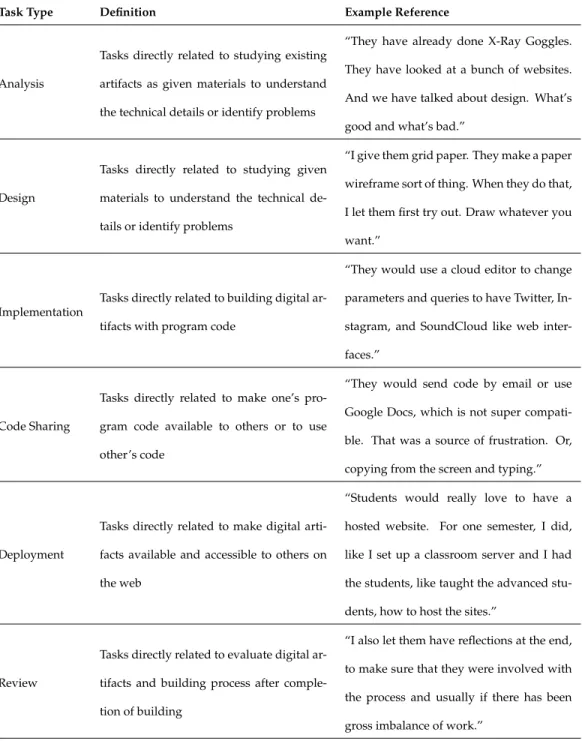
4.5 Task types in web programming courses identified . . . 42
4.6 Reported success of instructional designs per task type . . . 43
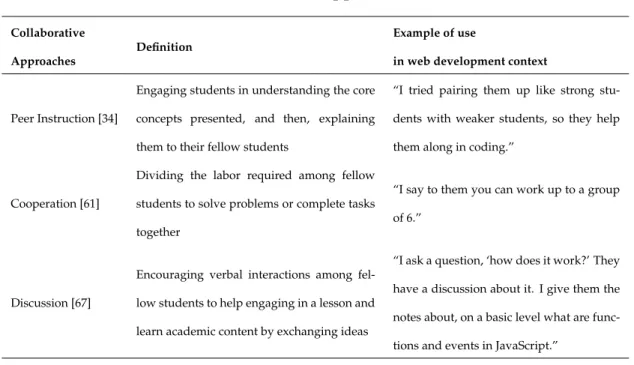
4.7 Collaborative approaches identified . . . 45
4.8 Reported success of collaborative approaches per task type . . . 46
5.1 Proposed Lesson Plans . . . 66
5.2 Content analysis results on the frequency misconception identi-fied in the feature branch workflow . . . 80
5.3 The changes of the removal of dedicated graphic designers iden-tified in the coordination plans . . . 92
5.4 Contribution stats per group from Git log . . . 94
6.1 Survey questionnaire . . . 107
LIST OF FIGURES
3.1 A screenshot of MOOCchat (the initial version) . . . 24 3.2 Illustration of structured task: collaborative quiz sessions . . . . 25 5.1 A conceptual diagram of the feature branch workflow. The
di-agram illustrates a new branch checked out (the curved arrow), two new commits (the colored circles) made on the branch, and the branch merged into master branch.) . . . 65 5.2 Interactive navigation bar of GLIDE illustrating the scaffolded
feature branch workflow . . . 67 5.3 Screenshots of GLIDE user interface . . . 69 5.4 Procedure for GLIDE Intervention and Observation . . . 73 5.5 Sharing code and website content on an online messenger for
manual code integration by the group leader . . . 93 5.6 Examples of commit trees showing that all the members can
work on code integration following the Git workflow . . . 94 5.7 Repository “insight” visualizing the participants activity during
the project period on GitHub . . . 95 6.1 Procedure for intervention and survey . . . 105 6.2 Effects of using scaffolded feature branch workflow on student
engagement, psychological ownership, and perceived fairness . 109 6.3 Effects of time on student engagement and psychological
CHAPTER 1
INTRODUCTION
There is recently growing interest in understanding how to better educate the next generation of students in computer science (CS). Specific needs for reformed CS education include covering modern topics [27], applying novel pedagogical approaches for students’ improved learning in CS [74, 81], and im-proving inclusiveness of computing education [114]. Such demand for changes has fueled several initiatives of educators, policy makers, and researchers in the field of CS education for next generation students. For example, CS4All of New York City Department of Education (NYCDOE) has incorporated mandatory CS units to ensure that every NYC student at elementary and secondary levels will receive CS education by 2025 [2]. A non-profit organization, such as Code.org [1], also has dedicated to expanding access to CS education to underrepresented populations, providing learning materials and tools on its web platform. Al-though such endeavors provide us with opportunities and promises to improve the quality and impact of CS education, it is not yet fully discussed and deter-mined on what specific topics to be embedded in typical classroom environment and what pedagogical approaches to be taken in each of the CS courses.
1.1
Review of the Previous Curriculum Development in CS
One of the best ways to answer the question of what and how to teach next generation CS could be looking backward into the history of CS education. Ac-cording to Curriculum ’68 [5] by Curriculum Committee on Computer Science (C3S), one of the earliest reports published on recommended computing
curric-Introduction to Computing, Computers and Programming, curric-Introduction to Dis-crete Structures, and Numerical Calculus. Other than the general introductory course for larger areas of computing, the rest three courses are suggestive of a huge emphasis on mathematics in CS education at that moment. Particularly, the description of the elementary courses in the report says “certain courses in mathematics are necessary, or at least highly desirable”. Among the basic courses listed in the report, Computers and Programming looks rather distinct in that it focuses on learning to use machine-interpretable languages to interact with computer systems. This report still acknowledges the importance of the programming course by stating that the programming course is “intended to lay a foundation for more advanced study in computer science”.
A decade later, Curriculum ’78 [9] has taken very different perspectives on CS curricula from the previous version [5]. It sets mathematics courses apart from the CS course curriculum, such that only two out of eighteen CS courses, Numerical Analysis and Linear Algebra, in the list directly cover mathematical or algebraic topics. Although this report does acknowledge that mathemati-cal concepts and techniques are crucial in CS education, it justifies elimination of the other mathematics courses by stating “the kind and amount of material needed from these areas for computer science usually can only be obtained, if at all, from the regular courses offered by departments of mathematics for their own majors”. In addition, none of mathematics courses and the two algebraic CS courses are included as a prerequisite for entry-level students. Instead, the report recommends students to take four topic areas: programming, software organization, hardware organization, and data structures and file processing. The changes made to the Curriculum ’78, compared to Curriculum ’68, sug-gest that CS has begun to be considered as a distinct and separate discipline
that solely covers computer systems at that moment. However, this approach has also been criticized for providing potential misunderstanding that computer science is all about programming [94].
In the early 90’s, Computing Curricula 1991 [119] shows significant changes in perspectives on CS education from its predecessors. One of the most notable features of this report is that it explains pedagogical principles as well as topics to cover in CS curriculum. Especially, it allocates considerable number of pages to emphasizing the role of programming in general and the importance of lab activities in CS education in a broader context. While it ensures that program-ming does not stand for the whole software engineering, it argues that novice students should be able to be engaged in the mastery of programming through their coursework, assignments, and lab activities. Furthermore, it demonstrates that lab activities are important for students to experience teamwork projects with other students in order to complete tasks. Although Curriculum ’78 also mentioned that team project is a good option as a teaching method (“consid-eration should be given to the implementation of programming projects by or-ganizing students into programming teams”), but more specific and concrete pedagogical recommendations have been made only in the early 90s.
Since Computing Curricula 2001 [23, 25, 103] has been introduced, CS cur-riculum has become highly comprehensive and detailed in providing teaching methods and teaching guidelines. The curriculum has been incrementally mod-ified to reflect the rapidly-changing field and emerging topics, such as World Wide Web and its applications, multimedia, and human-computer interaction. From the historical perspective, it seems that CS curriculum has constantly em-phasized the importance of exposures to programming activities for students,
since its earlier versions. Even though the specific focus on the programming practice has been changed (e.g., from algebraic concepts to networking princi-ples), better elaborated (e.g., concurrency-related issues in 80s and 2000s), or newly introduced (e.g., World Wide Web applications), the significance of pro-gramming education has been constantly highlighted in CS curriculum.
To date, little effort has been yet made in developing the practical and spe-cific CS curriculum that can better educate programming skills and knowl-edge, despite its long-lasting emphasis put on programming education in the previous carricula. One possible implication of the previous curricula is that team projects are highly encouraged and desired for programming practice [25, 103, 119]. None of the previous work, however, has focused on developing concrete and systematic methods for implementing teamwork in programming education, or justifying it by using further analytical and empirical approaches. Therefore, my dissertation work aims to highlight the significance of teamwork in programming education and discuss how to implement it in real world set-tings. Another point to make based on the history of CS curriculum is that targeted levels of students of interest are steadily expanding. Although the ear-lier CS curriculum has primarily targeted 4-year undergraduate students, later curricula extended its scope to 2-year college programs [25]. It also suggested that an increasing number of students are expected to get exposed to comput-ing education at the secondary level [119]. However, it has not been yet vali-dated whether the existing curricular are also suitable and effective for younger and more entry-level students. Since new standards and principles for teaching younger groups of students at entry or introductory level with little computing experiences still need to be established, this work will focus on CS education for novice students at the secondary level to provide new insights into how
in-troductory programming needs to be developed and implemented for younger students.
1.2
Current Learning Resources for Introductory Programming
Developing better tools to enhance learning of students with little exposure to computer programming has been an active research area in the field of com-puter science education. Most effort has been made in developing tools that better engage students in programming activities. Interacting with computer systems using programming languages requires understanding on computer architecture (e.g., memory space, file systems), programming language syntax, control flow, programming paradigm, and domain-specific high level logics and concepts. For students who do not have enough background or experiences, therefore, it is critical to develop the educational resources such as software tools that are dedicated to familiarizing them with these aspects.
“Scratch [99]” is another well-known example of educational tools for in-troductory programming. Using Scratch, learners can easily create projects by assembling color-coded blocks of programming elements; they can combine block-like operators to generate animated motion of objects, handle user-input events, or manipulate the control flow of the program. Moreover, it is also be-ing used for teenagers or even younger children, because creation of interestbe-ing programs is relatively easy and can be online-based for social interaction and collaborations among the users. It supports collaborative projects through its built-in feature of “remixing” by which a user can add their own products onto the top of others’ projects. According to the large-scale analysis on the data
from Scratch projects, sharing projects for collaborations can serve as a pathway to learning and improving computational thinking [35]. Thus, Scratch provides an example of how collaborative learning can be effectively used for education of introductory programming.
On the other hand, there is an alternative view that more general purpose languages such as Java, Python, or JavaScript should be directly introduced in programming education, rather than starting with Logo or Scratch [78]. It has been suggested that exposing novice students to such full-featured pro-gramming languages is a better way to motivate them [53] and more practi-cally applicable [93], compared to teaching education-purpose programming languages first. Several attempts have been made to help novice users learning the general-purpose programming languages with different aspects of program-ming. For example, “DrJava [4]” provides interactive REPL (read-eval-print loop) interface to provide an easier debugging environment for novice users. “Python Tutor [52]” provides step-by-step visualization of internal operations so that novice users can better understand what’s happening in heap, stack, and console area in the execution of the code. “Pythy [40]” is a cloud-based application platform that abstracts away installation of development tools, file management, and searching for example codes. These examples demonstrate that much effort has been made to to reduce novice users’ learning curves in programming practice.
Taken together, the previous research work in the field mainly focused on identifying the appropriate programming languages and educational tools for teaching introductory programming and syntax: Logo simplifies drawing mechanism based on units of geometry; Scratch abstracts away coding
pro-cess and supports the block-based visual programming via its drag-and-drop UI; and Python Tutor provides visual cues for internal operations on memory structure in executing user’s code.
1.3
How Can CS Education Support Collaborative Learning?
The overarching goal of my dissertation work is to foster collaborative pro-gramming environment for novice students in CS. The literature review in the previous sections (1.1 and 1.2) suggests that the previous CS curricular and re-search work on introductory programming education have heavily focused on teaching the syntax of programming languages to individual users in an iso-lated, non-collaborative learning environment. Although mastering program-ming skills is an important aspect of CS education, there are also other areas to be considered as the fundamentals of CS education rather than just being comfortable with writing code: Being a CS major is much more than learning how to code [55]. Therefore, my dissertation work first addresses the important aspect that has been widely overlooked in the previous literature and CS teach-ing curricula: effective approaches to implementteach-ing collaborative programmteach-ing environments to the introductory education for beginning students.
K-12 CS framework [44] expects that students who received CS education at the secondary level should be able to utilize their collaboration tools to build complex software by effectively working together with other students. In real-ity, however, collaborative learning environment is not easy to be implemented in CS classrooms and fostering it is also an under-explored research area. Al-though collaborative learning method such as pair programming, is known to
be a very effective strategy, most of these approaches are not closely linked to or built in the CS curriculum, but is considered to be rather supplementary. Fur-thermore, even the most widely used platforms for younger students’ collabo-rative programming, such as Scratch, do not effectively support collaborations that involve direct social interactions between users. In addition, its features are not sufficient to support the complex and dynamic aspects of collaborative pro-gramming projects in the real world settings. Therefore, my dissertation work focuses on how to better implement collaborative programming in the CS cur-riculum, so that the skill sets acquired in the classroom can be extended and applied to real-world industrial settings.
1.4
Outline of the Dissertation
In Chapter 2 of my dissertation, we will first review the literature on social de-velopment theory by Vygotsky [127] in the field of dede-velopmental psychology. The social developmental theory will provide the foundation of the roles of so-cial interactions in soso-cial, cognitive development and learning. This theory also has significant implications for the framework on interactive, multi-user com-puter systems, especially for the purpose of learning. The social development theory will also provide insights into general principles for designing learning activities, defining the roles and the types of interactions in learning of begin-ning students, and facilitating their meabegin-ning construction [70]. To establish ef-fective methods for the social interaction in learning, we will then review the existing literature on computer-supported collaborative learning (CSCL) [65]. The CSCL literature will provide us with better understanding of what types of interactive process using computer software would lead to successful
collabo-ration in learning contexts and how to support this. Chapter 2 then will end by discussing and high-level design principles that will potentially help designing effective and novel approaches to implementing a collaborative environment to CS classrooms.
Chapter 3 will describe the preliminary study that explores software-structured collaborative learning. It will illustrate the empirical work that as-sessed the feasibility of a specific software design to structure users’ behavior on it and their task performance. we will first describe the preliminary experiment on collaborative learning performed using a software tool, named “MOOC-chat”. MOOCchat is an educational software tool to facilitate chat-based peer learning processes in MOOCs (massive open online courses) settings. It creates ad-hoc discussion groups for users who are available in the online waitlist in each of the periodical quiz sessions. It scaffolds interactions between users in these discussion groups while they solve the quiz individually and collabora-tively. The findings of the study suggest that 1) the software design with the sequential phases effectively guided the participants to the intended behavior for collaborative learning and 2) the collaborative approach to problem solving through the text chat in small groups significantly improves the performance of the users.
Chapter 4 will explore how students learn to collaborate with other students in the real-world learning environment, rather than a simulated context de-scribed in Chapter 3. We will describe a qualitative study on the instructional approaches to teaching novice users web programming in real-world classroom. This study conducts interviews with teachers to characterize the potential chal-lenges and problems in implementing collaborative learning environments to
the lab sessions at secondary level. We will discuss these potential challenges by relating to the theoretical frameworks on cognitive load and cognitive ap-prenticeship. To summarize the findings, the qualitative data analyses from the interviews revealed three major challenges. First, collaboration is surprisingly unstructured in lab activities, suggesting the need of better structures to be im-plemented to collaboration. Second, there seems to be a mismatch between the types of knowledge students need for the task and the instructional strategies. Finally, teachers encounter difficulties in successfully convincing their inexperi-enced students to appreciate the importance of the collaborative process and its consequences.
Chapter 5 will discuss how these challenges can be addressed when imple-menting collaborative learning. It will propose a novel approach to implement-ing collaborative programmimplement-ing with lesson plans and a supportimplement-ing software tool for the lesson plans. It will further illustrate more specific requirements, de-sign considerations, and implementation strategies for the proposed approach. Based on the proposed approach, it will also introduce a software tool named “GLIDE (Git-Learning Integrated Development Environment)”. GLIDE pro-vides users with useful resources and guidance to a simplified version of stan-dard Git workflow. Chapter 5 also describes the design-based research (DBR) that explores the deployment of the proposed approach to teaching collabo-rative programming in a real-world classroom. Specifically, this observational study looked into how this approach affects the process and the outcomes of the class projects by novice students. The findings from the observation and focus group sessions showed that utilizing an appropriate teaching method will allow high school seniors to understand the concepts on the structured collaboration process and perform group projects by following the proposed workflow, even
when they only had basic literacy in web client programming (HTML, CSS, and JavaScript) and just a little experience in team projects.
Chapter 6 will quantitatively evaluate the performance of the students af-ter the classroom inaf-tervention with GLIDE. In this field experiment, we ex-amined the effects of the intervention on students’ experiential and attitudinal outcomes. The findings suggested that better understanding of the basic con-cepts in structured collaboration and scaffolding educational tools facilitated relevant communication between the students and improved qualitative aspects of learning, including better self-efficacy, class engagement, psychological own-ership of the group projects, and perceived equity in project coordination.
Finally, Chapter 7 will conclude by discussing the implications of this work including contributions to the field, limitations, and future directions of this study.
CHAPTER 2
LITERATURE REVIEW
This chapter reflects on the existing literature that provides theoretical basis for this dissertation work builds on. The literature review starts with social development theory as the theoretical foundation to understand how learning occurs in this dissertation. And then, it discusses prior works on computer-supported collaborative learning (CSCL) in CS, as a more concrete approach to learning through social interaction with the guidance from computer software.
2.1
Social Development Theory
Social development theory [126, 127] is a learning theory that views learning as internal developmental processes where knowledge and abilities are inter-nalized through social interactions. Vygotsky [126] used the concept of devel-opmental level, which indicates functional, psychological, and mental maturity of a student in explaining where and how learning occurs. The actual devel-opmental level (ADL) means the conceptual domain that a student has already matured into, so that she has developed the ability to independently solve prob-lems corresponding to this domain. On the other hand, the potential develop-mental level (PDL) means the higher level domain where she can solve prob-lems with guidance from “the more knowledgeable other (MKO; for example, a teacher, parents, or peer collaborators)”. This learning theory argues learning that aims the PDL facilitates a student’s development, which is otherwise in-effective. This makes a point of the concept of zone of proximal development (ZPD) as where learning occurs, indicating the distance between ADL and PDL. Thus, in order to facilitate a student’s internal development, social development
theory suggests that the MKO should provide the appropriate assistance for tasks or knowledge in the student’s ZPD through interaction with her.
Social development theory roots in the significance of tools and sign systems through which social interaction occurs. Vygotsky [125] believed that language, as the representative tool and also sign system for social interaction, is very important in learning for two reasons. One reason is that, when a student in-tellectually develops in ZPD with guidance from MKO, language is the main means for the information exchange during the social interaction. This idea up-holds the general theme of this learning theory that learning is a socio-cultural process because language itself has been formed under the cultural develop-ment of a society over the course of human history. Hence, learning through social interaction using the language, which is socially accepted and agreed on, includes the broader and more abstract sense of interaction with the society as well as the direct interaction with the MKO in learning context [127]. Another reason is that a student actively uses her own language in the process of inter-nalization to adapt the information that came from the social interaction. The active process of internalization, rather than passive copy, of knowledge that came from social origins is the central element of Vygotskian learning theory [46]. A student uses her personal interpretation in the form of language when this process takes place. Thus, this learning theory focuses on the tools and sign systems, such as language, in the core part of the learning process. This idea has become the pivotal foundation of the constructivist learning theory that learning is an active, interactive, and contextual process, rather than a unidirectional and didactic process, through which all knowledge is constructed from the learner’s experience and interpretation [15].
Existing research took Vygotskian approach to better understand novice stu-dents’ learning in CS. Gillespie and Beisser [48] explored how young students age of seven learns Logo programming language. The teachers who partnered with the research team had the pedagogical basis of Piagetian learning theory, which weighs more on the children’s biological development and their own construction of knowledge [90, 133]. However, the young children’s learning process turned out to be better aligned with Vygotskian theory, according to the observation that they learn through social interaction with MKOs includ-ing adults and more competent peers. Deepeninclud-ing this discussion, Whalley and Kasto [131] identified the patterns of ZPD of novice students in learning Java programming. They observed the developmental levels where each participant can solve problems either independently or with a teacher’s situational help while taking programming tests with three different complexity levels. Their findings, in consistence with the theory, suggested the importance of use of lan-guage both for interaction and internalization as a useful indicator of a student’s learning. Participants who performed well in the tests were able to interact with the teacher using their own language, whereas those who didn’t had diffi-culty in tracing and explaining their solutions. Another approach was taken by Hundhausen [57] where he reported positive learning outcomes when he had the students present animated explanation of algorithms they implemented in an undergraduate algorithms course. This work supports the Vygotskian argu-ment that students learn better when they’re given a chance to represent the knowledge they constructed in their own language and interact with others using their own representation. Moreover, this study pointed that algorithm visualization the students constructed was effective in mediating the student interaction, which expands the interpretation of tools and sign systems in
Vy-gotskian learning theory into computer-mediated interaction. Despite the in-fluence of the learning theory on CS educators and these examples of existing research, it is not often explicitly discussed in CS education, compared to the vast amount of literature on it in science and mathematics education [16]. This research tries to continue the discussion relevant to the socio-cultural learning theory into CS education for novice students.
From the perspective on how learning occurs provided by social develop-ment theory, this theory guides my work to the clear design of lesson plans that implements a novel approach to learning collaborative programming in CS. First, this theory provides a framework for planning and designing the learn-ing context uslearn-ing the introduced concepts of ADL, PDL, and ZPD. This will directly help this dissertation work specifying the lessons with what develop-mental level the potential target students have generally matured into (ADL) and what functions and knowledge are learnable, falling in their ZPD, con-sidering their PDL. Second, the gravity placed on ZPD in this theory advises that teachers should design “guided participation” from students in the learn-ing process. Learnlearn-ing functions and knowledge in PDL, by definition, requires help from MKO, so guided participation denotes the way to facilitate learning through interactive and collaborative ways. My dissertation work focuses on the design that guides students to learn practical functions and underlying con-cepts in collaborative programming in interactive ways as suggested. Lastly, this learning theory informs this work about what roles tools and sign systems play in learning. This theory indicates that language is used to support both so-cial interaction with others and internalization on a student’s own. Inspired by Hundhausen’s work [57], my dissertation continues using the extended mean-ing of tools and sign systems as language to represent ideas and knowledge,
which provides a guideline for the design of the tools this research proposes.
2.2
Computer-Supported Collaborative Learning
Collaborative learning is an educational approach where students work to-gether in solving problems or completing tasks [47]. It stems from the idea that learning occurs in a social context when the learners actively participate in the social interaction [109], which implies a thread of connection with Vygot-sky’s social development theory. As one of the instructional methods to support collaborative learning, this section reviews the existing literature on computer-supported collaborative learning (CSCL) that involves software tool as the me-diator of collaboration. Also, as existing literature says the effectiveness of col-laborative learning varies according to the specific learning settings [39], this section focuses on CSCL approaches dedicated to support learning in computer programming in CS.
Existing research made diverse attempts to take advantage of CSCL ap-proach in CS. One substantial class of them is based on the idea of sharing the artifacts to build. For example, Fields et al. [43] studied collaborative learn-ing for high school students who built animated music video uslearn-ing Scratch. They designed the programming task to involve the multi-level structure of col-laborative support; each student was guided to come up with the individual segment of music and also build on top of multiple layers of contribution from group members, mentors, teachers, and unknown Scratch users online. Their findings claim that this specific way of “nested” design of the task revealed potential inconsistency of program state among the different levels of
collabora-tion, which brought about the students’ learning on the concept of initialization. This type of collaborative programming is supported through project-sharing mechanisms, such as “remixing” [35, 36, 77]. On the other hand, Urai et al. [120] explored various tool supports for pair programming practice in distant settings. Pair programming is a typical example of collaborative programming where two programmers work together with the dedicated roles of driver (who writes code) and navigator (who reviews code written by the driver). Although the genuine form of collocated pair programming doesn’t necessarily take CSCL approach, there have been several attempts to support distant communication in pair programming in the shared project through a synchronized code editor [18, 38, 84, 118]. To sum up, CSCL approaches in this category provided asyn-chronized sharing features for existing projects that help students to build on top of others’ work or synchronized co-work mechanisms on the shared project.
Another significant chunk of works in CSCL in CS is to support students to communicate with each other sharing their representation of concepts to learn. HabiPro [124], for instance, is a software tool designed for students to collabora-tively solve programming-related problems. The tasks included identifying er-rors, reordering code segments, predicting the return values, and completing a partial program. It has a text chat tool where a group of students can discuss the problem to solve. The authors argued that this approach doesn’t directly teach how to program, but gives novice students a chance to reflect on their code and observe others thoughts, which is one of the critical aspects of collabora-tive learning. Similarly, CAROUSEL [58] takes constructivist learning approach to computer algorithms by allowing students to build multimedia representa-tion in explaining algorithms. The students were also allowed to discuss and evaluate the algorithm representations that other students generated won the
tool. The results of the quantitative evaluation on this approach show that the students engaged in creating their own explanations and improved their under-standing through the representation process. In sum, several CSCL approaches in this category primarily focused on providing verbal or graphical communi-cation channels for social interaction among the students, which consequently help them learning concepts and practice of programming [29, 71, 95, 102, 108].
2.3
Foundations for Theory-Driven Approach to Collaborative
Programming Education
The review of the literature on social development theory and related works in CSCL provides the theoretical framework of my dissertation. As a theory-driven approach to learning in collaborative programming, this work designs the collaborative learning environment and empirically tests the design ap-proach, where the learning context roots in Vygotsky’s learning theory and the concrete method follows the principles in CSCL.
First, informed by the learning theory, my dissertation considers what sign systems and tools to provide in order to facilitate learning. Existing works in CSCL have proposed a lot of novel tools supporting social interaction among students during their learning process. Even though this looks well aligned with Vygotsky’s theory that learning occurs from social interaction, there has been little consideration on the sign systems and tools that mediate the stu-dents and social context, but not only the learning context, as the socio-cultural products. The sign systems and tools in which the students communicate should help them (indirectly) interact with the broader sense of social
con-text, be part of the social context that has generated the tools, and internalize the socio-culturally constructed knowledge gained through interaction for their own mental development. This suggests that a potential approach to learn-ing in collaborative programmlearn-ing should actively embed norms, terminology, affordances of software, and widely accepted processes to collaborate in the learning context. Israel et al. [60] also pointed that collaboration models being used in actual classrooms, such as teacher-facilitated model and peer tutoring model, don’t fully reflect on the realistic model of collaborative programming, implying the discontinuity between the learning context and the social context. Therefore, this theory-driven approach aims to design the learning context that reflects the socio-cultural aspects of collaborative programming in real-world practice.
Second, grounded in the concepts of ZPD (where learning occurs) and guided participation (the method to facilitate learning in ZPD), this work will take scaffolding approach to facilitate novice students’ learning in PDL. Scaf-folding is one of the most widely accepted ways to interpret guided participa-tion [86, 101]. Wood et al. [132] first coined the term “scaffolding” to describe how teachers and parents can help learning in guided ways. They argued that the effective teaching requires two concrete ideas: 1) the conceptual model on the task with how it may be completed and 2) the conceptual model on the performance characteristics of the student. Combining these two, a teacher can design the instruction where she reduce degrees of freedom, redirect stu-dents, and marking critical features, or demonstrate her own task performance. In response to this, successful examples of CSCL approaches in CS included well-structured task designs along with the software tools supporting the tasks. Thus, this work tries to follow scaffolding approach to facilitate novice students’
learning in ZPD.
Lastly, this work tries to extend the existing literature on CSCL by embed-ding computer-supported collaboration in lab activities of programming. In overall CSCL literature across the disciplines, mediated communication in ver-bal language or other digital representation through software tools is one of the most common ways to support learning in selected lessons. Literature on CSCL in CS also rendered the foundation of collaborative learning in similar ways. However, CS courses, especially programming courses, might have more diverse opportunity to take CSCL approach since their coursework materials, assignments, and lab activities are already built on computer systems by its na-ture. Besides, the historical perspective on CS curricula has been calling for better support for lab activities in CS courses. Thus, this work will suggest a mediating software tool for computer-supported collaborative programming as a lab activity.
CHAPTER 3
STUDY1: BRINGING STUDENT INTERACTION INTO ONLINE LEARNING
3.1
Motivation
The foundations for theory-driven approach to collaborative programming ed-ucation (section 2.3) call for needs of dedicated software tools that mediate stu-dent interaction and guide their task process in learning context. Along with the theoretical foundation as a starting point for the rest of the dissertation work, it is also important to understand the practical aspects of collaborative learning structured by software and task designs that implement the theme of computer-mediated collaborative learning. This chapter describes the first empirical study that explored such software-structured collaborative learning. The purpose of this study is to test out a relatively simple and rough approach to support collab-oration in learning in CS and learn how students react to the proposed design.
Online education is often identified as a learning environment with limited students interaction because students are neither collocated, nor are they pro-gressing through course materials on the same schedule. That is, they are iso-lated in terms of both space and time, which makes online education a domain calling to engage in challenge to support their social interaction for learning. Ex-isting CSCL literature has shown several examples of text chat-enabled online workspaces where students perform individual tasks with extra communica-tion channels [102, 124], but there has been little attencommunica-tion paid to collaborative learning that involves online social interaction as an integral part of the tasks.
dents interaction in online CS education.
This study is inspired by the literature on structured peer learning [83, 111]. Peer learning in physical classrooms structures students activities in which they have discussion in small groups to come up with solutions to problem-solving tasks. The significant pedagogical benefits of peer learning as a practical teach-ing method, includteach-ing improved critical thinkteach-ing skills, retention of learnteach-ing gain, interest in subject matter, have been well documented by literature in sev-eral disciplines [26, 37, 76, 110]. Hence, this study implements a simple version of structured peer learning for online CS courses.
The idea of introduction of peer learning into an online education platform gets well aligned with the theoretical background of this dissertation work. One rationale is that peer learning, as a practical teaching method, encourages stu-dents interactions in the learning context, so that the interactions facilitate inter-psychological development [127] stated in Vygotskian learning theory. Another way peer learning in online education roots in the theory is that the students are required to actively process information for their own meaning construction while participating in discussion, rather than passively accept it. This helps the internalization process [46] whose important role in learning has been pointed out in social development theory.
3.2
Methodology
3.2.1
Participants
61 students taking the online course of CS.169.2x Software as a Service on edX participated in this study. They were recruited through the course announce-ment and their participation was voluntary. The announceannounce-ment stated there won’t be monetary compensation or advantages in grading upon the partici-pation, but encouraged their participation for the benefit in their own learning through collaborative learning tasks (practice quiz sessions, explained below) designed toward improved learning outcomes and experience. The six-week course was intended for students with an undergraduate CS major level of ex-pertise. Given the MOOCs (massive open online courses) settings, it was hard to collect accurate and detailed demographic information of the participants.
3.2.2
Design of Software and Tasks
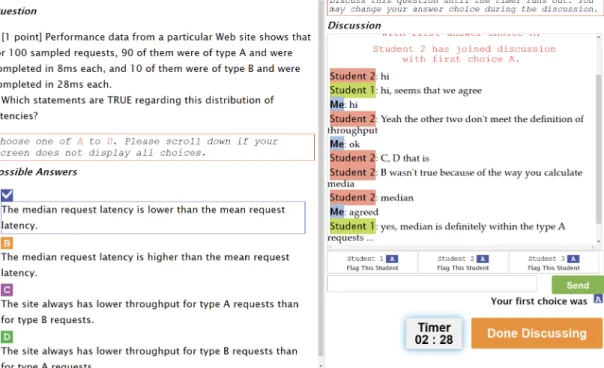
We built a software tool named MOOCchat. MOOCchat is a tool to run collabo-rative quiz sessions designed to be integrated with MOOCs web platforms. The main features of it included real-time grouping of users who are online, assign-ing quiz materials to each group, sharassign-ing the answers from individuals within the group, and allowing them to discuss using a timed chat tool (Figure 3.1). To bring students together into synchronous groups in online education settings, approaches from team formation in multi-player games and real-time crowd-sourcing [75] was adopted; the “bus terminal model” was implemented so that
online. MOOCchat is designed to form as many triads as possible, dyads if less than three users are remaining among the waiting users. In cases where there is only one user remaining online, MOOCchat was supposed to serve a non-collaborative practice quiz session for the user. MOOCchat was a web-based application built with Node.js.
Figure 3.1: A screenshot of MOOCchat (the initial version)
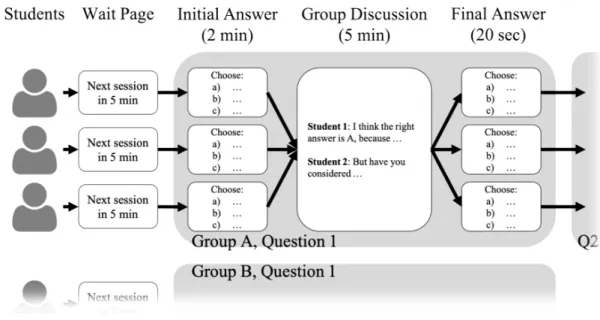
MOOCchat was deployed in the Fall 2013 offering of edX’s CS.169.2x Soft-ware as a Service. The intervention provided students with an online collabora-tive practice (ungraded) quiz session that they could opt to take using MOOC-chat integrated with the course website. MOOCMOOC-chat structured the online quiz task in three stages; 1) MOOCchat organizes students into small groups, 2) it gives them a chance to individually answer a question, and then, 3) it displays everyone’s responses and places them in the group’s private chat room so they can discuss the answer. These three stages of collaboration were guided by a
server-controlled timer counting down to keep the group of students in sync. When the timer runs out, the students were able to have the final chance to change and submit individual answers. Finally, they were then shown the cor-rect answer with an explanation. They then moved on to the next question to repeat the three-staged quiz session (Figure 3.2). The questions were composed by the instructor of the online course to help them review and better understand the course materials.
Figure 3.2: Illustration of structured task: collaborative quiz sessions
3.2.3
Data Collection
To understand students’ initial experience and thoughts on the software-structured collaborative task, we gave them brief survey questions at the end of the quiz session. This survey was to get qualitative understanding on partic-ipants’ reaction to the tool and the method, rather than statistical analysis for a
confirmatory study or hypothesis testing.
3.3
Results
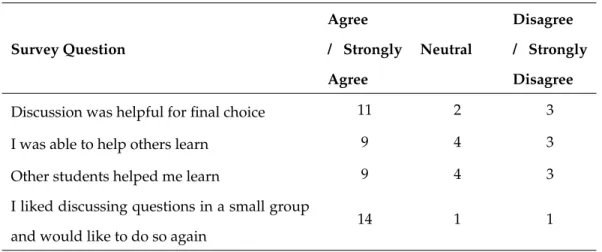
61 students took the practice quiz and completed the survey, which began every hour. Of these, only 16 were successfully placed in a discussion group of 2 or 3 participants; six of them were placed in groups of 3, and ten were in groups of 2 (More groups were not formed because not enough students arrived at the same time for the same session; a large MOOC with thousands of students could have a higher grouping success rate). The focus of this report is on the experiences of those students who did have a discussion with others using the chat tool to draw implications for collaborative learning.
Table 3.1 shows the post-quiz survey results, indicating overall positive re-sponses to this online intervention. In response to “Other students helped me learn during the discussion,” one student wrote “Yes, by having to explain my answers to the other students it forced me to think more deeply about the ques-tion,” which was one of the central tenets behind peer learning. In terms of group size, 6 out of 10 of those in dyads indicated they wanted more people in the discussion whereas everyone placed in triads indicated this was the right size for the discussion, reflecting results from the peer learning literature that dyads do not lend themselves to good discussions.
One of the survey questions was an open-ended one (not shown in Table 3.1) asking “Do you have any feedback about your experience using this discussion tool? What worked well and what can be improved?” The students expressed general satisfaction. one student commented that “It was my first time using
Table 3.1: Survey questionnaire and responses from MOOCchat partici-pants Survey Question Agree / Strongly Agree Neutral Disagree / Strongly Disagree
Discussion was helpful for final choice 11 2 3 I was able to help others learn 9 4 3 Other students helped me learn 9 4 3 I liked discussing questions in a small group
and would like to do so again
14 1 1
this. I think that overall it is a great tool. We were able to have some brief dis-cussion and it probably is the closest thing that we can get to being the same activity that is in the course.” Another wrote “That is very interesting, useful and fun. Cool.” A third wrote “It’s really cool, and make learning more inter-active!!!” These comments suggest that students in an online course are quite positive about this approach. Also, small coordinated group chats may success-fully lead to better learning and retention as has been found widely in the peer learning literature.
3.4
Discussion
We have developed MOOCchat and an instructional method to form syn-chronous discussion groups in MOOCs using the tool. Also, the software tool and the collaborative task design were tested out in an actual online course. It was the first step in understanding how software can guide students collabora-tion in an online educacollabora-tion environment, but much work remains to be done.
The first takeaway in terms of the software design is that the staged model works very well in structuring students behavior in using the tool. It seems that the students perceived the linear staged model straightforward, judging from no attrition observed out of 61 students who began the task. None of the open-ended feedback comments in the survey had negative report on the difficulty in using the tool or following the collaborative task. More encouragingly, the staged model worked well in guiding the cognitive tasks (e.g., reading passages and figuring out the answers) as well as the behavioral tasks (e.g., clicking but-ton to proceed and typing texts for discussion). This could be useful design implication for future works.
As the survey feedback shows, MOOCchat successfully facilitated students interaction around the task. The task design wise, it seems that the separa-tion of individual task from collaborative part (discussion) and deliberately us-ing the outcomes of individual task (answers) in the collaborative task (sharus-ing the group members’ answers) contributed to the feasibility of performing the task, judging from the responses to the survey question “Discussion was help-ful for final choice”. For further investigation, we conducted another iteration of MOOCchat in a crowdsourcing platform to verify the quantifiable effectiveness of this approach. In that experiment, participants who were grouped for the col-laborative tasks marked higher rates of correct answers in the quiz, compared to solo participants; among the 169 responses provided by solo participants, 84 (50%) were correct, where among the 269 responses from crowd workers who participated in a discussion group (dyads or triads), 169 (63%) were cor-rect. This difference turned out to be statistically significant (Fisher’s two-tailed exact test, p ¡ 0.01). This supports that MOOCchat approach successfully facili-tated the students interaction, which played a key role in performing the tasks
[31].
This study also had several limitations, which opens the possibility for the next step going forward. The online learning environment renders a lot of po-tential for novel approaches to learning with lower cost and higher accessibility, however, it also rendered serious defects as a research testbed. For example, the synchronous online collaboration is heavily affected by disperse attendance at any given time because online learning environment heavily relies on an indi-vidual’s self-directed or self-paced learning, which is on the opposite of struc-tured learning. It might be possible to strictly schedule the participation to alle-viate this issue, but this scenario less reflects on the real-world learning context as a natural field test. Consequently, the MOOCchat experiment left almost three quarters of the overall voluntary participants ungrouped for the collabo-rative task. This can’t be the ideal setting for the research trying to develop and test collaborative approaches to learning with students in the actual learning context.
We argued that MOOCchat approach effectively facilitated interaction. However, given that the students could answer multiple choice questions and collaborate to identify and correct errors in those answers through text chat, there is no evidence that the interaction has brought about learning; a possible alternative explanation is that the students had a chance to give a second look into their answers when others in the discussion group express different opin-ions, or even more simply, they could have corrected the answers just following others’ opinions. MOOCchat approach could be justified for its own purpose that the review and self-evaluation through peer discussion on the coursework materials were much needed to help the specific target students learn.
How-ever, the findings are hardly sufficient to expand to social learning in introduc-tory programming practice due to the use of the ad-hoc grouping and chat tool. Possible reasons include the simplicity of the task (answering multiple choice questions), the way of collaboration (a free-form text chat for a limited period of time), the level of engagement (self-directed online learning not being graded). This calls for further investigation in students tasks taking longer term, with higher complexity, which better engages them in and in better structured ways.
Another limitation, considering the general goal of this dissertation aiming to provide a social learning method for collaborative programming, was that the collaborative quiz task we designed didn’t provide the authentic experience in programming or yield potentials to iterate in that direction. Given the course materials that addressed programming issues and practice (Ruby on Rails), giv-ing Ruby-related questions for collaborative quiz sessions would have been as close as MOOCchat approach can get to programming education through so-cial interaction. Even with those questions, it would have been more of another replication of syntax-oriented learning in programming with extra communica-tion channels among peers, which doesn’t fulfill this dissertacommunica-tion’s vision that introductory programming education should be designed toward collaboration.
3.5
Summary
We conducted an experimental study to explore the practical feasibility of software-structured collaboration and to learn about how students behave on and react to it. This study designed MOOCchat approach that facilitates stu-dents interaction around collaborative quiz sessions and deployed it to an
on-line CS course. This method organized students into ad-hoc small groups to discuss their answers and rationale for the answers, to employ peer learning as the instructional method where students exchange their ideas in learning from others. The post-task survey results said that students were very positive about both the experience and the effectiveness of this approach. We concluded that MOOCchat successfully brought much desirable students interaction in an in-nately isolated online learning environment, but there wasn’t enough evidence that actual learning occurred through their interaction. This calls for more care-ful consideration on research domain and programming tasks that more directly connect to learning for future works and also better understanding on actual learning environment.
CHAPTER 4
STUDY 2: “WORK TOGETHER ON WHAT AND HOW?”: POTENTIALS AND CHALLENGES IN TEACHING COLLABORATIVE WEB
PROGRAMMING
4.1
Motivation
The preliminary study led us in a new direction; we felt the necessity of ex-ploring classroom environments and how students are guided to learn in in-troductory programming courses. One reason is that online learning environ-ment that relies solely on each individual student’s self-directed study may not allow us to introduce a novel approach with a focus on guided participa-tion or “well-structuredness” and observe the students behavior; due to un-structured progress of individual students, decontextualized observation, low turnout rates, and extreme selection bias of the participants. Also, to make in-tervention into a physical classroom environment, we need to better understand how students are currently learning. Thus, this chapter explores how students are guided to learning in an engaging CS topic for novice students.
Web development has become one of effective topics for engaging novice students in CS. Teachers and CS education researchers have made diverse at-tempts to teach web-based technologies in the CS curriculum [3, 69, 72, 78, 80, 96, 115]. For example, Mercuri et al. [80] used web programming languages for introductory programming, finding that website-building is highly engaging for students. A similar argument was made by Stepp et al. [115] in his quanti-fied evidence on students’ gradual curve of perceived difficulty and constantly high enjoyment across sub-topics of a web development course. Furthermore,
such enjoyment resulted in an increase in student’s motivation for taking CS advanced courses in their investigation. These examples also illustrate the im-portance of lab activities in these courses, where students learn through prac-tices and projects, and the effectiveness of engaging novice students in these rich web-development activities.
To better support novice users’ lab activities in web programming courses at the secondary level, this chapter identifies rooms to introduce collaboration. We investigate how teachers structure these kinds of lab activities and what element of the activities we can reconstruct to involve students collaboration, based on their reported success (or lack thereof) of these approaches from their experi-ence. Specifically, we asked high school and middle school teachers about what tasks they do with their students and what instructional approaches they adopt for these tasks, in their introductory web development courses. Understand-ing how these courses are taught in middle or high school context will give us an opportunity to broaden our understanding on challenges and potentials in instruction for novice students.
4.2
Related Work
Existing research has explored several challenges in introducing collaboration in learning environments. Janssen et al. [61] viewed novice users’ immaturity, as an individual factor, in coordinating group members as one of the most sig-nificant challenges. Their observation showed that working collaboratively may impose additional cognitive costs for novice students. This is because collabora-tion involves metacognitive activities that regulate their task performance, such
as planning the whole task, monitoring progress, and evaluating the task [41] in which novice users are generally underdeveloped. Another line of work argued that there is social factors including competition in education system and rela-tionship issues [12], which might demotivate students collaboration. Further-more, cultural factors were reported including teachers’ potential reluctance to bring collaboration in their classrooms where they consider it as an operating cost [100].
To extend the discussion, we explore instructional factors that make it diffi-cult to introduce collaboration in web programming courses. As our research shows, web programming involves diverse tasks, including analysis, design, and deployment related activities, but little is known about how to use collab-oration as a teaching strategy to support these relevant tasks in lab activities in those courses. We seek to address this gap by creating a taxonomy of these tasks, along with what instructional approaches have been used to introduce then, and how students were guided to work together by our sample of teach-ers.
4.3
Methodology
4.3.1
Participants
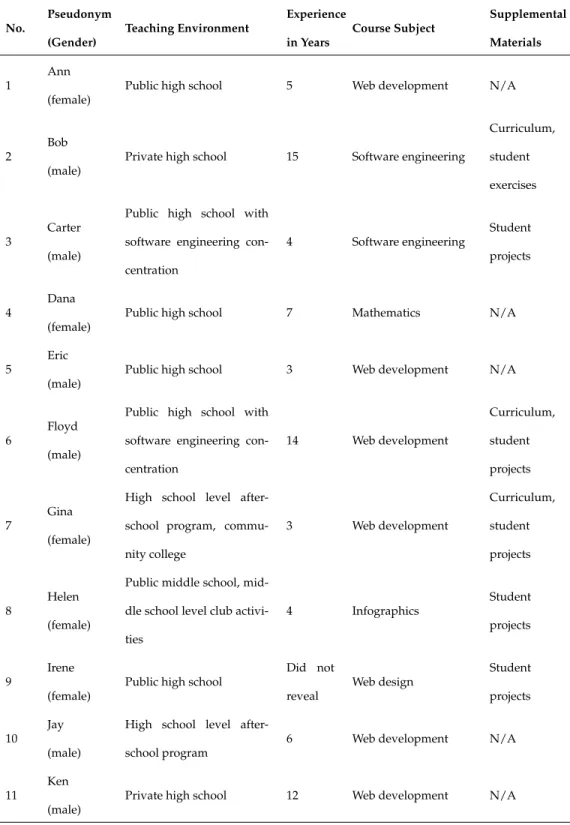
We recruited 11 (five female and six male) voluntary participants for data collec-tion through snowball sampling. They were sampled with common criteria of teaching experience in web development courses and 3 or more years of teach-ing experience in CS. They had experience of teachteach-ing different age groups of
students in different settings. The participants with pseudonyms and the char-acteristics of their teaching context are shown in Table 4.1.
4.3.2
Data Collection
We conducted semi-structured individual interviews. The purpose of these in-terviews was to understand how participants design and deliver lab activities in teaching web development courses. The interviews followed a prepared proto-col to get key information common to all participants, but as a semi-structured interview, it also allowed us to actively ask unscripted questions to be informed about further details or other relevant issues. The questions covered topics of curriculum, technology supports, and the class activity process. Example ques-tions for the topics are shown in Table 4.2. Seven participants joined the inter-view in-person, while four did remotely using video conferencing software over the Internet. The interviews were approximately 40 minutes in length.
Seven participants agreed to share any teaching materials (e.g., curriculum, exercises, etc.) they used along with examples of project outcomes of their stu-dents. These supplemental materials assisted us to better understand the inter-view data by providing information on what’s been done in student activities.
4.3.3
Data Analysis
The interview recordings were fully transcribed and analyzed. The analysis started with the first step of the grounded theory approach, which is open cod-ing [116]. Open codcod-ing, as an independent analytical method, has also been
Table 4.1: Interview participants for exploratory study No. Pseudonym (Gender) Teaching Environment Experience in Years Course Subject Supplemental Materials 1 Ann (female)
Public high school 5 Web development N/A
2
Bob (male)
Private high school 15 Software engineering
Curriculum, student exercises 3 Carter (male)
Public high school with software engineering con-centration 4 Software engineering Student projects 4 Dana (female)
Public high school 7 Mathematics N/A
5
Eric (male)
Public high school 3 Web development N/A
6
Floyd (male)
Public high school with software engineering con-centration 14 Web development Curriculum, student projects 7 Gina (female)
High school level after-school program, commu-nity college 3 Web development Curriculum, student projects 8 Helen (female)
Public middle school, mid-dle school level club activi-ties 4 Infographics Student projects 9 Irene (female)
Public high school
Did not reveal Web design Student projects 10 Jay (male)
High school level after-school program
6 Web development N/A
11
Ken (male)
Table 4.2: Examples of interview questions per topic for teachers
Topic Example Question
Curriculum
“What kind of curriculum do you use for teaching web devel-opment?”
“What are the high-level learning goals for the curriculum?” Class Activities “What kind of activities do you have your students conduct?”
“Could you explain the students’ task process in that activity?”
Technology Support “What tools do you have your students use?” “What materials or starter code do you provide?”
known to be useful in extracting concepts and ideas from the data, even with-out the complete process of axial coding and selective coding of grounded the-ory approach [82, 89]. During open coding on the interview data, references on noteworthy phenomena in the data are iteratively coded with emergent names that concisely describe the phenomena. The phenomena of interest for this re-search included tasks that students performed in lab activities and strategies used by teachers to support students in those tasks. After extraction of the con-cepts through open coding, we tried to identify patterns of strategies.
4.4
Theoretical Background
Cognitive load theory [85] and cognitive apprenticeship [32] were used to gen-erate systematic perspectives on the emerging codes and their categories. Use of these two theories was theoretically justified because they have common premise that learning can be explained by task complexity and cognitive load, which have been indicated as two factors contributing to difficulties in learning [92]. We used these two theories in our coding scheme to theoretically