Available online at https://sloap.org/journals/index.php/irjeis/ Vol. 2 No. 11, November 2016, pages: 11~21
ISSN: 2454-2261
https://sloap.org/journals/index.php/irjeis/article/view/517
Human Resource Scorecard (HRSC) as Performance Measurement
Method to Optimize Organization Performance
Dwi Ermayanti a Amirotul Ro’ifahb
Article history: Abstract
Received: 9 June 2016 Accepted: 30 September 2016 Published: 30 November 2016
Human Resources Scorecard (HRSC) is a human resource performance measurement system that links between people, strategy, and performance to produce an excellent company. HRSC describes the vision, mission, and strategy into human resources activities that can be measured the contribution. This human resources performance measurement is looking at business units from four perspectives: financial perspective (F), the customer (C), internal business process (I), and learning and growth (L). Each perspective in HRSC method HRSC weighted by Analytical Hierarchy process method. This measurement concept is important to be developed because the competition between companies is getting tougher. Therefore, the purpose of this study is to answer the question "how to conduct human resource performance measurement using the HRSC and what is the benefit of using it on KSP Sejahtera East Java?" this research uses the descriptive quantitative method and uses AHP and consistency test. The research resulted in perspective measurement that L with a score of 0.899 as the first priority. Secondly I with a score of 0,893. The third C with a score of 0.883 and the fourth is F with a score of 0.492. So that the performance assessment of human resources, about good, bad, quality and so forth, can be measured with this method, for the sake of improving the human resources quality of a company or organization.
Keywords:
analytical hierarchy process method;
HRSC method; human resources; performance; strategy;
2454-2261 ©Copyright 2016. The Author. This is an open-access article under the CC BY-SA license (https://creativecommons.org/licenses/by-sa/4.0/) All rights reserved. Author correspondence:
Dwi Ermayanti S,
UNMER Malang Student and
Lecturer of STIE PGRI Dewantara Jombang, Indonesia Email address: [email protected]
a UNMER Malang Student and Lecturer of STIE PGRI Dewantara Jombang, Indonesia b Lecturer of UNHASY Jombang, Indonesia
1. Introduction
Nowadays, the competition between companies is very strict need of the company's ability to improve the overall performance. Each company is required to improve the overall performance in facing competition and using resources effectively and efficiently and ultimately the vision, mission, and strategy can be achieved.
This KSP Sejahtera East Java is one of saving and loan cooperative that did not have a performance measurement system which is standard and comprehensive, at that day the human resource performance measurement more focus only on the administrative side or the employee working is in accordance with the Job Description. The head of the company considers the employee has worked well without any mistakes and in accordance with the procedures applicable to the company. This may cause the company made no attempt to improve the employee performance and remain in the same condition continuously. Based on that company condition, the problem should be answer is “how does we do human resource performance using Human Resources Scorecard (HRSC) method and what the benefit of using this method on this KSP Sejahtera Jatim?” those, the future actions that must be done are to measure human resource performance, and here the researchers consider that the right performance measurement appropriate is by using the concepts of Human Resources Scorecard concept (HRSC) to improve and enhance the human resources performance in a company. This measurement concept is essential for cooperatives or companies to effectively grow strategic responsibility to face future competition, in order to achieve the company vision and mission.
Research by this method is very important to be discussed and developed because the use of employee performance measurement by HRSC concept is still rarely used and did not develop. In fact, this measurement concept is essential for development so the cooperation or company is growing especially in solving customer complaints. Thus, this concept is not only important to be developed by KSP Sejahtera East Java, but also other cooperatives or companies to be able to achieve the better target. Here, we as researcher take and in this research, take KSP Sejahtera Jatim as the sample to trials HRSC application. This HRSC method also different with balance scorecards or another method that usually used by other organization. Because not only consider the financial aspect, but also a customer, internal business process, learning and growing.
This discussion is divided into four main points. The first is an introduction, provides a brief overview of some important points and the conceptual framework. The second is the research method and the third is research finding and discussion. Then the last is conclusion and suggestion.
As described above that at this point includes several important points to be understood first and the conceptual framework. Those are explained as follows:
a) Human Resources
In general, the definition of Human Resources (HR) can be divided into two, micro HR and macro HR (Koko, 2015). HR in micro meaning are people working in an agency or an organization, while in macro Meaning is the number of productive age population in a country. And Majid (2008) grouping of HR in two aspects, that are quality and quantity. In quantity regarding the amount of HR (population) is less important the contribution in development, compared to the quality aspect. Here, the quantity of human resources is not accompanied by good quality will burden the development of a nation. While in quality regarding the quality of HR, which involves non-physical ability (mental and intelligence). Therefore, if an organization wants to achieve the maximum results, the quality of HR must be increased.
To obtain the maximum results, it is necessary to be done human resource management. According to Dessler (2006:4), human resource management is the process of acquiring, training, valuing and providing compensation to employees, pay attention to their labor relations, health, and safety, and also the justice problem.
b) The Strategic Human Resource Management
The term Human Resources Management (HRM) according to Marwanto (2011) and Mangkunegara (2002:2) is one of the areas of general management that include aspects of planning, organizing, implementing, and controlling, and this process is contained in the field or the function of production, marketing, finance, or staffing.
Brian E. Becker in his book 'The Human Resources Scorecard, Linking People, Strategy, and Performance' proposed four perspectives about the evolution of human resources as a strategic asset. The evolution of HR as a strategic asset is a) the personal perspective, it is the company recruits the best employer and develop them, b)The compensation perspectives, it is the company uses bonuses, incentives payment, and significant differences in payments to give rewards to employees who are excellent and low. c) The alignment perspectives are that the senior managers see employees as a strategic asset, but they do not invest in improving human resource capability. d) The
Ermayanti, D., & Ro’ifah, A. (2016). Human resource scorecard (HRSC) as performance measurement method to high-performance perspective, it is human resources executives and others regard resources as a system that is inherent in a system that is bigger from the corporate strategy implementation.
c) Performance
According to Moeheriono (2012:95), the definition of performance is the description about the achievement implementation level of activity program or policies in realizing the goals, the objectives, the vision and mission of the organization that stated through an organizational strategic planning. According to Rivai et al (2009:604), performance is a term generally used for part or all of the actions or activities of an organization in a period with the reference to a number of standards. And Riadi (2012) stated that performance is the result of the quality and the quantity of work accomplished by an employee in performing its functions in accordance with the responsibilities given to him. It can be concluded that performance is the working result or quality of someone in achieving the objective as a target.
d) Employee Performance Indicators
To determine the employee performance in a company or organization needs to be established indicators to measure it. Performance Indicators according to Moeheriono (2012:113) includes an Effective, Efficient, Quality, Timeliness, Productivity and Safety. This indicator measures the overall health of the organization and the working environment of the employees in terms of safety. Meanwhile, according to Robbins (2006), there are five indicators to determine the performance of an employee, they are quality, quantity, timeliness, effectiveness, and independence.
e) Human Resource Scorecard (HRSC) Method
According to Gary Dessler (2006:16) human resource scorecard to measure the effectiveness and efficiency of human resource function in shaping the behavior of employees needed to achieve company strategic objectives. According to Becker et al., (2001), the basis of the strategic human resources role consists of the three-dimensional value chain that was developed by the architecture of the company human resources, i.e. functions, systems, and employee behavior.
Human Resources Scorecard method is very helpful in understanding the differences between Doubles Human Resources (Human Resource performance that does not affect the implementation of corporate strategy) with Human Resources Deliverable (Human Resource performance influence the company strategy implementation). The measuring rod by Rivai et al., (2009:612) explains the perspective that must be considered in performance measurement beside financial perspective, at least there are three other perspectives that should also get attention, those are a customer, internal business process, and learning and growth.
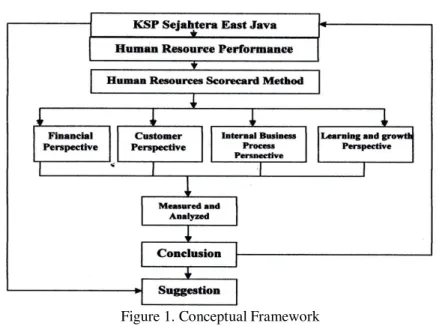
f) Conceptual framework
The conceptual framework of this research is as below:
2. Materials and Methods
The type of this research is quantitative descriptive. This research conducted in three steps: a preliminary survey, data collection, and analysis.
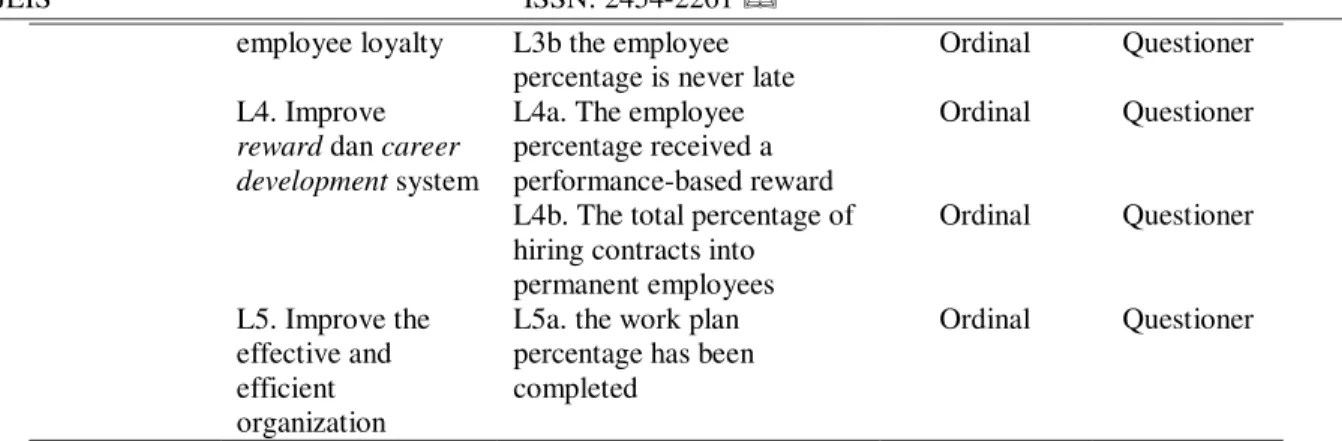
Table 1
Variable, Indicator, and Organization Performance Measurement Scale
Perspective Indicator Sub Indicator Measurement
Scale Instrument
Financial
F1. Improve Employee Productivity
F1a. the revenue each of employee
Ordinal Questioner
F2. Improve Efficiency in HR Side
F2a. The percentage decrease in human resource management cost Ordinal Questioner Customer C1. Improve Customer Satisfaction
C1a. The percentage of complaints resolved
Ordinal Questioner C1b. The number of
complaints comes in.
Ordinal Questioner C2. Improve
Customer Service
C2a. the percentage On time Service Ordinal Questioner Internal Business Process I1. Employee Satisfaction
I1a. Job satisfaction index Ordinal Questioner I2. Improve the
velocity service for employee
I2a. The average time of the process to obtain permission letter for other official
Ordinal Questioner
I3. Providing the exact prosperity
I3a. the employee's percentage follows the retirement preparation
Ordinal Questioner
I4. Improve quality relationship
I4a.the average percentage of the coordination meeting time between the leadership and unit manager
I4b. the average percentage of the coordination meeting time between the
manager/leader and staff.
Ordinal Questioner
I5. Improve the skill and competence of the employee
I5a the average number of training in each year.
Ordinal Questioner I5b. the employee's
percentage with the
excellent performance value
Ordinal Questioner Learning and Growth L1. Improve employee productivity
L1a. the percentage of workload resolved
Ordinal Questioner
L2. Improve the HR quality and quantity
L2a. the ratio number of employees attend the training
Ordinal Questioner
L2b. the number of new employees percentage recruited
Ordinal Questioner
L3. Improve the commitment or
L3a. The employee turnover amount
Ermayanti, D., & Ro’ifah, A. (2016). Human resource scorecard (HRSC) as performance measurement method to employee loyalty L3b the employee
percentage is never late
Ordinal Questioner L4. Improve
reward dan career development system
L4a. The employee percentage received a performance-based reward
Ordinal Questioner
L4b. The total percentage of hiring contracts into permanent employees Ordinal Questioner L5. Improve the effective and efficient organization
L5a. the work plan percentage has been completed
Ordinal Questioner
The population used in this study were all employees of KSP Sejahtera East Java by the total 50 employees, which are divided into five positions or parts, manager, accounting, sales, cashier, and the billing part. Then as a sample, the researchers took the employees of each position.
The data collection method in this study is by using an interview and questionnaire. The scoring scale is as follows:
Table 2 Scoring Scale
Score Explanation
7 A further but liked more than B 6 A far but liked more than B 5 A little but liked more than B 4 A similar to B
3 A little liked less than B 2 A far liked less than B 1 A further but liked less than B
The data processing in this research includes Editing, Coding, tabulation, and scoring.
3. Results and Discussions
3.1 Test by using Analytical Hierarchy Process (AHP) Method
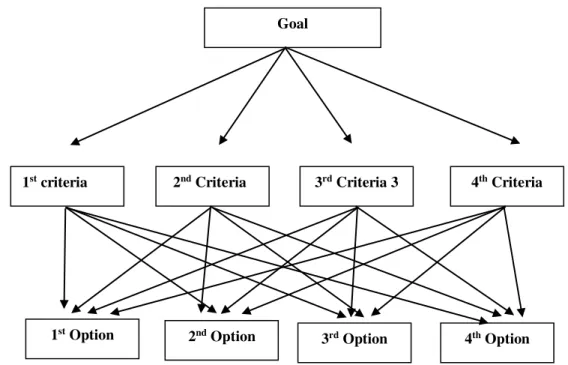
Broadly speaking there are three steps in arranging AHP priorities, those are: a) Problem decomposition
Picture 2. Decomposition problem picture b) Scoring for comparing elements of decomposition result
Table 3 Scoring Scale
Scoring Result A Score B Score
A further but liked more than B 1,9 0,1
A far liked more than B 1,6 0,4
A little liked more than B 1,3 0,7
A similar to B 1,0 1,0
A little liked less than B 0,7 1,3
A far liked lest than B 0,4 1,6
A further liked lest than B 0,1 1,9
From the table it can be summarized as follows: 1) CR(i) is scoring result/comparison among criteria 2) C(n) is the total of criteria to (i)
3) C is the total of all Cn score
4) The weight of criteria to (i) obtained by dividing the score of C (i) with C Table 4
Comparison of criteria
Criteria CR1 CR2 CR3 CR4 Total Weight
CR1 - CR12 CR13 CR14 C1 bc1= C1/C
CR2 CR21 - CR23 CR24 C2 bc1= C2/C
CR3 CR31 CR32 - CR34 C3 bc1= C3/C
CR4 CR41 CR42 CR43 - C4 bc1= C4/C
Goal
1st criteria 2nd Criteria 3rd Criteria 3 4th Criteria
1st Option
2nd Option
Ermayanti, D., & Ro’ifah, A. (2016). Human resource scorecard (HRSC) as performance measurement method to
Total C
By using the same procedure, then made a comparison among options (OP) for each criterion. The following table will illustrate the comparison among options (4 options) for 1st criteria (C1) as follows: O (n) is the result of
assessment or comparison between options (i) with k for the criteria to j, O (i) is the total values possessed by option to (i), O is the total of all score and Bo (n) is the option score to (J) for the criteria to j.
Table 5
Comparison among options for criteria to C1
C1 OP1 OP2 OP3 OP4 Total Weight
OP1 - O12 O13 O14 O1 BO11= O1/O
OP2 O21 - O23 O24 O2 BO21= O2/O
OP3 O31 O32 - O34 O3 BO33= O3/O
OP4 O41 O42 O43 - O4 BO44= O4/O
Total O
c) Scoring Synthesis
Synthesis of the scoring result is the last step of AHP. Basically, this synthesis is the total of the weights obtained each option on each criterion after being given a weighting of those criteria. Generally, the score of an option is as follows:
𝑏𝑜𝑝 𝑖 = ∑𝑛 𝑏𝑜 𝑛
𝑖=1 ∗ 𝑏𝑐 𝑗 ……… (1)
Bop i = score /weight for (i) option
Table 6 Scoring Synthesis
CR1 CR2 CR3 CR4 Priority
bc1 bc2 bc3 bc4 Bopi
OP1 bo11 bo12 bo13 bo14 bop1
OP2 bo21 bo22 bo23 bo24 bop2
OP3 bo31 bo32 bo33 bo34 bop3
OP4 bo41 bo42 bo43 bo44 bop4
3.2 Consistency Test
The consistency measurement of a matrix itself is based on the maximum Eigenvalue. Thomas L Saaty (2005) has proved that the consistency index of n matrix can be obtained by the formula: 𝐶𝐼 =(∂𝑚𝑎𝑥−n)
(n−1)
Results
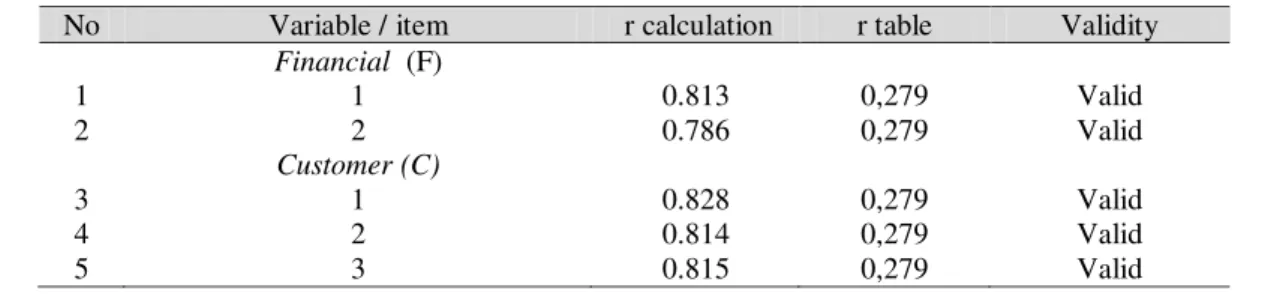
Table 7 Validity Test Result
No Variable / item r calculation r table Validity
Financial (F) 1 1 0.813 0,279 Valid 2 2 0.786 0,279 Valid Customer (C) 3 1 0.828 0,279 Valid 4 2 0.814 0,279 Valid 5 3 0.815 0,279 Valid
Internal Business Process (I) 6 1 0.367 0,279 Valid 7 2 0.615 0,279 Valid 8 3 0.650 0,279 Valid 9 4 0.664 0,279 Valid 10 5 0.787 0,279 Valid 11 6 0.673 0,279 Valid
Learning and Growth (L)
12 1 0.308 0,279 Valid 13 2 0.782 0,279 Valid 14 3 0.620 0,279 Valid 15 4 0.675 0,279 Valid 16 5 0.727 0,279 Valid 17 6 0.757 0,279 Valid 18 7 0.587 0,279 Valid 19 8 0.586 0,279 Valid Reliability Test Table 8 Reliability test results
Variable Calculation Score
Alpha Cronbach Reliability
Employee Performance Measurement (X) 0,875 Reliable
Employee Performance Optimization Value (Y) 0,837 Reliable
Table 9
The result of comparing among criterion
Criteria F C I L Total F 0 0,153 0,713 0,154 0,492 C 0,153 0 0,69 0,842 0,883 I 0,713 0,69 0 0,623 0,893 L 0,154 0,842 0,623 0 0,899 Total 1,02 1,685 2,026 1,619 3,167 4. Conclusion
Based on the analysis and the discussion done in the previous chapter, the human resources performance measurement by using the Human Resources Scorecard it can be concluded as follows:
a) Learning and Growth Perspective (L) with score 0,899, this perspective should be the first priority. To improve this perspective is done by the following way: increase employee productivity and improve the quality and the number of human resources, Improve commitment/ employee loyalty, repair the reward system and the career development, developing an effective and efficient organization.
b) Internal Business Process Perspective (I) with a score 0,893. This priority gets the second position. The way done to improve that perspective are as follow: improvements the Employee Satisfaction, Improve the speed of service for employees, granting the proper welfare, Improve the quality relationship and the skills and employees.
c) Internal Business Process (I) perspective with score 0,893. This priority gets the second option. The way to improve this perspective is Improve Employee Satisfaction, improve the service speed for the employee, the giving prosperity, improve the quality relationship and kill the employee competency. Customer Perspective
Ermayanti, D., & Ro’ifah, A. (2016). Human resource scorecard (HRSC) as performance measurement method to with a score of 0.883 was ranked third. How that is done to optimize through Improving Customer Satisfaction and Improves Customer Service and Priority.
d) The Financial Perspective with score of 0.492. Ways in which to optimize are: Improve and enhance employee productivity and Improving the Efficiency in the side of Human resource.
We have done the research in KSP Sejahtera East Java and from the discussion and analysis we can suggest that: a) Learning and Growth Perspective (L), to improve this perspective is done by these ways: improve employee
productivity, HR quality, and quantity, the commitment/employee loyalty, the system of rewards and career development, and develop an effective and efficient organization.
b) Internal Business Process Perspective (I), the way to improve this perspective are: make an improvement on the Employee Satisfaction, Improve the service speed for employees, granting the proper welfare, Improve the quality relationship and Improve skills and employee competencies.
c) Customer Perspective. The way to optimize is: by improving Customer Satisfaction, and Improves Customer Service and Priority
The Financial Perspective. The way to optimize is: Improve and enhance employee productivity and Increasing Efficiency in Human Resource line.
Conflict of interest statement and funding sources
The author(s) declared that (s)he/they have no competing interest. The study was financed by the authors. Statement of authorship
The author(s) have a responsibility for the conception and design of the study. The author(s) have approved the final article.
Acknowledgments
My deep and sincere gratitude were presented to God for having granted me the ability and the opportunity to complete this paper. I would also like to thank my former lecturers and my friends for their support, their patience, their contribution, and their valuable input, therefore, this article could be completed. I would also thank I Wayan Suryasa as an advisor as well as editor in chief of IJMRA and Skirec who has reviewed and approved this study to be published.
References
Astuti, K. R., & Meiyanto, I. S. (2011). lokakarya (workshop) human resources scorecard untuk meningkatkan
persepsi keterlibatan kerja karyawan departemen sumber daya manusia(Doctoral dissertation, Universitas
Gadjah Mada).
Becker, B. E., Huselid, M. A., Huselid, M. A., & Ulrich, D. (2001). The HR scorecard: Linking people, strategy, and
performance. Harvard Business Press.
Bourgeois, R. (2005). Analytical hierarchy process: an Overview. Bogor: Uncapsa-Unescap.
Dessler, D. (1989). What's at stake in the agent-structure debate?. International organization, 43(3), 441-473. Dewi, A. S. (2007). Hubungan Insentif Terhadap Kerja Karyawan pada PT Telkom Kuningan (Doctoral dissertation,
Universitas Widyatama).
Majid, A. (2008). Perencanaan pembelajaran mengembangkan standar kompetensi guru. Bandung: PT. Remaja
Rosdakarya.
Mangkunegara, A. A. P. (2000). Manajemen sumber daya manusia perusahaan. Remaja Rosdakarya. Marwanto, E. (2013). Aktivitas Marketing Above The line dan Below The Line. Retrieved Oktober, 10, 2015. Moeheriono, P., & Si, D. M. (2012). Pengukuran Kinerja Berbasis Kompetensi.
Riadi, M. (2013). Pengertian Sistem Pendukung Keputusan.
Robbins, S. P., & Judge, T. A. (2006). Perilaku organisasi. Edisi kesepuluh. Jakarta: PT Indeks Kelompok Gramedia. Saaty, T. L. (2005). Theory and applications of the analytic network process: decision making with benefits,
Ermayanti, D., & Ro’ifah, A. (2016). Human resource scorecard (HRSC) as performance measurement method to Biography of Authors
Bachelor : STIE Malangkucecwara Malang, Accounting Departement Master : Universitas Brawijaya Malang, Management Department.
Publication: International Journal of BBR Journal on the title: Intellectual Capital (IC) Analysis and The Effect To Financial Performance In PT. Kalasuba Indonesia (KSI), Pengungkapan Social, Diversifikasi Perusahaan, Dan Kompensasi Bonus Terhadap Manajemen Laba Pada Perusahaan Manufaktur Di BEI
Email: [email protected]
Bachelor : UIN Malang, on Language and Literature Department. Master : UGM Yogyakarta on General Linguistics Department.
Publication : International Journal of BBR Journal on the title: Intellectual Capital (IC) Analysis and The Effect To Financial Performance In PT. Kalasuba Indonesia (KSI) Email: [email protected]