A Quality-of-Service Enhanced Socket API in GNU/Linux
Hasan Abbasi, Christian Poellabauer, Karsten Schwan, Gregory Losik
College of Computing,
Georgia Institute of Technology,
Atlanta, GA 30332
{
habbasi,chris,schwan,losik
}
@cc.gatech.edu
Richard West
CS Department
Boston University
Boston, MA 02216
[email protected]
AbstractWith the increase in available network bandwidth and reduction in network latency, more emphasis has been placed on end-host QoS to provide quality of service guarantees for distributed real-time applications, such as video streaming servers, video conferencing applications, and VoIP applications. End-host QoS requires support from the underlying operating system (OS) in the form of network schedulers and traffic controllers. GNU/Linux supports a variety of network schedulers for the provision of end-host QoS, but no easy-to-use API is provided between applications and system-level traffic controllers. Moreover, existing APIs lack the ability to link QoS attributes with stream or datagram sockets and to associate QoS information with individual packets allowing sophisticated network schedulers to make scheduling decisions based on such information or to link different streams such that their QoS management is coordinated. We propose an extension to the standard Berkeley socket interface that enables applications to easily create and manage connections with QoS requirements. This new API – called QSockets – includes per-socket traffic classification that allows the application developer to link a socket connection with a scheduler so that all data going out on this socket is scheduled accordingly. We further allow an application to pass packet-specific parameters to the scheduler for fine-grained scheduler control. We evaluate our approach with a multimedia application using QSockets and a real-time packet scheduler.
1
Introduction
1.1
Background
There are a considerable number of applications to-day that require some form of guarantee from the
Network Subsystem with regards to Quality of Ser-vice (QoS) parameters for reliable operation. Such applications are usually continuous media applica-tions for soft real-time video and audio streaming, video-conferencing and Internet telephony. There has been a consistent push toward creating an Inter-networking infrastructure that can provide seamless guarantees to such applications. The two most com-monly accepted proposals areIntegrated Servicesand
Differentiated Services[2].
These proposals, however, require substantial mod-ifications to the underlying network model for pro-viding end-to-end guarantees. With high speed
in-tranets available today, it is possible to obtain rea-sonable guarantees for delay and bandwidth using only end-system QoS. While these guarantees are not absolute they do provide a good approximation without requiring any major changes to the physical network.
In [3] the authors show that even in the presence of network level QoS support, it is often necessary for the end-system to provide not only service differenti-ation but also traffic shaping. Moreover this shaping has to be provided on a per-application basis to pro-vide maximum functionality for the application and system developers.
Despite having comprehensive scheduling functional-ity in GNU/Linux [7], there is no support (in terms of either API or classifiers) for exposing this func-tionality to the application. Instead the traffic con-troller functionality is designed for use as a node on a DiffServ network. The lack of application level
differentiation as well as a comprehensive API for addressing the shaping of application traffic forces the developer to resort to application level rate con-trol. Such rate control is inefficient but highly flexi-ble. Each stream and even individual messages can be shaped according to the needs of the application. While flexible, using such methods can be inefficient and does not scale well for high system loads, es-pecially when each stream and individual messages have to be shaped (eg. scheduled) according to the application’s needs [9].
1.2
Contributions
We provided a comprehensive API for creating and attaching socket streams to end-system QoS at-tributes. The API called QSockets is based on the BSD socket API and follows the same semantics. We argue that using this API for end-system QoS does not impose any substantial overhead in terms of socket creation, destruction, or usage. We also argue that there is no substantial programmatic overhead associated with using our API. In fact we provide functionality for using the API with minimum mod-ifications to the core application.
An interesting characteristic of QSockets is its pro-vision of functionality for dynamically retrieving scheduling and transmission information for use by adaptive multimedia applications. For instance, QSockets-based network feedback can be used to throttle or speed up an application’s rate of packet transmission. Similarly, using a socket based classi-fier for the GNU/Linux traffic controller, we demon-strate how outgoing traffic may be classified on a per-socket basis, thereby allowing us to provide per-stream QoS attributes for scheduling network streams (using the socket-to-socket connection ab-straction). Moreover, by associating per-packet QoS attributes, stream scheduling can be made ‘smarter’, by re-ordering a packet stream according to packet priority, reliability, or deadlines. With this func-tionality, QSockets approaches the functionality of application-level rate control, but offers the efficiency of system-level packet scheduling.
Interesting aspects of the GNU/Linux QSockets im-plementation include the following. First, our experi-ence is that kernel-level packet scheduling performs at levels of granularity and predictability that far outpaces previous user-level approaches [9]. This is particularly important for interactive media applica-tions that have smaller packet sizes, like VOIP. Sec-ond, it turned out to be awkward to use the existing GNU/Linux QoS infrastructure for the application-level traffic scheduling required by our multimedia codes. This is because the Linux infrastructure was intended for DiffServ networking and was therefore,
placed ‘under’ Linux TCP and UDP protocol stacks. This makes it difficult to implement the application-level framing necessary for ‘lossy’ media scheduling, where frames that are likely to miss their dead-lines upon arrival are discarded at the source in-stead of the sink, thereby reducing network band-width needs. Finally, expanding the selective lossi-ness implemented by our kernel-level packet sched-uler [9], an extension of QSockets being implemented now permits end users to place application-specific packet filters and manipulations into the network path, using safe ‘kernel plugins’. Our future work will use QSockets with a variety of applications and in the context of a broader research effort addressing kernel-level support for QoS management for stan-dard Linux kernels, called Q-fabric [4].
1.3
Related work
An effort similar to QSockets can be found in [5]. However this approach was tailored to work only with CBQ. Moreover, this approach did not allow applications to create a socket connection that could be scheduled. In [3] and other papers, researchers have shown that it is useful to have a traffic con-troller in the kernel, however no significant API has been provided for using this functionality to the ap-plication developer. Furthermore, the concentration of such efforts is on traffic controller for nodes in a DiffServ network. Migrating Sockets [10] describes a similar mechanisms to ours, but for end-to-end QoS. However migrating sockets uses custom scheduling in Solaris, whereas we concentrate on using an available scheduling infrastructure in GNU/Linux. Another approach to the same problem is presented in [6], which uses an extension to the existing socket in-terface for addressing QoS support for multimedia applications. However this approach was designed to work only on Integrated Service networks, which already provide QoS support. The new socket API was only used for packet marking.
1.4
Overview
The remainder of this paper is structured as follows. In Section 2 we give an architectural overview of the current GNU/Linux traffic controller interface, an architectural overview of the QSockets infrastructure and an overview of the QSockets API. In Section 3 we describe how to use the QSockets API for modify-ing both existmodify-ing and new applications. Evaluation of the work, including micro-benchmarks and appli-cation benchmarks are presented in Section 4. Fi-nally we present our conclusions and discuss future research directions in Section 5.
2
Traffic controller
The GNU/Linux traffic controller was designed to provide Differentiated Services in a GNU/Linux net-work. The traffic controller handles packets that are being queued for transmission on a network device (Figure 1) Network Interface Device Queue Traffic Controller Packet Classifier Packets to be queued for transmission
FIGURE 1: Flow of data packets through
the traffic controller
Once the IP layer has processed the packet it hands the packet over to the device for output queuing. At this point the packet is processed by the traffic controller. The traffic controller classifies the pack-ets and queues them according to rules established previously. The output queuing process can be used to rate limit network traffic, to re-order the output queue and to provide delay/bandwidth guarantees for the network link (Figure 2).
The traffic controller consists of three major compo-nents:
• Queuing Disciplines
• Classes
• Filters
For each network device in a system that supports output queuing, there exists a queuing discipline,
Qdisc, attached to this device. It is this queue to which all packets to be sent on this device are queued for transmission. The Qdiscs supports methods for enqueuing and dequeueing a packet. The Qdisc may be associated with a set ofclassesandfilters(also called classifiers). The filters are used as a classifi-cation mechanism for assigning an outgoing packet to a specific class and each class contains a Qdisc also. In this way a hierarchical set of Qdiscs, classes and filters can be created for maximum flexibility in scheduling of outgoing traffic. A more thorough de-scription of the traffic controller can be found in [1].
Root qeueing discpline Socket filters Per-socket queues s1 s2 Incoming data Best-effort data
FIGURE 2: Traffic controller overview
2.1
Architectural overview
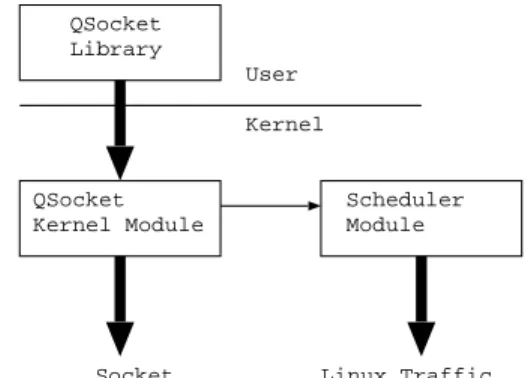
The QSockets architecture works on top of the traffic controller infrastructure. A new system call is added,
sys qsocketcallwhich works as a multiplexer (sim-ilar to sys socketcall). The QSockets architecture (Figure 3) is divided into three functional parts:
User Kernel QSocket Library QSocket Kernel Module Scheduler Module Socket Layer Linux Traffic Controller
FIGURE 3: QSockets structure
1. QSockets manager. The QSockets manager
is the controller module for QSockets opera-tions. It provides the actual QSockets interface to applications. The manager module provides scheduler independent setup functionality. The bulk of the work however is done in the sched-uler modules.
2. Scheduler module. The manager
mod-ule provides a registration functionality for scheduler modules. The scheduler module ex-poses functionality to the manager module for adding, removing, and changing scheduled streams. Use of the scheduler modules allows QSockets to provide equivalent functionality
for many different scheduler types. This func-tionality can be further extended to support multiple types of schedulers simultaneously, al-though currently QSockets is limited to provid-ing support for a sprovid-ingle schedulprovid-ing discipline in a system. Each scheduler module defines a set interface for adding a stream, for removing a stream, for changing a stream, and for initial-izing itself as the root Qdisc.
3. Socket classifier. We have provided a socket classifier which allows us to classify outgoing traffic using the associated socket as a clas-sification attribute. The socket classifier al-lows an application to use the already avail-able socket abstraction for identifying a data flow. The classifier works on the inode num-ber of the socket descriptor (although this is hidden from the application). Using the nat-ural socket abstraction allows an application developer to add advanced features into the ap-plication for differentiating flows and smarter scheduling. For example a video streaming ap-plication can stream multiple flows to the same client at different rates. In the presence of an overloaded network the application can adapt by reducing the frame rate of a low priority flow. Although, as stated earlier, QSockets does not necessarily allow end-to-end QoS sup-port, it can be used for service differentiation at the end-host, resulting in similar effects.
2.2
API overview
The QSockets API follows the BSD Socket API closely, following the same functional semantics, but new functionality is added through further exten-sions.
2.2.1 Socket creation
Sockets are created using the qsocket call. Apart from the domain, type and protocol an additional parameter is specified instruct qos params. The structure contains information about which device to attach the classifier to, the scheduler type and the scheduling attributes. At socket creation a socket classifier is also created which classifies outgoing packets according to the associated socket inode.
2.2.2 Changing scheduler attributes
One of the advantages of using a simple API for specifying QoS parameters is that the scheduling at-tributes can be modified with changing application requirements. In QSockets the parameters are mod-ified with theqchange call. The qchange call takes
the file descriptor of the socket and the new QoS parameters in a qos params structure.
2.2.3 Passing message specific parameters to
the scheduler
One of the major contributions of this work is the ability to let the application specify per-message scheduling information. This scheduling information can be used for making smart scheduling decisions. For example, a video streaming application can spec-ify a frame boundary for transmitted video frames. The scheduler can use this information to schedule the entire frame as a group. In the case of a lossy packet scheduler, the scheduler can use this informa-tion to drop entire frames instead of pieces of a frame. An application can also associate more information with each buffer. A drop priority can inform a sched-uler not to drop certain messages (for instance the I-frames in an MPEG video stream). Also a dead-line attribute can be used for creating per-message deadlines.
The callsqsend and qsendto are used for passing packet specific flags to the scheduler. The calls mir-ror the socket API send and sendto calls, but an additional parameter is passed containing a set of packet flags.
2.2.4 Retrieving scheduling information
A scheduler can provide the application with very de-tailed information about the transmission rate, the queuing delays, the packet drop rates as well as var-ious other scheduler specific information. These at-tributes can be retrieved with theqinfo call. Apart from scheduler information, information from the network stack can also be retrieved for even more flexible adaptation. Such information includes buffer sizes, receive windows, etc.
3
API usage
In this section we describe common usage scenar-ios for QSockets with code excerpts. For the pur-pose of our examples we use the DWCS queueing discipline [8], ported to Linux kernel version 2.4.17. DWCS provides soft real time guarantees for contin-uous media streams, and also allows the developer to specify a loss tolerance in the presence of transient overload situations. DWCS supports three parame-ters,ipg,olnandold. The stream rate is defined by
ipg and the loss tolerance by old and oln. A lossy stream is allowed to loseolnpackets out of everyold
packets queued. DWCS also supports non-deadline constrained streams by providing a best-effort FIFO
queue. We also added functionality to DWCS to sup-port per-packet attributes such as frame boundaries, packet deadlines, and drop priorities. Using these at-tributes we can use DWCS as an EDF scheduler by specifying packet deadlines. Although DWCS is the only scheduler currently supported we plan to add support for more schedulers (such as SFQ and CBQ) in the future.
3.1
New application
When developing a new application, QSockets can be used for providing additional functionality such as adaptation and rate control without the overhead of building a new scheduling discipline.
3.1.1 Initialization
The application developer must use the qsockinit
call to initialize the root queueing discipline on a device. This is required because of the current limi-tation within the QSockets architecture which allows the system to use only a single type of queueing disci-pline system wide. Since it effects the entire system,
qsockinit is a privileged call and requires root ac-cess.
struct qos_params params; int err = 0;
strncpy(params.dev, "eth0", IFNAMSIZ); strncpy(params.name, "dwcs", IFNAMSIZ); params.attributes = NULL;
err = qsockinit(¶ms);
This needs only be done once for all subsequent us-ages of QSockets. An error code indicating the con-dition is returned to indicate success or failure. An application must check the return value to deter-mine whether the root queueing discipline has been installed successfully. If an incompatible queueing discipline is already instantiated, an error code is re-turned.
3.1.2 Socket creation
The following code snippet describes the creation of a scheduled socket end point.
struct qos_params params; struct q_dwcs_attr attrs; int fd;
/*set device name*/
strncpy(params.dev, "eth0", IFNAMSIZ);
/*set scheduler name */
strncpy(params.name, "dwcs", IFNAMSIZ); /*set scheduling attributes*/
attrs.oln = 0; attrs.old = 10; attrs.ipg = 10;
attrs.stream_flags = DWCS_NON_DROPPABLE; params.attributes = &attrs;
/*create scheduled socket*/
fd=qsocket(domain,type,protocol,¶ms); On success a new socket identifier is returned to the application that can be used like another socket de-scriptor. Additional functionality can be exploited by the application, however, by using theqsendand
qsendto calls for sending data on this socket end point. Theqinfocall can also be used for retrieving information from the scheduler. The qchange call can also be used to modify the scheduling parameters of an existing application.
3.1.3 Passing message specific parameters
To add this functionality to an application the
qsendto call must be used instead of the normal
sendtosocket call. We pass a packet flags struc-ture in with theqsendtocall. In the example below we specify a non-droppable flag for the message as well as a packet specific deadline.
struct packet_flags pflags;
/*mark the packet as non-droppable*/ pflags.drop_flag = DWCS_NON_DROPPABLE; /*attach a packet deadline to this message*/ pflags.deadline = deadline
/*call qsendto and send the
packet information down to the scheduler*/ if(qsendto(sockfd, &next_frame,
sizeof(next_frame), 0, (struct sockaddr*)&name, size, &pflags)< 0) perror("qsendto");
3.2
Adding to an existing application
An existing application can be easily modified to use QSockets without the addition of many new lines of code. Instead of creating a new socket and associ-ating a scheduler with it, an existing socket can be associated with a new scheduler using the qattach
call. Message specific parameters can also be passed down to the scheduler usingqsendtoin the way de-scribed above. When qattach is called it does not
create a new socket to associate with a scheduler, but rather it uses and already existing socket. This al-lows the application developer to separate the socket creation functionality from the QSockets functional-ity.
struct qos_params params; struct q_dwcs_attr attrs; /*fd is the socket descriptor*/ /*set device name*/
strncpy(params.dev, "eth0", IFNAMSIZ); /*set scheduler name */
strncpy(params.name, "dwcs", IFNAMSIZ); /*set scheduling attributes*/
attrs.oln = 0; attrs.old = 10; attrs.ipg = 10;
attrs.stream_flags = DWCS_NON_DROPPABLE; params.attributes = &attrs;
/*create scheduled socket*/ qattach(fd, ¶ms);
4
Evaluation
Evaluation of an API requires consideration of two things. The API should be able to provide its func-tionality without significant overhead. And secondly the API’s additional functionality should be useful for applications.
4.1
Micro Benchmarks
QSockets adds the following new calls: qsockinit,
qsocket, qchange, qinfo, qsendto, qclose and
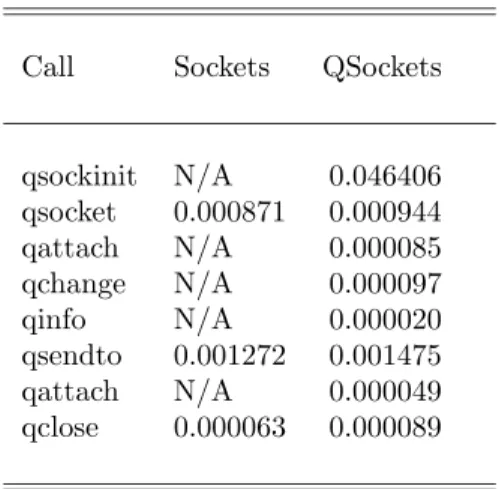
qattach. We compare the execution time of each call with the execution time of the equivalent socket calls. In the case of qsockinit, qinfo, qchange and qattach there are no equivalent socket calls, but we show that the time taken for these calls is minuscule. The re-sults displayed are the average of 10 runs. All times are in seconds. The experiments were performed on a dual P2-400 with a 10Mbps network interface.
Call Sockets QSockets
qsockinit N/A 0.046406 qsocket 0.000871 0.000944 qattach N/A 0.000085 qchange N/A 0.000097 qinfo N/A 0.000020 qsendto 0.001272 0.001475 qattach N/A 0.000049 qclose 0.000063 0.000089
TABLE 1: Execution time of API calls
As can be seen from table 1 the QSockets call over-head is very small. The only call which has a sig-nificant execution overhead is qsockinitbut this is called only once to initialize the QSockets interface. Since this is a privileged call it should not be placed in an application, but rather called by the system at startup. The callqsocketwhich is the replacement for the socket creation call has a very small overhead. The most frequently used call (qsendto) only has an overhead of 8.3% higher than the regular sendto call. We can also see that the new calls qinfo, qchange and qattach have very low execution times.
The reason for the high overhead ofqsockinitis the creation of a scheduling discipline. However the over-head forqsendtois harder to explain. Compared to a normal sendto call, there is additional work that happens during the execution of the qsendto call. The additional work includes processing of the socket classifier, the copying of the packet specific flags, as well the enqueueing of the packet into the DWCS queues. We feel that the 15.9% overhead is justified by additional functionality provided by the new call.
4.2
Application benchmarks
We use two separate classes of applications that re-quire delay guarantees from the end-host. A video server needs to transmit generated frames with a cer-tain rate (a rate based deadline). The server must transmit the data in a timely manner or the client receives a low frame rate and high levels of jitter. We show that by using a rate based scheduler (DWCS) in a video application we can achieve a more consis-tent frame rate and lower jitter. We also consider a data acquisition application example where a sensor provides data to a remote client. The sensor data is deadline constrained, i.e if the data is outdated it is
useless. We demonstrate that by attaching the dead-line to the data we can obtain significantly higher number of valid data frames. The applications used simulated traffic which we generated random data.. The video server generated a frame with a random type and transmitted that over the network. The data acquisition application generated both the data and the deadline randomly and transmitted it to the client. In both cases the client recorded values at 5 second intervals.
4.2.1 Streaming video server
A video server must be able to preserve its guaran-teed QoS level to the clients at all times, even in the presence of significant network perturbation. At the level of the end-host it requires being able to trans-mit data at a specific rate with low variations. To test this we developed a simulated server which gen-erated frames randomly.
FIGURE 4: Performance of QoS managed
stream compared to unmanaged stream
In Figure 4 we ran the video server twice, using the QSocket API and without the QSocket API, trans-mitting a 20fps stream. We also created two network perturbations (at times 15 and 30). The perturba-tion was created by started a large ftp transfer on the host machines. As can be seen the QSocket enabled video server was able to maintain a frame rate close to the ideal frame-rate of 20fps (frames per second). Without QSocket the frame-rate dropped consider-ably when the perturbation started. The small de-crease in the frame rate occurs because some frames are being dropped by DWCS. In such a situation we preferred that only P and B type frames are dropped, since they have a lower impact on the qual-ity of the MPEG video stream. We achieved this by marking theIframes as non-droppable.
FIGURE 5: Jitter in a QoS managed
stream compared to jitter in an unmanaged stream
Comparing the jitter in the two streams we see that the QSocket enabled video server is able to provide a much lower jitter rate. As can be seen in Figure 5 the time between consecutive frames never increases significantly even when the perturbations start.
FIGURE 6: Running video streams at
dif-ferent rate over QSocket
Finally we show that when the network is overloaded multiple video streams can be sent with the required QoS level, but unmanaged streams suffer as a result. In Figure 6 we see that two managed video streams at 20fps and 15fps respectively achieve their required QoS but an unmanaged stream at 20fps is transmit-ted at a much lower rate. However it should be notransmit-ted that there is no starvation of the best effort stream since most video streams are not work conserving.
4.2.2 Remote data acquisition application
The remote data acquisition application is comprised of a remote sensor and a client which acquires data
from this client. The sensor sends out data to the client aperiodically and hence a rate based scheduler cannot be used. Instead we use an earliest deadline first scheduler (EDF). The deadlines for each mes-sage are indicated by the mesmes-sage parameters. We record the number of missed deadlines at the client side (where the data is too late to be useful) as well as the number of frames dropped. We use two versions of the EDF scheduler (which is based on DWCS), viz. a lossy version and a lossless version. The lossless version tries to preferentially send out data over the network. In the case of a late packet, the data will still be sent, but best effort flows cannot cause sig-nificant delays in the deadline constrained streams. The lossy version of the scheduler drops late pack-ets, since it is assumed that the late data is useless. However by dropping late packets the system is able to send packets with achievable deadlines in time. To create the effect of network traffic a perturbation was started at time 30. Similar to the earlier exper-iments this perturbation was created by a starting a large FTP transfer on the host machine.
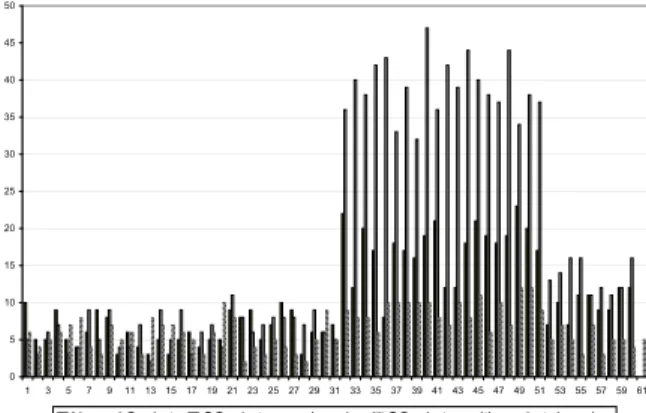
FIGURE 7: Missed deadlines for every 5
second interval in a remote data acquisition application
In Figure 7 we see that the number of late or lost data frames are much lower when using QSocket. Further-more by dropping late frames we achieve very good results. Looking at the breakdown of late or lost frame per-interval we see that after the perturbation is started the non-lossy and the non-QSocket flows both have significant increases in the number of late packets. However the lossy flow suffers from no late packets and is able to drop fewer data frames then the other two flows. This is a significant reduction in the number of deadlines missed by the scheduler.
4.3
Results discussion
As can be seen from the experiments QSockets is a useful API for developing scheduled applications
on top of the standard Linux traffic controller in-terface. Using some of the additional functionality within QSockets we can develop applications that are better able to achieve their desired levels of QoS. From the results in Figure 7 and 6 we see that it is possible to obtain even better levels of QoS by using a scheme for packet dropping. This gives the ap-plication developer more flexibility in dealing with situations where the network cannot handle the gen-erated traffic at the desired level of QoS.
5
Conclusion and future work
We presented QSockets, an API for end-host QoS support in GNU/Linux, using the existing function-ality of the traffic controller, instead of creating our own. QSockets also extends the functionality of the traffic controller by allowing the developer to pass in a per-packet attribute with each message to be used in making a smarter scheduling decision. We showed that QSockets provides significant advantages to con-tinuous media and remote sensor data applications, and provides these advantages at a low overhead cost. In the future we would like to add additional sched-ulers to the QSockets framework, including CBQ and SFQ. This will allow QSockets to be used for more general purpose applications which require band-width guarantees. We would also like to add further functionality into the traffic controller infrastructure for finer grained traffic classification using applica-tion specified, dynamically compiled filters.
We also have plans to compare the performance over-heads of positioning the scheduler at a level above the protocol stack, where additional application spe-cific information can be provided to the scheduler. During the deployment of QSockets we realized that because of the positioning of the scheduler below the protocol stack, the traffic controller cannot make traffic shaping decisions on the basis of the message content. We want to compare the costs and the bene-fits of using an alternate implementation of the traffic controller.
References
[1] W. Almesberger. Linux network traffic control — implementation overview.
[2] W. Almesberger, J. Salim, A. Kuznetsov, and D. Knuth. Differentiated services on linux, 1999. [3] M. Bechler, H. Ritter, G. Schafer, and J. Schiller. Traffic shaping in end systems at-tached to qos-supporting networks. In Com-puters and Communications, 2001. Proceedings.
Sixth IEEE Symposium on , Vol., 2001, pages 296– 301.
[4] C. Poellabauer, H. Abbasi, and K. Schwan. Co-operative run-time management of adaptive ap-plications and distributed resources. In Proceed-ings of the 10th ACM Multimedia Conference, 2002.
[5] G. Vaddi and P. Malipatna. An API for Linux QoS Support.
[6] P. Wang, Y. Yemini, D. Florissi, J. Zinky, and P. Florissi. Experimental QoS Performances of Multimedia Applications. In Proceedings of IEEE Infocom 2000.
[7] A. Werner. Linux traffic control — im-plementation overview. Technical
Re-port SSC/1998/037, EPFL, November 1998. ftp://lrcftp.epfl.ch/pub/people/ almesber/pub/tcio-current.ps.gz.
[8] R. West and K. Schwan. Dynamic window-constrained scheduling for multimedia applica-tions. InICMCS, Vol. 2, pages 87–91, 1999. [9] R. West, K. Schwan, and C. Poellabauer.
Scal-able Scheduling Support for Loss and Delay Constrained Media Streams. In Proc. 5th Real-Time Technology and Applications Symposium, Vancouver, Canada, 1999.
[10] D. K. Y. Yau and S. S. Lam. Migrating sockets — end system support for networking with qual-ity of service guarantees. IEEE/ACM Transac-tions on Networking, 6(6):700–716, 1998.