Cost-Aware Caching Algorithms for Distributed
Storage Servers
Shuang Liang1, Ke Chen2, Song Jiang3, and Xiaodong Zhang1 1 The Ohio State University, Columbus, OH 43210, USA
2 University of Illinois, Urbana, IL 61801, USA 3 Wayne State University, Detroit, MI 48202, USA
Abstract. We study replacement algorithms for non-uniform access caches that are used in distributed storage systems. Considering access latencies as major costs of data management in such a system, we show that the total cost of any replacement algorithm is bounded bythe total
costs of evicted blocks plus the total cost of the optimal off-line
algo-rithm (OPT). We propose two off-line heuristics: MIN-dand MIN-cod, as well as an on-line algorithm: HD-cod, which can be run efficiently and perform well at the same time.
Our simulation results with Storage Performance Council (SPC)’s stor-age server traces show that: (1) for off-line workloads, MIN-cod performs as well as OPT in some cases, all is at most three times worse in all test case; (2) for on-line workloads, HD-cod performs closely to the best al-gorithms in all cases, and is the single algorithm that performs well in all test cases, including the optimal on-line algorithm (Landlord). Our study suggests that the essential issue to be considered be the trade-off between the costs of victim blocks and the total number of evictions in or-der to effectively optimize both efficiency and performance of distributed storage cache replacement algorithms.
1
Introduction
Widely used distributed storage systems have two unique features: storage de-vice heterogeneity and multi-level caching management. In a typical multi-level heterogeneous distributed storage system, I/O buffer caches are installed at hi-erarchical levels. Access latencies to data blocks are no longer a constant due to non-uniform access times caused by heterogeneous storage devices and hierar-chical caching. This adds another dimension to the management of distributed storage caches, which is a significant impact factor to the system performance. However, most existing replacement algorithms in practice focus on minimizing miss rate as the single metric for performance optimization, treating access la-tency as a constant. For example, recent studies on replacement algorithms such as 2Q, ARC, LIRS, and MQ mainly aim to improve the traditional LRU heuris-tic4
, which consider only block recency or balance both recency and frequency 4 A brief overview of these algorithms is available in [1]
to reduce miss rate. These algorithms may not be suitable to manage caches of variable access latencies in distributed storage systems.
The replacement problem for caches with non-uniform access latencies can be modeled by the weighted caching problem, which can be solved off-line in
O(kn2) time by reduction to the minimal cost flow problem [2], where k is the cache size and n is the number of total requests. However, this optimal algorithm is resource intensive in terms of both space and time for real-world system workloads, particularly when k and n are large. As an example, for a sequence of only 16Krequests and a buffer cache of as small as 1.5 MBytes, the best known implementation of the minimum-cost flow algorithm [3] takes more than 17 GBytes of memory and multiple days to run on a dual-core 2.8GHz SMP Xeon server. Therefore, as current workloads and cache capacity continue to scale up, it becomes too unrealistic to timely make optimal replacement schedules.
In face of this problem, we study replacement algorithms for non-uniform ac-cess latency caches. Similar to previous studies, we use variablecostto model the non-uniform access latency in order to improve the efficiency and performance of replacement algorithms. In general, our model can be used for a distributed storage system with other non-uniform features, such as non-uniform energy consumption per access by instantiating costs as energy access consumption for different blocks to minimize total the energy consumption.
We show that for any replacement algorithm, the total access cost is bounded
bythe total cost of the evicted blocks(see Section 3) of the replacement algorithm
plus the total access cost of the optimal algorithm (OPT). Therefore, the key to design variable-cost cache replacement algorithms lies in the trade-off between the number of evictions and the cost of victim blocks. Based on this principle, we propose two off-line algorithms: MIN-d and MIN-cod. Specifically, we take the variable cost consideration into MIN – the optimal replacement algorithm for uniform caches [4]. We found that choosing replacement victims based on the ratio of cost andforward distance(see Section 3.1) is effective for minimizing the total costs. Using this heuristic, we also propose an on-line replacement algorithm HD-cod, which adaptively selects victims among blocks of largest recency from different cost groups.
We have evaluated the performance of the proposed algorithms with Stor-age Performance Council’s storStor-age server traces [5] by comparing our algorithms with OPT, Landlord [6] – a theoretically optimal on-line cost-aware algorithm , and other well-known cost-unaware replacement algorithms such as LRU, LFU, MRU, and Minimal Cost First (MCF). The results demonstrate that the pro-posed algorithms can be executed efficiently. Among all the algorithms, MIN-cod performs best in all cases, whose total cost is the same as OPT in some cases, and is at most four times of the lower bound of OPT in all cases. MIN-dperforms similarly to MIN-cod when the cost distribution is small. In on-line scenarios, HD-cod performs close to the best algorithms in all cases and is the single algo-rithm that performs well in all test cases.
2
Preliminaries
Theweighted cachingproblem [6] is defined as follows. Given a request sequence
of data blocks:r1, ..., rn, each block has a cost (or weight)cost(r). For a cache of sizek, upon each request r, if the requested block is not in cache(a miss), it is fetched in with cost(r). At the same time, one block in the cache is replaced to make space for r. If the requested block is already in cache, then no cost is involved. The goal is to minimize the total cost to serve the request sequence. An algorithm for the problem which assumes prior knowledge of the complete request sequence is anoff-line algorithm. If an algorithm only knows the current and past requests in the sequence, then it is an on-line algorithm.
OPT: An Optimal Off-line Algorithm. Chrobaket al. [7] gave an optimal
off-line algorithm for the weighted caching problem by reducing it to theminimal
cost maximum flow problem [2]. Since the minimum-cost maximum flow problem
can be solved inO(kn2) time and the reduction step takes onlyO(n2+k) time, the problem can be solved in O(kn2) in total. Therefore, this optimal offline algorithm is resource intensive, especially whenkandnare large. For example, for a request sequence of one million blocks, the flow network has around one thousand billion arcs to process and needs several terabytes storage, which is well beyond the capability of current off-the-shelf servers.
2.1 MIN: An Off-line Algorithm for Uniform Cost Cases
Belady’sMINalgorithm [4] is based on the assumption of a uniform block access
cost. It always replaces the block to be requested furthest in the future. Belady proved that MIN can minimize the total number of misses, thus minimizing the total cost when the access cost to each block is uniform. Compared withOPT, MINis much more efficient – it can be implemented inO(nlogk) time andO(n)
space.
In a variable-cost cache,MIN’s replacement decision can be far from optimal,
since the furthest blocks can carry high fetch costs and lead to subsequent high miss penalties. Next we analyze its performance in variable-cost cases.
Definition 1. Acache configurationis the set of (distinct) blocks resident in a
given cache C.
Given a request sequence S and an initial cache configuration cfg(C), let
tc(Alg,cfg(C), S) denote the total fetch costs incurred by an algorithm Alg;
and lettf(Alg,cfg(C), S)denote the total number of fetches (misses).
LetS be a request sequence, andcfg(C) be an initial cache configuration. Let
costmin = minr∈Scost(r) and costmax = maxr∈Scost(r) be the minimal fetch cost and the maximum fetch cost among all requests, respectively. it is easy to verify the following relationship.
tf(MIN,cfg(C), S)∗costmin≤tc(OPT,cfg(C), S)≤
Whencostmax/costmin is sufficiently small,MIN works pretty well; indeed,
tc(MIN,cfg(C), S) is bounded together with tc(OPT,cfg(C), S) – the optimal
cost by a narrow range. Actually, if a cache-resident block with an access cost of costmin is to be referenced furthest in the future, it is the optimal victim candidate for replacement. However, it is not easy to choose victims when the furthest-to-be-referenced block has a non-minimal cost. Therefore, a new heuris-tic is needed to choose victims efficiently and accurately.
3
Cost-Aware Cache Replacement
A storage cache is a fully associative cache. It has two kinds of misses:cold miss
and capacity miss [8]. Therefore, any replacement algorithm’s total fetch cost
can be divided into cold-miss cost and capacity-miss cost. Since cold miss is compulsory, it is the same for any algorithm including OPT, which means the
cold-miss cost is no greater than the total cost of OPT. Therefore, we have the
following observation.
Definition 2. Given a request sequence S, on each fetch of any replacement
algorithm, a block is evicted if it is replaced and is to be requested later in the
remaining request sequence.
Observation 1. Let S be a request sequence, cfg(C) be an initial cache
con-figuration, Algbe a replacement algorithm. Let v1, v2, . . . , vmbe the sequence
of blocks evicted by Alg when it serves S. It holds that tc(Alg,cfg(C), S)≤
tc(OPT,cfg(C), S) +Pm
1 cost(vi).
Observation 1 shows that the key to design replacement algorithms for a weighted cache is the trade-off between the cost of eviction victims and the total number of evictions to minimizePm1 cost(vi). If a replacement algorithm is wise in choosing replacement victims such that no eviction is needed, then the total cost involved is the same asOPT. Otherwise, it performs at mostPm
1 cost(vi) worse thanOPT.
In addition, unlike competitive analysis involving some unknown constant, observation 1 shows that a concrete upper bound of extra cost compared with
OPT can be determined by simply adding the costs of all the evicted blocks,
which can be implemented with negligible overhead in real systems. Such an upper bound is useful for evaluating the cache efficiency of a replacement algo-rithm. On the other hand, it can also be used to calculate the lower bound of
OPT so as to estimate its total cost by deducting the eviction costs from the
total costs of tested replacement algorithms.
Aimed at minimizingPm1 cost(vi), next we propose two off-line algorithms and one on-line algorithm.
3.1 MIN-d Algorithm
Our first algorithm,MIN-d, is an extension ofMIN. It chooses the minimal-cost
Input: request sequenceS and initial cache configurationcfg(C). foreach requestrinSdo
ifr /∈cfg(C)then
LetQ⊆cfg(C) be the set ofd+ 1 resident cache blocks having the largest forward distances. Letb∈Qbe the block having the smallest cost amongQ. Replaceband read block r.
Updatecfg(C) and the forward distances of resident cache blocks. Fig. 1.MIN-d Algorithm.
furthest block without consideration of costs. In particular, whend= 0,MIN-d
is MIN. Before giving the details of MIN-d, depicted in Figure 1, we make the
following definition.
Definition 3. Given a block rresident in the cache, the forward distance of r,
denoted by fwd(r), is the number of distinct accesses from the current position
to the next access ofr in the request sequence.
For example, suppose that the current cache configuration is{r1, r2, r3}, and
the remaining request sequence (that has not be served) is r2, r4, r5, r4, r3, r1.
Then we have fwd(r1) = 4,fwd(r2) = 0, andfwd(r3) = 3.
We claim thatMIN-d’s total number of misses is small, ifdis relatively small
compared to the cache size. Actually, the extra number of misses forMIN-d can
be at most n∗ln k−1
k−d−1, where k is the cache size, n is the number of total requests.
Bound of Miss Count for MIN-d In what follows, we fix a request sequence
S of lengthn. For simplicity of exposition, we assume that theith request ofS
occurs at time i. LetS[i, j] be the subsequence of S consisting of the requests at time fromitoj (inclusive).
Given a setH and two elementsx, y, the notationH−x+y refers to the set
(H\ {x})∪ {y}.
Definition 4. Let seq(t, b) be the first occurance of a blockb in the sequenceS
after time t; if b is not requested in S after time t then let seq(t, b) = ∞. For
example, if S={a, b, a, d, c, b}, then seq(4, b) = 6 andseq(3, a) =∞.
Definition 5. When S is being served by a given cache C, the cache
config-uration of C changes only when a miss occurs. Let curi(C) be the time when
the ith miss occurs (namely, if the rth request of S incurs the ith miss, then
curi(C) = r). Let cfgi(C) be the cache configuration of C after i misses have
occured. For example,cfg0(C)is the initial cache configuration of C.
LetHSi(C) ={seq(curi(C), b)6=∞ |b /∈cfgi(C)}. In words, if a blockb is not in the cache configuration cfgi(C) and if b is requested aftercuri(C), then the first occurance ofbaftercuri(C) is inHSi(C). Note that the next cache miss aftercuri(C), namelycuri+1(C), would occur at the earliest time inHSi(C).
Let H1 and H2 be two sets of positive integers, we write H2 ≺ H1 if
|H2∩[1, x]| ≥ |H1∩[1, x]|, for anyx≥1. For example,{1,2,4,5,7} ≺ {2,3,5,6}.
Claim 1.(i) LetH′
1andH
′
2 be the (nonempty) set after removing the smallest element fromH1 andH2, respectively. IfH2≺H1 thenH2′ ≺H
′
1. (ii) Let H′
1 = H1+h1 and H2′ = H2 +h2. If H2 ≺ H1 and h2 ≤ h1, then
H′
2≺H
′
1.
Lemma 1. Given a request sequence S, letC1 andC2 be two caches such that
|C1|=d+ 1 +|C2| andcfg0(C2)⊂cfg0(C1). If MIN-d is used forC1 and MIN
is used forC2, thencurr(C2)≤curr(C1)andHSr(C2)≺HSr(C1), for eachr≥0
(satisfying HSr(C1)6=∅).
Proof. By induction onr. Whenr= 0, it is easy to verify that the claim holds.
Assume the claim holds forr=i. Next we show that the claim holds forr=i+1. Letz1 =curi+1(C1) and z2 =curi+1(C2). By definition, z1 and z2 are the earliest times in HSi(C1) and HSi(C1), respectively. This immediately implies
z2≤z1, sinceHSi(C2)≺HSi(C1). It remains to proveHSi+1(C2)≺HSi+1(C1).
t
1t
2z
1z
2 C1withMIN-d C2withMINFig. 2.Here,z1=curi+1(C1) is the time when the (i+ 1)th miss occurs inC1. At time
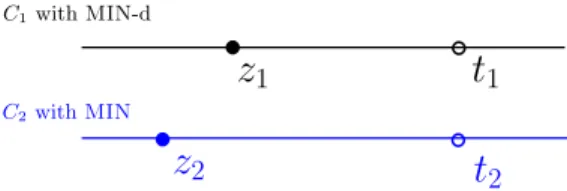
z1, the blockh1 is fetched intoC1 andv1 is the victim block. The time t1 is the first occurance of v1 (inS) after z1. The numbersz2 and t2 are defined similarly on C2. Note thatz1≥z2, butt1 may be smaller thant2.
Leth1 be the block being requested (inS) at timez1, andv1be the victim block (in C1) replaced by MIN-d at the same time. Let h2 be the block being requested at time z2, and v2 be the victim block (in C2) replaced by MIN at the same time. Lett1=seq(z1, v1) andt2=seq(z2, v2). See Figure 2.
For simplicity, we focus on the cases when t1 6=∞ and t2 6= ∞, and omit the other cases (when t1 =∞ or t2 =∞) since they are similar. Consider the difference betweenHSi(C1) andHSi+1(C1). It is easy to see thatz1is the earliest time inHSi(C1), and it is not inHSi+1(C1). Also note thatt1is inHSi+1(C1) but not inHSi(C1). All other elements inHSi(C1) remains unchanged inHSi+1(C1). Therefore, it holds that
HSi+1(C1) =HSi(C1)−z1+t1. (1)
Similarly, we have
1. t1≥t2. By Claim 1 (i), we haveHSi(C1)−z1≺HSi(C2)−z2, sincez1andz2 are the earliest times inHSi(C1) and HSi(C1), respectively. Now, by Claim 1 (ii), it is easy to verifyHSi+1(C1)≺HSi+1(C2), sincet2≤t1.
2. t1< t2. We need to show that|HSi+1(C2)∩[1, x]| ≥ |HSi+1(C1)∩[1, x]|, for
any integerx≥1.
(i)x≤z1. We haveHSi+1(C1)∩[1, x] =∅(recall thatz1is the earliest time inHSi(C1), which implies that the earliest time inHSi+1(C1) is larger than
z1). The claim trivially follows.
(ii)z1< x < t1. Note that z2≤z1 andt1 < t2. By Eq. (1) and Eq. (2), we
have |HSi+1(C1)∩[1, x]| =|HSi(C1)∩[1, x]| −1 and |HSi+1(C2)∩[1, x]|=
|HSi(C2)∩[1, x]| −1. The claim immediately follows, by the induction hy-pothesis|HSi(C1)∩[1, x]| ≤ |HSi(C2)∩[1, x]|.
(iii)x≥t1. Note thatHSi+1(C1)∩[1, z1] =∅ and HSi+1(C2)∩[1, z2] =∅, by similar arguments to (i). As such, it suffices to prove
|HSi+1(C1)∩[z1+ 1, x]| ≤ |HSi+1(C2)∩[z2+ 1, x]|. (3)
LetB1be the set of distinct blocks inS[z1+ 1, x], andR1⊆B1be the set of distinct blocks inS[z1+ 1, x] that are incfgi+1(C1). Similarly, letB2be the set of distinct blocks inS[z2+1, x], andR2⊆B2be the set of distinct blocks in S[z2+ 1, x] that are incfgi+1(C2). Now, notice that the LHS of Eq. (3) is the number of distinct blocks inS[z1+ 1, x] that are not in cfgi+1(C1), which is equal to|B1|−|R1|, and the RHS of Eq. (3) is the number of distinct blocks inS[z2+ 1, x] that are not incfgi+1(C2), which is equal to|B2| − |R2|. Therefore, we need to prove that
|B1| − |R1| ≤ |B2| − |R2|.
By theMIN-d algorithm,v1is one of thed+1 furthest block to be requested
at time z1. Therefore, |R1| ≥ |C1| −(d+ 1) = |C2|. On the other hand,
|R2| ≤ |C2|. It follows that |R1| ≥ |R2|. Furthermore, by the definition,
B1 ⊆B2, since z1 ≥z2. This implies that |B1| ≤ |B2|. It thus follows that
|B1| − |R1| ≤ |B2| − |R2|, as required.
⊓ ⊔
The following corollary is straightforward:
Corollary 1. Let S be a request sequence, C1 and C2 be two caches such at
|C1|=|C2|+d+1andcfg0(C1)⊇cfg0(C2). It holds thattf(MIN-d,cfg(C1), S)<=
tf(MIN,cfg(C2), S).
Due to the limit of space for presentation, we omit the proofs of the following lemma and theorem. Details can be found in [9].
Lemma 2. LetS be a given request sequence andC1andC2 be two caches such
that |C1|=|C2|+ 1and cfg(C1)⊇cfg(C2). The number of fetches by MIN on
C2 is at mostn/|C2| larger than the number of fetches by MINonC1. That is,
Input: request sequenceS and initial cache configurationcfg(C). foreach requestr inS do
ifr /∈cfg(C)then
Letb∈cfg(C) be the resident block having the smallest Cod value cost(b)
fwd(b)
in current cache configurationcfg(C). If there is a tie, choosebas the one with the largest forward distance. Replace band read blockr.
Updatecfg(C) and the forward distances of resident cache blocks. Fig. 3.MIN-cod Algorithm
The following theorem follows from Corollary 1 and Lemma 2.
Theorem 1. Let S be a request sequence of length n andC be a cache of size
k. We have tf(MIN-d,cfg(C), S)≤tf(MIN,cfg(C), S) +nln k−1
k−d−1, namely, the
MIN-d algorithm performs at mostnln k−1
k−d−1 more fetches than MIN.
3.2 MIN-cod Algorithm
TheMIN-d algorithm takes block cost into consideration for replacement
deci-sions without significantly increasing the number of misses. However, it is con-servative in nature as the scope of the candidate victim blocks is small (d+ 1 furthest blocks). In reality, it is possible that some blocks to be accessed recently are much cheaper than the d+ 1 furthest blocks such that evicting those near blocks to keep those expensive blocks despite of more misses is still beneficial. Obviously,MIN-d cannot make efficient decisions in these cases, thus its
perfor-mance is limited, especially when the cost differences among the blocks are large. Therefore, we propose an algorithm that more aggressively pursues an optimal trade-off between the number of evictions and block costs by considering every block as a potential replacement candidate.
As described in Figure 3, the algorithm MIN-cod makes replacement decisions based on the ratio of the cost over forward distance (Cod) among all the resident blocks in cache. If two blocks have the same ratio, the block with a larger forward distance is chosen. Clearly, if a block has the minimal cost among all resident blocks and is the furthest block, MIN-cod will replace it upon a miss, which is necessary for OPT too. However, if one block has a smaller cost and a shorter
forward distance than another block, then it is unclear which one is a better victim block to reduce the total cost. Note that the number of evictions for keeping a block is closely related with its forward distance. Assuming keeping a block is beneficial, then it must not be evicted before its next request, otherwise the sooner it is evicted the better so as to save space for other blocks. Since the space for this block is occupied from the current request to the block’s next request, keeping a block can be viewed as effectively reducing the cache size by one during this period. Based on the reasoning of Lemma 2, it is not difficult to know that the upper bound of extra misses caused for keeping this block in comparison to keeping a nearer block is roughly in proportion to its forward distance. Therefore, thecost/f wdessentially represents the minimal average cost
savings per extra miss. The Cod heuristic chooses to replace the furthest block that generates the smallest saving.
The Running Times of MIN-d and MIN-cod A naive implementation of
MIN-d and MIN-cod, on each request, scans the resident blocks in cache to find
the victim and update fwdvalues. Therefore, the total execution times of both algorithms areO(nk).
There are two observations that can lead to a faster implementation for
MIN-d, which uses only O(nlogk) time. First,MIN-d only requires to maintain the
relativeforward distances among the blocks to choose victims from. Second, after
serving a new request, the cache configuration changes by only one element, and at most one resident cache block changes its relative forward distance. Therefore, if we use a priority queue to maintain the (relative) forward distances of resident blocks, we only need logk time for processing each request, resulting a total running time ofO(nlogk).
In real systems, the number of different fetch costs of blocks is relatively small, because only a limited number of different storage devices and levels exist in a system. Therefore, by keeping the resident blocks in binary trees of different costs, MIN-cod only needs to compare the blocks of the largest (relative) forward distance within each tree to find the right victim, whose total execution steps are in proportion to the number of different trees, thus can be considered as
O(1). Since the maintenance of each binary tree needsO(logk) time, the overall running time is bounded byO(nlogk), which is much faster thanOPT.
3.3 An On-line Algorithm HD-cod
The off-line algorithms assume complete knowledge of future requests, which is not always realistic in practice. In this section, we present HD-cod, an on-line algorithm based on MIN-cod.
In on-line algorithms, we can only estimate the forward distance of a resident block. To this end, we use therecencyof a resident cache blockbas the estimated forward distance of b. (Recency is a concept borrowed from the well-known LRU replacement algorithm.) More specifically, the recency ofbis the difference between its current request sequence number and the request sequence number of the last request ofb.
It is widely recognized that the LRU replacement algorithm, which estimates the forward distance of a block by its recency, works well for most workloads with strong temporal locality. However, it performs poorly for workloads with weak locality such as those with looping or random access patterns, where a recent access of a block does not indicate its re-access is near. These observa-tions suggest that different consideraobserva-tions of forward distance can be used when evaluating Cod value of each block for the choice of replacement victims.
In HD-cod, we use cost
f wdα to evaluate each block, whereα is a workload
de-pendent parameter in [0,1]. For workloads with LRU-like temporal locality,α
Cod heuristic is appropriate. For non-LRU-like workload, α approaches 0 be-cause the estimation of forward distance is inaccurate and the forward distance becomes less relevant, so that the replacement decision can be more dependent on the cost.
To determine the workload type, HD-cod maintains an LRU queue (ordered by recency) for all the resident blocks. It divides the queue into multiple con-tiguous regions of a fixed size, which is a system run-time parameter and usually small. HD-cod traces the hit count in each recency region to generate the hit density curve of the workloads, so that αcan be set dynamically based on the locality feature. Therefore the algorithm is called Hit Density(HD)-cod. On each replacement decision, HD-cod walks through the regions to calculate α. (More details can be found in [9]). Since HD-cod maintains each queue using LRU order whose overhead is very small, its time complexity isO(n).
4
Evaluation
Methodology: We evaluate our proposed algorithms through trace-driven
simu-lation. We compare the performance of our proposed algorithms with the op-timal off-line algorithm OPT, representative non-cost-aware algorithms includ-ing MIN, Least Recently Used (LRU), Most Recently Used (MRU), Most Fre-quently Used (LFU) as well as cost-aware algorithms including Landlord and Minimal Cost First (MCF). Landlord is an optimal on-line cost-aware caching algorithm [10, 6]. Upon each replacement, it chooses the block with the minimal residual cost as victim, and decreases each resident block’s residual cost by this minimal value. Then upon each hit, the block’s residual cost is updated by a value that is between current value and its original cost. It is proved in [6] that Landlord is a k-competitive algorithm, hence an optimal on-line replacement algorithm. It is also a generalization of the GreedyDual algorithm [11], which is studied in WWW-proxy cache management.
The traces used in our experiments are production storage I/O traces from Storage Performance Council (SPC) [5] – a vendor-neutral standards body. They include both OLTP application I/O and search engine I/O. The OLTP traces are with strong temporal locality, i.e. repeated accesses to the same block, if any, are usually separated by a small (compared with cache size in blocks) count of accesses to other blocks. And the OLTP traces also include a significant portions of concurrent sequential accesses due to both the nature of server workloads and OLTP itself. The search engine traces comprise mostly random accesses, which are mostly non-sequential accesses with weak temporal locality, i.e. repeated accesses to the same block, if any, are usually separated by a large (compared with cache size in blocks) count of accesses to other blocks. Due to the resource-intensive nature of the OPT algorithm, which makes replaying the complete trace computationally intractable on our system, we split an entire trace into smaller traces by the ASU (Application Specific Unit) field of each request, so that logically related requests are grouped in the same trace file. We randomly generate the cost for each block based on two cost distributions. One cost
dis-tribution spans a wide range with differences as large as 70,000 times, the other spans a small range with differences at most 3 times. Specific values used and their distributions can be found in [9].
0 1 2 3 4 5 6 7 8 9
OLTP1 OLTP2 OLTP3
P e rf o rm a n ce R a ti o o ve r O P T LRU LFU MRU MIN MCF LANDLORD MIN-d MIN-cod 0 1 2 3 4 5 6 7
OLTP1 OLTP2 OLTP3
P e rf o rm a n ce R a ti o o ve r O P T LRU LFU MRU MIN MCF LANDLORD MIN-d MIN-cod 24.32 16.22
(a)Small Cost Distribution (b)Large Cost Distribution
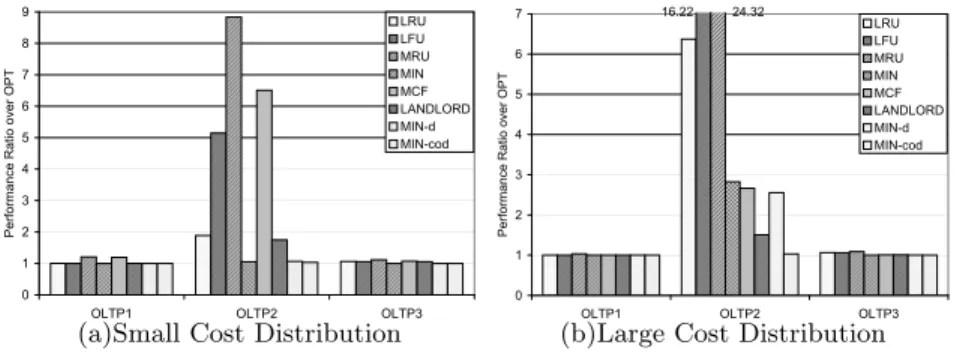
Fig. 4.Total cost comparison of three workloads between OPT and different algorithms
Impact of Cost-Aware Replacement: We compare OPT with both existing and
our proposed replacement algorithms to evaluate the impact of weighted cache on replacement performance. In this experiment, we set one eighth of the working set size as the cache size.
Figure 4 shows the performance ratio of various algorithms over OPT for three small workloads using two different cost distributions. Overall, a signifi-cant performance degradation is observed using non-cost-aware replacement al-gorithms. For example, the optimal non-cost-aware algorithm MIN is 182% worse than OPT for OLTP2 using large cost distribution, so is LRU 537% worse. In contrast, the cost-aware algorithms including Landlord, MIN-d, and MIN-cod perform better almost in all these cases. The only exception is for the small cost distribution, MIN performs closer to OPT than Landlord, since in these scenarios, miss count is more important in the trade-off for overall performance. The results also show that the extent of the performance degradation is related with the workload itself. As we can see, OLTP2 is much more sensitive to the cost-awareness of the algorithms than the other two, because the other two traces have very few reused blocks.
Miss Rate of MIN-d: We measure the miss rate of both OLTP and WebSearch
workloads. The OLTP workload has a working set of around 300Kblocks, while the WebSearch workload has a working set of around 480K. The results show that the miss rate does not increase noticeably untildis larger than 6% of the cache size. Based on this empirically result, in the following experiments, we set
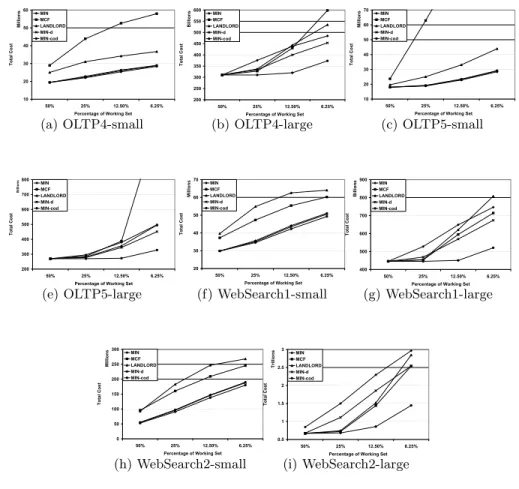
Off-line Algorithm Results: Figure 5 shows the experiment results comparing off-line algorithms (MIN-dand MIN-cod) with existing off-line algorithm MIN. We also include the comparison with on-line algorithms: MCF and Landlord for two reasons: a) MIN and MCF represent two ends on the trade-off between miss count and cost. MIN considers only misses in replacement decisions, while MCF considers only costr; b)since Landlord is the state-of-the-art cost aware replacement algorithm, the inclusion of it gives us an idea on the benefit of complete request knowledge to variable-cost cache replacement.
Overall, MIN-cod consistently performs the best for all workloads. It reduces up to 62% of the total cost ofMINand up to 50% of Landlord. Other algorithms
perform differently depending on the workloads. For example, as expected,
MIN-dperforms close to MIN-cod for the small cost distribution; however it is signifi-cantly worse than MIN-cod for the large distribution due to its scope limitation of victim candidates. Compared with Landlord, MCF performs poorly for the OLTP workloads, while it performs better for the Websearch workloads. Using the lower bound measured, it also shows that when the cache size is 50% of the workload, in seven out of the eight cases MIN-cod performs the same as OPT, while for one of the WebSearch workloads, MIN-cod has a total cost 20% larger than the lower bound of OPT. In all cases, using the bound reported, we can guarantee that MIN-cod’s performance is at most four times of optimal.
The above results show that the Cod heuristic works well with all the work-loads tested. Since MIN-cod balances the cost of evicted blocks and the number of misses the replacement decision can cause, it is effective for a cost-aware replacement algorithm.
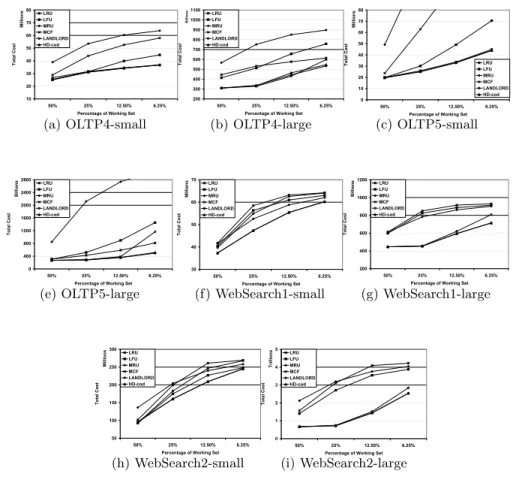
On-line Algorithm Results Figure 6 compares HD-cod with online algorithms:
LRU, LFU, MRU, MCF, and Landlord. Overall, HD-cod performs very close to the best algorithm in each test scenario. Specifically, for the OLTP workload, HD-cod performs comparably as Landlord, yet reduces up to 68% of the total cost of MCF; for the WebSearch workload, HD-cod performs similarly as MCF, yet reduces up to 15% of the total cost of Landlord.
The above results show that for on-line cost-aware replacement algorithms where the forward distance of a block is not known, the balance between the two metrics (cost and forward distance) needs to be conducted adaptively based on the workloads. Since the Landlord algorithm only considers future accesses as with LRU-like locality, it does not perform well for workloads with the non-LRU-like locality. Since HD-cod detects workload characteristics by tracing the hit density, it adapts itself to behave more like MCF when temporal locality is weak and to behave more like Landlord when temporal locality is strong. Therefore, HD-cod performs close to the best algorithm in all test cases.
5
Related Work
Previous work on cost-aware cache replacement includes both theoretical results and system studies. Young [12] studied the weighted caching problem and pro-posed an on-line algorithm – GreedyDual. Cao et al.[11] studied WWW-proxy
10 20 30 40 50 60 50% 25% 12.50% 6.25% M il li o n s
Percentage of Working Set
T o ta l C o s t MIN MCF LANDLORD MIN-d MIN-cod 200 250 300 350 400 450 500 550 600 50% 25% 12.50% 6.25% B il li o n s
Percentage of Working Set
T o ta l C o s t MIN MCF LANDLORD MIN-d MIN-cod 10 20 30 40 50 60 70 50% 25% 12.50% 6.25% M il li o n s
Percentage of Working Set
T o ta l C o s t MIN MCF LANDLORD MIN-d MIN-cod
(a) OLTP4-small (b) OLTP4-large (c) OLTP5-small
200 300 400 500 600 700 800 50% 25% 12.50% 6.25% B il li o n s
Percentage of Working Set
T o ta l C o s t MIN MCF LANDLORD MIN-d MIN-cod 20 30 40 50 60 70 50% 25% 12.50% 6.25% M il li o n s
Percentage of Working Set
T o ta l C o s t MIN MCF LANDLORD MIN-d MIN-cod 400 500 600 700 800 900 50% 25% 12.50% 6.25% B il li o n s
Percentage of Working Set
T o ta l C o s t MIN MCF LANDLORD MIN-d MIN-cod
(e) OLTP5-large (f) WebSearch1-small (g) WebSearch1-large
0 50 100 150 200 250 300 50% 25% 12.50% 6.25% M il li o n s
Percentage of Working Set
T o ta l C o s t MIN MCF LANDLORD MIN-d MIN-cod 0.5 1 1.5 2 2.5 3 50% 25% 12.50% 6.25% T ri ll io n s
Percentage of Working Set
T o ta l C o s t MIN MCF LANDLORD MIN-d MIN-cod
(h) WebSearch2-small (i) WebSearch2-large
Fig. 5.Comparison of off-line cost aware algorithms using different cache sizes
caching and proposed GreedyDual-size to incorporate file size into replacement decision. Landlord [6] is a generalization of both GreedyDual and GreedyDual-size. Chrobak et al. [7] proposed on-line algorithms: Rotate and Balance. All these algorithms are proved to be k-competitive, thus theoretically optimal. GreedyDual-size has also been demonstrated to be effective experimentally us-ing simulation experiments on Web proxy traces. Although competitive analysis provides a bound for approximation algorithms, the bound is usually too loose to be attractive. For example,kin the above results is the cache size in blocks, which is at the magnitude of millions with current technology; and it keeps in-creasing as the technology evolves. Although experimental results are provided to demonstrate the effective of GreedyDual-size [3], it focuses on the variance of document size rather than the access cost of uniform-sized block in storage system. Therefore, they compare with popular replacement algorithms such as LRU, LFU and other size-aware algorithms. Forneyet al.[10] studied
partition-10 20 30 40 50 60 70 80 50% 25% 12.50% 6.25% M il li o n s
Percentage of Working Set
T o ta l C o s t LRU LFU MRU MCF LANDLORD HD-cod 200 300 400 500 600 700 800 900 1000 1100 50% 25% 12.50% 6.25% B il li o n s
Percentage of Working Set
T o ta l C o s t LRU LFU MRU MCF LANDLORD HD-cod 0 10 20 30 40 50 60 70 80 50% 25% 12.50% 6.25% M il li o n s
Percentage of Working Set
T o ta l C o s t LRU LFU MRU MCF LANDLORD HD-cod
(a) OLTP4-small (b) OLTP4-large (c) OLTP5-small
0 400 800 1200 1600 2000 2400 2800 50% 25% 12.50% 6.25% B il li o n s
Percentage of Working Set
T o ta l C o s t LRU LFU MRU MCF LANDLORD HD-cod 30 40 50 60 70 50% 25% 12.50% 6.25% M il li o n s
Percentage of Working Set
T o ta l C o s t LRU LFU MRU MCF LANDLORD HD-cod 200 400 600 800 1000 1200 50% 25% 12.50% 6.25% B il li o n s
Percentage of Working Set
T o ta l C o s t LRU LFU MRU MCF LANDLORD HD-cod
(e) OLTP5-large (f) WebSearch1-small (g) WebSearch1-large
50 100 150 200 250 300 50% 25% 12.50% 6.25% M il li o n s
Percentage of Working Set
T o ta l C o s t LRU LFU MRU MCF LANDLORD HD-cod 0 1 2 3 4 5 50% 25% 12.50% 6.25% T ri ll io n s
Percentage of Working Set
T o ta l C o s t LRU LFU MRU MCF LANDLORD HD-cod
(h) WebSearch2-small (i) WebSearch2-large
Fig. 6.Comparison of on-line cost aware algorithms using different cache sizes
based cache management scheme for heterogeneous storage devices and proposed to use equal device wait time as a metric for dynamic cache allocation, which is orthogonal to our studies.
Compared with previous work, our work demonstrates that the upper-bound of performance degradation of any replacement algorithm over OPT can be determined by keeping track of the costs of evicted blocks, which is more practical and meaningful than the k-competitive result. We also point out that the key design issue for efficient cost-aware replacement algorithms is to make an effective trade-off between victim blocks’ cost and the total number of evictions. Our Cod heuristic which is based on the principle is demonstrated to outperform previous cost-aware and cost-unaware algorithms in real storage server traces simulations.
6
Conclusions
We have proposed both off-line and on-line algorithms that have performance comparable to the optimal replacement algorithm (OPT) measured by the total cost, yet are much faster to run in practice. The algorithms’ design is guided by the following findings of ours. The performance of any replacement algorithm is deviated from OPT by at most the cost of evicted blocks, such that the key to design cost-aware replacement algorithm is to trade-off the number of evictions and the cost of victim blocks. Our work provides analytical bases for buffer cache management in distributed storage systems. We will further understand the implications of our study in our experimental system research.
References
1. Jiang, S., Zhang, X.: Making LRU friendly to weak locality workloads: A novel re-placement algorithm to improve buffer cache performance. IEEE Trans. on Comp. 54(8) (2005) 939–952
2. Cormen, T.H., Leiserson, C.E., Rivest, R.L., Stein, C.: Introduction to Algorithms. The MIT Press (2001)
3. Goldberg, A.V.: An efficient implementation of a scaling minimum-cost flow algo-rithm. J. Algorithms22(1) (1997) 1–29
4. Belady, L.: A study of replacement algorithms for virtual storage computers. IBM Sys. J.5(1966) 78–101
5. Storage Performance Council: SPC I/O Traces. Available at http://www.storageperformance.org.
6. Young, N.E.: On-line file caching. In: Proc. 9th Annu. ACM-SIAM sympos. Dis-crete algorithms. (1998) 82–86
7. Chrobak, M., Karloff, H., Payne, T., Vishwanathan, S.: New results on server problems. SIAM J. Discret. Math.4(2) (1991) 172–181
8. Patterson, D.A., Hennessy, J.L.: Computer architecture: a quantitative approach. Morgan Kaufmann Publishers Inc. (1990)
9. Liang, S., Zhang, X., Jiang, S.: Cost-aware caching algorithms for distributed storage servers. Technical Report OSU-CISRC-3/07-TR23 (2007)
10. Forney, B., Arpaci-Dusseau, A.C., Arpaci-Dusseau, R.H.: Storage-aware caching: Revisiting caching for heterogeneous storage systems. In: Proc. 1st USENIX Sym-pos. File and Storage Tech. (2002) 61–74
11. Cao, P., Irani, S.: Cost-aware WWW proxy caching algorithms. In: Proc. 1997 Usenix Sympos. on Internet Tech. Sys. (1997)
12. Young, N.E.: The k-server dual and loose competitiveness for paging. Algorithmica 11(6) (1994) 525–541