Islamic University of Gaza
High Studies Deanery
Faculty of Commerce
Business Administration Department
The Role of Marketing Information System
Technology in the Decision Making Process
Case Study: The Banking Sector in Gaza Strip
Prepared by:
Mohammed Yousef Bahloul
Supervised by:
Dr. Rushdy Abd El-Latief Wady
Thesis Submitted in Partial Fulfillment of the Requirements for the
Master Degree in Business Administration
1433
ـه
-2011
م
اًمْلِع يِنْدِز ِّبَّر لُقَو
:وط[
114
]
Dedication
I would like to take this opportunity to dedicate
this research to my father soul, whose love and
support encouraged me throughout life.
May the All-Mighty Allah Bless his soul
To
my beloved mother whose love has been with
me all my life.
To
my beloved wife and children
(Raghad, Mohanned, Yousef)
Who has been patient and supportive throughout
my study.
Acknowledgment
First, all praises and glory are due to Allah the all mighty for all
the bounty and support granted to me to complete this MBA
research. This work could not been have done without God's
endless guidance and support.
I would like to express my deepest appreciation to Dr. Rushdy A.
Wady for providing me with excellent guidance, generous
supports, and continuous encouragements throughout my Master
studies. His suggestions and comments were of great value in the
research and in writing of this thesis.
My sincere appreciation to Prof. Yousef Ashoor and Dr. Sami
Abu Nasir who accepted to examine the research study.
My sincere appreciation to Dr. Samir Safi who provided me with
valuable advices.
I would also like to thank the Faculty of Commerce for all of their
support and feedback during my Master study.
Last, but not least I would like to express my thanks and
appreciation to all my colleagues, who has been with me during
my MBA degree.
Abstract
The study examines the role of Marketing Information System Technology in the decision making process of the working banks in Gaza Strip. The study population consists of all the banks‘ branches in Gaza Strip and the main management centers in Gaza Strip and the West Bank. The research targets the branch managers, the deputy managers, and the marketing managers of the banks.
The researcher used the descriptive analytical method and utilized both primary and secondary sources for data collection. The researcher retrieved 99 of the 117 distributed questionnaires, forming a recovery percentage of 84.6%.
The research results show that the managers rely on Marketing Information Systems (MkIS) in making their decisions and they trust these decisions, because the banks have reliable technology and Marketing Decision Support Systems (MDSS) that organizes the information gathered from all sources and analyze the data to help the managers in making marketing decisions. Moreover, MkIS components (i.e. internal records, marketing intelligence, marketing research, marketing decision support system, and the new technology) have effects on the decision making process. In addition, the study found a significant relationship between on one hand MkIS and all of the components and on the other hand the decision making process.
The research results also clarify the use of the MkIS tools in collecting information by the banks, where marketing research is widely used in the process of collecting the information, and is useful in the decision making process. Moreover, internal records are the second most used component for gathering information by the banks, where marketing intelligence is used for collecting information about competitors and all external environment members.
The researcher recommends that the banks should train the employees to use the MDSS available in the bank. In addition, the banks should enhance the use of marketing intelligence, increase the budget allocated for marketing research, and get more information from outside sources rather than depending only on internal source of information.
ةساردلا صخمم
:
يف ةمماعلا كونبلا يف رارقلا عنص ةيممع يف ةيقيوستلا تامومعملا مظن ايجولونكت رود ىمع فرعتلا ىلإ ةساردلا فديت ةمماعلا كونبلا يف ةساردلا عمتجم لثمتي ثيح ،نيطسمف يف .نيطسمف يف كونبلا هذيل ةماعلا تارادلإاو ةزغ عاطق لا ريدم نم لك ةساردلا تفديتساو ريدملا بئان ،كنب ’ هذيل ةماعلا ةرادلإا يفظوم ىلإ ةفاضلإاب قيوستلا ريدمو .كونبلا ثيح تامومعملا عمج يف ةيوناثلاو ةيسيئرلا رداصملا نم ددع ىمع دمتعاو يميمحتلا يفصولا جينملا ثحابلا مدختسا يف ةيلولأا رداصملا تمثم ةنابتسا دادرتسا مت ثيح ،ةساردلا هذيل ًاصيصخ تممص 99 ةنابتسا لصأ نم 111 يأ ةبسنب 6..8 .% نلا مىأ نمو ةساردلا اييلإ تصمخ يتلا جئات نأ وى ءاردم نودمتعي كونبلا ةيقيوستلا تامومعملا مظن ايجولونكت ىمع يف ذاختا ارقلا تارارقلا هذيب ءاردملا قثيو ،ر ملا ةيميمحتلا جماربلاو ةمزلالا ايجولونكتلا كمتمت كونبلا نأ ثيح ، ةبسان ةيقيوستلا تارارقلا ذاختإ يف دعاست يتلا . با ،كلذ ىلإ ةفاضلإ تلاجسلا( ةيقيوستلا تامومعملا مظن تانوكم نإف عنص ةيممع ىمع ميم ريثأت ايل )ةيقيوستلا تارارقلا معد مظن ،ةيقيوستلا ثوحبلا ،ةيقيوستلا تارابختسلإا ،ةيمخادلا ةقلاع دوجو ىلإ ةساردلا تصمخ دقو ،رارقلا تاذ عملا ماظن نيب ةيئاصحإ ةللاد ةيج نم وتانوكمو ةيقيوستلا تاموم .ىرخلأا ةيجلا نم رارقلا عنص ةيممع نيبو إ ن تانايبلا عمج يف لولأا ردصملا يى قيوستلا ثوحب نأو ةيمخادلا تلاجسلا يف تامومعممل يناثلا ردصملا يى كونبلا نأو كونبلا كمتمت يميمحت جماربو ةثيدح ايجولونكت بلا ليمحتب موقت يتلا ،ةروطتمو ةديدج ة ةيممع يف دعاستو تاناي رقلا عنص كونبلا نأ نيح يف را ىمع دمتعت تارابختسلاا تانايبلا عمج يف ةيقيوستلا ةيجراخلا ةئيبلاو نيسفمنملا لوح . ثحابلا ايب يصوي يتلا تايصوتلا مىأ نمو نأ يى فظومل ةيبيردت جمارب ريفوت كونبلا تارادإ ىمع مادختسا ىمع ايي ةيقيوستلا تارارقلا معد مظن مادختسا زيزعت كونبلا ىمع بجوتي امك ، تارابختسلاا تامومعملا عمج يف ةيقيوستلا ، ونإف كلذ ىلإ ةفاضلإاب و ،ةيقيوستلا ثوحبلا ةنزاوم ةدايز رداصم نم تامومعملا ىمع لوصحلا كونبلا ىمع بجوتي ةيجراخ رداصممل ةفاضلإاب يمخادلا ة .Table of Content
DEDICATION ... II ACKNOWLEDGMENT ... III ABSTRACT ... IV TABLE OF CONTENT ... VI LIST OF TABLES ... IX LIST OF FIGURES ... XI LIST OF ABBREVIATIONS ... XIICHAPTER ONE INTRODUCTION ... 1
1.1 Introduction ... 2 1.2 Research Problem ... 4 1.3 Research objectives ... 4 1.4 Research hypothesis ... 4 1.5 Research Variables ... 5 1.5.1 Independent variables ... 5 1.5.2 Dependent variable ... 5 1.6 Research Limitations: ... 5 1.7 Key terms ... 6 1.8 Previous Studies ... 6 1.8.1 Local Studies: ... 6 1.8.2 Regional Studies: ... 9 1.8.3 International Studies: ... 11
1.9 Distinction of the Study ... 17
CHAPTER TWO LITERATURE REVIEW ... 19
2.1 Marketing Information System (MkIS) ... 20
2.1.1 Introduction ... 20
2.1.2 Definition ... 20
2.1.3 Benefits and Importance of MkIS ... 21
2.1.4 MkIS Functions ... 24
2.1.5 Types of Marketing Information ... 24
2.1.6 Factors helped in the spread of MkIS ... 25
2.1.7 Difficulties of MkIS ... 25
2.1.8 Designing MkIS ... 25
2.2 Components of MkIS ... 28
2.2.1 Technology ... 28
2.2.2 Internal Records ... 30
2.2.3 Marketing Intelligence ... 35
2.2.4 Market Research ... 40
2.2.5 Marketing Decision Support System (MDSS)... 45
2.3 Decision Making ... 56
2.3.1 Introduction: ... 56
2.3.2 The significance of decision making ... 57
2.3.3 Decision making and problem solving ... 57
2.3.4 Types of Decisions ... 58
2.3.5 Classification of Decision ... 58
2.3.6 Conditions for making decisions ... 60
2.3.7 The decision making process ... 60
2.3.8 Factors affecting the decision making process ... 62
2.4 The Palestinian Banking Sector ... 62
2.4.1 Introduction ... 62
2.4.2 The emergence of the Palestinian banking sector: ... 63
2.4.3 Classification of banks operating in Palestine: ... 63
2.4.4 Distribution of the Palestinian banking sector employees: ... 64
CHAPTER THREE METHODOLOGY ... 65
3.1 Introduction ... 66
3.2 Research Method ... 66
3.3 Research Population ... 66
3.4 The Questionnaire Design ... 67
3.5 Pilot Study ... 68
3.6 Data Measurement ... 68
3.7 Test of Normality: ... 68
3.8 Statistical analysis Tools ... 68
3.9 Validity of Questionnaire ... 69
3.9.1 Internal Validity ... 69
3.9.2 Structure Validity of the Questionnaire ... 76
3.9.3 Reliability of the Research ... 77
3.9.4 Cronbach‘s Coefficient Alpha ... 77
CHAPTER FOUR DATA ANALYSIS AND INTERPRETATION OF THE
STUDY DIMENSIONS ... 80
4.1 Statistical description of the study population ... 81
4.1.1 Age Group ... 81 4.1.2 Gender ... 81 4.1.3 Educational Attainment ... 81 4.1.4 Field of Specialization ... 81 4.1.5 Job Title ... 82 4.1.6 Years of experience ... 82
4.1.7 Years of experience as a manager / deputy ... 83
4.2 Statistical description of the banks traits ... 83
4.2.1 Bank establishment ... 83
4.2.2 Number of employees ... 83
4.2.3 Workplace ... 83
4.2.4 Type of the bank ... 84
4.3 The System Used: ... 84
4.3.1 Field of: The Availability of hardware used in the system ... 84
4.3.2 Field of: The Availability of the Software Components ... 87
4.4 Field of: Internal Records ... 90
4.5 Field of: Marketing Intelligence System ... 92
4.6 Field of: Marketing Research System ... 94
4.7 Field of: Marketing Decision Support System (MDSS) ... 96
4.8 In General: All MkIS Technology components ... 98
4.9 Field of: Decision Making Process ... 99
CHAPTER FIVE CONCLUSIONS & RECOMMENDATIONS ... 121
5.1 Conclusions: ... 122
5.2 Recommendations: ... 124
5.3 Suggestions for future research: ... 125
REFERENCES ... 126
List of Tables
Table No.
Table
Page
No.
Table (2.1) Programmed Vs. Nonprogrammed decisions 59 Table (2.2) Phases of decision making 61
Table (3.1) Study Population 67
Table (3.2) Test of Normality 68
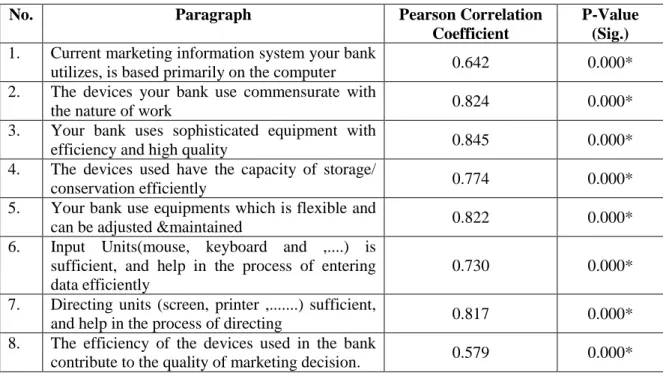
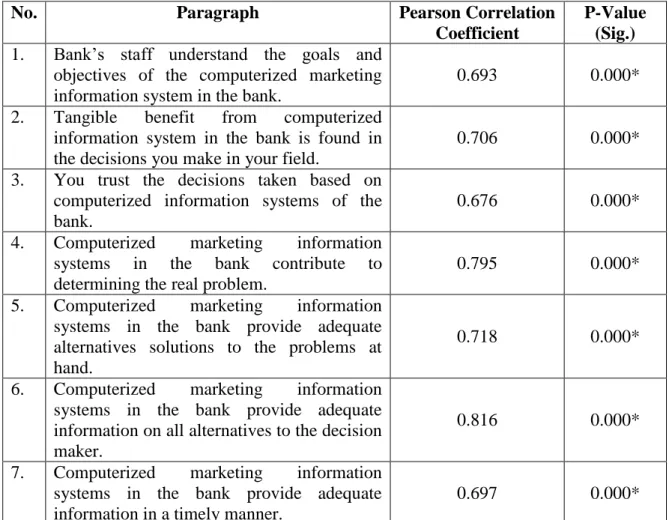
Table (3.3) Correlation coefficient of each paragraph of The Availability of hardware used in the system and the total of this field
70 Table (3.4) Correlation coefficient of each paragraph of The Availability
of the Software Components and the total of this field
71 Table (3.5) Correlation coefficient of each paragraph Internal Records and
the total of this field
72 Table (3.6) Correlation coefficient of each paragraph of Marketing
Intelligence System and the total of this field
73 Table (3.7) Correlation coefficient of each paragraph of Marketing
Research System and the total of this field
74 Table (3.8) Correlation coefficient of each paragraph of Marketing
Decision Support System (MDSS) and the total of this field
75 Table (3.9) Correlation coefficient of each paragraph of Decision Making
Process and the total of this field
76 Table (3.10) Correlation coefficient of each field and the whole of
questionnaire
77 Table (3.11) Cronbach's Alpha for each filed of the questionnaire and the
entire questionnaire
78 Table (3.12) Split Half Method for each field of the questionnaire and the
entire questionnaire
78
Table (4.1) Age Group 81
Table (4.2) Gender 81
Table (4.3) Educational Attainment 81
Table (4.4) Field of Specialization 82
Table (4.5) Job Title 82
Table (4.6) Years of experience 82
Table (4.7) Years of experience as a manager / deputy 83
Table (4.8) Bank establishment 83
Table (4.9) Number Of employees 83
Table (4.10) Workplace 84
Table (4.11) Type of Bank 84
Table (4.12) Bank's names 84
Table (4.13) Means and Test values for ―The Availability of hardware used in the system‖
86 Table (4.14) Means and Test values for ―The Availability of the Software
Components‖
88 Table (4.15) Means and Test values for ―Technological part of Marketing
Information System‖
89 Table (4.16) Means and Test values for ―Internal Records‖ 91 Table (4.17) Means and Test values for ―Marketing Intelligence System‖ 93 Table (4.18) Means and Test values for ―Marketing Research System‖ 95
Table No.
Table
Page
No.
Table (4.19) Means and Test values for ―Marketing Decision Support System (MDSS)‖
97 Table (4.20) Means and Test values for ―All MkIS Technology
Components‖
98 Table (4.21) Means and Test values for ―Decision making process‖ 100 Table (4.22) Correlation coefficient between new hardware technology and
the Decision Making Process
101 Table (4.23) Correlation coefficient between New Software technology and
the Decision Making Process
102 Table (4.24) Correlation coefficient between New technology (Hardware,
Software) and the Decision Making Process
103 Table (4.25) Correlation coefficient between Internal Records and the
Decision Making Process
103 Table (4.26) Correlation coefficient between Marketing Intelligence and
the Decision Making Process
104 Table (4.27) Correlation coefficient between Marketing Research and the
Decision Making Process
105 Table (4.28) Correlation coefficient between Marketing Decision Support
System and the Decision Making Process
105 Table (4.29) Correlation coefficient between Marketing Information
Systems Technology and the decision making processes in the banking sector in Palestine
106
Table (4.30) Independent Samples-Test of the fields and their p-values for each field for Age
108 Table (4.31) Independent Samples-Test of the fields and their p-values for
each field for Gender
109 Table (4.32) ANOVA test of the fields and their p-values for Educational
Attainment
110 Table (4.33) ANOVA test of the fields and their p-values for Field of
Specialization
111 Table (4.34) Mean for each field of Field of Specialization 112 Table (4.35) ANOVA test of the fields and their p-values for Job Title 112 Table (4.36) ANOVA test of the fields and their p-values for Years of
experience
113 Table (4.37) Mean for each field of Years of experience 114 Table (4.38) ANOVA test of the fields and their p-values for Years of
experience as a manager / deputy
115 Table (4.39) Mean for each field of Years of experience as a manager /
deputy
115 Table (4.40) Independent Samples-Test of the fields and their p-values for
each field for Bank establishment
117 Table (4.41) ANOVA test of the fields and their p-values for Number of
employees
118 Table (4.42) Independent Samples-Test of the fields and their p-values for
each field for Workplace
119 Table (4.43) Independent Samples-Test of the fields and their p-values for
each field for Type of the bank
List of Figures
Figure No. Figure Page No.
Figure (2.1): Role of MkIS 24
Figure (2.2): Shows Kotler model for MkIS 26
Figure (2.3): elements of MkIS 27
Figure (2.4): Albaum and Duerr MkIS model 27 Figure (2.5): Information Technology Components 29 Figure (2.6): Pride and Ferrell Marketing Research Process 41 Figure (2.7): Kotler Marketing Research Process 41
Figure (2.8): Data Sources 43
Figure (2.9): Relationship between marketing research and marketing management
45
Figure (2.10): Components of DSS 48 Figure (2.11): DSS Characteristics 50 Figure (2.12): Programmed Vs. Nonprogrammed decisions 60
List of Abbreviations
MkIS
Marketing Information System
IMkIS
Intelligent Marketing Information System
MI
Marketing Intelligence
DSS
Decision Support System
MDSS
Marketing Decision Support System
PMA
Palestinian Monetary Authority
IS
Information System
IT
Information Technology
1
Chapter One
Introduction
1.1
Introduction
Marketing deals with customers more than any other business function, where building customer relationship based on customer value and satisfaction is the heart of modern marketing (Armstrong and Kotler, 2010). Marketing is defined as ―the process of creating, distributing, promoting, and selling the goods, services, and ideas to facilitate satisfying exchange relationship with customers in a dynamic environment‖ (Pride And Ferrell, 2003).
According to Kotler and Keller (2009), financial success depend on marketing ability, since finance operations, accounting and other functions will not really matter if there is no demand for the company‘s products and services. Moreover, the competition is increasing day by day in the very fast growing global marketing, and marketing is affected by internal and external environment forces (Taey and Alaq, 2009). Due to those changes, marketing management is a necessity which is defined as the art and science of choosing target market, winning customer loyalty, and attracting new customers through creating, delivering, and communicating superior customer value (Kotler and Keller, 2012). Marketing managers have to know what to sell, when to sell and how to sell the goods and services and in-order to do so, the managers have to get certain information to be able to make the right marketing decision. The value of information increases since it becomes one of the most valuable assets in ranking the competitive rivalry of the modern markets. The marketing managers have to make marketing decisions such as service to provide, price of the service, promoting the service and the place to sell the service (McLeod and Schell, 2001). This means that the firms need a systematic organization and development of Marketing Information Systems (MkIS) which can effectively collect, process and diffuse the necessary information available both to the internal and external levels (Panigyrakis, 2006). MkIS have been seen as a support system for the firms' marketing management with its decision making process; in addition, to the management perspective, marketing information system can be an essential tool for the entire market organization. Kotler and Keller (2012), defines the Marketing Information Systems as ―an interacting structure of people, equipment and procedures to gather sort, analyze, evaluate and distribute, timely and accurate information for use by marketing decision makers to improve their marketing planning, implementation, and control". An efficient MkIS captures the status of and the relevant changes in the marketplace while simultaneously ridding the reporting environment of redundant information‖(O‘Brien et al, 1995).
MkIS help in analyzing product features with customer data, evaluating channel and pricing options, creating and testing promotion plans, gaining instant feedback on concepts and plans, and moving marketing plans rapidly into production (Harmon, 2003). Kotler and Keller (2012) model of a Marketing Information System has four parts, which are Internal records, Marketing Intelligence, Marketing Research, and Marketing Decision Support System (MDSS).
Internal records are the most used information in all the companies around the world such as reports of orders, sales, prices, costs, inventory levels, receivables, payables and so on. When analyzing these data the managers can spot the opportunities and threats facing the firm (Kotler, 2008).
Market intelligence system is a set of procedures and sources used by managers to obtain their everyday information about pertinent developments in the marketing environment (Kotler and Armstrong, 2010). Marketing intelligence is viewed in its totality as a continuing and interacting structure of people, equipment, and procedures to gather, sort, analyze and distribute pertinent, timely and accurate information for use by marketing decision makers to improve their marketing planning, implementation and control.
Kotler (2006) defines marketing research as the systematic design, collection, analysis and reporting of data and findings relevant to a specific marketing situation facing the company. According to Proctor (2005), the marketing research follows certain steps in the procedure to get the desired and accurate results.
Marketing Decision Support System (MDSS) is a set of core applications in the MkIS that provides computer-based tools, models, and techniques to support the marketing decision making process (Kotler, 2006). In the general case, MDSS is optimized for queries of historical data. MDSS data typically are derived from both internal and external market sources.
"Marketing information system technology is IT within the marketing information system (MkIS). The distinction is important as MkIS do not have to contain any IT, they can be completely manually based. In reality most MkIS within financial institutions contain some IT, although the sophistication varies greatly"(Colgate, 1998). However, when using the technology it will be easier to connect all the departments together, at the same time there will be no redundant information. This will lead to better decision making by the firms when faced by either day to day problems, or for a certain problem. According to the above information, all the components of the MkIS have a relation
with the decision making process. The research will concentrate on the use of the MkIS technology in the working banks in Palestine in the decision making process. The banking industry is one of the major industries in Gaza, and there are many different banks working in Palestine nowadays, and the competition is high.
1.2
Research Problem
Since marketing is more than just selling and promoting, marketing information system technology can be useful for the banks, especially large ones in-order to get the firm to higher ranks. Studies about computer-based marketing information systems technology in Gaza has not been done yet. Moreover, we do not know exactly if the banks in Gaza use the marketing information system technology when making decisions.
This study focuses on the role of Marketing Information System Technology in the decision making processes in the working banks in Gaza Strip.
1.3
Research objectives
1. To identify the role of MkIS technology on decision making process..
2. The extent to which the new technology of Marketing Information Systems affects the decision making processes.
3. To assess the role of internal records in the decision making process.
4. To identify the components and outcomes of the marketing intelligence used by the banks and their role on the decision making process.
5. To clarify the sources of information for marketing research, and the marketing research role in the decision making process.
6. To identify the role of MDSS in the decision making process.
7. To assess the role of personal traits on the role of MkIS in the decision making process.
8. To assess the role of organizational traits on the role of MkIS in the decision making process.
1.4
Research hypothesis
1. There is a significant relationship at the level (α ≤ 0.05) between Marketing Information Systems Technology and the decision making processes in the banking sector in Palestine.
a) There is a statistical positive relationship at the level (α ≤ 0.05) between new technology (Hardware, Software) and the decision making process.
b) There is a statistical positive relationship at the level (α ≤ 0.05) between Internal Records and the decision making process.
c) There is a statistical positive relationship at the level (α ≤ 0.05) between Marketing Intelligence and the decision making process.
d) There is a statistical positive relationship at the level (α ≤ 0.05) between Marketing Research and the decision making process.
e) There is a statistical positive relationship at the level (α ≤ 0.05) between Marketing Decision Support System and the decision making process. 2. There are no significant statistical differences at significant level (α=0.05) among
the respondents' answers regarding the Role of Marketing Information Systems Technology in the Decision Making Process due to the personal traits of the executives (Age, Gender, Educational Attainment, Field of Specialization, Job Title, Years of experience, and Years of experience as a manager / deputy).
3. There are no significant statistical differences at significant level (α=0.05) among the respondents' answers regarding the Role of Marketing Information Systems Technology in the Decision Making Process due to the organizational traits (Type of the bank "Branch/Main", Bank establishment, and Number Of employees, and Workplace).
1.5
Research Variables
1.5.1 Independent variables
Internal Records
Marketing intelligence system
Marketing research system
Marketing decision support system (MDSS)
Marketing Information System Technology
1.5.2 Dependent variable
The role of Marketing Information Systems technology in the Decision making processes.
1.6
Research Limitations:
The banks in the west bank were not included due to the closure on Gaza and the geographical barriers to get to the west bank. The main offices were contacted
using the phone and the questionnaire was e-mailed to them, where the branches in the west bank were hard to contact.
1.7
Key terms
Marketing Information systems: Kotler and Keller (2012) defines the Marketing Information Systems as ―an interacting structure of people, equipment and procedures to gather sort, analyze, evaluate and distribute, timely and accurate information for use by marketing decision makers to improve their marketing planning, implementation, and control"
Internal records (Database): An electronic collections of information obtained from data sources within the company (Kotler and Armstrong, 2010).
Marketing Intelligence: Marketing intelligence is systematic collection and analysis of publicly available information about competitors and developments in the marketing environment (Kotler and Armstrong, 2010).
Marketing research: Albaum and Duerr (2008), defined Marketing research as" the systematic and objective search for, and analysis of, information relevant to the identification and solution of any problem relevant to the firm's marketing activity and marketing decision makers".
Marketing Decision Support System: A decision support system for marketing activity. It consists of information technology, marketing data and modeling capabilities that enable the system to provide predicted outcomes from different scenarios and marketing strategies, so answering "what if?" questions (Wikipedia, 2011).
1.8
Previous Studies
This parts consists of previous studies conducted in Palestine, regional countries, and other international countries. The findings in these studies help in understanding the topic, and in the comparison of the findings between them and this study.
1.8.1 Local Studies:
1. (Wady, 2009), ―The Effect of Marketing Information System (MkIS) on the Marketing Performance: Case study on Banking Sector in Gaza Strip‖.
Purpose: Discuss the importance of Marketing Information System (MkIS), and reveals its effect on marketing performance. This study was applied on the banking sector in Gaza Strip.
Methodology: In order to collect the needed data for this research, the researcher chose random sample to rely on questionnaire as an instrument to collect information and recovered (90.0%) of the distributed questionnaires.
Findings: The study revealed that there is significant effect for the availability of hardware and software used in the system on the effectiveness of marketing performance in banking sector in Gaza strip. In addition, the Characteristics of marketing information used in the system of banking sector in Gaza is accurate, flexible and appropriate to the purpose.
The researchers found that effective marketing research and marketing intelligence also reflect positively on the marketing performance of the employees in banking sector in Gaza through predicting, allocating and tracing potential problems.
The researchers found that there are strong correlations between all components of MkIS and the marketing performance of the employees.
2. (Al-Astal, 2009), ―the reality of the application and practice of electronic marketing to banks operating in the Gaza Strip‖.
Purpose: Identify the reality of the application and practice of electronic marketing to banks operating in the Gaza Strip, from the viewpoint of administrative levels. Identify the difficulties facing the bank's employees, and customers.
Methodology: The researcher used the descriptive analytical approach in the research. The researcher used stratified random sampling method and rely on Questionnaire as an instrument to collect information and recovered (91.81%) of the distributed questionnaires.
Findings: There was indeed a follower of electronic marketing to banks operating in the Gaza Strip, from the viewpoint of administrative levels, as well as provide elements of the use of electronic marketing in the form of (the database, confidence and safety, privacy and confidentiality, support of senior management, research and development). There was no statistically significant differences at the level of significance a = 0.05 between the views of respondents attributed to demographic factors such as: (sex, age, qualifications, academic specialization, the Job Title, the average monthly income, the number of years of experience, the duration of the using of the internet).
3. (Arafat, 2007), ―Evaluation of Managerial Requirements Toward Utilization Of Decision Support System (DSS) In Palestinian Ministries (PM) In The Gaza Strip‖. Purpose: Evaluate the managerial requirements toward the utilization of DSS in Palestinian Ministries; the practice has been applied in two ministries (ministry of education and ministry of health).
Methodology: This study uses the descriptive analytical approach. The recovered 141 of the distributed questionnaire forming 94.0% recovery percentage.
Findings:
There is proper awareness of DSS importance in Palestinian ministries management levels that facilitate utilization of DSS and there are significant statistical differences at trends of managers in respect to managerial requirements of DSS due to the age in years, experience and education level at significant level a= 0.05. In addition, there is a need for awareness enhancements for utilized DSS in Palestinian ministries main management domains (Human Resource, Organization Structure, Business Process, Control of Change and Conduct &Commitment domains) and the Conduct and Commitments are moderate at Palestinian ministries in terms of facilitating utilization of DSS.
4. (Ghonaim, 2004), ―the Role of Computerized Management Information Systems (CMIS) in Palestinian Gaza Strip Municipalities (PGSM)‖.
Purpose: Examine on the Role of Computerized Management Information Systems (CMIS) in Palestinian Gaza Strip Municipalities. The study concentrated on exploring the availability extent of CMIS infrastructure and decision making on PGSM in addition to knowing the most important factors that affects the efficiency of CMIS use in decision making.
Methodology: This study uses the descriptive analytical approach. The study population included all 25 municipalities in Gaza Strip, where a special designed questionnaire was designed to collect the primary data, in addition to in-depth interviews with municipalities management personnel.
Findings: The administrators depend on current CMIS as effective system to make decisions, because the information that current system offers are corresponded with decision making requirements and the municipality uses some of CMIS types. In addition, the study revealed the existence of a direct positive relationship between the availability of CMIS infrastructure and the production and use of information needed to
decision making. Finally, the study revealed that there is a direct positive relationship between the existence of CMIS and the production of information needed for decision making.
5. (El-Shantaf, 2000), ―The Role Of Computerized Management Information Systems In The Decision Making Process - A Field Study Of The Commercial Banks Operating In Gaza Strip‖
Purpose: The study aimed to determine the role of computerized Management information systems "CMIS" in the decision making process.
Methodology: The study is conducted upon sixty-one decision makers of three managerial levels (Top, Middle and Executive) in the commercial banks operating in Gaza Strip, The study has comprised thirteen of the commercial banks operating in Gaza, out of a total population of thirty three branches. A questionnaire was used to collect the required data to measure the five main dimensions which determine the efficiency of "CMIS, in addition to personal interviews.
Findings: The findings conclude that 76.92% of the banks have independent MIS department, and the relationship between MIS and decision making is low. In addition, the banks use of new technology is increasing and became more efficient reaching a percentage of 75.0%, where the percentage of the commercial banks operating in Gaza Strip basically dependent on information resulting from "CMIS" on making their decisions has reached 77.45%. Through personal interviews conducted with some persons who work in the commercial banks sector in Gaza Strip, some abstract results were detected of using "CMIS" such as: speeding up of decision making, improving the quality of supervising and controlling, improving services offered to customers, providing new jobs for new specialization's. The "CMIS" aims at providing a variety of services for customers and these services have reached 83.27%.
1.8.2 Regional Studies:
6. (Ismail, 2011), ―The role of Marketing Information System on Decision making: An applied study on Royal Jordanian Air lines (RJA)‖.
Purpose: This study aims at highlighting the significance and importance of utilizing marketing information system (MkIS) on decision-making, by clarifying the need for quick and efficient decision-making due to time saving and preventing of duplication of work.
Methodology: The empirical research method was evaluated by specialized experts, conducted by means of questionnaires, where 170 questionnaires were recovered forming a recovery percentage of 85.0%.
Findings: There are significant relationships between internal records, marketing intelligence, MDSS and decision making in the Royal Jordanian Airlines (RJA). However, the researcher revealed that there is no significant relationship between marketing research and decision making in RJA. The researcher concluded that there is a significant relationship between MkIS and decision making in RJA. The empirical study findings confirmed positive relationships between the level of utilizing and adopting ―decision support system & marketing intelligence‖ and the success of an organizational decision making, and provide the organization with a competitive advantage as it allows the organization to solve problems.
7. (Nasri, 2011), ―Competitive intelligence in Tunisian companies‖.
Purpose: The purpose of this study is to investigate the degree of knowledge of competitive intelligence in Tunisian companies.
Methodology: This exploratory study was conducted using semi-in depth interviews and focus group with six executives in six companies in Tunisia. Three sectors were chosen for this study: communication technologies, manufacturing and commercial retailing. These companies are prevalent in Tunisia and are very different.
Findings: The results show that Tunisian managers are conscious of the importance of competitive intelligence in the management of their companies. Second, managers believe that internal sources of information are more valuable than external sources information and personal source information is deemed most valuable. Third, the results of the process and structure questions indicate that companies may not yet be investing appropriately in building the internal infrastructure required for fully effective intelligence efficacy. Finally, this practice is not organized in a separate department and, if it is mostly done in the marketing department.
8.(Hashim, 2006), ―The role of Marketing Information Systems in improving marketing performance of public shareholding companies of Jordan‖.
Purpose: The aim of the study is to identify the role of MkIS in improving the marketing performance of public shareholding companies of Jordan.
Methodology: This study uses the descriptive analytical approach. The study population included marketing managers of 194 Jordanian companies listed in Amman
stock exchange divided into four groups (Industry, Services, Insurance and Banks). The researcher recovered 77.5% of the distributed questionnaires designed for the study.
Findings: The researcher concluded the findings for all four groups, and he found that all companies use the components of MkIS with high grade, and also concluded that the banking industry and the Insurance industry are updating their technology more often than others. The study also reveals that internal records are the most dependent on component of MkIS for gathering information. The main findings were that there is a correlation between the availability of MkIS and the improvement of marketing performance, and there are significant relationships between marketing intelligence and marketing research in setting the companies‘ strategic goals.
1.8.3 International Studies:
9.(Ahlstedt, 2007),"Implementation of an IT based Marketing information system in a high tech company".
Purpose: "The aim of this thesis has been to try to answer the question of how an IT based marketing information system support the formation of business and product related strategies and when and how such a system should be integrated in a company.
Methodology: Analytical meta-study of published literature condensed through a SWOT analysis and combined with a qualitative evaluation of questionnaires directed to companies with experience of developing and implementing marketing information systems.
Findings: Company size and market volatility decides the time of implementation of a marketing information system. Implementation should be initiated top-down in order to secure full organizational inertia. The approach should be holistic and tailor-made for each specific organization. Users should fully integrated in development and implementation.
10. (Gounaris et al, 2007), "Measuring the effectiveness of marketing information systems. An empirically validated instrument".
Purpose: The purpose of the study is to design and empirically validate an instrument for measuring the effectiveness of a marketing intelligence system.
Methodology: A thorough review of the literature of IS in general and MkIS in particular was the foundation for a new conceptualization of MkIS effectiveness, which was developed into a measuring instrument for experimental application to data collected by a pre-tested postal questionnaire from 254 five-star hotels in Greece.
Findings: The effectiveness of MkIS is found to comprise both internal and external components, related on the one hand to the extent to which the user organization
improves functional effectiveness and corporate climate and on the other hand to its adaptability to market conditions and its customer responsiveness.
11. (Ganeshasundaram and Henley, 2007) "―Decision research” correlates directly with better business performance".
Purpose: Proceeding from the widely accepted but relatively untested premise that the gathering of intelligence via market research is central to business success, this paper reports a study investigating the extent to which the type of research carried out influences the level of business performance.
Methodology: Firm size and the market research budget were taken into account as potential confounding variables. ANOVA, MANOVA and factor analysis were applied to data gathered from responses to a questionnaire developed by Diamantopoulos and Souchon, appropriately modified to the specific conditions of this study.
Findings: Companies carrying out mostly ―decision research‖ rated themselves as performing generally better than those placing more emphasis on ―background research‖ regardless of the size of the firm or it‘s market research budget. They scored highly on return-on-assets, return-on-sales and sales growth, and exhibited positive overall performance. The initial finding was strongly reinforced by factor analysis, 98% of the variation in business performance being explained by the categorization of a company's research as dominantly ―decision‖ ―background‖ or ―mixed‖.
12. (Wood, 2001), ―Marketing Information Systems in Tourism and Hospitality small- and – Medium sized Enterprises: a Study of Internet use for Market Intelligence‖. Purpose: The study investigates the nature of marketing information systems with small- and– medium sized enterprises and focuses on the importance of external information and market intelligence.
Methodology: A survey was chosen as the main method of data collection. The types of companies selected were to cover two main subgroups of tourist attractions and accommodation. These companies were classified as small or medium sized using the DTI classification of less than 250 employees and were independently run. The survey was administered in the form of postal questionnaire. A pilot survey of five companies was undertaken in order to test the appropriateness of the questions, comprehension, relevance, response rates, etc.
Findings: The enterprises make use of informal marketing information systems which mainly concentrate on internal and immediate operating environment data. Important wider marketing intelligence is underutilized owing to the resources constraints of these
smaller businesses, and the MkIS used in the medium sized firms is based largely on internal data.
13. (Li, McLeod, and Rogers, 2001), ―Marketing information systems in Fortune 500 companies: a longitudinal analysis of 1980, 1990, and 2000‖.
Purpose: The aim of this stud is to reveal the pattern in MkIS usage in Fortune 500 companies.
Methodology: The study population in this study consisted of managers of marketing research in Fortune 500 companies listed in the April 1999 issue of Fortune magazine. A four-page questionnaire was sent and recovered only 51 questionnaires, forming a recovery percentage of 10%. The questionnaire was divided into two sections. The first section contained general questions regarding the computer and networking support. The second section contained specific questions relating to the MkIS support.
Findings: This study is the first where the marketing managers reported a decrease in the existence of an MkIS in their firms. Many marketers today are using computers and the Internet. They are more and more knowledgeable about computer technologies and actively taking part in creating computer applications to meet their own information needs. In addition, 96% of the marketing managers have a computer available and 88% use it daily indicates that the computer is a vital part of marketing operations and management. The study revealed that data warehouses and data mining techniques will become essential for marketers to fully utilize their internal data and environmental information.
14. Nelson, R. (1999), ―Bank Marketing and Information Technology: A Historical Analysis of the post-1970 Period‖.
Purpose: Analyzing the bank marketing and information technology in the working bank in the United States, and check the level of alignment between the marketing and information services.
Methodology: Literature review and Semi-structured interviews with the managers at several organizations within the United States retail banking industry were conducted.
Findings: There is a lack of alignment and integration between the marketing and information services in the banks. Improving the communication between the marketing and information systems will lead to better performance by the banks.
15. (Xianzhong, 1999), "The strategic orientation of marketing information systems – an empirical study".
Purpose: The aim of the study is to examine the current practice of the strategic function of marketing, and the application of information systems in supporting the strategic function.
Methodology: The companies selected for conducting this study were drawn from company database by specifying industry as ``computer'' and ``finance''. In total 200 companies with employees over 250 have been selected. Small entrepreneurial firms thus are excluded from the study due to the concern that small sized companies may not commit to strategic activities to a significant extent. A total of 200 questionnaires were mailed to the named addressee which had recovered only 55 of them, where 58.2% of the respondents are either marketing directors, or marketing managers.
Findings: The study reveals that the strategic function of marketing has been perceived important by marketing managers, and many companies perform some of the strategic functions, such as market segmentation/targeting, competition and market analysis. Yet, the application of MkIS does not keep abreast with the current practice of marketing strategic function. Qualitative data generated from the survey suggests that marketing managers view lack of a strategic sense and vision by some marketing managers and professionals, and lack of a strategic marketing culture and organizational support that enable the company to gear towards strategic marketing; in addition to the lack of knowledge, experience and tools to diminish overwhelmed data from the marketing daily operations, and to base the development of strategic oriented marketing information systems as the main barriers that hamper the shift towards strategic oriented marketing and MkIS. Moreover, the size of a company and communication is the biggest barrier to success.
16. (Colgate, 1998), "Creating sustainable competitive advantage through marketing information system technology: a triangulation methodology within the banking industry".
Purpose: This paper hypothesizes that marketing information system technology can leverage this sustainable competitive advantage ahead of other marketing technologies which bank management have implemented or are thinking of implementing. An analysis of the current use of marketing information system technology, however, reveals low levels of sophistication throughout the UK and Irish retail banking
industries. Given this fact, the factors involved in successfully implementing marketing information system technology are presented.
Methodology: Empirical evidence was drawn from 48 postal questionnaires conducted in the UK and Ireland and ten case studies undertaken in the UK, USA and Australasia.
Findings: From the quantitative data it was found that the most successful banks in terms of implementing IT were those banks who had greater responsibility in marketing activities, had a clear vision of what MkIS technology should be used for and where they should be heading in the future, had a strong marketing culture and had available resources to invest into MkIS technology.
17. (Amaravadi et al., 1995), “Intelligent marketing information systems: computerized intelligence for marketing decision making‖.
Purpose: Introduce IMkIS as a decision-making aid for managers.
Methodology: Secondary sources of information used to collect the information needed for the study, and comparison between the authors opinion to come with the final coclusion.
Findings: IMkIS has the potential to address some of the pressing concerns facing marketers today. It could help in analyzing product features with customer data, evaluating channel and pricing options, creating and testing promotion plans, gaining instant feedback on concepts and plans, and moving marketing plans rapidly into production. The knowledge-base component of the Intelligent MkIS enables marketing expertise to be accessed and shared easily. Marketing managers should seriously consider the potential of interfacing artificial intelligence with conventional MkIS in order to have a system that supports their strategic decision making.
18. (Li, 1995), "Marketing information systems in the top U.S. companies: A longitudinal analysis".
Purpose: The purpose of the study is to determine the overall status of MkISs in top U.S. companies.
Methodology: A questionnaire concerning the use of MkIS with instructions for completing it was mailed to the marketing executives of the top 1000 firms listed in a recent issue of Business Week. 138 replies were returned. The questionnaire was pretested twice to determine its format and wording. The final questionnaire was sent to all 1000 executives.
Findings: Of the 138 respondents, 25% said that they did not have a corporate MkIS; however, they all agree that computers are needed by marketing managers, for retrieving data and then storing and processing it.
Internal accounting continues to be the most important source of MkIS information while the use of marketing intelligence and marketing research as information source
are more balanced, where Decision models are used mostly for product and price decisions.
19. (Talvinen, 1995), "information systems in marketing, identifying opportunities for new applications".
Purpose: The purpose of this article is to identify opportunities offered by integrating MkIS with other marketing and management related IS in the company.
Methodology: Analysis were based on a literature review in the context of marketing management and IS in marketing. To make the study feasible, the analysis were limited mainly to traditional, internal IS.
Findings: Information technology has a key role to play in new flexible organization forms such as strategic partnerships and cross-functional networks. While new organizations will be designed around business processes rather than functional hierarchies, we definitely have a need also for new kinds of IS in marketing. In fact, IS will be the cornerstone of a new approach to marketing. Therefore management and systems designers should be better aware of the avenues available to integrate marketing and management processes in new innovative ways.
20. (Talvinen, and Saarinen 1995), ―MkIS support for the marketing management process: perceived improvements for marketing management‖.
Purpose: First, to evaluate which information included in marketing information systems (MkIS) has been important in providing support for the marketing management process. Second, to analyze what improvements in marketing and sales have been realized by implementing MkIS to support the marketing management process. Third, to investigate, in more detail, what operational MkIS sub-systems have contributed to improved effectiveness for implementing and controlling marketing efforts.
Methodology: They conducted a mail survey in Finnish wholesale companies followed by in-depth case studies in two organizations. In the mail survey their unit of analysis was senior marketing management and in the case studies the entire marketing organization.
Findings: The findings of this study indicated that in order to achieve improvements in the fifth step of the marketing management process, i.e. implementing and controlling marketing efforts, an operational MkIS should be used for telemarketing and especially for direct mailing.
21. (Saaksjarvi and Talvinen, 1993), "Integration and effectiveness of Marketing Information Systems".
Purpose: The purpose of the study is to empirically evaluate the impact of integration of MkIS on marketing effectiveness. Also, studying of several parts of the system that could improve effectiveness.
Methodology: The methodology used was by selecting one large organization the detailed and case-oriented study. Two broad principles of case selection by Markus were used.
Findings: Technical integration of marketing systems is needed, since many of the users need several subsystems of the MkIS in their work. This seems to result in a significantly better service level and benefits of the system.
22. (Li et al., 1993), "Marketing information systems in the Fortune 500 Companies: Past, Present, and Future".
Purpose: This study is to examine the attitudes of marketing executives in Fortune 500
firms toward their marketing information systems (MkIS).
Methodology: The population selected is the marketing executives for the fortune 500 companies. A questionnaire was mail to them with questions about the firm's usage of information systems.
Findings: The findings indicated that although 132 firms have returned the questionnaires, only 99 firms indicated they have some forms of MkIS. The responses from the 99 firms were analyzed and compared with those of the two similar earlier surveys on Fortune 500 firms, one in 1972 and the other in 1980. The results of this survey revealed that 35 of the 95 managers (37%) who answered the question regarding the MkIS framework view their MkISs as the data gathering and information producing system known as the framework of the marketing information system. Eighteen managers (19%) see their MkISs as systems intended to help the manager answer key questions, 16 managers (17%) regard their systems as data banks and model banks, and 12 managers (13%) see their systems as primarily helping in the development of marketing programs.
1.9
Distinction of the Study
The findings of the previous studies show that, the organizations around the world are depending more on new technology in processing their operations. MkIS is used widely in all kinds of businesses, and has a great effect on decision making. The studies also show that MkIS popularity is increasing, and the information gathered by the firms is stored in the database, where it can be easily reached when making decisions.
The previous studies concentrates on MkIS in general or at one component of the MkIS only; moreover, studies about the MkIS use in the Palestinian banking sector has not been done, where this study concentrates on the use of each component of the MkIS in the banks, and it shows the level of importance to each component with regard to the MkIS. In addition, the study reveals the use of the MkIS in the banks, and clarifies the sources of information that the banks rely on.
2
Chapter Two
Literature Review
2.1
Marketing Information System (MkIS)
2.1.1 Introduction
There are some firms which lack information sophistication, and others do not have marketing research department, and others do their work on a routine basis. "Without good marketing information, managers have to use intuition or guesses-and in today's fast-changing and competitive markets, this invites failure." (McCarthy and Perreault, 1993). Moreover, there are some managers who complain about the lack of information, getting the information needed late, and getting too much information that they can't use. All the firms around the globe should organize the information and distributed in a timely fashion continuously. The firms have functional information systems that consist of Marketing IS, Manufacturing IS, Finance IS, Human Resource IS, and Information Resource IS (McLeod and Schell, 2001). The firms have to study the manager's needs and design a Marketing Information System that really meets their needs (kotler and Keller, 2012).
Kotler and Armstrong (2010), pointed out that there is no one MkIS that will serve all organizations because of the unique information requirements of different organizations which are composed of sub-systems and they have been built over a long period of time. From the marketing management point of view, MkIS are tools for managing marketing information, marketing research, modeling marketing transactions, decision making in marketing, planning marketing strategy and tactics, budgeting, analyzing different courses of action, and reporting and control(Li, 1995) and (Higby and Farah, 1991). The general system elements for any MkIS include a data acquisition system, database management system, graphical and statistical analysis tools, model base, directories (specific data elements/information classification schemes) and retrieval systems (Amaravadi et al., 1995).
2.1.2 Definition
Marketing Information System (MkIS) was first seen by Cox and Good (1967) as a set of procedures and methods for the regular planned analysis and presentation of information for use in making marketing decisions. The purpose of the earliest marketing systems was to gather, sort, analyze, evaluate and distribute pertinent, timely and accurate information for marketing decision makers to improve their planning, implementation and control (Talvinen, 1995).
Cox (1979), defined MkIS as ―a structured, interacting complex of persons, machines and procedures designed to generate an orderly flow of pertinent information, collected from both intra- and extra-firm sources, for use as the basis for decision making in specified responsibility areas of marketing management.
"An MkIS is an organized set of data that is analyzed through reports and statistical routines and models on an ongoing basis. The data are transformed into information that allows the marketing manager to make better decisions and perform better planning and budgeting"(O‘Brien et al., 1995).
"An MkIS is a computerized system that is designed to provide an organized flow of information to enable and support the marketing activities of an organization", (Harmon, 2003).
All of these descriptions envisioned the MkIS as an information processor, gathering data and information from the marketing environment, processing that data and information, and providing the results to marketing managers in the form of management information. The managers would act on the information and make decisions that affect the environment as well as the firm's operations (Li et al., 1993).
2.1.3 Benefits and Importance of MkIS
One of the very first benefits that a company derives from the use of IT-based MkIS is improvements in the reporting system. Information processing becomes faster and the company‘s management is able to relate pertinent information from different sources within the organization (Van Bruggen et al., 2001). Such information would be almost impossible to bring together in a meaningfully and integrated fashion without the necessary IT infrastructure. The purpose of MkIS applications is to integrate inputs from various organizational functions into a holistic and meaningful map of company‘s activities, depicting its interactions with suppliers, customers, and so on. As a result of doing this in a timely fashion, decision making is enhanced by relying more on facts than gut-feeling and intuition (Van Bruggen et al., 1998; Talvinen and Saarinen, 1995). This is a major prerequisite for developing realistic and successful marketing plans (McDonald and Payne, 2005), which in turn affects both the company‘s marketing planning process and the outcome of this process (Amaravadi et al., 1995; O‘Brien et al., 1995). Such improvements in the marketing planning effort have, among many other consequences, a positive direct effect on marketing operations (Baker, 2001). As companies assimilate the IT-based MkIS, they eventually become capable of
transforming marketing intelligence into concrete benefits for their customers (Brady et al., 2002), which in turn allows them to improve their marketing operations.
MkIS gives the management the opportunity to make better decisions by providing a flow of information continuously, such as prices, advertising expenditures, sales, competition, and distribution expenses (Pride and Ferrell, 1987).
MkIS has been a tool for analyzing both internal and external effectiveness of marketing and for controlling marketing activities and environment. MkIS can be seen as a natural expansion of traditional market research (Heiser et al. , 1987). From the planning point of view, analyzed data in MkIS are used as a basis for planning, but planning itself is done in other systems and often manually (Talvinen, 1995). Implementation and control of these plans is then performed with the help of management and operational MkIS.
The MkIS can enable marketers to collaborate with customers on product designs and requirements.
MkIS systems are designed to be comprehensive and flexible in nature and to integrate with each other functionally. They are formal, forward looking and essential to the organization‘s ability to create competitive advantage. The MkIS is the firm‘s ―window on the world‖ and, increasingly, it is the primary customer interface (Harmon, 2003). An MkIS can support managers in their marketing decision due to the fact that MkIS provide integration between functional departments or divisions (O‘Brien et al., 1995). MkIS plays a major role in the international marketing decisions support system. MkIS involves data collection, data management, data storing and retrieving, processing data into useful information, and disseminating information to people inside the firm who need the information (Albaum and Duerr, 2008).
An MkIS organizes the data that has been available to the firm in order for it to be available when needed. Most of the companies have information processing specialists who are assigned for making standard reports from the available data to help managers make better decisions (Perreault and McCarthy, 1993).
Amaravadi et al. (1995) mentioned, "Intelligent Marketing Information System (IMkIS) has the potential to address some of the pressing concerns facing marketers today. It could help in analyzing product features with customer data, evaluating channel and pricing options, creating and testing promotion plans, gaining instant feedback on concepts and plans, and moving marketing plans rapidly into production".
According to Harmon (2003), the primary benefits of the MkIS can be useful in the areas of functional integration, market monitoring, strategy development, and strategy implementation.
Functional integration: The MkIS enables the coordination of activities within the marketing department and between marketing and other organizational functions.
Market Monitoring: Through the use of market research and marketing intelligence activities the MkIS can enable the identification of emerging market segments, and the monitoring of the market environment for changes in consumer behavior, competitor activities, new technologies, economic conditions and governmental policies.
Strategy Development. The MkIS provides the information necessary to develop marketing strategy. It supports strategy development for new products, product positioning, marketing, pricing, personal selling, distribution, customer service and partnerships and alliances.
Strategy Implementation. The MkIS provides support for product launches, enables the coordination of marketing strategies, and is an integral part of sales force automation (SFA), customer relationship management (CRM), and customer service systems implementations. The MkIS enables decision makers to more effectively manage the sales force as well as customer relationships. There are three roles for the marketing information system according to Assael (1993), which are data collection, analysis, and dissemination. The MkIS must be able to collect relevant data from different sources such as customers, competition, and government. At the mean time, the MkIS must be able to analyze the data, and disseminate the data to the management and the departments in the firm (Assael, 1993). The figure (2.1) explains the role of MkIS:
Figure (2.1): Role of MkIS
Source: Assael, H., 1993, p.210
2.1.4 MkIS Functions
According to Alzabi (2010). the functions of nay MkIS are : 1. Identify information needs.
2. Gathering information from different sources.
3. Data processing and preparing the information for use. 4. Disseminating information to the decision makers. 5. Saving and recording the information.
2.1.5 Types of Marketing Information
A Marketing Information System supplies three types of information (scribd.com, 2011):
1. Recurrent Information: The data that MkIS supplies which includes data such as sales, Market Share, sales call reports, inventory levels, payables, and receivables. which are made available regularly. Information on customer awareness of company‘s brands, advertising campaigns and similar data on close competitors can also be provided.
2. Monitoring Information: The data obtained from regular scanning of certain sources such as trade journals and other publications. Here relevant data from external environment is captured to monitor changes and trends related to marketing situation. Data about competitors can also be part of this category