Counseling Student
Handbook
Introduction
Additional Sources of Information Mission
Description of Programs Program Objectives
Programs of Study
Program of Study Worksheet Faculty/Staff Directory
Department Policies
Current Contact Information
Warner School Student Orientations Diversity Policy
Advisors
Evaluation, Retention and Dismissal Procedures Complaints, Grievances, Petitions
Classroom Etiquette
Professional Development Opportunities Master’s Thesis or Capstone Project Job Placement and Credentials File
Letters of Recommendation and Endorsements Master’s Program Policies
Evaluation, Retention and Dismissal Procedures Fingerprinting
Personal/Professional Development and Counseling Services Master’s Practicum/Internship Policies
Counseling Doctoral Program Policies Progress Reports
Portfolio Examination
Comprehensive Examination
Doctoral Dissertation and Dissertation Research Time Limits
Evaluation, Retention and Dismissal Procedures
Personal/Professional Development and Counseling Services Professional Organizations
Residency Requirement (Ph.D.)
Research Apprenticeship Requirement (Ph.D.) Doctoral Internships
Membership and Licensure Professional Membership Liability Insurance
National Counselors Exam Certification and Licensure School Counselor Certification Mental Health Counseling Licensure Transportability
Counseling Honor Society
Checklist and Timeline-Master’s Students Checklist and Timeline-Doctoral Students Student Sign-off Sheet
INTRODUCTION
Dear New Counseling Student,We are pleased to welcome you to the Counseling and Human Development Department of the Margaret Warner School of Education and Human
Development, and we look forward to working with you. The Counseling and Human Development faculty are committed to making this a positive
educational experience for you as we assist you to achieve your academic and professional goals. As you begin your program, we wish you success and hope that you take full advantage of the opportunities that are provided for you at the Warner School.
As you read through the contents of the handbook, it will quickly become apparent to you that it contains important details concerning key milestones in your academic studies at the Warner School. Thus, it is important to keep this handbook in a place where it can be an easily accessible reference.
Although this handbook provides vital information, initiating personal contact with Warner staff members, professors, and advisors is an equally important way to gain information and advice about your program. To this end, the staff and faculty of the Counseling and Human Development Program encourage you to request help or information in order to meet your personal, educational, and professional needs.
Sincerely,
The Counseling and Human Development Faculty and Staff Note:
The Counseling and Human Development Department requires that all counseling students acknowledge in writing (see Student Sign-off Sheet) that they have read the Counseling Student’s Handbook of the Counselor Education Program and that they agree to abide by the policies, procedures, and ethical standards of the Counselor Education Program and the counseling profession. The Warner School reserves the right to make amendments to this handbook and to the rules, requirements and procedures in the Counseling Program at any time. If material changes are made, students will be notified by appropriate means.
ADDITIONAL SOURCES OF INFORMATION
This handbook focuses on the Counseling Program in particular. There is a great deal of other information, including rules and procedures for graduate students, that is provided in other official documents of the Warner School of Education and the University. These are:
• The Warner School’s web site: www.rochester.edu/warner
• University of Rochester’s Regulations and University Policies Concerning Graduate Studies (sometimes called the “red book” – containing pages from the Official Bulletin)
• The University of Rochester’s Official Bulletin—Graduate Studies
You should familiarize yourself with the content of these documents and keep them as ready references throughout your graduate study.
COUNSELING PROGRAM MISSION
The mission of the Counseling Program at the Warner School of Education and Human Development is two-fold:
To educate counselors who will empower their clients and students to create more rewarding and meaningful lives and relationships; become more self-reflective, caring and compassionate persons; and contribute to reform of the systems in which their lives are imbedded.
To prepare counselor educators, researchers, practitioners and leaders in the counseling profession who will educate the next generation of
counselors to do all of the above; will contribute new knowledge in the fields of counseling, counselor education and human development; and will be leaders in reforming educational and social systems to promote social justice, healthy human development, and quality relationships. This mission is based on a an ecological perspective of professional counseling that acknowledges the importance of personal development, but also
recognizes that individual lives are imbedded in a variety of personal and extended relationships and social systems. Within this perspective, we:
• see human development, counseling and education in a historical, cultural and social context
• work to foster healthy development across the life course and across a diversity of capabilities
• see the integration of biological, psychological and social intervention as an essential foundation for enduring and just human development and change.
• recognize the counselor’s role as an agent of institutional change and social justice as well as personal empowerment
• recognize the diversity of traditions, disciplines, practices and cultures that generate the wealth of counseling resources and welcome difference and innovation
Incorporating the principles of this mission, we provide the following graduate programs:
Master of Science in Counseling and Human Development (with specialization in school counseling) – provides entry-level preparation and New York State
provisional certification for school counselors
Master of Science in Counseling and Human Development (with specialization in school counseling and additional concentration in community counseling) – provides entry-level preparation for counselors who may work in schools (with provisional certification) and qualifies the student for permanent certification in school counseling after two years as a school counselor.
Master of Science in Counseling and Human Development (with specialization in school counseling and additional concentration in disability counseling) –
provides entry-level preparation for counselors who may work in schools (with provisional certification) and qualifies the student for permanent certification in school counseling after the equivalent of two years as a school counselor.
Master of Science in Counseling and Human Development (with specialization in school counseling and additional concentration in diversity counseling) –
provides entry-level preparation for counselors who may work in schools (with provisional certification) and qualifies the student for permanent certification in school counseling after the equivalent of two years as a school counselor.
Master of Science in Counseling and Human Development (with specialization in school counseling and additional concentration in educational leadership) – provides entry-level preparation for counselors who may work in schools (with provisional certification) and qualifies the student for permanent certification in school counseling after the equivalent of two years as a school counselor.
Master of Science in Community Mental Health Counseling – provides entry-level preparation for counselors to become New York State license eligible as mental health counselors. Students graduating from this program are prepared to work in social service agencies, health care settings, child and family service centers, government agencies and other community facilities. Students can choose electives and internships to specialize in gerontological counseling or college counseling, if they so wish. Upon graduation from the program students will be eligible to receive a limited permit that will allow them to amass the 3000 hours of supervised practice required for the state license. Full licensure will be
granted once the student has completed the 3000-hour requirement and has passed the state licensure examination.
Doctor of Education (Ed.D.) in Counseling and Human Development with a Concentration in Counseling – prepares counseling professionals to become
counselor educators, leaders and advanced practitioners in the counseling field. Graduates of this program will typically work to advance personal development and systems change in schools, community agencies, government or higher education. (Accelerated option available.)
Doctor of Education (Ed.D.) in Mental Health Counseling and Supervision – prepares
counseling professionals to become advanced practitioners who will work primarily in agency, medical or university settings, or assume a role in counselor education. This degree allows students, upon completion of the program, to begin the process of applying for a New York State license in Mental Health Counseling. (Accelerated option available.)
Doctor of Philosophy (Ph.D.) with a Concentration in Counselor Education and Human Development – prepares counselor educators, leaders, and researchers
who will work in university settings, educating the next generation of counselors and contributing to new knowledge in the fields of counseling, human development, and counselor education.
Program Demographics
Currently, our student body draws from a regional, national and international base. The Master’s programs consist mostly, but not exclusively, of students from the region and nation while our doctoral programs are comprised of a cross-section of regional, national and international students. Consistent with our mission, we serve both a part-time and full-time student body.
Meeting with an advisor to complete a Program of Study
In addition to reading the information provided in this section, you will be required to meet with your advisor to discuss the courses you will be taking throughout your program and to complete and sign a Program of Study to that effect. This is necessary because: (a) It is important to plan a course sequence that fits with the number of courses you intend to take each semester or summer session. Not all courses are offered every semester or even every year, so it is important to develop a program of study with your advisor that takes these scheduling issues into
account. (b) Courses and requirements may change over time, so the courses listed on the following pages, or the times they are offered, may have changed since this edition of the Handbook was published. Your advisor should have the latest information about such changes, if any.
Once a Program of Study is completed and approved, be sure to get approval from your advisor for any changes. If it is a significant change, approval of the program chair and the Associate Dean will also be required.
PROGRAM OBJECTIVES
The objectives of the Counseling Program are as follows:1. To offer a variety of degree programs that are nationally accredited by the Council for the Accreditation of Counseling and Related Educational Programs (CACREP) 2. To educate qualified and state-certified School Counselors
3. To educate qualified and license-eligible Community Mental Health Counselors 4. To educate Doctors of Education and Doctors of Philosophy in Counseling,
Counselor Education and Supervision, and Mental Health Counseling. 5. To produce graduates who understand and pursue counseling:
• as a research-based discipline
• as a holistic approach to psychological wellness that encompasses multiple approaches to intra-psychic developmental process and integrates micro- and macro-systemic considerations in the individual change process
• from a perspective that honors and celebrates the multiple dimensions of cultural diversity
• as a purveyor of social justice working for the health of persons, families, and communities
6. To produce graduates who:
• have excellent helping, communication, problem-solving, conflict resolution, consultation, leadership, advocacy and other intra-personal and inter-personal skills
• are self-reflecting, self-renewing, and professionally current and active in the field
• are committed agents of change
7. To have faculty and students generate useful theory, research, practice and policy in counseling, human development, and counselor education
8. To develop leaders for the counseling field who develop and improve counseling programs and contribute to the counseling field— in districts, agencies, universities, government, and professional organizations, from the local and regional to state, national and international levels
9. To contribute to the local and regional community by:
• preparing qualified counselors to serve the area
• training, consulting, and working with local schools and community institutions
• providing professional development opportunities for practicing counselors and related professionals
Programs of Study for the Counseling and Human
Development Department
Program of Study for CA1 Certificate of Advance Study (School Counseling) Program of Study for CA2 Certificate of Advance Study (Community Counseling) Program of Study for CA3 Ed.D. in Counseling
Program of Study for CA4 Ph.D. in Counseling and Counselor Education Program of Study for CA5 Ed.D. in Mental Health Counseling and Supervision Program of Study for CA9 Ed.D. in Counseling (Accelerated)
Program of Study for CM1 M.S. in Community Mental Health Counseling Program of Study for CS1 M.S. in School Counseling
Program of Study for CS2 M.S. in School Counseling (3+2 program for U of R undergraduates)
Program of Study for CS3 M.S. in School and Community Counseling Program of Study for CS4 M.S. in School Counseling and Diversity Program of Study for CS5 M.S. in School Counseling and Disability Program of Study for CS6 M.S. in School Counseling and Leadership
Program of Study for HA1 Program and Specialization in Applied Behavior Analysis Program of Study for HA2 M.S. in Human Development (Developmental Differences
and BCBA Certification)
Program of Study for HA3 M.S. in Human Development (Developmental Differences and BCBA Courses)
Program of Study for HD0 Ed.D. in Human Development (Accelerated) Program of Study for HD1 M.S. in Human Development (General)
Program of Study for HD2 M.S. in Human Development (3+2 program for U of R undergraduates)
Program of Study for HD3 Ed.D. in Human Development Program of Study for HD4 Ph.D. in Human Development
Program of Study for HD5 M.S. in Human Development (Early Childhood)
Program of Study for HD7 M.S. in Human Development (Family Studies) Program of Study for HD8 M.S. in Human Development (Gerontology) Program of Study for HD9 M.S. in Human Development (Research)
Program of Study - Student Worksheet1
Name: Program:
Matriculation Term & Year:
Fall Spring Summer
Fall Spring Summer
Fall Spring Summer
Fall Spring Summer
Fall Spring Summer
FACULTY/STAFF DIRECTORY
Counseling and Human Development Faculty
Name Phone Email Office Credentials
Douthit, Kathryn (C) Associate Professor, Dept. Chair 276-6138 kdouthit@warner. rochester.edu 486 Ph.D., LMHC, University of Rochester Donnelly, David (HD) Assistant Professor
Program Advisor, ABA 275-7833
ddonnelly@warner. rochester.edu 482 Ph.D., BCBA, University of Rochester Duckles, Joyce (HD) Assistant Professor Program Advisor, Human
Development
276-4894 joyce.duckles@warner. rochester.edu 489 Ph.D., University of Rochester
Guiffrida, Doug (C)
Associate Professor 275-3964 dguiffrida@warner. rochester.edu 490
Ph.D., LMHC, Syracuse University Linnenberg, Daniel (C) Assistant Professor Program Advisor, Community Mental Health
276-4782 dlinnenberg@warner. rochester.edu 491 Ed.D., LMHC, University of Rochester Lynch, Martin (C)
Associate Professor 273-3408 mlynch@warner. rochester.edu 483
Ph. D., LCP, University of Rochester Mackie, Karen (C)
Assistant Professor 275-9557 kmackie@warner. rochester.edu 496
Ph.D., LMHC, University of
Rochester Marquis, Andre (C)
Associate Professor 275-5582 amarquis@warner. rochester.edu 494
Ph.D., LMHC, University of North Texas McGee, Meghan [email protected]hester.edu 482 Behavior Analyst Board Certified Rubenstein, Bonnie (C)
Associate Professor Program Advisor, School
Counseling
275-5163 brubenstein@warner. rochester.edu 493 Ed.D., University of Rochester
Sorensen, Silvia
Associate Professor 273-2952 [email protected]du 488 Pennsylvania Ph.D. , State Swanson, Dena (C & HD)
Counseling and Human Development Senior and Emeriti Faculty
Jefferson, Frederick [email protected] Ed.D., University of Massachusetts Kirschenbaum, Howard [email protected] Ed.D., Temple University
French, Lucia (HD)
Earl B. Taylor Professor lucia.french@warner. rochester.edu Ph.D., University of Illinois Counseling and Human Development Adjunct Faculty
Agor, Jennifer (C) [email protected] Jennifer_Farah- LCSW, Doctoral program, University of Rochester Casamento, Nicole (C) [email protected].edu University of Rochester Doctoral program,
Christensen, Tom (C) tchristensen@warner. rochester.edu Ph.D. Candidate, University of Rochester Coffey, Kevin (C) [email protected] Ed.D., University of Rochester
Flack, Amy (C) [email protected] University of Rochester Doctoral program, Gallegos Greenwich, Joel
(HD) [email protected] University of Rochester Doctoral program, Hazel, Cameka (C) [email protected] University of Rochester Doctoral program,
Hudson, Deborah (C) [email protected] LCSW, Doctoral program, University of Rochester Lampo, Denise (C) [email protected] University of Rochester Doctoral program,
Lin, Yi-Ying (C) [email protected] University of Rochester Doctoral program,
Lustice, Hennessey (C) [email protected]du University of Rochester Doctoral program, McAdam, David (HD) [email protected] Ph.D., BCBA, University of Kansas
Mruzek, Daniel (HD) [email protected] Ph.D., BCBA, Ohio State University Napolitano, Deborah (HD) [email protected]r.edu Ph.D., BCBA, University of Kansas
Smith, Atiya (HD) [email protected] University of Rochester Doctoral program, Yimaz, Sule (HD) [email protected] University of Rochester Doctoral program,
Administrative Support Office
Cellini, Wendy [email protected] 275-9959 Administrative Assistant Reda, Bonnie [email protected] 273-1764 Secretary
Counseling and Human Development Department Policies
CURRENT CONTACT INFORMATIONYour advisor, the Counseling Program and the Warner School periodically may need to contact students for a variety of reasons. If you change your address, phone number or email, please give the new contact information to the Warner School Registrar at
[email protected] or 585-273-3383. Thank you.
WARNER SCHOOL STUDENT ORIENTATION
All first year Warner School students are required to attend the Warner School student orientations held throughout the year. This orientation is a valuable experience
because you will be able to meet fellow students and faculty members. If you cannot attend a scheduled orientation, you should ask Brenda Grosswirth in the Warner School Student Services Office for any handouts distributed, and you should talk with another student who did attend to find out what you missed.
In addition to the Warner School orientation, all new Counseling and Human
Development students are required to attend the Counseling Program orientation that is held the Thursday or Friday prior to the beginning week of classes (this may be held the week before or the same week as the fall semester Warner School Student
orientation). The purpose of the Department Orientation is to address the subjects covered in this handbook in depth. If you cannot attend this orientation, you should obtain the handouts and disks from the Faculty Services Office.
DIVERSITY POLICY
The program understands the importance of addressing the needs of an increasingly diverse society. Toward that end the program strives to attract and increase the
educational opportunities of diverse student populations and to create an atmosphere where the values and concerns of diverse populations receive attention and respect. Issues of diversity are integrated throughout program-specific courses and developed more fully through special topics courses.
If any student would benefit from accommodations in accordance with the Americans with Disabilities Act please contact your instructor or Student Services, 273-2927.
PROGRAM ADVISORS
Each student accepted into the Counseling and Human Development Department is assigned an advisor. Upon being notified of your advisor, it is important for you to
arrange a meeting with this faculty member in order to develop your program of study. A meeting should be arranged before you register for your first courses to ensure that you approach your coursework in an optimum sequence.
The role of the program advisor is extremely important for your success in your program. Advisors assist in developing programs of study, solving problems, monitoring students’ progress and providing other types of help and support when needed. You should arrange personal meetings with your faculty advisor at regular intervals. Even if you do not have a particular problem, be sure to get together with your advisor at least once a year.
EVALUATION, RETENTION AND DISMISSAL PROCEDURES
Ongoing student evaluations occur, in part, through each course taken. Each student is admitted into the program based on an evaluation of academic, professional and personal characteristics associated with success in the student’s program. However, unanticipated issues can emerge or personal crises and difficulties may arise that interfere with a student’s continued success in the program. For these reasons,
Counseling and Human Development Program faculty continuously monitor students’ progress through their program—informally throughout the year and formally once a year for all students. It is Warner School policy that any student who receives two “C” course grades while at the Warner School be dismissed from the program.
The University’s Regulations and University Policies Concerning Graduate Studies (the “red book”) and the University’s Official Bulletin—Graduate Studies contain additional information on how dismissal may also result from harassment, academic misconduct, or violation of other university rules. Both documents are available on the University of Rochester’s web site: http://www.rochester.edu/gradstudies/
COMPLAINTS, GRIEVANCES, PETITIONS
The program advisor is the first person whom students should normally consult about all matters pertaining to their academic experience in the Warner School. If students have further questions or concerns – or simply wish to express their views about various issues in the Warner School – they should next consult the Counseling and Human
Development Program Chair, Kathryn Douthit, 276-6138. Beyond that, students may contact the Associate Dean Brian Brent (275-3930).
CLASSROOM ETIQUETTE
The age of technology has brought significant improvements to the classroom, yet it has also brought some problems that can seriously disrupt the learning environment. Problems counterproductive to optimal classroom functioning include ringing cell phones, texting and twittering, checking e-mail, searching the Internet and playing computer games. Technological distractions along with standard issues of etiquette (e.g., private discussions with classmates, more than one person talking at a time, lack of civility towards fellow student, napping and other disruptive behavior) during an intellectual or sensitive discussion or class lecture can create a toxic environment or compromise the learning experience of classmates. In light of the importance of maintaining a healthy, safe and productive learning environment, all students will adhere to the following guidelines during class time:
1. Cell Phones will either be turned off or put into a silent mode
2. Students who receive emergency or “on call” phone calls will exit the room to answer them.
3. No texting or twittering during class time. 4. Watch and phone alarms will be turned off.
5. Computers will be used for note taking only (no e-mail, web searches, or other class projects).
6. Students will be civil to each other and to the faculty at all times (i.e., avoid talking over others, having private conversations, yelling at others, using
disrespectful and/or using profane language outside of an appropriate context). 7. Students will be prepared to participate in class discussions and activities (fully
immersed in assigned readings) by no later than the second class period. Information on the assigned books can be found at the University Bookstore website.
Students will be warned of inappropriate behavior or language and will be subject to disciplinary action or ultimate dismissal if warranted by their persistent violation of these policies.
PROFESSIONAL DEVELOPMENT OPPORTUNITIES
There are many professional opportunities available to you at the Warner School, the University, in the Rochester area, and beyond. These opportunities include workshops that are designed to help you meet your professional and educational needs, lectures, workshops, conferences and educational opportunities offered within the Warner School, the University, and the community that can contribute to your personal and professional development.
These opportunities include workshops that are designed to help you meet your professional and educational needs, including a Master’s thesis workshop, an NCE
exam workshop for counseling students, and others that will be announced. Another valuable opportunity is the Warner School lunch hour colloquia that are given on a regular basis by professionals in the field of counseling, education and human development. In addition, the School Counselors’ Conference sponsored by the Western New York School Counselor Consortium, in which the Warner School is a partner, is held each year. Likewise the Counseling and Human Development
Department has sponsored a film series that highlights the differing aspects of human development and family interaction.
Some of these opportunities may be announced in classes and some by notices placed in your mail folder. Another excellent place for learning about such opportunities is on the Counseling and Human Development Program bulletin board in the counseling office wing of LeChase Hall. You are encouraged to check the bulletin board regularly for information on upcoming conferences, professional workshops and educational events.
MASTER’S THESIS OR CAPSTONE PROJECT
Candidates for the Master’s degree engage in a culminating project. They may choose between a Master’s thesis or Master’s capstone project. The Master’s thesis
demonstrates their ability to deal with an intellectual issue in a rigorous and scholarly fashion and focuses on a critical review of a researchable problem in theory or practice that is relevant to counseling. It can extend a line of inquiry initiated in a regular course of study, e.g., an elaboration of a summative paper in a course, or it can be a freshly designed paper. The Masters project also engages the student in a review of the literature in a particular topic in counseling or human development, but it culminates in the student giving a presentation or workshop or developing a learning resource
related to that topic. Students typically complete this requirement during their last semester of study.
There is a short publication describing the Master’s thesis and projects in counseling that can be picked up at the Administrative Support Office in 405 LeChase Hall.
Thesis/Capstone project workshops will be held in connection with EDF458 master’s internship class during the academic year.
JOB PLACEMENT AND CREDENTIALS FILE
The University of Rochester Career Center assists students in their search for professional positions. As students near graduation, it is a good idea to contact the Career Center in order to obtain information on recommended procedures to follow in searching for a job. Students have the option of creating a professional file that includes their
academic record, resume, letters of recommendation, and any other information that is needed when applying for jobs or further graduate study. By establishing a file, you are able to keep all the information needed in the application process together and it is available to be sent to prospective graduate schools, credentialing bodies, and
employers upon your request. The Career Center also has helpful information about resume writing, interviewing, job searching and other career-related information. The University of Rochester Career Center is located at 302 Meliora Hall.
LETTERS OF RECOMMENDATION AND ENDORSEMENTS
Students may request letters of recommendation and endorsement from program faculty for credentialing, doctoral program applications, or employment purposes. Ethically, graduate faculty may endorse students for employment only in the area(s) for which they have been trained. Students should not list faculty members as references on job applications, university applications, or resumes/vitae without first obtaining the consent of the faculty member.
The more familiar a faculty member is with the students’ academic work, professional experience, character, and other qualifications, the better reference or
recommendation they can give. Neither the program nor the faculty members are obliged to serve as references or write letters of recommendation for students, but when faculty members can do so in a way that can be meaningful and helpful to students, they are usually happy to do so. Please give faculty members ample notice when requesting letters of recommendation.
COUNSELING MASTER’S POLICEIS
EVALUATION, RETENTION AND DISMISSAL PROCEDURES
When a student graduates from the Warner School with a Master’s degree in School Counseling, School and Community Counseling, School and Disability Counseling, School and Diversity Counseling, School Counseling and Leadership or Community Mental Health Counseling, we are certifying that student is ready to begin serving the public as a qualified professional counselor. We take this responsibility very seriously, and in this spirit formal and informal evaluation occurs continuously throughout each student’s program.
In part, evaluation takes place in each course, and it is Warner School policy that any student who receives two “C” course grades while at the Warner School be dismissed from the program. The University’s Regulations and University Policies Concerning Graduate Studies (the “red book”), and the
University’s Official Bulletin—Graduate Studies contain additional information on how dismissal may result from harassment, academic misconduct, or violation of other university rules.
Aside from these issues, not everyone is suited to the profession of counseling. We do our best during the admissions process to accept students who appear to have the academic, professional and personal characteristics that would lead to success in counseling. However, such judgments are unavoidably based on limited data. Moreover, personal crises and difficulties subsequently may arise that interfere with a student’s continued success in the program. For these reasons, the faculty of the Counseling and Human Development
department continuously monitor students’ dispositions, behaviors and general progress through the program—informally throughout the year and formally once a year—for all students. To ultimately be awarded a degree, the following dispositions are required of all Graduate Students in the Counseling Programs of the Warner Graduate School of Education.
Student Dispositions
A. Students must consistently and reliably display a level of emotional strength and balance that allows them to effectively carry out the duties of a competent school or mental health counselor. Indicators of emotional health and fitness would include the following:
• Capacity for sound clinical and interpersonal judgment and the ability to deal with critique and conflict in a healthy and productive manner, including work with:
o Classmates, in and out of the classroom o Staff at the university and at clinical sites o Professors, supervisors and graduate assistants
• Reliable completion, even under conditions of stress and emotional
challenge, of expected clinical and academic responsibilities including:
o Meeting all obligations to staff and clients at the clinical site o Completing all necessary documentation and communication
commitments at the internship or practicum placement
o Completing class assignments and being an active learner in the
classroom.
• A respect for diversity of beliefs, practices, appearances, and orientations, and a commitment to, and capacity for self-reflection regarding issues related to diversity
• The ability, even in times of extreme stress, to convey empathy and compassion.
B. Students must display sound moral and ethical judgment including the following:
• Full disclosure to supervisors or appropriate faculty of any difficulties with clients or delivery of client services
• Accurately and honestly recording case notes
• Strictly adhering to the rules of confidentiality including both client information and personal information shared by classmates in the classroom
• Becoming familiar with the ACA Code of Ethics and adhering to its principles
Discipline or Remediation
The 2005 ACA Code of Ethics states that faculty members in counseling
programs should help students and supervisees to obtain remedial assistance when needed, and that students should be dismissed from the training program who are unable to provide competent service due to academic or personal limitations.
If it appears to the program faculty that a student is having difficulty developing the professional knowledge, attitudes, skills, and essential behaviors expected of professional counselors, the faculty will intervene. If a student’s fitness or
suitability for the program is in question, the following steps will be taken:
1. Meeting with faculty: A request will be made for the student to meet with the appropriate faculty member or the advisor.
2. Documentation: Following discussion with the faculty member or advisor, assuming that the faculty member or advisor stills deems the conduct or disposition unacceptable, the behavior or disposition will be documented and placed in the student’s record.
3. Remediation: Steps will be proposed by the faculty/advisor for
remediation of the problem. It is expected that the student will commit to the remediation process. If the student fails to commit, actions for
dismissal may be taken.
4. Continued Pattern of Misconduct: If the student’s pattern of misconduct or inappropriate disposition persists in spite of remediation efforts, the following will take place:
a. The student will receive a letter from the department chair informing them that their continuation in the program is in jeopardy.
b. Full-time program faculty and other faculty relevant to the case will meet to decide whether: i) further remediation should be considered, in which case the student will receive a written detailing of the
remediation steps, ii) the student will be told to take a mandatory
leave of absence, or iii) the student will be dismissed from the program. c. A letter will be sent to the student stating the decision of the faculty
committee.
5. Counseling: The student will be asked to meet with the advisor who will provide counseling regarding suggested remediation along with a
contract to that effect, which will be signed by the student. In the case of dismissal, in accordance with the ACA Code of Ethics, the student will be provided with counseling regarding alternative career or program
Please note: Students may be required to engage in personal counseling as part of a remediation process. In addition, students may occasionally be asked submit to a psychological evaluation to determine that they can function effectively in a clinical setting.
Grievance Procedure
The student may appeal any of these decisions to the Warner School’s Associate Dean, who will then follow Warner School procedures for mediating and adjudicating student complaints, protests and dismissal actions.
Practicum and Internship
If the faculty determines that a student is not ready to begin the Practicum in Counseling, a written, remedial plan will be proposed to enable the student to gain the knowledge, attitudes, skills or behaviors expected of students entering the Practicum. Upon successful completion of the plan, the student can
proceed to the Practicum. Similarly, if the faculty determines that a student is not ready to begin the Supervised Internship I or II, a written, remedial plan will be proposed to enable the student to gain the knowledge, attitudes, skills or behaviors expected of students entering the Supervised Internship. Upon
successful completion of the plan, the student can proceed to the Internship. If the student does not successfully complete the remediation plan, either
dismissal proceedings will ensue or further remediation will be required. Finally, if the faculty determines that the student has failed, during the Internship, to
demonstrate the knowledge, attitudes, skills or behaviors expected of beginning counselors, the student will not receive credit for the Internship and may: a) be required to repeat it, b) be required to complete recommended remediation proceedings or 3) face dismissal. Dismissal would be considered as an option if it becomes apparent that the student, even with professional counseling or a remediation plan, is not able to meet standards related to the academic, professional or personal characteristics needed for successful work as a counselor.
Should a referral for services be deemed appropriate, students may access campus resources including:
1. University Counseling Center, (3rd Floor of the UHS Building),
www.rochester.edu/ucc, (585) 275-3113, (Monday thru Friday 8:30 am – 5:00 pm for appointment);
2. Writing Support Services, (LeChase 372), (for appointment access through the website link www.rochester.edu/warner/programs/writing/);
3. Career Center (302 Meliora Hall), www.rochester.edu/careercenter, (585) 275 2366;
4. Campus Ministry (Interfaith Chapel), www.rochester.edu/chapel, (585) 275- 4321.
FINGERPRINTING AND IMMUNIZATIONS
State law requires that School Counseling employees be fingerprinted before being allowed to work in a school. Community mental health counselors who will be working with children in clinic and school settings are also required to be fingerprinted prior to employment. Mental health counselors working in hospital clinic settings will also need proof of immunizations. (This does not pertain to students doing their Practicum or Internship.) Near the end of your program, you will receive further information about fingerprinting, but we wanted you to be aware of this ahead of time in case there is something on your record that might disqualify you for work in a school. For further information, please contact
Brenda Grosswirth in the Warner School’s Office of Student Services (275-1009)
PERSONAL/PROFESSIONAL DEVELOPMENT AND COUNSELING SERVICES During the course of the program, students will engage in certain exercises and experiential activities to learn clinical techniques and promote self-awareness. These activities are not intended as therapy or counseling for the student. However, any exploration into the self has the potential to invoke emotions, memories or personal insights that may prove unpleasant or disconcerting.
Participating as a client in individual or group counseling fosters professional growth for future counselors to the extent that counseling helps us grow as
persons, gain insight into our own lives and the relationships and systems in which we operate, and resolve our own conflicts. Even if we are experiencing no
particular conflicts or problems ourselves, counseling can be a means of further growth and learning. Counseling is a form of inquiry, a mode of research. Once we have experienced counseling from the perspective of a client, the deeper understanding we will have of the counseling process and the institutional
practice of counseling. For all these reasons and others, we strongly encourage all students to take the opportunity of receiving even a limited number of
counseling sessions—for their own personal development and to help them to become successful in their future careers as professional counselors.
You may know of professional counselors with whom you might work as a client. However, to make this opportunity more readily available to our counseling students, we have arranged with a number of Warner School’s Counselor Education Program alumni, now experienced counselors, who have
volunteered to provide current students with counseling services at minimal cost. Students will be given a list of such professional counselors in the community to contact. Students can also use the services of the University Counseling Center (UCC) (www.rochester.edu/ucc, (585) 275-3113). UCC will provide evaluation and counseling sessions for full-time students and will do evaluations and referral for part-time students. Students who are having any academic, professional, or personal problems are encouraged to utilize one of these services, and students who are having none of these difficulties are equally encouraged to do so. Students engaged in such counseling are assured that not only are their sessions completely confidential, but Warner School faculty will not even know who is availing themselves of this service.
Aside from the need or opportunity for formal counseling, students may
demonstrate attitudes or behavior that counseling program faculty perceive as potentially problematic for professional counselors. The faculty reserves the right to provide feedback to students regarding communication skills, interpersonal relations, attitudes and behavior that seem relevant to the role of professional counselor, if they believe the student may benefit from this information.
MASTER’S PRACTICUM AND INTERNSHIP POLICIES
Full-time Master’s students in counseling generally enter the Practicum in the spring semester of their first full year of study. In order to enter Practicum class, school counseling students must have an S in Theory and Practice I; and community mental health counseling students must have a B or better in Pre-practicum and Problem Identification and Intervention I and an S in Theory and Practice I. The Practicum is the students’ first experience working with clients and students are therefore carefully screened before they are allowed to begin Practicum clinical work. The faculty in any program course may occasionally deem that a student is 1) dispositionally unprepared to enter Practicum or that 2) the student has not mastered enough basic skill or knowledge of ethical issues to begin working with clients in a Practicum setting. In some cases faculty may require that students engage in personal counseling as a condition of their being admitted to the Practicum class.
INTERNSHIP POLICIES
For all Master’s programs in counseling, the internship is normally done in the last academic year of study. For School Counseling students, Internship I is taken in the fall semester and Internship II taken the following spring semester. For
Community Mental Health Counseling Students, one of two options is available. Option one divides the internship experience into 2 semesters, fall and spring, with each semester entailing 300 hours of work; while option two allows the student to gain hours over the summer to either compute final hours or to start early at the request of the site. This positioning of Internship at the end of the program allows students to have taken as many courses as possible before beginning this intensive clinical experience. The following are special internship policies and practices that address questions and requests that sometimes arise. Faculty also reserves the right to ask a student to submit to a psychological evaluation to determine if they can function effectively in a clinical setting.
Prerequisites, Sequencing, Incompletes, Counseling
In order to enter Internship I, II or III (please note that Internship III is only an option for Community Mental Health students school counseling students must have an S in Counseling Practicum and Theory and Practice II and must not have any outstanding incomplete grades in any other course on their program of study; and community mental health counseling students must have an S in Counseling Practicum, and Theory and Practice II and a B- in Problem
Identification II. The faculty in any program courses may occasionally deem that a student is 1) dispositionally unprepared to enter Internship or that 2) the
student has not mastered enough basic skill or knowledge of ethical issues to begin working with clients in an Internship setting. Likewise, faculty may
occasionally (case by case situation) deem that a student is prepared to move ahead even if the student’s grades have not met the academic criteria due to extraordinary circumstances. Faculty will require remedial work concurrently as the student participates in the internship. In some cases faculty may require that students engage in personal counseling as a condition of their being admitted to the Internship class. Faculty also reserves the right to ask a student to submit to a psychological evaluation to determine if they can function effectively in a clinical setting.
Changing Internships
The expectation is that Internships are year-long experiences at the same site. However, it is possible to change internship sites if (a) your current placement really isn’t working and attempts to improve it have failed, or (b) a too-good-to-pass-up opportunity arises. Therefore, an internship site may be changed if the following conditions are met:
1. Your current internship site supervisor accepts the change. In light of the fact that you will already have a signed contract with an existing supervisor, it is important to honor that contract so that the supervisor maintains an amicable working relationship with the Warner School Counseling Department. Changes in site supervisor must not hurt the counseling program or opportunities for future practicum and
internship students. If site supervisors feel abandoned, they may no longer be willing to take on that role. The needs of your current individual clients and groups must also be taken into consideration. Once you have talked to your site supervisor and you inform the Counseling Program’s Clinical Coordinators (for School Counselors, Bonnie Rubenstein; for Community Mental Health Counselors, Karen
Mackie) that you have reached an agreement with your current site supervisor, the Clinical Coordinator will call him/her to confirm that an agreement has indeed been reached.
2. You have completed a significant number of hours at your current site, and your current site supervisor completes a “Joint Assessment Form” so that we have her/his evaluation of your work at that site. 3. Your new site is an appropriate setting for your continued internship. 4. There is a qualified supervisor at your new site who agrees to provide
site supervision for you. This means a professional with at least a Master’s degree in counseling or a closely related field and at least two years experience at the site.
5. You develop a new “Internship Contract” with the new supervisor before or as soon as you begin at the new site.
6. You continue to meet all the requirements of the internship, such as tapes and attending classes and supervision.
Paid Internships
Occasionally, in a small minority of cases, the opportunity occurs for an intern to be paid by the internship site. This may happen if a counselor at the site goes on maternity or sick leave or leaves abruptly, and since the Intern is already working successfully at the site, she is asked to fill in for the departing employee. It may also occur that a student already working as a counselor (typically a community counselor) sees an opportunity to do the Internship at her work site while
continuing to be employed there.
Can a Student Do Her Internship at Her Current Work Site?
The answer is “Yes,” under the following three conditions, as well as conditions A, B, & C below:
1. The Internship will involve a substantially new learning experience in which the student engages in a new type of counseling or works with a new population. The student cannot simply continue her/his normal work and receive Internship credit for it.
2. There is appropriate supervision. Appropriate supervision means that a site supervisor meets all the usual qualifications expected of a site supervisor, and also has expertise in the new type of counseling or with the new population and can therefore support and facilitate the student’s learning experience. This supervisor should not be the
student’s co-worker/buddy who may find it difficult to act or be perceived as a supervisor with one’s peer or friend.
3. There are no other potentially serious role conflicts or problematic situations at the site
Can an Intern Receive Pay as a Substitute or Part-time or Full-time Employee? During the Internship?
In past experience, an intern shifting from practicum student or intern to
employee at the internship site has often created problems. When an intern is an employee, school districts and agencies often forget that the intern is there for a learning experience and assign the intern to duties that might be beyond the intern’s capability, reduce supervision of the intern, and/or neglect to facilitate new learning experiences for the intern. Simultaneously, the intern is often more reluctant to ask for help or to say she is not ready for a particular assignment, because after all, she is being treated as and paid as a regular counselor or because she hopes to be offered a permanent position at the site and does not want to appear inexperienced.
Therefore, if you will be paid at the internship site (e.g., as a substitute or part-time or full-part-time counselor), these additional requirements apply:
A. Your supervisor recognizes that you are still doing your internship, which means that weekly supervision, provision of new learning
experiences, and on-going support are still important and expected. It does not mean that since you are now a paid member of the staff you can be "left alone", which has sometimes happened in the past when interns became employees. To be sure that this criterion is met, the Clinical Coordinator will speak with the Site Supervisor and, if needed, the site administrator (principal, director, etc.), and the site supervisor or administrator will sign an addendum to the Internship Contract agreeing that a) the Intern will receive on-going supervision, b) the Intern will not be asked to engage in activities that are beyond her professional capacity, and c) the site will honor the intern’s
program needs, including work hours that enable the intern to get to classes on time.
B. You will still be willing to ask your site supervisor and others for help, say “I’m not yet qualified to do that,” or “I’m going to need some help and support to fulfill that assignment.” Again, in the past, interns who became employees have felt they could not say “no” or ask for
help because they were being paid or because they hoped to be offered a permanent position at the site and did not want to appear inexperienced. The first goal of the internship is still learning.
C. You are still required to participate in the Internship course for its entire length. By working full-time, for example, an intern could accumulate 600 hours in one semester. The intern must still participate fully in the Internship throughout the spring semester in order to benefit from the ongoing supervision, learning experiences, and reflection
opportunities that the Internship provides.
Summer Community Counseling Internship & Community Mental Health Counseling Internship
The summer Community Mental Health Counseling internship is designed for dual program (School and Community) students after they have completed their full School Counseling internship. The summer Community Counseling Internship cannot be taken before the two semester School Counseling Internship because the School Counseling fall-spring internship also contains important learning experiences that give needed structural and intellectual support to first and second semester internship students. In addition, the fall-spring internship has more levels of supervision than the summer internship, and is inappropriate for a first semester internship experience. Students who are staying at the same site for practicum and internship can start in the summer session, however, summer starts must still register and attend the fall-spring sequence for EDF458. Students who are taking an additional 300 hours of fieldwork as their elective course can also complete this by utilizing the 12 week summer session either before or after the internship year.
The summer internship in Community Mental Health Counseling is designed to be a Fall-Spring-Summer Internship sequence, taken at the end of the student’s program in Community Mental Health Counseling. This enables the student to have taken as many courses as possible before or during the internship. Students who are completing the CMHC Internship who wish to stay at the same site for Practicum and Internship are permitted to start accumulating field-based hours towards the Internship requirement during the intervening summer session (12 weeks).
The Comprehensive Examination for students in Counseling and Human Development reflects students’ ability to review and evaluate scholarship relevant to their particular interest area, and is designed to determine whether students are developmentally prepared to meet the challenges of dissertation work. Dissertation work comprises the most demanding and labor intensive component of the doctoral program and marks the time when students are expected to act in the capacity of independent scholars. As such, the dissertation requires a considerable level of skill, including: (1) the ability to articulate a plausible dissertation question that is supported by a thorough review of relevant empirical literature, (2) an understanding of methodology that enables the student to select a method that is appropriate for their
dissertation study, (3) the analytic skills necessary to critically evaluate existing empirical and theoretical literature in the field, (4) the ability to analyze their own dissertation data, and (5) the technical writing ability to present dissertation work to scholars in the field.
The comprehensive examination has twoformats, namely, the Three-Question Format and the
Two-Question Format.
ALL Ph.D. STUDENTS ARE REQUIRED TO FOLLOW THE THREE-QUESTION FORMAT Ed.D. STUDENTS, IN CLOSE CONSULTATION WITH THEIR ADVISOR, MAY OPT FOR EITHER THE
TWO QUESTION FORMAT OR THE THREE QUESTION FORMAT
**INSTRUCTIONS FOR THREE-QUESTION FORMAT**
Procedure for: 1) All Ph.D. Students
2) Ed.D. Students Opting for the Three-Question Format
The three-question format for the comprehensive examination is required of all Ph.D. students in Counseling and Human Development and is one of two options for EdD students. In light of its close relationship to the dissertation process, the comprehensive examination is designed to test students’ readiness in the areas enumerated above. The examination consists of three papers, approximately 25 pages in length, with each paper addressing a unique dimension of the student’s interest area. In general terms, the three papers are divided as follows: (1) an examination of theories relevant to the student’s identified interest, (2) a critical review of relevant empirical research literature that emphasizes primary sources, and (3) in consultation with your advisor, either a) a critical assessment of methods and procedures that have been used to study work within the student’s area of interest or b) an in-depth consideration of a particular method that the student is considering for use in their dissertation. Occasionally, because of the particular nature of an individual’s research interest, the student’s
they need to prepare their dissertation proposals. They are not, however, dissertation chapters.
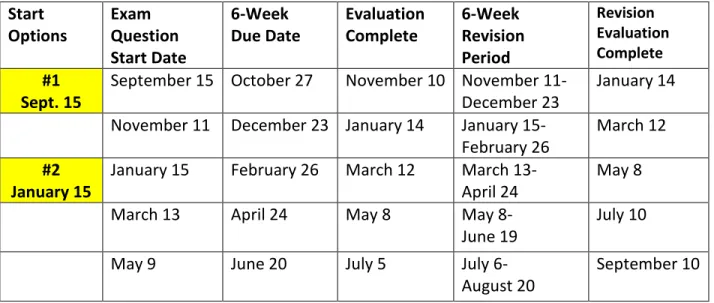
The procedure for the comprehensive examination Three-Question Format is as follows. (See the table below for a detailing of the dates referenced in this description):
1) The comprehensive examination will consist of three questions, with each question being allotted a maximum of 6 weeks to complete.
2) Students, in consultation with their advisor, will choose their start date from options #1 and #2 indicated in the first column of the table below.
3) Before the start date, students, in consultation with their advisor, and based on feedback from the comprehensive examination committee, will articulate the three questions that will comprise the examination. The questions should provide the
student with a broad understanding of the issues related to his or her primary research question. They should also be clearly stated and appropriate within the field(s) to be investigated.
4) The examination then officially starts on the date that the student has chosen
5) The student then has 6 weeks to complete the exam question as indicated by the due date listed in the table. He or she will then receive feedback within a time frame of two to three weeks (see table for exact dates).
6) If the student receives a passing grade on an exam question, they will then proceed to the next start option date in the table to begin the next question. For example, if a student started the exam on September 15th, completed exam one on October 27th, and received a passing grade when their evaluation was complete on November 10th they would then proceed to exam question #2, which would officially begin on
November 11th and would need to be completed by December 23. The evaluation for this second question would be completed by January 14th. The third question would then follow the same pattern (assuming that it was passed on the first attempt) with the start date on January 15th, the due date on February 26th, and evaluation feedback on March 12th. The student, at this point, would have officially passed their
comprehensive exams.
7) If the student does not pass a question, rather than going on to the next question in their sequence, he or she would take the next six weeks to re-write the exam (see the
be a “Pass”, the student will then proceed to the next start date available. In our example, with the revision evaluation outcome being received on January 14th, the student would then proceed to the second question beginning on January 15th. This
pattern would be repeated for all of the questions where a re-write is required. (See below for consequences of failing a re-write).
Table 1: Comprehensive Examination Three-Question Format Schedule
StartOptions Exam Question Start Date
6-Week
Due Date Evaluation Complete 6-Week Revision Period
Revision Evaluation Complete #1
Sept. 15 September 15 October 27 November 10 November 11-December 23 January 14 November 11 December 23 January 14 January
15-February 26 March 12
#2
January 15 January 15 February 26 March 12 March 13- April 24 May 8 March 13 April 24 May 8 May 8-
June 19 July 10 May 9 June 20 July 5 July 6-
August 20 September 10
then proceed to her second exam question beginning November 11th. Suzie would then have until December 23rd to complete question #2, for which she will receive feedback by January 14th. If she passes question #2, Suzie can then proceed to question #3, beginning January 15th. Suzie has until February 26th to complete question #3 and will receive feedback by March 12th. If she passes question #3, she will have completed the entire comprehensive examination process.
Let’s assume in the example above that on November 10th Suzie is asked to re-write her question #1. She then has the period from November 11th to December 23rd. to complete that revision. Suzie will receive feedback on her revision by January 14th, and if she has passed the revision, she will then proceed to question #2 beginning January 15th. Assuming that Suzie passes the next two examination questions on the first try, she would complete her comprehensive examination process no later than May 8th. If instead Suzie is asked to re-write question #2 in addition to rewriting question #1, writing for question #2 would begin on January 15th with a revision starting on March 13th, and evalution being received on May 8th. Suzie would then proceed to question #3, which would begin on May 9th. If Suzie passes question #3 on the first try, she will know her outcome by July 5th. If she has passed question #3, she has completed the comprehensive exam process. If she is asked to revise question three, she would have until August 20th to do so, and would receive the evaluation of the question on September 10th. If Suzie passes question #3 on September 10th, she will have successfully completed the comprehensive examination.
Instructions for Two-Question Format
Procedure for EdD Students Opting for the Two-Question Format
Counseling and Human Development Ed.D. students, in either the traditional or accelerated track, may, after close consultation with their advisor, opt for this two-question comprehensive examination format. In this option, students must demonstrate competency in two areas of inquiry, one of which emphasizes their role as reflective practitioners. The examination consists of two papers, approximately 30-40 pages in length, with each paper addressing a unique set of dimensions related to the student’s interest area. In general terms, the two papers are divided as follows:
of inquiry that will be the focus of the dissertation.
Paper #2:
This paper consists of an elaboration of the student’s specific dissertation research question, an explanation of the relevance of the area of inquiry to improving practice, a presentation of evidence that supports the students claims of relevance to practice, a comprehensive scholarly description of a methodology to address this area of inquiry, and a rationale for the use of the student’s chosen methodology.
The procedure for the two-question format comprehensive examination as follows: (See the table below for a detailing of the dates referenced in this description)
1) The comprehensive examination will consist of two questions, with each question being allotted a maximum of 8 weeks to complete.
2) Students, in consultation with their advisor, will choose their start date from one of the two options indicated in the table below.
3) Before the start date, students, again in consultation with their advisor and based on feedback from the comprehensive examination committee, will articulate the two questions that will comprise the examination. The questions should provide the
student with a broad understanding of the issues related to his or her primary research question. They should also be clearly stated and appropriate within the field(s) to be investigated.
4) Once the student completes an exam question, he or she will then receive feedback within a time frame of two to three weeks (see table for exact dates).
5) If the student receives a passing grade on an exam question, they will then proceed to the next exam question start date in the table (column 2) to begin the next question.
6) If the student does not pass a question, rather than going on to the next question in their sequence, he or she would take the next six weeks to re-write the exam (see the 6-week revision period in the table below). If, after the evaluation period, the re-write is considered to be a “Pass”, the student will then proceed to the next start date available if they have just successfully completed the first question. If they have just successfully completed the second question, they would have officially passed the
Start
Options Exam Question Start Date
8-Week Due
Date Evaluation Complete 6-Week Revision Period
Revision Evaluation Complete #1
Sept. 15 September 15 November 10 November 24 November 25 - January 6 January 20 November 25 January 20 February 3 February 4 –
March 18 April 1
#2
January 21 January 21 March 17 March 31 April 1 – May 13 May 27 April 1 May 27 June 10 June 11 –
July 23 August 6 May 28 July 23 August 6 August 7 -
September 18 October 2
Example:
Ed.D. student Sam Smith is trying to decide whether to begin his comprehensive exams on September 15th or January 21st. Assume that Sam, in consultation with his advisor, decides to begin his comprehensive examination process on September 15th. Sam then has 8 weeks to complete question #1, bringing him to November 10th, which would be his completion
deadline. By November 24th, Sam will receive feedback on his question #1. If Sam has passed question #1, he will then proceed to his second exam question (and jump to the next line in the above table) beginning November 25th. Sam would then have until January 20th to complete question #2, for which he will receive feedback by February 3rd. If he passes question #2, he will have completed the entire comprehensive examination process. Let’s assume in the example above that on November 24th Sam is asked to re-write his question #1. He then has the period from November 25th to January 6th to complete that revision. Sam will receive feedback on his revision by January 20th, and if he has passed the revision, he will then proceed to question #2 beginning January 21st and will have until March 17th to complete question #2. Assuming that Sam passes the second examination question on the first try, he would complete his comprehensive examination process when he receives his feedback on March 31st. If instead Sam is asked to re-write question #2, writing for question #2 would begin on April 1st and would be due on May 13th. Evaluation would then be
received on May 27th. If Sam passes the second question on May 27th, he will have successfully completed his comprehensive examination.
grade of “Pass” or “Fail”. Detailed criteria for evaluating the papers are provided on the last two pages of this document. Under conditions of a Failed exam, students are allowed one resubmission. The following are general reasons for a failing grade:
a. Further elaboration on a specific issue or area is necessary to represent breadth of knowledge
b. The student failed to demonstrate an ability to critically evaluate existing literature or demonstrates an interpretive misunderstanding of the literature c. The student demonstrates a basic misunderstanding of theoretical constructs d. The student failed to appropriately and correctly implement APA formatting e. The technical quality of writing is unsatisfactory and compromises the scholarly
presentation of the response
8) Once committee members have completed their review, they will send their feedback to the comprehensive exam committee chair who will share and review this feedback with the student.
9) If the student receives a failing grade on any of the examination questions, the student has the one time option of submitting a revised examination to the committee
member(s). The revision periods are specified in the table above. All failed examination questions must be completed within the revision period. Students must pass the exam within these boundaries to be retained in the program.
More specifically, the following rules apply if a student receives a failing grade on a revision:
• A student is dismissed from the program if one resubmitted paper is failed. The student can petition faculty for admission that could result in: a) reinstatement with
remediation criteria or b) supporting the student's dismissal.
• A student is dismissed from the program if a second resubmitted paper is failed. While a student can petition for readmission, concerns raised by failing the resubmission of a second comprehensive exam will make reinstatement unlikely. If reinstatement is granted, there will likely be remediation criteria.
• A student who is readmitted after failing a second resubmission, and subsequently fails a third resubmission, will be dismissed from the program. In the case of a third
resubmission failure, the Counseling and Human Development faculty will not entertain a petition for reinstatement.