Impediments to requirements engineering
during global software development
Jo Hanisch
1and
Brian Corbitt
21School of Computer and Information Science, University of South Australia, Adelaide, Australia; 2School of Business Information Technology, RMIT, Melbourne, Australia
Correspondence: Jo Hanisch, School of Computer and Information Science, University of South Australia, City West Campus, 27–29 North Terrace, Adelaide SA 5000, Australia. Tel: þ61 8 83020252; Fax: þ61 8 83029190; E-mail: [email protected] Received: 20 August 2004 Revised: 17 October 2005 2nd Revision: 31 January 2006 3rd Revision: 7 November 2006 4th Revision: 30 August 2007 Accepted: 29 September 2007 Abstract
Developing software when team members are located in widely distributed geographic locations poses many challenges for developers, particularly during the requirements engineering (RE) phase. Using a case study of a large software development project with users located in the UK and software developers from an international software house based in New Zealand, the paper argues that while global RE using electronic communication media may be desirable in achieving economy of resources, social and cultural aspects of RE need to be considered so that lasting relationships with clients may be formed, and RE activities achieved. The main impediments to the process of RE during global software development are communication resulting from differences in shared meanings and context associated with the following: distribution of the clients and the development team; distribution of the development team; cultural differences between the clients and the development team; and cultural differences among the development team.
European Journal of Information Systems(2007)16,793–805. doi:10.1057/palgrave.ejis.3000723
Keywords: global software development; requirements engineering; global virtual teams
Introduction
Requirements engineering (RE) is an important phase in the development of any information system. In the past few years, researchers (Hanisch
et al., 2001) have explored the cultural and social aspects of RE, and identified a number of challenges including: developing trust between team members and their client; accounting for communication prefer-ences; and sensitivity to the ways various cultures work. More recently, focus on RE during global software development (GSD) has emerged (Damian & Zowghi, 2002). Issues that appear most frequently in the literature concerning GSD, include loss of communication richness (Carmel, 1999; Jarvenpaa & Leidner, 1998; Battin et al., 2001), cultural differences (Carmel, 1999; Herbsleb & Moitra, 2001), loss of identity with the team (Karolak, 1998; Carmel, 1999), and lack of management support (Karolak, 1998). When RE is undertaken as part of GSD, these issues will most probably be exacerbated by the dynamic nature of the process of RE, as well as by the social and cultural aspects associated with gathering and managing requirements. From the extant literature, it is known that communication is a key concern for dispersed team members. However, it is not clear how team members overcome communication issues, nor is it clear what are the team members’ responses to any impediments to RE during GSD. Hence, there is the need to explore how team members attempt to create a shared context, make sense of, and construct requirements in the virtual domain.
This paper reports research that asked: ‘How are the processes of communications during RE influenced by working in global virtual teams?’ by exploring commu-nication issues associated with the RE phase of the software development process as it occurs in the virtual domain. The paper focuses on one case study concerning a large software development project that was completed in just 7 months between a contracting company located in the UK and a software house based in New Zealand. We report that the GSD team in the case study experienced some similar communication and coordination issues to those reported in other global virtual teams (Leaet al., 1995; Hinds & Bailey, 2003; Rennecker & Goodwin, 2005). This paper adds to the current knowledge of these issues by providing an in-depth study of communication processes associated with RE during GSD, and a detailed account of the team’s responses to these issues. Following a review of the literature concerning GSD, communica-tions, and RE, the paper describes the impediments to the RE processes in this case with particular focus on communication. The discussion highlights the need to understand the software development project environ-ment, and the ways in which business can address the complex activities and communication demands for RE in the virtual domain.
GSD, communications, and RE
As recently as 10 years ago, virtual work consisted mainly of simple administrative tasks (Staples, 1996), which required little collaboration and teamwork. Since then, GSD (Karolak, 1998; Carmel, 1999) and global virtual teams (O’Hara-Devereaux & Johansen, 1994; Lipnack & Stamps, 1997; Jarvenpaa & Leidner, 1998; Sarker & Sahay, 2004) have emerged, where the need to solve more complex tasks, such as RE, occurs in the virtual domain. Today, it appears that GSD has become a necessity, growing at a rapid pace, and according to Damian & Moitra (2006), it is a pervasive business phenomenon which needs to be organised and managed effectively.
Global virtual teams are defined as ‘teams whose members share a common purpose and are located in at least two different countries’ (Ramesh & Dennis, 2002, p. 1). GSD teams, one type of global virtual team, require the cooperation and collaboration of team members who use electronic communication media to explain and communicate complex concepts as they develop soft-ware. There is a noticeable transition from traditional forms of software development to GSD where team members collaborate across national borders (Damian & Zowghi, 2002). Reasons for this transition include: the limited pool of trained workforce; the necessity to locate specific expertise close to the customer; the differences in development costs; and the promise of round-the-clock development (Carmel, 1999; Mockus & Herbsleb, 2001; Damian & Moitra, 2006).
Carmel (1999) suggests that success in GSD occurs when rigour is imposed on the team through discipline and structure that compensate for the loss of informal
communication. However, while Carmel (1999) argues that structure is necessary to ensure strict change management, sign-off procedures and reporting mechan-isms, Panteli (2004) considers that structure imposed on the team may in fact decrease the social and cultural exchange between team members. It is this divergence in views that provides the motivation for this paper as we explore the influences on the communication processes in the virtual domain. Of particular interest are the influences of cultural differences on communication during RE. Recently, Levina (2005) has provided an in-depth account of collaboration on multiparty software development projects, highlighting the need for collec-tive identity so team members attach meaning and make sense of their contributions. This relates to the issues of culture and shared meanings. As culture and commu-nications are closely linked and relevant in GSD teams, the remainder of this section focuses on the social and cultural aspects of RE and the ways in which a shared context is created in GSD teams. Developing a shared context is viewed through the lens of symbolic conver-gence theory (SCT) (Bormann, 1985), as this is relevant to the ways the team members respond to the impediments to RE in this case.
Social and cultural aspects in RE
Traditional research in RE has focused on the methods used for elicitation, specification and validation of requirements (Greenspan et al., 1994; Kotonya & Som-merville, 1998). Many researchers conclude that the more structured the methods used, the more likely that the requirements will be clearly defined and understood (Kotonya & Sommerville, 1998; Carmel, 1999). However, as Thanasankit (2002) argues, organisations need to go further and consider the emotions and culture of users and IS specialists.
It is well established that the communication process is profoundly influenced by varying cultural backgrounds (Hofstede, 2001; Ardichviliet al., 2006). Communication between individuals from different cultural backgrounds is influenced by differences in cognitive styles, and preferences for different forms of visual and verbal presentation of information (Ardichvili et al., 2006). When using limited choices of communication media, such as electronic communications, there is increased potential for misinterpretations and misunderstandings. Sarker & Sahay (2004) observed such issues, including mismatch in preferred language for conversation; mis-interpretation of conversation style; and performance expectations not taking into account local holidays and religious festivals.
RE is a crucial phase in the software development process (Greenspan et al., 1994) and failure of many software development projects is not only due to inadequate requirements (Boehm, 1981) in general, but more specifically to the social, political and cultural factors associated with the project (Goguen & Linde, 1993). Where there is collaboration and communication
across geographical or national boundaries ( Jarvenpaa & Leidner, 1998; Espinosa et al., 2003), there may arise cross-cultural issues associated with managing a global virtual team (Walsham, 2002; Krishnaet al., 2004).
When considering RE during GSD, inadequate com-munication in global structures creates most challenges (Damian & Zowghi, 2002), and contributes to many underlying problems. Further, unless the four major aspects of cultural diversity, inadequate communication, knowledge management and time differences, are addressed in GSD, the stakeholders will face difficulties in RE practice (Damian & Zowghi, 2002). As the main distinction between collocated and global teams is their mode of communication (Zack, 1993), using electronic communication becomes an important managerial issue for global teams. Not only are the team members required to make use of electronic communication technologies for everyday project tasks, managers are also required to exhibit leadership, track performance and solve complex software development problems while using electronic communication media. RE, which requires a higher degree of communication than the other phases in systems development, involves communication and collaboration that is more complex in global teams. One potential solution is the establishment of formal mechanisms of communication for requirements changes. However, problems occur with requirements changes in GSD because formal changes in documenta-tion, such as requirements specifications, and using structured mechanisms of communication slow the process of RE (Mockus & Herbsleb, 2001). This reaction time is extended in the virtual domain due to the time lag in responses between team members.
Choosing the appropriate communication tools and techniques for RE in the virtual domain is problematic, because the activities of RE often require communication-rich media to analyse the requirements and present creative solutions. Most electronic communication med-ia, such as email, are recognised as the antithesis of communication-rich (Daft & Lengel, 1986; Panteli, 2004). This may create a dilemma for project managers who are responsible for the RE phase of GSD. Structured software development methods may assist requirements engineers in gathering requirements in the virtual domain. However, these methods may also inhibit the social aspects of virtual communications (Hanisch, 2001), and this may cause misinterpretation and miscommuni-cation of the requirements. Both the social and cultural aspects in RE require shared context for improved understanding of communications.
Culture and the creation of a shared context
SCT provides a lens through which we can view organisational communication processes in this paper. SCT may be used to explain the significance of context and interpretation in the process of communication (Vasquez, 1993) within the team, and between require-ments engineers and their clients. Bormann uses SCT to
account for human communication in discourse by asserting that ‘SCT assumes that human beings are social storytellers who share ‘‘fantasies’’ and thus build group consciousness and create social realities’ (Vasquez, 1993, p. 202). Therefore SCT provides a vehicle to explain how groups (or teams) can share a common symbolic reality. If team members symbolically participate in the drama of the shared fantasy, the result is an ‘explosive commu-nication episode in which the symbolic involvements chains through the group’ (Bormann, 1985, p. 73). Hence, the team comes to a symbolic convergence about that part of their common experience.
Smircich (1983) provides a comprehensive review of the different ways culture in organisations has been researched. Our focus on communication and culture is informed by a combination of the organisational symbo-lism work of Smircich (1983) and the anthropological studies of Geertz (1973). When Geertz’s symbolic anthro-pology is applied to organisational analysis, an organisa-tion as a culture is conceived as a pattern of symbolic discourse. In order to be understood, the organisation therefore needs to be interpreted, read or deciphered (Van Maanen, 1973; Smircich, 1983; Turner, 1983). We con-tend, based on these theories, that as teams and team members are part of organisations, in order to understand their culture and shared meanings, they need to be interpreted, read and deciphered. However, understand-ing the shared meanunderstand-ings needs to be contextualised in the mode of communication (Daft & Lengel, 1986; Panteli, 2004).
Research methodology
Having established from the literature that the social and cultural aspects of RE need to be considered when communicating in the virtual domain, and that con-textualising and developing shared meanings are relevant for complex communications, this paper focuses on one detailed exemplar to explore what happened and develop propositions for further research. Hence, the aim of this research is to address the research question: How are the processes of communications during RE influenced by working in global virtual teams? To collect data, a complete global project team consisting of the project manager, three system architects and two system devel-opers from a New Zealand Software House were inter-viewed in New Zealand during December 2001–January 2002. The interviewees were selected based on their responsibilities in gathering requirements from clients, who were engaged in interviewing users, and who were observing user activities, and gathering documents to construct requirements for development of the system.
The data was collected by taped in-depth interviews, which lasted from between 1.5 to 4 h. The interviews were informal and semi-structured with non-directive, open-ended questioning to stimulate the subjects’ thoughts. The interviewees had freedom to describe their experiences and problems beyond the questions’ bound-aries. Based on the knowledge from the literature that
communication issues, culture and shared meanings are hard to articulate, questions were constructed to encou-rage interviewees to compose stories in useful constructs to analyse processes of reality construction (Lindloff, 1995). Stories provide a rich entre´e into the nuances of meaning and enable the interviewee to be more con-scious of the meanings which they attribute to events and concepts (Louis & Sutton, 1991). Further, the researchers were provided access to all documentation and numerous emails concerning the project, as well as a ‘live’ demonstration of the final software product. The interviews were transcribed and an analysis of the interviewees’ stories included descriptions, thematic conceptual matrices and cognitive mapping (Miles & Huberman, 1994; Creswell, 1998). Developing an under-standing of shared meanings and the mode of commu-nication is a key element of this research. The researchers used hermeneutic evaluation of the interview transcrip-tions to decipher and interpret the extent of shared meanings and noted the relationship between each shared meaning and the mode of communication used. Follow-up email and telephone calls after the interviews provided clarification when necessary concerning mat-ters of fact and of interpretation related to the existence and strength of shared meanings; as well as reconfirma-tion of the effect of mode of communicareconfirma-tion on the development of shared meanings during the RE process in the virtual teams. The conclusions reported in the following analysis of the case study data represent the authors’ interpretations of the evidence. The case study is applied to the conceptualisations outlined above accept-ing that it is only one case study, albeit in some detail, and that it represents only one sphere of influence.
Case study description
Sapphire Software House1 was chosen for this research because the company recently used a global project team to develop and implement an international information system. This was an object-oriented system developed between Sapphire (based in New Zealand), the users from a large government rail company located in the UK and the users’ IT group also in the UK. The project team for a significant part of the project lifecycle worked in the virtual domain.
Sapphire Software House is a privately owned interna-tional software company that has developed a suite of enterprise application development solutions. Sapphire offers application service provider capability where an application is rented, or enterprise service provider facilities, where the entire business application is mana-ged, for a client. Sapphire’s main product combines the robust nature of mainframe technology with the flex-ibility and low cost advantages of commodity hardware and the Internet.
Sapphire was contracted to develop an online ordering system for the rail industry in order to streamline the
ordering, planning and monitoring of relevant trains. Prior to the development and implementation of this project, the users dealt with a complex and time-consuming system to track, order and plan for the trains to reach their required locations. Orders were placed by the phone, fax or email and the customer relations’ staff manually compiled them. The planning team would then create nine separate spreadsheets, one for each geogra-phical region within the UK, to schedule and plan the trains required to deliver the correct train type to the correct location. This included information such as the day, time, location, number and type of carriages and engine type for each journey. Each spreadsheet would then be used to book rail space for the trains to run (which is the unique way that the UK train service operates and hence one of the constraints of the system). The schedules were produced in advance each week, which allowed considerable lead-time for errors in scheduling during the week. Further, if delays or problems arose with the trains or tracks during the week, there was no possibility for ad hoc changes. A system architect described the system:
[They] had a set of existing spreadsheets they were using to do their planning process ony.They weren’t delivering
orders so that’s how they knew they were falling over quite badly in terms of performance – trains being cancelled due to them not being able to supply trainsyand because of the
fact they had Excel spreadsheets done by nine different peopleyand they were all completely different – it was just
an absolute disaster (Interviewee 2).
The existing system did not provide an efficient method of tracking orders in progress due to the manual nature of the planning process and, as the information was split across many disparate spreadsheets, querying and reporting on information was time-consuming. Sapphire undertook to build a system of four modules including ordering, planning/scheduling, schedule con-firmation and performance monitoring, and manage-ment reporting. One of the key developmanage-ment issues was the necessity to provide a central repository of informa-tion. This was achieved by the use of a central database, which is owned and maintained by Sapphire, but where multiple users are able to query, update and plan using a web interface.
RE processes during GSD
The developers in NZ commenced communication with the users in the UK once the contract negotiation between Sapphire and the contracting company was complete. The contracting company’s Senior Manage-ment assigned two staff, who visited the developManage-ment site in NZ for 3 weeks during the initial stages of the project. Once they returned to the UK, all communica-tion between Sapphire and the staff was computer-mediated. After only 2 weeks Sapphire decided to relocate their three system architects to the UK, as they were concerned that progress was being hampered by
communication constraints between the UK-based staff and the development team located in NZ. Sapphire’s project manager and two junior developers remained in NZ. The development team was thus divided between the two continents for the remaining 5 months, and the majority of the project.
Sapphire developed the system architecture using object-oriented tools and techniques in the framework of the Agile development methodology (Cockburn, 2002). One Agile principle Cockburn (2002, p. 213) describes is to ‘welcome changing requirements, even late in develop-ment’ so that customer collaboration is valued over contract negotiation. In this case the requirements were never ‘nailed down’ and change was continuous through-out the project. Hence the RE processes essentially did not end until the point of implementation. In this way they created their symbolic reality built in their user stories and interactions, both real and virtual.
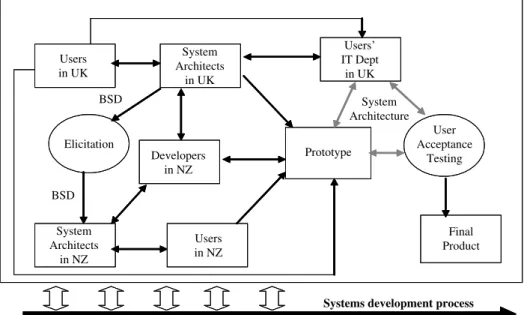
Figure 1 summarises the interactions during the project to elicit the users’ needs, build the prototype and then move to user acceptance testing and the final product. However, Figure 1 fails to encapsulate the complex web of interactions that occurred and cannot represent the communication processes that were intense. The RE processes in this case were complex because they entailed an iterative and ongoing set of communication chal-lenges and modes within Sapphire’s development team; between the users and Sapphire’s developers; and between the users’ department, their IT group and some of Sapphire’s developers.
The level and intensity of the communication in-creased throughout the development lifecycle. From the commencement of the project Sapphire recognised that electronic communications would be demanding, because their Agile development methodology usually
involved considerable face-to-face contact, and they produced prototypes that were modified daily while requirements were gathered. Undertaking this style of systems development is challenging in the virtual domain and presents many communication challenges.
When the system architects moved to the UK, communication within the development team was more challenging. At the same time, the relative intensity of communication increased due to the need to solve technical problems in a short timeframe. As communica-tion within email was often misinterpreted, the time taken to rectify miscommunication began to impact on the project deadline
yif you get an email and somebody can come in here [in
NZ] in the morning and understand exactly they can get all this work done while you are sleeping over there [in UK], andyif you don’t write something so the guy at the other
end can see it, then you get one wrong interpretation or assumption and you lose the whole day because the email goes bad. We just couldn’t afford that amount of time (Interviewee 1)
When the communication challenge became too intense (mainly due to miscommunication/misinterpretation and invalid requirements), new ways of communicating, or improved use of the current communication mode, were introduced to meet the communication challenge. For example, when the team found that using email was too difficult, video conferencing was used extensively.
y.the video conferencing – just saved so much time and it’s
good for people who are away just to be able to see and talk to people, and when you are trying to sort out a lot of development problems – you know email is so inefficient. You can spend hours just trying to type something up that you can say in a few minutes (Interviewee 3).
Systems development process Users in UK System Architects in NZ Elicitation Prototype Final Product System Architecture BSD User Acceptance Testing Users in NZ System Architects in UK BSD Developers in NZ Users’ IT Dept in UK
Hence, the team was able to continue its Agile methodology while it was managing the pace of the development. However, according to the system archi-tects, once the system design was ‘firm’, Sapphire’s project team lost some control over the project, as the users’ IT department led the project through the User Acceptance Testing (UAT) phase. While UAT would not normally be considered part of the RE process, in this project there were many late changes in requirements, which to some extent may be attributed to the Agile philosophy of embracing change, but also may be attributed to some communication issues. Once the users’ IT department were in control, Sapphire’s system architects were frustrated with the slow progress pace of the project. The interviewees agreed:
Oh it was terrible. They were putting priority eight faults over spelling errors, which was just ridiculous. They were missing the point. And of course IT were scaring the usersyBecause they could see that IT had the power at
that point (Interviewee 3).
yAnd when it went into UAT, because they [users’ IT
department] were now effectively in control of the thing, the whole pace of it just ground to a halt. We found that quite frustrating andythat had morale impacts on our guys
because the pace of it slowed and peopleywere trying to get
things signed-off and there were things that we felt could have been tested very, very quickly if people had just thrown a bit of commitment in behind it to actually get it signed-off (Interviewee 1).
Sapphire did not understand the bureaucracy of the large UK government department, compared with their flat, flexible company structure. They felt thwarted in their attempts to move the project forward and con-cerned that the deadline for the implementation would be affected by the users’ IT department. They had underestimated the communication issues and the need for good relations with the users’ IT department for the success of the project.
The impediments that emerged in the RE process are of significant interest in this case because they highlight the influences of communication on the RE phase of the project, and from these impediments some solutions to the issues may be determined.
Team response to impediments to RE Owing to the communication problems and emergent complexity, Sapphire responded to the impediments to RE in two ways: (1) the project team elected a project leader (from the three system architects), who became responsible for verifying and validating communication and informa-tion rather than designing the system; and (2) the team members moved into the same room at their respective sites, and then at both sites they set up video conferen-cing facilities with printable whiteboards. They con-ducted two videoconferences per day which enabled the team to communicate each morning and evening, so that work on the project was continuous.
Further, the three system architects who relocated to the UK were effectively working 20-h days in order to coordinate the information, requirements and design. Overall Sapphire Software House executives were pre-pared to support their development team to work long hours on this project in order to win the contract. However, the developers agreed that this was not sustainable.
Discussion
Communication issues during GSD
Informants in Sapphire highlighted some of the major issues that concerned the members of the global virtual teams in this project:
the majority of Sapphire’s experienced skill sets were located at one site, hence miscommunication and misinterpretation of requirements occurred at the location where team members were less experienced;
communication overheads were exacerbated by the short development time frame over such a large time zone difference;
Sapphire were not able to identify and did not have appropriate access to the key users, hence the require-ments gathered were tailored towards the users who were available;
the difference between the culture of the working environments in the UK and New Zealand once the users’ IT department gained control over the project; and
the hidden meanings of cultural differences within the development team.
When considering the dynamics of communication in this case, there are two obvious perspectives based on the separation of the communicators. Firstly, the separation of developers from each other, and secondly, the separa-tion of the clients from the development team members. However, emerging from the data analysis, the cultural differences and the use of computer-mediated commu-nication influence the ability to develop shared mean-ings, which add to the complexity of communication. Communication issues, which the team members recounted as their main cause of impediments to the RE processes, are therefore described in terms of the follow-ing four categories: distribution of the development team; distribution of the clients and the development team; cultural differences between the clients and the development team; and cultural differences among the development team.
Communication and distribution of the development team
Communication issues arose when Sapphire moved their experienced system architects to the client’s site in the UK leaving junior systems developers in NZ. While Sapphire’s project manager remained in NZ, he was not directly involved in the technical issues of the project. Hence, the junior developers in NZ lacked understanding of both the
system requirements and the direction of the project. The three system architects agreed that problems arose because the content of the communication was complex (object-oriented design documents) and therefore required explanation and understanding. Email, as the communi-cation mode for the system requirements, was not appropriate to communicate complex concepts (Zack, 1993).
As predicted by Daft & Lengel (1986), team members chose to employ different communication media depen-ding on the way they perceived the task and the electro-nic commuelectro-nication mode. For commuelectro-nication tasks that have high complexity, higher information richness media are necessary. As communication media vary in their ability to carry rich information (Wijayanayake & Higa, 1999), distributed workers made more use of video conferencing than email when conducting complex tasks, because video conferencing is a more communica-tion-rich medium. This is similar for tasks with high ambiguity, such as conflict or problem resolution.
Further, time pressures may influence the selection of media for communication (Wijayanayake & Higa, 1999). When there are time/distance pressures, synchro-nous communication media become more effective. Hence the telephone or video conferencing would be used rather than email. Sproull & Keisler (1986) recognise there are negative consequences of using electronic media for communication in organisations, including misinterpretations, angry and uninhibited exchanges and feelings of depersonalisation and isolation (Markus, 1994). This can lead to decreased social exchange at work (Markus, 1994), which influences the shared context, the performance of the communication and hence the team. Establishing social exchanges and a shared context (Geertz, 1973; Smircich, 1983) are there-fore important for the team to collaborate and achieve its goals.
Email has many characteristics that make it attractive in the organisation. From Sapphire’s field notes, email messages were at first more formal in language with greetings and signatures or closing remarks. As the emails went back and forth between the team members, there was less attention to grammar, punctuation and spelling. There were briefer statements, which were more sponta-neous and contained more banter, informal comments and personal disclosure. However, even though the team members may have felt comfortable communicating using email, this did not prevent the loss of meaning of the requirements during the RE process. The issues that arose when using email during RE were the loss of shared context, misinterpretation, poor or no response to questions and misunderstandings.
The time zone difference between the two sites impacted on how quickly the requirements were relayed from the UK to NZ. This in turn caused pressure within the development team, because when delays occurred due to the time difference, there was an added burden on the system architects in the UK to work long hours
to address the communication issues as well as the requirements issues.
When there were time delays as well as conflicts in understanding and interpretation by the developers in NZ, the system architects again felt under time pressure to address the communication issues and requirements problems. The system architects agreed that email was useful for sending documents, but to elicit and explain the requirements, it was necessary to provide a medium where further conversation, immediate responses, and validation of requirements were possible. In order to improve the communication flows, understanding of the system requirements and the speed of communication between the system architects in the UK and the developers in NZ, video conferencing was established. Sapphire felt that video conferencing was the only way to achieve a similar level of contact as face-to-face communication. One system architect asserts that using videoconferencing was faster and improved understand-ing compared with email.
By using both email and video conferencing, the development team were able to establish an ‘around the clock’ work environment. However, this was only possible due to the heroic efforts on the part of the system architects who worked excessive hours but they did not consider this arrangement viable and sustainable in the long term. They ultimately established the shared context they needed to work in. Interviewee statements to support these findings are presented in Table 1. These phenomena are generated specifically from the virtual team context in different ways than other phenomena are generated from other RE processes.
Communication and distribution of the clients and the development team Identifying and gaining access to appropriate users in the beginning of the project caused communication issues between the clients and the development team. Those staff who visited NZ initially were able to devote the majority of their time to the requirements of the project. While this appeared an ideal situation, there were problems because they were not key users, and were uncertain of many facets of the system required by the users’ department. Without Sapphire realising, the two staff were able to direct the project after establishing face-to-face rapport in NZ, through filtering or ignoring the requirements of the other users located in the UK. Had the system architects known who the key users were and been provided access to them in the UK throughout the entire project, the project outcomes and/ or the project delivery time may have been different.
While this is potentially no different to any develop-ment project (traditional or global) where access to key users is problematic, the issues were exacerbated in the virtual domain of this project. The distance between the system architects and the users, the time lag in gaining answers to questions about their requirements, and the problem that the responses were filtered through or ignored by the assigned users in NZ, provided no
opportunity for the system architects to clarify any issues with the users in the UK; gain a different perspective concerning an issue; or ensure that the project was going to suit the majority of users. When the system architects relocated to the UK and obtained access to other users who were higher ranking stakeholders, they found many requirements were overlooked and many changes were needed. The system architects conceded that various key users were not as well consulted as those who were assigned and visited NZ. While the underlying philoso-phy of the development team valued embracing change; and customer collaboration over contract negotiation (Cockburn, 2002), the communication issues were evi-dent when requirements changes were requested well beyond UAT.
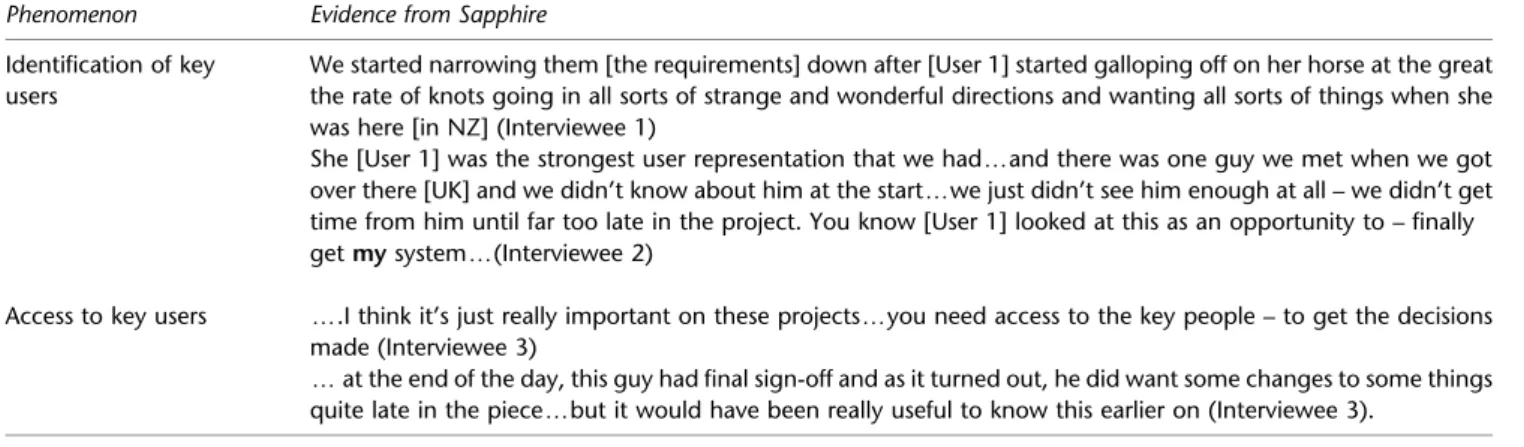
Overall, identifying and gaining access to key users is important to reduce the number of changes in require-ments as the system is being developed. In the virtual domain, it is difficult for the development team to determine who the key users are, as the development team has no local or informal knowledge when they are not located on site. Further, the differences in time and distance of the virtual domain adds complexity and difficulty in gaining access to key users. In this case, once the system architects were located on the users’ site in the UK, access to the users was still demanding, but with persistence, opportunities occurred which were not possible when the system architects were located in NZ. This highlights clearly an impediment to RE as software is developed in the virtual domain. Table 2 includes interviewee statements to support these findings.
Three conclusions emerge from this analysis: (1) the lack of knowledge adds to complexity in GSD; (2) poor
communications leads to potential misinterpretation, and; (3) geographic separation and isolation tends to create situations of re-interpretation or re-contextualisa-tion; and this changes the character of a project in ways similar to those identified by Thanasankit (2002) for systems development in-house.
Communication and cultural differences between the clients and the developers Communication and cultural differ-ences between the clients and the development team in this case were due to the difference in working culture between the two organisations. Sapphire executives highlighted the differences in working culture between government workers in the UK and a dynamic business in NZ. These differences caused conflict and frustration during the progress of the development. Sapphire was initially in control of the project, and according to one system architect, the users’ IT department felt ‘de-powered’ and ‘sidelined’.
However, once the users’ IT department gained control of the project during UAT, the power base changed and then Sapphire was delayed and frustrated in their efforts to move the project forward. The system architects lacked understanding of the culture of a traditional public service institution. Sapphire found the working pace of the client company could be an impediment to the RE phase of system development. They considered that culture of the government employees was a problem that influenced the progress of the project. Interviewee statements to support these findings are presented in Table 3.
In this case, the power play between the users’ IT department and the software house provides an example of organisational politics. These findings support Nicholson
Table 1 Communication and distribution of the development team
Phenomenon Evidence from Sapphire
Separation of experienced and inexperienced team members
yAll of the design knowledge was in the UK, and we were working 12 hours out of sync with them.
And that made us work 20-hour days for a monthyand it was very stressful. No matter how much you
would try and get things on the screen so they can see it, but it really needed someone who had that knowledge here [in NZ] as well. So you probably needed two people over there [in UK] – two strong people driving it from the users’ perspective – business perspective and another one here [in NZ] being able to drive the developers (Interviewee 2).
Time pressures yit’s even more apparent when you have this big distance that their [the lead communicator] job
is just to make sure that everybody else is in with the big picture. And sometimes you could spend your whole day just talking to everyone and answering emails. Just keeping everybody on tracky(Interviewee 1).
Miscommunication and misinterpretation
yin fact a couple of us ended up spending a lot of our day time actually sorting outycommunication
issues – answering a lot of emails that had come in over night just back to people saying – yes this is the decision on that – this is how you approach thisy(Interviewee 3).
Choice of communication media It’s [video conferencing] 10–20% faster than actually sending email. You can read things the wrong way. It’s so hard to pick up on that when you are doing email. You’ve got to do it through spoken word – it makes a big difference – massive difference – the interpretationy(Interviewee 3).
& Sahay (2001, p. 37) who suggest that structured IS and project management methodology may be used ‘as resources of power to create an organizational reality’. Nicholson & Sahay (2001) consider that these cultural differences may be explained as globalisation effects that occur between developed and developing countries, where mechanistic and rigid structured analysis and design are imposed. However, this research has estab-lished that globalisation effects may also occur between two Westernised and developed countries. While working cultures also vary between large traditional public service institutions and smaller flexible businesses in traditional software development, the communication issues are exacerbated when these companies are from different countries and cultures.
Communication and cultural differences among the team
The final affect on communication related to differences in working culture among the development team members. This occurred in two ways in this research. When the system architects were located in the UK, they were able to devote extended working hours to the project because they had no other outside commitments. However, the devel-opers in NZ remained in their home environment with everyday commitments, and were not able to devote endless overtime to their work. There was pressure from their more senior colleagues in the UK to work longer hours and this caused conflict in the team.
Communication conflict and complexity emerged also due to the national cultural differences within the development team. The system architects did not explicitly admit to any communication issues due to national culture differences within the team, but the junior developers did attribute some differences in understanding of the design requirements to these differences. While all team members were long-term residents of NZ, the system architects were born in NZ, but the two junior developers were from Nicaragua and Malaysia. As Thanasankit (2002) indicates, there exists hidden meanings and interpretations of requirements information between developers from different cultural backgrounds, and this may be an impediment to the RE process. Evidence to support these findings is presented in Table 4.
Overall the miscommunication and misinterpretation of the system requirements between the system architects and the junior developers may be attributed to: inexperi-ence, the difficulties in interpreting complex designs using less rich communication media, as well as lack of understanding between the two sites of the hidden meanings relating to cultural differences.
Contributions to research and practice
This paper contributes to both theory and practice. From a theoretical perspective, the findings concur with Damian & Zowghi (2002) that communication is a
Table 2 Communication and distribution of the clients and the development team
Phenomenon Evidence from Sapphire Identification of key
users
We started narrowing them [the requirements] down after [User 1] started galloping off on her horse at the great the rate of knots going in all sorts of strange and wonderful directions and wanting all sorts of things when she was here [in NZ] (Interviewee 1)
She [User 1] was the strongest user representation that we hadyand there was one guy we met when we got
over there [UK] and we didn’t know about him at the startywe just didn’t see him enough at all – we didn’t get
time from him until far too late in the project. You know [User 1] looked at this as an opportunity to – finally getmysystemy(Interviewee 2)
Access to key users y.I think it’s just really important on these projectsyyou need access to the key people – to get the decisions
made (Interviewee 3)
yat the end of the day, this guy had final sign-off and as it turned out, he did want some changes to some things
quite late in the pieceybut it would have been really useful to know this earlier on (Interviewee 3).
Table 3 Communication and cultural differences between the clients and the developers
Phenomenon Evidence from Sapphire
Working culture By the time we got there we hadythe contract was signedythe IT department [the user’s IT department] had no
choice in the matter which was probably a little bit of a mistake as that made them sidelined and de-powered (Interviewee 3).
yit can be quite bureaucratic and the pace with which stuff (sic) happened, we would find it frustrating trying
to get things doney. I guess it was a cultural aspectythat was more a cultural clash was the different style of
significant issue for RE during GSD. However, this paper goes beyond to demonstrate that communication involves a complex web of interactions and shared meanings (Smircich, 1983) with many layers of influ-ences on the RE processes, so that determining the impediments, and therefore solutions to communication issues, are problematic. These layers, involving client and management expectations; social and cultural differ-ences; establishing trust between team members and with the clients; creating a shared identity and myriad communication media, may be viewed through the lens of SCT.
Symbolic convergence theory In this case, there is evidence from the field notes and IS specialists’ email messages that SCT is applicable. Team members devel-oped symbolic meanings and shared stories through fantasies, such as wishes and hopes, or when they shared what is known as an ‘inside joke’ (Bormann, 1985). For example, one email exchange included:
We need to develop this schema, similar to the one last week and I’m hoping we can get this done today. If so, the milky bars are on me! (Interviewee 1).
Yeah i can see what we need to doybtw – what do mean by
milky bars? (Interviewee 5).
It’s a saying from an old ad for kids on tv that I will pay for chocolates (Interviewee 1).
Oh i no what u mean now, we speak on the same wavelength (Interviewee 5).
Then a few days later:
Can you get this job done today? (Interviewee 1). So long as the milky bars are on you. (Interviewee 5).
Through this simple exchange there is evidence of shared meanings and camaraderie developing between team members, even though they are separated physi-cally and it is not feasible or likely that the inside joke with be enacted.
There is also evidence that the clients shared meanings with the developers. For example, the development team used an Agile development methodology, using stories to gather users’ requirements (Beck, 1999). The advantage of users’ stories is that the development can adapt well to changing requirements, as new stories simply emerge in subsequent specifications. When stories become too complex, they are modified or broken down until they are represented more easily (Beck, 1999). Thus, the clients and IS specialists developed shared meanings during RE, especially when users participated actively in sharing their system requirements.
However, it is difficult for a team to establish shared meanings through fantasies and stories in the virtual domain, as the stories can be misconstrued, and mis-interpretations occur, particularly when the team is in the formative stages of development. Further, when a team is under pressure to communicate quickly and over large time zone differences, it is not so easy to establish ‘good’ communication (which Church (1996) refers to as open, honest, participative and direct), and/or to com-municate on topics other than work related tasks, both of which are necessary to build shared stories.
The team needs to establish a symbolic convergence about their common experience through the fantasies they share in the discourse. Because during GSD, the task of developing an information system or product goes beyond simple integration or cooperative alliance, the collaboration of the team requires shifts in perception and a broadening of their world views (Roy, 2001) so that the goals can be achieved. This complex process requires communication competence (Gudykunst, 1993), which may be achieved through effective and appro-priate communication (Roy, 2001). However, what constitutes both effective and appropriate communica-tion is complex and open to conjecture. Hence, to understand a team’s ability to collaborate in RE during GSD, it is necessary to understand the team’s background and propensity for effective and appropriate communication. This involves establishing a shared identity and long-term trust within the team and with their clients.
Table 4 Communication and cultural differences among the team
Phenomenon Evidence from Sapphire
Working long hours yI think from a developer’s perspective it caused a lot of stress inside the teamyIt was a lot of hours. We [in NZ]
still had our home life, but the guys in the UK did not think of thatyYou end up burning out (Interviewee 4).
Miscommunication and misinterpretation
yI know [Interviewee 1] and [Interviewee 2] at times were frustrated because we didn’t understand their
requirements, but it was too difficult to know exactly what they meant (Interviewee 4).
Language yI think email is very difficult to read the meaning of the message. Sometimes they used terms I did not know. It
was not a technical term, but a language term. They could not understand why they need to explain again (Interviewee 5).
Implications for business practice Of significance for business practice is the confirmation that regardless of the communication mode or domain, developing a shared context and developing shared meanings both among the team, and between the team and their clients, are essential to reduce the layers of complexity. This is especially needed when there is high communication intensity for tasks such as RE. The detail in the case study shows that reduction of communication complexity may be achieved more generally in a number of ways, including: (1) improving social exchanges by adapting new media and adoption of a virtual system of commu-nication; (2) developing awareness of ‘hidden’ cultural differences that are implicit in behaviour misalignment evident in communications and team-interaction pro-cesses; (3) alleviating the time pressures that software developers face when communicating in the virtual domain; (4) providing access to key users; and (5) creating a communication coordinator role to reduce misinter-pretations. A further lesson for managers from this case is the need to balance the desire to create a ‘good impression’ with the client by establishing long working hours, with the need to develop working relationships that are sustainable in the longer term.
Conclusion
In conclusion, the RE processes in this case study were influenced by the communication and the various distributions of the development team and their clients. In this process two clear patterns emerged. Firstly, the level and intensity of the communication increased throughout the development lifecycle; and secondly, when the communication challenge became too intense, new ways of communicating, or improved use of the current communication mode, were introduced to meet the communication challenge, increasing the dimen-sional complexity of the requirements and the RE processes. During the development of this complexity, communication between members in the virtual team was impeded by (1) miscommunication and misinterpre-tation of requirements where team members were less experienced; (2) the short development time frame over such a large time zone difference; (3) the extent of availability of the key users; and (4) the cultural differences in the working environments of the UK and New Zealand. Four key influences on communication then, affected RE processes in the case study: the distribution of the development team; the distribution of the clients and the development team; cultural differences between the clients and the development team; and cultural differences among the development team members. As a result the RE process was less than efficient and contributed to cost overruns and inability to meet deadlines in the project. Effective and appropriate communications have been argued to be key to successful software development projects.
A limitation of the paper is the inability to report the data from the users’ perspectives. While the clients in this case were never considered to be part of the develop-ment team, and were not under line control of the Software House, data from the clients would have added a rich dimension. While access to the users was not granted, this paper is worthy in that it gives a voice to the IS specialists, provides the opportunity to recount in-depth the team’s interpretations and to explore the complex web of communication issues from the devel-opers’ perspectives. Ongoing research is required to describe the processes of other development teams undertaking RE during GSD and to provide the user’s perspective.
This case study has highlighted that the complexity created through communication processes in a virtual situation make understanding the nature of effectiveness and appropriateness of communication problematic and in need of intensive study over a large number of cases. The resolution of complexity is necessary to gain shared meaning and in this case study the actors did this by: adapting new media for communication, reducing the layers of complexity created by geography, and the adoption of a virtual system of communication. They achieved their sharedness with attention to a single focus on the project. In this way the dialectics of miscommu-nication and misinterpretation were resolved. This case study has shown that complexity resolution in the RE process in virtual teams was addressed by improving social exchange; by developing awareness of cultural difference; by alleviating the time pressures that software developers face when communicating in the virtual domain; by providing access to key users; and by creating a communication coordinator role to reduce misinter-pretations. Complexity in communications, coupled with complexity in process in a virtual domain, needs to be recognised and resolved by acceptance rather than by reductionist practices, which attempt to simplify either communication or process. Such simplification does not mirror real-world practice and provides no support for practitioners trying to resolve communica-tion, cultural and process problems in developing real world solutions. RE process models must embrace com-plexity and use it constructively in solutions to software development project problems.
The case study also demonstrates that SCT enables the researcher to pull away the complexity situated in each ‘layer’ of influence to draw some meaning in the RE processes. Each layer is written by actors in the RE process relating to their real or virtual context. SCT provides the researcher with the analytical tools to identify each ‘layer as symbol’ in the text of the actors. The researcher then adapts those layers to contribute meaning in terms of accepted RE practice. In this way complexity can be identified and used to solve software development project problems.
About the authors
Jo Hanisch is a lecturer and researcher in Information Systems in the School of Computer and Information Science, University of South Australia. This follows a diverse career commencing in CSIRO, Canberra; the Commonwealth and State public service and Telstra Corporation. She holds degrees in Science from Adelaide University and Business from the University of South Australia; and a PhD in Information Systems from Deakin University, Melbourne. She has published in numerous conference proceedings and scholarly journals. Her research interests include global software development with emphasis on communications; virtual communities of practice; the digital divide and sports information systems.
Brian Corbitt is currently Professor of Management Information Systems, Head of the School of Business Information Technology and Dean (Research and Inno-vation) at RMIT University, Australia. He has previously
been Adjunct Professor of IT at KMIT (NB) and then Professor of Management Science at Shinawatra Univer-sity in Thailand, Pro Vice Chancellor (Online Services at Deakin University), JADE Professor of eCommerce at Victoria University of Wellington in New Zealand and prior to that lectured at the University of Melbourne, where he was also Head of International House, and before that Monash University. He specialises in IT policy development, in Health Information Systems design, analysis and implementation; in Business Modeling and Design and Electronic Commerce trade relationships, and knowledge management. He has published six books on eBusiness, eCommerce and eGovernment, and another four books. He has also published over 150-refereed scholarly papers, and numerous government reports to the Governments of Thailand and New Zealand, and some 20 invited papers as a keynote speaker on IT policy in Malaysia, Singapore, Thailand, New Zealand, Japan, Hong Kong, and Australia.
References
ARDICHVILIA., MAURERM., LIW., WENTLINGT. and STUEDEMANNR. (2006) Cultural influences on knowledge sharing through online communities of practice.Journal of Knowledge Management10(1),94–107. BATTIN RD, CROCKER R and KREIDLER J (2001) Leveraging resources in
global software development.IEEE Software18(2),70–77.
BECKK (1999) Embracing change with extreme programming.Computer 32(10),70–77.
BOEHMB (1981)Software Engineering Economics. Prentice-Hall, Englewood Cliffs, NJ.
BORMANNEG (1985) Symbolic convergence theory: a communication formulation.The Journal of Communication35,128–138.
CARMELE (1999)Global Software Teams: Collaborating Across Borders and Time Zones. Prentice-Hall, Englewood Cliffs, NJ.
CHURCH AH (1996) Giving your organizational communication C-P-R. Leadership & Organizational Development Journal17(7),4–11. COCKBURNA (2002)Agile Software Development. Addison-Wesley Pearson
Education, USA.
CRESWELL JW (1998) Qualitative Inquiry and Research Design: Choosing Among Five Traditions. Sage Publications, UK.
DAFTRL and LENGELRH (1986) Organizational information requirements, media richness and structural design.Management Science32(5),554–571. DAMIANDEH and MOITRAD (2006) Global software development: how far
have we come?IEEE Software23(5),17–19.
DAMIAN DEH and ZOWGHI D (2002) The impact of stakeholders’ geographical distribution on managing requirements in a multi-site organization. InProceedings of the IEEE joint International Conference on Requirements Engineering, 9–13 September 2002, Essen, Germany, pp 319–328, IEEE Computer Society, USA.
ESPINOSA JA, CUMMINGS JN, WILSON JM and PEARCEBM (2003) Team boundary issues across multiple global firms.Journal of Management Information Systems19(4),157–190.
GEERTZC (1973)The Interpretation of Cultures. Basic Books, USA. GOGUENJA and LINDEC (1993) Techniques for requirements elicitation. In
Proceedings of the IEEE International Symposium on Requirements Engineering(FICKASS and FINKELSTEINA, Eds), January 1993, New York, NY, pp 152–164, IEEE Computer Society Press, USA.
GREENSPANS, MYLOPOULOS J and BORGIDAA (1994) On formal require-ments modeling languages: RML revisited. In Proceedings 16th International Conference on Software Engineering, May 1994, Sorrento, Italy, pp 135–147, IEEE Computer Society Prees, USA.
GUDYKUNST WB (1993) Toward a theory of effective interpersonal and intergroup communication. In Intercultural Communication Competence(WISEMANand KOESTER, Eds), Sage Publications, California. HANISCHJ (2001) Requirements engineering in virtual software develop-ment: achieving balance. InProceedings Information Resource Manage-ment Association 2001 (KHOSROW-POUR M, Eds), pp 203–207, Idea publishing Group, Toronto, Canada, USA.
HANISCHJ, THANASANKITT and CORBITTB (2001) Exploring the cultural and social impacts on the requirements engineering processes – high-lighting some problems challenging virtual team relationships with clients.Journal of Systems and Information Technology5(2),1–19. HERBSLEB JD and MOITRAD (2001) Global software development.IEEE
Software18(2),16–20.
HOFSTEDEG. (2001)Culture’s consequences: comparing values, behaviors, institutions and organizations across nations, 2nd edn, Sage Publica-tions, California.
HINDS PJ and BAILEY DE (2003) Out of sight, out of sync: under-standing conflict in distributed teams. Organization Science 14(6), 615–632.
JARVENPAASL and LEIDNERDE (1998) Communication and trust in global virtual teams. Journal of Computer-Mediated Communication 3(4) http://www.ascusc.org/jcmc/vol3/issue4/jarvenpaa.html (Retrieved 24/10/2001).
KAROLAK DW (1998) Global Software Development: Managing Virtual Teams and Environments. IEEE Computer Society Press, USA. KOTONYAG and SOMMERVILLEI (1998)Requirements Engineering: Processes
and Techniques. John Wiley & Sons, UK.
KRISHNA S, SAHAY S and WALSHAM G (2004) Managing cross-cultural issues in global software outsourcing. Communications of the ACM 47(4),62–66.
LEA M, O’SHEA T and FUNG P (1995) Constructing the networked organization: content and context in the development of electronic communications.Organization Science6(4),462–478.
LEVINA N (2005) Collaborating on multiparty information systems development projects: a collective reflection-in-action view. Informa-tion Systems Research16(2),109–130.
LINDLOFFT (1995)Qualitative Communication Research Methods. Sage, California.
LIPNACKJ and STAMPSJ (1997)Virtual Teams: Reaching Across Space, Time, And Organizations With Technology. John Wiley & Sons, New York.
LOUISMR and SUTTONR (1991) Switching cognitive gears: from habits of mind to active thinking.Human Relations44,55–76.
MARKUSML (1994) Finding a happy medium: explaining the negative effects of electronic communication on social life at work. ACM Transactions on Information Systems12(2),119–149.
MILESMB and HUBERMANAM (1994)Qualitative Data Analysis, 2nd edn, Sage Publications, California.
MOCKUS A and HERBSLEB J (2001) Challenges of global software development. In Proceedings of 7th International Software Metrics Symposium, 4–6 April 2001, pp 182–184, Bell Labs, London, USA. NICHOLSONB and SAHAYS (2001) Some political and cultural issues in the
globalisation of software development: case experience from Britain and India.Information and Organization11,25–43.
O’HARA-DEVEREAUX M and JOHANSEN R (1994) Globalwork – Bridging Distance Culture and Time. Jossey-Bass, USA.
PANTELIN (2004) Discursive articulations of presence in virtual organiz-ing.Information and Organization14,59–81.
RAMESHV and DENNISAR (2002) The object-oriented team: lessons for virtual teams from global software development. InProceedings of the 35th Hawaii International Conference on System Sciences, 7–10 January, pp 212–221, IEEE Computer Press, Hawaii, USA.
RENNECKER J and GOODWIN L (2005) Delays and interruptions: a self-perpetuating paradox of communication technology use.Information and Organization15,247–266.
ROY MH (2001) Small group communication and performance: do cognitive flexibility and context matter?Management Decision39(4), 323–330.
SARKER S and SAHAY S (2004) Implications of space and time for distributed work: an interpretive study of US-Norwegian
systems development teams.European Journal of Information Systems 13,3–20.
SPROULLL and KEISLERS (1986) Reducing social context cues: electronic mail in organizational communication.Management Science32(11), 1492–1513.
SMIRCICH L (1983) Concepts of culture and organizational analysis. Administrative Science Quarterly28,339–358.
STAPLESS (1996) An investigation of some key information technology – enabled remote management and remote work issues.Proceedings of 7th Australasian Conference on Information Systems2,665–676. THANASANKIT T (2002) Requirements engineering – exploring the
influence of power and Thai values. European Journal of Information Systems11(2),128–141.
TURNERSP (1983) Studying organization through Levi–Strauss’s structur-alism, InBeyond Method: Social Research Strategies(MORGANG, Ed), Sage Publications, California.
VANMAANENJ (1973) Observations on the making of policemen.Human Organization32,407–418.
VASQUEZ GM (1993) A Homo Narrans paradigm for public relations: combining Bormann’s symbolic convergence theory and Grunig’s situational theory of publics.Journal of Public Relations Research5(3), 201–216.
WALSHAM G (2002) Cross-cultural software production and use: a structurational analysis.MIS Quarterly26(4),359–380.
WIJAYANAYAKE J and HIGA K (1999) Communication media choice by workers in distributed environment.Information & Management36, 329–338.
ZACKMH (1993) Interactivity and communication mode choice in ongoing management groups.Information Systems Research4(3),207–239.