Masters Theses Student Theses and Dissertations
Spring 2017
Personalizing education with algorithmic course selection
Personalizing education with algorithmic course selection
Tyler Morrow
Follow this and additional works at: https://scholarsmine.mst.edu/masters_theses
Part of the Computer Sciences Commons
Department: Department:
Recommended Citation Recommended Citation
Morrow, Tyler, "Personalizing education with algorithmic course selection" (2017). Masters Theses. 7653.
https://scholarsmine.mst.edu/masters_theses/7653
This thesis is brought to you by Scholars' Mine, a service of the Missouri S&T Library and Learning Resources. This work is protected by U. S. Copyright Law. Unauthorized use including reproduction for redistribution requires the permission of the copyright holder. For more information, please contact [email protected].
by
TYLER MORROW
A THESIS
Presented to the Graduate Faculty of the
MISSOURI UNIVERSITY OF SCIENCE AND TECHNOLOGY In Partial Fulfillment of the Requirements for the Degree
MASTER OF SCIENCE in
COMPUTER SCIENCE 2017
Approved by
Ali R. Hurson, Co-advisor Sahra Sedigh Sarvestani, Co-advisor
The work presented in this thesis utilizes context-aware recommendation to facil-itate personalized education and assist students in selecting courses (or in non-traditional curricula, topics or modules) that meet curricular requirements, leverage their skills and background, and are relevant to their interests. The original research contribution of this thesis is an algorithm that can generate a schedule of courses with consideration of a stu-dent’s profile, minimization of cost, and complete adherence to institution requirements. The research problem at hand - a constrained optimization problem with potentially con-flicting objectives - is solved by first identifying a minimal sets of courses a student can take to graduate and then intelligently placing the selected courses into available semesters.
The distinction between the proposed approach and related studies is in its simulta-neous achievement of the following: guaranteed fulfillment of curricular requirements; ap-plicability to both traditional and non-traditional curricula; and flexibility in nomenclature - semantics are extracted from syntax to allow the identification of relevant content, despite
differences in course or topic titles from one institution to the next. The course selection
algorithm presented is developed for the Pervasive Cyberinfrastructure for Personalized eLearning and Instructional Support (PERCEPOLIS), which can assist or supplement the degree planning actions of an academic advisor, with the assurance that recommended se-lections are always valid. With this algorithm, PERCEPOLIS can recommend the entire trajectory that a student could take to graduation, as opposed to just the next semester, and it does so with consideration of course or topic availability.
I would like to express my sincerest appreciation to a number of people, without whom this work would not have been possible. The road often diverted to places some of us would not have liked, but we still made it. Firstly, thank you to my family for constant love, support, and freedom to pursue what I want. Secondly, thank you to my advisors, mentors, teachers, and co-workers who have given me considerable help and opportunities. Lastly, thank you to my friends and extended family who challenged me to be a better human-being, thank you.
My appreciation for teaching and learning is a result of my relationships with all of you, and it is this appreciation that ultimately led me to conduct the work described here. Please know that I am grateful for all that you have done.
Page ABSTRACT . . . iii ACKNOWLEDGMENTS . . . iv LIST OF ILLUSTRATIONS . . . x LIST OF TABLES . . . xi NOMENCLATURE . . . xii SECTION 1. INTRODUCTION . . . 1 1.1. MOTIVATION . . . 2 1.2. OBJECTIVES . . . 4 1.3. OUTLINE . . . 4 2. BACKGROUND . . . 6 2.1. ONTOLOGY . . . 6
2.2. CONTEXT-AWARE RECOMMENDER SYSTEMS . . . 7
2.3. DATA HETEROGENEITY & SEMANTIC SIMILARITY . . . 9
2.4. COURSE SELECTION. . . 11
2.5. CONCLUSION . . . 15
3. PERCEPOLIS . . . 16
3.1. DESIGN . . . 16
3.1.2. Blended Instruction and Learning . . . 18
3.1.3. Intelligent Access Tools . . . 19
3.1.4. Personalization of Course Content and Tracking of Student Progress 21 3.2. ANTICIPATED OUTCOMES. . . 22
3.3. CONCLUSION . . . 25
4. METHODOLOGY . . . 26
4.1. THE MODULAR COURSE HIERARCHY . . . 26
4.1.1. Entities . . . 27
4.1.2. Relationships . . . 28
4.2. THE COURSE SELECTION PROBLEM . . . 33
4.3. DATA . . . 35
4.3.1. Institutional Requirements . . . 37
4.3.2. Interests . . . 38
4.3.3. Promoting Improved Performance . . . 39
4.3.4. Desired Time-to-Degree. . . 43
4.4. SCHEDULE CREATION . . . 44
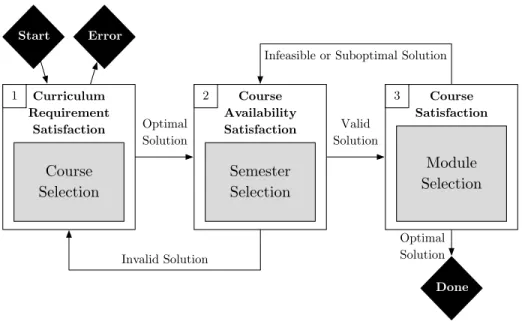
4.4.1. Curriculum/Requirement Satisfaction . . . 45
4.4.1.1 Decision variables . . . 46
4.4.1.2 Reusability constraints . . . 46
4.4.1.3 Prerequisite/corequisite constraints. . . 47
4.4.1.4 Requirement credit constraints . . . 48
4.4.1.5 Interest constraints . . . 49
4.4.1.6 Prior course or module constraints . . . 50
4.4.1.7 Total credit constraint . . . 50
4.4.1.8 Objective function . . . 50
4.4.2. Availability Satisfaction . . . 51 4.4.2.1 Course prioritization . . . 51 4.4.2.2 Semester selection . . . 54 4.4.3. Course Satisfaction . . . 56 4.5. SELECTION ENUMERATION . . . 58 4.6. SCHEDULE PRESENTATION . . . 59 4.7. CONCLUSION . . . 61 5. RESULTS . . . 62
5.1. NO PRIOR COURSES OR PREFERENCES . . . 62
5.1.1. Course Selection . . . 63
5.1.1.1 Decision variables . . . 63
5.1.1.2 Requirement reusability constraints . . . 63
5.1.1.3 Requirement credit constraints . . . 63
5.1.1.4 Prerequisite constraints . . . 64
5.1.1.5 Total credit constraint . . . 64
5.1.1.6 Objective function . . . 64 5.1.1.7 Solutions . . . 64 5.1.2. Semester Selection . . . 65 5.1.2.1 Iteration 1 . . . 65 5.1.2.2 Iteration 2 . . . 65 5.1.2.3 Iteration 3 . . . 65 5.1.2.4 Iteration 4 . . . 66 5.1.2.5 Iteration 5 . . . 67 5.1.2.6 Iteration 6 . . . 67 5.1.2.7 Iteration 7 . . . 67 5.1.3. Module Selection . . . 67
5.1.3.1 Decision variables . . . 67
5.1.3.2 Required module constraints. . . 68
5.1.3.3 Course credit constraints . . . 69
5.1.3.4 Total credit constraint . . . 69
5.1.3.5 Objective function . . . 70
5.1.3.6 Solution . . . 70
5.2. PRIOR COURSE AND EXPLICIT PREFERENCE . . . 70
5.2.1. Course Selection . . . 70
5.2.1.1 Decision variables . . . 71
5.2.1.2 Requirement reusability constraints . . . 71
5.2.1.3 Requirement credit constraints . . . 71
5.2.1.4 Prerequisite constraints . . . 71
5.2.1.5 Course preference constraint. . . 72
5.2.1.6 Prior course constraint . . . 72
5.2.1.7 Total credit constraint . . . 72
5.2.1.8 Objective function . . . 72 5.2.1.9 Solution . . . 72 5.2.2. Semester Selection . . . 72 5.2.2.1 Iteration 1 . . . 73 5.2.2.2 Iteration 2 . . . 73 5.2.2.3 Iteration 3 . . . 73 5.2.2.4 Iteration 4 . . . 74 5.2.2.5 Iteration 5 . . . 74 5.2.2.6 Iteration 6 . . . 74 5.2.2.7 Iteration 7 . . . 74 5.2.3. Module Selection . . . 74 5.2.3.1 Decision variables . . . 75
5.2.3.2 Course reusability constraints . . . 75
5.2.3.3 Required module constraints. . . 75
5.2.3.4 Course credit constraints . . . 76
5.2.3.5 Module preference constraint . . . 76
5.2.3.6 Prior module constraints . . . 77
5.2.3.7 Total credit constraint . . . 77
5.2.3.8 Objective function . . . 77 5.2.3.9 Solution . . . 77 6. CONCLUSION . . . 78 APPENDIX . . . 80 BIBLIOGRAPHY . . . 83 VITA . . . 87
LIST OF ILLUSTRATIONS
Figure Page
4.1 Example of a Modular Course Hierarchy . . . 30
4.2 Database ER Diagram of MCH Levels 1-3 . . . 31
4.3 CSA Flowchart . . . 45
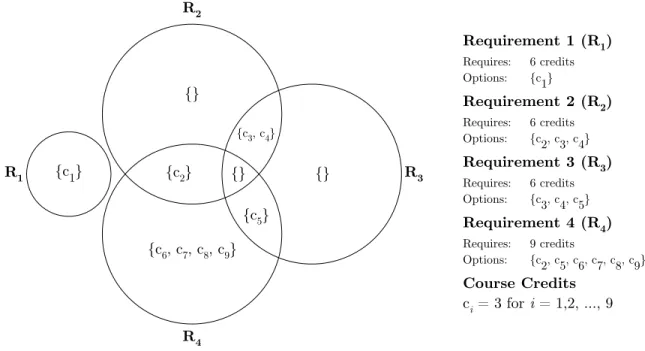
4.4 Shared Courses Between Requirements. . . 47
4.5 Prioritized Requirement Graph . . . 52
4.6 Prioritized Course List . . . 54
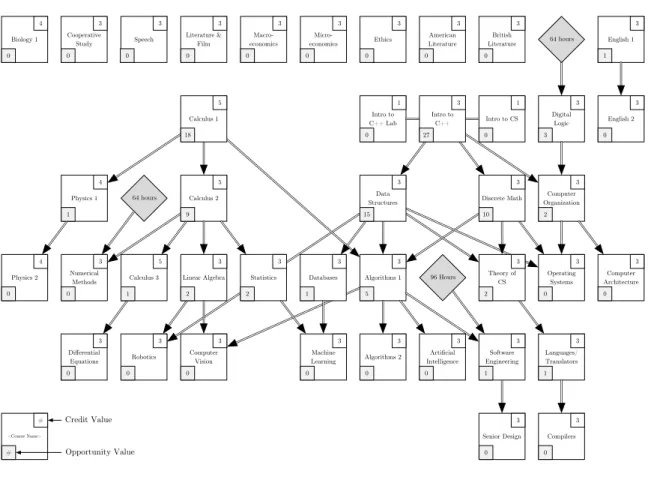
5.1 Prerequisite Graph . . . 66
5.2 Priority List . . . 66
5.3 Shared Modules Between Courses . . . 68
Table Page
4.1 Modular Course Hierarchy Entities . . . 28
4.2 Example Entity Relationships . . . 32
4.3 Entity Relationship Type Descriptions . . . 33
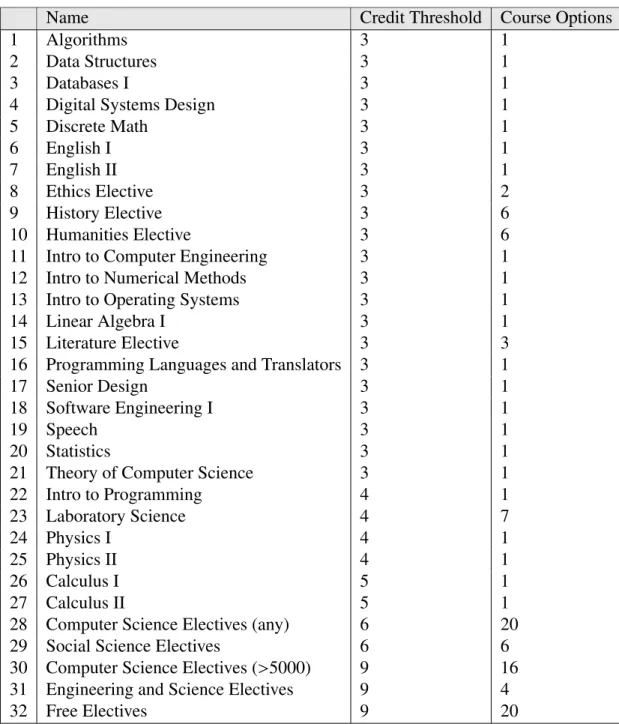
4.4 Sample Computer Science Curriculum Requirements . . . 60
5.1 Curriculum Requirements . . . 62
5.2 Course Selection Solutions . . . 65
5.3 Module Selection Solution. . . 70
5.4 Course Selection Solutions . . . 73
Acronyms
AOE Area of Emphasis
CSA Course Selection Algorithm
ER Entity-Relationship
ESA Entity Selection Algorithm
ILP Integer Linear Program
LP Linear Programming
MCH Modular Course Hierarchy
PERCEPOLIS Pervasive Cyberinfrastructure for Personalized Learning and Instructional Support
RS Recommender System
SSM Summary Schemas Model SVG Singular Value Decomposition
Education-applicable technology, e.g., databases, pervasive computing, computa-tional intelligence, has long been leveraged to support learning online, in the classroom, or elsewhere [1, 2, 3]. As a result, there has been a continuous attempt in using technol-ogy to engage those who wish to learn. The prevalence of mobile computers coupled with wireless connectivity has made a vast amount of information readily available. In addition, many schools are using software tools such as Blackboard and Canvas, which help teachers to organize their courses and create content that can be easily delivered and graded [4, 5].
Moreover, recently we have been witness to efforts to publish course content for
consump-tion by anyone with an Internet connecconsump-tion, free of charge [6, 7, 8, 9]. Consequently, a vast amount of content already exists, and many technological solutions are available that deliver content anytime, anywhere. In spite of all of the content delivery solutions available to us, none have replaced the classroom as the predominant environment for content deliv-ery. This work focuses on developing ways to improve learning by designing solutions that can ensure that students and instructors are better prepared before they even set foot in the classroom.
PERCEPOLIS allows one to develop a personalized education plan that ensures in-tended graduation date and is tailorable to the individual’s interests or mandates. The first step toward this goal has been to understand entities within the educational space, such as students, instructors, courses, and technology, among others. To this end, this research developed an ontology denoted as the modular course hierarchy (MCH). The MCH defines and classifies entities, e.g., institutions, curricula, courses, according to their attributes and relationships with other entities. By arranging these entities into layers based on their clas-sification, a hierarchical structure is formed. A curriculum is comprised of many courses; hence the curriculum can be observed as exhibiting modularity and hierarchical attributes.
Modularity is applied to nearly all levels within the MCH and is the primary concept used to define the relationships between entities. By having layers of entities and relationships, a higher resolution of information is achieved.
When implemented for persistent storage, such as a relational database, the MCH can be used by applications to intelligently extract information, such as student interests, skills, learning styles, and performance, at any level of the MCH. One such application is PERCEPOLIS, a pervasive cyberinfrastructure for personalized learning and instructional support, originally presented in [2]. The most recent implementation of PERCEPOLIS is a web-based application that utilizes the MCH in relational database form. PERCEPOLIS is used to represent curricula (managing entities and relationships) and make context-based recommendations to both students and instructors who are identified as users within the application.
1.1. MOTIVATION
The importance of addressing educational shortcomings in order to maintain com-petitiveness is seen at the highest levels of government [10] [11]. In a 2009 Pew Research survey that same year, 61 percent of Americans felt that improving education was a top priority, making it the fifth-highest ranking of the 20 issues in the inquiry [12]. The same survey repeated in 2016 reported an increase in public prioritization to 66%, making ed-ucation the third-highest [13]. In spite of those statistics, proficiencies in elementary and secondary education have not seen significant improvements, and college enrollment de-creased by 4 percent, both according to the National Center for Education Statistics (NCES) [14]. Despite the decrease, however, the same article by the NCES projects college enroll-ment to increase 14 percent from 2014 to 2025. The Departenroll-ment of Education reports that the average length of time it is taking students to achieve a B.A. or B.S. is about 6 years at 4-year institutions [15]. Outside the classroom, advisors and instructors play a crucial role in student confidence with educational planning that can save or waste students’ time
and money. This is becoming increasingly more important as the cost of higher educa-tion increases. Students are better able to plan their educaeduca-tion and reduce costs if they are able to receive timely feedback from an expert advisor, but for many students the quality and availability of such feedback is lacking [16]. This is akin to coursework were stu-dent access to rapid and corrective feedback is key to ensuring information retention [17]. Collectively, the above studies show that demand for higher education is growing, but in order to maintain or increase the quality of education institutions will have to operate more
efficiently.
One option is to introduce technology which seeks to help students decide what, when, and where to learn, and with whom to do so. This could involve decision support all the way from planning courses for multiple degrees down to which content to access and in what order. If one searches recent media reports, both mainstream and student or-ganizations still call for improvements to degree planning. In February of 2017, The New York Times reported on Georgia State’s nursing program where data analysis showed that failure in introductory math correlated more strongly with long term success in the pro-gram than did failure in a core curriculum nursing course [18]. The report emphasized
the expanding efforts of using predictive analytics to determine the likelihood of long-term
student success. The California State University System issued a press released on efforts
to expand the use of e-advising systems on their campuses [19]. Over the past 4-5 years, electronic academic planning and course scheduling have been implemented on all of their 23 campuses, while predictive analytics has been implemented on only 15. This level of adoption illustrates a high-level recognition that students can benefit from better tools if implemented properly. Still, technology to handle curriculum changes such as modified requirements or course renumbering is not available everywhere. The Ithacan reported this year that some senior students at Ithaca University are barely managing to graduate because of changes to curriculum requirements [20]. These changes led to inaccurate advising, re-sulting in a perceived reduction in flexibility and mistakenly taking a course that supposedly
fulfills two requirements, when in actuality it did not. This thesis aims to directly address aforementioned issues.
1.2. OBJECTIVES
The objectives of the research presented in this thesis are three-fold: 1. Define the course selection problem
2. Solve the problem with a course selection algorithm 3. Personalize the course selection
4. Implement and validate the proposed algorithm
The course selection problem continues to plague students in many different
insti-tutions, so this research defines the problem in a way that makes it more widely applicable. To accomplish objective 1, the problem is defined in terms of the entities and relationships within the educational environment while maintaining simplicity and institution indepen-dence. To satisfy objective 2, the problem is modeled as an integer linear program (ILP) and solved using an established solutions. To satisfy objective 3, achieving personalization requires the integration of algorithmic behavior which favors adherence to the target stu-dent’s preferences. Lastly, satisfying objective 4 requires coding of the algorithm, creation
of different data sets, and analyzing the results of execution under a variety of conditions.
1.3. OUTLINE
The remainder of this thesis presents the new course selection features within PER-CEPOLIS, beginning in Section 2 with a treatise on such background research as ontology, context-aware recommender systems, semantic similarity, and course selection. Section 3 contains an in-depth look at what PERCEPOLIS was envisioned to be in [2], the goal of which is to make it clear how the contributions of this thesis impact the larger project. All of this establishes a backdrop for Section 4 where the research contributions are
pre-sented and the methodology of PERCEPOLIS’s course selection algorithm is discussed in detail. Once the algorithm has been presented, Section 5 presents the results of numerous case studies. Lastly, the thesis concludes with some final thoughts and proposals for future research directions in this area.
Development and implementation of this course selection methodology, and more broadly, PERCEPOLIS, borrows knowledge from several areas including: ontology, context-aware recommender systems, data heterogeneity, and semantic similarity. Ontology en-ables the unification of entities and relationships within the educational space into one formal definition and ultimately, allowing the course selection algorithm (CSA) presented in this thesis to operate on educational entities from multiple institutions. PERCEPOLIS itself is a context-aware recommender system since it considers the available context sur-rounding a student prior to making recommendations. Familiarity with data heterogeneity
has made aware of the eventual challenges associated with merging data from different
institutions. Obtaining an effective tool for semantic similarity is important to matching
student interests to available courses. Lastly, previous attempts at course selection have played a crucial role in providing insight on how to begin modeling the problem, let alone to solve it. The primary goal of this section is to provide the reader with a literary basis with
which they are sufficiently prepared to understand PERCEPOLIS and its underpinnings.
2.1. ONTOLOGY
An ontology can be viewed as a meta-data schema [21]. With respect to computer science, ontologies serve to represent the real world in computer programs as visualiza-tions of a shared conceptualization. Ontology-based models by nature exhibit great formal expressiveness and capabilities for applying ontology reasoning techniques [22]. As such, they are especially useful tools for modeling context-based pervasive computing environ-ments. Each ontology establishes the essential components of that which is being modeled, and its semantics are explicitly defined and machine-processable. By defining shared and common domain theories, ontologies help people and machines to communicate concisely,
supporting semantics exchange, not just syntax [23]. Ontology-based modeling also
nego-tiates a trade-offbetween expressiveness and complexity of reasoning [24]. Examples of
context-aware frameworks utilizing ontologies as the underlying context model are easy to find in the literature [25, 26, 27].
A 2004 survey sought the most relevant methods of modeling contexts for ubiqui-tous environments [28]. In the survey, six requirements were identified within ubiquiubiqui-tous computing: distributed composition, partial validation, richness and quality of information, incompleteness and ambiguity, level of formality, and applicability to existing
environ-ments. The authors evaluated six different models to see which of these requirements were
met. These six models are: key-value, markup scheme, graphical, object-oriented, logic-based, and ontology-based. They concluded that the most promising methods of context modeling for ubiquitous computing environments were ontology-based. Object-oriented methods were close behind, falling short in partial validation and level of formality.
2.2. CONTEXT-AWARE RECOMMENDER SYSTEMS
This section discusses the definition of context-aware recommender systems and the influence related literature has on PERCEPOLIS. [29] provides a “coherent and uni-fied repository of recommender systems’ major concepts, theories, methodologies, trends, challenges and applications.” Recommender systems (RS’s) are introduced as software and techniques that suggest one or more items to a particular user [30]. Traditional RS’s typically rate a user’s preference towards all items and recommend the item or items that are rated the highest. RS’s are called traditional (or two-dimensional) because their rec-ommendation process only considers the user and item. Recrec-ommendations can also be tailored to recommending sequences or groups of related items, which is directly applica-ble to PERCEPOLIS since it recommends course schedules which technically fall into both categories. Considerable concern is also often given to the data and availability of data used by a recommender system [31]. A lack of data is often a major challenge for recommender
systems within the educational space, and PERCEPOLIS is no exception. Because of this, much of the data PERCEPOLIS needed was partially obtained by automated means and curated by hand after the fact over a long period of time.
Context, a multifaceted concept, is used by recommender systems to improve the quality of recommendations by considering the circumstances surrounding users and items, forming what are known as context-aware recommender systems (CARS) [32]. The defi-nition of context varies greatly by field and even subfield, but it typically involves informa-tion about time, locainforma-tion, and relainforma-tionships between users and items. As such, one will find that context-aware systems often involve mobile devices. The definition of context within
PERCEPOLIS falls under arepresentationalview because the set of attributes for different
user types can be observed and predefined with a reasonable expectation that they will not change over time [32], a quality established by the use of ontology. The exact contextual information considered by PERCEPOLIS is discussed in Section 4.3.
The termcontext-awareis often associated in literature with mobile devices that can
sense some aspect of their environment and adapt accordingly [33]. CARS that use mobile devices can easily fall into the field of pervasive computing when the context gathering is conducted in an ubiquitous fashion and recommendations are made proactively [34]. Such systems could use student location data to draw conclusions about performance by class-room, or by knowing when the student usually studies, proactively suggest a quiet study location based on the current concentration of students across campus. Within PERCEPO-LIS, there is an expectation that contextual information related to courses and students be updated frequently to make sure recommendations stay valid. This can be done for students by periodically searching for updates to courses or available content, and then recomputing the potential interest a student may have in a course. On the other hand, information such as course availability must be provided by institutions as they are able to provide it.
2.3. DATA HETEROGENEITY&SEMANTIC SIMILARITY
An increase in the number of institutions using learning technology results in a wealth of institution-specific data that is distributed and heterogeneous in nature [3]. Each institution maintains its own database(s) of student records, courses, instructors, etc., the autonomy of which must be preserved. At this stage, students and their institutions must provide PERCEPOLIS with their information. Connecting to and retrieving data from the proprietary schemas of institution databases, while technologically possible and vastly more convenient, is not within the current scope of this work. Such information reveals that
the same course at different institutions may have slightly dissimilar names and content,
which presents a challenge when comparing students at different institutions based on their
enrollment behavior. The area of multidatabase systems, the closely associated challenge of resolving data heterogeneity, is not a new area of research [35]. Any adoption of this algorithm in a system which includes data from multiple institutions will either need to use the underlying ontology-based cyberinfrastructure of PERCEPOLIS or limit its use to a single institution, which has downsides.
By identifying equivalence or similarity across institutions, more information about certain types of students is made available. Moreover, deriving similarity enables us to in-telligently share content from one institution to students in another. The issue of similarity also arises when the course selection algorithm presented in this thesis attempts to match student interests to existing courses. PERCEPOLIS uses an implementation of Word2Vec, a natural language processing model developed by Google to identify words related to the student’s interests, to find courses of interest [36]. PERCEPOLIS then searches course information attempting to find content that matches the related set of words.
One of the basic principles behind this method is to represent words in terms of their neighbors as vectors. Word vectors can be formed by taking counts of neighboring words and forming what is called a co-occurrence matrix, however the dimensionality of this matrix can get unreasonably large. To solve the high dimensionality issue, Singular Value
Decomposition (SVD) was used on the co-occurrence matrix to obtain word vectors with lower dimensionality. However, for millions of words or documents, the co-occurrence matrix size creates a scalability problem increasing computational cost of performing SVD quadratically. For a more recent introductory reading on deep learning in natural language processing, the interested reader is referred to [37]. Another approach to creating word vectors, which is used by Word2Vec, is to predict the surrounding words of every word, as opposed to taking the global count for an entire text corpus. This allows one to identify complex patterns in addition to word similarity.
WordNet, an English, lexical database that has been developed at Princeton since the 1980’s was also considered [38]. WordNet is similar to a dictionary, but instead of storing words with respect to their spelling, it stores words based on their relationships with other words. More specifically, words which are similar in meaning are linked together with pointers of varying types forming a semantic network, i.e., an acyclic graph. These pointer types correspond to the relationship type, e.g., synonym, hypernym, hyponym, etc. Deriving a similarity metric using WordNet essentially involves the path length between two words [39].
For this research, Word2Vec was chosen for a couple of reasons: firstly, unlike WordNet, Word2Vec does not require the storage and management of a large database of syntactic and semantic relationships. Word2Vec can just keep reading the latest avail-able text corpus to stay up-to-date with new terminology and even improve existing word vectors. Secondly, working implementations of Word2Vec that integrated easily with PER-CEPOLIS were more readily available thanks to its popularity. It should be noted that WordNet is limited to its English-based taxonomy, so supporting other languages would
2.4. COURSE SELECTION
The problem of selecting courses for a particular student is primarily the role of academic advisors who are experts in institutional requirements. Many researchers have inevitably attempted to automate parts of the advising process because requirements are numerous yet well-defined. Selecting courses to fulfill requirements for some degree at a specific institution is relatively straight-forward. However, designing a system which accommodates multiple degrees across institutions, let alone attempting to personalize a selection, is much more complex and shown in literature without significant or reproducible results. Nonetheless, a number of related works have contributed to better course selection by providing more insight or solving smaller pieces of the course selection problem.
Murray and Le Blanc provide one of the earliest and most notable attempts at a decision support for academic advising [40, 41, 42]. A major contribution of their work was the identification of key observations and rules for course selection. Firstly, they cate-gorized degree requirements, and while their categorization seemed correct, doing so is not
necessarily needed. If different requirements lead to different categories across different
degrees, then one must carry out the burdensome task of identifying and accounting for all of them. As a result, this thesis finds that it makes more sense to define requirements only in terms of what courses can and should fulfill them. Murray and Le Blanc also apply the following rules in order:
1. Deepest Layer: the longest chain of courses connected by prerequisite relationships represents the minimum number of semesters required to graduate.
2. Maximum Dependency: courses thatunlock more courses for enrollment should be
taken earlier.
3. Lower Course Number: courses with lower course numbers should be taken earlier. The authors state that when courses are indistinguishable after applying all three rules, then the order of selection does not matter. Unfortunately, little detail is given on the implementation and their influence on this thesis ends here.
Since the 90s, a number of systems which perform automated advising have been developed by or for specific institutions, but there is no survey which attempts to catalog them. These systems vary greatly how they accommodate institution rules and perform course selection, and only those systems which met certain criteria are discussed from this point forward. The criteria used are defined as follows:
• the course selection methodology must be discussed in enough detail to be
repro-ducible (excluding source code);
• the course selection methodology must be adaptable to more than one institution and
degree, even if that is the only use-case discussed; and
• attempts must be made to personalize course selections for students.
What is left are relatively recent attempts.
SASSY performs course selection by using a proprietary Course-Petri Net (CPN) to model courses, requirements, semesters, and availability [43]. The creators of SASSY
define a Petri Net (PN) as a four-tuple (P,T,I,O) where P = p1,p2, . . . ,pi is a finite set
of places, T = t1,t2, . . . ,tj is a finite set of transitions, P ∩T = ∅, I : T → P∞ is the
input function mapping from transitions to multi-sets of places,O : P →T∞ is the output
function mapping from transitions to multi-sets of places, all of which come from [44].
A CPN is then defined as a Petri Net for which P andT are expanded. P is partitioned
into the sets D, R, and A where D is a finite set of degree requirements, R is a finite
set of prerequisites, and A is a finite set of availabilities. Thus, P = D ∪ R ∪ A and
D ∩ R ∩ A = ∅. T is then partitioned into the sets S and C where S is a finite set of
semester transitions and C is a finite set of course transitions. Thus, T = S ∪C and
S ∩C = ∅. With this additional information, SASSY attempts to produce a complete
selection of courses for the remainder of the student’s time in school while considering issues such as course load, time to graduation, and course preferences specified by the student. SASSY and PERCEPOLIS agree on the intuitiveness of a graph-based solution to the problem since it naturally follows from the prerequisite relationships between courses.
However, the two systems differ primarily in scope with SASSY’s considerations being a subset of those found in PERCEPOLIS leading to a greater degree of personalization with respect to performance and implicit interest in courses. Moreover, SASSY does not attempt to handle the modularization of courses as PERCEPOLIS does to reduce the time to graduation.
While Section 4 discusses the CSA in detail, an important topic with which to be familiar is linear programming, a classical computer science problem. A linear program (LP) involves the minimization or maximization of a linear function with respect to a set
of linear equalities or linear inequalities [45]. Given a set of real numbers a1,a2, . . . ,an
and a set of variables x1,x2, . . . ,xn, the general LP has a linear objective function of the
following form [45]: f(x1,x2, . . . ,xn)= a1x1+a2x2+· · ·+anxn = n X j=1 ajxj.
Alternatively, the above definition is sometimes found in a more complex matrix represen-tation. It is the objective function for which the minimum or maximum value is sought, and in practice constraints are applied which limit possible values. These constraints are represented as linear equalities or inequalities depending on the form being used. The
prob-lem becomes an integer linear program (ILP) when the variables x1,x2, . . . ,xn may only
take integer values. The most common methods used to solve linear programs are simplex-based and interior points, and for ILP’s something like COIN-OR CBC is used [46]. This
research identifies that course selection consists of different linear programming problems,
examples of which are requirement satisfaction and semester satisfaction. In the case of requirement satisfaction, the goal is to minimize the number of credit hours while ensuring that the right courses are used. For semester satisfaction, the goal is to keeping credit hours within some range while preserving requisite constraints.
IDiSC+expands prior work and SASSY by considering more institution rules and
creating a variety of selections from which a student must choose [47]. IDiSC+, similar
to SASSY, formalizes its course selection methodology, except it uses integer linear pro-gramming. The overall process consists of three sequential phases: modeling, exploration, and consolidation. Constraints, such as desired courses, availability, credits per semester, courses per semester, GPA per semester, budget per semester, and others, are first set by the institution or student in the modeling phase. All of these constraints are input to an objective-function which provides a value of optimality. The exploration phase involves providing these constraints to third-party software tool that searches for “optimal” solu-tions, each with their own objective-function value. A “diverse” set of course plans for the student to choose from is created by running the software tool with slight variations on the
constraints. The final phase ofconsolidationis where the student makes a decision or
ex-ploreswhat-if scenarios. Note that the terms “course plan” or “study plan” are used in [47]
while “course selection” is used in this thesis. The author primarily focuses on defining the constraints and discussing how to properly tune them for diverse, yet valid, solutions.
The constraints that institutions and students may set in IDiSC+are comparable to those in
PERCEPOLIS, however the following differences should be noted: firstly, the separation
of course requirements and the courses which can satisfy them is not resolved. Any CSA must guarantee adherence to certain institution rules and only after that provide a mea-sure of optimality with respect to less strict constraints. Secondly, there is no mechanism
by which IDiSC+attempts to personalize the schedule for students whose interests are
un-known. Another key difference is that students’ grades only affect the selection of electives,
whereas PERCEPOLIS uses grade information for both course selection as well as
loca-tion in the schedule. As a result, IDiSC+ attempts to distribute courses within a schedule
normally. The final notable difference is that individual semester difficulty is never
consid-ered by IDiSC+. Differences between the two systems, of which there are more, represent
2.5. CONCLUSION
This section laid out the related works that lend to the work presented in this thesis. Each section provides discussion primarily on only those works that have had direct influ-ence. Note that in a small number of cases, a related work was not directly influential, but it is still discussed to give the reader awareness of particularly important works in the area. Additionally, concepts which are key to the problems being solved were outlined with a citation which covers the subject in significantly more depth. Ontology is the first area dis-cussed, and its influence on this thesis is the establishment of a shared conceptualization of
the existing educational space. This has affected nearly everything from terminology to the
PERCEPOLIS implementation (database design, CSA, etc.). Context-aware recommender systems were then discussed at a high level because while the focus of this thesis is
pre-dominantly about the CSA, PERCEPOLIS in its entiretyisa context-aware recommender
system. As such, idiomatic terms and techniques of the field need to be established. The third section discussed data heterogeneity and work that has aided in connecting student in-terests to available options based on semantic similarity. The last section is most important as it covers specific attempts at course selection that have educated the design and imple-mentation of the CSA. Altogether, the reader should come away from this section with a
foundation sufficient enough to understand the course selection problem and how the CSA
This section presents an overview of PERCEPOLIS, a Pervasive Cyberinfrastruc-ture for Personalized Learning and Instructional Support [2]. PERCEPOLIS is an educa-tional platform developed to support personalized learning and networked curricular mod-els in higher education. PERCEPOLIS carries out its functions by leveraging pervasive computing and communication through the use of intelligent software agents. These soft-ware agents consider all available contextual information from institution information and student profiles to customize courses. The goal of this section is to give the reader insight into the larger project (as described in [2]) such that this research’s contribution can be better appreciated. This section discusses the design and anticipated outcomes of PERCE-POLIS in two distinct sections. The first section on the design of PERCEPERCE-POLIS covers modular course development, blended instruction and learning, intelligent access tools, personalization of course content, and tracking of student progress. The second and final
section on anticipated outcomes describes what the expected effects are on students and
classrooms if PERCEPOLIS is employed.
3.1. DESIGN
The PERCEPOLIS platform views a degree-granting program as three sets of
enti-ties: 1) the set of instructors/advisors,I; 2) the set of students,S; and 3) the set of courses,
C. An instructor/advisor,i ∈ I, has expertise in one or more subjects. A student, s ∈ S,
is studying towards a degree and is required to take courses fromC, in an orderly fashion,
to satisfy degree requirements and objectives. Eachc ∈ C represents a course in the
cur-riculum. The courses inCare interrelated, per the structure of the curriculum. In addition,
courses are tagged as required or elective, according to degree requirements. Each of I, S,
and negotiate with each other according to the defined tasks, e.g., personalizing the trajec-tory through a course or curriculum. A modular approach is used in the development and
delivery of courses, so that each coursec ∈Ccan be viewed as a collection of interrelated
modules, where the degree of connectivity among modules can vary from course to course.
3.1.1. Modular Course Development. Fundamental to PERCEPOLIS is the mod-ular approach to course development. Each course is divided into several content modules, a number of which are mandatory, as dictated by the curriculum to satisfy degree objectives, requirements, and accreditation requirements, e.g., ABET. The remaining content modules, typically smaller in number, include elective content that can be chosen to supplement the student’s knowledge of prerequisites, or to engage an interested student in more advanced
topics. The content modules for each course can be supplemented by experiential
mod-ules, which are intended to reemphasize key issues covered in the content modules through hands-on individual and group projects. The experiential modules are dynamic, as their contents can be determined based on topics that a majority of the students in a given class find challenging or confusing. Associated with each module are learning objects such as prerequisite modules, lecture notes, problems, sample solutions, and programming or lab-oratory exercises. Course modules are self-contained, self-paced, and designed to promote active rather than passive learning.
All courses are “mix-and-match,” in the sense that each consists of several mod-ules on interrelated topics which are, in turn, interrelated across the whole curriculum in a networked fashion. Some modules require prior knowledge; if the student does not have
this background, he/she should be able to peruse a module from an earlier course before
reentering the current module. Assessments that gauge the student’s mastery of concepts at the module level are used to allow self-paced progression through the course. If a stu-dent has already mastered the material in a module and wishes to explore the topic in more
depth, he/she can choose a more advanced module in that subject. To maintain a sense of
encour-aged to serve as group leaders. This peer learning approach fosters “soft” skills, such as communication and negotiation. Each module reinforces background knowledge and
al-lows self-paced progression and options to study more advanced concepts and/or to gain
missing basics.
In short, modular course design offers:
• Adaptability/flexibility: to a certain extent, course contents can be personalized based
on a student’s needs and interests. This is particularly beneficial to students in honors or certificate programs, graduate students, and transfer students.
• Continuity: the modular approach to the course design, combined with the ability
to personalize the contents of a course allows greater continuity in the curriculum, while satisfying the needs of some students without sacrificing the needs of others.
3.1.2. Blended Instruction and Learning. Common experience shows that on-line availability, e.g., through a course management system such as Blackboard, of lecture notes and other instructional content generally leads to low class attendance by students. Even students who continue to regularly attend classes may become inattentive in the class-room and passive in any discussions that take place. Furthermore, there is an increasing expectation that the course coverage and examination must be limited to whatever is avail-able online, and any topics discussed outside of class should not be covered on the tests. Periodic examinations and pop quizzes (though extremely unpopular among the students), to some degree, could be reasonable solutions; but are becoming scarce due to large class sizes. This research seeks to adopt a new teaching practice that is attuned to advances in technology, is interactive and motivates active class participation, enforces continuous learning, and fosters interpersonal skills that may be neglected in a traditional classroom. To achieve these objectives, PERCEPOLIS modifies the traditional lecture-based teaching environment by utilizing a blended approach to learning and instruction as follows:
• Most, if not all, of the class period is dedicated to interactive problem-solving based
• Students are required to peruse specified learning objects before class. All content modules are made available online in advance, and group study (facilitated by the experimental modules) is highly encouraged.
• Students are expected to either communicate major issues with the instructor ahead
of time, bring their questions to the class, and/or use online communication tools
such as discussion boards to share their concerns and questions with their peers.
• The class period then is dynamically organized to address major issues raised by
students and enhance their understanding of subject matter learned in the content module.
• To encourage independent learning and reflection and continuous involvement, at the
beginning of each class period, students are quizzed on the major conceptual topics (mandatory modules) they have been asked to study. The remainder of the session is devoted to addressing students’ questions, and discussing and analyzing the more complex topics covered in the mandatory modules.
• Traditional periodic homework assignments, projects, and examinations will
con-tinue to be utilized to reinforce learning and determine the students’ overall mastery of course contents. Naturally, implementation details such as absences due to exten-uating circumstances need to be addressed in a fair and appropriate fashion.
• Maintain a sense of community, advanced students who progress through the course
more rapidly will serve as group leaders and are rewarded with extra credit for their
efforts in mentoring and tutoring their peers.
• Finally, provisions are made to encourage, promote, and reward group activities and
missing basics such as leadership, communication skills, and ethics.
In short, this perspective of the classroom promotes experimentation and discovery, and allows more time to address key issues in mandatory content modules.
3.1.3. Intelligent Access Tools. PERCEPOLIS leverages research in mobile agent technology, multidatabases, pervasive computing, and mobile data access systems to
de-velop middleware that serves as global information sharing cyberinfrastructure. This mid-dleware is positioned on top of existing database and course management systems, and allows anytime, anywhere, intelligent, and transparent access to content modules that com-prise the courses of a curriculum. PERCEPOLIS research within the scope of global in-formation sharing, multidatabases, and multimedia data processing has resulted in the de-sign and implementation of an intelligent search engine, denoted as the Summary Schemas
Model (SSM) [35], that supports automatic identification of semantically similar/
dissim-ilar data that have different/same names and representations in a wired or wireless
plat-form. The model uses word relationships, i.e., hypernym, hyponym, synonym, defined in a standard thesaurus such as Roget’s, to automatically build hierarchical metadata of lo-cal access terms exported from underlying lolo-cal databases. The embedded dynamic nature and bottom-up design approach of the SSM makes it particularly suitable for extending the scope of PERCEPOLIS beyond a single discipline or educational unit. The summary schemas concept underlies a semantic network and semantic metadata that integrate course modules, and hence courses, within and across multiple curricula.
Furthermore, with the aid of the navigational tools and imprecise content-based search capability of the SSM, users, e.g., students, instructors, and advisors, can browse through content modules from a range of courses and curricula to determine an appropriate learning trajectory. The choice of the SSM, regardless of one’s familiarity with the concept and access to its prototype, stems from: 1) its ability to perform semantic search and im-precise queries, 2) the relatively small size of its metadata, 3) the robustness of the model,
4) its automatic generation of metadata, and finally, 5) the efficiency of the platform.
In the context of PERCEPOLIS, the SSM metadata hierarchy, at the root level, represents the curriculum, e.g., computer science and computer engineering curricula, with semantic terms that specify curriculum objectives and content requirements. The leaf nodes then represent the course modules. The synonym, hypernym, and hyponym links are used
The metadata structure of SSM can be built in either a centralized or distributed fashion on top of the content and experiential modules. The relational data model is ex-pected to be used to model course modules. As a security measure, provisions are made
to provide different access capabilities to different classes of users, e.g., students,
adminis-trators, or course developers, based on their individual profiles. In addition, PERCEPOLIS has an interactive, dynamic, and user-friendly graphical user interface (GUI) to facilitate user access to the system.
3.1.4. Personalization of Course Content and Tracking of Student Progress.
PERCEPOLIS is extended into the areas of pervasive computing and mobile agent tech-nology to create a virtual environment that supports a networked curricular model and a subject-based one-to-one student-faculty ratio for the purpose of mentoring, advising, guiding, and educating students within a program. As described earlier, a student agent,
in communication with the agent of his/her academic advisor, in concert with his/her
ac-cumulated academic background, interests, and special needs, determines a personalized
trajectory of courses and/or modules for the student. In this process, the SSM is consulted
as a backbone data source to determine the personalized trajectory, as well as a contact course advisor (naturally, in most cases this would be the designated course instructor or course supervisor). At this point, various communication means are set up for the duration
of the semester, to facilitate interaction between the student and instructor/advisor.
An agent is associated with each module. The agent is also linked to other agents (modules) in the same course, as well as related modules in other courses. The agents representing various modules within a course form a community among themselves, repre-senting that course. The agent associated with a module reports directly to the instructor, but also serves as a virtual guide to the student for the duration of the course.
More specifically, when a student,s, is required to take a course,c, an agent,Dsc, is
created to represent the student in that course. Dsc acquires information about the student’s
pre-requisite knowledge, among other required information. Dsc interacts with the agents of
course modules to identify a personalized trajectory of modules and learning objects for
the student. Furthermore, Dsc ensures that the student peruses required material-notes,
sample programs, exercises, and the like. Dsc also alerts the student to timelines, class
schedules, learning/discussion schedules, project deadlines, appointments with the
instruc-tor, and corresponding preparations. The instructor agent for the course, Dsc, ensures that
the student meets all requirements for each mandatory module, and collaborates with Dsc
to ensure that the student is supplied with all required course material. Dscalso informs the
instructor about the progress of the student and alerts the instructor whenever the student is progressing too slowly or too rapidly.
3.2. ANTICIPATED OUTCOMES
PERCEPOLIS aims to facilitate all four stages of cognitive apprenticeship: 1. Modeling: enabling students to observe an expert in action.
2. Scaffolding: provide support for students to emulate expert performance.
3. Coaching: providing students with deliberate, planned feedback that guides their performance from novice- to expert-level.
4. Fading: removing the scaffolding as students become more competent.
In the modeling stage, multimedia demonstrations and animations can be incorpo-rated into the course modules as representations of expert performance. Solved problems, design examples, and guided exercises with “hints” are among the learning objects useful
in the scaffolding stage. Online assessments, some of which are graded instantaneously,
are examples of learning objects that facilitate coaching. The fine-grained data collection enabled by the cyberinfrastructure facilitates the provision of more accurate and detailed feedback to the students, which is especially helpful in the coaching stage. Graceful and gradual fading of instructor support is also supported, e.g., through learning objects that feature advanced problems or exercises. The availability of online learning objects that
can be perused at a student’s convenience provides subtle assistance that encourages and
supports efforts in the absence of the instructor, further facilitating fading.
PERCEPOLIS enables blended learning, where online, computer-mediated instruc-tion supplements tradiinstruc-tional classrooms. Students are expected to peruse before class learn-ing objects pertainlearn-ing to concepts traditionally taught durlearn-ing the lecture portion of a course. This allows class time to be used for problem-based learning and other educational ap-proaches conducive to the cognitive apprenticeship. As an example, the students can be required to peruse a learning object that presents the general steps of a design technique prior to class. In-class demonstrations of the technique on an actual design problem by the instructor or a guest expert can serve as a model for the students. Alternatively, they can
work on a design problem in class (scaffolding) and receive feedback (coaching). Gradually
increasing the sophistication of the in-class activities supports fading.
The flexibility of the proposed cyberinfrastructure in utilizing computing technol-ogy to support rich educational content has the added benefit of facilitating the
accommo-dation of differences in learning styles. A traditional classroom setting mainly offers visual
and auditory content; print- or video-based distance study does the same. The ability to pro-vide tactile content, whether in reality, in a classroom setting, or through remote access and virtual reality, is especially helpful in the modeling stage of the cognitive apprenticeship,
but can also be exploited to increase the efficacy of other stages. Furthermore, the
pre-dominant learning style of a student can be assessed and used in personalizing courses and curricular trajectories for each student. An intelligent access tool can allow these resources
to be efficiently and dynamically incorporated into classroom discussions and linked to
electronic learning objects available for perusal by the students outside of class.
The self-paced and modular nature of the courses and the “anytime, anywhere” availability of the learning objects make the platform well-suited to eLearning, distance education, outreach activities, and workforce education or certificate programs. The same attributes allow graduate students engaged in interdisciplinary research to acquire the
requi-site broad background without having to complete traditional undergraduate level courses.
The software and content artifacts of PERCEPOLIS serve as effective advising tools that
can facilitate student course scheduling. Finally, the special accommodations needed for students with learning disabilities or physical challenges are aspects of personalization fa-cilitated by the cyberinfrastructure. Outside of academia, the intelligent personalization facilitated by PERCEPOLIS can be useful to streamlining professional training, whether technical or related to topics such as safety, workplace conduct, or cultural sensitivity.
Beyond the fundamental objective of personalizing the learning trajectory of a stu-dent through a networked curriculum, PERCEPOLIS aims to utilize teaching tools, ani-mation techniques, and remote access to inforani-mation to present the same inforani-mation in
different ways and accommodate differences in learning styles; allow self-pacing, privacy,
and flexibility; achieve spatial and temporal uniformity in presentation of the same
mate-rial; and ensure efficient utilization of resources and lower costs to students and providers.
The following outcomes are anticipated as a result of successful adoption of the proposed cyberinfrastructure:
1. Creation of a dynamic, student-sensitive, and adaptable blended learning environ-ment that allows a virtual one-to-one instructor-to-student ratio.
2. Definition of a novel methodology for modular course development, implementa-tion, and delivery that promotes continuous, self-paced, active, and peer learning and supports networked curricula.
3. Development of a novel navigational tool for student advising and course manage-ment that facilitates access, browsing, developmanage-ment, expansion, and modification of curricula and courses across multiple disciplines and institutions.
4. Development of a new technology-based methodology for effective and efficient
pre-sentation of courses and active engagement of students in the classroom.
5. A shift to professional practice as the focus of educational efforts, rather than
The novelty of PERCEPOLIS lies in its ability to leverage pervasive and ubiquitous computing and communication through the use of intelligent software agents that use a
stu-dent’s academic profile and interests, as well as supplemental information such as his/her
learning style, to customize the content of a course for the student. Furthermore, PERCE-POLIS facilitates the collection of data on student performance and learning at a resolution that far exceeds what is currently available. Knowledge discovery from this rich data set
can yield invaluable insights, such as the efficacy of particular instructional techniques and
strategies embedded in the learning objects. The data collected is also helpful for accred-itation self-studies. Learning objects, in particular assessments can be linked to specific learning outcomes of a course.
3.3. CONCLUSION
This section discussed PERCEPOLIS in order to give the reader a better
under-standing of how this research’s efforts on course selection fit into the overarching project.
PERCEPOLIS supports a shift from teaching technical skills to fostering the professional expertise required for a student to succeed as a practicing engineer. The dynamic nature of PERCEPOLIS lends itself to a wide range of disciplines beyond engineering. The self-paced and modular nature of the courses and the “anytime, anywhere” availability of the learning objects make the platform well-suited to eLearning, distance education, outreach activities, and workforce education or certificate programs. The software and content
ar-tifacts of PERCEPOLIS serve as effective advising tools that can facilitate student course
scheduling. Finally, the special accommodations needed for students with learning disabil-ities or physical challenges are aspects of personalization facilitated by the cyberinfrastruc-ture.
This section describes the course selection algorithm (CSA) used by PERCEPOLIS to generate personalized schedules for a given student, as well as key conceptual underpin-nings which may clarify or override certain designs decisions mentioned in Section 3. The CSA itself consists of four stages:
1. Data Collection 2. Schedule Creation
(a) Curriculum/Requirement Satisfaction (Course Selection)
(b) Course Availability Satisfaction (Semester Selection) (c) Course Satisfaction (Module Selection)
3. Schedule Enumeration 4. Schedule Presentation
This section is organized into six subsections that cover this thesis’ contribution to PERCEPOLIS. The first two subsections cover conceptual underpinnings of the CSA: the MCH ontology and the course selection problem. The subsequent four subsections discuss the four stages of the CSA: data, schedule creation, schedule enumeration, and schedule presentation.
4.1. THE MODULAR COURSE HIERARCHY
This section articulates the modular course hierarchy (MCH) by examining the en-tities and relationships it contains. This hierarchy provides both the high-level definitions and the conceptual introduction to a data layer from which information is queried. As an ontology, the MCH is, in general, neutral in terms of how it is implemented, however the work presented in this thesis chose to define the database in both an object-oriented model and relational model.
4.1.1. Entities. It is the intention of this work to promote progressive improve-ments to current educational practices in order to help students become better educated and prepared for professional practice. To this end, the initial design of PERCEPOLIS involves interpreting the traditional educational space as a familiar ontology and then re-moving redundancies or adding useful aspects. An ontology originating from a traditional model was chosen because it is more easily understood and adoptable by both instructors and students. The ontology developed for PERCEPOLIS contains both a modular course hierarchy (MCH) and the user entities who interact with entities in the MCH. The first step
in building this ontology is to establish the existence ofuserswho are outside entities that
have discretionary interaction with the MCH entities. A user bears simple attributes such
as a unique identifier, a name, and contact information. Instructor, advisor, and student
entities are users who exhibit specific behavior by having certain relationships with MCH entities, as opposed to being defined by some unique attributes. This distinction allows a user to play multiple roles in the system, i.e., a user can be both a student and an instructor. The relationships between entities are discussed in the next section.
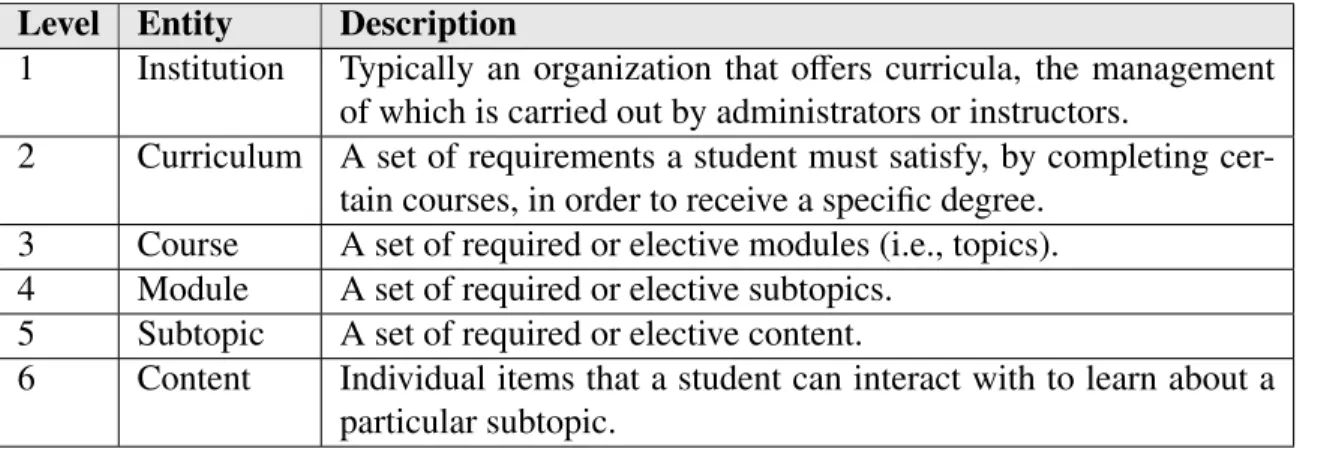
The MCH is comprised of six entity types: institutions, curricula, courses, modules (topics), subtopics, and content. The levels of the MCH and their corresponding entity are shown in Table 4.1 such that the level represents depth. Each entity contains certain meta-data, such as a unique identifier (identifiers are unique among entities of the same type) and name. For the purposes of establishing the hierarchy, this is the only information needed. However, a description attribute is also present. Moreover, content entities are defined as either consumable or evaluable. Examples of consumable content are lecture videos, plain text, and slides. Examples of evaluable content are quizzes and problem sets. Most of the entities are familiar concepts from traditional education, with the exception of modules and subtopics which are not usually considered. Previous work on PERCEPOLIS focused on
splitting courses into their different topics (denoted as modules) for added granularity. This
which are at the lowest level (finest grain) of the hierarchy. By themselves, the entities do not form the MCH. The relationships between entities must also be considered, and it is with these relationships that the hierarchical structure is created.
Table 4.1. Modular Course Hierarchy Entities
Level Entity Description
1 Institution Typically an organization that offers curricula, the management
of which is carried out by administrators or instructors.
2 Curriculum A set of requirements a student must satisfy, by completing
cer-tain courses, in order to receive a specific degree.
3 Course A set of required or elective modules (i.e., topics).
4 Module A set of required or elective subtopics.
5 Subtopic A set of required or elective content.
6 Content Individual items that a student can interact with to learn about a
particular subtopic.
4.1.2. Relationships. MCH relationships are governed by the following rules: 1. Relationships can only exist between two entities of the same level or neighboring
level; and
2. Only one type of relationship may exist between two distinct entities.
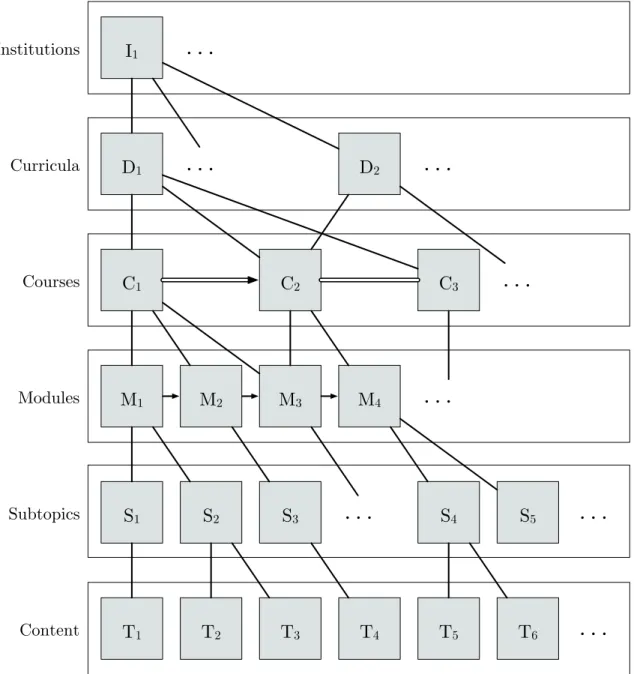
These rules provide limitations on complexity by drastically reducing the number of possible relationships in the MCH. Based on the aforementioned rules, a single entity is allowed to have relationships with multiple entities, and the nature of a relationship depends on the entities involved. Figure 4.1 provides a partial, conceptual visualization of an MCH, showing the entity types organized into their layers (as seen in Table 4.1) and connected by relationships depicted as lines. A complete visualization of a well-populated MCH can be quite large, and it is for this reason that Figure 4.1 visually implies additional entities and relationships with ellipses.
In Figure 4.1, two curricula, D1 and D2, are shown as being associated with
insti-tution I1. Solid, undirected connections from an entity in a given level to entities in the
next level below (sub-entities) are consideredcontaining relationships, which are usually
entities within the same level are also shown:C1toC2;C2toC3;M1to M2; M2toM3; and
M3 to M4. Relationships between entities of the same type come in three different forms:
prerequisite (striped and directed), corequisite (striped and undirected), and consequisite
(solid and directed). Prerequisite relationships establish that some course (the postrequi-site) must taken at some point after another course has been completed (the prerequipostrequi-site). Corequisite relationships establish that a course must be taken in the same semester as
an-other course. Consequisite(a term used by this thesis for convenience) is a special type of
prerequisite relationship where the postrequisite course must by taken in the next semester
where it is available. Consequisites are sometimes seen in courses such as senior design
which can span two semesters.
A traditional educational hierarchy would not usually recognize the existence of modules and subtopics as individual entities. Introducing modularity to courses creates both a simple construct for course design and more course information. This increased resolution and potential for meaningful relationships creates a wide variety of new recom-mendations for PERCEPOLIS to make. Conceptually, any lower levels of the MCH are an added level of detail for all of the related entities that exist in levels above. To give the reader an idea of the MCH implementation complexity, Figure 4.2 provides a database entity relationship (ER) Diagram of only the top three levels of the MCH with attributes excluded. A representation of what attributes to expect can found later in Section 4.3.
Aside from establishing the MCH, relationships between entities are the mecha-nisms by which PERCEPOLIS derives contextual information. In addition to the relation-ships between entities within the MCH, additional relationrelation-ships exist between users and
the different layers of the MCH. Instructors tend to create the relationships between
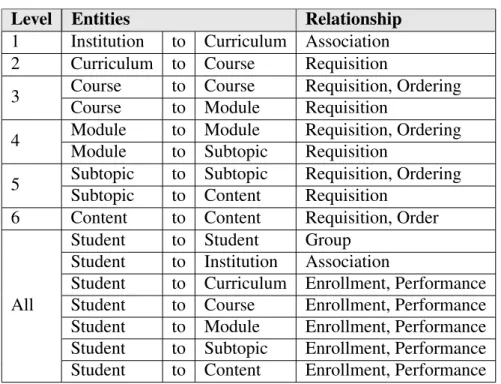
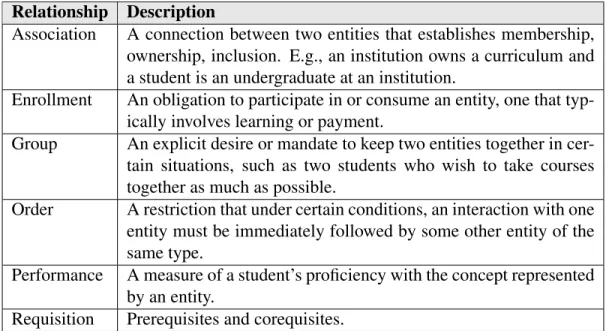
enti-ties within the MCH, while students tend to create relationships between themselves and the MCH. Table 4.2 lists some of the relationships that can appear between entities and what they represent. Table 4.3 then provides a description for each of the relationship types shown in the last column of Table 4.2. Systems are free to incorporate only the
relation-I1 C1 D1 M1 S1 S2 S3 T3 S4 T2 M2 M3 M4 C2 T4 T5 T6 D2 C3 S5 T1
…
…
…
…
…
Institutions Curricula Courses Modules Subtopics Content…
…
…
Figure 4.1. Example of a Modular Course Hierarchy
ships they may find useful, as is the case with PERCEPOLIS which does not recognize all possible relationships. The absence of a physical connection between two entities does not mean that they are not related to one another via other relationships, i.e., relatedness can be inferred from non-direct connections. All relationships imply a pairing of the unique identifiers between the two entities involved and any additional attributes specific to the relationship.
Offers Enrolls In Contains Has StudentCourse StudentInstitution Has Has Has Requires Has Fulfills Available During For Has StudentSchedule Contains ExplicitInterest Course Institution User Curriculum Implicit Interest DegreeLevel Semester Requirement Schedule ScheduleCourse
Figure 4.2. Database ER Diagram of MCH Levels 1-3
Some context is determined from entities alone, but the most useful context comes from the relationships between entities. With this in mind, recommendations can be viewed as a potential relationship. Identifying and validating potential relationships, in general, is simple. The implementing system must simply identify two entities between which a recognized (Table 4.2) relationship could exist without violating the MCH governing rules. As such, the number of relationships could become very large. It then becomes necessary to ascertain which potential relationships are more favorable and this is done by narrowing and prioritizing them through analysis of available and pertinent context.
In theory, a new student entity with no existing relationships is equally likely to establish a relationship with any other recognized entity, but in practice, that is not usu-ally the case. One way to narrow down institution choices for the student is to ask them
Table 4.2. Example Entity Relationships
Level Entities Relationship
1 Institution to Curriculum Association
2 Curriculum to Course Requisition
3 Course to Course Requisition, Ordering
Course to Module Requisition
4 Module to Module Requisition, Ordering
Module to Subtopic Requisition
5 Subtopic to Subtopic Requisition, Ordering
Subtopic to Content Requisition
6 Content to Content Requisition, Order
All
Student to Student Group
Student to Institution Association
Student to Curriculum Enrollment, Performance
Student to Course Enrollment, Performance
Student to Module Enrollment, Performance
Student to Subtopic Enrollment, Performance
Student to Content Enrollment, Performance
their interests and then give them a list of institutions most associated with those interests. Association with those interests can be determined by the number and depth of paths to sub-entities that are related semantically to the student’s interests. It is very likely, how-ever, that the institution with which the student will associate is predetermined. When a student associates with an institution, their concern becomes finding a curriculum, then a course schedule, and finally a study plan for specific courses.
Relationships between students and the lowest levels of the hierarchy provide the greatest insight into students’ interests and performance. Aggregation of relationships at lower levels of the MCH can be used to quickly inform instructors about collective or individual student understanding at high granularity levels. Students can choose from ex-isting subtopics in the system (direct matches) or provide interests which may or may not be semantically matched to existing subtopics. Direct or close matches carry immediate influence in recommendations while distant mismatches result in new subtopics that are waiting to be associated with modules. At first glance, disconnected subtopics (distant