The Evidence Available to Teach Evidence-Based Nursing Practice by Nurse Educators
A Thesis Submitted to the College of Graduate and Postdoctoral Studies In Partial Fulfilment of the Requirements
For the Degree of Masters in Nursing In the College of Nursing University of Saskatchewan
Saskatoon
By
SAMSON WAKIBI
i
Permission to Use
This thesis is presented in partial fulfilment of the requirements for the degree of Master of Nursing from the University of Saskatchewan. I agree that the libraries of the University of Saskatchewan may make this document freely available for inspection. I further agree that permission for photocopying this thesis, in whole or in part for scholarly purposes, may be granted by the professors who supervised this thesis work, or in their
absence, by the Head of the Department, or the Dean of the College. It is understood that any copying of this thesis in whole or in part for financial gain shall not be allowed without my written permission. It is also understood that recognition will be given to me and the University of Saskatchewan for any scholarly use that is made of any of the material in my thesis.
Requests for permission to copy or make other use of the material in this thesis, in whole or in part, should be addressed to:
Dean of the College of Nursing University of Saskatchewan
4th Floor, Health Sciences E-Wing, 104 Clinic Place, Saskatoon, Saskatchewan S7N 2Z4,
Canada
OR
Dean of the College of Graduate and Postdoctoral Studies University of Saskatchewan
116 Thorvaldson Building, 110 Science Place, Saskatoon, Saskatchewan S7N 5C9,
ii Abstract
Background and Aim: The benefits that ensue from evidence-based nursing practice (EBNP) in health care settings have been globally communicated to nurses. However, the current clinical activities surrounding EBNP demand involvement of nursing institutions in creating an EBNP thrust. The purpose of this research project was to explore, synthesize, and describe the evidence available to teach EBNP to undergraduate student nurses, so the
students can continue to integrate EBNP in clinical settings upon becoming professional nurses.
Methods and Design: This thesis was guided by the Joanna Briggs Institute (JBI) guidelines for writing systematic reviews. While using these guidelines, the focus was on qualitatively synthesizing all the available evidence. All the retrieved articles were subjected to the inclusion and exclusion criteria and finally appraised for quality using the JBI tools for qualitative assessment.
Results and Conclusion: Fifteen articles were included in the systematic review. The results indicate that several educational strategies exist to teach EBNP effectively. These strategies have been designed based on time and duration of teaching EBNP, nursing practice content to be taught, context of teaching and learning, and EBNP pre-requisites. Well-designed
evidence-informed educational strategies have a positive impact on students’ EBNP
knowledge and a big potential for promoting EBNP implementation in clinical practice. The effective EBNP educational strategies should be student engaging, bridging classroom and clinical settings, built on the context of EBNP steps (Melnyk & Newhouse, 2014), and be time friendly. A significant benefit is realized when nurse educators use these strategies in combination. However, cost effective strategies promoting critical and evidence-based thinking are needed for teaching EBNP by nurse educators, especially in developing African countries where health care fiscal and human resources are scarce.
iii
Acknowledgements
The road to success is not always easy but I personally believe it takes a high self-determination, commitment, and patience. Above these three personal aspects is support and good people around us. I am very grateful and thankful to my supervisors, Dr. Linda
Ferguson and Dr. Lois Berry, for their relentless support, guidance, and encouragement throughout this academic journey. Thank you to my committee members for your insightful comments and suggestions. I am very thankful to Jill Brown the graduate students’ advisor (on leave) who has always been there to see that my life while in Saskatoon and in the College of Nursing is conducive for my academic success. I would also like to acknowledge the funding support for my entire masters’ degree education I received from Queen Elizabeth II Diamond Jubilee Scholarship. Thanks to all the friends who have encouraged and guided me in this education process.
iv Dedication
This thesis is dedicated to my parents; Wilberforce Mukisa and Rebecca Ndikwani, who entrusted their hope and finances in me that they would see me graduate and be of help to them and other people. This work is also dedicated to all nurse educators who are very passionate about changing the status quo of nursing education and practice in African countries.
v Table of Contents Table of Contents Permission to Use ... i Abstract ... ii Acknowledgements ... iii Dedication ... iv Table of Contents ... v List of Tables ... xi List of Figures ... xi
Chapter One: Introduction and Literature Review ... 1
1.1. Introduction ... 1
1.1.1. Statement of the problem. ... 3
1.1.2. Research purpose and questions.. ... 4
1.1.3. The significance of the study………4
1.2. Literature Review.. ... . ... ………...………..4
1.2.1. EBNP Critique………..………..……….4
1.2.2. Barriers to EBNP……….. .... 5
1.2.3. Strategies to Overcome EBNP Barriers. ... 7
1.2.4. The role of context in EBNP. ... 7
1.2.5. Teaching and Learning of EBNP. ... 9
1.2.6. Review studies on teaching and learning of EBNP. ... 12
vi
1.2.8. Assessing learning of EBNP... 16
1.2.9. Underpinning learning of EBNP. ... 17
1.2.10. Definitions of terms………...19
References ... 21
Chapter Two: Methods ... 30
2.1. Study Design ... 30
2.2. Study Protocol ... 30
2.3. Inclusion Criteria ... 31
2.4. Exclusion Criteria ... 31
2.5. Data Sources ... 32
2.6. Data Collection and Synthesis... 32
2.6.1. Search strategy. ... 32
2.6.2. Quality appraisal. ... 32
2.6.3. Data extraction and management. ... 33
Figure 1 ... 34
2.6.4. Data synthesis. ... 35
2.7. Ethical Considerations... 35
References ... 36
Chapter Three (Manuscript One). The Evidence Available to Teach Evidence-based Nursing Practice by Nurse Educators: A mixed Studies Systematic Review... 37
3.1. Introduction. ... 37
vii
3.3. Methods. ... 43
3.3.1. Design. ... 43
3.3.2. Inclusion and exclusion. ... 43
3.3.3. Data sources. ... 43
3.3.4. Search process. ... 44
3.3.5. Quality of the included studies. ... 44
3.3.6. Data extraction and management. ... 45
3.3.7. Data synthesis. ... 45
3.4. Results ... 45
3.4.1. Search outcomes. ... 45
3.4.2. Characteristics of included studies. ... 46
3.4.3. Findings. ... 46 3.4.3.1. Educational strategies ... 46 3.4.3.1.1. Timing ... 46 3.4.3.1.2. Duration ... 47 3.4.3.1.3. Content ... 47 3.4.3.1.4. Delivery Method. ... 48 3.4.3.1.5. Context ... 49 3.4.3.1.6. Prerequisites ... 49
3.4.3.2. EBNP knowledge and implementation ... 49
viii
3.4.3.2.2. Collaborative teaching... 50
3.4.3.2.3. EBNP use and research utilization ... 51
3.4.3.2.4. Facilitation in learning ... 51
3.4.3.2.5. Barriers and facilitators to EBNP education ... 52
3.5. Discussion ... 52
3.5.1. The weight of the evidence. ... 58
3.5.2. Limitations of this review. ... 59
3.6. Implications and Conclusions ... 59
References ... 61
Chapter Four (Manuscript Two). Teaching Evidence-based Nursing Practice Using Evidence to Student Nurses in Developing Countries ... 69
4.1. Introduction ... 69
4.2. Nursing Education in Africa……….71
4.2.1. Connecting nursing education to EBNP ………73
4.3. Evidence-based Nursing Practice Education... 75
4.4. The State of Evidence-Based Nursing Practice in Africa ... 77
4.4.1. Healthcare system realities that frustrate EBNP in Africa (using a Ugandan example). ... 78
4.5. Transforming EBNP Education in Africa ... 79
4.5.1. Initiating and transcending EBNP education. ... 83
4.5.2. Integrative approaches to teaching and learning of EBNP. ... 86
ix
4.5.2.3. Problem-based learning ... 87
4.5.2.4. Concept mapping. ... 88
4.5.2.5. Simulation ... 88
4.5.3. Evaluation of EBNP education. ... 90
4.6. Conclusion ... 92
References ... 93
Chapter Five: Discussion and Conclusions... 100
5.1. Discussion and Recommendations ... 100
5.2. Conclusion ... 104
References ... 106
Appendices ... 108
Appendix A: JBI protocol (JBI follows the PRISMA-P format for systematic reviews) .. 108
Appendix B: Table 1; Data Extraction ... 109
Appendix C: Table 2; Summary of Significant Findings ... 119
Appendix D: Table 3; Quality Appraisal Results... 124
Appendix E: Table 4; Search Strategy and Output ... 129
Appendix F: JBI Critical Appraisal Checklist for Qualitative Research ... 133
Appendix G: JBI Critical Appraisal Checklist for Analytical Cross-Sectional Studies .... 134
Appendix H: JBI Critical Appraisal Checklist for Quasi-Experimental Studies (non-randomized experimental studies) ... 135
Appendix I: Grading System Created by Down et al. (2009), Based on the Work of Lincoln and Guba, (1985) ... 136
x
Appendix J: Meta-analysis of statistics assessment and review instrument ... 137 Appendix K: Qualitative assessment and review instrument ... 138
xi List of Tables
Table 1: Data Extraction ……… 107
Table 2: Summary of Significant Findings ……… 117
Table 3: Quality Appraisal Results ……… 122
Table 4: Search Strategy and Output ………. 127
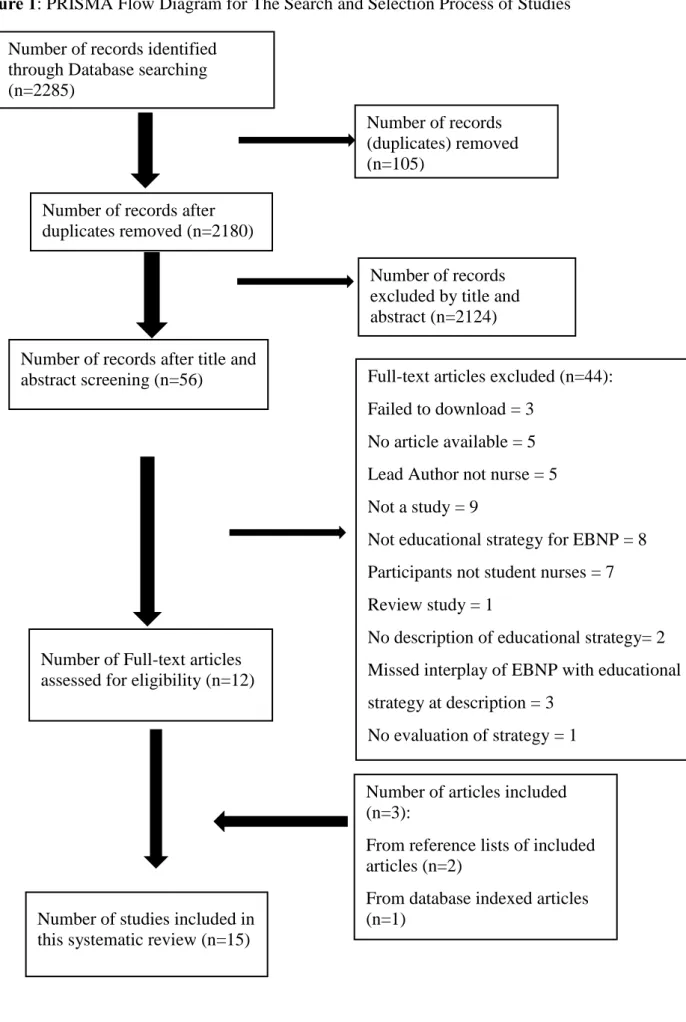
List of Figures Figure 1: PRISMA Flow Diagram for The Search and Selection Process of Studies ……33
1
Chapter One: Introduction and Literature Review
In this chapter the researcher described the background to this research project, the problem that necessitated this study, and the significance of this study. The research purpose and research questions are also stated in this chapter. This chapter is also inclusive of a diversified literature review of the available information surrounding this topic. 1.1. Introduction
Evidence-based nursing practice (EBNP) is a decision-making approach to patient care that utilizes an integration of the most current and valid research findings, the nurse’s clinical expertise, the client values and preferences, and available resources in making practice decisions (Registered Nurses’ Association of Ontario, 2014). The benefits that spring from EBNP include: improved nurses’ practice knowledge, patient-centred care with better patient outcomes, reduced occurrence of adverse events, reduced patient care costs to patients and health facility, and increased patient satisfaction (DiCenso et al., 2005; Registered Nurses’ Association of Ontario, 2014).
Reaching the desired EBNP decision involves the usually unmentioned decision analysis. This decision analysis consists of defining a decision problem and outlining all possible actions, benefits, and risks which precede a decision option (Dowding & Thompson, 2009). Whether a nursing decision option is accepted or rejected, is dependent on the risk-benefit comparison which is supported by the knowledge from explicit information (Dowding & Thompson, 2009; International Council for Nurses, 2012; Registered Nurses’ Association of Ontario, 2014). This information falls into two categories; the information to nurses informed by research findings, institutional factors, and their clinical team members and the
information from patients on their care values, beliefs, and preferences. The patients’ preferences are majorly affected by their previous experience with the healthcare, culture, religion, economic status, and the information availed to them from the health care team
2
(DiCenso et al., 2005). The best decision is one with the highest benefit estimate a nurse or nurses settle for (Estabrook, 1998), and in this EBNP case, it draws from information well understood by nurses and that well understood by patients. This information should be of good quality and explicit enough to create the best decision option (Dowding & Thompson, 2009).
Nurses are required to search for quality research evidence (Melnyk & Newhouse, 2014), but because of the challenges to EBNP (discussed later), there has been a move to summarize this information in to evidence-based tools (Bergman, 1999; DiCenso et al., 2005; Dowding & Thompson, 2009; Registered Nurses’ Association of Ontario, 2014). These tools include evidence-based practice guidelines (EBPG), case reports, drug guides, evidence-based textbooks, evidence-based textbook summaries, procedure manuals, and clinical pathways (Bergman, 1999; DiCenso et al., 2005; Lavelle, Schast, & Keren, 2015). Through these tools, gathered and appraised evidence is combined to make explicit recommendations for
clinicians (DiCenso et al., 2005; Lavelle et al., 2015; Registered Nurses’ Association of Ontario, 2014). Above all, these tools are usually nationally or locally accepted for use (Rycroft-Malone, 2008). The use of these evidence-based tools is aimed at extending the benefit of EBNP through uniform clinical practice, increased patient education, and medical and nursing litigation protection (Lavelle et al., 2015; Registered Nurses’ Association of Ontario, 2014). The individual and group understanding of clinical guidelines and any other evidence-based tools is more likely to be uniform, unlike their understanding of research findings (Rycroft-Malone, 2008). In this case, the benefits of EBNP would be hard to achieve when individuals and groups make effort to interpret research findings for their individual clinical use. Rycroft-Malone (2008) contends that research findings are suitable catalysts for clinical decision making while evidence-based tools like clinical guidelines are ready
3
Following the recognized benefits of EBNP, governments, organizations, and professional associations around the world exhort nurses to use evidence-based nursing practice (EBNP) in clinical settings (DiCenso et al., 2005; International Council for Nurses, 2012; Registered Nurses’ Association of Ontario, 2014). Also, the teaching of EBNP to student nurses is advocated for (Malik, McKenna, & Griffiths, 2017) and some research describes the existence of this teaching in nursing education (Aglen, 2016; Balakas, Sparks, Steurer, & Bryant, 2013; Moen, Ndateba, Collins, & Iyamuremye, 2015; Winters &
Echeverri, 2012). However, in some African countries, teaching EBNP is not yet part of the curricula content of nursing programs although this kind of practice is highly needed in the clinical settings as is detailed in chapter four. Also, the degree nurses who would be at the centre of EBNP are very few in clinical settings of these countries.
1.1.1. Statement of the problem.Evidence-based nursing practice is vital in clinical practice. The use of EBNP as a decision-making trail enables nurses to achieve effective and efficient patient care within the hospital care settings (Registered Nurses’ Association of Ontario, 2014). EBNP demands nurses’ skills that go beyond those needed for understanding scientific research. Nurses also, need to understand their patients’ and the health care setting related factors (Melnyk et al., 2012). Short of any of these needs poses a barrier to effective EBNP in clinical settings by the nurses. In nursing educational programs, many nurse
educators strive to equip student nurses with EBNP competencies in an attempt to assist them to be ready for the required EBNP in clinical settings (Dawley et al., 2011; Doane & Varcoe, 2012; Finotto et al., 2013; Moen et al., 2015). Some of these nurse educators’ instruction approaches particularly emphasize more of the students’ understanding of research concepts and principles and less of how the research evidence is integrated with patients’ and
organizational factors to make patient care decisions. In a similar way, many of the nurse educators follow Melnyk et al.’s (2010) seven EBNP steps; aiming at having the students
4
master the flow of these steps. The systematic application of the EBNP steps is impossible for many of the nurses in clinical care settings (DiCenso et al., 2005). These nurses often use other ways of EBNP like using evidence-based practice guidelines to inform their clinical practice. Therefore, in pursuit of a generation where all nurses are subject to meaningful and effective EBNP, it is important for nurse educators to understand the effective strategies for teaching EBNP and how these strategies can be used to transform the learning of EBNP into implementation in clinical settings. This understanding should ultimately empower nurse educators to assist undergraduate student nurses to effectively apply EBNP when they become professional nurses.
1.1.2. Research purpose and questions. The purpose of this study was, therefore, to explore, synthesize, and describe the evidence available through the current curricula designs and teaching strategies to teach EBNP to undergraduate student nurses, so the students can continue to integrate evidence-based nursing practice in clinical settings upon becoming professional nurses. This research study was intended to understand EBNP knowledge transmission and implementation by exploring the processes and outcomes of the current EBNP educational strategies.
This study was directed by two questions: (1) What educational strategies are being used by nurse educators to teach EBNP to undergraduate student nurses? (2) How do these strategies impact undergraduate student nurses’ acquisition of EBNP knowledge and EBNP implementation?
5
1.1.3. The significance of the study. Through this study, two dimensions of significance are conceivable; the importance of using evidence to design educational strategies and the power of well-designed educational strategies in transforming EBNP in clinical settings. The available evidence on teaching EBNP to undergraduate student nurses presents grounds on which nurse educator can base to take a certain line of instruction. As such, nurse educators should design or re-design EBNP curricula and teaching strategies based on the existing justification of the teaching-learning process, which draws on both clinical and academic factors. Hence, this study contributes to improvement in nursing education programs and nurses’ clinical practice, particularly as far as EBNP teaching and practice are concerned respectively. These improvements are additionally met by this study informing policymakers for educational program and clinical practice policies. 1.2. Literature Review.
This is an additional review of the information available within the realm of evidence-based nursing practice. In this section, criticisms, barriers, strategies to overcome barriers to EBNP are explored. Followed by an understanding of the role of context in EBNP. An assessment of the available review studies on EBNP is discussed and how teaching and learning of EBNP takes effect. Lastly, a discussion on how learning EBNP can be supported is explored.
1.2.1. EBNP Critique. The existing criticisms of EBNP might have significantly contributed to its slow uptake where it is not well recognized. Some nursing researchers argue that EBNP is devoid of theory, is more empirical, and undervalues other sources of evidence (Fawcett, 2012; Melnyk et al., 2012, Porter, 2012). Fawcett (2012) dismissed these criticisms by showing that the criticisms are majorly because of poor interpretation of EBNP. The author argued that each of the four ways of knowing (ethical, empirical, personal and aesthetic), which are highly central to nursing knowledge, has a theoretical foundation
6
(ethical theories, personal theories, empirical theories and aesthetic theories) (Fawcett, 2012). Thus, if well interpreted, all the four ways of knowing fit well within the scope of nursing practice, and particularly EBNP. Hence, EBNP is not devoid of theory (DiCenso et al., 2005). Additionally, EBNP is not more empirical as some nurses may claim, neither does it value quantitative research over qualitative research (Estabrook, 1988; Porter, 2012). While researchers of quantitative research seek to understand interventions and assessments, their counterparts conducting qualitative research seek to create the meaning of phenomena (DiCenso et al., 2005; Porter, 2012). As a result, qualitative and quantitative research
complement each other and EBNP requires the application of the best research which can be either or both two research forms (DiCenso et al., 2005). Hence, no single source of evidence is undervalued in EBNP.
1.2.2. Barriers to EBNP. Amidst the reported need for and the tremendous benefits of EBNP, several challenges to EBNP movement have often been reported. Studies have reported that while some nurses lack enough skills to evaluate the quality of research
(DiCenso et al., 2005; Malik, McKenna, & Plummer, 2016), many nurses do not have enough time for EBNP during clinical practice (Laibhen-Parkes, 2014). Some nurses have limited EBNP Knowledge, interest, and motivation to implement EBNP (DiCenso et al., 2005; Doane & Varcoe, 2012; Fiset, Graham, & Davies, 2017). The nurses’ interest in implementing EBNP may basically be affected by attitude, knowledge, and skills (Weng, Kuo, Lo, Chen, & Chiu, 2013). These three factors complement each other. A knowledgeable nurse will most likely be skilled and highly committed (positive attitude) because of the value attached to EBNP (Fiset et al., 2017). Doane and Varcoe (2012) contend that the quality of action can only be
determined by the extent of value and privilege accorded to it. In this case, EBNP calls for nurses to value it and currently this change is reported to have largely taken effect (André et al., 2016: Brooke, Hvalič-Touzery, & Skela-Savič, 2015; International Council for Nurses,
7
2012). Therefore, these nurses practice EBNP. Organizational barriers to EBNP also exist (DiCenso et al., 2005; Melnyk et al., 2012). Some organizations lack support to implement EBNP, do not have an EBNP vision and strategy, and have poor leadership structures to offer direction to the implementation of EBNP (Melnyk et al., 2012).
1.2.3. Strategies to overcome EBNP barriers. To counteract the above challenges, key strategies have come into place. Ciliska, Pinelli, DiCenso, and Cullum (2001) proposed availing time to nurses for library literature search that they may gather, appraise, and synthesize evidence needed for their practice. This proposal might be impractical given the global shortage of nurses in clinical settings (Doane & Varcoe, 2012; Mugomeri, Chatanga, Maibvise, & Masitha, 2016). The patient workload is very demanding, needing more than the time available for nursing practice for the nurses employed on wards in most clinical settings (Doane & Varcoe, 2012). The lack of printed or online nursing research journals in clinical institutional libraries is another concern (Ciliska et al., 2001). Increasing the availability of the resources in the clinical setting has a potential of infringing on the already financially constrained healthcare settings of some countries (Melnyk et al.,2012) and the time and capability to analyze and synthesize a research article may not be available to the nurses, as highlighted above. Instead, DiCenso et al. (2005) found it more feasible to designate a person who can analyze and synthesize recent research or search for already synthesized information like the evidence-based tools. This information can then be made available to nurses through continuous nursing education, grand rounds, and staff meetings to facilitate decision making and practice change (DiCenso et al., 2005; Estabrooks, 1998).
1.2.4. The role of context in EBNP. The practice of EBNP in a clinical setting is in part influenced by contextual factors (DiCenso et al., 2005; Melnyk & Newhouse, 2014; McCormack, Kitson, Harvey, Rycroft-Malone, Titchen, & Seers, 2002). In clinical practice, context refers to an environment in which healthcare practice happens; this environment can
8
be affected by political, social, economic, cultural and historical factors (Melnyk et al., 2012; McCormack et al., 2002). Therefore, equipping nurses with EBNP skills and knowledge is not enough. Successful implementation of EBNP requires a focus beyond nurses as
individuals to nurses as a team (Melnyk et al., 2012), and an institutional commitment. EBNP drawing from a team dialogue on contextual factors has a higher success potential than individual EBNP (Kitson, Rycroft-Malone, Harvey, McCormack, Seers, & Titchen, 2008; Melnyk et al., 2012). As such, some settings, for example, those with good leadership, facilitation, enough resources, appropriate learning, and evaluative mechanisms have been more conducive for successful implementation of EBNP compared to those settings without (Kitson et al., 2008). Additionally, the recommendations of the EBNP competencies required of nurses are uniform for all nurse graduates globally (Hines, Kynoch, Munday, & McArdle, 2017; International Council for Nurses, 2012; Jackson, 2016), yet, the country contexts differ tremendously. This contextual variation might to a reasonable extent explain the slow
adoption of EBNP in some countries.
To clearly illustrate how context plays a big role in the EBNP movement, DiCenso et al., (2005) and Pashaeypoor, Ashktorab, Rassouli, and Majd (2017) demonstrated how EBNP implementation (using an evidence-based tool) in an organization can be facilitated using frameworks such as the Rogers’ diffusion of innovation theory. Diffusion of innovation is a five-step process; knowledge, persuasion, decision, implementation, and confirmation (Rogers, 1983). Information about the evidence-based tool needs to be adequately shared by all members of the organization (DiCenso et al., 2005; Pashaeypoor et al., 2017). This approach is aimed at sharing the evidence available in the tool such that all members of the team are knowledgeable (knowledge step) about it. This step creates a platform for
persuading members to understand how the contextual factors of the clinical setting interact with the information about the tool (persuasion step), an approach often adopted by a
9
healthcare agency. At this point, team members are in a better position to decide (decision step) whether they need to adopt and use the evidence-based tool or not. This decision usually depends on the information about the tool, clinical setting factor, patient values, and clinical expertise. Therefore, this decision influences adopting the tool to facilitate EBNP or not adopting it (implementation step). Lastly, an evaluation to confirm (confirmation step) that the adopted tool is changing practice as predicted in the knowledge step takes place (DiCenso et al., 2005; Pashaeypoor et al., 2017). This innovation is one of the best ways nursing
practice can be changed at an organization or a team level. Additionally, institutions may, and often do insist on a particular approach and this five-step process illustrates how one achieves commitment to that approach.
1.2.5. Teaching and learning of EBNP. EBNP has received maximum attention, and research shows that nurses in clinical settings practice it (International Council for Nurses, 2012; Registered Nurses’ Association of Ontario, 2014). However, the EBNP taught to student nurses in academic settings seems to be different from the EBNP happening among nurses in the clinical setting. There seems to be a difference between what nurses learn and what they practice (Doane & Varcoe, 2012). Some evidence shows that student nurses learn searching, synthesizing, and appraising research studies in EBNP courses (Dawley, Bloch, Suplee, McKeever & Scherzer; 2011; Finotto, Carpanoni, Turroni, Camellini & Mecugni, 2013). However, do the nurses really conduct these steps when in clinical practice for EBNP?
The educational strategies nurse educators use in nursing education play a big role in the conversion of evidence into clinical nursing practice (Moen et al., 2015). However, there is a reported ineffectiveness in the educational strategies some nurse educators use to teach EBNP to student nurses. This ineffective teaching can be explained in two dimensions. First, evidence shows that in nursing education, the teaching of research utilization is
10
nursing, research utilization is significantly different from EBNP. While research utilization is limited to the use of research findings in nurses’ work, in EBNP, nurses take an integrated approach to practice where research findings, clinical expertise, patient values, and resources are all considered and valued (DiCenso et al., 2005; Estabrooks,1998). Thus, research
utilization is a subset of EBNP (Estabrooks,1998). In several studies, nurse educators have reported teaching research utilization to mean the teaching of EBNP (André et al., 2016; Nordsteien, Horntvedt, & Syse, 2017). Even in some institutions where educators can differentiate the two, teaching EBNP has been done mostly theoretically, inadvertently reinforcing the gap between what students know and do (Malik et al., 2017). Yet, evidence shows that effectively teaching students EBNP reduces the skill-knowledge gap (Doane & Varcoe, 2012). Therefore, there is a need to strengthen nursing education programs to adequately deliver the required EBNP knowledge and skills to the students so as to close the learning-practice disparity.
Second, because teaching EBNP means appropriately integrating knowledge from the classroom into clinical practice, EBNP knowledge from classrooms ought to give way to evidence-based patient care skills (Malik et al., 2017). Malik et al. (2017) reported that in clinical settings, student nurses are exposed to learning which is different from that in classrooms. The nurses in clinical settings teach student nurses what they practice (Malik et al., 2017); the EBNP guided by evidenced-based tools like clinical guidelines (Registered Nurses’ Association of Ontario, 2014), according to how they learned while in school (Balakas et al., 2013; Moen et al., 2015), or according to the practice tactics they developed due to patient workloads and shift demands (DiCenso et al., 2005). In classrooms, nurse educators teach students an evidence-based approach in which they should search, gather and appraise research evidence to support a decision reached (Wallace & Vanhook, 2016;
11
recommendations for the teaching of EBNP, yet, some of the nurses in clinical settings were in school years before the teaching of EBNP started (Balakas et al., 2013; Moen et al., 2015). Therefore, a stronger bond of collaboration between teaching institutions and healthcare institutions is needed to ensure consistent and collaborative approaches to EBNP in education and practice (André et al., 2016; Malik et al., 2017). Through this collaboration, student nurses can be taught the current and valid evidence-based approach to patient care. These weaknesses in the teaching of EBNP show the need for equally drawing from research, academic, and clinical/patient experiences in the teaching of EBNP to student nurses.
The teaching of EBNP to undergraduate student nurses is vital because it is the first preparation level for student nurses into the professional role (Sin & Bliquez, 2017).
Evidence-based practice education prepares student nurses for dynamic health care systems where patient safety and best patient outcomes with minimal care costs are highly needed (Registered Nurses’ Association of Ontario, 2014; Balakas et al., 2013; Ruzafa-Martínez, López-Iborra, Armero Barranco, & Ramos-Morcillo, 2016). Therefore, being EBNP
competent is an essential outcome for all undergraduate baccalaureate student nurses (Bloom, Olinzock, Radjenovic, & Trice, 2013) and nursing education programmes have a fundamental role of reinforcing this outcome (Hickman, Kelly, & Phillips, 2014).
In nursing education, there is a reported lack of consensus across the world on how EBNP competencies should be taught in nursing curricula (Finotto et al., 2013). Competency refers to an integrated use of attitude, knowledge, and skills in practice which is usually developed in an educational setting (Ruzafa-Martínez et al., 2016). Several teaching
innovations which have been used either alone or in combination exist to equip students with EBNP competencies. These innovations include: teaching EBNP through debates (Boyd, Baliko, & Polyakova-Norwood, 2015), social media (Carrington, Pace, Sheppard, Dudding, & Stratton, 2017), simulations (Raurell-Torreda & Romero-Collado, 2015), courses or
12
curriculum/ learning modules (Balakas et al., 2013; Finotto et al., 2013; Jackson, 2016), game-based learning (Davidson & Candy, 2016), and workshops and training sessions (Chen, Chen, Tzeng, & Liu, 2014). None of these strategies is better recommended for teaching EBNP compared to the others; however, all of them contribute to assisting the student nurses in using EBNP.
1.2.6. Review studies on teaching and learning of EBNP. Several review studies exist on teaching EBNP. In a narrative synthesis which was initially designed as a systematic review, Kyriakoulis, Patelarou, Laliotis, Wan, Matalliotakis, Tsiou, and Patelarou (2016) identified the educational strategies for teaching evidence-based practice to undergraduate health students. While the participants in the articles in this review were from several
professions, only two articles represented the nursing profession. The authors’ study aim was to identify the best teaching strategies; however, their discussion does not reflect this. Instead, it addresses the teaching time, the need for multifaceted teaching approach, and the
evaluation of teaching evidence-based practice. Among the limitations mentioned was the failure to discern the effective method of teaching evidence-based practice (Kyriakoulis et al., 2016).
In another study, Häggman-Laitila, Mattila, and Melender (2016) conducted a
systematic review of educational interventions and their outcomes on evidence-based nursing in clinical practice. One of their major findings is that educational interventions with better outcomes incorporated at least a theoretical background explaining the linkage of the EBNP teaching strategy to the learning outcome. This study focused only on learning and not the implementation of EBNP. The included studies had clinical nurses and other healthcare workers as study participants. Similarly, Melender, Mattila, and Häggman-Laitila (2016) conducted a systematic review with the aim of identifying the educational interventions used to promote learning of EBNP in nursing education. From the ten analyzed articles, each
13
educational intervention had a significant outcome on the students’ acquisition of EBNP competencies. However, the study lacks a discussion on whether the different interventions can be combined, or which one is a better intervention compared to the others. Additionally, not only is the educational level of the student participants unclear in this study but also the exact descriptions of the educational interventions are not reported. The authors
recommended conducting another review of interventional studies with long enough follow-ups.
In a systematic review on pedagogical strategies to teach baccalaureate students evidence-based practice, Aglen (2016) described two categories of pedagogical interventions: Learning information literacy and learning research process. The author’s discussion was based more on teacher focused interventions (interventions that aim at informing students solely without drawing on the benefits of students’ interaction with the clinical setting) and although they recommended educational theories for better pedagogical interventions, none was revealed in their study.
In a scoping review on the barriers, facilitators and educational interventions that promote students’ use of EBNP in clinical nursing, Fiset, Graham, and Davies (2017), showed that most students and faculty lacked knowledge of and had a negative attitude toward EBNP; the nature of the negative attitude was not reported. However, the authors reported those strategies that promoted the teaching of EBNP in clinical setting had a big potential of reducing these barriers. The lack of substantiated description of the educational interventions in the retrieved articles limited this study (Fiset, Graham, & Davies, 2017). The teaching of EBNP at undergraduate nursing level needs to be given more attention so as to enable the student nurses to have the capacity to acquire and understand all necessary evidence, as well as appropriately implement this evidence within the clinical setting (Estabrook 1998; Sin & Bliquez, 2017).
14
1.2.7. EBNP steps and content. In line with the above need, Melnyk, Fineout-Overholt, Stillwell & Kathleen (2010) provided seven EBNP steps; 1) cultivate a spirit of inquiry and EBNP Culture, 2) ask the PICOT question (population of study, intervention or issue of concern, comparison intervention, outcome, time duration), 3) search for the best evidence, 4) critically appraise the evidence, 5) integrate the evidence with clinical expertise and patient preferences to make the best clinical decision, 6) evaluate the outcomes of the EBNP practice, 7) and disseminate the outcomes (Melnyk et al., 2010). All nurse educators have the onus to teach this information to student nurses. Some evidence suggests that students heavily rely on what they see in practice compared to what they learn in class to be better suited for clinical settings upon graduation (Sin & Bliquez, 2017). As such, the seven EBNP steps ought to be taught to students in accessibility of clinical context, so as to
encourage EBNP implementation (Carrington et al., 2017; Chen et al., 2014; Sin & Blique, 2017). Nurse educators should immerse student nurses into the experience of EBNP, rather than just offering them knowledge on what EBNP should be. Nonetheless, the third EBNP step necessitates that student nurses have good literature search skills to retrieve all valid literature to adequately support the last four steps of EBNP (André et al., 2016; Nordsteien et al., 2017). As such, student nurses also need to have computer and database search skills in learning EBNP.
Currently, there is no clear outline of the EBNP content to be taught to the students of different program levels in nursing education (Jackson, 2016). Rather, only examples of EBNP implementation strategies have been provided (Finotto et al., 2013). In an attempt to understand how nursing education programs were incorporating EBNP education at
undergraduate nursing curricula in Australia, Malik, McKenna, and Griffiths (2015) showed that there was no national standardized goals and objectives to be followed by programs. As such, a significant disparity in nursing education curricula pertaining to EBNP was evident
15
across the 32 studied universities (Malik et al., 2015). In the University of North Florida School of Nursing (USA), undergraduate nurse educators comprehensively cover only the first four steps of EBNP; cultivating a spirit of inquiry, asking PICOT question, searching the best evidence, and critically appraising the evidence (Bloom et al., 2013). The authors argue that these are the only steps which resonate with the American Association of Colleges of Nursing baccalaureate competencies and the rest have to be developed at other educational levels as nurses advance in their nursing career (Bloom et al., 2013). Contrary to these authors’ argument, the definition of EBNP supports the need to include the fifth EBNP step (integrating research evidence with other evidence) in the teaching of EBNP. One would wonder whether the four taught steps are enough to create the desired national EBNP change. Additionally, this EBNP teaching seems to be more evaluative than being practice orientated. Therefore, there is a need to clearly understand the teaching of EBNP in line with the current clinical practice.
Researchers contend that teaching of EBNP to undergraduate students is a big challenge to nurse educators (Hande, Williams, Robbins, Kennedy, & Christenbery, 2017; Malik et al., 2017; Ruzafa-Martínez et al., 2016; Scurlock-Evans, Upton, Rouse, & Upton, 2017; Sin & Bliquez, 2017). The teaching of EBNP has constantly attracted a debate on when to teach or introduce EBNP (Elçin, Turan, Odabaşi, & Sayek, 2014), whether EBNP should be taught as a standalone course or integrated within the curricula (Finotto et al., 2013; Scurlock-Evans et al., 2017), and what is or is not a barrier to teaching EBNP (Malik et al., 2016; Ruzafa-Martínez et al., 2016).
In nursing education, the goals and objectives of teaching EBNP seem to be unclear to nurse educators. Nursing students at different program levels are unusually expected to have the same EBNP competencies (Chang & Levin, 2014; Hande et al., 2017). Hande et al. (2017) called for a clear-cut line between what should be learned by students while advancing
16
from baccalaureate, to master’s, and to Nursing doctorate (Ph.D., DNP, DNS) levels of the nursing curriculum. The authors argue that although clinical decision making, critical thinking, problem identification, and outcome measurement are the EBNP competencies identical to the three programs, students’ abilities can never be the same across the different levels (Hande et al., 2017). Therefore, nurse educators should develop students’ EBNP competencies according to the learners’ objectives at the different levels of nursing education.
1.2.8. Assessing learning of EBNP. The argument by Hande et al. (2017) brings to light the implausible findings of some of the evaluative studies on the teaching of EBNP to student nurses. Studies have reported EBNP competencies being assessed on either student nurses or practicing nurses without specifying what the participants ought to know and do, given their levels of nursing qualification (Chen, Tzeng, et al., 2014; Ruzafa-Martínez et al., 2016; Upton, Scurlock-Evans, & Upton, 2016). Yet, Upton, Scurlock-Evans, and Upton (2016) contend that the measurement tools for these studies, like the student evidence-based practice questionnaire (S-EBPQ), have the potential to evaluate EBNP competencies at all levels, stretching from student nurses, through practicing nurses to specialist nurse
practitioners whose levels of EBNP competencies certainly vary. These tools are even
relevant for the theoretical evaluation of student learning of EBNP (Upton et al., 2016). Thus, the practical abilities of the participants (students) could be inadequately reflected in
evaluation studies based on self-report. These observations in the assessment/evaluation of learning EBNP call for designing and using of appropriate assessment tools which would reflect the real learning of EBNP (particular to either EBNP theory or use of EBNP) and in the respective educational levels. Therefore, EBNP competencies for the different nursing education levels should be identified and the subsequent evaluation tools should also be based on these competencies.
17
1.2.9. Underpinning learning of EBNP. Although a need for creative and enjoyable educational strategies is reportedly paramount to students' learning of EBNP and is highly sought after by nurse educators currently (Chang & Levin, 2014; Sin & Bliquez, 2017), Hande et al. (2017) reminds nurse educators to not forget the students’ way of learning which follows the domains of psychomotor, affection, and cognitive stages in teaching EBNP. This learning trajectory enables nurse educators to look at student nurses as individuals who can learn differently in different conditions (Hande et al.,2017). Paying maximum attention to this trajectory in the teaching of EBNP will support the still challenging EBNP
implementation (Chang & Levin, 2014). Consequently, researchers have found curriculum designs and learning strategies based on theoretical frameworks and models to teach EBNP having significant EBNP outcomes (Ruzafa-Martínez et al., 2016; Scurlock-Evans et al., 2017). Some of the employed theoretical frameworks and models include constructivism (Scurlock-Evans et al., 2017), theory of planned behaviour (Ramos-Morcillo, Fernández-Salazar, Ruzafa-Martínez, & Del-Pino-Casado, 2015), active learning (Boyd et al., 2015; Davidson & Candy, 2016; Zhang, Zeng, Chen, & Li, 2012), diffusion of innovations (Pashaeypoor et al., 2017), and domains of learning (Hande et al., 2017).
In the context of educational theories, two curricula learning approaches have been implemented and evaluated; EBNP as a standalone course and EBNP embedded in the existing nursing courses. In standalone courses, EBNP content and processes are taught to students in a single course usually disconnected from other curricula courses, while in embedded curricula, EBNP content is integrated throughout the entire curriculum in
connection with other theoretical and clinical courses (Malik et al., 2015). Malik et al. (2015) added that in EBNP embedded curricula, EBNP is considered an everyday practice to the learners during their entire nursing program unlike in standalone EBNP courses where EBNP can potentially be viewed as an academic exercise. Scurlock-Evans et al. (2017), in their
18
quantitative study comparing the impact of embedded curriculum with modular-based EBNP teaching, found no statistical significance between curriculum-design and impact on students' evidence-based practice profiles. In contrast, Ruzafa-Martínez et al. (2016) in their quasi-experimental study found out that nursing students who participated in EBNP concepts integrated within the curriculum significantly improved their evidence-based practice competency compared to the students who did not. Nonetheless, researchers argue that through the embedded curriculum, new information builds on the previously learned information, hence, reinforcing learning (Malik et al., 2015; Scurlock-Evans et al., 2017). The important question is, could both of these learning approaches be used?
Scurlock-Evans et al. (2017) described nursing education curricula embedding evidence-based practice in nursing courses as spiral curricula. In the spiral curricula, topics are covered in increasing complexity across the years of program study and new (more complex) topics are studied in reference to the already covered topics (Malik et al., 2015; Elçin et al., 2014; Scurlock-Evans et al., 2017). As such, the spiral learning is of benefit if applied to student nurses as they switch between academic and practice settings (Malik et al., 2015; Scurlock-Evans et al., 2017). Additionally, the spiral learning ensures that what is planned is both delivered to and learned by the students (Knight, 2001). The spiral curricula facilitate student nurses to see the value of research evidence in patient care (Malik et al., 2015). In this way, spiral curricula have the potential of making the learning process ample enough for students to utilize and build on the previously learned information. Elçin et al. (2014) believe that students may best understand the philosophy of EBNP when involved in its practical application with actual patients. As such, the interplay between academic and clinical teaching settings is key to EBNP of holistic qualities (Mackey & Bassendowski, 2017; Scurlock-Evans et al., 2017). As opposed to the use of hypothetical scenarios where students miss out on the patient encounter, Hande et al. (2017), and Mackey and
19
Bassendowski (2017) recommend the use of patient-centered strategies in teaching EBNP to student nurses. These strategies give student nurses opportunities to value the patient as a member of the decision-making group (Hande et al., 2017) as well as lessening the knowledge-skills gap (Mackey & Bassendowski, 2017). Consequently, these strategies facilitate the recognition and use of patients’ values in decision making by student nurses (Hande et al., 2017) as required by the definition of EBNP and the seven EBNP steps.
Therefore, EBNP learning through spiral curricula should be intertwined with student-patient encounters. Scurlock-Evans et al. (2017) contend that nurses’ culture of practice in the clinical setting is inculcated in them at school when still students. As such, the EBNP in clinical settings can be in part explained by the way nurses were taught while at school as student nurses (Scurlock-Evans et al. (2017). Similarly, based on Khan and Coomarasamy's (2006) proposal for interactive and clinically-integrated teaching approaches of evidence-based practice, Fiset, Graham, and Davies (2017) recommended understanding how the teaching strategies impact evidence-based practice.
1.2.10. Definitions of terms. The above literature review has set a context for the evolution of EBNP over time. As such, the following terms generated from the literature review need to be well understood as they are used in this research.
Evidence-based medicine (EBM) refers to “the conscientious, explicit and judicious use of current best evidence in making decisions about the care of individual patients” (Sackett, Rosenberg, Muir, Haynes, & Richardson,1996) (p. 71) and its integration with clinical judgement of the physician (Mackey & Bassendowski, 2017; Sackett et al.,1996). This definition makes physicians more of technicians who just do what evidence says. As such, evidence-based practice emerged from EBM because of the need for evidence to be used by members of healthcare professions other than medicine while thinking through other factors which might affect that evidence (Mackey & Bassendowski, 2017).
20
Evidence-based practice refers to the application of the best available, current, valid and relevant research findings into clinical decision-making by integrating one’s own clinical expertise and considering client values and preferences, and available resources (International Council for Nurses, 2012; Melnyk, Fineout-Overholt, Gallagher-Ford, & Kaplan, 2012; Registered Nurses’ Association of Ontario, 2014).
Evidence-based nursing practice (EBNP) is the evidence-based practice specific to the nursing discipline as nurses encounter patients in the clinical settings (DiCenso, Guyatt & Ciliska, 2005; André, Aune, & Brænd, 2016). The terms Evidence-based nursing (EBN) and EBNP can be used interchangeably (DiCenso et al., 2005; Winters & Echeverri, 2012). The two terms mean the same thing as in the definition for EBNP above. The choice of preference for the use of these two terms is up to the individual using them.
Evidence-informed practice (EIP) is another recent term which emerged with the plethora of criticisms on EBNP. This term (EIP) refers to the consideration of EBP (as defined above) in the context of its implementation (Melnyk & Newhouse, 2014). As such, EIP requires that EBNP is implemented considering organizational and institutional factors that affect clinical practice (Melnyk & Newhouse, 2014). For consistency, the term EBNP was used in this project write-up.
21 References
Aglen, B. (2016). Pedagogical strategies to teach bachelor students evidence-based practice: A systematic review. Nurse Education Today, 36, 255–263.
https://doi.org/10.1016/j.nedt.2015.08.025
André, B., Aune, A. G., & Brænd, J. A. (2016). Embedding evidence-based practice among nursing undergraduates: Results from a pilot study. Nurse Education in Practice, 18, 30–35. https://doi.org/10.1016/j.nepr.2016.03.004
Balakas, K., Sparks, L., Steurer, L., & Bryant, T. (2013). An outcome of evidence-based practice education: Sustained clinical decision-making among bedside nurses. Journal of Pediatric Nursing, 28(5), 479–485. https://doi.org/10.1016/j.pedn.2012.08.007
Bergman, D. A. (1999). Evidence-based guidelines and critical pathways for quality improvement. Pediatrics, 103(1 Suppl E), 225–232.
https://doi.org/10.1542/peds.103.1.SE1.225
Bloom, K. C., Olinzock, B. J., Radjenovic, D., & Trice, L. B. (2013). Leveling evidence-based practice content for undergraduate nursing students. Journal of Professional Nursing, 29(4). http://dx.doi.org/10.1016/j.profnurs.2012.05.015
Boyd, M. R., Baliko, B., & Polyakova-Norwood, V. (2015). Using debates to teach evidence-based practice in large online courses. Journal of Nursing Education, 54(10), 578–582. http://dx.doi.org/10.3928/01484834-20150916-06
Brooke, J., Hvalič-Touzery, S., & Skela-Savič, B. (2015). Student nurse perceptions on evidence-based practice and research: An exploratory research study involving students from the University of Greenwich, England and the faculty of health care Jesenice, Slovenia. Nurse Education Today, 35(7), e6–e11.
22
Carrington, J. M., Pace, T. W. W., Sheppard, K. G., Dudding, K. M., & Stratton, D. (2017). Using Twitter to teach evidence-based practice in doctor of nursing practice degree program. Clinical Nurse Specialist, 31(6), 349–352.
http://dx.doi.org/10.1097/NUR.0000000000000336
Chang, A., & Levin, R. F. (2014). Tactics for teaching evidence-based practice: Improving self-efficacy in finding and appraising evidence in a master’s evidence-based practice unit. Worldviews on Evidence-Based Nursing, 11(4), 266–269.
http://dx.doi.org/10.1111/wvn.12050
Chen, K.-H., Chen, C., Tzeng, P.-C., & Liu, H.-E. (2014). The learning effectiveness of structured assessment stations with immediate feedback in evidence-based practice education. American Journal of Educational Research, 2(8), 691–697.
http://dx.doi.org/10.12691/education-2-8-19
Ciliska. D. K., Pinelli. J., DiCenso. A., Cullum. N. (2001). Resources to enhance evidence-based nursing practice. American Association of Critical-Care Nurses Clinical Issues, 12(4):520-528. https://doi.org/10.1097/00044067-200111000-00008
Davidson, S. J., & Candy, L. (2016). Teaching evidence based practice using game-based learning: Improving the student experience. Worldviews on Evidence-Based Nursing / Sigma Theta Tau International, Honor Society of Nursing, (2010), 1–9.
http://dx.doi.org/10.1111/wvn.12152
Dawley, K., Bloch, J. R., Suplee, P. D., McKeever, A., & Scherzer, G. (2011). Using a pedagogical approach to integrate evidence-based teaching in an undergraduate women's health course. Worldviews on evidence-based nursing, 8(2), 116-123. https://doi.org/10.1111/j.1741-6787.2010.00210.x
23 practice. St. Louis, MO: Elsevier Mosby.
Doane,H G., & Varcoe, C. (2012). Knowledge translation in everyday nursing: From evidence-based practice to inquiry-based practice.In P. G. Reed & N.B. Crawford Shearer (Eds.), Perspectives on nursing theory, (6th ed.) (pp. 82-92). Philadelphia, PA: Wolters Kluwer, Lippincott, Williams & Wilkins.
Dowding, D, &Thompson, C. (2009). Evidence-based decisions: The role of decision
analysis. In D. Dowding & C. Thompson (Eds.), Essential decision making and clinical judgement for Nurses, (1st ed.) (pp. 173-195). London, UK: Churchill Livingstone, Elsevier. Retrieved from
http://booksite.elsevier.com/samplechapters/9780443067273/9780443067237_11.pdf Elçin, M., Turan, S., Odabaşi, O., & Sayek, I. (2014). Development and evaluation of the
evidence-based medicine program in surgery: A spiral approach. Medical Education Online, 19(1), 1–6. http://dx.doi.org/10.3402/meo.v19.24269
Estabrooks, C. A. (1998). Will evidence-based nursing practice make perfect? Canadian Journal of Nursing Research, 30(1), 15–36.
Fawcett, J. (2012). Criteria for evaluation of theory. In P.G. Reed & N.B. Crawford-Shearer (Eds.), Perspectives on nursing theory (6th ed.) (pp. 352-357). Philadelphia, PA: Wolters Kluwer, Lippincott, Williams & Wilkins.
Finotto, S., Carpanoni, M., Turroni, E. C., Camellini, R., & Mecugni, D. (2013). Teaching evidence-based practice: Developing a curriculum model to foster evidence-based practice in undergraduate student nurses. Nurse Education in Practice, 13(5), 459–465. https://doi.org/10.1016/j.nepr.2013.03.021
24
nursing education: A scoping review. Journal of Nursing Education, 56(9), 534–541. https://doi.org/10.3928/01484834-20170817-04
Häggman-Laitila, A., Mattila, L. R., & Melender, H. L. (2016). Educational interventions on evidence-based nursing in clinical practice: A systematic review with qualitative
analysis. Nurse Education Today, 43, 50–59. https://doi.org/10.1016/j.nedt.2016.04.023 Hande, K., Williams, C. T., Robbins, H. M., Kennedy, B. B., & Christenbery, T. (2017).
Leveling evidence-based practice across the nursing curriculum. Journal for Nurse Practitioners, 13(1), e17–e22. https://doi.org/10.1016/j.nurpra.2016.09.015
Hines, S., Kynoch, K., Munday, J., & McArdle, A. (2017). Evidence-based practice education for better knowledge, attitudes, and practices in nurses and midwives. The Journal of Continuing Education in Nursing, 48(6), 256–262.
https://doi.org/10.3928/00220124-20170517-05
Hickman, L. D., Kelly, H., & Phillips, J. L. (2014). Eviteach: A study exploring ways to optimise the uptake of evidence-based practice to undergraduate nurses. Nurse Education in Practice, 14(6), 598–604. https://doi.org/10.1016/j.nepr.2014.05.013
International Council for Nurses. (2012). Closing the gap: From evidence to action. Retrieved from
http://www.nursingworld.org/MainMenuCategories/ThePracticeofProfessionalNursing/I
mproving-Your-Practice/Research-Toolkit/ICN-Evidence-Based-Practice-Resource/Closing-the-Gap-from-Evidence-to-Action.pdf
Jackson, N. (2016). Incorporating evidence-based practice learning into a nurse residency program: Are new graduates ready to apply evidence at the bedside? The Journal of Nursing Administration, 46(5), 278–83.
25
Kitson, A. L., Rycroft-Malone, J., Harvey, G., McCormack, B., Seers, K., & Titchen, A. (2008). Evaluating the successful implementation of evidence into practice using the PARiHS framework: Theoretical and practical challenges. Implementation Science, 3(1), 1–12. https://doi.org/10.1186/1748-5908-3-1
Knight, T.P. (2001). Complexity and curriculum: A process approach to curriculum-making. Teaching in Higher Education, 6(3), 369-381.
https://doi.org/10.1080/13562510120061223
Kyriakoulis, K., Patelarou, A., Laliotis, A., Wan, A. C., Matalliotakis, M., Tsiou, C., & Patelarou, E. (2016). Educational strategies for teaching evidence-based practice to undergraduate health students: systematic review. Journal of Educational Evaluation for Health Professions, 13, 34. https://doi.org/10.3352/jeehp.2016.13.34
Laibhen-parkes, N. (2014). Evidence-based practice competence: A concept analysis. International Journal of Nursing Knowledge, 25(3):173-82.
https://doi.org/10.1111/2047-3095.12035
Lavelle, J., Schast, A., & Keren, R. (2015). Standardizing care processes and improving quality using pathways and continuous quality improvement. Current Treatment Options in Pediatrics, 1(4), 347–358. https://doi.org/10.1007/s40746-015-0026-4
Mackey, A., & Bassendowski, S. (2017). The history of evidence-based practice in nursing education and practice. Journal of Professional Nursing, 33(1), 51–55.
https://doi.org/10.1016/j.profnurs.2016.05.009
Malik, G., McKenna, L., & Griffiths, D. (2017). Envisaging the use of evidence-based practice: How nurse academics facilitate evidence-based practice use in theory and practice across Australian undergraduate programmes. Journal of Clinical Nursing,
26
26(17–18), 2669–2679. https://doi.org/10.1111/jocn.13705
Malik.G., McKenna.L., & Griffiths.D. (2015). An analysis of evidence-based practice curriculum integration in Australian undergraduate nursing programs. Journal of Nursing and Health Care, 3(1), 158-164. https://doi.org/10.5176/2345-718X_3.1.104
Malik, G., McKenna, L., & Plummer, V. (2016). Facilitators and barriers to evidence-based practice: Perceptions of nurse educators, clinical coaches and nurse specialists from a descriptive study. Contemporary Nurse, 52(5), 544–554.
https://doi.org/10.1080/10376178.2016.1188017
McCormack, B., Kitson, A., Harvey, G., Rycroft-Malone, J., Titchen, A., & Seers, K. (2002). Getting evidence into pratice: The meaning of “context.” Journal of Advanced Nursing, 38(1), 94–104. Retrieved from
http://www.unisa.edu.au/PageFiles/71171/Context%20reference.pdf
Melender, H.-L., Mattila, L.-R., & Häggman-Laitila, A. (2016). A systematic review on educational interventions for learning and implementing evidence-based practice in nursing education: The state of evidence. Nordic Journal of Nursing Research, 36(1), 3– 12. https://doi.org/10.1177/0107408315595161
Melnyk, B. B., Fineout-Overholt, E., Stillwell, S. B., & Kathleen, M. (2010). The seven steps of evidence-based practice, 110(1), 51–53. Retrieved from
http://download.lww.com/wolterskluwer_vitalstream_com/PermaLink/NCNJ/A/NCNJ_ 165_516_2010_08_23_DGSODKGNM_1651_SDC516.pdf
Melnyk, B. M., Fineout-Overholt, E., Gallagher-Ford, L., & Kaplan, L. (2012). The state of evidence-based practice in US nurses: Critical implications for nurse leaders and
educators. Journal of Nursing Administration, 42(9), 410–417. https://doi.org/10.1097/NNA.0b013e3182664e0a
27
Melnyk, B. M., & Newhouse, R. (2014). Evidence-based practice versus evidence-informed practice: A debate that could stall forward momentum in improving healthcare quality, safety, patient outcomes, and costs. Worldviews on Evidence-Based Nursing, 11(6), 347–349. https://doi.org/10.1111/wvn.12070
Moen, M., Ndateba, I., Collins, A., & Iyamuremye, J. . (2015). Evidence based practice: Valuable and successful examples from nursing and midwifery in Rwanda. Rwanda Journal, 2(2), 62–68. http://dx.doi.org/10.4314/rj.v2i2.11F
Nordsteien, A., Horntvedt, M.-E. T., & Syse, J. (2017). Use of research in undergraduate nursing students’ theses: A mixed methods study. Nurse Education Today, 56, 23–28. https://doi.org/10.1016/j.nedt.2017.06.001
Pashaeypoor, S., Ashktorab, T., Rassouli, M., & Majd A., H. (2017). Experiences of nursing students of evidence-based practice education according to rogers’ diffusion of
innovation model: a directed content analysis. Journal of Advances in Medicical Education and Professionalism, 5(4), 203–208. Retrieved from
https://www.tums.ac.ir/1396/11/09/JAMP-5-203-1.pdf-sh-pashaeipour-2018-01-29-12-05.pdf
Porter, S. (2012). In P. G. Reed & N.B. Crawford Shearer (Eds.), Perspectives on nursing theory, (6th ed.) (pp. 235-243). Philadelphia, PA: Wolters Kluwer, Lippincott, Williams & Wilkins.
Raurell-Torreda, M., & Romero-Collado, A. (2015). Simulation-based learning in nurse education: Systematic review. Journal of Advanced Nursing, 12(6), 392–394. Retrieved from http://onlinelibrary.wiley.com/doi/10.1111/wvn.12107/full
Registered Nurses’ Association of Ontario. (2014). Promoting evidence-based practice and healthy work environments; RNAO Vision backgrounder. Retrieved from
28
http://rnao.ca/sites/rnao-ca/files/vision-docs/RNAO-Vision-Nurturing-Evidenced- BasedPractice-and-HWE.pdf
Rogers, E. (1983). Diffusion of innovations. (3rd ed.). New York, NY: The free press. Ruzafa-Martínez, M., López-Iborra, L., Armero Barranco, D., & Ramos-Morcillo, A. J.
(2016). Effectiveness of an evidence-based practice course on the evidence based practice competence of undergraduate nursing students: A quasi-experimental study. Nurse Education Today, 38, 82–87. https://doi.org/10.1016/j.nedt.2015.12.012
Rycroft-Malone, J. (2008). Evidence-informed practice: From individual to context. Journal of Nursing Management, 16(4), 404–408.
https://doi.org/10.1111/j.1365-2834.2008.00859.x
Sackett, D. L., Rosenberg, W. M., Gray, J. A., Haynes, R. B., Richardson, W. S. (1996). Evidence based medicine: What it is and what it isn't. British Medical Journal, 312(7023):71-2. Retrieved from
https://www-ncbi-nlm-nih-gov.cyber.usask.ca/pubmed/8555924
Scurlock-Evans, L., Upton, P., Rouse, J., & Upton, D. (2017). To embed or not to embed? A longitudinal study exploring the impact of curriculum design on the evidence-based practice profiles of UK pre-registration nursing students. Nurse Education Today, 58(June), 12–18. https://doi.org/10.1016/j.nedt.2017.07.011
Sin, M. K., & Bliquez, R. (2017). Teaching evidence based practice to undergraduate nursing students. Journal of Professional Nursing, 33(6), 447–451.
https://doi.org/10.1016/j.profnurs.2017.06.003
Upton, P., Scurlock-Evans, L., & Upton, D. (2016). Development of the student evidence-based practice questionnaire (S-EBPQ). Nurse Education Today, 37, 38–44.
29 doi:10.1016/j.nedt.2015.11.010
Wallace, R., & Vanhook, P. (2016). The importance of evidence-based practice. The Tennessee Nurse, 78(4), 11. Retrieved from
https://www.ncbi.nlm.nih.gov/pubmed/26761990
Weng, Y. H., Kuo, K. N., Yang, C. Y., Lo, H. L., Chen, C., & Chiu, Y. W. (2013).
Implementation of evidence-based practice across medical, nursing, pharmacological and allied healthcare professionals: A questionnaire survey in nationwide hospital settings. Implementation Science, 8(1), 1–10. https://doi.org/10.1186/1748-5908-8-112 Winters, C. A., & Echeverri, R. (2012). Teaching strategies to support evidence-based
practice. Critical Care Nurse, 32(3), 49–55. Retrieved from http://ccn.aacnjournals.org/ Zhang, Q., Zeng, T., Chen, Y., & Li, X. (2012). Assisting undergraduate nursing students to
learn evidence-based practice through self-directed learning and workshop strategies during clinical practicum. Nurse Education Today, 32(5), 570–575.
30
Chapter Two: Methods
This chapter describes the different approaches that were used to explore, synthesize and describe the evidence available through the educational strategies to teach EBNP to undergraduate student nurses. These approaches basically explain how the results for the mixed methods systematic review presented in chapter four were obtained. The study design, protocol, data collection and synthesis, and rationale for the different choices are detailed in this chapter.
2.1. Study Design
A mixed studies systematic review was employed in this study. A mixed studies systematic review refers to a kind of systematic review which brings together findings from studies with different study designs (Pluye & Hong, 2014). In systematic reviews, researchers try to gather all appropriate evidence “that fits pre-specified eligibility criteria to answer a specific research question,” (Moher, 2015, p.3). Systematic reviews bring all the vast information some people would not get given the time, resource, and skill constraints (Higgins & Green, 2008). Additionally, a systematic review is taken to be comprehensive when it incorporates more than one method; combined evidence from quantitative,
qualitative, or mixed studies for easy decision making (Joanna Briggs Institute, 2014; Pluye & Hong, 2014). Therefore, a mixed methods systematic review was used in this study to achieve a succinct, explicit, and elaborate synthesis which incorporates all the evidence available from qualitative, quantitative, and mixed methods studies.
2.2. Study Protocol
This study followed the guidelines for writing systematic reviews by the Joanna
Briggs Institute (JBI) (Joanna Briggs Institute, 2014). These guidelines provide for the review of studies with either qualitative or quantitative findings. The researcher commences a
31
of the study, background, study goal and objectives, and the inclusion and exclusion criteria. The researcher details a search strategy through which potential studies are identified and subjected to the eligible criteria (inclusion and exclusion). All eligible studies are then subjected to quality appraisal using the JBI Meta-Analysis of Statistics Assessment and Review Instruments (MAStARI) for quantitative findings and the JBI Qualitative Assessment and Review Instrument (QARI) for qualitative findings. Once the quality of the eligible studies is established, data extraction follows using the MAStARI and the QARI data collection forms. The relationship between and within the studies is subsequently explored, followed by synthesis or analysis of the best evidence, and lastly, recommendations and conclusions are given. The preferred reporting items for systematic reviews and meta-analyses (PRISMA) flowchart is the required format for the Joanna Briggs Institute systematic reviews (Joanna Briggs Institute, 2014) and it is shown in appendix A. 2.3. Inclusion Criteria
All articles with undergraduate baccalaureate student nurses as study participants and nurse educators as lead authors were included in this study. These articles included a
description of educational strategies to teach EBNP. The articles showed availability of evaluative criteria and findings of the impact of the education strategy. All the included studies were between 2008-2018 (10 years) with either qualitative, quantitative or mixed methods study designs.
2.4. Exclusion Criteria
Articles with any description of an educational strategy on EBNP for qualified nurses (non-students) and graduate student nurses were excluded. Articles with no description of the educational strategy were not included in the study. Non-peer-reviewed articles and articles in languages other than English were excluded. Articles that were not reporting on studies,